The Association Between MIND Diet Adherence, Nutritional Status, and Psychosomatic Health in Adults Aged 60+: A Pilot Study

 ,
,  , ,
, ,  and
and
Highlights
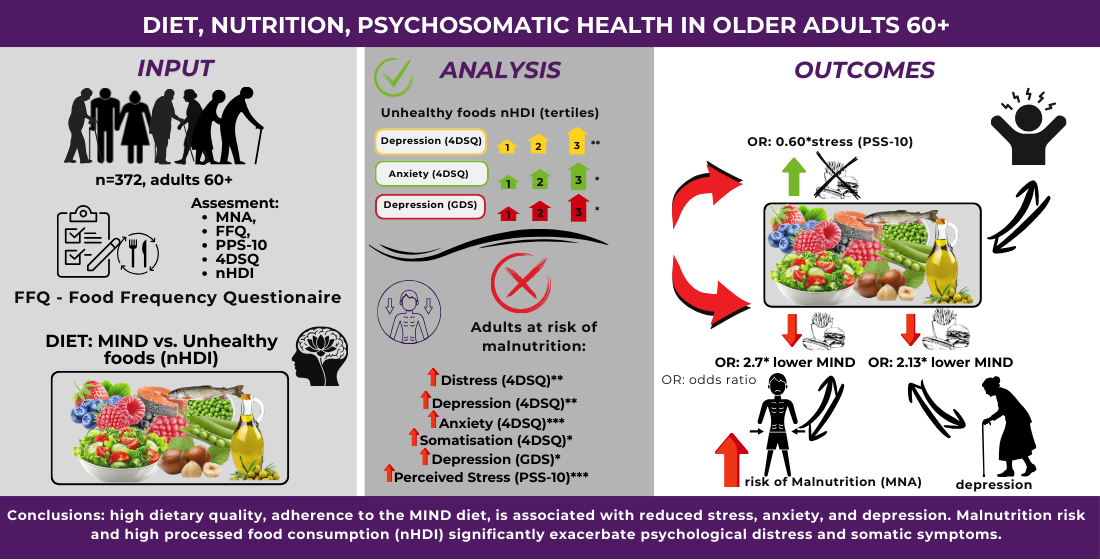
- Nutritional status (MNA) is a primary determinant of mental health, with malnutrition risk significantly increasing levels of distress, anxiety, and depression in seniors.
- Consumption of unhealthy foods (nHDI) is directly linked to psychological symptoms, whereas strict adherence to the MIND diet showed no significant correlation in this group.
- Geriatric interventions must integrate routine nutritional screening with psychological assessment to identify vulnerable individuals and support resilient ageing.
- Public health policies should prioritize reducing unhealthy food intake and improving overall nutritional status as key strategies for protecting senior mental health.
Abstract
1. Introduction
1.1. Defining Health Factors for Seniors
1.2. Well-Being and Resilience as a Goal for Healthy Ageing
2. Materials and Methods
2.1. Participants and Design
2.2. Measurement Tools
2.2.1. Mini Nutritional Assessment (MNA)
2.2.2. Food Frequency Questionnaire (FFQ)
2.2.3. The Four-Dimensional Symptom Questionnaire (4DSQ)
2.2.4. Geriatric Depression Rating Scale (GDS)
2.2.5. Perceived Stress Scale (PSS)
2.3. Statistical Analysis
3. Results
3.1. Correlation Coefficients of Nutritional Status, Dietary Patterns, Psychological Symptoms and Other Parameters
3.2. Psychological Symptoms and Nutritional Status in Relation to the Gender of the Study Sample
3.3. Psychological Symptoms and Nutritional Status in Relation to the Non-Healthy Diet Index
3.4. Psychological Symptoms in Relation to the Nutritional Status in the Study Sample
4. Discussion
5. Conclusions
Author Contributions
Funding
Institutional Review Board Statement
Informed Consent Statement
Data Availability Statement
Acknowledgments
Conflicts of Interest
Abbreviations
| MNA | The Mini Nutritional Assessment |
| FFQ | Food Frequency Questionnaire |
| 4DSQ | The Four-Dimensional Symptom Questionnaire |
| GDS | Geriatric Depression Rating Scale |
References
- Główny Urząd Statystyczny. Trwanie Życia w 2023 r.; Główny Urząd Statystyczny: Warszawa, Poland, 2024.
- Institute for Health Metrics and Evaluation Global Burden of Disease (GBD). Available online: https://www.healthdata.org/research-analysis/gbd (accessed on 28 August 2025).
- Kaluźniak-Szymanowska, A.; Deskur-Śmielecka, E.; Krzymińska-Siemaszko, R.; Styszyński, A.; Tobis, S.; Lewandowicz, M.; Chudek, J.; Kostka, T.; Mossakowska, M.; Piotrowicz, K.; et al. Health Status Correlates of Malnutrition Diagnosed Based on the GLIM Criteria in Older Polish Adults—Results of the PolSenior 2 Study. PLoS ONE 2025, 20, e0317011. [Google Scholar] [CrossRef] [PubMed]
- Sparre-Sørensen, M.; Kristensen, G.N. Malnutrition Related Deaths. Clin. Nutr. ESPEN 2016, 15, 63–68. [Google Scholar] [CrossRef]
- Norman, K.; Haß, U.; Pirlich, M. Malnutrition in Older Adults—Recent Advances and Remaining Challenges. Nutrients 2021, 13, 2764. [Google Scholar] [CrossRef]
- Suma, S.; Furuta, M.; Yamashita, Y.; Matsushita, K. Aging, Mastication, and Malnutrition and Their Associations with Cognitive Disorder: Evidence from Epidemiological Data. Curr. Oral Health Rep. 2019, 6, 89–99. [Google Scholar] [CrossRef]
- Ożga, E.; Małgorzewicz, S. Assessment of Nutritional Status of the Elderly. Geriatria 2013, 7, 98–103. [Google Scholar]
- Jachimowicz, V.; Kostka, T. Satisfaction with Life of Elderly Women. Ginekol. Prakt. 2009, 17, 27–32. [Google Scholar]
- Brooks, J.; Fairbairn, P.; Mantzouratou, A.; Chester, L.; Tsofliou, F. The Effect of Healthy Dietary Patterns on Stress, Mood, and Mental Health Outcomes: A Systematic Review. Proc. Nutr. Soc. 2024, 83, E281. [Google Scholar] [CrossRef]
- Tulchinsky, T.H. Marc Lalonde, the Health Field Concept and Health Promotion. Case Stud. Public Health 2018, 523–541. [Google Scholar] [CrossRef]
- Wysocki, M.J.; Miller, M. Paradygmat Lalonde’a, Światowa Organizacja Zdrowia i Nowe Zdrowie Publiczne. Przegl. Epidemiol. 2003, 57, 505–512. [Google Scholar]
- Berkman, L.F.; Kawachi, I.; Glymour, M.M. (Eds.) Social Epidemiology, 2nd ed.; Oxford University Press: Oxford, UK, 2014. [Google Scholar]
- Hawkley, L.C.; Cacioppo, J.T. Loneliness Matters: A Theoretical and Empirical Review of Consequences and Mechanisms. Ann. Behav. Med. 2010, 40, 218–227. [Google Scholar] [CrossRef]
- Holt-Lunstad, J. Why Social Relationships Are Important for Physical Health: A Systems Approach to Understanding and Modifying Risk and Protection. Annu. Rev. Psychol. 2018, 69, 437–458. [Google Scholar] [CrossRef]
- Kim, E.S.; Tkatch, R.; Martin, D.; MacLeod, S.; Sandy, L.; Yeh, C. Resilient Aging: Psychological Well-Being and Social Well-Being as Targets for the Promotion of Healthy Aging. Gerontol. Geriatr. Med. 2021, 7, 23337214211002951. [Google Scholar] [CrossRef]
- Warren, L. John Rowe and Robert Kahn. 1997. Successful Ageing. The Gerontologist, 37 (4), 433–440. Ageing Soc. 1998, 18, 371–378. [Google Scholar] [CrossRef]
- Rowe, J.; Kahn, R. Successful Aging 2.0: Conceptual Expansions for the 21st Century. J. Gerontol. B Psychol. Sci. Soc. Sci. 2015, 70, 593–596. [Google Scholar] [CrossRef] [PubMed]
- Kashdan, T.B.; Biswas-Diener, R.; King, L.A. Reconsidering Happiness: The Costs of Distinguishing between Hedonics and Eudaimonia. J. Posit. Psychol. 2008, 3, 219–233. [Google Scholar] [CrossRef]
- Ryff, C.D. Psychological Well-Being Revisited: Advances in the Science and Practice of Eudaimonia. Psychother. Psychosom. 2013, 83, 10–28. [Google Scholar] [CrossRef]
- Diener, E.; Suh, E.M.; Lucas, R.E.; Smith, H.L. Subjective Well-Being: Three Decades of Progress. Psychol. Bull. 1999, 125, 276–302. [Google Scholar] [CrossRef]
- Ryff, C.D.; Singer, B.H. Know Thyself and Become What You Are: A Eudaimonic Approach to Psychological Well-Being. J. Happiness Stud. 2008, 9, 13–39. [Google Scholar] [CrossRef]
- Szczuka, J.; Steuden, S. Personal Resources of the Elderly on Different Levels of Psychological Well-Being. Gerontol. Pol. 2020, 20, 10–16. [Google Scholar]
- Bonanno, G.A.; Romero, S.A.; Klein, S.I. The Temporal Elements of Psychological Resilience: An Integrative Framework for the Study of Individuals, Families, and Communities. Psychol. Inq. 2015, 26, 139–169. [Google Scholar] [CrossRef]
- Lavretsky, H. Resilience and Aging: Research and Practice; JHU Press: Baltimore, MD, USA, 2014. [Google Scholar]
- Pruchno, R.; Heid, A.R.; Genderson, M.W. Resilience and Successful Aging: Aligning Complementary Constructs Using a Life Course Approach. Psychol. Inq. 2015, 26, 200–207. [Google Scholar] [CrossRef]
- Martinson, M.; Berridge, C. Successful Aging and Its Discontents: A Systematic Review of the Social Gerontology Literature. Gerontologist 2015, 55, 58–69. [Google Scholar] [CrossRef]
- Wild, K.; Wiles, J.L.; Allen, R.E.S. Resilience: Thoughts on the Value of the Concept for Critical Gerontology. Ageing Soc. 2013, 33, 137–158. [Google Scholar] [CrossRef]
- Declaration of Helsinki—WMA—The World Medical Association. Available online: https://www.wma.net/what-we-do/medical-ethics/declaration-of-helsinki/ (accessed on 17 February 2026).
- Torbahn, G.; Strauss, T.; Sieber, C.C.; Kiesswetter, E.; Volkert, D. Nutritional Status According to the Mini Nutritional Assessment (MNA)® as Potential Prognostic Factor for Health and Treatment Outcomes in Patients with Cancer—A Systematic Review. BMC Cancer 2020, 20, 594. [Google Scholar] [CrossRef]
- Nes, M.; Van Staveren, W.A.; Zajkas, G.; Inelmen, E.M.; Moreiras-Varela, O. Validity of the Dietary History Method in Elderly Subjects. Euronut SENECA Investigators. Eur. J. Clin. Nutr. 1991, 45, 97–104. [Google Scholar] [PubMed]
- Bajerska, J.; Woźniewicz, M.; Suwalska, A.; Jeszka, J. Eating Patterns Are Associated with Cognitive Function in the Elderly at Risk of Metabolic Syndrome from Rural Areas. Eur. Rev. Med. Pharmacol. Sci. 2014, 18, 3234–3245. [Google Scholar]
- Gronowska-Senger, A. Przewodnik Metodyczny Badań Sposobu Żywienia; Komitet Nauki o Żywieniu Człowieka Polskiej Akademii Nauk: Warszawa, Poland, 2013. [Google Scholar]
- Bykowska-Derda, A.; Czlapka-Matyasik, M.; Kaluzna, M.; Ruchala, M.; Ziemnicka, K. Diet Quality Scores in Relation to Fatness and Nutritional Knowledge in Women with Polycystic Ovary Syndrome: Case-Control Study. Public Health Nutr. 2021, 24, 3389–3398. [Google Scholar] [CrossRef]
- Kowalkowska, J.; Wadolowska, L.; Czarnocinska, J.; Czlapka-Matyasik, M.; Galinski, G.; Jezewska-Zychowicz, M.; Bronkowska, M.; Dlugosz, A.; Loboda, D.; Wyka, J. Reproducibility of a Questionnaire for Dietary Habits, Lifestyle and Nutrition Knowledge Assessment (KomPAN) in Polish Adolescents and Adults. Nutrients 2018, 10, 1845. [Google Scholar] [CrossRef]
- Sobas, K.; Wadolowska, L.; Slowinska, M.A.; Czlapka-Matyasik, M.; Wuenstel, J.; Niedzwiedzka, E. Like Mother, Like Daughter? Dietary and Non-Dietary Bone Fracture Risk Factors in Mothers and Their Daughters. Iran. J. Public Health 2015, 44, 939–952. [Google Scholar]
- Czlapka-Matyasik, M.; Lonnie, M.; Wadolowska, L.; Frelich, A. “Cutting down on Sugar” by Non-Dieting Young Women: An Impact on Diet Quality on Weekdays and the Weekend. Nutrients 2018, 10, 1463. [Google Scholar] [CrossRef]
- Garbacz, A.; Stelcer, B.; Wielgosik, M.; Czlapka-Matyasik, M. Assessment of Sugar-Related Dietary Patterns to Personality Traits and Cognitive–Behavioural and Emotional Functioning in Working-Age Women. Appl. Sci. 2024, 14, 3176. [Google Scholar] [CrossRef]
- Morris, M.C.; Tangney, C.C.; Wang, Y.; Sacks, F.M.; Barnes, L.L.; Bennett, D.A.; Aggarwal, N.T. MIND Diet Slows Cognitive Decline with Aging. Alzheimers Dement. 2015, 11, 1015. [Google Scholar] [CrossRef]
- Burton, R.; Sheron, N. No Level of Alcohol Consumption Improves Health. Lancet 2018, 392, 987–988. [Google Scholar] [CrossRef]
- Terluin, B.; van der Wouden, J.C.; De Vet, H.C.W. Measurement Equivalence of the Four-Dimensional Symptom Questionnaire (4DSQ) in Adolescents and Emerging Adults. PLoS ONE 2019, 14, e0221904. [Google Scholar] [CrossRef]
- Czachowski, S.; Terluin, B.; Izdebski, A.; Izdebski, P. Evaluating the Cross-Cultural Validity of the Polish Version of the Four-Dimensional Symptom Questionnaire (4DSQ) Using Differential Item Functioning (DIF) Analysis. Fam. Pract. 2012, 29, 609–615. [Google Scholar] [CrossRef]
- Czachowski, S.; Izdebski, A.; Terluin, B.; Izdebski, P. Validation Study of the Dutch Four-Dimensional Symptom Questionnaire in Poland. Probl. Med. Rodzzinnej 2013, 4, 14–20. [Google Scholar]
- Terluin, B.; van Marwijk, H.W.; Adèr, H.J.; de Vet, H.C.; Penninx, B.W.; Hermens, M.L.; van Boeijen, C.A.; van Balkom, A.J.; van der Klink, J.J.; Stalman, W.A. The Four-Dimensional Symptom Questionnaire (4DSQ): A Validation Study of a Multidimensional Self-Report Questionnaire to Assess Distress, Depression, Anxiety and Somatization. BMC Psychiatry 2006, 6, 34. [Google Scholar] [CrossRef] [PubMed]
- Albiński, R.; Kleszczewska-Albińska, A.; Bedyńska, S. Geriatryczna Skala Depresji (GDS). Trafność i Rzetelność Różnych Wersji Tego Narzędzia—Przegląd Badań. Psychiatr. Pol. 2011, 45, 555–562. [Google Scholar]
- Yesavage, J.A.; Brink, T.L.; Rose, T.L.; Lum, O.; Huang, V.; Adey, M.; Leirer, V.O. Development and Validation of a Geriatric Depression Screening Scale: A Preliminary Report. J. Psychiatr. Res. 1982, 17, 37–49. [Google Scholar] [CrossRef]
- Solis, J.; Cohen, S.; Kamarck, T.; Mermelstein, R. A Global Measure of Perceived Stress. J. Health Soc. Behav. 1983, 24, 385–396. [Google Scholar]
- Sample Size Calculator. Available online: https://www.calculator.net/sample-size-calculator.html?type=1&cl=98&ci=5&pp=50&ps=9479673&x=Calculate (accessed on 18 February 2026).
- TIBCO Software Inc. Statistica (Data Analysis Software System); Start—StatSoft: Tulsa, OK, USA, 2017. [Google Scholar]
- Lassale, C.; Batty, G.D.; Baghdadli, A.; Jacka, F.; Sánchez-Villegas, A.; Kivimäki, M.; Akbaraly, T. Healthy Dietary Indices and Risk of Depressive Outcomes: A Systematic Review and Meta-Analysis of Observational Studies. Mol. Psychiatry 2019, 24, 965–986. [Google Scholar] [CrossRef] [PubMed]
- Berk, M.; Jacka, F.N. Diet and Depression—From Confirmation to Implementation. JAMA 2019, 321, 842–843. [Google Scholar] [CrossRef]
- Julius, S. Nutritional Psychiatry: The Impact of Diet on Mental Health. Newport Int. J. Res. Med. Sci. 2025, 6, 9–13. [Google Scholar] [CrossRef]
- Jacka, F.N.; Pasco, J.A.; Mykletun, A.; Williams, L.J.; Hodge, A.M.; O’Reilly, S.L.; Nicholson, G.C.; Kotowicz, M.A.; Berk, M. Association of Western and Traditional Diets with Depression and Anxiety in Women. Am. J. Psychiatry 2010, 167, 305–311. [Google Scholar] [CrossRef]
- Matison, A.P.; Mather, K.A.; Flood, V.M.; Reppermund, S. Associations between Nutrition and the Incidence of Depression in Middle-Aged and Older Adults: A Systematic Review and Meta-Analysis of Prospective Observational Population-Based Studies. Ageing Res. Rev. 2021, 70, 101403. [Google Scholar] [CrossRef]
- Matison, A.P.; Thalamuthu, A.; Flood, V.M.; Catts, V.S.; Christensen, K.; Nygaard, M.; Pedersen, N.L.; Sachdev, P.S.; Reppermund, S.; Mather, K.A. Longitudinal Associations between Fruit and Vegetable Intakes and Depressive Symptoms in Middle-Aged and Older Adults from Four International Twin Cohorts. Sci. Rep. 2024, 14, 29711. [Google Scholar] [CrossRef] [PubMed]
- Dharmayani, P.N.A.; Juergens, M.; Allman-Farinelli, M.; Mihrshahi, S. Association between Fruit and Vegetable Consumption and Depression Symptoms in Young People and Adults Aged 15–45: A Systematic Review of Cohort Studies. Int. J. Environ. Res. Public Health 2021, 18, 780. [Google Scholar] [CrossRef]
- Jacka, F.N.; Mykletun, A.; Berk, M. Moving towards a Population Health Approach to the Primary Prevention of Common Mental Disorders. BMC Med. 2012, 10, 149. [Google Scholar] [CrossRef]
- Nucci, D.; Sommariva, A.; Degoni, L.M.; Gallo, G.; Mancarella, M.; Natarelli, F.; Savoia, A.; Catalini, A.; Ferranti, R.; Pregliasco, F.E.; et al. Association between Mediterranean Diet and Dementia and Alzheimer Disease: A Systematic Review with Meta-Analysis. Aging Clin. Exp. Res. 2024, 36, 77. [Google Scholar] [CrossRef]
- Kris-Etherton, P.M.; Petersen, K.S.; Hibbeln, J.R.; Hurley, D.; Kolick, V.; Peoples, S.; Rodriguez, N.; Woodward-Lopez, G. Nutrition and Behavioral Health Disorders: Depression and Anxiety. Nutr. Rev. 2021, 79, 247–260. [Google Scholar] [CrossRef]
- Wu, Y.; Tao, Z.; Qiao, Y.; Chai, Y.; Liu, Q.; Lu, Q.; Zhou, H.; Li, S.; Mao, J.; Jiang, M.; et al. Prevalence and Characteristics of Somatic Symptom Disorder in the Elderly in a Community-Based Population: A Large-Scale Cross-Sectional Study in China. BMC Psychiatry 2022, 22, 257. [Google Scholar] [CrossRef]
- Stankunas, M.; Soares, J.; Stankuniene, A.; Gabriella Melchiorre, M.; Torres-Gonzales, F.; Ioannidi-Kapolou, E.; Barros, H.; Lindert, J. Differences in Reporting Somatic Complaints in Elderly by Education Level. Open Med. 2013, 8, 125–131. [Google Scholar] [CrossRef]
- Beutel, M.E.; Wiltink, J.; Ghaemi Kerahrodi, J.; Tibubos, A.N.; Brähler, E.; Schulz, A.; Wild, P.; Münzel, T.; Lackner, K.; König, J.; et al. Somatic Symptom Load in Men and Women from Middle to High Age in the Gutenberg Health Study—Association with Psychosocial and Somatic Factors. Sci. Rep. 2019, 9, 4610. [Google Scholar] [CrossRef]
- Aonso-Diego, G.; Ruz, M.; Fernández-Artamendi, S.; Ruiz, M.J.; López-Núñez, C. Anxiety Sensitivity and Tobacco Use: A Transdiagnostic Approach. Clin. Salud 2023, 34, 9–13. [Google Scholar] [CrossRef]
- Jiang, F.; Li, S.; Pan, L.; Zhang, N.; Jia, C. Association of Anxiety Disorders with the Risk of Smoking Behaviors: A Meta-Analysis of Prospective Observational Studies. Drug Alcohol Depend. 2014, 145, 69–76. [Google Scholar] [CrossRef]
- Morissette, S.B.; Tull, M.T.; Gulliver, S.B.; Kamholz, B.W.; Zimering, R.T. Anxiety, Anxiety Disorders, Tobacco Use, and Nicotine: A Critical Review of Interrelationships. Psychol. Bull. 2007, 133, 245–272. [Google Scholar] [CrossRef] [PubMed]
- Barkhordari, R.; Namayandeh, M.; Mirzaei, M.; Sohouli, M.H.; Hosseinzadeh, M. The Relation between MIND Diet with Psychological Disorders and Psychological Stress among Iranian Adults. BMC Psychiatry 2022, 22, 496. [Google Scholar] [CrossRef]
- Arabpour, Z.; Milajerdi, A. Adherence to the MIND Diet and Its Association with the Risk of Depression, Anxiety, and Sleep Disturbances in Physically Active Adults: A Cross-Sectional Study. BMC Psychiatry 2025, 25, 1048. [Google Scholar] [CrossRef] [PubMed]
- Çakır, S.; Özge, A. Dietary Patterns and Mental Health. In Feeding the Mind: The Connection Between Diet, Drugs, and Mental Health Volume 2; Springer Nature: Singapore, 2025; pp. 331–345. [Google Scholar]
- Ebrahimpour-Koujan, S.; Keshteli, A.H.; Afshar, H.; Esmaillzadeh, A.; Adibi, P. Adherence to Low Carbohydrate Diet and Prevalence of Psychological Disorders in Adults. Nutr. J. 2019, 18, 87. [Google Scholar] [CrossRef]
- Du, Y.; Wang, M.; Wang, Y.; Dou, Y.; Yan, Y.; Fan, H.; Fan, N.; Yang, X.; Ma, X. The Association between Dietary Quality, Sleep Duration, and Depression Symptoms in the General Population: Findings from Cross-Sectional NHANES Study. BMC Public Health 2024, 24, 2588. [Google Scholar] [CrossRef] [PubMed]
- Nowicki, G.J.; Polak, M.; Ślusarska, B.; Czernecki, K. The Relationship between Diet and the Occurrence of Depressive Symptoms in a Community Example with High Rates of Social Deprivation: A Cross-Sectional Study. Nutrients 2023, 15, 3778. [Google Scholar] [CrossRef]
- Chen, H.; Cao, Z.; Hou, Y.; Yang, H.; Wang, X.; Xu, C. The Associations of Dietary Patterns with Depressive and Anxiety Symptoms: A Prospective Study. BMC Med. 2023, 21, 307. [Google Scholar] [CrossRef] [PubMed]
- Heidari, Z.; Feizi, A.; Roohafza, H.; Rabiei, K.; Sarrafzadegan, N. Are Dietary Patterns Differently Associated with Differentiated Levels of Mental Health Problems? Results from a Large Cross-Sectional Study among Iranian Manufacturing Employees. BMJ Open 2019, 9, e020083. [Google Scholar] [CrossRef] [PubMed]
- Zhang, H.; Li, M.; Mo, L.; Luo, J.; Shen, Q.; Quan, W. Association between Western Dietary Patterns, Typical Food Groups, and Behavioral Health Disorders: An Updated Systematic Review and Meta-Analysis of Observational Studies. Nutrients 2024, 16, 125. [Google Scholar] [CrossRef]
- Li, Y.; Lv, M.R.; Wei, Y.J.; Sun, L.; Zhang, J.X.; Zhang, H.G.; Li, B. Dietary Patterns and Depression Risk: A Meta-Analysis. Psychiatry Res. 2017, 253, 373–382. [Google Scholar] [CrossRef]
- Brandstetter, S.; Rüter, J.; Curbach, J.; Loss, J. A Systematic Review on Empowerment for Healthy Nutrition in Health Promotion. Public Health Nutr. 2015, 18, 3146–3154. [Google Scholar] [CrossRef]
- Ogińska-Bulik, N.; Zadworna-Cieślak, M.; Rogala, E. Rola Zasobów Osobistych w Podejmowaniu Zachowań Zdrowotnych Przez Osoby w Wieku Senioralnym. Probl. Hig. Epidemiol. 2015, 96, 570–577. [Google Scholar]
- Merlo, G.; Sugden, S.G. The Power of Lifestyle Psychiatry: A New Approach to Mental Health. Am. J. Lifestyle Med. 2025, 19, 1034–1044. [Google Scholar] [CrossRef] [PubMed]
- Jacka, F.N. Nutritional Psychiatry: Where to Next? EBioMedicine 2017, 17, 24–29. [Google Scholar] [CrossRef]
- Lieber, S.B.; Moxley, J.; Mandl, L.A.; Reid, M.C.; Czaja, S.J. Social Support and Physical Activity: Does General Health Matter? Eur. Rev. Aging Phys. Act. 2024, 21, 16. [Google Scholar] [CrossRef]

| Characteristics | Data |
|---|---|
| No. of individuals | 372 |
| No. of females (no./%) | 295 (79) |
| At the age of 75 or older (no./%) | 68/18 |
| Exact age, years (Mean ± SD) | 69.2 ± 5.7 |
| Educational level: | |
| primary school/vocational training (no./%) | 63/17 |
| secondary school (no./%) | 162/44 |
| university (no./%) | 147/39 |
| BMI, kg/m2 (Mean ± SD) | 28.0 ± 5.0 |
| pHDI-8 (Mean ± SD) | 10.0 ± 4.3 |
| nHDI-11 (Mean ± SD) | 4.1 ± 2.2 |
| MIND (Mean ± SD) | 7.6 ± 1.6 |
| Nutritional Status and Psychological Symptoms | Age | BMI | Cigarettes per Day | pHDI | nHDI | MIND |
|---|---|---|---|---|---|---|
| Nutritional status (MNA) | −0.059 | 0.053 | −0.067 | 0.035 | 0.080 | −0.074 |
| Distress (4DSQ) | 0.101 | 0.003 | 0.069 | 0.064 | 0.062 | −0.056 |
| Depression (4DSQ) | 0.112 * | 0.081 | 0.034 | 0.050 | 0.119 * | −0.045 |
| Anxiety (4DSQ) | 0.007 | 0.085 | 0.135 * | 0.023 | 0.092 | −0.047 |
| Somatisation (4DSQ) | 0.125 * | 0.130 * | 0.076 | 0.038 | 0.059 | −0.017 |
| Depression (GDS) | 0.064 | 0.060 | 0.097 | 0.001 | 0.092 | −0.098 |
| Perceived Stress (PSS-10) | −0.028 | 0.006 | 0.092 | −0.031 | 0.056 | −0.068 |
| Nutritional Status and Psychological Symptoms | Total | Gender | p | |
|---|---|---|---|---|
| F (n = 295) | M (n = 77) | |||
| Nutritional status (MNA) | 26.71 ± 2.06 | 26.61 ± 2.17 | 27.09 ± 1.54 | 0.066 |
| Distress (4DSQ) | 5.33 ± 4.29 | 5.83 ± 4.34 | 3.39 ± 3.49 | <0.001 * |
| Depression (4DSQ) | 0.37 ± 0.96 | 0.40 ± 0.98 | 0.23 ± 0.87 | 0.174 |
| Anxiety (4DSQ) | 0.85 ± 1.61 | 0.97 ± 1.73 | 0.39 ± 0.97 | 0.005 * |
| Somatisation (4DSQ) | 5.77 ± 4.32 | 6.18 ± 4.40 | 4.22 ± 3.62 | <0.001 * |
| Depression (GDS) | 1.91 ± 2.21 | 2.05 ± 2.19 | 1.36 ± 2.21 | 0.015 * |
| Perceived Stress (PSS-10) | 12.88 ± 6.88 | 13.50 ± 6.90 | 10.50 ± 6.10 | <0.001 * |
| Nutritional Status and Psychological Symptoms | nHDI | p | ||
|---|---|---|---|---|
| Tertile 1 | Tertile 2 | Tertile 3 | ||
| Nutritional status (MNA) | 26.54 ± 2.13 | 26.7 ± 1.86 | 26.92 ± 2.16 | 0.321 |
| Distress (4DSQ) | 4.74 ± 3.78 | 5.61 ± 4.36 | 5.62 ± 4.66 | 0.181 |
| Depression (4DSQ) | 0.15 ± 0.46 a | 0.41 ± 0.95 b | 0.54 ± 1.26 b | 0.006 * |
| Anxiety (4DSQ) | 0.69 ± 1.47 a | 0.72 ± 1.46 a | 1.14 ± 1.87 b | 0.048 * |
| Somatisation (4DSQ) | 5.26 ± 4.10 | 5.98 ± 4.32 | 6.06 ± 4.51 | 0.277 |
| Depression (GDS) | 1.55 ± 1.86 a | 1.82 ± 2.10 ab | 2.27 ± 2.57 b | 0.036 * |
| Perceived Stress (PSS-10) | 12.09 ± 7.02 | 13.37 ± 7.09 | 13.16 ± 6.50 | 0.297 |
| Psychological Symptoms | MNA | p | |
|---|---|---|---|
| Well (n = 339) | Risk (n = 33) | ||
| Distress (4DSQ) | 5.03 ± 4.10 | 8.33 ± 5.11 | <0.001 * |
| Depression (4DSQ) | 0.33 ± 0.92 | 0.73 ± 1.28 | 0.029 * |
| Anxiety (4DSQ) | 0.77 ± 1.45 | 1.76 ± 2.68 | 0.000 * |
| Somatisation (4DSQ) | 5.54 ± 4.13 | 8.12 ± 5.42 | <0.001 * |
| Depression (GDS) | 1.82 ± 2.18 | 2.76 ± 2.33 | 0.020 * |
| Perceived Stress (PSS-10) | 12.51 ± 6.84 | 16.64 ± 6.16 | <0.001 * |
| High Adherence to MIND, 3rd Tertile | Middle or High Adherence to MIND, 2nd & 3rd Tertile | Low Adherence to MIND, 1st Tertile | |||||||
|---|---|---|---|---|---|---|---|---|---|
| n | Crude Model OR (CI95%), p | Adjusted Model 1 OR (CI95%), p | n | Crude Mode OR (CI95%), p | Adjusted Mode OR (CI95%), p | n | Crude Mode OR (CI95%), p | Adjusted Mode OR (CI95%), p | |
| Mild or severe depression (GDS) | 8 | 0.64 (0.28; 1.48), p = 0.296 | 0.70 (0.30; 1.64), p = 0.413 | 12 | 0.46 (0.21; 0.97), p = 0.041 | 0.47 (0.22; 1.00), p = 0.050 | 19 | 2.19 (1.03; 4.67), p = 0.041 | 2.13 (1.00; 4.56), p = 0.050 |
| Moderate or high perceived stress (PSS10) | 82 | 0.60 (0.39; 0.93), p = 0.022 | 0.60 (0.38; 0.93), p = 0.023 | 121 | 0.85 (0.56; 1.29), p = 0.451 | 1.15 (0.76; 1.75), p = 0.498 | 87 | 1.17 (0.77; 1.77), p = 0.451 | 1.15 (0.76; 1.75), p = 0.498 |
| High perceived stress (PSS10) | 16 | 0.58 (0.32; 1.08), p = 0.084 | 0.59 (0.32; 1.10), p = 0.098 | 33 | 0.79 (0.46; 1.35), p = 0.387 | 0.78 (0.45; 1.34), p = 0.370 | 31 | 1.27 (0.74; 2.18), p = 0.387 | 1.28 (0.74; 2.21), p = 0.370 |
| Moderately elevated or high tendency to somatisation (4DSQ) | 1 | 1.12 (0.61; 2.07), p = 0.717 | 1.10 (0.59; 2.06), p = 0.760 | 1 | 1.16 (0.64; 2.11), p = 0.624 | 1.22 (0.67; 2.24), p = 0.514 | 1 | 1.30 (0.08; 21.14), p = 0.853 | 0.98 (0.06; 16.97), p = 0.990 |
| High score on depression (4DSQ) | 1 | 0.95 (0.08; 10.67), p = 0.966 | 1.10 (0.10; 12.53), p = 0.938 | 1 | 0.38 (0.03; 4.27), p = 0.432 | 0.43 (0.04; 4.87), p = 0.493 | 2 | 2.63 (0.23; 29.48), p = 0.432 | 2.33 (0.21; 26.50), p = 0.493 |
| Medium or high risk of depression (4DSQ) | 6 | 0.95 (0.08; 10.67), p = 0.966 | 1.12 (0.61; 2.07), p = 0.717 | 7 | 0.76 (0.26; 2.22), p = 0.612 | 0.82 (0.28; 2.40), p = 0.710 | 7 | 1.32 (0.45; 3.85), p = 0.612 | 1.23 (0.42; 3.61), p = 0.710 |
| Moderately elevated distress (4DSQ) | 13 | 0.63 (0.32; 1.24), p = 0.181 | 0.69 (0.35; 1.37), p = 0.287 | 24 | 0.67 (0.37; 1.23), p = 0.197 | 0.71 (0.39; 1.29), p = 0.259 | 26 | 1.48 (0.81; 2.70), p = 0.197 | 1.42 (0.77; 2.60), p = 0.259 |
| Risk of malnutrition (MNA) | 16 | 0.52 (0.25; 1.08), p = 0.079 | 0.51 (0.25; 1.05) 2, p = 0.069 | 25 | 0.38 (1.17; 0.88), p = 0.023 | 0.37 (0.16; 0.85) 2, p = 0.019 | 8 | 2.60 (1.14; 5.95), p = 0.023 | 2.70 (1.17; 6.19) 2, p = 0.019 |
Disclaimer/Publisher’s Note: The statements, opinions and data contained in all publications are solely those of the individual author(s) and contributor(s) and not of MDPI and/or the editor(s). MDPI and/or the editor(s) disclaim responsibility for any injury to people or property resulting from any ideas, methods, instructions or products referred to in the content. |
© 2026 by the authors. Licensee MDPI, Basel, Switzerland. This article is an open access article distributed under the terms and conditions of the Creative Commons Attribution (CC BY) license.
Share and Cite
Stelcer, B.; Czlapka-Matyasik, M.; Woźniewicz, M.; Campos, M.J.; Anioła, J. The Association Between MIND Diet Adherence, Nutritional Status, and Psychosomatic Health in Adults Aged 60+: A Pilot Study. Healthcare 2026, 14, 598. https://doi.org/10.3390/healthcare14050598
Stelcer B, Czlapka-Matyasik M, Woźniewicz M, Campos MJ, Anioła J. The Association Between MIND Diet Adherence, Nutritional Status, and Psychosomatic Health in Adults Aged 60+: A Pilot Study. Healthcare. 2026; 14(5):598. https://doi.org/10.3390/healthcare14050598
Chicago/Turabian StyleStelcer, Bogusław, Magdalena Czlapka-Matyasik, Małgorzata Woźniewicz, Maria João Campos, and Jacek Anioła. 2026. "The Association Between MIND Diet Adherence, Nutritional Status, and Psychosomatic Health in Adults Aged 60+: A Pilot Study" Healthcare 14, no. 5: 598. https://doi.org/10.3390/healthcare14050598
APA StyleStelcer, B., Czlapka-Matyasik, M., Woźniewicz, M., Campos, M. J., & Anioła, J. (2026). The Association Between MIND Diet Adherence, Nutritional Status, and Psychosomatic Health in Adults Aged 60+: A Pilot Study. Healthcare, 14(5), 598. https://doi.org/10.3390/healthcare14050598