1. Introduction
Premenstrual syndrome (PMS) represents a complex convergence of physical, emotional, and behavioral symptoms that recur during the luteal phase of the menstrual cycle and remit with menstruation [
1]. The etiology of PMS is multifactorial and not yet fully understood, though it is widely believed to result from an abnormal sensitivity to normal hormonal fluctuations—specifically estrogen and progesterone—during the luteal phase [
1]. These hormonal changes interact with central neurotransmitters, such as serotonin and gamma-aminobutyric acid (GABA), influencing mood and pain perception [
2]. Several risk factors have been correlated with the severity of PMS, including genetic predisposition, age, high body mass index (BMI), parity, and lifestyle factors such as smoking or high caffeine intake [
1,
2]. Furthermore, comorbidities like endometriosis or dysmenorrhea can exacerbate the clinical presentation. Symptoms are diverse, ranging from somatic complaints (breast tenderness, bloating, headache) to affective symptoms (irritability, anxiety, depression), which often have a more debilitating effect on the patient’s quality of life [
3]. Although up to 90% of women of reproductive age report experiencing some premenstrual symptoms, it is estimated that 47.8% suffer from PMS, and between 24 and 32% experience moderate-to-severe symptoms that interfere with their daily lives [
4]. Despite this high prevalence, PMS remains underdiagnosed and undertreated, often dismissed as an inevitable part of female physiology rather than a manageable condition [
5].
To date, there have been no objective biochemical markers for PMS. Diagnosis relies on detailed anamnesis and prospective daily symptom tracking over at least two menstrual cycles. The hallmark is symptom onset restricted to the luteal phase, with complete remission during the follicular phase. Physical examination is essential to exclude differential diagnoses, and psychiatric evaluation may be warranted [
6].
Current management strategies include lifestyle modifications—such as diet, exercise, and stress management—as first-line approaches, followed by pharmacological treatments like Selective Serotonin Reuptake Inhibitors (SSRIs) or hormonal contraceptives for more severe cases [
7,
8,
9,
10,
11,
12,
13]. However, many women rely on self-care strategies without professional guidance, potentially leading to suboptimal symptom relief. While the benefits of health education are well-documented, few studies have specifically explored the role of community pharmacists as primary educators in menstrual health [
14,
15,
16].
Community pharmacies are strategically positioned to bridge this gap due to their accessibility and the frequency with which women visit them for minor ailments or pain relief. However, there is a lack of structured, evidence-based pharmaceutical intervention protocols specifically designed to empower women with PMS through visual and educational tools.
The primary objective of this study was to evaluate the effectiveness of a structured, pharmacist-led educational intervention—supported by evidence-based infographics—in reducing the severity of PMS symptoms and improving self-care practices and quality of life among women in Spain. This study seeks to demonstrate that the community pharmacist can play a pivotal clinical role in the multidisciplinary management of women’s health.
2. Materials and Methods
2.1. Study Design
A mixed-methods study design was employed. Phase 1 (Cross-sectional): A descriptive study was conducted to determine the prevalence of PMS and compare characteristics between women with PMS (PMS group) and those without (control group). The control group was utilized solely for this baseline characterization and risk factor analysis. Phase 2 (longitudinal intervention): Women identified with PMS were invited to participate in a 6-month prospective intervention study (January to June 2025). A pre-post design was used to evaluate the effectiveness of the pharmaceutical intervention within the PMS group.
The intervention was delivered by community pharmacists who received prior training on the study protocol. The intervention consisted of the following:
Initial Counseling (Month 0): A standardized 15 min face-to-face session where the pharmacist explained the physiology of PMS and provided personalized lifestyle advice.
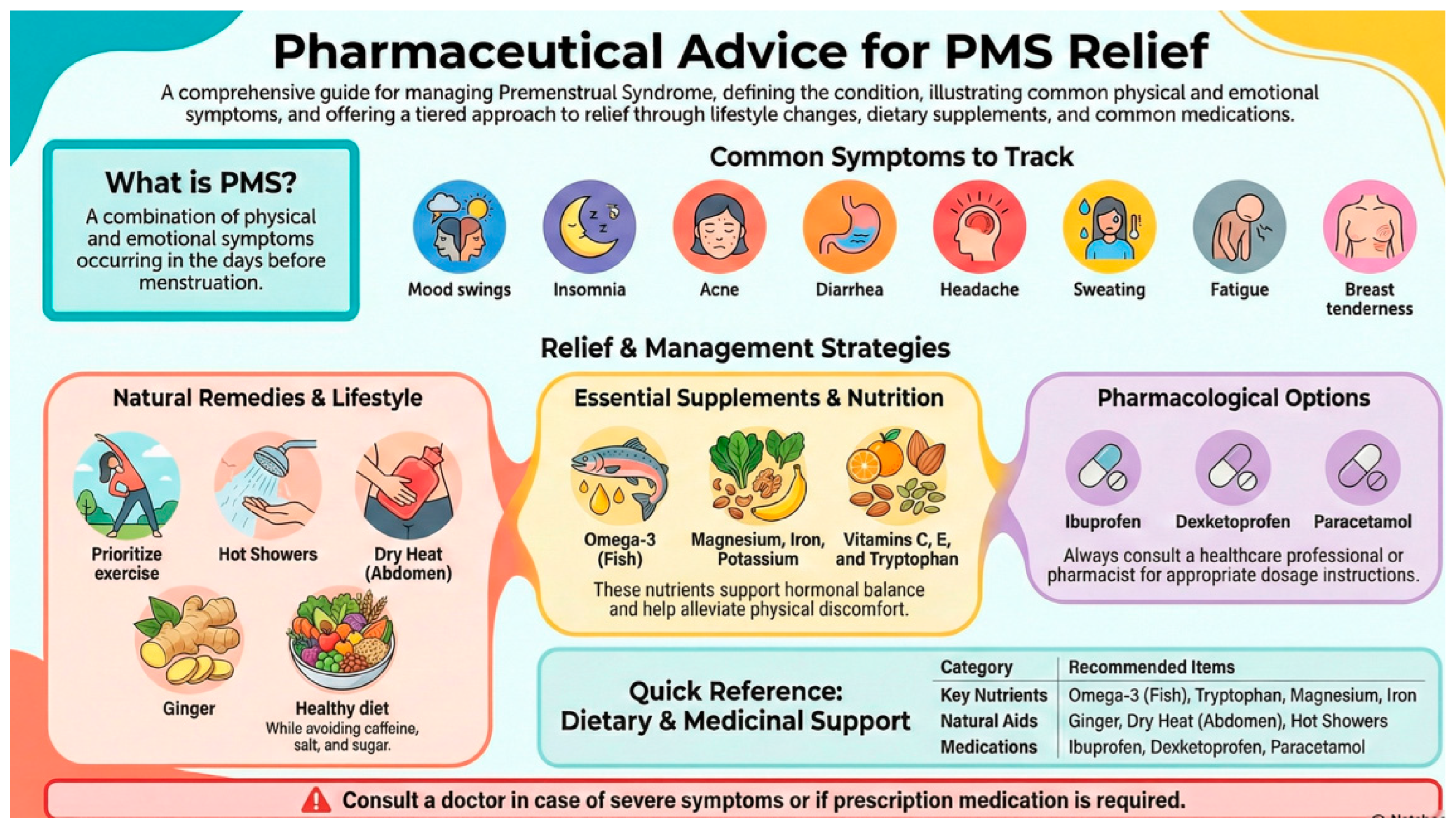
Educational Material: Participants received a digital infographic covering four key pillars: dietary changes (reducing caffeine/salt), regular aerobic exercise, stress management techniques, and evidence-based supplementation.
Follow-up (Months 1–5): To ensure fidelity and adherence, participants received monthly reinforcement videos (approx. 2 min each) via digital messaging, reiterating the key messages of the infographic.
2.2. Participants
Eligible participants were women experiencing PMS with no comorbid menstrual disorders.
The study population was calculated based on women with PMS in Spain. The sample size was calculated using the following formula:
Regarding sample size, the initial calculation (n = 373) was based on estimating prevalence with a 95% confidence interval. For the intervention phase, the final sample of n = 165 provided >80% power to detect a medium effect size (Cohen’s d = 0.5) in the reduction in pain scores.
2.2.1. Inclusion Criteria
Currently menstruating.
Participants over 18 years of age.
Inclusion in the PMS group was based on retrospective reporting of symptoms consistent with the American College of Obstetricians and Gynecologists (ACOG) criteria. Participants were screened for the presence of at least one affective and one somatic symptom during the five days prior to menses for three consecutive cycles. It is important to note that this screening constitutes a “PMS-like symptom” assessment rather than a prospective clinical diagnosis confirmed by daily charting over two months.
2.2.2. Exclusion Criteria
Participants were classified into a PMS group and a control group based on the presence or absence of PMS symptoms.
2.3. Questionnaire Design
The questionnaire was adapted from the validated tool developed by Sima et al. [
17], translated into Spanish, and administered at the pharmacy. It consisted of four main sections:
Sociodemographic data: age, weight, height, city of residence, marital status, education level, employment status, and number of pregnancies.
Menstrual history: age at menarche, cycle regularity and duration, duration of menstrual bleeding, and presence of heavy flow.
PMS-associated factors: previous PMS diagnosis, autoimmune disease, endometriosis, polycystic ovary syndrome, infertility, sexual activity, use of oral contraceptives, physical activity level, regular healthy diet, tobacco, alcohol, and caffeine consumption, sleep duration, frequency and severity of PMS symptoms, and number of symptomatic days.
Pain and symptom management: intensity of menstrual pain, use of medications (non-steroidal anti-inflammatory drugs (NSAIDs), SSRIs, others), non-pharmacological methods (e.g., exercise, massage, relaxation, heat application), and use of nutritional supplements (e.g., evening primrose oil, vitamin B6, magnesium, iron).
Pain was assessed using a 1–10 scale (1 being best to 10 worst), both before and during PMS. Participants were also asked about the impact of symptoms on quality of life.
To assess the impact on quality of life (QoL), we utilized a specific item derived from the validated questionnaire by Sima et al. [
17]. Participants were asked to evaluate whether their premenstrual symptoms interfered with their daily activities (including work, academic performance, and social interactions) using a self-perceived dichotomous scale (Yes/No). This measure, combined with the pain intensity score, provided a functional assessment of symptom severity.
In the 6-month follow-up questionnaire, sociodemographic items were omitted. Remaining questions were repeated, and new ones were added to assess which recommendations were implemented, whether any improvement was perceived, if participants sought medical advice, and if new pharmacological treatments were started.
2.4. Intervention
The intervention consisted of a structured pharmaceutical education program. Participants received a digital infographic via WhatsApp or email containing evidence-based recommendations on diet, exercise, and supplements (
Figure 1). Data were collected at baseline and at a six-month follow-up to assess the impact of the intervention. It included the following PMS management recommendations:
Non-pharmacological strategies: abdominal heat application, physical exercise, relaxation techniques, increased fluid intake, avoidance of sugar, salt, carbonated drinks, alcohol, and caffeine, and consumption of balanced, frequent, and moderate meals.
Nutritional supplementation: recommended nutrients included ginger, evening primrose oil, vitamin B6 (from supplements or foods like bananas, nuts, green leafy vegetables, whole grains), vitamin C (e.g., kiwis, oranges, Brussels sprouts, citrus fruits, peppers), vitamin E (e.g., olive oil, leafy greens, avocado), omega-3 (e.g., fatty fish, walnuts), magnesium, iron, potassium, and tryptophan (from dairy, eggs, meat, fish, legumes, and nuts).
Pharmacological recommendations: use of NSAIDs like ibuprofen or paracetamol in cases of moderate-to-severe pain. Participants with persistent or severe symptoms were advised to consult a healthcare provider.
Additionally, to reinforce adherence, six short videos (one per month) were sent to participants, covering specific topics such as diet, stress management, and exercise.
Figure 1.
Digital infographic.
Figure 1.
Digital infographic.
2.5. Statistical Analysis
Data analysis was performed using SPSS version 29 (SPSS Inc., Chicago, IL, USA). Continuous variables are presented as mean ± standard deviation (SD), and categorical variables are expressed as frequencies and percentages. For the cross-sectional phase, comparisons between the PMS group and the Control group were performed using Student’s t-test for independent samples (continuous data) and Chi-square tests (categorical data). Multivariate logistic regression analysis was performed to identify potential protective factors. The dependent variable was defined as the presence of PMS (PMS group = 1 vs. control group = 0), while supplement intake (tryptophan, iron, magnesium, vitamin B6, calcium) was included as independent binary variables (Yes/No). Results are expressed as odds ratios (ORs) with 95% confidence intervals (CIs). For the longitudinal intervention phase (within-subject analysis), changes in symptom severity (pain scores) were analyzed using paired t-tests. Changes in categorical variables (e.g., impact on quality of life) were analyzed using McNemar’s test. A p-value < 0.05 was considered statistically significant.
2.6. AI Statement
The image in the figure was created using Canva, a website (
https://www.canva.com/es_es/) (accessed on 27 January 2026) that provides design tools.
4. Discussion
The present study demonstrates that a community pharmacist-led educational intervention significantly reduces the intensity of PMS symptoms and improves women’s quality of life.
Our findings reveal a drastic reduction in pain intensity (from 6.86 to 3.26, p < 0.001) and a decrease in the proportion of women reporting a negative impact on quality of life from 97.0% to 60.8% after six months.
The success of the intervention suggests that lack of knowledge regarding lifestyle and self-care is a major barrier to PMS management [
18,
19]. By providing evidence-based visual tools (infographics) and personalized counseling, pharmacists empowered women to adopt effective strategies such as local heat application, exercise, and targeted supplementation (vitamin B6, magnesium, omega-3). This aligns with the “gatekeeper” role of the pharmacist, moving beyond simple medication dispensing to proactive health education [
20,
21]. The significant reduction in psychological symptoms like irritability and insomnia highlights that somatic and affective symptoms are interconnected and responsive to lifestyle changes. Significant associations were found between specific strategies (e.g., vitamin E or a healthy diet) and the reduction in particular symptoms such as headache, diarrhea, and agitation, corroborating recent findings in young female populations [
22]. As this was a non-randomized comparison, we cannot establish a direct causal relationship. The observed association might be influenced by the ‘healthy user bias,’ where women who take supplements may also systematically engage in other healthy behaviors (better diet, more exercise) that mitigate PMS symptoms. Therefore, while the association is promising, it does not confirm that supplements alone prevent PMS without controlled clinical trials.
Our results corroborate previous research indicating the benefits of non-pharmacological interventions. For instance, Ozeki et al. found that educational checklists improved menstrual symptoms and work productivity [
23]. However, unlike general educational campaigns, our study highlights the added value of the community pharmacist’s active involvement, a gap identified by Suaidi et al. [
5]. Regarding risk factors, our multivariate analysis confirmed that family history and endometriosis significantly increase PMS risk, consistent with findings by Katib et al. [
24]. Furthermore, the protective effect of oral contraceptives observed in our study (OR = 0.33) reinforces clinical trial data suggesting hormonal stability mitigates symptoms [
25].
Our findings align with previous research suggesting that health education significantly mitigates PMS symptoms. The reduction in somatic and psychological symptoms observed in our study is consistent with results reported by Sima et al. [
17] and others utilizing educational models. The mechanism behind this improvement is likely rooted in increased health literacy and self-efficacy. By understanding the physiological basis of their symptoms and receiving actionable, evidence-based advice (e.g., reducing caffeine to lower irritability, using heat for pain), patients regain a sense of control. This empowerment promotes adherence to lifestyle modifications, which are the first-line defense against PMS inflammation and hormonal sensitivity.
These findings have direct implications for pharmacy practice. Implementing structured PMS protocols in community pharmacies can reduce the burden on primary care physicians and provide immediate relief for women. The use of accessible visual tools (infographics) proved to be an effective method for enhancing adherence to healthy habits [
26].
This study has several limitations that must be considered. First, the study design for the intervention phase was a single-arm pre-post study without a concurrent control group. Consequently, we cannot rule out the influence of placebo effects or natural variations in symptoms over time on the observed improvements. Second, the diagnosis of PMS was based on retrospective self-reports rather than prospective daily symptom charting, which is the gold standard; this may introduce recall bias. Third, the sample characteristics (predominantly young, university-educated women) limit the generalizability of our findings to older women, those with lower socioeconomic status, or rural populations. Finally, while we monitored adherence to the educational advice, medication changes (e.g., starting hormonal contraceptives or analgesics) during the 6-month period were not controlled for in the statistical analysis, which could act as a confounding factor.




 ,
,