Patient Activation Among Individuals with Chronic Illness: A Cross-Sectional Study from Jordan

 , , ,
, , ,  and
and
Abstract
1. Introduction
2. Materials and Methods
2.1. Study Design and Setting
2.2. Participants
2.3. Data Sources
- (1)
- sociodemographic and clinical variables, including age, gender, insurance, employment status, income, marital status, number of medications, and chronic medical conditions. Participants were asked to report all medications they had taken regularly in the past four weeks, including prescription and nonprescription medications and supplements. Polypharmacy was defined as the concurrent use of five or more medications.
- (2)
- the Single Item Literacy Screener (SILS) was used to assess functional health literacy related to reading and understanding written health information [26]. Patients report how often they require assistance reading and understanding health information and instructions from healthcare providers using a 5-point Likert scale (1: never to 5: always). A score of 3–5 (i.e., sometimes, often, or always) indicates limited health literacy, whereas a score of 1–2 (i.e., never or rarely) indicates adequate health literacy [26]. In this study, we used the Arabic version of the SILS [27]. The SILS has strong evidence of validity and correlates with more complex health literacy assessments (e.g., S-TOFLHA) [26,28,29,30].
- (3)
- the Patient Activation Measure-13 (PAM), a widely recognized tool for assessing patient knowledge, skills, and confidence in self-management. The PAM has undergone extensive validation in over 30 languages and countries and has been used in more than 800 published research studies [31]. Patients’ responses to the PAM are converted into activation scores and levels using a computer algorithm provided by Insignia Health, LLC. (Portland, OR, USA). Patient activation scores range from 0 to 100, with higher scores indicating greater activation. PAM scores categorize patients into four levels: level one: individuals lack confidence and are passive, disengaged, and overwhelmed; level two: individuals have some healthcare knowledge but are still struggling; level three: individuals are building self-management skills and gaining control; and level four: individuals have adopted new behaviors and aim to maintain a healthy lifestyle and positive health behaviors but with some challenges in maintaining them [32,33].
2.4. Study Size
2.5. Statistical Methods
3. Results
3.1. PAM Results
3.2. Factors Associated with Patient Activation
4. Discussion
Strengths and Limitations
5. Conclusions
Supplementary Materials
Author Contributions
Funding
Institutional Review Board Statement
Informed Consent Statement
Data Availability Statement
Conflicts of Interest
Abbreviations
| PA | Patient Activation |
| PAM | Patient Activation Measure |
| MENA | Middle East and North Africa |
References
- Khan, H.T.A.; Addo, K.M.; Findlay, H. Public Health Challenges and Responses to the Growing Ageing Populations. Public Health Chall. 2024, 3, e213. [Google Scholar] [CrossRef] [Scilit] [PubMed]
- Hajat, C.; Stein, E. The Global Burden of Multiple Chronic Conditions: A Narrative Review. Prev. Med. Rep. 2018, 12, 284–293. [Google Scholar] [CrossRef] [Scilit] [PubMed]
- OECD. Does Healthcare Deliver?: Results from the Patient-Reported Indicator Surveys (PaRIS); OECD Publishing: Paris, France, 2025. [Google Scholar]
- Nobili, A.; Garattini, S.; Mannucci, P.M. Multiple Diseases and Polypharmacy in the Elderly: Challenges for the Internist of the Third Millennium. J. Comorb. 2011, 1, 28. [Google Scholar] [CrossRef] [Scilit] [PubMed]
- Masnoon, N.; Shakib, S.; Kalisch-Ellett, L.; Caughey, G.E. What Is Polypharmacy? A Systematic Review of Definitions. BMC Geriatr. 2017, 17, 230. [Google Scholar] [CrossRef] [Scilit]
- Davies, L.E.; Spiers, G.; Kingston, A.; Todd, A.; Adamson, J.; Hanratty, B. Adverse Outcomes of Polypharmacy in Older People: Systematic Review of Reviews. J. Am. Med. Dir. Assoc. 2020, 21, 181–187. [Google Scholar] [CrossRef] [Scilit]
- Lightfoot, C.J.; Nair, D.; Bennett, P.N.; Smith, A.C.; Griffin, A.D.; Warren, M.; Wilkinson, T.J. Patient Activation: The Cornerstone of Effective Self-Management in Chronic Kidney Disease? Kidney Dial. 2022, 2, 91–105. [Google Scholar] [CrossRef] [Scilit]
- Cukor, D.; Zelnick, L.; Charytan, D.; Shallcross, A.; Mehrotra, R. Patient Activation Measure in Dialysis-Dependent Patients in the United States. J. Am. Soc. Nephrol. 2021, 32, 3017–3019. [Google Scholar] [CrossRef] [Scilit]
- Hibbard, J.H.; Mahoney, E. Toward a Theory of Patient and Consumer Activation. Patient Educ. Couns. 2010, 78, 377–381. [Google Scholar] [CrossRef] [Scilit]
- Liu, C.; Wang, D.; Liu, C.; Jiang, J.; Wang, X.; Chen, H.; Ju, X.; Zhang, X. What Is the Meaning of Health Literacy? A Systematic Review and qualitative Synthesis. Fam. Med. Community Health 2020, 8, e000351. [Google Scholar] [CrossRef] [Scilit]
- Greene, J.; Hibbard, J.H. Why Does Patient Activation Matter? An Examination of the Relationships between Patient Activation and Health-Related Outcomes. J. Gen. Intern. Med. 2012, 27, 520–526. [Google Scholar] [CrossRef] [Scilit]
- Paukkonen, L.; Oikarinen, A.; Kähkönen, O.; Kaakinen, P. Patient Activation for Self-management among Adult Patients with Multimorbidity in Primary Healthcare Settings. Health Sci. Rep. 2022, 5, e735. [Google Scholar] [CrossRef] [Scilit]
- Anderson, G.; Rega, M.L.; Casasanta, D.; Graffigna, G.; Damiani, G.; Barello, S. The Association between Patient Activation and Healthcare Resources Utilization: A Systematic Review and Meta-Analysis. Public. Health 2022, 210, 134–141. [Google Scholar] [CrossRef] [Scilit] [PubMed]
- Zill, J.M.; Scholl, I.; Härter, M.; Dirmaier, J. Which Dimensions of Patient-Centeredness Matter?—Results of a Web-Based Expert Delphi Survey. PLoS ONE 2015, 10, e0141978. [Google Scholar] [CrossRef] [Scilit] [PubMed]
- Mangin, D.; Bahat, G.; Golomb, B.A.; Mallery, L.H.; Moorhouse, P.; Onder, G.; Petrovic, M.; Garfinkel, D. International Group for Reducing Inappropriate Medication Use & Polypharmacy (IGRIMUP): Position Statement and 10 Recommendations for Action. Drugs Aging 2018, 35, 575–587. [Google Scholar] [CrossRef] [Scilit] [PubMed]
- Jansen, J.; Naganathan, V.; Carter, S.M.; McLachlan, A.J.; Nickel, B.; Irwig, L.; Bonner, C.; Doust, J.; Colvin, J.; Heaney, A.; et al. Too Much Medicine in Older People? Deprescribing through Shared Decision Making. BMJ 2016, 353, i2893. [Google Scholar] [CrossRef] [Scilit]
- Baxter, K.A.; Sachdeva, N.; Baker, S. The Application of Cognitive Load Theory to the Design of Health and Behavior Change Programs: Principles and Recommendations. Health Educ. Behav. 2025, 52, 469. [Google Scholar] [CrossRef] [Scilit]
- Wang, Z.; Song, Y.; Ou, L.; Liao, D.; He, L.; Ning, Q.; Chen, Y.; Chen, H. Factors Affecting Patient Activation among Patients with Systemic Lupus Erythematosus. Sci. Rep. 2024, 14, 1632. [Google Scholar] [CrossRef] [Scilit]
- Klatt, E.C. Cognitive Factors Impacting Patient Understanding of Laboratory Test Information. J. Pathol. Inform. 2024, 15, 100349. [Google Scholar] [CrossRef] [Scilit]
- Khamaiseh, A.M.; Habashneh, S.S. Prevalence and Associated Factors of Non-Communicable Chronic Diseases among University Academics in Jordan. PLoS ONE 2024, 19, e0304829. [Google Scholar] [CrossRef] [Scilit]
- Al-Nsour, M.; Zindah, M.; Belbeisi, A.; Hadaddin, R.; Brown, D.W.; Walke, H. Prevalence of Selected Chronic, Noncommunicable Disease Risk Factors in Jordan: Results of the 2007 Jordan Behavioral Risk Factor Surveillance Survey. Prev. Chronic. Dis. 2012, 9, E25. [Google Scholar] [CrossRef] [Scilit]
- Nusair, M.B.; Arabyat, R.; Al-Azzam, S.; El-Hajji, F.D.; Nusir, A.T.; Al-Batineh, M. Translation and Psychometric Properties of the Arabic Version of the Revised Patients’ Attitudes Towards Deprescribing Questionnaire. J. Pharm. Health Serv. Res. 2020, 11, 173–181. [Google Scholar] [CrossRef] [Scilit]
- Nusair, M.B.; Al-Azzam, S.I.; Arabyat, R.M.; Amawi, H.A.; Alzoubi, K.H.; Rabah, A.A. The Prevalence and Severity of Potential Drug-Drug Interactions among Adult Polypharmacy Patients at Outpatient Clinics in Jordan. Saudi Pharm. J. 2020, 28, 155–160. [Google Scholar] [CrossRef] [Scilit] [PubMed]
- Al-Azzam, S.; Nusair, M.; Arabiat, R. Prevalence and Predictors of Polypharmacy in Jordan: Implications for Pharmacists. In Proceedings of the 47th ESCP Symposium on Clinical Pharmacy Personalised Pharmacy Care, Belfast, UK, 24–26 October 2018; p. 333. [Google Scholar]
- Alkhaibari, R.A.; Smith-Merry, J.; Forsyth, R.; Raymundo, G.M. Patient-Centered Care in the Middle East and North African Region: A Systematic Literature Review. BMC Health Serv. Res. 2023, 23, 135. [Google Scholar] [CrossRef] [Scilit] [PubMed]
- Morris, N.S.; MacLean, C.D.; Chew, L.D.; Littenberg, B. The Single Item Literacy Screener: Evaluation of a Brief Instrument to Identify Limited Reading Ability. BMC Fam. Pract. 2006, 7, 21. [Google Scholar] [CrossRef] [Scilit] [PubMed]
- Al-Jumaili, A.A.; Al-Rekabi, M.D.; Sorofman, B. Evaluation of Instruments to Assess Health Literacy in Arabic Language among Iraqis. Res. Soc. Adm. Pharm. 2015, 11, 803–813. [Google Scholar] [CrossRef] [Scilit]
- Bonaccorsi, G.; Grazzini, M.; Pieri, L.; Santomauro, F.; Ciancio, M.; Lorini, C. Assessment of Health Literacy and Validation of Single-Item Literacy Screener (SILS) in a Sample of Italian People. Ann. Ist. Super. Sanita 2017, 53, 205–212. [Google Scholar] [CrossRef] [Scilit]
- Mock, M.S.; Sethares, K.A. Concurrent Validity and Acceptability of Health Literacy Measures of Adults Hospitalized with Heart Failure. Appl. Nurs. Res. 2019, 46, 50–56. [Google Scholar] [CrossRef] [Scilit]
- Brice, J.H.; Foster, M.B.; Principe, S.; Moss, C.; Shofer, F.S.; Falk, R.J.; Ferris, M.E.; DeWalt, D.A. Single-Item or Two-Item Literacy Screener to Predict the S-TOFHLA among Adult Hemodialysis Patients. Patient Educ. Couns. 2014, 94, 71–75. [Google Scholar] [CrossRef] [Scilit]
- Insignia Health Research Studies Featuring PAM. Available online: https://www.phreesia.com/research-library/ (accessed on 20 April 2025).
- Hibbard, J.H.; Stockard, J.; Mahoney, E.R.; Tusler, M. Development of the Patient Activation Measure (PAM): Conceptualizing and Measuring Activation in Patients and Consumers. Health Serv. Res. 2004, 39, 1005. [Google Scholar] [CrossRef] [Scilit]
- Insignia Health Patient Activation Measure (PAM). Available online: https://www.insigniahealth.com/pam/ (accessed on 23 December 2025).
- Raosoft I Sample Size Calculator by Raosoft, Inc. Available online: http://www.raosoft.com/samplesize.html (accessed on 23 October 2024).
- Ngooi, B.X.; Packer, T.L.; Kephart, G.; Warner, G.; Koh, K.W.L.; Wong, R.C.C.; Lim, S.P. Validation of the Patient Activation Measure (PAM-13) among Adults with Cardiac Conditions in Singapore. Qual. Life Res. 2017, 26, 1071–1080. [Google Scholar] [CrossRef] [Scilit]
- Hendriks, M.; Rademakers, J. Relationships between Patient Activation, Disease-Specific Knowledge and Health Outcomes among People with Diabetes; a Survey Study. BMC Health Serv. Res. 2014, 14, 393. [Google Scholar] [CrossRef] [Scilit] [PubMed]
- Holter, M.; Avian, A.; Weger, M.; Strini, S.; Michelitsch, M.; Brenk-Franz, K.; Wedrich, A.; Berghold, A. Measuring Patient Activation: The Utility of the Patient Activation Measure Administered in an Interview Setting. Qual. Life Res. 2024, 33, 1389–1400. [Google Scholar] [CrossRef] [Scilit] [PubMed]
- The Health Foundation How Engaged Are People in Their Healthcare? Available online: https://www.health.org.uk/reports-and-analysis/reports/how-engaged-are-people-in-their-healthcare (accessed on 30 May 2025).
- Graffigna, G.; Barello, S.; Bonanomi, A.; Lozza, E.; Hibbard, J. Measuring Patient Activation in Italy: Translation, Adaptation and Validation of the Italian Version of the Patient Activation Measure 13 (PAM13-I) Clinical Decision-Making, Knowledge Support Systems, and Theory. BMC Med. Inform. Decis. Mak. 2015, 15, 109. [Google Scholar] [CrossRef] [Scilit] [PubMed]
- Rademakers, J.; Nijman, J.; Van Der Hoek, L.; Heijmans, M.; Rijken, M. Measuring Patient Activation in the Netherlands: Translation and Validation of the American Short Form Patient Activation Measure (PAM13). BMC Public Health 2012, 12, 577. [Google Scholar] [CrossRef] [Scilit]
- Nemer, O.; Malak, M.Z. Self-Efficacy and Self-Care Behaviors among Patients with Coronary Artery Disease in Jordan. Int. Res. J. Pharm. Med. Sci. 2022, 5, 32–47. [Google Scholar]
- Hani, S.B.; Abu Sabra, M.A.; Alhalabi, M.N.; Alomari, A.E.; Abu Aqoulah, E.A. Exploring the Level of Self-Care Behavior, Motivation, and Self-Efficacy among Individuals with Hypertension: A Cross-Sectional Study. SAGE Open Nurs. 2024, 10, 23779608241257823. [Google Scholar] [CrossRef] [Scilit]
- Hussein, W.F.; Bennett, P.N.; Sun, S.J.; Reiterman, M.; Watson, E.; Farwell, I.M.; Schiller, B. Patient Activation Among Prevalent Hemodialysis Patients: An Observational Cross-Sectional Study. J. Patient Exp. 2022, 9, 23743735221112220. [Google Scholar] [CrossRef] [Scilit]
- Hernandez, E.M.; Margolis, R.; Hummer, R.A. Educational and Gender Differences in Health Behavior Changes After a Gateway Diagnosis. J. Aging Health 2018, 30, 342–364. [Google Scholar] [CrossRef] [Scilit]
- Olson, J.S.; Hummer, R.A.; Harris, K.M. Gender and Health Behavior Clustering among U.S. Young Adults. Biodemography Soc. Biol. 2017, 63, 3–20. [Google Scholar] [CrossRef] [Scilit]
- Alissa, N.A. A Cross-Sectional Study on Healthcare Seeking Behavior among Saudi Women in Riyadh. Sci. Rep. 2025, 15, 9497. [Google Scholar] [CrossRef] [Scilit]
- Zeidalkilani, J.M.; Milhem, Y.A.; Shorafa, R.N.; Taha, S.; Koni, A.A.; Al-Jabi, S.W.; Zyoud, S.H. Factors Associated with Patient Activation among Patients with Diabetes on Hemodialysis: A Multicenter Cross-Sectional Study from a Developing Country. BMC Nephrol 2024, 25, 23743735221112220. [Google Scholar] [CrossRef] [Scilit] [PubMed]
- Van Bulck, L.; Claes, K.; Dierickx, K.; Hellemans, A.; Jamar, S.; Smets, S.; Van Pottelbergh, G. Patient and Treatment Characteristics Associated with Patient Activation in Patients Undergoing Hemodialysis: A Cross-Sectional Study. BMC Nephrol. 2018, 19, 126. [Google Scholar] [CrossRef] [Scilit] [PubMed]
- Skolasky, R.L.; Green, A.F.; Scharfstein, D.; Boult, C.; Reider, L.; Wegener, S.T. Psychometric Properties of the Patient Activation Measure among Multimorbid Older Adults. Health Serv. Res. 2011, 46, 457–478. [Google Scholar] [CrossRef] [Scilit] [PubMed]
- Keriakos, M.; Lee, S.; Stannard, C.; Ariss, S.; Dunn, L.; Wilkie, M.; Fotheringham, J. Supporting Patient Self-Management: A Cross-Sectional and Prospective Cohort Study Investigating Patient Activation Measure (PAM) and Clinician Support for PAM Scores as Part of a Multi-Centre Haemodialysis Breakthrough Series Collaborative. PLoS ONE 2024, 19, e0303299. [Google Scholar] [CrossRef] [Scilit]
- Marshall, R.; Beach, M.C.; Saha, S.; Mori, T.; Loveless, M.O.; Hibbard, J.H.; Cohn, J.A.; Sharp, V.L.; Korthuis, P.T. Patient Activation and Improved Outcomes in HIV-Infected Patients. J. Gen. Intern. Med. 2013, 28, 668. [Google Scholar] [CrossRef] [Scilit]
- Tsichla, L.; Patelarou, E.; Detorakis, E.; Tsilibaris, M.; Patelarou, A.; Christodoulakis, A.; Dokoutsidou, E.; Giakoumidakis, K. Exploring the Health Literacy and Patient Activation Among Patients with Glaucoma: A Cross-Sectional Study. Clin. Pract. 2025, 15, 24. [Google Scholar] [CrossRef] [Scilit]
- Gwynn, K.B.; Winter, M.R.; Cabral, H.J.; Wolf, M.S.; Hanchate, A.D.; Henault, L.; Waite, K.; Bickmore, T.W.; Paasche-Orlow, M.K. Racial Disparities in Patient Activation: Evaluating the Mediating Role of Health Literacy with Path Analyses. Patient Educ. Couns. 2016, 99, 1033–1037. [Google Scholar] [CrossRef] [Scilit]
- Wang, M.J.; Hung, L.C.; Lo, Y.T. Glycemic Control in Type 2 Diabetes: Role of Health Literacy and Shared Decision-Making. Patient Prefer. Adherence 2019, 13, 871–879. [Google Scholar] [CrossRef] [Scilit]
- Taylor, D.M.; Fraser, S.; Dudley, C.; Oniscu, G.C.; Tomson, C.; Ravanan, R.; Roderick, P. Health Literacy and Patient Outcomes in Chronic Kidney Disease: A Systematic Review. Nephrol. Dial. Transplant. 2018, 33, 1545–1558. [Google Scholar] [CrossRef] [Scilit]
- Baker, D.W.; Wolf, M.S.; Feinglass, J.; Thompson, J.A.; Gazmararian, J.A.; Huang, J. Health Literacy and Mortality among Elderly Persons. Arch. Intern. Med. 2007, 167, 1503–1509. [Google Scholar] [CrossRef] [Scilit]
- Sarhan, M.B.A.; Fujii, Y.; Kiriya, J.; Fujiya, R.; Giacaman, R.; Kitamura, A.; Jimba, M. Exploring Health Literacy and Its Associated Factors among Palestinian University Students: A Cross-Sectional Study. Health Promot. Int. 2021, 36, 854–865. [Google Scholar] [CrossRef] [Scilit]
- Ge, L.; Kaur, P.; Yap, C.W.; Heng, B.H. Psychometric Properties of the Patient Activation Measure in Community-Dwelling Adults in Singapore. Inq. J. Health Care Organ. Provis. Financ. 2022, 59, 00469580221100781. [Google Scholar] [CrossRef] [Scilit]
- World Health Organization Medication Safety in Polypharmacy: Technical Report. Available online: https://www.who.int/publications/i/item/medication-safety-in-polypharmacy-technical-report (accessed on 7 June 2025).
- Doumat, G.; Daher, D.; Itani, M.; Abdouni, L.; El Asmar, K.; Assaf, G. The Effect of Polypharmacy on Healthcare Services Utilization in Older Adults with Comorbidities: A Retrospective Cohort Study. BMC Prim. Care 2023, 24, 120. [Google Scholar] [CrossRef] [Scilit]
- Jyrkkä, J.; Enlund, H.; Lavikainen, P.; Sulkava, R.; Hartikainen, S. Association of Polypharmacy with Nutritional Status, Functional Ability and Cognitive Capacity over a Three-Year Period in an Elderly Population. Pharmacoepidemiol. Drug Saf. 2011, 20, 514–522. [Google Scholar] [CrossRef] [Scilit]
- Ryan, P.; Sawin, K.J. The Individual and Family Self-Management Theory: Background and Perspectives on Context, Process, and Outcomes. Nurs. Outlook 2009, 57, 217–225.e216. [Google Scholar] [CrossRef] [Scilit]


| Variable | n (%) | PAM Score (Mean ± SD) | p Value | |
|---|---|---|---|---|
| Gender | Female | 396 (59.5%) | 58.1 ± 8.75 | <0.001 |
| Male | 270 (40.5%) | 55.7 ± 9.59 | ||
| Marital Status | Single/never married | 59 (8.9%) | 57.4 ± 9.60 | 0.948 |
| Married/Previously married | 607 (91.1%) | 57.0 ± 9.12 | ||
| Education | Up to secondary education | 360 (54.1%) | 55.5 ± 8.73 | <0.001 |
| Post-secondary education | 306 (45.9%) | 59.0 ± 9.31 | ||
| Insurance | Insured | 497 (74.6%) | 57.3 ± 9.25 | 0.251 |
| No insurance | 169 (25.4%) | 56.4 ± 8.90 | ||
| Employment Status | Employed | 150 (22.5%) | 58.9 ± 9.62 | 0.006 |
| Unemployed/Retired | 516 (77.5%) | 56.5 ± 8.96 | ||
| Monthly Income | <500 JOD | 362 (54.4%) | 55.7 ± 8.74 | 0.001 * |
| 500–999 JOD | 260 (39%) | 58.1 ± 8.77 | ||
| 1000–1499 JOD | 30 (4.5%) | 61.4 ± 12.5 | ||
| 1500 JOD or more | 14 (2.1%) | 64 ± 11.17 | ||
| Health Literacy | Adequate | 402 (60.4%) | 58.7 ± 8.78 | <0.001 |
| Limited | 263 (39.6%) | 54.7 ± 9.22 | ||
| Polypharmacy | Yes | 346 (52%) | 55.2 ± 8.71 | <0.001 |
| No | 320 (48%) | 59.1 ± 9.24 | ||
| Age (mean ± SD), Spearman’s correlation (ρ) | ρ = −0.232 | 55.7 ± 15.68 | <0.001 | |
| Number of chronic medical conditions per patient (mean ± SD), Spearman’s correlation (ρ) | ρ = −0.152 | 2.5 ± 1.51 | <0.001 | |
| Number of medications per patient (mean ± SD), Spearman’s correlation (ρ) | ρ = −0.186 | 5.3 ± 3.38 | <0.001 | |
| Variable | B | SE | β | p-Value | 95% CI |
|---|---|---|---|---|---|
| Polypharmacy (Yes) | −1.900 | 0.735 | −0.104 | 0.010 | [−3.344, −0.456] |
| Health Literacy (Adequate) | 2.336 | 0.737 | 0.125 | 0.002 | [0.888, 3.785] |
| Age (years) | −0.069 | 0.024 | −0.118 | 0.004 | [−0.117, −0.022] |
| Gender (Female) | 1.741 | 0.706 | 0.093 | 0.014 | [0.355, 3.126] |
| Education Level (Post-secondary education) | 2.083 | 0.721 | 0.113 | 0.004 | [0.668, 3.499] |
| Variable | B | SE | β | p-Value | 95% CI |
|---|---|---|---|---|---|
| Polypharmacy (Yes) | −3.674 | 1.142 | −0.200 | 0.001 | [−5.916, −1.433] |
| Health Literacy (Adequate) | 1.977 | 2.381 | 0.106 | 0.407 | [−2.699, 6.652] |
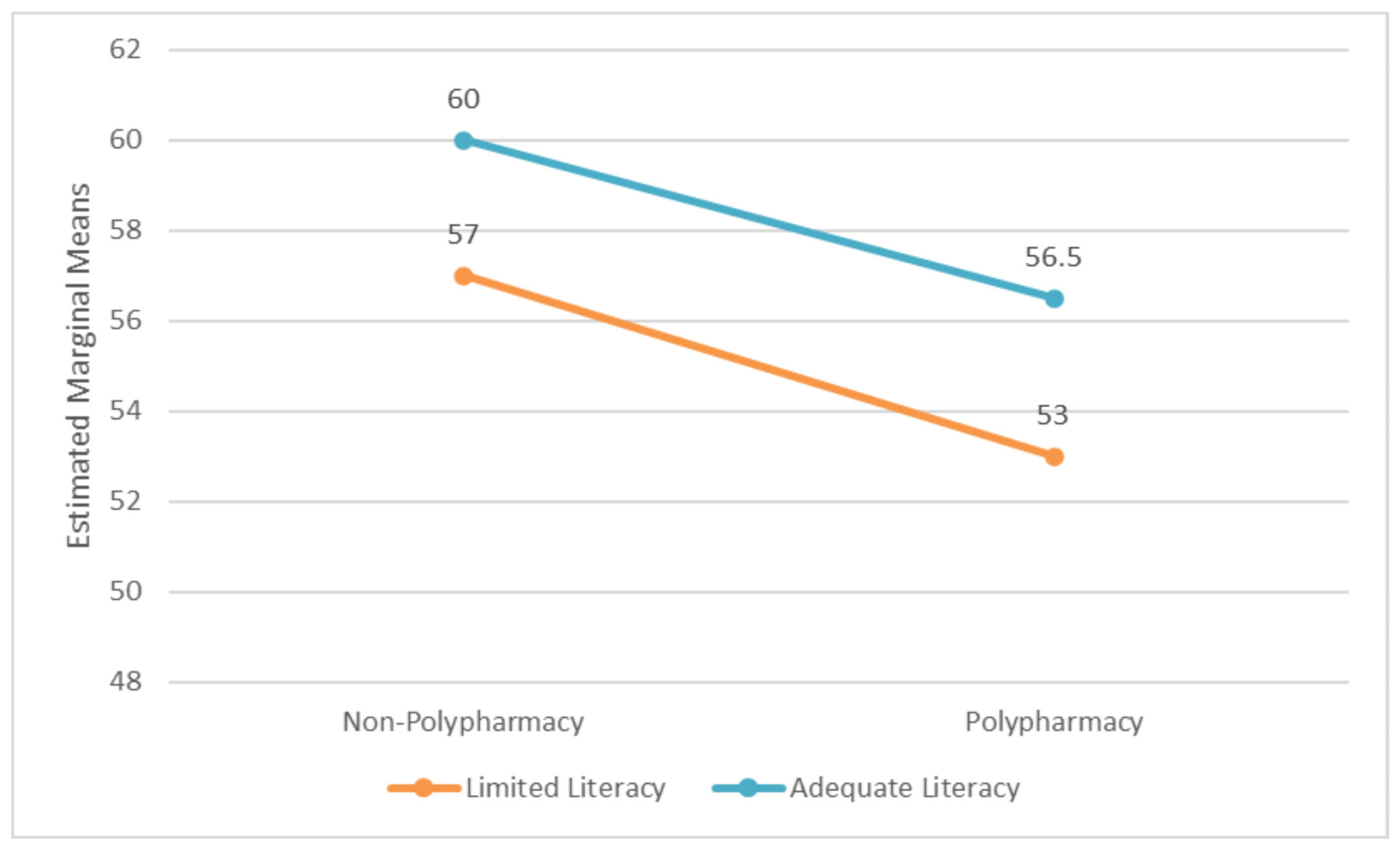
| Interaction: Polypharmacy × Health Literacy | 0.854 | 1.447 | 0.075 | 0.555 | [−1.988, 3.696] |
Disclaimer/Publisher’s Note: The statements, opinions and data contained in all publications are solely those of the individual author(s) and contributor(s) and not of MDPI and/or the editor(s). MDPI and/or the editor(s) disclaim responsibility for any injury to people or property resulting from any ideas, methods, instructions or products referred to in the content. |
© 2026 by the authors. Licensee MDPI, Basel, Switzerland. This article is an open access article distributed under the terms and conditions of the Creative Commons Attribution (CC BY) license.
Share and Cite
Nusair, M.B.; Khasawneh, R.; Baali, F.H.; Alkhalil, A.B.; Aldehoun, S.A.; Al-Azzam, S. Patient Activation Among Individuals with Chronic Illness: A Cross-Sectional Study from Jordan. Healthcare 2026, 14, 204. https://doi.org/10.3390/healthcare14020204
Nusair MB, Khasawneh R, Baali FH, Alkhalil AB, Aldehoun SA, Al-Azzam S. Patient Activation Among Individuals with Chronic Illness: A Cross-Sectional Study from Jordan. Healthcare. 2026; 14(2):204. https://doi.org/10.3390/healthcare14020204
Chicago/Turabian StyleNusair, Mohammad B., Rawand Khasawneh, Fahad H. Baali, Ahmed B. Alkhalil, Samer A. Aldehoun, and Sayer Al-Azzam. 2026. "Patient Activation Among Individuals with Chronic Illness: A Cross-Sectional Study from Jordan" Healthcare 14, no. 2: 204. https://doi.org/10.3390/healthcare14020204
APA StyleNusair, M. B., Khasawneh, R., Baali, F. H., Alkhalil, A. B., Aldehoun, S. A., & Al-Azzam, S. (2026). Patient Activation Among Individuals with Chronic Illness: A Cross-Sectional Study from Jordan. Healthcare, 14(2), 204. https://doi.org/10.3390/healthcare14020204