
A Parent-Focused Intervention Programme to Promote Socio-Emotional Well-Being of Preschool Children: “Hug and Change”
 ,
,  ,
, 
Highlights
- The Hug and Change programme improved children’s psychosocial development and social competence in early childhood.
- Parent-focused interventions can effectively promote children’s socio-emotional well-being during early childhood.
- Supporting parents through structured, evidence-based interventions may enhance children’s socio-emotional well-being by strengthening everyday parent–child interactions.
- Integrating evidence-informed parent-focused programmes into preschool settings may expand access to preventive support while strengthening family–school partnerships.
Abstract
1. Introduction
1.1. Socio-Emotional Well-Being in Early Childhood
1.2. Parents as Promoters of Children’s Socio-Emotional Well-Being
1.3. Parent-Focused Interventions and Child Outcomes
1.4. The Present Study
2. Materials and Methods
2.1. Study Design
2.2. Participants and Procedures
2.3. Measures
2.3.1. Children’s Psychosocial Adjustment
2.3.2. Children’s Social Competence
2.4. Intervention Programme Hug and Change
2.5. Ethical Considerations
2.6. Data Analysis Plan
3. Results
3.1. Initial Analyses
3.2. Effects of the Intervention on SDQ Outcomes (RQ1)
3.3. Effects of the Intervention on Social Competence (RQ2)
4. Discussion
4.1. Effects on Children’s Psychosocial Adjustment
4.2. Effects on Children’s Social Competence
4.3. Implications for Promoting Socio-Emotional Well-Being
4.4. Practical Implications for Parents and Early Childhood Education
4.5. Strengths and Limitations
4.6. Future Research
5. Conclusions
Author Contributions
Funding
Institutional Review Board Statement
Informed Consent Statement
Data Availability Statement
Acknowledgments
Conflicts of Interest
Abbreviations
| ESBS | Early School Behaviour Scale |
| CASEL | Collaborative for Academic, Social, and Emotional Learning |
| SDQ | Strengths and Difficulties Questionnaire |
Appendix A

| Variable | Group | n | Skewness | SE | Kurtosis | SE | W | p |
|---|---|---|---|---|---|---|---|---|
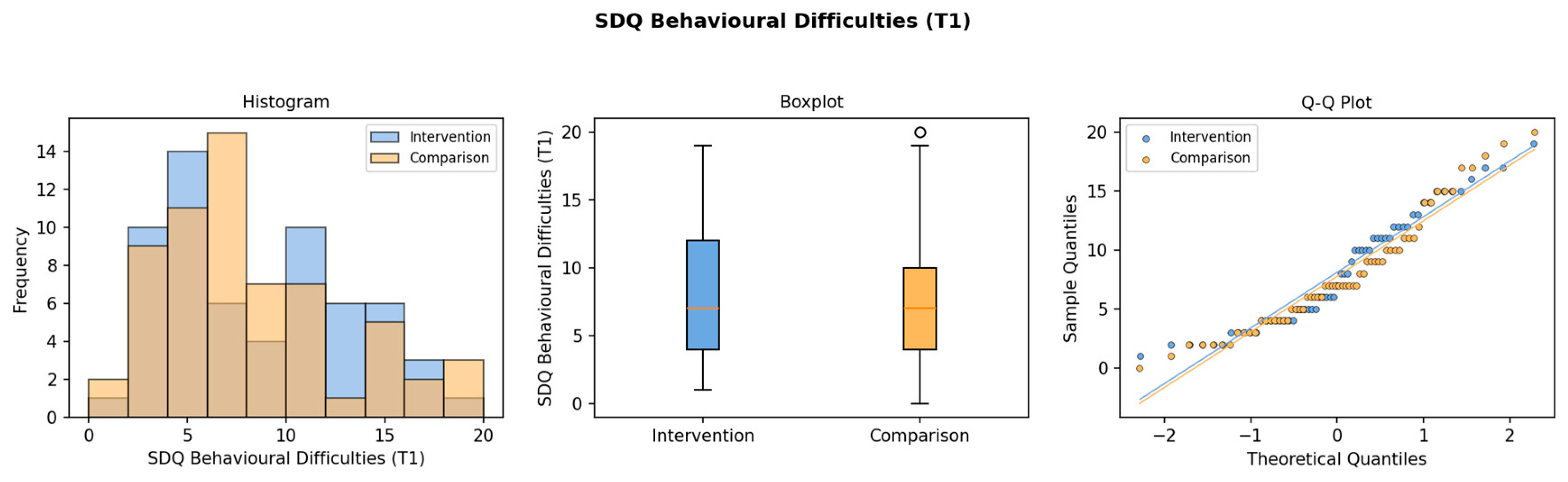
| SDQ Behavioural Difficulties (T1) | Intervention | 61 | 0.423 | 0.306 | −0.966 | 0.604 | 0.935 | 0.003 |
| SDQ Behavioural Difficulties (T1) | Comparison | 62 | 0.808 | 0.304 | 0.076 | 0.599 | 0.935 | 0.003 |
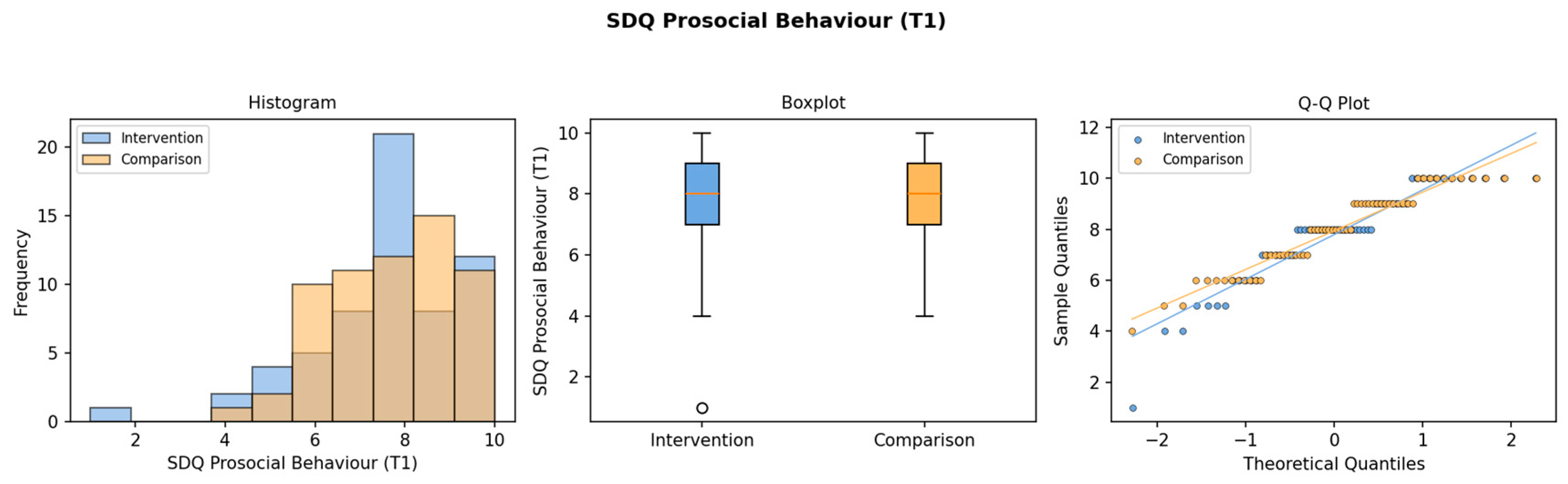
| SDQ Prosocial Behaviour (T1) | Intervention | 61 | −1.135 | 0.306 | 2.132 | 0.604 | 0.888 | <0.001 |
| SDQ Prosocial Behaviour (T1) | Comparison | 62 | −0.366 | 0.304 | −0.690 | 0.599 | 0.925 | <0.001 |
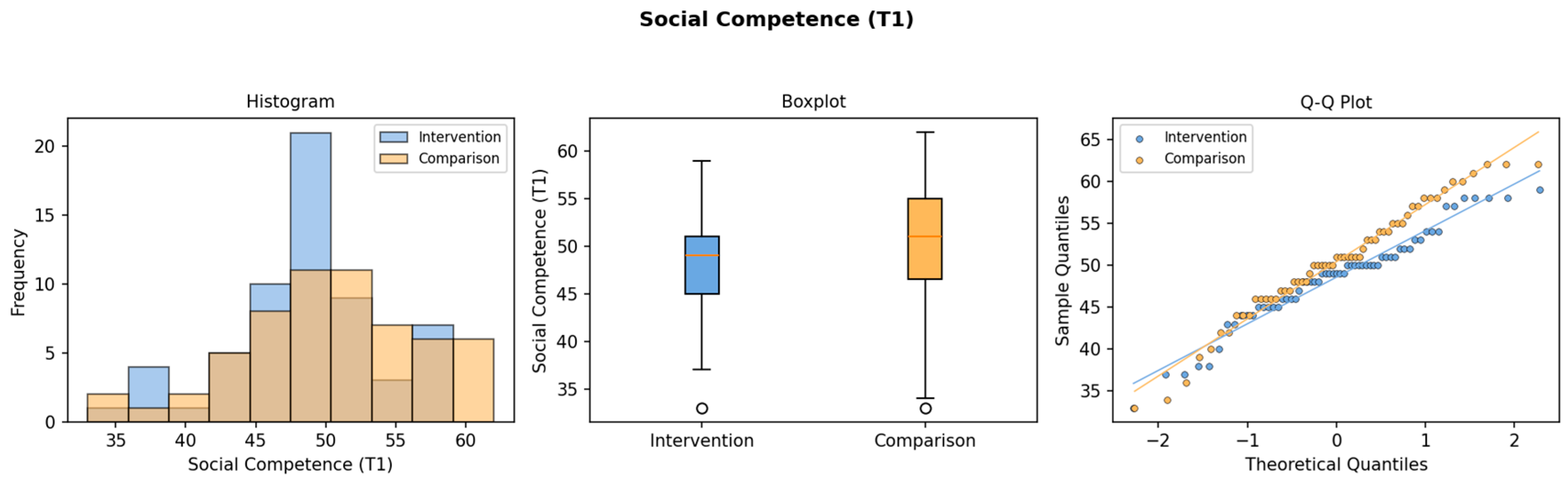
| Social Competence (T1) | Intervention | 61 | −0.434 | 0.306 | 0.507 | 0.604 | 0.961 | 0.051 |
| Social Competence (T1) | Comparison | 62 | −0.420 | 0.311 | 0.179 | 0.613 | 0.972 | 0.192 |
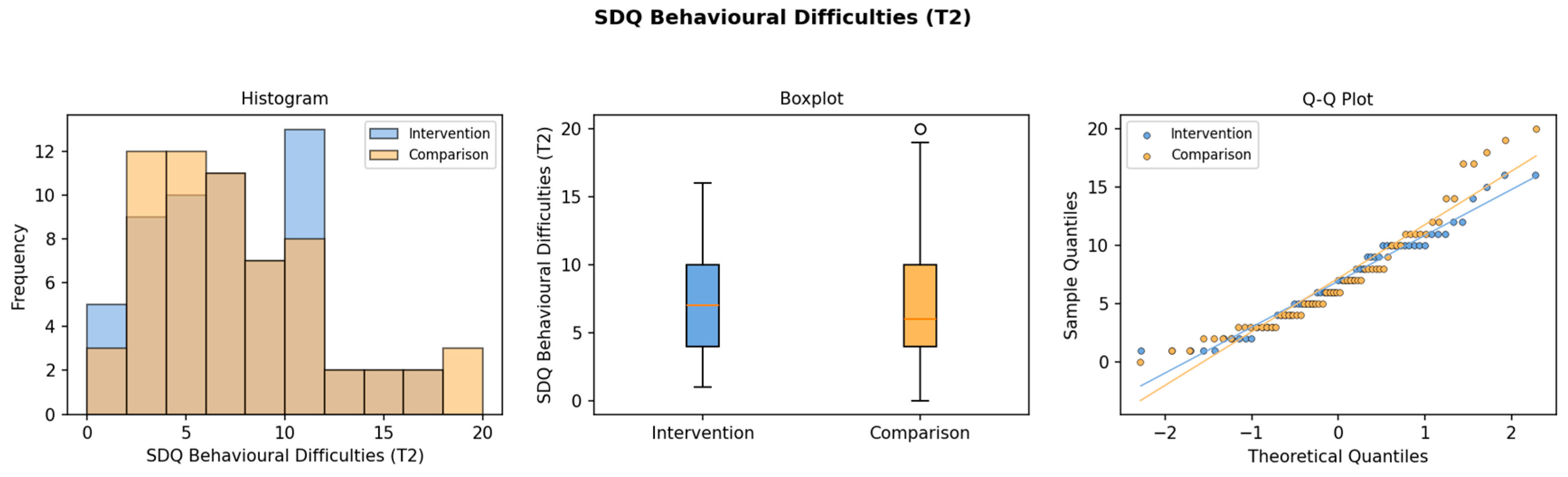
| SDQ Behavioural Difficulties (T2) | Intervention | 61 | 0.335 | 0.306 | −0.479 | 0.604 | 0.958 | 0.034 |
| SDQ Behavioural Difficulties (T2) | Comparison | 62 | 0.982 | 0.304 | 0.551 | 0.599 | 0.920 | <0.001 |
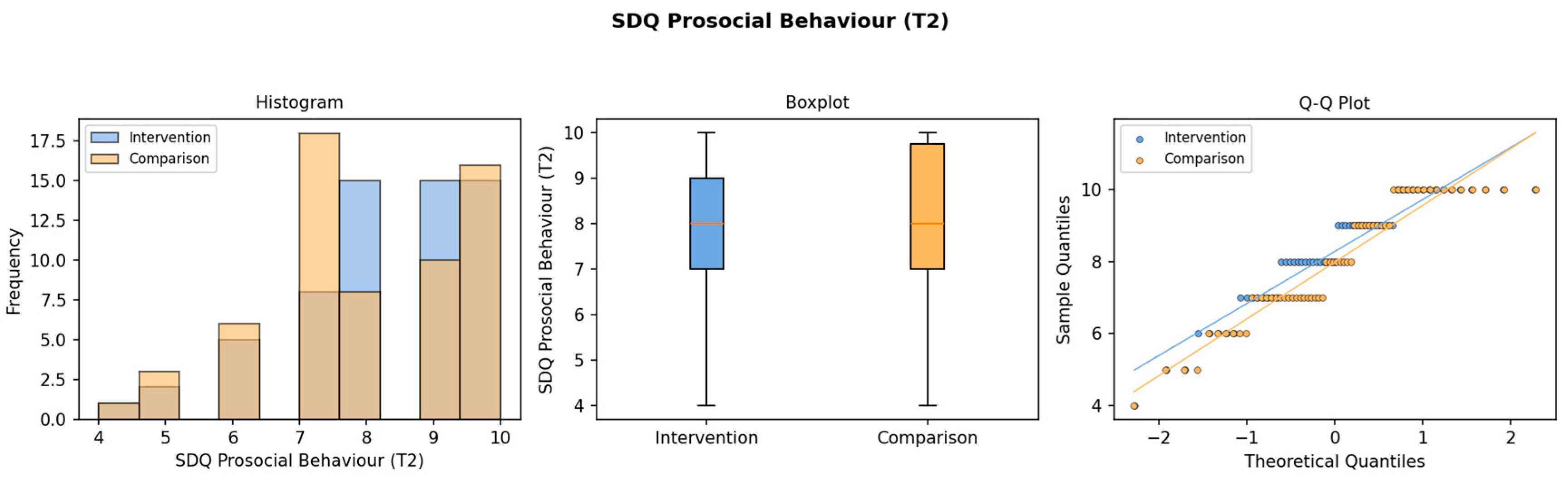
| SDQ Prosocial Behaviour (T2) | Intervention | 61 | −0.752 | 0.306 | 0.098 | 0.604 | 0.900 | <0.001 |
| SDQ Prosocial Behaviour (T2) | Comparison | 62 | −0.263 | 0.304 | −0.825 | 0.599 | 0.904 | <0.001 |
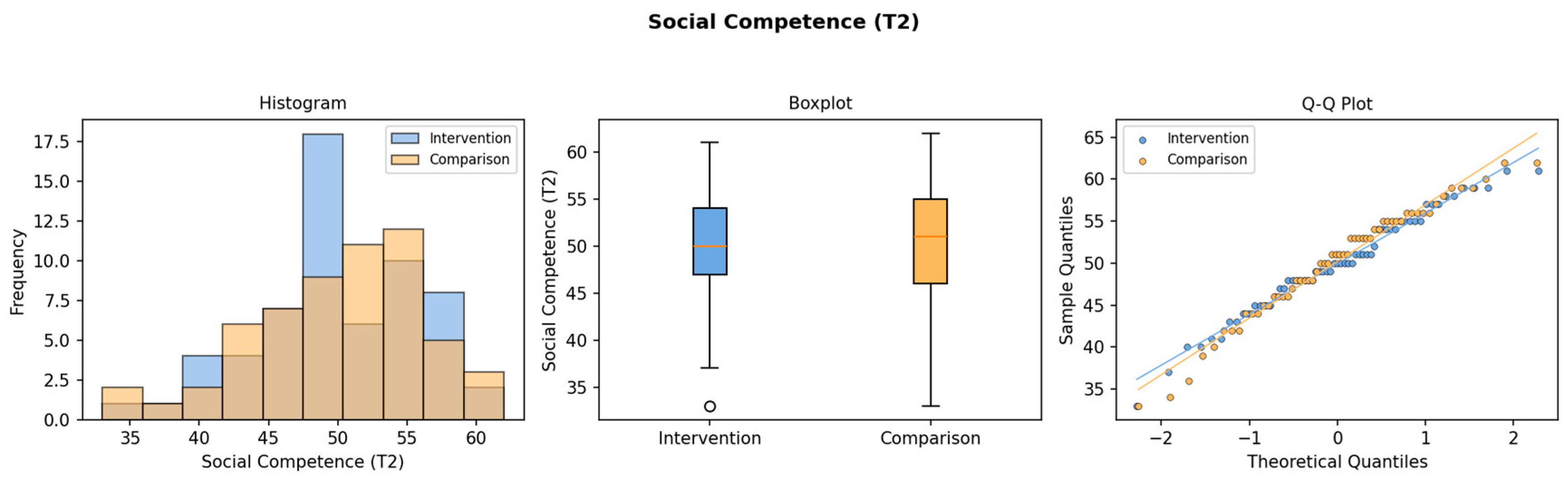
| Social Competence (T2) | Intervention | 61 | −0.324 | 0.306 | 0.102 | 0.604 | 0.979 | 0.392 |
| Social Competence (T2) | Comparison | 62 | −0.544 | 0.314 | 0.024 | 0.618 | 0.970 | 0.161 |


References
- World Health Organization. Improving Early Childhood Development: WHO Guideline, 1st ed.; World Health Organization: Geneva, Switzerland, 2020. [Google Scholar]
- Ben-Arieh, A.; Casas, F.; Frønes, I.; Korbin, J.E. (Eds.) Multifaceted Concept of Child Well-Being. In Handbook of Child Well-Being; Springer: Dordrecht, The Netherlands, 2014; pp. 1–27. [Google Scholar]
- Minkkinen, J. The Structural Model of Child Well-Being. Child Indic. Res. 2013, 6, 547–558. [Google Scholar] [CrossRef] [Scilit]
- Lee, B.J. Mapping Domains and Indicators of Children’s Well-Being. In Handbook of Child Well-Being; Ben-Arieh, A., Casas, F., Frønes, I., Korbin, J.E., Eds.; Springer: Dordrecht, The Netherlands, 2014; pp. 2797–2805. [Google Scholar]
- Cuartas, J. The Effect of Spanking on Early Social-Emotional Skills. Child Dev. 2022, 93, 180–193. [Google Scholar] [CrossRef] [Scilit] [PubMed]
- Vatou, A.; Evangelou-Tsitiridou, M.; Tympa, E.; Gregoriadis, A.; Vatou, A. Parenting Intervention Programs Supporting Social–Emotional Development in Preschool Children: A Literature Review. Encyclopedia 2026, 6, 17. [Google Scholar] [CrossRef] [Scilit]
- Mondi, C.F.; Giovanelli, A.; Reynolds, A.J. Fostering Socio-Emotional Learning through Early Childhood Intervention. Int. J. Child Care Educ. Policy 2021, 15, 6. [Google Scholar] [CrossRef] [Scilit] [PubMed]
- Murray, L.; Levickis, P.; McFarland, L.; Eadie, P.; Lee-Pang, L.; Quach, J.; Page, J. Supporting Young Children’s Social–Emotional Wellbeing in Early Childhood Education and Care: Perspectives from the Sector. Educ. Sci. 2025, 15, 569. [Google Scholar] [CrossRef] [Scilit]
- Jones, S.M.; Bouffard, S.M. Social and Emotional Learning in Schools: From Programs to Strategies and Commentaries. Child Policy Nexus 2012, 26, 1–33. [Google Scholar] [CrossRef] [Scilit]
- McClelland, M.M.; Tominey, S.L.; Schmitt, S.A.; Duncan, R. SEL Interventions in Early Childhood. Future Child. 2017, 27, 33–47. [Google Scholar] [CrossRef] [Scilit]
- Prado, E.L.; Dewey, K.G. Nutrition and Brain Development in Early Life. Nutr. Rev. 2014, 72, 267–284. [Google Scholar] [CrossRef] [Scilit] [PubMed]
- Spencer, S.J.; Korosi, A.; Layé, S.; Shukitt-Hale, B.; Barrientos, R.M. Food for Thought: How Nutrition Impacts Cognition and Emotion. npj Sci. Food 2017, 1, 7. [Google Scholar] [CrossRef] [Scilit] [PubMed]
- Hosokawa, R.; Matsumoto, Y.; Nishida, C.; Funato, K.; Mitani, A. Enhancing Social-Emotional Skills in Early Childhood: Intervention Study on the Effectiveness of Social and Emotional Learning. BMC Psychol. 2024, 12, 761. [Google Scholar] [CrossRef] [Scilit] [PubMed]
- Ahmad, S.; Peterson, E.R.; Waldie, K.E.; Morton, S.M.B. Development of an Index of Socio-Emotional Competence for Preschool Children in the Growing Up in New Zealand Study. Front. Educ. 2019, 4, 2. [Google Scholar] [CrossRef] [Scilit]
- Goldschmidt, T.; Pedro, A. Early Childhood Socio-Emotional Development Indicators: Pre-School Teachers’ Perceptions. J. Psychol. Afr. 2019, 29, 474–479. [Google Scholar] [CrossRef] [Scilit]
- Domitrovich, C.E.; Cortes, R.C.; Greenberg, M.T. Improving Young Children’s Social and Emotional Competence: A Randomized Trial of the Preschool “PATHS” Curriculum. J. Prim. Prev. 2007, 28, 67–91. [Google Scholar] [CrossRef] [Scilit] [PubMed]
- Bronfenbrenner, U.; Morris, P.A. The Bioecological Model of Human Development. In Handbook of Child Psychology: Theoretical Models of Human Development; Damon, W., Lerner, R.M., Eds.; John Wiley & Sons: Hoboken, NJ, USA, 2006; Volume 1, pp. 793–828. [Google Scholar]
- Denham, S.A.; Bassett, H.H.; Zinsser, K.; Wyatt, T.M. How Preschoolers’ Social-Emotional Learning Predicts Their Early School Success: Developing Theory-Promoting, Competency-Based Assessments: How Preschoolers’ Social-Emotional Learning Predicts. Infant Child Dev. 2014, 23, 426–454. [Google Scholar] [CrossRef] [Scilit]
- Hajal, N.; Paley, B. Parental Emotion and Emotion Regulation: A Critical Target of Study for Research and Intervention to Promote Child Emotion Socialization. Dev. Psychol. 2020, 56, 403–417. [Google Scholar] [CrossRef] [Scilit] [PubMed]
- Thompson, R.A.; Meyer, S. The Socialization of Emotion Regulation in the Family. In Handbook of Emotion Regulation; The Guilford Press: New York, NY, USA, 2007; pp. 249–268. [Google Scholar]
- Bowlby, J. A Secure Base: Parent-Child Attachment and Healthy Human Development; Nachdruck; Basic Books: New York, NY, USA, 1998. [Google Scholar]
- Barone, L.; Lionetti, F. Attachment and Emotional Understanding: A Study on Late-adopted Pre-schoolers and Their Parents. Child Care Health Dev. 2012, 38, 690–696. [Google Scholar] [CrossRef] [Scilit] [PubMed]
- Fernandes, C.; Fernandes, M.; Santos, A.J.; Antunes, M.; Monteiro, L.; Vaughn, B.E.; Verissimo, M. Early Attachment to Mothers and Fathers: Contributions to Preschoolers’ Emotional Regulation. Front. Psychol. 2021, 12, 660866. [Google Scholar] [CrossRef] [Scilit] [PubMed]
- Bandura, A.; Walters, R. Social Learning Theory; Prentice-Hall: Englewood Cliffs, NJ, USA, 1977; Volume 1. [Google Scholar]
- Eisenberg, N.; Cumberland, A.; Spinrad, T. Parental Socialization of Emotion. Psychol. Inq. 1998, 9, 241–273. [Google Scholar] [CrossRef] [Scilit] [PubMed]
- Denham, S.A. Emotional Competence During Childhood and Adolescence. In Handbook of Emotional Development; LoBue, V., Pérez-Edgar, K., Buss, K.A., Eds.; Springer International Publishing: Cham, Switzerland, 2019; pp. 493–541. [Google Scholar]
- Davis, M.; Suveg, C.; Shaffer, A. Maternal Positive Affect Mediates the Link Between Family Risk and Preschoolers’ Positive Affect. Child Psychiatry Hum. Dev. 2015, 46, 167–175. [Google Scholar] [CrossRef] [Scilit] [PubMed][Green Version]
- Meyer, S.; Raikes, H.A.; Virmani, E.A.; Waters, S.; Thompson, R.A. Parent Emotion Representations and the Socialization of Emotion Regulation in the Family. Int. J. Behav. Dev. 2014, 38, 164–173. [Google Scholar] [CrossRef] [Scilit]
- Morelen, D.; Shaffer, A.; Suveg, C. Maternal Emotion Regulation: Links to Emotion Parenting and Child Emotion Regulation. J. Fam. Issues 2016, 37, 1891–1916. [Google Scholar] [CrossRef] [Scilit]
- Woods, S.E.; Menna, R.; McAndrew, A.J. The Mediating Role of Emotional Control in the Link between Parenting and Young Children’s Physical Aggression. Early Child Dev. Care 2017, 187, 1157–1169. [Google Scholar] [CrossRef] [Scilit]
- Aryani, A.; Warsini, S.; Haryanti, F. Relationship between quality of care of young mothers and social-emotional development in preschool children. Belitung Nurs. J. 2018, 4, 31–38. [Google Scholar] [CrossRef] [Scilit]
- Yue, Y.; Huang, J.; Yuan, H.; Zhao, Y.; Lei, J.; Fan, J. The Mediating Role of Self-Competence in the Relationship between Parental Involvement and Support and Children’s Social Skills: Evidence from China. Child. Youth Serv. Rev. 2024, 161, 107641. [Google Scholar] [CrossRef] [Scilit]
- Oh, E.; Bayer, J.K. Predicting Parents’ Intentions to Seek Help for Young Children’s Mental Health. Int. J. Ment. Health Promot. 2017, 19, 38–49. [Google Scholar] [CrossRef] [Scilit]
- Wyatt Kaminski, J.; Valle, L.A.; Filene, J.H.; Boyle, C.L. A Meta-Analytic Review of Components Associated with Parent Training Program Effectiveness. J. Abnorm. Child Psychol. 2008, 36, 567–589. [Google Scholar] [CrossRef] [Scilit] [PubMed]
- Jeong, J.; Franchett, E.E.; Ramos De Oliveira, C.V.; Rehmani, K.; Yousafzai, A.K. Parenting Interventions to Promote Early Child Development in the First Three Years of Life: A Global Systematic Review and Meta-Analysis. PLoS Med. 2021, 18, e1003602. [Google Scholar] [CrossRef] [Scilit] [PubMed]
- Ahun, M.N.; Ali, N.B.; Hentschel, E.; Jeong, J.; Franchett, E.; Yousafzai, A.K. A Meta-analytic Review of the Implementation Characteristics in Parenting Interventions to Promote Early Child Development. Ann. N. Y. Acad. Sci. 2024, 1533, 99–144. [Google Scholar] [CrossRef] [Scilit] [PubMed]
- Webster-Stratton, C. The Incredible Years: Parents, Teachers, and Children Training Series. Resid. Treat. Child. Youth 2001, 18, 31–45. [Google Scholar] [CrossRef] [Scilit]
- Sanders, M.R. The Triple P System of Evidence-Based Parenting Support: Past, Present, and Future Directions. Clin. Child Fam. Psychol. Rev. 2023, 26, 880–903. [Google Scholar] [CrossRef] [Scilit] [PubMed]
- Havighurst, S.; Ambrosi, C.C.; Harley, A.; Kehoe, C. Tuning in to Kids: Theoretical Basis, Program Description, and Factors Impacting Effectiveness. J. Appl. Dev. Psychol. 2025, 98, 101797. [Google Scholar] [CrossRef] [Scilit]
- Sheridan, S.M.; Knoche, L.L.; Boise, C.E.; Moen, A.L.; Lester, H.; Edwards, C.P.; Schumacher, R.; Cheng, K. Supporting Preschool Children with Developmental Concerns: Effects of the Getting Ready Intervention on School-Based Social Competencies and Relationships. Early Child. Res. Q. 2019, 48, 303–316. [Google Scholar] [CrossRef] [Scilit]
- Zhang, L.; Ssewanyana, D.; Martin, M.-C.; Lye, S.; Moran, G.; Abubakar, A.; Marfo, K.; Marangu, J.; Proulx, K.; Malti, T. Supporting Child Development Through Parenting Interventions in Low- to Middle-Income Countries: An Updated Systematic Review. Front. Public Health 2021, 9, 671988. [Google Scholar] [CrossRef] [Scilit] [PubMed]
- Dalgaard, N.T.; Filges, T.; Viinholt, B.C.A.; Pontoppidan, M. Parenting Interventions to Support Parent/Child Attachment and Psychosocial Adjustment in Foster and Adoptive Parents and Children: A Systematic Review. Campbell Syst. Rev. 2022, 18, e1209. [Google Scholar] [CrossRef] [Scilit] [PubMed]
- Havighurst, S.S.; Duncombe, M.; Frankling, E.; Holland, K.; Kehoe, C.; Stargatt, R. An Emotion-Focused Early Intervention for Children with Emerging Conduct Problems. J. Abnorm. Child Psychol. 2015, 43, 749–760. [Google Scholar] [CrossRef] [Scilit] [PubMed]
- Knoche, L.L.; Edwards, C.P.; Sheridan, S.M.; Kupzyk, K.A.; Marvin, C.A.; Cline, K.D.; Clarke, B.L. Getting Ready: Results of a Randomized Trial of a Relationship-focused Intervention on the Parent–Infant Relationship in Rural Early Head Start. Infant Ment. Health J. 2012, 33, 439–458. [Google Scholar] [CrossRef] [Scilit] [PubMed]
- Bryman, A. Quantitative and Qualitative Research: Further Reflections on Their Integration. In Mixing Methods: Qualitative and Quantitative Research; Routledge: London, UK, 1992; pp. 57–78. [Google Scholar]
- Maciejewski, M.L. Quasi-Experimental Design. Biostat. Epidemiol. 2020, 4, 38–47. [Google Scholar] [CrossRef] [Scilit]
- Goodman, R. The Strengths and Difficulties Questionnaire: A Research Note. J. Child Psychol. Psychiatry 1997, 38, 581–586. [Google Scholar] [CrossRef] [Scilit] [PubMed]
- Goodman, R. Psychometric Properties of the Strengths and Difficulties Questionnaire. J. Am. Acad. Child Adolesc. Psychiatry 2001, 40, 1337–1345. [Google Scholar] [CrossRef] [Scilit] [PubMed]
- Stone, L.L.; Otten, R.; Engels, R.C.M.E.; Vermulst, A.A.; Janssens, J.M.A.M. Psychometric Properties of the Parent and Teacher Versions of the Strengths and Difficulties Questionnaire for 4- to 12-Year-Olds: A Review. Clin. Child Fam. Psychol. Rev. 2010, 13, 254–274. [Google Scholar] [CrossRef] [Scilit] [PubMed]
- Bibou-Nakou, I.; Markos, A.; Padeliadu, S.; Chatzilampou, P.; Ververidou, S. Multi-Informant Evaluation of Students’ Psychosocial Status through SDQ in a National Greek Sample. Child. Youth Serv. Rev. 2019, 96, 47–54. [Google Scholar] [CrossRef] [Scilit]
- Mieloo, C.L.; Bevaart, F.; Donker, M.C.H.; Van Oort, F.V.A.; Raat, H.; Jansen, W. Validation of the SDQ in a Multi-Ethnic Population of Young Children. Eur. J. Public Health 2014, 24, 26–32. [Google Scholar] [CrossRef] [Scilit] [PubMed]
- Vatou, A. Parents’ Self-Efficacy and Children’s Behavior in the First Wave of the COVID-19 Pandemic in Greece. Child Care Pract. 2023, 29, 458–469. [Google Scholar] [CrossRef] [Scilit]
- Borg, A.-M.; Kaukonen, P.; Salmelin, R.; Joukamaa, M.; Tamminen, T. Reliability of the Strengths and Difficulties Questionnaire among Finnish 4–9-Year-Old Children. Nord. J. Psychiatry 2012, 66, 403–413. [Google Scholar] [CrossRef] [Scilit] [PubMed]
- Kersten, P.; Czuba, K.; McPherson, K.; Dudley, M.; Elder, H.; Tauroa, R.; Vandal, A. A Systematic Review of Evidence for the Psychometric Properties of the Strengths and Difficulties Questionnaire. Int. J. Behav. Dev. 2016, 40, 64–75. [Google Scholar] [CrossRef] [Scilit]
- Caldwell, C.B.; Pianta, R.C. A Measure of Young Children’s Problem and Competence Behaviors: The Early School Behavior Scale. J. Psychoeduc. Assess. 1991, 9, 32–44. [Google Scholar] [CrossRef] [Scilit]
- Ren, L.; Knoche, L.L.; Edwards, C.P. The Relation between Chinese Preschoolers’ Social-Emotional Competence and Preacademic Skills. Early Educ. Dev. 2016, 27, 875–895. [Google Scholar] [CrossRef] [Scilit]
- Ren, L.; Pope Edwards, C. Pathways of Influence: Chinese Parents’ Expectations, Parenting Styles, and Child Social Competence. Early Child Dev. Care 2015, 185, 614–630. [Google Scholar] [CrossRef] [Scilit]
- Field, A. Discovering Statistics Using IBM SPSS Statistics, 5th ed.; Sage: London, UK, 2017. [Google Scholar]
- Berk, L.E. Development Through the Lifespan, 7th ed.; Pearson: Hoboken, NJ, USA, 2018. [Google Scholar]
- McLeod, B.D.; Sutherland, K.S.; Martinez, R.G.; Conroy, M.A.; Snyder, P.A.; Southam-Gerow, M.A. Identifying Common Practice Elements to Improve Social, Emotional, and Behavioral Outcomes of Young Children in Early Childhood Classrooms. Prev. Sci. 2017, 18, 204–213. [Google Scholar] [CrossRef] [Scilit] [PubMed]
- Vatou, A. The Parental Support for Enhancing the Socio-Emotional Development of Preschool Children: An Intervention Program: Hug and Change. Ph.D. Thesis, International Hellenic University, Thessaloniki, Greece, 2026. [Google Scholar]
- Fulbright-Anderson, K.; Kubisch, A.C.; Connell, J.P.; Aspen Institute (Eds.) New Approaches to Evaluating Community Initiatives; Aspen Institute, Publications Office: Washington, DC, USA; Queenstown, MD, USA, 1998. [Google Scholar]
- Collaborative for Academic, Social, and Emotional Learning. CASEL School Kit: A Guide for Implementing Schoolwide Academic, Social, and Emotional Learning; CASEL: Chicago, IL, USA, 2013. [Google Scholar]
- Hannon, P. Literacy, Home and School: Research and Practice in Teaching Literacy with Parents; Falmer Press: London, UK, 1995. [Google Scholar]
- Pallant, J. SPSS Survival Manual: A Step-by-Step Guide to Data Analysis Using IBM SPSS, 7th ed.; Routledge: Abingdon, UK, 2020. [Google Scholar]
- Duch, H.; Marti, M.; Wu, W.; Snow, R.; Garcia, V. CARING: The Impact of a Parent–Child, Play-Based Intervention to Promote Latino Head Start Children’s Social–Emotional Development. J. Prim. Prev. 2019, 40, 171–188. [Google Scholar] [CrossRef] [Scilit] [PubMed]
- Furlong, M.; McLoughlin, F.; McGilloway, S. The Incredible Years Parenting Program for Foster Carers and Biological Parents of Children in Foster Care: A Mixed Methods Study. Child. Youth Serv. Rev. 2021, 126, 106028. [Google Scholar] [CrossRef] [Scilit]
- England-Mason, G.; Andrews, K.; Atkinson, L.; Gonzalez, A. Emotion Socialization Parenting Interventions Targeting Emotional Competence in Young Children: A Systematic Review and Meta-Analysis of Randomized Controlled Trials. Clin. Psychol. Rev. 2023, 100, 102252. [Google Scholar] [CrossRef] [Scilit] [PubMed]
- Webster-Stratton, C.; Bywater, T. The Incredible Years® Series: An Internationally Evidenced Multimodal Approach to Enhancing Child Outcomes. In APA Handbook of Contemporary Family Psychology: Family Therapy and Training (Vol. 3); Fiese, B.H., Celano, M., Deater-Deckard, K., Jouriles, E.N., Whisman, M.A., Eds.; American Psychological Association: Washington, DC, USA, 2019; pp. 343–359. [Google Scholar]
- McGilloway, S.; Mhaille, G.N.; Bywater, T.; Furlong, M.; Leckey, Y.; Kelly, P.; Comiskey, C.; Donnelly, M. A Parenting Intervention for Childhood Behavioral Problems: A Randomized Controlled Trial in Disadvantaged Community-Based Settings. J. Consult. Clin. Psychol. 2012, 80, 116–127. [Google Scholar] [CrossRef] [Scilit] [PubMed]
- Sanders, M.R.; Kirby, J.N.; Tellegen, C.L.; Day, J.J. The Triple P-Positive Parenting Program: A Systematic Review and Meta-Analysis of a Multi-Level System of Parenting Support. Clin. Psychol. Rev. 2014, 34, 337–357. [Google Scholar] [CrossRef] [Scilit] [PubMed]
- Havighurst, S.S.; Wilson, K.R.; Harley, A.E.; Prior, M.R.; Kehoe, C. Tuning in to Kids: Improving Emotion Socialization Practices in Parents of Preschool Children—Findings from a Community Trial. J. Child Psychol. Psychiatry 2010, 51, 1342–1350. [Google Scholar] [CrossRef] [Scilit] [PubMed]
- Havighurst, S.S.; Wilson, K.R.; Harley, A.E.; Kehoe, C.; Efron, D.; Prior, M.R. “Tuning into Kids”: Reducing Young Children’s Behavior Problems Using an Emotion Coaching Parenting Program. Child Psychiatry Hum. Dev. 2013, 44, 247–264. [Google Scholar] [CrossRef] [Scilit] [PubMed]
- Niec, L.N.; Barnett, M.L.; Prewett, M.S.; Shanley Chatham, J.R. Group Parent–Child Interaction Therapy: A Randomized Control Trial for the Treatment of Conduct Problems in Young Children. J. Consult. Clin. Psychol. 2016, 84, 682–698. [Google Scholar] [CrossRef] [Scilit] [PubMed]
- Thomas, R.; Abell, B.; Webb, H.J.; Avdagic, E.; Zimmer-Gembeck, M.J. Parent-Child Interaction Therapy: A Meta-Analysis. Pediatrics 2017, 140, e20170352. [Google Scholar] [CrossRef] [Scilit] [PubMed]
- Gagné, M.-H.; Piché, G.; Brunson, L.; Clément, M.-È.; Drapeau, S.; Jean, S.-M. Efficacy of the Triple P—Positive Parenting Program on 0–12 Year-Old Quebec Children’s Behavior. Child. Youth Serv. Rev. 2023, 149, 106946. [Google Scholar] [CrossRef] [Scilit]
- Axberg, U.; Broberg, A.G. Evaluation of “The Incredible Years” in Sweden: The Transferability of an American Parent-training Program to Sweden. Scand. J. Psychol. 2012, 53, 224–232. [Google Scholar] [CrossRef] [Scilit] [PubMed]
- Overbeek, G.; Van Aar, J.; De Castro, B.O.; Matthys, W.; Weeland, J.; Chhangur, R.R.; Leijten, P. Longer-Term Outcomes of the Incredible Years Parenting Intervention. Prev. Sci. 2021, 22, 419–431. [Google Scholar] [CrossRef] [Scilit] [PubMed]
- Leijten, P.; Gardner, F.; Melendez-Torres, G.J.; Van Aar, J.; Hutchings, J.; Schulz, S.; Knerr, W.; Overbeek, G. Meta-Analyses: Key Parenting Program Components for Disruptive Child Behavior. J. Am. Acad. Child Adolesc. Psychiatry 2019, 58, 180–190. [Google Scholar] [CrossRef] [Scilit] [PubMed]
- Shaw, D.S. Parenting Programs and Their Impact on the Social and Emotional Development of Young Children. In Encyclopedia on Early Childhood Development; Tremblay, R.E., Boivin, M., Peters, R.D.V., Eds.; University of Montreal: Montreal, QC, Canada, 2014; Available online: https://www.child-encyclopedia.com/parenting-skills/according-experts/parenting-programs-and-their-impact-social-and-emotional?utm_source (accessed on 2 September 2026).
- Al Sager, A.; Goodman, S.H.; Jeong, J.; Bain, P.A.; Ahun, M.N. Effects of Multi-Component Parenting and Parental Mental Health Interventions on Early Childhood Development and Parent Outcomes: A Systematic Review and Meta-Analysis. Lancet Child Adolesc. Health 2024, 8, 656–669. [Google Scholar] [CrossRef] [Scilit] [PubMed]
- Luo, L.; Reichow, B.; Snyder, P.; Harrington, J.; Polignano, J. Systematic Review and Meta-Analysis of Classroom-Wide Social–Emotional Interventions for Preschool Children. Top. Early Child. Spec. Educ. 2022, 42, 4–19. [Google Scholar] [CrossRef] [Scilit]
- Ştefan, C.A.; Miclea, M. Effects of a multifocused prevention program on preschool children’s competencies and behavior problems. Psychol. Sch. 2013, 50, 382–402. [Google Scholar] [CrossRef] [Scilit]
- Azevedo, A.F.; Seabra-Santos, M.J.; Gaspar, M.F.; Homem, T.C. The Incredible Years Basic Parent Training for Portuguese Preschoolers with AD/HD Behaviors: Does It Make a Difference? Child Youth Care Forum 2013, 42, 403–424. [Google Scholar] [CrossRef] [Scilit][Green Version]
- Gregoriadis, A.; Evangelou, M. Revisiting the Home Learning Environment: Introducing the Home Learning Ecosystem. Australas. J. Early Child. 2022, 47, 206–218. [Google Scholar] [CrossRef] [Scilit]
- Djamnezhad, D.; Koltcheva, N.; Dizdarevic, A.; Mujezinovic, A.; Peixoto, C.; Coelho, V.; Achten, M.; Kolumbán, E.; Machado, F.; Hofvander, B. Social and Emotional Learning in Preschool Settings: A Systematic Map of Systematic Reviews. Front. Educ. 2021, 6, 691670. [Google Scholar] [CrossRef] [Scilit]
- Domitrovich, C.E.; Durlak, J.A.; Staley, K.C.; Weissberg, R.P. Social-Emotional Competence: An Essential Factor for Promoting Positive Adjustment and Reducing Risk in School Children. Child Dev. 2017, 88, 408–416. [Google Scholar] [CrossRef] [Scilit] [PubMed]
| Characteristic | Intervention Group (n = 61) | Comparison Group (n = 62) |
|---|---|---|
| Parent sex | ||
| Mother, n (%) | 55 (90.2) | 50 (80.6) |
| Father, n (%) | 6 (9.8) | 11 (17.7) |
| Mother age (years), M (SD) | 37.8 (4.28) | 38.0 (4.81) |
| Father age (years), M (SD) | 43.0 (6.29) | 46.5 (6.06) |
| Parent age range (years) | 28–50 | 28–60 |
| Number of children in family | ||
| 1, n (%) | 24 (39.3) | 22 (35.5) |
| 2, n (%) | 31 (50.8) | 33 (53.2) |
| 3, n (%) | 6 (9.8) | 7 (11.3) |
| Mother’s educational level | ||
| Upper secondary, n (%) | 4 (6.6) | 6 (9.7) |
| Vocational/technical, n (%) | 16 (26.2) | 14 (22.6) |
| University, n (%) | 30 (49.2) | 29 (46.8) |
| Postgraduate, n (%) | 11 (18.0) | 11 (17.7) |
| Father’s educational level | ||
| Lower secondary, n (%) | 0 (0.0) | 3 (4.8) |
| Upper secondary, n (%) | 10 (16.4) | 5 (8.1) |
| Vocational/technical, n (%) | 15 (24.6) | 13 (21.0) |
| University, n (%) | 30 (49.2) | 30 (48.4) |
| Postgraduate, n (%) | 5 (8.2) | 5 (8.1) |
| Doctoral, n (%) | 1 (1.6) | 3 (4.8) |
| Monthly household income (EUR) | ||
| 401–800, n (%) | 2 (3.3) | 3 (4.8) |
| 801–1200, n (%) | 4 (6.6) | 5 (8.1) |
| 1201–1600, n (%) | 13 (21.3) | 11 (17.7) |
| 1601–2000, n (%) | 11 (18.0) | 14 (22.6) |
| 2001–2400, n (%) | 17 (27.9) | 22 (35.5) |
| 2401–2800, n (%) | 8 (13.1) | 1 (1.6) |
| 2801–3200, n (%) | 0 (0.0) | 3 (4.8) |
| 3201–3600, n (%) | 3 (4.9) | 1 (1.6) |
| 3601–4000, n (%) | 1 (1.6) | 0 (0.0) |
| >4000, n (%) | 0 (0.0) | 2 (3.2) |
| Characteristic | Intervention Group (n = 61) | Comparison Group (n = 62) |
|---|---|---|
| Sex | ||
| Male, n (%) | 31 (50.8) | 32 (51.6) |
| Female, n (%) | 30 (49.2) | 30 (48.4) |
| Age (years), M (SD) | 4.95 (0.60) | 5.14 (0.52) |
| Age range (years) | 3.04–6.03 | 4.18–6.13 |
| Birth order | ||
| Only child, n (%) | 25 (41.0) | 22 (35.5) |
| First child, n (%) | 18 (29.5) | 13 (21.0) |
| Middle child, n (%) | 4 (6.6) | 6 (9.7) |
| Last child, n (%) | 9 (14.8) | 21 (33.9) |
| Other, n (%) | 5 (8.2) | 0 (0.0) |
| Nationality | ||
| Greek, n (%) | 61 (100.0) | 61 (98.4) |
| Other, n (%) | 0 (0.0) | 1 (1.6) |
| Measure | T1 | T2 |
|---|---|---|
| SDQ—Behavioural Difficulties (parent report) | ω = 0.78 | ω = 0.81 |
| SDQ—Prosocial Behaviour (parent report) | ω = 0.68 | ω = 0.70 |
| Social Competence (parent report) | ω = 0.83 | ω = 0.85 |
| Variable | U | p |
|---|---|---|
| SDQ—Behavioural Difficulties | 1818 | 0.713 |
| SDQ—Prosocial Behaviour | 1853 | 0.847 |
| Social Competence | 1456 | 0.071 |
| Variable | Group | T1 | T2 | ||
|---|---|---|---|---|---|
| M | SD | M | SD | ||
| SDQ—Behavioural Difficulties | Intervention (n = 61) | 8.10 | 4.74 | 6.15 | 2.90 |
| Comparison (n = 62) | 7.76 | 4.75 | 7.18 | 4.67 | |
| SDQ—Prosocial Behaviour | Intervention (n = 61) | 7.79 | 1.81 | 8.38 | 1.33 |
| Comparison (n = 62) | 7.94 | 1.54 | 7.98 | 1.61 | |
| Social Competence | Intervention (n = 61) | 48.57 | 5.54 | 49.90 | 5.96 |
| Comparison (n = 62) | 50.12 | 6.0 | 50.20 | 6.73 | |
| Variable | Group | W | p | r |
|---|---|---|---|---|
| Behavioural Difficulties | Intervention | 171 | <0.001 | −0.670 |
| Behavioural Difficulties | Comparison | 252 | 0.196 | −0.246 |
| Prosocial Behaviour | Intervention | 431 | <0.001 | 0.631 |
| Prosocial Behaviour | Comparison | 279 | 0.786 | 0.054 |
| Variable | Group | M Diff | SD Diff | U | p | r |
|---|---|---|---|---|---|---|
| Behavioural Difficulties | Intervention | −1.95 | 3.34 | 1311 | 0.003 | 0.307 |
| Behavioural Difficulties | Comparison | −0.58 | 2.60 | |||
| Prosocial Behaviour | Intervention | 0.59 | 1.36 | 1516 | 0.043 | 0.198 |
| Prosocial Behaviour | Comparison | 0.06 | 1.13 |
| Variable | Group | W | p | r |
|---|---|---|---|---|
| Social Competence | Intervention | 565 | 0.005 | 0.524 |
| Social Competence | Comparison | 241 | 0.869 | 0.036 |
| Variable | Group | M Diff | SD Diff | U | p | r |
|---|---|---|---|---|---|---|
| Social Competence | Intervention | 1.34 | 3.89 | 1348 | 0.029 | 0.225 |
| Social Competence | Comparison | 0.07 | 3.39 |
Disclaimer/Publisher’s Note: The statements, opinions and data contained in all publications are solely those of the individual author(s) and contributor(s) and not of MDPI and/or the editor(s). MDPI and/or the editor(s) disclaim responsibility for any injury to people or property resulting from any ideas, methods, instructions or products referred to in the content. |
© 2026 by the authors. Licensee MDPI, Basel, Switzerland. This article is an open access article distributed under the terms and conditions of the Creative Commons Attribution (CC BY) license.
Share and Cite
Vatou, A.; Vatou, A.; Evangelou-Tsitiridou, M.; Tympa, E.; Gregoriadis, A. A Parent-Focused Intervention Programme to Promote Socio-Emotional Well-Being of Preschool Children: “Hug and Change”. Healthcare 2026, 14, 3014. https://doi.org/10.3390/healthcare14183014
Vatou A, Vatou A, Evangelou-Tsitiridou M, Tympa E, Gregoriadis A. A Parent-Focused Intervention Programme to Promote Socio-Emotional Well-Being of Preschool Children: “Hug and Change”. Healthcare. 2026; 14(18):3014. https://doi.org/10.3390/healthcare14183014
Chicago/Turabian StyleVatou, Athina, Anastasia Vatou, Maria Evangelou-Tsitiridou, Eleni Tympa, and Athanasios Gregoriadis. 2026. "A Parent-Focused Intervention Programme to Promote Socio-Emotional Well-Being of Preschool Children: “Hug and Change”" Healthcare 14, no. 18: 3014. https://doi.org/10.3390/healthcare14183014
APA StyleVatou, A., Vatou, A., Evangelou-Tsitiridou, M., Tympa, E., & Gregoriadis, A. (2026). A Parent-Focused Intervention Programme to Promote Socio-Emotional Well-Being of Preschool Children: “Hug and Change”. Healthcare, 14(18), 3014. https://doi.org/10.3390/healthcare14183014