Mapping Conditional Associations Among Wellbeing, Distress, Spirituality, and Yoga Practice: A Network Analysis


Highlights
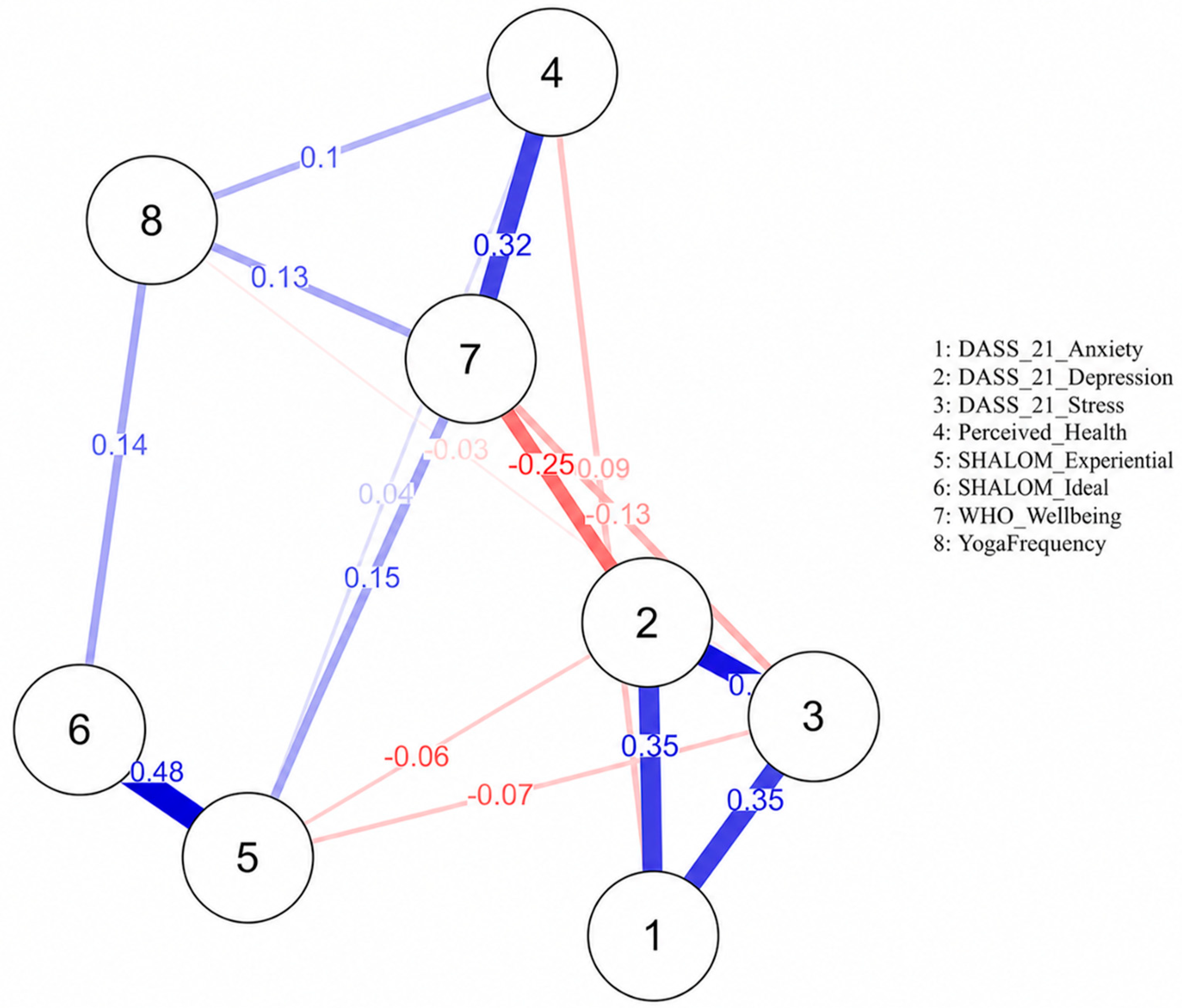
- Network analysis revealed distinct but interconnected wellbeing, distress, and spirituality domains among yoga practitioners.
- Perceived health and yoga practice frequency were uniquely associated with wellbeing beyond psychological distress. Environmental spirituality was a significant correlate in the main model, although supplementary analyses indicated that this association depended on model specification.
- The findings contribute to a multidimensional view of wellbeing that integrates psychological, health-related, and spiritual factors.
- Network approaches may help identify potential correlates for yoga-based health promotion and wellbeing interventions.
Abstract
1. Introduction
2. Materials and Methods
2.1. Study Design and Sample Size Calculation
2.2. Participants
2.2.1. Sample Characteristics
2.2.2. Yoga-Related Characteristics of the Sample
2.3. Instruments
2.3.1. Depression, Anxiety, and Stress
2.3.2. Self-Rated Health
2.3.3. Spiritual Wellbeing
2.3.4. Subjective Wellbeing
2.4. Statistical Analysis
2.5. Ethical Compliance
3. Results
3.1. Network Structure
3.2. Centrality and Clustering
3.3. Node Distinguishability
3.4. Network Stability
3.5. Hierarchical Regression
4. Discussion
Limitations
5. Conclusions
Supplementary Materials
Author Contributions
Funding
Institutional Review Board Statement
Informed Consent Statement
Data Availability Statement
Acknowledgments
Conflicts of Interest
Abbreviations
| CS | Correlation stability |
| DASS-21 | Depression Anxiety Stress Scales |
| EBIC | Bayesian information criterion |
| GGM | Gaussian graphical model |
| SHALOM | Spiritual Health and Life-Orientation Measure |
| SWB | Subjective wellbeing |
| VIF | Variance inflation factors |
| WHO | World Health Organization |
| WHO-5 | WHO Well-Being Index |
References
- De Michelis, E. A History of Modern Yoga: Patañjali and Western Esotericism; Continuum: London, UK, 2004. [Google Scholar]
- Putchavayala, C.K.; Singh, D.; Sashidharan, R.K. A perspective of yoga on smartphone addiction: A narrative review. J. Fam. Med. Prim. Care 2022, 11, 2284–2291. [Google Scholar] [CrossRef] [PubMed]
- Satchidananda, S. The Yoga Sutras of Patanjali; Integral Yoga Publications: Buckingham, VA, USA, 1990. [Google Scholar]
- Tornóczky, G.J. A jóga története. Recreation 2013, 3, 10–13. [Google Scholar] [CrossRef]
- World Health Organization. Promoting Wellbeing [Internet]; World Health Organization: Geneva, Switzerland, 2026; Available online: https://www.who.int/activities/promoting-well-being (accessed on 30 March 2026).
- Gupta, B.M.; Ahmed, K.K.M.; Dhawan, S.M.; Ritu, G. Yoga research: A scientometric assessment of global publications output during 2007-16. Pharmacogn. J. 2018, 10, 394–402. [Google Scholar] [CrossRef]
- Sankapal, S. Yoga as a therapy for mental health: A systematic review. Indian. J. Yoga Exerc. Sport. Sci. Phys. Educ. 2025, 10, 39–45. [Google Scholar] [CrossRef]
- Velten, J.; Bieda, A.; Scholten, S.; Wannemüller, A.; Margraf, J. Lifestyle choices and mental health: A longitudinal survey with German and Chinese students. BMC Public Health 2018, 18, 632. [Google Scholar] [CrossRef] [PubMed]
- Institute for Health Metrics and Evaluation. Global Health Data Exchange (GHDx) [Internet]; University of Washington: Seattle, WA, USA, 2021; Available online: https://vizhub.healthdata.org/gbd-results/ (accessed on 30 March 2026).
- World Health Organization. Depressive Disorder (Depression) [Internet]; World Health Organization: Geneva, Switzerland, 2025; Available online: https://www.who.int/news-room/fact-sheets/detail/depression (accessed on 30 March 2026).
- World Health Organization. Anxiety Disorders [Internet]; World Health Organization: Geneva, Switzerland, 2025; Available online: https://www.who.int/news-room/fact-sheets/detail/anxiety-disorders (accessed on 30 March 2026).
- Bhowmik, S.K.; Yumkhaibam, A.H.; Sharma, B. The impact of yoga on global wellbeing: A comprehensive overview of therapeutic and preventive health benefits in diverse populations. Int. J. Yogic Hum. Mov. Sports Sci. 2025, 10, 558–563. [Google Scholar] [CrossRef]
- Cramer, H.; Lauche, R.; Langhorst, J.; Dobos, G. Yoga for depression: A systematic review and meta-analysis. Depress. Anxiety 2013, 30, 1068–1083. [Google Scholar] [CrossRef] [PubMed]
- Wu, Y.; Yan, D.; Yang, J. Effectiveness of yoga for major depressive disorder: A systematic review and meta-analysis. Front. Psychiatry 2023, 14, 1138205. [Google Scholar] [CrossRef] [PubMed]
- Keyes, C.L.M. Mental illness and/or mental health? Investigating axioms of the complete state model of health. J. Consult. Clin. Psychol. 2005, 73, 539–548. [Google Scholar] [CrossRef] [PubMed]
- Coan, R.W. Hero, Artist, Sage, or Saint? A Survey of Views on What is Variously Called Mental Health, Normality, Maturity, Self-Actualization, and Human Fulfillment; Columbia University Press: New York, NY, USA, 1977. [Google Scholar]
- Borsboom, D.; Cramer, A.O.J. Network analysis: An integrative approach to the structure of psychopathology. Annu. Rev. Clin. Psychol. 2013, 9, 91–121. [Google Scholar] [CrossRef] [PubMed]
- James-Palmer, A.; Anderson, E.Z.; Zucker, L.; Kofman, Y.; Daneault, J.F. Yoga as an intervention for the reduction of symptoms of anxiety and depression in children and adolescents: A systematic review. Front. Pediatr. 2020, 8, 78. [Google Scholar] [CrossRef] [PubMed]
- Tornóczky, G.J.; Bánhidi, M.; Marie, Y.; Nagy, H.; Rózsa, S. How yoga practice time impacts the levels of depression, anxiety, stress and positive and negative affect among Hungarian yoga practitioners. Acta Salus Vitae 2019, 7, 40–50. [Google Scholar]
- Wang, F.; Szabo, A. Effects of yoga on stress among healthy adults: A systematic review. Altern. Ther. Health Med. 2020, 26, 58–64. [Google Scholar]
- Pascoe, M.C.; de Manincor, M.J.; Hallgren, M.; Baldwin, P.A.; Tseberja, J.; Parker, A.G. Psychobiological mechanisms underlying the mental health benefits of yoga-based interventions: A narrative review. Mindfulness 2021, 12, 2877–2889. [Google Scholar] [CrossRef]
- Campbell, A.; Converse, P.E.; Rodgers, W.L. The Quality of American Life: Perceptions, Evaluations, and Satisfactions; Russell Sage Foundation: New York, NY, USA, 1976. [Google Scholar]
- Kauppi, K.; Vanhala, A.; Roos, E.; Torkki, P. Assessing the structures and domains of wellness models: A systematic review. Int. J. Wellbeing 2023, 13, 1–19. [Google Scholar] [CrossRef]
- Koburtay, T.; Jamali, D.; Aljafari, A. Religion, spirituality, and well-being: A systematic literature review and future research agenda. Bus. Ethics Environ. Responsib. 2022, 32, 341–357. [Google Scholar] [CrossRef]
- Norozi, S.A. The nexus of holistic wellbeing and school education: A literature-informed theoretical framework. Societies 2023, 13, 113. [Google Scholar] [CrossRef]
- Fisher, J. Development and application of a spiritual well-being questionnaire called SHALOM. Religions 2010, 1, 105–121. [Google Scholar] [CrossRef]
- Tornóczky, G.J. A Jógázók Mentális Egészsége a Gyakorlási Paraméterekkel Összefüggésben. Ph.D. Thesis, Magyar Testnevelési és Sporttudományi Egyetem Sporttudományok Doktori Iskola, Budapest, Hungary, 2023. [Google Scholar]
- Feuerstein, G. The Yoga Tradition: Its History, Literature, Philosophy and Practice; Hohm Press: Prescott, AZ, USA, 1998. [Google Scholar]
- Büssing, A.; Hedtstück, A.; Khalsa, S.B.S.; Ostermann, T.; Heusser, P. Development of specific aspects of spirituality during a 6-month intensive yoga practice. Evid. Based Complement. Altern. Med. 2012, 2012, 981523. [Google Scholar] [CrossRef] [PubMed]
- Csala, B.; Springinsfeld, C.M.; Köteles, F. The relationship between yoga and spirituality: A systematic review of empirical research. Front. Psychol. 2021, 12, 695939. [Google Scholar] [CrossRef] [PubMed]
- Erkin, Ö.; Akçay, N. Self-perceived health status and yoga-related perceptions among yoga practitioners. Turk. J. Fam. Med. Prim. Care 2018, 12, 193–199. [Google Scholar] [CrossRef]
- Sharma, R.; Gupta, N.; Biljani, R.L. Effect of yoga-based lifestyle intervention on subjective wellbeing. Indian. J. Physiol. Pharmacol. 2008, 52, 123–131. [Google Scholar] [PubMed]
- Telles, S.; Gupta, R.K.; Kumar, A.; Pal, D.K.; Tyagi, D.; Balkrishna, A. Mental wellbeing, quality of life, and perception of chronic illness in yoga-experienced compared with yoga-naïve patients. Med. Sci. Monit. Basic. Res. 2019, 25, 153–163. [Google Scholar] [CrossRef] [PubMed]
- Bös, C.; Gaiswinkler, L.; Fuchshuber, J.; Schwerdtfeger, A.; Unterrainer, H.F. Effect of yoga involvement on mental health in times of crisis: A cross-sectional study. Front. Psychol. 2023, 14, 1096848. [Google Scholar] [CrossRef] [PubMed]
- Gaiswinkler, L.; Unterrainer, H.F. The relationship between yoga involvement, mindfulness and psychological well-being. Complement. Ther. Med. 2016, 26, 123–127. [Google Scholar] [CrossRef] [PubMed]
- Hendriks, T.; de Jong, J.; Cramer, H. The effects of yoga on positive mental health among healthy adults: A systematic review and meta-analysis. J. Altern. Complement. Med. 2017, 23, 505–517. [Google Scholar] [CrossRef] [PubMed]
- Tornóczky, G.J.; Nagy, H.; Karsai, I.; Conceição, A.; Podstawski, R.; Szabo, A. The role of yoga in enhancing spiritual and psychological health: Evidence from a large cross-sectional study. Complement. Ther. Med. 2026, 97, 103330. [Google Scholar] [CrossRef] [PubMed]
- Qualtrics. Qualtrics XM [Survey Software]; Qualtrics: Provo, UT, USA, 2026. [Google Scholar]
- Faul, F.; Erdfelder, E.; Buchner, A.; Lang, A.G. Statistical power analyses using G*Power 3.1: Tests for correlation and regression analyses. Behav. Res. Methods 2009, 41, 1149–1160. [Google Scholar] [CrossRef] [PubMed]
- Lovibond, S.H.; Lovibond, P.F. Manual for the Depression Anxiety Stress Scales, 2nd ed.; Psychology Foundation: Sydney, Australia, 1995. [Google Scholar]
- Henry, J.D.; Crawford, J.R. The short-form version of the Depression Anxiety Stress Scales (DASS-21): Construct validity and normative data in a large non-clinical sample. Br. J. Clin. Psychol. 2005, 44, 227–239. [Google Scholar] [CrossRef] [PubMed]
- Randall, D.; Thomas, M.; Whiting, D.; McGrath, A. Depression Anxiety Stress Scales (DASS-21): Factor structure in traumatic brain injury rehabilitation. J. Head. Trauma. Rehabil. 2017, 32, 134–144. [Google Scholar] [CrossRef] [PubMed]
- Szabó, M. The short version of the Depression Anxiety Stress Scales (DASS-21): Factor structure in a young adolescent sample. J. Adolesc. 2010, 33, 1–8. [Google Scholar] [CrossRef] [PubMed][Green Version]
- Susánszky, É.; Székely, A.; Szabó, G.; Szántó, Z.; Klinger, A.; Konkolÿ Thege, B.; Kopp, M. A Hungarostudy egészségpanel (HEP) felmérés módszertani leírása. Mentálhig. Pszichoszom. 2007, 8, 259–276. [Google Scholar] [CrossRef]
- Tornóczky, G.J.; Bánhidi, M.; Karsai, I.; Nagy, H.; Rózsa, S. A Spirituális Egészségés Életorientáció Kérdőív (SHALOM) magyar nyelvű adaptációja és pszichometriai elemzése. Mentálhig. Pszichoszom. 2022, 23, 433–463. [Google Scholar] [CrossRef]
- Topp, C.W.; Østergaard, S.D.; Søndergaard, S.; Bech, P. The WHO-5 wellbeing index: A systematic review of the literature. Psychother. Psychosom. 2015, 84, 167–176. [Google Scholar] [CrossRef] [PubMed]
- Susánszky, É.; Konkoly Thege, B.; Stauder, A.; Kopp, M. A WHO jól-lét kérdőív rövidített (WBI-5) magyar változatának validálása a Hungarostudy 2002 országos lakossági egészségfelmérés alapján. Mentálhig. Pszichoszom. 2006, 7, 247–255. [Google Scholar] [CrossRef]
- Fried, E.I.; Cramer, A.O.J. Moving forward: Challenges and directions for psychopathological network theory and methodology. Perspect. Psychol. Sci. 2017, 12, 999–1020. [Google Scholar] [CrossRef] [PubMed]
- Friedman, J.; Hastie, T.; Tibshirani, R. Sparse inverse covariance estimation with the graphical lasso. Biostatistics 2008, 9, 432–441. [Google Scholar] [CrossRef] [PubMed]
- Epskamp, S.; Borsboom, D.; Fried, E.I. Estimating psychological networks and their accuracy: A tutorial paper. Behav. Res. Methods 2018, 50, 195–212. [Google Scholar] [CrossRef] [PubMed]
- Barthélemy, M.; Barrat, A.; Pastor-Satorras, R.; Vespignani, A. Characterization and modeling of weighted networks. Phys. A 2005, 346, 34–43. [Google Scholar] [CrossRef]
- Onnela, J.P.; Saramäki, J.; Kertész, J.; Kaski, K. Intensity and coherence of motifs in weighted complex networks. Phys. Rev. E 2005, 71, 065103. [Google Scholar] [CrossRef]
- Watts, D.J.; Strogatz, S.H. Collective dynamics of ‘small-world’ networks. Nature 1998, 393, 440–442. [Google Scholar] [CrossRef] [PubMed]
- Zhang, B.; Horvath, S. A general framework for weighted gene co-expression network analysis. Stat. Appl. Genet. Mol. Biol. 2005, 4, 17. [Google Scholar] [CrossRef]
- Koenig, H.G. Religion, spirituality, and health: The research and clinical implications. ISRN Psychiatry 2012, 2012, 278730. [Google Scholar] [CrossRef] [PubMed]
- Ross, A.; Thomas, S. The health benefits of yoga and exercise: A review of comparison studies. J. Altern. Complement. Med. 2010, 16, 3–12. [Google Scholar] [CrossRef] [PubMed]
- Robinaugh, D.J.; Hoekstra, R.H.A.; Toner, E.R.; Borsboom, D. The network approach to psychopathology: A review of the literature 2008-2018 and an agenda for future research. Psychol. Med. 2020, 50, 353–366. [Google Scholar] [CrossRef] [PubMed]
- Bringmann, L.F.; Elmer, T.; Epskamp, S.; Krause, R.W.; Schoch, D.; Wichers, M.; Wigman, J.T.W.; Snippe, E. What do centrality measures measure in psychological networks? J. Abnorm. Psychol. 2019, 128, 892–903. [Google Scholar] [CrossRef] [PubMed]
- Castellote-Caballero, Y.; Carcelén-Fraile, M.D.C.; Aibar-Almazán, A.; Rivas-Campo, Y.; González-Martín, A.M. Yoga as a therapeutic approach to mental health in university students: A randomized controlled trial. Front. Public Health 2024, 12, 1406937. [Google Scholar] [CrossRef] [PubMed]
- Nylén-Eriksen, M.; Bjørnnes, A.K.; Hafstad, H.; Lie, I.; Grov, E.K.; Lara-Cabrera, M.L. Validating the five-item World Health Organization well-being index. Int. J. Environ. Res. Public Health 2022, 19, 11489. [Google Scholar] [CrossRef] [PubMed]
- Domenech, A.; Kasujee, I.; Koscielny, V.; Griffiths, C.E.M. Systematic review of the use of the WHO-5 Well-Being Index across different disease areas. Adv. Ther. 2025, 42, 3657–3677. [Google Scholar] [CrossRef] [PubMed]
- Van den Bergh, N.; Marchetti, I.; Koster, E.H. Bridges over troubled waters: Mapping the interplay between anxiety, depression and stress through network analysis of the DASS-21. Cogn. Ther. Res. 2021, 45, 46–60. [Google Scholar]
- Broda, M.D.; Conley, A.H.; Clarke, P.B.; Ohrt, J.H.; Joy, J. Examining the dimensionality, internal consistency, and invariance of the Depression, Anxiety, and Stress Scale-21 (DASS-21) across age, race, ethnicity, and caretaking status. Psychol. Rep. 2025, 332941241313105. [Google Scholar] [CrossRef] [PubMed]
- Salcone, S.G.; Currier, J.M.; McDermott, R.C.; Davis, D.E.; Raines, A.M.; Lee, Y.; Exline, J.J.; Pargament, K.I. Development and evaluation of the Religious and Spiritual Struggles Scale-5 (RSS-5). J. Psychopathol. Behav. Assess. 2025, 47, 8. [Google Scholar] [CrossRef]
- Bonelli, R.; Dew, R.E.; Koenig, H.G.; Rosmarin, D.H.; Vasegh, S. Religious and spiritual factors in depression: Review and integration of the research. Depress. Res. Treat. 2012, 2012, 962860. [Google Scholar] [CrossRef] [PubMed]
- Fox, J.; Picciotto, G. The mediating effects of spiritual bypass on depression, anxiety, and stress. Couns. Values 2019, 64, 227–245. [Google Scholar] [CrossRef]
- Ellison, C.G.; Fang, Q.; Flannelly, K.J.; Steckler, R.A. Spiritual struggles and mental health: Exploring the moderating effects of religious identity. Int. J. Psychol. Relig. 2013, 23, 214–229. [Google Scholar] [CrossRef]
- Leurent, B.; Nazareth, I.; Bellón-Saameño, J.; Geerlings, M.I.; Maaroos, H.; Saldivia, S.; Svab, I.; Torres-González, F.; Xavier, M.; King, M. Spiritual and religious beliefs as risk factors for the onset of major depression: An international cohort study. Psychol. Med. 2013, 43, 2109–2120. [Google Scholar] [CrossRef] [PubMed]
- Kéri, S. Stress responses among individuals with spiritual struggles in Hungary: An experimental study. J. Relig. Health 2024, 63, 185–201. [Google Scholar] [CrossRef] [PubMed]
- Chilver, M.R.; Champaigne-Klassen, E.; Schofield, P.R.; Williams, L.M.; Gatt, J.M. Predicting wellbeing over one year using sociodemographic factors, personality, health behaviours, cognition, and life events. Sci. Rep. 2023, 13, 5565. [Google Scholar] [CrossRef] [PubMed]
- Fisher, J.W. Selecting the best version of SHALOM to assess spiritual well-being. Religions 2016, 7, 45. [Google Scholar] [CrossRef]
- Martin, L.; White, M.P.; Hunt, A.; Richardson, M.; Pahl, S.; Burt, J. Nature contact, nature connectedness and associations with health, wellbeing and pro-environmental behaviours. J. Environ. Psychol. 2020, 68, 101389. [Google Scholar] [CrossRef]
- Pritchard, A.; Richardson, M.; Sheffield, D.; McEwan, K. The relationship between nature connectedness and eudaimonic well-being: A meta-analysis. J. Happiness Stud. 2020, 21, 1145–1167. [Google Scholar] [CrossRef]
- McMahan, E.A.; Estes, D. The effect of contact with natural environments on positive and negative affect: A meta-analysis. J. Posit. Psychol. 2015, 10, 507–519. [Google Scholar] [CrossRef]
- Barragan-Jason, G.; de Mazancourt, C.; Loreau, M.; Singer, M.C. Psychological and physical connections with nature improve both human well-being and nature conservation: A systematic review of meta-analyses. Biol. Conserv. 2023, 277, 109842. [Google Scholar] [CrossRef]
- Bratman, G.N.; Anderson, C.B.; Berman, M.G.; Cochran, B.; de Vries, S.; Flanders, J.; Folke, C.; Frumkin, H.; Gross, J.J.; Hartig, T.; et al. Nature and mental health: An ecosystem service perspective. Sci. Adv. 2019, 5, eaax0903. [Google Scholar] [CrossRef] [PubMed]
- Gard, T.; Noggle, J.J.; Park, C.L.; Vago, D.R.; Wilson, A. Potential self-regulatory mechanisms of yoga for psychological health. Front. Hum. Neurosci. 2014, 8, 770. [Google Scholar] [CrossRef] [PubMed]
- Kaplan, R.; Kaplan, S. The Experience of Nature: A Psychological Perspective; Cambridge University Press: Cambridge, UK, 1989. [Google Scholar]
- Halafoff, A.; Singleton, A.; Fitzpatrick, S. Spirituality, wellbeing and risks in contemporary societies. J. Contemp. Relig. 2026, 47, 217–225. [Google Scholar] [CrossRef]



| Age | Mean + SD (Min–Max) 39.84 ± 14.81 (18–82) | |
|---|---|---|
| n | % | |
| Gender | ||
| Male | 19 | 5.8 |
| Female | 307 | 94.2 |
| Educational level | ||
| Elementary school | 1 | 0.3 |
| Vocational school | 2 | 0.6 |
| Graduation (high- or vocational school) | 106 | 32.5 |
| BSc or MSc degree | 208 | 63.8 |
| PhD or higher degree | 9 | 2.8 |
| Family status | ||
| Single | 81 | 24.8 |
| In a relationship or civil partnership | 80 | 24.5 |
| Married | 134 | 41.1 |
| Divorced | 24 | 7.4 |
| Widowed | 7 | 2.1 |
| Place of residence | ||
| Village | 42 | 12.9 |
| Small town | 25 | 7.7 |
| City (10,000–100,000 inhabitants) | 87 | 26.7 |
| Large city (>100,000 inhabitants) | 48 | 14.7 |
| Capital city | 124 | 38.0 |
| Country | ||
| Hungary | 312 | 95.7 |
| Other countries | 14 | 4.3 |
| Region (Hungary) | ||
| Pest county (incl. capital region) | 178 | 54.6 |
| Other Hungarian counties | 134 | 41.1 |
| Foreign countries | 14 | 4.3 |
| Employment status | ||
| Student | 65 | 19.9 |
| Entrepreneur | 74 | 22.7 |
| Employed (employee/public servant) | 151 | 46.3 |
| Casual worker | 4 | 1.2 |
| Retired/unemployed/other | 32 | 9.8 |
| Yoga-related characteristics | ||
| Yoga practitioner | 224 | 68.7 |
| Yoga instructor | 102 | 31.3 |
| Additional physical activity (besides yoga) | ||
| No | 57 | 17.5 |
| Yes | 269 | 82.5 |
| Node | Betweenness | Closeness | Strength | Expected Influence |
|---|---|---|---|---|
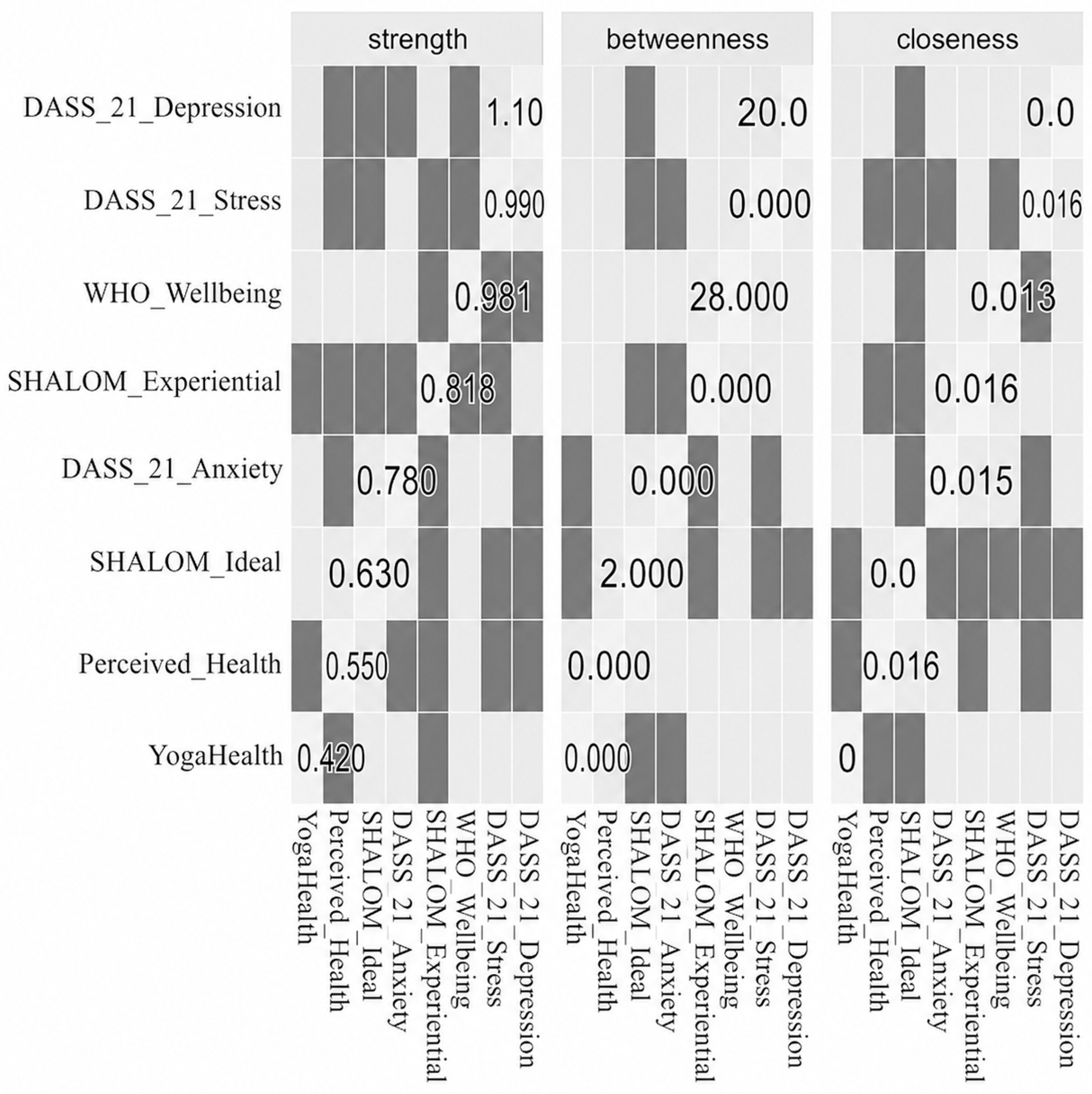
| WHO-5 Wellbeing | 1.874 | 1.958 | 0.884 | −1.395 |
| DASS-21 Depression | 1.142 | 0.752 | 0.798 | −0.227 |
| SHALOM Experiential | 0.228 | 0.098 | 0.983 | 1.805 |
| SHALOM Ideal | −0.503 | −0.349 | 0.269 | 0.595 |
| DASS-21 Stress | −0.685 | −0.313 | 0.215 | 0.311 |
| DASS-21 Anxiety | −0.685 | −0.494 | −0.333 | 0.400 |
| Perceived Health | −0.685 | −0.209 | −0.947 | −0.641 |
| Yoga Frequency | −0.685 | −1.444 | −1.868 | −0.849 |
| Predictor | B | SE B | β | t | p | 95% CI for B | VIF |
|---|---|---|---|---|---|---|---|
| SHALOM_B Environmental | 0.080 | 0.028 | 0.136 | 2.85 | 0.005 | [0.025, 0.135] | 1.39 |
| SHALOM_B Transcendent | 0.017 | 0.018 | 0.043 | 0.93 | 0.354 | [−0.019, 0.053] | 1.29 |
| Depression | −0.228 | 0.042 | −0.362 | −5.41 | <0.001 | [−0.310, −0.145] | 2.74 |
| Anxiety | 0.072 | 0.043 | 0.104 | 1.68 | 0.094 | [−0.012, 0.156] | 2.37 |
| Stress | −0.116 | 0.039 | −0.198 | −2.98 | 0.003 | [−0.192, −0.039] | 2.69 |
| Weekly yoga frequency | 0.145 | 0.059 | 0.104 | 20.44 | 0.015 | [0.028, 0.261] | 1.12 |
| Perceived health | 1.087 | 0.186 | 0.256 | 5.86 | <0.001 | [0.721, 1.452] | 1.17 |
Disclaimer/Publisher’s Note: The statements, opinions and data contained in all publications are solely those of the individual author(s) and contributor(s) and not of MDPI and/or the editor(s). MDPI and/or the editor(s) disclaim responsibility for any injury to people or property resulting from any ideas, methods, instructions or products referred to in the content. |
© 2026 by the authors. Licensee MDPI, Basel, Switzerland. This article is an open access article distributed under the terms and conditions of the Creative Commons Attribution (CC BY) license.
Share and Cite
Bosnyák, D.; Tornóczky, G.J.; Szabo, A. Mapping Conditional Associations Among Wellbeing, Distress, Spirituality, and Yoga Practice: A Network Analysis. Healthcare 2026, 14, 2293. https://doi.org/10.3390/healthcare14152293
Bosnyák D, Tornóczky GJ, Szabo A. Mapping Conditional Associations Among Wellbeing, Distress, Spirituality, and Yoga Practice: A Network Analysis. Healthcare. 2026; 14(15):2293. https://doi.org/10.3390/healthcare14152293
Chicago/Turabian StyleBosnyák, Dorottya, Gusztáv József Tornóczky, and Attila Szabo. 2026. "Mapping Conditional Associations Among Wellbeing, Distress, Spirituality, and Yoga Practice: A Network Analysis" Healthcare 14, no. 15: 2293. https://doi.org/10.3390/healthcare14152293
APA StyleBosnyák, D., Tornóczky, G. J., & Szabo, A. (2026). Mapping Conditional Associations Among Wellbeing, Distress, Spirituality, and Yoga Practice: A Network Analysis. Healthcare, 14(15), 2293. https://doi.org/10.3390/healthcare14152293