Article

Association of Type D Personality with Disability and Quality of Life in Patients with Chronic Nonspecific Low Back Pain

by
Esra Şahingöz Bakırcı
1,
Muhammed Balcı
2 and
Tuğba Alışık
2,*
1
Department of Physical Medicine and Rehabilitation, Faculty of Medicine, Yozgat Bozok University, 66000 Yozgat, Türkiye
2
Department of Physical Medicine and Rehabilitation, Faculty of Medicine, AIBU İzzet Baysal Physical Treatment and Rehabilitation Training and Research Hospital, Bolu Abant İzzet Baysal University, 14030 Bolu, Türkiye
*
Author to whom correspondence should be addressed.
Healthcare 2026, 14(11), 1439; https://doi.org/10.3390/healthcare14111439

Submission received: 19 March 2026 / Revised: 13 May 2026 / Accepted: 19 May 2026 / Published: 22 May 2026

Abstract

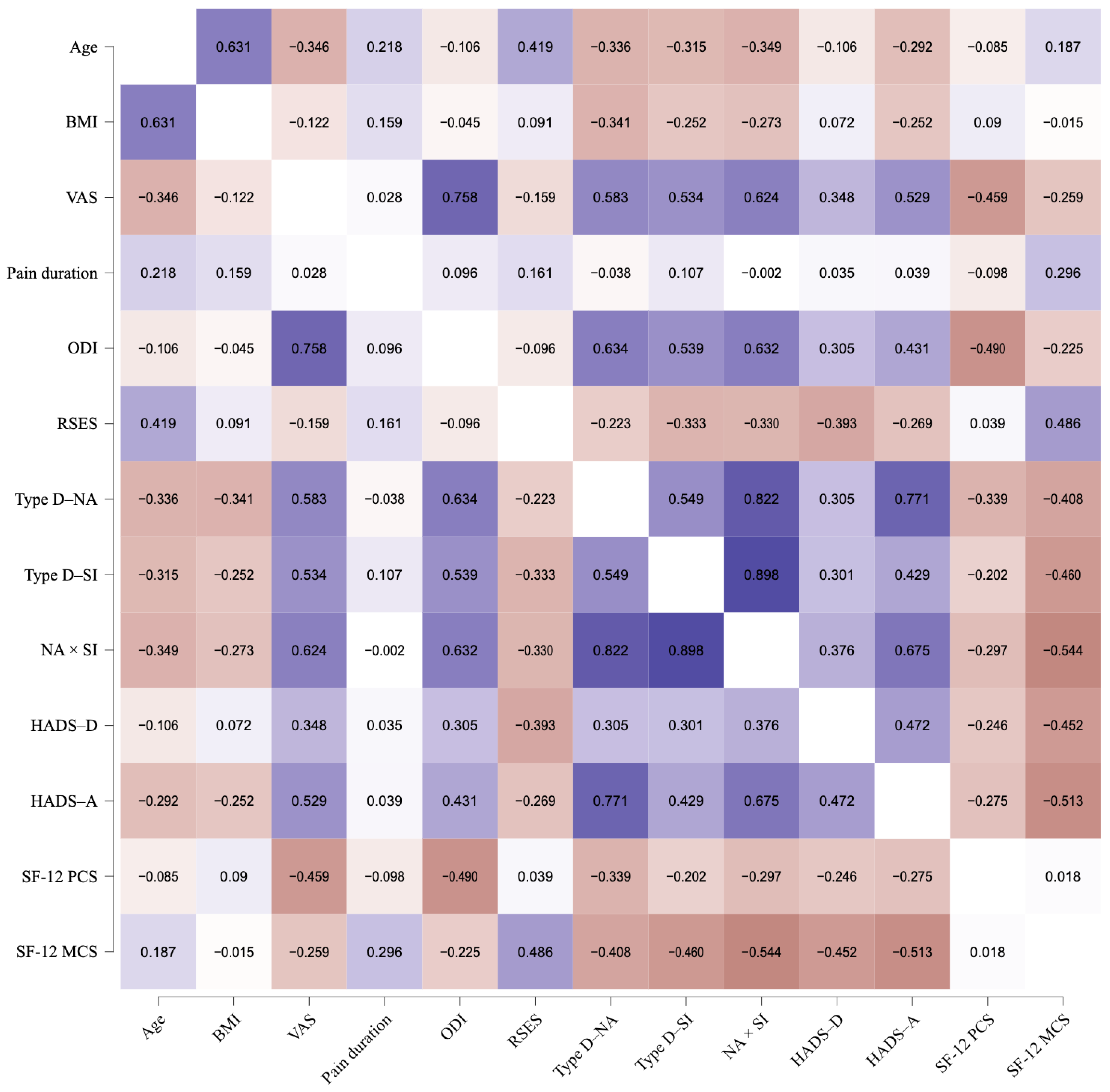
Background and Objectives: This research aimed to compare Type D personality characteristics and self-esteem between individuals with chronic NSLBP and healthy controls, while also exploring their relationships with functional status, psychological symptoms, and quality of life within the patient group. Materials and Methods: In this cross-sectional investigation, 34 patients with chronic NSLBP were compared with 34 healthy controls with similar age and sex distribution. Pain intensity was quantified via the Visual Analog Scale (VAS), while functional impairment was evaluated using the Oswestry Disability Index (ODI). Psychological profiling included the Type D Scale-14 (DS14) for personality traits, the Rosenberg Self-Esteem Scale (RSES) for self-worth, and the Hospital Anxiety and Depression Scale (HADS) for emotional distress. Health-related quality of life was captured through the 12-Item Short Form Health Survey (SF-12). Results: Type D personality was significantly more prevalent in the NSLBP group than in controls (50% vs. 20.6%, p = 0.011). Patients with NSLBP had significantly higher negative affectivity (NA) scores (p < 0.001) and anxiety scores (p = 0.007) and lower SF-12 Physical Component Summary scores (p < 0.001) than controls. Pain intensity and disability were positively correlated with Type D personality traits, particularly NA and the Type D composite score. In exploratory subgroup analyses, patients with Type D personality also had higher pain intensity, disability, anxiety, and depression scores and lower SF-12 Mental Component Summary (MCS) scores than those without Type D personality. In adjusted regression analyses within the NSLBP group, Type D personality was associated with higher VAS (p = 0.004) and ODI scores (p = 0.007) and lower SF-12 MCS scores (p = 0.003). Conclusions: Type D personality characteristics were more frequent in patients with chronic NSLBP than in healthy controls and were associated with higher pain intensity, greater disability, higher anxiety and depressive symptom scores, and poorer mental quality-of-life scores within the patient group. In contrast, self-esteem did not differ significantly between patients and controls. Due to the inherent constraints of a cross-sectional framework and the potential construct redundancy between NA and emotional distress, the current results signify correlational links rather than definitive causality. Consequently, subsequent prospective research is vital to delineate the temporal dynamics and the long-term predictive value of Type D personality traits in the progression of chronic NSLBP.
Keywords: low back pain; chronic; type D personality; self concept; disability evaluation; quality of life low back pain; chronic; type D personality; self concept; disability evaluation; quality of life