1. Introduction
The evolution of social media has radically transformed the way individuals communicate or express emotions and seek support during times of mental distress. Twitter and Reddit allow mass expression and result in a high-volume stream of text, which, when properly utilized, can reinforce the work of public health surveillance by allowing the population-wide monitoring of mental health indicators. Nevertheless, one of the main methodological issues is to transform these enormous, unstructured, and noisy streams of data into credible psychological constructs. Mental health conditions are generally accepted as one of the critical public health issues in the world; according to the World Health Organization (WHO), hundreds of millions of individual’s experience depression, and a significant number of deaths occur every year due to suicide [
1]. Such challenges can also be seen in student and young adult groups as the symptoms of anxiety, depression, and suicidal ideation are often common in these groups, which highlights the necessity of scaling and making screening methods more accessible [
2]. Timely intervention and detection at an early age is vital, and many people do not receive conventional mental healthcare services because of stigma and financial or geographical access, as well as a lack of awareness [
3]. In this respect, social media-based monitoring can serve as an auxiliary tool that would assist in detecting possible risk indicators at an earlier stage and aid in human-in-the-loop triage but should not be regarded as a part of clinical diagnosis and treatment trajectories.
With the widespread use of digital media, the use of Artificial Intelligence (AI) as a tool to identify mental health problems from written material has expanded rapidly in recent years. The traditional machine learning models, such as Support Vector Machines (SVM) and Random Forests, were reported to achieve moderate success in mental health classification [
4,
5]. However, they are often limited in mental health forums because the features are hand-engineered and not expressive enough for the semantic complexity or context nuances in figurative language commonly used in recovery-focused narratives. The introduction of deep learning with transformer architectures, and in particular Bidirectional Encoder Representations from Transformers (BERT) [
6], has brought NLP to new frontiers with the ability for bidirectional context modeling. It can produce state-of-the-art results on tasks such as sentiment analysis, emotion recognition, and mental health classification [
7]. When fine-tuned to domain-specific corpora, it can also capture subtle linguistic cues of distress and suicidal ideation apparent in casual or metaphorical language [
8]. However, BERT processes individual posts and may therefore miss larger behavior patterns and relationships across user communities. A complementary approach that has emerged to compensate for this limitation is graph-based modeling. Graph Neural Networks (GNNs) can model the relational dependencies between users and posts, reflect how content propagates, and discover regularities in community evolution [
9,
10].
Recent research has investigated graph-based models for mental health analysis with various types of GNNs, such as Graph Convolutional Networks (GCN) and its variants. However, unlike these studies, this paper does not contribute to the introduction of graph-based modeling, but the integration of contextual text representation, bio-inspired feature learning, and inductive graph reasoning in a single, reproducible framework. Moreover, this study utilizes GraphSAGE given its inductive nature, which enables the inference of unseen nodes. This feature is crucial for user-disjoint evaluation, where unseen test users do not exist during training, and allows for more realistic off-the-shelf deployment in contrast to transductive approaches such as GCN or GAT.
In contrast to the success of both transformer-based and graph-based methods, two significant challenges remain, which consist of (1) efficient feature processing on high-dimensional and noisy spaces created by social media data, and (2) powerful learning results that are well generalized as well as robust. These tasks are well-known to bio-inspired metaheuristic algorithms that have shown successful techniques for feature selection and hyperparameter tuning. A very important algorithm, which has demonstrated its high performance in combining exploration and exploitation that it is of particular importance for selecting the most useful discriminative features in a high-dimensional background, is the Secretary Bird Optimization (SBO) algorithm [
11]. When integrated into deep learning pipelines, SBO can benefit those with improvements in accuracy, as well as decreases in overfitting and the reduction in computational costs [
12].
We present a new hybrid AI framework, which combines transformer-based contextual language modeling with community-level graph reasoning as well as bio-inspired feature optimization for mental health surveillance on social media. First, a pipeline of SBO-based feature selection is used to better understand an assortment of linguistic and psychological features. We then pass those features through a fine-tuned BERT model and generate deep contextual embeddings. A Convolutional Neural Network (CNN) layer is employed with BERT outputs to better recognize localized high-risk expressions; this helps the model capture short, discriminative phrase patterns. The second is a GNN module that models the user–post interaction graph to learn relational patterns and detect high-risk clusters in the communities, as well as behavioral propagation. Key components within the framework are explainability and ethics compliance. Interpretability of both local and global predictions is explained using Explainable AI (XAI) methods such as SHapley Additive exPlanations (SHAP) and Local Interpretable Model-Agnostic Explanations (LIME). These methods not only highlight important tokens, phrases, and additional features on which the classification is based as a post-processing step (crucial for clinical validation and trust), but also sort them automatically. We test the suggested framework using two publicly available benchmark datasets that are commonly used in research of mental health NLP: eRisk [
13] and CLPsych [
14]. In addition, Reddit-based mental health classification has been widely explored in prior studies, including contextualized classification of Reddit posts using DSM-5 categories for web-based intervention [
15]. The two datasets are both based on Reddit and are used to label risk indicators that are related to mental health with clinical labels. Although user-disjoint evaluation has been adopted as the standard evaluation protocol for early risk prediction (e.g., eRisk), this study adopts the same protocol for practical and reproducible generalization, rather than claiming originality.
This study is motivated by the need for multi-level mental health modeling in social media, and unlike previous research that mostly concentrates on either post-level classification or feature engineering, this paper focuses on a multi-level approach to model mental health in social media. Psychological signals are multi-faceted and include (i) linguistic and psychological features, (ii) contextual and local semantic expressions of each post, and (iii) user- and community-level relations. Current methods may focus on these separately, resulting in partial representations. To resolve this issue, we develop an integrated, multi-stage model in which each stage targets a specific problem in the modeling process: (i) feature optimization (SBO), (ii) semantic and local modeling (BERT + CNN), (iii) community and relational modeling (Graph Neural Networks), and (iv) explainability and trustworthiness for decision-making (SHAP/LIME). This approach allows for integrating different learning paradigms instead of simply integrating different techniques.
The key contributions of this paper are listed below:
- ➢
We design a multilevel text-based approach to model mental health status by incorporating feature-level, post-level, and community-level information for detecting depression and suicide.
- ➢
We propose a hybrid BERT-CNN representation module to integrate contextual semantic features and boost phrase-level risk pattern recognition in social media text.
- ➢
We investigate SBO-based bio-inspired feature selection to compact high-dimensional handcrafted linguistic and psychological features while retaining clinically relevant indicators.
- ➢
We combine GraphSAGE-based community reasoning, as well as explainability and calibration analysis with SHAP/LIME to enable interpretable, leakage-free, and reproducible evaluation with a user-disjoint protocol.
Overall, this paper attempts to fill the gap between individual mental health detection and community behavioral analysis on social media. Our proposed system, comprising state-of-the-art NLP and relational modeling, integrated with bio-inspired optimization in an explainable and ethically sound framework, provides a scalable, i.e., interpretable and robust solution to detect mental health crisis proactively. The remaining part of this paper is organized as follows:
Section 2 discusses the related work on AI-based mental health detection, community, and feature optimization.
Section 3: It is separated into three parts, i.e., proposed methodology, feature selection, and model architecture with community-level reasoning.
Section 4: datasets, experimental setup, and evaluation measurement, provides the results and discussion of comparative and ablation studies. The last
Section 5 wraps up our work and addresses future development.
2. Related Work
Initial research on mental health detection using social media was mainly based on conventional machine learning pipelines that involve the integration of manually engineered features and shallow classifiers. Sentiment through lexicon and linguistic characteristics combined with SVMs was applied to screening depression and Post-Traumatic Stress Disorder (PTSD) in short text [
16], and behavioral/interaction alerts based on Reddit usage were investigated to predict the risk of postpartum depression [
17]. Even though these strategies are interpretable and work well in limited contexts, they tend to miss context-based nuance, figurative language, and long-range dependencies where mental health disclosures often occur.
In order to address these shortcomings, there was a research transition to deep neural models in representation learning and text classification. CNNs, LSTMs, and hybrid RNN-CNN architectures enhanced performance by learning discriminative patterns directly from text [
18]. This was further advanced by transformer-based models, which enable bidirectional context modeling and strong transfer learning; BERT-style encoders have been successfully used to detect suicidal ideation, depression, and stress, and generally outperform earlier baselines [
19,
20,
21,
22]. Later works explore domain-adaptive and mental-health-specific transformer variants to better capture conversational patterns [
23,
24], with comparative studies demonstrating the effectiveness of transformer encoders over recurrent models [
25]. However, many transformer-based systems remain post-centric, focusing on individual posts or aggregated user summaries without explicitly modeling relational structures between posts and users.
Graph-based learning has been introduced to address this limitation by modeling relationships such as authorship, interactions, and semantic similarity through graph structures. Graph convolutional models have been used to analyze depression prevalence and identify community-level patterns [
26], and temporal GNN extensions have been proposed to track changes in psychological states over time [
27]. These studies demonstrate that graph-based modeling is already an established approach in mental health analysis, including explicit graph construction in several prior works. However, several practical challenges remain: (i) incomplete or inconsistent graph schema specification (e.g., unclear node and edge definitions), (ii) limited emphasis on controlled evaluation settings, particularly with respect to avoiding information leakage across user splits, and (iii) limited integration of graph reasoning with strong contextual encoders and feature optimization within a unified pipeline.
Another line of research focuses on improving efficiency and robustness through meta-heuristic optimization, particularly for high-dimensional feature selection. Systematic reviews show that such methods can reduce redundancy and improve generalization in text classification [
28]. The Secretary Bird Optimization (SBO) algorithm has been introduced as a competitive global optimizer with an effective exploration–exploitation balance for selecting compact feature subsets [
29]. However, in mental health NLP, bio-inspired optimization is often applied as a standalone preprocessing step or alongside shallow classifiers, with limited evidence of its integration with transformer-based representations in end-to-end frameworks.
In addition to predictive performance, transparency, reliability, and responsible deployment are critical for real-world mental health applications. Explainable AI techniques such as SHAP and LIME are widely used to interpret model predictions by highlighting influential features [
30,
31,
32]. Ethical and governance-oriented research emphasizes privacy, risk mitigation, and responsible use in surveillance settings [
33,
34], while more recent studies address fairness and bias across heterogeneous populations [
35]. Complementary directions include multimodal depression detection using speech and facial cues [
36,
37], longitudinal modeling of suicide risk patterns [
38,
39], and domain adaptation for cross-platform generalization [
40,
41]. Lightweight and real-time pipelines have also been proposed for crisis monitoring, highlighting the importance of deployable and uncertainty-aware systems [
42,
43].
In general, previous research has considered transformer-based modeling, graph-based reasoning, feature selection, and explainability as either independent or loosely interrelated components. Thus, this study has not contributed individually to the use of these techniques, but rather to their integration in a single and reproducible system. Although user-disjoint evaluation has been widely adopted for early risk prediction tasks, it is adopted here primarily for realistic generalization rather than as a contribution. In addition, although inductive GraphSAGE is used to enable generalization to unseen nodes, this study does not claim to directly compare the performance of this GNN variant with other alternatives, which is left as future work.
Table 1 summarizes prior studies, highlighting that existing approaches typically address contextual modeling, graph-based reasoning, and feature optimization independently.
3. Proposed Framework
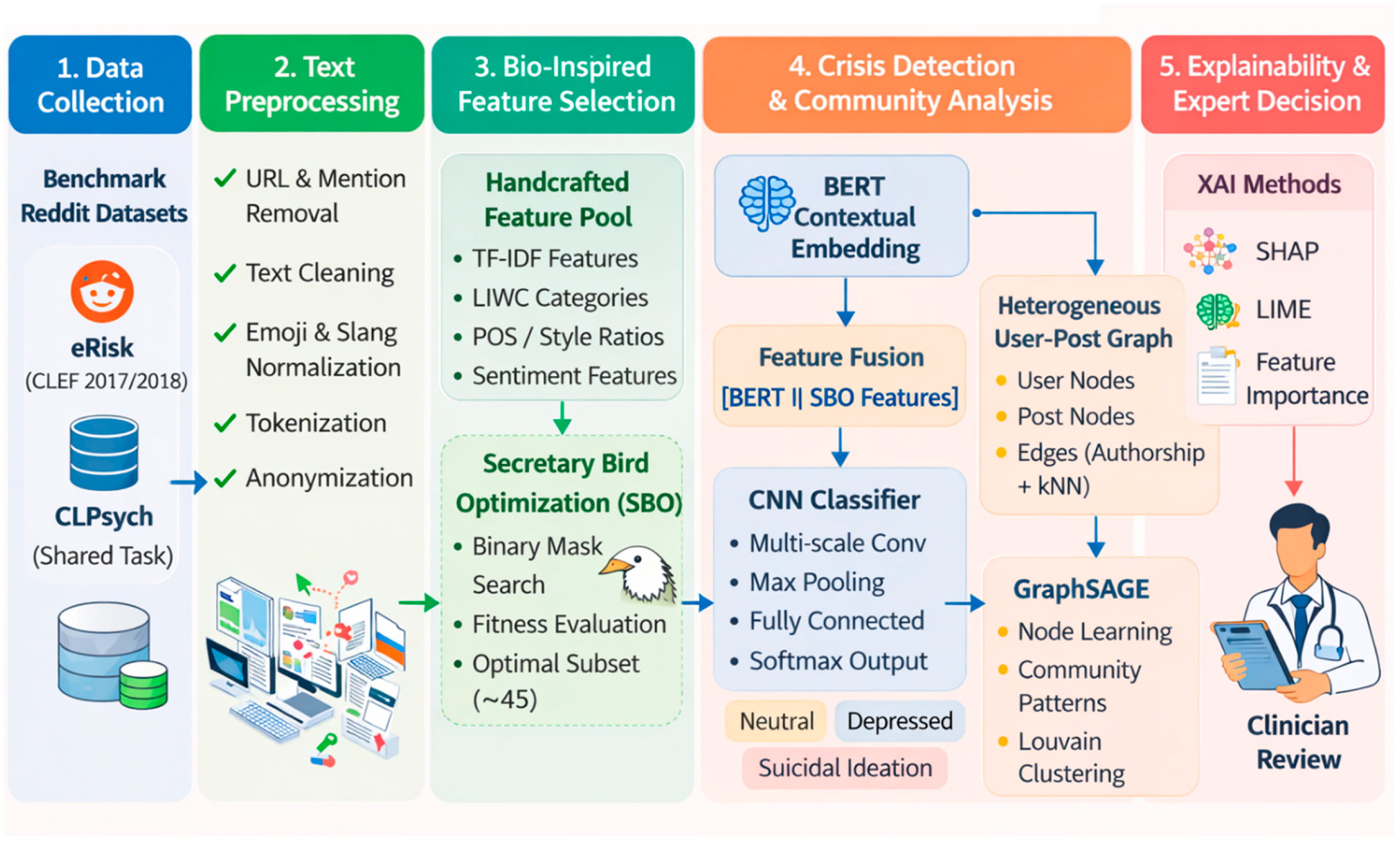
The suggested framework offers a strong, interpretable, and community-conscious solution to identifying mental health crises and trends from social media content. It combines four main AI modules: (1) bio-inspired feature extraction, (2) transformer contextual embeddings, (3) CNN-augmented crisis identification, and (4) graph neural networks (GNNs) for inference at the community level, with a final Explainable AI (XAI) layer for ensuring interpretability and ethical transparency, as shown in
Figure 1.
These modules are motivated by specific limitations of the existing approaches, rather than arbitrary design. Specifically, transformer-based models like BERT are well-suited to capture contextual semantics but lack a focus on local expressions of crisis that drive the use of CNN for phrase-level pattern extraction. Moreover, most current methods focus on the post level and do not model relational dependencies between users and posts; this is remedied with the use of an inductive Graph Neural Network (GraphSAGE) for user community-level inference. Moreover, manually designed psychological and linguistic features are informative but lead to a high-dimensional and redundant feature space, which is addressed through the Secretary Bird Optimization (SBO) algorithm for feature selection. Finally, due to the sensitive nature of applications in mental health, explainability and reliability are achieved via SHAP, LIME, and calibration analysis to ensure explainability, trust, and accountability. These modules combine to create a complementary and necessity-based architecture, rather than an amalgam of prior approaches.
The pipeline starts with a data acquisition module that ingests social media posts publicly available on platforms like Reddit and Twitter, which have keywords and metadata that are related to mental health. Various experiments in this study are all performed on released Reddit benchmark datasets (eRisk and CLPsych) only. Preprocessing is performed on the text before modeling, noise is removed, identifiers are anonymized, slang and emojis are normalized to standardize the text, making it robust to extract the features and downstream learning. To process the sparse, noisy, and high-dimensional inputs, Secretary Bird Optimization (SBO) is employed to select the most informative linguistic and behavioral features, including TF-IDF words, sentiment scores, part-of-speech ratios, and LIWC categories. This yields a small, high-quality feature set for deep learning. A finely tuned BERT model then projects all the posts into rich contextual embeddings. These embeddings are then passed through a Convolutional Neural Network (CNN), which extracts local phrase-level patterns and affective cues typical of depression or suicidal ideation. To generalize beyond per-post classification, a user–post interaction graph is learned by a GNN module where posts or users are nodes and interactions like replies, mentions, or co-occurring hashtags are edges. With GraphSAGE, the model detects clusters of high-risk and monitors potential escalation patterns within communities. Performance assessment is conducted through the utilization of precision, recall, F1-score, and ROC-AUC metrics on standardized datasets, including eRisk and CLPsych. To ensure transparency, SHAP and LIME methodologies emphasize significant tokens and features, thus facilitating interpretability for clinicians, moderators, and researchers. Overall, the method accomplishes three things: (1) correct high-risk content detection, (2) detection of community-level trends in mental health, and (3) ethically sound, interpretable decision-making.
4. Data Collection and Preprocessing
The suggested mental health surveillance construct is based on the prudent preparation of quality textual information that is acquired from open sources. The two fundamental elements of this step include (i) selection of the dataset and clear specification of tasks and label harmonization, and (ii) standardized preprocessing to make sure that the data sent to the next models are salient, consistent, and least influenced by platform noise.
4.1. Datasets and Ethical Use
The experiments are conducted using two publicly available Reddit-based benchmark datasets, eRisk and CLPsych Shared Task dataset. It is worth noting that the datasets are not synthetic, but these are standard benchmark datasets originally built from real Reddit data and distributed in research shared tasks (CLEF eRisk and CLPsych). The Kaggle links provided in this paper refer only to the mirror distributions of these datasets for ease of access, and do not represent a different (synthetic) data source. eRisk has user-level timelines that are curated to perform timely risk detection (i.e., depression-related disorders) on long user histories, and CLPsych includes posts annotated with suicide risk and related psychological issues using expert-determined protocols. The datasets are utilized as distributed by their terms; no effort is made to find, contact, or otherwise engage with any of the people depicted in the data.
4.1.1. Harmonization of 3-Class Task Definition and Labels
Since eRisk and CLPsych were originally released under different shared-task formulations, we establish a unified 3-class label space consisting of Neutral, Depressed, and Suicidal Ideation to enable consistent evaluation across datasets. It is crucial to clarify that the annotations are not changed. The eRisk dataset includes only labels for depression risk, but not an explicit label for “Suicidal Ideation”. On the other hand, suicide-related labels are obtained from the CLPsych dataset only. As a consequence, the harmonization process introduces an alignment between different label spaces at the time of evaluation, without re-labeling the data. The claim “no re-labeling” means that we do not change the labels of the original datasets. The set of mapping rules used is shown in
Table 2.
4.1.2. Splits and Leakage Control of the Datasets (User-Disjoint)
To avoid leakage and provide a realistic generalization, we adhere to a strict user-disjoint splitting: posts of an individual user are in a single split (train/validation/test). This is especially significant to mental health NLP since the user-specific linguistic characteristics may artificially exaggerate performance in the post-level splitting. To be complete and reproducible, we have provided the user-level dataset statistics employed under the split protocol adopted, i.e., (i) the number of users in the dataset and each split, (ii) posts-per-user distribution (median/IQR) shown in
Table 3.
4.1.3. Text Preprocessing
Since social media text is noisy and conversational, a unified preprocessing pipeline is implemented on both datasets to minimize variance even though clinically meaningful cues are retained.
Figure 2 shows that preprocessing involves URLs and user mentions removal, casing/whitespace normalization, token- level cleaning, elongated/stretched word normalization, and emoji/emoticon transliteration in order to retain the affective intent. Any identifying strings are encrypted in order to protect privacy. This standardized preprocessing enhances robustness and lowers consistency representations before feature extraction and modeling.
Finally,
Table 4 gives an annotated sample of representatives in eRisk and CLPsych, which shows the variety of linguistic expressions and the homogenous mental health categories applied in this research.
4.2. Feature Selection Using Secretary Bird Optimization (SBO)
Textual indicators (TF-IDF, LIWC, POS-like ratios, sentiment cues) are handcrafted contextual embeddings supplementing contextual embeddings and depict explicit patterns of affect and style that can be utilized in mental health risk prediction. The full handcrafted pool, however, is high-dimensional and redundant, which adds risk of overfitting and computation to it. We thus use Secretary Bird Optimization (SBO) to use a small group of handcrafted features and retain predictive utility. The SBO algorithm is applied to enable joint optimization of diverse feature groups towards a single objective. Classical methods like L1-regularized linear regression (LASSO), recursive feature elimination (RFE), and mutual information-based methods are also viable alternatives, but SBO is used here as a general meta-heuristic that can learn non-linear interactions. This paper does not claim to be superior to all of these approaches, but provides an example of SBO as an optimization algorithm for the proposed framework.
Table 5 lists the handcrafted feature pool size and SBO setting, with the original 5110-dimensional feature pool containing 5000 TF-IDF word n-gram features and 110 engineered linguistic and psychological features. The 110 engineered features consist of 93 features from LIWC, 12 POS/style ratio features and 5 sentiment features. SBO optimally reduces this 5110-dimensional feature pool to a subset of 45 features, which is used as final feature set in the proposed approach
Let the feature pool (crafted by hand) be F of total dimensionality N. All SBO candidate solutions are binary masks. The binary mask representation of each candidate solution is defined in Equation (1)
The fitness function optimized by SBO is given in Equation (2), where classification performance is maximized while larger feature subsets are penalized:
Here, is the mean accuracy from -fold cross-validation within the training split, and penalizes overly large subsets. SBO’s fitness function uses inner cross-validation to ensure that no validation or test data are used for training. This approach reduces the possibility of overfitting and avoids data leakage between splits in the user-disjoint setting. After convergence (or reaching the iteration limit), SBO outputs and the selected subset .
In our experiments, SBO selected 45 handcrafted features, whereas RF-importance retained 73, giving a 38.36 reduction in selected dimensionality. The percentage reduction in selected dimensionality relative to the RF-based baseline is computed using Equation (3):
The reduction in features is due to a compact and less redundant feature space; however, some features may still contain a weak signal predictive of suicide, and we will leave a detailed ablation study of features removed for future work.
All corpus-dependent statistics (TF-IDF vocabulary/IDF, scaling) are fitted on training data only and then applied unchanged to validation/test to prevent leakage. Some selected features are explicit lexical clues (e.g., suicide keywords), but the framework augments these with contextual and graph embeddings, making it less dependent on the presence of keywords for detection. The top-ranked selected features are reported in
Table 6. We perform feature selection separately with the same protocol for each dataset. We do not presume that the selected features are transferable across datasets.
While some selected features represent explicit lexical cues (e.g., suicide-related words), the proposed model is not solely based on keyword matching. These explicit cues are integrated with contextual embeddings of BERT-CNN and graph-based representations, and reliance on lexical cues is reduced, leading to better contextualization
4.3. Contextual Embedding with BERT
For better mitigation of diverse syntactic and emotional aspects involved in targeted social media posts, the system utilizes BERT Bidirectional Encoder Representations from Transformers as its core contextual encoder by capturing co-related bidirectional attention to catch up with underlying subtle linguistic cues relevant to depression, anxiety, and suicide intention. Static embeddings (i.e., Word2Vec, GloVe) cannot capture contextual information and will not be able to make sense of phrases that are charged emotionally or written sarcastically in nature, unlike BERT which generates dynamic context-aware representations. The pre-trained BERT-base (12 layers, 768 hidden units, 12 attention heads) model is fine-tuned for domain adaptation on the mental health datasets–eRisk and CLPsych), which treats each post as an independent sample with every tokenized by the WordPiece tokenizer and prepended with a [CLS] token along with additional attention masks and segment embeddings. Where h[CLS] is the final hidden state of the token [CLS] which is used to represent/write down the entire sequence and then sent it to a Fully connected layer for classification. The post-level contextual representation generated from the [CLS] token is transformed for classification as expressed in Equation (4)
Here W and b are learnable parameters. Optionally, optimal features from SBO (e.g., LIWC scores, POS ratios) can be concatenated with h[CLS], to have a fused vector. The fusion of the BERT contextual representation with SBO-selected handcrafted features is formulated in Equation (5)
better exploit the complementarity of LIWC and POS, for example. These embeddings are then passed to the CNN layer for local pattern detection, as node features in GNN-based community analysis, and for Explainability through SHAP and LIME. Through this integration, the model learn at both the individual granular semantic level with specific clinical details and the community wide scale of behavior patterns important for mental health crisis detection.
4.4. Crisis Detection via BERT + CNN Hybrid
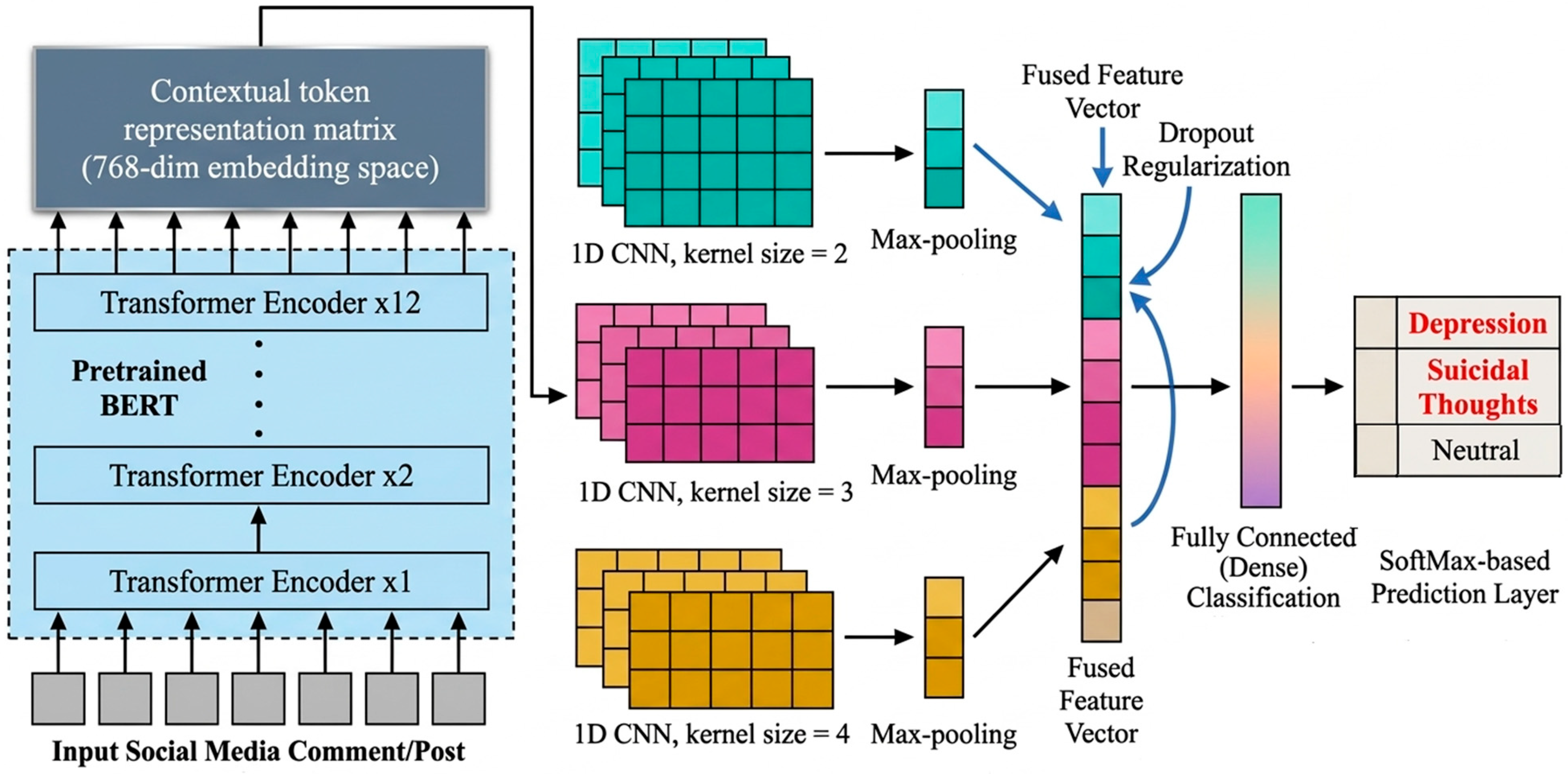
The proposed crisis detection module applies to a hybrid model that utilizes BERT and CNN to classify social media comments as depression, suicidal thoughts, or neutral (refer to
Figure 3). BERT generates contextual embeddings for each token,
, thus capturing bidirectional semantics. BERT may capture long-range dependencies, but the CNN is added to capture local phrase-level dependencies (e.g., short n-grams like “I hate myself”) that are not explicitly highlighted by attention. To enhance localized, strong expression detection (i.e., “I hate myself”), the convolution operation used to extract local phrase-level patterns from contextual embeddings is defined in Equation (6).
Each feature map is max-pooled to preserve the strongest activation, concatenated, and dropout regularized. The pooled and regularized feature representation obtained after convolution is expressed in Equation (7).
The final class probability computation through the fully connected SoftMax layer is given in Equation (8).
The model is cross-entropy loss trained with class weighting or oversampling for imbalance. Predicted labels and output activations are fed to the GNN module for community reasoning and the XAI module for interpretability. This architecture bridges BERT’s semantic depth and CNN’s phrase-level accuracy to support robust detection of mental health crises. The training objective of the BERT-CNN classifier is defined by the cross-entropy loss in Equation (9).
The output of the BERT-CNN module serves as the primary post-level prediction, which is subsequently used as input to the GNN for relational refinement and community-level reasoning. An ablation comparing other fusion strategies or models (e.g., without CNN, different fusion schemes) is out of the scope of this paper and is left for future work.
4.5. Community-Level Graph Reasoning with Graph Neural Networks
4.5.1. Task Definition and Learning Objective
The Graph Neural Network (GNN) has two somewhat different uses: (1) supervised mental health risk classification, and (2) unsupervised post hoc community analysis. In the proposed approach, the majority of the classification is performed by the BERT-CNN module, and the GNN module is used to supplement it by learning from the graph structure. During the supervised training, the GNN is used to classify post nodes’ mental health risk labels using gold-standard labels, primarily for learning the graph-aware features, rather than primary classification. The learned representations are used for community detection with no labels involved, to understand the risk structure at the community level. No labels are used for clustering, and the clustering process does not interfere with the supervised training. Therefore, the predictions are provided by BERT-CNN, and are refined by GNN based on community-level knowledge
4.5.2. Graph Construction and Schema
We build a heterogeneous user post graph G (V, E), with the node set V consisting of two classes of nodes: user and post nodes. Edges encode (i) authorship links connecting each post node to its author (user node) and (ii) semantic similarity links between posts. Cosine similarity between Bert + CNN representations is used to weigh semantic edges, and where applicable, interaction edges are weighted with normalized interaction frequency. Edges are all made undirected to indicate the reciprocal flow of information, and self-loops are introduced to retain the node-specific information in passing along the messages.
Semantic edge formation. For each post node , we compute cosine similarity between its BERT + CNN representation and all other post embeddings within the same split. To prevent any leakage, the BERT + CNN model for generating graph-construction embeddings is trained on the training set and then frozen for producing validation and test embeddings. As such, the edges of the validation/test graph are determined using frozen representations without access to validation/test labels. We then connect to its top nearest post neighbors (kNN) to form semantic edges. We tune on the validation set and select and , which yields a well-connected yet noise-controlled graph. Accordingly, an edge is retained only if ; otherwise, it is discarded. If fewer than neighbors satisfy the threshold, we keep all available neighbors above , resulting in a degree for that node. The semantic graph is symmetrized (undirected) by taking the union of KNN edges, and edge weights are set to . For stable message passing in GraphSAGE, we apply symmetric normalization to the weighted adjacency with self-loops, , where is the degree matrix and I add self-connections.
To clarify, cosine similarity is only used to determine initial graph structure and weights, and is not used for relational learning. The GNN is not redundant because GraphSAGE learns task-specific features for each node by aggregating its neighborhood over this graph structure. Unlike traditional pairwise similarity, GraphSAGE supports multi-hop neighborhood aggregation, so each post can propagate (and learn) from its related posts and users. Hence, the GNN provides community-scale relational reasoning on top of the semantic similarity-based graph construction.
4.5.3. Node Features and Message Passing
The nodes are set to be initially represented by the BERT-CNN representation, instead of the raw BERT embedding. The BERT representation captures contextual embeddings of a post, and the CNN learn fine-grained risk patterns from phrases. The BERT-CNN vector is used as the primary node feature vector for each post node in GraphSAGE. Linguistic and psychological features (TF-IDF, LIWC, sentiment, POS-based features) selected by SBO are concatenated as supplemental interpretable features. Aggregated user statistics can also be used. Output logits or class probabilities of BERT-CNN are only used as optional confidence-aware features and not as labels/pseudo-labels or supervision for GNN training. The GraphSAGE-based neighborhood aggregation and node representation update are defined in Equation (10).
where
denotes the embedding of node
at layer
,
represents the set of neighboring nodes of
, AGG refers to the aggregation function used to combine neighborhood information, such as mean, max, or attention-based aggregation, and
denotes a non-linear activation function, such as ReLU.
4.5.4. Supervised Training and Loss Function (Ground Truth Only)
The GNN is estimated by the cross-entropy loss based on labeled post nodes, with the labels being considered only based on the ground truth annotations of the benchmark datasets. Notably, no post-level predicted labels are used as training targets (i.e., no pseudo-label supervision is used); the model is trained only on labels of the ground truth dataset. Class-weighted cross-entropy is used in the supervised training to fix the issue of class imbalance, particularly in the case of suicidal ideation. It only uses supervision in the classification objective, but not in the community detection.
4.5.5. Community Detection and Analysis (Post Hoc, Unsupervised)
Upon training, the final-layer node embeddings are found and used with an unsupervised community detection algorithm, namely Louvain modularity optimization. This stage groups users and posts with similar learned representations, thus allowing qualitative and quantitative examination of risk structure at the community level. Community detection is thus applied only to analysis and does not interfere with the learnt classifier parameters.
4.5.6. Leakage Control and Evaluation Protocol
Training and message passing in a selected training split are limited to avoid information leakage. The graph of training is only built with training nodes and edges, and the GNN is optimized only with ground truth labels of training post nodes only; validation and test nodes (and their labels) are never used during training. It is embedded at inference time, by validation/test nodes, using the learned GraphSAGE aggregation function (inductive inference). In these evaluation nodes, the connection between two points is established based on a fixed, label-free semantic rule (e.g., top (k) nearest neighbors of text-based neighbors taking out BERT + CNN representations under cosine similarity), which enables graph connectivity to be generated using only the attributes of the text between pairs, not the labels. The embeddings derived on the evaluation split are then subjected to community detection, which does not interfere with the supervised classifier parameters and does not induce any bias in the reported classification results.
We use the same fixed graph construction hyperparameter (k = 15, τ = 0.60) across splits. Importantly, kNN retrieval and thresholding are performed within each split only (train graph from train nodes; test graph from test nodes) and the normalized adjacency, is computed per split, preventing cross-split edges and information leakage.
4.6. Model Evaluation Metrics
In order to evaluate the performance of the model, the important performance parameters, i.e., accuracy, precision, recall, F1-score and AUC were calculated using the following Equations
Community-level metrics, Modularity Score (cluster quality), Node Classification Accuracy and Silhouette Coefficient (cluster compactness/separability) are used for GNN Outputs. Rigorous evaluation based on multiple metrics ensures that the proposed method can achieve reliable detection, robustness under imbalance, and capture both individual and community-level mental health patterns.
4.7. Explainability and Ethical Considerations
Our proposed framework includes explanations and epistemic safeguards to promote transparency, trustworthiness, and responsible conduct in carrying out mental health surveillance. This article introduces Explainable AI techniques, based on SHAP (compute Shapley value for feature-specific word/phrase/SBO contribution to the prediction) and LIME (local surrogate model to characterize key terms for each classification), that are integrated to generate explanations from BERT + CNN/GNN module outputs at the global level as well as the instance level.
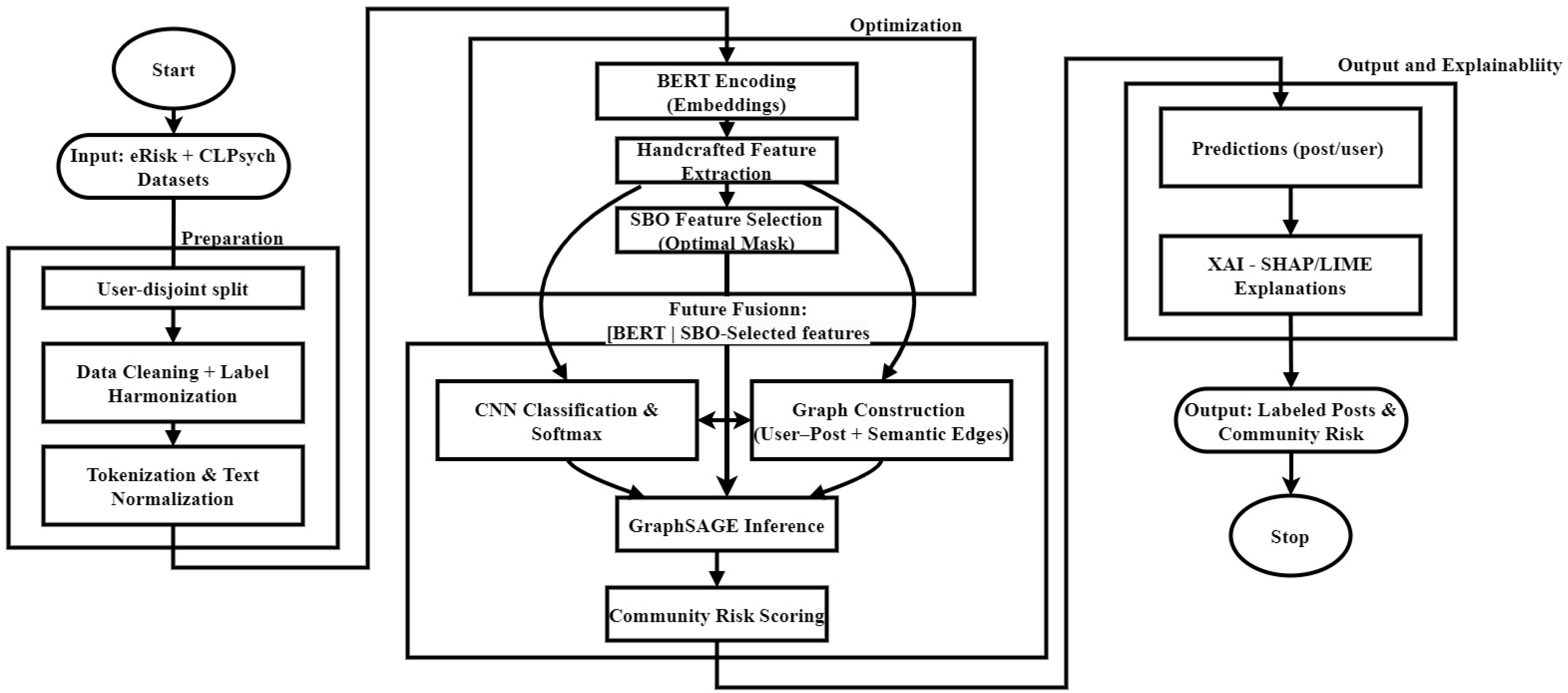
Maintained Ethical Compliance (Privacy & anonymity, publicly available data, PII Stripped, Dataset Licenses adherence; IRB Guidelines; Reducing Demographic Skew using Bias Mitigation Strategies). This high-risk prediction is not diagnostic and should be reviewed by a clinician before a planned intervention. Thus, the system consolidates interpretability, privacy-preserving and bias-aware practices for robust, fair and ethical human-centered deployment in sensitive mental health applications. To explain the process of operation of the proposed methodology, the full MENTAL_PIPELINE of transparent detection of crisis, with the description of each part of it, can be found in Algorithm 1 and
Figure 4, which starts with the benchmark data acquisition and processing and continues through SBO-directed feature selection, post-level classification with BERT and CNN, and community-level reasoning provided by GNNS. The pipeline also introduces XAI-based interpretability (e.g., SHAP/LIME) to interpret model decisions, thus delivering a structured and step-by-step end-to-end structure that aids in both precise prediction and responsible analysis.
| Algorithm 1: Explainable Crisis Detection via SBO-BERT-CNN with Inductive GraphSAGE Refinement |
Input: Labeled posts ; label map ; preprocessing Clean(⋅) and tokenizer Tok(•); handcrafted extractor with dimension ; SBO settings ; BERT encoder ; CNN head ; class weights with ; graph params ; GraphSAGE parameters ; Louvain; SHAP/LIME.
Output: Post predictions , optional graph-refined ; communities and risk scores ; explanations - 1.
Harmonize labels: . Create user-disjoint splits and datasets . - 2.
Preprocess + represent: For each , compute ,
- 3.
SBO feature selection: Use a binary mask with and selected features
then fix .
- 4.
BERT fusion embedding: Compute CLS , and fuse
- 5.
Post-level CNN classification: Obtain logits ,
Probabilities , and . Train by minimizing
- 6.
Leakage-free graph construction: For each split , build an isolated heterogeneous graph with nodes . Add authorship edges . Add semantic post-post edges using cosine similarity
- 7.
GraphSAGE refinement (inductive): For layer ,
For each post .
Train on with
then apply inductively to .
- 8.
Community risk scoring: Run Louvain to obtain communities . For each community,
- 9.
Explainability: Compute global SHAP summary and per-post local explanations using LIME/SHAP for tokens and SBO-selected features.
Return: , optional , and explanations |
5. Results and Discussion
5.1. Overall Performance of the Proposed Framework
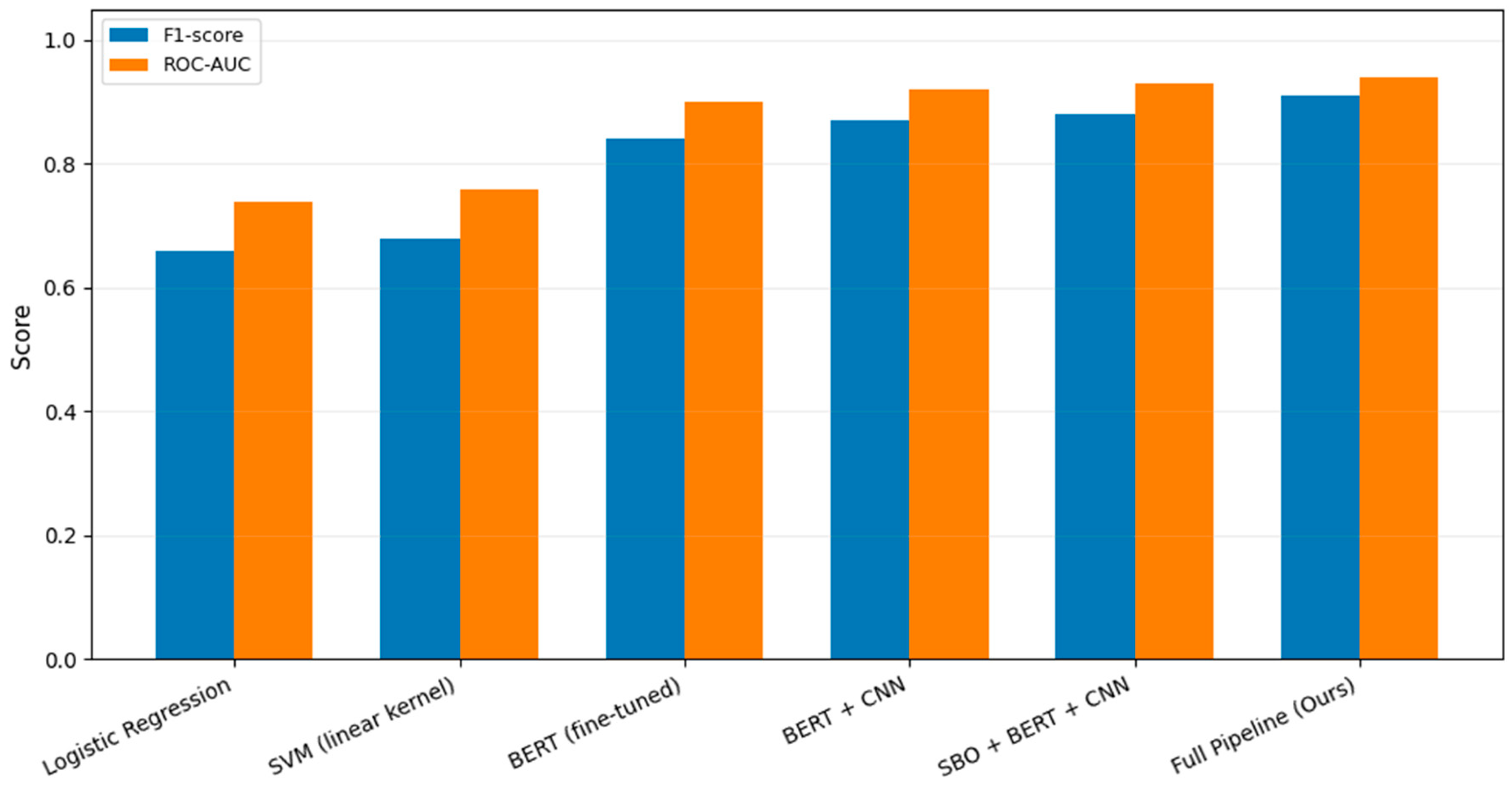
The hybrid framework is evaluated on eRisk benchmark dataset and CLPsych Shared Task dataset for identifying neutral, depressive and suicidal ideation social media posts. Under a strict user-disjoint evaluation protocol, the full SBO + BERT + CNN + GNN pipeline achieved the best overall performance among all compared methods, with an accuracy of 93.1%, F1-score of 0.91, and ROC-AUC of 0.944. These results indicate that the proposed framework provides robust and reliable detection of high-risk mental health content across benchmark datasets.
The suggested SBO + BERT + CNN + GNN pipeline was compared with classical classifiers (Logistic Regression, SVM) and deep learning baselines (BERT, BERT + CNN, SBO + BERT + CNN) on accuracy, precision, recall, F1-score, and ROC-AUC. As can be seen in
Table 7 and
Figure 5, classical models performed well on depressed and neutral classes but poorly on suicidal ideation. Fine-tuned BERT enhanced performance through contextual embeddings, and the addition of CNN enhanced recall and F1-score through local n-gram pattern capture. The addition of SBO enhanced feature dimensionality reduction without sacrificing accuracy, and GNN enhanced community-level risk detection through relational signals from user post graphs. The end-to-end pipeline had the best performance (Accuracy = 93.1%, F1 = 0.91, ROC-AUC = 0.944), indicating robustness in identifying high-risk mental health content.
5.2. User-Level Risk Aggregation Results
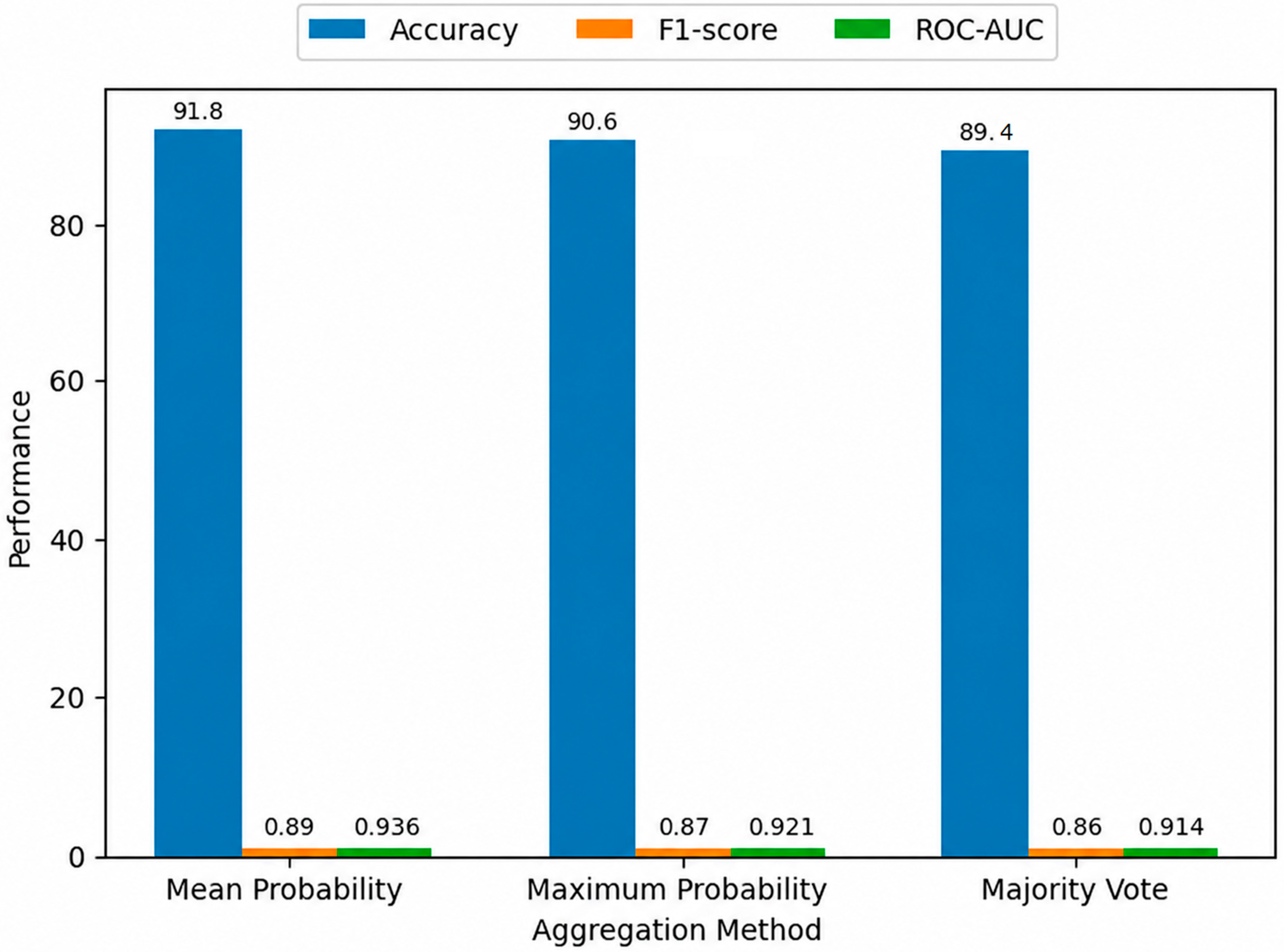
Mental health assessment is inherently user-friendly, although the model evaluation is carried on the post level. To test the hypothesis of post-level prediction being a reliable user-level risk predictor, we conducted a user-level aggregation analysis of both eRisk and CLPsych test splits using the current model predictions (not retrained). Post-level predictive probabilities were aggregated using three strategies, mean probability, maximum probability, and majority voting and the strongest user-level performance was obtained with mean probability aggregation (Accuracy = 91.8%, F1-score = 0.89, ROC-AUC = 0.936), as summarized in
Table 8. Maximum probability aggregation has competitive performance, but it is more prone to local high-risk posts, whereas majority voting performs poorly in the case of risk signals that are subtle or expressed intermittently across posts. The relative dynamics among the aggregation strategies are further demonstrated in
Figure 6 that indicates that the aspect of mean-based aggregation is more stable compared to the other methodologies. These findings suggest that the suggested framework generates coherent post-level predictions that can be successfully aggregated to useful user-level predictions of risk. Notably, the analysis is not a temporal early-risk detection analysis; instead, it indicates consistency between post-level and user-level analysis in an offline evaluation environment.
To ensure that user-level aggregation does not impact performance, user aggregation was performed only among the held-out test users using their post-level prediction probabilities. We did not use any posts from training/validation users. We also compared performance on users with different activity patterns, dividing users into low-activity users (1–2 posts), moderate-activity users (3–10 posts), and high-activity users (>10 posts), to see whether aggregation performance is consistent across varying distributions of post counts.
Besides the aggregated comparison in
Table 8 and
Figure 5, we also provide the per-dataset post-level results of eRisk and CLPsych to make sure that the overall gains are not based on one benchmark. As
Table 9 demonstrates, the proposed full pipeline obtains generally high accuracy, F1-score and ROC-AUC on both datasets, which confirms their cross-dataset robustness when using the same evaluation protocol of user-disjointing.
5.3. Class-Wise Performance and Error Characterization
Although general measures allow a general comparison on a global scale, mental health risk detection needs a class-sensitive assessment, especially when it comes to suicidal thoughts, which are usually a minority and the most at risk group. Accordingly, we also provide class-wise precision, recall, and F1-score of the suggested full pipeline in
Table 10 to confirm that the excellent overall results are not due to the majority neutral class alone.
As can be seen in
Table 10, the model has good results in all the classes and high recall in suicidal ideation, which is particularly relevant in screening-based contexts where conservative false alarms that are conservative are less damaging than missed high-risk posts. The model design gains belong to the class-wise gains: BERT is sensitive to contextual distress, CNN is sensitive to the identification of short spans on crisis-related situations, and SBO is sensitive to reducing the redundancy of noisy features that can hinder minority-class discrimination.
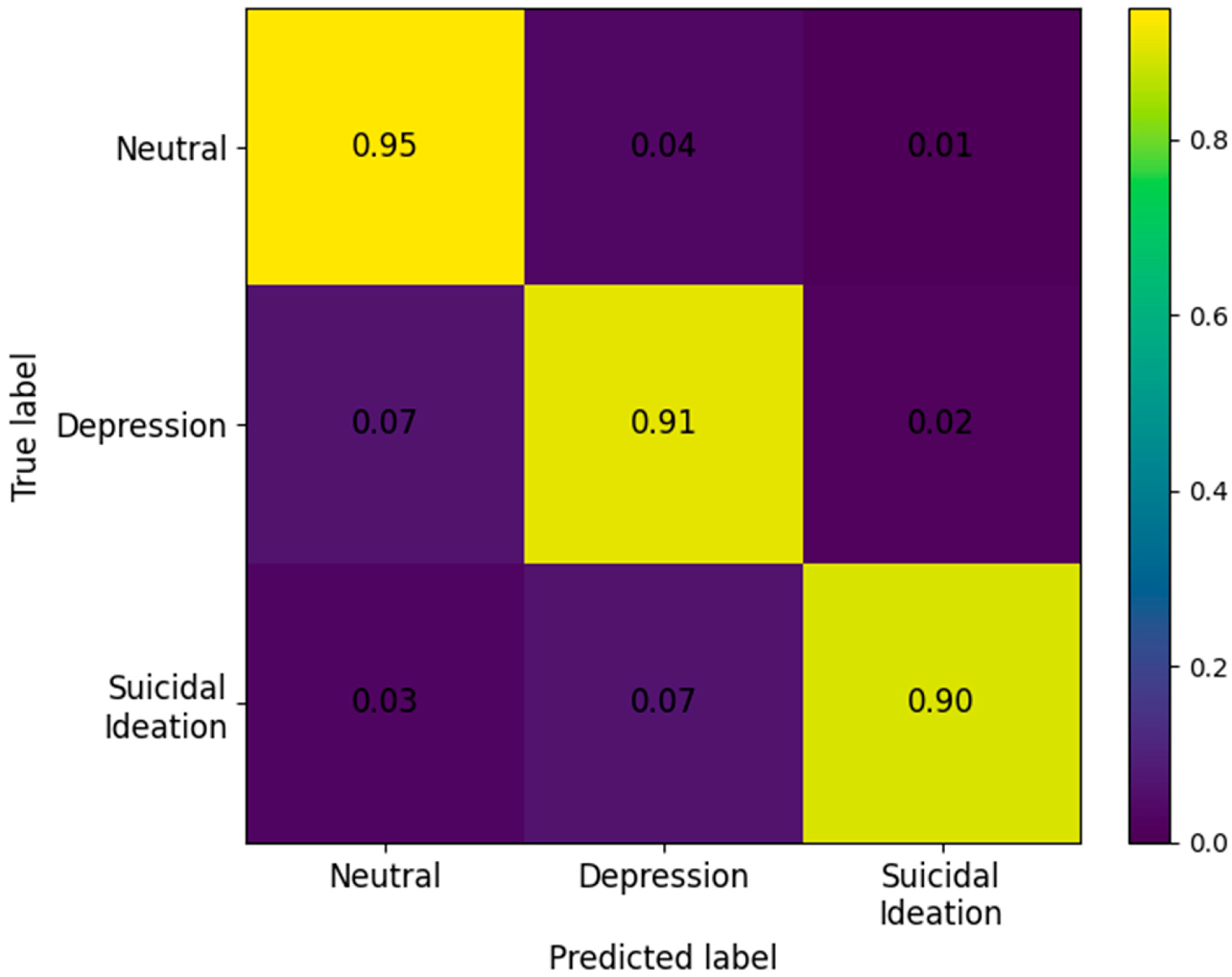
To examine the patterns of errors further,
Figure 7 provides the normalized confusion matrix of the proposed full pipeline. According to the matrix, the residual errors are concentrated on the depression and suicidal ideation, which depicts linguistic overlap in the distress stories (e.g., hopelessness vs. explicit self-harm intent). The generalizability of suicidal ideation to depression is still under-represented, indicating that the model is sensitive to the explicit crisis manifestations but not the generalized depressive manifestations. This error structure assists in interpreting that the suggested framework implements a balanced post-level risk identification, and on top of this, community-level graph analysis can be followed on a higher-level monitoring without suggesting the existence of the temporal early-risk definition.
As shown in
Table 11, the proposed full pipeline remains consistent over five random seeds, achieving a Macro-F1 of 0.910 ± 0.006 and a suicidal recall of 0.900 ± 0.011. The low standard deviations indicate that performance is stable across runs and not driven by a favorable initialization, supporting reliable screening of high-risk posts.
To endorse the idea of triage-centered interpretation, we present an analysis of the operating point of a suicidal risk screening at different decisions as shown in
Table 12. The decrease in the threshold causes suicidal recall to be higher (e.g., t = 0.30) but the workload of false alarms to increase, whereas the increase in threshold decreases the false alarms (e.g., t = 0.70) at the expense of false misses of high-risk posts. Mid-range threshold (t = 0.50) offers a realistic balance, both being highly recall with a low number of false alarms per 1000 posts which, together with the confusion matrix insights in
Figure 7, serve to complement the insights offered by the confusion matrixes.
5.4. Ablation Study
An ablation study was performed to analyze the contribution of each module—SBO, CNN, and GNN—within the proposed pipeline.
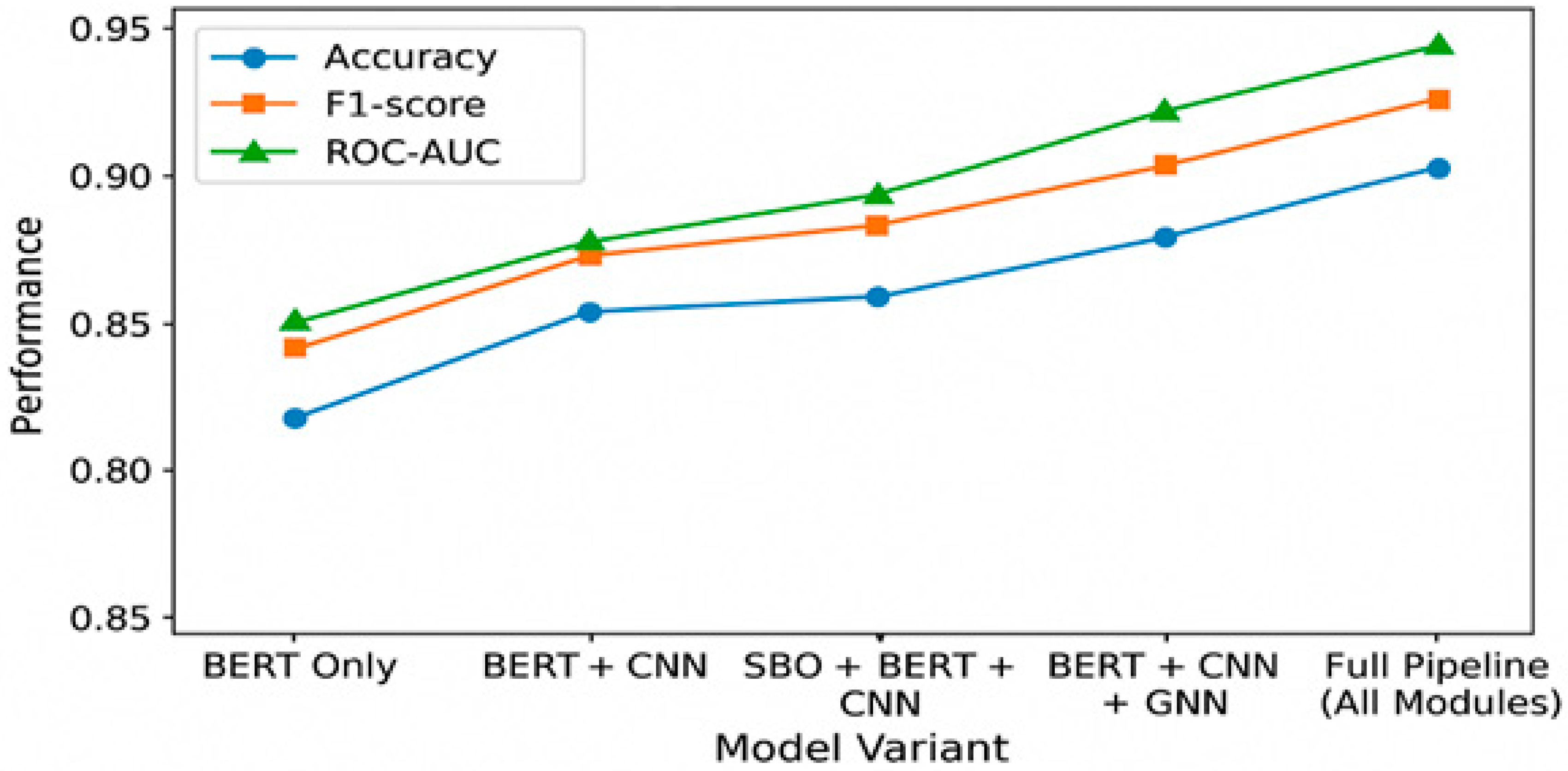
Table 13 presents a progressive component-wise analysis rather than a strict leave-one-component-out ablation, while
Figure 8 provides the corresponding visual comparison. The BERT-only baseline achieves strong contextual performance but lacks robustness in subtle and edge-case expressions. Adding CNN improves detection of localized crisis phrases, while incorporating GNN further enhances performance through community-level relational reasoning. The slight variation observed between SBO + BERT + CNN (91.2%) and BERT + CNN + GNN (91.4%) indicates that feature selection and relational modeling contribute differently and are complementary rather than independently optimal. Without SBO, redundant high-dimensional features reduce efficiency and slightly degrade performance. Without CNN, the model loses localized phrase detection capability. Without GNN, community-level reasoning is absent, limiting detection of socially clustered distress. The end-to-end pipeline achieves the best overall performance (Accuracy = 93.1%, F1 = 0.91, ROC-AUC = 0.944), demonstrating that the combined use of feature optimization, contextual modeling, and relational reasoning provides complementary benefits. A systematic ablation where each component (SBO, CNN, and GNN) is individually removed from the full pipeline is left for future work.
5.5. Calibration, Uncertainty, and Cross-Dataset Robustness
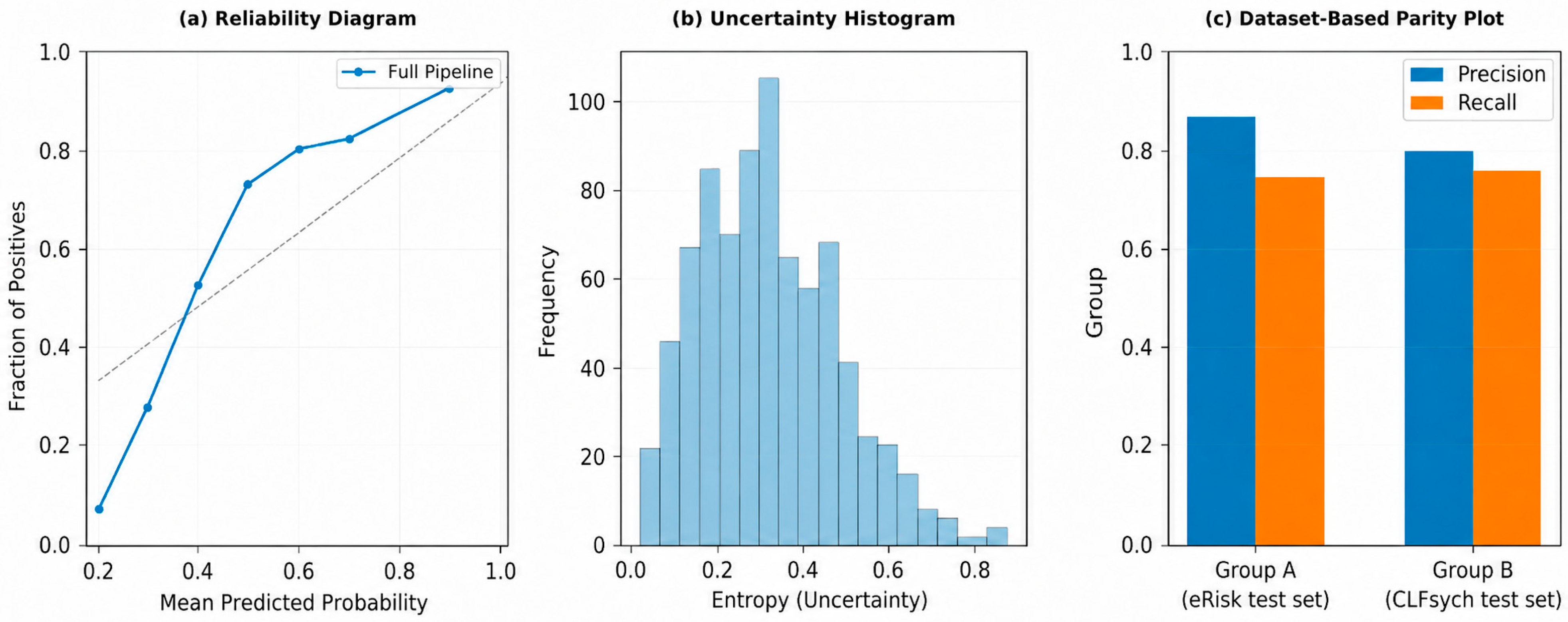
To assess model reliability beyond standard classification metrics, we analyze calibration, predictive uncertainty, and cross-dataset robustness (precision/recall consistency across the eRisk and CLPsych test sets), as summarized in
Figure 9. The reliability diagram in
Figure 9a compares predicted confidence with empirical correctness We further evaluate how well the proposed model is calibrated using the Expected Calibration Error (ECE) and Brier score, as in Equation (16). Our model achieves
ECE = 0.048 and
Brier = 0.092 on the eRisk dataset, and
ECE = 0.052 and
Brier = 0.097 on the CLPsych dataset, suggesting stable model calibration across both datasets.
Predictive uncertainty is reported in
Figure 9b using entropy, the entropy-based uncertainty measure used to quantify predictive ambiguity is given in Equation (17)
The higher the entropy, the more uncertain the prediction, which can be sent for human review in practice using uncertainty thresholds, though this is not explicitly defined in this work. Finally,
Figure 9c compares performance across two dataset-defined groups, Group A (eRisk test set) and Group B (CLPsych test set), to evaluate cross-dataset robustness (no demographic attributes are inferred). Precision and recall show only minor disparity between groups (Group A: Precision = 0.86, Recall = 0.67; Group B: Precision = 0.85, Recall = 0.68), indicating stable performance across the two benchmark sources.
5.6. Feature Selection Effectiveness
Text classification often involves high-dimensional, sparse feature spaces even in the mental health domain; feature selection is crucial to our study to improve generalizability, reduce computational cost and enhance interpretability. We evaluate our SBO approach with RF importance using a collection of 1- and 2-tf-idf, LIWC psychological traits, VADER sentiment scores, and metadata. This has been done to achieve the highest classification accuracy (especially for suicidal ideation) while keeping the selected feature subset as compact as possible, as defined in Equation (2).
As observed in
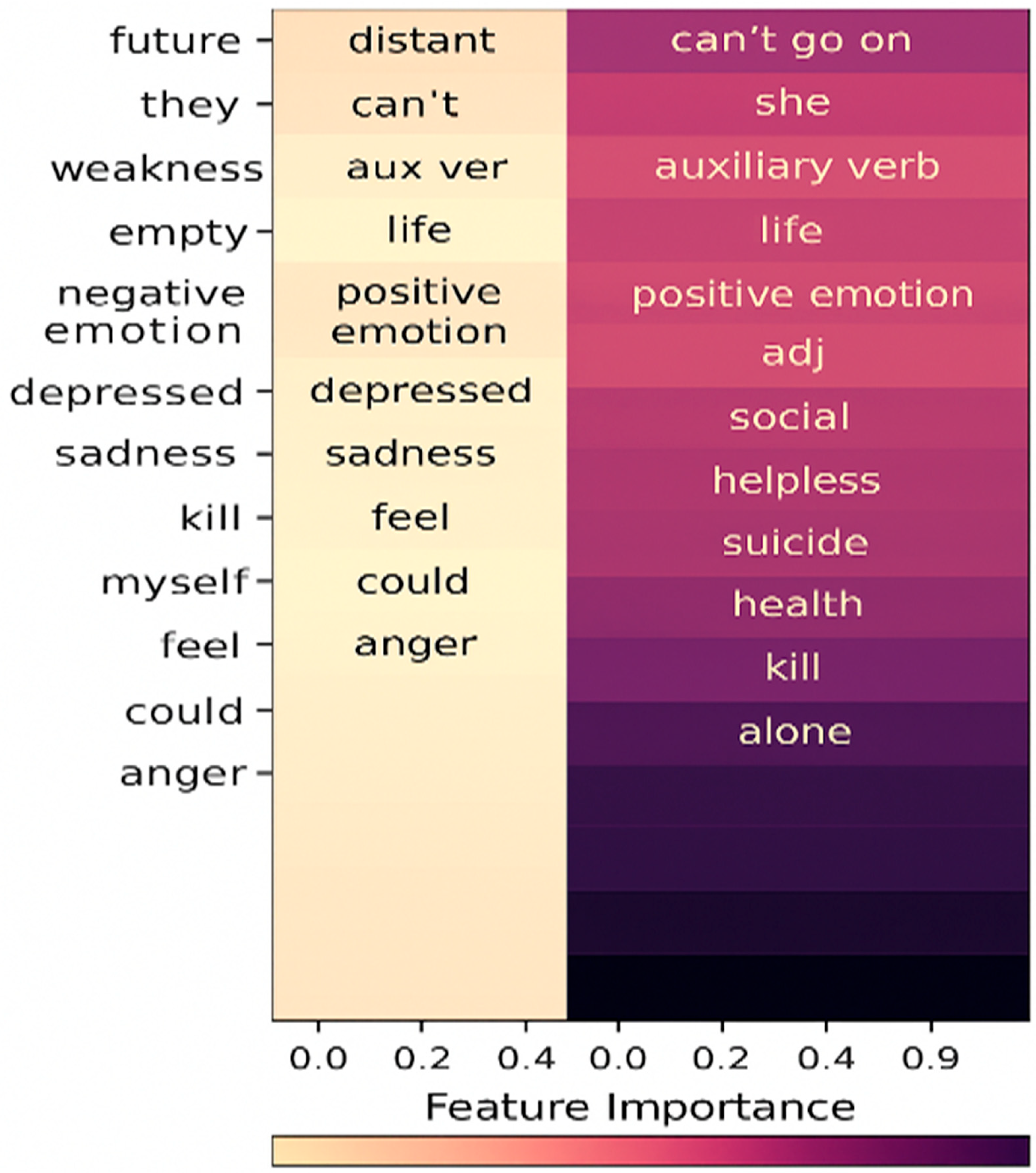
Table 14, 45 features were chosen by SBO (≈38% less than RF), producing better accuracy (91.2%), F1-score (0.88), and ROC-AUC (0.926) which proves superior generalization and prediction capabilities for crisis detection. Random Forest importance is used as a reference baseline for comparison. A comprehensive evaluation against additional feature selection methods, such as LASSO, RFE, and Boruta, is beyond the scope of this study and is identified as future work. The feature importance heatmap.
Figure 10 highlights emotionally and psychologically loaded language (e.g., “die”, “hopeless”, “sadness”. “self-focus”), verifying that SBO can keep semantically and clinically meaningful signals, while excluding redundancy noise.
These results further reinforce SBO as a concise, explainable and effective feature selector, allowing its insertion prior to context modeling in our pipeline. Feature selection is performed independently for each dataset under the same protocol. Therefore, cross-dataset transferability of selected features is not assumed in this study and remains an open direction for future investigation.
5.7. Feature Relationship Analysis
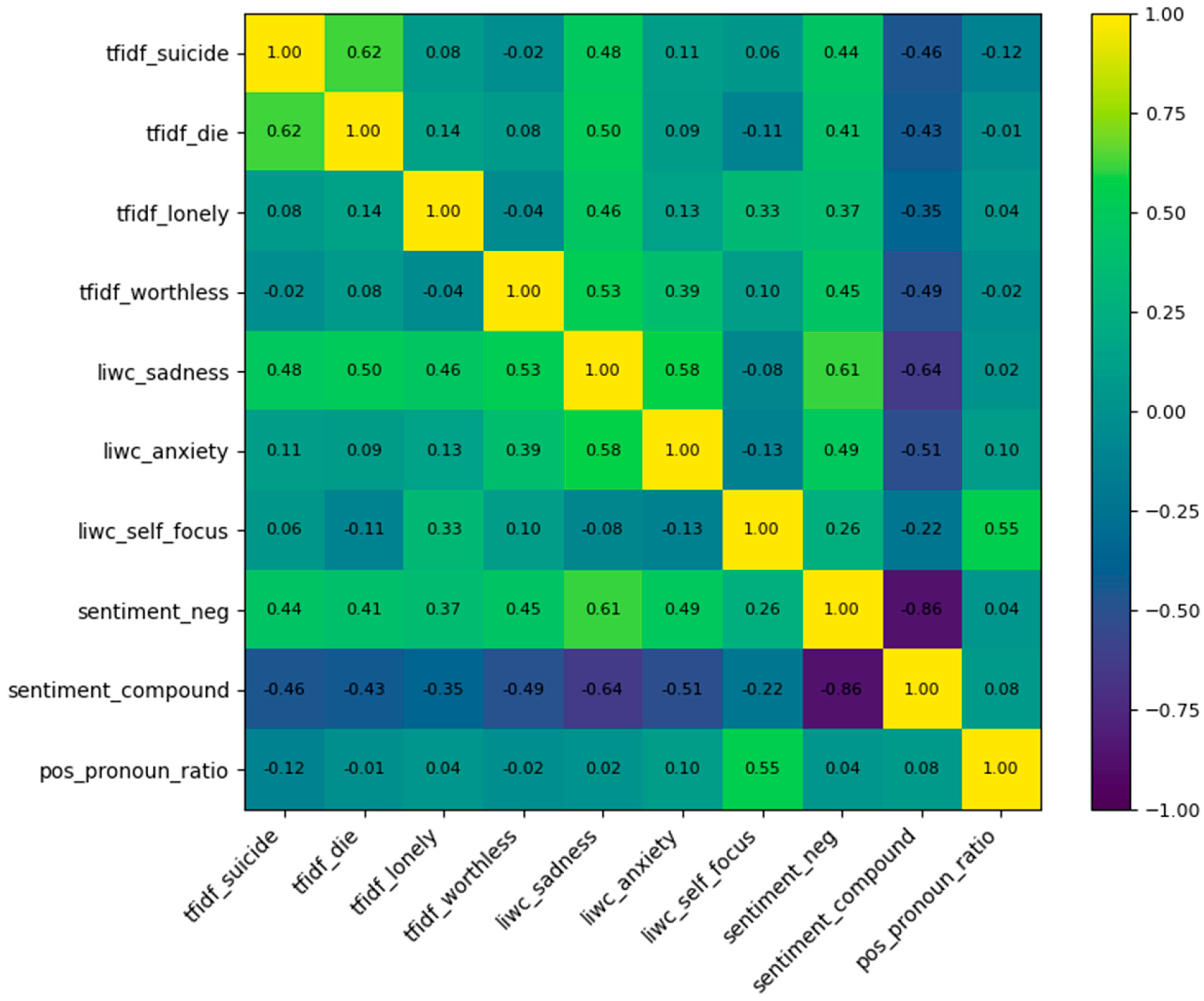
To evaluate the redundancy and dependency structure of the linguistic and psychological signals that the proposed framework takes advantage of, we calculate pairwise correlations of the representative features of SBO-selected features and plot them in the matrix in
Figure 11. The correlation structure suggests interpretable groupings based on (i) crisis lexical indicators (TFIDF words), (ii) affective and psycholinguistic indicators (e.g., LIWC sadness/anxiety), and (iii) sentiment-induced indicators. As anticipated, there are positive associations between affective distress indicators and negative-sentiment elements, and negative-sentiment measures and compound polarity, and the overall directional behavior of affective distress and sentiment orientation is consistent. All this analysis suggests the importance of optimization of the SBO-based features: a number of handcrafted cues encode the same information, and the choice of a small set of them can be used to reduce redundancy and preserve salient discriminative features, which, in turn, can enhance robustness and generalization to noisy social media text.
5.8. Community Detection Insights
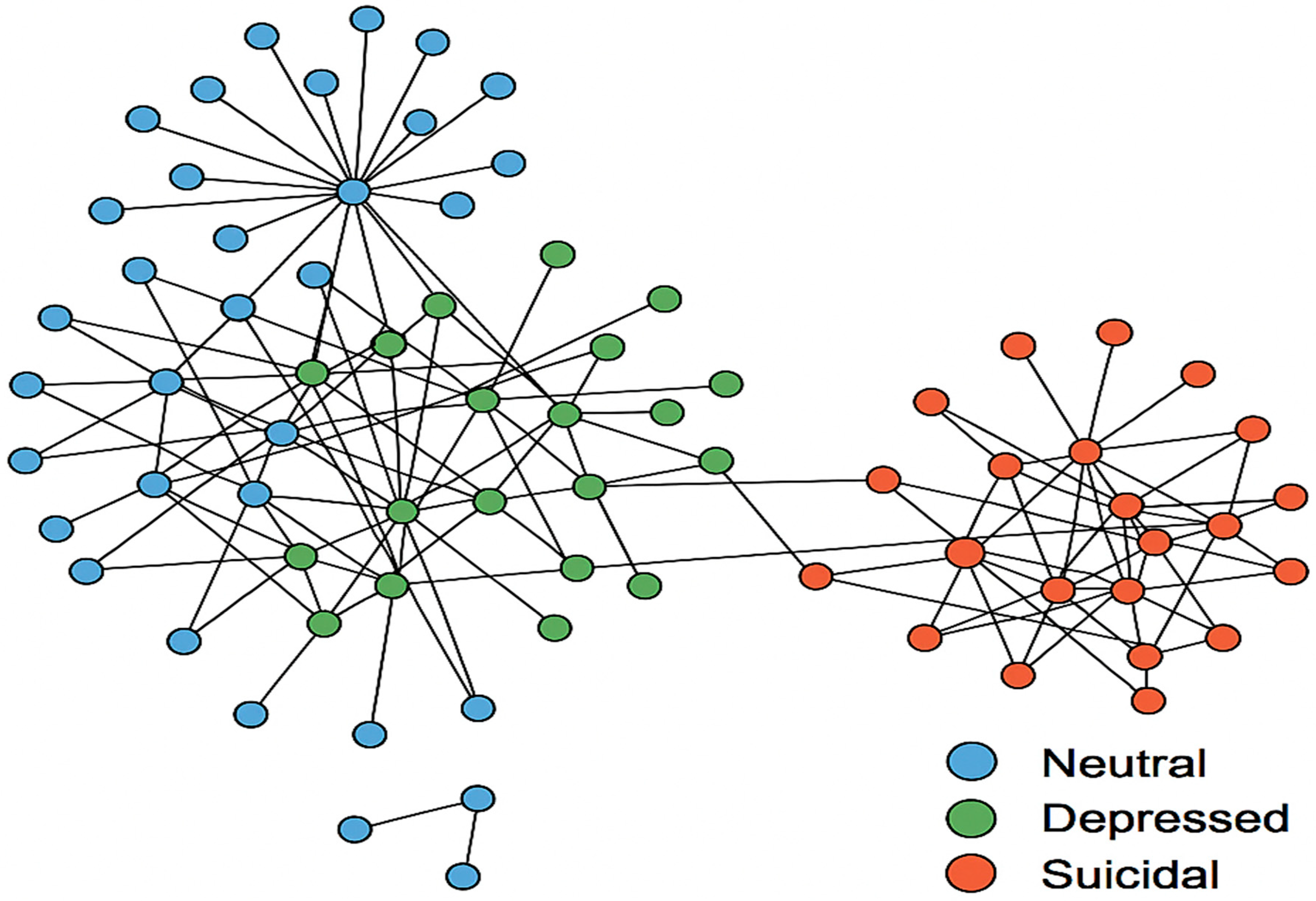
Apart from the post-level classifier, the model utilizes a GraphSAGE-based GNN to explore community-level risk patterns based on a user–post graph constructed from authorship links and semantic similarity between posts. This analysis is an exploratory post hoc examination of relational structure rather than an evidence of risk propagation.
Figure 12 shows a qualitative view of the community structure. As illustrated in
Figure 12, suicidal risk nodes appear to form relatively dense clusters in the constructed graph, while some depressive risk nodes appear near similar regions. But this is interpreted qualitatively and not as causal evidence of escalation or propagation. The GNN attained 91.4% accuracy in post-node classification on the held-out test split. The learned embeddings also produced separable community patterns, with average internal edge density of 0.61 and Louvain modularity of 0.73, as summarized in
Table 15.
The detected modularity is affected by the kNN graph construction, and is therefore reported as an exploratory analysis. Comparisons with null models (e.g., degree-preserving random graphs) and quantitative examination of the within- versus between-community connections are left for future work.
5.9. Explainability Analysis
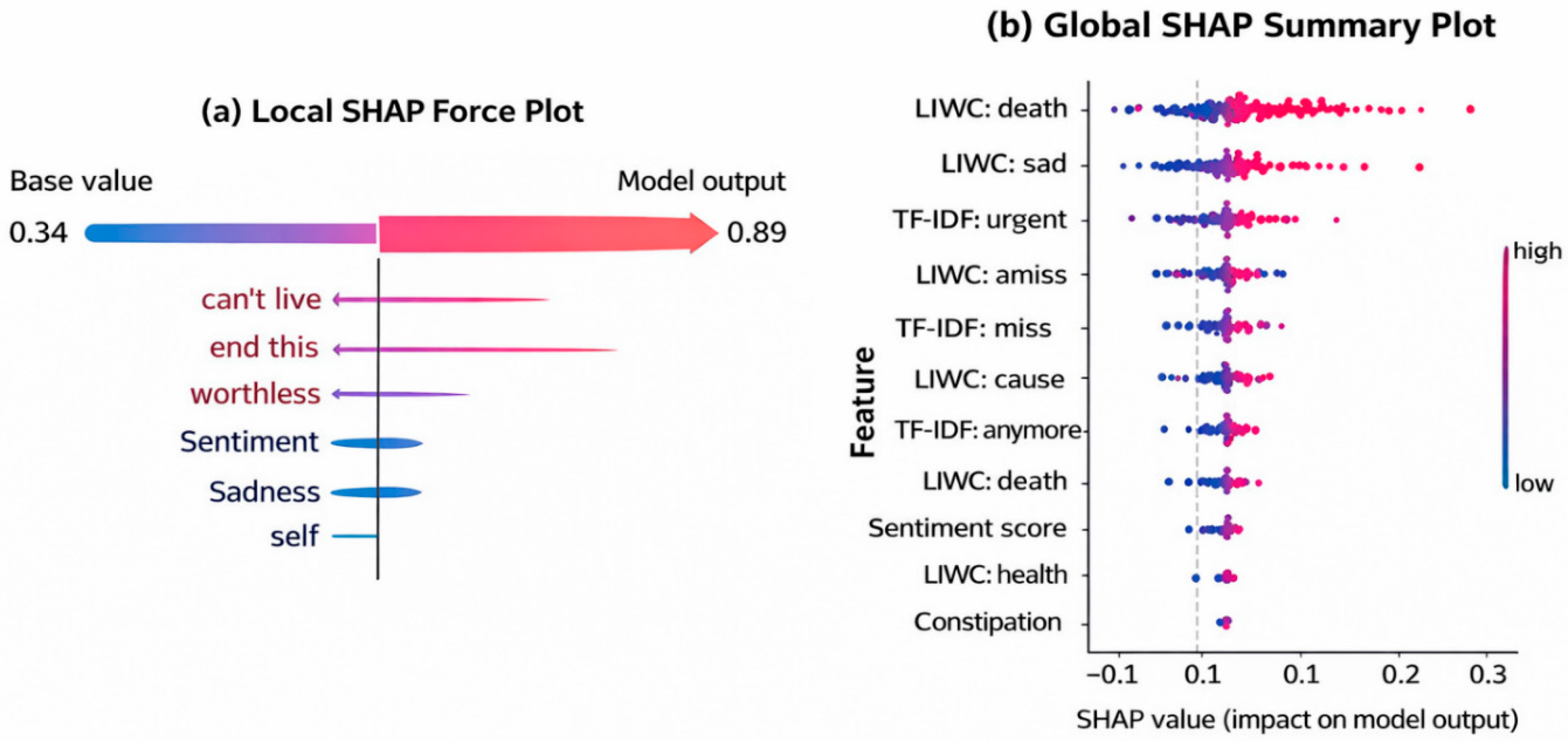
Explainability is important beyond conventional accuracy metrics for deploying mental health surveillance models in sensitive, high-stakes environments. We used SHAP to interpret predictions locally (on a per-post basis) as well as globally within the feature space, aiding transparency in identifying depression and suicidal ideation. For consistency, KernelSHAP was used with 100 background samples drawn from the training set. SHAP values were calculated using the BERT-CNN output, and SBO-selected features, with LIME used at the post level using locally weighted surrogate explanations. Kernel SHAP: The predictions from the BERT + CNN classifier and features selected by SBO (TF-IDF, LIWC, sentiment) were input into KernelSHAP to assess the importance of each feature in determining prediction outcomes. At the local level, as shown in
Figure 13a, the SHAP force plot reveals that lexical and linguistic properties contribute to suicidal risk prediction. At the global level, the SHAP summary plot in
Figure 13b shows that LIWC categories (e.g., death, sadness), crisis-related terms, and sentiment scores are key separators across the dataset. These results indicate that the model’s decision-making aligns with psychologically relevant indicators.
Table 16 ranks the ten most influential features, with “die” (TF-IDF), sadness (LIWC), and negative polarity scoring highest in mean SHAP contribution. While direct cues such as “die” and “end it” feature prominently among the top features, the model does not solely rely on explicit keywords. For instance, a post like “I feel like I am slowly disappearing, and nothing feels real anymore” was correctly classified as suicidal ideation, yet does not contain explicit suicide keywords, where the explanation showed indirect cues of distress such as emptiness and hopelessness.
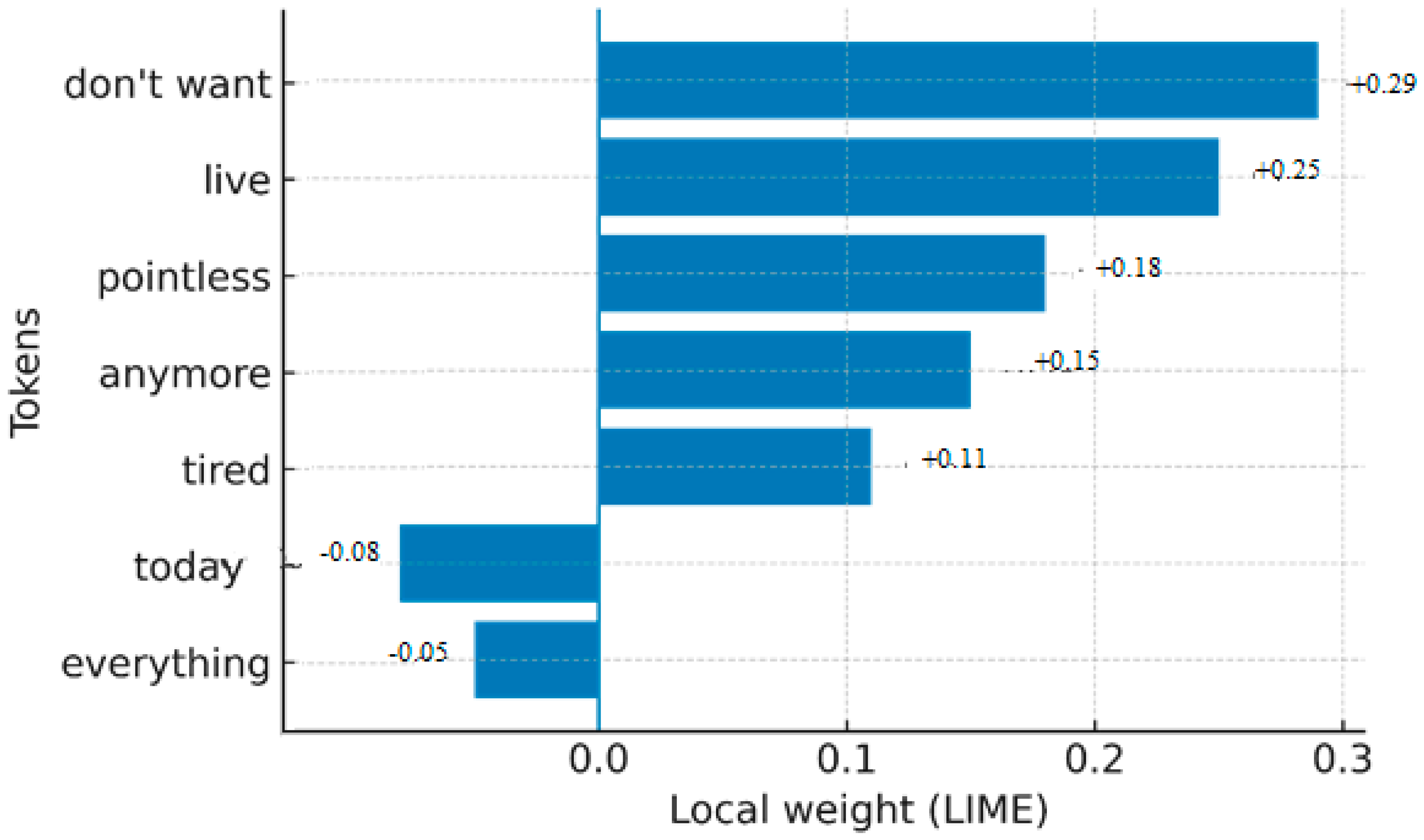
Furthermore, LIME was employed to provide complementary post-level interpretability using locally faithful surrogate models. As depicted in
Figure 14 and summarized in
Table 17, LIME identified tokens such as “don’t want,” “live,” and “pointless” as strong positive contributors toward a suicidal classification, whereas neutral terms such as “everything” exerted minimal influence. The combined use of SHAP and LIME supports transparency and interpretability of the proposed framework.
5.10. Training Dynamics and Convergence Analysis
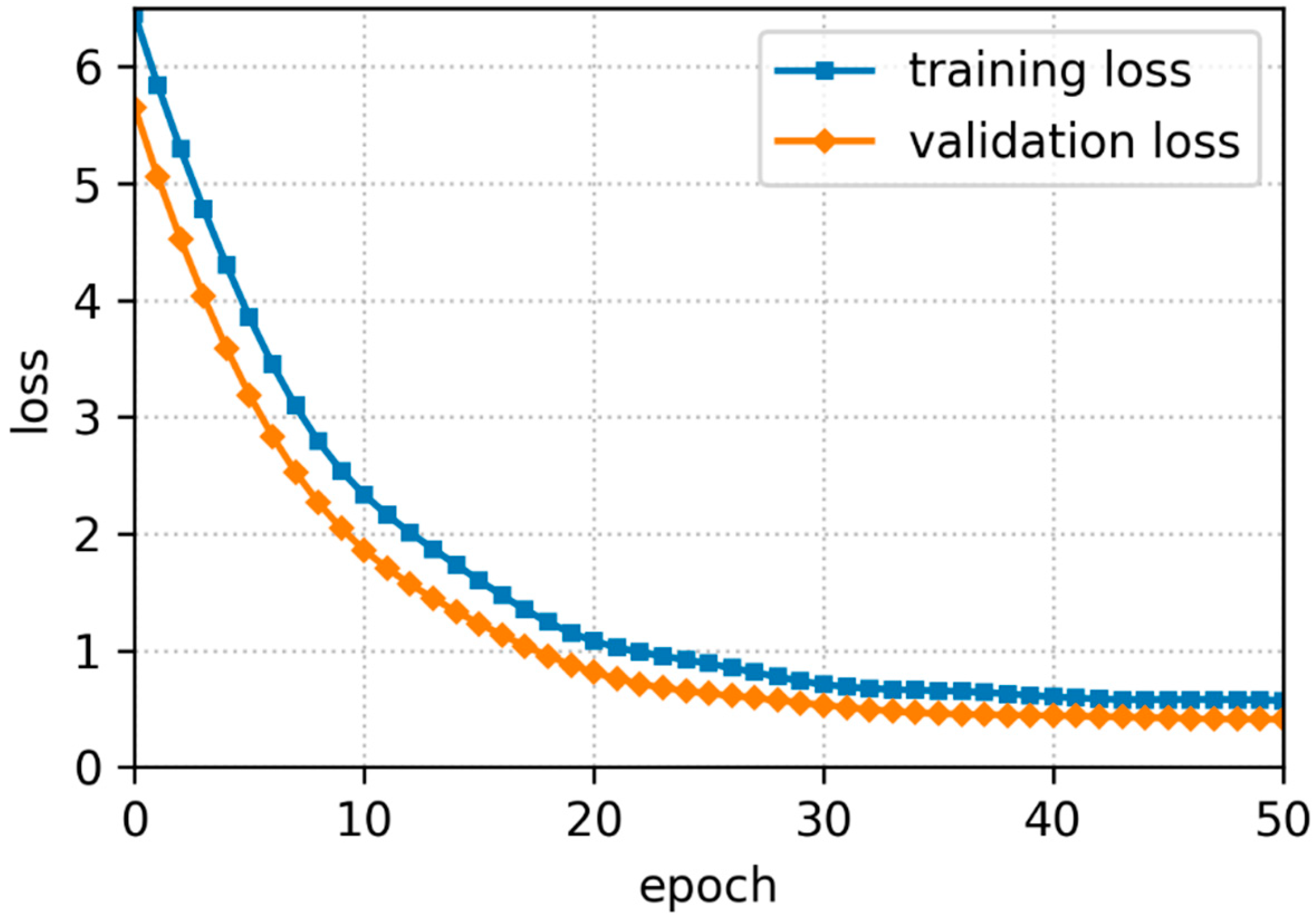
As a further measure to confirm training stability and generalization behavior, we report the cross-entropy loss curves for the training and validation splits. The proposed model is trained in a two-step manner: first, the BERT-CNN module is fine-tuned 5 times for post-level classification; then, the output of the BERT-CNN module is used as node representations, and the GraphSAGE module is trained 50 times for graph-based post-level refinement and community-level reasoning.
Figure 15 shows the training and validation loss of the GraphSAGE stage only. The training loss decreases monotonically, while the validation loss also declines and gradually plateaus, indicating stable convergence. The low difference between the training and validation loss suggests that there is no overfitting during the GraphSAGE training (using the chosen dropout regularization and user-disjoint testing protocol).
5.11. Dataset Statistics, Annotation Protocol, and Experimental Setup
We evaluated the proposed hybrid framework for risk detection on two benchmark datasets that are based on the Reddit social media platform and include posts with neutral, depressed and suicidal ideation, namely the eRisk benchmark dataset and the CLPsych Shared Task dataset. For clarity, the suicidal ideation labels are derived from CLPsych only, and the eRisk dataset provides only the Neutral and Depressed classes under the new label mapping.
Table 18 shows that the data were split into 70% training, 15% validation and 15% testing.
Suicidal ideation labels are derived exclusively from CLPsych; the eRisk dataset does not include such annotations, and therefore no suicidal samples are counted from eRisk in this study.
5.11.1. Annotation Protocol and Label Reliability
This work is based solely on the official labels of the benchmark datasets eRisk and CLPsych and does not involve any re-annotation or label modification. The eRisk dataset was curated within the CLEF eRisk shared-task framework and provides user-level labels for mental health conditions such as depression, based on longitudinal user timelines. The CLPsych data were released as part of shared tasks with expert-driven annotation methodologies detailed in original task descriptions. For the sake of avoiding unfounded specificity, we do not claim separate certification status, or ranges on inter-annotator agreement other than those cited in the original publications. Inter-annotator agreement varies across annual tasks and is reported in the original CLPsych publications rather than being generalized. These datasets provide curated and clinically informed labels, supporting reliable model training and evaluation under standardized benchmark conditions.
Experiments were conducted on a workstation with an NVIDIA RTX A6000 GPU 48 GB VRAM, Intel Xeon Gold 6326 CPU, 128 GB RAM, and Ubuntu 22.04 LTS. Models were implemented in PyTorch 2.0 using Hugging Face Transformers 4.30 and PyTorch Geometric 2.4. The main settings were: BERT bert-base-uncased, max sequence length 128, 5 epochs, learning rate 2 × 10⁻⁵; CNN with 1D convolution filters of sizes 3, 4, and 5, 100 filters each, and dropout 0.5; SBO with population size 30, 50 iterations, and fitness = accuracy − λ × selected features; and a two-layer GraphSAGE model with hidden dimension 128 and dropout 0.3.
5.11.2. User-Disjoint Evaluation Protocol
A strict user-disjoint data splitting strategy was used to ensure realistic performance estimation and avoid information leakage in all experiments. The user posts were limited to a single split (training, validation, or testing), so that no user is represented in more than a single subset. The protocol is of particular significance to mental health detection tasks where linguistic patterns are very user-specific and post-level splitting can cause overestimation of performance. Any reported outcomes are in line with this user-level separation, which is the best practice for analyzing mental health based on social media.
6. Conclusions and Future Work
This paper introduced a hybrid text-based system to identify mental health risk signals in social media posts through bio-inspired feature selection, transformer-based language modeling, and graph-based relational analysis. The model incorporates Secretary Bird Optimization (SBO) to select salient linguistic and psychological features, a BERT-CNN model for post-level classification, and a Graph Neural Network (GraphSAGE) to learn user–post relationships.
Strict user-disjoint experiments using the eRisk and CLPsych benchmark datasets demonstrate that the proposed framework achieves higher accuracy, F1-score, and ROC-AUC compared to classical machine learning and strong deep learning baselines. The SBO module improves generalization by reducing feature redundancy, while the GNN module enhances post hoc community-level analysis. SHAP and LIME further support interpretability by highlighting linguistically and psychologically relevant indicators, with consistent behavior observed across datasets and calibration analysis.
This study focuses on post-level and community-level risk detection rather than temporal early risk prediction or real-time intervention. As such, the proposed system should not be taken as a clinical diagnostic system, but rather a research-focused decision support system for high-throughput screening. The “human-in-the-loop” approach is theoretical and supported by explainability techniques (SHAP/LIME), but not implemented in the current work.
Future work will extend this framework to longitudinal and temporal modeling, multilingual and cross-platform adaptation, and real-time screening pipelines. We will also implement “uncertainty-aware” decision thresholds and clinician-driven validation for safe use. Also, we plan to release code, pre-processing, and model settings to facilitate replication and extensions.




 ,
,