Effects of an Equine-Assisted Riding Program on Motor Performance, Movement Quality, and Well-Being Among Young Inmates



Abstract
1. Introduction
2. Materials and Methods
2.1. Participants
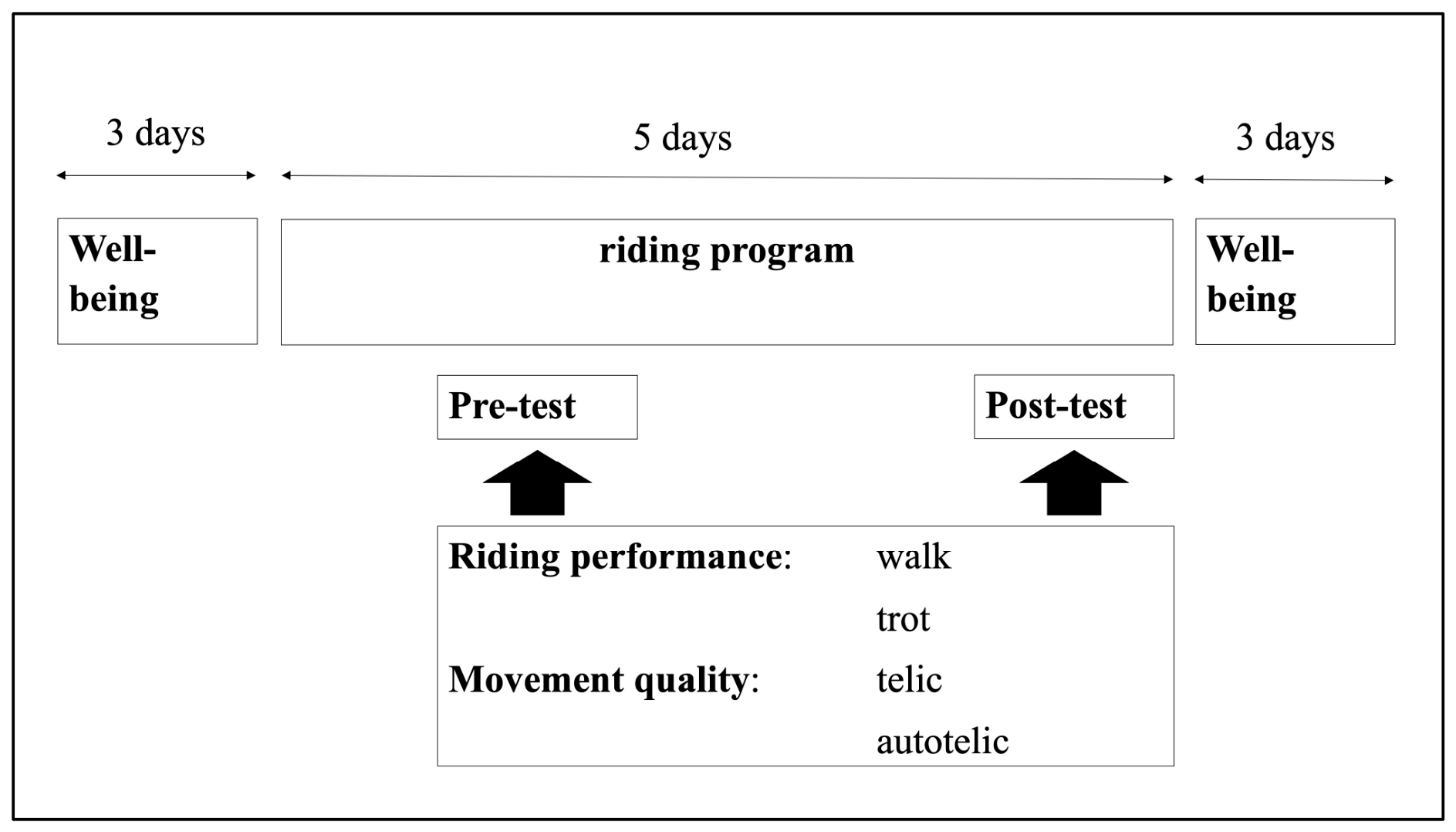
2.2. Design and Procedure
2.3. Program
2.4. Riding Performance
2.5. Movement Quality and Well-Being
2.6. Statistical Analyses
3. Results
3.1. Anthropometric Characteristics
3.2. Riding Performance
3.3. Movement Quality and Well-Being
4. Discussion
5. Conclusions
Author Contributions
Funding
Institutional Review Board Statement
Informed Consent Statement
Data Availability Statement
Acknowledgments
Conflicts of Interest
Abbreviations
| WHO | World Health Organization |
References
- Sykes, G.M. The Society of Captives: A Study of a Maximum Security Prison; Princeton University Press: Princeton, NJ, USA, 1958. [Google Scholar]
- Murray, C.; Coyle, B.; Morgan, H.; Marder, I.; Woods, D.; Haughey, T.; Maycock, M. International Consensus Statement on the Design, Delivery and Evaluation of Sport-Based Interventions Aimed at Promoting Social, Psychological and Physical Well-Being in Prison. BMJ Open 2024, 14, e075792. [Google Scholar] [CrossRef]
- Koddebusch, M.; Gröben, B.; Wicker, P.; Dransmann, M. Discontinuity and Prison Sickness: Sport Participation Barriers and Mental Well-Being Effects among Women in Prison. Int. J. Prison Health 2025, 21, 292–304. [Google Scholar] [CrossRef] [PubMed]
- Müller, J. Sport in der Totalen Institution: Eine Gefängnisethnographie [Sport in the Total Institution: A Prison Ethnography]; Springer: Wiesbaden, Germany, 2024. [Google Scholar] [CrossRef]
- Campana, H.; Edmondson, L.; Edghill, C.; Crowther, T.; Aspin, J.; Aspey, L.; Meek, R. Prisoners’ Experiences of Custodial Parkrun in the UK: Links to Rehabilitation Culture and Desistance. J. Criminol. Res. Policy Pract. 2023, 9, 163–176. [Google Scholar] [CrossRef]
- MacLean, A.; Maycock, M.; Hunt, K.; Mailer, C.; Mason, K.; Gray, C.M. Fit for LIFE: The Development and Optimization of an Intervention Delivered Through Prison Gymnasia to Support Incarcerated Men in Making Positive Lifestyle Changes. BMC Public Health 2022, 22, 783. [Google Scholar] [CrossRef]
- Wulf, G.; Lewthwaite, R. Optimizing Performance Through Intrinsic Motivation and Attention for Learning: The OPTIMAL Theory of Motor Learning. Psychon. Bull. Rev. 2016, 23, 1382–1414. [Google Scholar] [CrossRef]
- Tyng, C.M.; Amin, H.U.; Saad, M.N.M.; Malik, A.S. The Influences of Emotion on Learning and Memory. Front. Psychol. 2017, 8, 1454. [Google Scholar] [CrossRef] [PubMed]
- Dransmann, M.; Meier, C.; Gröben, B.; Wicker, P. “Fußball Ist Schon Was Verbindendes”—Soziale Interaktion und Kommunikation im und Durch Fußball in Einer Offenen Deutschen Justizvollzugsanstalt. In Diversität im Sportspiel [Diversity in Team Sports]; Greve, S., Süßenbach, J., Schiemann, S., Eds.; Czwalina: Hamburg, Germany, 2023; pp. 144–156. [Google Scholar]
- Liguori, F.; Calella, P. Physical Activity and Well-Being in Prisoners: A Scoping Review. Int. J. Prison Health 2025, 21, 278–291. [Google Scholar] [CrossRef]
- Woods, D.; Breslin, G.; Hassan, D. A Systematic Review of the Impact of Sport-Based Interventions on the Psychological Well-Being of People in Prison. Ment. Health Phys. Act. 2017, 12, 50–61. [Google Scholar] [CrossRef]
- Dransmann, M.; Koddebusch, M.; Gröben, B.; Wicker, P. Functional High-Intensity Interval Training Lowers Body Mass and Improves Coordination, Strength, Muscular Endurance, and Aerobic Endurance of Inmates in a German Prison. Front. Physiol. 2021, 12, 733774. [Google Scholar] [CrossRef]
- Ortega Vila, G.; Abad Robles, M.T.; Robles Rodríguez, J.; Durán González, L.J.; Franco Martín, J.; Jiménez Sánchez, A.C.; Giménez Fuentes-Guerra, F.J. Analysis of a Sports-Educational Program in Prisons. Int. J. Environ. Res. Public Health 2020, 17, 3467. [Google Scholar] [CrossRef]
- Topbaş, Z.S.; Şimşek, N. Effect of Animal-Assisted Interventions on Inmates: A Systematic Review. Curr. Approaches Psychiatry 2022, 14, 12–20. [Google Scholar] [CrossRef]
- Hemingway, A.; Carter, S.; Callaway, A.; Kavanagh, E.; Ellis, S. An Exploration of the Mechanism of Action of an Equine-Assisted Intervention. Animals 2019, 9, 303. [Google Scholar] [CrossRef]
- Hemingway, A.; Meek, R.; Hill, C.E. An Exploration of an Equine-Facilitated Learning Intervention with Young Offenders. Soc. Anim. 2015, 23, 544–568. [Google Scholar] [CrossRef]
- Bittner, E.; Böttcher, K.; Genn, R.; Huckemeyer, P.; Sabla, K.P. Pferdegestützte Interventionen zur Resozialisierung Junger Inhaftierter Frauen. In Tiergestützte Interventionen im Justizvollzug [Animal-Assisted Interventions in Prison]; Wesenberg, S., Scheidig, L., Nestmann, F., Eds.; Springer: Wiesbaden, Germany, 2020; pp. 77–93. [Google Scholar]
- Morgan, A.A.; Arditti, J.A.; Spiers, S.; Buechner-Maxwell, V.; Shivey, V. “Came for the Horses, Stayed for the Men”: A Mixed-Methods Analysis of Staff, Community, and Reentrant Perceptions of a Prison-Equine Program (PEP). J. Offender Rehabil. 2020, 59, 156–176. [Google Scholar] [CrossRef]
- Bachi, K. Equine-Facilitated Prison-Based Programs within the Context of Prison-Based Animal Programs: State-of-the-Science Review. J. Offender Rehabil. 2013, 52, 46–74. [Google Scholar] [CrossRef]
- Bahlo, M.; Bahlke, S.; Wicker, P.; Gröben, B.; Dransmann, M. Der Beitrag des Freizeitsports zur Identitätsbildung junger, männlicher Strafgefangener. Forum Kinder-Jugendsport 2022, 3, 35–45. [Google Scholar] [CrossRef]
- Capova, D.; Lipfert, K. Reiten—Balsam für das Selbstkonzept. Bewegungserziehung 2012, 66, 9–18. [Google Scholar]
- Höltkemeyer-Schwick, K.; Seidler, J. Differenzierung des offenen Vollzuges: Zur Binnenstruktur der größten offenen Anstalt Europas. Forum Strafvollzug 2020, 2, 103–107. [Google Scholar]
- Albert, M.; Hurrelmann, K.; Quenzel, G. Jugend 2019. Eine Generation Meldet sich zu Wort. 18. Shell Jugendstudie [Youth 2019: A Generation Speaks out. 18th Shell Youth Study]; Beltz: Weinheim, Germany, 2019. [Google Scholar]
- Field, A. Discovering Statistics Using IBM SPSS Statistics, 6th ed.; Sage: London, UK, 2024. [Google Scholar]
- Atkinson, G.; Reilly, T. Circadian Variation in Sports Performance. Sports Med. 1996, 21, 292–312. [Google Scholar] [CrossRef]
- Boutin, A.; Blandin, Y.; Massen, C.; Heuer, H.; Badets, A. Conscious Awareness of Action Potentiates Sensorimotor Learning. Cognition 2014, 133, 1–9. [Google Scholar] [CrossRef]
- Ryan, R.M.; Deci, E.L. On Happiness and Human Potentials: A Review of Research on Hedonic and Eudaimonic Well-Being. Annu. Rev. Psychol. 2001, 52, 141–166. [Google Scholar] [CrossRef]
- Thomas, J.R.; Nelson, J.K.; Silverman, S.J. Research Methods in Physical Activity, 7th ed.; Human Kinetics: Champaign, IL, USA, 2015. [Google Scholar]
- McGreevy, P.D. Equine Behavior: A Guide for Veterinarians and Equine Scientists, 2nd ed.; Saunders: Philadelphia, PA, USA, 2012. [Google Scholar]
- Hallberg, L. The Clinical Practice of Equine-Assisted Therapy: Including Horses in Human Healthcare; Routledge: New York, NY, USA, 2018. [Google Scholar]
- Dell, C.A.; Chalmers, D.; Dell, D.; Sauve, E.; MacKinnon, T. Horse as Healer: An Examination of Equine-Assisted Learning in the Healing of First Nations Youth from Solvent Abuse. Pimatisiwin J. Aborig. Indig. Community Health 2008, 6, 81–106. [Google Scholar]
- Deutsche Reiterliche Vereinigung. Leistungs-Prüfungs-Ordnung (LPO). In Regelwerk für den Deutschen Turniersport [Performance Test Regulations. Rules and Regulations for German Tournament Sports]; FNverlag: Warendorf, Germany, 2024. [Google Scholar]
- Koo, T.K.; Li, M.Y. A Guideline of Selecting and Reporting Intraclass Correlation Coefficients for Reliability Research. J. Chiropr. Med. 2016, 15, 155–163. [Google Scholar] [CrossRef]
- Meier, C.; Braksiek, M.; Gröben, B. Semantische Differentiale zur Erfassung von Bewegungsqualität bei sportlichen Bewegungen. Ger. J. Exerc. Sport Res. 2020, 50, 179–184. [Google Scholar] [CrossRef]
- Hair, J.; Black, W.; Babin, B.; Anderson, R.E. Multivariate Data Analysis, 7th ed.; Pearson: Upper Saddle River, NJ, USA, 2010. [Google Scholar]
- Muehlan, H.; Schmidt, S. WHO-5 Wohlbefindens-Index. In Psychologische und Sozialwissenschaftliche Kurzskalen [Psychological and Social Science Short Scales]; Brähler, E., Zenger, M., Kemper, C., Eds.; Medizinisch Wissenschaftliche Verlagsgesellschaft: Berlin, Germany, 2014; pp. 344–347. [Google Scholar]
- Herold, E.; Wicker, P.; Czyrnick-Leber, U.; Gröben, B.; Dransmann, M. Sport in Prison: Social and Subjective Health Outcomes of Different Sport Programs. Int. J. Prison Health 2023, 19, 682–698. [Google Scholar] [CrossRef]
- Rosenthal, R. Meta-Analytic Procedures for Social Research; Sage: Newbury Park, CA, USA, 1991. [Google Scholar]
- Cohen, J. Statistical Power Analysis for the Behavioral Sciences, 2nd ed.; Erlbaum: Hillsdale, NJ, USA, 1988. [Google Scholar]
- Dransmann, M.; Koddebusch, M.; Gröben, B.; Wicker, P. A Six-Week Balance Training Intervention with Older Inmates Improves Static Balance in a German Prison. J. Aging Res. Lifestyle 2026, 15, 100065. [Google Scholar] [CrossRef] [PubMed]
- Hecksteden, A.; Kellner, R.; Donath, L. Dealing with Small Samples in Football Research. Sci. Med. Footb. 2021, 6, 389–397. [Google Scholar] [CrossRef] [PubMed]
- Tabachnick, B.G.; Fidell, L.S. Using Multivariate Statistics, 7th ed.; Pearson: London, UK, 2019. [Google Scholar]
- Lai, S.K.; Costigan, S.A.; Morgan, P.J.; Lubans, D.R.; Stodden, D.F.; Salmon, J.; Barnett, L.M. Do School-Based Interventions Focusing on Physical Activity, Fitness, or Fundamental Movement Skill Competency Produce a Sustained Impact in These Outcomes in Children and Adolescents? A Systematic Review of Follow-Up Studies. Sports Med. 2014, 44, 67–79. [Google Scholar] [CrossRef] [PubMed]
- Dransmann, M. Hochintensives Intervalltraining vs. Extensive Dauermethode: Feldstudie zum Ausdauernden Laufen im Sportunterricht [High-Intensity Interval Training vs. Extensive Continuous Method: Field Study on Endurance Running in Physical Education]; Springer: Wiesbaden, Germany, 2020. [Google Scholar] [CrossRef]
- Nieuwenhuys, A.; Oudejans, R.R.D. Anxiety and Perceptual-Motor Performance: Toward an Integrated Model of Concepts, Mechanisms, and Processes. Psychol. Res. 2012, 76, 747–759. [Google Scholar] [CrossRef]
- Prohl, R. Sportwissenschaft und Sportpädagogik: Ein Anthropologischer Aufriss [Sport Science and Sport Pedagogy: An Anthropological Outline]; Hofmann: Schorndorf, Germany, 1991. [Google Scholar]
- Birrer, D.; Röthlin, P.; Morgan, G. Mindfulness to Enhance Athletic Performance: Theoretical Considerations and Possible Impact Mechanisms. Mindfulness 2012, 3, 235–246. [Google Scholar] [CrossRef]
- Dransmann, M.; Meier, C.; Gröben, B.; Wicker, P. Unlocking Potential? The Impact of a Soccer Intervention on Social-Educational Outcomes in a German Prison. Cogent Soc. Sci. 2024, 10, 2365980. [Google Scholar] [CrossRef]
- Gröben, B. Einheitenbildung im Bewegungshandeln: Zur Phänomenalen Struktur des Sportbezogenen Bewegungslernens [Formation of Units in Motor Action: On the Phenomenal Structure of Sport-Related Movement Learning]; Hofmann: Schorndorf, Germany, 2000. [Google Scholar]
- Bähr, I. Erleben Frauen Sportbezogene Bewegung Anders als Männer? [Do Women Experience Sport-Related Movement Differently than Men?]; Hofmann: Schorndorf, Germany, 2006. [Google Scholar]
- Craig, P.; Dieppe, P.; Macintyre, S.; Michie, S.; Nazareth, I.; Petticrew, M. Developing and Evaluating Complex Interventions: The New Medical Research Council Guidance. BMJ 2008, 337, a1655. [Google Scholar] [CrossRef] [PubMed]
- Williams, S.M.; Lacy, A.C. Measurement and Evaluation in Physical Education and Exercise Science, 9th ed.; Routledge: New York, NY, USA, 2026. [Google Scholar]



| Item (Scale 1–6) | M | SD | Cronbach’s α |
|---|---|---|---|
| Autotelic subindex | 5.13 | 0.66 | 0.610 |
| unpleasant—pleasant | 5.40 | 1.07 | |
| ugly—beautiful | 5.90 | 0.32 | |
| hesitant—fluid | 4.50 | 1.16 | |
| tense—relaxed | 4.70 | 1.06 | |
| unstable—balanced 1 | 4.20 | 1.03 | |
| Telic subindex | 4.98 | 0.77 | 0.765 |
| unsuccessful—successful | 5.80 | 0.63 | |
| wrong—right | 4.90 | 1.10 | |
| faulty—perfect | 4.70 | 1.16 | |
| failed—accomplished | 5.20 | 0.79 | |
| unrhythmic—rhythmic | 4.30 | 1.49 |
| Parameter | Pre-Test | 95% CI | Post-Test | 95% CI |
|---|---|---|---|---|
| Height (cm) | 177.10 ± 5.63 | [173.08, 181.12] | - | - |
| Body mass (kg) | 87.11 ± 10.00 | [79.95, 94.27] | 87.75 ± 10.12 | [80.51, 95.00] |
| Fat mass (kg) | 19.89 ± 8.24 | [14.00, 25.78] | 19.97 ± 8.38 | [13.98, 25.96] |
| Fat-free mass (kg) | 67.22 ± 6.64 | [62.47, 71.97] | 67.78 ± 6.37 | [63.23, 72.33] |
| Parameter | Pre-Test | 95% CI | Post-Test | 95% CI | z | p | r |
|---|---|---|---|---|---|---|---|
| Walk | 5.58 ± 0.61 | [5.14, 6.02] | 6.78 ± 0.65 | [6.32, 7.24] | 2.810 | 0.005 | 0.890 |
| Trot | 2.48 ± 1.92 | [1.10, 3.85] | 6.13 ± 2.08 | [4.64, 7.61] | 2.805 | 0.005 | 0.887 |
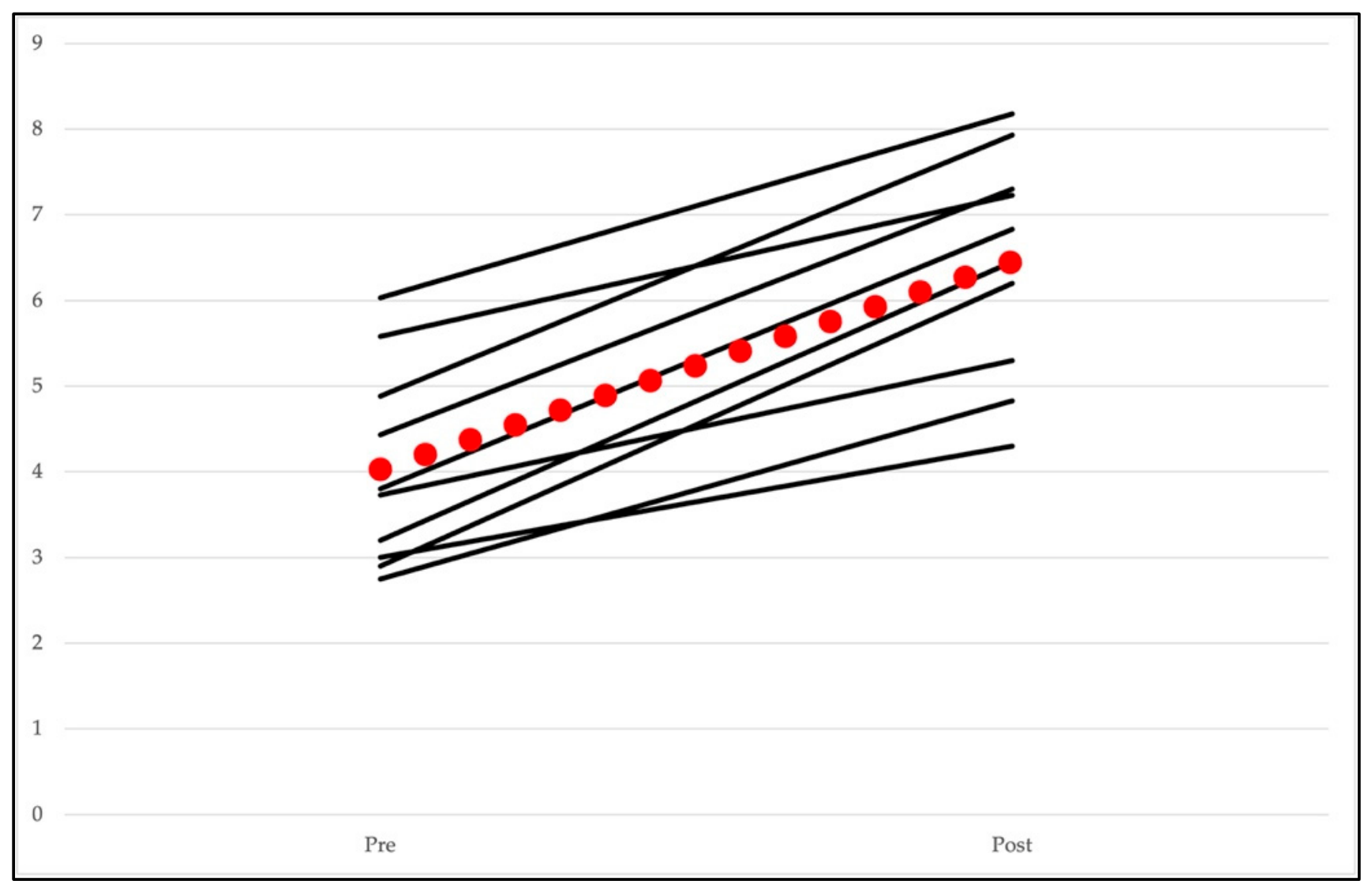
| Overall | 4.03 ± 1.16 | [3.20, 4.86] | 6.45 ± 1.30 | [5.52, 7.34] | 2.803 | 0.005 | 0.886 |
| Parameter | Pre-Test | 95% CI | Post-Test | 95% CI | z | p | r |
|---|---|---|---|---|---|---|---|
| Autotelic | 5.13 ± 0.66 | [4.65, 5.60] | 5.63 ± 0.24 | [5.45, 5.80] | 2.552 | 0.011 | 0.807 |
| Telic | 4.98 ± 0.77 | [4.43, 5.53] | 5.14 ± 0.48 | [4.80, 5.48] | 0.653 | 0.514 | 0.206 |
| Parameter | Pre-Test | 95% CI | Post-Test | 95% CI | z | p | r |
|---|---|---|---|---|---|---|---|
| Well-being | 13.40 ± 6.70 | [8.60, 18.20] | 18.40 ± 7.26 | [13.21, 23.59] | 2.201 | 0.028 | 0.696 |
Disclaimer/Publisher’s Note: The statements, opinions and data contained in all publications are solely those of the individual author(s) and contributor(s) and not of MDPI and/or the editor(s). MDPI and/or the editor(s) disclaim responsibility for any injury to people or property resulting from any ideas, methods, instructions or products referred to in the content. |
© 2026 by the authors. Licensee MDPI, Basel, Switzerland. This article is an open access article distributed under the terms and conditions of the Creative Commons Attribution (CC BY) license.
Share and Cite
Dransmann, M.; Koddebusch, M.; Wicker, P.; Gröben, D.; Gröben, B. Effects of an Equine-Assisted Riding Program on Motor Performance, Movement Quality, and Well-Being Among Young Inmates. Healthcare 2026, 14, 1418. https://doi.org/10.3390/healthcare14101418
Dransmann M, Koddebusch M, Wicker P, Gröben D, Gröben B. Effects of an Equine-Assisted Riding Program on Motor Performance, Movement Quality, and Well-Being Among Young Inmates. Healthcare. 2026; 14(10):1418. https://doi.org/10.3390/healthcare14101418
Chicago/Turabian StyleDransmann, Milan, Martin Koddebusch, Pamela Wicker, Daniela Gröben, and Bernd Gröben. 2026. "Effects of an Equine-Assisted Riding Program on Motor Performance, Movement Quality, and Well-Being Among Young Inmates" Healthcare 14, no. 10: 1418. https://doi.org/10.3390/healthcare14101418
APA StyleDransmann, M., Koddebusch, M., Wicker, P., Gröben, D., & Gröben, B. (2026). Effects of an Equine-Assisted Riding Program on Motor Performance, Movement Quality, and Well-Being Among Young Inmates. Healthcare, 14(10), 1418. https://doi.org/10.3390/healthcare14101418