Relationship Between Quality of Life and Sports Performance Among Athletes with Disabilities: A Focus on Individual Sports

 ,
,  , ,
, ,  ,
,  ,
,  , and
, and 
Highlights
- Athletes with physical disabilities reported high levels of overall quality of life, regardless of gender or competition level.
- No significant correlation was found between athletic performance and quality of life across provincial, national, or international levels.
- Participation in individual sports may enhance physical and psychological well-being in athletes with physical disabilities.
- Promoting engagement in individual sports could be a valuable strategy for improving overall quality of life among people with disabilities.
Abstract
1. Introduction
2. Materials and Methods
2.1. Participants
2.2. Procedure
2.3. Quality of Life Assessment Tool
2.4. Evaluation of Athletic Performance
2.5. Statistical Analysis
3. Results
3.1. Quality of Life Among Individual Sport Athletes
3.2. Analysis of the Number of Championships Among Individual Sport Athletes
3.3. Association Between Quality of Life and Athletic Performance Across Competitive Levels
3.4. Association Between Physical Health (As a Domain of Quality of Life) and Athletic Performance Across Competitive Levels
3.5. Association Between Mental Health (As a Component of Quality of Life) and Athletic Performance at Provincial, National, and International Levels
3.6. Multivariate Regression Study on the Relationship Between Quality of Life Components and Sports Performance
4. Discussion
Limitations, Practical Implications, and Future Research Directions
5. Conclusions
Author Contributions
Funding
Institutional Review Board Statement
Informed Consent Statement
Data Availability Statement
Acknowledgments
Conflicts of Interest
Abbreviations
| QoL | Quality of life |
| HRQoL | Health-related quality of life |
| SF-36 | 36-Item Short Form Survey |
| HQol-F | Health-related quality of life-Female |
| HQol-M | Health-related quality of life-Male |
| MCS-F | Mental Component Summary-Female |
| MCS-M | Mental Component Summary-Male |
| PCS-F | Physical component summary-Female |
| PCS-M | physical component summary-Male |
| PLA-F | Provincial-level championships-Female |
| PLA-M | Provincial-level championships-Male |
| NLA-F | National-level championships-Female |
| NLA-M | National-level championships-Male |
| ILA-F | International-level championships-Female |
| ILA-M | International-level championships-Male |
References
- Bjornson, K.F.; McLaughlin, J.F. The measurement of health-related quality of life (HRQL) in children with cerebral palsy. Eur. J. Neurol. 2001, 8, 183–193. [Google Scholar] [CrossRef]
- Group, W. Development of the WHOQOL: Rationale and current status. Int. J. Ment. Health 1994, 23, 24–56. [Google Scholar] [CrossRef]
- Kim, S. World Health Organization quality of life (WHOQOL) assessment. In ENCYCLOPEDIA of Quality of Life and Well-Being Research; Springer: Berlin/Heidelberg, Germany, 2024; pp. 7866–7867. [Google Scholar]
- Kim, J.; Chung, H.; Amtmann, D.; Salem, R.; Park, R.; Askew, R.L. Symptoms and quality of life indicators among children with chronic medical conditions. Disabil. Health J. 2014, 7, 96–104. [Google Scholar] [CrossRef] [PubMed]
- Enssle, F.; Kabisch, N. Urban green spaces for the social interaction, health and well-being of older people—An integrated view of urban ecosystem services and socio-environmental justice. Environ. Sci. Policy 2020, 109, 36–44. [Google Scholar] [CrossRef]
- Kamelska, A.M.; Mazurek, K. The assessment of the quality of life in visually impaired people with different level of physical activity. Phys. Cult. Sport 2015, 67, 31. [Google Scholar] [CrossRef]
- Deci, E.L.; Ryan, R.M. The “what” and “why” of goal pursuits: Human needs and the self-determination of behavior. Psychol. Inq. 2000, 11, 227–268. [Google Scholar] [CrossRef]
- Ryan, R.M.; Deci, E.L. Intrinsic and extrinsic motivation from a self-determination theory perspective: Definitions, theory, practices, and future directions. Contemp. Educ. Psychol. 2020, 61, 101860. [Google Scholar] [CrossRef]
- Chatzilelecas, E.; Filipovic, B.; Petrinovic, L. Differences in quality of life according to the level of physical activity between two groups of basketball players in the wheelchairs. SportLogia 2015, 11, 11–17. [Google Scholar] [CrossRef]
- Tahmasebi, H.; Abasi, E.; Zafari, M.; Darvish Gkezri, H. Comparison of the quality of life of paraplegic veterans and disables; Case study of Mazandaran Province, Iran. Iran. J. War Public Health 2016, 8, 171–176. [Google Scholar]
- Borade, N.; Ingle, A.; Nagarkar, A. Lived experiences of people with mobility-related disability using assistive devices. Disabil. Rehabil. Assist. Technol. 2021, 16, 730–734. [Google Scholar] [CrossRef]
- Koo, K.M.; Kim, C.J.; Park, C.H.; Byeun, J.K.; Seo, G.W. Restrictions of physical activity participation in older adults with disability: Employing keyword network analysis. J. Exerc. Rehabil. 2016, 12, 373–378. [Google Scholar] [CrossRef]
- Laskowski, E.R.; Lexell, J. Exercise and sports for health promotion, disease, and disability. PM&R 2012, 4, 795–796. [Google Scholar] [CrossRef]
- Sahlin, K.B.; Lexell, J. Impact of Organized Sports on Activity, Participation, and Quality of Life in People with Neurologic Disabilities. PM&R 2015, 7, 1081–1088. [Google Scholar] [CrossRef]
- Caddick, N.; Smith, B. The impact of sport and physical activity on the well-being of combat veterans: A systematic review. Psychol. Sport Exerc. 2014, 15, 9–18. [Google Scholar] [CrossRef]
- Hogan, C.L.; Catalino, L.I.; Mata, J.; Fredrickson, B.L. Beyond emotional benefits: Physical activity and sedentary behaviour affect psychosocial resources through emotions. Psychol. Health 2015, 30, 354–369. [Google Scholar] [CrossRef] [PubMed]
- Blauwet, C.; Willick, S.E. The Paralympic Movement: Using sports to promote health, disability rights, and social integration for athletes with disabilities. PM&R 2012, 4, 851–856. [Google Scholar] [CrossRef] [PubMed]
- Frank, C.; Land, W.M.; Schack, T. Mental representation and learning: The influence of practice on the development of mental representation structure in complex action. Psychol. Sport Exerc. 2013, 14, 353–361. [Google Scholar] [CrossRef]
- Ku, P.-W.; Fox, K.R.; Chang, C.-Y.; Sun, W.-J.; Chen, L.-J. Cross-Sectional and Longitudinal Associations of Categories of Physical Activities with Dimensions of Subjective Well-Being in Taiwanese Older Adults. Soc. Indic. Res. 2014, 117, 705–718. [Google Scholar] [CrossRef]
- Olsson, L.A.; Hurtig-Wennlöf, A.; Nilsson, T.K. Subjective well-being in Swedish active seniors and its relationship with physical activity and commonly available biomarkers. Clin. Interv. Aging 2014, 9, 1233–1239. [Google Scholar] [CrossRef]
- Mira, T.; Costa, A.M.; Jacinto, M.; Diz, S.; Monteiro, D.; Rodrigues, F.; Matos, R.; Antunes, R. Well-Being, Resilience and Social Support of Athletes with Disabilities: A Systematic Review. Behav. Sci. 2023, 13, 389. [Google Scholar] [CrossRef]
- Nicholls, A.R.; Morley, D.; Perry, J.L. The model of motivational dynamics in sport: Resistance to peer influence, behavioral engagement and disaffection, dispositional coping, and resilience. Front. Psychol. 2016, 6, 2010. [Google Scholar] [CrossRef]
- Lu, F.J.H.; Lee, W.P.; Chang, Y.-K.; Chou, C.-C.; Hsu, Y.-W.; Lin, J.-H.; Gill, D.L. Interaction of athletes’ resilience and coaches’ social support on the stress-burnout relationship: A conjunctive moderation perspective. Psychol. Sport Exerc. 2016, 22, 202–209. [Google Scholar] [CrossRef]
- Ong, A.D.; Bergeman, C.S.; Boker, S.M. Resilience comes of age: Defining features in later adulthood. J. Pers. 2009, 77, 1777–1804. [Google Scholar] [CrossRef] [PubMed]
- Fletcher, D.; Sarkar, M. A grounded theory of psychological resilience in Olympic champions. Psychol. Sport Exerc. 2012, 13, 669–678. [Google Scholar] [CrossRef]
- Cohn, M.A.; Fredrickson, B.L.; Brown, S.L.; Mikels, J.A.; Conway, A.M. Happiness unpacked: Positive emotions increase life satisfaction by building resilience. Emotion 2009, 9, 361. [Google Scholar] [CrossRef] [PubMed]
- Ryff, C.D. Self Realization and Meaning Making in the Face of Adversity: A Eudaimonic Approach to Human Resilience. J. Psychol. Afr. 2014, 24, 1–12. [Google Scholar] [CrossRef]
- Feeney, B.C.; Collins, N.L. A new look at social support: A theoretical perspective on thriving through relationships. Personal. Soc. Psychol. Rev. 2015, 19, 113–147. [Google Scholar] [CrossRef]
- Ascione, A.; Belfiore, P.; Di Palma, D. Sports program to promote the wellbeing of people with disabilities. Acta Medica Mediterr. 2018, 34, 1261–1263. [Google Scholar]
- Sheridan, D.; Coffee, P.; Lavallee, D. A systematic review of social support in youth sport. Int. Rev. Sport Exerc. Psychol. 2014, 7, 198–228. [Google Scholar] [CrossRef]
- Guo, C.; Chen, F.; Wang, Y. The Psychological Impact of Competitive Sports Participation on Adolescent Athletes: An Analysis of Coping Mechanisms and Performance Outcomes. J. Ration.–Emotive Cogn.–Behav. Ther. 2025, 43, 24. [Google Scholar] [CrossRef]
- Yazicioglu, K.; Yavuz, F.; Goktepe, A.S.; Tan, A.K. Influence of adapted sports on quality of life and life satisfaction in sport participants and non-sport participants with physical disabilities. Disabil. Health J. 2012, 5, 249–253. [Google Scholar] [CrossRef]
- Perrier, M.-J.; Sweet, S.N.; Strachan, S.M.; Latimer-Cheung, A.E. I act, therefore I am: Athletic identity and the health action process approach predict sport participation among individuals with acquired physical disabilities. Psychol. Sport Exerc. 2012, 13, 713–720. [Google Scholar] [CrossRef]
- Diz, S.; Jacinto, M.; Costa, A.M.; Monteiro, D.; Matos, R.; Antunes, R. Physical activity, quality of live and well-being in individuals with intellectual and developmental disability. Healthcare 2024, 12, 654. [Google Scholar] [CrossRef] [PubMed]
- Ebrahimi, A.; Kazemi, A.; Ebrahimi, A. Wheelchair design and its influence on physical activity and quality of life among disabled individuals. Iran. Rehabil. J. 2016, 14, 85–92. [Google Scholar] [CrossRef]
- Ponzano, M.; Buren, R.; Adams, N.T.; Jun, J.; Jetha, A.; Mack, D.E.; Ginis, K.A.M. Effect of Exercise on Mental Health and Health-related Quality of Life in Adults with Spinal Cord Injury: A Systematic Review and Meta-analysis. Arch. Phys. Med. Rehabil. 2024, 105, 2350–2361. [Google Scholar] [CrossRef]
- Ciampolini, V.; Columna, L.; Lapolli, B.; Iha, T.; Grosso, E.C.; Silva, D.A.S.; Galatti, L.R. Quality of life of Brazilian wheelchair tennis athletes across competitive and elite levels. Mot. Rev. Educ. Física 2017, 23, e101703. [Google Scholar] [CrossRef]
- Krejcie, R.V.; Morgan, D.W. Determining sample size for research activities. Educ. Psychol. Meas. 1970, 30, 607–610. [Google Scholar] [CrossRef]
- Ware, J.E., Jr.; Sherbourne, C.D. The MOS 36-item short-form health survey (SF-36): I. Conceptual framework and item selection. Med. Care 1992, 30, 473–483. [Google Scholar] [CrossRef]
- Asghari Moghaddam, M.; Faghehi, S. Validity of the sf-36 health survey questionnaire in two iranian samples. Clin. Psychol. Personal. 2003, 1, 1–10. [Google Scholar]
- Montazeri, A.; Goshtasebi, A.; Vahdaninia, M.; Gandek, B. The Short Form Health Survey (SF-36): Translation and validation study of the Iranian version. Qual. Life Res. 2005, 14, 875–882. [Google Scholar] [CrossRef]
- Montazeri, A.; Vahdaninia, M.; Mousavi, S.J.; Omidvari, S. The Iranian version of 12-item Short Form Health Survey (SF-12): Factor structure, internal consistency and construct validity. BMC Public Health 2009, 9, 341. [Google Scholar] [CrossRef]
- Ware, J.E., Jr.; Kosinski, M.; Keller, S.D. A 12-Item Short-Form Health Survey: Construction of scales and preliminary tests of reliability and validity. Med. Care 1996, 34, 220–233. [Google Scholar] [CrossRef]
- Zar, A.; Reza, S.H.; Ahmadi, F.; Nikolaidis, P.T.; Safari, M.A.; Keshazarz, M.H.; Ramsbottom, R. Investigating the Relationship between Big Five Personality Traits and Sports Performance among Disabled Athletes. BioMed Res. Int. 2022, 2022, 8072824. [Google Scholar] [CrossRef] [PubMed]
- Mason, O.J.; Holt, R. Mental health and physical activity interventions: A review of the qualitative literature. J. Ment. Health 2012, 21, 274–284. [Google Scholar] [CrossRef] [PubMed]
- Ahmadi, M.A.; Zar, A.; Vahdatpoor, H.; Ahmadi, F. The role of professional sports on quality of sleep and life in veterans and disabled professional cycling team athletes. Health Dev. J. 2018, 7, 111–120. [Google Scholar]
- Kirk, T.; McKay, C.; Holland, K. “A Kind of Therapy”: Wheelchair Sport Athletes and Health-Related Quality of Life. Res. Q. Exerc. Sport 2025, 96, 426–438. [Google Scholar] [CrossRef]
- Calheiros, D.d.S.; Neto, J.L.C.; Melo, F.A.P.d.; Pedrosa de Melo, F.Í.; Munster, M.d.A.v. Quality of life and associated factors among male wheelchair handball athletes. Percept. Mot. Ski. 2021, 128, 1623–1639. [Google Scholar] [CrossRef]
- Ryan, R.M.; Deci, E.L. Self-determination theory and the facilitation of intrinsic motivation, social development, and well-being. Am. Psychol. 2000, 55, 68. [Google Scholar] [CrossRef]
- Ballas, J.; Buultjens, M.; Murphy, G.; Jackson, M. Elite-level athletes with physical impairments: Barriers and facilitators to sport participation. Disabil. Soc. 2022, 37, 1018–1037. [Google Scholar] [CrossRef]
- Unver, S.; Tulin, A.; Cavusoglu, G.; Vedat, E.; Yamak, B. A comparison of levels of quality of life, depression and loneliness among athletes with different levels of training. Educ. Res. Rev. 2015, 10, 130–134. [Google Scholar]


| Variable | Men | Women | p Value |
|---|---|---|---|
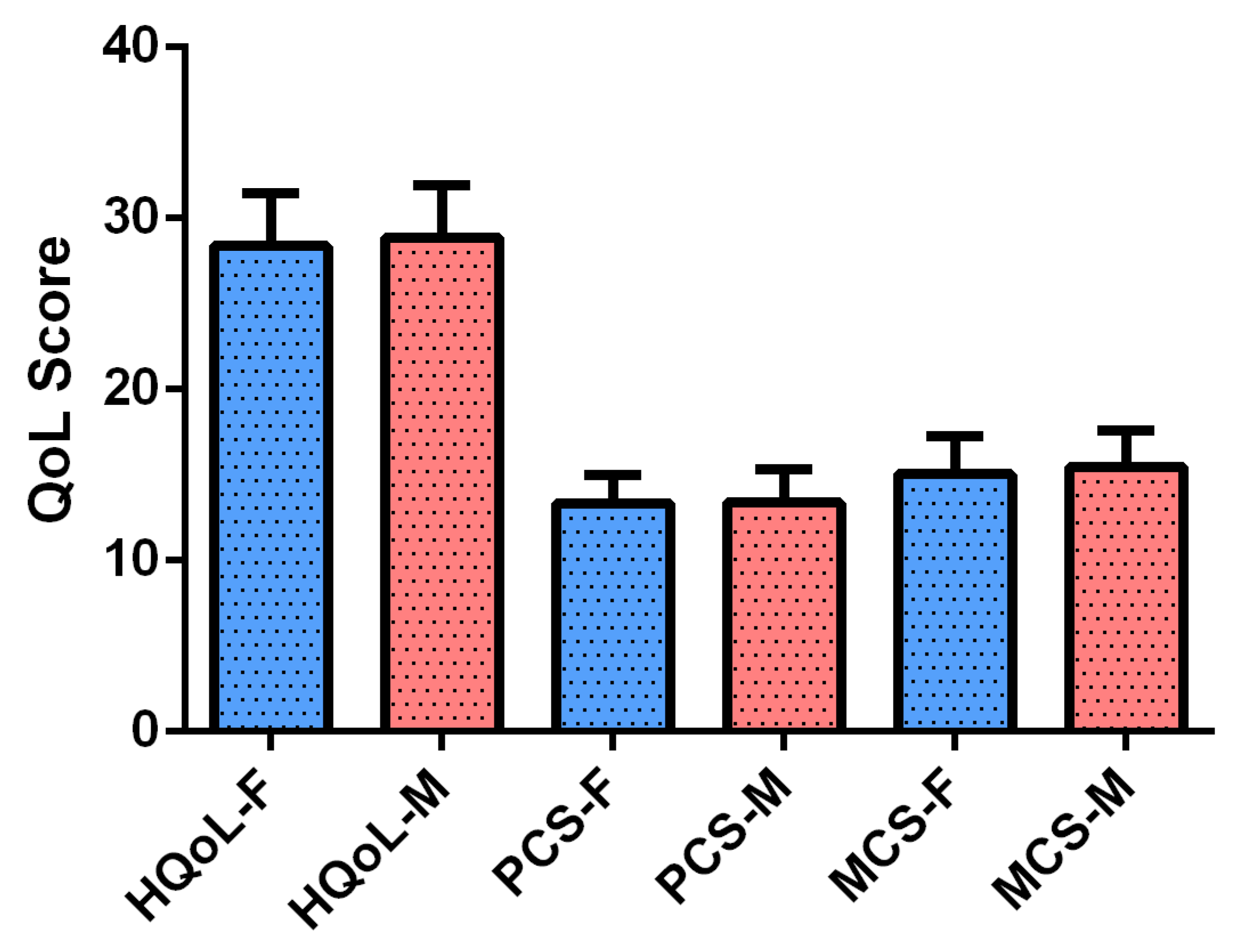
| Mental Component Summary | 15.03 ± 2.34 | 15.47 ± 2.11 | 0.079 |
| Social Function | 2.16 ± 1.25 | 2.52 ± 1.36 | 0.016 * |
| Vitality | 3.97 ± 1.20 | 3.97 ± 1.16 | 0.953 |
| Mental Health | 6.9 ± 1.52 | 6.35 ± 1.27 | 0.813 |
| Emotional problems | 2.50 ± 0.78 | 2.62 ± 0.87 | 0.206 |
| Physical component summary | 13.35 ± 1.69 | 13.38 ± 1.91 | 0.857 |
| Body Pain | 3.88 ± 1.23 | 3.85 ± 1.19 | 0.905 |
| Understanding of your life | 3.32 ± 1.06 | 3.58 ± 1.18 | 0.027 * |
| Physical Function | 3.66 ± 1.37 | 3.47 ± 1.39 | 0.199 |
| Physical health | 12.48 ± 0.82 | 14.46 ± 0.80 | 0.793 |
| Health-related quality of life | 28.39 ± 3.05 | 28.86 ± 3.04 | 0.162 |
| Variable | Female Group | Male Group | Overall Score | p |
|---|---|---|---|---|
| Provincial-level championships | 2.21 ± 090 | 2.19 ± 0.98 | 2.20 ± 0.33 | 0.030 * |
| National-level championships | 3.43 ± 1.33 | 3.10 ± 1.47 | 3.24 ± 1.42 | 0.020 * |
| International-level championships | 3.80 ± 1.24 | 3.44 ± 1.48 | 3.59 ± 1.40 | 0.001 * |
| Variable | Group | Sports Performance | |||||
|---|---|---|---|---|---|---|---|
| Provincial Level | National Level | International Level | |||||
| r | p | r | p | r | p | ||
| Quality of life | Women | −0.102 | 0.226 | −0.089 | 0.291 | −0.065 | 0.443 |
| Men | 0.051 | 0.479 | −0.010 | 0.893 | 0.060 | 0.401 | |
| Women + men | −0.018 | 0.738 | −0.049 | 0.372 | 0.002 | 0.977 | |
| Variable | Group | Sports Performance | |||||
|---|---|---|---|---|---|---|---|
| Provincial Level | National Level | International Level | |||||
| r | p | r | p | r | p | ||
| Physical health | Women | −0.044 | 0.607 | −0.022 | 0.796 | −0.052 | 0.539 |
| Men | −0.036 | 0.618 | −0.056 | 0.432 | −0.035 | 0.631 | |
| Women + men | −0.039 | 0.469 | −0.030 | 0.583 | −0.041 | 0.450 | |
| Variable | Group | Sports Performance | |||||
|---|---|---|---|---|---|---|---|
| Provincial Level | National Level | International Level | |||||
| r | p | r | p | r | p | ||
| Mental health | Women | −0.102 | 0.228 | −0.132 | 0.116 | −0.047 | 0.578 |
| Men | −0.019 | 0.787 | −0.007 | 0.919 | 0.146 | 0.042 * | |
| Women + men | 0.007 | 0.894 | −0.042 | 0.436 | 0.036 | 0.509 | |
Disclaimer/Publisher’s Note: The statements, opinions and data contained in all publications are solely those of the individual author(s) and contributor(s) and not of MDPI and/or the editor(s). MDPI and/or the editor(s) disclaim responsibility for any injury to people or property resulting from any ideas, methods, instructions or products referred to in the content. |
© 2025 by the authors. Licensee MDPI, Basel, Switzerland. This article is an open access article distributed under the terms and conditions of the Creative Commons Attribution (CC BY) license (https://creativecommons.org/licenses/by/4.0/).
Share and Cite
Ahmadi, F.; Khaleghi, M.M.; Zar, A.; Tejaswi, J.; Govindasamy, K.; Ardelean, V.P.; Ursu, V.E.; Geantă, V.A. Relationship Between Quality of Life and Sports Performance Among Athletes with Disabilities: A Focus on Individual Sports. Healthcare 2025, 13, 2919. https://doi.org/10.3390/healthcare13222919
Ahmadi F, Khaleghi MM, Zar A, Tejaswi J, Govindasamy K, Ardelean VP, Ursu VE, Geantă VA. Relationship Between Quality of Life and Sports Performance Among Athletes with Disabilities: A Focus on Individual Sports. Healthcare. 2025; 13(22):2919. https://doi.org/10.3390/healthcare13222919
Chicago/Turabian StyleAhmadi, Fatemeh, Mohammad Mehdi Khaleghi, Abdosaleh Zar, Josyula Tejaswi, Karuppasamy Govindasamy, Viorel Petru Ardelean, Vasile Emil Ursu, and Vlad Adrian Geantă. 2025. "Relationship Between Quality of Life and Sports Performance Among Athletes with Disabilities: A Focus on Individual Sports" Healthcare 13, no. 22: 2919. https://doi.org/10.3390/healthcare13222919
APA StyleAhmadi, F., Khaleghi, M. M., Zar, A., Tejaswi, J., Govindasamy, K., Ardelean, V. P., Ursu, V. E., & Geantă, V. A. (2025). Relationship Between Quality of Life and Sports Performance Among Athletes with Disabilities: A Focus on Individual Sports. Healthcare, 13(22), 2919. https://doi.org/10.3390/healthcare13222919