Federated Learning for Cardiovascular Disease Prediction: A Comparative Review of Biosignal- and EHR-Based Approaches




Abstract
1. Introduction
2. Materials and Methods
3. Results
3.1. Biosignal-Based FL Applications
3.2. EHR-Based FL Applications
3.3. Comparative Analysis of Biosignal- and EHR-Based FL
4. Discussion
5. Conclusions
Author Contributions
Funding
Institutional Review Board Statement
Informed Consent Statement
Data Availability Statement
Acknowledgments
Conflicts of Interest
Abbreviations
| FL | Federated Learning |
| ECG | Electrocardiogram |
| PPG | Photoplethysmography |
| PCG | Phonocardiogram |
| EHR | Electronic Health Record |
| CVD | Cardiovascular Diseases |
| IoMT | Internet of Medical Things |
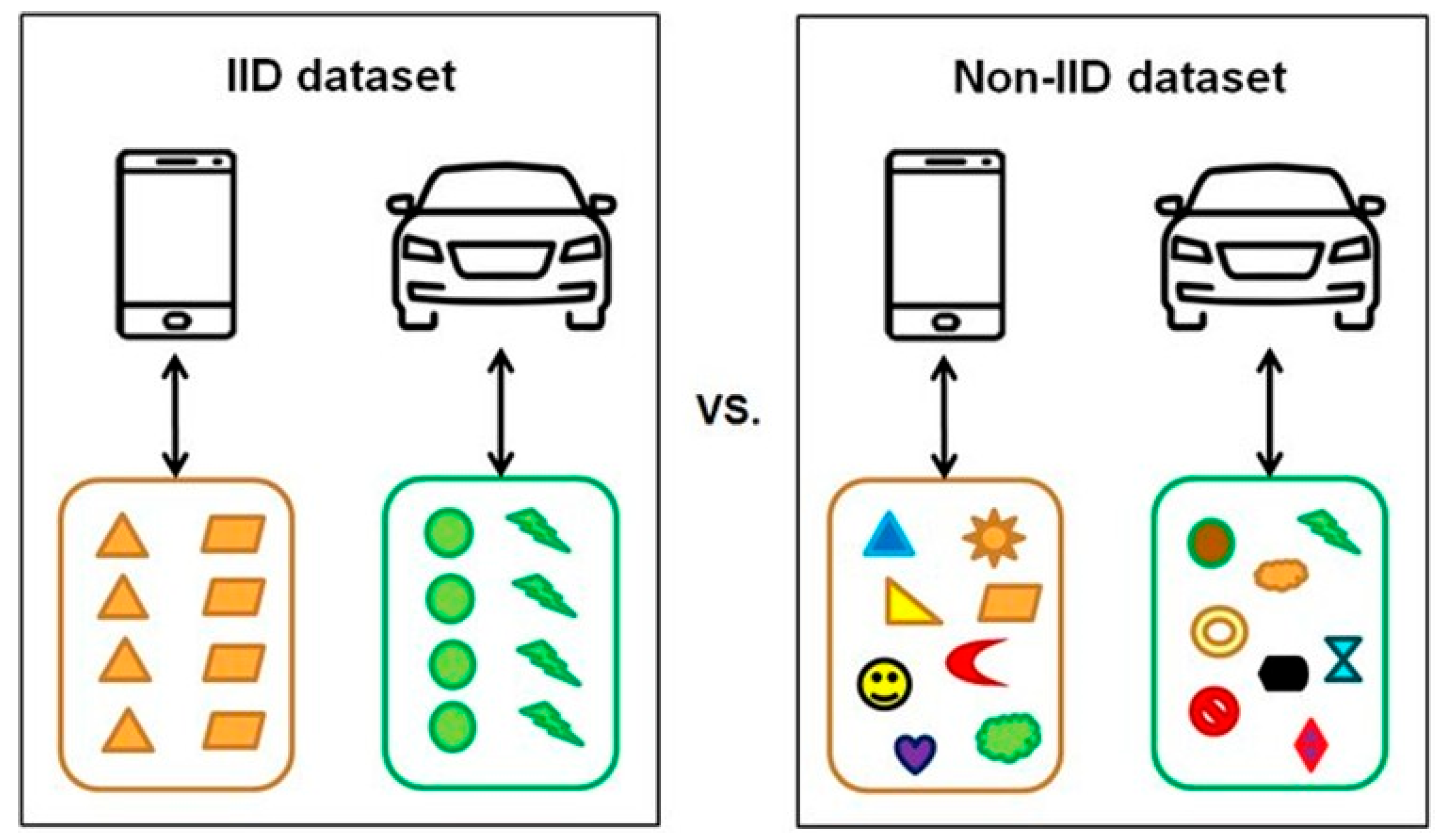
| Non-IID | Non-Independent and Identically Distributed |
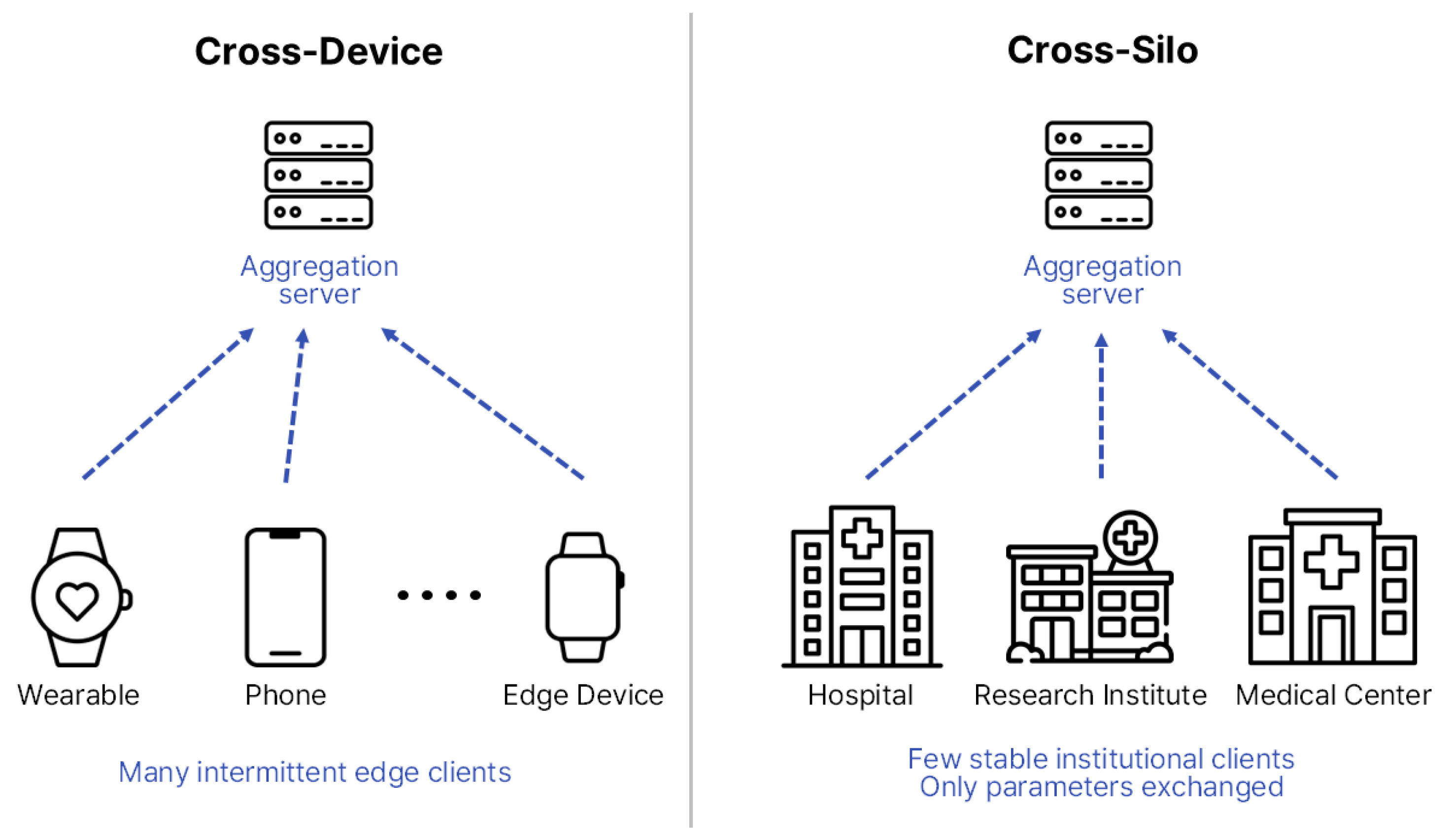
| Cross-Device FL | Federated Learning across numerous edge or wearable devices (e.g., ECG sensors) |
| Cross-Silo FL | Federated Learning among a limited number of institutions (e.g., hospitals, research centers) |
| C-statistic | Concordance statistic; equivalent to the area under the ROC curve (AUC) used in medical evaluation |
References
- Sheller, M.J.; Edwards, B.; Reina, G.A.; Martin, J.; Pati, S.; Kotrotsou, A.; Milchenko, M.; Xu, W.; Marcus, D.; Colen, R.R.; et al. Federated Learning in Medicine: Facilitating Multi-Institutional Collaborations without Sharing Patient Data. Sci. Rep. 2020, 10, 12598. [Google Scholar] [CrossRef]
- Xu, J.; Glicksberg, B.S.; Su, C.; Walker, P.; Bian, J.; Wang, F. Federated Learning for Healthcare Informatics. J. Healthc. Inform. Res. 2021, 5, 1–19. [Google Scholar] [CrossRef]
- Dayan, I.; Roth, H.R.; Zhong, A.; Harouni, A.; Gentili, A.; Abidin, A.Z.; Liu, A.; Costa, A.B.; Wood, B.J.; Tsai, C.-S.; et al. Federated Learning for Predicting Clinical Outcomes in Patients with COVID-19. Nat. Med. 2021, 27, 1735–1743. [Google Scholar] [CrossRef]
- Rieke, N.; Hancox, J.; Li, W.; Milletarì, F.; Roth, H.R.; Albarqouni, S.; Bakas, S.; Galtier, M.N.; Landman, B.A.; Maier-Hein, K.; et al. The Future of Digital Health with Federated Learning. npj Digit. Med. 2020, 3, 119. [Google Scholar] [CrossRef]
- Benjamin, E.J.; Muntner, P.; Alonso, A.; Bittencourt, M.S.; Callaway, C.W.; Carson, A.P.; Chamberlain, A.M.; Chang, A.R.; Cheng, S.; Das, S.R.; et al. Heart Disease and Stroke Statistics—2019 Update: A Report from the American Heart Association. Circulation 2019, 139, e56–e528. [Google Scholar] [CrossRef] [PubMed]
- World Health Organization. Cardiovascular Diseases (CVDs). 2025. Available online: https://www.who.int/news-room/fact-sheets/detail/cardiovascular-diseases-(cvds) (accessed on 9 October 2025).
- Mensah, G.A.; Fuster, V.; Murray, C.J.L.; Roth, G.A.; Abate, Y.H.; Abbasian, M.; Abd-Allah, F.; Abdollahi, A.; Abdollahi, M.; Abdulah, D.M.; et al. Global Burden of Cardiovascular Diseases and Risks, 1990–2022. J. Am. Coll. Cardiol. 2023, 82, 2350–2473. [Google Scholar] [CrossRef] [PubMed]
- Martin, S.S.; Aday, A.W.; Allen, N.B.; Almarzooq, Z.I.; Anderson, C.A.M.; Arora, P.; Avery, C.L.; Baker-Smith, C.M.; Bansal, N.; Beaton, A.Z.; et al. 2025 Heart Disease and Stroke Statistics: A Report of US and Global Data from the American Heart Association. Circulation 2025, 151, e41–e660. [Google Scholar] [CrossRef]
- Di Cesare, M.; McGhie, D.V.; Perel, P.; Mwangi, J.; Taylor, S.; Pervan, B.; Narula, J.; Pineiro, D.; Pinto, F.J.; Kabudula, C.; et al. The Heart of the World. Glob. Heart 2024, 19, 11. [Google Scholar] [CrossRef] [PubMed]
- Chong, B.; Jayabaskaran, J.; Jauhari, S.M.; Chan, S.P.; Goh, R.; Kueh, M.T.W.; Li, H.; Chin, Y.H.; Kong, G.; Anand, V.V.; et al. Global Burden of Cardiovascular Diseases: Projections from 2025 to 2050. Eur. J. Prev. Cardiol. 2024, 32, 1001–1015. [Google Scholar] [CrossRef]
- Rumsfeld, J.S.; Joynt, K.E.; Maddox, T.M. Big Data Analytics to Improve Cardiovascular Care: Promise and Challenges. Nat. Rev. Cardiol. 2016, 13, 350–359. [Google Scholar] [CrossRef]
- Tamura, T.; Maeda, Y.; Sekine, M.; Yoshida, M. Wearable Photoplethysmographic Sensors—Past and Present. Electronics 2014, 3, 282–302. [Google Scholar] [CrossRef]
- Brisimi, T.S.; Chen, R.; Mela, T.; Olshevsky, A.; Paschalidis, I.C.; Shi, W. Federated Learning of Predictive Models from Federated Electronic Health Records. Int. J. Med. Inform. 2018, 112, 59–67. [Google Scholar] [CrossRef]
- Donkada, S.; Pouriyeh, S.; Parizi, R.M.; Han, M.; Dehbozorgi, N.; Sakib, N.; Sheng, Q. Uncovering Promises and Challenges of Federated Learning to Detect Cardiovascular Diseases: A Scoping Literature Review. arXiv 2023. [Google Scholar] [CrossRef]
- Rahman, M.S.; Karmarkar, C.; Islam, S.M.S. Application of Federated Learning in Cardiology: Key Challenges and Potential Solutions. Mayo Clin. Proc. Digit. Health 2024, 2, 590–595. [Google Scholar] [CrossRef]
- Chaddad, A.; Wu, Y.; Desrosiers, C. Federated Learning for Healthcare Applications. IEEE Internet Things J. 2023, 11, 7339–7358. [Google Scholar] [CrossRef]
- Teo, Z.L.; Jin, L.; Li, S.; Miao, D.; Zhang, X.; Ng, W.Y.; Tan, T.F.; Lee, D.M.; Chua, K.J.; Heng, J.; et al. Federated Machine Learning in Healthcare: A Systematic Review on Clinical Applications and Technical Architecture. Cell Rep. Med. 2024, 5, 101419. [Google Scholar] [CrossRef]
- McMahan, H.B.; Moore, E.; Ramage, D.; Hampson, S.; Agüera y Arcas, B. Communication-Efficient Learning of Deep Networks from Decentralized Data. In Proceedings of the 20th International Conference on Artificial Intelligence and Statistics (AISTATS), Fort Lauderdale, FL, USA, 20–22 April 2017. [Google Scholar] [CrossRef]
- Intel. Secure and Regulatory Compliant Data Science. Intel Community Blogs. 2025. Available online: https://community.intel.com/t5/Blogs/Products-and-Solutions/HPC/Secure-and-Compliant-Data-Using-Embargoed-Confidential-and/post/1421771 (accessed on 9 October 2025).
- Huang, C.; Huang, J.; Liu, X. Cross-Silo Federated Learning: Challenges and Opportunities. IEEE Commun. Mag. 2023, 62, 82–88. [Google Scholar] [CrossRef]
- Google Cloud. Cross-Silo and Cross-Device Federated Learning. Cloud Architecture Center. 2025. Available online: https://cloud.google.com/architecture/cross-silo-cross-device-federated-learning-google-cloud?hl=ko (accessed on 9 October 2025).
- Soudan, B.; Abbas, S.; Kubba, A.; Talib, M.A.W.; Nasir, Q. Scalability and Performance Evaluation of Federated Learning Frameworks: A Comparative Analysis. Int. J. Mach. Learn. Cybern. 2024, 16, 3329–3343. [Google Scholar] [CrossRef]
- Criado, M.F.; Casado, F.E.; Iglesias, R.; Regueiro, C.V.; Barro, S. Non-IID Data and Continual Learning Processes in Federated Learning: A Long Road Ahead. Inf. Fusion 2022, 88, 263–280. [Google Scholar] [CrossRef]
- Milvus. What is the Impact of Non-IID Data in Federated Learning? Milvus AI Documentation. 2025. Available online: https://milvus.io/ai-quick-reference/what-is-the-impact-of-noniid-data-in-federated-learning (accessed on 9 October 2025).
- Daniel, M.; Jimenez, G.; Solans, D.; Heikkila, M.; Vitaletti, A.; Kourtellis, N.; Anagnostopoulos, A.; Chatzigiannakis, I. Non-IID Data in Federated Learning: A Survey with Taxonomy, Metrics, Methods, Frameworks and Future Directions. arXiv 2024. [Google Scholar] [CrossRef]
- Orlandi, F.C.; Dos Anjos, J.C.S.; Leithardt, V.R.Q.; De Paz Santana, J.F.; Geyer, C.F.R. Entropy to Mitigate Non-IID Data Problem on Federated Learning for the Edge Intelligence Environment. IEEE Access 2023, 11, 78845–78857. [Google Scholar] [CrossRef]
- Tang, R.; Luo, J.; Qian, J.; Jin, J. Personalized Federated Learning for ECG Classification Based on Feature Alignment. Secur. Commun. Netw. 2021, 2021, 6217601. [Google Scholar] [CrossRef]
- Lin, D.; Guo, Y.; Sun, H.; Chen, Y. FedCluster: A Federated Learning Framework for Cross-Device Private ECG Classification. In Proceedings of the IEEE INFOCOM Workshops, New York, NY, USA, 2–5 May 2022. [Google Scholar] [CrossRef]
- Zhang, M.; Wang, Y.; Luo, T. Federated Learning for Arrhythmia Detection of Non-IID ECG. In Proceedings of the 2020 IEEE 6th International Conference on Computer and Communications (ICCC), Chengdu, China, 11–14 December 2020; pp. 1176–1180. [Google Scholar] [CrossRef]
- Asif, R.N.; Ditta, A.; Alquhayz, H.; Abbas, S.; Khan, M.A.; Ghazal, T.M.; Lee, S.-W. Detecting Electrocardiogram Arrhythmia Empowered with Weighted Federated Learning. IEEE Access 2024, 12, 1909–1926. [Google Scholar] [CrossRef]
- Fang, L.; Liu, X.; Su, X.; Ye, J.; Dobson, S.; Hui, P.; Tarkoma, S. Bayesian Inference Federated Learning for Heart Rate Prediction. In Lecture Notes of the Institute for Computer Sciences, Social Informatics and Telecommunications Engineering (LNICST); Springer: Berlin/Heidelberg, Germany, 2021; Volume 362, pp. 116–130. [Google Scholar] [CrossRef]
- Goto, S.; Solanki, D.; John, J.E.; Yagi, R.; Homilius, M.; Ichihara, G.; Katsumata, Y.; Gaggin, H.K.; Itabashi, Y.; MacRae, C.A.; et al. Multinational Federated Learning Approach to Train ECG and Echocardiogram Models for Hypertrophic Cardiomyopathy Detection. Circulation 2022, 146, 755–769. [Google Scholar] [CrossRef]
- Raza, A.; Tran, K.P.; Koehl, L.; Li, S. Designing ECG Monitoring Healthcare System with Federated Transfer Learning and Explainable AI. Knowl.-Based Syst. 2022, 236, 107763. [Google Scholar] [CrossRef]
- Ogbuabor, G.O.; Augusto, J.C.; Moseley, R.; van Wyk, A. Context-Aware Support for Cardiac Health Monitoring Using Federated Machine Learning. In Lecture Notes in Computer Science (LNCS); Springer: Berlin/Heidelberg, Germany, 2021; Volume 13101, pp. 267–281. [Google Scholar] [CrossRef]
- Ying, Z.; Zhang, G.; Pan, Z.; Chu, C.; Liu, X. FedECG: A Federated Semi-Supervised Learning Framework for Electrocardiogram Abnormalities Prediction. J. King Saud Univ. Comput. Inf. Sci. 2023, 35, 101568. [Google Scholar] [CrossRef]
- Wang, X.; Hu, J.; Lin, H.; Liu, W.; Moon, H.; Piran, M.J. Federated Learning-Empowered Disease Diagnosis Mechanism in the Internet of Medical Things: From the Privacy-Preservation Perspective. IEEE Trans. Ind. Inform. 2023, 19, 7905–7913. [Google Scholar] [CrossRef]
- Mehta, S.; Kundra, D. Advanced Cardiac Signal Processing with Federated Learning and IoT for Remote Health Monitoring. In Proceedings of the 2nd International Conference on Recent Trends in Microelectronics, Automation, Computing, and Communications Systems (ICMACC 2024), Hyderabad, India, 19–21 December 2024; pp. 463–467. [Google Scholar] [CrossRef]
- Sakib, S.; Fouda, M.M.; Md Fadlullah, Z.; Abualsaud, K.; Yaacoub, E.; Guizani, M. Asynchronous Federated Learning-Based ECG Analysis for Arrhythmia Detection. In Proceedings of the 2021 IEEE International Mediterranean Conference on Communications and Networking (MeditCom), Athens, Greece, 7–10 September 2021; pp. 277–282. [Google Scholar] [CrossRef]
- Khan, M.A.; Alsulami, M.; Yaqoob, M.M.; Alsadie, D.; Saudagar, A.K.J.; AlKhathami, M.; Khattak, U.F. Asynchronous Federated Learning for Improved Cardiovascular Disease Prediction Using Artificial Intelligence. Diagnostics 2023, 13, 2340. [Google Scholar] [CrossRef]
- Zou, L.; Huang, Z.; Yu, X.; Zheng, J.; Liu, A.; Lei, M. Automatic Detection of Congestive Heart Failure Based on Multiscale Residual UNet++: From Centralized Learning to Federated Learning. IEEE Trans. Instrum. Meas. 2023, 72, 1–13. [Google Scholar] [CrossRef]
- Qiu, W.; Qian, K.; Wang, Z.; Chang, Y.; Bao, Z.; Hu, B.; Schuller, B.W.; Yamamoto, Y. A Federated Learning Paradigm for Heart Sound Classification. In Proceedings of the Annual International Conference of the IEEE Engineering in Medicine and Biology Society (EMBS), Glasgow, UK, 12–15 July 2022; pp. 1045–1048. [Google Scholar] [CrossRef]
- Qiu, W.; Feng, Y.; Li, Y.; Chang, Y.; Qian, K.; Hu, B.; Yamamoto, Y.; Schuller, B.W. Fed-MStacking: Heterogeneous Federated Learning with Stacking Misaligned Labels for Abnormal Heart Sound Detection. IEEE J. Biomed. Health Inform. 2024, 28, 5055–5066. [Google Scholar] [CrossRef]
- Brophy, E.; De Vos, M.; Boylan, G.; Ward, T. Estimation of Continuous Blood Pressure from PPG via a Federated Learning Approach. Sensors 2021, 21, 6311. [Google Scholar] [CrossRef]
- Gutierrez, D.M.J.; Hassan, H.M.; Landi, L.; Vitaletti, A.; Chatzigiannakis, I. Application of Federated Learning Techniques for Arrhythmia Classification Using 12-Lead ECG Signals. arXiv 2024. [Google Scholar] [CrossRef]
- Altaf, A.; Mahdin, H.; Alive, A.M.; Ninggal, M.I.H.; Altaf, A.; Javid, I. Systematic Review for Phonocardiography Classification Based on Machine Learning. Int. J. Adv. Comput. Sci. Appl. 2023, 14, 806–817. [Google Scholar] [CrossRef]
- Castaneda, D.; Esparza, A.; Ghamari, M.; Soltanpur, C.; Nazeran, H. A Review on Wearable Photoplethysmography Sensors and Their Potential Future Applications in Health Care. Int. J. Biosens. Bioelectron. 2018, 4, 195. [Google Scholar] [CrossRef] [PubMed]
- Li, S.; Liu, P.; Nascimento, G.G.; Wang, X.; Leite, F.R.M.; Chakraborty, B.; Hong, C.; Ning, Y.; Xie, F.; Teo, Z.L.; et al. Federated and Distributed Learning Applications for Electronic Health Records and Structured Medical Data: A Scoping Review. J. Am. Med. Inform. Assoc. 2023, 30, 2041–2049. [Google Scholar] [CrossRef]
- Kavitha Bharathi, S.; Dhavamani, M.; Niranjan, K. A Federated Learning Based Approach for Heart Disease Prediction. In Proceedings of the 6th International Conference on Computing Methodologies and Communication (ICCMC 2022), Erode, India, 29–31 March 2022; pp. 1117–1121. [Google Scholar] [CrossRef]
- Sharma, P.; Sharma, S. An Effective FL-CNN Based Data Securing Model for Heart Disease Prediction. In Proceedings of the International Conference on Contemporary Computing and Informatics (IC3I 2023), Uttar Pradesh, India, 14–16 September 2023; pp. 1862–1866. [Google Scholar] [CrossRef]
- Ramaswami, A. Predictive Analytics for Cardiovascular Disease Diagnosis Using Federated Machine Learning. J. Electr. Syst. 2024, 20, 195–204. [Google Scholar]
- Lee, E.W.; Xiong, L.; Hertzberg, V.S.; Simpson, R.L.; Ho, J.C. Privacy-Preserving Sequential Pattern Mining in Distributed EHRs for Predicting Cardiovascular Disease. AMIA Summits Transl. Sci. Proc. 2021, 2021, 384. [Google Scholar] [PubMed]
- Wei, M.; Yang, J.; Zhao, Z.; Zhang, X.; Li, J.; Deng, Z. DeFedHDP: Fully Decentralized Online Federated Learning for Heart Disease Prediction in Computational Health Systems. IEEE Trans. Comput. Soc. Syst. 2024, 11, 6854–6867. [Google Scholar] [CrossRef]
- Jalal, S.M.; Hasan, M.R.; Haque, M.A.; Alam, M.G.R. A Horizontal Federated Random Forest for Heart Disease Detection from Decentralized Local Data. In Proceedings of the IEEE Region 10 Humanitarian Technology Conference (R10-HTC 2022), Hyderabad, India, 16–18 September 2022; pp. 191–196. [Google Scholar] [CrossRef]
- Bebortta, S.; Tripathy, S.S.; Basheer, S.; Chowdhary, C.L. FedEHR: A Federated Learning Approach towards the Prediction of Heart Diseases in IoT-Based Electronic Health Records. Diagnostics 2023, 13, 3166. [Google Scholar] [CrossRef]
- Wolff, J.; Matschinske, J.; Baumgart, D.; Pytlik, A.; Keck, A.; Natarajan, A.; von Schacky, C.E.; Pauling, J.K.; Baumbach, J. Federated Machine Learning for a Facilitated Implementation of Artificial Intelligence in Healthcare—A Proof of Concept Study for the Prediction of Coronary Artery Calcification Scores. J. Integr. Bioinform. 2022, 19, 20220032. [Google Scholar] [CrossRef]
- Birari, D.R.; Bamane, K.D.; Kamble, P.B.; Dhaigude, T.A.; Shendge, R.B.; Dandavate, A. Towards a Holistic Approach to Chronic Disease Management: Integrating Federated Learning and IoT for Personalized Health Care. J. Electr. Syst. 2023, 19, 15–22. [Google Scholar] [CrossRef]
- Potti, D.; Saisandeep, M.N.V.; Viswanatham, V.M.; Ganapavarapu, P. Heart Stroke Prediction Using Federated Learning. Int. J. Membr. Sci. Technol. 2023, 10, 1773–1778. [Google Scholar] [CrossRef]
- Kapila, R.; Saleti, S. Federated Learning-Based Disease Prediction: A Fusion Approach with Feature Selection and Extraction. Biomed. Signal Process. Control 2025, 100, 106961. [Google Scholar] [CrossRef]
- Kairouz, P.; McMahan, H.B.; Avent, B.; Bellet, A.; Bennis, M.; Bhagoji, A.N.; Bonawitz, K.; Charles, Z.; Cormode, G.; Cummings, R.; et al. Advances and Open Problems in Federated Learning. Found. Trends Mach. Learn. 2019, 14, 1–210. [Google Scholar] [CrossRef]
- SNOMED International. Home|SNOMED International. Available online: https://www.snomed.org/ (accessed on 9 October 2025).
- Regenstrief Institute. Home—LOINC. Available online: https://loinc.org/ (accessed on 9 October 2025).
- MedPerf Initiative. Clinically Impactful Machine Learning|MedPerf. Available online: https://www.medperf.org/ (accessed on 9 October 2025).
- Caldas, S.; Meher, S.; Duddu, K.; Wu, P.; Li, T.; Konečný, J.; McMahan, H.B.; Smith, V.; Talwalkar, A. LEAF: A Benchmark for Federated Settings. arXiv 2018, arXiv:1812.01097. [Google Scholar] [CrossRef]
- Kaissis, G.A.; Makowski, M.R.; Rückert, D.; Braren, R.F. Secure, Privacy-Preserving and Federated Machine Learning in Medical Imaging. Nat. Mach. Intell. 2020, 2, 305–311. [Google Scholar] [CrossRef]



| Biosignal | Reference | Objective | FL Strategy | Centralized | FL |
|---|---|---|---|---|---|
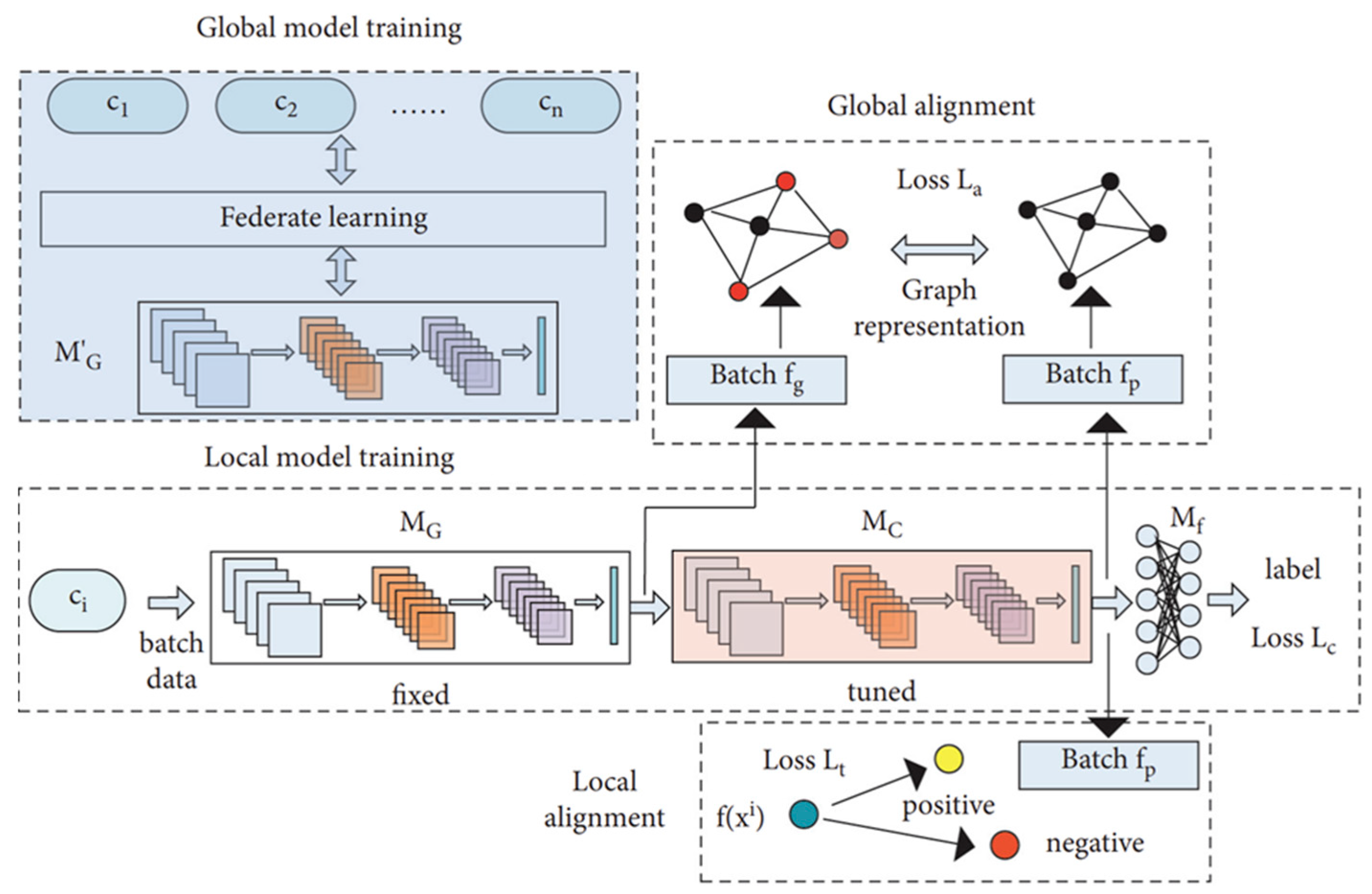
| ECG | [27] | Personalized ECG classification | Feature alignment, Dual model | 82.6% | 87.8% (local) 83.9% (global) |
| [28] | Personalization enhancement | Client clustering | 96.9% | 89.3% (average) | |
| [29] | Handling Non-IID data | Local optimization | N/A | 0.70 F1-score | |
| [30] | Handling Non-IID data | Importance weighted updates | ≈95.0% | 98.0% | |
| [31] | Heart rate regression | Bayesian inference | N/A | MSE 2.81 | |
| [32] | Rare cardiac disease diagnosis | Cross-Silo collaboration | AUROC 0.88–0.93 (int.); 0.79–0.82 (ext.) | AUROC 0.90–0.96 (multi-site, incl. ext) | |
| [33] | Providing visual explanations | Explainable AI | ~96.9–98.8% (prior works, indirect comparison) | 98.9% (clean), 94.5% (noisy) | |
| [34] | Context-aware adaptation | Context-aware FL | 53–88% (client-level test) | 89% (SVM) 81% (LR) | |
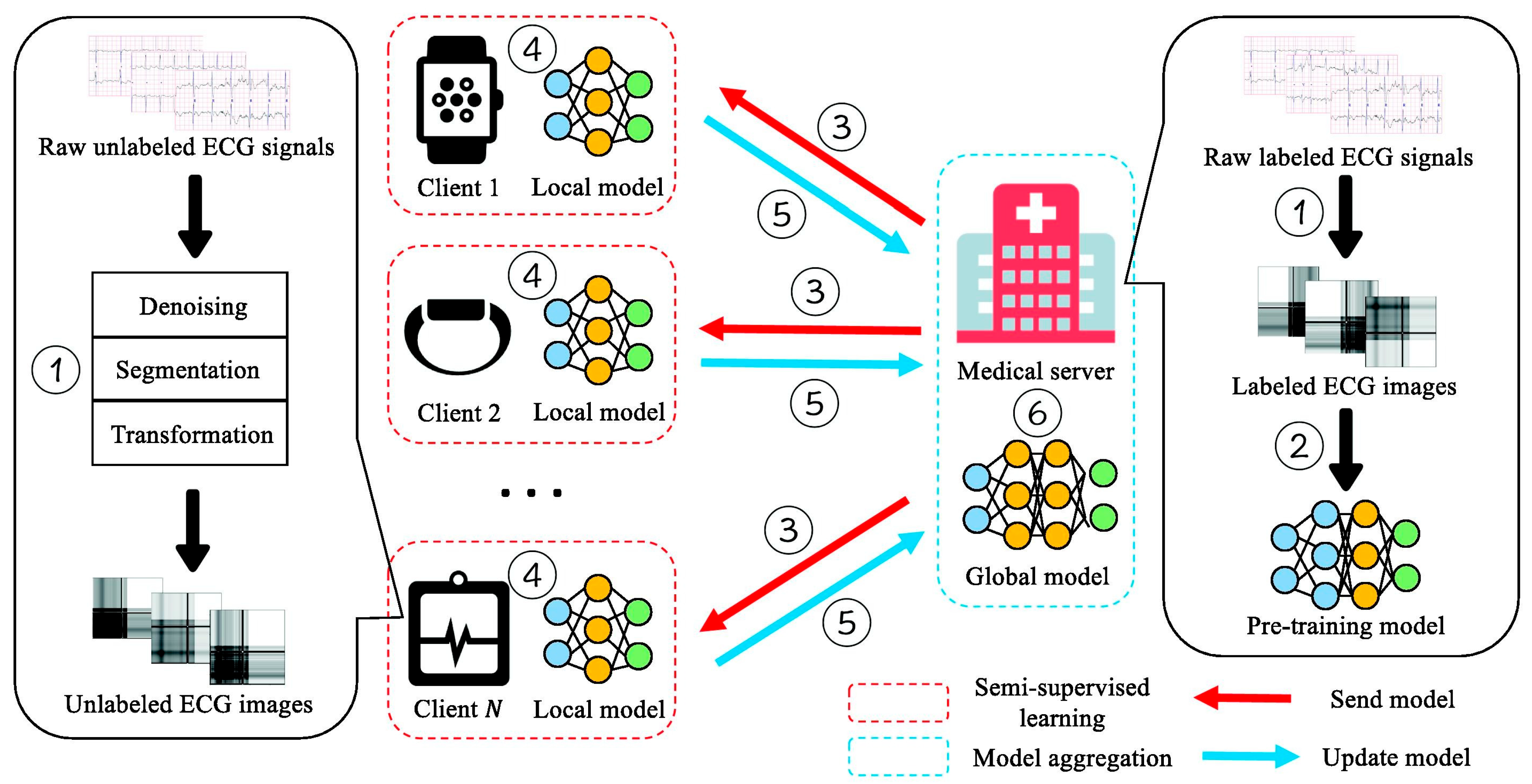
| [35] | Semi-supervised learning | Semi-supervised FL | 95.9% (supervised baseline) | 94.8% (semi-supervised, 50% labeled) | |
| [36] | Privacy-centric design | IoMT-based FL | N/A | 90.9% | |
| [37] | Remote health monitoring | Edge device optimization | N/A | 97.8% | |
| [38] | Handling delays | Asynchronous FL | N/A | ~95.0% | |
| [39] | Handling delays | Asynchronous FL | N/A | 89.9% | |
| [40] | Early CHF prediction | CNN-integrated FL | 89.8% | 87.5% | |
| PCG | [41] | Abnormal heart sound detection | Local training, Global update | 76.2% | 72.1% |
| [42] | Label inconsistency | Stacking-based ensemble | 75.2% UAR | 79.3% UAR | |
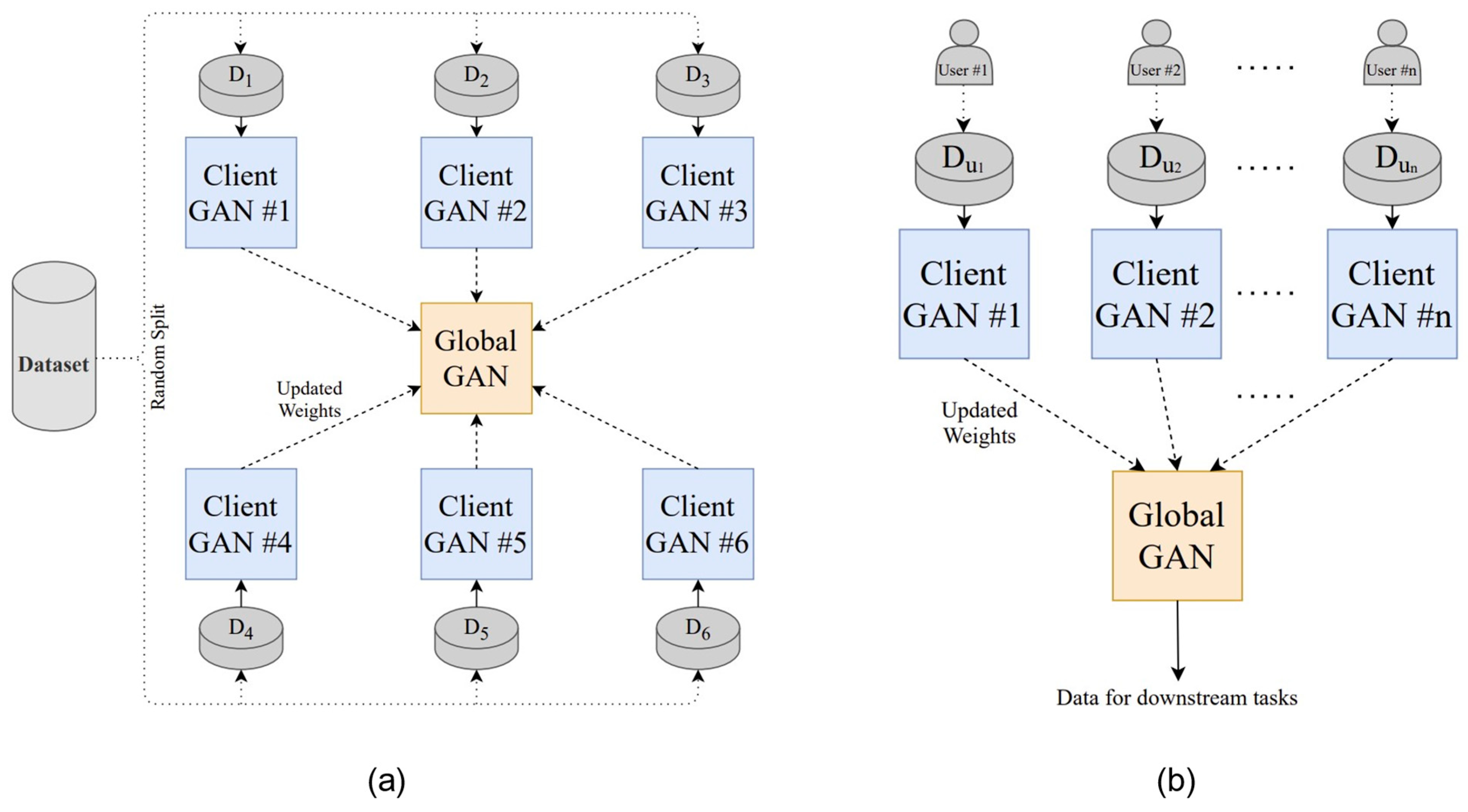
| PPG | [43] | Blood pressure estimation | GAN-based FL | RMSE 0.19/0.23 | RMSE 0.24/0.25, MAP error 2.95 mmHg |
| Category | Reference | Objective | FL Strategy | Centralized | FL |
|---|---|---|---|---|---|
| Basic Framework | [48] | Heart disease prediction | Basic FL, Deep learning | LR 95.8% | LR 82.4% SVM 90.3% |
| [49] | Data security & accuracy | Local CNN, Server aggregation | 97.0% | 94.9% | |
| [50] | Diagnostic performance | Classifier comparison | N/A | 0.95–0.96 (accuracy, precision, recall, F1-score) | |
| Security-Centric Design | [51] | Privacy-preserving pattern mining | Sequential mining, Differential privacy | N/A | Minor loss with DP, stable F1-score, AUC |
| [52] | Decentralized online learning | Fully decentralized FL, Local updates | N/A (compared qualitatively to FedAvg) | ≈90.0% | |
| Low-Resource/IoT | [53] | Low-resource FL | Horizontal FL, RF | ≈85% | 97.2% |
| [54] | IoT-based heart disease prediction | Clustering-based FL | ≈95–96% | 99.8% | |
| Multi- Institutional | [55] | Hospital collaboration | FeatureCloud FL | 67.6%, AUC 75.52 | 67.6%, AUC 75.1 |
| Adaptive/Advanced | [56] | Adaptive learning | Adaptive Gradient Clipping | N/A | AUC 88.5% |
| [57] | Distributed learning improvement | Server–client FL | RF 93.3% | 96.3%, F1 = 91.2% | |
| [58] | Feature selection & extraction | ANOVA, Chi-square, LDA | N/A | 88.5%., F1 = 89.2% |
| Category | Biosignal-Based FL | EHR-Based FL |
|---|---|---|
| Data Characteristics | Time-series, high-resolution, real-time collection | Mixed structured and unstructured data, medical records |
| Main Challenges | Non-IID, personalization, communication resources | Structural heterogeneity, standardization, privacy |
| Applied Techniques | XAI, asynchronous learning, lightweight models, GANs | Feature selection/extraction, distributed learning, pattern mining |
| Representative Applications | Arrhythmia, heart failure, real-time monitoring | Stroke, coronary artery disease, chronic disease management |
| Domain | Dataset | Modality | Reference | Sample Size | Source |
|---|---|---|---|---|---|
| Biosignal | MIT-BIH Arrhythmia Database | ECG | [28,30,33,35,36,37,38] | ≈109 k beats (47 subjects) | PhysioNet |
| MIT-BIH Supraventricular Arrhythmia Database | ECG | [38] | Not specified | PhysioNet | |
| INCART 12-lead Arrhythmia Database | ECG | [38] | Not specified | PhysioNet | |
| Sudden Cardiac Death Holter Database | ECG | [38] | Not specified | PhysioNet | |
| NSR-RR Interval Database | RR-interval | [40] | 54 patients | PhysioNet | |
| CHF-RR Interval Database | RR-interval | [40] | 29 patients | PhysioNet | |
| Physical Activity Recognition Dataset | ECG + Activity data | [34] | 12 patients | Middlesex Univ. | |
| CinC Challenge 2016 Heart Sound Dataset | PCG | [41,42] | 3240 samples (764 subjects) | PhysioNet | |
| Cuffless Blood Pressure Estimation | PPG, ECG ABP | [43] | ≈144 k samples | Kaggle, UCI ML Repo. | |
| University of Queensland Vital Signs Dataset | PPG, ABP | [43] | 900 samples | Univ. of Queensland, RAH | |
| EHR | UCI Heart Disease Database | Structured (ECG, clinical data) | [48,49,58] | 303 subjects (14 features) | UCI ML Repo. |
| UCI Heart Disease Database (multi-site) | Structured (clinical data) | [53] | 1190 subjects (4 hospital sites) | UCI ML Repo. (multi-site) |
Disclaimer/Publisher’s Note: The statements, opinions and data contained in all publications are solely those of the individual author(s) and contributor(s) and not of MDPI and/or the editor(s). MDPI and/or the editor(s) disclaim responsibility for any injury to people or property resulting from any ideas, methods, instructions or products referred to in the content. |
© 2025 by the authors. Licensee MDPI, Basel, Switzerland. This article is an open access article distributed under the terms and conditions of the Creative Commons Attribution (CC BY) license (https://creativecommons.org/licenses/by/4.0/).
Share and Cite
Ryu, H.; Lee, M.; Kim, S.-h.; Kim, J.H.; Yang, H.-j. Federated Learning for Cardiovascular Disease Prediction: A Comparative Review of Biosignal- and EHR-Based Approaches. Healthcare 2025, 13, 2811. https://doi.org/10.3390/healthcare13212811
Ryu H, Lee M, Kim S-h, Kim JH, Yang H-j. Federated Learning for Cardiovascular Disease Prediction: A Comparative Review of Biosignal- and EHR-Based Approaches. Healthcare. 2025; 13(21):2811. https://doi.org/10.3390/healthcare13212811
Chicago/Turabian StyleRyu, Hagyeong, Myungeun Lee, Soo-hyung Kim, Ju Han Kim, and Hyung-jeong Yang. 2025. "Federated Learning for Cardiovascular Disease Prediction: A Comparative Review of Biosignal- and EHR-Based Approaches" Healthcare 13, no. 21: 2811. https://doi.org/10.3390/healthcare13212811
APA StyleRyu, H., Lee, M., Kim, S.-h., Kim, J. H., & Yang, H.-j. (2025). Federated Learning for Cardiovascular Disease Prediction: A Comparative Review of Biosignal- and EHR-Based Approaches. Healthcare, 13(21), 2811. https://doi.org/10.3390/healthcare13212811