Abstract
In the present paper, we introduce S-evolution algebras and investigate their solvability, simplicity, and semisimplicity. The structure of enveloping algebras has been carried out through the attached graph of S-evolution algebras. Moreover, we introduce the concept of -linear derivation of S-evolution algebras, and prove such derivations can be extended to their enveloping algebras under certain conditions.
1. Introduction
It is well-known that several classes of non-associative algebras such as baric, evolution, Bernstein, train, stochastic, etc., were tied up with abstract algebra and biology [1,2,3]. The investigation of such kinds of algebras has offered many significant contributions to population genetics theory [3]. We point out that first population genetics problems can be traced back to the work of Bernstein [4] where evolution operators were examined, which naturally describe genetic algebras (see [3,5]). Evolution algebras are considered as a type of genetic algebras which are non-associative algebras with a dynamic nature. Such a type of algebras has been introduced in [6,7]. After that, in [8] the foundations of these algebras have been established. Later on, evolution algebras are used to model non-Mendelian genetics laws [9,10,11,12,13]. Moreover, these algebras are tightly connected with group theory, the theory of knots, dynamic systems, Markov processes and graph theory [14,15,16,17,18]. Evolution algebras allowed introduce useful algebraic techniques and methods into the investigation of some digraphs because such kind of algebras and weighted digraphs can be canonically identified [7,19]. In most investigations, considered evolution algebras were taken nilpotent [19,20,21,22,23,24]. A few papers are devoted to non-nilpotent evolution algebras [25,26,27]. In [28,29,30], a new class of evolution algebras, called Lotka–Volterra evolution algebras, has been introduced (see also [31]). It turns out that such kind of algebras are not nilpotent. Given an evolution algebra , then its enveloping algebra is considered as a subalgebra of full matrix algebra of the endomorphism of linear space generated by all left multiplications. The common properties between algebra and its enveloping algebra are essential tasks in algebra [32]. Therefore, it is natural to find which algebraic properties can be extended from the algebra to its enveloping. Some extendible properties among those algebras have been found (see [33] and the references given therein). It is worth pointing out that majority of studies constraint nilpotent algebras. In the present paper, we introduce a new class of evolution algebras called S-evolution algebras. These algebras are not nilpotent, but naturally extend Lotka–Volterra ones [30]. We point out that directed weighted graphs associated with S-evolution algebras have meaning while the Lotka–Volterra ones do not. Therefore, the study structure of these algebras may give some information about electrical circuits, find the shortest routes, and construct a model for analysis and solution of other problems [9,10,34].
One of this paper’s main aims is to study basic algebraic properties of S-evolution algebras such as simplicity, semisimplicity [25]. Up to now, there are not any investigations between evolution algebras and their enveloping algebras. Therefore, we will investigate the evolution algebras together with the specific properties of their enveloping algebras. Besides, the extendibility of derivations of S-evolution algebras will be examined as well. We notice that derivations of evolution algebras have been studied in [16,20,33,35,36,37,38].
Let us briefly highlight an organization of this paper. In Section 2, we provide ceratin basic properties of S-evolution algebras and their graphs. In Section 3, we study the structure of enveloping algebras generated by S-evolution algebras, whose attached graphs are complete. Furthermore, we prove that if two S-algebras are isomorphic, then their corresponding enveloping algebras are isomorphic, but the converse is not valid. In Section 4, we investigate properties of enveloping algebras generated by S-evolution algebras. Furthermore, in Section 5, a concept of -linear derivation is defined of enveloping algebras of S-evolution algebras. In the final Section 6, a description of all -linear derivations of enveloping algebra generated by 3-dimensional S-evolution algebras is provided.
2. S-Evolution Algebras and Their Graphs
Let us start with a definition of evolution algebras.
Definition 1.
Let be a vector space over a field with multiplication · and a basis such that
then is called an evolution algebra and the basis is said to be natural basis.
Here, the matrix is called a structural matrix of the algebra in the natural basis
One can immediately see that every evolution algebra is commutative (therefore, flexible). Moreover, we have this yields that for every finite-dimensional evolution algebra its rank of the matrix does not depend on the choice of natural basis. In what follows, we will consider non-degenerate evolution algebras, i.e., for any For convenience, we write instead of for any and we shall write instead of .
Definition 2.
A matrix is called an S-matrix if
- (i)
- for all
- (ii)
- if and only if .
We notice that if is an S-matrix, then there is a family of injective functions with such that for all . Hence, each S-matrix is uniquely defined by off diagonal upper triangular matrix and a family of functions . This allows us to construct lots of examples of S-matrices.
Example 1.
Let be a given upper triangular matrix. Let us construct certain examples of S-matrices as follows:
- 1.
- Assume that B is a symmetric matrix such that and for all . In this setting, one can see that ;
- 2.
- Assume that C is a skew-symmetric matrix such that , for all . It is clear that ;
- 3.
- Assume that M is a matrix such that , for all . In this setting, we have .
Definition 3.
An evolution algebra is called an S-evolution algebra if its structural matrix is an S-matrix.
Remark 1.
We note that evolution algebras corresponding to skew-symmetric matrices are called Lotka–Volterra (or Volterra) evolution algebras. Such kind of algebras have been investigated in [30,39]. From the given Example 1, we can see that Lotka–Volterra algebras and S-evolution algebras (different from those ones) may not share common properties. For example, if A is a skew-symmetric matrix, then its rank could be even, while if one considers an S-matrix which is symmetric, then its rank could be any positive integer.
Remark 2.
The motivation behind introducing S-evolution algebra is that such algebras have certain applications in the study of electrical circuits, find the shortest routes, and construct a model for analysis and solution of other problems [9,38]. From the physical point of view, if one considers species than a pair interacts with rate. Therefore, it is natural investigate algebraic properties of such kind of interactions. On the other hand, such kind of interactions lead us to the game theory like zero-sum games [40,41]. Moreover, recently, Lotka–Volterra matrices have been considered within the framework of phase transitions and Gibbs measures [42,43,44].
Example 2.
Let us provide a more concrete example. Let us consider two players A and B stochastic game, who move a token along one of the outgoing arcs [34]
To determine whose turn, a coin is flipped. If head it is s turn and if tail then s turn. A pays to B the weight of the arc along which the token is moved. Such kinds of games have a lot of applications in economics, evolutionary biology, etc. One can see that the given weighted graph defines a matrix.
which is clearly an S-matrix. Hence, we can investigate the algebraic properties of the corresponding evolution algebra ( This is an S-evolution algebra). It is stressed that the evolution algebra is not Lotka–Volterra one. Therefore, it is natural to investigate such algebra, which may open some shed into these games from an algebraic point of view. Note that evolution algebra associated with the Markov process has been considered in [8,15,45]. However, the considered evolution algebra is not Markov evolution algebra, and hence, it is needed for the investigation (algebraic properties )
![]() |
Example 3.
Another implementation of S-evolution algebras could be in a face recognition. Suppose we are interested in designing a model to face recognition. The first step in any model of face recognition is devoted to finding out the coordinates of faces. If one person stands in front of the camera, the system will find the coordinates of the face and install them in a big matrix. If we assume that the region is related to the coordinate , this region is common and has the same properties in each person. One of the significant challenges of any face recognition system is the rotation of the person’s face when he stands in front of the camera. Usually, the company stored several images of its Customers in its database. The implementation of S-evolution algebra as follows:
Suppose the system took a picture of person A and installed it in the matrix, then the corresponding S-evolution algebra is denoted by and if we assume that this person has ten pictures in the database, then each picture related to S-evolution algebra where Now our model will check the isomorphism between and all S-evolution algebras generated by the pictures in the database. Surely, the system will find where Hence, in this way, we can identify this person.
In what follows, for the sake of simplicity, we always assume that is taken as the field of the complex numbers .
Let be an S-evolution algebra w.r.t. natural basis, then the canonical form of the table of multiplications is given by
We notice that if then the first summand of (2) is zero, if then the second summand is zero.
Let us define the following sequences:
Next inclusions are true for
Due to the commutativity of one has
Definition 4.
An evolution algebra is called
- (i)
- solvable if there exists such that and the minimal such number is called index of solvability;
- (ii)
- right nilpotent if there exists such that and the minimal such number is called index of right nilpotency;
- (iii)
- nilpotent if there exists such that and the minimal such number is called index of nilpotency.
Remark 3.
We point out that the nilpotency of evolution algebra implies its right nilpotentcy and solvability. Moreover, the solvablity of evolution algebra does not imply its right nilpotency ([20], Example 2.4).
Definition 5.
Let be an evolution algebra with a natural basis and a structural matrix .
- (i)
- A graph , with and , is called the graph attached to the evolution algebra relative to the natural basis B.
- (ii)
- The triple , with and where ω is the map given by , is called the weighted graph attached to the S-evolution algebra relative to the natural basis B.
A graph is called complete if every two vertices of the graph are connected by an edge. Moreover, is connected if there is a path between any two vertices, otherwise is called disconnected.
Definition 6
([25]). An evolution subalgebra of an evolution algebra is a subalgebra such that is an evolution algebra, i.e., has a natural basis.
We notice that the definition of evolution subalgebra, which is given in [7,8] has more restrictive than the Definition 6. The concepts of evolution subalgebra and evolution ideal in the sense of definition given in [7,8] are equivalent. However, they are not equivalent in the sense of Definition 6 (see Example 2.6 [25]). In this paper, we will consider the Definition 6.
Definition 7
([25]). An evolution ideal of an evolution algebra is an ideal I of such that I has a natural basis.
Recall that an evolution algebra is called simple if and it has no non-trivial proper ideal, and it is called semisimple if it can be written as direct sum of simple subalgebras. An ideal is called simple if it does not contain any proper sub-ideal.
Remark 4.
In [46] a notion of basic ideals of evolution algebras is defined and corresponding basic simple evolution algebras are studied. A relation between simplicity and basic simplicity is established as well. These results allowed to describe four dimensional perfect non-simple evolution algebras over a field with mild restrictions.
Proposition 1
([25]). Let A be an evolution algebra and be its natural basis. Consider the following conditions:
- (i)
- is simple.
- (ii)
- satisfies the following properties:
- (a)
- is non-degenerate.
- (b)
- .
- (c)
- is a non-zero ideal of A for a non-empty then
Then (i) ⇒ (ii) and (ii) ⇒ (i) if .
In what follow, we always consider
3. Some Properties of S-Evolution Algebras
In this section, we are going to study some properties of S-evolution algebras.
In [30] we have recently proved the following fact.
Theorem 1
([30]). Let be a non-trivial Lotka–Volterra evolution algebra then is not nilpotent.
It turns out that this result could be extended for S-evolution algebras in a more general setting.
Theorem 2.
Let be a non-trivial n-dimensional S-evolution algebra, then is not solvable.
Proof.
Let since is non-degenerate, then there exists such that Therefore, one finds such that since the structural matrix of is a S-matrix, then so, . We claim that for any positive integer Let us prove it by induction. Assume that due to and we get . This yields that for any positive Hence, is not solvable. □
The proved theorem together with Remark 3 implies that any non-degenerate S-evolution algebra is not nilpotent.
Let be a natural basis of an evolution algebra and let The first-generation descendants of are the elements of the subset given by:
Note that if and only if, (where is the canonical projection of over ). Similarly, we say that j is a second-generation descendant of whenever for some Therefore,
By recurrency, we define the set of mth-generation descendantsof as
Finally, the set of descendants of is defined as the subset of ∨ given by
On the other hand, we say that is an ascendant of if that is, is a descendant of
Proposition 2.
Let be an S-evolution algebra with natural basis If is complete, then for any .
Proof.
Since the attached graph is complete, then, for any
From we infer
Consequently,
Therefore,
Due to the arbitrariness of we get the assertion. □
Theorem 3.
Let be an S-evolution algebra with Then is simple if and only if where A is the structural matrix of
Proof.
Let be a simple algebra then by Proposition 1(b), we have . Hence, the set contains linearly independent vectors, this implies that
Conversely, let us assume the contrary, i.e., is not simple. Then, there exists such that is a non-zero proper ideal of Let such that Then is a non-zero ideal of contained in but
Due to , we have
which means which is a contradiction as a proper ideal of This completes the proof. □
Corollary 1.
Let be a simple S-evolution algebra with Then is connected.
We stress that the converse of Corollary 1 is not true. For example, let us consider a three dimensional S-evolution algebra with a table of multiplication given by:
It is clear that is connected. However, is not simple as is a non-zero proper ideal of
Proposition 3.
Let be an n-dimensional S-evolution algebra with disconnected attached graphs, i.e., and for any where p is the number of disconnected graphs. Then each graph corresponds to a proper ideal of
Proof.
As before, the attached graph of is denoted by . Let We claim that is an ideal. Since for any one finds for all and Next, fix i and pick then Hence, whenever, This means that is an ideal of □
Example 4.
Let us consider an algebra with the following structural matrix:
The attached graphs are
Then and are proper ideals of
![]() |
Corollary 2.
Let be an n-dimensional S-evolution algebra with disconnected attached graphs,
where for any and p is the number of disconnected graphs. Then
if and only if each is a simple S-evolution algebra.
Theorem 4.
If a non-trivial finite dimensional S-evolution algebra is semisimple, then the attached graph of is disconnected.
Proof.
Assume that is semisimple, then there exists a non-trivial proper ideal I of Let us define the following set
It follows that if then Since one has that for any Hence, the vertex m is not connected to any vertex of A. Therefore, the attached graph is disconnected. □
Remark 5.
The converse of the Theorem 4 is, in general, not true. Namely, if the attached graph is disconnected then an evolution algebra may be not semisimple.
Example 5.
Let us consider an S-evolution algebra with the following table of multiplication:
It is clear that the attached graph is disconnected. However, where and . From we infer that is not simple.
In [30] we have established an isomorphism criteria of Lotka–Volterra evolution algebras.
Theorem 5
([30]). Let and be two Lotka–Volterra evolution algebras whose attached graphs are complete. Then if and only if for any and
Next result extends the formulated one to S-evolution algebras.
Theorem 6.
Let and be two S-evolution algebras with structural matrices, respectively, whose attached graphs are complete. Then if and only if the following conditions are satisfied
Proof.
Let and . Assume that , then one can write
From for any without loss of generality, we can assume that Then
On the other hand,
Comparing (3) and (4), we obtain
For any , from (5) one finds
Solving the above equations, we get
The arbitrariness of j implies
Conversely, the isomorphism between and can be established by the following change of basis
□
4. Enveloping Algebras Generated by S-Evolution Algebras
Let us recall some notions from [32]. Let be an evolution algebra, by we denote the left multiplication operator by an element :
By we denote the full matrix algebra of endomorphisms of . A subalgebra of generated by , is called multiplication algebra of , denoted by .
Proposition 4.
Let be an S-evolution algebra and be its associative enveloping algebra. Then the vectors are linearly dependent.
Proof.
We first observe that
and
If then which implies that these two vector are linearly dependent. If one has that
Hence, in both cases they are linearly dependent. □
For fixed we define
Proposition 5.
Let be an S-evolution algebra whose attached graph is complete, with matrix of structural constants A and be its associative enveloping algebra, then the following statements hold true:
- (1)
- if is simple then for each
- (2)
- if is not simple then for each
- (3)
- if the sets contain linearly independent vectors then contains linearly independent vectors for any
Proof. (i) Consider
Since for any Then one gets the following system of homogeneous linear equations:
where are the row vectors of the structural matrix A without the ith row, and • stands for the dot product given by
Denote
then we can rewrite (7) as follows
Since then Therefore, the only solution of (7) is
Hence, contains linearly independent vectors. Let then one can easily show that Hence,
(ii) Next, assume that and Now, by removing dependent rows, we obtain a matrix Clearly, Then, let us consider
From the last equation, we get
The solution of the last system is trivial, hence a maximum number of independent vectors is Therefore,
(iii) Finally, assume that contains linearly independent elements for all Then is a subspace. Now let us suppose that are linearly dependent. It is clear that for any which yields Assume that
Now, we consider the following cases:
If for all k then we get is linearly dependent which is a contradiction. If for all m then we get is linearly dependent which is again a contradiction. Now, if
then , but it contradicts to Hence, contains linearly independent vectors for any □
Corollary 3.
Let contain linearly independent vectors then is linearly independent.
Proposition 6.
Let be an associative enveloping algebra generated by an -evolution algebra whose attached graph is complete. Then the following statements are true:
- (i)
- vectors of are linearly independent;
- (ii)
- if is simple then for each the set is linearly independent;
- (iii)
- if is not simple then for each the set is linearly dependent.
Proof. (i). Let us consider
Since is complete, then for any This implies that for all Hence, the set contains linearly independent vectors.
(ii) Consider the equality
Then
here, as before, are row vectors of the structural matrix A. Now,
with . Since and the attached graph is complete, we find Hence, the only solution of the system Equation (9) is trivial. Therefore, the set contains linearly independent vectors.
(iii) Due to the fact and from one has that there is a non-trivial solution of (9). Hence, in this case the set contains linearly dependent vectors. This completes the proof. □
Theorem 7.
Let be an associative enveloping algebra generated by an S-evolution algebra whose attached graph is complete. Then the following statements are true:
- (i)
- if is simple then
- (ii)
- if is not simple and Thenwhere
Proof.
By compiling Propositions 5 and 6, we get the assertion. □
Definition 8.
If a graph Γ has a vertex with no edges, then such vertex is called isolated.
Let us denote the set of isolated vertices by It is obvious that in a complete graph where is the number of isolated vertices in
Remark 6.
If then Hence, for all
Corollary 4.
Let be an associative enveloping algebra generated by an n-dimensional S-evolution algebra with disconnected attached graph where is complete and contains the isolated vertices. Then the following statements hold true:
- (i)
- If is simple then where is the number of edges in .
- (ii)
- If is not simple and Then
Proof.
Note that
Then,
Consider
It is clear that if and only if Since the structural matrix is an S-matrix, then if and only if . This implies that if and only if Then Therefore, by Theorem 7
Next, if and Then
Then,
Note that
However,
Now, after removing dependent vectors from the structural matrix A we have a new structural matrix say where its attached graph has n vertices such that the first m vertices will joint vertices and the rest will join m vertices. Hence,
Consequently,
This completes the proof. □
Remark 7.
We point out that a table of multiplication of the enveloping algebra is given as follows:
Theorem 8.
Let be an associative enveloping algebra generated by an n-dimensional simple S-evolution algebra whose attached graph is complete. Then
Proof.
Let us denote Then Due to for any we infer that is a subalgebra of Now, let us pick any arbitrary element of say we have to show that Indeed, if we consider the following equality
Then we have the following system of equations:
Now,
with . Now the simplicity of (as ) implies Hence, by the Gaussian elimination of system (12) we obtain a unique solution. Therefore, , so This completes the proof. □
Corollary 5.
Let be an enveloping algebra generated by a simple S-evolution algebra whose attached graph is complete, then
Let us consider the following example.
Example 6.
Let be a two dimensional S-evolution algebra with the following matrix of structural constants.
The table of multiplication of enveloping algebra is given by
then the attached graph as follows:
Then and
with Furthermore, this algebra is simple.
![]() |
Example 7.
Let be a three dimensional S-evolution algebra with the following structural matrix:
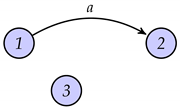
then the attached graph is:
In this example, we have and then Furthermore, this algebra is neither simple nor semisimple.
![]() |
Theorem 9
([47]). Every finite-dimensional simple algebra over is isomorphic to
Theorem 10.
Let be an n-dimensional S-evolution algebra whose attached graph is complete. Then is simple if and only if is simple.
Proof.
Let I be an ideal of such the We notice that one dimensional subalgebras and (for some ) are not ideals. As then any ideal of should contain for some This implies that the subalgebras and are contained in I. For fixed let
It is easy to check that contains and . Moreover,
Since for all then is a sub-algebra. Let
where ⊖ stand for removing the subalgebra from . Note that is a sub-algebra. Moreover,
Assume that
Then Moreover, Then
However, then Hence, This implies that is simple.
Conversely, let us assume that is simple, then by Theorem 8, we have Hence, for any again by the proof of Theorem 8, one has
Then, but as has complete attached graph, so Therefore, Theorem 3 implies that is simple. This completes the proof. □
Corollary 6.
If is an enveloping algebra generated by an n-dimensional not simple S-evolution algebra, then is not simple.
Proof.
Since is not simple and then Hence, by Theorem 9, we have is not simple. □
Corollary 7.
Let and be two n-dimensional simple S-evolution algebras, whose attached graphs are complete. Then
Proof.
As and are simple. Hence, by Theorems 9 and 10, one gets , , so □
From the above corollary, we infer that if the attached graphs of two simple S-evolution algebras are complete, then the corresponding enveloping algebras are isomorphic. However, the corollary does not give an explicit isomorphism. Therefore, it will be interesting to find an explicit construction of the isomorphism. However, the job of finding explicit isomorphism between two enveloping algebra is tricky. In the next result, it turns out that such an isomorphism can be constructed explicitly for Lotka–Volterra evolution algebras.
Theorem 11.
Let and be Lotka–Volterra evolution algebras whose attached graphs are complete. If , then Moreover, the isomorphism can be explicitly constructed.
Proof.
Let and Define a mapping by
Let us check that is a homomorphism. Indeed,
On the other hand,
Due to by Theorem 5 we have Hence,
The equality of other elements in the table of multiplication are proceeded by the same way. Thus, is an algebra homomorphism from into . Moreover, This implies that the mapping is an isomorphism. □
Remark 8.
The converse of Theorem 11 is not true, i.e., if two S-evolution algebras are not isomorphic then their corresponding enveloping algebras could be isomorphic.
Example 8.
Let and be two three dimensional S-evolution algebras with the following structural matrices:
respectively. Then by Theorem 6, these algebras are not isomorphic. Since and have complete attached graphs, and their determinates are not zero then Theorem 10 implies the corresponding enveloping algebras and are simple, then by Theorem 9, we have
Theorem 12.
Any non-trivial finite dimensional S-evolution algebra is semisimple if and only if its enveloping algebra is semisimple.
Proof.
Assume that is semisimple, then by Theorem 4, its attached graph is disconnected. Therefore, then by Proposition 3 each corresponds to a simple ideal, say Due to the semisimplicity of one has Define
We claim that is a proper simple ideal of First observe that On the other hand, for any then by Theorem 4, we have for any Consequently, Hence, is a proper simple ideal of , then Thus, is semisimple.
Conversely, assume that is semisimple, then there exists a non-trivial proper ideal I of On the contrary, suppose that is not semisimple, then by Theorem 4 is connected. Hence, Due to the connectivity of , then there is a path between any two different vertices. Fix then we have a non-zero element Additionally, connectivity allows the existence of a cycle path, which means that there is a non-zero element, say This implies that for all Therefore, which contradicts to the simisimplicity of Thus, is semisimple. □
Remark 9.
We emphasize that the above theorem is not valid for general evolution algebras, i.e., if an evolution algebra is semisimple then the corresponding enveloping algebra may not be semisimple. The following example ensures this fact.
Example 9.
Let be an evolution algebra, with the following matrix of structural constant:
It clear that where are ideals of The corresponding enveloping algebra which is simple.
5. -Linear Derivation of Enveloping Algebras Generated by S-Evolution Algebras
In this section, we are going to describe -linear derivations of enveloping algebras generated by S-evolution algebras.
Definition 9.
A linear mapping is called -linear if
for some matrix .
Definition 10.
A derivation Δ of is called -derivation if Δ is -linear.
By we denote the set of all -derivations of .
Theorem 13.
Let be enveloping algebra generated by whose attached graph is complete. Then the following assertions hold true:
- (i)
- If then
- (ii)
- If then , i.e., any -derivation is trivial.
Proof. (i) Assume that then the structural matrix of is given by
Note that the attached graph is complete, therefore, Since is linear, then
Since are linearly independent, we have Consequently,
Next,
Then
So, one has This completes prove of
(ii) Assume that for fixed i we have
Since the set and the set are linearly independent for any then So,
Now, consider
One the other hand,
Since the attached graph is complete, then for any Hence, This implies
Therefore,
This completes the proof. □
In [30] we have established the following result.
Theorem 14
([30]). Let be a Lotka–Volterra evolution algebra whose associated graph is complete. Then any derivation of is trivial.
Theorem 15.
Let be an enveloping algebra generated by an n-dimensional S-evolution algebra whose attached graph is where is complete graph and contains all isolated vertices, and . Then any -linear derivation of has the following form
Proof.
From , due to the -linearity of we have
Since the set and the set are linearly independent for all then for all Next, act on the basis as
Therefore,
On the other hand, one has
Comparing both sides, we obtain and for any . Since , and applying for both sides, one gets for any Finally, let and then it is clear that Consider This implies that for all This completes the proof. □
Remark 10.
We point out that Theorem 13 is a particular case of Theorem 15 when is empty.
6. -Linear Derivation of Enveloping Algebras Generated by Three Dimensional S-Evolution Algebras
In this section we are going to fully describe all possible -linear derivations of enveloping algebras generated by three dimensional S-evolution algebras.
The possible graphs of three dimension non-isomorphic S-evolution algebras are the following ones
![]() |
Theorem 16.
Let be an enveloping algebra generated by three dimensional S-evolution algebra then the following statements hold true:
- (i)
- If the attached graph is a complete, then any -linear derivation is trivial.
- (ii)
- If the attached graph is disconnected, then any -linear derivation has the following form
- (iii)
- If the attached graph is connected, but not complete, then any -linear derivation has the following form
Proof. (i) Since the graph is complete, then by Theorem 13 any -derivation of corresponding enveloping algebra is trivial. The attached graph of (ii) can be represent as where is and is a graph containing the isolated vertex Then by Theorem 15 the derivation in this case has the following form
Therefore, the only case left to prove is (iii), when the enveloping algebra generated by S-evolution algebra whose attached graph has no isolated vertex. Without lost of generality, we may assume that the structural matrix constant has the following form:
Acting on yields that Doing the same job for and , one finds Next, consider
and
Therefore, applying to we obtain
By the same argument, applying to one gets
Finally, from and we get These imply that which completes the proof. □
Remark 11.
From the proved theorem and ([30], Theorem 7.5), we infer that any derivation of Lotka–Volterra evolution algebra can be extend to -linear derivation of enveloping algebra for the cases (i) and (ii), but it is not extendible for the case (iii).
Remark 12.
Here, we should point out that to describe derivations when is a tricky job, due to many cases and sub-cases of attached graphs will appear. Hence, we have demonstrated even in dimension 3, there are non-trivial derivations.
7. Conclusions
The main aim of this work was to introduce S-evolution algebra and discuss its solvability, simplicity, and semisimplicity. We have proved that such kind of algebras are not solvable, hence are not nilpotent. Moreover, we have demonstrated that if S-evolution algebras is simple, then the attached graph is connected. If S-evolution algebra is semisimple, then the attached graph is disconnected; this result motivates us to study when two S-evolution algebras are isomorphic. The second main aim was to study the enveloping algebras generated by S-evolution algebras, whose attached graph are complete. The main result in this direction was is simple if and only if is simple. However, in the case of is semisimple, then is semisimple, but the converse is not valid, and the counter-example has been introduced. Finally, the concept of -linear derivation has been introduced and proved such derivations can be extended to their enveloping algebra under certain conditions.
Author Contributions
Writing—original draft, F.M. and I.Q. All authors have read and agreed to the published version of the manuscript.
Funding
This research was funded by UAEU UPAR Grant No. G00003447 for support.
Institutional Review Board Statement
Not applicable.
Informed Consent Statement
Not applicable.
Data Availability Statement
Not applicable.
Acknowledgments
The first named author (F.M.) thanks the UAEU UPAR Grant No. G00003447 for support. The authors are grateful to all referees for their useful suggestions which allowed us to improve the presentation of this paper.
Conflicts of Interest
The authors declare that they have no conflict of interest.
References
- Etherington, I.H. Genetic algebras. Proc. R. Soc. Edinb. 1940, 59, 242–258. [Google Scholar] [CrossRef]
- Reed, M. Algebraic structure of genetic inheritance. Bull. Am. Math. Soc. 1997, 34, 107–130. [Google Scholar] [CrossRef]
- Wörz-Busekros, A. Algebras in genetics. In Algebras in Genetics; Springer: Berlin/Heidelberg, Germany, 1980; pp. 5–16. [Google Scholar]
- Bernstein, S. Principe de stationnarité et géneralisation de la loi de Mendel. CR Acad. Sci. Paris 1923, 177, 581–584. [Google Scholar]
- Lyubich, Y.I. Mathematical Structures in Population Genetics; Biomathematics; Spinger: Berlin/Heidelberg, Germany, 1992. [Google Scholar]
- Tian, J.; Li, B.-L. Coalgebraic structure of genetic inheritance. Math. Biosci. Eng. 2004, 1, 243. [Google Scholar] [CrossRef] [PubMed]
- Tian, J.-P.; Vojtĕchovskỳ, P. Mathematical concepts of evolution algebras in non-mendelian genetics. Quasigroups Relat. Syst. 2006, 14, 111–122. [Google Scholar]
- Tian, J.P. Evolution Algebras and Their Applications; Springer: Berlin/Heidelberg, Germany, 2007. [Google Scholar]
- Becerra, J.; Beltrán, M.; Velasco, M.V. Pulse Processes in Networks and Evolution Algebras. Mathematics 2020, 8, 387. [Google Scholar] [CrossRef]
- Birky, C.W., Jr. The inheritance of genes in mitochondria and chloroplasts: Laws, mechanisms, and models. Annu. Rev. Genet. 2001, 35, 125–148. [Google Scholar] [CrossRef]
- Falcon, O.J.; Falcon, R.M.; Nunez, J. Classification of asexual diploid organisms by means of strongly isotopic evolution algebras defined over any field. J. Algebra 2017, 472, 573–593. [Google Scholar] [CrossRef]
- Ling, F.; Shibata, T. Mhr1p-dependent concatemeric mitochondrial dna formation for generating yeast mitochondrial homoplasmic cells. Mol. Biol. Cell 2004, 15, 310–322. [Google Scholar] [CrossRef]
- Rozikov, U.A.; Velasco, M.V. Discrete-time dynamical system and an evolution algebra of mosquito population. J. Math. Biol. 2019, 78, 1225–1244. [Google Scholar] [CrossRef]
- Bustamante, M.D.; Mellon, P.; Velasco, M.V. Determining when an algebra is an evolution algebra. Mathematics 2020, 8, 1349. [Google Scholar] [CrossRef]
- Cadavid, P.; Rodino Montoya, M.L.; Rodriguez, P.M. The connection between evolution algebras, random walks and graphs. J. Alg. Appl. 2020, 19, 2050023. [Google Scholar] [CrossRef]
- Cadavid, P.; Rodino Montoya, M.L.; Rodriguez, P.M. Characterization theorems for the spaces of derivations of evolution algebras associated to graphs. Linear Multilinear Algebra 2020, 68, 1340–1354. [Google Scholar] [CrossRef]
- Ceballos, M.; Nunez, J.; Tenorio, Á.F. Finite dimensional evolution algebras and (pseudo)digraphs. Math. Meth. Appl. Sci. 2020. [Google Scholar] [CrossRef]
- Dzhumadil’daev, A.; Omirov, B.A.; Rozikov, U.A. Constrained evolution algebras and dynamical systems of a bisexual population. Linear Algebra Its Appl. 2016, 496, 351–380. [Google Scholar] [CrossRef]
- Elduque, A.; Labra, A. Evolution algebras and graphs. J. Algebra Appl. 2015, 14, 1550103. [Google Scholar] [CrossRef]
- Camacho, L.M.; Goméz, J.R.; Omirov, B.A.; Turdibaev, R.M. The derivations of some evolution algebras. Linear Multilinear Algebra 2013, 61, 309–322. [Google Scholar] [CrossRef]
- Casas, J.M.; Ladra, M.; Omirov, B.A.; Rozikov, U.A. On evolution algebras. Algebra Colloq. 2014, 21, 331–342. [Google Scholar] [CrossRef]
- Hegazi, A.S.; Abdelwahab, H. Nilpotent evolution algebras over arbitrary fields. Linear Algebra Appl. 2015, 486, 345–360. [Google Scholar] [CrossRef]
- Ladra, M.; Rozikov, U.A. Evolution algebra of a bisexual population. J. Algebra 2013, 378, 153–172. [Google Scholar] [CrossRef][Green Version]
- Omirov, B.; Rozikov, U.; Velasco, M.V. A class of nilpotent evolution algebras. Commun. Algebra 2019, 47, 1556–1567. [Google Scholar] [CrossRef]
- Casado, Y.C.; Molina, M.S.; Velasco, M.V. Evolution algebras of arbitrary dimension and their decompositions. Linear Algebra Appl. 2016, 495, 122–162. [Google Scholar] [CrossRef]
- Celorrio, M.E.; Velasco, M.V. Classifying evolution algebras of dimensions two and three. Mathematics 2019, 7, 1236. [Google Scholar] [CrossRef]
- Velasco, M.V. The Jacobson radical of an evolution algebra. J. Spectr. Theory 2019, 9, 601–634. [Google Scholar] [CrossRef]
- Gutierrez, J.C.; Garcia, C.I. On Lotka—Volterra algebras. J. Algebra Appl. 2019, 18, 1950187. [Google Scholar]
- Itoh, Y. Nonassociative algebra and Lotka—Volterra equation with ternary interaction. Nonlinear Anal. 1981, 5, 53–56. [Google Scholar] [CrossRef]
- Qaralleh, I.; Mukhamedov, F. Volterra evolution algebras and their graphs. Linear Multilinear Algebra 2019. [Google Scholar] [CrossRef]
- Ganikhodzhaev, R.; Mukhamedov, F.; Pirnapasov, A.; Qaralleh, I. On genetic Volterra algebras and their derivations. Commun. Algebra 2018, 46, 1353–1366. [Google Scholar] [CrossRef]
- Zhevlakov, K.A.; Slin’ko, A.M.; Shestakov, I.P.; Shirshov, A.I. Rings That Are Nearly Associative; Academic Press: London, UK, 1982. [Google Scholar]
- Mukhamedov, F.; Khakimov, O.; Qaralleh, I. Classification of nilpotent evolution algebras and extensions of their derivations. Commun. Algebra 2020, 48, 4155–4169. [Google Scholar] [CrossRef]
- Solan, E.; Vieille, N. Stochastic games. Proc. Natl. Acad. Sci. USA 1953, 39, 1095–1100. [Google Scholar]
- Casado, Y.C.; Cadavid, P.; Rodino Montoya, M.L.; Rodriguez, P.M. On the characterization of the space of derivations in evolution algebras. Ann. Mat. Pura Appl. 2021, 200, 737–755. [Google Scholar] [CrossRef]
- Desamparados, F.T.; Gómez-Sousa, V.M.; Núñez-Valdés, J. The evolution operator of evolution algebras. Linear Multilinear Algebra 2021. [Google Scholar] [CrossRef]
- Mukhamedov, F.; Khakimov, F.; Omirov, B.; Qaralleh, I. Derivations and automorphisms of nilpotent evolution algebras with maximal nilindex. J. Algebra Appl. 2019, 18, 1950233. [Google Scholar] [CrossRef]
- Reis, T.; Cadavid, P. Derivations of evolution algebras associated to graphs over a field of any characteristic. Linear Multilinear Algebra 2020. [Google Scholar] [CrossRef]
- Arenasa, M.; Labra, A.; Paniello, I. Lotka—Volterra coalgebras. Linear Multilin. Alg. 2020. [Google Scholar] [CrossRef]
- Akin, E.; Losert, V. Evolutionary dynamics of zero-sum game. J. Math. Biol. 1984, 20, 231–258. [Google Scholar] [CrossRef] [PubMed]
- Hofbauer, J.; Sigmund, K. Evolutionary Games and Population Dynamics; Cambridge University Press: Cambridge, UK, 1998. [Google Scholar]
- Ganikhodzhaev, N.; Pah, C.H. Rock-Paper-Scissors lattice model. Malays. J. Fund. Appl. Sci. 2020, 16, 400–402. [Google Scholar] [CrossRef]
- Mukhamedov, F. On factor associated with the disordered phase of λ-model on a Cayley tree. Rep. Math. Phys. 2004, 53, 1–18. [Google Scholar] [CrossRef]
- Rozikov, U.A.; Tian, J.P. Evolution algebras generated by Gibbs measures. Lobachevskii J. Math. 2011, 32, 270–277. [Google Scholar] [CrossRef]
- Paniello, I. Markov evolution algebras. Linear Multilinear Algebra 2021. [Google Scholar] [CrossRef]
- Casado, Y.C.; Kanuni, M.; Molina, M.S. Basic ideals in evolution algebras. Linear Algebra Appl. 2019, 570, 148–180. [Google Scholar] [CrossRef]
- Drozd, Y.A.; Kirichenko, V.V. Finite Dimensional Algebras; Springer Science & Business Media: Berlin/Heidelberg, Germany, 2012. [Google Scholar]
Publisher’s Note: MDPI stays neutral with regard to jurisdictional claims in published maps and institutional affiliations. |
© 2021 by the authors. Licensee MDPI, Basel, Switzerland. This article is an open access article distributed under the terms and conditions of the Creative Commons Attribution (CC BY) license (https://creativecommons.org/licenses/by/4.0/).