

Systematic Review of Geometrical Approaches and Analytical Integration for Chen’s System

Abstract
1. Introduction
2. Analytic Approximate Solutions of the Chen System (2) Using the Multistage Optimal Homotopy Asymptotic Method
- (a)
- We divide the theoretical interval into some subintervals, such as where and ;
- (b)
- The approximate analytic solution has the formwith , , and is continuous differentiable function;
- (c)
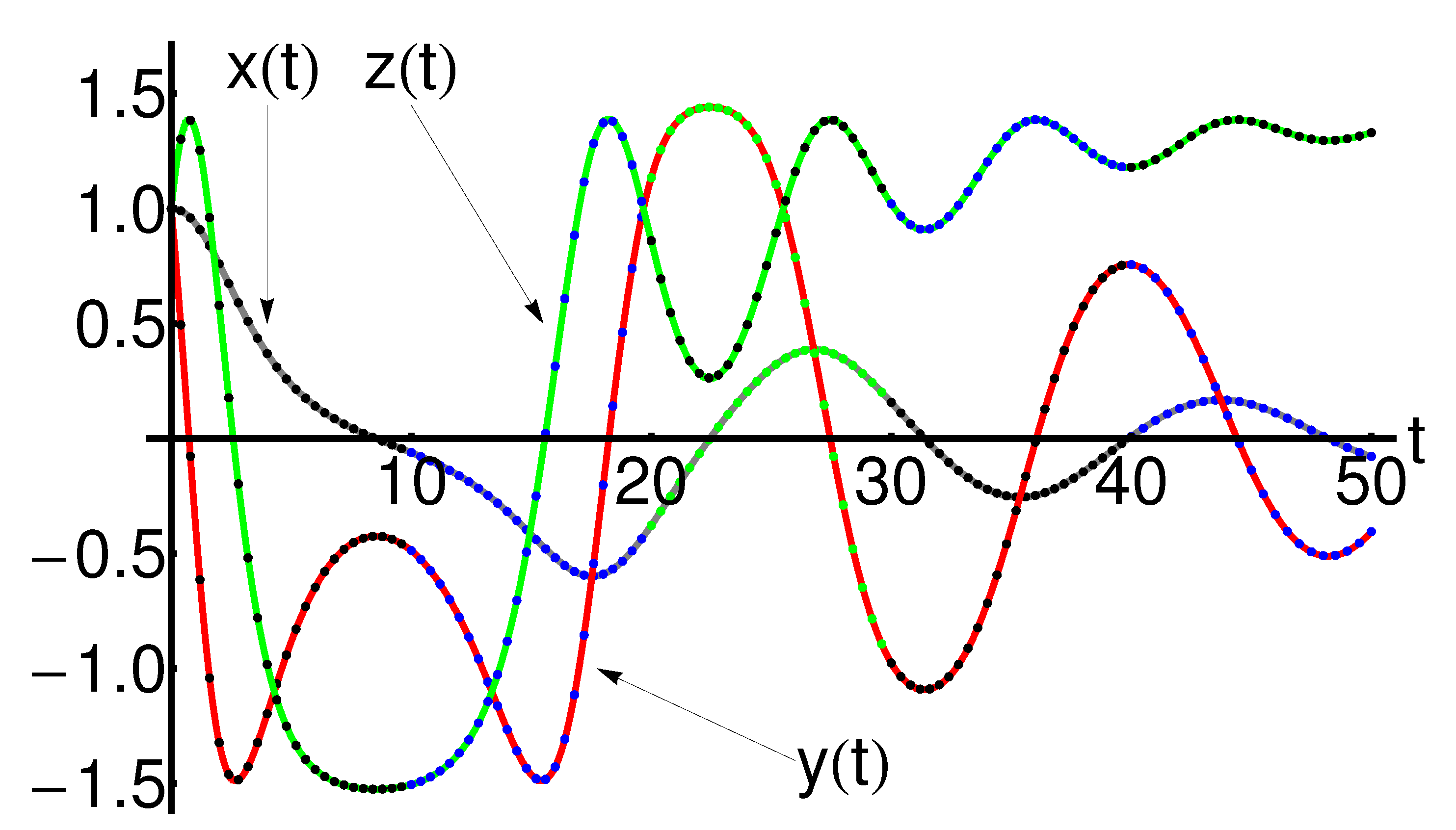
3. Numerical Examples and Discussions
- For the convergence-control parameters on the interval are:
- For the convergence-control parameters on the interval are:
- For the convergence-control parameters on the interval are:
4. Conclusions
Author Contributions
Funding
Conflicts of Interest
Appendix A
- on the interval
- on the interval
- on the interval
- on the interval
- on the interval
- on the interval
- on the interval
- on the interval
- on the interval
- on the interval
- on the interval
- on the interval
References
- Chen, G.; Ueta, T. Yet another chaotic attractor. Int. J. Bifurcat. Chaos 1999, 9, 1465–1466. [Google Scholar] [CrossRef]
- Li, G.H. Generalized projective synchronization between Lorenz system and Chen’s system. Chaos Soliton Fract. 2007, 32, 1454–1458. [Google Scholar] [CrossRef]
- Bashkirtseva, I.; Chen, G.; Ryashko, L. Analysis of stochastic cycles in the Chen system. Int. J. Bifurcat. Chaos 2010, 20, 1439–1450. [Google Scholar] [CrossRef]
- Ariesanu, C.P.; Petrisor, C. A geometric approach of the Chen’s system. IFAC Proc. Vol. 2012, 45, 288–292. [Google Scholar] [CrossRef]
- Zhou, T.; Tang, Y.; Chen, G. Chen’s attractor exists. Int. J. Bifurcat. Chaos 2004, 14, 3167–3177. [Google Scholar] [CrossRef]
- Aron, A.; Girban, G.; Kilyeni, S. A Geometric Approach of a Battery Mathematical Model for On-Line Energy Monitoring. In Proceedings of the EUROCON 2011, Lisbon, Portugal, 27–29 April 2011. [Google Scholar] [CrossRef]
- Sidorov, N.A. A class of degenerate differential equations with convergence. Math. Notes Acad. Sci. USSR 1984, 35, 300–305. [Google Scholar] [CrossRef]
- Anakira, N.R.; Alomari, A.K.; Jameel, A.; Hashim, I. Multistage optimal homotopy asymptotic method for solving initial-value problems. Nonlinear Sci. Appl. 2016, 9, 1826–1843. [Google Scholar] [CrossRef]
- Marinca, V.; Herisanu, N.; Bota, C.; Marinca, B. An optimal homotopy asymptotic method applied to the steady flow of a fourth grade fluid past a porous plate. Appl. Math. Lett. 2009, 22, 245–251. [Google Scholar] [CrossRef]
- Marinca, V.; Herisanu, N. The Optimal Homotopy Asymptotic Method: Engineering Applications; Springer: Heidelberg, Germany, 2015. [Google Scholar]
- Bota, C.; Caruntu, B. Approximate analytical solutions of the regularized long wave equation using the optimal homotopy perturbation method. Sci. World J. 2014, 2014, 721865. [Google Scholar] [CrossRef] [PubMed]
- Daminou, P.A. Multiple Hamiltonian structures for Toda systems of type A-B-C. Regul. Chaotic Dyn. 2000, 5, 17–32. [Google Scholar] [CrossRef]
- Puta, M.; Pop, C.; Danaiasa, C.; Hedrea, C. Some geometric aspects in the theory of Lagrange system. Tensor 2008, 69, 83–87. [Google Scholar]
- Pop, C.; Aron, A.; Galea, C.; Ciobanu, M.; Ivan, M. Some geometric aspects in the theory of Lotka-Volterra system. In Proceedings of the 11th WSEAS International Conference on Sustenability in Science Engineering, Timisoara, Romania, 27–29 May 2009; pp. 91–97. [Google Scholar]
- Aron, A.; Puta, M. Stability, periodic solutions and numerical integration in the Kowalevski top dynamics. Int. J. Geom. Methods Mod. Phys. 2006, 3, 1323–1330. [Google Scholar] [CrossRef]
- Gumral, H.; Nutku, Y. Poisson structure of dynamical systems with three degrees of freedom. AIP J. Math. Phys. 1993, 34, 5691–5721. [Google Scholar] [CrossRef]
- Tudoran, R.M.; Aron, A.; Nicoara, S. On a Hamiltonian Version of the Rikitake System. SIAM J. Appl. Dyn. Syst. 2010, 8, 454–479. [Google Scholar] [CrossRef]
- Pop, C.; Petrisor, C.; Bala, D. Hamilton-Poisson Realizations for the Lü System. Math. Probl. Eng. 2011, 2011, 842325. [Google Scholar] [CrossRef]
- Ariesanu, C.P. Numerical integration and Stability Problems in the Study of Lorenz System. Acta Tech. Napoc. 2011, 54, 333–339. [Google Scholar]

| t | |||
|---|---|---|---|
| Given by Equation (17) on | |||
| 0 | 1 | 1 | 0 |
| 1 | 0.9364117165 | 0.9364116923 | 2.418795 |
| 2 | 0.7598648489 | 0.7598648112 | 3.773508 |
| 3 | 0.5496634288 | 0.5496634002 | 2.856912 |
| 4 | 0.3696539068 | 0.3696539545 | 4.768122 |
| 5 | 0.2361306278 | 0.2361305711 | 5.672768 |
| 6 | 0.1417808360 | 0.1417808950 | 5.904862 |
| 7 | 0.0744693389 | 0.0744692855 | 5.335994 |
| 8 | 0.0235417451 | 0.0235417987 | 5.357260 |
| 9 | −0.0193274185 | −0.0193274710 | 5.247476 |
| 10 | −0.0607564092 | −0.0607563471 | 6.213179 |
| t | |||
|---|---|---|---|
| Given by Equation (18) on | |||
| 0 | 1 | 0.999999999935 | 6.445688 |
| 1 | −0.3553574878 | −0.3553406469 | 1.684093 |
| 2 | −1.3222633236 | −1.3222267995 | 3.652404 |
| 3 | −1.4627365880 | −1.4627655007 | 2.891273 |
| 4 | −1.1965325679 | −1.1965069538 | 2.561406 |
| 5 | −0.8833863981 | −0.8834211067 | 3.470861 |
| 6 | −0.6467691477 | −0.6467410965 | 2.805123 |
| 7 | −0.5010248753 | −0.5010288335 | 3.958216 |
| 8 | −0.4332635221 | −0.4332863552 | 2.283315 |
| 9 | −0.4308009782 | −0.4307717036 | 2.927459 |
| 10 | −0.4872360436 | −0.4872559270 | 1.988340 |
| t | ||||
|---|---|---|---|---|
| Given by Equation (19) on | ||||
| 0 | 1 | 1.000000000007 | 7.753353 | |
| 1 | 1.3435098520 | 1.3435117225 | 1.870482 | |
| 2 | 0.5794256998 | 0.5794264180 | 7.182044 | |
| 3 | −0.3653327889 | −0.3653338194 | 1.030464 | |
| 4 | −0.9822187335 | −0.9822190522 | 3.187262 | |
| 5 | −1.2956707043 | −1.2956700418 | 6.625175 | |
| 6 | −1.4385401687 | −1.4385409624 | 7.936812 | |
| 7 | −1.4996335886 | −1.4996327358 | 8.528737 | |
| 8 | −1.5220698429 | −1.5220705915 | 7.486002 | |
| 9 | −1.5228177923 | −1.5228170129 | 7.794542 | |
| 10 | −1.5044931170 | −1.5044943712 | 1.254174 |
| t | |||
|---|---|---|---|
| Given by Equation (A5) on | |||
| 10 | −0.4872360436 | −0.4872559270 | 1.988340 |
| 11 | −0.6020163945 | −0.6019673252 | 4.906934 |
| 12 | −0.7769448025 | −0.7769582240 | 1.342157 |
| 13 | −1.0076845857 | −1.0076745905 | 9.995179 |
| 14 | −1.2647930513 | −1.2648497330 | 5.668172 |
| 15 | −1.4608323548 | −1.4607292187 | 1.031360 |
| 16 | −1.4275878870 | −1.4275819492 | 5.937881 |
| 17 | −0.9926160834 | −0.9924248087 | 1.912747 |
| 18 | −0.2018262566 | −0.2017968869 | 2.936977 |
| 19 | 0.6069402387 | 0.6070773469 | 1.371082 |
| 20 | 1.1347132559 | 1.1347995011 | 8.624522 |
| t | |||
|---|---|---|---|
| Given by Equation (A11) on | |||
| 30 | 1.0212205896 | 1.0213459275 | 1.253379 |
| 31 | 0.9180981076 | 0.9182408746 | 1.427670 |
| 32 | 0.9306470486 | 0.9308026898 | 1.556412 |
| 33 | 1.0435260411 | 1.0436704899 | 1.444488 |
| 34 | 1.2025755175 | 1.2027255256 | 1.500081 |
| 35 | 1.3353033803 | 1.3354462611 | 1.428807 |
| 36 | 1.3865223388 | 1.3866649002 | 1.425614 |
| 37 | 1.3509108877 | 1.3510545089 | 1.436211 |
| 38 | 1.2706560671 | 1.2707974871 | 1.414199 |
| 39 | 1.2013516479 | 1.2014949451 | 1.432972 |
| 40 | 1.1798239453 | 1.1799651910 | 1.412457 |
© 2020 by the authors. Licensee MDPI, Basel, Switzerland. This article is an open access article distributed under the terms and conditions of the Creative Commons Attribution (CC BY) license (http://creativecommons.org/licenses/by/4.0/).
Share and Cite
Ene, R.-D.; Pop, C.; Petrişor, C. Systematic Review of Geometrical Approaches and Analytical Integration for Chen’s System. Mathematics 2020, 8, 1530. https://doi.org/10.3390/math8091530
Ene R-D, Pop C, Petrişor C. Systematic Review of Geometrical Approaches and Analytical Integration for Chen’s System. Mathematics. 2020; 8(9):1530. https://doi.org/10.3390/math8091530
Chicago/Turabian StyleEne, Remus-Daniel, Camelia Pop, and Camelia Petrişor. 2020. "Systematic Review of Geometrical Approaches and Analytical Integration for Chen’s System" Mathematics 8, no. 9: 1530. https://doi.org/10.3390/math8091530
APA StyleEne, R.-D., Pop, C., & Petrişor, C. (2020). Systematic Review of Geometrical Approaches and Analytical Integration for Chen’s System. Mathematics, 8(9), 1530. https://doi.org/10.3390/math8091530

