Abstract
The widely orthant dependent (WOD) sequences are very weak dependent sequences of random variables. For the weighted sums of non-negative m-WOD random variables, we provide asymptotic expressions for their appropriate inverse moments which are easy to calculate. As applications, we also obtain asymptotic expressions for the moments of random ratios. It is pointed out that our random ratios can include some models such as change-point detection. Last, some simulations are illustrated to test our results.
MSC:
60E15; 62E20
1. Introduction
In this paper, we will study the asymptotic expressions for inverse moments of weighted sums based on dependent random variables. As applications, we obtain some asymptotic approximations to the random ratios which include some change-point models. In the following, let’s introduce some inverse moment models and ratio models.
1.1. Inverse Moment Models and Ratio Models
First, we consider a weighted inverse moment model. Let be a non-negative and independent sequence of random variables and denote . For some , it is assumed that satisfies a Linderberg-type condition
Then, Wu et al. [1] obtained the asymptotic approximation of inverse moment that for all real numbers and ,
where . Here means as . Usually, the left side formula in (1) is more difficult to calculate than the right side formula in (1). Under some regular conditions, the inverse moment can be approximated by the inverse of moment. The inverse moments can be used in many areas such as reliability life testing, evaluation of risks of estimators, insurance and financial mathematics, etc. (see [1,2,3,4] and references therein). Therefore, many authors have pay attention on the research of inverse moments. For example, [5,6,7,8,9] extended the results of Wu et al. [1] to some nonnegative dependent random variables.
Second, we consider a non-weighted inverse moment model. Shi et al. [10] establish the asymptotic approximation of inverse moment (1), where weighted case was replaced by the non-weighted case . Yang et al. [11] extended Shi et al. [10] and obtained the convergence rates for inverse moments.
Third, let us consider a general weighted inverse moment model. Yang et al. [12] obtained the inverse moment result (1), where is replaced by a general weighted case , and is a triangular array of non-negative weights. Li et al. [13] studied this general weighted case of inverse moment under nonnegative widely orthant dependent (WOD) random variables.
Fourth, let us recall some the ratio models. Shi et al. [14] used the inverse moment method to consider the ratio models such as and , where for . They obtained some asymptotic expressions for the means of and . For all , Yang et al. [12] investigated a general ratio , where , and are non-negative weights. Some asymptotic expressions for ratios and were presented in Yang et al. [12].
To proceed the study of inverse moment models and ratio models, we give some definitions of dependent random variables in the next subsection.
1.2. Definitions of WOD and m-WOD
Definition 1.
For the random variables , if there exists a finite sequence of real numbers such that for each and for all ,
then we say that the random variables are widely upper orthant dependent (WUOD), if there exists a finite sequence of real numbers such that for each and for all ,
then we say that the random variables are widely lower orthant dependent (WLOD). If the random variables are both WUOD and WLOD, then we say that the random variables are widely orthant dependent (WOD).
Definition 2.
Let be a fixed integer. A sequence of random variables is said to be m-WOD if for any and any , in such that for all , we have that are WOD.
On one hand, the notion of WOD random variables was introduced by Wang and Cheng [15] for risk models. On the other hand, Hu et al. [16] introduced m-negatively associated (m-NA) notion and gave its application to study the complete convergence. Inspired by WOD and m-NA, we give the notion of m-WOD and study the inverse moments and ratio moments based on these dependent sequences.
If , then WOD sequences become extended negatively dependent (END) sequences which were introduced by Liu [17]). In addition, END sequences contain several negative dependent sequences such as negatively orthant dependent (NOD, see Lehmann [18]), negatively superadditive dependent (NSD, see Hu [19]) and negatively associated (NA, see Joag-Dev and Proschan [20]). For , if joint distribution of is a multivariate normal (Gaussian) distribution, then is NA if and only if its components are non-positively correlated (see Joag-Dev and Proschan [20], Bulinski and Shaskin [21]). Obviously, Laplace distribution has heavier tails than Gaussian tails (see Davidian and Giltinan [22], Kozubowskia et al. [23]). So it is an interesting research how to use multivariate Laplace distribution to construct NA sequence. Likely, if joint distribution of is a Frank copula
where , and , then is END (see Ko and Tang [24], Yang et al. [25]). A lot of attention have been paid on the study of negative dependent sequences such WOD, END, NO, NA, m-NA, m-END, m-linearly negative quadrant dependent (m-LNQD), etc. We can refer to [26,27,28,29,30,31,32,33,34,35] the references therein.
1.3. Our Models
Let be a triangular array of non-negative and non-random weights. For all and , we proceed to study the general weighted inverse moment model
where and is a sequence of non-negative m-WOD random variables. As an important application, we establish some asymptotic expressions for the means of ratios
and
where . Yang et al. [12] studied the inverse moment model (2) and ratio model (3) based on the independent sequence and weighted condition . Li et al. [13] also studied this inverse moment model (2) based on WOD sequence and weighted condition . Models (2), (3) and (4) can be regarded as ratio models. So in this paper, we investigate the ratio models (2)–(4) based on m-WOD sequence . But the weight does not require the condition . It is pointed that the ratio model (4) is an important statistic model, which can be used to detect change-points. For example, by taking in (4), one can get the estimator
by Hsu [36]. Let . If for and for , one can obtain the estimator
by Inclán and Tiao [37]. Hsu [36] and Inclán and Tiao [37] used these estimators and to do the research of change-point detection. For more details of ratio models, one can refer to [10,11,38,39], etc.
The rest of this paper is organized as follows. Some asymptotic approximation to inverse moments for (2) and ratio moments for (3) and (4) are presented in Section 2. We do some simulations in Section 3, which are agreed with the results obtained in this paper. Last, the conclusions and the proofs are given in Section 4 and Section 5, respectively. Throughout the paper, let be some positive constants not depending on n and be some positive constants depending only on m and q.
2. Results
In the following, let be a sequence of non-negative m-WOD random variables with the dominating coefficient and be a triangular array of non-negative and non-random weights. Denote , and for some . In order to study the inverse moment model (2), we list some assumptions as follows.
Assumption 1.
(A.1) for some ;
(A.2) for some γ such that and ;
(A.3) as ;
(A.4) as .
Theorem 1.
Let for all and Assumptions (A.1)–(A.4) hold true. Then
holds for all constants and .
Theorem 2.
For some , suppose that for all and
Let the Assumptions (A.1)–(A.4) be fulfilled and . Then for all and ,
and for all and ,
Next, we apply Theorems 1 and 2 to evaluate the means ratios models (3) and (4). Let , , and for some .
Assumption 2.
(B.1) for some ;
(B.2) for some λ satisfying .
(B.3) as .
(B.4) as .
(B.5) Let for all and
Theorem 3.
Let Assumptions (B.1)–(B.5) hold true. Then for all ,
where and . Moreover, if , then for all ,
As an application of Theorems 2 and 3, we obtain the following Corollary 1 which does not contain the parameter a. The proof is complex and it is used (7) in Theorem 2 (with and ) and (10) in Theorem 3 (with ). Please see the details in Section 5. But the ratio model is important which can be used in change-point detection models (see details of (4) in Section 1).
Corollary 1.
Assume that Assumptions (B.1)–(B.5) be satisfied. Then
where and . In addition, if , then
Remark 1.
Since the dependent sequences of NA, NA, NOD, NSD, END and END, are m-WOD with and , all the results obtained in this paper hold true for all of them.
3. Simulations
In this section, we will do some simulations for the ratio models (2) and (4) under different weighted sequences. For convenience, X and Y have the same distribution denoted by . Let and . For , it is assumed that there is a change-point such that
and for some ,
It can be seen that is a NA sequence. Let and . Then and are nonnegative NA sequences, which imply that they are m-WOD sequences with and dominating coefficient . Thus, in the following, we do the simulations for
and
where , , and is defined in (14) and (15), . The weight sequences are listed as follows
(C.1) , , , ;
(C.2) , , ;
(C.3) , , ;
(C.4) , , .
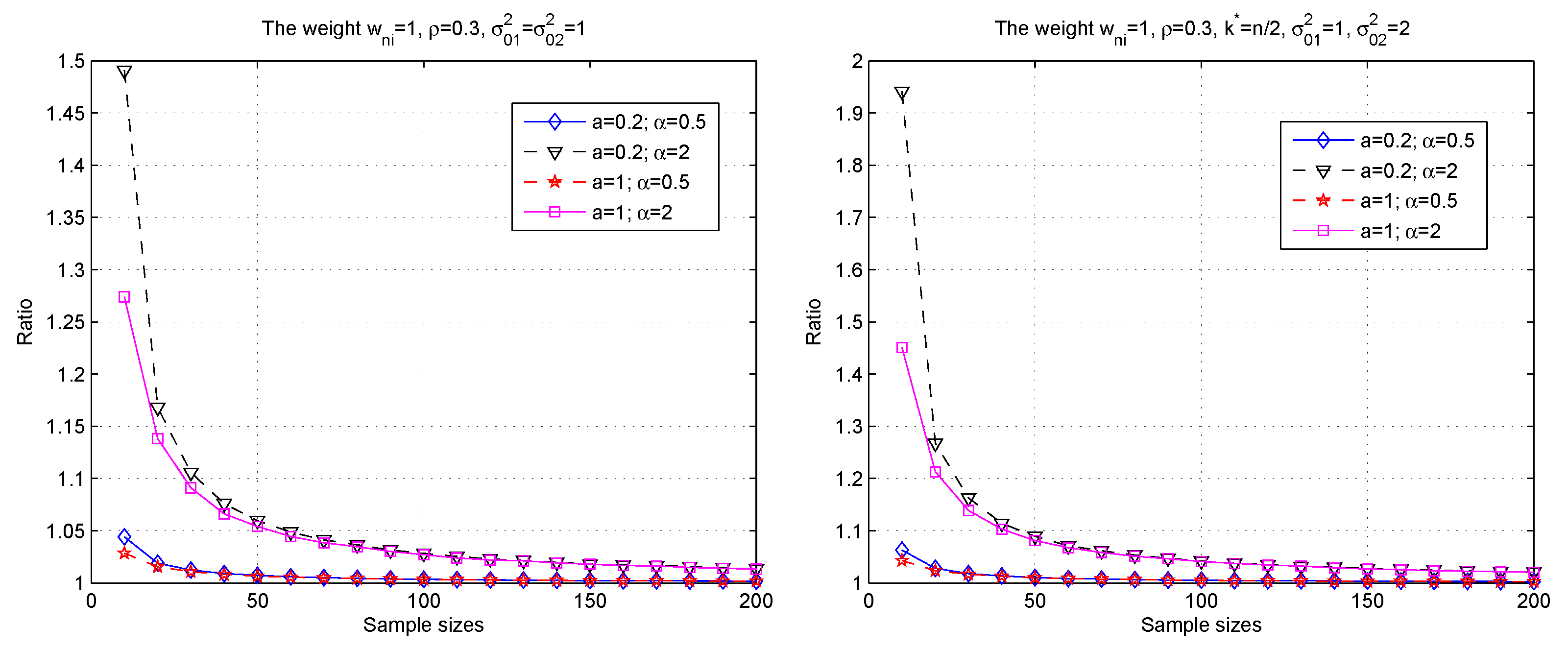
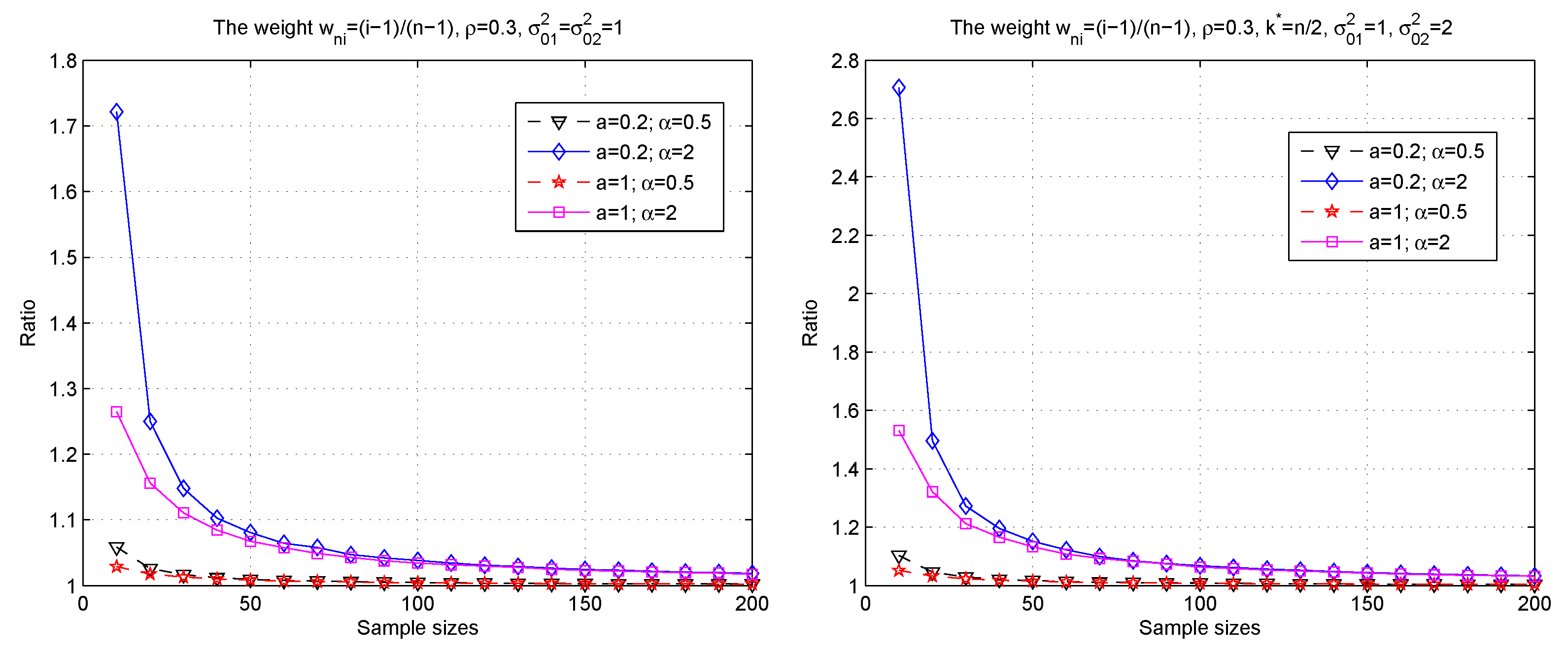
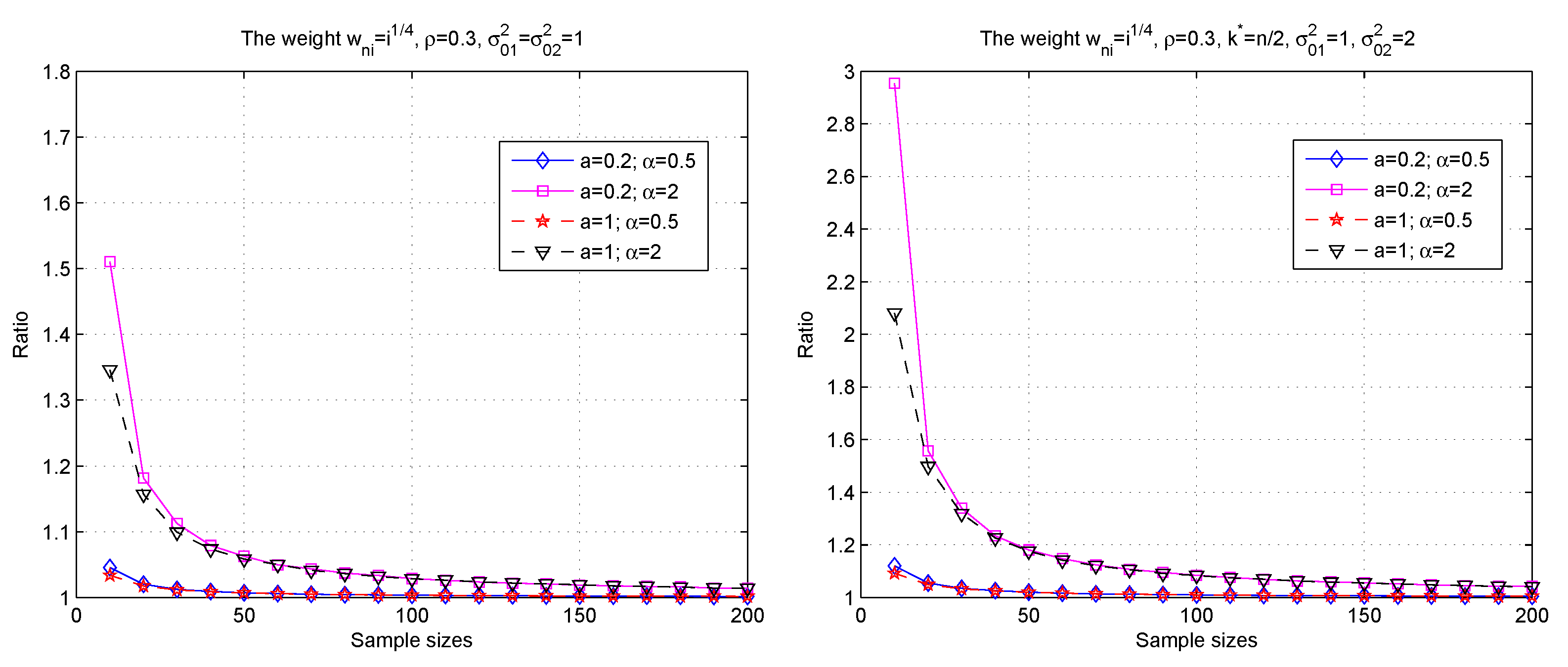
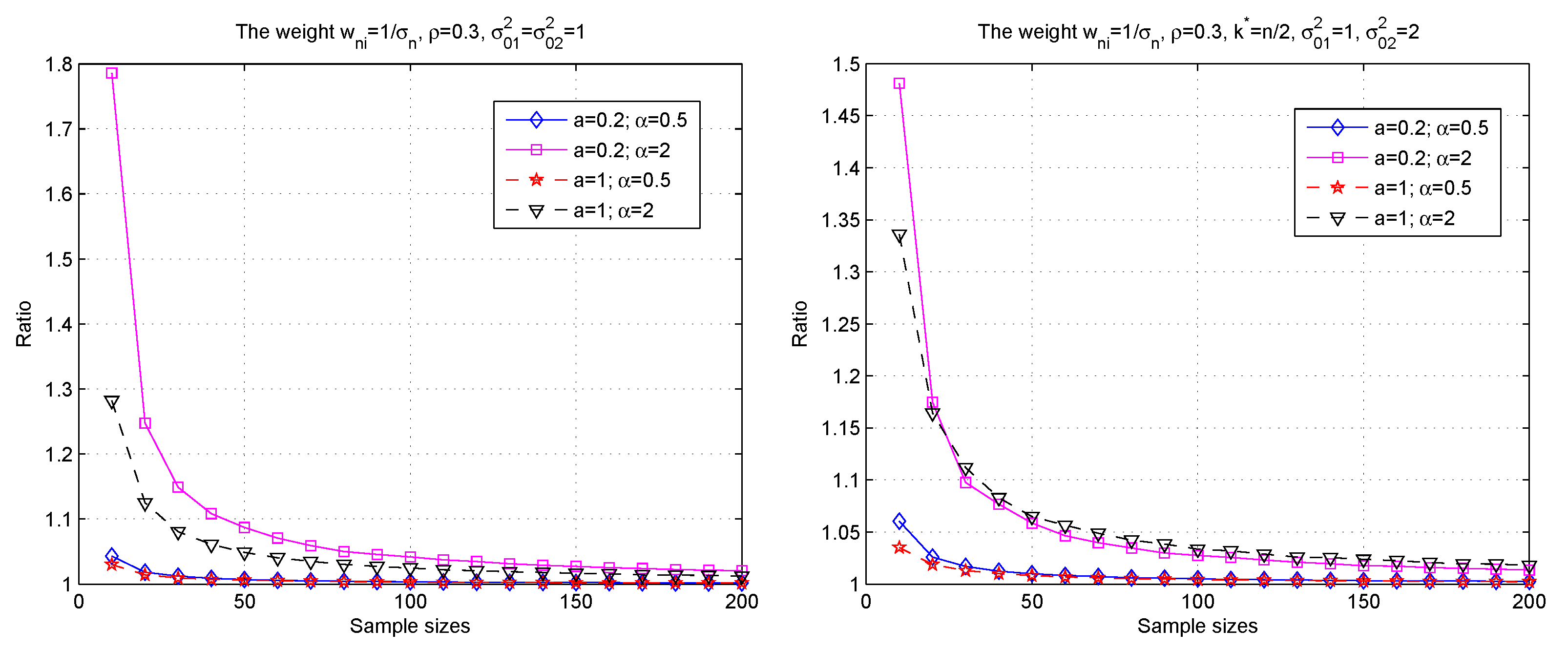
First, we do simulate (16). For all and , it has as , by the fact that as . So we use MATLAB software to obtain the empirical values for the “ratio” in (16) by repeating 10000 experiments and obtain the Figure 1, Figure 2, Figure 3 and Figure 4 The label of y-axis “ratio” is empirical values of (16) and the label of x-axis “sample sizes” is the number of sample n. For and (or , ), we take , and , and obtain the results of Figure 1, Figure 2, Figure 3 and Figure 4 for the weighted cases (C.1)–(C.4), respectively.
Figure 1.
Empirical values of ratio for the weighted case , where , , or and , .
Figure 2.
Empirical values of ratio for the weighted case , where , , or and , .
Figure 3.
Empirical values of ratio for the weighted case , where , , or and , .
Figure 4.
Empirical values of ratio for the weighted case , where , , or and , .
By Figure 1, Figure 2, Figure 3 and Figure 4, it can be found that the ratio for all and , since it is guaranteed by Jensen’s inequality. As the sample n increases, the ratio decreases to one. So, the results of Figure 1, Figure 2, Figure 3 and Figure 4 are agreed with formulas of (5) and (7).
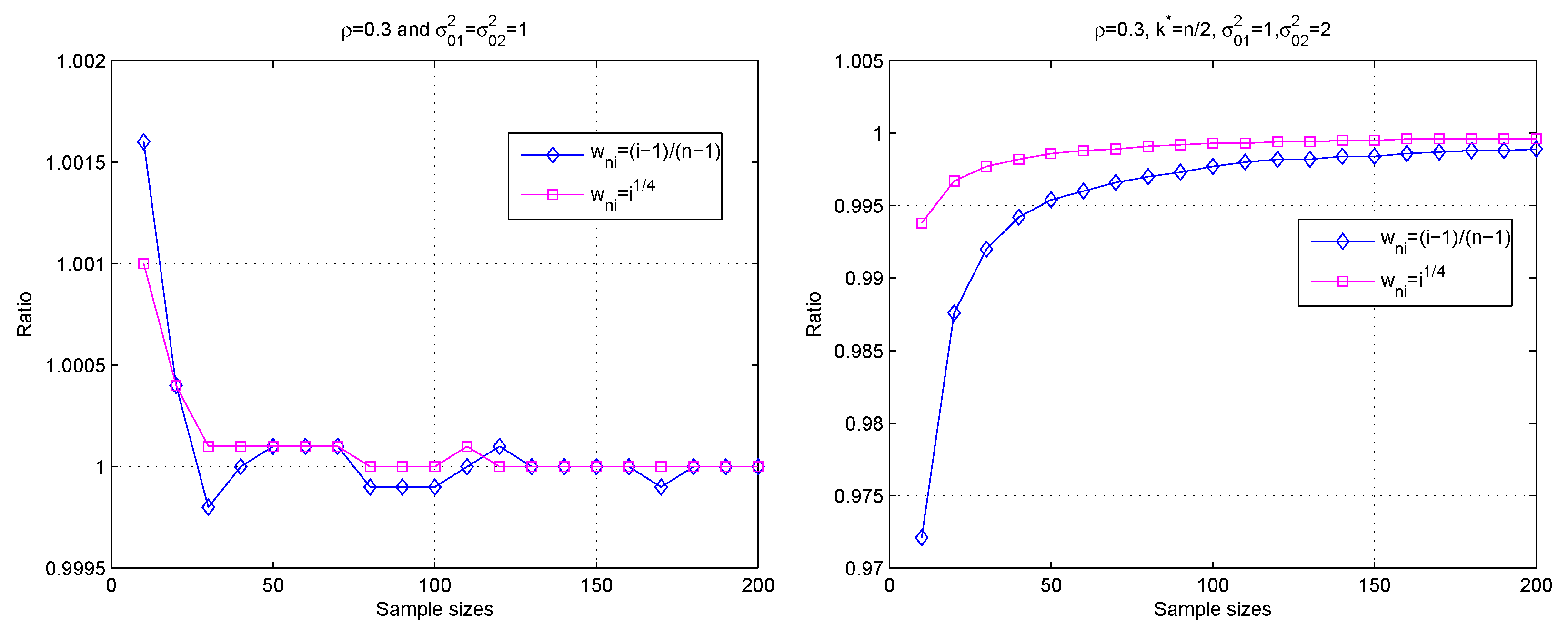
Second, we do the simulation for (17). It can be seen that under the equal weight cases of (C.1) and (C.2). So we do the simulation under the unequal weight cases of (C.3) and (C.4), and obtain Figure 5.
Figure 5.
Empirical values of ratio for the weighted cases and , , , or and , .
In Figure 5, the label of y-axis “ratio” is empirical values of (17) and the label of x-axis “sample sizes” is the number of sample n taking values . By Figure 5, the ratio goes to one as the sample n increases, which agrees with (13).
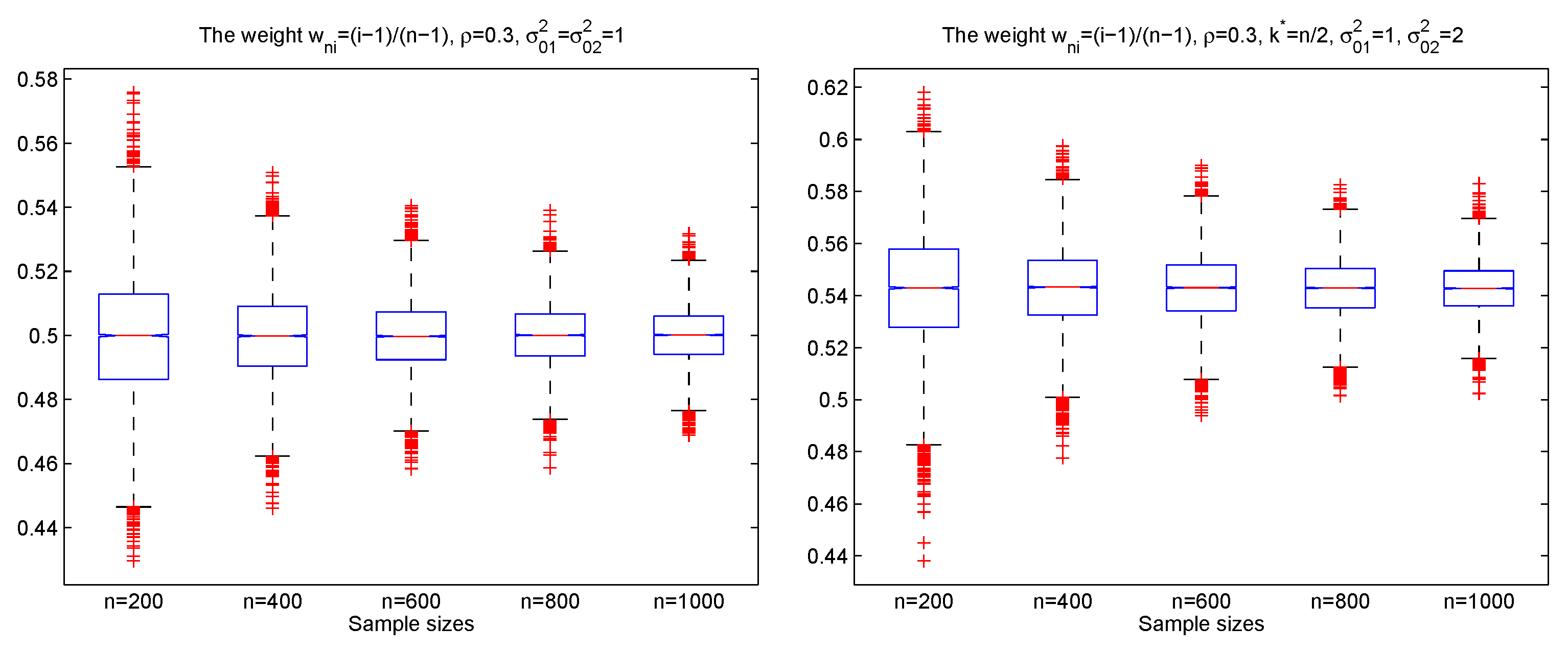
Third, we do some box plots of with the weight case of (C.3). If in (14), then it is easy to check
Let denote the largest integer not exceeding x. Likewise, we take , , and obtain that
Thus, we take , , (or and , ) and obtain the box plots in Figure 6, by repeating 10000 experiments.
Figure 6.
Box plots of for the weighted case , where , , or and , .
4. Conclusions
On one hand, by taking (i.e., ) in Theorems 1 and 2, one can obtain the results of (5), (7) and (8) with , which imply Theorems 2.1 and 2.2 of Li et al. [13] for nonnegative WOD sequences. Obviously, the condition (A.2) is weaker than the one of . So Theorems 1 and 2 generalize and improve the results of Li et al. [13]. On the other hand, independent sequence is a m-WOD sequence with . So by taking (i.e., ) and in Theorem 3, we have (10) with and , which implies Theorem 2.3 of Yang et al. [12] for nonnegative independent sequences. Furthermore, by using Theorems 2 and 3, we obtain Corollary 1 which does not contain the parameter a. It can be easy to use in practice (for example change-point detection). In addition, we also do some simulations to check our results such as and based on the different weight cases.
5. Proofs of Main Results
Lemma 1.
(Wang et al. [26] [Proposition 1.1]) Let be WUOD (WLOD) with dominating coefficients . If are nondecreasing, then are still WUOD (WLOD) with dominating coefficients ; if are nonincreasing, then are WLOD (WUOD) with dominating coefficients .
Corollary 2.
Let be a sequence of m-WOD random variables. If are nondecreasing (nonincreading) functions, then are also m-WOD random variables with same dominating coefficients.
Proof of Corollary 2.
According to the definition of m-WOD, a sequence of m-WOD can decompose to m sequences of WOD, i.e. , , …, . Then, by Lemma 1, the sequences , , …, are also WOD sequence with same dominating coefficients. Thus, by the definition of m-WOD again, are also m-WOD random variables with same dominating coefficients. □
Lemma 2.
(Wang et al. [28] [Corollary 2.3]) Let and be a mean zero sequence of WOD random variables with dominating coefficient and for all . Then for all , there exist positive constants and depending only on q such that
Corollary 3.
Let and be a mean zero sequence of m-WOD random variables with dominating coefficient and for all . Then for all , there exist a positive constant depending only on m and q such that
Proof of Corollary 3.
Proof of Theorem 1.
The proof is similar to the one of Theorem 2.1 in Li et al. [13], where Li et al. [13] consider WOD case with weight . In this paper, we consider general case (A.2) and give the key parts of proofs. By Jensen’s inequality, we have for all and . Thus, in order to prove (5), we only have to show that for ,
(or see Li et al. [13]). By (A.4), there exist a such that for all and
We can break into two formulas:
where
Since , we obtain . So, by (A.3), we establish
It follows from (23) that for all . Denote , . So, by Corollary 2, are also mean zero m-WOD random variables with dominating coefficient . Thus, by Markov’s inequality, Corollary 3 and inequality, it has that for all and ,
If , then by the conditions (A.1)–(A.3) and (26) that
Since , it has . We take in (27) and obtain that
Similarly, if , then by the conditions (A.1)–(A.3) and (26) that
In view of , , and , if , then
which implies that
So we take in (29) and obtain that
So, by (24), (25), (28) and (30), (22) holds true. □
Proof of Theorem 2.
By Taylor expansion, it can be checked that
where lies between and . Next, we will verify that
where and . It is easy to see that
On the one hand, for some , it can be argued by Corollary 3, (6) and (A.2) that
where .
Proof of Theorem 3.
The proof is similar to the one of Theorem 2.3 in Yang et al. [12], where Yang et al. [12] consider the independent case and weight condition . In this paper, weight condition (B.2) is very weak. So we give the complete proofs here. By bivariate Taylor expansion, one can establish that
where lies between and , lies between and , and , . Next, we will verify that
where . It follows from (B.2) that
By Corollary 3 and conditions (B.1) and (B.5), one can check that
which implies
Combining Hölder inequality with (42) and (43), we obtain that
By Hölder inequality, (40), (41), (B.1), (B.3), (B.4), we have that
Similarly, we apply Hölder inequality, (39) and (41), then obtain that
It follows from (39) and (43) that
It can be seen that
For , by Hölder inequality, (40) and (41),
since . Similarly, for , by Hölder inequality, (39) and (41),
In addition, we have by Hölder inequality, (39), (41)–(43) and that
Proof of Corollary 1.
In view of (B.2), there exists a positive constant C such that
Then
which implies
By (10) in Theorem 3 with , we establish that
where . In addition, by (7) in Theorem 2 with , , and , we obtain that
Thus, by (52), (55) and (56), it can be checked that
where . Furthermore, in view of and (54)–(57), the proof of (12) is finished to prove. Last, by and (54)–(57), we have that
Thus, (13) is completely proved. □
Author Contributions
Supervision W.Y.; software H.F. and S.D.; writing—original draft preparation, H.F., X.L. and W.Y. All authors have read and agreed to the published version of the manuscript.
Funding
This research was funded by (11701004, 11801003), NSF of Anhui Province (1808085QA03, 1808085QA17, 1808085QF212) and Provincial Natural Science Research Project of Anhui Colleges (KJ2019A0006, KJ2019A0021).
Acknowledgments
The authors are deeply grateful to editors and anonymous referees for their careful reading and insightful comments. The comments led us to significantly improve the paper.
Conflicts of Interest
The authors declare no conflict of interest.
References
- Wu, T.J.; Shi, X.P.; Miao, B.Q. Asymptotic approximation of inverse moments of nonnegative random variables. Statist. Probab. Lett. 2009, 79, 1366–1371. [Google Scholar] [CrossRef]
- Garcia, N.L.; Palacios, J.L. On inverse moments of nonnegative random variables. Statist. Probab. Lett. 2001, 53, 235–239. [Google Scholar] [CrossRef]
- Kaluszka, M.; Okolewski, A. On Fatou-type lemma for monotone moments of weakly convergent random variables. Statist. Probab. Lett. 2004, 66, 45–50. [Google Scholar] [CrossRef]
- Jäntschi, L. Detecting extreme values with order statistics in samples from continuous distributions. Mathematics 2020, 8, 216. [Google Scholar] [CrossRef]
- Wang, X.J.; Hu, S.H.; Yang, W.Z.; Ling, N.X. Exponential inequalities and inverse moment for NOD sequence. Statist. Probab. Lett. 2010, 80, 452–461. [Google Scholar] [CrossRef]
- Sung, S.H. On inverse moments for a class of nonnegative random variables. J. Inequal. Appl. 2010, 2010, 823767. [Google Scholar] [CrossRef][Green Version]
- Xu, M.; Chen, P.Y. On inverse moments for nonnegative NOD sequence. Acta Math. Sin. (Chin. Ser.) 2013, 55, 201–206. [Google Scholar]
- Horng, W.J.; Chen, P.Y.; Hu, T.C. On approximation for inverse moments of nonnegative random variables. J. Math. Stat. Oper. Res. (JMSOR) 2012, 1, 38–42. [Google Scholar] [CrossRef]
- Hu, S.H.; Wang, X.H.; Yang, W.Z.; Wang, X.J. A note on the inverse moment for the nonnegative random variables. Commun. Statist.-Theory Methods 2014, 43, 1750–1757. [Google Scholar] [CrossRef]
- Shi, X.P.; Wu, Y.H.; Liu, Y. A note on asymptotic approximations of inverse moments of nonnegative random variables. Statist. Probab. Lett. 2010, 80, 1260–1264. [Google Scholar] [CrossRef]
- Yang, W.Z.; Hu, S.H.; Wang, X.J. On the asymptotic approximation of inverse moment for nonnegative random variables. Commun. Statist.-Theory Methods 2017, 46, 7787–7797. [Google Scholar] [CrossRef]
- Yang, W.Z.; Shi, X.P.; Li, X.Q.; Hu, S.H. Approximations to inverse moments of double-indexed weighted sums. J. Math. Anal. Appl. 2016, 440, 833–852. [Google Scholar] [CrossRef]
- Li, X.Q.; Liu, X.; Yang, W.Z.; Hu, S.H. The inverse moment for widely orthant dependent random variables. J. Inequal. Appl. 2016, 2016, 161. [Google Scholar] [CrossRef][Green Version]
- Shi, X.P.; Reid, N.; Wu, Y.H. Approximation to the moments of ratios of cumulative sums. Canad. J. Statist. 2014, 42, 325–336. [Google Scholar] [CrossRef]
- Wang, Y.B.; Cheng, D.Y. Basic renewal theorems for random walks with widely dependent increments. J. Math. Anal. Appl. 2011, 384, 597–606. [Google Scholar] [CrossRef]
- Hu, T.C.; Chiang, C.Y.; Taylor, R.L. On complete convergence for arrays of rowwise m-negatively associated random variables. Nonlinear Anal. 2009, 71, e1075–e1081. [Google Scholar] [CrossRef]
- Liu, L. Precise large deviations for dependent random variables with heavy tails. Statist. Probab. Lett. 2009, 79, 1290–1298. [Google Scholar] [CrossRef]
- Lehmann, E.L. Some concepts of dependence. Ann. Math. Stat. 1966, 37, 1137–1153. [Google Scholar] [CrossRef]
- Hu, T.Z. Negatively superadditive dependence of random variables with applications. Chin. J. Appl. Probab. Statist. 2000, 16, 133–144. [Google Scholar]
- Joag-Dev, K.; Proschan, F. Negative association of random variables with applications. Ann. Statist. 1983, 11, 286–295. [Google Scholar] [CrossRef]
- Bulinski, A.V.; Shaskin, A. Limit Theorems for Associated Random Fields and Related Systems; World Scientific: Singapore, 2007; pp. 1–20. [Google Scholar]
- Davidian, M.; Giltinan, D.M. Nonlinear Models for Repeated Measurement Data; Chapman and Hall: New York, NY, USA, 1995; pp. 16–60. [Google Scholar]
- Tomasz, J.; Kozubowskia, T.J.; Podgórski, K.; Rychlik, I. Multivariate generalized Laplace distribution and related random fields. J. Multivar. Anal. 2013, 113, 59–72. [Google Scholar]
- Ko, B.; Tang, Q. Sums of dependent nonnegative random variables with subexponential tails. J. Appl. Probab. 2008, 45, 85–94. [Google Scholar] [CrossRef]
- Yang, W.Z.; Zhao, Z.R.; Wang, X.H.; Hu, S.H. The large deviation results for the nonlinear regression model with dependent errors. TEST 2017, 26, 261–283. [Google Scholar]
- Wang, Y.B.; Cui, Z.L.; Wang, K.Y.; Ma, X.L. Uniform asymptotics of the fnite-time ruin probability for all times. J. Math. Anal. Appl. 2012, 390, 208–223. [Google Scholar] [CrossRef]
- Wang, K.Y.; Wang, Y.B.; Gao, Q.W. Uniform asymptotics of the fnite-time ruin probability of dependent risk model with a constant interest rate. Methodol. Comput. Appl. Probab. 2013, 15, 109–124. [Google Scholar] [CrossRef]
- Wang, X.J.; Xu, C.; Hu, T.C.; Volodin, A.I.; Hu, S.H. On complete convergence for widely orthant-dependent random variables and its applications in nonparametric regression models. TEST 2014, 23, 607–629. [Google Scholar]
- Yang, W.Z.; Liu, T.T.; Wang, X.J.; Hu, S.H. On the Bahadur Representation of sample quantiles for widely orthant dependent sequences. Filomat 2014, 28, 1333–1343. [Google Scholar] [CrossRef]
- Wang, X.J.; Hu, S.H. The consistency of the nearest neighbor estimator of the density function based on WOD samples. J. Math. Anal. Appl. 2015, 429, 497–512. [Google Scholar] [CrossRef]
- Shen, A.T.; Zhang, Y.; Xiao, B.Q.; Volodin, A. Moment inequalities for m-negatively associated random variables and their applications. Statist. Pap. 2017, 58, 911–928. [Google Scholar] [CrossRef]
- Wang, X.J.; Wu, Y.; Hu, S.H. Exponential probability inequality for m-END random variables and its applications. Metrika 2016, 79, 127–147. [Google Scholar] [CrossRef]
- Wu, Y.F.; Rosalsky, A.; Volodin, A. Some mean convergence and complete convergence theorems for sequences of m-linearly negative quadrant dependent random variables. Appl. Math. 2013, 58, 511–529. [Google Scholar] [CrossRef][Green Version]
- Wu, Y.F.; Rosalsky, A.; Volodin, A. Erratum to Some mean convergence and complete convergence theorems for sequences of m-linearly negative quadrant dependent random variables. Appl. Math. 2017, 62, 209–211. [Google Scholar] [CrossRef]
- Ye, R.Y.; Xinsheng Liu, X.S.; Yu, Y.C. Pointwise optimality of wavelet density estimation for negatively associated biased sample. Mathematics 2020, 8, 176. [Google Scholar] [CrossRef]
- Hsu, D.A. Detecting shifts of parameter in gamma sequences with applications to stock price and air traffic flow analysis. J. Am. Statist. Assoc. 1979, 74, 31–40. [Google Scholar] [CrossRef]
- Inclán, C.; Tiao, G.C. Use of cumulative sums of squares for retrospective detection of changes of variance. J. Am. Statist. Assoc. 1994, 89, 913–923. [Google Scholar]
- Abbas, N.; Abujiya, M.A.R.; Riaz, M.; Mahmood, T. Cumulative sum chart modeled under the presence of outliers. Mathematics 2020, 8, 269. [Google Scholar] [CrossRef]
- Doukhan, P.; Lang, G. Evaluation for moments of a ratio with application to regression estimation. Bernoulli 2009, 15, 1259–1286. [Google Scholar] [CrossRef]
© 2020 by the authors. Licensee MDPI, Basel, Switzerland. This article is an open access article distributed under the terms and conditions of the Creative Commons Attribution (CC BY) license (http://creativecommons.org/licenses/by/4.0/).