Abstract
To locate a locally-unique solution of a nonlinear equation, the local convergence analysis of a derivative-free fifth order method is studied in Banach space. This approach provides radius of convergence and error bounds under the hypotheses based on the first Fréchet-derivative only. Such estimates are not introduced in the earlier procedures employing Taylor’s expansion of higher derivatives that may not exist or may be expensive to compute. The convergence domain of the method is also shown by a visual approach, namely basins of attraction. Theoretical results are endorsed via numerical experiments that show the cases where earlier results cannot be applicable.
MSC:
49M15; 47H17; 65H10
1. Introduction
Banach [1] or complete normed vector spaces constantly bring new solving strategies for real problems in domains dealing with numerical methods (see for example [2,3,4,5]). In this context, development of new methods [6] and their convergence analysis [7] are of growing interest.
Let , be Banach spaces and be closed and convex. In this study, we locate a solution of the nonlinear equation
where is a Fréchet-differentiable operator. In computational sciences, many problems can be transformed into form (1). For example, see the References [8,9,10,11]. The solution of such nonlinear equations is hardly attainable in closed form. Therefore, most of the methods for solving such equations are usually iterative. The important issue addressed to an iterative method is its domain of convergence since it gives us the degree of difficulty for obtaining initial points. This domain is generally small. Thus, it is necessary to enlarge the domain of convergence but without any additional hypotheses. Another important problem related to convergence analysis of an iterative method is to find precise error estimates on or .
A good reference for the general principles of functional analysis is [12]. Recurrence relations for rational cubic methods are revised in [13] (for Halley method) and in [14] (for Chebyshev method). A new iterative modification of Newton’s method for solving nonlinear scalar equations was proposed in [15], while a modification of a variant of it with accelerated third order convergence was proposed in [16]. An ample collection of iterative methods is found in [9]. The recurrence relations for Chebyshev-type methods accelerating classical Newton iteration have been introduced in [17], recurrence relations in a third-order family of Newton-like methods for approximating solution of a nonlinear equation in Banach spaces were studied in [18]. In the context of Kantrovich assumptions for semilocal convergence of a Chebyshev method, the convergence conditions are significantly reduced in [19]. The computational efficiency and the domain of the uniqueness of the solution were readdressed in [20]. The point of attraction of two fourth-order iterative Newton-type methods was studied in [21], while convergence ball and error analysis of Newton-type methods with cubic convergence were studied in [22,23]. Weaker conditions for the convergence of Newton’s method are given in [24], while further analytical improvements in two particular cases as well as numerical analysis in the general case are given in [25], while local convergence of three-step Newton–Gauss methods in Banach spaces was recently analyzed in [26]. Recently, researchers have also constructed some higher order methods; see, for example [27,28,29,30,31] and references cited therein.
One of the basic methods for approximating a simple solution of Equation (1) is the quadratically convergent derivative-free Traub–Steffensen’s method, which is given by
where , has a quadratic order of convergence. Based on (2), Sharma et al. [32] have recently proposed a derivative-free method with fifth order convergence for approximating a solution of using the weight-function scheme defined for each by
wherein . The computational efficiency of this method was discussed in detail and performance was favorably compared with existing methods in [32]. To prove the local convergence order, the authors used Taylor expansions with hypotheses based on a Fréchet-derivative up to the fifth order. It is quite clear that these hypotheses restrict the applicability of methods to the problems involving functions that are at least five times Fréchet-differentiable. For example, let us define a function g on by
We have that
and
Then, is unbounded on . Notice also that the proofs of convergence use Taylor expansions.
In this work, we study the local convergence of the methods (3) using the hypotheses on the first Fréchet-derivative only taking advantage of the Lipschitz continuity of the first Fréchet-derivative. Moreover, our results are presented in the more general setting of a Banach space. We summarize the contents of the paper. In Section 2, the local convergence analysis of method (3) is presented. In Section 3, numerical examples are performed to verify the theoretical results. Basins of attraction showing convergence domain are drawn in Section 4. Concluding remarks are reported in Section 5.
2. Local Convergence Analysis
Let’s study the local convergence of method (3). Let and be the parameters and be a continuous and nondecreasing function with . Let the parameter r be defined by
Consider the functions and as continuous and nondecreasing. Furthermore, define functions and on the interval as
and
Suppose that
From (6), we obtain that
and, by (5), as . Then, it follows from the intermediate value theorem [33] that equation has solutions in . Denote by the smallest such solution.
Furthermore, define functions and on the interval by
and
Then, we have that and as . Let be the smallest zero of function on the interval .
Finally, define the functions , and on the interval by
and
It follows that and as . Denote the smallest zero of function by on the interval . Finally, define the radius of convergence (say, ) by
Then, for each , we have that
Denote by the ball whose center and radius . Moreover, denotes the closure of .
We will study the local convergence of method (3) in a Banach space setting under the following hypotheses (collectively called by the name ‘A’):
- (a1)
- is a continuously differentiable operator and is a first divided difference operator of F.
- (a2)
- There exists so that and
- (a3)
- There exists a continuous and nondecreasing function with such that, for each ,
- (a4)
- Let , where r has been defined before. There exists continuous and nondecreasing function such that, for each ,
- (a5)
- and .
- (a6)
- Let and set ,
Theorem 1.
Suppose that the hypotheses hold. Then, the sequence generated by method (3) for is well defined in , remains in and converges to . Moreover, the following conditions hold:
and
where the functions , are defined as above. Furthermore, the vector is the only solution of in .
Proof.
We shall show estimates (9)–(11) using mathematical induction. By hypothesis (a3) and for , we have that
We show that is well defined by the method (3) for . We have
Then, using (8) (for ), the conditions (a4) and (13), we have in turn that
which implies (9) for and .
Note that for each and , that is, , writing
Then, using (a5), we get that
Similarly, we obtain
From the second sub-step of method (3), (13), (15) and (18), we obtain that
which proves (10) for and .
Let and notice that, since , we have that
Replace , , , by , , , in the preceding estimates to obtain (9)–(11). Then, from the estimates , where , we deduce that and .
Next, we show the uniqueness part using conditions (a3) and (a6). Define operator P by for some with . Then, we have that
so . Then, from the identity
it implies that . ☐
3. Numerical Examples
We illustrate the theoretical results shown in Theorem 1. For the computation of divided difference, let us choose . Consider the following three numerical examples:
Example 1.
Assume that the motion of a particle in three dimensions is governed by a system of differential equations:
with for . A solution of the system is given for by function defined by
Its Fréchet-derivative is given by
Then, for , we deduce that and , , , where and . Then, using a definition of parameters, the calculated values are displayed as
Example 2.
Let , . We consider the integral equation of the mixed Hammerstein-type [9] given by
wherein the kernel k is the green function on the interval defined by
Solution is the same as the solution of equation , where is given by
Observe that
Then, we have that
and . We can choose , , , and . Then, using a definition of parameters, the calculated values are displayed as
Example 3.
Let be the spaces of continuous functions defined on the interval . Define function F on by
It follows that
Then, for , we have that and , , , where and . The parameters are displayed as
4. Basins of Attraction
The basin of attraction is a useful geometrical tool for assessing convergence regions of the iterative methods. These basins show us all the starting points that converge to any root when we apply an iterative method, so we can see in a visual way which points are good choices as starting points and which are not. We take the initial point as , where R is a rectangular region in containing all the roots of a poynomial The iterative methods starting at a point in a rectangle can converge to the zero of the function or eventually diverge. In order to analyze the basins, we consider the stopping criterion for convergence as up to a maximum of 25 iterations. If the mentioned tolerance is not attained in 25 iterations, the process is stopped with the conclusion that the iterative method starting at does not converge to any root. The following strategy is taken into account: A color is assigned to each starting point in the basin of attraction of a zero. If the iteration starting from the initial point converges, then it represents the basins of attraction with that particular color assigned to it and, if it fails to converge in 25 iterations, then it shows the black color.
We analyze the basins of attraction on the following two problems:
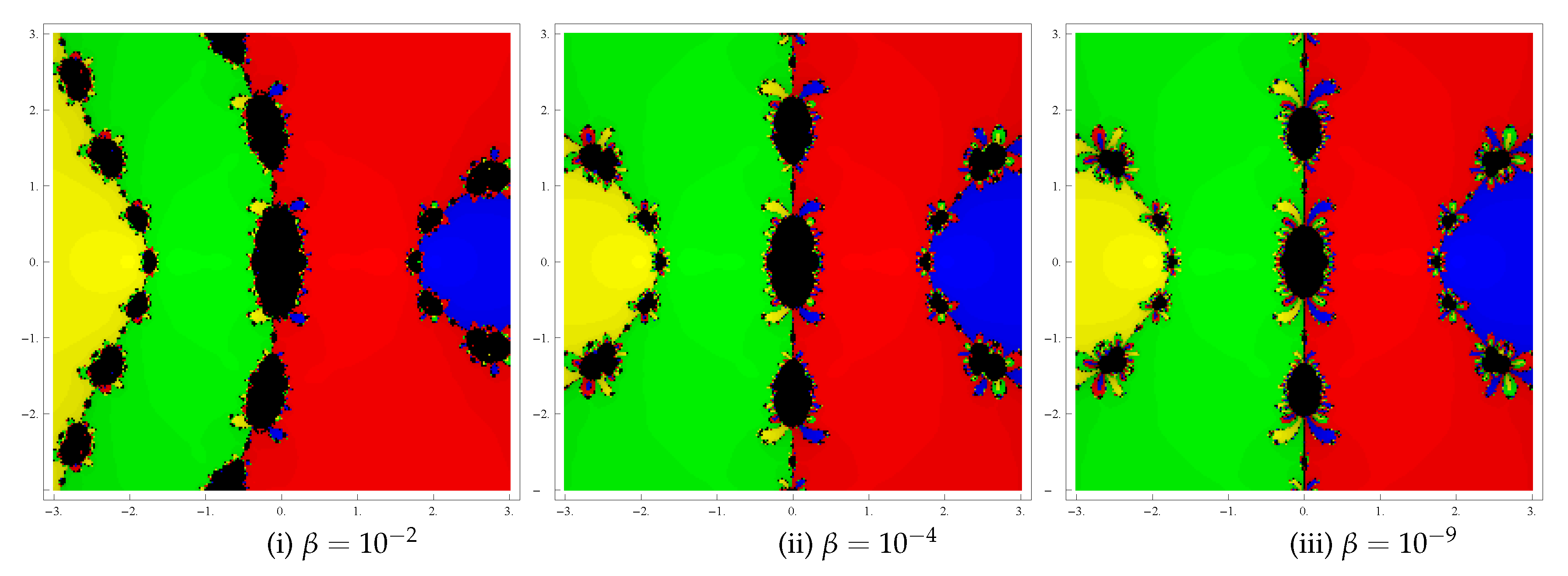
Test problem 1. Consider the polynomial that has four simple zeros . We use a grid of points in a rectangle of size and allocate the red, blue, green and yellow colors to the basins of attraction of these four zeros. Basins obtained for the method (3) are shown in Figure 1(i)–(iii) corresponding to . Observing the behavior of the method, we say that the divergent zones (black zones) are becoming smaller with the decreasing value of .
Figure 1.
Basins of attraction of method for polynomial .
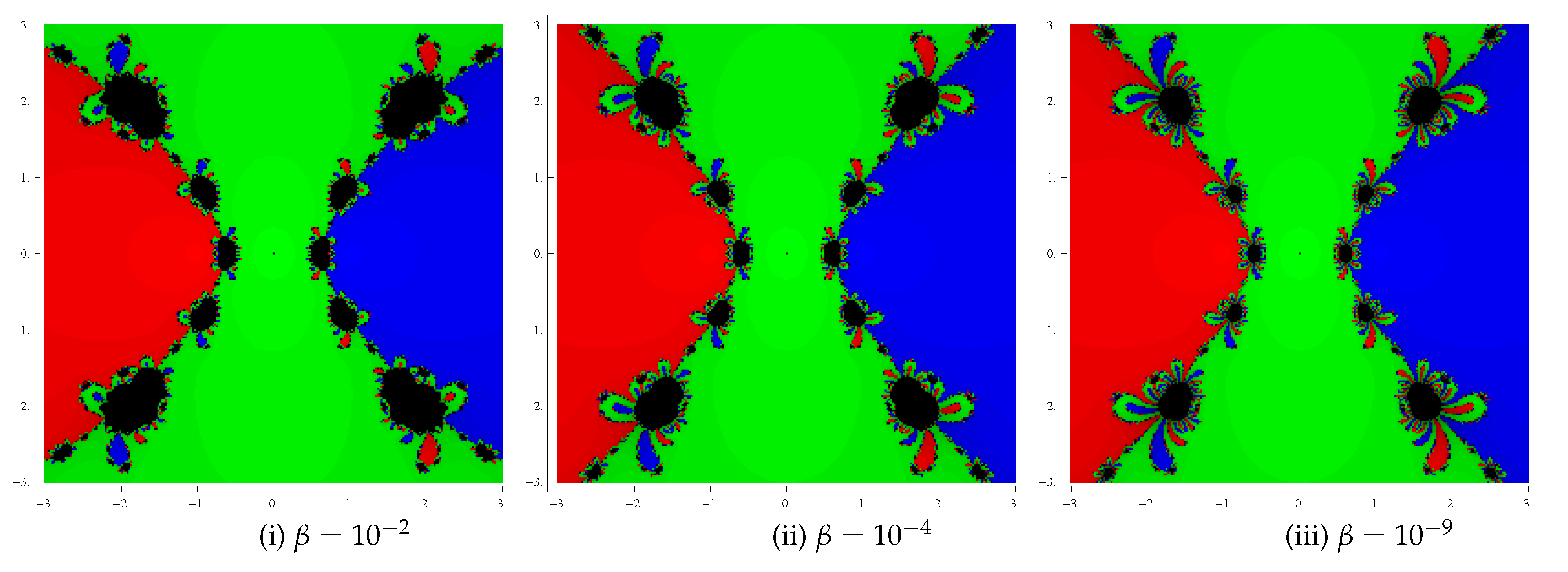
Problem 2. Let us take the polynomial having zeros . In this case, we also consider a rectangle with grid points and allocate the colors red, green and blue to each point in the basin of attraction of , 0 and 1, respectively. Basins obtained for the method (3) are displayed in Figure 2(i)–(iii) for the parameter values . Notice that the divergent zones are becoming smaller in size as parameter assumes smaller values.
Figure 2.
Basins of attraction of method for polynomial .
5. Conclusions
In this paper, the local convergence analysis of a derivative-free fifth order method is studied in Banach space. Unlike other techniques that rely on higher derivatives and Taylor series, we have used only derivative of order one in our approach. In this way, we have extended the usage of the considered method since the method can be applied to a wider class of functions. Another advantage of analyzing the local convergence is the computation of a convergence ball, uniqueness of the ball where the iterates lie and estimation of errors. Theoretical results of convergence thus achieved are confirmed through testing on some practical problems.
The basins of attraction have been analyzed by applying the method on some polynomials. From these graphics, one can easily visualize the behavior and suitability of any method. If we choose an initial guess in a domain where different basins of the roots meet each other, it is uncertain to predict which root is going to be reached by the iterative method that begins from . Thus, the choice of initial guess lying in such a domain is not suitable. In addition, black zones and the zones with different colors are not suitable to take the initial guess when we want to achieve a particular root. The most attractive pictures appear when we have very intricate boundaries of the basins. Such pictures belong to the cases where the method is more demanding with respect to the initial point.
Author Contributions
Methodology, D.K.; writing, review and editing, J.R.S.; investigation, J.R.S.; data curation, D.K.; conceptualization, L.J.; formal analysis, L.J.
Funding
This research received no external funding.
Acknowledgments
We would like to express our gratitude to the anonymous reviewers for their valuable comments and suggestions which have greatly improved the presentation of this paper.
Conflicts of Interest
The authors declare no conflict of interest.
References
- Banach, S. Théorie des Opérations Linéare; Monografje Matematyczne: Warszawna, Poland, 1932. [Google Scholar]
- Gupta, V.; Bora, S.N.; Nieto, J.J. Dhage iterative principle for quadratic perturbation of fractional boundary value problems with finite delay. Math. Methods Appl. Sci. 2019, 42, 4244–4255. [Google Scholar] [CrossRef]
- Jäntschi, L.; Bálint, D.; Bolboacă, S. Multiple linear regressions by maximizing the likelihood under assumption of generalized Gauss-Laplace distribution of the error. Comput. Math. Methods Med. 2016, 2016, 8578156. [Google Scholar] [CrossRef] [PubMed]
- Kitkuan, D.; Kumam, P.; Padcharoen, A.; Kumam, W.; Thounthong, P. Algorithms for zeros of two accretive operators for solving convex minimization problems and its application to image restoration problems. J. Comput. Appl. Math. 2019, 354, 471–495. [Google Scholar] [CrossRef]
- Sachs, M.; Leimkuhler, B.; Danos, V. Langevin dynamics with variable coefficients and nonconservative forces: From stationary states to numerical methods. Entropy 2017, 19, 647. [Google Scholar] [CrossRef]
- Behl, R.; Cordero, A.; Torregrosa, J.R.; Alshomrani, A.S. New iterative methods for solving nonlinear problems with one and several unknowns. Mathematics 2018, 6, 296. [Google Scholar] [CrossRef]
- Argyros, I.K.; George, S. Unified semi-local convergence for k-step iterative methods with flexible and frozen linear operator. Mathematics 2018, 6, 233. [Google Scholar] [CrossRef]
- Argyros, I.K.; Hilout, S. Computational Methods in Nonlinear Analysis; World Scientific Publishing Company: Hackensack, NJ, USA, 2013. [Google Scholar]
- Argyros, I.K. Computational Theory of Iterative Methods, Series: Studies in Computational Mathematics 15; Chui, C.K., Wuytack, L., Eds.; Elsevier: New York, NY, USA, 2007. [Google Scholar]
- Traub, J.F. Iterative Methods for the Solution of Equations; Prentice-Hall: Englewood Cliffs, NJ, USA, 1964. [Google Scholar]
- Potra, F.A.; Ptak, V. Nondiscrete Induction and Iterative Process; Research Notes in Mathematics; Pitman: Boston, MA, USA, 1984. [Google Scholar]
- Kantrovich, L.V.; Akilov, G.P. Functional Analysis; Pergamon Press: Oxford, UK, 1982. [Google Scholar]
- Candela, V.; Marquina, A. Recurrence relations for rational cubic methods I: The Halley method. Computing 1990, 44, 169–184. [Google Scholar] [CrossRef]
- Candela, V.; Marquina, A. Recurrence relations for rational cubic methods II: The Chebyshev method. Computing 1990, 45, 355–367. [Google Scholar] [CrossRef]
- Hasanov, V.I.; Ivanov, I.G.; Nebzhibov, G. A new modification of Newton’s method. Appl. Math. Eng. 2002, 27, 278–286. [Google Scholar]
- Kou, J.S.; Li, Y.T.; Wang, X.H. A modification of Newton’s method with third-order convergence. Appl. Math. Comput. 2006, 181, 1106–1111. [Google Scholar] [CrossRef]
- Ezquerro, J.A.; Hernández, M.A. Recurrence relation for Chebyshev-type methods. Appl. Math. Optim. 2000, 41, 227–236. [Google Scholar] [CrossRef]
- Chun, C.; Stănică, P.; Neta, B. Third-order family of methods in Banach spaces. Comput. Math. Appl. 2011, 61, 1665–1675. [Google Scholar] [CrossRef]
- Hernández, M.A.; Salanova, M.A. Modification of the Kantorovich assumptions for semilocal convergence of the Chebyshev method. J. Comput. Appl. Math. 2000, 126, 131–143. [Google Scholar] [CrossRef]
- Amat, S.; Hernández, M.A.; Romero, N. Semilocal convergence of a sixth order iterative method for quadratic equations. Appl. Numer. Math. 2012, 62, 833–841. [Google Scholar] [CrossRef]
- Babajee, D.K.R.; Dauhoo, M.Z.; Darvishi, M.T.; Barati, A. A note on the local convergence of iterative methods based on Adomian decomposition method and 3-node quadrature rule. Appl. Math. Comput. 2008, 200, 452–458. [Google Scholar] [CrossRef]
- Ren, H.; Wu, Q. Convergence ball and error analysis of a family of iterative methods with cubic convergence. Appl. Math. Comput. 2009, 209, 369–378. [Google Scholar] [CrossRef]
- Ren, H.; Argyros, I.K. Improved local analysis for certain class of iterative methods with cubic convergence. Numer. Algor 2012, 59, 505–521. [Google Scholar] [CrossRef]
- Argyros, I.K.; Hilout, S. Weaker conditions for the convergence of Newton’s method. J. Complexity 2012, 28, 364–387. [Google Scholar] [CrossRef]
- Gutiérrez, J.M.; Magreñán, A.A.; Romero, N. On the semilocal convergence of Newton–Kantorovich method under center-Lipschitz conditions. Appl. Math. Comput. 2013, 221, 79–88. [Google Scholar] [CrossRef]
- Argyros, I.K.; Sharma, J.R.; Kumar, D. Local convergence of Newton–Gauss methods in Banach space. SeMA 2016, 74, 429–439. [Google Scholar] [CrossRef]
- Behl, R.; Salimi, M.; Ferrara, M.; Sharifi, S.; Alharbi, S.K. Some real-life applications of a newly constructed derivative free iterative scheme. Symmetry 2019, 11, 239. [Google Scholar] [CrossRef]
- Salimi, M.; Nik Long, N.M.A.; Sharifi, S.; Pansera, B.A. A multi-point iterative method for solving nonlinear equations with optimal order of convergence. Jpn. J. Ind. Appl. Math. 2018, 35, 497–509. [Google Scholar] [CrossRef]
- Sharma, J.R.; Kumar, D. A fast and efficient composite Newton-Chebyshev method for systems of nonlinear equations. J. Complexity 2018, 49, 56–73. [Google Scholar] [CrossRef]
- Sharma, J.R.; Arora, H. On efficient weighted-Newton methods for solving systems of nonlinear equations. Appl. Math. Comput. 2013, 222, 497–506. [Google Scholar] [CrossRef]
- Lofti, T.; Sharifi, S.; Salimi, M.; Siegmund, S. A new class of three-point methods with optimal convergence order eight and its dynamics. Numer. Algor. 2015, 68, 261–288. [Google Scholar] [CrossRef]
- Sharma, J.R.; Kumar, D.; Jäntschi, L. On a reduced cost higher order Traub–Steffensen-like method for nonlinear systems. Symmetry 2019, 11, 891. [Google Scholar] [CrossRef]
- Grabnier, J.V. Who gave you the epsilon? Cauchy and the origins of rigorous calculus. Am. Math. Mon. 1983, 90, 185–194. [Google Scholar] [CrossRef]
© 2019 by the authors. Licensee MDPI, Basel, Switzerland. This article is an open access article distributed under the terms and conditions of the Creative Commons Attribution (CC BY) license (http://creativecommons.org/licenses/by/4.0/).