Abstract
Higher-order derivatives are used to determine the convergence order of iterative methods. However, such derivatives are not present in the formulas. Therefore, the assumptions on the higher-order derivatives of the function restrict the applicability of methods. Our convergence analysis of an eighth-order method uses only the derivative of order one. The convergence results so obtained are applied to some real problems, which arise in science and engineering. Finally, stability of the method is checked through complex geometry shown by drawing basins of attraction of the solutions.
MSC:
65H10; 65J10; 41A25; 49M15
1. Introduction
Let be differentiable continuously according to Fréchet between the Banach spaces and and be a convex set. Let for . Denote by the closure of . Let also stand for the set of bounded linear operators from to .
In this study, we locate p by solving equation
Many problems look like (1) [1,2,3]. The solutions of such equations are rarely attainable in closed form. That is why most methods for solving such equations are usually iterative. Convergence analysis is an important part in the development of an iterative method. In general, the convergence domain is narrow. Without additional hypotheses, it is important to enlarge the convergence domain. Knowledge of initial guesses requires the convergence radius. Other studies are found in [1,2,4,5,6,7,8,9].
The most well-known method is Newton’s method, which is written as
Many higher orders of convergence, modified Newton’s, or Newton-like methods have been appeared in the literature, e.g., [1,2,3,5,6,7,9,10,11,12,13,14,15,16,17,18,19,20,21] and references therein. In particular, Cordero et al. [11] studied eighth-order method for finding approximate solution of defined for each by
They considered the method (3) for solving system of equations, when (). The method was compared favorably to existing methods. They proved the eighth order of convergence of the method but using Taylor series as well as eighth-order derivatives. The convergence order of the other methods mentioned in [11] also use higher-order derivatives. Therefore, they can be handled with the same technique. We simply picked (3) to work with which seems to be the best to study among the rest.
It can be clearly seen that the assumptions on the higher-order Fréchet derivatives of the operator F limit the applicability of method (3). As a motivational example, we consider the following:
Let and . Consider the Hammerstein-type equation [1,4] defined by
where D is defined on as
Clearly, solves
Then, we have that the Fréchet derivative is given by
where the prime denotes derivative with respect to x. We have
Boundary value problems of order two can be found in many disciplines: In Physics, many problems can be expressed in this way, e.g., Newton’s laws; calculating concentrations of various chemicals in a reaction; computing modes in biology etc. If we assume kinetic plus potential energy is constant. Then, the mechanical system is called conservative. Consider the conservative system defined by the Boundary Value Problem (BVP)
where is differentiable at least one time. Then, solving BVP reduced to finding a solution of an integral equation like (4) [15].
In this work, our approach is to weaken the assumptions in [11]. We work with Banach space valued operators which constitute a more general setting and use only first-order derivatives. We summarize the contents of the paper. The local convergence of (3) is given in Section 2. Experiments on some problems of the applied sciences are performed to verify the theoretical results in Section 3. Then, in Section 4 we check the convergence domain of the iterative technique geometrically by means of drawing basin of attractors. Concluding remarks are given in Section 5.
2. Local Convergence
Let be a continuous and increasing function with . Assume a minimal positive solution
has . Let also , be continuous and increasing functions with , and functions , on the interval are given as
and
Clearly, and as . By the intermediate value theorem, equation has at least one solution in the interval , denote by . Assume
has a minimal positive solution and let . Define the functions and on interval by
and
Since, and as , let be the minimal solution of equation in . Assume
has a minimal solution and let . Define the functions and on interval by
and
However, and as , let be the minimal solution of equation
Define radius of convergence
Then, for all
and
We shall use the conditions in the local convergence analysis of method (3) given below:
Next, the convergence analysis of method (3) follows using the preceding notations and the conditions .
Theorem 1.
Assume that the conditions hold. Then, the sequence starting at converges to p, and the following inequalities hold
and
where the “q” functions are given previously and R is defined in (10). Furthermore, p is the only solution of equation in .
Proof.
A mathematical induction-based proof is used. If , using (10) and , we get that
so, by the Banach Lemma on invertible operators [2,22], we have that and
This also shows that is well defined. Using (10), (14) (for ), and (19), we get in turn that
so (15) holds for and , so and are well defined.
We can have by that
Then, by the second condition in (), we get that
By second substep of method (3) for , we have
By using (10), (14) (for ), (19) (for ), (20), (22) (for ) and (23), we obtain in turn that
so (17) holds for , and . Moreover, by the third sub step of method (3), we have that
Using (10), (14) (for ), (19) (for ), (20), (22) (for ), (24) and (25), we get in turn that
so (17) holds for and . The induction for (17) is completed if , , , are replaced by , , , in the preceding calculations. Then, in view of the inequality
where , we get that and .
Furthermore, for the uniqueness part, let for some such that . Using (), we get that
so . Finally, , we get . □
Remark 1.
- (i)
- In view of ()Then, we can set , and condition can be removed, condition () can be dropped and can be replaced by .
- (ii)
- Let be any iterative method. Then, we define the computational order of convergence (COC) [21] byand the approximate computational order of convergence (ACOC) [13], byThe order of convergence is derived.
3. Numerical Experiments
To show the applicability of our theory, we consider the following problems:
Example 1.
The Van der Waals equation of state for a vapor is (see [23])
Then, we must solve equation
in V, where all constants have a physical meaning whose values can be found in [23]. We solve this problem when kPa and K. The solution p of resulting equation is . Then, we can choose and , and by using conditions the parameters are given by
So,
Thus, the convergence of the method (3) to is guaranteed, provided that .
Example 2.
The following equation appears in the study of fractional conversation to ammonia from nitrogen-hydrogen [24,25]. In particular, for 250 atm, 500 °C and the equation is
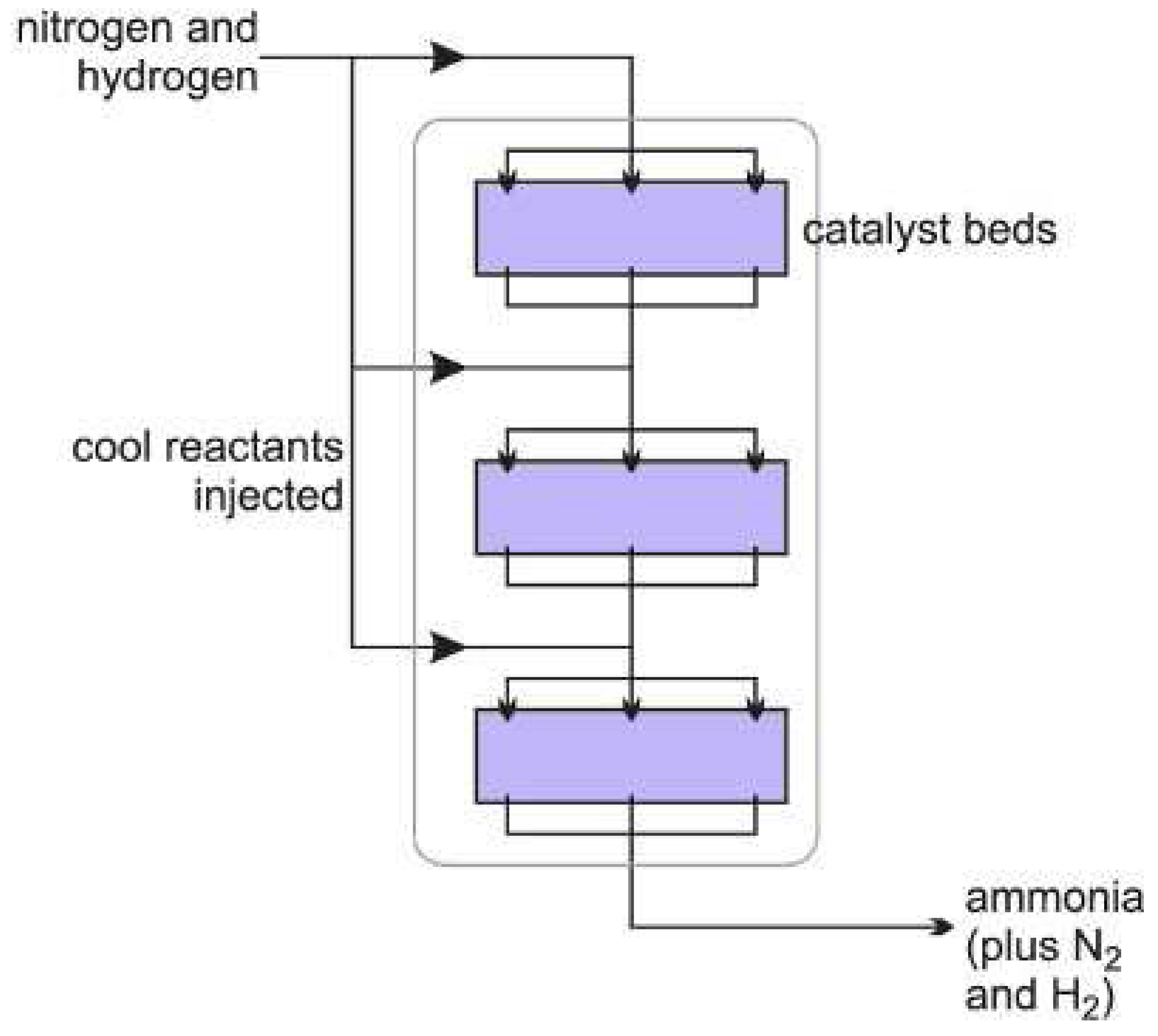
Figure 1 shows the conversion process. Then, for we have , and . The parameters by using conditions are computed as
Figure 1.
Ammonia process.
So,
Example 3.
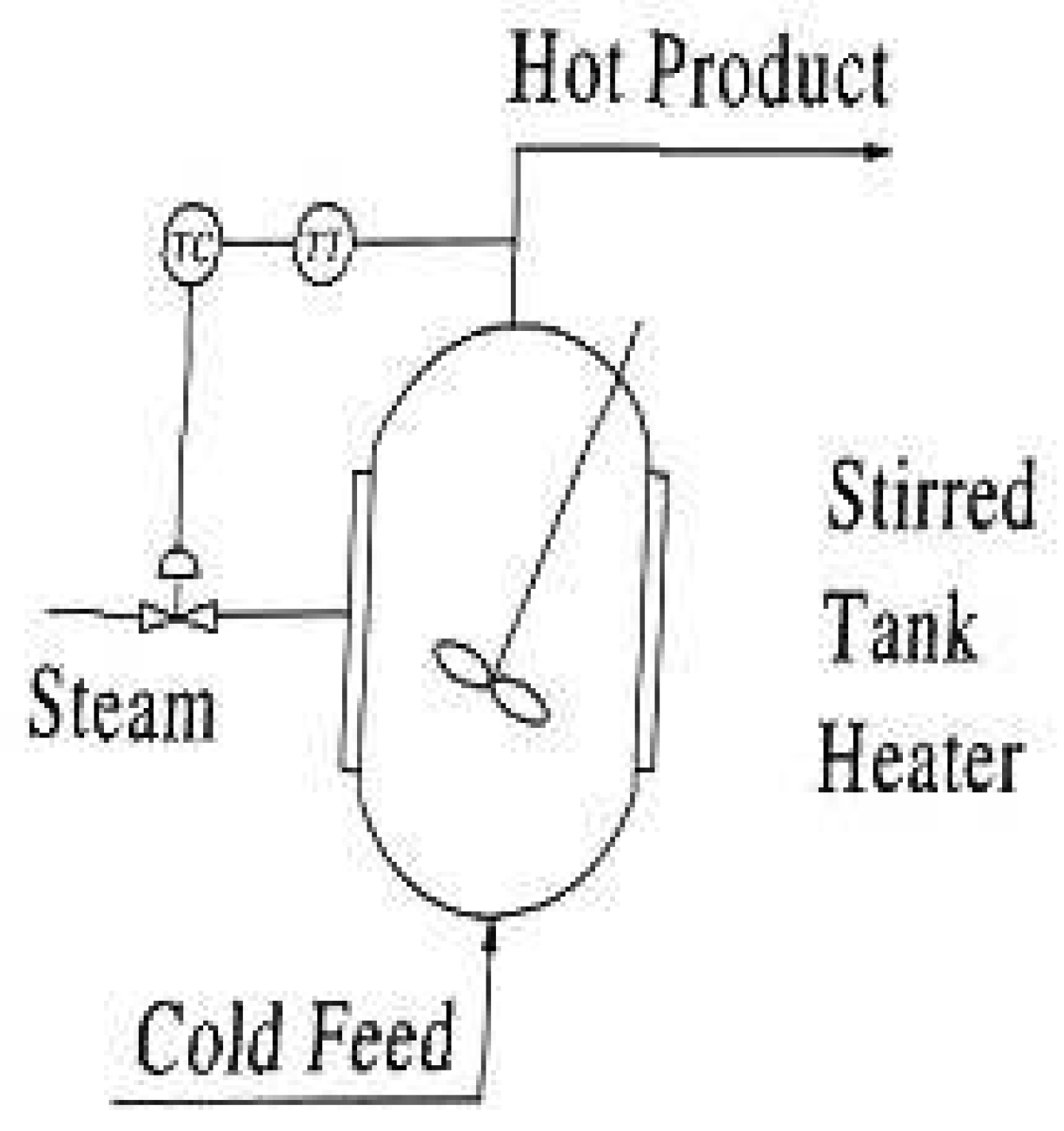
Consider the three-mode feedback control of a stirred-tank heater system (Figure 2). The measured output variable is the feed stream temperature [26]. Using standard methods [26], we get the control system defined by
where, the constants appearing in (31) have a physical meaning [26].
Figure 2.
Stirred-tank heater.
To study stability, we first specialize constants and then set the denominator in (31) equal to zero, and solve
We solve the characteristic polynomial when is equal to its “critical” value that is using
By substituting the above parameters in (32), we get that
so . Then, we have that , , and by using the conditions, we obtain the parameter values
which implies that
Example 4.
Let and . Define function Q on Ω by
We have that
Then for we have that , and . So, by conditions, we obtain the parameters
So,
Example 5.
In the example, of introduction, we can choose and , so
Thus, the convergence of the method (3) to is guaranteed, provided that .
4. Complex Dynamics of Method
The convergence and stability of iterative methods use complex dynamics of rational functions [18,27,28]. A more complete study can be found, for example, in [29]. Consider mapping , where is a Riemann sphere, the set of its iterates can be considered as a discrete dynamical system. The set
defines the orbit of .
The dynamical behavior of the orbit of a point of can be categorized on its asymptotic behavior. We need the standard definitions
- attractor if ,
- superattractor if ,
- repuslor if ,
- parabolic if .
The basin of attraction of an attracting point consists of the set of points that accumulate on under iteration of , that is
The Fatou set contains elements with orbits converging to a fixed point. Moreover, the Juila set is the closure of a set containing fixed points that are repelling.
We take the initial point as , where is a rectangular region in complex plane containing all the roots of The iterative methods beginning at point in a rectangle can converge to the zero of or not converge. We consider the stopping criterion for convergence as up to a maximum of 25 iterations. If we have not obtained the desired tolerance in 25 iterations, we do not continue and decide that the iterative method starting at does not converge to any root. The approach taken into account is following: A color is allotted to each starting point in the basin of attraction of a zero. If the iteration starting from the initial point converges then it represents the basins of attraction with that particular color assigned to it and if it fails to converge in 25 iterations then it shows the black color. In this way, we discriminate the attraction basins by their colors for the method.
Next, basin of attraction is analyzed.
Test problem 1.
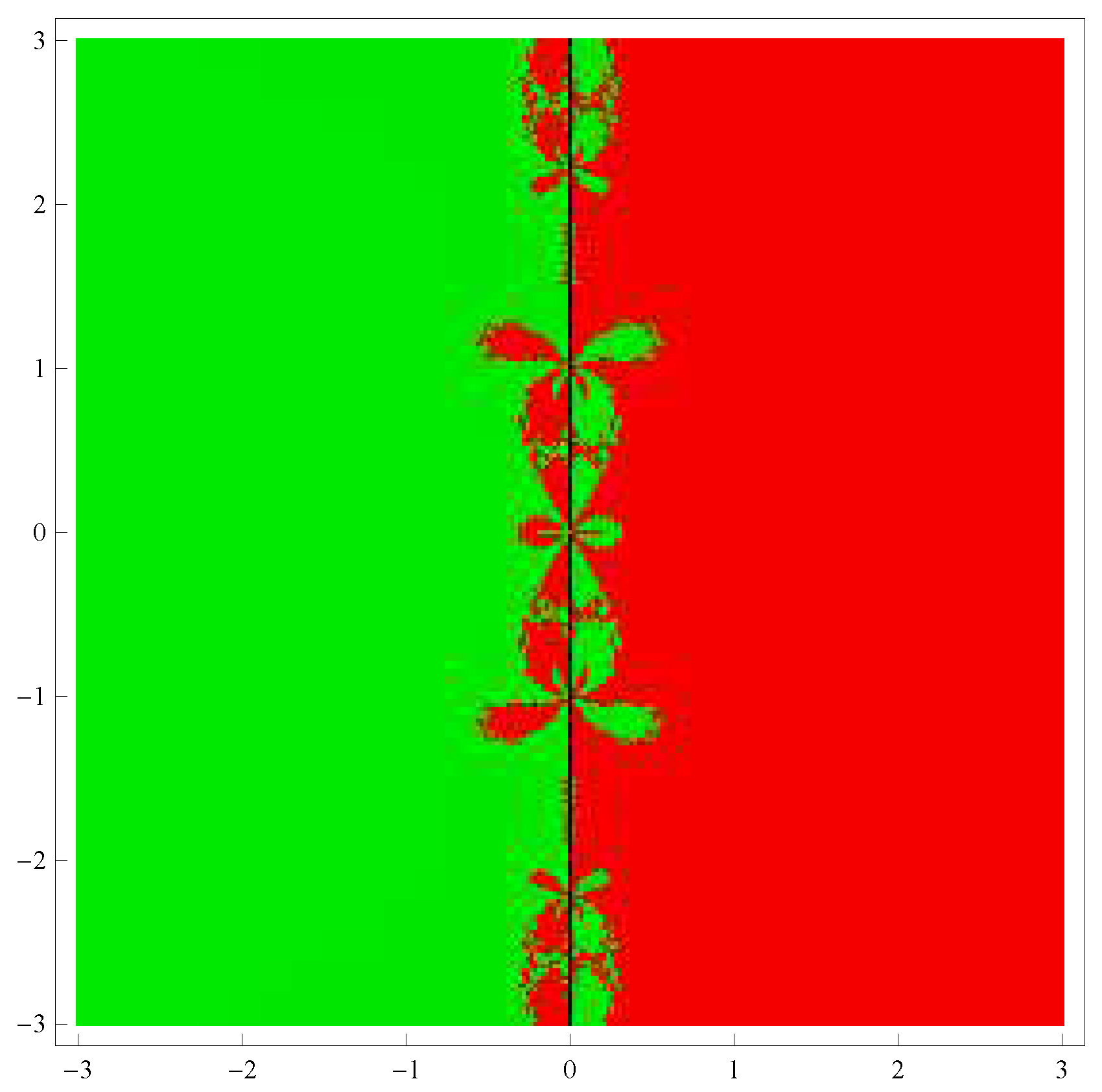
Consider the polynomial having two simple zeros . The basin of attractors for this polynomial are shown in Figure 3. From this figure, it can be observed that method (3) has very stable behavior. In addition, the method does not exhibit chaotic behavior on the boundary points.
Figure 3.
Basins of attraction of method (3) for test problem 1.
Test problem 2.
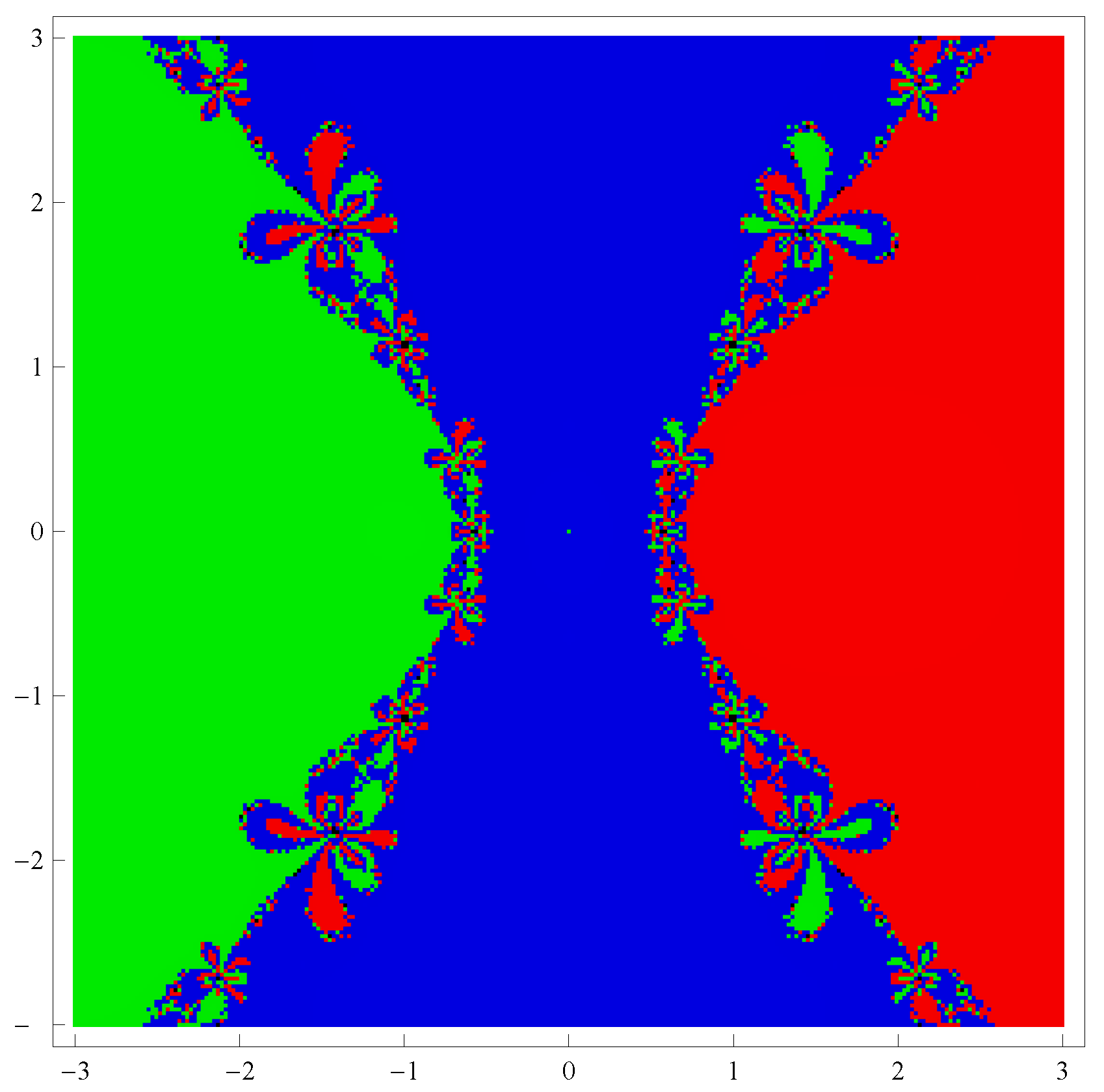
Consider having three simple zeros . The basin of attractors for this polynomial are shown in Figure 4. From this figure, we observe the stable behavior of method (3). Moreover, the method does not show chaotic behavior on the boundary of basins.
Figure 4.
Basins of attraction of method (3) for test problem 2.
Test problem 3.
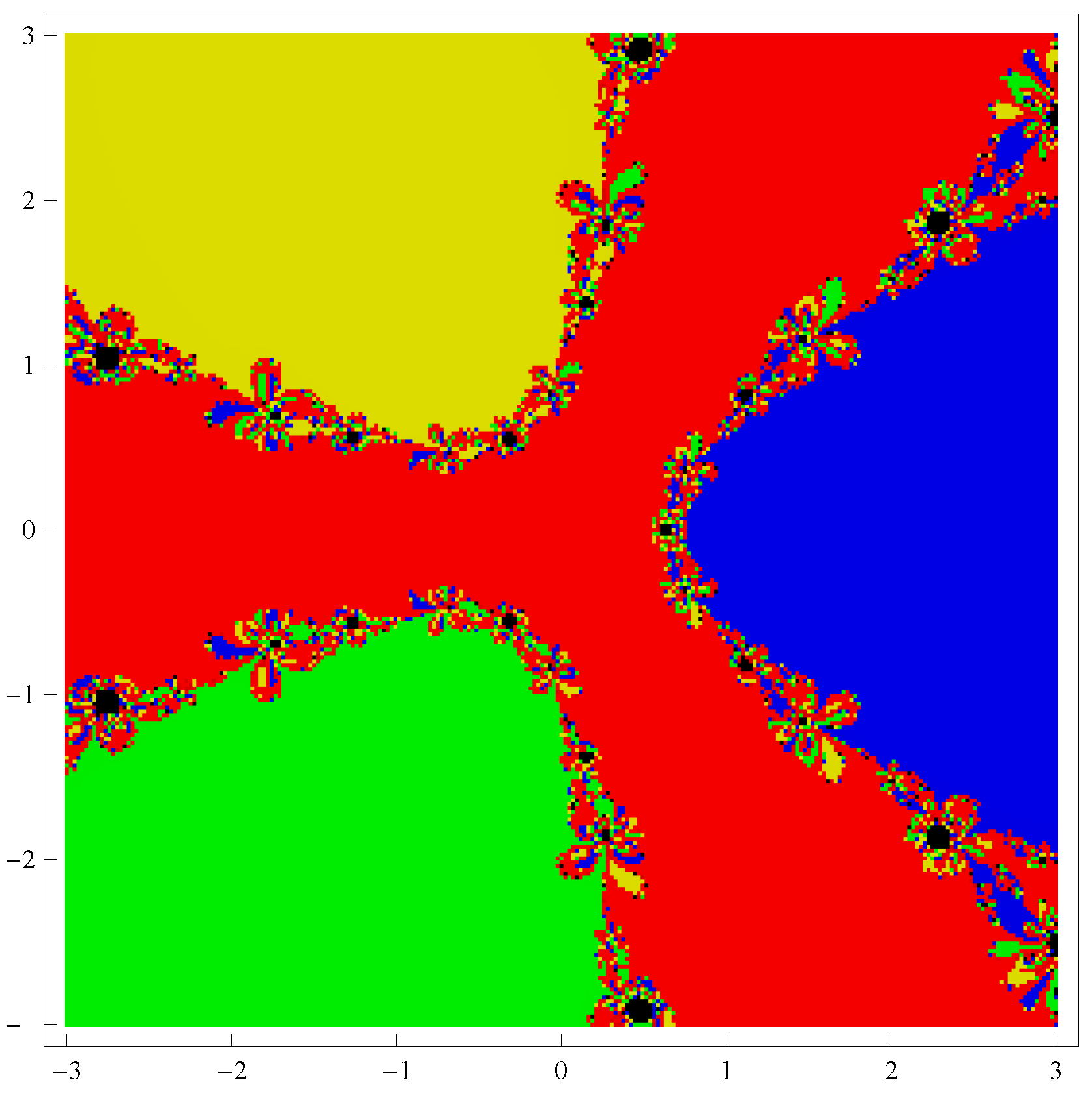
Consider the polynomial having four simple zeros , . The basin of attractors is shown in Figure 5. In this case, we also observe the beautiful shape of the basins of attraction of different roots. At the boundaries, however, a few small black points show that the method is divergent at such points.
Figure 5.
Basins of attraction of method (3) for test problem 3.
5. Conclusions
In this study, we have extended the usage of method (3) by presenting its convergence analysis and complex dynamics. In contrast to other techniques relying on higher derivative order as well as Taylor series, we have used only derivative of order one, since this actually appears in the method. Another advantage of our approach is the computation of balls, uniqueness balls where the iterates lie as well as estimates on . These goals are achieved using our Lipschitz-like conditions. Theoretical results so derived are verified on some practical problems. Finally, we have checked the stability of the method by means of using complex dynamics tool, namely, basin of attraction.
Author Contributions
Investigation, D.K.; Data Curation, D.K.; Conceptualization, I.K.A.; Formal analysis, I.K.A.; Methodology, J.R.S.; Writing—review & editing, J.R.S.
Conflicts of Interest
The authors declare no conflict of interest.
References
- Argyros, I.K. Computational Theory of Iterative Methods, Series: Studies in Computational Mathematics, 15; Chui, C.K., Wuytack, L., Eds.; Elsevier: New York, NY, USA, 2007. [Google Scholar]
- Argyros, I.K.; Hilout, S. Computational Methods in Nonlinear Analysis; World Scientific Publishing Company: Hackensack, NJ, USA, 2013. [Google Scholar]
- Traub, J.F. Iterative Methods for the Solution of Equations; Prentice-Hall: Englewood Cliffs, NJ, USA, 1982. [Google Scholar]
- Argyros, I.K.; Sharma, J.R.; Kumar, D. Local convergence of Newton-Gauss method in Banach spaces. SeMA 2017, 74, 429–439. [Google Scholar] [CrossRef]
- Argyros, I.K.; Magreñán, Á.A. Iterative Methods and Their Dynamics with Applications: A Contemporary Study; CRC Press: New York, NY, USA, 2017. [Google Scholar]
- Babajee, D.K.R.; Dauhoo, M.Z.; Darvishi, M.T.; Barati, A. A note on the local convergence of iterative methods based on Adomian decomposition method and 3-node quadrature rule. Appl. Math. Comput. 2008, 200, 452–458. [Google Scholar] [CrossRef]
- Chun, C.; Stănică, P.; Neta, B. Third-order family of methods in Banach spaces. Comput. Math. Appl. 2011, 61, 1665–1675. [Google Scholar] [CrossRef]
- Gutiérrez, J.M.; Magreñán, Á.A.; Romero, N. On the semilocal convergence of Newton-Kantrovich method under center–Lipschitz conditions. Appl. Math. Comput. 2013, 221, 79–88. [Google Scholar]
- Hasanov, V.I.; Ivanov, I.G.; Nebzhibov, F. A new modification of Newton’s method. Appl. Math. Eng. 2002, 27, 278–286. [Google Scholar]
- Alzahrani, A.K.H.; Behl, R.; Alshomrani, A. Some higher-order iteration functions for solving nonlinear models. Appl. Math. Comput. 2018, 334, 80–93. [Google Scholar] [CrossRef]
- Cordero, A.; Gómez, E.; Torregrosa, J.R. Efficient high-order iterative methods for solving nonlinear systems and their application on heat conduction problems. Complexity 2017, 2017, 6457532. [Google Scholar] [CrossRef]
- Babajee, D.K.R.; Madhu, K.; Jayaraman, J. On some improved harmonic mean Newton-like methods for solving systems of nonlinear equations. Algorithms 2015, 8, 895–909. [Google Scholar] [CrossRef]
- Cordero, A.; Torregrosa, J.R. Variants of Newton’s method using fifth-order quadrature formulas. Appl. Math. Comput. 2007, 199, 686–698. [Google Scholar] [CrossRef]
- Darvishi, M.T.; Barati, A. A third-order Newton-type method to solve systems of nonlinear equations. Appl. Math. Comput. 2007, 187, 630–635. [Google Scholar] [CrossRef]
- Ezquerro, J.A.; Hernańdez, M.A. Newton’s Method: An Updated Approach of Kantrovich’s Theory; Frontiers in Mathematics; Birkhausor: Cham, Switzerland, 2017. [Google Scholar]
- Jaiswal, J.P. Semilocal convergence of an eighth-order method in Banach spaces and its computational efficiency. Numer. Algor. 2016, 71, 933–951. [Google Scholar] [CrossRef]
- Lotfi, T.; Bakhtiari, P.; Cordero, A.; Mahdiani, K.; Torregrosa, J.R. Some new efficient multipoint iterative methods for solving nonlinear systems of equations. Int. J. Comput. Math. 2015, 92, 1921–1934. [Google Scholar] [CrossRef]
- Lotfi, T.; Sharifi, S.; Salimi, M.; Siegmund, S. A new class of three-point methods with optimal convergence order eight and its dynamics. Numer. Algor. 2015, 68, 261–288. [Google Scholar] [CrossRef]
- Madhu, K.; Babajee, D.K.R.; Jayaraman, J. An improvement to double–step Newton method and its multi-step version for solving system of nonlinear equations and its applications. Numer. Algor. 2017, 74, 593–607. [Google Scholar] [CrossRef]
- Narang, M.; Bhatia, S.; Kanwar, V. New two–parameter Chebyshev–Halley–like family of fourth and sixth–order methods for systems of nonlinear equations. Appl. Math. Comput. 2016, 275, 394–403. [Google Scholar] [CrossRef]
- Weerakoon, S.; Fernando, T.G.I. A variant of Newton’s method with accelerated third-order convergence. Appl. Math. Lett. 2000, 13, 87–93. [Google Scholar] [CrossRef]
- Kantrovich, L.V.; Akilov, G.P. Functional Analysis; Pergamon Press: Oxford, UK, 1982. [Google Scholar]
- Hoffman, J.D. Numerical Methods for Engineers and Scientists; McGraw-Hill Book Company: New York, NY, USA, 1992. [Google Scholar]
- Gopalan, V.B.; Seader, J.D. Application of interval Newton’s method to chemical engineering problems. Reliab. Comput. 1995, 13, 215–223. [Google Scholar]
- Shacham, M. An improved memory method for the solution of a nonlinear equation. Chem. Eng. Sci. 1989, 44, 1495–1501. [Google Scholar] [CrossRef]
- Constantinides, A.; Mostoufi, N. Numerical Methods for Chemical Engineers with Matlab Applications; Prentice Hall: Upper Saddle River, NJ, USA, 2000. [Google Scholar]
- Magreñán, Á.A. A new tool to study real dynamics: The convergence plane. Appl. Math. Comput. 2014, 248, 215–224. [Google Scholar] [CrossRef]
- Scott, M.; Neta, B.; Chun, C. Basin attractors for various methods. Appl. Math. Comput. 2011, 218, 2584–2599. [Google Scholar]
- Traub, J.F. Dynamics in One Complex Variable; Annals of Mathematics Studies. 160; Princeton University Press: Princeton, NJ, USA, 2006. [Google Scholar]
© 2018 by the authors. Licensee MDPI, Basel, Switzerland. This article is an open access article distributed under the terms and conditions of the Creative Commons Attribution (CC BY) license (http://creativecommons.org/licenses/by/4.0/).