Abstract
Given a (molecular) graph, the first multiplicative Zagreb index is considered to be the product of squares of the degree of its vertices, while the second multiplicative Zagreb index is expressed as the product of endvertex degree of each edge over all edges. We consider a set of graphs having n vertices and k cut edges, and explore the graphs subject to a number of cut edges. In addition, the maximum and minimum multiplicative Zagreb indices of graphs in are provided. We also provide these graphs with the largest and smallest and in .
1. Introduction
Within the areas of theoretical chemistry and mathematics, the structure invariant is an important tool to study the quantitative molecular properties [1]. One type of the most classical topological molecular expression is called as Zagreb indices and [2]. This information can be used as qualitative levels for integral -electron energy of the conjugated molecules. In the view of successful considerations on the applications on Zagreb indices [3], Todeschini et al., (2010) [4,5,6] introduced the multiplicative Zagreb indices of molecular graphs, denoted by and the multiplicative Zagreb indices. (Multiplicative) Zagreb indices are employed as molecular expressions in quantitative structure–property relationships and quantitative structure–activity relationships [7,8].
Mathematicians have been interested in the information of Zagreb indices about the upper and lower bounds for special (chemical) graphs, as well as corresponding areas of determining their extremal graphs [9,10,11,12,13,14,15,16,17,18,19,20,21,22,23]. In addition to a plenty of applications for the usage of Zagreb indices in theoretical chemistry, there are many studies for multiplicative Zagreb indices, which attracted one of the focus of interests in physics and graph theory. Borovićanin et al. [24] investigated upper bounds on Zagreb indices of noncyclic graphs with given domination number. Wang and Wei [6] determined the maximal and minimal values of multiplicative Zagreb indices in the extended noncyclic graph, k-trees. In some graph classes, Liu and Zhang provided some upper bounds for -index and -index of graphs subject to structure parameters [25]. Xu and Hua [26] explored a common method to characterize the bounds of -cyclic graphs. Iranmanesh et al. [27] gave these indices for a type of chemical molecules, specific dendrimers. Kazemi [28] found interesting extremal values for related moments and probability generating functions in random trees. The graphs subject to a given number of cut edges (or vertices) are intriguing in extremal mathematics [29,30,31,32,33]. It is a natural observation that trees having largest and smallest multiplicative Zagreb indices have been considered as interesting topics [27,34,35].
In view of mentioned outcomes, we continue this way and study multiplicative Zagreb indices of graphs subject to a given number of cut edges. In addition, the maximum and minimum of and of graphs in subject to fixed number of cut edges are provided. Lastly, the corresponding graphs with the largest and smallest multiplicative Zagreb indices in are determined.
2. Preliminaries
Denote by a simple undirected connected graph of vertex number n and edge number m with vertex set and edge set . For , denotes the neighbors of w, that is, , and is the degree of w. The Zagreb indices [3] of a connected graph are given by
The first multiplicative Zagreb index and the second multiplicative Zagreb index [4,5] of any graph G are considered as
A vertex of degree one is called pendent vertex. The supporting vertex is a vertex in a graph which is incident to at least one pendent vertex. A pendent edge is an edge connecting a pendent vertex and a supporting vertex. If , , ⋯, with share a common vertex v, then denote the graph with edge set and . For and , if is a path, then denote this graph by or in which P is called an internal path. By deleting a vertex or an edge, the resulting graph has at least two components, and this vertex or edge is called a cut. If G has no cut vertex, then G is 2-connected. A block is 2-connected, and an endblock has not more than two cut vertices. means that is isomorphic to . As usual, , , and are a path, a clique, a star and a cycle on n vertices, respectively. The cyclomatic number of a graph G is defined as . In particular, if and 2, then G will be trees, unicyclic graphs and bicyclic graphs, respectively. If , then G has at most cut edges. Thus, we suppose that G contains cut edges in our following discussion.
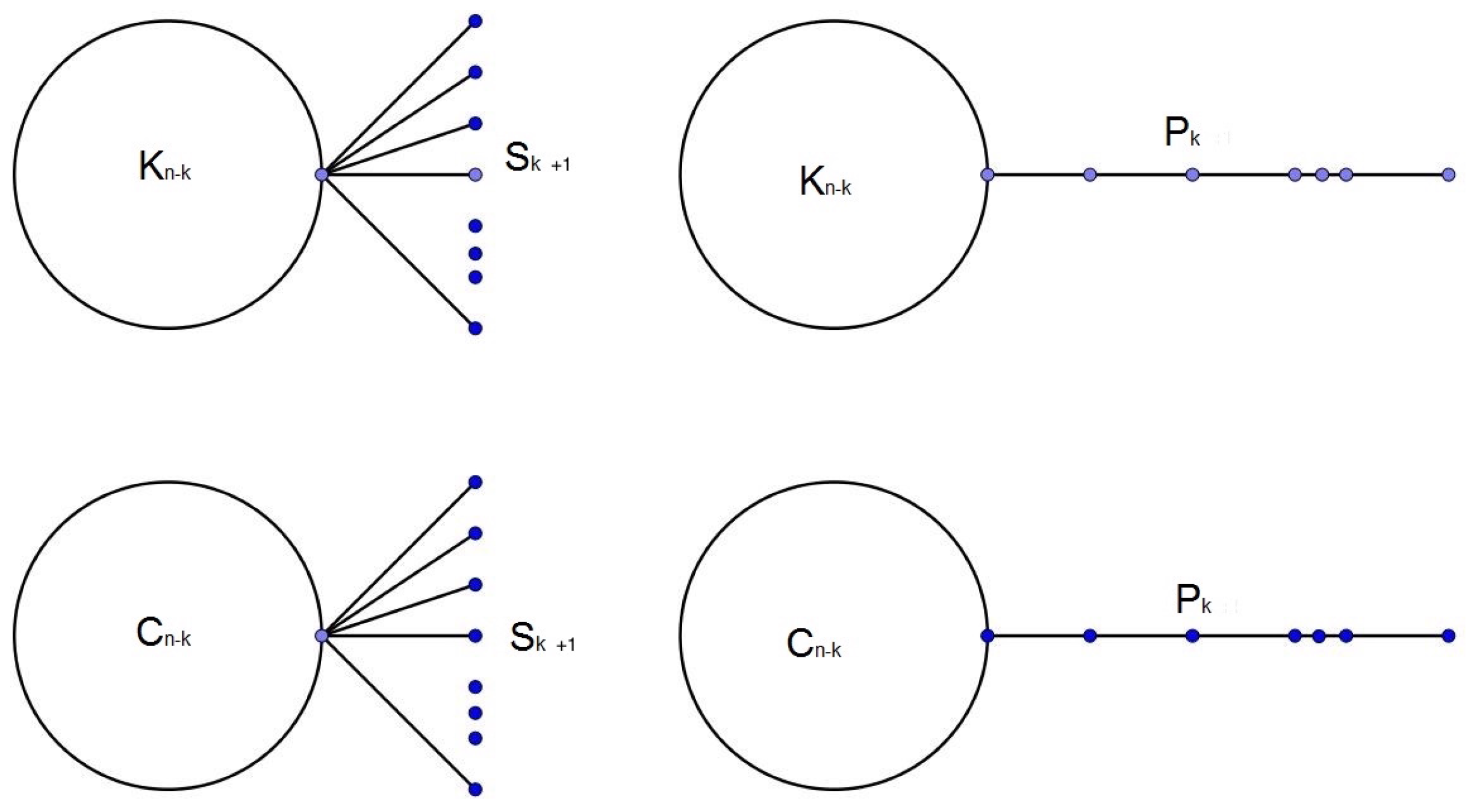
Let be the set of the connected graphs with cut edges, and be a set of cut edges of the graph . Then can be considered as two categories, which are the pendent edges and nonpendent edges (or internal paths of length 1). contains some 2-connected graphs and isolated vertices. Denote by (or , respectively) a graph obtained by identifying (connecting to, respectively) the nonpendent vertex of a star (or a pendent vertex of a path , respectively) to a vertex of (see Figure 1). In addition, let (or , respectively) be a graph obtained by identifying (connecting to, respectively) the nonpendent vertex of a star (or a pendent vertex of a path , respectively) to a vertex of .
Figure 1.
and .
In our work, we may use some terminologies and notations of these textbooks of graph theory (see [36,37]). By elementary processes, the following results are not hard.
Proposition 1.
If is a function for , then is an increasing function in .
Proposition 2.
If is a function for , then is a decreasing function in .
Based on the concepts of and and the fact that adding edges increases the degrees, we have
Lemma 1.
Suppose that is a connected graph and .
- (i)
- If are not adjacent in G, then .
- (ii)
- If , we have .
Lemma 2 yields the following result.
Lemma 2.
Suppose that is a 2-connected graph with .
- (i)
- If is maximal, then G ≅ .
- (ii)
- If is minimal, then G ≅ .
Lemma 3.
Let be cycles, and be an internal path of such that and . Assume that and such that and . Let . Then with .
Proof.
By the graph operations from G to , we have . For , . Then with , and we complete the proof. ☐
Lemma 4.
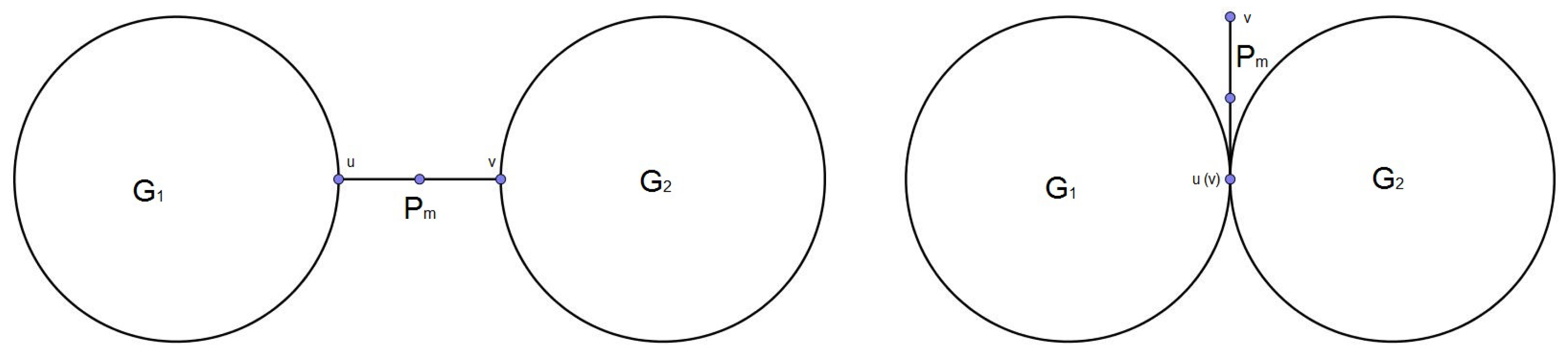
Let and be graphs (see Figure 2), in which is a path, and , are connected. Then and .
Figure 2.
and .
Proof.
Let and . Then . From the formulas of multiplicative Zagreb indices, we obtain
Since , and by Proposition 1, we have . Note that
By and Proposition 2, we have , that is, . Thus, this completes the proof. ☐
From Lemma 4, if we have an internal path, then we can move out it. By keeping this process, we have the useful lemma below.
Lemma 5.
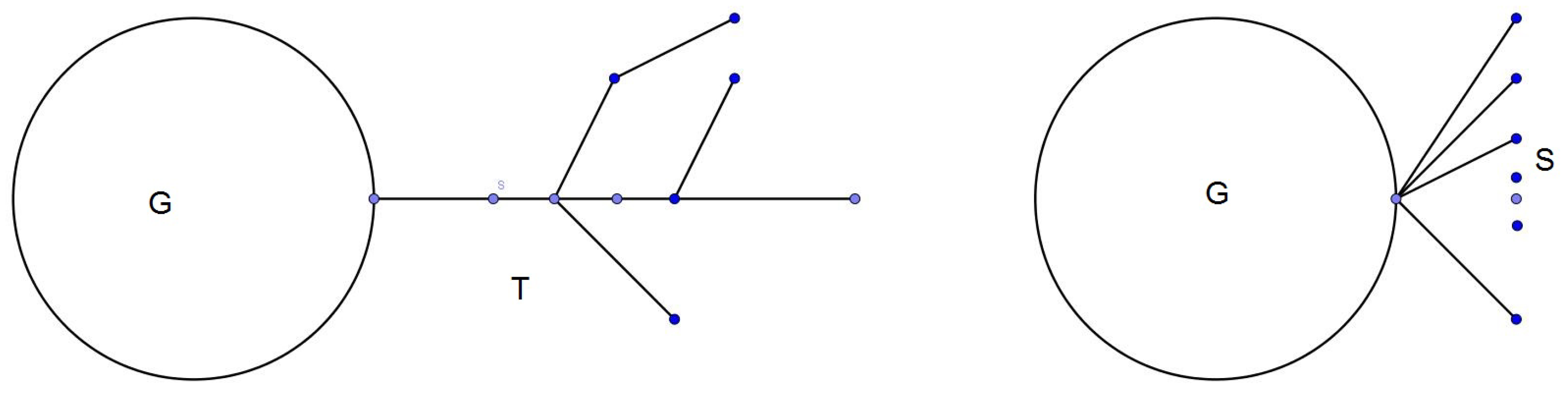
Let be a graph by identifying a vertex of a tree T (not ) to a vertex u of G, and be a graph by attaching pendent edges to u (see Figure 3). Then and .
Figure 3.
and .
Lemma 6.
Let u (v, respectively) be a vertex in G, and be the endvertices of pendent path ( be the endvertices of , respectively). Set with , and with . Let with , with and (see Figure 4). Then either and , or and .
Figure 4.
G, and .
Proof.
Let , . By the constructions of and , we have , , and Combining with the concepts of multiplicative Zagreb indices, we have
If , by Propositions 1 and 2, we can obtain that and . If , then . Propositions 1 and 2 yield that and . Thus, the lemma is proved. ☐
Lemma 7.
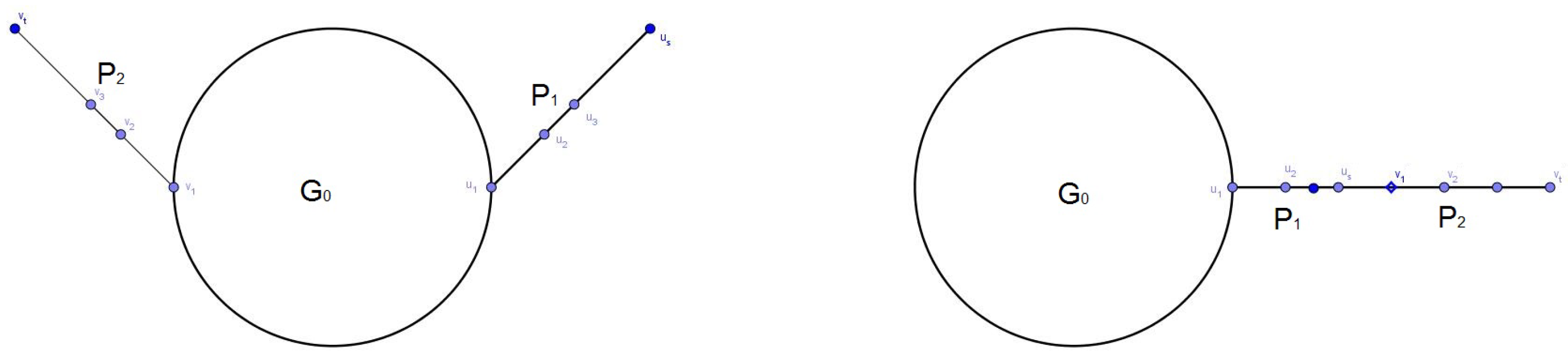
Let and be two pendent paths of G with and (see Figure 5). Let . Then and .
Figure 5.
G and .
Proof.
Note that . From the expressions of multiplicative Zagreb indices, we have
By Proposition 1, we have , that is, .
By Proposition 2, we have , that is, .
Thus, this completes the proof. ☐
3. Graphs with Smallest Multiplicative Zagreb Indices in
We begin to determine the graphs having the smallest and in .
Theorem 1.
Let G be a graph in with . Then
where the equality holds if and only , respectively.
Proof.
Choose a graph such that the value of is as small as possible. Let be a cut edge set of G and be the components of . We first do some graph operations by previous lemmas. By Lemma 2, we have is a cycle or an isolated vertex. Lemma 3 implies that G has a unique cycle. By Lemma 5, all cut edges in G are pendent edge. By Lemma 6, all pendent edges share a common supporting vertex, that is, . Thus, this completes the proof. ☐
Theorem 2.
Assume that G is a graph in for . We have
where the equality holds if and only .
Proof.
Let be a graph such that is minimal. Let be a cut edge set of G and be the components of . By Lemma 2, we have is a cycle or an isolated vertex. Lemma 3 implies that G has a unique cycle. By Lemma 7, there is only one pendent path in G. Thus , and we prove this theorem. ☐
4. Graphs with Largest Multiplicative Zagreb Indices in
We proceed to consider graphs with the largest and in in this section.
Theorem 3.
If G is a graph in for , we have
where the equality holds if and only .
Proof.
Denote by a graph such that is maximal. Set to be a cut edge set of G and the components of . By Lemma 2, we have is a clique of size at least 3 or an isolated vertex. Next we start with the following claims.
Claim 1.
Every two cliques of size at least 3 do not share a common vertex.
Proof of Claim 1.
We prove it by a contradiction. Assume there are at least two blocks sharing a common vertex in G such that . Choose , and . Let . By Lemma 1, , that is a contradiction to the assumption of G. The claim is proved. ☐
We introduce a graph transformation that is used in the rest of our proof.
Claim 2.
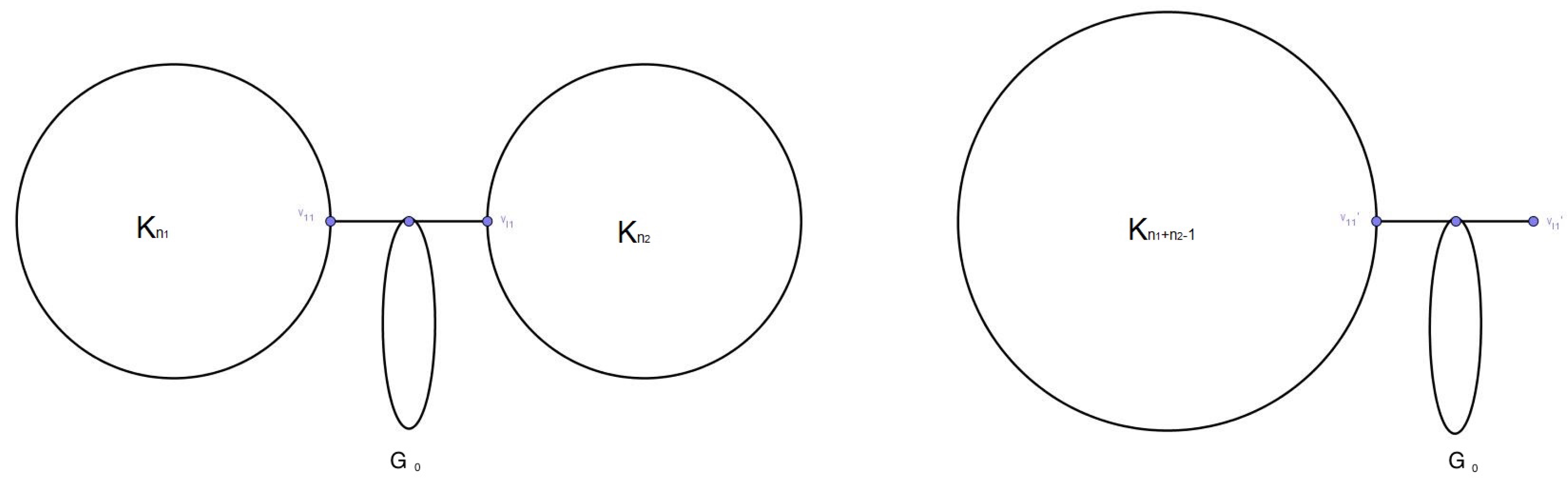
Let and be two farthest endblocks of such that and (see Figure 6). If and , then
Figure 6.
G and .
Proof of Claim 2.
Let and . Denote by and . From concepts of multiplicative Zagreb indices, one may obtain that
Let . Then we take a derivative of as , by .
Set . Note that and , by L’ Hospital’s Rule. Thus, , that is, the function is decreasing. We have
Since and , then This completes the proof of Claim 2. ☐
Claim 3.
If is maximal, then there exists exactly one path in G.
Proof of Claim 3.
We prove it by contradictions. Assume that there are at least two paths with . We consider three cases that is either a pendent path or an internal path with . ☐
Case 1.
Proof of Case 1.
By Lemma 7, there is another graph such that , which is a contradiction to the choice of G. ☐
Case 2.
Proof of Case 2.
Let . Note that
Since , by Proposition 1, we have , that is a contradiction to the choice of G. ☐
Case 3.
Proof of Case 3.
By Case 2, there does not exist any pendent paths in G. Then every cut edge is in an internal path. By choosing two farthest endblocks and Claim 2, there is another graph such that , which contradicts that is maximal. This completes the proof of Case 3. ☐
Therefore, G contains a unique clique of size at least 3 and the unique path is a pendent path. Thus , and this completes the proof. ☐
Theorem 4.
Let G be a graph in with . Then
where the equality holds if and only .
Proof.
Pick a graph such that is as large as possible. Denote by a cut edge set of G and be the components of . By Lemma 2, we have is a clique of size at least 3 or an isolated vertex. By Lemma 4, if two blocks are connected by a path, then they share a common vertex.
Claim 4.
There is a unique block B such that .
Proof of Claim 4.
We prove it by a contradiction. Assume that there are at least two blocks sharing a common vertex in G such that . Choose and and . Let . By Lemma 1, and this claim is proved. ☐
By Lemmas 5 and 6, we have , and this completes the proof. ☐.
Author Contributions
All authors contributed equally to this work. Investigation: C.W. and Z.S.; Methodology: S.W. and J.-B.L.; Validation: L.C.
Funding
The work was partially supported by the National Natural Science Foundation of China under Grants 11771172 and 11571134, and Anhui Province Key Laboratory of Intelligent Building & Building Energy Saving.
Acknowledgments
The authors would like to express their sincere gratitude to the anonymous referees and the editor for many friendly and helpful suggestions, which led to great deal of improvement of the original manuscript.
Conflicts of Interest
The authors declare no conflict of interest.
References
- Klavžar, S.; Gutman, I. The Szeged and the Wiener index of graphs. Appl. Math. Lett. 1996, 9, 45–49. [Google Scholar] [CrossRef]
- Gutman, I.; Trinajstić, N. Graph theory and molecular orbitals. Total π-electron energy of alternant hydrocarbons. Chem. Phys. Lett. 1972, 17, 535–538. [Google Scholar] [CrossRef]
- Gutman, I. On the origin of two degree-based topological indices. Bull. Acad. Serbe Sci. Arts 2014, 146, 39–52. [Google Scholar]
- Todeschini, R.; Ballabio, D.; Consonni, V. Novel molecular descriptors based on functions of new vertex degrees. In Novel Molecular Structure Descriptors Theory and Applications I; Gutman, I., Furtula, B., Eds.; University Kragujevac: Kragujevac, Serbia, 2010; pp. 72–100. [Google Scholar]
- Todeschini, R.; Consonni, V. New local vertex invariants and molecular descriptors based on functions of the vertex degrees. MATCH Commun. Math. Comput. Chem. 2010, 64, 359–372. [Google Scholar]
- Wang, S.; Wei, B. Multiplicative Zagreb indices of k-trees. Discret. Appl. Math. 2015, 180, 168–175. [Google Scholar] [CrossRef]
- Wang, C.; Liu, J.; Wang, S. Sharp upper bounds for multiplicative Zagreb indices of bipartite graphs with given diameter. Discret. Appl. Math. 2017, 227, 156–165. [Google Scholar] [CrossRef]
- Basak, S.C.; Grunwald, G.D.; Niemi, G.J. Use of graph-theoretic geometric molecular descriptors in structure-activity relationships. In From Chemical Topology to Three-Dimensional Geometry; Balaban, A.T., Ed.; Plenum Press: New York, NY, USA, 1997; pp. 73–116. [Google Scholar]
- Hu, Y.; Li, X.; Shi, Y.; Xu, T.; Gutman, I. On molecular graphs with smallest and greatest zeroth order general randić index. MATCH Commun. Math. Comput. Chem. 2005, 54, 425–434. [Google Scholar]
- Li, X.; Shi, Y. A survey on the randić index. MATCH Commun. Math. Comput. Chem. 2008, 59, 127–156. [Google Scholar]
- Shi, Y. Note on two generalizations of the randić index. Appl. Math. Comput. 2015, 265, 1019–1025. [Google Scholar] [CrossRef]
- Furtula, B.; Gutman, I.; Ediz, S. On difference of Zagreb indices. Discret. Appl. Math. 2014, 178, 83–88. [Google Scholar] [CrossRef]
- Hosamani, S.M.; Gutman, I. Zagreb indices of transformation graphs and total transformation graphs. Appl. Math. Comput. 2014, 247, 1156–1160. [Google Scholar] [CrossRef]
- Xu, K.; Das, K.C.; Balachandran, S. Maximizing the Zagreb indices of (n, m)-graphs. MATCH Commun. Math. Comput. Chem. 2014, 72, 641–654. [Google Scholar]
- Wang, J.F.; Belardo, F. A lower bound for the first Zagreb index and its application. MATCH Commun. Math. Comput. Chem. 2015, 74, 35–56. [Google Scholar]
- Gao, W.; Farahani, M.; Husin, M.; Wang, S. On the edge-version atom-bond connectivity and geometric arithmetic indices of certain graph operations. Appl. Math. Comput. 2017, 308, 11–17. [Google Scholar] [CrossRef]
- Liu, J.; Pan, X.; Hu, F.; Hu, F. Asymptotic Laplacian-energy-like invariant of lattices. Appl. Math. Comput. 2015, 253, 205–214. [Google Scholar] [CrossRef]
- Ji, S.; Wang, S. On the sharp lower bounds of Zagreb indices of graphs with given number of cut vertices. J. Math. Anal. Appl. 2018, 458, 21–29. [Google Scholar] [CrossRef]
- Matejić, M.; Milovanović, I.; Milovanović, E. On Bounds for Harmonic Topological Index. Filomat 2018, 32, 311–317. [Google Scholar] [CrossRef]
- Upadhyay, A.K.; Maity, D. On the enumeration of a class of toroidal graphs. Contrib. Discret. Math. 2018, 13, 79–119. [Google Scholar]
- Zhang, X. Equitable vertex arboricity of planar graphs. Taiwan J. Math. 2015, 19, 123–131. [Google Scholar] [CrossRef]
- Tan, L.; Zhu, Z. The extremal graphs with respect to Hosoya index and Merrifield-Simmons index. MATCH Commun. Math. Comput. Chem. 2010, 63, 789–798. [Google Scholar]
- Chen, G.; Zhu, Z. The number of independent sets in unicyclic graph with given size of maximum matchings. Discret. Appl. Math. 2012, 160, 108–115. [Google Scholar] [CrossRef]
- Borovićanin, B.; Furtula, B. On extremal Zagreb indices of trees with given domination number. Appl. Math. Comput. 2016, 279, 208–218. [Google Scholar] [CrossRef]
- Liu, J.; Zhang, Q. Sharp upper bounds for multiplicative Zagreb indices. MATCH Commun. Math. Comput. Chem. 2012, 68, 231–240. [Google Scholar]
- Xu, K.; Hua, H. A unified approach to extremal multiplicative Zagreb indices for trees, unicyclic and bicyclic graphs. MATCH Commun. Math. Comput. Chem. 2012, 68, 241–256. [Google Scholar]
- Iranmanesh, A.; Hosseinzadeh, M.A.; Gutman, I. On multiplicative Zagreb indices of graphs. Iran. J. Math. Chem. 2012, 3, 145–154. [Google Scholar]
- Kazemi, R. Note on the multiplicative Zagreb indices. Discret. Appl. Math. 2016, 198, 147–154. [Google Scholar] [CrossRef]
- Liu, H.; Lu, M.; Tian, F. On the spectral radius of graphs with cut edges. Linear Algebra Appl. 2004, 389, 139–145. [Google Scholar] [CrossRef]
- Wu, Y.R.; He, S.; Shu, J.L. Largest spectral radius among graphs with cut edges. J. East China Norm. Univ. Nat. Sci. Ed. 2007, 3, 67–74. [Google Scholar]
- Zhao, Q.; Li, S.C. On the maximum Zagreb indices of graphs with k cut edges. Acta Appl. Math. 2010, 111, 93–106. [Google Scholar] [CrossRef]
- Deng, H. On the minimum Kirchhoff index of graphs with a given cut edges. MATCH Commun. Math. Comput. Chem. 2010, 63, 171–180. [Google Scholar]
- Borovićanin, B.; Lampert, T.A. On the maximum and minimum Zagreb indices of trees with a given number of vertices of maximum degree. MATCH Commun. Math. Comput. Chem. 2015, 74, 81–96. [Google Scholar]
- Wang, S.; Wang, C.; Liu, J. On extremal multiplicative Zagreb indices of trees with given domination number. Appl. Math. Comput. 2018, 332, 338–350. [Google Scholar] [CrossRef]
- Wang, S.; Wang, C.; Chen, L.; Liu, J. On extremal multiplicative Zagreb indices of trees with given number of vertices of maximum degree. Discret. Appl. Math. 2017, 227, 166–173. [Google Scholar] [CrossRef]
- Bollobás, B. Modern Graph Theory; Springer: Berlin, Germany, 1998. [Google Scholar]
- Trinajstić, N. Chemical Graph Theory; CRC Press: Boca Raton, FL, USA, 1992. [Google Scholar]
© 2018 by the authors. Licensee MDPI, Basel, Switzerland. This article is an open access article distributed under the terms and conditions of the Creative Commons Attribution (CC BY) license (http://creativecommons.org/licenses/by/4.0/).