Article

Acting Fibrations and Lifting Functions in the Homotopy Theory of Single Intersection Graphs over Topological Semigroups

by
Fozaiyah Alhubairah
1,
Adem Kiliçman
2,*,
Maryam F. Alshammari
1 and
Altaf Alshuhail
1
1
Department of Mathematics, Faculty of Sciences, Ha’il University, Ha’il 2440, Saudi Arabia
2
Faculty of Computer and Mathematical Sciences, Universiti Teknologi MARA, Shah Alam 40450, Selangor, Malaysia
*
Author to whom correspondence should be addressed.
Mathematics 2026, 14(9), 1557; https://doi.org/10.3390/math14091557
Submission received: 2 March 2026 / Revised: 18 April 2026 / Accepted: 27 April 2026 / Published: 4 May 2026

Abstract

In this paper, we study the homotopy theory of single intersection graphs arising from acting spaces over topological semigroups. An acting space ( S , B ) is defined as a topological space B equipped with a continuous action of a topological semigroup S , generalizing the notion of algebraic actions in a topological setting. To connect this structure with graph theory, we associate to each acting space a single intersection graph G S B , whose vertices are proper S B -subacting spaces, and two vertices are adjacent if their intersection is a singleton set. This graph construction encodes both algebraic and topological interactions between subacting spaces and provides a framework to study connectivity and homotopical properties via combinatorial methods. We then work within a categorical framework, where objects are graphical acting semigroups and morphisms are S -acting maps, allowing us to systematically study structural properties and their invariance under morphisms. In this setting, we introduce the notion of acting fibrations and formulate the corresponding lifting problem. Our main result establishes that an S -acting map is an acting fibration if and only if it admits an A -lifting function, providing a characterization analogous to classical fibration theory. Furthermore, we introduce A -regular lifting functions and analyze their role in preserving homotopical structures, including a natural homotopy extension property.

1. Introduction

Graph theory is an important subject of mathematics that connects algebra and topology which helps us study mathematical structures by using vertices and edges. This provides a framework for analyzing the structure. Graph theory is widely used to represent algebraic structures such as groups, rings, and modules, where vertices correspond to elements or substructures and edges describe their relations. It also provides useful tools for studying topological properties such as connectedness. Thus, graph theory serves as a natural link between algebra and topology. Damag et al. [1] introduced monophonic sets in rough directed topological spaces to study connectivity in directed networks. The homotopy theory is one important area in mathematics and its connection with graph theory and algebra and discrete structures has been developed in several recent works, such as Lupton et al. [2], who introduced the concept of the second homotopy group for digital images, which helps to understand higher level structure and connectivity in discrete topological structures. Yamagata [3] studied mapping fiber graphs and loop graphs in discrete homotopy theory. Kapulkin and Mavinkurve [4] introduced and studied the fundamental group in discrete homotopy theory. Their work shows how algebraic tools can be used to study discrete structures and their properties. Celis-Rojas [5] studied finite groups as homotopy self equivalences of finite spaces. This work explains how algebraic groups can describe symmetry and structure in topological spaces. Baues [6] introduced and studied algebraic homotopy classes, which help classify mathematical objects based on their homotopy properties using algebraic methods. These works show the strong connection between graph theory, algebra, and topology, and provide important tools for studying discrete and algebraic structures. Damag et al. [7] introduced monophonic sets in rough directed topological spaces to study connectivity in directed networks and developed m-negative sets and out-monodirected topologies with applications to the human nervous system. Graphs that come from algebraic structures show a strong connection between algebra and combinatorics. In these graphs, algebraic substructures are represented as vertices and the relation between them is shown by edges. One of the most common types is the intersection graph. These graphs have been used successfully to study algebraic properties such as chain conditions, simplicity, and decomposition by using graph properties like connectivity, diameter, and clique number. Many articles regarding the theory of intersection graphs were presented; for example, Csakany and Pollak [8] defined the subgroup intersection graph of a finite group by considering the proper nontrivial subgroups of a group as its vertices and two distinct vertices are adjacent if the corresponding subgroups have a nontrivial intersection. This idea was later refined in the context of finite abelian groups by Zelinka [9], studying the influence of the abelian structure on the resulting intersection graph. The idea was generalized later on for non-groups. Chakrabarty et al. [10] defined the intersection graph of ideals of a ring by taking vertices as proper ideals, where two vertices are adjacent if their intersection is nonzero. Hence, the method of intersection graphs is employed to study rings. The subgroup intersection graphs of general finite groups were further studied by Shen [11], who considered several graph-theoretic invariants such as diameter and girth. Akbari et al. [12] pursued this direction by analyzing structural features such as connectivity and completeness of intersection graphs. Connectivity was a main topic in these studies. Zhao et al. [13] gave necessary and sufficient conditions for the connectivity of the intersection graph of subgroups, and Kayacan [14] strengthened and generalized these results to some special classes of finite groups. Later, additional results were derived by Aprose and Fathima [15], which give more information on graph invariants related to subgroup intersection graphs. Our results build on recent work on clique parameters. Beheshtipour et al. [16] were the first to undertake a methodical study of the clique numbers of subgroup intersection graphs of some cyclic groups, which was generalized to finite groups in the work of Liu [17]. Beheshtipour and Jafarian [18] strengthened the above mentioned results by providing the clique numbers for even larger classes of finite groups. The coverage of intersection graph was generalized to module theory in [19] by Ahmed and Mohd by defining a new kind of intersection graph on modules, resulting in a new line of investigation in algebraic graph theory. Ramanathan [20] introduced the concept of the projective intersection graph of ideals of a commutative ring. At the same time, more extensive work was done on intersection graphs of ideals of commutative rings. Mohd and Ahmed [21] established the concept of simple intersection graphs of rings, where edges are determined by the minimal intersection conditions, thus enhancing the classical intersection graph model. In this direction, chain conditions in semigroup-like structures were studied by Davvaz and Nazemian [22], on commutative monoids, and by Khosravi and Roueentan [23] on chain conditions for Rees congruences of S -acts. Intersection graph theory was extended explicitly to S -acts by Rasouli and Tehranian [24], under the name of intersection graphs of S -acts, and also by Delfan et al. [25], in which they generalized intersection graphs related to semigroup acts.
Intersection graphs connect algebra and graph theory, but their connection with homotopy theory over topological semigroups remains limited. Although homotopy and fibration theory study deformation and lifting properties of maps, a unified framework combining single intersection graphs with semigroup actions and fibrations is still lacking. Motivated by this gap we study the homotopy theory of single intersection graphs arising from acting spaces over topological semigroups. Our aim is to develop a clear framework that links intersection graphs with acting fibrations and lifting functions.
The main contributions of this paper are summarized as follows:
  • We introduce graphical acting semigroups associated with single intersection graphs.
  • We develop the notion of graphical acting homotopy and study its basic properties.
  • We define acting fibrations in this framework and formulate the corresponding lifting problem.
  • We prove that an S -acting map is an acting fibration if and only if it admits an A -lifting function.
  • We introduce A -regular lifting functions and analyze their role in homotopy extension properties.
The paper is organized as follows. In Section 2, we recall the necessary preliminaries. In Section 3, we introduce single intersection graphs and graphical acting semigroups. Section 4 develops the notion of graphical acting homotopy and related properties. In Section 5, we study acting fibrations and solve the lifting problem. Finally, Section 6 is devoted to regular lifting functions and their homotopical consequences.

2. Preliminaries

Let G be an undirected graph whose vertex set is denoted by V ( G ) and whose edge set is denoted by E ( G ) . A loop in a graph is an edge that connects a vertex to itself. A simple graph is a graph that contains neither loops nor multiple edges. A path is a finite sequence of distinct vertices where each pair of consecutive vertices are neighbors. An edge of a path P joining two non-adjoint vertices of P is a chord. A monophonic path is a chordless path with a length of at least 2. A graph G is connected if for all pairs of vertices, there is a path connecting them.
For more details about the definitions and facts concerning the topological spaces, see [26]. We say a topological space S has locally compact property if for every point in S , there is an open set U containing it such that the closure U ¯ of U is compact. A topological space S has regular property if for every closed set G S and for every x G there are open sets H and F such that x H , G F and H F = . A topological space S has normal property if for every pair of closed sets A , B with A B = , there are open sets F and H such that A F , B H and F H = . Let S 1 and S 2 be any topological spaces and C ( S 1 , S 2 ) denotes the family of all continuous maps from S 1 to S 2 . The compact-open topology on C ( S 1 , S 2 ) is the topology generated by the following subbasis
{ A , B : A is   compact   set   in   S 1 , B is   open   set   in   S 2 }
where A , B = { g C ( S 1 , S 2 ) : g ( A ) B } . In this work, for any two spaces S 1 and S 2 , we consider the space C ( S 1 , S 2 ) equipped with the compact-open topology. A topological space S is defined as a contractible space if the identity map on id S is homotopic to a constant map. A topological space S is defined as pathwise connected if for every two points x , y in S there exists a path (continuous function) λ : I S such that λ ( 0 ) = x and λ ( 1 ) = y , where I = [ 0 , 1 ] is a closed interval in the usual topological space R . A continuous map f : S S is called a fibration [27], if for every topological space S , every continuous map g : S S , and every continuous map ψ : S × I S such that ψ ( x , 0 ) = f ( g ( x ) ) for all x S , there exists continuous map ϕ : S × I S such that ϕ ( x , 0 ) = g ( x ) and f ( ϕ ( x , t ) ) = ψ ( x , t ) for all x S and all t I .
Lemma 1
([26]). Let S 1 be a regular and locally compact space. Let S 2 be any space. Then the function ϕ : C ( S 1 , S 2 ) × S 1 S 2 given by ϕ ( g , a ) = g ( a ) is continuous for all g C ( S 1 , S 2 ) and a S 1 .
Lemma 2
([26]). Let S 1 , S 2 and S 3 be topological spaces. If the function ψ : S 1 × S 2 S 3 is continuous then the function ϕ : S 1 C ( S 2 , S 3 ) defined by ϕ ( a ) ( b ) = ψ ( a , b ) is continuous for all a S 1 , b S 2 .
Theorem 1
([28]). Let S 1 , S 2 and S 3 be topological spaces. Let S 2 be locally compact and regular space. If the function ϕ : S 1 C ( S 2 , S 3 ) is continuous then the function ψ : S 1 × S 2 S 3 defined by ψ ( a , b ) = ϕ ( a ) ( b ) for all a S 1 , b S 2 .
Let S be any semigroup. The set of all idempotent points in S is denoted by E ( S ) , i.e., E ( S ) = { x S : x x = x } . Recall [29], a nonempty set B is called an S -act if there is a function, called action, S × B B : ( x , b ) x b such that ( x y ) b = x ( y b ) for all x , y S , b B . This action will satisfy e b = b for every b B if S is a semigroup with the identity e. Note that the notion of an S -act is closely related to the classical concept of a group action on a set. In both cases, there is an action satisfying a compatibility condition. However, an S -act generalizes group actions by allowing S to be a semigroup, where the existence of identity elements and inverses is not required.
A point b 0 B is called fixed acting point in S -act B if x b 0 = b 0 for all x S and F i x ( B ) denote to the set of all fixed acting points in B . A nonempty subset C B is called an S -subact of B if s c C for all s S and c C . Recall [30], a topological semigroup S is a semigroup endowed with a topology such that the multiplication S × S S is continuous function. For any topological semigroup S , S p denote to the set of all paths I S , that is, S p : = C ( I , S ) . For any topological space B , we denote by B p = C ( I , B ) the set of all continuous maps from I = [ 0 , 1 ] into B , equipped with the compact-open topology.

3. The Single Intersection Graph

Let S be any topological semigroup and B be any topological space. A pair ( S , B ) is called an acting space if B is an S -act under continuous action of S on B . If B is topological semigroup then an acting space ( S , B ) is called an acting semigroup. A nonempty subset C B is called an SB -subacting space if C is closed under continuous action of S on B endowed with the subspace topology.
Definition 1.
Let ( S , B ) be any acting space. The single intersection graph G S B of acting space ( S , B ) is defined as a simple undirected graph with all proper SB -subacting spaces as vertices. Two distinct vertices in G S B are joined if their intersection is a singleton set.
Example 1.
Let S be any topological semigroup and B be any topological space. Define the action S × B B : ( x , b ) b as the first projection. This action is continuous since for every open set U in B , the inverse image is S × U which is open set in S × B . That is, ( S , B ) is an acting space and every nonempty subset of B is an SB -subacting space. Hence
V ( G S B ) = P ( B ) { , B } ,
where P ( B ) is the power set of B , and
E ( G S B ) = { D C : D , C V ( G S B ) , D C , a n d D C i s   a   s i n g l e t o n   s e t } .
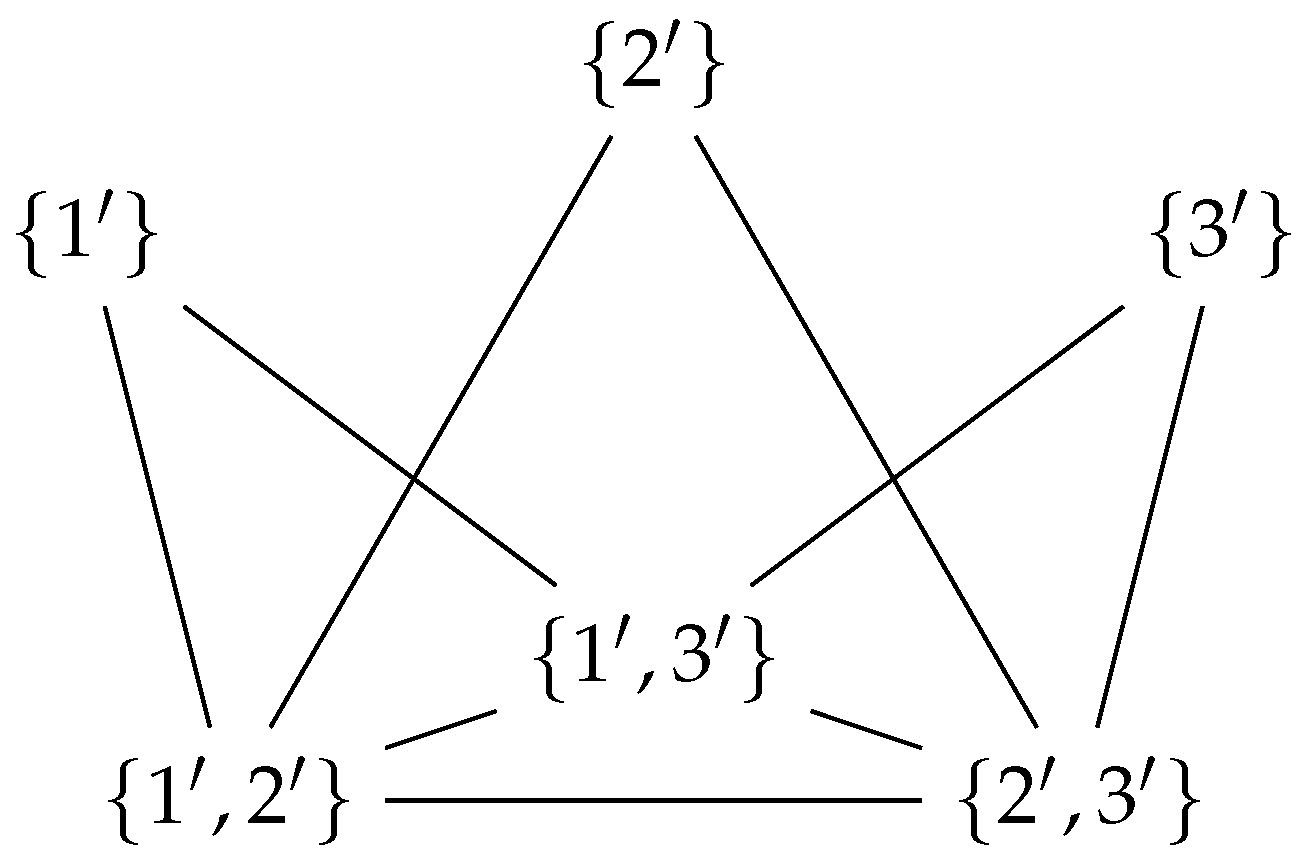
If we take B = { 1 , 2 , 3 } then V ( G S B ) , in Figure 1, is given by
V ( G S B ) = { { 1 } , { 2 } , { 3 } , { 1 , 2 } , { 1 , 3 } , { 2 , 3 } } .
Let C and D be two SB -subacting spaces in acting space ( S , B ) (i.e., C , D V ( G S B ) ). Then C is called monophonic SB -subacting space of D if there is a monophonic path between them in the single intersection graph G S B . For C V ( G S B ) , N ( C ) denote the union of all monophonic SB -subacting spaces of C . An acting space ( S , B ) is called a graphical acting space if the collection Δ S B = { B , N ( C ) : C V ( G S B ) } forms a subbasis for a topological space B .
Example 2.
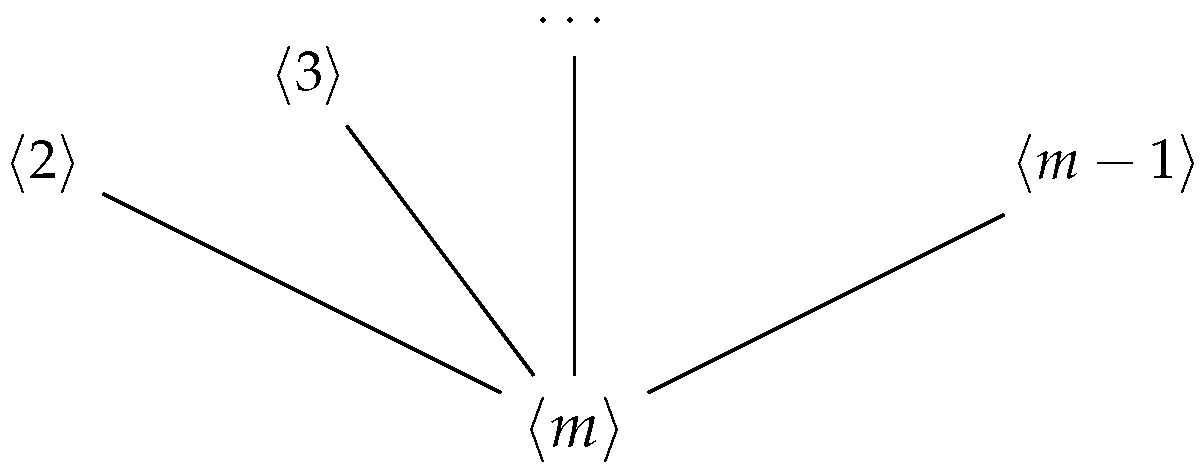
Let S = { 1 , 2 , , m } be topological semigroup with discrete topology and the operation S × B B : ( k , n ) max { k , n } . Note that S is an S -act over itself and the action k n = max { k , n } is continuous since S is discrete topological space. That is, ( S , S ) is an acting space with proper SS -subacting spaces n = { n , n + 1 , , m } for all n = 2 , 3 , , m . That is, V ( G S B ) , in Figure 2, is given by
V ( G S S ) = n : n = 2 , 3 , , m .
Note that N ( m ) = and
N ( k ) = j : j { 2 , 3 , , j 1 , j + 1 , , m 1 }
for all k = 2 , 3 , , m 1 . Hence the collection Δ S S induces discrete topology, that is, ( S , S ) is a graphical acting space.
In Example 1 for the case B = { 1 , 2 , 3 } , if B is discrete topological space then ( S , B ) is a graphical acting space, since we have
N ( { 1 } ) = { 2 } { 3 } { 2 , 3 } = { 2 , 3 } , N ( { 2 } ) = { 1 } { 3 } { 1 , 3 } = { 1 , 3 } ,
N ( { 3 } ) = { 1 } { 2 } { 1 , 2 } = { 1 , 2 } , N ( { 1 , 2 } ) = { 3 } , N ( { 1 , 3 } ) = { 2 } ,
N ( { 2 , 3 } ) = { 1 } .
In the following lemma S p is a semigroup under the binary operation λ μ for all λ , μ S p = C ( I , S ) , where
( λ μ ) ( t ) = λ ( t ) μ ( t ) , t I .
Lemma 3.
Let S be any topological semigroup. Then S p is a topological semigroup under the compact-open topology and the operation ( λ μ ) ( t ) = λ ( t ) μ ( t ) for all λ , μ S p and t I .
Proof. 
It is easy to see that S p is a semigroup with the operation ( λ μ ) ( t ) = λ ( t ) μ ( t ) for all λ , μ S p and t I . Denote the continuous operation on S by h : S × S S and the operation on S p by ϕ : S p × S p S p . Hence ϕ ( λ , μ ) ( t ) = h ( λ ( t ) , μ ( t ) ) for all λ , μ S p and t I . Define a function ψ : S p × S p × I S by ψ ( λ , μ , t ) = h ( λ ( t ) , μ ( t ) ) for all λ , μ S p and t I . Since I is locally compact and regular, the evaluation map E : S p × I S , E ( λ , t ) = λ ( t ) is continuous by Lemma 1. Hence the maps ( λ , μ , t ) λ ( t ) and ( λ , μ , t ) μ ( t ) are continuous. Since h is continuous, it follows that ψ ( λ , μ , t ) = h ( λ ( t ) , μ ( t ) ) is continuous. Then we have ϕ ( λ , μ ) ( t ) = ψ ( λ , μ , t ) for all λ , μ S p and t I . Hence by Lemma 2, the map ϕ : S p × S p S p is continuous. That is, S p is a topological semigroup. □
Theorem 2.
For any acting space ( S , B ) , ( S p , B ) is an acting space.
Proof. 
Since ( S , B ) is an acting space, then S is a topological semigroup. Then by Lemma 3 above, S p is a topological semigroup. Denote the continuous action by h : S × B B . Then we have h ( x y , b ) = x h ( y , b ) for all x , y S , b B . Define a function ϕ : S p × B B by ϕ ( λ , b ) = h ( λ ( 0 ) , b ) for all λ S p and b B . Now we will prove that the function E 0 : S p S : λ λ ( 0 ) is continuous. Let λ S p be any point and U be any open set in S containing λ ( 0 ) . Since { 0 } is compact set then
E 0 1 ( U ) = { μ S p : μ ( 0 ) U } = { μ S p : μ ( { 0 } ) U } = { 0 } , U
is open set in compact-open topological space S p . That is, E 0 is continuous. Since h is continuous then ϕ = h ( E 0 × i d B ) is continuous, where i d B is the identity function on B . For the condition of action, note that for all λ , μ S p and b B , we have
ϕ ( λ μ , b ) = h [ ( λ μ ) ( 0 ) , b ] = h ( λ ( 0 ) μ ( 0 ) , b ) = h [ λ ( 0 ) , h ( μ ( 0 ) , b ) ]
= h [ λ ( 0 ) , ϕ ( μ , b ) ] = ϕ [ λ , ϕ ( μ , b ) ] .
Hence ϕ is action function. Therefore ( S p , B ) is an acting space. □
Corollary 1.
For any graphical acting space ( S , B ) , ( S p , B ) is a graphical acting space.
Proof. 
This follows immediately from Theorem 2. □
Theorem 3.
For any acting space ( S , B ) , ( S , B p ) is an acting space.
Proof. 
Denote to the continuous action in acting space ( S , B ) by h : S × B B . Define a function ϕ : S × B p B p by ϕ ( x , λ ) ( t ) = h ( x , λ ( t ) ) for all λ B p , x S , and t I . For proving the continuity of ϕ , define a function ψ : S × B p × I B by ψ ( x , λ , t ) = h ( x , λ ( t ) ) for all λ B p , x S , and t I . Since h is continuous and I is a regular and locally compact space, then by Lemma 1 ψ is continuous. Note that ϕ ( x , λ ) ( t ) = ψ ( x , λ , t ) for all λ B p , x S , and t I . Then by Lemma 2, ϕ is continuous. For the action condition, note that for all λ B p , x , y S , t I , we have
ϕ ( x y , λ ) ( t ) = h ( x y , λ ( t ) ) = h [ x , h ( y , λ ( t ) ) ] = h [ x , ϕ ( y , λ ) ( t ) ]
= ϕ [ x , ϕ ( y , λ ) ] ( t ) .
That is, ϕ ( x y , λ ) = ϕ [ x , ϕ ( y , λ ) ] for all λ B p , x , y S . Hence ϕ is action function. Therefore ( S , B p ) is an acting space. □
Corollary 2.
For any acting space ( S , B ) , ( S p , B p ) is an acting space.
Proof. 
Since ( S , B ) is an acting space, then by Theorem 3, ( S , B p ) is an acting space. By Theorem 2, ( S p , B p ) is an acting space. □

4. Graphical Acting Homotopy

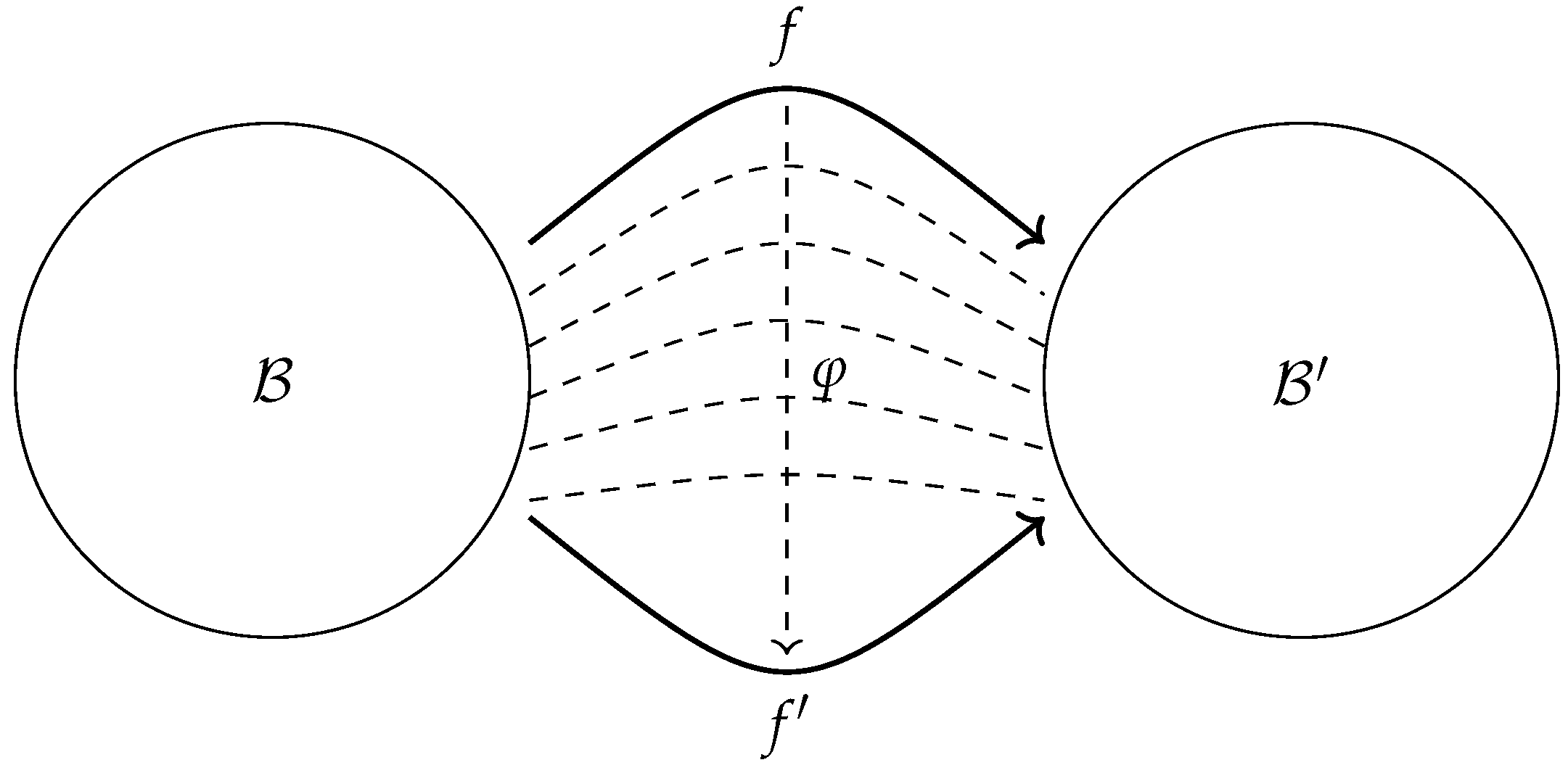
In this section, we introduce the concept of graphical acting homotopy which helps us study continuous deformation between S -acting maps. We define graphical homotopy, graphical acting homotopy, and related properties such as contractibility and connectedness. Let ( S , B ) and ( S , B ) be two graphical acting semigroups. A function f : B B is called an S -homomorphism if it is continuous and f ( b b ) = f ( b ) f ( b ) for all b , b B . An S -homomorphism f : B B is called an S -acting map if f ( x b ) = x f ( b ) for all x S and b B . Let f , f : B B be two S -acting maps in Figure 3. The S -acting map f is called graphically homotopic to f , write f f , if there is an S -homomorphism, called graphical homotopy, ϕ : B B p such that ϕ ( b ) ( 0 ) = f ( b ) and ϕ ( b ) ( 1 ) = f ( b ) for all b B . If for all x S , b B , t I , this graphical homotopy satisfies ϕ ( x b ) ( t ) = x ϕ ( b ) ( t ) then ϕ is called graphical acting homotopy and we say that f is graphical acting homotopic to f , write f a c f .
The graphical homotopy relation ≈ is an equivalence relation in the category of topological semigroups, see [30].
Theorem 4.
The graphical acting homotopy relation a c is an equivalence relation in the collection of S -acting maps under topological semigroup S .
Proof. 
Let ( S , B ) and ( S , B ) be graphical acting semigroups. Let a function f , f , f : B B be S -acting maps.
Reflexivity: Define ϕ : B B p by ϕ ( b ) ( t ) = f ( b ) for all b B and t I . Since f is a homomorphism continuous then ϕ is a homomorphism continuous. Note that ϕ ( b ) ( 0 ) = ϕ ( b ) ( 1 ) = f ( b ) and
ϕ ( x b ) ( t ) = f ( x b ) = x f ( b ) = x ϕ ( b ) ( t )
for all x S , b B and t I . That is, f a c f .
Symmetry: Let f a c f by a graphical acting homotopy ϕ : B B p . Define a graphical acting homotopy ψ : B B p by ψ ( b ) ( t ) = ϕ ( b ) ( 1 t ) for all b B and t I . Since ϕ is a homomorphism continuous then ψ is a homomorphism continuous. Note that ψ ( b ) ( 0 ) = ϕ ( b ) ( 1 ) = f ( b ) , ψ ( b ) ( 1 ) = ϕ ( b ) ( 0 ) = f ( b ) and
ψ ( x b ) ( t ) = ϕ ( x b ) ( 1 t ) = x ϕ ( b ) ( 1 t ) = x ψ ( b ) ( t )
for all x S , b B and t I . That is, f a c f .
Transitivity: Let f a c f and f a c f by graphical acting homotopies ϕ : B B p and ψ : B B p , respectively. Define a graphical acting homotopy ξ : B B p by
ξ ( b ) ( t ) = ϕ ( b ) ( 2 t ) , for 0 t < 1 2 , ψ ( b ) ( 2 t 1 ) , for 1 2 t 1
for all b B and t I . Since ϕ and ψ are homomorphism continuous maps then ξ is a homomorphism continuous. Note that ξ ( b ) ( 0 ) = ϕ ( b ) ( 0 ) = f ( b ) , ξ ( b ) ( 1 ) = ψ ( b ) ( 1 ) = f ( b ) and
ξ ( x b ) ( t ) = ϕ ( x b ) ( 2 t ) , for 0 t < 1 2 , ψ ( x b ) ( 2 t 1 ) , for 1 2 t 1 = x ϕ ( b ) ( 2 t ) , for 0 t < 1 2 , x ψ ( b ) ( 2 t 1 ) , for 1 2 t 1 = x ϕ ( b ) ( 2 t ) , for 0 t < 1 2 , ψ ( b ) ( 2 t 1 ) , for 1 2 t 1 = x ξ ( b ) ( t )
for all x S , b B and t I . That is, f a c f . □
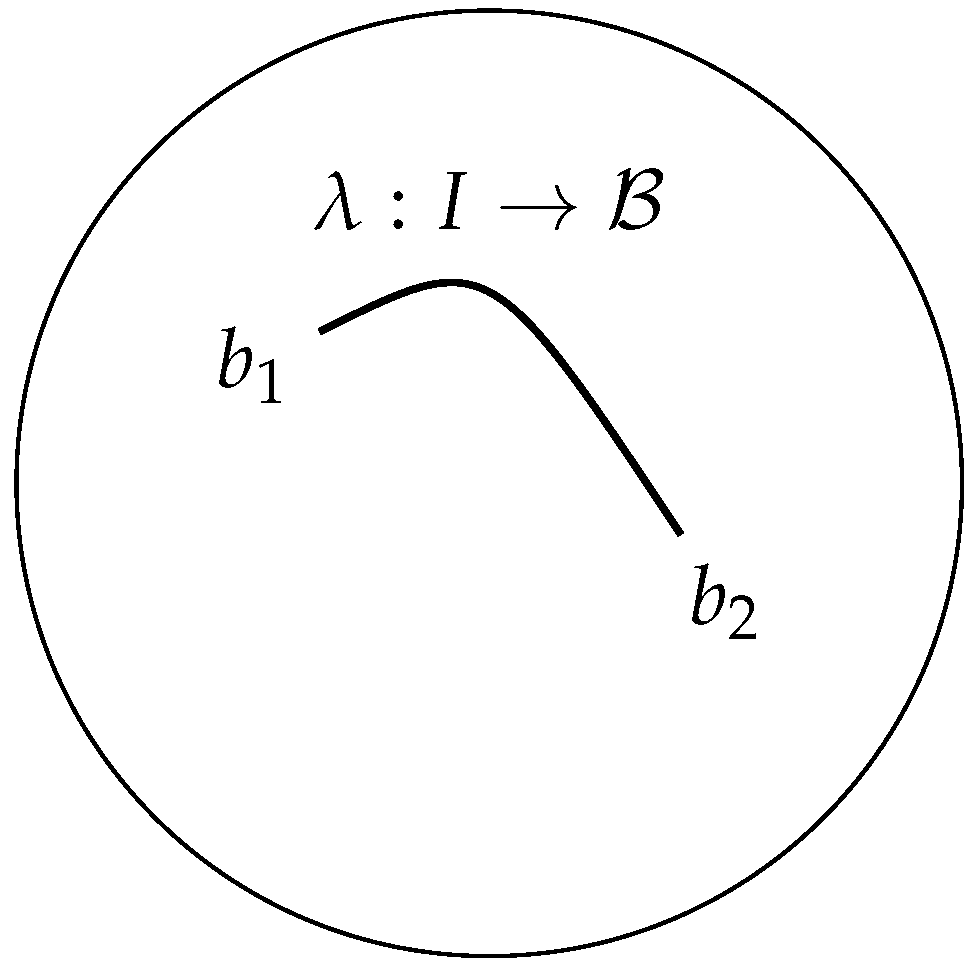
An graphical acting semigroup ( S , B ) in Figure 4 is called pathwise acting connected if for each b 1 , b 2 B , there is a graphical acting semigroup ( S , B ) with E ( B ) and graphical homotopy ϕ : B B p such that ϕ ( b ) ( 0 ) = b 1 and ϕ ( b ) ( 1 ) = b 2 for all b B .
A graphical acting semigroup ( S , B ) is called acting contractible if there is b 0 F i x ( B ) E ( B ) such that the identity S -acting map i d B of B is graphical acting homotopic to a constant S -acting map C b 0 at point b 0 .
Theorem 5.
If a graphical acting semigroup ( S , B ) is pathwise acting connected then B is a pathwise connected space.
Proof. 
Let ( S , B ) be pathwise acting connected. Then for each b 1 , b 2 B , there is graphical acting semigroup ( S , B ) with E ( B ) and graphical homotopy ϕ : B B p such that ϕ ( b ) ( 0 ) = b 1 and ϕ ( b ) ( 1 ) = b 2 for all b B . Define a function λ : I B by λ ( t ) = ϕ ( b ) ( t ) for all t I . Note that
λ ( 0 ) = ϕ ( b ) ( 0 ) = b 1 a n d λ ( 1 ) = ϕ ( b ) ( 1 ) = b 2 .
Hence λ is a path connecting b 1 and b 2 . That is, B is a pathwise connected space. □
By the definition of pathwise acting connected, we observe that E ( B ) implies E ( B ) . So the converse of Theorem 5 is not true in general. For example, consider the semigroup B = ( 0 , ) with the usual topology and the semigroup operation defined by addition. Then B is a pathwise connected topological space, since for any b 1 , b 2 B the map λ : I B , λ ( t ) = ( 1 t ) b 1 + t b 2 is continuous, with λ ( 0 ) = b 1 and λ ( 1 ) = b 2 . However, B has no idempotent elements. Indeed if b B satisfies b + b = b , then b = 0 B . That is, E ( B ) = .
A graphical acting semigroup ( S , B ) is called trivial if B is endowed with the operation b b = b or b b = b on B and the action x b = b for all b , b B and x S . In this case, the collection Δ S S in a single intersection graph G S B induces a discrete topology on B ; that is, B will be a discrete topological space in any trivial graphical acting semigroup ( S , B ) .
Corollary 3.
A trivial graphical acting semigroup ( S , B ) is pathwise acting connected if and only if B is a pathwise connected space.
Proof. 
Let B be a pathwise connected space. Let b 1 , b 2 B be any two points in B . Then there is a path λ : I B such that λ ( 0 ) = b 1 and λ ( 1 ) = b 2 . In the trivial graphical acting semigroup ( S , B ) , we have E ( B ) = B . So take B = B and define a graphical homotopy ϕ : B B p by ϕ ( b ) ( t ) = λ ( t ) . Then
ϕ ( b ) ( 0 ) = λ ( 0 ) = b 1 and ϕ ( b ) ( 1 ) = λ ( 1 ) = b 2
for all b B . That is, ( S , B ) is pathwise acting connected.
The converse holds directly by Theorem 5. □
Theorem 6.
If a graphical acting semigroup ( S , B ) is an acting contractible then B is a contractible space.
Proof. 
Let ( S , B ) be an acting contractible. Then there is b 0 F i x ( B ) E ( B ) such that the identity S -acting map i d B of B is graphical acting homotopic to a constant S -acting map C b 0 by graphical acting homotopy ψ : B B p where ψ ( b ) ( 0 ) = b and ψ ( b ) ( 1 ) = b 0 for all b B . Define a function ϕ : B × I B by ϕ ( b , t ) = ψ ( b ) ( t ) for all b B and t I . By the continuity of ψ and since I is regular and locally compact, then by Theorem 1, ϕ is continuous. Since
ϕ ( b , 0 ) = ψ ( b ) ( 0 ) = b and ϕ ( b , 1 ) = ψ ( b ) ( 1 ) = b 0
for all b B then the identity i d B is homotopic to a constant C b 0 . That is, B is a contractible space. □
The converse of Theorem 6 is not true in general. For example, consider the semigroup B = ( 0 , 1 ) with the usual topology and the semigroup operation given by multiplication. Then B is a contractible space. But B has no idempotent elements. Indeed, if b ( 0 , 1 ) and b 2 = b , then b { 0 , 1 } , which is impossible. Hence E ( B ) = . That is, F i x ( B ) E ( B ) = .
Corollary 4.
A trivial graphical acting semigroup ( S , B ) is an acting contractible if and only if B is a contractible space.
Proof. 
Let B be a contractible space. Then the identity i d B is homotopic to a constant C b 0 by the homotopy ϕ : B × I B where ϕ ( b , 0 ) = b and ϕ ( b , 1 ) = b 0 for all b B and for some b 0 B . In the trivial graphical acting semigroup ( S , B ) , we have F i x ( B ) E ( B ) = B . So b 0 F i x ( B ) E ( B ) . Define a graphical acting homotopy ψ : B B p by ψ ( b ) ( t ) = ϕ ( b , t ) for all b B and t I . By the continuity of ϕ and Lemma 2, ψ is continuous. Since
ψ ( b ) ( 0 ) = ϕ ( b , 0 ) = b and ψ ( b ) ( 1 ) = ϕ ( b , 1 ) = b 0
for all b B then the identity i d B is graphical acting homotopic to a constant C b 0 . That is, B is an acting contractible.
The converse holds directly by Theorem 6. □
Theorem 7.
Let ( S , B ) be a graphical acting semigroup with F i x ( B ) E ( B ) . Then ( S , B ) is an acting contractible if and only if all S -acting maps of B into B are graphical acting homotopic.
Proof. 
Let ( S , B ) be an acting contractible. Then there is b 0 F i x ( B ) E ( B ) such that the identity S -acting map i d B of B is graphical acting homotopic to a constant S -acting map C b 0 by a graphical acting homotopy ϕ : B B p where ϕ ( b ) ( 0 ) = b and ϕ ( b ) ( 1 ) = b 0 for all b B . Let f : B B be any S -acting map. Define a graphical acting homotopy ψ : B B p by ψ = ϕ f . By the continuity and homomorphically properties of ϕ and f, we get also ψ has these properties. Note that
ψ ( b ) ( 0 ) = [ ( ϕ f ) ( b ) ] ( 0 ) = ϕ [ f ( b ) ] ( 0 ) = f ( b ) ,
ψ ( b ) ( 1 ) = [ ( ϕ f ) ( b ) ] ( 1 ) = ϕ [ f ( b ) ] ( 1 ) = b 0
and
ψ ( x b ) ( t ) = [ ( ϕ f ) ( x b ) ] ( t ) = ϕ [ f ( x b ) ] ( t ) = ϕ [ x f ( b ) ] ( t )
= x ϕ [ f ( b ) ] ( t ) = x ψ ( b ) ( t )
for all x S , b B and t I . That is, f a c C b 0 .
Conversely, since F i x ( B ) E ( B ) , then there is at least b 0 F i x ( B ) E ( B ) . Then C b 0 is an S -acting map of B into B . Since the identity i d B is an S -acting map of B into B , then by the hypothesis, we get that i d B a c C b 0 . That is, ( S , B ) is an acting contractible. □
Corollary 5.
If ( S , B ) is an acting contractible with F i x ( B ) E ( B ) = B , then ( S , B ) is pathwise acting connected.
Proof. 
Let b 1 , b 2 B be any two points in B . Then b 1 , b 2 F i x ( B ) E ( B ) . Hence the two constant functions C b 1 and C b 2 are S -acting maps of B into B . Since ( S , B ) is an acting contractible then by Theorem 7 above, C b 1 a c C b 2 . Hence there is a graphical acting homotopy ϕ : B B p such that ϕ ( b ) ( 0 ) = b 1 and ϕ ( b ) ( 1 ) = b 2 for all b B . That is, ( S , B ) is pathwise acting connected. □
We say a graphical acting semigroup ( S , B ) is graphically dominated by a graphical acting semigroup ( S , B ) if there are two S -acting maps f : B B and g : B B such that g f i d B . If g f a c i d B then we say ( S , B ) is graphically acting dominated by ( S , B ) .
Theorem 8.
If a graphical acting semigroup ( S , B ) is graphically dominated by a pathwise acting connected ( S , B ) , then ( S , B ) is a pathwise acting connected.
Proof. 
Let ( S , B ) be a graphically dominated by a pathwise acting connected ( S , B ) . Then there are two S -acting maps f : B B and g : B B such that g f i d B . That is, there is graphical homotopy ϕ : B B p such that
ϕ ( b ) ( 0 ) = ( g f ) ( b ) and ϕ ( b ) ( 1 ) = b
for all b B . Let b 1 , b 2 B be any two points in B . Then f ( b 1 ) , f ( b 2 ) B . Since B is a pathwise acting connected, then there is graphical acting semigroup ( S , B ) with E ( B ) and graphical homotopy ψ : B B p such that
ψ ( b ) ( 0 ) = f ( b 1 ) and ψ ( b ) ( 1 ) = f ( b 2 )
for all b B . Now define a graphical homotopy ξ : B B p by
ξ ( b ) ( t ) = ϕ ( b 1 ) ( 1 4 t ) , for 0 t < 1 4 , [ g ψ ( b ) ] ( 4 t 1 ) , for 1 4 t < 1 2 , ϕ ( b 2 ) ( 2 t 1 ) , for 1 2 t 1
for all b B and t I . By the continuity and homomorphically properties of g, ϕ and ψ , we get also ξ has these properties. Note that
ξ ( b ) ( 0 ) = ϕ ( b 1 ) ( 1 ) = b 1 and ξ ( b ) ( 1 ) = ϕ ( b 2 ) ( 1 ) = b 2 .
That is, ( S , B ) is pathwise acting connected. □
Theorem 9.
If a graphical acting semigroup ( S , B ) is graphically acting dominated by an acting contractible ( S , B ) , then ( S , B ) is an acting contractible.
Proof. 
Let ( S , B ) be graphically dominated by an acting contractible ( S , B ) . Then there are two S -acting maps f : B B and g : B B such that g f a c i d B . Since B is an acting contractible, then there is b 0 F i x ( B ) E ( B ) such that i d B a c C b 0 . That is, there is graphical acting homotopy ϕ : B B p such that
ϕ ( b ) ( 0 ) = b and ϕ ( b ) ( 1 ) = b 0
for all b B . Define a function ψ : B B p by ψ ( b ) ( t ) = g [ ϕ ( f ( b ) ) ( t ) ] for all b B and t I . By the continuity and homomorphically properties of g, f and ϕ , we get also ψ has also these properties. Note that
ψ ( b ) ( 0 ) = g [ ϕ ( f ( b ) ) ( 0 ) ] = g [ f ( b ) ] = ( g f ) ( b )
and
ψ ( b ) ( 1 ) = g [ ϕ ( f ( b ) ) ( 1 ) ] = g ( b 0 )
for all b B . Also we have
ψ ( x b ) ( t ) = g [ ϕ ( f ( x b ) ) ( t ) ] = g [ ϕ ( x f ( b ) ) ( t ) ] = g [ x ϕ ( f ( b ) ) ( t ) ]
= x g [ ϕ ( f ( b ) ) ( t ) ] = x ψ ( b ) ( t )
for all b B and t I . That is, i d B a c C g ( b 0 ) . Since g ( b 0 ) g ( b 0 ) = g ( b 0 b 0 ) = g ( b 0 ) then g ( b 0 ) E ( B ) . Since b g ( b 0 ) = g ( b b 0 ) = g ( b 0 ) for all b B then g ( b 0 ) F i x ( B ) . Hence g ( b 0 ) F i x ( B ) E ( B ) . That is, ( S , B ) is an acting contractible. □
In any graphical acting semigroup ( S , B ) , if b 0 F i x ( B ) E ( B ) then it is easy to see that ( S , { b 0 } ) is a graphical acting semigroup.
Corollary 6.
Let ( S , B ) is a graphical acting semigroup with F i x ( B ) E ( B ) . Then ( S , B ) is an acting contractible if and only if ( S , B ) is graphically acting dominated by ( S , { b 0 } ) for some b 0 F i x ( B ) E ( B ) .
Proof. 
Let ( S , B ) is an acting contractible. Then there is b 0 F i x ( B ) E ( B ) such that i d B a c C b 0 . Define two S -acting maps f : B { b 0 } and g : { b 0 } B by f ( b ) = b 0 and g ( b 0 ) = b 0 for all b B , respectively. Note that g f = C b 0 , that is, g f a c i d B . Hence ( S , B ) is graphically acting dominated by ( S , { b 0 } ) .
Conversely, it is clear that ( S , { b 0 } ) is an acting contractible. Then by Theorem 9, ( S , B ) is an acting contractible. □
A graphical acting normal ( S , B ) is graphical acting semigroup with normal space B . A graphical acting semigroup ( S , B ) is called an D -retract for graphical acting normal ( S , B ) if for every closed SB -subacting C of B , any S -acting map f : C B has an extension S -acting map ψ : B B .
Theorem 10.
If ( S , B ) is an D -retract, then ( S , B p ) is also an D -retract.
Proof. 
Let C be a closed SB -subacting of any graphical acting normal ( S , B ) . Let ϕ : C   t o   B p be any S -acting map. For every t I , define an S -acting map f t : C B by f t ( c ) = ϕ ( c ) ( t ) for all c C . Since ( S , B ) is an D -retract, then for t I , the S -acting map f t has an extension S -acting map ψ t : B B . Hence ϕ has an extension S -acting map ψ : B B p defined by
ψ ( b ) ( t ) = ψ t ( x ) for   all   b B , t I .
Hence ( S , B p ) is an D -retract. □
Let ( S , B ) and ( S , B ) be graphical acting semigroups. Let C be an SB -subacting of B . By the triple ( S C 1 , S B 2 , B ) -maps we mean the two S -acting maps
S C 1 : C B p and S B 2 : B B
such that S C 1 ( c ) ( 0 ) = S B 2 ( c ) for all c C . A closed SB -subacting C of B is said to have H -homotopy extension property in ( S , B ) with respect to ( S , B ) if any ( S C 1 , S B 2 , B ) -maps can be extended to a graphical acting homotopy ψ : B B p . That is,
ψ ( b ) ( 0 ) = S B 2 ( b ) and ψ ( c ) ( t ) = S C 1 ( c ) ( t )
for all c C , b B , t I .
Theorem 11.
Let ( S , B ) be an D -retract and C be a closed SB -subacting of graphical acting normal ( S , B ) . Then C has H -homotopy extension property in ( S , B ) with respect to ( S , B ) .
Proof. 
Suppose that there is ( S C 1 , S S 2 , B ) -maps. For every t I { 0 } , define an S -acting map f t : C B by
f t ( c ) = S C 1 ( c ) ( t ) for   all   c C .
Since ( S , B ) is an D -retract, then for t I { 0 } , the S -acting map f t has an extension S -acting map ψ t : B B . In the case t = 0 , choose ψ 0 = S B 2 . Hence there is an S -acting map ψ : B B p defined by
ψ ( b ) ( t ) = S B 2 ( b ) , for b B , t = 0 , ψ t ( b ) , for b B , t I { 0 } .
Note that
ψ ( c ) ( t ) = ψ t ( c ) = f t ( c ) = S C 1 ( c ) ( t )
for all c C and t I .That is, C has H -homotopy extension property in ( S , B ) with respect to ( S , B ) . □

5. On Acting Fibration Property

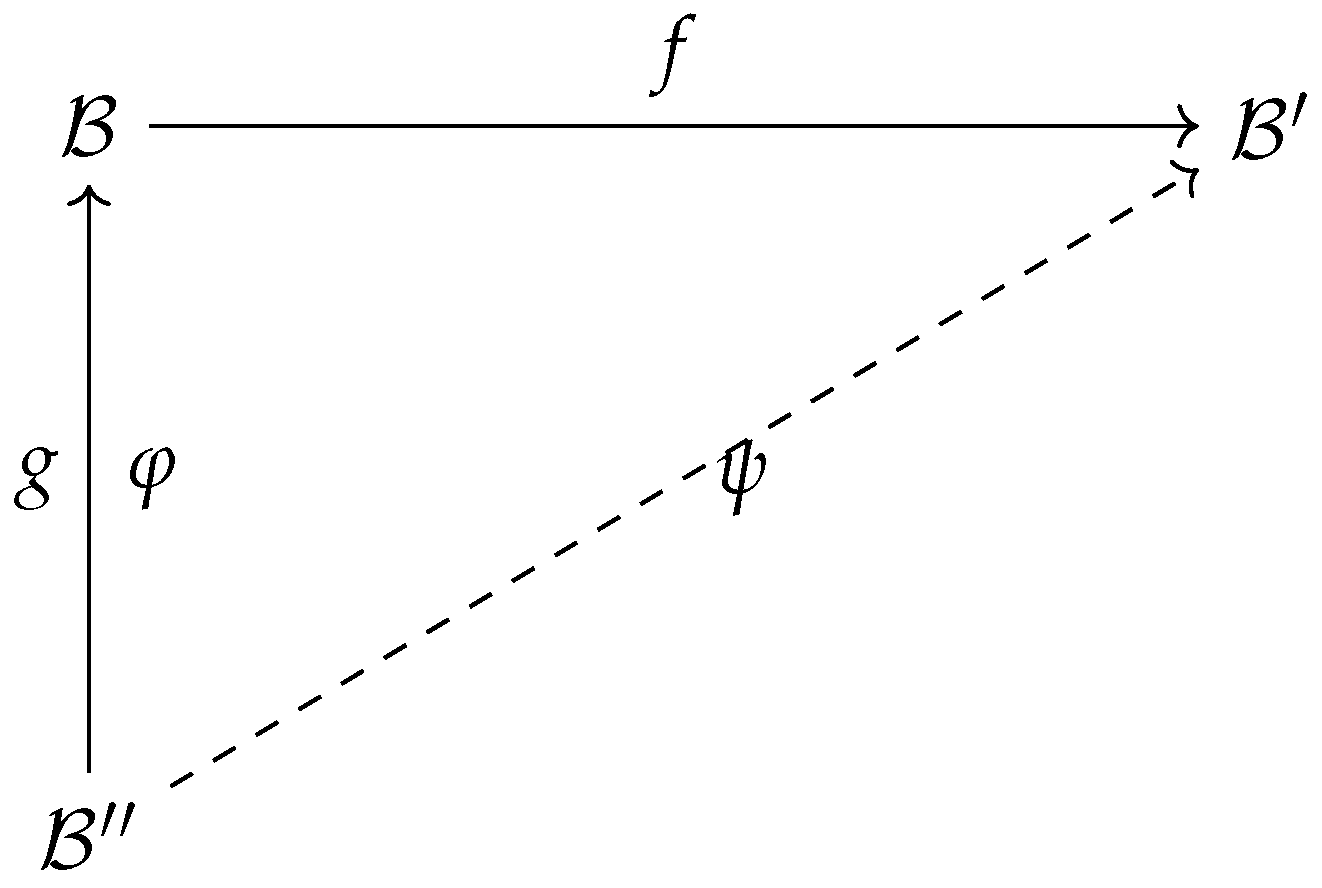
One important problem in fibration theory is the lifting problem, which concerns finding a lifting function. In this work, we solve the lifting problem by proving the existence of lifting functions for acting fibrations. Let ( S , B ) and ( S , B ) be graphical acting semigroups. An S -acting map f : B B is called an acting fibration in Figure 5 if for every graphical acting semigroup ( S , B ) , an S -acting map g : B B and a graphical acting homotopy ψ : B B p with ψ ( b ) ( 0 ) = ( f g ) ( b ) for all b B , there is a graphical acting homotopy φ : B B p such that
φ ( b ) ( 0 ) = g ( b ) and f [ φ ( b ) ( t ) ] = ψ ( b ) ( t )
for all b B and t I .
Theorem 12.
The composition of two acting fibrations is acting fibration.
Proof. 
Let ( S , B ) , ( S , B ) and ( S , D ) be graphical acting semigroups. Let f 1 : B B and f 2 : B D be two acting fibrations. We prove that f 2 f 1 : B D is acting fibration. Let ( S , B ) be any graphical acting semigroup, g : B B be any S -acting map, and ψ : B D p be any graphical acting homotopy with
ψ ( b ) ( 0 ) = [ ( f 2 f 1 ) g ] ( b )
for all b B . Note that
ψ ( b ) ( 0 ) = [ ( f 2 f 1 ) g ] ( b ) = [ f 2 ( f 1 g ) ] ( b )
for all b B . Since f 1 g is S -acting map and f 2 is an acting fibration, then there is graphical acting homotopy ϕ : B B p such that
ϕ ( b ) ( 0 ) = ( f 1 g ) ( b ) and f 2 [ ϕ ( b ) ( t ) ] = ψ ( b ) ( t )
for all b B and t I . Now since f 1 is acting fibration, then there is graphical acting homotopy φ : B B p such that
φ ( b ) ( 0 ) = g ( b ) and f 1 [ φ ( b ) ( t ) ] = ϕ ( b ) ( t )
for all b B and t I . Also we have
( f 2 f 1 ) [ φ ( b ) ( t ) ] = f 2 [ ϕ ( b ) ( t ) ] = ψ ( b ) ( t )
for all b B and t I . Hence the composition f 2 f 1 : B D is acting fibration. □
Lemma 4.
Let f : B B be an S -acting map of graphical acting semigroups ( S , B ) into ( S , B ) . If C is SB -subacting of B then ( S , f 1 ( C ) ) is a graphical acting semigroup.
Proof. 
Take f 1 ( C ) as a subspace with relative topology in topological semigroup B . Note that for every c , c f 1 ( C ) , f ( c ) , f ( c ) C . Hence f ( c c ) = f ( c ) f ( c ) C and so c c f 1 ( C ) . For the action map, for every c f 1 ( C ) ) and for every x S , we have f ( c ) C and f ( x c ) = x f ( c ) C , and hence x c f 1 ( C ) ) . That is, ( S , f 1 ( C ) ) is a graphical acting semigroups. □
From the proof of the lemma above, f 1 ( C ) is an SB -subacting of B . In the following theorem, we will prove that the restriction of any acting fibration f : B B on graphical acting semigroup ( S , f 1 ( C ) ) is acting fibration, for any SB -subacting C of B .
Theorem 13.
Let f : B B be an acting fibration and C be an SB -subacting of B . Then the restriction map f | f 1 ( C ) : f 1 ( C ) C is an acting fibration.
Proof. 
First, we prove that the restriction f | f 1 ( C ) : f 1 ( C ) C is an S -acting map. Note that for every b , b f 1 ( C ) and x S ,
f | f 1 ( C ) ( b b ) = f ( b b ) = f ( b ) f ( b ) = f | f 1 ( C ) ( b ) f | f 1 ( C ) ( b )
and
f | f 1 ( C ) ( x b ) = f ( x b ) = x f ( b ) = x f | f 1 ( C ) ( b ) .
It is clear that the restriction of continuous function is continuous; that is, f | f 1 ( C ) is an S -acting map. Now let ( S , B ) be any graphical acting semigroup, g : B f 1 ( C ) be any S -acting map and ψ : B C p be any graphical acting homotopy with
ψ ( b ) ( 0 ) = f | f 1 ( C ) g ( b )
for all b B . Since f 1 ( C ) is an SB -subacting of B and C is an SB -subacting of B , then we can consider g as S -acting map: B B and ψ as S -acting map: B B p . Since f is acting fibration, then there is graphical acting homotopy ϕ : B B p such that
ϕ ( b ) ( 0 ) = g ( b ) and f [ ϕ ( b ) ( t ) ] = ψ ( b ) ( t )
for all b B and t I . In the last part, we note that ϕ ( b ) ( t ) f 1 ( C ) for all b B and t I . Hence define the graphical acting homotopy φ : B f 1 ( C ) p by φ ( b ) ( t ) = ϕ ( b ) ( t ) for all b B and t I . Then we have
φ ( b ) ( 0 ) = ϕ ( b ) ( 0 ) = g ( b ) and f [ φ ( b ) ( t ) ] = f [ ϕ ( b ) ( t ) ] = ψ ( b ) ( t )
for all b B and t I . Hence the S -acting map f | f 1 ( C ) : f 1 ( C ) C is acting fibration. □
Here we will extend the notion of lifting function for acting fibrations to its analogical structure in homotopy theory for graphical acting semigroups. Before this extension we introduce the following lemma and theorem which help us in giving the notion of lifting function for acting fibrations.
Lemma 5.
Let ( S , B ) and ( S , B ) be two graphical acting semigroups. Then ( S , B × B ) is a graphical acting semigroup.
Proof. 
It is clear that B × B is a topological semigroup since B and B are topological semigroups under the product topology an the operation given by ( b , b ) ( c , c ) = ( b c , b c ) for all ( b , b ) ( c , c ) B × B . For the action map, we define x ( b , b ) = ( x b , x b ) for all ( b , b ) B × B and x S . □
Theorem 14.
Let f : B B be an S -acting map of graphical acting semigroups ( S , B ) into ( S , B ) . Then Γ ( f ) is an S ( B × B p ) -subacting of B × B p where
Γ ( f ) = { ( b , λ ) B × B p : f ( b ) = λ ( 0 ) } .
Proof. 
From Lemma 5, we have ( S , B × B p ) is a graphical acting semigroup. topological semigroups. Note that for every ( b , λ ) , ( b , λ ) Γ ( f ) ,
f ( b b ) = f ( b ) f ( b ) = λ ( 0 ) λ ( 0 ) = ( λ λ ) ( 0 )
That is, ( b , λ ) ( b , λ ) = ( b b , λ λ ) Γ ( f ) . For the action condition, note that for every ( b , λ ) Γ ( f ) and x S ,
f ( x b ) = x f ( b ) = x λ ( 0 ) = ( x λ ) ( 0 )
That is, x ( b , λ ) = ( x b , x λ ) Γ ( f ) . Hence Γ ( f ) is an S ( B × B p ) -subacting of B × B p . □
Let ( S , B ) and ( S , B ) be two graphical acting semigroups. Let f : B B be an S -acting map. Then the function A f : Γ ( f ) B p is called an A -lifting function for f if it is an S -acting map, A f ( b , λ ) ( 0 ) = b and f [ A f ( b , λ ) ] = λ for all ( b , λ ) Γ ( f ) .
Example 3.
Let S = [ 0 , 1 ] be a topological semigroup under the usual multiplication. Let B = [ 0 , 1 ] × [ 0 , 1 ] be a topological semigroup under pointwise multiplication ( b , c ) ( b , c ) = ( b b , c c ) , and let B = [ 0 , 1 ] be a topological semigroup under multiplication. Define a continuous action of S on B and B by x · ( b , c ) = ( x b , x c ) and x · u = x u , for all x S , ( b , c ) B and u B . This action is continuous and satisfies the acting condition
x ( ( b , c ) ( b , c ) ) = ( x b b , x c c ) = ( x b , x c ) ( b , c ) = ( x ( b , c ) ) ( b , c )
for all x S . Define the map f : B B by f ( b , c ) = c . Then f is continuous and satisfies
( ( b , c ) ( b , c ) ) = f ( b b , c c ) = c c = f ( b , c ) f ( b , c )
and
f ( x · ( b , c ) ) = f ( x b , x c ) = x c = x f ( b , c )
for all x S . Hence f is an S -acting map. Now we construct an A-lifting function for f. Recall that
Γ ( f ) = { ( ( b , c ) , λ ) B × B I : λ ( 0 ) = f ( b , c ) = c } .
Define A f : Γ ( f ) B I by A f ( ( b , c ) , λ ) ( t ) = ( b , λ ( t ) ) for all t I . Then A f ( ( b , c ) , λ ) ( 0 ) = ( b , λ ( 0 ) ) = ( b , c ) . Since
A f ( ( b , c ) , λ ) ( t ) = ( b , λ ( t ) ) ,
we obtain
f ( A f ( ( b , c ) , λ ) ( t ) ) = f ( b , λ ( t ) ) .
By the definition of f : B B , where f ( b , c ) = c , it follows that
f ( b , λ ( t ) ) = λ ( t ) .
Hence
f ( A f ( ( b , c ) , λ ) ( t ) ) = λ ( t ) .
for all t I . Hence f A f ( ( b , c ) , λ ) = λ . Moreover, for every x S ,
A f ( x · ( ( b , c ) , λ ) ) ( t ) = A f ( ( x b , x c ) , x λ ) ( t ) = ( x b , x λ ( t ) ) = x · ( b , λ ( t ) ) = x · A f ( ( b , c ) , λ ) ( t ) ,
which shows that A f is an S -acting map. Hence A f is an A-lifting function for f. By Theorem 12, the map f : B B is an acting fibration.
Lemma 6.
Let ( S , B ) be a graphical acting semigroup. For every λ B p and s I , let λ s B p defined by λ s ( t ) = λ [ f ( s , t ) ] for all t I , where f : I × I I be any map. Then the function ϕ : B p ( B p ) p defined by ϕ ( λ ) ( s ) = λ s , for all s I , λ B p , is an S -acting map.
Proof. 
By Lemma 2 to prove that ϕ is continuous, we will prove that ψ : B p × I B p defined by
ψ ( λ , s ) = λ s for   all   s I , λ B p ,
is continuous. Let ( μ , s o ) B p × I and N , M be a neighborhood of μ s o in B p . Then
μ ( f ( { s o } × N ) ) = μ s o ( N ) M .
By the continuity of μ and M is an open set containing μ ( f ( { s o } × N ) ) , there is open set G in I such that f ( { s o } × N ) G and μ ( G ) M . Also by the continuity of f, there are two open sets I s o and I N in I such that
{ s o } × N I s o × I N and f ( I s o × I N ) G .
Since I s o is an open set in I containing s o , then there is a positive number γ > 0 such that
s o ( s o γ / 3 , s o + γ / 3 ) D = [ s o γ / 2 , s o + γ / 2 ] ( s o γ , s o + γ ) I s o .
Since D and N are compact sets in I and f is continuous, then f ( D × N ) is also a compact set in I. Now consider that
f ( D × N ) , M × ( s o γ / 3 , s o + γ / 3 )
is a neighborhood of ( μ , s o ) in B p × I . Hence for
( λ , s ) f ( D × N ) , M × ( s o γ / 3 , s o + γ / 3 ) ,
ψ ( λ , s ) ( N ) = λ s ( N ) = λ ( f ( { s } × N ) ) λ [ f ( D × N ) ] M .
That is, ψ ( λ , s ) N , M . Hence the function ψ is continuous. For the homomorphism condition, note that for every λ , μ B p ,
[ ϕ [ λ μ ] ( s ) ] ( t ) = [ λ μ ] s ( t ) = ( λ μ ) ( f ( s , t ) ) = λ ( f ( s , t ) ) μ ( f ( s , t ) ) = λ s ( t ) μ s ( t )
= [ λ s μ s ] ( t ) = [ ϕ ( λ ) ( s ) ϕ ( μ ) ( s ) ] ( t ) .
That is, ϕ [ λ μ ] = ϕ ( λ ) ϕ ( μ ) . For the action condition, note that for every λ B p and for every x S ,
[ ϕ [ x λ ] ( s ) ] ( t ) = [ x λ ] s ( t ) = ( x λ ) ( f ( s , t ) ) = x λ ( f ( s , t ) ) = x λ s ( t )
= x [ ϕ ( λ ) ( s ) ] ( t ) .
That is, ϕ [ x λ ] = x ϕ ( λ ) . Hence ϕ is an S -acting map. □
Theorem 15.
Let ( S , B ) and ( S , B ) be two graphical acting semigroups. An S -acting map f : B B is an acting fibration if and only if it has A -lifting function.
Proof. 
Suppose that an S -acting map f : B B has A -lifting function A f : Γ ( f ) B p . Let ( S , B ) be any graphical acting semigroup, g : B B be any S -acting map and ψ : B B p be any graphical acting homotopy with ψ ( b ) ( 0 ) = ( f g ) ( b ) for all b B . For every b B , let λ b be a path: t ψ ( b ) ( t ) . Then by Lemma 6 above, the function D : B B p defined by D ( b ) = λ b for all b B is an S -acting map. Hence define the graphical acting homotopy φ : B B p by
φ ( b ) ( t ) = A f [ g ( b ) , λ b ] ( t ) for   all   b B , t I .
Hence
φ ( b ) ( 0 ) = g ( b ) and f [ φ ( b ) ( t ) ] = ψ ( b ) ( t )
for all b B and t I . Hence f is acting fibration.
Conversely, let f be an acting fibration and B = Γ ( f ) . Define graphical acting homotopy ψ : B B p by
ψ ( b , λ ) ( t ) = λ ( t ) for   all   ( b , λ ) B , t I ,
and an S -acting map g : B B by
g ( b , λ ) = b for   all   ( b , λ ) Γ ( f ) .
Since f is an acting fibration and
ψ ( b , λ ) ( 0 ) = f ( b ) = ( f g ) ( b , λ )
for all ( b , λ ) B , then there is an graphical acting homotopy φ : B B p such that
φ ( b , λ ) ( 0 ) = g ( b , λ ) and f [ φ ( b , λ ) ( t ) ] = ψ ( b , λ ) ( t )
for all ( b , λ ) B and t I . Hence define the A -lifting function A f : Γ ( f ) B p for f by
A f ( b , λ ) ( t ) = φ ( b , λ ) ( t ) ,
for all ( b , λ ) Γ ( f ) , t I . Note that A f is an S -acting map, A f ( b , λ ) ( 0 ) = b and f [ A f ( b , λ ) ] = λ for all ( b , λ ) Γ ( f ) . □

6. Regularity for Lifting Function

In this section, we study regular lifting functions and their properties. We define regular acting fibrations and explain how lifting functions play important roles in satisfying H -homotopy extension property. Let ( S , B ) and ( S , B ) be two graphical acting semigroups. Let f : B B be an S -acting map with an A -lifting function A f : Γ ( f ) B p . If E ( B ) F i x ( B ) = B and A f ( b , f P b ) = P b for all b B , then A f is called an A -regular lifting function, where P b is a constant path at b. We say that the S -acting map f : B B is an A -regular acting fibration if it has A -regular lifting function.
Theorem 16.
Let ( S , B ) and ( S , B ) be two graphical acting semigroups. Let f : B B be an A -regular fibration and L f be an S -acting map of B p into itself defined by
L f ( λ ) = A f ( λ ( 0 ) , f λ ) f o r   a l l   λ B p .
Then L f a c i d B p preserving projection. Hence there is a graphical acting homotopy ϕ between two S -acting maps L f and i d B p such that
[ f ( ϕ ( λ ) ( r ) ) ] ( t ) = f ( λ ( t ) ) f o r   a l l   r , t I , λ B p .
Proof. 
For λ B p and r I , define a path λ r B p by
λ r ( t ) = λ ( t ) , for 0 t < r , λ ( r ) , for r t 1 .
For μ = f λ and r I , define the path μ 1 r B p by
μ 1 r ( t ) = μ ( r + t ) , for 0 t < 1 r , μ ( 1 ) , for 1 r t 1 .
Then by Lemma 6, the two functions
B p ( B p ) p : ( λ ) ( r ) λ r ,
B p ( B p ) p : ( μ ) ( r ) μ 1 r
are S -acting maps. Hence we define a graphical acting homotopy ϕ : B p ( B p ) p by
[ ϕ ( λ ) ( r ) ] ( t ) = λ r ( t ) , for 0 t < r , A f ( λ ( r ) , μ 1 r ) ( t r ) , for r t 1 ,
for all r I , λ B p . Then by the A -regularity of A f , we get that
[ ϕ ( λ ) ( 0 ) ] ( t ) = A f ( λ ( 0 ) , μ 1 ) ( t ) = A f ( λ ( 0 ) , μ ) ( t ) = A f ( λ ( 0 ) , f λ ) ( t ) = L f ( λ ) ( t ) ,
and [ ϕ ( λ ) ( 1 ) ] ( t ) = λ ( t ) for all λ B p , t I . Hence
ϕ ( λ ) ( 0 ) = L f ( λ ) and ϕ ( λ ) ( 1 ) = λ = i d B p ,
for all λ B p . That is, L f a c i d B p . Also we have
[ f ( ϕ ( λ ) ( r ) ) ] ( t ) = f ( λ r ( t ) ) , for 0 t < r , f [ A f ( λ ( r ) , μ 1 r ) ( t r ) ] , for r t 1 ; = f ( λ ( t ) ) , for 0 t < r , μ 1 r ( t r ) , for 0 t r 1 r ; = f ( λ ( t ) ) , for 0 t < r , μ ( r + t r ) , for 0 t r 1 r ; = f ( λ ( t ) ) , for 0 t < r , μ ( t ) , for r t 1 ; = f ( λ ( t ) ) , for 0 t < r , f ( λ ( t ) ) , for r t 1 ; = f ( λ ( t ) ) .
Hence L f a c i d B p preserving projection. □
Corollary 7.
Let ( S , B ) and ( S , B ) be two graphical acting semigroups. Let f : B B be an A -regular fibration. Then B p and Γ ( f ) are graphically acting dominated.
Proof. 
Define the S -acting map ξ : B p Γ ( f ) by
ξ ( λ ) = ( λ ( 0 ) , f λ ) for   all   λ B p .
By Theorem 16 we have
L f = A f ξ a c i d B p ,
by the graphical acting homotopy ϕ . Also note that for ( b , λ ) Γ ( f ) ,
( ξ A f ) ( b , λ ) = ξ [ A f ( b , λ ) ] = { A f ( b , λ ) ( 0 ) , f [ A f ( b , λ ) ] } = ( b , λ ) = i d Γ ( f ) ( b , λ ) .
Hence ξ A f = i d Γ ( f ) . Therefore B p and Γ ( f ) are graphically acting dominated. □
Lemma 7.
Let ( S , B ) be a graphical acting semigroup. Then:
1. 
The S -acting maps ϕ , φ : B p B p which are defined by φ ( λ ) = λ and
ϕ ( λ ) ( t ) = P λ ( 0 ) , for 0 t < 1 2 , λ ( 2 t 1 ) , for 1 2 t 1
for all λ B p are graphical acting homotopic;
2. 
The S -acting maps ϕ , φ : B p B p which are defined by φ ( λ ) = λ and
ϕ ( λ ) ( t ) = λ ( 2 t ) , for 0 t < 1 2 , P λ ( 1 ) , for 1 2 t 1
for all λ B p are graphical acting homotopic.
Proof. 
(1) Define the graphical acting homotopy ψ : B p ( B p ) p between φ and ϕ by
[ ψ ( λ ) ( r ) ] ( t ) = P λ ( 0 ) , for 0 t < r 2 , λ 2 t r 2 r , for r 2 t 1 ,
for all λ B p , r I . Then
[ ψ ( λ ) ( 0 ) ] ( t ) = λ ( t ) = φ ( λ ) ( t ) ,
and
[ ψ ( λ ) ( 1 ) ] ( t ) = P λ ( 0 ) , for 0 t < 1 2 , λ ( 2 t 1 ) , for 1 2 t 1 , = ϕ ( λ ) ( t ) ,
for all λ B p . Hence ψ is a graphical acting homotopy between two S -acting maps ϕ and φ . We have also the graphical acting homotopy ψ satisfies
ψ ( λ ) ( r ) ] ( 1 ) = λ ( 1 ) for   all   r I , λ B p .
(2) Similarly, define the graphical acting homotopy ψ : B p ( B p ) p between Q and ϕ by
[ ψ ( λ ) ( r ) ] ( t ) = λ t 1 r 2 , for 0 t < 1 r 2 , P λ ( 1 ) , for 1 r 2 t 1 ,
for all λ B p , r I . Then
[ ψ ( λ ) ( 0 ) ] ( t ) = λ ( t ) = φ ( λ ) ( t ) ,
and
[ ψ ( λ ) ( 1 ) ] ( t ) = λ ( 2 t ) , for 0 t < 1 2 , P λ ( 1 ) , for 1 2 t 1 , = ϕ ( λ ) ( t ) ,
for all λ B p . Hence ψ is a graphical acting homotopy between two S -acting maps ϕ and φ . We have also the graphical acting homotopy ψ satisfies
[ ψ ( λ ) ( r ) ] ( 1 ) = λ ( 1 ) for   all   r I , λ B p .
Proposition 1.
In Theorem 16, for a path λ B p , let P λ be a path in B p defined by
P λ ( r ) = [ ϕ ( λ ) ( r ) ] ( 1 ) f o r   a l l   r I .
Let ψ : B p B p be an S -acting map defined by
ψ ( λ ) ( t ) = A f ( λ ( 0 ) , f λ ) ( 2 t ) , f o r 0 t < 1 2 , P λ ( 2 t 1 ) , f o r 1 2 t 1 ,
for all λ B p . Then ψ a c i d B p keeping end points fixed.
Proof. 
For every λ ( B p ) p and r I , define a path λ r in B p by
λ r ( t ) = λ ( r + ( 1 r ) t ) for   all   t I .
Then by Lemma 6, the function B p ( B p ) p : ( λ ) ( r ) λ r is an S -acting map. Hence define the graphical acting homotopy φ : B p ( B p ) p by
[ φ ( λ ) ( r ) ] ( t ) = [ ϕ ( λ ) ( r ) ] ( 2 t ) , for 0 t < 1 2 , ( P λ ) r ( 2 t 1 ) , for 1 2 t 1 ,
for all r I and λ B p . Then
[ φ ( λ ) ( 0 ) ] ( t ) = [ ϕ ( λ ) ( 0 ) ] ( 2 t ) , for 0 t < 1 2 , ( P λ ) 0 ( 2 t 1 ) , for 1 2 t 1 , = A f ( λ ( 0 ) , f λ ) ( 2 t ) , for 0 t < 1 2 , P λ ( 2 t 1 ) , for 1 2 t 1 , = ψ ( λ ) ( t ) .
and By Lemma 7,
[ φ ( λ ) ( 1 ) ] ( t ) = [ ϕ ( λ ) ( 1 ) ] ( 2 t ) , for 0 t < 1 2 , ( P λ ) 1 ( 2 t 1 ) , for 1 2 t 1 , = λ ( 2 t ) , for 0 t < 1 2 , P λ ( 1 ) , for 1 2 t 1 , a c i d B p ,
for all λ B p . Hence ψ a c i d B p . Also we get that
[ φ ( λ ) ( r ) ] ( 0 ) = [ ϕ ( λ ) ( r ) ] ( 0 ) = λ r ( 0 ) = λ ( 0 ) ,
and
[ φ ( λ ) ( r ) ] ( 1 ) = ( P λ ) r ( 1 ) = λ ( 1 ) .
Hence ψ a c i d B p keeping end points fixed. □
Theorem 17.
Let ( S , B ) and ( S , B ) be two graphical acting semigroups. Let f : B B be an A -regular fibration with an D -retract B . Let C be a closed SB -subacting of a normal topological semigroup B . If there is ( S C 1 , S B 2 , B ) -maps such that
f [ S C 1 ( c ) ( t ) ] = f [ S C 1 ( c ) ( 0 ) ] f o r   a l l   c C , t I ,
then there is an S -acting map ϕ : B B p such that ϕ is an extension of S C 1 , ϕ ( b ) ( 0 ) = S B 2 ( b ) and
f [ ϕ ( b ) ( t ) ] = f [ ϕ ( b ) ( 0 ) ] f o r   a l l   b B , t I .
Proof. 
Since B is an D -retract and C is a closed SB -subacting of a normal topological semigroup B , then by Theorem 11, the S -acting map S C 1 can be extended to S -acting map φ : B B p such that φ ( b ) ( 0 ) = S B 2 ( b ) for all b B . Now for λ B p and r I , we define the path λ r in B p by
λ r ( t ) = λ [ ( 1 t ) r ] for   all   t I .
Then by Lemma 6, the function B p ( B p ) p : ( λ ) ( r ) λ r is an S -acting map. Hence we can define the S -acting map ϕ : B B p by
ϕ ( b ) ( t ) = A f [ φ ( b ) ( t ) , f φ ( b ) t ] ( 1 ) for   all   b B , t I .
Firstly, we show that ϕ ( b ) ( 0 ) = S B 2 ( b ) for all b B . By the A -regularity of A f and since φ is an extension for S C 1 , we observe that for b B ,
ϕ ( b ) ( 0 ) = A f ( φ ( b ) ( 0 ) , f φ ( b ) 0 ) ( 1 ) = A f ( φ ( b ) ( 0 ) , f φ ( b ) ( 0 ) ) ( 1 ) = A f ( φ ( b ) ( 0 ) , f P φ ( b ) ( 0 ) ) ( 1 ) = P φ ( b ) ( 0 ) ( 1 ) = φ ( b ) ( 0 ) = S B 2 ( b ) ,
and secondly, we show that ϕ is an extension of S C 1 . Since φ is an extension for S C 1 and by the hypothesis we get that
( f φ ( a ) r ) ( t ) = f [ φ ( c ) ( ( 1 t ) r ) ] = f [ S C 1 ( c ) ( ( 1 t ) r ) ] = f [ S C 1 ( c ) ( 0 ) ] = f [ S C 1 ( c ) ( r ) ] = f [ φ ( c ) ( r ) ] ,
for all c C and r , t I . Hence by the A -regularity of A f we get that
ϕ ( c ) ( r ) = φ ( c ) ( r ) = S C 1 ( c ) ( r ) for   all   r I , c C .
Hence ϕ is an extension for S C 1 . Finally, we also observe that
f [ ϕ ( b ) ( t ) ] = f [ A f ( φ ( b ) ( t ) , f φ ( b ) t ) ( 1 ) ] = ( f φ ( b ) t ) ( 1 ) = f [ φ ( b ) t ( 1 ) ] = f [ φ ( b ) ( 0 ) ] = f [ S B 2 ( b ) ] = f [ ϕ ( b ) ( 0 ) ] ,
for all b B , t I . □
The following corollary is an equivalent restatement of the above theorem.
Corollary 8.
Let ( S , B ) and ( S , B ) be two graphical acting semigroups. Let f : B B be an A -regular fibration with an D -retract B and C be a closed SB -subacting of a normal topological semigroup B . Let k 1 , k 2 : C B be two S -acting maps and ψ : C B p be a graphical acting homotopy between them such that
f [ ψ ( c ) ( t ) ] = f [ ψ ( c ) ( 0 ) ] f o r   a l l   c C , t I .
If k 1 has an extension S -acting map ξ 1 to all of B , then k 2 has an extension S -acting map ξ 2 to all of B . Also there is a graphical acting homotopy ϕ : B B p between ξ 1 and ξ 2 such that ϕ is an extension of ψ and
f [ ϕ ( b ) ( t ) ] = f [ ϕ ( b ) ( 0 ) ] f o r   a l l   b B , t I .
Proof. 
Since k 1 has an extension S -acting map ξ 1 to all of B , that is,
ξ 1 ( c ) = k 1 ( c ) = ψ ( c ) ( 0 ) for   all   c C .
Hence there is ( ψ , ξ 1 , B ) -maps with the property
f [ ψ ( c ) ( t ) ] = f [ ψ ( c ) ( 0 ) ] for   all   c C , t I .
Then by theorem above there is an S -acting map ϕ : B B p such that ϕ is an extension of ψ , ϕ ( b ) ( 0 ) = ξ 1 ( b ) and
f [ ϕ ( b ) ( t ) ] = f [ ϕ ( b ) ( 0 ) ] for   all   b B , t I .
Also we can define the S -acting map ξ 2 : B B by ξ 2 ( b ) = ϕ ( b ) ( 1 ) for all b B . Then ϕ is a graphical acting homotopy between ξ 1 and ξ 2 and also
ξ 2 ( c ) = ϕ ( c ) ( 1 ) = k 2 ( c ) for   all   c C .
That is, ξ 2 is an extension of k 2 . □

7. Comparative Evaluation

We compare our results with several recent works suggested by the reviewer in order to highlight the novelty and mathematical positioning of the present work.
Fibrations between mapping spaces have been studied in [31], where lifting properties and homotopy-theoretic structures are analyzed in classical function spaces equipped with suitable topologies. In that setting, the focus is on continuous maps between mapping spaces and the behavior of homotopies under such mappings. In contrast, the present work investigates lifting properties within the framework of graphical acting semigroups, where the structure is induced by the single intersection graph G S B . This leads to a formulation of acting fibrations that combines algebraic actions with graph-based topology, providing a discrete–combinatorial interpretation that differs from the classical mapping space approach.
Topological spaces satisfying closed graph conditions are investigated in [32], where attention is given to structural properties of mappings and the relationship between graph conditions and continuity. While this provides a general framework for analyzing mappings in topological spaces, the present work incorporates semigroup actions and studies how these actions generate graph-induced topological structures. In this way, the emphasis shifts from purely topological conditions on mappings to a combined algebraic–topological perspective in which graph structures arise naturally from the action.
Graphical models for topological groups are developed in [33], particularly in the setting of countable Stone spaces, where graph structures are used to encode algebraic and topological features of groups. In contrast, the present work does not begin with group structures, but instead constructs graphs from S -acting spaces, thereby allowing a broader class of algebraic systems to be studied without requiring invertibility.
Topological spaces generated by simple undirected graphs are studied in [34], where graphs serve as primary objects from which topological structures are derived. While this approach highlights the role of graphs in defining topology, the present work reverses this perspective by deriving graphs from semigroup actions via intersection conditions among subacting spaces. These graphs are then used to investigate homotopy relations and fibration properties.
The work in [35] studies topologies on simple graphs and their applications, focusing on equipping graphs with suitable topological structures. In contrast, our approach does not impose topology directly on graphs, but rather uses graph constructions arising from S -actions to analyze the topology of acting spaces and their homotopy behavior.
Interactions between homotopy theory and topological groups are investigated in [36], particularly in the context of covering space embeddings, where group structures play a central role. The present work differs in that it replaces group actions with semigroup actions and develops graphical acting homotopy in this more general setting. This allows the study of homotopy-type properties without relying on invertibility or group symmetries.
Classical constructions in topological graph theory are discussed in [37], including covering space techniques and their applications in topology. While these constructions provide important connections between graph theory and topology, they are typically based on classical combinatorial or group-theoretic frameworks. In contrast, the present work introduces a new interaction between graph structures and semigroup actions through single intersection graphs, leading to a different class of topological constructions.
Furthermore, the results obtained in this paper, particularly the characterization of acting fibrations via A -lifting functions and the formulation of graphical acting homotopy, establish a new framework that connects discrete graph structures with continuous homotopy theory. This connection is not explicitly developed in the cited works, where algebraic actions, graph structures, and homotopy are typically treated separately or under more restrictive assumptions.
Overall, the present work provides a unified framework that integrates algebraic actions, graph theory, and homotopy theory through graphical acting semigroups and single intersection graphs. This perspective differs from existing approaches by deriving topological and homotopical properties directly from semigroup actions via graph constructions, thereby offering a new method for analyzing acting spaces and their associated topological structures.


8. Conclusions

In this paper, we developed a homotopy theory framework for single intersection graphs associated with acting spaces over topological semigroups. We introduced the notions of graphical acting homotopy, acting fibrations, and A-lifting functionsv and established a fundamental equivalence between acting fibrations and the existence of lifting functions. We further defined A-regular lifting functions and showed that regular acting fibrations satisfy a natural H-homotopy extension property. These results extend classical fibration theory to the graphical setting of single intersection graphs and provide new connections between semigroup actions, homotopy theory and intersection graph structures. Future work may focus on studying higher homotopy invariants in this framework and exploring applications to broader classes of algebraic and topological structures.
Author Contributions

Formal analysis, F.A., A.K. and A.A.; Investigation, F.A., M.F.A. and A.A.; Resources, F.A., A.K. and M.F.A.; Writing—original draft, F.A. and A.K.; Writing—review and editing, F.A., A.K., M.F.A. and A.A. All authors have read and agreed to the published version of the manuscript.

Funding

This research has been funded by the Deanship of Scientific Research at University of Ha’il—Saudi Arabia through project number BA-25 025.

Data Availability Statement

No new data were created or analyzed in this study.

Conflicts of Interest

The authors declare no conflicts of interest.

References

  1. Dammag, F.H.; Saif, A.; Kiliçman, A.; Ali, E.E.; Mesmouli, M.B. Monophonic sets and rough directed topological spaces: Applications with some directed networks. AIMS Math. 2025, 10, 17623–17641. [Google Scholar] [CrossRef]
  2. Lupton, G.; Musin, O.; Scoville, N.A.; Staecker, P.C.; Treviño-Marroquín, J. A second homotopy group for digital images. J. Algebr. Comb. 2024, 60, 781–815. [Google Scholar] [CrossRef]
  3. Yamagata, S. Mapping fiber, loop and suspension graphs in naive discrete homotopy theory. arXiv 2024, arXiv:2402.15714. [Google Scholar] [CrossRef]
  4. Kapulkin, K.; Mavinkurve, U. The fundamental group in discrete homotopy theory. Adv. Appl. Math. 2025, 164, 102838. [Google Scholar] [CrossRef]
  5. Celis-Rojas, J.F. Finite groups as homotopy self-equivalences of finite spaces. arXiv 2024, arXiv:2411.01005. [Google Scholar] [CrossRef]
  6. Baues, H.J. Algebraic Homotopy; Cambridge University Press: Cambridge, UK, 1989; Volume 15. [Google Scholar]
  7. Dammag, F.H.; Saif, A.; Kiliçman, A.; Ali, E.E.; Mesmouli, M.B. On m-negative sets and out mondirected topologies in the human nervous system. Mathematics 2024, 12, 3763. [Google Scholar] [CrossRef]
  8. Csakany, B.; Pollak, G. The graph of subgroups of a finite group. Czechoslov. Math. J. 1969, 19, 241–247. [Google Scholar] [CrossRef]
  9. Zelinka, B. Intersection graphs of finite abelian groups. Czechoslov. Math. J. 1975, 25, 171–174. [Google Scholar] [CrossRef]
  10. Chakrabarty, I.; Ghosh, S.; Mukherjee, T.K.; Sen, M.K. Intersection graphs of ideals of rings. Discret. Math. 2009, 309, 5381–5392. [Google Scholar] [CrossRef]
  11. Shen, R. Intersection graphs of subgroups of finite groups. Czechoslov. Math. J. 2010, 60, 945–950. [Google Scholar] [CrossRef][Green Version]
  12. Akbari, S.; Heydari, F.; Maghasedi, M. The intersection graph of a group. J. Algebra Its Appl. 2015, 14, 1550065. [Google Scholar] [CrossRef]
  13. Zhao, J.; Yağan, O.; Gligor, V. On connectivity and robustness in random intersection graphs. IEEE Trans. Autom. Control 2016, 62, 2121–2136. [Google Scholar] [CrossRef]
  14. Kayacan, S. Connectivity of intersection graphs of finite groups. Commun. Algebra 2018, 46, 1492–1505. [Google Scholar] [CrossRef]
  15. Aprose, M.A.; Fathima, S.S.A. Further results on intersection power graph of finite groups. Punjab Univ. J. Math. 2020, 52, 47–53. [Google Scholar]
  16. Beheshtipour, A.; Jafarian Amiri, S.M. The clique number of the intersection graph of some cyclic groups. Int. J. Group Theory 2025, 15, 9–16. [Google Scholar] [CrossRef]
  17. Liu, S. Finite groups for which all proper subgroups have consecutive character degrees. AIMS Math. 2023, 8, 5745–5762. [Google Scholar] [CrossRef]
  18. Beheshtipour, A.; Jafarian Amiri, S.M. The clique number of the intersection graph of a finite group. Bull. Iran. Math. Soc. 2023, 49, 74. [Google Scholar] [CrossRef]
  19. Ahmed, M.; Moh’d, F. A new intersection-graph type for modules. Commun. Algebra 2024, 52, 2065–2078. [Google Scholar] [CrossRef]
  20. Ramanathan, V. On projective intersection graph of ideals of commutative rings. J. Algebra Its Appl. 2021, 20, 2150017. [Google Scholar] [CrossRef]
  21. Moh’d, F.; Ahmed, M. Simple-intersection graphs of rings. AIMS Math. 2023, 8, 1040–1054. [Google Scholar] [CrossRef]
  22. Davvaz, B.; Nazemian, Z. Chain conditions on commutative monoids. Semigroup Forum 2020, 100, 732–742. [Google Scholar] [CrossRef]
  23. Khosravi, R.; Roueentan, M. Chain conditions on (Rees) congruences of S-acts. J. Algebra Its Appl. 2024, 23, 2450085. [Google Scholar] [CrossRef]
  24. Rasouli, H.; Tehranian, A. Intersection graphs of S-acts. Bull. Malays. Math. Sci. Soc. 2015, 38, 1575–1587. [Google Scholar] [CrossRef]
  25. Delfan, A.; Rasouli, H.; Tehranian, A. Intersection graphs associated with semigroup acts. Categ. Gen. Algebr. Struct. Appl. 2019, 11, 131–148. [Google Scholar] [CrossRef]
  26. Spanier, E.H. Algebraic Topology; McGraw-Hill: New York, NY, USA, 1966. [Google Scholar]
  27. Hurewicz, W. On the concept of fiber space. Proc. Natl. Acad. Sci. USA 1955, 41, 956–961. [Google Scholar] [CrossRef] [PubMed]
  28. Massey, W.S. A Basic Course in Algebraic Topology; Springer: New York, NY, USA, 1991. [Google Scholar]
  29. Kilp, M.; Knauer, U.; Mikhalev, A.V. Monoids, Acts and Categories; Walter de Gruyter: Berlin, Germany, 2000. [Google Scholar]
  30. Cerin, Z. Homotopy theory of topological semigroups. Topol. Its Appl. 2002, 123, 57–68. [Google Scholar] [CrossRef]
  31. Pavešić, P. Fibrations between mapping spaces. Topol. Its Appl. 2014, 178, 276–287. [Google Scholar] [CrossRef]
  32. Noll, D. Topological spaces satisfying a closed graph theorem. Topol. Its Appl. 2024, 349, 108903. [Google Scholar] [CrossRef]
  33. Branman, B.; Domat, G.; Hoganson, H.; Lyman, R.A. Graphical models for topological groups: A case study on countable Stone spaces. Bull. Lond. Math. Soc. 2025, 57, 2311–2335. [Google Scholar] [CrossRef]
  34. Sarı, H.K.; Kopuzlu, A. On topological spaces generated by simple undirected graphs. AIMS Math. 2020, 5, 5541. [Google Scholar] [CrossRef]
  35. Alzubaidi, H.; Kočinac, L.D.R.; Othman, H.A. On topologies on simple graphs and their applications in radar chart methods. Axioms 2025, 14, 178. [Google Scholar] [CrossRef]
  36. Bagchi, S. Interactions between homotopy and topological groups in covering (C, R) space embeddings. Symmetry 2021, 13, 1421. [Google Scholar] [CrossRef]
  37. Tucker, T.W. Some topological graph theory for topologists: A sampler of covering space constructions. In Topology and Combinatorial Group Theory; Latiolais, P., Ed.; Lecture Notes in Mathematics; Springer: Berlin/Heidelberg, Germany, 1990; Volume 1440. [Google Scholar] [CrossRef]
Figure 1. The graph G S B for Example 1.
Mathematics 14 01557 g001
Figure 2. The graph G S S for Example 2.
Mathematics 14 01557 g002
Figure 3. Graphical acting homotopy between two S -acting maps f and f .
Mathematics 14 01557 g003
Figure 4. Pathwise acting connectedness in B .
Mathematics 14 01557 g004
Figure 5. Lifting property for acting fibrations.
Mathematics 14 01557 g005
Disclaimer/Publisher’s Note: The statements, opinions and data contained in all publications are solely those of the individual author(s) and contributor(s) and not of MDPI and/or the editor(s). MDPI and/or the editor(s) disclaim responsibility for any injury to people or property resulting from any ideas, methods, instructions or products referred to in the content.