1. Introduction
In this study, we present new results on two variants of Roman domination: -Roman domination and strong Roman domination.
In 1999, Stewart described the defensive strategy decreed by Emperor Constantine I “The Great” to defend the Roman Empire [
1]. Subsequently, Cockayne et al. formalized the concept of Roman domination based on this defensive strategy [
2].
A graph is denoted by , where is the vertex set and is the edge set. Two edges are said to be independent if they do not share any endpoint, that is, no vertex is incident to both edges. We consider only simple, undirected, and finite graphs without loops or multiedges. A Roman dominating function (RDF) on a finite graph is a function that assigns to each vertex one of the labels , such that every vertex labeled 0 is adjacent to at least one vertex labeled 2. Vertices labeled 2 are intended to protect their neighbors labeled 0. The Roman domination number of the graph, , is the minimum weight (the sum of all vertex labels) of an RDF. An RDF f of minimum weight is called a -function. For a subset , we denote by the sum .
Since then, various studies have emerged that attempt to improve the effectiveness of this model. These studies propose different strategies based on increasing the number of units, edges, etc., under single attacks [
2,
3,
4] or simultaneous attacks [
5,
6,
7].
We denote by the set of consecutive integers starting from 1. The open neighborhood (resp. closed neighborhood) of a vertex u in a graph, (resp. ), is the set of adjacent vertices to u (resp. the set of adjacent vertices to including the vertex itself). That is, . We denote by and the minimum and maximum degree of G, respectively.
Given a labeling f of the vertices of a graph the active neighborhood of u, denoted by , is the set . Similarly,
A dominating set of vertices in a graph is a subset such that every vertex in has a neighbor in D. The domination number, , of a graph is the minimum cardinality of a dominating set in G. A vertex with degree equal to 1 is called a leaf, and a vertex that is adjacent to exactly one leaf (resp. to at least two leaves) is called a weak support vertex (resp. strong support vertex). A path of length n is a sequence of distinct vertices such that for all . A cycle on n vertices, denoted , is a sequence of distinct vertices together with edges for and forming a closed loop. A tree is a connected and acyclic graph. A tree with exactly two non-leaf vertices is called a bi-star or a double star, , where the non-leaf vertices are adjacent to s and t leaves, respectively, with
A caterpillar is a tree T such that the subgraph obtained by deleting all leaves of T is a path; this path is called the spine of the caterpillar. A crown graph is the graph obtained from a complete bipartite graph by removing a complete matching, i.e., a set of n pairwise independent edges. Let H be a graph with a distinguished vertex (called the root). The rooted product of a graph G and the rooted graph , denoted by , is obtained by taking vertex-disjoint copies of H and identifying the root r of the i-th copy with the i-th vertex of G. For integers and , the t-fold wheel is the graph obtained from a cycle (the rim) by adding t new vertices (the hubs) which are pairwise nonadjacent, and making each hub adjacent to every rim vertex. A bipartite graph is star-convex if there exists a star T with vertex set A such that, for every , the neighborhood induces a connected subtree of T.
One of the strategies used to defend a graph against an individual attack on a vertex is to increase the number of protection units, without leaving strong vertices undefended. Consequently, a series of variations appeared, such as double, triple, or quadruple Roman domination [
3,
4,
8]. To generalize this defensive strategy, Ahangar et al. [
3] defined
-Roman domination in 2021. A function
is said to be a
-Roman dominating function, and it is denoted by
-RDF, if for every vertex
u of the graph we have
The minimum weight of a
-RDF on a graph
G is known as the
-Roman domination number (
-RDN) of
G, and it is denoted by
. We say that a
-RDF with weight equal to
is a
-RDF. Any labeling
f of the vertices of a graph may be expressed as an ordered vertex partition
where
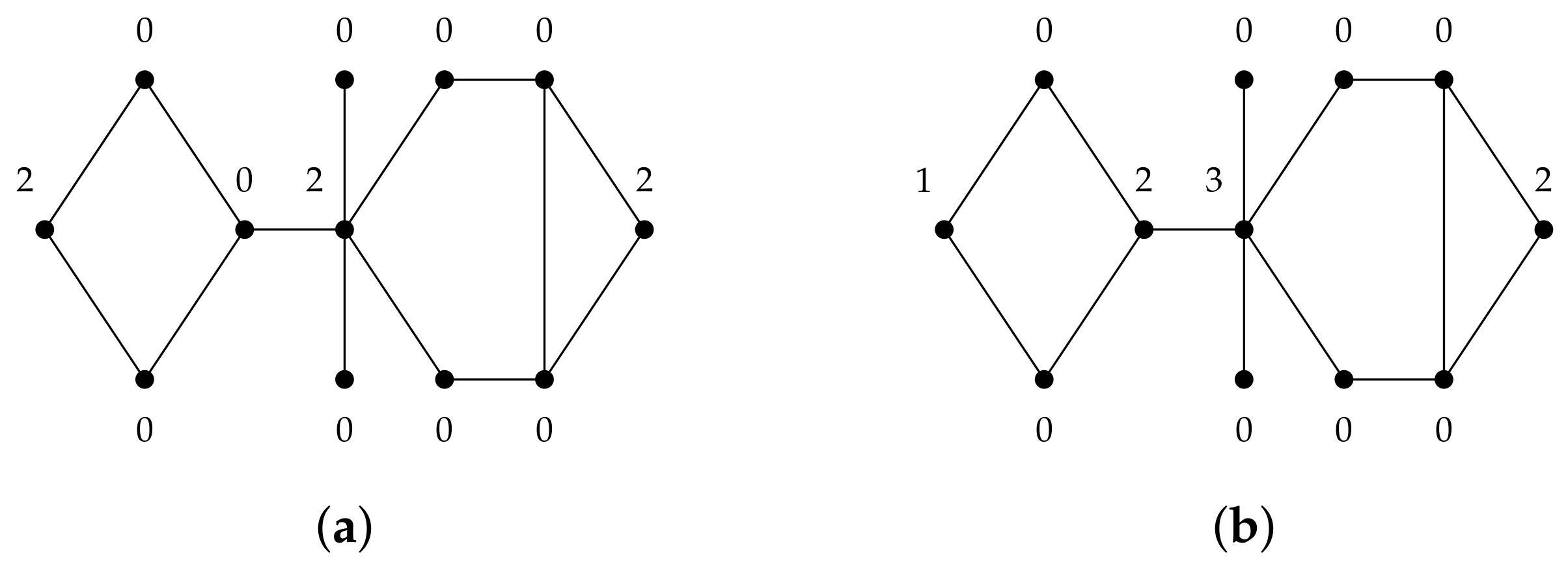
Figure 1 shows an RDF and a
-RDF on a graph.
A natural question arises:
How many units are sufficient to defend a graph against multiple simultaneous attacks? Several authors have investigated this problem [
6,
9]. To address this problem, in 2017, Alvarez et al. [
5] introduced
strong Roman domination. A strong Roman dominating function
f (for short, StRDF) assigns labels from the set
to the vertices of the graph in such a way that for every vertex
v with
, there exists at least one neighbor
u such that
where
In other words, under simultaneous attacks, every strong vertex could defend, at least, one-half of its undefended neighbors without leaving itself unprotected. We also denote by
and by
The
strong Roman domination number (for short, StRDN) of
G is the minimum weight of an StRDF on
G and is denoted by
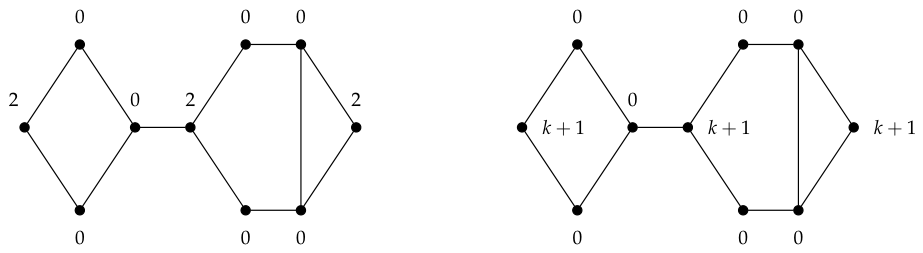
It can be observed, see
Figure 2, that with two more units compared to Roman domination, at least half of the undefended vertices can be protected against multiple simultaneous attacks.
Let f be a Roman-type dominating function on G and let with .
We say that u is Roman dominated by v if .
We say that u is strongly Roman dominated by v if where
For , we say that u is -Roman dominated by v whenever .
Next, we recall some results used in the proofs. Let p be a positive integer. A graph G is called a p-graph if it is equipped with a labeling function assigning to each vertex a label from a set of size p.
The clique-width of a graph G, denoted by , is the minimum number of labels needed to construct G using the following operations: (i) creation of a new vertex with a given label, (ii) disjoint union of two labeled graphs, (iii) joining by edges all the vertices with label i to all vertices with label j, and (iv) relabeling all vertices with label i to label j.
An r-expression is an algebraic expression that constructs a graph using at most r labels and the operations defining clique-width. A graph has clique-width at most r if and only if it can be generated by an r-expression.
Proposition 1 ([
5])
. Given any graph G, Proposition 2 ([
5])
. Let G be a graph of order then, Proposition 3 ([
5])
. Let G be a graph of order then, Furthermore, if n is odd, then equality holds if and only if . Corollary 1 ([
5])
. For , The corona product is obtained by taking one copy of G and disjoint copies of H, connecting each vertex to all vertices of the i-th copy , so that and .
Proposition 4 ([
10])
. For , , where Theorem 1 ([
11])
. Let G be a connected graph of order n with Then, Remark 1 ([
11])
. Let G be a connected graph of order n with and let be a -RDF. Let , , and Clearly, is a partition of and is a partition of . From this, it follows that , , and Among all the possible -functions f of a graph, we choose one that maximizes Consequently, it is satisfied that and for all 2. Complexity Results for [k]-Roman Domination
Recent investigations have established that the decision problem for
-Roman domination is NP-complete across several graph classes, including bipartite and chordal graphs [
12], and star-convex and comb-convex bipartite graphs [
13]. In contrast to these hardness results, this section demonstrates that
-Roman domination can be solved in linear time when the graph satisfies certain structural conditions.
Courcelle’s Theorem 2 provides a framework for solving optimization problems in linear time by expressing them in Monadic Second-Order Logic (MSOL).
Monadic Second-Order Logic (MSOL) is a powerful extension of first-order logic that, in addition to quantification over individual vertices, allows quantification over sets of vertices (and, in some variants, sets of edges). In the context of graphs, MSOL formulas are interpreted over the structure , where indicates adjacency between vertices u and v. This expressive framework enables the definition of a wide range of graph properties and combinatorial problems by means of logical formulas involving vertex variables, set variables, and standard logical connectives.
LinEMSOL (Linear Extended Monadic Second-Order Logic) is an extension of MSOL that allows, in addition to the usual logical predicates over vertices, edges, and sets, the use of linear objective functions defined in terms of the cardinalities of monadic sets. In this framework, one can express optimization problems of the form , where is an MSOL formula and are fixed integers. Courcelle’s Theorem extends to LinEMSOL, ensuring that such optimization problems are solvable in linear time on graph classes of bounded clique-width, provided that an appropriate graph decomposition (such as an r-expression) is given.
Theorem 2 ([
14])
. Let be a class of p-graphs with clique-width at most r such that there is a known algorithm which, for each p-graph in , constructs an r-expression defining it. Then every LinEMSOL problem on can be solved in time . To demonstrate that we can reduce the complexity of the problem, let us express it in LinEMSOL. Let us consider
where
if and only if
and let
be the monadic sets. Then,
which is satisfied if the sets
represent a partition of
V.
Each vertex
v must satisfy the condition for a
-RDF. Therefore, we need to introduce the predicate corresponding to the set
as follows:
With this notation, the following predicate represents the condition of
-RDF,
Thus, finding a minimum-weight
-RDF in the graph
G can be expressed as the following LinEMSOL-type problem:
Consequently, the task of identifying a minimum-weight -RDF is successfully reduced to a LinEMSOL optimization problem. This leads to the following theorem.
Theorem 3. The decision problem associated with -Roman domination, -RDN, can be expressed as a LinEMSOL optimization problem. Consequently, if an r-representation of the graph is included in the problem input, or if an efficient algorithm is available that provides it, then the -RDN problem can be solved in linear time with respect to the graph order.
Corollary 2. Since is expressible in LinEMSOL, it can be solved in time for any graph class with bounded clique-width, including cographs, distance-hereditary graphs, and complete graphs; and bounded treewidth, including trees, series-parallel graphs, and outerplanar graphs.
3. Complexity Results for Strong Roman Domination
Álvarez et al. introduced the concept of strong Roman domination in their seminal paper (see [
5]) and showed that the associated decision problem is NP-complete for planar graphs. In this section, we prove that the StRDP is also NP-complete for several classes of graphs, including subclasses of bipartite graphs.
We begin by formulating the associated decision problem for strong Roman domination.
StRDN PROBLEM
Instance: A graph and a positive integer k.
Question: Does G have an StRD function f with ?
To show that the StRDN PROBLEM is NP-complete, we make use of the restricted version of the Exact Cover by 3-Sets (RX3C) problem (see [
15,
16]).
RESTRICTED EXACT 3-COVER (RX3C) PROBLEM
Instance: Let X be a finite set with , and let C be a set of 3-element subsets of X such that each belongs to exactly three sets in C.
Question: Does there exist a subset
such that the sets in
form a
partition of
X, i.e.,
(such a set
is called
an exact cover of
X).
Theorem 4. The StRDN PROBLEM is NP-complete for star-convex bipartite graphs.
Proof. It can be readily verified that the StRDN PROBLEM belongs to the complexity class . Indeed, one can check in polynomial time whether a function is an StRDF of weight at most k.
Next, we prove that the StRDN PROBLEM is NP-complete for star-convex bipartite graphs by constructing a polynomial transformation between RX3C and the StRDN PROBLEM.
Let be an instance of RX3C with and .
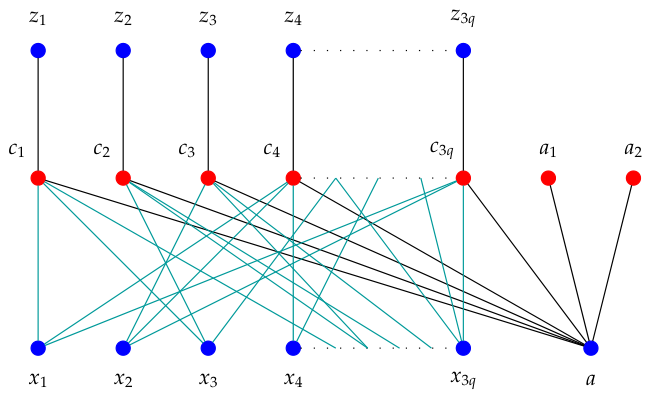
We construct (see
Figure 3) a star-convex bipartite graph
and we give a positive integer
k such that
I contains an exact cover if and only if
has an StRD function
f with
Consider the bipartite graph
with
, where
Then
and
. For
, we join
to
if and only if
, and set
Let us point out that
is a star-convex bipartite graph with vertex classes given by
, the set of edges
E defined above and the star graph
with central vertex
a and leaves
associated to the vertex class
B. That is, for each vertex
the subset
induces a connected subtree in the graph
Assume that
is an exact cover of
X in the RX3C instance
, with
. We define a function
as follows:
Let us verify that f is a strong Roman dominating function:
Each vertex belongs to exactly one . Since and has at most four neighbors with , the strong Roman domination condition is satisfied for .
Each vertex either satisfies or has a neighbor with , which guarantees that is strongly Roman dominated.
For the vertex a, we have , where , ensuring that all vertices in are strongly Roman dominated.
Finally, the total weight of
f is
Therefore,
f is a strong Roman dominating function of
with weight
, as required.
Conversely, let us assume that there exists an StRDF with
Since it can be readily verified that the minimum weight of f is achieved when and
Let
. First of all, we note that since
for all
the minimum weight of
is obtained if and only if
and
. Moreover, there must exist a subset
with
such that
for all
ensuring that the set
is strongly Roman dominated by
. Then
It can be easily verified that if
then
. As a consequence, r ≥ 1 implies that f(V) ≥ 6
q + 3, a contradiction. Therefore, we must have r = 0, and the claim
holds.
Let By Claim 2, we have that for all which implies that for any . Moreover, since then
Furthermore, since
for all
must be strongly Roman dominated by the vertex
a, whenever
Then,
and the inequalities become equalities.
Thus, we have and and there are exactly q vertices with , which implies that the q corresponding vertices satisfy Clearly, otherwise. Moreover, the remaining vertices with add to the total weight which implies that for all with
By Claim 3, we have that By Claim 2, for all and f is an StRD function. Therefore, each and every vertex must be adjacent to exactly one vertex which means that is a solution to
The latter concludes the proof. □
4. Exact Values for [k]-Roman Domination
This section presents some results obtained for the -Roman domination number that will be presented. The first result allows us to bound the labels of a -Roman dominating function asigned to strong and weak support vertices, leaves, and their neighborhoods.
Lemma 1. Let G be a non-trivial connected graph and let f be a -RDF with .
- (i)
If v is a weak support vertex and u is a leaf adjacent to v, then Furthermore, if it follows that and
- (ii)
If v is a strong support vertex, then and for all leaves .
Proof. The first inequality in item (i) follows directly from the definition of a -RDF, since Now, suppose, for the sake of contradiction, that Consider the function g defined as follows: and for all other vertices. Since u is perfectly dominated by its support vertex v, and f is a -RDF, it follows that g is also a -RDF. Moreover, which contradicts the optimality of f. Therefore, .
If and we assume that , then v must be an active neighbor of u. Consequently, which is a contradiction. Hence, we must have . Since , we deduce that and .
Now, we prove item (ii). Let be the set of leaves adjacent to the strong support vertex Since v is a strong support vertex, We consider the function g defined by for all , , and otherwise. If , the result follows immediately, since is required to dominate those leaves. Assume, therefore, that at least one leaf has a non-zero label; without loss of generality, let . If for any other leaf, say , we had , it would follow that Then, the function g described above would be a -RDF with weight which is impossible. Thus, under these conditions, for every .
Furthermore, it is also impossible that
because
v is a strong support vertex; otherwise,
for all
. In that case, the function
g would be a
-RDF with weight
which is again a contradiction. Therefore,
for all
. Assume, without loss of generality, that
Then, the function
g satisfies:
which leads to a contradiction. This concludes the proof. □
Let be integers, and let , for , be n star graphs with central vertices denoted by . Let be an arbitrary graph of order n, where We denote by the graph obtained by identifying each central vertex of with the vertex of the graph H.
Lemma 2. Let be integers and let H be a graph of order n. Then,
Proof. We consider the previously defined graph This graph is composed entirely of strong support vertices and their corresponding leaves. The result follows directly from the second item of Lemma 1. □
As a consequence of the previous result, one can readily derive the -Roman domination number for bi-stars.
Proposition 5. Let p and q be two positive integers. Then:
- (i)
, for
- (ii)
, for
Proof. To prove item (i), we denote by u the weak support vertex and by v the strong support vertex of the bistar . Then, the function f defined as and for all other vertices, is a -RDF; therefore, On the other hand, by Lemma 1, we know that for any -RDF f on we have that and , which proves the equality.
Item (ii) is a straightforward consequence of Lemma 2 by considering . □
Given a -function, the following proposition allows us to establish bounds on the sequence of labels for cycles and paths.
Proposition 6. Let G be a path or cycle with at least four vertices and let f be a -function. There cannot exist four consecutive vertices in G assigned the label under
Proof. First, consider the case . Suppose there exist four consecutive vertices in G, all assigned the label We can then define the function g by setting and otherwise. This function is a -RDF with a total weight which contradicts the optimality of
Now, assume and suppose there are four consecutive vertices in G such that for every We define the function g as follows: , , and for all other vertices. Since , we have . Therefore, is -dominated by its two neighbors because The weight of g satisfies: yielding a contradiction. □
The following results allow us to establish general bounds for the -Roman domination number, as well as exact values under certain conditions for cycles and paths.
Remark 2. If k is even, the previous proposition is true for three consecutive vertices. That is, if k is even, there cannot exist three consecutive vertices in G assigned the label under f. If such vertices existed, by considering the function g such that and otherwise for , or , and otherwise for , we would obtain that g is a -RDF with a smaller weight than f, which would be a contradiction. Furthermore, if k is odd, the previous statement is not true. It suffices to consider for and the label assignment .
In the work of Brezovnik and Zerovnik [
17], it is proven (Lemma 8 [
17]) that if
H is a spanning subgraph of the graph
G, then
. Taking the previous result into account, the following holds.
Proposition 7. Let and let and be the path and the cycle of order n, respectively, with . Then, for any , Under certain conditions regarding the existence of a -RDF on a path, the inequality shown in the previous result can be improved.
Proposition 8. Let be positive integers and let be a path of order n such that there exists a -RDF, denoted by Then,
Proof. Let be a path and let f be a -RDF on with In particular, it follows that Consider the cycle obtained by adding to the edge , that is, Without loss of generality, we may assume that
Let us define the function g on as follows: and otherwise. For any vertex other than , the function g satisfies the conditions to be a -RDF, since this property holds for the original function f.
On the other hand, since
it follows that
Furthermore, since
f is a
-RDF, we have that
. Consequently, it can be verified that:
Then,
g is a
-RDF on the cycle
with weight
This concludes the proof. □
To introduce the next result, we recall that an efficient dominating set is a dominating set S such that for every vertex . An efficient graph is a graph having an efficient dominating set.
Theorem 5 establishes that for the -Roman domination numbers for and are equal; furthermore, we determine their exact value. To this end, we first provide a preliminary lemma below.
Lemma 3. [18] For any graph G, if S and are two different efficient sets then We also use a result by Brezovnik and Zerovnik [
17].
Proposition 9. [17] Let G be an efficient graph. Then As a consequence of the previous results, we derive the following theorem.
Theorem 5. Let n be a positive integer such that Then, Proof. Let G be a cycle or a path graph and let be the vertex set of G. It is sufficient to note that the set is an efficient dominating set in □
Finally, we extend the concept of reinforcement, defined in [
19] as the minimum number of edges that must be added to a graph to decrease its Roman domination number.
Definition 1. Let be a graph. The -Roman domination reinforcement number
of G, denoted by , is defined aswhere denotes the edge set of , and is obtained by adding to G the edges of F. Proposition 10. Let be a path with vertices. Then, . Moreover, there exist two edges such that,
- (i)
If , then and
- (ii)
If , then and
- (iii)
If , then and
Proof. Let be a path of order n.
Case (i). If we observe that Let us define the function as follows for where , and otherwise. This function is a -RDF with weight Thus, by adding two edges, we decrease the -Roman domination number of by one.
Case (ii). If we have that Let us define the function in the following way: for and or all other vertices. This function is a -RDF in with weight So, by adding one edge, we decrease the -Roman domination number of by
Case (iii). If then In this case, the function defined as , for and otherwise, is a -RDF in with weight Therefore, by adding one edge, we decrease the -Roman domination number of by one, yielding . □
5. Exact Values for Strong Roman Domination
In this section, we address the problem of obtaining the exact values for some graph families under strong Roman domination. Specifically, the first result determines the exact values for t-fold wheel graphs.
Proposition 11. Let be positive integers. Then Proof. To prove the result, we distinguish the following cases:
Case (i). Here, all vertices are universal. Since , we have By Proposition 3, it follows that , for
Cases (ii) and (iii). We distinguish two subcases:
Subcase (ii): , for and Subcase (iii.1): for and
In both instances, there are two non-adjacent vertices with maximum degree
. Using the upper bound from Proposition 2, we have:
From Proposition 3, we deduce
Moreover, if
n is odd, since
we have that
and therefore,
On the other hand, if n is even,
Since for Subcase (ii) and for Subcase (iii.1), the result follows.
Subcase (iii.2). For with and .
Using Proposition 2 and the fact that is even, we obtain
For the lower bound, the assumption that m is even implies that the graph order n is odd. Consequently, by Proposition 3, we obtain the strict inequality Thus,
Case (iv). For , . We distinguish the following subcases:
Subcase (iv.1). with and .
Subcase (iv.2). and with and .
In this case,
n is odd. We proceed as in Subcase (iv.1). A similarly constructed function
f satisfies Equations (
1) and (
2).
If with vertex on the cycle and or is an interior vertex with , the bounds hold. The The remaining cases—specifically, , with vertex on the cycle and or an interior vertex with and with all strong vertices either on the cycle or in the interior—lead to a contradiction. We conclude that there are at least two strong vertices (one on the cycle, one interior) and the bounds hold.
Subcase (iv.3). and with and
Note that
n is odd. By defining
f as in the previous subcases, inequalities (
1) and (
2) are verified.
If and either is on the cycle with or is an interior vertex with the inequalities become equalities. The remaining cases (; with a cycle vertex and or an interior vertex with and with all the strong vertices either on the cycle or in the interior) again lead to a contradiction. Therefore, we can assume that there are at least two strong vertices (one on the cycle, one interior), completing the proof for this subcase.
Case (v). and with .
Case (vi). with and .
To begin, we define a function
f as follows: if
is a vertex on the cycle, then
; if
, then
if
s is an interior vertex, then
and
otherwise. Vertex
covers the
undefended interior vertices and its sole undefended neighbor in the cycle, while
s covers the
vertices of the cycle. Thus, all vertices are strongly Roman dominated, ensuring
f is an StRDF.
For the reverse inequality, we will show by contradiction that we may assume the existence of two strong vertices, one in the interior and the other on the cycle:
If
then
, which contradicts the upper bound:
If
and either
is on the cycle with
or
is an interior vertex with
, the inequalities of the lower bound (
2) become equalities.
Proceeding as in the previous cases, if
and either
is on the cycle with
or
is an interior vertex with
, using the lower bound, (
2), we obtain a contradiction with the upper bound.
Similarly, if and all strong vertices are interior vertices or all are on the cycle, following the same arguments, and using the lower and upper bounds, we again arrive at a contradiction.
Therefore, we can assume that there are at least two strong vertices
(one on the cycle, one interior) and therefore,
This concludes the proof. □
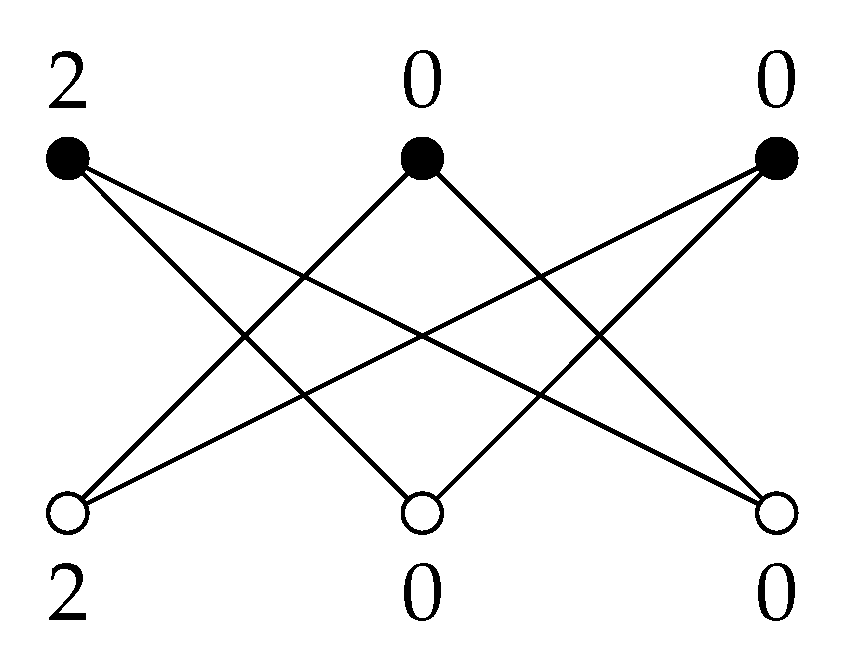
Next, we determine the exact values of the strong Roman domination number for crown graphs
see
Figure 4, whose values depend strictly on the parity of
Proposition 12. Let be a crown graph with vertices, where . Then, Proof. Let denote the crown graph with vertices. Let A be the independent set containing n vertices , and let B be the subset consisting of the remaining n vertices, denoted by , where each is a neighbor of for all
To obtain an upper bound for , we define a function f by assigning and for the remaining vertices. Thus, the vertex covers the vertices of the set B, and covers the vertices of A under the conditions of strong Roman domination.
Consequently, f is an StRDF and Since the upper bound holds.
Taking into account Proposition 3, we have that
Therefore, for odd
we obtain the equality.
Let us assume that is an even integer. We now show that contains at least two vertices. If then , which is a contradiction.
If
, say
, it follows that
which is again a contradiction.
Hence, there are at least two strong vertices in
. Moreover, if
or
then
which is again a contradiction. Therefore, there is at least one vertex in
and one vertex in
From this, one can straightforwardly deduce that
□
Proposition 13. Let be the corona product of a cycle and a singleton . Then, Proof. We construct a labeling on G and show that it is an StRD function, thereby obtaining an upper bound for .
For it can be easily verified that Let with and . Let be the vertices of the cycle and let be the pendant vertices, for where is adjacent to . We define the labeling as follows:
Cycle vertices: For the blocks of four vertices, we define
and
for all
. If
, the labels of the remaining vertices
(for
) are defined as:
Pendant vertices: The labels of the pendant vertices are determined by their neighbors:
Observe that every vertex labeled 0 is adjacent to at least one vertex labeled 2. Furthermore, every vertex labeled 2 has sufficient weight to satisfy the StRDF condition for its, at most, two neighbors labeled 0. Hence,
f is an StRDF of
G with total weight:
These values match those stated in the proposition. Therefore, the upper bound holds.
Now, let us prove the lower bound. First, consider the case . Let f be an StRD function such that is maximum. We claim that:
There is no vertex such that Otherwise, v must be a vertex of the cycle, say Then, we would have and We define the following function and , otherwise. The new function g is an StRD function with the same weight as f but which is a contradiction.
Every vertex v with a label 2 has exactly two neighbors having a label 0. Otherwise, if v would have only one neighbor in , the function defined by would be an StRDF of minimum weight with more vertices labeled 1 than yielding again a contradiction.
As a consequence, every vertex with a label 2 is a vertex of the cycle its leaf has a label 0; one of its neighbors in the cycle, say , must have a label and the corresponding leaf must have a label
We now apply the following discharging procedure. Consider as the initial charge for each vertex v of G. We apply the following rules to obtain the new value of the charges :
Each vertex of the cycle with a label 0 receives a charge of 1 unit from its leaf with a label so increases by 1 and
Each vertex of the cycle with a label 2 transfers a charge of unit to its neighbor on the cycle having a label 0, hence and increases by .
Each vertex of the cycle with a label 1, if any, receives unit from its leaf which also has a label 1 because f has minimum weight. So, and
In summary, by this procedure, the total charge does not vary, i.e.,
. After applying the rules to all the vertices of
G, we have that:
The proof for the other two cases of congruences is quite similar. □
Remark 3. Let G be a connected graph, f a -function, v a support vertex of the graph, and be the set of its leaves, with Then, Now, we establish a specific result for a particular class of caterpillar graphs, which is subsequently extended to a more general setting, see
Figure 5.
Proposition 14. Let C be a caterpillar graph whose central path consists of n vertices each having leaves, where and . Then, Proof. Let
C be the caterpillar graph as stated in the proposition. Let us define a function
f by setting
for the vertices
(
) on the central path; and
, otherwise. This labelling convention ensures that
f is an StRDF and, therefore,
On the other hand, by Remark 3, since the vertices
are strong support vertices, we know that
,
Therefore,
and the result follows. □
To conclude this section, we provide an upper bound for the StRDN of caterpillars. To this end, let C be a caterpillar whose central path consists of n vertices . We denote by the number of leaves attached to the vertex where , and let be the induced subpaths of length that may occur between the support vertices and .
Proposition 15. Let C be a caterpillar whose central path consists of n strong support vertices (having leaves each); k weak support vertices; and q induced subpaths of length whose vertices are not support vertices of the caterpillar. Then, Proof. To obtain this bound, we define a function
f on the caterpillar, ensuring that it is an StRDF. For vertices
with two or more leaves, we define
;
for all weak support vertices; and we label each intermediate subpath of length
for
, with a
-function
having weight
All vertices are thus covered under strong Roman domination and, therefore, we obtain:
□




 ,
,