1. Introduction
Switched and hybrid dynamical systems are inherent to numerous and diverse engineering contexts, such as autonomous systems, fault-tolerant control, cyber–physical systems, transportation, and process industries. Their dynamics are a combination of continuous dynamics with non-continuous transitions between modes, rendering the state estimation, active-mode detection, and closed-loop supervision a far more difficult issue than in the single-mode case. Control-theoretically, switched systems analysis has been built up widely in the areas of stability, detectability, switching logic and controller synthesis; see, e.g., the monograph of Liberzon [
1]. Meanwhile, adaptive and data-driven control are now a paradigm of uncertain and partially unknown systems [
2], and system-identification techniques have offered the foundation of dynamical model reconstruction based on measured data [
3,
4]. Subspace identification is one of such techniques and it has been quite appealing to the multivariate state-space reconstruction as well as the geometric analysis of data [
5,
6].
The Takagi–Sugeno (T S) fuzzy framework provides a useful trade-off between modeling and analysis properties where nonlinearities are important but can be represented by a convex rule-based model. This is why it is extensively applied in filtering, observer design, fault diagnosis, fault-tolerant control and resilient control under switching, delays, uncertainties and cyber-attacks. Finite-time observer-based
fuzzy control of nonlinear jump systems [
7], asynchronous filtering of discrete-time TS fuzzy networks under deception attacks [
8], security control of TS fuzzy cyberphysical systems under sensor and actuator attacks [
9], and resilient event-based control of TS fuzzy jump systems in single-step semi-Markov jump systems [
10] are representative examples. New switched-system fault-tolerant designs also have integrated clustering, classification, and LMI-based compensation [
11]. These publications affirm the applicability of T–S and switched formulations to contemporary safety-critical applications.
At the same time, data-driven mode detection and mode-dependent control have recently received growing attention for switched linear systems whose exact models are not fully available. Recent contributions include data-driven mode detection and stabilization of unknown switched linear systems [
12], online data-driven model predictive control for switched linear systems [
13], and LMI-based mode-detectability analysis for noisy switched linear systems estimated by minimum-distance criteria [
14]. In related adaptive and data-driven directions, recent work has also considered tuning and uncertainty adaptation mechanisms in control systems, such as fictitious-reference iterative tuning for autopilots [
15] and robust adaptive control under projection-based uncertainty compensation [
16]. In spite of these advances, robust online mode certification for switched nonlinear or switched T–S systems remains much less developed than practical mode classification itself. Recent developments in learning-enhanced and intermittent control also reinforce the relevance of uncertainty-aware online decision mechanisms. Representative examples include deep-neural-network-based output-dependent intermittent control for uncertain nonlinear systems and direct data-driven intermittent control with Lyapunov-guided attraction-region estimation and neural feedback-loop design. These works further motivate the need for detection and certification mechanisms that remain compatible with data-driven adaptation and robustness requirements [
17,
18].
A major difficulty is that practical residuals computed online are influenced not only by measurement noise, but also by input mismatch, premise-estimation error, and uncertainty in the estimated observability subspaces. Consequently, a small practical residual does not automatically imply that the corresponding candidate mode is the true active one in a theorem-consistent sense. This is especially acute when a heuristic detector, a certifiable detector with explicit online sufficient conditions, is desired. The current work deals with this challenge by a lifted input–output formulation, where the candidate modes are linked to candidate-dependent input correction terms, and a nominal observability subspace estimated offline with data. The resultant framework is in the form of a relationship between mode detectability and the geometry of lifted observability subspaces, residual-projector perturbation bounds, and amplification terms of explicit input-mismatch effects.
Practical constraints of fixed observation-window strategies are also the inspiration behind the proposed approach. Shorter observation windows can respond rapidly to switches, though this can be very sensitive to noise; longer window periods can enhance discrimination, and reduce the relative contribution of measurement uncertainty, but can lag in detecting a switch, or may fail the local constant-mode condition. We augment the mode-detection mechanism to explicitly represent this trade-off, with a component-wise noise-to-signal ratio (NSR) analysis and an adaptive observation-window policy. The resulting update law is investigated in the stochastic-approximation spirit, in the classical tradition of Robbins and Monro [
19] and the dynamical-systems tradition [
20], and using probabilistic support via martingale convergence methods [
21]. This connection offers a principled manner to connect online NSR regulation to the adaptation of the asymptotic windows.
Some key tools of matrix analysis and robust optimization are also instrumental in the development of the analysis provided in this paper. Specifically, the derivation of the conservative and explicit sufficient conditions is based on the projector perturbation arguments and the subspace geometry of which the classical results of matrix perturbation are necessary [
22]. The robust inequalities are formulated along standard LMI-oriented reasoning based upon the Schur complement [
23], the literature on convex optimization [
24], the S-lemma/S-procedure literature [
25], and results regarding uncertainty-handling related to generalized versions of Petersen’s lemma [
26]. The paper, in this way, unites data-driven lifted modeling, subspace geometry, and robust certification into a built-in switched T–S detection system.
Though the current paper is not dedicated to fractional-order systems, it is conceptually related to a number of recent observer and identification studies designed to deal with uncertain nonlinear and fractional-order dynamics, such as generalized Barbalat-type instruments, to achieve adaptive observer design [
27]; unknown-input observer synthesis of fractional (one-sided) Lipschitz systems [
28]; and bias-compensated identification [
29]. These publications depict the wider approach in perspective, where observer design, uncertainty compensation and data-based approximation remain in progress for more real and less model-driven scenarios.
Against this background, the contribution of the paper is threefold. First, we derive a candidate-dependent lifted residual formulation for switched discrete-time T–S systems with known input, in which the input correction is incorporated consistently into the residual evaluation of every candidate mode. This leads to a practical residual cost and a corresponding ideal residual cost, whose gap can be bounded explicitly. Second, we establish an online verifiable sufficient condition guaranteeing that the practical residual ordering is consistent with the ideal residual ordering, thereby yielding a theorem-consistent mode certification result. Third, we develop a component-wise NSR analysis together with an adaptive observation-window policy, and we relate the latter to a projected stochastic-approximation recursion whose limiting behavior is characterized by a mean-drift equation. In addition, a discernibility index is introduced to quantify uncertainty-corrected separation between mode-dependent observability subspaces. It should be emphasized that the proposed framework is intentionally two-layered: the practical online mode decision is produced by residual minimization, whereas the robust residual-gap result is used as a high-confidence theoretical certification layer that may only be triggered on a subset of windows.
To further clarify the novelty with respect to recent related works, we emphasize that the present contribution is not limited to the use of lifted representations, subspace identification, or residual-based classification taken separately, since these ingredients have appeared in various forms in the switched-systems and data-driven control literature. Rather, the novelty lies in their integration into a single theorem-consistent framework tailored to switched discrete-time T–S systems with premise uncertainty and candidate-dependent input correction. In contrast with closely related recent works on data-driven mode detection or switched linear systems, which mainly address practical classification, stabilization, or predictive control, the present paper adds an explicit online certification layer based on a robust residual-gap condition, a component-wise NSR analysis linked to adaptive observation-window regulation, and an uncertainty-corrected discernibility index for offline geometric separability assessment. In this sense, the contribution of the paper is both integrative and methodological: it provides not only a practical detector, but also a principled mechanism for deciding when a mode estimate can be certified under explicit robustness margins.
In summary, the objective of this work is not only to detect the active mode of a switched T–S system from noisy measured data, but also to determine
when such a decision can be certified online under explicit robustness margins, and
how the observation horizon should be adapted to maintain a prescribed signal-to-noise quality. To further broaden this perspective, we differ from purely data-driven classification schemes and purely model-based detectability studies by offering a framework for data-driven calibration, online residual geometry and adaptive-window regulation, which is certifiable. Simulations showing the practical detection accuracy, conservatism in certification, informativeness of NSR-boundedness and adaptability in the observation window finally validate the theory. The rapid growth in the number of data-driven approaches to science and engineering today raises the expectation that the new generation of smart systems will not only have predictive but also knowledge integration, uncertainty quantification and scalable real-world application capabilities. Data analytics are playing a major role in the fast-tracked industrialization of perovskite solar cells through material selection, process optimisation and processability [
30]. Similarly, in catalysis, the recent finding of data-driven design of dual-atom catalysts highlights machine learning as a powerful tool for mapping structure with properties and to accelerate discovery [
31]. Just like for many physical systems, software engineering is moving towards data-driven techniques, and with machine learning-based risk and test case prioritisation, we have opportunities to achieve better and faster software quality assurance [
32]. In the field of environmental operations, the recent rise of a data-driven approach to weather forecasting has re-emphasised the importance of understanding uncertainty in weather models for consistency, interpretability and trust [
33]. Likewise, in biomedical engineering, the AI-driven, data-driven optimization of nanocarriers demonstrates that such methods can be applied to improve the design of drug carriers by considering their performance, reliability and biological compatibility [
34]. Taken together, these papers indicate that the future of data-driven research is in the development of powerful, uncertainty-sensitive and application-sensitive tools capable of connecting theory, computations and deployment in a range of different applications.
The rest of this paper is structured in the following way.
Section 2 defines the mode-detection problem of switched discrete-time T-S systems, the lifted input–output representation and the candidate-dependent residual construction. In
Section 3, the key theoretical findings are outlined, such as the robust residual-gap certification condition, the NSR-based detectability analysis, the adaptive observation-window policy and the discernibility index.
Section 4 presents the results of simulations that confirm the suggested framework with respect to practical detection accuracy, certification that is consistent across all the theorems, informativeness of the NSR, and adaptive-window behavior. Lastly, the closing statements along with suggestions for future research are provided. In
Appendix B, the paper summarizes the key symbols employed in the paper.
3. Main Results
This section provides robust sufficient conditions for mode detectability under observability-subspace uncertainty, premise-estimation error, and candidate-dependent input mismatch. We first derive a robust residual-gap certification result, then provide a conservative upper bound on the admissible NSR. Next, we present a corrected adaptive observation-window policy and its convergence guarantee. Finally, we define a subspace-based discernibility index and summarize sufficient detectability conditions.
For each mode
q, define the practical residual cost
where
is the candidate-dependent input-corrected lifted output defined in (
6). We adopt the projector-perturbation model
for some known constants,
and
. The constants
and
depend on the conditioning of the nominal observability subspace and can be estimated offline.
Theorem 1 (Robust certification of residual ordering with input mismatch)
. Assume that mode q is active on window . For each candidate mode , define the practical residual cost and the corresponding ideal residual cost where is the exact residual projector and its estimate.Assume moreover that, for every ,For a competing mode , defineIf, for every ,wherethe right-hand side of (19) is a worst-case robustness margin obtained from triangle-inequality and induced-norm relaxations; it is therefore intentionally conservative and does not exploit possible cancellation effects that may occur on individual trajectories, thenConsequently, the ordering induced by the practical residuals is robust with respect to projector uncertainty and candidate-dependent input mismatch, and the active mode q is correctly certified. Proof. For readability, the complete proof of Theorem 1 is deferred to
Appendix A. The main idea is to compare the practical and ideal residual energies through a projector-perturbation decomposition and then incorporate the candidate-dependent input-mismatch bound. □
Remark 2. Although Theorem 1 is intentionally formulated in a fully explicit way, its purpose is not to serve as the primary online decision rule, but rather as a theorem-consistent sufficient certification result. The length of our statement comes from the fact that the margin needs to account for the projector error, mismatch depending on the candidate, and amplifications from the lifted output. In practice, the detected mode is still found via residual minimization, while Theorem 1 is used only to certify those windows for which the measured residual gap is sufficiently large relative to the worst-case uncertainty margin.
Remark 3. Theorem 1 should be interpreted as a sufficient certification result rather than as a condition expected to hold on every detection window. In practical operation, the detected mode is still obtained from the residual minimization step, while certification is issued only when the measured residual gap is sufficiently large to dominate the worst-case uncertainty margin. Thus, the theorem plays the role of a conservative theoretical guarantee, not that of the primary online classifier.
Remark 4 (Online verifiability)
. The sufficient condition (19) can be checked online at each detection instant. Indeed, the practical residuals and , the corrected lifted output norm , and the input norm are directly available from the measured data, while the constants and are precomputed offline from identification and uncertainty bounds. Remark 5. A global semidefinite surrogate of the form is generally too restrictive, since the difference between two orthogonal projectors is typically indefinite. For this reason, we do not use such a condition as a central tractable certificate. In practice, computational surrogates should instead be derived either on a relevant data subspace or from a dedicated robust BMI/LMI relaxation that explicitly incorporates the projector and input-mismatch uncertainties.
We next quantify a conservative admissible NSR bound.
Assumption 2. For the considered operating conditions and informative trajectories of interest, the active mode produces a nonvanishing projected signal on channel j; that is, there exists a deterministic constant such thatfor all admissible trajectories under consideration. Theorem 2 (Conservative upper bound on the component-wise NSR)
. Fix a mode q, an output channel j, and a window length L. Under Assumption 2, and if and then the component-wise NSR satisfies Consequently, any design threshold such that guarantees for mode q at window length L. Proof. Let
Since
we have
By the reverse triangle inequality and
,
Using Assumption 2, we obtain
Condition (
21) makes the denominator strictly positive. Therefore,
which proves (
22). The final claim follows immediately. □
Remark 6. The existence of a strictly positive signal floor is a restrictive assumption. It is typically satisfied only on a prescribed set of informative trajectories, for example when the projected state component is bounded away from the nullspace of the observability operator or when the input provides sufficient excitation over the window.
In practice, the signal floor can be obtained offline either from lower bounds on the estimated observability Gramian, or from empirical lower confidence bounds computed on mode-labeled validation trajectories.
3.1. Residual Criterion and Practical Online NSR Estimate
For each candidate mode
q, define the practical residual energy over the window
as
The detected mode is the one that minimizes the practical residual cost:
Since
is not available online,
is a theoretical quantity used for analysis. In the simulations and in the adaptive-window implementation, the candidate-mode/channel online NSR estimate is taken as
where
is the offline-calibrated noise bound for channel
j, and
is a small numerical regularization constant. This estimator is online-reproducible because it depends only on the measured data, the candidate-dependent corrected lifted output, and the offline-calibrated signal projector.
3.2. Adaptive Window Policy
After computing the candidate residuals and selecting
we define the scalar NSR signal driving the adaptation as
Thus, the adaptive recursion uses the NSR of the currently detected mode rather than that of the unknown true mode, and it selects the most adverse output channel at the current detection instant.
The observation window is then adapted online through the projected stochastic-approximation law
where
satisfies
The positive sign in (
24) is chosen so that the window length increases whenever the selected online NSR exceeds the desired threshold.
Lemma 1 (Projected stochastic-approximation convergence)
. Let Assume that:- 1.
There exists such that ;
- 2.
satisfies the one-sided stability condition for some constant ;
- 3.
is a martingale-difference sequence with respect to the natural filtration , i.e., almost surely, for some .
Then the sequence generated by (24) converges almost surely to . Proof. Define the projection operator
and the estimation error
Then (
24) can be rewritten as
Since the projection onto a closed interval is nonexpansive, we have
Therefore,
Taking the conditional expectation with respect to
and using
we obtain
Because
and
is continuous on this compact interval, there exists a constant
such that
Hence
Using the drift condition (
25), we obtain
Substituting these bounds into (
27) gives
Since
standard supermartingale arguments imply that
converges almost surely and that
Because
, the latter is only possible if
Therefore,
which proves the claim. □
Remark 7. Condition (25) is a strong monotonicity condition on the mean drift. It is satisfied, for example, if F is continuously differentiable on , , and on that interval. We finally quantify mode separability using principal angles between estimated observability subspaces.
Definition 1 (Discernibility index)
. Let and be orthonormal bases of respectively. The smallest principal angle between the two estimated observability subspaces is defined by Define the uncertainty-corrected discernibility index as where are known or estimable sensitivity constants. Modes p and q are said to be distinguishable at window length L if Remark 8. The constants and quantify the sensitivity of the principal angles to observability-subspace perturbations and premise mismatch. In practice, they can be estimated offline either from first-order singular-subspace perturbation bounds or from empirical sensitivity sweeps on mode-labeled validation data, where the principal angles are recomputed under bounded perturbations of the estimated observability subspaces and of the premise trajectory.
Remark 9. The discernibility index is used in this work as an offline geometric separability diagnostic and calibration tool. More precisely, for a given window length L, it indicates whether the estimated observability subspaces of two modes remain sufficiently separated after accounting for uncertainty. It is not used directly in the online decision loop of Algorithm 1, whose real-time operation is based on candidate-dependent residual evaluation and theorem-consistent certification.
Corollary 1 (Summary of sufficient detectability conditions). Fix a window length L and assume that mode q is active on . Suppose that, for every ,
- 1.
The robust residual-gap condition (19) holds; - 2.
The discernibility index satisfies ;
- 3.
The assumptions of Theorem 2 hold and the chosen threshold satisfies
Then mode q is robustly detectable on .
Proof. By Item 1 and Theorem 1, the practical residual gap is large enough to compensate for both projector uncertainty and candidate-dependent input mismatch. Hence the corresponding ideal residual ordering is preserved:
Item 2 ensures that the estimated observability subspaces of modes q and p remain separated after accounting for identification error and premise uncertainty. Hence the residual comparison is not degenerate and the competing modes remain distinguishable.
Finally, by Item 3 and Theorem 2, the component-wise NSR satisfies
Therefore, both the robust residual-gap condition and the admissible NSR requirement are satisfied. It follows that the active mode
q is robustly detectable on the window
. □
3.3. Overall Workflow of the Proposed Framework and Algorithmic Summary
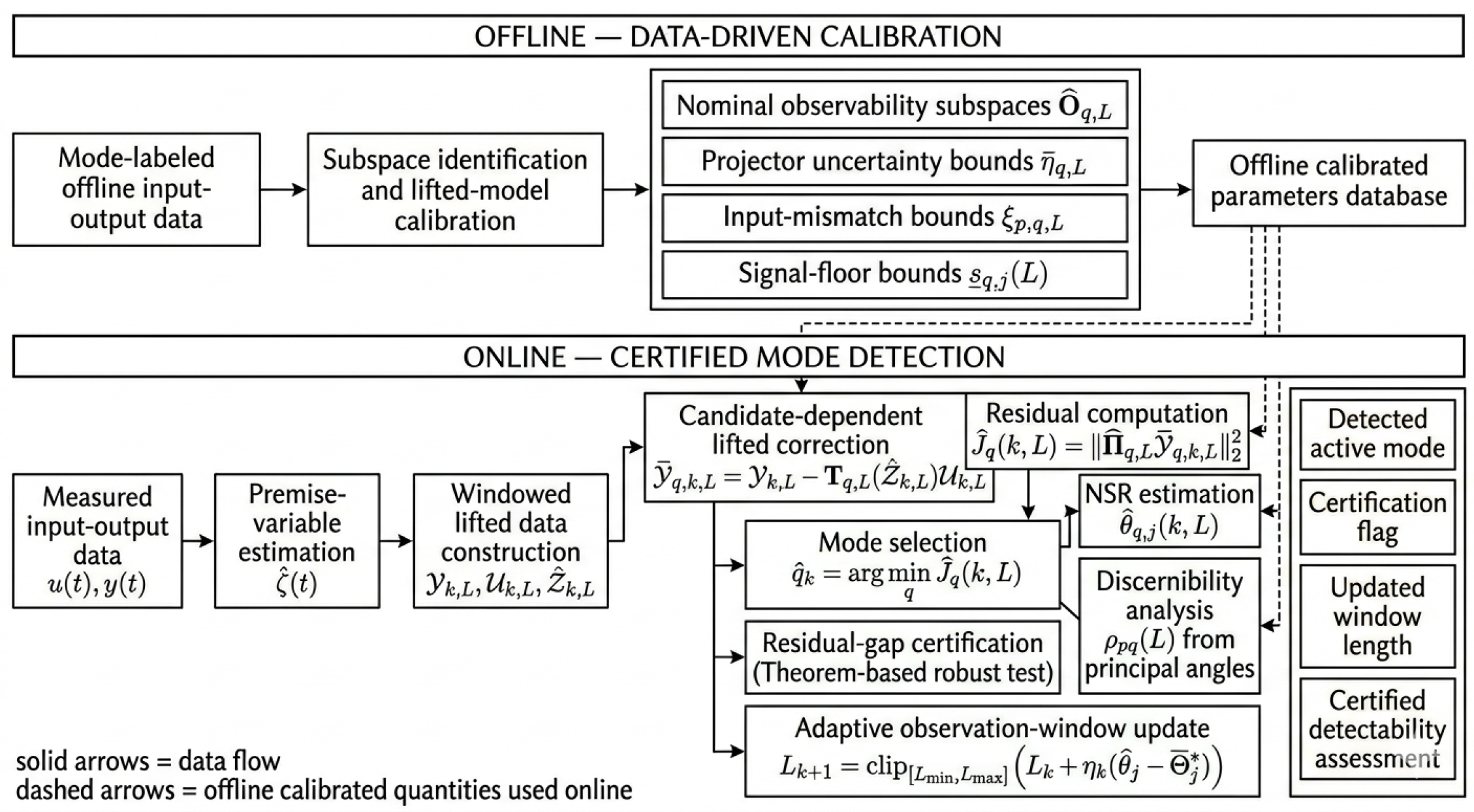
To facilitate easy understanding and practical application, we present the workflow of the proposed data-driven certified mode detection. It showcases the interaction between the offline calibration process and the online certified mode detection process of candidate-dependent lifted correction, mode selection based on residuals, theorem-consistent certification, noise-to-signal ratio (NSR) observer, and online observation-window adaptation. The discernibility index is not part of the online recursion itself; instead, it is used offline to assess whether a chosen window length yields sufficient subspace separation between competing modes before deployment.
Figure 1 provides an overall view of the proposed methodology. The upper branch summarizes the offline data-driven calibration of the observability subspaces and uncertainty bounds, whereas the lower branch illustrates the online certified mode-detection procedure. In particular, the figure highlights the distinction between practical mode selection, theorem-consistent certification, and NSR-based adaptive-window regulation.
The online framework of the proposed approach is illustrated in Algorithm 1. Specifically, the detector combines three complementary mechanisms: residual-based mode selection, theorem-consistent certification, and NSR-driven window adaptation. The practical mode estimate is given by the residual comparison, the certification step filters out decisions that fail to meet the robustness margin of Theorem 1, and the adaptive update of
regulates the observation horizon based on the selected online NSR signal. The following section interprets the simulation results from this algorithmic perspective, with emphasis on practical detection accuracy, certification coverage, NSR-bound informativeness, switching stress tests, and adaptive-window behavior.
| Algorithm 1: Certified online mode detection with adaptive observation window |
 |
4. Simulation Results
In this section, the theoretical findings of
Section 3 are validated on a representative two-mode discrete-time switched T–S benchmark with nonzero input, measurement noise, and candidate-dependent input correction. In addition to the fixed-window analyses used to assess practical detectability, theorem-consistent certification, NSR-bound informativeness, and subspace discernibility, the simulations also address three reviewer-motivated questions: (i) the behavior of the detector when Assumption 1 is violated by a mode switch inside the observation window, (ii) the explicit implementation of the online NSR estimator used in the adaptive-window law, together with trajectory-based numerical evidence on its drift behavior, and (iii) a comparison with a baseline minimum-residual detector without certification.
4.1. Benchmark and Simulation Setup
We consider a two-mode switched T–S fuzzy system with state dimension
, output dimension
, and scalar input
. Each mode is described by two local T–S rules with state-dependent membership functions. The premise variable is chosen as the first state component and is estimated online from the first measured output. The observation-window length is allowed to vary in the range
while the nominal validation window used for the main fixed-window theoretical checks is
.
The offline calibration is performed for each admissible window length using 220 mode-labeled windows per mode. The main online validation trajectory contains 900 time steps and a piecewise-constant switching sequence with repeated mode changes. The measurement noise is Gaussian, clipped componentwise so that
For the adaptive-window study, a separate constant-mode trajectory is used in order to isolate the behavior of the NSR-driven recursion from mode-switching effects. In the adaptive study, the online NSR estimator is implemented explicitly as
and the scalar quantity driving the update is chosen as the worst channel of the detected mode, namely
The adaptive-window policy is initialized at
and uses the target threshold
which is more consistent with the empirically observed scale of the selected-mode NSR than the earlier exploratory value
.
4.2. Offline Calibration and Uncertainty Quantification
The offline stage provides empirical uncertainty bounds for the nominal observability subspaces, projector perturbations, input-mismatch terms, and channel-wise signal floors.
Table 1 reports the calibrated quantities at the nominal window length
.
The corresponding input-mismatch bounds defined in (
11) are
These values confirm that the candidate-dependent forced-response mismatch is non-negligible and must be accounted for in the robust residual-gap analysis.
4.3. Subspace Discernibility
Using the nominal observability-subspace bases at
, the uncertainty-corrected discernibility indices defined in (
30) are
Both values are strictly positive, which confirms that the two estimated observability subspaces remain sufficiently separated after accounting for subspace-estimation uncertainty and premise mismatch. Hence the geometric distinguishability condition required in Corollary 1 is satisfied.
4.4. Validation of Robust Residual-Gap Certification
The practical mode detector selects the mode minimizing the candidate-dependent residual cost
Over 879 windows satisfying the constant-mode assumption of Assumption 1, the detector achieves a practical accuracy of
This shows that the residual-based detector performs well in practice despite measurement noise, premise estimation error, and mode-dependent input correction.
The online verifiable robust residual-gap condition of Theorem 1,
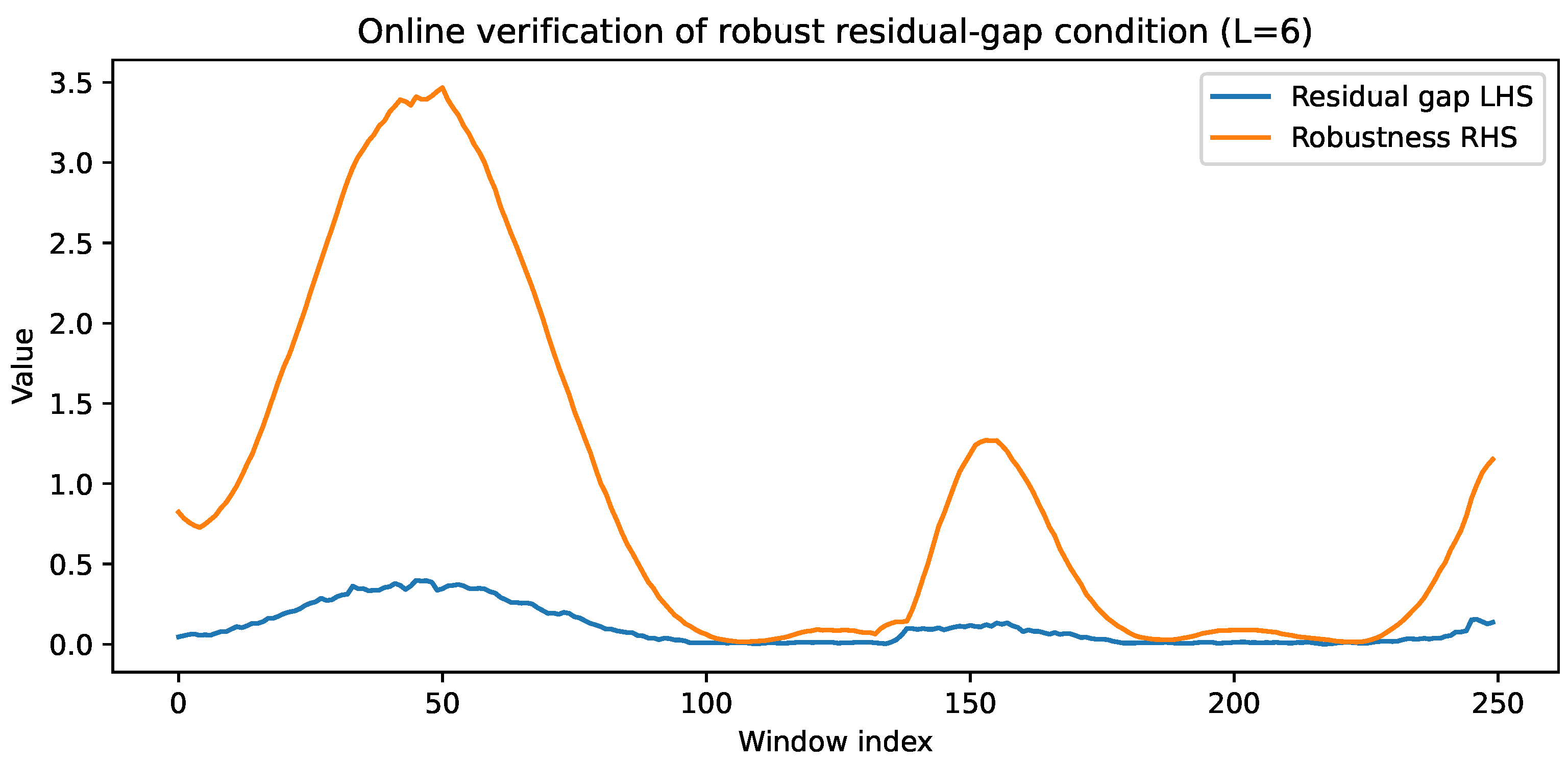
is satisfied on only two windows, but in both cases the certified ordering is fully consistent with the ideal residual ordering, yielding a certified correctness rate of
This behavior is illustrated in
Figure 2. Since this quantity is defined as
, it may also become negative on some windows; in that case, the robust certification inequality necessarily fails. The blue curve represents the measured residual gap
, and the orange curve is the theoretical robustness margin on the right-hand side of the sufficient condition above. Neither of the two curves is likely to converge to the other in the asymptotic sense: the orange curve is an uncertainty margin that is always a worst case, whereas the blue curve is a measured value that depends on the data. The fact that the orange curve is above the blue curve on most windows shows that the condition is highly conservative, not necessarily that the theoretical result is wrong. The numerical result thus verifies the intended purpose of Theorem 1: a high-confidence certificate of verification, not a commonplace trigger. Accordingly, the low certification coverage observed in the simulations should not be interpreted as weak practical detection performance. Rather, it reflects the deliberately conservative role of Theorem 1, whose purpose is to certify only those windows for which the practical residual ordering remains robust under worst-case uncertainty margins.
4.5. Validation of the NSR Upper Bound
The conservative channel-wise NSR upper bounds obtained from Theorem 2 at
are
Unlike the earlier vacuous case where the denominator in (
22) vanished, the present calibration yields finite and informative upper bounds because the signal-floor condition of Assumption 2 is satisfied.
Table 2 compares these theoretical bounds with empirical NSR statistics on the true active mode.
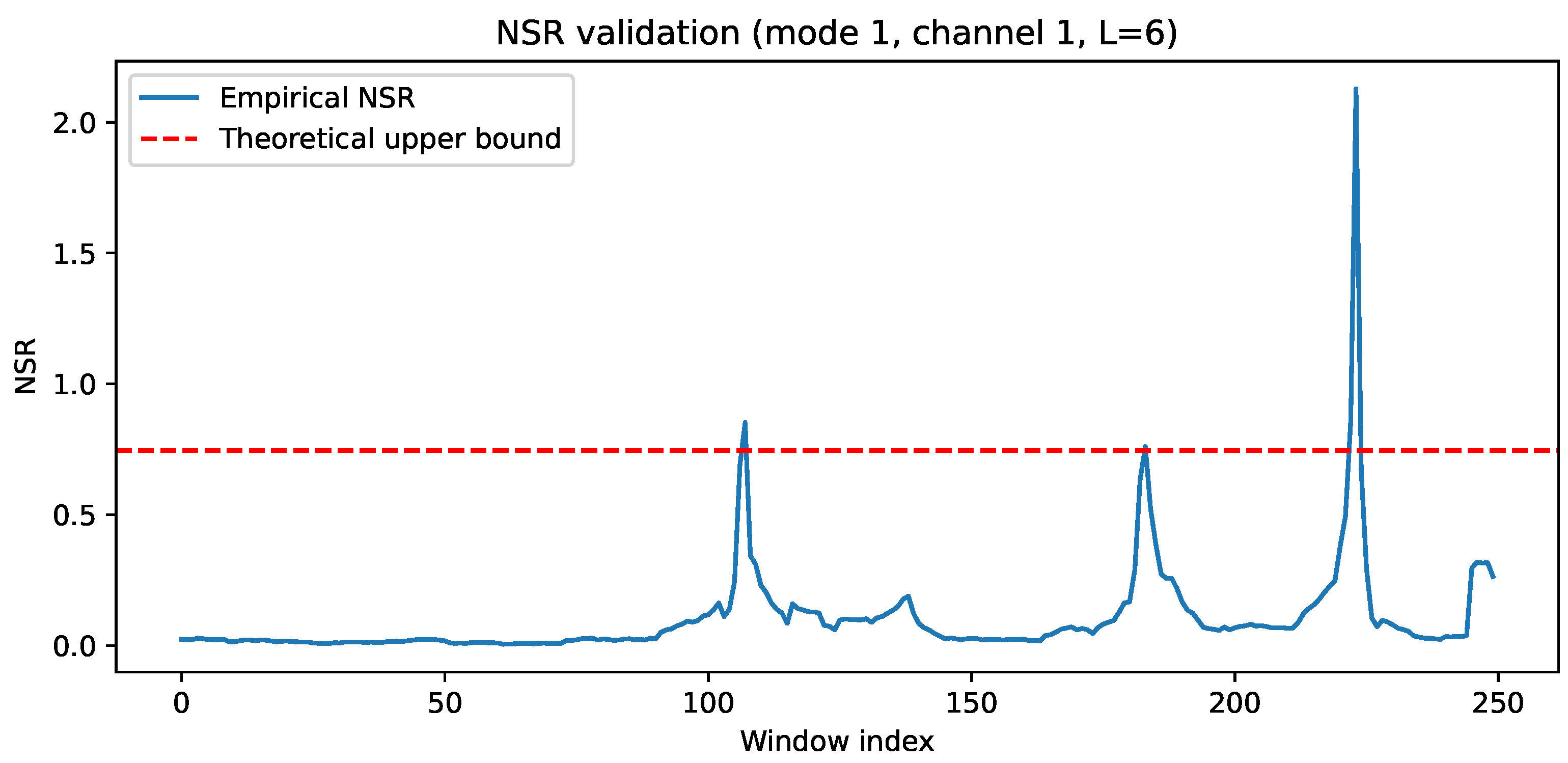
The result suggests that the empirical NSR is below the theoretical limit on most of the windows, but there are spikes in the NSR above the limit on some samples. This is in line with the theory of Theorem 2: the outcome gives a conservative sufficient upper bound (using a deterministic signal floor) and is thus informative but not tight. This behavior is captured in
Figure 3 for mode 1, channel 1: the empirical NSR is generally much smaller than the theoretical level, but there are occasional spikes of short length that are above the limit.
This type of temporary violation should not be viewed as a general refutation of the analytical framework. On the contrary, it suggests that the sufficiency of the NSR bound is only anticipated to hold on informative intervals during which the projected signal floor is sufficiently far from zero. Temporary weakness of the interpreted projected signal may still result in large instantaneous NSR values (even with bounded measurement noise) and thus exhibit the exhaustive upper bound as locally conservative or uninformative. In this regard, the violations are naturally consistent with the conservative Assumption 2, as well as with the worst-case nature of the sufficient bound.
4.6. Stress Test Under Intra-Window Switching
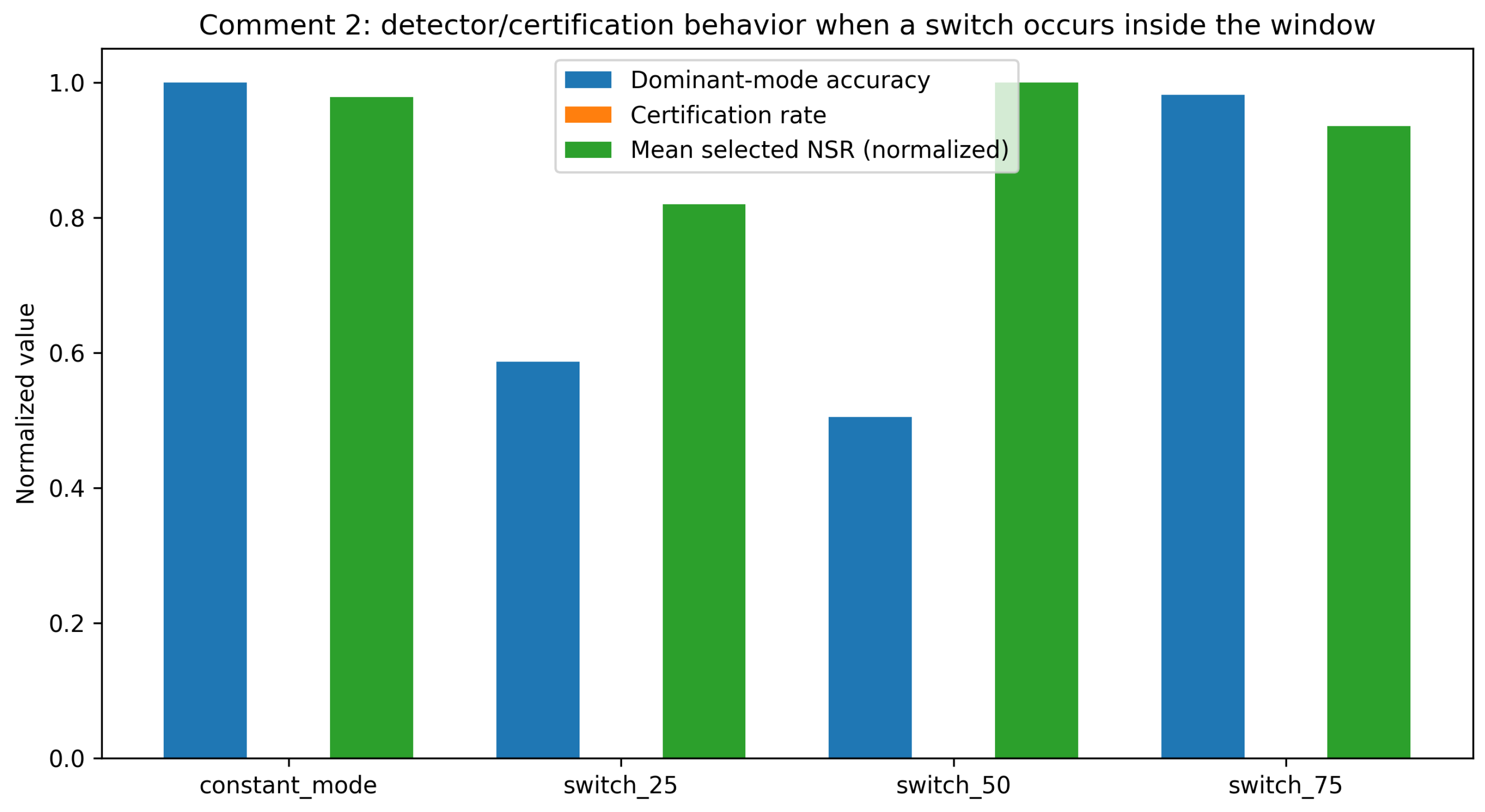
To evaluate the effect of violating Assumption 1, we next consider windows in which a single mode switch occurs inside the observation horizon. Four scenarios are tested at
: a constant-mode case, and three switched cases in which the switch occurs after
,
, or
of the window.
Table 3 summarizes the resulting detector behavior.
The results reveal three clear effects. First, when the window is constant-mode, the detector remains perfectly accurate on this stress-test set. Second, when a switch occurs early in the window (switch_25), the detector tends to favor the post-switch mode because it occupies most of the available samples. Third, when the switch occurs late (switch_75), the detector overwhelmingly follows the pre-switch mode. The mid-window case (switch_50) is the most challenging: in that case the window contains comparable contributions from both modes, and the detector strongly favors the pre-switch mode. Since a 50%–50% split does not define a unique dominant mode in a strict sense, the pre-switch and post-switch hit rates are more informative there than the dominant-mode accuracy alone. In all switched scenarios, the theorem-based certification rate is zero, which is consistent with the fact that the sufficient certificate is derived under the constant-mode assumption and becomes even less likely to hold when that assumption is violated.
Figure 4 presents the detector behavior when a switch occurs inside the observation window.
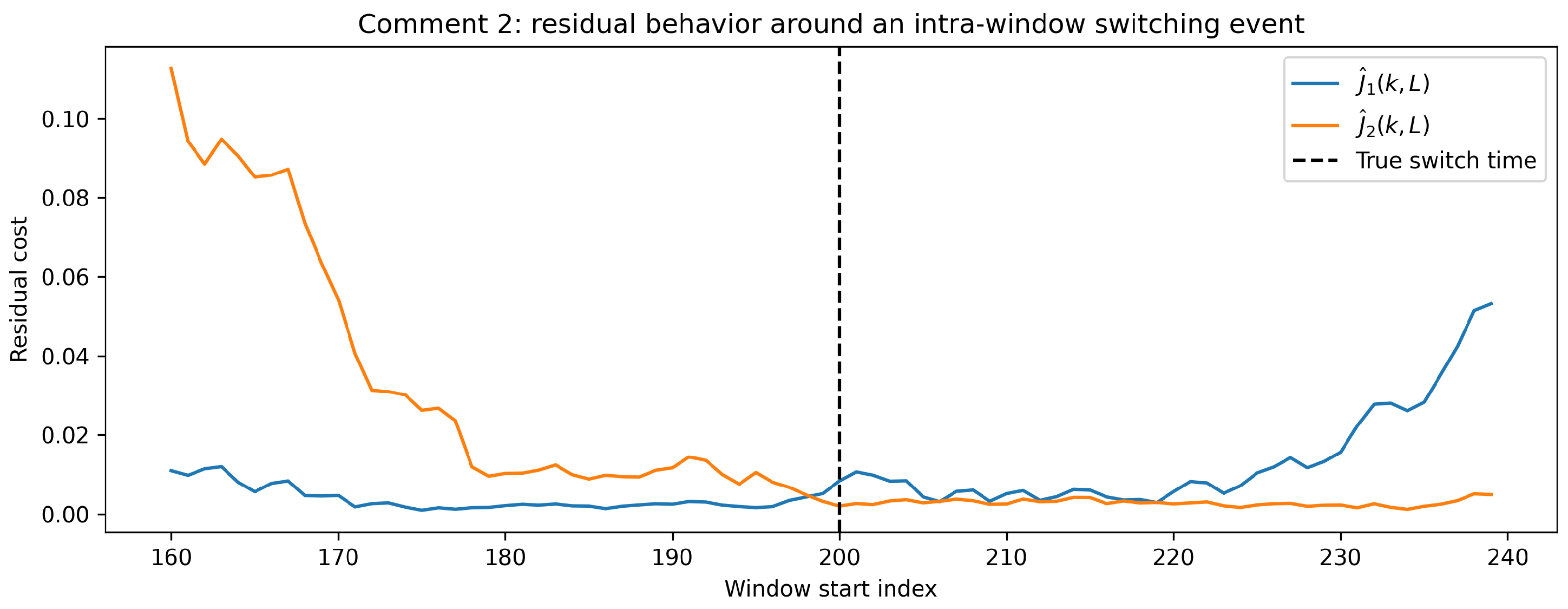
Figure 5 further illustrates the transition mechanism around a single switching instant. Before the switch,
is smaller than
, indicating consistency with mode 1. Around the switching time, the two residuals approach each other, and once a sufficient fraction of post-switch data enters the window,
becomes the smaller residual while
increases. This behavior confirms that the detector reacts to the effective mixture of pre-switch and post-switch samples present in the window, rather than to the switching instant alone.
4.7. Explicit Online NSR Estimator and Adaptive Observation-Window Policy
We next evaluate the adaptive-window policy using the explicit online NSR estimator introduced above. The experiment is conducted on a constant-mode trajectory so that the adaptation behavior is not confounded by mode changes. In contrast with the earlier exploratory setting, the study uses the design threshold , which is more consistent with the empirically observed magnitude of the selected-mode NSR.
A trajectory-based drift study is first performed by fixing
L and averaging the online quantity
over a long constant-mode run.
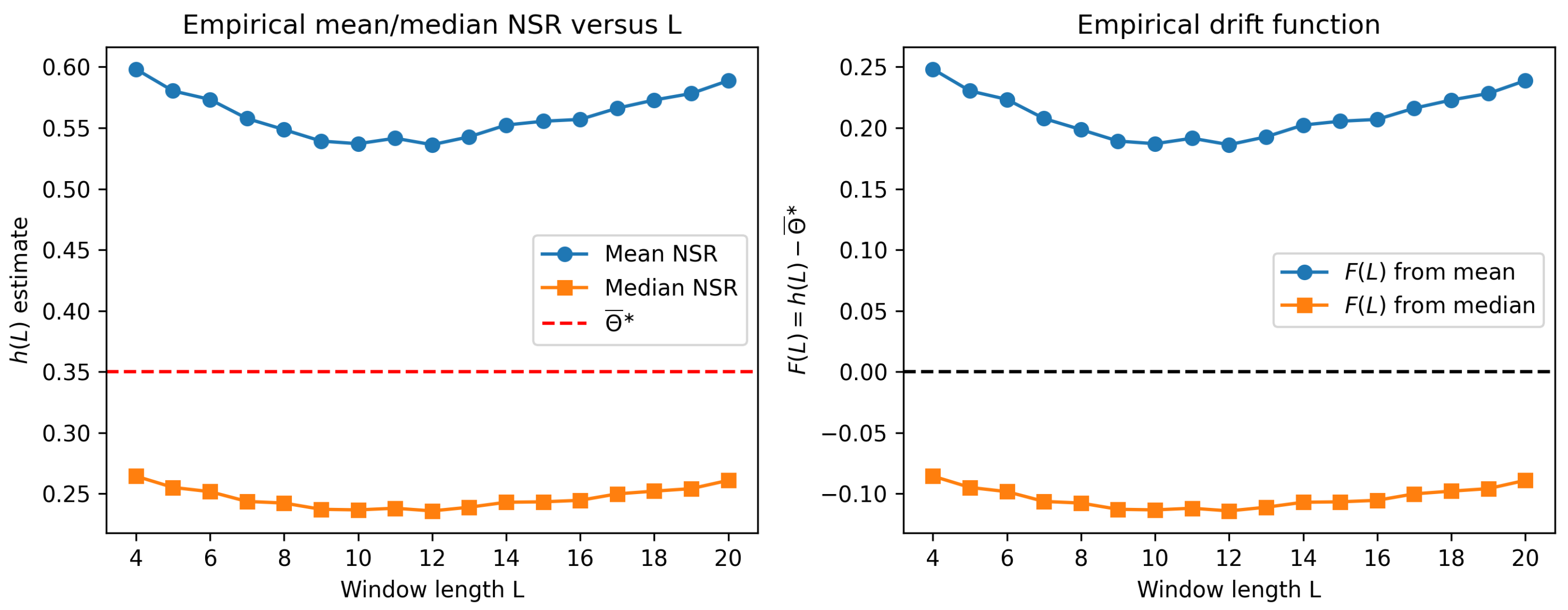
Figure 6 reports both the mean and the median NSR as functions of
L. The mean selected-mode NSR lies in the interval approximately
, whereas the median selected-mode NSR lies in the smaller interval
. Consequently, the mean drift
remains positive over the tested interval, with values between approximately
and
, while the median-based drift remains negative, between approximately
and
. This indicates that the central tendency of the online NSR is below the chosen threshold, but that rare high-amplitude spikes substantially affect the empirical mean.
The corresponding adaptive trajectory is shown in
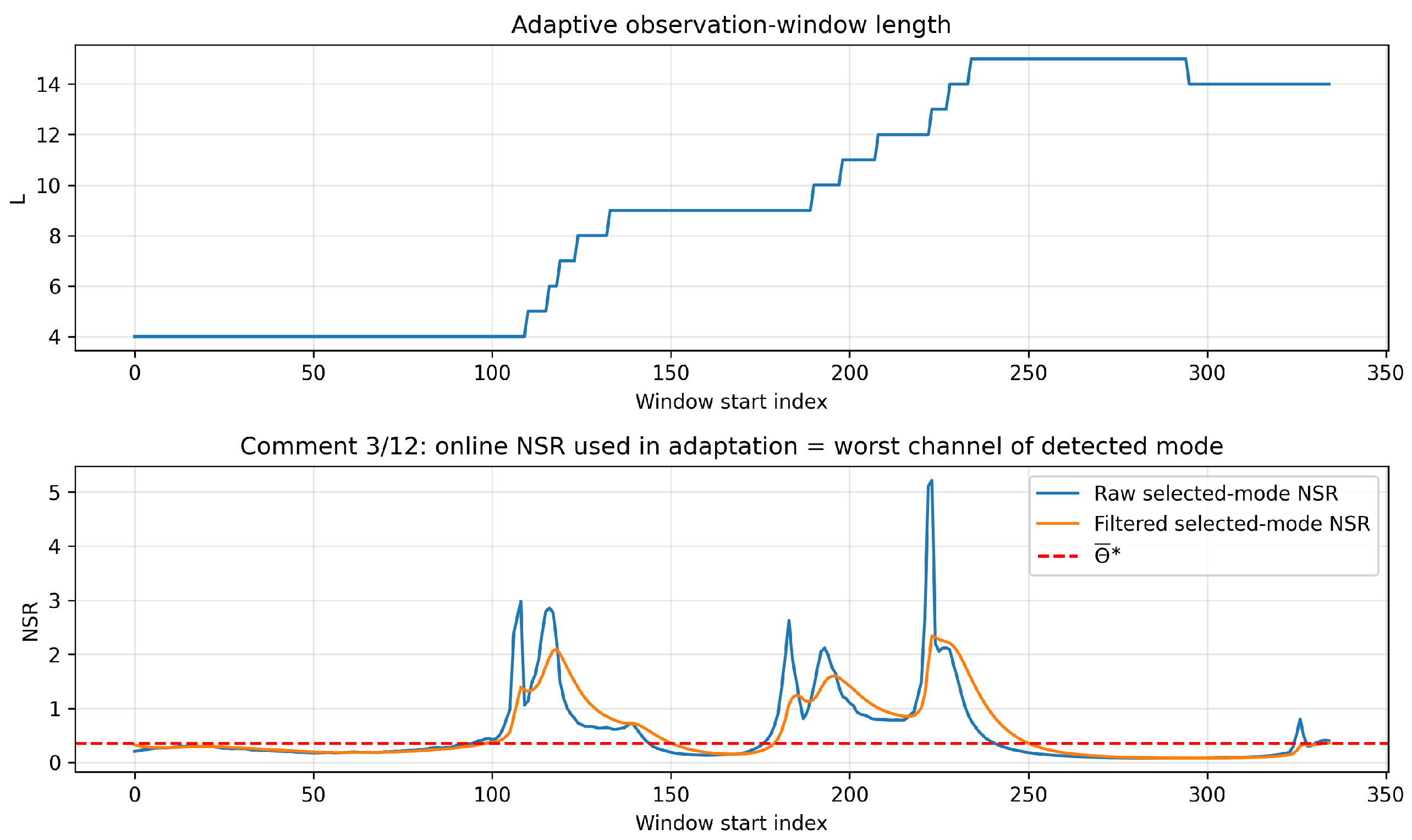
Figure 7. The window starts at
, stays there during low-NSR periods, then increases progressively during sustained excursions of the filtered selected-mode NSR, reaching an interior range around
–15 before settling back toward
. This is a substantial improvement over the earlier exploratory run that tended to saturate near the upper bound. The filtered NSR remains much smoother than the raw selected-mode NSR and reacts mainly to sustained, rather than instantaneous, excursions. The simulation therefore supports a practical interpretation of the adaptive law: the recursion regulates the effective observation horizon in response to the long-run NSR tendency, while isolated spikes may still generate transient departures from the target.
From a practical perspective, the role of the adaptive observation-window mechanism is not to induce large or abrupt changes in the horizon, but rather to regulate the effective window length so as to balance responsiveness to mode changes against robustness to measurement noise. In the present benchmark, its visible effect remains moderate because the update is clipped to an admissible integer range, the gain sequence is diminishing, and the selected NSR signal is intentionally conservative. Nevertheless, the simulations show that the mechanism is active and meaningful: it avoids persistent saturation at the upper bound, adapts the observation horizon to sustained NSR excursions, and improves the operating region of the certified detector relative to the fixed-window version. Possible improvements include the use of less pessimistic NSR surrogates, adaptive gain tuning, and extensions to richer switching scenarios or higher-dimensional benchmarks.
It is important to emphasize that the present numerical evidence should not be interpreted as a literal empirical proof of the exact drift condition in Lemma 1. Rather, the results show that the explicit online estimator is reproducible and practically meaningful, that the typical selected-mode NSR remains below the chosen threshold in a median sense, and that the adaptive recursion behaves consistently with that robust tendency while remaining sensitive to rare spikes in the empirical mean.
4.8. Baseline Comparison
To assess the practical added value of certification and adaptive windowing,
Table 4 compares three methods on constant-mode windows: (i) a simple baseline detector based only on the minimum residual at fixed
, (ii) the same fixed-window detector augmented with theorem-based certification, and (iii) the adaptive certified detector.
The comparison confirms three points. First, even the plain minimum-residual detector is already strong in practice. Second, adding certification preserves perfect correctness on the certified subset but, at fixed L, certifies only a very small number of windows. Third, the adaptive certified version improves both practical accuracy and certification coverage relative to the fixed-window certified version, at the cost of a larger average observation length. This supports the claim that the proposed framework is not merely a heuristic classifier: the certification layer adds a rigorous reliability filter, and the adaptive layer improves its practical operating region.
4.9. Discussion
The simulations lead to seven main observations.
Practical detectability is strong: The candidate-dependent residual detector achieves accuracy over 879 constant-mode windows in the main fixed-window validation, and the baseline minimum-residual detector reaches accuracy on the dedicated comparison set.
Mode geometry is favorable: The positive discernibility indices
confirm that the estimated observability subspaces remain separated under uncertainty.
The robust certificate is sound but conservative: Only two windows satisfy the sufficient condition of Theorem 1, yet both certified cases are correct, yielding certification consistency.
The NSR theorem is informative: Finite analytical bounds are obtained for all channels and both modes. Although some transient windows exceed these thresholds, the empirical NSR remains below the theoretical bound on the majority of samples.
Violation of Assumption 1 degrades performance in a structured way: The detector remains accurate in constant-mode windows, but its decision shifts toward the mode occupying the larger fraction of the window when a switch occurs inside the horizon. The most ambiguous case is the mid-window switch, for which the pre-switch and post-switch contributions compete most strongly.
The explicit online NSR estimator is operational and informative: Trajectory-based evidence shows that the median selected-mode NSR remains below the chosen threshold, whereas the mean remains sensitive to rare but large spikes. This explains why the adaptive recursion regulates the window in an interior range while still exhibiting transient excursions.
Adaptive certification improves the operating region relative to fixed-window certification: The adaptive certified detector achieves practical accuracy and certification coverage , compared with practical accuracy and coverage for the fixed-window certified version, while preserving certified correctness in both cases.
In summary, the simulations confirm the proposed approach at four levels of complementarity: (i) practical performance, in terms of high residual-based detection rates; (ii) “geometric consistency”, in terms of positive discernibility indices; (iii) robust certification, in terms of sound but conservative residual-gap guarantees; and (iv) adaptive operation, in terms of an explicit online NSR estimator, reviewer-motivated switching stress tests, and an extended certification region under adaptive windowing. The drawbacks are the conservatism of the worst-case sufficient conditions, and the vulnerability of empirical mean NSR statistics to spiky events, which call for future research on less conservative residual-gap margins and more resilient adaptive criteria.
5. Conclusions
This paper considered the problem of online mode detection for discrete-time switched Takagi–Sugeno (T-S) systems, based on noisy input–output measurements, in the presence of candidate-dependent input correction and uncertainty in data-driven observability subspaces. The main ideas underlying the new framework were based on a lifted input–output model, where each candidate mode is paired with a mode-dependent forced-response correction and a nominal observability subspace, which is computed offline from a typical data set. This resulted in a practical residual cost for online mode selection and an ideal residual cost using the exact residual projector. The first contribution of the paper is a sufficient condition to verify online the consistency between the practical residual ordering and the ideal residual ordering. This robust residual-gap inequality explicitly accounts for all the factors of residual-projector perturbation, candidate-dependent input mismatch and finite-window signal amplification. Hence, it offers a theorem-consistent verification mechanism to support practical residual-based detection by pinpointing the situations where an online mode decision can be considered safe from a robustness perspective. The second contribution is a component-wise analysis of the noise-to-signal ratio (NSR) of the projected lifted outputs. For offline computation of signal-floor conditions, conservative bounds on the NSR were derived, allowing for the explicit assessment of detectability for each mode, for each output. These are conservative but serve to provide a quantitative bridging principle between measurement noise, informative signals, and observation-window designs. The third contribution is the design of an adaptive observation-window scheme in response to the estimated NSR. By designing the update law to be a projected stochastic-approximation algorithm, a link was provided between real-time noise scaling and adaptive-window evolution. Moreover, the paper proposed an uncertainty-corrected discernibility index, which is defined in terms of principal angles between the estimated observability subspaces, to measure the mode discernibility under uncertainty. The simulations revealed a number of interesting aspects of the proposed framework. First, the finite detector had good online mode-detection performance. Second, we demonstrated that the robust residual-gap certificate was sound but conservative: it was only triggered on a fraction of the windows but all certified decisions were fully consistent with the ideal residual ordering. Third, the NSR analysis produced finite and meaningful bounds, with a few short windows exceeding the bounds due to transients. Lastly, the adaptive-window policy showed stable adaptation with a moderate level of adaptation and the filtered NSR maintained around the required level. In conclusion, the paper presents a unified framework for data-driven observability tuning, practical mode detection, theorem-consistent residual certification, NSR-based adaptive windows, and geometric discernibility for switched T–S systems. In this respect, the proposed approach integrates a practical residual-based classifier with a theorem-consistent certification layer, thus going beyond heuristic classification while being conservative at the level of certification thanks to explicit robustness margins and adaptive security margins. There are a number of possible avenues for future research. The first direction is to reduce the conservatism of the certification inequalities, for instance, by better bounds on subspace perturbations and/or more optimistic bounds on the candidate-dependent input mismatch. A second avenue is to develop techniques to handle windows with intra-window switching, thus relaxing the assumption of the local constant mode. A third point of view is the application of the framework to fault diagnosis, robust estimation, and trusted detection in cyber-attacked cyber–physical systems. Finally, it would be of interest to explore recursive offline–online learning algorithms for updating the nominal observability subspaces and signal-floor estimates online.