1. Introduction
Tensor–scalar extensions of General Relativity provide a mathematically convenient way to enlarge the phenomenology of gravitation while retaining a geometric description of spacetime [
1,
2,
3]. In their simplest versions, one supplements the metric with one or more scalar degrees of freedom, motivated both by classical alternatives (e.g., Brans–Dicke variability of the effective gravitational coupling) and by effective low-energy limits of higher-dimensional or quantum-corrected gravitational actions, where additional scalar modes naturally emerge. The framework considered here is a two-scalar tensor–scalar model in a Jordan/Fierz representation, featuring a Brans–Dicke-like scalar
non-minimally coupled to the Ricci scalar and a second scalar
minimally coupled through a source term
[
4,
5,
6].
A key novelty arises when this gravitational sector is coupled not to standard Maxwell electrodynamics but to extended Aharonov–Bohm (AB) electrodynamics, whose reduced gauge symmetry permits an additional propagating scalar quantity
sourced by the “extra-current”
in situations of local charge nonconservation ([
7,
8,
9,
10,
11] and references, [
12] and references). This is physically interesting because, in Maxwell theory, the electromagnetic energy–momentum tensor is traceless, whereas AB electrodynamics admits couplings involving
S and (in general) nontrivial trace contributions; this opens qualitatively new channels for an interaction between gravitational scalars and electromagnetic configurations capable of generating
S. The resulting formal framework can thus be viewed as a controlled “extension” of the usual Maxwell/GR regime (recovered when
) that becomes nontrivial only in special circumstances where
S is excited.
A useful way to clarify the physical motivation of the present construction is to contrast it with the standard Maxwell-plus-General-Relativity setting. In ordinary Maxwell electrodynamics, the electromagnetic energy-momentum tensor is traceless in vacuum. As a consequence, in scalar–tensor extensions of gravity the electromagnetic sector does not naturally provide, through the trace channel, a robust source for additional scalar gravitational degrees of freedom. This severely limits the possibility of generating self-supported vacuum traveling structures through a purely electromagnetic-scalar coupling mechanism. By contrast, in extended Aharonov–Bohm electrodynamics the reduced gauge symmetry allows the appearance of the scalar quantity , and the electromagnetic sector is no longer constrained to behave exactly as in the Maxwell case. In particular, the scalar mode S provides an additional channel through which the gravitational scalars can be sourced and can feed back on the traveling-wave dynamics. It is precisely this extra scalar sector, absent in standard Maxwell theory, that makes possible the nonlinear reduced system studied here. This is the sense in which the present solitary-wave mechanism should be regarded not as a generic feature of Einstein–Maxwell theory, but as a consequence of coupling tensor–scalar gravity to the extended AB framework.
A second important point concerns the physical origin of the extra-current . Within the AB extension, I parametrizes departures from strict local charge conservation and acts as the source of the scalar mode S. In ordinary classical electrodynamics one has , and, therefore, and S is not excited. The AB framework becomes nontrivial only in special situations in which the effective current is not locally conserved in the standard sense, or in which coarse-grained or quantum-effective descriptions produce a non-vanishing . For this reason, the model is not intended to describe generic electromagnetic phenomena, but rather a restricted class of systems in which anomalous source terms may arise. This viewpoint is also useful conceptually: the source region, where , is the place where the scalar mode is generated, while the reduced traveling-wave equations analyzed in this work describe the subsequent propagation outside the source region, where the autonomous reduction applies. In this sense, the “extra-current” should not be interpreted as an ad hoc mathematical device, but as the effective trigger of the AB scalar sector and hence of the nonlinear solitary-wave dynamics.
The question of physical plausibility is therefore closely tied to the question of experimental accessibility. At present, the most natural arena for such effects is not standard astrophysical or cosmological propagation, but rather special laboratory situations or macroscopic quantum systems in which local charge conservation may become effectively nontrivial at an intermediate description level. In this regard, the present work should be read with appropriate caution. We do not claim that the solitary waves constructed here are already identified with known astrophysical or cosmological signals, nor that they directly provide a model for observed gravito-electromagnetic pulses. Establishing such a connection would require, at a minimum, a detailed analysis of realistic source mechanisms, parameter ranges, energetics, stability, and propagation in multidimensional settings. These issues lie beyond the scope of the present paper. What the present analysis does provide is a mathematically complete classification of the one-dimensional traveling-wave sector of the reduced theory, which may serve as a first step toward future phenomenological investigations if experimentally credible source mechanisms for are identified.
From this perspective, the physical significance of the present solutions is twofold. First, they show explicitly that once the AB scalar mode is admitted, the coupled scalar–tensor/electromagnetic system can sustain coherent traveling structures in vacuum without invoking an external material medium. Second, they isolate the dynamical regimes that such structures may exhibit after leaving the generation region: bounded pulses, escaping branches, and trajectories driven toward the singular boundary of the reduced model. Whether any of these regimes can be realized in concrete experiments, or can play a role in broader astrophysical environments, remains an open problem. For the time being, the most conservative interpretation is that the present solitary-wave families should be viewed as theoretically admissible propagation modes of the reduced tensor–scalar/AB system, and as candidate asymptotic profiles to be selected by special source regions, rather than as already established observable signals.
1.1. From Field Equations to One-Dimensional Traveling Reductions
In the weak-field regime around Minkowski space and around vacuum expectation values, the coupled system reduces to wave-type equations for the scalar perturbations driven by nonlinear source terms proportional to
, together with a modified AB wave equation for the four-potential. A simple reduction is obtained by seeking one-dimensional traveling profiles depending on a single comoving variable
with ansatz of the form
so that
and the associated longitudinal electric component is proportional to
. (Note that we have denoted here the physical space and time coordinates with
and
, respectively, in order to avoid confusion later with the variables
X and
t used in the mathematical treatment.) Outside the sources, the reduced equations can be written as the coupled autonomous ODEs
where
and
is a constant determined by the scalar–electromagnetic couplings. These equations are further reducible to a single nonlinear second-order equation for
, namely
where
is an integration constant. The resulting first integrals yield an implicit expression for a localized traveling profile (a soliton-like pulse) for
, parametrized by
v and integration constants.
In greater detail, the derivation is the following: let us define
From the reduced equations outside the sources, namely
the first is rewritten as
Introducing
, one has
, therefore,
whence
, for a constant
C. Therefore,
Replacing into the second equation,
i.e.,
Redefining the constant as
, one obtains
.
We stress that the present classification concerns a very specific sector of the full field theory: one-dimensional traveling profiles of the form , , , valid outside sources and in the weak-field approximation. We do not claim that these solutions are generic for arbitrary Cauchy data, nor that their stability under multidimensional perturbations has been established. Stability, transverse perturbations, and source-to-propagation matching in the full PDE system are natural next steps.
1.2. Solitons in Nonlinear Field Models
Broadly speaking, a
soliton is a localized, non-dispersive solution of a nonlinear evolution equation that propagates while preserving its shape, typically because nonlinearity balances dispersive spreading. In integrable settings, solitons possess additional structure (e.g., elastic interactions and infinitely many conserved quantities), while in non-integrable settings, one often uses “solitary wave” or “soliton-like” to emphasize robustness rather than complete integrability [
13,
14].
In classical and relativistic field theory, solitons appear both as topological configurations (kinks, vortices, monopoles) and as non-topological localized lumps, and traveling coherent structures provide a natural bridge between PDE dynamics and ODE phase-portrait analysis [
14].
1.3. Nonlinearity Without a Material Medium
Many of the most familiar electromagnetic solitons arise in media: nonlinear optics provides paradigmatic cases where constitutive relations (e.g., Kerr-type responses) produce nonlinear propagation, enabling stable pulses whose propagation would otherwise disperse in vacuum [
15,
16,
17]. The present setting is conceptually different. No external medium is invoked to supply the nonlinearity; instead, the effective nonlinearity responsible for coherent traveling pulses is generated intrinsically by the coupling between the gravitational scalar sector and the AB electromagnetic scalar
S (and the associated coupling function
), yielding a closed nonlinear vacuum field system after reduction.
1.4. On Superluminal Phase/Group Parameters and Causality
The appearance of traveling-wave families parametrized by
raises an immediate interpretive question: does this entail a violation of causality? In a wide class of wave systems, the answer is negative. It is known that in dispersive media phase velocities and even group velocities may exceed
c without enabling superluminal signaling; the causality-relevant quantity is the
front (or signal) velocity, governed by analyticity/causal response and by the characteristic structure of the underlying hyperbolic problem [
18,
19]. Even in vacuum settings, superluminal phase velocities occur routinely (e.g., guided waves in waveguides), while the energy/information transport remains subluminal.
Accordingly, in the present tensor–scalar/AB model, the parameter v arising in a one-variable traveling reduction should be interpreted with care: the existence of a comoving-profile solution does not, by itself, determine the operational signal speed, which is controlled by the causal domain of dependence of the full field equations and by the behavior of localized perturbations.
In this paper, v is only the parameter of the one-variable traveling-wave reduction. We do not identify it with the signal or front velocity. Determining the operational propagation speed would require an analysis of the characteristic structure and/or of compactly supported perturbations of the full hyperbolic field system, which lies beyond the scope of the present work.
1.5. Scope of the Present Work
The solitary-wave solutions identified in the original formulation are provided in implicit form. Here, we develop a complete description of the most general one-variable traveling solutions allowed by the reduced system: we classify admissible initial conditions, derive the relevant first integrals and invariant relations, and analyze the resulting phase portrait. This yields a unified parametrization of solution families (including limiting and degenerate cases) and provides a practical foundation for accurate numerical constructions of localized gravitational–electromagnetic pulses.
We emphasize that the reduced ODE is not new as a stand-alone dynamical system; it is a classical singular Newton equation with a well-known energy integral. (It can also be seen as an Emden–Fowler equation with .) The present contribution is instead threefold: (i) its derivation as the governing traveling-wave reduction of the scalar–tensor/extended AB model outside sources; (ii) a self-contained phase-space classification adapted to the physically relevant variables () and normalized parameters (); (iii) the interpretation of the integration constants as source-selected invariants for outgoing solitary pulses, together with a numerical atlas and cross-validation strategy.
1.6. Generation and Selection of Solitary Pulses: The Role of the Source Region
In many nonlinear wave models, a solitary wave (or “soliton” in the broader sense) is a coherent, shape-preserving packet that propagates with a well-defined velocity. From the viewpoint of the Cauchy problem, this raises an apparent paradox: the evolution equation admits infinitely many initial data, yet solitary waves form only for special configurations. The resolution is that solitary waves typically represent low-dimensional coherent structures (often forming a finite- or low-parameter manifold of traveling-wave solutions), and generic initial data decompose into (i) a component that converges toward such a coherent structure and (ii) a residual component that disperses as radiation (in conservative dispersive systems) or decays under damping (in dissipative settings). In integrable equations, this mechanism is made precise by the inverse-scattering transform, where discrete spectral data correspond to solitons and continuous spectral data to radiation; in non-integrable equations, an analogous “soliton plus radiation” scenario often persists at the qualitative level.
From a physical perspective, the “right” initial conditions are seldom prepared by hand. Rather, they are produced by a generation region (a source, a boundary driver, a localized interaction zone) whose dynamics is not identical to the asymptotic propagation model. In many experimental and field-theoretic contexts the evolution law within the source region includes forcing, dissipation, or additional couplings, while the equation describing propagation is an effective reduced model valid outside the source and after transients. The solitary packet observed in propagation is then the outcome of a matching process: the source produces outgoing data with certain effective invariants (area, energy, momentum, charge), and the free nonlinear dynamics organizes this outgoing pulse into the nearest coherent structure, while the remaining component radiates away.
In the present tensor–scalar/extended Aharonov–Bohm setting, this viewpoint is particularly natural. The traveling-wave reduction leading to the traveling wave reduced ODE for is derived in the region outside sources, where the reduced autonomous system applies. In contrast, within (or near) the generation region the electromagnetic sector can be driven by nontrivial sources and, in particular, the “extra-current” responsible for exciting the scalar mode need not vanish. The source zone therefore implements a selection of outgoing data for the propagation problem, effectively fixing the relevant integration constants of the reduced ODE.
This selection mechanism can be formulated succinctly in phase-space terms. Writing the solitary-waves equation in Hamiltonian form with phase variables
one obtains an autonomous planar system with a first integral
where
E is fixed by initial conditions. Hence, the entire set of traveling profiles corresponds to the level curves
in the
plane, and different qualitative behaviours (localized pulse with finite
, monotone branches, or trajectories approaching the singular boundary
) correspond to different regions of this phase portrait. A localized generation region may therefore be viewed as a
launcher that selects a point
(equivalently
) on the boundary of the source zone, thereby selecting the phase curve
followed during subsequent propagation. In this sense, the fact that the governing equations differ inside and outside the source region is not a complication but a natural physical mechanism for selecting a narrow family of admissible solitary packets from the infinite-dimensional space of all Cauchy data.
2. Detailed Analytical Study
Let the second-order ordinary differential equation be rewritten as
where
is a constant parameter and the unknown function
is at least twice differentiable on an open interval
containing the origin.
Note that since the actual dependence in the original equation is on , the derivations in the following apply to the function evaluated at a single point in space, as time evolves. In this way, what is called the initial conditions in the following analytical and numerical study are really the values of the function and its time derivative at an arbitrary fixed x position (one has thus spatial profiles of initial conditions rather than just two values). How to interpret such a description in terms of the actual solution depending on requires a further physical discussion.
The regular initial conditions at time
are defined by
and one observes that, since the term
is singular at
, the solutions must satisfy
Introducing the velocity variable
for
, the equation
can be rewritten as the first-order autonomous system
that is, a regular vector field on
Now, by multiplying the original Equation (
3) by
, one obtains the expression
that is, a total derivative both on the left and on the right. Indeed, one observes that the left-hand side is the time derivative of
while the right-hand side can be rewritten as the time derivative of
by means of the chain rule
By equating the two total derivatives and integrating, we find the first integral
which we can rewrite in terms of velocity as the first integral obtained previously in the previous section,
This shows that the trajectories in the phase plane
are contained in the level curves
Clearly, one observes that the constant
E is determined by the initial data (
4):
Now, it is useful to note that Equation (
12) reduces to a first-order differential equation for
X:
which, solving in terms of velocity, becomes
Moreover, since
is non-negative, it is necessary that the quantity
remains non-negative along the solutions and that, in the study of the solutions, one distinguishes the various cases according to the sign of
E.
The singularity
naturally separates the domain into two connected components,
and a classical solution cannot cross the line
. Consequently, the sign of
remains constant along the whole maximal interval of existence. The reality condition for the trajectories is
It identifies the admissible regions of the phase plane for each energy level. A turning point of the motion corresponds to
From the energy relation, it therefore follows that
It exists on the semiaxis of the solution if and only if
k and
E have the same sign. Geometrically, it is the point at which the two branches in (
17) meet.
The sign of the selected branch determines the temporal orientation of the trajectory:
On the branch with sign +, the solution is increasing; on the branch with sign −, the solution is decreasing. In the presence of a turning point, the motion passes regularly from one branch to the other.
Finally, we observes that, since the vector field of the system (
8) is
on
, the Cauchy–Lipschitz theorem guarantees that, for every initial datum
there exists a unique local classical solution and a unique maximal extension defined on an open interval
The energy (
13) is conserved along the whole maximal trajectory. This makes it possible to identify the only possible mechanism of loss of existence in finite time.
Let
be a maximal solution of (
7). Then:
and similarly
In particular, the only mechanism of breakdown in finite time is the collision with the singularity
. The result is proved for
; the case
is completely analogous. Suppose
and, by contradiction, that
does not tend to 0 when
. Then, there exist
and
such that
From the conserved energy,
it follows that
V is uniformly bounded on
, since
By integrating
, one then also obtains the boundedness of
X on
. Moreover,
remains uniformly bounded because
. The trajectory
therefore remains contained in a compact set
and the local extension theorem makes it possible to extend the solution beyond
, in contradiction with maximality. One therefore concludes that
for
.
2.1. Study of the Solutions
2.1.1. Trivial Case
The value
implies
which has solution
with
A and
B real constants.
2.1.2. Solutions with
Assuming
, the solution
remains positive on its interval of existence. One imposes the sign of the parameter
When
, the differential equation is symmetric and the two branches correspond to
. We rewrite the reduced Equation (
16) as
The separation of variables allows the integration to be carried out according to the sign of
E. We introduce the parameter
so that
Case
If
the square root (
34) is real for
X satisfying
. The separation of variables leads to
We integrate
We set
, I have
, therefore,
We use the tabulated antiderivative
Finally, one obtains
We define
Then we obtain an implicit solution for
This is defined for
and
if
. When
, the logarithm always has a positive argument for
.
If
, then
is automatically positive because
; therefore, one always finds oneself in the case just described. Moreover,
, so
imposes the constraint
The solution never collides with 0 and may possibly reach the minimum value
(where
) and then rise again, giving rise to an oscillating but non-periodic dynamics. If
, the solution decreases from
to
c and then increases; if
, it increases monotonically.
If and , then . In this case, the expression is always positive for ; therefore, a lower barrier does not exist and the solution is monotone: if , the solution grows indefinitely; if , it decreases and tends to .
Case
The case
requires
. With
, this necessarily implies
so that the term
can balance
. From Formula (
16), it follows
which is real only if
.
One obtains
from which, by separating and integrating,
Integrating both sides, one obtains the explicit solution
Imposing
we have
Therefore,
The law (
50) is typical of equations with force proportional to
: the variable
X grows like
or decreases like
according to the sign of
.
Case
Let us consider
. Let
with
. It is necessary that
With
, this can happen only if
. Then, we define
Formula (
34) becomes
and the separation of variables gives
We integrate
We set
Then,
and
Therefore,
Returning to
X,
Therefore, the antiderivative can be written as
Applying the initial data
, we obtain the implicit relation
The natural domain is
, because
when
. Therefore, the solution with
grows up to the turning point
(where the velocity vanishes) and then decreases, returning toward 0; with
, the trajectory decreases immediately. In both cases, the solution reaches 0 in a finite time
, beyond which the equation is no longer defined.
2.1.3. Solution with
To avoid radicals of negative quantities, let us set
Then
and the equation becomes
The initial data for
Y are
Therefore, the case
is exactly the positive case for
Y. Multiplying
by
and integrating
where
is constant. Substituting the initial data
Therefore, also in the case
,
The reduction to first order is
on the real branches
with
We introduce
then,
Case
One has
The antiderivative is the same as in the positive case
We define
Then,
Since
,
, we obtain
where
One needs
that is,
If
, no additional restriction beyond
applies.
Case
From the energy,
For reality of the solutions with
, it is necessary that
Therefore, in the case
, the case
is possible only if
. Writing
one obtains
Therefore,
and, therefore,
Case
Let us write
To have real solutions:
With
, this is possible only if
, that is,
We define
Then,
Therefore,
The antiderivative is
We obtain
Since
,
where
Here, necessarily
The point
is a turning point
.
2.2. Remarks
2.2.1. Time of Flight
On an interval on which the sign of
is constant, the solution is monotone and the energy relation provides the quadrature
from which, for two admissible positions
a and
b on the same monotone branch, the time of flight is
2.2.2. Time to Reach a Turning Point
If there exists a turning point
, the time to reach it is finite. Indeed, setting
one has
therefore,
is a simple zero of
R. By Taylor expansion,
and, therefore,
with
. Since
is integrable, the integral (
95) converges in a neighborhood of
.
2.2.3. Time of Collision with
If a trajectory is directed toward the singularity, the collision time is finite as well. One distinguishes the two cases compatible with the reality of the motion. If
, necessarily
, and for
, one has
from which,
The integrand is therefore integrable at
. If instead
, necessarily
, and analogously
for which,
again integrable. In both cases, the collision time is finite.
2.2.4. Universal Asymptotics near the Collision
Suppose that a classical solution reaches the singularity in a finite time
, that is
From conservation of energy,
and since
, one obtains
The singular term therefore dominates the energy constant and the asymptotics is universal. For collision from the right,
,
, near
, the motion is necessarily decreasing and
By formally separating the variables, we know from the solutions
For collision from the left,
,
, setting
, one therefore recalls
The laws (
108) and (
109) show that the collision is always governed by the universal exponent
, independent of the energy
E and of the global details of the trajectory. In particular,
for a suitable constant
.
2.2.5. Asymptotics of the Branches That Escape to Infinity
Let us now consider a branch of solution for which
This can happen only in the case
. Indeed, from the energy,
it follows immediately that, for
,
The motion is therefore asymptotically uniform.
In the case
, the implicit quadrature contains the function
or its equivalent form on the negative semiaxis. For
, one has the expansion
It follows that, along each branch with
,
where
is the asymptotic sign of the velocity. By asymptotically inverting,
The leading term is linear in time, while the potential introduces a subdominant logarithmic correction.
2.2.6. Local Regularity at Turning Points
If
is a turning instant, then
Evaluating the equation at
,
The turning point is therefore nondegenerate. The Taylor expansion around
yields
that is,
This formula shows that, if
, the turning point is a local minimum; if
, the turning point is a local maximum. Moreover,
therefore, the change of monotonicity occurs in a regular way, without any dynamical singularity.
2.2.7. Taylor Expansion Around
Since the vector field of the system is analytic in a neighborhood of every initial datum with
, the solution is analytic for sufficiently small
t. The coefficients of the series are obtained by differentiating the equation successively. One has first
Differentiating once:
Differentiating again:
and therefore
It follows the Taylor series up to fourth order:
2.2.8. Time Translation
If
is a solution, then for every
, the function
is still a solution.
2.2.9. Time Reversal
If
is a solution, then, also
is a solution. In terms of initial data centered at
,
2.2.10. Semiaxis Reflection
If
solves
then
solves
This transformation exchanges the two semiaxes and the two signs of
k:
2.2.11. Scale Symmetry
For every
, if
is a solution, then
is still a solution of the same equation with the same value of
k. Indeed, setting
,
This symmetry explains the natural scale
consistent with the
collision law.
3. Numerical Study
This numerical section is organized in terms of the dimensionless reduced variables (), whose purpose is to represent the distinct qualitative regimes of the normalized ODE. These choices are therefore structural rather than phenomenological: they are not meant as a fit of the microscopic parameters of the full scalar–tensor/AB theory, but as representative points in the regime map.
3.1. Global Phase Portrait
Introducing the velocity
the system can be written as
The associated first integral is
where
is the energy level. Solving with respect to
v, one obtains the phase branches
The singularity
separates the phase plane into the two semiaxes
and
, and it cannot be crossed by a classical solution. The admissible regions are therefore determined by the reality condition
The turning points of the motion correspond to the points where
, namely
and, therefore, they exist only when
k and
have the same sign.
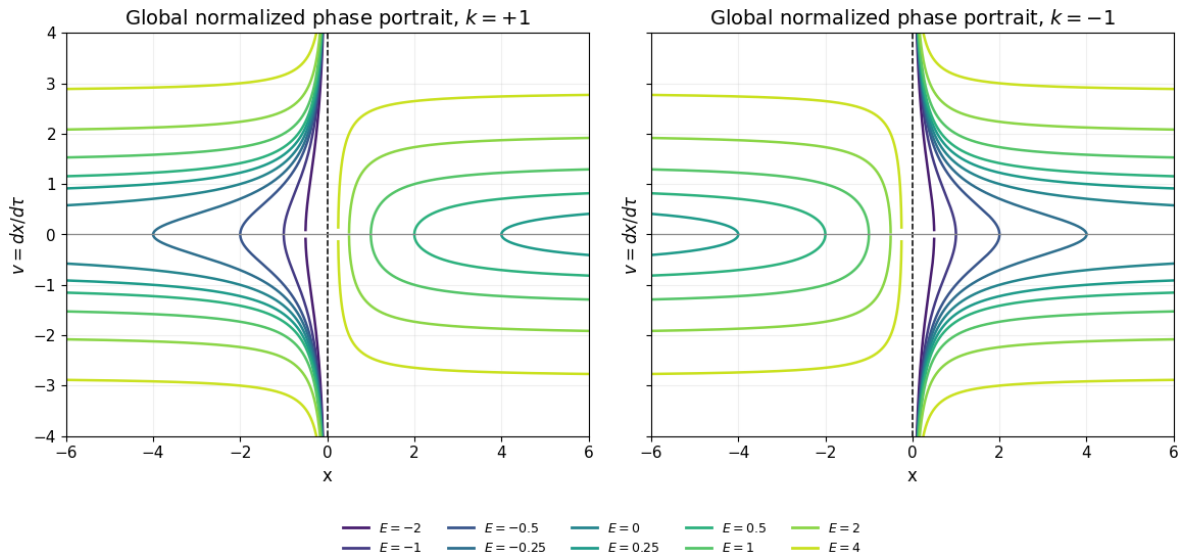
For a qualitative representation, it is sufficient to consider the two representative cases and , which describe, respectively, the two possible signs of the singular term.
Figure 1 immediately shows four essential qualitative facts: the admissible regions are those in which the radicand is non-negative; the turning points correspond to the intersection with the axis
; the semiaxes
and
remain dynamically disjoint; the sign of
k substantially modifies the structure of the orbits and therefore the type of temporal evolution allowed.
3.2. Map of Normalized Regimes
To classify all motions in a minimal way, we fix
and introduce the dimensionless variable
After the possible semiaxis reflection that brings the initial datum to the point
, we set
so that
The problem is then reduced to the normalized form
where
The parameter
distinguishes the two fundamental regimes:
The dimensionless energy is
In the attractive case
, one obtains
from which, the critical threshold follows
It separates the three energetic regimes:
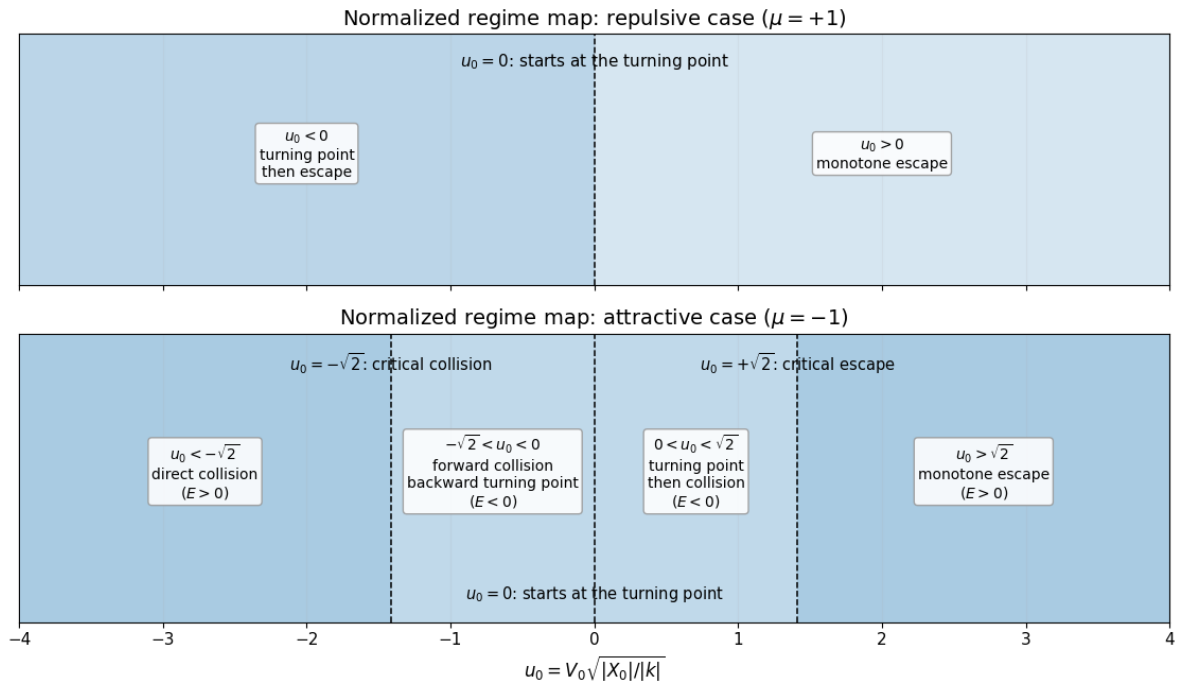
Figure 2 classifies the motion directly as a function of the effective sign
and of the dimensionless initial velocity
. In the repulsive regime
, if
the trajectory is initially directed toward the singularity, but it does not reach it: it encounters a turning point and then escapes toward infinity. If
, the motion starts exactly from the turning point. If
, the escape is monotone. In the attractive regime
, the classification is richer. For
there is direct collision with the singularity without a turning point forward in time. For
the collision still occurs forward in time, but with negative energy; the turning point exists only backward in time. For
the trajectory starts from a turning point. For
the solution initially moves away from
, reaches a turning point, and then returns to collide with the singularity. Finally, for
the motion is one of monotone escape. The two critical cases
correspond to the zero energy level. In particular, for
, one has critical collision, while for
, the trajectory escapes forward and collides backward; in both cases the dynamics near the collision is governed by the universal law with exponent
.
3.3. Atlas of Trajectories
Let us consider the normalized initial-value problem and, as in the previous sections, let us recall that the parameter distinguishes the repulsive regime from the attractive regime , while the parameter represents the dimensionless initial velocity. The objective is to present a minimal set of trajectories that makes visible, in a direct way, all the essential dynamical types of the reduced problem.
The trajectories reported in the atlas were obtained by numerical integration of the normalized initial-value problem by means of an adaptive integrator for ordinary Cauchy problems, in particular by numerical integration of the normalized initial-value problem with the function
solve_ivp of SciPy, without specifying explicitly the parameter
method; consequently, the solver employed is the default method
RK45, that is, an explicit Runge–Kutta scheme of order
of the Dormand–Prince family, with adaptive step control. In the present calculation, the following tolerances were adopted
to guarantee high accuracy in the reconstruction of the trajectories and in the localization of the notable points. These parameters are, respectively, the relative tolerance and the absolute tolerance of the numerical solver. In
solve_ivp, the local error is controlled by requiring that it remain smaller than a quantity of the type
The parameter
therefore regulates the relative accuracy of the solution, while
fixes the admissible error threshold when the components of the solution become very small. The choice adopted in this work guarantees a particularly accurate numerical control in the construction of the trajectories of the atlas.
For each initial datum, the integration is performed on the interval , but it is stopped early when the solution reaches the singularity , treated numerically as a terminal event. In this way, the orbits that collide with the singularity are truncated exactly at the collision time . Moreover, the option dense_output=True makes it possible to construct a continuous interpolation of the solution; in the case of the method RK45, such a reconstruction is based on a quartic polynomial. This allows one to include the collision point accurately in the plot and to identify with good precision any turning points observed forward in time. From the computational point of view, the use of an explicit adaptive-step integrator is appropriate for this class of non-stiff trajectories, while the imposition of an upper bound on the time step further improves the numerical resolution in the regions in which the dynamics accelerates, in particular, near the collision.
3.3.1. Panel (A): Repulsive Regime
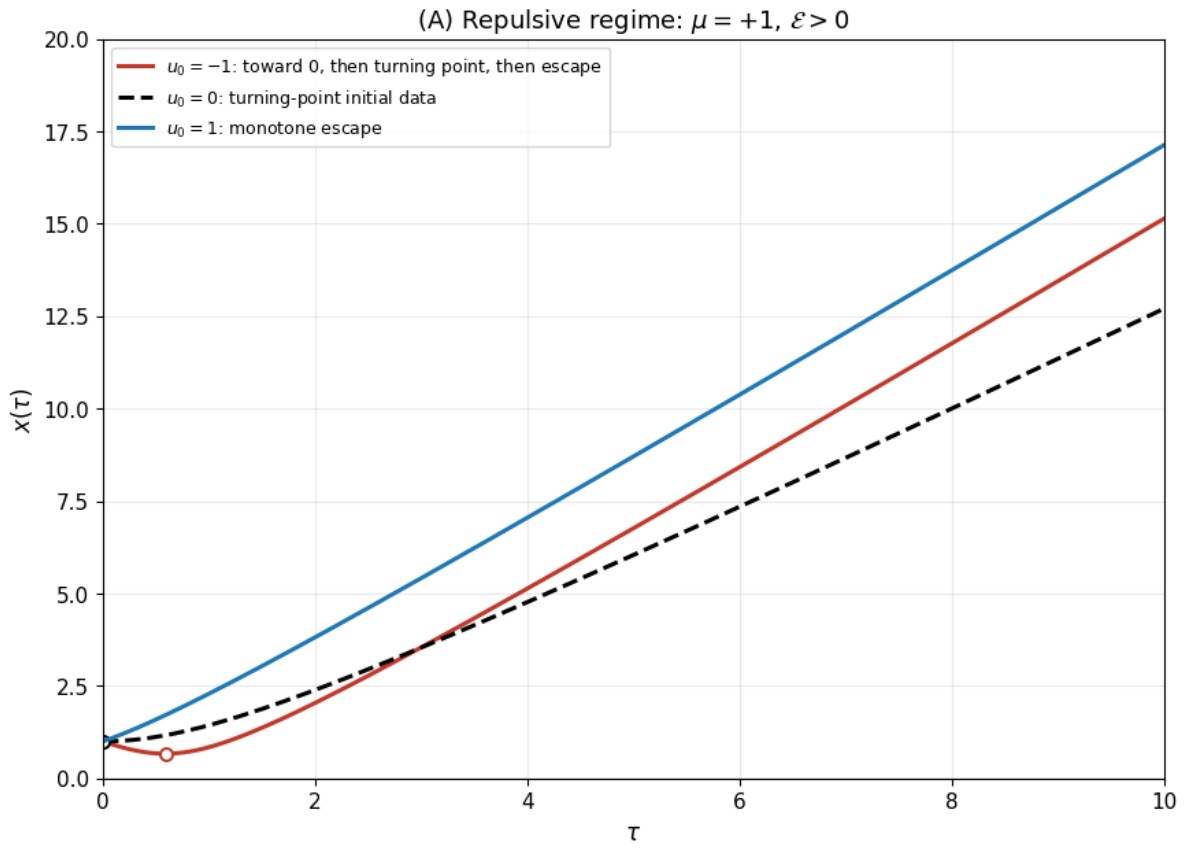
In panel (A) (
Figure 3), three trajectories corresponding to the initial data
are represented. In this regime, one always has
Therefore, there is no further energetic subdivision, but the sign of
generates three distinct behaviors.
For , the trajectory is initially directed toward the singularity, but it cannot collide, instead it reaches a turning point, corresponding to a local minimum, and subsequently escapes toward .
For , the solution starts exactly from the initial turning point .
For , finally, the motion is monotonically increasing from the beginning and leads to escape without reversal. This panel illustrates in a particularly clear way the repulsive character of the singular potential: collision with is forbidden, while a forward turning point appears for .
3.3.2. Panel (B): Attractive Subcritical Regime ,
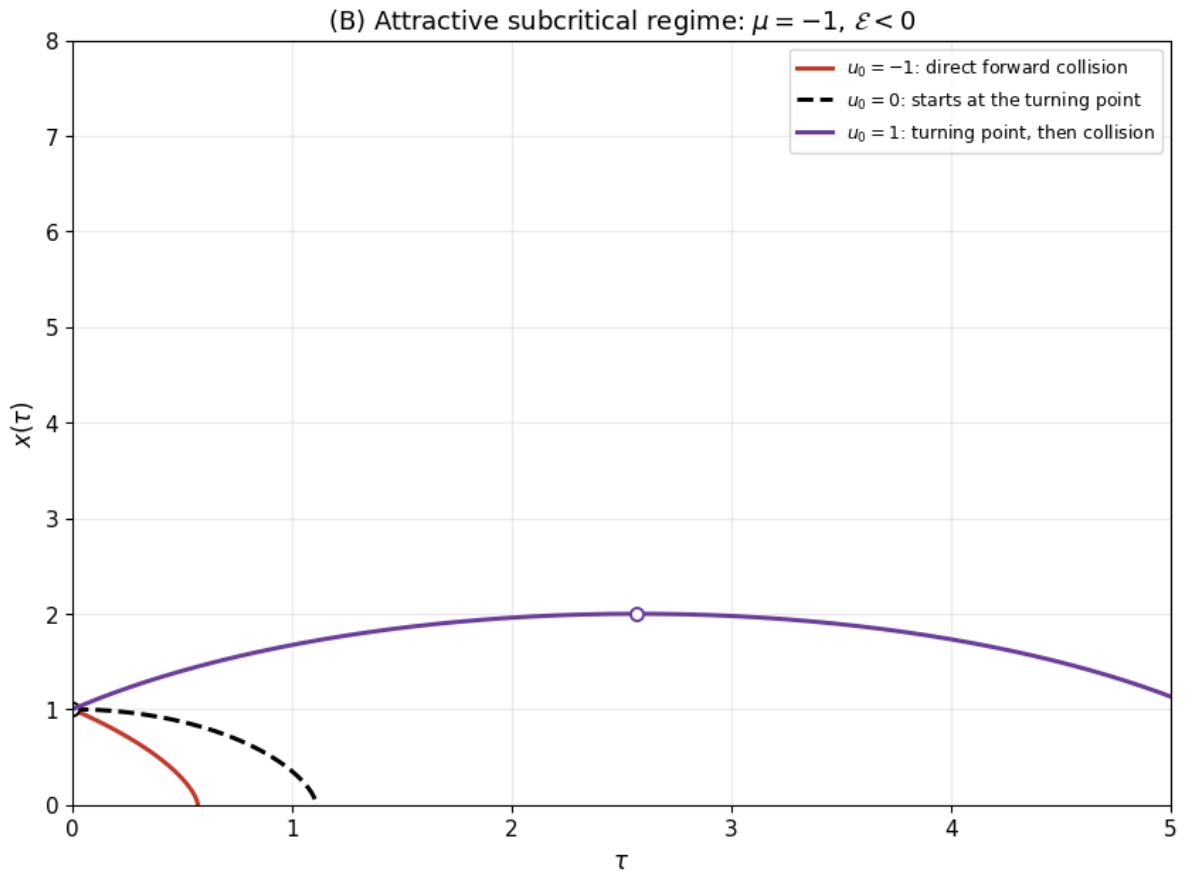
In panel (B) (
Figure 4), the initial data
are considered, all satisfying
In this case, the turning point exists, since
and
have the same sign, and it is given by
However, its role depends on the initial direction of the motion.
For , the trajectory is immediately decreasing and collides with in finite time.
For , the solution starts from the initial turning point and then evolves toward the collision.
For , instead, the trajectory first moves away from the singularity, reaches a turning point, and therefore will return backward until it collides with .
It follows that in the subcritical regime all forward trajectories end in collision, but only those with show the turning point forward in time.
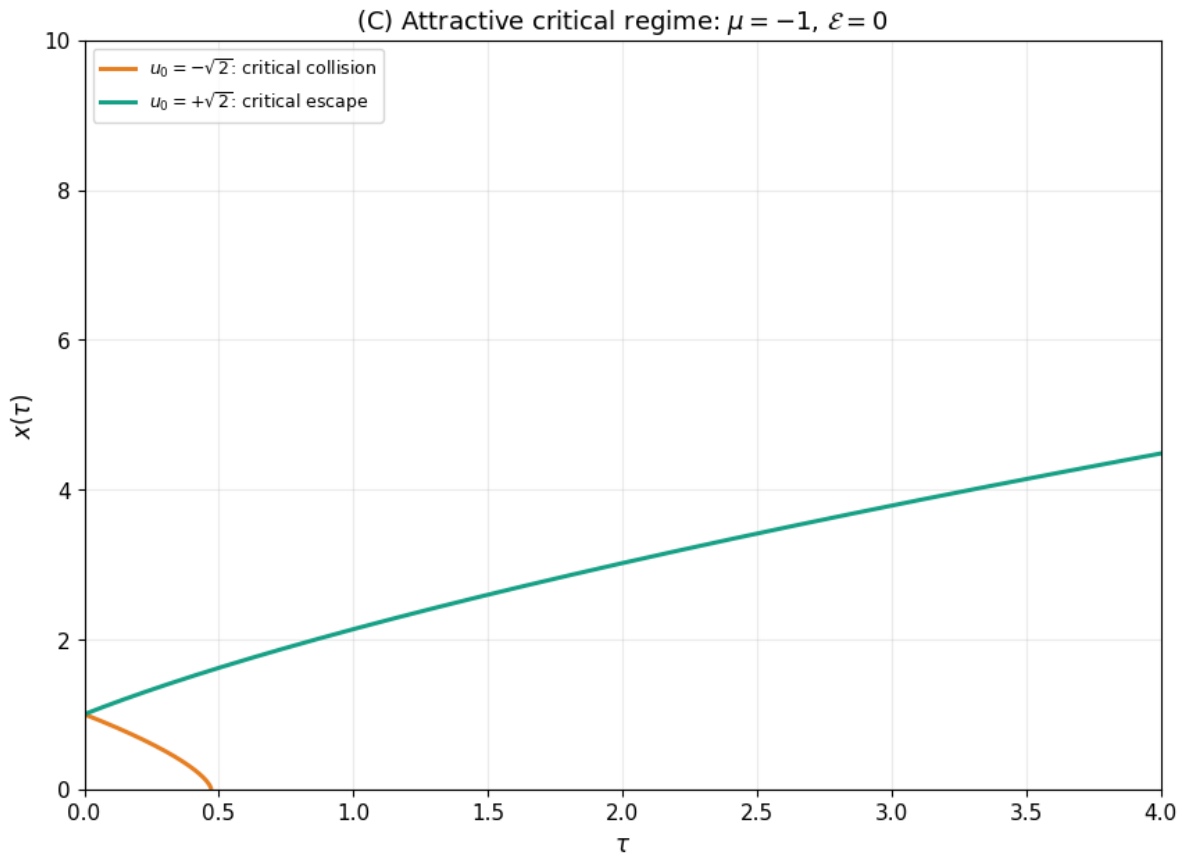
3.3.3. Panel (C): Attractive Critical Regime ,
In this critical panel (
Figure 5), the two values
are chosen, for which
This is the threshold regime that separates the subcritical case from the supercritical one. The first integral reduces to
and the explicit solution takes the form
Equivalently,
The branch with minus sign describes a critical collision in finite time, while the branch with plus sign describes a critical escape forward in time. This panel is particularly important because it isolates the universal law with exponent
which governs the behavior near the collision:
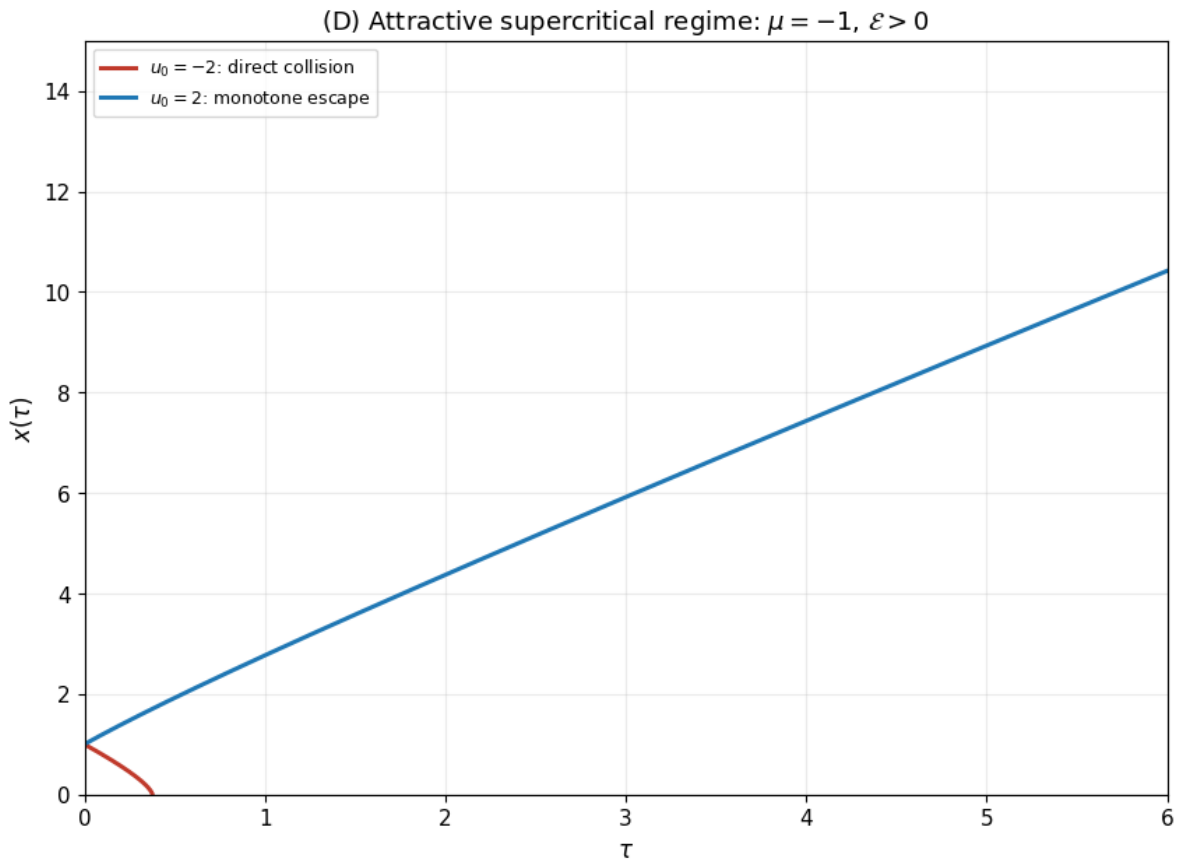
3.3.4. Panel (D): Attractive Supercritical Regime ,
In panel (D) (
Figure 6), the two trajectories
are chosen, for which
In this regime there is no turning point, since
and
have opposite sign. There therefore remain only two dynamical possibilities, determined by the sign of
.
For , the trajectory is monotonically decreasing and collides directly with the singularity in finite time, without any reversal. For , instead, the trajectory is monotonically increasing and escapes to infinity. The panel therefore shows that, in the attractive supercritical regime, the sign of the initial velocity completely determines the fate of the motion.
Observation
Once a normalized trajectory
is known, the corresponding solution of the original problem is reconstructed by means of
with
It follows that each trajectory of the atlas represents, in the physical variable
, an entire class of solutions obtained by rescaling and reflection.
3.4. Zoom in on the Collision and Quantitative Verification of the Asymptotic Law 2/3
Let us consider the normalized initial-value problem in the attractive regime and choose the initial datum
. The corresponding trajectory belongs to the attractive supercritical regime. In particular, the solution is monotonically decreasing for
and reaches the singular boundary
in finite time. In the numerical treatment, the integration is not pushed all the way to
, because near the singularity the term
becomes too large and a direct event at
is not sufficiently robust. We therefore introduce a small positive threshold
and stop the integration when the trajectory reaches this level. The time
is identified numerically as a terminal event. A first estimate of the collision time is then obtained directly from the numerical integration by means of the local asymptotic law. Since
one obtains
In the present computation, this yields
An independent estimate is provided by the implicit quadrature associated with the conserved energy. Since
the collision time can also be written as
A high-accuracy numerical evaluation gives
Therefore, the two independent determinations agree within
with relative discrepancy
This shows that the numerical growth of the defect very close to the singularity does not affect the computed collision time at any relevant level.
Once
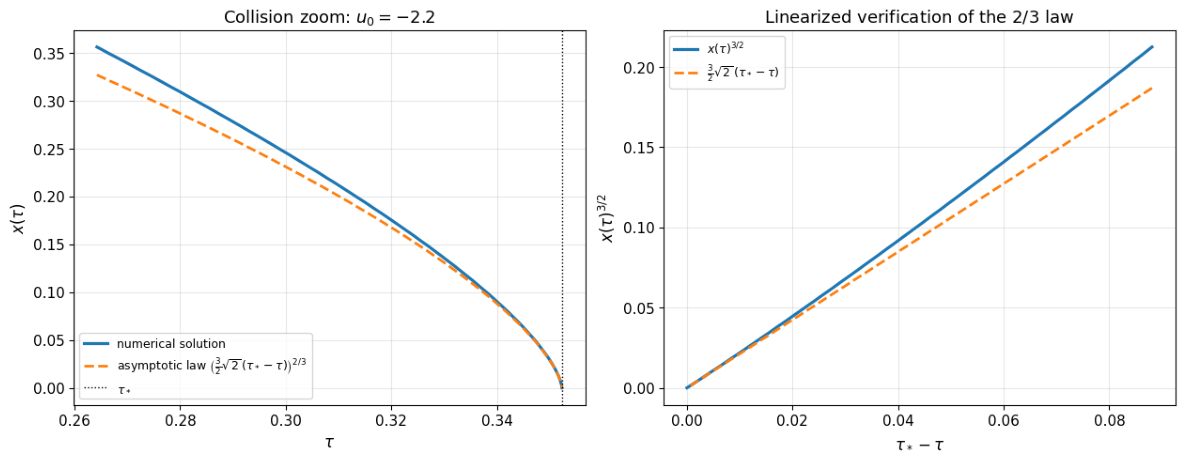
has been determined, the solution is resampled in a final window near the collision. In
Figure 7, below, we use
with 1500 sampling points. Near the collision time, the dynamics is dominated by the singular term and the solution satisfies the universal law
This relation shows that the collapse toward the singularity is governed by the universal exponent
, independently of the specific initial datum within the collision regime.
To obtain a particularly transparent numerical verification, it is useful to raise the asymptotic law to the power
. One thus obtains
that is, an asymptotically linear relation in the variable
.
The visual agreement displayed in
Figure 7 can be reinforced by a direct logarithmic fit of the exponent. Using
as reference value, we perform linear regressions of
on three shrinking final windows. The results are reported in
Table 1.
The fitted exponent approaches as the fitting window is restricted toward the collision time, while the quality of the regression remains essentially perfect. This provides a quantitative confirmation that the near-singularity numerical errors do not spoil the universal collapse exponent, and that both the direct-integration estimate and the implicit-quadrature estimate of are fully consistent.
3.5. Escape Asymptotics: Linear Term and Logarithmic Correction
Let us now pass to the long-time behavior of the escape trajectories and choose the repulsive case
In this case, the solution belongs to a monotonically increasing branch and therefore satisfies
From the first integral of the system,
on the branch of monotone escape, where
, one can rewrite
For
, one therefore obtains the expansion
Equivalently,
By integrating with respect to
x, one obtains
By asymptotically inverting this relation, one obtains the long-time behavior
In the specific case
, the logarithmic correction therefore has negative coefficient:
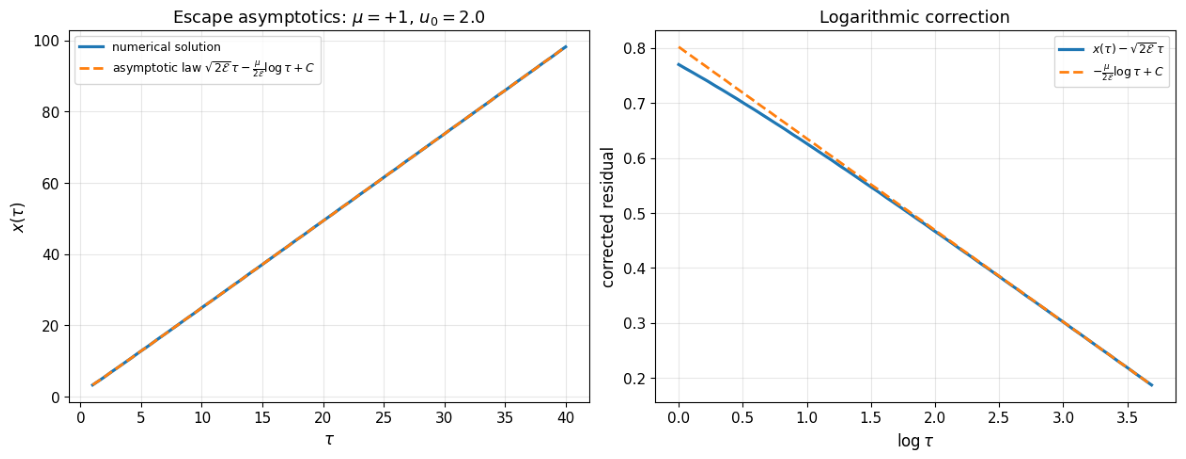
To verify numerically such an expansion, the trajectory is first calculated by direct integration of the initial-value problem up to a sufficiently large final time. In the reference plot shown below, we choose
and sample the solution on a uniform grid of 5000 points. For the asymptotic comparison, one considers only the portion
to exclude the initial region, in which the term
is not yet representative of the long-time regime.
Since the
term depends on the initial datum and is not known a priori in closed form, it is replaced by a fitting constant
C. In the numerical implementation, this constant is estimated by averaging over the final
of the data with
, namely
The asymptotic function used in the comparison is therefore
In the left panel of
Figure 8, the numerical solution
is compared with the asymptotic approximation
The agreement observed shows that the trajectory is well described by a linear leading term corrected by a logarithmic contribution.
In the right panel, one considers the corrected residual
and represents it as a function of
. The theory predicts that
for which the graph of the residual against
must be asymptotically linear. The comparison with the line
highlights precisely this structure. To verify that the choice
is not arbitrary, we repeated the same asymptotic analysis for
More precisely, for each final time, we fitted the residual
against
on the last
of the data with
, according to
In the present case,
The fitted logarithmic coefficients and the corresponding root-mean-square residuals are reported in
Table 2.
The fitted logarithmic coefficient approaches the theoretical value as the final integration time increases, while the residual of the fit decreases monotonically. This confirms that the logarithmic correction is already clearly visible for , and that extending the integration to and produces only a mild quantitative refinement, without changing the asymptotic interpretation.
3.6. Comparison Between Methods and Energy Diagnostics
To complete the numerical treatment of the problem, let us consider two distinct levels of verification. The first is a direct comparison between two independent procedures of reconstruction of the same trajectory. The second consists of monitoring the energy defect along the numerical integration for some representative trajectories. The first has an immediate structural and geometrical meaning, while the second must instead be interpreted as an internal numerical diagnostic of the method.
3.6.1. Comparison Between Direct Integration and Implicit Quadrature
As a test case let us consider the monotone collision branch in the attractive supercritical regime, that is, the reduced initial-value problem with
The resulting trajectory is monotonically decreasing up to collision in finite time. This case is particularly suitable for numerical comparison, because it is simple from the geometrical point of view and is interesting from the computational point of view, because of the rapid acceleration of the dynamics near the singularity.
Direct Integration of the System
The first reconstruction of the trajectory is obtained by directly integrating the first-order system associated with our differential problem with the method used so far previously described. In this way, one obtains a pair of profiles
sampled on a temporal grid
. To avoid the extreme singular region, the final time is chosen strictly smaller than the theoretical collision time:
In the code, the temporal grid contains 1500 equally spaced points in the interval
.
Numerical Inversion of the Implicit Quadrature
The second reconstruction exploits the implicit form of the solution obtained from the first integral. In the case
, on a monotone branch, the dynamics satisfies a relation of the type
where
and
In the case considered here,
and
, for which the branch is monotonically decreasing and one has
. For each value of the temporal grid, the trajectory
is reconstructed by solving numerically the scalar equation
by means of Brent’s method, on the interval
This algorithm searches for a real root in an interval
such that
, combining adaptively bisection, the secant method, and inverse quadratic interpolation. In this way it combines the robustness of bracketing with a generally faster convergence than simple bisection. In the monotone collision branch considered here, the physically relevant solution satisfies
, for which the root is searched for in a natural interval and compatible with the monotonicity of the trajectory. The use of Brent’s method is particularly appropriate in this context, since it does not require the calculation of derivatives and provides a stable reconstruction of the implicit solution even near the singularity. From the numerical point of view, this procedure constitutes an independent check of the direct integration of the differential system: while the latter evolves the solution in time, inversion through Brent reconstructs
directly from the integrated quadrature relation. The comparison between the two trajectories therefore provides a particularly solid cross-validation of the correctness of the numerical calculation.
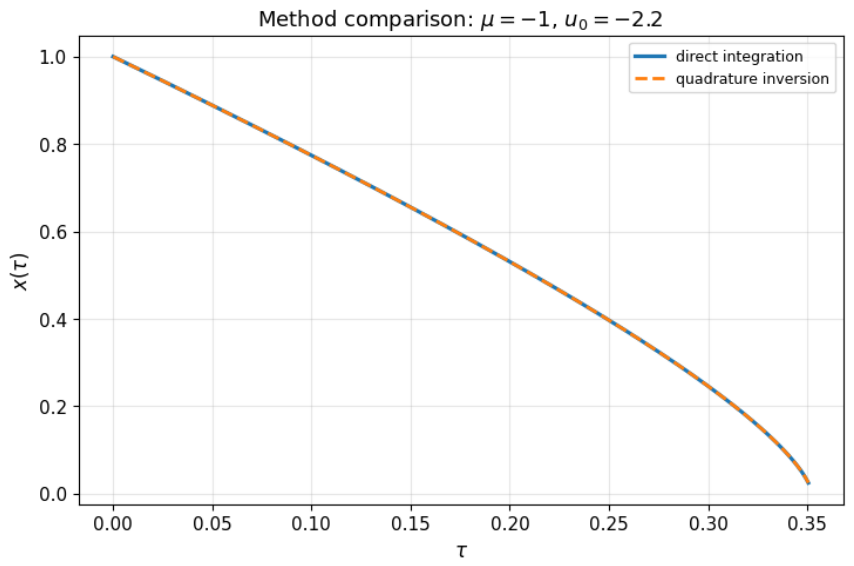
Figure 9 shows the direct comparison between
The almost perfect overlap of the two curves indicates that the direct integration of the system and the numerical inversion of the implicit quadrature reconstruct the same trajectory within the accuracy of the calculation. Therefore, it provides the cleanest and most directly interpretable numerical validation: two conceptually independent procedures reconstruct the same solution.
Observation
The discrepancy between the two methods is measured by
The code also returns the global quantity
which summarizes the quantitative discrepancy measure between direct integration and inversion of the implicit quadrature.
3.6.2. Energy Defect as Numerical Diagnostic
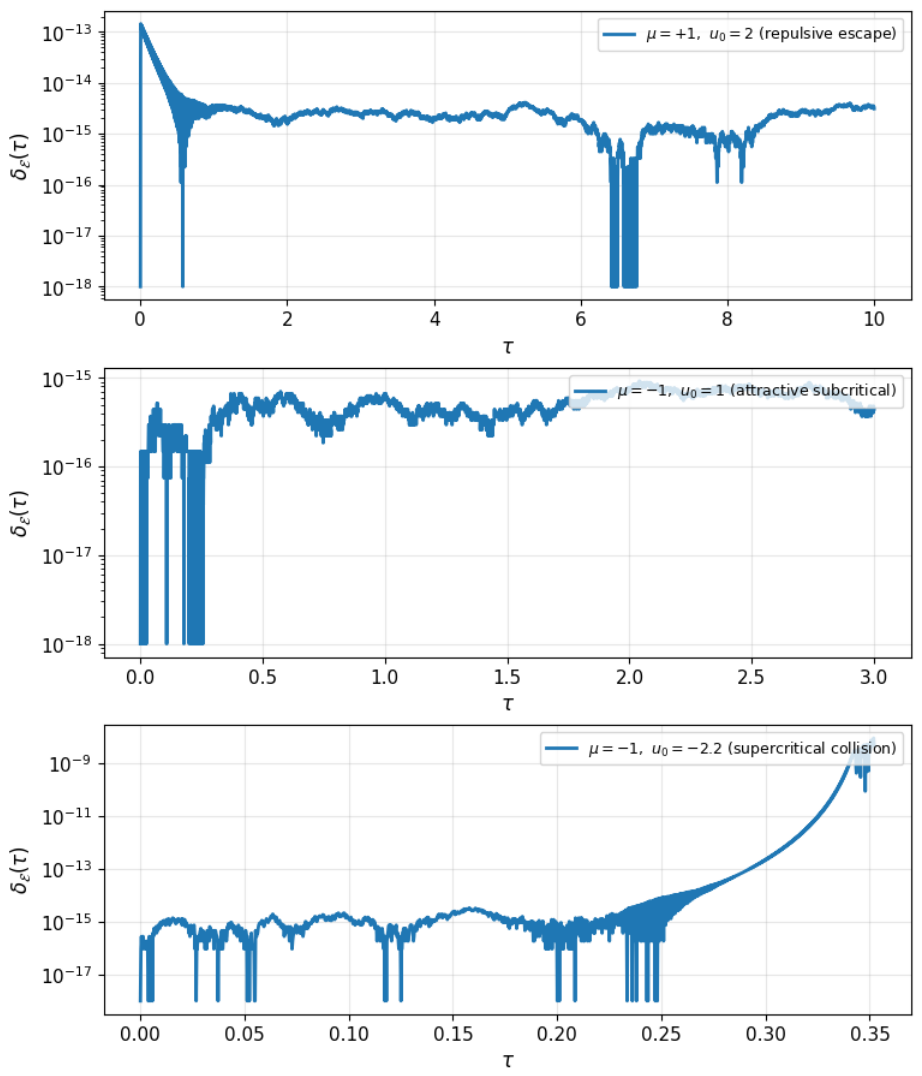
Alongside the comparison between methods, it is also useful to monitor how well the integration method conserves the energy along the integration. This information mainly describes the numerical quality of the calculation. For a trajectory with theoretical constant energy
, we define the normalized energy defect
This choice is preferable to the pure ratio
, since it remains well defined also in the cases in which
. In the code, this quantity is plotted for three representative trajectories:
which correspond, respectively, to a repulsive escape, to an attractive subcritical case, and to a supercritical collision. For visualization purposes only in logarithmic scale, a very small numerical floor, equal to
, is also introduced, so as to avoid spurious drops due to machine precision.
The quantity
measures how well the method conserves the energy numerically. Results for example trajectories are plotted in
Figure 10.
In the upper panel, referring to the repulsive case , the trajectory escapes monotonically and does not encounter the singularity; the energy defect remains typically between and , indicating a very good conservation of the energy.
In the central panel, referring to the attractive subcritical case , the trajectory presents a turning point and then returns toward the collision. Furthermore, in this case the energy defect remains very small, typically between and . The slightly greater irregularity of the graph is due mainly to the change in dynamical regime near the turning point and to the consequent adaptation of the step of the solver method.
In the lower panel, referring to the supercritical colliding case
, the energy defect remains small for a large part of the interval, but grows sensibly near the final time. This worsening must not be interpreted as a failure of the numerical trajectory: it mainly reflects the fact that, in proximity to the singularity
, both the kinetic term
and the potential term
become very large in modulus and the calculation of the energy
involves the subtraction of large quantities to obtain a finite quantity. It follows a loss of numerical significance, which makes the energy diagnostic less reliable near the collision.
Observation
Therefore, we can conclude that
In the regular regimes and far from the singularity, the solver method conserves very well the energy;
The energy defect remains typically between and , therefore at very small levels;
Near the singular extreme of the colliding trajectories, the energy diagnostic worsens mainly because of the poor numerical conditioning of the energy formula and not necessarily because of a substantial deterioration of the integrated trajectory.
4. Conclusions
Starting from the weak-field traveling-wave reduction of a tensor–scalar gravitational model coupled to extended Aharonov–Bohm electrodynamics, we focused on the one-dimensional autonomous ODE that governs the scalar electromagnetic mode
through
, namely
. By a change of variables, this equation is equivalent to the singular Newton equation
, which admits a conserved energy
and therefore a complete phase-plane description in terms of level sets.
Our first contribution is a global and explicit classification of all maximal classical solutions generated by admissible initial data , . After normalization and semiaxis reduction, the dynamics is parametrized by the effective sign and by the dimensionless initial velocity , which yields a minimal regime map. In the attractive case , the threshold separates subcritical (), critical (), and supercritical () behaviors, determining whether turning points occur forward/backward in time and whether the trajectory collides with the singular barrier.
The singular boundary corresponds to , hence . Within the reduced weak-field traveling-wave model this is a genuine blow-up of the AB scalar mode. However, this should not automatically be interpreted as an admissible finite-energy configuration of the full field theory. Rather, it marks the boundary of validity of the reduced description: before the formal collision is reached, one expects either backreaction, source-region effects, higher-order corrections, or finite-width regularization mechanisms to become relevant. Therefore, in the present work, colliding branches are understood primarily as maximal solutions of the reduced ODE and as asymptotic indicators of strong-field concentration, not as a claim that the full tensor–scalar/AB theory supports arbitrary blow-up as a physically realizable vacuum state.
A second key result concerns asymptotics. Whenever a trajectory collides with the singularity in finite time, the approach is universal: independently of the energy level and of global orbit features, the solution satisfies the collapse law . Conversely, for escaping trajectories (), the motion is asymptotically uniform, with an explicitly determined logarithmic correction inherited from the singular potential.
Finally, we complemented the analytical study with a numerical atlas covering all qualitative regimes. The computations were validated by two independent reconstructions of the same trajectory (direct integration of the first-order system versus numerical inversion of the implicit quadrature) and by monitoring a normalized energy defect. The resulting framework provides a practical basis for constructing and interpreting localized traveling gravitational–electromagnetic pulses in the underlying field model, and it identifies the invariant parameters that a source region must effectively select in order to launch a specific solitary profile.
Several natural extensions of the present work deserve further investigation. First, the stability of the one-dimensional traveling solitary-wave families should be analyzed, both within the reduced model and with respect to perturbations of the full hyperbolic field system. Second, it would be important to make the source-selection mechanism more explicit by constructing a detailed matching between the source region, where the extra-current may be nonzero, and the outgoing invariants of the reduced propagation problem. Third, the present one-dimensional setting could be generalized to higher-dimensional geometries, for instance by considering planar, cylindrical, or radially symmetric configurations. Finally, an interesting open problem is the interaction of multiple localized pulses, including whether the reduced dynamics admits robust scattering scenarios or more complicated non-integrable behaviors. These directions would help clarify both the mathematical structure and the physical relevance of the solitary-wave sector identified here.