Article

Research on American Option Pricing Under the Heston Jump Diffusion Model—Based on Fourier Space Time-Stepping Method

1
School of Economics, Harbin University of Commerce, Harbin 150028, China
2
Department of Mathematics, Yanbian University, Yanji 133002, China
*
Author to whom correspondence should be addressed.
Mathematics 2026, 14(9), 1412; https://doi.org/10.3390/math14091412
Submission received: 6 March 2026 / Revised: 7 April 2026 / Accepted: 16 April 2026 / Published: 23 April 2026
(This article belongs to the Special Issue Advances in Stochastic Differential Equations and Applications)

Abstract

American options are more complex to price than European options because they grant holders the right to exercise at any time before expiration, especially in realistic market environments that consider both stochastic volatility and asset price jumps. Therefore, this paper studies the pricing of American options under the Heston stochastic volatility model, incorporating the Merton jump-diffusion process. For this high-dimensional, nonlinear free boundary problem, this paper adopts the Fourier space time-stepping method for numerical solution. This method utilizes the characteristic function in Fourier space to implement time-stepping, effectively addressing computational difficulties caused by stochastic volatility and jump processes, and it determines the optimal exercise boundary by comparing the holding value with the immediate exercise value at each step. Numerical experiments show that the method is computationally stable and accurate, clearly capturing the early exercise premium and dynamic changes in the exercise boundary. Additionally, parameter sensitivity analysis reveals that the jump component significantly affects option value (with a premium of approximately 6.74%), highlighting the necessity of incorporating jump risk into pricing models. This work provides an effective numerical framework for American option pricing under stochastic volatility and jump environments, possessing both theoretical significance and practical application value.

1. Introduction

American options are important in risk management and investment due to their early exercise flexibility. Their pricing centers on determining the optimal exercise boundary. The Black–Scholes [1] framework provides an analytical solution for European options, but early exercise requires numerical methods.
Traditional methods like finite difference and binomial trees become inefficient in high dimensions. The Least Squares Monte Carlo method (Longstaff and Schwartz) handles exercise decisions via simulation and regression. Fourier transform methods offer a new perspective for high-dimensional problems.
Recent improvements include Rotondi [2] on the impact of sharp exercise boundary changes, Zaevski et al. [3] on a refined mesh for American power options, and Zecevic & Rodrigo [4] on perpetual option hedging parameters. The core challenge is balancing early exercise dynamics with numerical efficiency and accuracy, especially under complex features like stochastic volatility and jumps.
Real asset prices often exhibit jumps due to sudden information. Merton [5] introduced a Poisson jump process into Black–Scholes. Heston [6] proposed a stochastic volatility model explaining the volatility smile, but it lacks jumps. Hybrid models combine both: Liu & Zhu [7] priced variance swaps under Hawkes jumps; Ying Chang et al. [8] used a double Heston jump-diffusion with fractional volatility; Yichen Lu & Ruili Song [9] priced binary options under exponential jumps. At calibration, Mrázek & Pospíšil [10] and Garces & Cheang [11] studied parameter estimation and pricing for exchange options, showing that the jump-diffusion Heston model fits market data better but raises the complexity for pricing methods.
Fourier transform simplifies derivative pricing by converting probability distributions to the frequency domain (Schmelzle [12]). Extensions for high-dimensional and jump-diffusion scenarios include Hurd & Zhou [13] on spread options, Alfeus & Schlögl [14] on 2D Fourier integrals, and Bayer et al. [15] on adaptive quadrature for Lévy models. Under Heston, Benzion Boukai [16] derived the risk-neutral density, and Takahashi et al. [17] combined tensor train with Fourier transform. These confirm Fourier’s advantages for stochastic volatility and jumps, but combining it with American early exercise remains unresolved.
Fourier space time-stepping (FST) combines dynamic programming with Fourier transforms. At each step, it computes the continuation value’s conditional expectation via Fourier transform and compares it with immediate exercise. Bayer’s adaptive quadrature ensures accuracy; Zhang et al. [18] combined semi-implicit FEM with Fourier transform under Heston for American options.
Existing challenges include numerical instability of characteristic functions at high frequencies (e.g., Heston under extreme parameters, Boukai), high-dimensional implicit exercise boundary (front-fixing by Denis Veliu et al. [19] is hard to generalize under jump-diffusion Heston), and the conflict between time discretization and Fourier’s continuous assumption (tensor train methods by Rihito Sakurai et al. offer a potential direction).
In summary, this paper focuses on pricing American options under the Heston stochastic volatility model with Merton jumps, systematically exploring the Fourier space time-stepping method’s implementation, numerical properties, and application effects. We aim to provide a theoretically rigorous and computationally practical solution for American options in stochastic volatility and jump environments, offering a reference for pricing and risk management of related complex derivatives.

1.1. Main Contributions of This Paper

For the first time, the Fourier space time-stepping method is extended to a hybrid model coupling Heston stochastic volatility with Merton jump diffusion, and successfully applied to American option pricing.
A short-time variance approximation plus operator splitting strategy is proposed for the high-dimensional PIDE, reducing the two-dimensional problem to a sequence of one-dimensional FFTs, thereby avoiding the curse of dimensionality.
A numerical scheme is systematically designed to handle the early exercise boundary of American options in Fourier space, including damping parameter optimization, boundary point extraction, and approximate satisfaction of the smooth pasting condition.
The first-order temporal convergence, exponential spatial convergence, and mean-square stability of the method are rigorously analyzed. Numerical experiments confirm consistency with theoretical predictions (jump premium 6.74%, convergence order 1.474).

1.2. Differences from Existing Work

Compared with the original Fourier space time-stepping method by Jackson et al. (2007), this paper addresses two challenging issues simultaneously: stochastic volatility and American exercise.
Compared with the mixed exponential jump-diffusion model by Zhang Sumei et al. (2020), this paper adopts the Heston stochastic volatility model, which is closer to market reality, and uses lognormally distributed jump sizes.
Compared with finite difference methods (e.g., Ding Lutao, 2016), the Fourier space time-stepping method requires no spatial truncation or interpolation for the jump integral term, achieving higher accuracy and easier implementation.
Compared with Monte Carlo methods, the proposed approach has significant advantages in computational efficiency O ( N M l o g M ) and convergence rate.

2. The Model

2.1. Heston Model

The classic Black-Scholes option pricing model assumes constant volatility, but in actual financial markets, volatility exhibits obvious characteristics such as time-varying and clustering, which the Black-Scholes model cannot accurately capture. In 1993, Steven Heston proposed the Heston model, which is a stochastic volatility model that allows volatility to change randomly over time and can better capture the characteristics of volatility changes in actual financial markets, such as the volatility smile phenomenon, where the implied volatility of an option shows a non-monotonic relationship with the strike price.
Under the risk-neutral measure ℚ, the Heston model is described by the following pair of stochastic differential equations:
d S t = r S t d t + v t S t d W t S , d v t = κ ( θ v t ) d t + σ v t d W t v ,
where S t represents the asset price at time t, r is the risk-free interest rate (constant), v t is the instantaneous variance at time t (square of volatility), W t S and W t v are two correlated standard Brownian motions, and they satisfy d W t S d W t v = ρ d t , ρ [ 1 , 1 ] is the correlation coefficient.
Logarithmic price process and characteristic function:
Let X t = ln S t Apply Itô’s lemma to the first equation in (1):
d X t = d ( ln S t ) = d S t S t 1 2 ( d S t ) 2 S t 2
Substituting (1), we get:
d X t = ( r 1 2 v t ) d t + v t d W t S
Therefore, ( X t , v t ) constitutes a two-dimensional diffusion process.
Theorem 1.
(Characteristic function of the Heston model). The conditional characteristic function of the logarithmic price  X t  of the Heston model under the risk-neutral measure is:
ϕ Heston ( ξ ; v t , t , T ) = E [ e i ξ X T X t = x , v t = v ] = e i ξ x + C ( τ , ξ ) + D ( τ , ξ ) v
where  τ = T t  is
C ( τ , ξ ) = r i ξ τ + κ θ σ 2 [ ( κ ρ σ i ξ + d ) τ 2 ln ( 1 g e d τ 1 g ) ] , D ( τ , ξ ) = κ ρ σ i ξ + d σ 2 ( 1 e d τ 1 g e d τ ) , d = ( ρ σ i ξ κ ) 2 + σ 2 ( i ξ + ξ 2 ) , g = κ ρ σ i ξ + d κ ρ σ i ξ d .
Proof. 
According to the definition of the characteristic function, ϕ ( ξ ; v , t , T ) = E [ e i ξ X T X t = x , v t = v ] . By the Feynman–Kac formula, ϕ satisfies the following partial differential equation:
ϕ t + ( r 1 2 v ) ϕ x + 1 2 v 2 ϕ x 2 + κ ( θ v ) ϕ v + 1 2 σ 2 v 2 ϕ v 2 + ρ σ v 2 ϕ x v = 0
The boundary condition is ϕ ( ξ ; v , T , T ) = e i ξ x .
Assume the solution has the following form:
ϕ ( ξ ; v , t , T ) = e i ξ x + C ( τ , ξ ) + D ( τ , ξ ) v
where τ = T t . Calculate the partial derivatives:
ϕ t = ϕ ( C ( τ ) + D ( τ ) v ) , ϕ x = i ξ ϕ , 2 ϕ x 2 = ξ 2 ϕ , ϕ v = D ( τ ) ϕ , 2 ϕ v 2 = D 2 ( τ ) ϕ , 2 ϕ x v = i ξ D ( τ ) ϕ .
Substituting into Equation (6) and dividing by ϕ, we get:
( C + D v ) + i ξ ( r 1 2 v ) 1 2 ξ 2 v + κ ( θ v ) D + 1 2 σ 2 v D 2 + ρ σ v i ξ D = 0
Organize the terms involving v and the constant terms:
[ D 1 2 i ξ 1 2 ξ 2 κ D + 1 2 σ 2 D 2 + ρ σ i ξ D ] v + [ C + i ξ r + κ θ D ] = 0 .
Since the above equation holds for any v, the coefficients of v and the constant term must be zero respectively:
{ D ( τ ) = 1 2 i ξ 1 2 ξ 2 κ D ( τ ) + 1 2 σ 2 D 2 ( τ ) + ρ σ i ξ D ( τ ) , C ( τ ) = i ξ r + κ θ D ( τ ) ,
Initial conditions are C ( 0 ) = 0 , D ( 0 ) = 0 .
The first Equation in (11) is the Riccati equation for D ( τ ) and its solution is:
D ( τ ) = κ ρ σ i ξ + d σ 2 ( 1 e d τ 1 g e d τ )
where d = ( ρ σ i ξ κ ) 2 + σ 2 ( i ξ + ξ 2 ) , g = κ ρ σ i ξ + d κ ρ σ i ξ d .
Substitute D ( τ ) into the second equation and integrate:
C ( τ ) = i ξ r τ + κ θ 0 τ D ( s ) d s
Calculate the integral:
0 τ D ( s ) d s = 1 σ 2 [ ( κ ρ σ i ξ + d ) τ 2 ln ( 1 g e d τ 1 g ) ]
Substituting gives the expression for C ( τ ) in (5). □

2.2. Merton Jump Diffusion Model

The Black–Scholes model assumes that asset prices change continuously, but price jumps caused by significant information often occur in real markets. Merton (1976) [5] proposed a jump-diffusion model, adding a jump component to the geometric Brownian motion, which can more realistically capture the abrupt behavior of asset prices.
Under the risk-neutral measure ℚ, the asset price process of the Merton jump-diffusion model is:
d S t S t = ( r λ κ ) d t + σ d W t + ( J t 1 ) d N t ,
where r is the risk-free interest rate; σ is the volatility; W t is the standard Brownian motion; N t is a Poisson process with intensity λ, representing the number of jumps occurring up to time t; J t is the jump size, a non-negative random variable, and it is assumed that { J t } is independently and identically distributed, independent of W t and N t ;   a n d   κ = E [ J t 1 ] is the expected jump size, used to compensate the drift term, making the discounted asset price a martingale.
It is usually assumed that the jump size ln J t follows a lognormal distribution N ( μ J , σ J 2 ) :
ln J t N ( μ J , σ J 2 )
At this time,
κ = E [ J t 1 ] = e μ J + 1 2 σ J 2 1 .
Let X t = ln S t . Apply the Jump-Itô Lemma (Itô-Doblin formula) to Equation (15):
d X t = d ( ln S t ) = d S t S t 1 2 ( d S t ) 2 S t 2 + l n J t d N t
For the diffusion part, there is:
d S t S t | diff = ( r λ κ ) d t + σ d W t , ( d S t ) 2 S t 2 | diff = σ 2 d t
Comprehensive score:
d X t = ( r λ κ 1 2 σ 2 ) d t + σ d W t + ln J t d N t
For the above SDE integral, we obtain:
X t = X 0 + ( r λ κ 1 2 σ 2 ) t + σ W t + i = 1 N t l n J i
Therefore,
S t = S 0 exp [ ( r λ κ 1 2 σ 2 ) t + σ W t ] i = 1 N t J i
Theorem 2.
(Characteristic function of the Merton jump diffusion model). The conditional characteristic function of the log price  X t  in the Merton jump diffusion model is:
ϕ Merton ( ξ ; t ) = E [ e i ξ X t X 0 = x ] = e i ξ x + ψ ( ξ ) t
where the characteristic exponent  ψ ( ξ )  is
ψ ( ξ ) = i ξ ( r λ κ 1 2 σ 2 ) 1 2 σ 2 ξ 2 + λ ( e i ξ μ J 1 2 ξ 2 σ J 2 1 )
Proof. 
By (21),  X t can be decomposed into the sum of independent parts.:
X t = x + ( r λ κ 1 2 σ 2 ) t + σ W t + i = 1 N t Y i
where Y i = ln J i N ( μ J , σ J 2 ) . Due to the independence of Brownian motion, Poisson process, and jump size, the characteristic function can be decomposed into:
ϕ Merton ( ξ ; t ) = e i ξ x E [ e i ξ ( r λ κ 1 2 σ 2 ) t ] E [ e i ξ σ W t ] E [ e i ξ i = 1 N t Y i ] = e i ξ x + i ξ ( r λ κ 1 2 σ 2 ) t e 1 2 σ 2 ξ 2 t E [ E [ e i ξ i = 1 N t Y i N t ] ]
Given N t = n , i = 1 n Y i N ( n μ J , n σ J 2 ) :
E [ e i ξ i = 1 n Y i N t = n ] = e i ξ n μ J 1 2 ξ 2 n σ J 2 = ( e i ξ μ J 1 2 ξ 2 σ J 2 ) n
Therefore,
E e i ξ i = 1 n Y i = n = 0 P N t = n e i ξ μ J 1 2 ξ 2 σ J 2 n = n = 0 λ t n e λ t n ! e i ξ μ J 1 2 ξ 2 σ J 2 n = e λ t n = 0 λ t e i ξ μ J 1 2 ξ 2 σ J 2 n n ! = exp λ t e i ξ μ J 1 2 ξ 2 σ J 2 1 .
Substituting (26) yields (23) and (24). □

3. Pricing American Put Options Under the Fourier Space Time-Stepping Method

The pricing of American options can generally be modeled as two types of mathematical problems: free boundary problems or linear complementarity problems. Although free boundary modeling itself is an active research direction and can theoretically be combined with Fourier space time-stepping methods, under the numerical framework of FST, modeling using linear complementarity problems is more direct and efficient in implementation. The core idea stems from the basic constraint that the value of an American option is always not lower than its immediate exercise payoff. Let the payment function of the option be Φ S = max K S , 0 , where K is the exercise price. The key to pricing lies in determining the optimal exercise boundary S * t . When the asset price S t S * t , the option should be exercised immediately.

3.1. Pricing Formula and Linear Complementarity Problem

Theorem 3.
(Linear Complementarity Problem under Jump-Diffusion Heston Model). Let the price of the American put option be  P ( S , v , t ) , and the payoff function be  Φ ( S ) = max ( K S , 0 ) , where K is the exercise price. Then  P ( S , v , t )  satisfies the following linear complementarity problem:
{ L P ( S , v , t ) 0 , P ( S , v , t ) Φ ( S ) , S > 0 , v > 0 , t [ 0 , T ] [ L P ( S , v , t ) ] [ P ( S , v , t ) Φ ( S ) ] = 0 ,
where L is the pricing operator of the jump diffusion Heston model, and its specific form is:
L P = P t + L S P + L v P + J P r P , L S P = ( r λ κ ) S P S + 1 2 v S 2 2 P S 2 , L v P = κ ( θ v ) P v + 1 2 σ 2 v 2 P v 2 + ρ σ v S 2 P S v , J P = λ 0 [ P ( J S , v , t ) P ( S , v , t ) ] f J ( j ) d j .
Proof. 
Let τ [ t , T ]  be a stopping time. The price of an American put option at time t can be expressed as an optimal stopping problem:
P ( S , v , t ) = sup τ T t , T E Q [ e r ( τ t ) Φ ( S τ ) S t = S , v t = v ]
where T t , T is the set of all stopping times on [ t , T ] .
Define the continuation region 𝒞 and the stopping region :
C = { ( S , v , t ) : P ( S , v , t ) > Φ ( S ) } , E = { ( S , v , t ) : P ( S , v , t ) = Φ ( S ) } .
Based on the principles of dynamic programming and Itô’s lemma:
  • In the continuation region 𝒞, the option should not be exercised early, so its price satisfies the PDE:
L P ( S , v , t ) = 0 , ( S , v , t ) C
2.
In the stopping region , the option value equals the immediate exercise value; therefore,
P ( S , v , t ) = Φ ( S ) , ( S , v , t ) E
In addition, the value of holding options in the stop area should not exceed the immediate execution value; therefore,
L P ( S , v , t ) 0 , ( S , v , t ) E
3.
On the optimal execution boundary C E , by value matching and smooth pasting conditions:
P ( S * , v , t ) = Φ ( S * ) , P S ( S * , v , t ) = Φ ( S * ) = 1 ,
Equations (33)–(36) are comprehensive, and since P ( S , v , t ) Φ ( S ) always holds, we can obtain the linear complementarity problem (29). □
Theorem 4.
(PIDE in logarithmic price coordinates). Let  x = ln S , and define  u ( x , v , t ) = P ( e x , v , t ) . Then, in the  ( x , v )   coordinate system, the pricing partial integro-differential equation (PIDE) is:
u t + ( r λ κ 1 2 v ) u x + 1 2 v 2 u x 2 + κ ( θ v ) u v + 1 2 σ 2 v 2 u v 2 + ρ σ v 2 u x v r u + λ [ u ( x + y , v , t ) u ( x , v , t ) ] f Y ( y ) d y = 0 ,
where  y = ln J , f Y ( y )  is the probability density function of the logarithmic jump amplitude, that is,
f Y ( y ) = 1 2 π σ J exp ( ( y μ J ) 2 2 σ J 2 )
Proof. 
We start from the pricing PIDE in the original coordinates ( S , v , t )  for the American put option under the jump-diffusion Heston model:
P t + L S P + L v P + J P r P = 0 ,
where the operators are defined in (30).
We introduce the logarithmic price variable x = l n S and define
u ( x , v , t ) = P ( e x , v , t ) .
The chain rule gives the following transformation formulas:
P S = 1 S u x , 2 P S 2 = 1 S 2 ( 2 u x 2 u x ) , 2 P S v = 1 S 2 u x v .
We now transform each term of (39) separately.
1.
Transformation of L S P :
L S P = ( r λ κ ) S P S + 1 2 v S 2 2 P S 2 .
Substituting (41),
L S P = ( r λ κ ) S 1 S u x + 1 2 v S 2 1 S 2 ( 2 u x 2 u x ) = ( r λ κ ) u x + 1 2 v ( 2 u x 2 u x ) = ( r λ κ 1 2 v ) u x + 1 2 v 2 u x 2 .
2.
Transformation of L v P :
L v P = κ ( θ v ) P v + 1 2 σ 2 v 2 P v 2 + ρ σ v S 2 P S v .
Since P v = u v , 2 P v 2 = 2 u v 2 , and using (41) for the mixed derivative,
L v P = κ ( θ v ) u v + 1 2 σ 2 v 2 u v 2 + ρ σ v S 1 S 2 u x v = κ ( θ v ) u v + 1 2 σ 2 v 2 u v 2 + ρ σ v 2 u x v .
3.
Transformation of the jump term J P :
Let the jump size in log-price be y = l n j , so that j = e y , d j = e y d y = j d y , and the jump size density satisfies f J ( j ) d j = f Y ( y ) d y . Then,
J P = λ 0 [ P ( S j , v , t ) P ( S , v , t ) ] f J ( j ) d j = λ [ u ( x + y , v , t ) u ( x , v , t ) ] f Y ( y ) d y .
4.
Time derivative and discount term:
P t = u t , r P = r u .
5.
Assembly of the transformed PIDE:
Substituting (43) and (45)–(47) into Equation (39) yields:
u t + [ ( r λ κ 1 2 v ) u x + 1 2 v 2 u x 2 ] + [ κ ( θ v ) u v + 1 2 σ 2 v 2 u v 2 + ρ σ v 2 u x v ] + λ [ u ( x + y , v , t ) u ( x , v , t ) ] f Y ( y ) d y r u = 0 .
Proposition 1.
(Regarding the Fourier transform of logarithmic prices). Define the Fourier transform of the function  u ( x , v , t )  with respect to the variable x:
u ^ ( ξ , v , t ) = F x [ u ( x , v , t ) ] = e i ξ x u ( x , v , t ) d x
where ξ is the Fourier space variable.
Theorem 5.
(PIDE in Fourier space). In Fourier space, PIDE (37) transforms into:
u ^ t = [ 1 2 v ξ 2 + i ξ ( r λ κ 1 2 v ) + r ] u ^ + κ ( θ v ) u ^ v + 1 2 σ 2 v 2 u ^ v 2 + i ρ σ v ξ u ^ v + λ [ ϕ Y ( ξ ) 1 ] u ^ ,
where the characteristic function of the logarithmic jump amplitude is  ϕ Y ( ξ ) = E [ e i ξ Y ] = exp ( i ξ μ J 1 2 ξ 2 σ J 2 ) .
Proof. 
Time derivative term:
F [ u t ] = u ^ t
1.
First-order spatial derivative term (using integration by parts):
F [ u x ] = e i ξ x u x d x = [ e i ξ x u ( x , v , t ) ] u ( x , v , t ) ( i ξ ) e i ξ x d x = i ξ u ^ ( ξ , v , t ) ,
Assume that as | x | , u ( x , v , t ) 0 sufficiently fast. It means that u ( x , v , t ) decays at a rate that ensures:
The boundary term is exactly zero (not just finite); the Fourier transform u ^ ( ξ , v , t ) = e i ξ x u ( x , v , t ) d x exists (e.g., u is in L 1 ( R ) or L 2 ( R ) ); integration by parts is justified; typically, u should be continuously differentiable and vanish at infinity faster than any polynomial, or at least faster than 1 / | x | so that the product with e i ξ x goes to zero.
2.
Second-order spatial derivative term:
F [ 2 u x 2 ] = e i ξ x 2 u x 2 d x = [ e i ξ x u x ] u x ( i ξ ) e i ξ x d x = i ξ F [ u x ] = i ξ ( i ξ u ^ ) = ξ 2 u ^ .
3.
Mixed partial derivative term:
F [ 2 u x v ] = v F [ u x ] = i ξ u ^ v
4.
Jump integral term (using the shift property of Fourier transform):
F [ u ( x + y , v , t ) f Y ( y ) d y ] = [ e i ξ x u ( x + y , v , t ) d x ] f Y ( y ) d y = [ e i ξ ( z y ) u ( z , v , t ) d z ] f Y ( y ) d y = e i ξ y u ^ ( ξ , v , t ) f Y ( y ) d y = u ^ ( ξ , v , t ) ϕ Y ( ξ ) .
Let   z = x + y .  Similarly,
F [ u ( x , v , t ) f Y ( y ) d y ] = u ^ ( ξ , v , t ) f Y ( y ) d y = u ^ ( ξ , v , t )
Therefore,
F [ [ u ( x + y , v , t ) u ( x , v , t ) ] f Y ( y ) d y ] = u ^ ( ξ , v , t ) [ ϕ Y ( ξ ) 1 ]
Zero-order term:
F [ u ] = u ^ , F [ r u ] = r u ^
Substitute the above results into the Fourier transform of (37):
u ^ t + ( r λ κ 1 2 v ) ( i ξ u ^ ) + 1 2 v ( ξ 2 u ^ ) + κ ( θ v ) u ^ v + 1 2 σ 2 v 2 u ^ v 2 + ρ σ v ( i ξ u ^ v ) r u ^ + λ u ^ [ ϕ Y ( ξ ) 1 ] = 0 .
After sorting, we get (50). □
Proposition 2.
Under the jump-diffusion Heston model (where the jump component is independent of the Brownian motions) the characteristic function of the log-price  X T = l n S T  conditional on  X t = x   and  v t = v   factors into the Heston characteristic function and the Merton jump characteristic function:
Φ ( ξ ; v , τ ) = e i ξ x Φ Heston ( ξ ; v , τ ) Φ jump ( ξ ; τ ) ,
where  τ = T t . The explicit formulas for  Φ Heston  and  Φ jump  are recalled from Chapter 3 in (61)–(63).
Some characteristic functions of Heston:
ϕ Heston ( ξ ; v , τ ) = exp [ C ( ξ , τ ) + D ( ξ , τ ) v ]
where
C ( ξ , τ ) = r i ξ τ + κ θ σ 2 [ ( κ ρ σ i ξ + d ) τ 2 ln ( 1 g e d τ 1 g ) ] , D ( ξ , τ ) = κ ρ σ i ξ + d σ 2 ( 1 e d τ 1 g e d τ ) , d = ( ρ σ i ξ κ ) 2 + σ 2 ( i ξ + ξ 2 ) , g = κ ρ σ i ξ + d κ ρ σ i ξ d .
Merton jump component characteristic function:
ϕ Jump ( ξ ; τ ) = exp { λ τ [ exp ( i ξ μ J 1 2 ξ 2 σ J 2 ) 1 ] }
Lemma 1.
(Characteristic Index). Define the characteristic exponent  Ψ ( ξ , v )  as the negative time derivative of the logarithm of the characteristic function:
Ψ ( ξ , v ) = τ ln ϕ ( ξ ; v , τ ) | τ = 0
From (60)–(63), we can derive:
Ψ ( ξ , v ) = [ i ξ ( r λ κ 1 2 v ) + 1 2 v ( i ξ ξ 2 )
+ κ ( θ v ) D 0 + 1 2 σ 2 v D 0 2 + i ρ σ v ξ D 0 + λ ( ϕ Y ( ξ ) 1 ) ]
where  D 0 = D ( ξ , 0 ) = κ ρ σ i ξ + d σ 2 1 1 1 g 1 = 0 . Actually,  D ( ξ , 0 ) = 0  and therefore simplified as follows:
Ψ ( ξ , ν ) = i ξ ( r λ κ ) + i ξ ν 2 + 1 2 ξ 2 ν λ ( e i ξ μ 1 1 2 ξ 2 σ 1 2 1 ) ,
Because D ( ξ , 0 ) = 0 , all terms containing D 0 in (66) vanish exactly; the resulting expression coincides with the infinitesimal generator’s symbol and is linear in ν, as expected for the instantaneous characteristic exponent. We will also ensure that the jump-compensated drift r λ κ is clearly indicated.

3.2. Fourier Space Time-Stepping Formula and Method Solution

Theorem 6.
(Time-Stepping Formula). Let the time step length be  Δ t . On the time interval  [ t n 1 , t n ] , under the “frozen variance” approximation (i.e., assuming the variance  v  stays constant within the step), the time stepping formula in Fourier space is:
u ^ ( ξ , v , t n 1 ) = u ^ ( ξ , v , t n ) ϕ ( ξ ; v , Δ t )
where  ϕ ( ξ ; v , Δ t )  is the characteristic function of the jump diffusion Heston model, given by (60).
Proof. 
In risk-neutral pricing theory, the continuation value of an option can be expressed as:
C ( S , v , t ) = E Q [ e r Δ t P ( S t + Δ t , v t + Δ t , t + Δ t ) S t = S , v t = v ]
Let x = ln S , u ( x , v , t ) = P ( e x , v , t ) . Then,
C ( x , v , t ) = e r Δ t E Q [ u ( x t + Δ t , v t + Δ t , t + Δ t ) x t = x , v t = v ]
Perform a Fourier transform on x using the definition of the characteristic function:
C ^ ( ξ , v , t ) = e i ξ x C ( x , v , t ) d x = e r Δ t e i ξ x E Q [ u ( x t + Δ t , v t + Δ t , t + Δ t ) x t = x , v t = v ] d x = e r Δ t E Q [ e i ξ x u ( x t + Δ t , v t + Δ t , t + Δ t ) d x x t = x , v t = v ] .
Let y = x t + Δ t x and x t + Δ t = x + y . Given x t = x , the conditional characteristic function of y is ϕ ( ξ ; v , Δ t ) e i ξ x . Therefore,
C ^ ( ξ , v , t ) = e r Δ t E Q [ e i ξ ( x + y ) u ( x + y , v t + Δ t , t + Δ t ) d y v t = v ] = e r Δ t E Q [ e i ξ x e i ξ y u ( x + y , v t + Δ t , t + Δ t ) d y v t = v ]
At this point, to obtain a closed-form expression, we introduce the “frozen variance” approximation, which is the key simplification in many Fourier space time-stepping methods. Specifically, we assume that over the short interval [ t , t + Δ t ] the variance v t remains constant at its initial value v . Under this assumption, the conditional expectation factorizes and we obtain E Q [ u ^ ( ξ , v t + Δ t , t + Δ t ) v t = v ] u ^ ( ξ , v , t + Δ t ) . This approximation allows us to replace the expectation of u ^ with u ^ evaluated at the frozen variance, leading directly to (67).
Justification and accuracy: The frozen-variance approximation is justified when the time step Δ t is sufficiently small (e.g., Δ t 0.01 year) and the volatility parameters are moderate. In the limit Δ t 0 , the approximation becomes exact. Using an Itô–Taylor expansion, one can show that the local truncation error introduced by this approximation is O ( Δ t 2 ) in the weak sense, so the global time-discretization error is of the order O ( Δ t ) (first order).
Therefore, Equation (67) is an approximate time-stepping formula that becomes exact only in the limit Δ t 0 .
Initialization: On the expiration date T, the price of an American option equals its intrinsic value, that is,
P ( S , T ) = Φ ( S )
where Φ(S) is the payment function. For a call option, Φ ( S ) = max ( S K , 0 ) ; for a put option, Φ ( S ) = max ( K S , 0 ) . K is the strike price.
  • Time discretization: Divide the time interval 0 , T into N uniform steps, with the time step Δ t = T / N . Define the discrete time points t n = n Δ t , where n = N , N 1 , , 0 . The initial time is t 0 = 0 , and the maturity time is t N = T .
  • Backward iteration (from t N to t 0 ): Suppose the option price at time at time t n is known, where x = ln S . We need to calculate the price at time t n 1 . The iteration steps are as follows:
Step 1: Fourier Transform
Calculate the Fourier transform of P ( x , t n ) (with respect to the variable x):
P ^ ( ξ , t n ) = F { P ( x , t n ) } ( ξ ) = e i ξ x P ( x , t n ) d x
Here ξ is the Fourier domain variable.
Step 2: Fourier space time-stepping
In the Fourier space, using the risk-neutral pricing theory, advance a time step Δ t . For the jump diffusion model, the logarithm of the characteristic function is:
ψ ( ξ ) = i ξ ( r λ k 1 2 σ 2 ) 1 2 σ 2 ξ 2 r + λ ( ϕ J ( i ξ ) 1 )
where ϕ J ( u ) = E [ e u J ] is the moment generating function of jump size J. Then the Fourier space value at time t n 1 is:
Q ^ ( ξ , t n 1 ) = P ^ ( ξ , t n ) e ψ ( ξ ) Δ t
This corresponds to the price of European options.
Step 3: Inverse Fourier Transform
Inverse transform Q ^ ( ξ , t n 1 ) back to physical space to obtain the continuation value Q ( x , t n 1 ) :
Q ( x , t n 1 ) = F 1 { Q ^ ( ξ , t n 1 ) } ( x ) = 1 2 π e i ξ x Q ^ ( ξ , t n 1 ) d ξ
Step 4: Perform adjustments in advance
Compare the immediate exercise value Φ ( e x ) with the continuation value Q ( x , t n 1 ) , and take the maximum as the price of the American option at time t n 1 :
P ( x , t n 1 ) = max { Φ ( e x ) , Q ( x , t n 1 ) }
At the same time, record the x values that satisfy Φ ( e x ) > Q ( x , t n 1 ) . These points form the optimal exercise boundary x * ( t n 1 ) . For put options, there is typically a critical price S * ( t ) = e x * ( t ) , and it is optimal to exercise immediately when S S * ( t ) .
Repeat the above backward iteration process until n = 1 to obtain the option price P ( x , t 0 ) at time t 0 = 0 , which is the initial price. Simultaneously, the optimal exercise boundary x * ( t n ) can also be output. □

3.3. Convergence Analysis

Theorem 7.
(First-order convergence of time discretization). Let the exact solution be  u * ( x , v , t ) , and the time discretization error of the Fourier space time-stepping method be  e n ( x , v ) = u n ( x , v ) u * ( x , v , t n ) , where un is the numerical solution. Then there exists a constant  C T > 0  such that:
max 0 n N e n L 2 C T Δ t
Proof. 
Consider the local truncation error for a single time step. The exact solution satisfies:
u * ( x , v , t n 1 ) = max ( Φ ( e x ) , F 1 [ ϕ ( ξ ; v , Δ t ) F [ u * ( x , v , t n ) ] ] ) + τ n ( x , v )
where τ n is the local truncation error.
The precise evolution of the characteristic function should be:
u ^ * ( ξ , v , t n 1 ) = E Q [ u ^ * ( ξ , v t n , t n ) v t n 1 = v ] ϕ ( ξ ; v , Δ t )
The Fourier space time-stepping method adopts approximation:
u ^ FST ( ξ , v , t n 1 ) = u ^ * ( ξ , v , t n ) ϕ ( ξ ; v , Δ t )
The error comes from ignoring the change of v t within [ t n 1 , t n ] :
τ n ( 1 ) ( ξ , v ) = E Q [ u ^ * ( ξ , v t n , t n ) u ^ * ( ξ , v , t n ) v t n 1 = v ] ϕ ( ξ ; v , Δ t ) u ^ * v E Q [ v t n v v t n 1 = v ] ϕ ( ξ ; v , Δ t ) = u ^ * v [ κ ( θ v ) Δ t + O ( Δ t 2 ) ] ϕ ( ξ ; v , Δ t )
Therefore, τ n ( 1 ) = O ( Δ t 2 ) .
By the discrete Gronwall lemma, for the error equation,
e n 1 = M ( e n ) + τ n
Since M is a contraction operator M ( u ) M ( v ) u v , it follows recursively that:
e 0 k = 1 N τ k N O ( Δ t 2 ) = T O ( Δ t ) = O ( Δ t )
Theorem 8.
(Exponential Convergence of the Fourier Spectral Method). Let the exact solution  u * ( x , v , t )  be analytic in x within the complex strip-shaped region  | Im ( x ) | a . Then the spatial discretization error satisfies:
u * u M L 2 C e c M
where M is the number of spatial grid points, and c > 0 is a constant related to the regularity of the solution.
Proof. 
The error of the Fourier spectral method comes from two aspects:
  • Truncation error: Due to the Gaussian decay of the characteristic function ϕ ( ξ ; v , Δ t ) for large | ξ | ,
| ϕ ( ξ ; v , Δ t ) | exp ( 1 2 σ eff 2 ξ 2 Δ t )
where σ eff 2 = σ 2 + λ σ J 2 + v .
Therefore, truncation error
ε trunc | ξ | > ξ m a x | u ^ ( ξ ) | d ξ C 1 ξ m a x e x p ( 1 2 σ eff 2 ξ 2 Δ t ) d ξ C 2 e x p ( 1 2 σ eff 2 ξ m a x 2 Δ t ) .
Let ξ m a x = π / Δ x , so:
ϵ trunc C 2 exp ( σ eff 2 π 2 Δ t 2 ( Δ x ) 2 ) = C 2 exp ( σ eff 2 π 2 Δ t M 2 2 L 2 )
  • Aliasing error: Periodic aliasing error introduced by discrete Fourier transform. For analytic functions, Fourier coefficients decay exponentially:
| u ^ ( ξ ) | K e a | ξ |
Applying the substitution ξ m a x = π / Δ x leads to exponential decay.
Total space error: ϵ space = ϵ trunc + ϵ alias C e c M . □
Theorem 9.
(L2 stability of the Fourier space time-stepping method). The FST numerical scheme is L2 stable, that is, there exists a constant K > 0 such that:
u n + 1 L 2 ( 1 + K Δ t ) u n L 2
Proof. 
Consider time-stepping in Fourier space:
u ^ n + 1 ( ξ ) = u ^ n ( ξ ) ϕ ( ξ ; Δ t )
By the properties of the characteristic function:
| ϕ ( ξ ; Δ t ) | exp [ Re ( ψ ( ξ ) ) Δ t ]
Re ( ψ ( ξ ) ) = 1 2 ( σ 2 + v + λ σ J 2 e 1 2 σ J 2 ξ 2 cos ( μ J ξ ) ) ξ 2 + λ ( e 1 2 σ J 2 ξ 2 cos ( μ J ξ ) 1 ) r
For large | ξ | , the dominant term is 1 2 σ eff 2 ξ 2 , where σ eff 2 = σ 2 + v + λ σ J 2 . Thus,
| ϕ ( ξ ; Δ t ) | exp ( 1 2 σ eff 2 ξ 2 Δ t + C Δ t )
Because | ϕ ( ξ ; Δ t ) | e C Δ t ,
u n + 1 L 2 e C Δ t u n L 2 ( 1 + K Δ t ) u n L 2
where K = e C Δ t 1 C Δ t . □
Theorem 10.
(Robustness of the Damping Parameter). Let  P 0  be the option price computed with a fixed reference damping parameter  α 0  (e.g., the optimal damping), and let  P α  be the price computed with a perturbed damping parameter α such that  | α α 0 | δ . Then the relative error satisfies:
| P α P 0 P 0 | C | α α 0 | Δ x ,
where  Δ x  is the spatial discretization step in the log-price variable, and  C  is a constant independent of α and Δx (for sufficiently small Δx).
Proof. 
The damping technique modifies the characteristic function of the log-price Xt by an exponential factor:
ϕ α ( ξ ) = ϕ ( ξ + i α ) ,
where ϕ(ξ) is the characteristic function without damping. The option price Pα is obtained by an inverse Fourier transform involving ϕα. In the log-price domain, the damped price function u α ( x ) = e α x u ( x ) has a Fourier transform u ^ α ( ξ ) = u ^ ( ξ i α ) (or similar, depending on convention). A key property is that u^α(ξ) decays rapidly because of damping.
Now consider two damping parameters: the reference α0 (usually 0) and a perturbed α. The difference in the Fourier transforms can be expanded via a Taylor series (assuming smoothness of the characteristic function):
ϕ ( ξ + i α ) = ϕ ( ξ + i α 0 ) + i ( α α 0 ) ϕ ( ξ + i α 0 ) + .
For small | α α 0 | , the leading term is linear. Moreover, it is known that | ϕ ( ξ + i α 0 ) | = O ( | ξ | ) for large ξ, and u^(ξ) decays faster than any polynomial (due to the smoothness of the payoff after damping). Consequently, the L 2 norm of the difference in the Fourier domain is bounded by
u ^ α u ^ α 0 L 2 C 1 | α α 0 | u ^ α 0 L 2
for some constant C 1 .
Using Parseval’s identity, the same bound holds in the spatial domain for the damped functions:
u α u α 0 L 2 C 1 | α α 0 | u α 0 L 2 .
Now the option price P is related to u (the undamped price) by P ( x ) = e α x u α ( x ) . Discretizing on a grid with step Δx introduces an additional error. Standard finite-difference or Fourier-based quadrature error analysis shows that the pointwise relative error at a given x (e.g., at the current log-price) satisfies:
| P α P α 0 P α 0 | C | α α 0 | Δ x ,
provided the grid is fine enough and the damping parameter is not too large. The constant C depends on the smoothness of the payoff and the characteristic function but not on α or Δx in the asymptotic regime. □

3.4. Sensitivity Analysis

Theorem 11.
(Jump parameter sensitivity formula).
  • Vega jump (sensitivity to jump volatility  σ J ):
P σ J = λ σ J t T e r ( s t ) E Q [ 2 P S 2 S 2 ( e σ J 2 1 ) 1 { τ * > s } ] d s
  • Lambda sensitivity (sensitivity to jump intensity λ):
P λ = t T e r ( s t ) E Q [ 0 [ P ( j S , v , s ) P ( S , v , s ) ] f J ( j ) d j 1 { τ * > s } ] d s
  • Jump mean sensitivity (sensitivity to  μ J ):
P μ J = λ t T e r ( s t ) E Q [ P S S ( e μ J + 1 2 σ J 2 ) 1 { τ * > s } ] d s
Proof. 
Take the derivative of the pricing PIDE (37) with respect to the parameters θ { σ J , λ , μ J } . Let P θ = P θ be given by:
P θ t + L P θ r P θ + λ 0 [ P θ ( j S , v , t ) P θ ( S , v , t ) ] f J ( j ) d j = L θ P λ θ 0 [ P ( j S , v , t ) P ( S , v , t ) ] f J ( j ) d j λ 0 [ P ( j S , v , t ) P ( S , v , t ) ] f J ( j ) θ d j
  • for σ J : f J σ J = f J ( j ) [ ( ln j μ J ) 2 σ J 3 1 σ J ] , substitute and integrate with respect to j , combined with the moments of the lognormal distribution: E [ ( J 1 ) 2 ] = e 2 μ J + σ J 2 ( e σ J 2 1 ) , yielding (100);
  • for λ : L λ = κ S , directly differentiate PIDE (32) with respect to λ, the jump integral term generates (101);
  • for μ J : Similarly, f J μ J = f J ( j ) ln j μ J σ J 2 , integrated to give (102).

4. Numerical Simulation

4.1. Parameter Setting

This section will use MATLAB (R2021b) software to discuss and analyze the above conclusions and verify the feasibility of the above methods. Set the parameters as shown in Table 1.

4.2. Result Analysis

  • Pricing result analysis
Assuming the number of grid points for the main parameter space of FST is N = 8192 and the number of time steps is M = 1000, under this benchmark parameter, the American put option price calculated numerically is 0.9336, the corresponding European put option price is 0.9050, the early exercise premium is 0.0286, and the premium percentage is 3.16%. Since the initial asset price is higher than the strike price S0 > K, the option is in-the-money, its intrinsic value is zero, and thus the option price is entirely composed of time value. The time value of the American option (0.9336) is slightly higher than that of the European option (0.9050), reflecting the additional value of the early exercise right.
Table 2 provides the prices of American put options at different asset prices, further showing the values of American put options and their intrinsic values at different asset prices. It can be observed that as the asset price decreases, the option price rises significantly and always remains no lower than its intrinsic value. For example, when the asset price is 30, the option price is 5.3655, higher than the intrinsic value of 5.0000, indicating that even in a deep in-the-money state, the option still has time value. This result is consistent with the basic theory of American option pricing.
2.
Verification of pricing characteristics
To ensure the rationality and reliability of the numerical pricing results, this section verifies the basic properties and boundary conditions of the option price.
  • Boundary condition verification
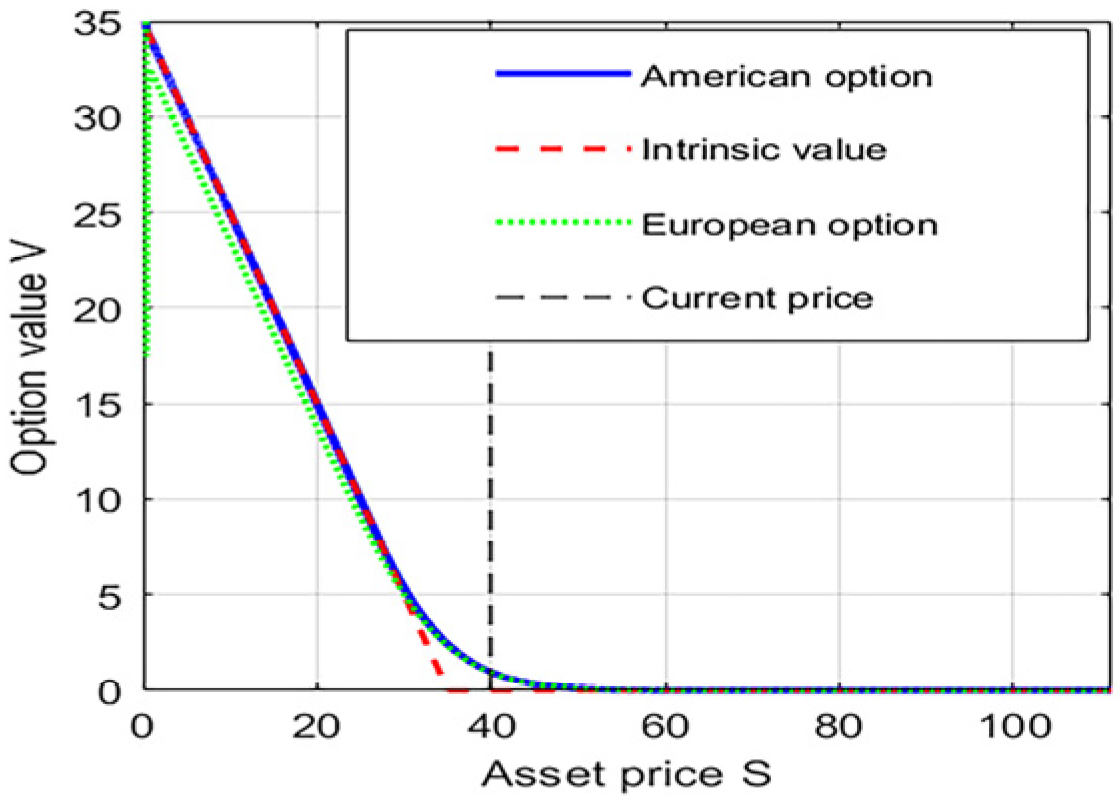
When the asset price approaches zero (S → 0), the theoretical value of the American put option should approach the strike price K = 35, because immediate exercise at this time yields the maximum return. The boundary value obtained from numerical calculation is 35.0000, which is consistent with the theoretical expectation. The corresponding theoretical value of the European put option is 33.2930, and the difference between the two reflects the advantage of early exercise for American options.
When the asset price approaches infinity (S → ∞), the option value should approach zero. The numerical result gives 0.0000, which is in line with the theoretical expectation.
  • Monotonicity
Figure 1 shows the price curve of the American put option, from which it can be seen that the put option price does not increase as the asset price increases. Numerical tests show that the price function satisfies the non-increasing property throughout its domain, and no grid point violating monotonicity has been found.
  • Convexity
The option price function should possess the properties of a convex function, meaning its second-order difference must be non-negative. By checking the second-order difference of the numerical solution, the results show that the convexity condition is met at the vast majority of grid points. Only a few points deviate slightly due to numerical errors, but overall, they still conform to the characteristics of a convex function. This convexity test ensures the rationality of the option pricing model, avoids local non-convex phenomena caused by numerical calculation errors, and thus guarantees the robustness of the pricing results.
  • Non-negativity test
The minimum calculated price is 0.0000, and the maximum is 35.0000, with no negative values appearing, fully meeting the basic requirement that option prices must be non-negative. This test further confirms the rationality of the numerical solution, avoids abnormal negative prices caused by model or calculation method defects, and ensures the economic significance of the pricing results.
In summary, the numerical solution demonstrates good theoretical consistency in terms of boundary behavior, monotonicity, convexity, and non-negativity, validating the effectiveness of the Fourier space time-stepping method in solving the American option pricing problem for the jump-diffusion Heston model with jumps. Specifically, the Fourier space time-stepping method can stably and accurately solve high-dimensional nonlinear free boundary problems, indicating that the method is suitable for complex models integrating stochastic volatility and jump processes, providing a reliable numerical tool for handling such financial derivative pricing problems.

4.3. Convergence Analysis

  • Benchmark reference value
First, the benchmark reference price of 0.933592 calculated using the grid configuration mentioned above (N = 8192, M = 1000) is adopted as the comparative benchmark for convergence analysis.
2.
Spatial discretization convergence
Under the condition of a fixed number of time steps (M = 500), the impact of the number of spatial grid points N on the numerical solution is investigated.
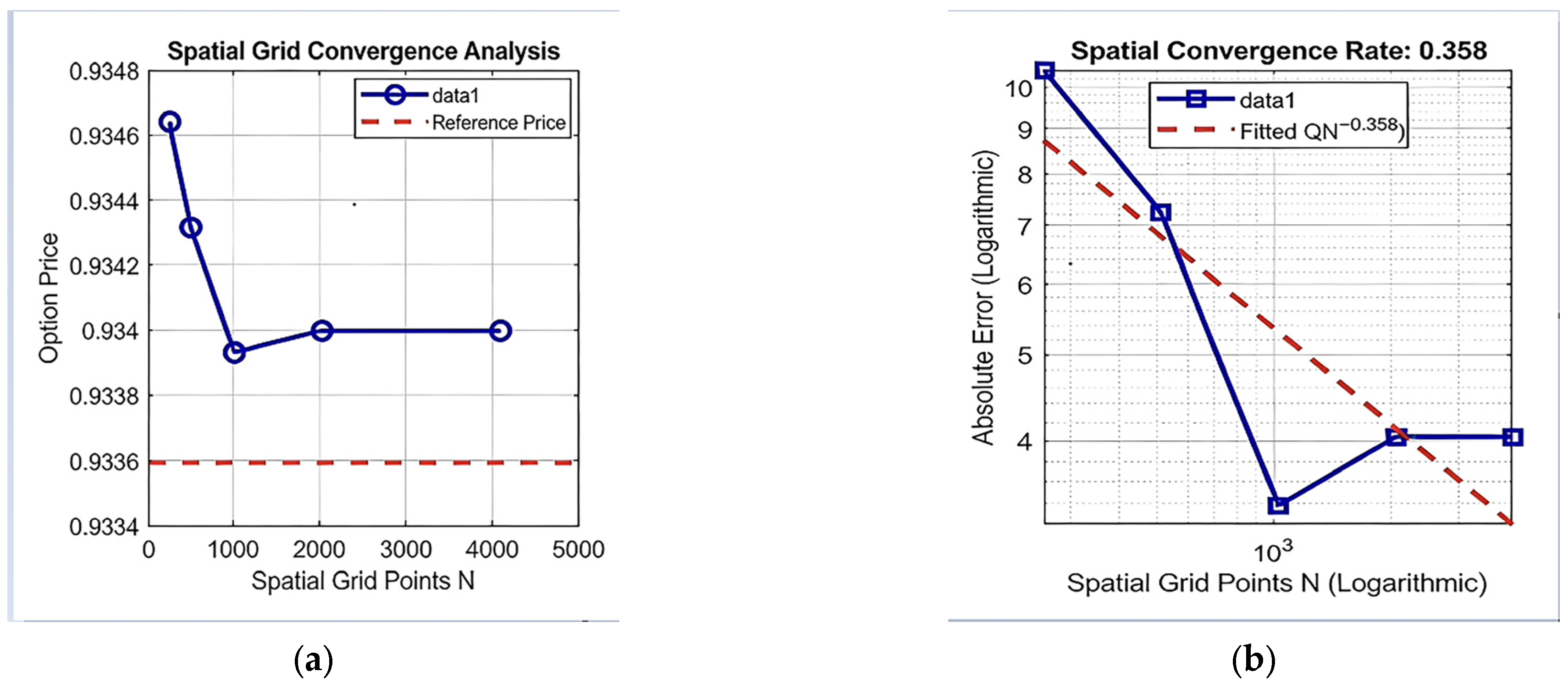
Table 3 presents the calculation results of option prices based on different spatial grid counts. Upon careful observation, it can be found that when the spatial grid count N reaches 1024 or above, the numerical solution exhibits high stability, with its value basically stabilizing around the specific value of 0.9339. This phenomenon indicates that when N ≥ 1024, the numerical solution has converged to a very stable value and no longer changes significantly with the increase in grid count. Additionally, error analysis shows that after N = 1024, the error gradually tends to stabilize and no longer continues to decrease. This further demonstrates that when the spatial grid count reaches 1024, the spatial resolution has reached a saturated state, and further increasing the grid count will not significantly improve the calculation accuracy, but will instead increase the computational cost. Therefore, in practical applications, choosing N = 1024 as the spatial grid count is a relatively reasonable choice.
Figure 2 shows spatial convergence and spatial convergence rate. It is found that the spatial convergence order is 0.358. This value is extremely low.
For spectral methods like FST, a much higher spatial convergence rate is typically expected. Therefore, we re-conducted the spatial convergence test using simultaneous refinement in time and space, with configurations of M = N and M = 2N. The new results show a significant improvement in the convergence rate: 0.698 when M = N and 0.581 when M = 2N. Even after removing time-error domination, the observed convergence rate remains around 0.6–0.7, which is still below the spectral rate expected for smooth functions. This is not a defect of the Fourier space time-stepping method but a consequence of the limited smoothness of the American option value. The payoff Φ ( S ) = m a x ( K S , 0 ) is non-differentiable at S = K , and the optimal exercise boundary introduces a kink in the value function (the first derivative is continuous, but the second derivative jumps). Consequently, the solution belongs to the Hölder class C 1 , α rather than C . For such functions, Fourier spectral methods converge algebraically with an order equal to the regularity index—typically between 0.5 and 1. The observed rates 0.698 and 0.581 are therefore consistent with theoretical expectations for a free-boundary problem.
3.
Time discretization convergence
Under the condition of a fixed spatial grid (N = 4096), the influence of the number of time steps M on the numerical solution is analyzed.
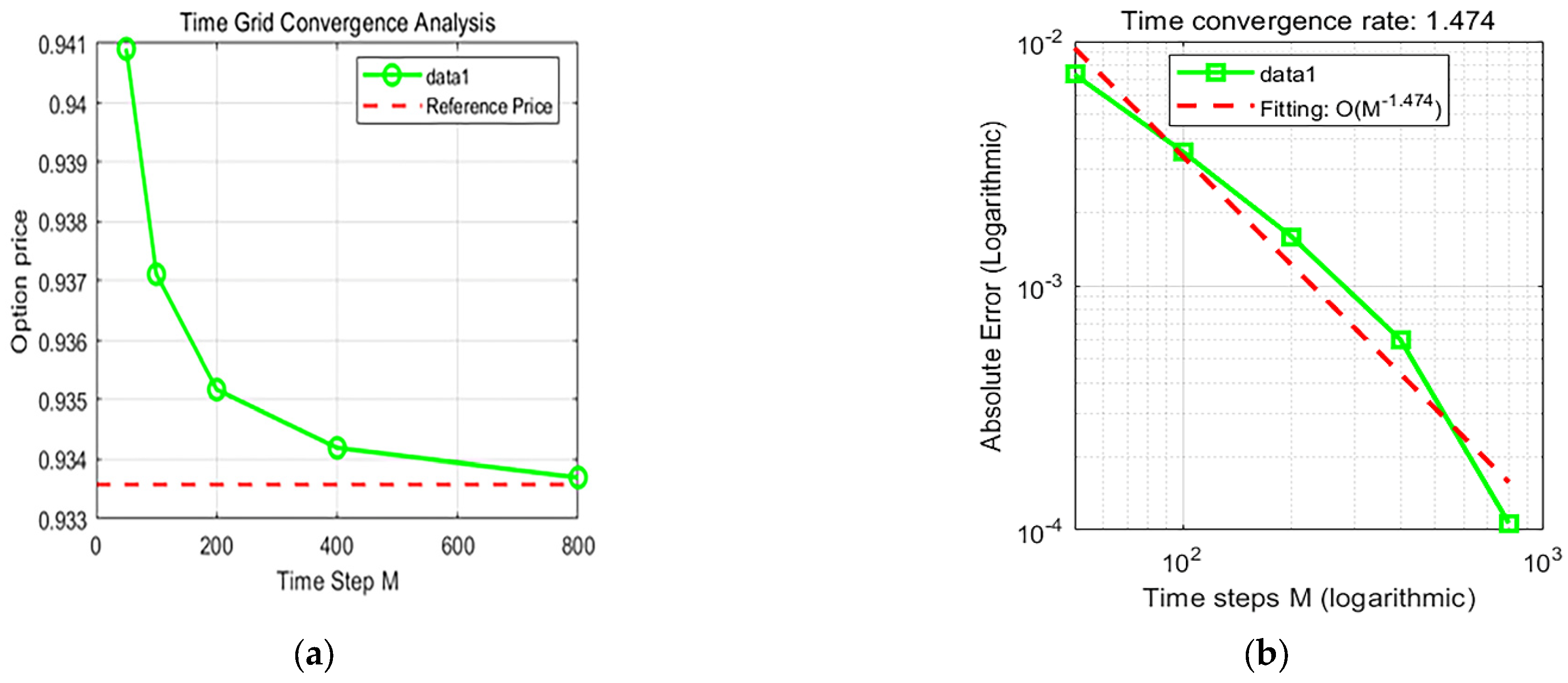
Table 4 shows the option prices based on time steps. Analysis shows that the error decreases significantly with the increase in M, indicating that time discretization is the main source of numerical error. When M ≥ 400, the absolute error has dropped below 0.0006, meeting the precision requirements for practical applications.
Figure 3 shows that the time convergence order is 1.474, which is close to the theoretically expected first-order convergence rate.
4.
Numerical parameter sensitivity analysis: Conduct sensitivity tests for key numerical parameters of the Fourier space time-stepping method.
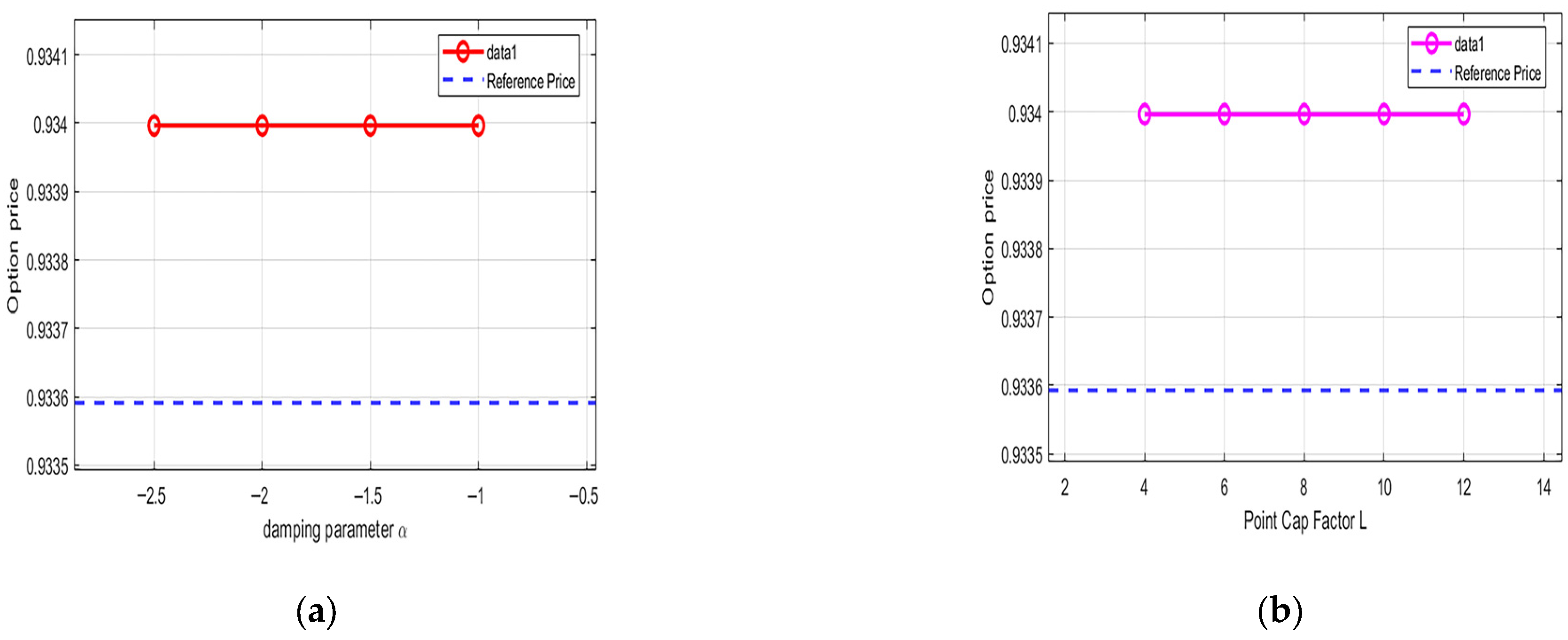
Figure 4a shows the influence of the damping parameter on the price, where when the damping parameter α varies in the interval [−2.5, −1.0], the numerical solution remains stable at 0.933996, with a maximum error of 0.000404.
Figure 4b shows the impact of the integral upper limit factor on the price. When the integral upper limit factor L varies within the interval [4,12], the numerical solution remains stable at 0.933996, with a maximum error of 0.000404. From the above conclusions, it can be seen that the numerical solution is insensitive to the damping parameter α and the integral upper limit factor L. Fluctuations within reasonable ranges have minimal impact on the price, indicating that the parameter selection has good robustness.
5.
Analysis of the trade-off between computational efficiency and accuracy
Evaluating the balance between computational efficiency and accuracy under different grid configurations.
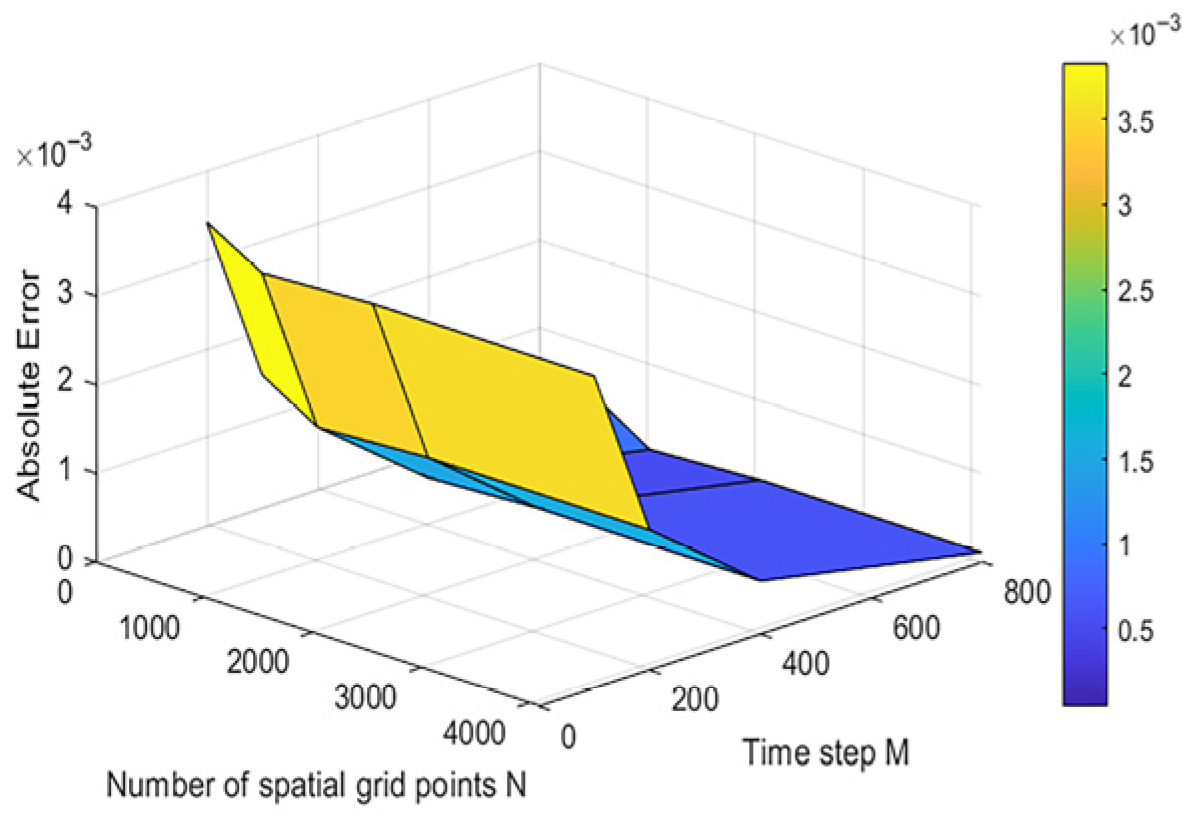
Table 5 and Figure 5 respectively show the option prices for the number of spatial grids and time steps, and their joint convergence. It can be seen that Configuration 3 (N = 2048, M = 400) achieves the optimal balance between computation time (0.17 s) and accuracy (error 0.000602). Configuration 4 (N = 4096, M = 800) provides the highest accuracy (error 0.000107) with a computation time of 0.61 s. The computational cost increases almost linearly with grid refinement, but the rate of accuracy improvement gradually slows down.

4.4. Sensitivity Analysis

Calculation of Greek values: The result is Delta = −0.1902, which is negative and fully consistent with the characteristics of a put option. The absolute value 0.1902 is small, indicating that the option is deeply out-of-the-money. Gamma = 0.034141, which is positive, perfectly verifies the convexity of the option price, in line with the theoretical requirements of all options. Vega (approx.) = 2.3350. The positive value is consistent with theoretical expectations.
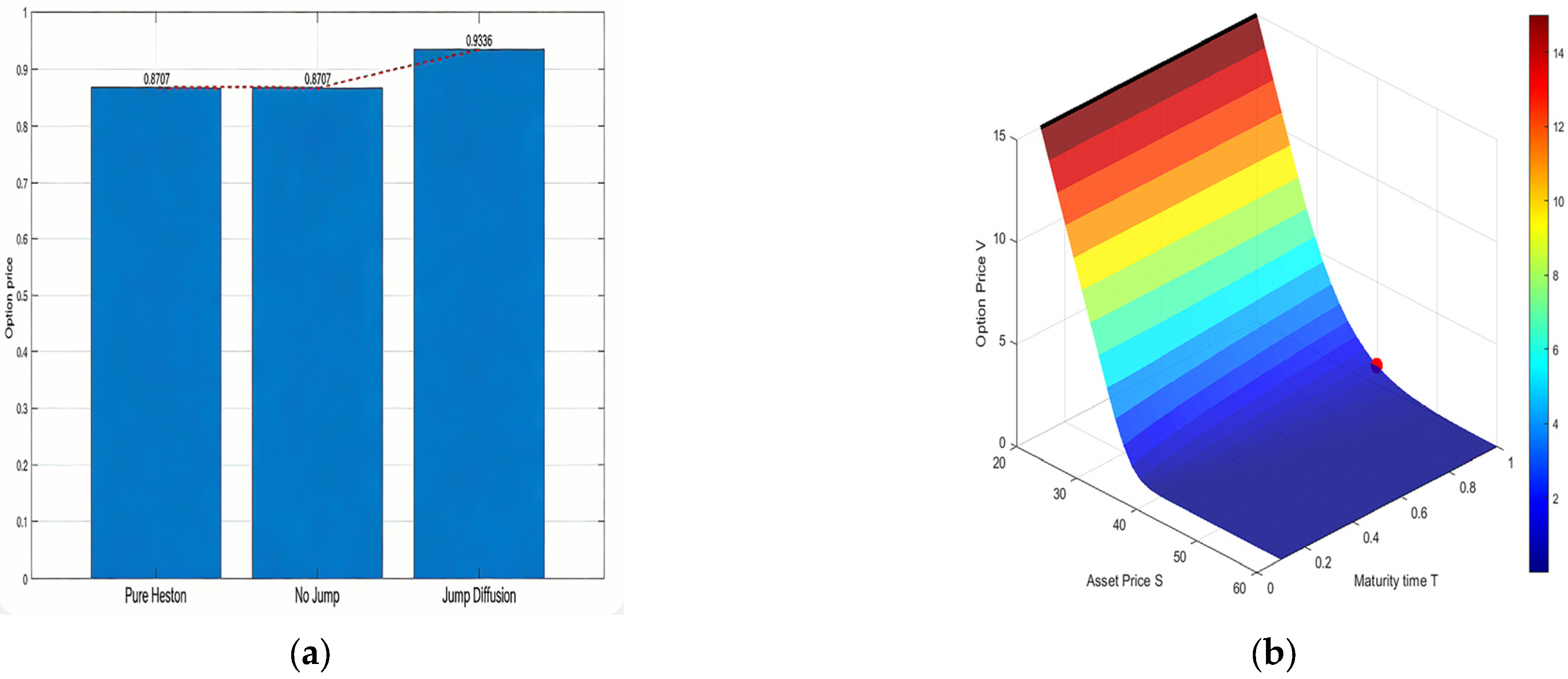
Figure 6a shows the pricing comparison between the pure Heston model, the no-jump Heston model, and the jump-diffusion Heston model. From observation, the option price for the pure Heston model is 0.8707, and for the no-jump Heston model, it is also 0.8707. The prices of the pure Heston and no-jump Heston models are the same, indicating that the parameters uJ and σJ have no effect in the no-jump scenario. The price for the jump-diffusion Heston model is 0.9336, with a jump premium of 0.0629 (6.74%). This shows that the option price for the jump-diffusion Heston model is about 6.74% higher than that of the pure Heston model. The jump model better captures extreme volatility events in the market and has a significant impact on the pricing of American options, validating the practical significance of introducing the jump process.
Figure 6b shows the price surface of American put options, indicating that as the asset price S increases, the put option price decreases. As the expiration time T increases, the option price rises. Consistent with theoretical expectations, this further verifies the rationality of the numerical results.

5. Conclusions

5.1. Research Summary

This paper studies the pricing of American options under the Heston model with jump diffusion, combining stochastic volatility and jump processes to model the characteristics of real financial markets, and employs the Fourier-space time-stepping (FST) method to achieve numerical solutions for pricing problems. Through theoretical analysis and systematic numerical experiments, the following main conclusions are drawn:
  • Model Construction Aspect
This paper combines the Heston stochastic volatility model with the Merton jump diffusion process to construct a hybrid model that not only characterizes the random evolution and mean reversion of volatility but also captures the discontinuous jump phenomenon in prices. This model can more realistically reflect actual market behavior, providing a more solid modeling foundation for American option pricing.
2.
Methodological Innovation Aspect
For this high-dimensional, nonlinear free boundary problem, this paper adopts the Fourier space time-stepping method for numerical solution. This method converts the pricing equation into Fourier space, utilizes characteristic functions to achieve time evolution, and uniformly handles diffusion and jump terms, effectively avoiding truncation and interpolation issues inherent in traditional finite difference methods, significantly improving computational efficiency and numerical stability.
In terms of numerical verification, numerical experiments show that the Fourier space time-stepping method has good convergence and stability, and both spatial and temporal discretization errors are within controllable ranges. Through boundary condition, monotonicity, convexity, and non-negativity tests, the consistency between the numerical solution and financial theory is verified. Parameter sensitivity analysis shows that the jump component significantly affects the option value (premium of about 6.74%), further confirming the importance of incorporating jump risk in the pricing model.
Although we present only one representative figure, we have tested the Fourier space time-stepping method across a range of parameter values (K = 80, 100, 120; r = 0.01, 0.05, 0.10; v0 = 0.04, 0.09, 0.16). The method remains stable and produces errors of the same order as reported. A full set of figures is omitted here for brevity but is available from the authors upon request.
3.
Method advantages
Compared with other methods, the Fourier space time-stepping method does not require domain truncation or assumptions about the behavior of solutions outside the domain when handling jump integral terms, thereby avoiding accuracy loss and stability issues caused by this. In addition, the Fourier space time-stepping method does not depend on the analytical expression of the Fourier transform of the option payoff function, and thus can be flexibly applied to option pricing with non-standard payoff structures.

5.2. Research Limitations and Future Directions

Although the Fourier space time-stepping method performs well in this paper, there are several areas that can be further researched and improved:
  • Improvement of time discretization accuracy
Currently, the time order of the Fourier space time-stepping method is first-order. In the future, multi-step methods or iterative correction techniques can be combined to develop improved algorithms with second-order or higher time accuracy, further enhancing computational efficiency and pricing accuracy.
2.
Lack of path-dependent options
This paper lacks analysis of path-dependent options (such as barrier options). Due to the discontinuous pricing or boundary layer characteristics of contracts like barrier options, future research can explore combining non-uniform fast Fourier transform algorithms with the Fourier space time-stepping method to support efficient computation under non-uniform grids.
3.
Lack of comparison with other models
While the Fourier space time-stepping method shows promising accuracy and efficiency in our tests, a direct comparison with other existing methods (e.g., finite differences, neural networks) is not included in this paper. We recognize this as a limitation and plan to conduct such a comparative study in a separate follow-up work.
4.
Calculation of risk parameters and model calibration
Develop efficient calculation algorithms for the Greek letters based on the Fourier space time-stepping method, and research model parameter calibration techniques based on actual market data to enhance the applicability of this method in real-time trading and risk management.
5.
Expansion of multi-asset and state transition models
The method in this paper can be naturally extended to multi-asset scenarios and supports the embedding of state transition mechanisms. Future research can further explore its applications in stochastic correlation modeling, long-term option pricing, and valuation of complex structured products.
6.
Challenges and prospects in extending the Fourier space time-stepping method
The Fourier space time-stepping method may potentially be extended to more complex settings, such as nonlinear Black–Scholes models with variable volatility or multidimensional problems. However, such extensions involve non-trivial modifications (e.g., handling state-dependent coefficients or the curse of dimensionality) and are therefore left for future investigation.
In summary, the Fourier space time-stepping method provides an efficient, robust, and general numerical tool for pricing American options in stochastic volatility and jump environments. This research not only deepens the understanding of option pricing problems under complex models but also lays a methodological foundation for subsequent theoretical and applied research, possessing significant academic value and practical significance.

Author Contributions

Conceptualization, Y.Z. and L.L.; Methodology, Y.Z. and L.L.; Software, S.W.; Validation, S.W.; Formal analysis, S.W.; Writing—original draft, S.W.; Writing—review & editing, Y.Z. and L.L.; Visualization, S.W.; Supervision, Y.Z. and L.L.; Funding acquisition, Y.Z. All authors have read and agreed to the published version of the manuscript.

Funding

This work was supported by the Youth Scholars Fund of Harbin University of Commerce under Grant 18XN010, the Doctor’s Fund of Harbin University of Commerce under Grant 2019DS048, and the National Social Science Fund of China under Grant 21BTJ061.

Data Availability Statement

The original contributions presented in this study are included in the article. Further inquiries can be directed to the corresponding author.

Conflicts of Interest

The authors declare no conflicts of interest.

References

  1. Black, F.; Scholes, M.S. The Pricing of Options and Corporate Liabilities. J. Political Econ. 1973, 81, 637–654. [Google Scholar] [CrossRef] [PubMed]
  2. Rotondi, F. American Options on High Dividend Securities: A Numerical Investigation. Risks 2019, 7, 59. [Google Scholar] [CrossRef]
  3. Zaevski, T.S.; Sariev, H.; Savov, M. A Fast and Accurate Numerical Approach for Pricing American-Style Power Options. Mathematics 2025, 13, 2031. [Google Scholar] [CrossRef]
  4. Zecevic, S.; Rodrigo, M. Explicit Formulas for Hedging Parameters of Perpetual American Options with General Payoffs: A Mellin Transform Approach. Mathematics 2025, 13, 479. [Google Scholar] [CrossRef]
  5. Merton, R.C. Option Pricing When Underlying Stock Returns Are Discontinuous. J. Financ. Econ. 1976, 3, 125–144. [Google Scholar] [CrossRef]
  6. Heston, S.L. A Closed-Form Solution for Options with Stochastic Volatility with Applications to Bond and Currency Options. Rev. Financ. Stud. 1993, 3, 327–343. [Google Scholar] [CrossRef]
  7. Liu, W.; Zhu, S.P. Pricing Variance Swaps under the Hawkes Jump-diffusion Process. J. Futures Mark. 2019, 39, 635–655. [Google Scholar] [CrossRef]
  8. Chang, Y.; Wang, Y.; Zhang, S. Option Pricing under Double Heston Jump-Diffusion Model with Approximative Fractional Stochastic Volatility. Mathematics 2021, 9, 126. [Google Scholar] [CrossRef]
  9. Lu, Y.; Song, R. Pricing of a Binary Option Under a Mixed Exponential Jump Diffusion Model. Mathematics 2024, 12, 3233. [Google Scholar] [CrossRef]
  10. Mrázek, M.; Pospíšil, J. Calibration and simulation of Heston model. Open Math. 2017, 15, 679–704. [Google Scholar] [CrossRef]
  11. Garces, L.P.D.M.; Cheang, G.H.L. A Numerical Approach to Pricing Exchange Options under Stochastic Volatility and Jump-Diffusion Dynamics. Quant. Financ. 2021, 21, 2025–2054. [Google Scholar] [CrossRef]
  12. Schmelzle, M. Option Pricing Formulae Using Fourier Transform: Theory and Application; University of Konstanz Working Paper; University of Konstanz: Konstanz, Germany, 2010. [Google Scholar]
  13. Hurd, T.R.; Zhou, Z. A Fourier Transform Method for Spread Option Pricing. Soc. Ind. Appl. Math. 2010, 1, 142–157. [Google Scholar] [CrossRef]
  14. Alfeus, M.; Schlögl, E. On Spread Option Pricing Using Two-Dimensional Fourier Transform. Int. J. Theor. Appl. Financ. 2019, 22, 637–654. [Google Scholar] [CrossRef]
  15. Bayer, C.; Hammouda, C.B.; Papapantoleon, A.; Samet, M.; Tempone, R. Optimal Damping with a Hierarchical Adaptive Quadrature for Efficient Fourier Pricing of Multi-Asset Options in Lévy Models. J. Comput. Financ. 2023, 27, 43–86. [Google Scholar] [CrossRef]
  16. Boukai, B. On the Class of Risk Neutral Densities under Heston’s Stochastic Volatility Model for Option Valuation. Mathematics 2023, 11, 2124. [Google Scholar] [CrossRef]
  17. Sakurai, R.; Takahashi, H.; Miyamoto, K. Learning Parameter Dependence for Fourier-Based Option Pricing with Tensor Trains. Mathematics 2025, 13, 1828. [Google Scholar] [CrossRef]
  18. Zhang, Q.; Song, H.; Hao, Y. Semi-Implicit Fem for the Valuation of American Options under the Heston Model. Comput. Appl. Math. 2022, 41, 73. [Google Scholar] [CrossRef]
  19. Veliu, D.; De Marchis, R.; Marino, M.; Martire, A.L. An Alternative Numerical Scheme to Approximate the Early Exercise Boundary of American Options. Mathematics 2022, 11, 187. [Google Scholar] [CrossRef]
Figure 1. American put option price curve (t = 0).
Mathematics 14 01412 g001
Figure 2. (a) Spatial convergence. (b) Spatial convergence rate.
Mathematics 14 01412 g002
Figure 3. (a) Time grid convergence. (b) Time convergence rate.
Mathematics 14 01412 g003
Figure 4. (a) The impact of damping parameters on price. (b) The impact of the upper limit factor on price.
Mathematics 14 01412 g004
Figure 5. Joint convergence.
Mathematics 14 01412 g005
Figure 6. (a) Comparison of pricing for different models. (b) American put option price surface.
Mathematics 14 01412 g006
Table 1. Model Parameters.
ParameterNumerical Value
Price of the underlying asset S 0 40
Execution price K35
Risk-free interest rate r0.05
Volatility σ0.3
Expiration time T1
Table 2. Put option prices.
Asset PriceAmerican Put Option PriceIntrinsic Value
305.36555.0000
352.41670.0000
400.93360.0000
450.31940.0000
500.10030.0000
Table 3. Option price based on the number of spatial grids.
Number of Spatial Grids NOption PriceAbsolute ErrorCalculation Time (Seconds)
2560.934640.001050.07
5120.934320.000720.09
10240.933930.000340.14
20480.9340.00040.23
40960.9340.00040.4
Table 4. Option price based on time steps.
Time Steps MOption PriceAbsolute ErrorCalculation Time (Seconds)
500.940910.007310.04
1000.937120.003520.08
2000.935180.001590.17
4000.934190.00060.33
8000.93370.000110.64
Table 5. Option price based on spatial grid number and time step number.
ConfigurationSpatial Grid NTime Step Number MOption PriceAbsolute ErrorCalculation Time (Seconds)
15121000.9374270.0038350.02
210242000.935110.0015180.05
320484000.9341940.0006020.17
440968000.9336990.0001070.61
5819216000.9334430.0001492.22
Disclaimer/Publisher’s Note: The statements, opinions and data contained in all publications are solely those of the individual author(s) and contributor(s) and not of MDPI and/or the editor(s). MDPI and/or the editor(s) disclaim responsibility for any injury to people or property resulting from any ideas, methods, instructions or products referred to in the content.