Recent Advancements in Active Learning


Abstract
1. Introduction
- Outline the problem settings of AL based on an extensive literature review.
- Examine recent advancements and strategies within the AL framework.
- Identify underexplored research opportunities to enhance AL capabilities.
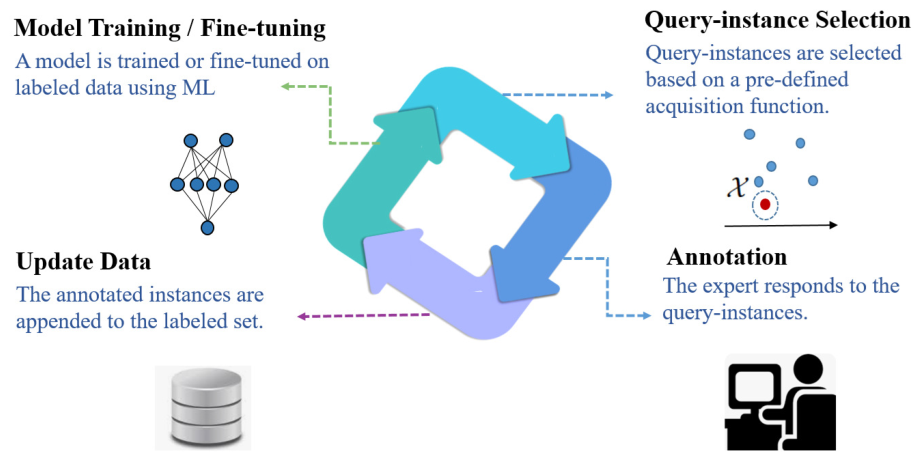
2. Brief Introduction of Active Learning
2.1. Problem Setting
2.2. Notations and Definition
2.3. Noise Assumptions
- Realizable noise condition:The realizable assumption posits an ‘error-free’ environment, where function perfectly approximates the target function, and the instances are perfectly separable. This condition is assumed in many studies, but this condition is relatively stringent in practice since the target function is typically unknown.
- Agnostic noise condition:The agnostic noise assumption is the weakest non-realizable assumption. This condition makes no assumption on the target function, as shown in Equation (2), and it is often referred to as adversarial noise condition. This assumption is described as follows for .
- Benign noise condition:The benign noise assumption is defined by constraining the range of to in Equation (2).
- Tsybakov’s noise condition:Tsybakov’s noise assumption is a widely applied non-realizable condition, as shown in Equation (3), and it is also referred to as the low noise condition for some and .This condition reflects the pragmatic hypothesis that the amount of label noise is inversely related to the distance from the decision boundary [5]. Since this condition is always true when , it is appealing when , where is the Bayes classifier. Here, indicates how quickly the target function changes as instance x approaches the decision boundary [6].
- Massart’s noise condition:Massart’s noise assumption is interpreted as a margin condition on the probability distribution , as shown in Equation (4), which is also referred to as bounded noise assumption [7].where , and is a target function. Massart’s noise condition is derived from Tsybakov’s noise assumption by setting with .
- Bernstein’s noise condition:
2.4. Standard Query Strategies
- The version space strategy:The version space strategy repeatedly narrows down the version space by eliminating inconsistent concepts based on instances at each iteration, where the version space refers to all plausible versions of concepts [2]. Hence, the version space is defined as at the k-th iteration. Since the version space is refined by examining concepts at each iteration, effective implementation significantly reduces label complexity; however, inconsistent concepts hinder the identification of the optimal hypothesis [10] and lead to computational intractability.
- The query by committee (QBC) strategy:The QBC strategy selects the instance exhibiting maximal disagreement in voting among the committee consisting of multiple learners, according to a given criterion. This strategy is formulated as the summation of disagreement measure such as divergence, as shown in Equation (6), where and indicate the number of committee members and the given criterion, respectively [11].Here, represents a mixing weight, and denotes the inner product between committee member parameters and input, while represents the consensus model parameters, which is also referred to as the e-mixture of models [12].This strategy exponentially decreases the generalization error: since each query bisects the version space, the bound on information gain asymptotically approaches 1 as the number of queries approaches ∞ [13]. Furthermore, the accuracy of the estimate generally increases if the number of committees exceeds two.
- The expected error reduction (EER) strategy:The expected error is defined as the predicted error of a specific estimator when a new observation is incorporated into the training process. The expected error reduction (EER) strategy estimates the potential generalization error associated with an observation and selects the query instance that minimizes this expected error. According to Settles [3], this objective is typically formulated as:In (7), denotes the model retrained after augmenting the training set with the pair . Given that the error term can be decomposed into bias and variance components, the variance term—being more analytically tractable than the total error—is frequently utilized in practice, focusing on expected variance reduction [14].
- The uncertainty sampling strategy:Uncertainty sampling strategies prioritize instances for selection based on predefined uncertainty criteria, under the assumption that high uncertainty corresponds to high informativeness. The concept is intuitive and can be implemented using various measures, such as entropy or margin-based metrics. For binary classification using posterior probabilities, uncertainty can be formulated as in (8):
- The representative sampling strategy:The representative sampling strategy selects the most informative instances by analyzing the structural characteristics of the unlabeled data based on predefined criteria, such as density, diversity, or similarity. In density-based selection [15], the density score, Q, is defined as the average feature similarity among the nearest neighbors within a batch, as formulated in Equation (10):This approach identifies query instances that exhibit the highest density scores within the input space. Furthermore, diversity-based strategies are widely adopted across various information criteria [16,17,18], particularly when integrated with uncertainty sampling in batch settings. However, due to its inherent nature, this strategy often requires a larger number of samples, which may lead to slower convergence rates.
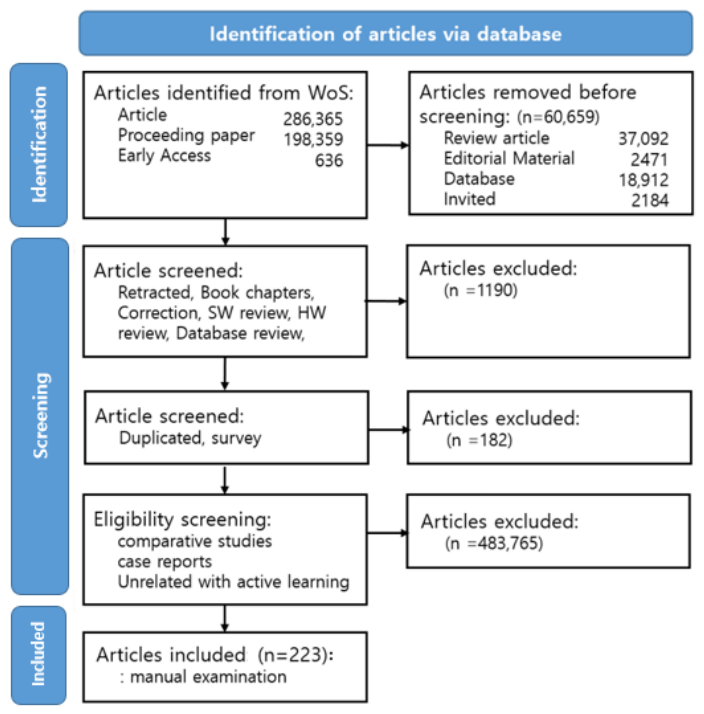
3. Literature Collection
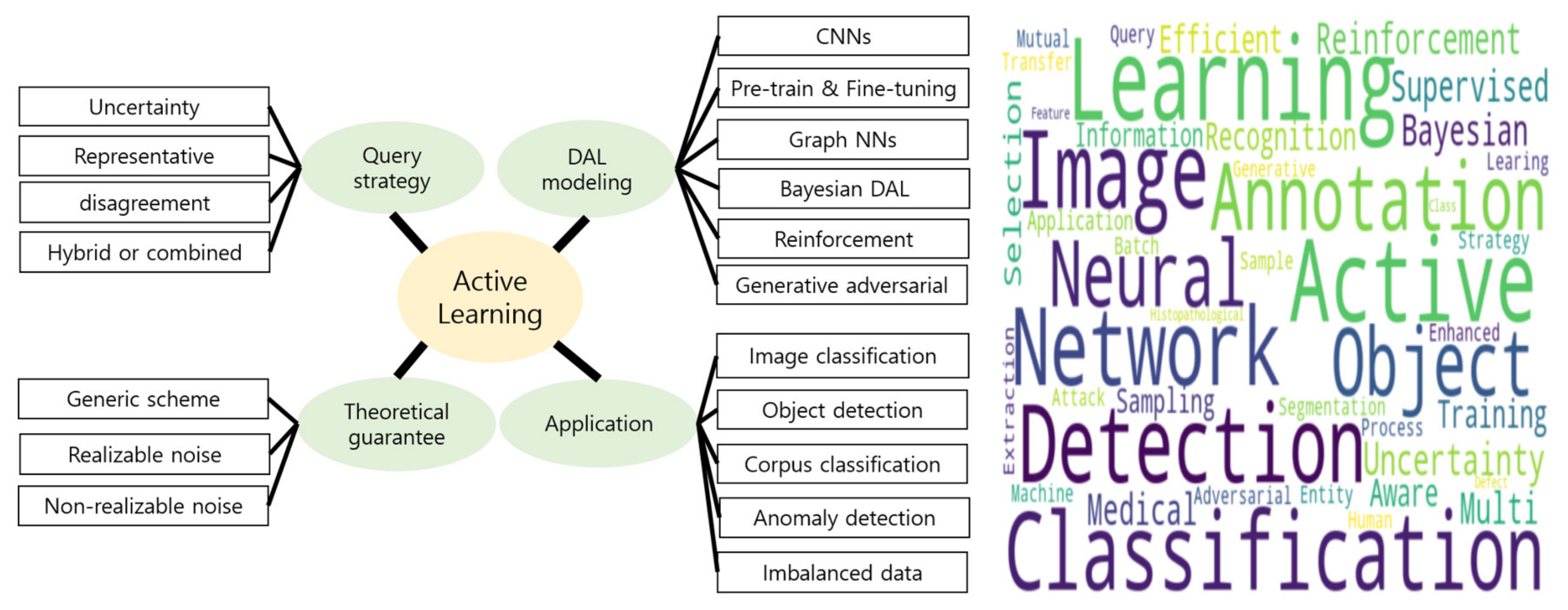
4. Modern Development of Active Learning Strategies
4.1. Classical Results: Theoretical Guarantees in Active Learning
4.2. Emerging Trends in Active Learning Research
- Multiple or Batch-mode Selection: Traditionally, AL involves selecting a single query instance at a time from a given dataset. However, because deep learning models typically operate on mini-batches, AL has evolved to select multiple instances simultaneously in a batch-mode fashion. This natural transition toward batch-mode AL has been extensively adopted in recent studies [24,25,26,27,28] and is discussed in detail in Section 4.3.
- Transfer Learning Setting: AL is conventionally integrated into target environments as a generic framework. Deep learning models are typically pre-trained in a source domain and subsequently fine-tuned in the target domain. In this transfer learning (TL) setting, domain adaptation challenges inherently arise during the learning phase. Consequently, AL strategies must account for distributional shifts between domains. Several methodologies [16,29,30,31] developed under TL paradigms address these issues, as detailed in Section 4.4.
- Multiple Query Strategy: Selecting informative query instances is pivotal in active learning. In conventional settings, instances are typically chosen from the entire dataset based on a single criterion. However, in batch-mode implementations, a single criterion may fail to identify diverse and informative samples, as examples within a batch often exhibit high homogeneity. To address this limitation, the recent literature has deployed query strategies based on multiple criteria [15,32,33]. These standard query strategies are further detailed in Section 2.4.
- Extension to Diverse Applications: While AL algorithms are typically task-agnostic, their application domains have expanded significantly with the widespread adoption of deep learning models. Although many general challenges have been addressed, certain problems remain confined to domain-specific environments, necessitating tailored AL approaches. Among the various methodologies developed for specific application domains [31,34,35,36], several representative studies are discussed in Section 4.5.
4.3. Multiple or Batch-Mode Selection with Multi-Label Problems
4.4. Active Learning Under Transfer Setting
4.5. Extension to Diverse Applications
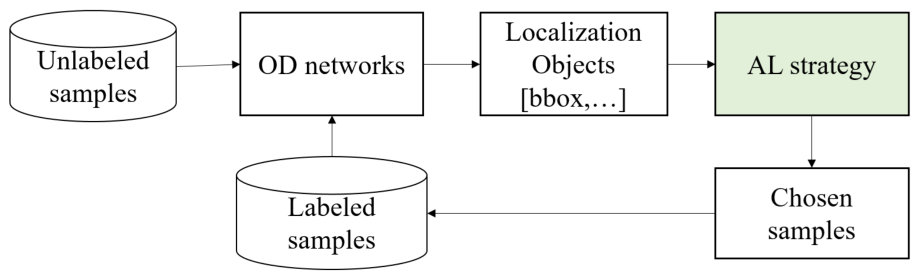
4.5.1. Object Detection
4.5.2. Biomedical Data Classification
4.5.3. Entity Recognition for Network Security
4.5.4. Transformation
4.5.5. Exploration and Mapping
4.5.6. Facial Age Estimation
4.5.7. Demonstration
5. Underexplored Opportunity: Imbalanced Class Distribution
6. Discussion
- Batch-mode Selection: Modern AL approaches frequently employ multiple or batch-mode selection. While this accelerates data acquisition, samples within a single batch often exhibit similar characteristics. This necessitates more sophisticated query strategies to maintain sample efficiency.
- Transfer Learning Integration: AL is increasingly applied within transfer learning frameworks. However, performance may degrade due to the domain gap between source and target data, requiring strategies that offer better generalization for unseen tasks.
- Multiple or Hybrid Query Strategies: There is a growing trend toward using multiple query strategies simultaneously. Since uncertainty-based methods alone may select redundant samples in a batch, they are often paired with representativeness-based strategies (e.g., diversity) to prioritize heterogeneous samples. While effective, this approach increases computational overhead and risks, introducing redundant information or sensitivity issues if the criteria overlap excessively.
- Domain Expansion: AL has expanded into diverse application domains, proving particularly beneficial where annotation costs are prohibitive. Nevertheless, highly specialized fields continue to demand more tailored AL architectures.
Author Contributions
Funding
Data Availability Statement
Conflicts of Interest
Abbreviations
| AL | Active Learning |
| DAL | Deep Active Learning |
| DNNs | Deep Neural Networks |
| CNNs | Convolutional Neural Networks |
Appendix A. Appendix Tables

| Noise | Setting | Query Strategy | Primary Findings | Reference |
|---|---|---|---|---|
| Realizable | pool | Greedy | Label complexity of greedy is times that of any other strategy | [61] |
| Benign | pool | Uncertainty | Both upper and lower bound of expected excess error of active learning is proportional to as the passive learning | [62] |
| Agnostic | stream | Disagreement | A fast rate in convergence based on disagreement coefficient | [63] |
| pool | Disagreement | Exponential savings using the negativity of the excess risk also adapted to Massart’s condition | [22] | |
| Tsybakov | stream | Margin | The convergence rate of active learning is faster than passive learning for | [21] |
| stream | Plug-in | Proposed the minimax lower bound for the excess risk. The optimal rate attained by shrinking confidence bands | [64] | |
| stream | Synthesis | Achieve the optimal rate up to polylogarithemic factor | [18] | |
| Massart’s | pool | Adaptive | Exponential savings in label complexity of comparing to realizable noise condition | [19] |
| Bernstein’s | stream | Disagreement | Exponential savings in label complexity compared to passive learning | [23] |
| Methods | Query-Strategy | Main Contribution | Datasets | Ref. |
|---|---|---|---|---|
| MIRAL | EER | Selects top k query instances | VOC2007, MS-COCO | [24] |
| ACTS | Uncertainty | Global uncertainty criteria in HDRE | CIFAR10/100 | [32] |
| BALQUE | Entropy | Calibrated confidence for k instances | CIFAR10/100, SVHN | [25] |
| DDDS | Uncert. + Div. | Dual diversity or least confidence | CoNLL-2003 | [48] |
| ALLG | Representative | Optimal graph structures | GSAD, Waveform | [35] |
| VeSSAL | Uncert. + Div. | Expected detrimental contribution | MNIST, CIFAR10 | [17] |
| ADS | Data Shapley | Points with high DSvs | CIFAR10/100, SVHN | [38] |
| DALRel | Exp. Model Change | Highest EMOC scores for k instances | IMDB, Wiki | [51] |
| BatchBALD | Mutual Info. | Mutual info between model and data | CINIC-10, MNIST | [27] |
| Core-set | Representative | distance to solve k-center | CIFAR10/100, SVHN | [37] |
| Methods | Query-Strategy | Main Contribution | Datasets | Ref. |
|---|---|---|---|---|
| TAL | Uncert. + Repre. | Uses entropy and weighted average similarity for time series classification | RAUS, MeteoNet, KenCentralMet | [30] |
| Goswami’s | Uncert. + Div. | Solves iterative quadratic programming to select videos and k frames | UCF-101, Kinetics, ImageNet | [16] |
| DTSE | Uncert. + Repre. | Selects salient instances in source and target domains for HSI fine-tuning | Pavia, Urban, etc. | [31] |
| ALFREDO | Uncert. + Repre. | Weighted sum of four criteria after obtaining disentangled features | CAMELYON17, NIH Chest Xray14 | [15] |
| Methods | Query-Strategy | Main Contribution | Datasets | Ref. |
|---|---|---|---|---|
| ASSL | Uncert. + Div. | Euclidean distance between sets for Image OD | MS COCO, ILSVRC | [40] |
| ODBS | Uncert. + Div. | Gaussian variances from heatmaps for Autonomous Driving | KITTI (vehicle) | [26] |
| Lin’s | Diversity | Spatial/temporal diversity for Autonomous Driving | VoxelNet, BEVFusion | [41] |
| Arthur’s | Uncert. + Imb. | Cosine similarity of embeddings for Vehicle Detection | DOT CCTV, MIO-TCD | [34] |
| GMU-CS | Uncertainty | Collaborative sampling for Aerial Image OD | VisDrone2019, DOTA-1.5 | [14] |
| IAU | Uncertainty | Positional and categorical components for Image OD | MS COCO, Pascal VOC | [42] |
| bioRE | Uncert., Margin | Six query strategies for Bio-relation Extraction | AIMED, BioRED, CDR | [36] |
| MedAL | Uncert. + Repre. | Maximizes average distance for Medical Image Class | Messidor, Breast Cancer | [44] |
| AD | Uncert. + Repre. | Subregion probability prediction for Medical Image Class | HQDS | [45] |
| MDAL | Uncert. + Repre. | Mutual info and diversity for Multi-modal Image | Brain glioma, Ovarian cancer | [33] |
| M-VAAL | Uncert. + Repre. | Predicted unlabeled set via discriminator for Multi-modal | BraTS2018, COVID-QU-Ex | [47] |
References
- Baum, E.; Haussler, D. What Size Net Gives Valid Generalization? In Advances in Neural Information Processing Systems; Morgan Kaufmann: San Francisco, CA, USA, 1989. [Google Scholar]
- Angluin, D. Queries and Concept Learning. Mach. Learn. 1988, 2, 319–342. [Google Scholar] [CrossRef]
- Settles, B. Active Learning Literature Survey; Computer Science Technical Report 1648; University of Wisconsin–Madison: Madison, WI, USA, 2009; pp. 1–47. [Google Scholar]
- Lughofer, E. On-line active learning: A new paradigm to improve practical usability of data stream modeling methods. Inf. Sci. 2017, 415, 356–376. [Google Scholar] [CrossRef]
- Tsybakov, A. Optimal aggregation of classifiers in statistical learning. Ann. Stat. 2004, 32, 135–166. [Google Scholar] [CrossRef]
- Mammen, E.; Tsybakov, A.B. Smooth discrimination analysis. Ann. Stat. 1999, 27, 1808–1829. [Google Scholar] [CrossRef]
- Massart, P.; Nédélec, E. Risk bounds for statistical learning. Ann. Stat. 2006, 34, 2326–2366. [Google Scholar] [CrossRef]
- Bernstein, S. The Theory of Probabilities; Gastehizdat Publishing House: Moscow, Russia, 1946. [Google Scholar]
- Bartlett, P.; Mendelson, S. Empirical Minimization. Probab. Theory Relat. Fields 2006, 135, 311–334. [Google Scholar] [CrossRef]
- Beygelzimer, A.; Hsu, D.; Langford, J.; Zhang, T. Agnostic Active Learning without Constraints. In Proceedings of the 24th International Conference on Neural Information Processing Systems, Vancouver, BC, Canada, 6–9 December 2010. [Google Scholar]
- McCallum, A.; Nigam, K. Employing EM and Pool-Based Active Learning for Text Classification. In Proceedings of the Fifteenth International Conference on Machine Learning, Madison, WI, USA, 24–27 July 1998; pp. 350–358. [Google Scholar]
- Takano, K.; Hino, H.; Akaho, S.; Murata, N. Nonparametric e-mixture estimation. Neural Comput. 2016, 28, 2687–2725. [Google Scholar] [CrossRef] [PubMed]
- Seung, H.S.; Opper, M.; Sompolinsky, H. Query by Committee. In Proceedings of the Fifth Annual Workshop on Computational Learning Theory, Pittsburgh, PA, USA, 27–29 July 1992; pp. 287–294. [Google Scholar]
- Zhang, T.; Oles, F. A probability analysis on the value of unlabeled data for classification problems. In Proceedings of the Seventeenth International Conference on Machine Learning, Stanford, CA, USA, 29 June–2 July 2000; pp. 1191–1198. [Google Scholar]
- Mahapatra, D.; Tennakoon, R.; George, Y.; Roy, S.; Bozorgtabar, B.; Ge, Z.; Reyes, M. ALFREDO: Active learning with feature disentanglement and domain adaptation for medical image classification. Med Image Anal. 2024, 97, 103261. [Google Scholar] [CrossRef] [PubMed]
- Goswami, D.; Chakraborty, S. Active Learning for Video Classification with Frame-Level Queries. arXiv 2023, arXiv:2307.05587. [Google Scholar]
- Saran, A.; Yousefi, S.; Krishnamurthy, A.; Langford, J.; Ash, J. Streaming Active Learning with Deep Neural Networks. arXiv 2023, arXiv:2303.02535. [Google Scholar] [CrossRef]
- Wang, Y.; Singh, A. Noise-Adaptive Margin-Based Active Learning and Lower Bounds under Tsybakov Noise Condition. In Proceedings of the Thirtieth AAAI Conference on Artificial Intelligence (AAAI-16), Phoenix, AZ, USA, 12–17 February 2016. [Google Scholar]
- Kaariainen, M. Active Learning in the Non-Realizable Case. In Proceedings of the 17th International Conference on Algorithmic Learning Theory, Barcelona, Spain, 7–10 October 2006; pp. 63–77. [Google Scholar]
- Hanneke, S. Rates of Convergence in Active Learning. Ann. Stat. 2011, 39, 333–361. [Google Scholar] [CrossRef]
- Cavallanti, G.; Cesa-Bianchi, N.; Gentile, C. Linear Classification and Selective Sampling under Low Noise Conditions. In Proceedings of the Advances in Neural Information Processing Systems, Vancouver, BC, Canada, 7–10 December 2009; pp. 249–256. [Google Scholar]
- Puchkin, N.; Zhivotovskiy, N. Exponential Savings in Agnostic Active Learning Through Abstention. IEEE Trans. Inf. Theory 2021, 68, 4651–4665. [Google Scholar] [CrossRef]
- Shayestehmanesh, H. Active Learning Under the Bernstein Condition for General Losses. Master’s Thesis, University of Victoria, Victoria, BC, Canada, 2020. [Google Scholar]
- Cai, Q.; Tao, R.; Fang, X.; Xie, X.; Liu, G. A deep reinforcement active learning method for multi-label image classification. Comput. Vis. Image Underst. 2025, 257, 104351. [Google Scholar] [CrossRef]
- Han, Y.; Liu, D.; Shang, J.; Zheng, L.; Zhong, J.; Cao, W.; Sun, H.; Xie, W. BALQUE: Batch Active Learning by Querying Unstable Examples with Calibrated Confidence. Pattern Recognit. 2024, 151, 110385. [Google Scholar] [CrossRef]
- Hekimoglu, A.; Schmidt, M.; Marcos-Ramiro, M.; Rigoll, G. Efficient Active Learning Strategies for Monocular 3D Object Detection. In Proceedings of the IEEE Intelligent Vehicles Symposium, Aachen, Germany, 4–9 June 2022; pp. 295–302. [Google Scholar]
- Kirsch, A.; Amersfoort, J.; Gal, Y. BatchBALD: Efficient and Diverse Batch Acquisition for Deep Bayesian Active Learning. In Proceedings of the Thirty-Third Conference on Neural Information Processing Systems, Vancouver, BC, Canada, 8–14 December 2019; pp. 1–12. [Google Scholar]
- Toneva, M.; Sordoni, A.; Tachet des Combes, R.; Trischler, A.; Bengio, Y.; Gordon, G.J. An empirical study of example forgetting during deep neural network learning. arXiv 2019, arXiv:1812.05159. [Google Scholar] [CrossRef]
- Cook, D.; Feuz, K.; Krishnan, N. Transfer Learning for Activity Recognition: A Survey. Knowl. Inf. Syst. 2013, 36, 537–556. [Google Scholar] [CrossRef]
- Gikunda, P.; Jouandeau, N. Homogeneous Transfer Active Learning for Time Series Classification. In Proceedings of the IEEE International Conference on Machine Learning and Applications, Pasadena, CA, USA, 13–16 December 2021; pp. 1–7. [Google Scholar]
- Lin, J.; Zhao, L.; Li, S.; Ward, R.; Wang, Z. Active-Learning-Incorporated Deep Transfer Learning for Hyperspectral Image Classification. IEEE J. Sel. Top. Appl. Earth Obs. Remote Sens. 2018, 11, 4048–4062. [Google Scholar] [CrossRef]
- Wu, Y.; Wang, M.; Fan, M.; Wang, Q.; Zhang, Z.; Zhang, H.; Zhou, X. Deep Active Learning for Image Hierarchical Classification by Introducing Dependencies and Constraints Between Classes. IEEE Trans. Syst. Man Cybern. Syst. 2025, 55, 4396–4409. [Google Scholar] [CrossRef]
- Wang, H.; Jin, Q.; Du, X.; Wang, L.; Guo, Q.; Li, H.; Wang, M.; Song, Z. MDAL: Modality-difference-based active learning for multimodal medical image analysis via contrastive learning and pointwise mutual information. Comput. Med. Imaging Graph. 2025, 123, 102544. [Google Scholar] [CrossRef] [PubMed]
- Arthur, E.; Muturi, T.; Adu-Gyamfi, Y. Training Vehicle Detection and Classification Models with Less Data: An Active Learning Approach. Transp. Res. Rec. 2024, 2678, 2146–2164. [Google Scholar] [CrossRef]
- Ma, H.; Li, C.; Shi, X.; Yuan, Y.; Wang, G. Deep Unsupervised Active Learning on Learnable Graphs. IEEE Trans. Neural Netw. Learn. Syst. 2021, 35, 2894–2900. [Google Scholar] [CrossRef] [PubMed]
- Nachtegael, C.; De Stefani, J.; Lenaerts, T. A study of deep active learning methods to reduce labelling efforts in biomedical relation extraction. PLoS ONE 2023, 18, e0292356. [Google Scholar] [CrossRef]
- Sener, O. Active Learning for Convolutional Neural Networks: A Core-Set Approach. In Proceedings of the Sixth International Conference on Learning Representations (ICLR), Vancouver, BC, Canada, 30 April–3 May 2018; pp. 1–13. [Google Scholar]
- Ghorbani, A.; Zou, J.; Esteban, A. Data Shapley Valuation for Efficient Batch Active Learning. In Proceedings of the 56th Asilomar Conference on Signals, Systems, and Computers, Pacific Grove, CA, USA, 30 October–2 November 2022; pp. 1456–1462. [Google Scholar]
- Yuan, X.; Zhang, T. Truncated power method for sparse eigenvalue problems. J. Mach. Learn. Res. 2013, 14, 899–925. [Google Scholar]
- Rhee, P.; Erdenee, E.; Shin, D.; Ahmed, M.U.; Jin, S. Active and semi-supervised learning for object detection with imperfect data. Cogn. Syst. Res. 2017, 45, 10–123. [Google Scholar] [CrossRef]
- Liang, Z.; Xu, X.; Deng, S.; Cai, L.; Jiang, T.; Jia, K. Exploring Diversity-Based Active Learning for 3D Object Detection in Autonomous Driving. IEEE Trans. Intell. Transp. Syst. 2022, 25, 15454–15466. [Google Scholar]
- Zhang, Z.; Ma, W.; Yuan, X.; Hao, Y.; Guo, M.; Tang, H.; Zhou, Z.; Yao, Z. Instance-Aware Uncertainty for Active Learning in Object Detection. In Proceedings of the IEEE International Conference on Image Processing (ICIP), Abu Dhabi, United Arab Emirates, 27–30 October 2024; pp. 298–304. [Google Scholar]
- Gu, Y.; Tinn, R.; Cheng, H.; Lucas, M.; Usuyama, N.; Liu, X.; Naumann, T.; Gao, J.; Poon, H. Domain-Specific Language Model Pretraining for Biomedical Natural Language Processing. ACM Trans. Comput. Healthc. 2021, 3, 1–23. [Google Scholar] [CrossRef]
- Smail, A.; Noh, H.; Campilho, A.; Costa, P.; Walawalkar, D.; Khandelwal, K.; Mirshekari, M.; Fagert, J.; Galdran, A.; Xu, S. MedAL: Accurate and Robust Deep Active Learning for Medical Image Analysis. In Proceedings of the 17th IEEE International Conference on Machine Learning and Applications (ICMLA), Orlando, FL, USA, 17–20 December 2018; pp. 1–8. [Google Scholar]
- Zhou, J.; Cao, R.; Kang, J.; Guo, K.; Xu, Y. An Efficient High-Quality Medical Lesion Image Data Labeling Method Based on Active Learning. IEEE Access 2020, 8, 144331–144342. [Google Scholar] [CrossRef]
- Van den Oord, A.; Li, Y.; Vinyals, O. Representation learning with contrastive predictive coding. arXiv 2018, arXiv:1807.03748. [Google Scholar]
- Khanal, B.; Bhattarai, B.; Khanal, B.; Stoyanov, D.; Linte, C.A. M-VAAL: Multimodal Variational Adversarial Active Learning for Downstream Medical Image Analysis Tasks. arXiv 2023, arXiv:2306.12376. [Google Scholar] [CrossRef]
- Wang, L.; Ma, Y.; Li, M.; Li, H.; Zhang, P. A Method of Network Attack Named Entity Recognition Based on Deep Active Learning. In Proceedings of the IEEE 24th International Conference on Software Quality, Reliability and Security (QRS), Cambridge, UK, 1–5 July 2024. [Google Scholar]
- Li, T.; Hu, Y.; Ju, A.; Hu, Z. Adversarial Active Learning for Named Entity Recognition in Cybersecurity. Comput. Mater. Contin. 2020, 66, 407–414. [Google Scholar] [CrossRef]
- Alcalde, M.; Ferreira, M.; González, P.; Andrade, F.; Tejera, G. DA-SLAM: Deep Active SLAM Based on Deep Reinforcement Learning. In Proceedings of the 2022 Latin American Robotics Symposium (LARS)/Brazilian Symposium on Robotics (SBR)/Workshop on Robotics in Education (WRE), São Bernardo do Campo, Brazil, 18–21 October 2022; pp. 282–287. [Google Scholar]
- Singh, A.; Chakraborty, S. Deep Active Learning with Relative Label Feedback: An Application to Facial Age Estimation. In Proceedings of the International Joint Conference on Neural Networks, Virtual, 18–22 July 2021; pp. 1–9. [Google Scholar]
- Chen, S.; Tangkaratt, V.; Lin, H.; Sugiyama, M. Active Deep Q-Learning with Demonstration. arXiv 2020, arXiv:1812.02632. [Google Scholar] [CrossRef]
- Deng, J.; Sun, J.; Peng, W.; Zhang, D.; Vyatkin, V. Imbalanced Multiclass Classification with Active Learning in Strip Rolling Process. Knowl.-Based Syst. 2022, 255, 109754. [Google Scholar] [CrossRef]
- Elreedy, D.; Atiya, D.; Kamalov, F. A Theoretical Distribution Analysis of Synthetic Minority Oversampling Technique (SMOTE) for Imbalanced Learning. Mach. Learn. 2023, 113, 4903–4923. [Google Scholar] [CrossRef]
- Fairstein, Y.; Kalinsky, O.; Karnin, Z.; Kushilevitz, G.; Libov, A.; Tolmach, S. Class Balancing for Efficient Active Learning in Imbalanced Datasets. In Proceedings of the 18th Linguistic Annotation Workshop, St. Julians, Malta, 17–22 March 2024; pp. 77–86. [Google Scholar]
- Aggarwal, U.; Popescu, A.; Hudelot, C. Minority Class-Oriented Active Learning for Imbalanced Datasets. arXiv 2022, arXiv:2202.00390. [Google Scholar]
- Bengar, J.; van de Weijer, J.; Fuentes, L.; Raducanu, B. Class-Balanced Active Learning for Image Classification. In Proceedings of the IEEE/CVF Winter Conference on Applications of Computer Vision, Waikoloa, HI, USA, 4–8 January 2022; pp. 1–10. [Google Scholar]
- Wolf, G. Facility location: Concepts, models, algorithms and case studies. Int. J. Geogr. Inf. Sci. 2011, 25, 331–333. [Google Scholar] [CrossRef]
- Jin, Q.; Yuan, M.; Wang, H.; Wang, M.; Song, Z. Deep Active Learning Models for Imbalanced Image Classification. Knowl.-Based Syst. 2022, 257, 109817. [Google Scholar] [CrossRef]
- Sklar, M. Fonctions de répartition á n dimensions et leurs marges. Publ. Inst. Stat. Univ. Paris 1959, 8, 229–231. [Google Scholar]
- Dasgupta, S. Analysis of a Greedy Active Learning Strategy. In Proceedings of the 17th International Conference on Neural Information Processing Systems, Vancouver, BC, Canada, 13–18 December 2004; pp. 337–344. [Google Scholar]
- Mussmann, S.; Dasgupta, S. Constants matter: The performance gains of active learning. In Proceedings of the 39th International Conference on Machine Learning, Baltimore, MD, USA, 17–23 July 2022; pp. 16123–16173. [Google Scholar]
- Gelbhart, R.; El-Yaniv, R. The Relationship Between Agnostic Selective Classification, Active Learning, and the Disagreement Coefficient. J. Mach. Learn. Res. 2019, 20, 33–41. [Google Scholar]
- Minsker, S. Plug-in approach to active learning. arXiv 2011, arXiv:1104.1450. [Google Scholar] [CrossRef]



Disclaimer/Publisher’s Note: The statements, opinions and data contained in all publications are solely those of the individual author(s) and contributor(s) and not of MDPI and/or the editor(s). MDPI and/or the editor(s) disclaim responsibility for any injury to people or property resulting from any ideas, methods, instructions or products referred to in the content. |
© 2026 by the authors. Licensee MDPI, Basel, Switzerland. This article is an open access article distributed under the terms and conditions of the Creative Commons Attribution (CC BY) license.
Share and Cite
Kwon, B.A.; Kang, K. Recent Advancements in Active Learning. Mathematics 2026, 14, 1358. https://doi.org/10.3390/math14081358
Kwon BA, Kang K. Recent Advancements in Active Learning. Mathematics. 2026; 14(8):1358. https://doi.org/10.3390/math14081358
Chicago/Turabian StyleKwon, Bokyung Amy, and Kyungtae Kang. 2026. "Recent Advancements in Active Learning" Mathematics 14, no. 8: 1358. https://doi.org/10.3390/math14081358
APA StyleKwon, B. A., & Kang, K. (2026). Recent Advancements in Active Learning. Mathematics, 14(8), 1358. https://doi.org/10.3390/math14081358