1. Introduction
The Stewart platform, also commonly referred to as a hexapod (HEX), is a parallel kinematic mechanism composed of a stationary and mobile platform and of six independently actuated connections linked through spherical or prismatic joints. This HEX configuration allows motion to be expressed in terms of the coordinates of stationary and mobile joints, enabling precise manipulation of position and orientation [
1,
2,
3]. Unlike traditional manipulators and positioning systems, the HEX is able to offer six degrees of freedom (DOF) with a relatively compact structure, achieving a good footprint-to-load ratio and the potential for high-accuracy motion and positioning [
4,
5].
Therefore, these advantages have made the HEX an important system in a wide spectrum of scientific, engineering, and industrial areas. For example, in advanced high-accuracy optics, bio-photonics and surface scanning, the HEX ensures high-accuracy positioning, which is the backbone of these areas. In automation, manufacturing and metrology, it serves as a solution for high-precision alignment and measurement tasks [
6,
7]. HEX is also widely applied in medical robotics, where its speed and motion precision give significant advantages and benefits. Furthermore, HEX plays an important role in vibration isolation and damping, as well as in environmental, flight simulation, and space-oriented systems where realistic multi-axis motion reproduction is essential [
8,
9,
10]. Despite these advantages, the HEX is a highly complex system due to its nonlinear coupled kinematics and dynamics. The complexity arises from the lack of absolute rigidity and the presence of a strong dependence between the inputs of actuators and the motion of the platform [
11,
12]. These aspects create challenges in both the control and the modeling processes of HEX. HEX control and driving strategies must address these challenges to ensure robust, accurate, and stable performance of the system [
13].
Despite extensive research, there are no generalized solutions that are able to provide fast and precise kinematic calculations of HEX systems. Current approaches such as analytical, numerical, or AI-based approaches are not able to fully address the nonlinear and coupled nature of HEX kinematics [
14,
15,
16,
17]. Therefore, this problem can be grouped into two domains: inverse kinematics and forward kinematics, each with challenges to overcome [
18]. So, inverse kinematics issues include defining the workspace based on actuator stroke, velocity, and acceleration, as well as modeling random workspaces from actuator conditions or platform trajectories and incorporating stiffness and mapping errors [
19,
20]. Therefore, achieving a complete solution that simultaneously considers numerous boundary conditions remains a challenging task. On the other hand, forward kinematics is even more complex, i.e., has demand on integration of actuator travel, workspace singularities, multiple pivot points and error mapping, which remain challenging from the point of view of computing time and power [
21,
22]. So, empirical testing is becoming essential while physical HEX systems, combined with high-precision optical tools such as interferometers and autocollimators, ensure proper validation of both inverse and forward kinematic models.
Qi et al. address the challenge of tracking a trajectory on a Stewart platform under uncertain load conditions, where external disturbances and internal errors degrade stability and accuracy [
23]. The authors propose a novel dynamic image-based visual (IBVS) controller combined with a radial basis function neural network (RBFNN) for real-time compensation of disturbances. The controller incorporates second-order acceleration models and uses RBFNN to estimate uncertainties, with stability proven via the Lyapunov method. Simulation studies demonstrated robustness and tracking accuracy compared to classical computed torque, dynamic IBVS, and adaptive sliding mode controllers. Although the results confirm the effectiveness of the method, they remain validated only in simulation, highlighting the need for future experimental verification in physical prototypes.
Sapietová et al. reported on research focused on the kinematic synthesis of a Stewart platform to achieve prescribed trajectories including epitrochoids, hypocycloids, epicycloids, and spirals [
24]. A virtual prototype was developed in ADAMS and co-simulated with MATLAB/Simulink, enabling identification of actuator velocity inputs for accurate motion of the platform. The study highlights the potential of integrated simulation environments for trajectory design and kinematic analysis. Although primarily focused on kinematics, the developed framework can be extended to dynamics by including mass, force, and linkage effects, offering a foundation for optimization and performance evaluation of Stewart platforms.
Beniak et al. reported a complete workflow for developing a Stewart three-DOF platform in a 3-RSS configuration, from theoretical modeling to experimental realization and validation [
25]. The study introduces a novel symmetrical structure that produces more complex kinematics and higher potential compared to standard solutions. A dynamic model of the system built by using the Lagrange method was validated through simulations as well as tested on a system prototype. Both inverse kinematic and dynamic control strategies achieved high motion precision, with position errors below ±0.08° and angular velocity errors within ±0.05 rad/s under load conditions. The results of the investigation show the potential of the platform for high-accuracy industrial automation and robotics applications.
The objective of this paper is to propose the use of an ultra-high-precision HEX module as a platform for empirical validation. Due to the sub-micrometre accuracy of the HEX system, several orders of magnitude higher than that of conventional platforms, error sources that are usually negligible become significant. In particular, the quality of the joint mounting surfaces and the assembly procedures introduces dispersion in the nominal joint coordinates on both the base and the mobile platforms. Furthermore, actuator, joint, and platform stiffness strongly affect joint positioning and modify the dynamic and acoustic response of the system. Low-frequency modal behaviour causes time-varying joint displacements, while joint and actuator backlash introduce nonlinear effects. The paper, therefore, focuses on parameters derived from inverse kinematics, geometric calibration, and dynamic analysis. Although forward kinematics is also relevant to a comprehensive description of HEX behaviour, it is not treated in detail in this study since the primary objective is to investigate experimentally observable error sources and their influence on model accuracy within the available validation framework. Moreover, for general HEX architectures, forward kinematics is typically a more complex problem, commonly addressed through iterative numerical solvers or, alternatively, through approximation techniques such as learning-based models. By combining high-resolution experimental measurements with theoretical models, the study aims to refine existing models, compensate for static and dynamic errors, and enable robust and accurate HEX operation.
2. Kinematic Configuration of 6-DOF Platform
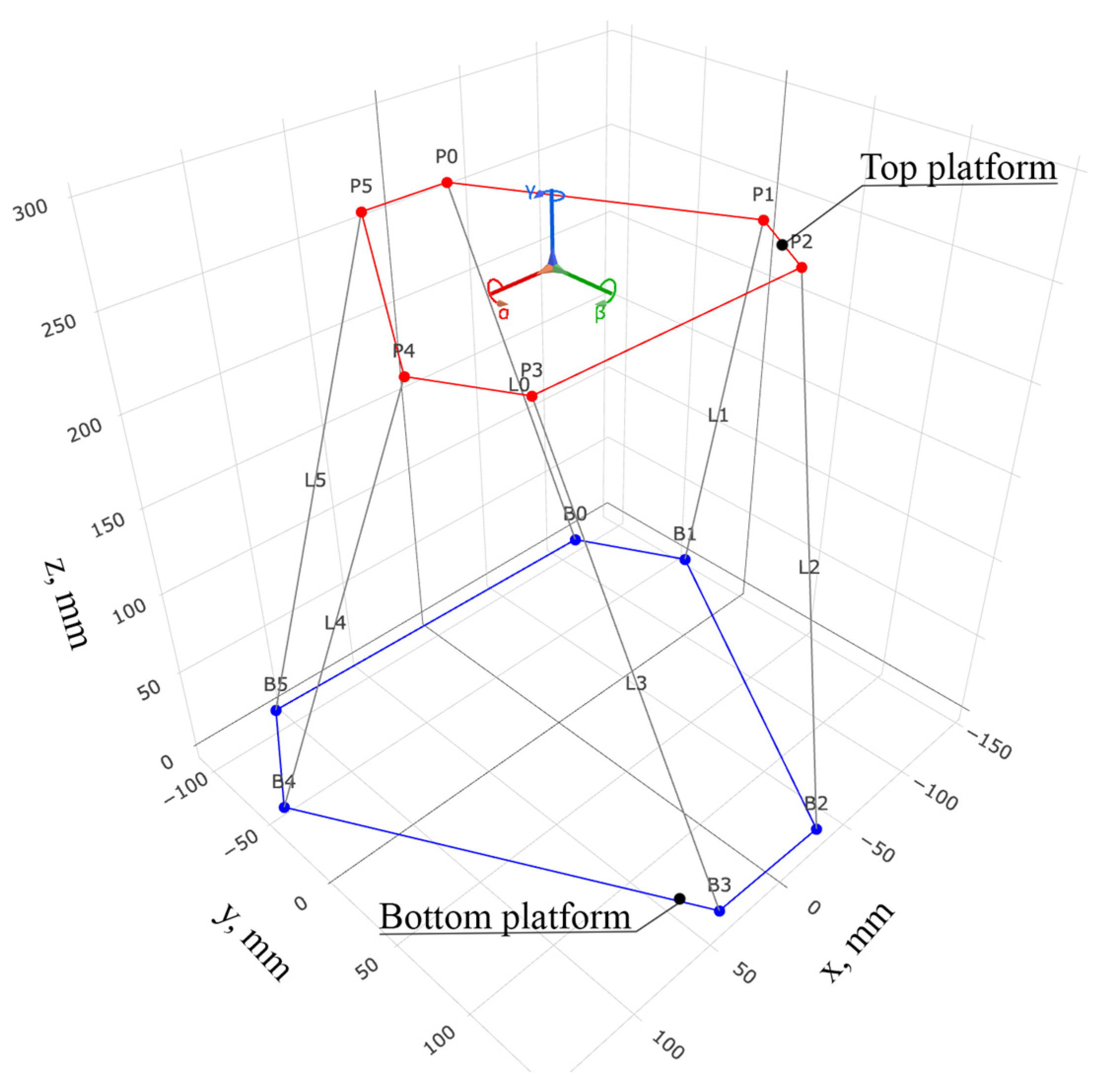
The hexapod platform analyzed in this work is a classic Stewart 6 to 6 configuration, consisting of six independently driven actuators that connect the fixed base to the movable top platform. To describe the kinematic geometry of the mechanism, the coordinates of the attachment points on both platforms must first be defined. Let
Bi denote the Cartesian coordinates of the six joints located on the base platform, expressed in the base coordinate frame, and let
Pi represent the corresponding coordinates of the joints on the top platform. The graphical representation and notation of the HEX system are given in
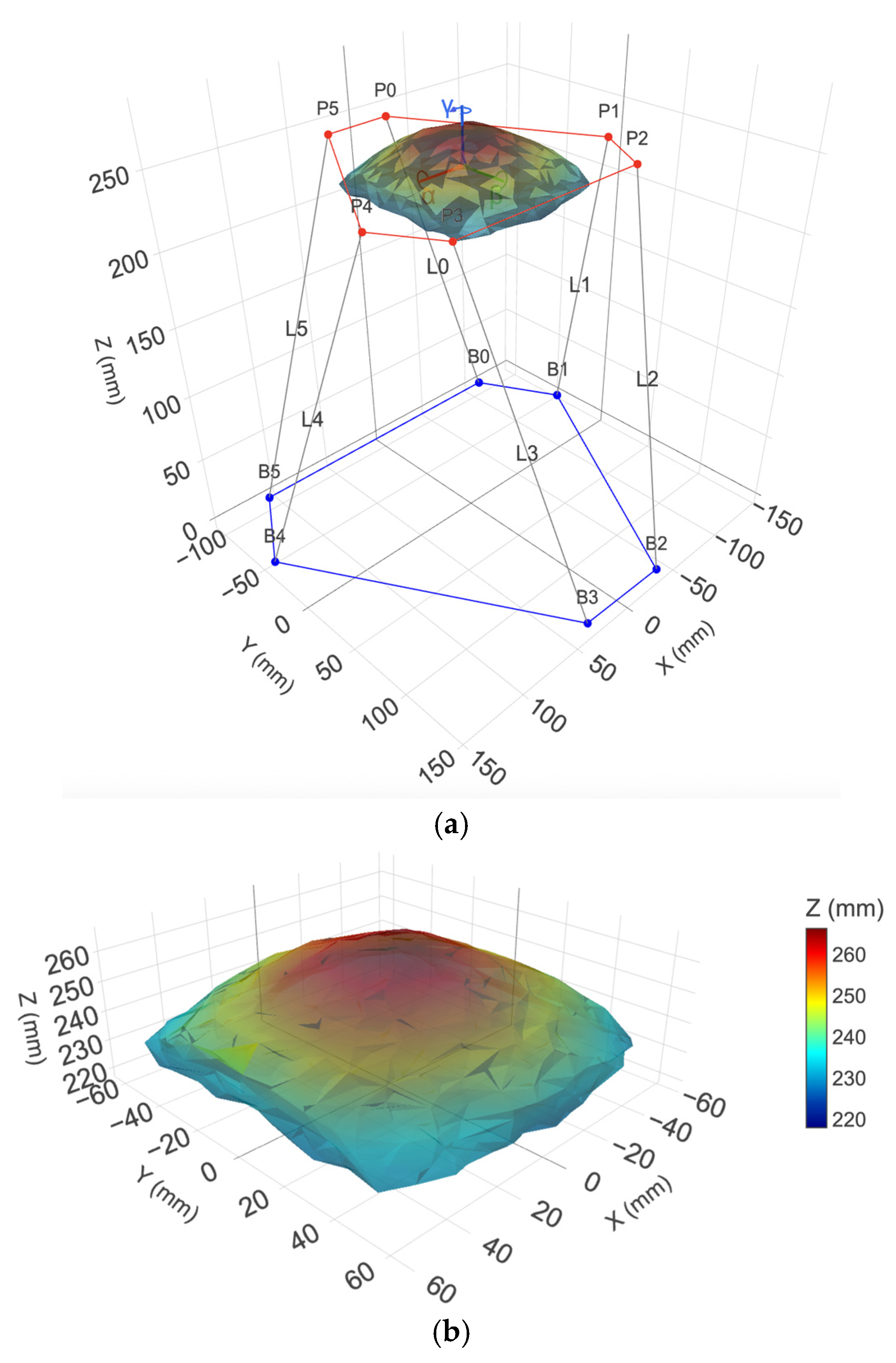
Figure 1.
So, corresponding coordinates of joints in the platform coordinate frame can be expressed as given in Equations (1) and (2):
Each row of matrices (Equations (1) and (2)) corresponds to the x, y, and z positions of one of the six universal joints. Since the base platform lies in the horizontal plane, all its joints have zero height, i.e.,
Conversely, the spherical joints on the top platform are located at a constant nominal height
Zw which corresponds to the mid-stroke position (home position) of the actuators, such that
The matrices defined in (Equations (1) and (2)) fully characterize the fixed geometric parameters of the hexapod. Based on this definition, the next step is to derive the inverse kinematics by transforming the coordinates of the upper joints into the base frame and computing the actuator lengths as a function of the platform pose.
Once the geometric parameters of the hexapod are defined, the actuator lengths can be computed using inverse kinematics. For a given pose of the moving platform, the length of the
i-th actuator, denoted
Li, is obtained as the Euclidean distance between the transformed upper joint coordinate and the corresponding base joint coordinate. The vector connecting these two points is defined as
where
T is the translation vector of the platform which refers to the center of the moving platform;
R is the rotation matrix;
Pi is the coordinate of the
i-th joint on the top platform; and
Bi is the coordinate of the corresponding joint on the base platform. The actuator length is therefore given by
So, the orientation of the platform is described by three sequential rotations about the
x-,
y-, and
z-axes, parameterized by the angles
α,
β and
γ respectively. The individual rotation matrices are:
The complete rotation matrix is obtained by multiplying the three matrices in the chosen order. For the commonly used Z–Y–X Euler angle sequence,
So, the translation vector of the top platform’s reference point is defined as
where
Px,
Py and
Pz denote the Cartesian coordinates of the platform center in the base coordinate frame. Thus, the full platform pose is represented by the 6-tuple
where
α—rotation about the
x-
axis or roll;
β—rotation about the
y-
axis or pitch; and
γ—rotation about the
z-
axis or yaw.
So, as it was indicated earlier, the fixed base platform contains six attachment points B0, …, B5, whereas the moving platform contains the corresponding upper joints P0, …, P5. actuator lengths L1, …, L6 connect each pair of joints. The base and platform radii are denoted Ra and Rb respectively, while the angular offsets between adjacent joints are represented by αa and αb. The global z-axis is aligned vertically, and the translation vector T defines the displacement of the top platform with respect to the base coordinate frame.
3. Numerical Simulations of 6-DOF Platform Workspace
In order to numerically simulate the HEX working space, the kinematic framework established in the previous section will be used, including geometric parameterization and inverse kinematic formulation, which will be the basis of the simulation process. By defining the travel distances of the actuators as functions of the position of the platform, the simulation models the translational and rotational behaviour of the platform in a three-dimensional space. In the model the platform’s position is fully described by six independent variables, i.e., three Cartesian translations and three Euler-angle-based rotations about the x-, y-, and z-axes. With this formulation, actuator travel distance changes ensure that a desired platform trajectory can be generated and analyzed, enabling the study of the HEX workspace and kinematic constraints under varying motion scenarios.
The numerical simulations were implemented in Python 3.14.0 using a modular software architecture built around the Flask framework (Flask 3.1.2), which provides an interface to configure the geometry of the hexapod and execute the calculations of the workspace. The core numerical routines were implemented using NumPy (2.0.2) and SciPy (1.13.1), while Matplotlib (3.9.4) and Pandas (2.3.3) were used for auxiliary data processing and visualization. The software is structured into separate modules responsible for geometry parsing, inverse kinematics, constraint evaluation, axis-limit estimation, and workspace mapping. For volumetric workspace evaluation, the translational domain is sampled on a regular Cartesian grid with a configurable step size (typically 0.5–1 mm). To improve computational efficiency, the evaluation of actuator lengths and leg inclination angles is implemented using vectorized NumPy operations. Three-dimensional grids are generated using numpy.meshgrid, and leg vectors for all grid points and all six legs are computed simultaneously using array broadcasting, allowing constraint checks to be performed without explicit Python loops.
This implementation enables a systematic analysis of positioning accuracy, workspace behaviour, and sensitivity to model parameters. For software-based model validation, the motion controller’s built-in coordinate transformation framework was used to embed the kinematic relationships directly in the control architecture. The overall control system was based on the integration of inverse kinematics with the actuator control algorithm. In operation, inverse-kinematics calculations and actuator control were executed in a closed-loop cycle, with the inverse solution recomputed at every cycle to generate updated actuator commands. Real-time position feedback signals were recorded and compared with commanded and measured positions to assess tracking performance and validate the model. This approach allowed for direct validation of the numerical model against controller-level kinematic transformations and experimental motion data.
Therefore, the base stationary platform (
Bi) and top platform (
Pi) matrices (Equations (13) and (14)) were defined on the basis of the physical HEX system. The system was used for the geometry identification at the initial position which is represented below:
The parameters presented in Equations (13) and (14) were identified from the physical 8HEX280 system by combining encoder-based actuation feedback with geometric calibration based on CMM. Specifically, the actual positions of the joints on the fixed and moving platforms were measured using a coordinate measuring machine and implemented as corrected values in the inverse kinematic model. In addition, each actuator was first homed to the encoder INDEX position, after which its physical reference length was measured by CMM and introduced as an individual homing offset. In this way, production and assembly tolerances were compensated for by correcting the joint coordinates and the zero-length values of the actuator. Measurement quality was further improved by compensating the SIN/COS encoder signals using Lissajous calibration, while the linear encoder resolution was 50 nm and the inverse kinematic loop was updated at 2 kHz.
So, the numerical model of the hexapod (HEX) system is based on inverse kinematics principles, enabling precise computation of actuator travel distances for any desired position of the top platform. With a travel range of 50 mm (Li) per actuator, each actuator is able to extend or retract by ±25 mm from its nominal length at initial position, and it is defined as Pi(0,0,0,0,0,0). Additionally, angular displacement of both the top platform ball joints and base platform joints is constrained to a maximum of ±30°, ensuring mechanical feasibility and preventing overextension of the actuators.
The ball joint angle limit refers to the inclination of each leg relative to the global vertical axis. For a candidate platform pose, the vector of leg
i is calculated as given in Equation (5). Therefore, the hinge angle is then defined as the angle between the leg vector and the global
z-
axis and is computed as
A pose is considered feasible only if this condition is satisfied for all legs:
θi ≤ 30°,
i = 1, …, 6. This criterion provides a direct computational check for the maximum allowable articulation of the leg joints during the workspace evaluation. These geometric and motion constraints define the limits of the platform’s operating workspace. The boundary conditions are listed in
Table 1.
Therefore, two complementary numerical procedures were used to characterize the hexapod workspace. First, independent limits along each translational and rotational axis were determined using a one-dimensional boundary search. Starting from the neutral pose (home position)
Zw, the algorithm incrementally advances along a selected axis until a constraint violation occurs, thereby bracketing the boundary between feasible and infeasible poses. The boundary location is then refined using a bisection search until the desired positional or angular tolerance is reached. Under the assumption of monotonic constraint violation along a single axis direction, the refinement stage converges with logarithmic complexity.
where Δ is the bracketing interval and ε is the target accuracy.
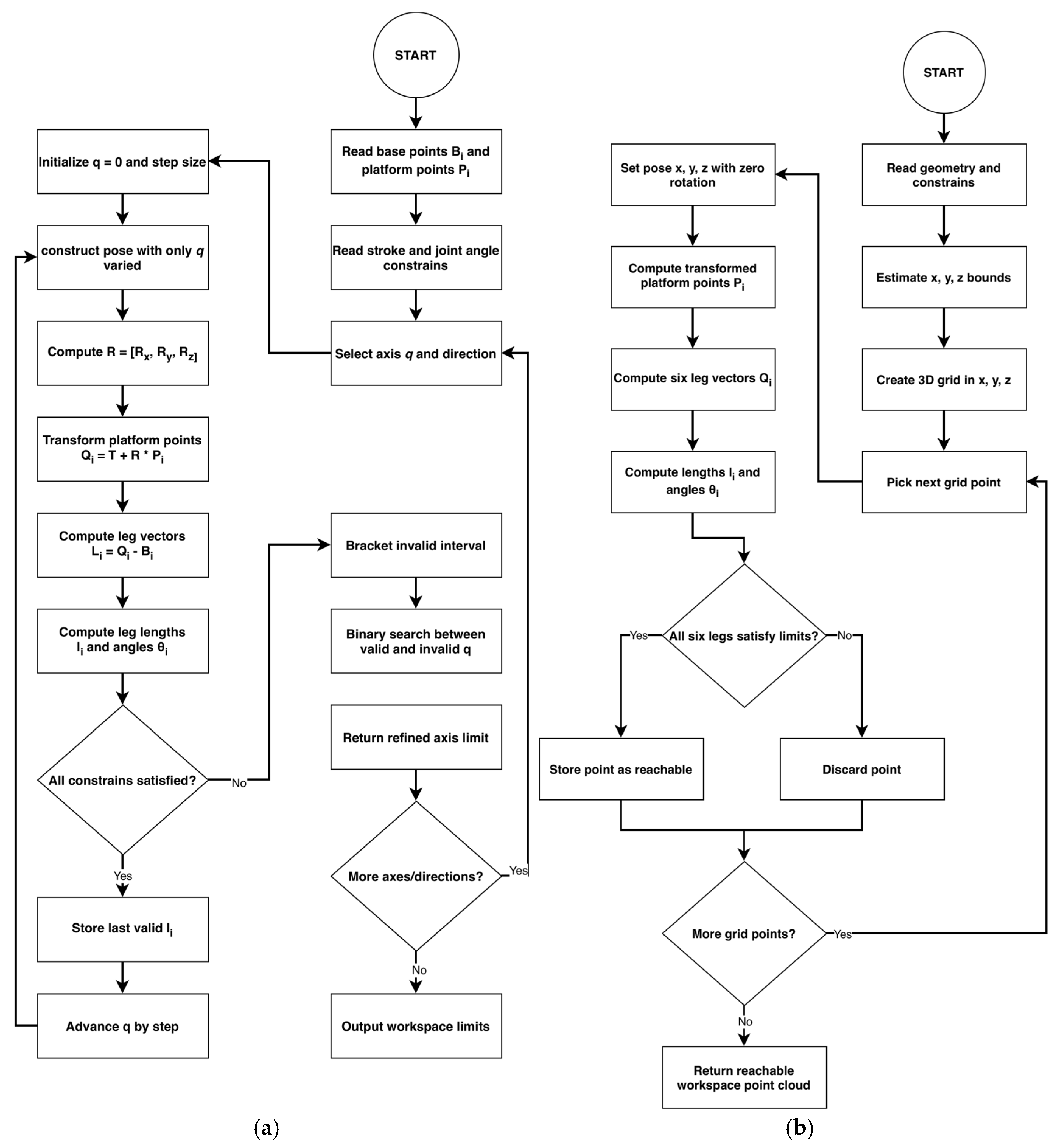
This approach provides an efficient estimate of the maximum reachable displacement in each individual degree of freedom while requiring only repeated evaluations of the inverse kinematics and constraint checks. The flow charts of both procedures are represented in
Figure 2.
So, the workspace was evaluated under actuator stroke and leg inclination constraints derived from the mechanical limits of the hexapod. The actuator stroke constraint was defined by a total travel range, resulting in reachable actuator lengths. Additionally, the maximum allowable angle of inclination of each leg relative to the global vertical axis was limited to θi, reflecting the mechanical limits of the joints. The numerical search for translational workspace boundaries was carried out while keeping all the rotational coordinates fixed at zero (α = β = γ = 0), thus isolating only the translational reach of the platform. For the determination of axis limits, a one-dimensional boundary search was applied in which a candidate displacement along the selected axis was progressively increased until a constraint violation occurred, after which the boundary was refined using bisection until a prescribed accuracy threshold was reached. The resulting limits were then used to define the bounds of a Cartesian sampling grid for workspace mapping. Within these bounds, the translational workspace was approximated by evaluating candidate poses on a regular grid with spacing Δ depending on resolution. For each point on the grid (x, y, and z), inverse kinematics was evaluated to compute the six actuator lengths and corresponding leg inclination angles, and the pose was classified as feasible only if all stroke and angular constraints were satisfied simultaneously.
All valid workspace points were subsequently down sampled to a manageable set of 3000 points. In addition, the algorithm evaluates geometric feasibility by scanning a 3D grid of Cartesian translations (x, y, z), checking each position against the constraints of all six inverse kinematic solutions. Although the naive computational complexity is , vectorized NumPy operations optimize performance by processing entire z-axis slices per (x, y) pair in compiled code, substantially reducing the effective runtime. Such a hybrid approach of calculations enables dense, high-resolution mapping of the HEX workspace with practical efficiency.
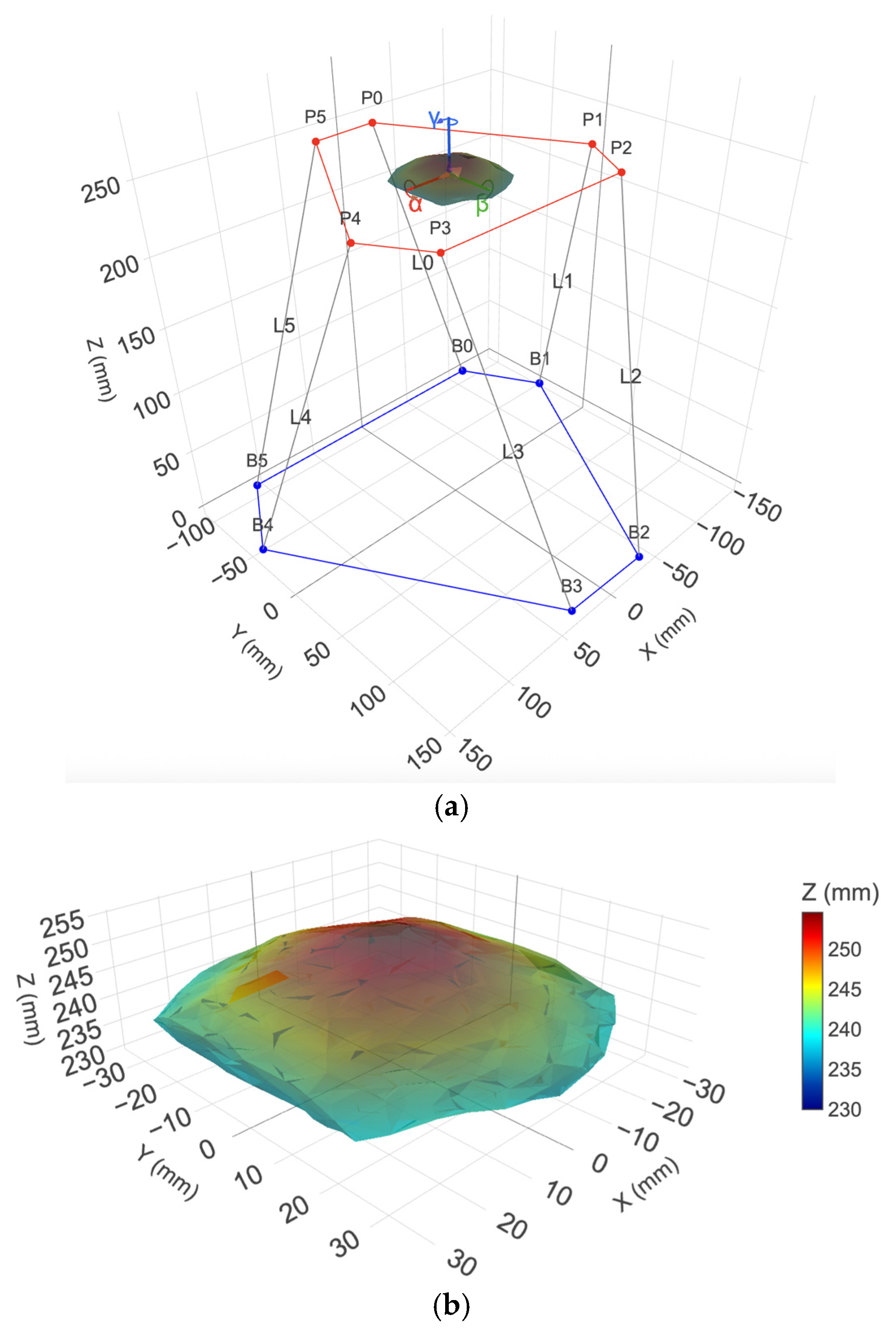
Therefore, on the basis of the model and boundary conditions, a series of simulations was performed. The simulations were set to three cases, i.e., the actuators’ travel ranges set to ±12.5 mm or 25 mm, ±25 mm or 50 mm and ±37.5 mm or 75 mm. So, in
Figure 3 the combined visualization of the HEX geometry, leg topology, and the resulting three-dimensional workspace behaviour is shown. The actuator travel range is ±12.5 mm.
As can be found in
Figure 3 for an actuator travel range of ±12.5 mm, the simulation predicts a symmetric workspace with identical limits at −12.5 mm and +12.5 mm, indicating consistent kinematic behaviour throughout the entire stroke. The translational workspace reaches
x ≈ ±32.03 mm and
y ≈ ±35.94 mm, while the vertical motion is directly constrained by the actuator range to
z = ±12.50 mm. The rotational limits are expressed as
α,
β, and
γ, corresponding to platform rotations about the global
x-,
y-, and
z-
axes, respectively. Among these, rotation about the
x-
axis (
α) is dominant, reaching approximately ±17.81°, whereas rotations about the
y- and
z-
axes (
β and
γ) are limited to ±5.00°. This anisotropic rotational behaviour reflects the HEX geometry and kinematic coupling. Overall, the results indicate that at ±12.5 mm travel, the workspace is primarily stroke-limited in Z and exhibits direction-dependent rotational capability, establishing a reference case for further workspace expansion analysis.
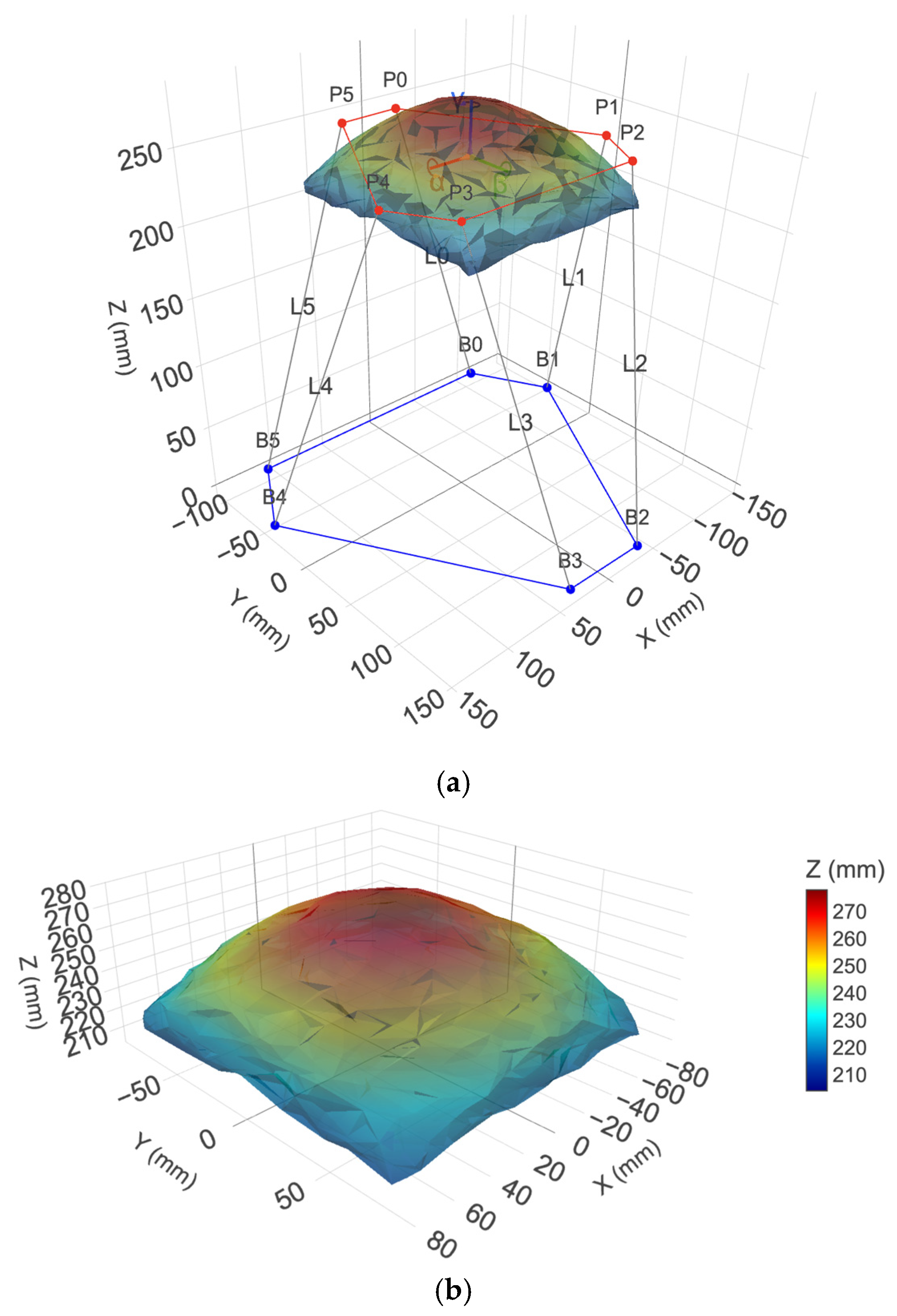
Further, simulations with a traveling range of ±25 mm were performed with the same boundary conditions. The results are given in
Figure 4.
So, for an actuator travel range of ±25 mm, the simulation predicts a symmetric work pace, with identical limits at −25 mm and +25 mm, indicating consistent kinematic behaviour throughout the entire stroke. The translational workspace expands to x ≈ ±58.59 mm and y ≈ ±64.06 mm, while the vertical range reaches z ≈ ±26.56 mm, confirming that the z ability is primarily driven by strokes and scales nearly proportionally to the movement of the actuator.
Rotational limits are expressed as α, β, and for the ±25 mm case, the simulation yields rotational limits of γ ≈ ±32.50°, β ≈ ±10.63°, and α ≈ ±10.31°. The significantly larger γ range indicates strong anisotropy in rotational mobility, governed by the HEX geometry and the coupling between translational and rotational degrees of freedom. In general, the ±25 mm case demonstrates a substantial enlargement of both translational and rotational workspace compared to shorter actuator strokes.
Finally, simulations with ±37.5 mm actuator strokes were performed. The results are given in
Figure 5.
As shown in
Figure 5, when the actuator travel range is increased to ±37.5 mm, the simulated results show a pronounced enlargement of the reachable workspace, while maintaining symmetry between positive and negative stroke limits. The translational motion capacity extends to approximately ±82.03 mm in
x and ±87.89 mm in
y, and the vertical displacement reaches ±39.84 mm. This confirms that vertical motion remains predominantly governed by actuator stroke, whereas horizontal motion benefits increasingly from the changing actuator geometry at larger extensions.
The rotational workspace, under angles of α, β, and γ, also expands significantly. Rotations about the x- and y-axes increase to approximately ±15.94° and ±15.63°, respectively, while rotation about the z-axis reaches ±45.94°. This strong dominance of γ highlights the increasing influence of the kinematic coupling between translation and rotation at extended travel ranges. Overall, the ±37.5 mm case illustrates a regime where both translational and rotational freedoms are substantially enhanced, but with growing anisotropy that must be considered in high-precision applications.
In order to fully represent the results of simulations, a summary of the parameters of the workspace was made. The summary is given in
Table 2.
The results of the simulation of the workspace, summarized in
Table 2, demonstrate a systematic expansion of both translational and rotational capabilities as the range of actuator travel increases from ±12.5 mm to ±37.5 mm. The translational motion in
x,
y, and
z grows with stroke length; however, the increase is not linear. Although vertical displacement scales almost proportionally to actuator travel, lateral motion exhibits diminishing incremental gains at higher ranges. A similar trend is observed in rotational motion, where the γ rotation increases more rapidly than α and β, revealing a strong anisotropy in the orientation capacity. This behaviour is inherent to hexapod kinematics, where all six degrees of freedom are coupled through nonlinear geometry. Each actuator simultaneously influences translation and rotation, and changes in actuator extension modify the Jacobian sensitivity and mechanical advantage across the workspace. Consequently, larger actuator travel does not result in uniform workspace growth, but instead leads to uneven and direction-dependent expansion. Based on that, it can be stated that the simulations confirm that actuator stroke is a primary, but not exclusive, determinant of the HEX workspace.
4. Experimental Investigations of 6-DOF Platform Working Space
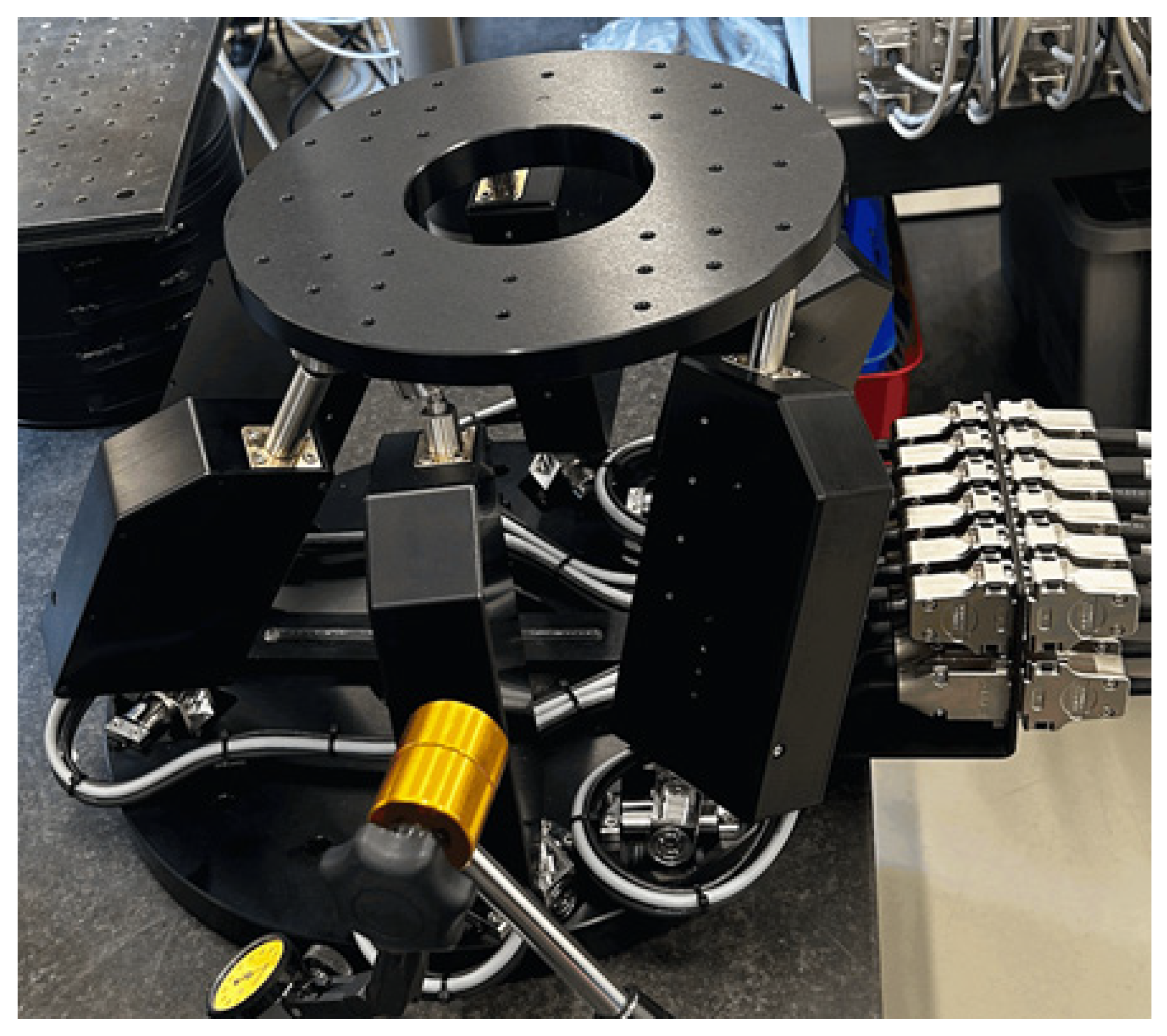
In order to experimentally investigate the working space of the HEX platform and its control through inverse kinematics, a physical prototype of the HEX system was used (
Figure 6). The prototype configuration corresponds to the model used in the numerical simulations of the working space. The experimental setup comprised several principal components, namely a supporting structure based on a lapped granite surface with mechanical dampers, a STANDA 8HEX280 HEX (JSC “Standa”, Vilnius, Lithuania) platform, and a control and drive system rack STANDA 8UMC-02-06 (JSC “Standa”, Vilnius, Lithuania) with associated cabling for subsystem integration. The supporting structure consisted of four main elements: supporting cones, a steel frame, mechanical dampers with a natural frequency of 20 Hz, and a lapped granite plate. These components are considered auxiliary elements of the overall system. The 8HEX20 (JSC “Standa”, Vilnius, Lithuania) prototype itself was composed of five primary parts: a stationary base platform, a mobile platform, universal joints, spherical joints, and six motorized actuators. The control rack included four main components: a servo controller module, servo motor drivers, a motor power supply, and a control system power supply.
The HEX actuators are based on a ball-screw mechanism with dual encoder feedback. A rotary optical encoder with a resolution of 50 nm is used for commutation and for closing the velocity control loop, while a linear optical encoder with the same resolution is integrated at the end effector to close the position control loop and directly measure the actual actuator length (Li). The encoder scaling factors, defined as the ratio between encoder counts and physical displacement, are precisely configured to ensure accurate kinematic control. Both the velocity and position control loops for each actuator are carefully tuned to achieve high position stability. The mechanical design and control architecture of the experimental setup enable near-zero backlash performance and effectively linearize the actuator output, as well as its static error characteristics. Consequently, although the mechanical structure and cabling are relatively straightforward, the control and actuation subsystems exhibit substantially higher architectural complexity.
The HEX controller is implemented using an inverse kinematics approach in combination with dedicated “Connect…Depends” functions. This architecture allows the default one-to-one connection between the motion profiler and the actuator controller to be overridden, thereby enabling the inverse kinematic formulation to be embedded between the driver-level profiler and the actuator controller. As a result, the commanded actuator position (or Li) becomes a function of the requested position of the mobile platform rather than a direct profiler output.
The complete experimental setup effectively allows several boundary conditions to be neglected. Mechanical dampers suppress most ambient vibrations above 20 Hz, while the lapped granite surface with flatness < 5 μm minimizes base-induced mechanical deformations. The controller architecture enables real-time embedding of the inverse kinematics algorithm between the profiler and the actuator controller while maintaining closed-loop actuator control. Furthermore, the dual-loop actuator architecture compensates for kinematic backlash and linearizes the static error behaviour.
Also, it should be noted that inverse kinematics maps a set of joint positions and actuator lengths to the position of the mobile platform. Accordingly, the experimental setup enables direct measurement of actuator lengths through the FPOS and FVEL variables and minimizes potential disturbances arising from initial mechanical deformations, environment-induced dynamic excitation, control-loop-induced position jitter, backlash-related reversal errors, and periodic but predictable static errors.
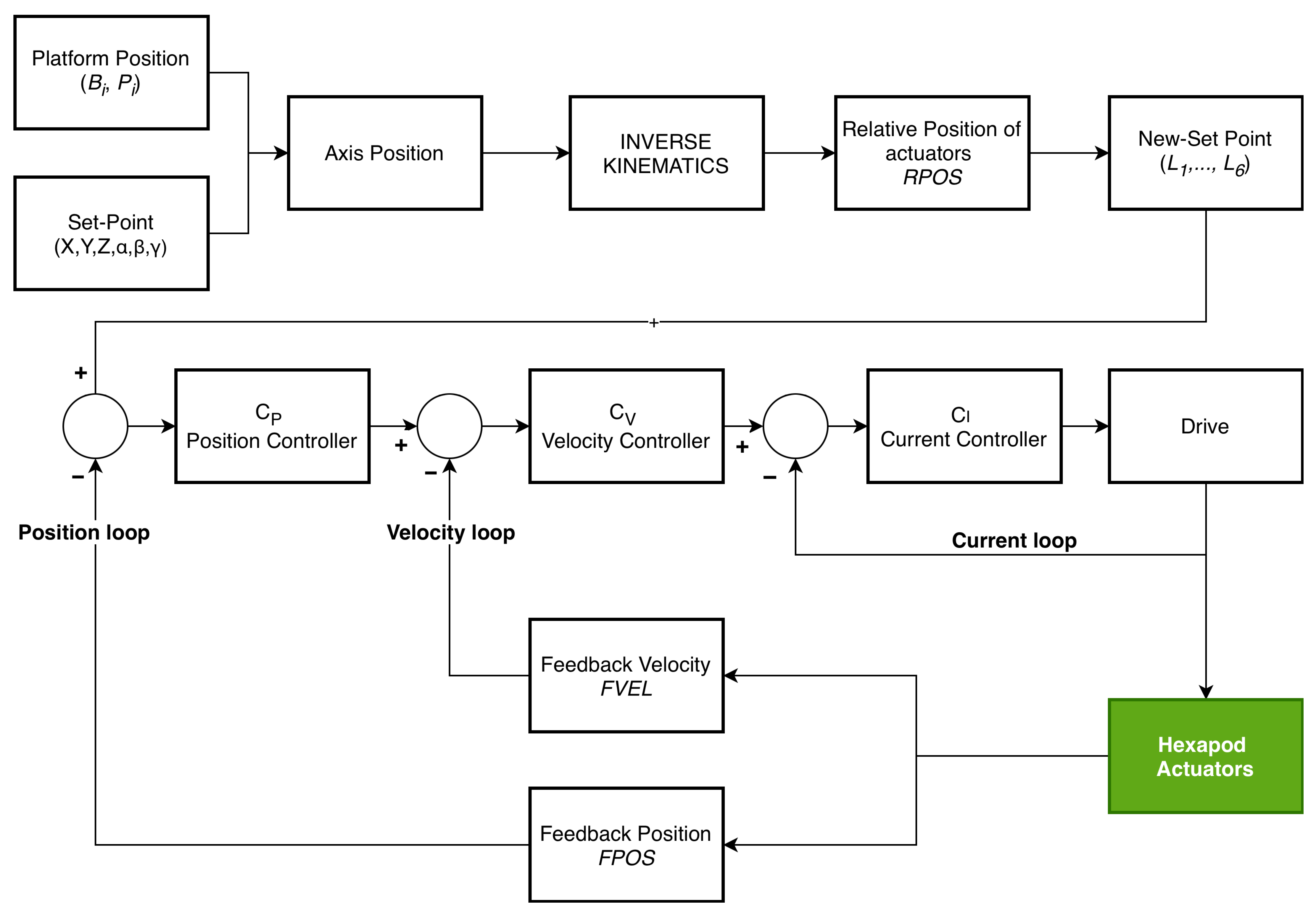
Therefore, in order to implement the HEX platform control, which is based on inverse kinematics, a control algorithm was established. The schematics of the HEX platform control algorithm are given in
Figure 7.
The hexapod control system was structured around a hierarchical, cascaded position–velocity–current control architecture integrated with an inverse kinematics formulation to achieve precise six-degree-of-freedom motion. The desired platform position, defined by the translational and rotational set-point (x, y, z, α, β, γ), together with the known geometric parameters of the mechanism, namely the base and platform attachment point coordinates (Bi, Pi), is processed by the inverse kinematics module. This module computes the relative positions of the actuators (RPOS) and the corresponding leg length commands (L1, …, L6), which constitute the primary references for motion execution. These length commands are regulated by the outer position control loop, implemented via a position controller (CP), which minimizes the position error using feedback position signals (FPOS) and generates velocity references. The intermediate velocity loop, governed by the velocity controller (CV), utilizes feedback velocity measurements (FVEL) to produce current references. Finally, the innermost current loop, controlled by (CI), directly drives the actuator through the power drive, ensuring fast torque response and robustness to disturbances. The cascade structure, combined with the generation of command based on inverse kinematics, enables accurate tracking of complex platform motions while maintaining stability, bandwidth separation, and high positioning accuracy of the hexapod system.
The simulation-to-experiment interface is defined by using the same numerically generated workspace grid. For each grid point, the inverse-kinematics solution is computed through the hardcoded CONNECTION formula implemented in the controller, and the resulting actuator-length commands are applied directly to the six closed-loop actuators. For completeness, the experimental platform employs a closed-loop control architecture implemented on the ACS SPiiPlus controller with UDM motor drives. The 8HEX280 consists of six closed-loop actuators with a dual-loop structure: the position loop is closed by a P controller with a Bi-Quad filter, the velocity loop by a PI controller with Bi-Quad, low-pass, and notch filters, while the current loop is closed by a PI controller; acceleration feedforward is additionally applied. After individual frequency-domain tuning of each actuator to satisfy stability margins, the actuators were treated as linear within the investigated operating range, with bidirectional repeatability better than ±100 nm. Under these conditions, the experimental setpoints correspond to the same grid used in the simulation and are synchronized with the controller motion-processing cycle through the internal ACS SPiiPlus/UDM architecture. No additional external interpolation layer was introduced. Interpolation and command execution are handled internally by the drive-control system. For the purposes of the present investigation, the control system was assumed to introduce negligible dynamic error relative to the kinematic workspace analysis. This interpretation was based on the measured repeatability and further assumes linear actuator behavior, negligible backlash, absence of stick-slip effects, rigid-body-dominant dynamics, constant moving mass, and stable environmental conditions. Residual discrepancies between simulation and experiment may nevertheless arise from filtering, controller safety limits, and structural dynamic effects not explicitly included in the geometric model.
The dynamic response of the system was verified during the actuator tuning stage through 12 subsequent sine-sweep experiments for loop shaping and validation in the frequency domain, together with six additional experiments for fitting the acceleration feedforward. However, these dynamic-response data and settling-time results were used for tuning purposes only and were not stored in a form suitable for subsequent statistical analysis.
After tuning, bidirectional repeatability was evaluated experimentally using a Michelson interferometer in an absolute peak-to-peak manner, without a full statistical treatment. The measured bidirectional repeatability was better than ±100 nm for both the individual actuators and the hexapod platform. The repeatability experiment was repeated three times for each actuator, corresponding to 18 actuator-level experiments in total, and three times for the hexapod.
Following frequency-domain identification and loop shaping, the HEX was homed, the hardcoded inverse-kinematics algorithm was compiled, and the system was operated in inverse-kinematic mode. During this stage, time-domain position data were acquired from the linear encoder mounted on the actuator end effector while the hexapod was excited in the x-direction using the maximum design motion profile, i.e.,
v = 5.25 mm/s;
a = 250 mm/s
2;
j = 1250 mm/s
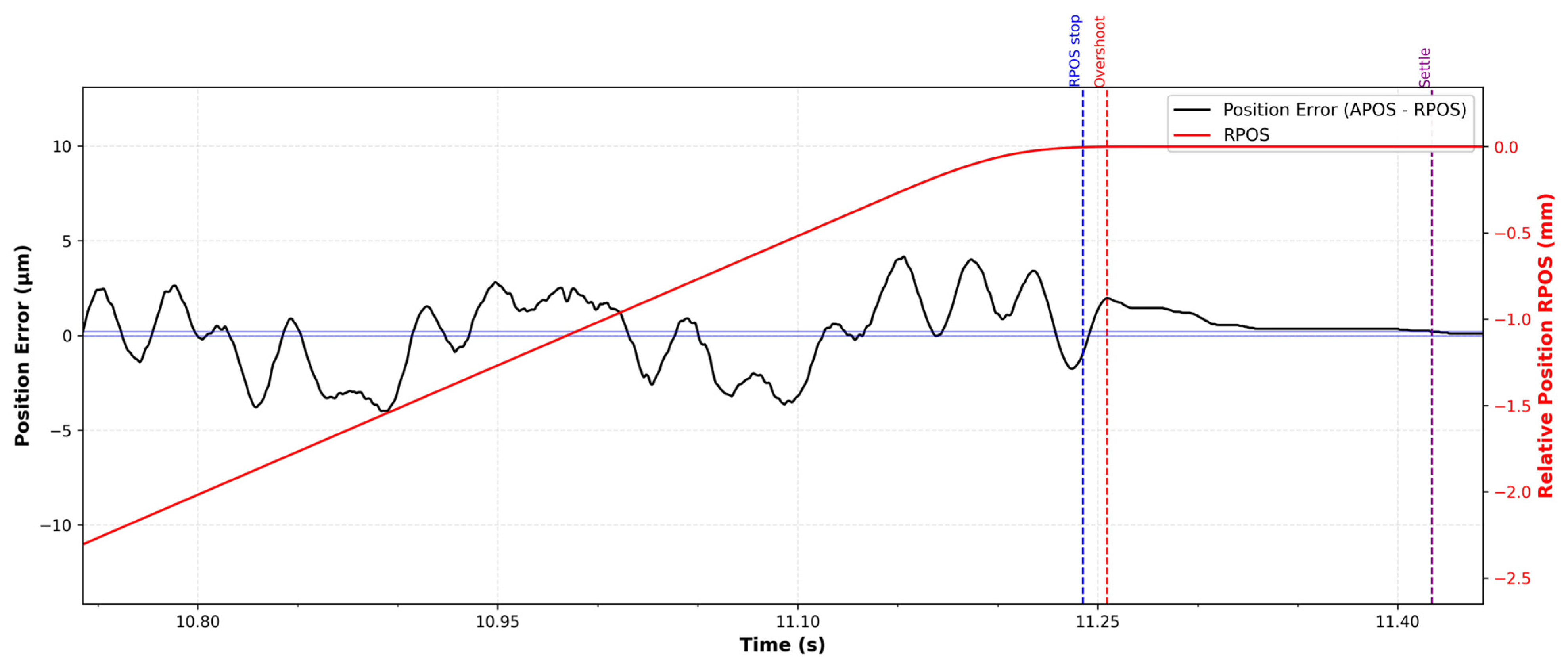
3. The controller motion-processing and inverse-kinematics update sampling time was 0.5 ms (2 kHz). To assess the control-system influence under conservative conditions, the worst-case actuator settling response was analyzed. For the actuator, the measured overshoot was 1.8827 µm, the settling time was 174.5 ms, and the steady-state error ranged from 0.1003 µm to 0.2029 µm, with a mean of 0.1618 µm. The corresponding 2% settling window was below 0.004 µm, which is below the actuator resolution of 0.05 µm. Therefore, after settling, the residual dynamic error can be considered negligible with respect to the workspace characterization presented in this study. The settling process of the worst-case scenario and a summary of the settling process are given in
Figure 8 and
Table 3, respectively.
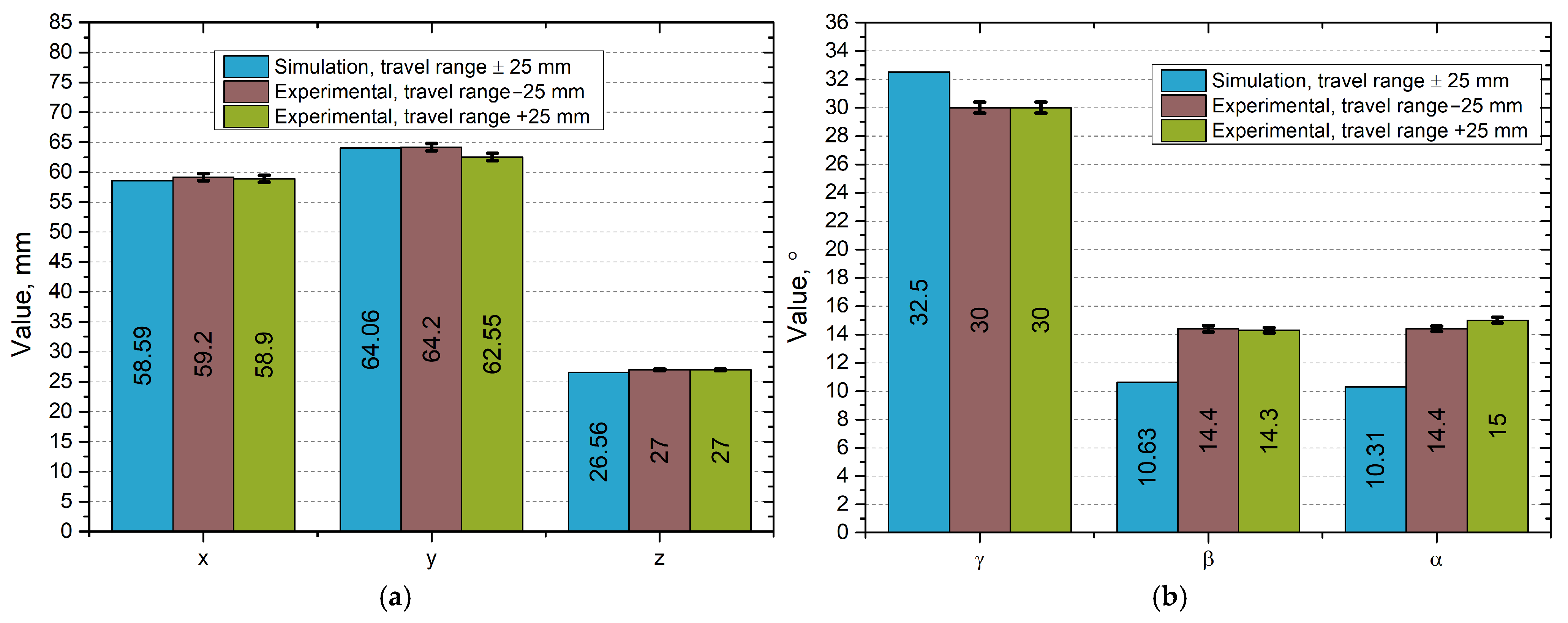
Therefore, the results of the experimental investigation of the motion characteristics of the HEX platform and their comparison with the numerical results while the actuator travel range was set to ±25 mm are given in
Table 4 and
Table 5, respectively. In addition, the comparison of the results is represented in
Figure 9.
The measurements for each case were repeated four times in order to obtain stable and repeatable results, which are suitable for comparison and further processing. Therefore, the comparison between the simulation and experimental measurement results (
Figure 9) shows a close quantitative agreement in translational axes, with small but systematic deviations that become more pronounced in rotational motion. For a ±25 mm actuator travel range, the simulated translational workspace reaches 58.59 mm in
x, 64.06 mm in
y, and 26.56 mm in
z, while the measured values are in range from 58.9 mm to 59.2 mm in
x, 62.6 mm to 64.2 mm in
y, and 27.0 mm in
z, indicating differences about 2–3% and confirming that the geometric model captures the dominant kinematic behaviour. In contrast, the rotational limits show larger discrepancies, i.e., the simulation predicts rotations of about 32.5° around
γ and approximately 10–11° around
β and
α, whereas the empirical measurements yield roughly 30° around
γ and significantly higher values of about 14–15° around
β and
α. This redistribution of rotational capability suggests that real joint geometry, including non-intersecting universal-joint axes, finite joint clearances, and asymmetric angular limits, alters how rotational motion is accommodated compared to the idealized model. Additionally, control-related effects such as conservative motion limits, compliance, and load-dependent behaviour further constrain or bias the achievable rotations in practice. Overall, while the simulation accurately predicts translational workspace and general scaling trends, the empirical results highlight that rotational performance is more sensitive to mechanical details and control implementation, emphasizing the importance of experimental validation when assessing the true operational workspace of a hexapod system.