Article

The Moduli Space of Octonionic Bundles as a Subvariety of Orthogonal Bundles

by
Álvaro Antón-Sancho
1,2
1
Department of Mathematics and Experimental Science, Fray Luis de León University College of Education, C/Tirso de Molina, 44, 47010 Valladolid, Spain
2
Faculty of Humanities and Education, Catholic University of Ávila, C/Canteros s/n, 05005 Ávila, Spain
Mathematics 2026, 14(8), 1330; https://doi.org/10.3390/math14081330
Submission received: 25 March 2026 / Revised: 13 April 2026 / Accepted: 14 April 2026 / Published: 15 April 2026

Abstract

Let X be a compact Riemann surface of genus g 2 . An octonionic bundle over X is a fiber bundle whose fiber is the non-associative algebra of complex octonions, equivalently a principal G 2 ( C ) -bundle, where G 2 ( C ) is the exceptional Lie group of automorphisms of the octonions. We prove that the natural inclusion G 2 ( C ) SO ( 7 , C ) induces a closed embedding of the moduli space M Oct ( X ) into the moduli space M SO ( 7 , C ) ( X ) of SO ( 7 , C ) -bundles. We further analyze the normal bundle to this embedding, computing its rank as 7 ( g 1 ) and providing an explicit cohomological description of its fibers, which enables explicit computations of tangent spaces and provides a foundation for deformation theory. As applications of the embedding, we prove that the image is a closed irreducible subvariety not contained in the singular locus of the ambient space, and we derive the Whitney formula c ( T amb ) = c ( T ) · c ( N ) relating the Chern classes of the tangent bundle of M Oct ( X ) , the pullback of the ambient tangent bundle, and the normal bundle over the smooth locus.
MSC:
14H60; 14H10; 14L30; 17B25

1. Introduction

The octonions O form the largest of the four normed division algebras over the real numbers, following the real numbers R themselves, the complex numbers C , and the quaternions H . In contrast to these algebras, the octonions are neither commutative nor associative, but they satisfy a weaker form of associativity known as alternativity, meaning that every subalgebra generated by two elements is associative [1]. The complexified octonions O C = O R C inherit this non-associative algebraic structure while gaining the rich analytic properties of complex manifolds. The automorphism group of O C is the simple complex Lie group of exceptional type G 2 ( C ) , which is a 14-dimensional complex group and the complexification of the compact exceptional Lie group G 2 [1,2,3]. More precisely, the group G 2 ( C ) can be characterized as the subgroup of Aut ( O C ) that preserves the octonionic multiplication and the standard inner product [1]. The Lie algebra g 2 ( C ) of G 2 ( C ) can be realized as the derivations of O C that preserve the octonionic multiplication:
g 2 ( C ) = { D Der ( O C ) D ( x y ) = D ( x ) y + x D ( y ) for all x , y O C } .
Let X be a compact Riemann surface of genus g 2 . The main object of interest in this paper is the moduli space of octonionic bundles over X. An octonionic bundle E over X can be viewed as a holomorphic fiber bundle with fiber O C and structure group G 2 ( C ) . This can be equivalently understood as a principal G 2 ( C ) -bundle E together with the associated bundle construction E O = E × G 2 ( C ) O C , where G 2 ( C ) acts on O C through its natural action as the automorphism group. Thus, an octonionic bundle can be equivalently viewed as a principal G 2 ( C ) -bundle over X, allowing us to apply the theory of principal bundles and the geometry of G 2 ( C ) to study octonionic structures.
Through this identification, suitable notions of stability and polystability for octonionic bundles are derived from those of principal bundles, as provided by Ramanathan [4,5,6] for any reductive complex Lie structure group. Thus the moduli space M Oct ( X ) of octonionic bundles over X is a complex algebraic variety parametrizing isomorphism classes of polystable octonionic bundles, which can be identified with the moduli space M G 2 ( C ) ( X ) of principal G 2 ( C ) -bundles over X. This identification reflects the fact that every octonionic bundle corresponds to a unique principal G 2 ( C ) -bundle.
The non-associative nature of the octonions is linked to exceptional structures in geometry, with G 2 -holonomy in seven-dimensional manifolds being a particularly interesting and deeply studied topic [7]. The geometric study of the moduli space of principal G 2 ( C ) -bundles over curves and related structures, such as G 2 ( C ) -Higgs bundles, has attracted recent attention in algebraic geometry [7,8,9,10]. A fruitful line of research analyzes how the moduli space M G 2 ( C ) ( X ) embeds into larger moduli spaces, from which topological and geometric properties arise [11]. This aligns with work on moduli spaces of bundles with exceptional structure groups, yielding geometric and physical consequences [12,13].
In the study of moduli spaces of principal bundles, understanding the geometric structure of embeddings between these spaces provides valuable insights. The main objective of this paper is to rigorously establish and analyze the embedding of the moduli space of octonionic bundles into the moduli space of principal SO ( 7 , C ) -bundles. The group G 2 ( C ) is naturally embedded into the simple complex Lie group SO ( 7 , C ) [3], and this Lie group inclusion induces a forgetful map from M Oct ( X ) to the moduli space M SO ( 7 , C ) ( X ) , which sends each octonionic bundle with underlying principal G 2 ( C ) -bundle E to the principal SO ( 7 , C ) -bundle E × G 2 ( C ) SO ( 7 , C ) .
Our first main result, proved in Theorem 1, establishes that this forgetful map is a closed embedding, showing that the moduli space of octonionic bundles can be viewed as a closed subvariety of the moduli space of principal SO ( 7 , C ) -bundles. The proof proceeds in three steps. First, we establish set-theoretic injectivity by showing that the forgetful map is injective on points and that semistability is preserved under the embedding. This requires a technical result describing how parabolic subgroups and their characters behave under the embedding G 2 ( C ) SO ( 7 , C ) , developed in Proposition 1. Second, we prove in Proposition 2 that the differential of the embedding is injective at smooth points corresponding to stable bundles. This uses deformation theory and a cohomological analysis involving the exact sequence
0 ad ( E ) ad ( ι ( E ) ) E × G 2 ( C ) m 0 ,
where m is the orthogonal complement of g 2 ( C ) in so ( 7 , C ) , isomorphic to the seven-dimensional fundamental representation of G 2 ( C ) . Third, in Proposition 3, we extend the injectivity of the differential to singular points of the moduli space using Luna’s étale slice theorem. This has not been addressed in previous work on similar embeddings. At singular points corresponding to strictly semistable bundles, we use the local description of the moduli space as a quotient of an affine slice by a reductive stabilizer group, and show that the differential remains injective by analyzing the equivariant structure. Finally, the properness of the embedding follows from the valuative criterion: from the result of Balaji–Seshadri [14], semistable families extend over DVR base changes, and the G 2 ( C ) -reduction extends uniquely from the result of Drinfeld–Simpson [15], using the fact that SO ( 7 , C ) / G 2 ( C ) is an affine variety and X has a cohomological dimension of one.
The second main result of the paper, established in Theorem 2, analyzes the normal bundle to this embedding. We show that at a smooth point [ E ] corresponding to a stable octonionic bundle, the fiber of the normal bundle is canonically isomorphic to H 1 X , E × G 2 ( C ) m , and in particular the normal bundle has rank 7 ( g 1 ) . This result establishes that the embedding has codimension 7 ( g 1 ) in the ambient space, as confirmed in Corollary 1, which can be verified both by dimensional considerations ( dim M Oct ( X ) = 14 ( g 1 ) and dim M SO ( 7 , C ) ( X ) = 21 ( g 1 ) ) and by analyzing the tangent spaces using the cohomological long exact sequence.
We further develop applications of the above main results to deformation theory. Specifically, Proposition 4 shows that for a stable octonionic bundle E, the tangent space T [ E ] M Oct ( X ) is canonically isomorphic to H 1 ( X , ad ( E ) ) and has dimension 14 ( g 1 ) . Moreover, the differential of the embedding identifies this tangent space with a 14 ( g 1 ) -dimensional subspace of the 21 ( g 1 ) -dimensional tangent space T [ ι ( E ) ] M SO ( 7 , C ) ( X ) . This provides an explicit cohomological framework for understanding infinitesimal deformations of octonionic bundles and how they relate to deformations of the underlying SO ( 7 , C ) -structure. The injectivity of the differential reflects the geometric fact that the G 2 ( C ) -structure is more rigid than the underlying SO ( 7 , C ) -structure, meaning that every infinitesimal deformation of a G 2 ( C ) -bundle induces a unique infinitesimal deformation of the associated SO ( 7 , C ) -bundle, but not every infinitesimal deformation of an SO ( 7 , C ) -bundle preserves the G 2 ( C ) -structure.
Some consequences of the embedding are also derived as applications of the main results. Thus, Proposition 5 establishes that the image of M Oct ( X ) is a closed irreducible subvariety of M SO ( 7 , C ) ( X ) that intersects the smooth locus in a dense open subset and is not contained in the singular locus. Proposition 6 shows that the embedding gives rise to an exact sequence of holomorphic vector bundles 0 T T amb N 0 over the smooth locus M Oct s ( X ) , where T is the tangent bundle of M Oct s ( X ) , T amb is the pullback of the ambient tangent bundle, and N is the normal bundle. The Whitney sum formula then yields the identity
c ( T amb ) = c ( T ) · c ( N )
in H ( M Oct s ( X ) , Z ) , providing a structural constraint relating the characteristic classes of M Oct ( X ) , the normal bundle, and the ambient moduli space. In particular, the first Chern class of the normal bundle satisfies
c 1 ( N ) = ι c 1 ( T M SO ( 7 , C ) s ( X ) ) c 1 ( T ) ,
expressing the anticanonical class of M Oct s ( X ) in terms of the pullback of the anticanonical class of the ambient space and c 1 ( N ) .
The structure of this paper is as follows. Section 2 introduces octonionic bundles and establishes their equivalence with principal G 2 ( C ) -bundles, including the crucial result that all such bundles are topologically trivial. Section 3 contains the proof of the closed embedding theorem, beginning with the analysis of parabolic subgroups and characters, establishing set-theoretic injectivity and preservation of semistability, proving differential injectivity at smooth points, extending to singular points using Luna’s theorem, and completing the proof using the valuative criterion. The analysis of the normal bundle is developed in Section 4 by computing its rank and providing the cohomological description of fibers. The applications to deformation theory, consisting on the explicit computation of the tangent spaces and the analysis of how infinitesimal deformations of octonionic bundles relate to deformations of SO ( 7 , C ) -bundles, are given in Section 5. In Section 6, the main geometric consequences of the embedding are derived, establishing irreducibility of the image and the Whitney formula relating the characteristic classes of the tangent bundle, the normal bundle, and the pullback of the ambient tangent bundle. Finally, Section 7 summarizes our main results and discusses open questions for future research.

2. Octonionic Bundles over a Riemann Surface

Throughout the paper, X will be a compact Riemann surface of genus g 2 and, for a principal G-bundle P over X and a representation ρ : G GL ( V ) , we denote by P × G V the associated vector bundle with fiber V. In particular, for the adjoint representation Ad : G GL ( g ) , we write ad ( P ) : = P × G g for the adjoint bundle. When the group G needs to be specified, we may write ad G ( P ) to emphasize the structure group.
In this section, the notion of octonionic bundle is formally recalled, and octonionic bundles are related to principal G 2 ( C ) -bundles over X.
Definition 1.
An octonionic bundle E over the compact Riemann surface X is a fiber bundle π : E X whose fiber is the algebra of complex octonions O C and whose structure group is Aut ( O C ) G 2 ( C ) .
The structure group of an octonionic bundle over X can be identified with the simple complex Lie group of exceptional type G 2 ( C ) , which acts on the fiber O C via automorphisms. Indeed, the complex octonions O C form an eight-dimensional non-associative algebra over C , and the automorphism group of O C , which preserves the algebra structure, including the non-associative multiplication, is Aut ( O C ) G 2 ( C ) , the complex form of the exceptional Lie group G 2 [2,3,7]. This isomorphism can be explicitly constructed by noting that G 2 ( C ) is the subgroup of GL ( 7 , C ) that preserves a particular three-form, which corresponds to the structure constants of the octonion multiplication. Thus, the structure group of an octonionic bundle is G 2 ( C ) . Consequently, giving an octonionic bundle over X is equivalent to giving a principal G 2 ( C ) -bundle over X.
Lemma 1.
Let X be a compact Riemann surface of genus g 2 . Then, the topological classification of octonionic bundles over X is given by elements of the cohomology H 2 ( X , π 1 ( G 2 ( C ) ) ) . Moreover, since G 2 ( C ) is simply connected, all octonionic bundles over X are topologically trivial.
Proof. 
For a principal G-bundle P over a surface X, the topological classification is given by elements of H 2 ( X , π 1 ( G ) ) [16]. Since G 2 ( C ) is simply connected, i.e., π 1 ( G 2 ( C ) ) = 0 [2,3], it follows that H 2 ( X , π 1 ( G 2 ( C ) ) ) = 0 . Thus, all octonionic bundles over X are topologically trivial, distinguished only by their holomorphic structures. □
The moduli space of octonionic bundles over X, which will be denoted by M Oct ( X ) , parametrizes isomorphism classes of polystable octonionic bundles. Two octonionic bundles are isomorphic as principal G 2 ( C ) -bundles over X if there exists a G 2 ( C ) -equivariant bundle isomorphism between them covering the identity on X. The moduli space is defined as
M Oct ( X ) = M G 2 ( C ) ( X ) ,
the moduli space of polystable principal G 2 ( C ) -bundles over X, with the stability notion established by Ramanathan [4,5,6]. This space is a complex variety of dimension 14 ( g 1 ) . Reduced notions of G 2 ( C ) -bundles have also been provided in the preceding literature [8].

3. The Embedding into M SO ( 7 , C ) ( X )

The embedding of Lie groups G 2 ( C ) SO ( 7 , C ) induces a forgetful morphism between the corresponding moduli spaces,
ι SO ( 7 , C ) : M Oct ( X ) M SO ( 7 , C ) ( X ) ,
which maps every octonionic bundle E over X to the principal SO ( 7 , C ) -bundle E × G 2 ( C ) SO ( 7 , C ) . The main result of this section establishes that this forgetful map is a closed embedding. The proof proceeds in three steps: first, we establish set-theoretic injectivity and study the behavior of semistability under the embedding; second, we prove that the differential is injective at smooth points using deformation theory; third, we extend the injectivity of the differential to all points, including singular points of the moduli spaces.
The results of this section are original; the background on stability and the GIT construction of the moduli spaces recalled in Section 2 and Section 3 is due to Ramanathan [4,5,6], and the slice theorem is due to Luna as applied in [17].

3.1. Set-Theoretic Injectivity and the Behavior of Semistability

Let G be a complex semisimple Lie group with a fixed maximal torus T. Let Φ be the root system of G with respect to T, and let Δ = { α 1 , , α r } be a choice of simple roots, where r is the rank of G. For a subset I Δ , the standard parabolic subgroup P I is defined as the subgroup of G generated by T, the root subgroups U α for α Φ + (positive roots), and the root subgroups U β for β I .
Every parabolic subgroup of G is conjugate to a standard parabolic subgroup. A standard parabolic subgroup P I has a Levi decomposition P I = L I U I , where L I is the Levi subgroup generated by T and the root subgroups U ± β for β I , and U I is the unipotent radical.
A character χ : P I C is called strictly dominant if it is trivial on the unipotent radical U I and corresponds to a strictly dominant weight when restricted to the Levi subgroup L I , that is, if the corresponding weight λ Char ( L I ) Z R satisfies λ , α > 0 for every simple root α I , where α denotes the corresponding simple coroot and · , · is the natural pairing between weights and coweights [18].
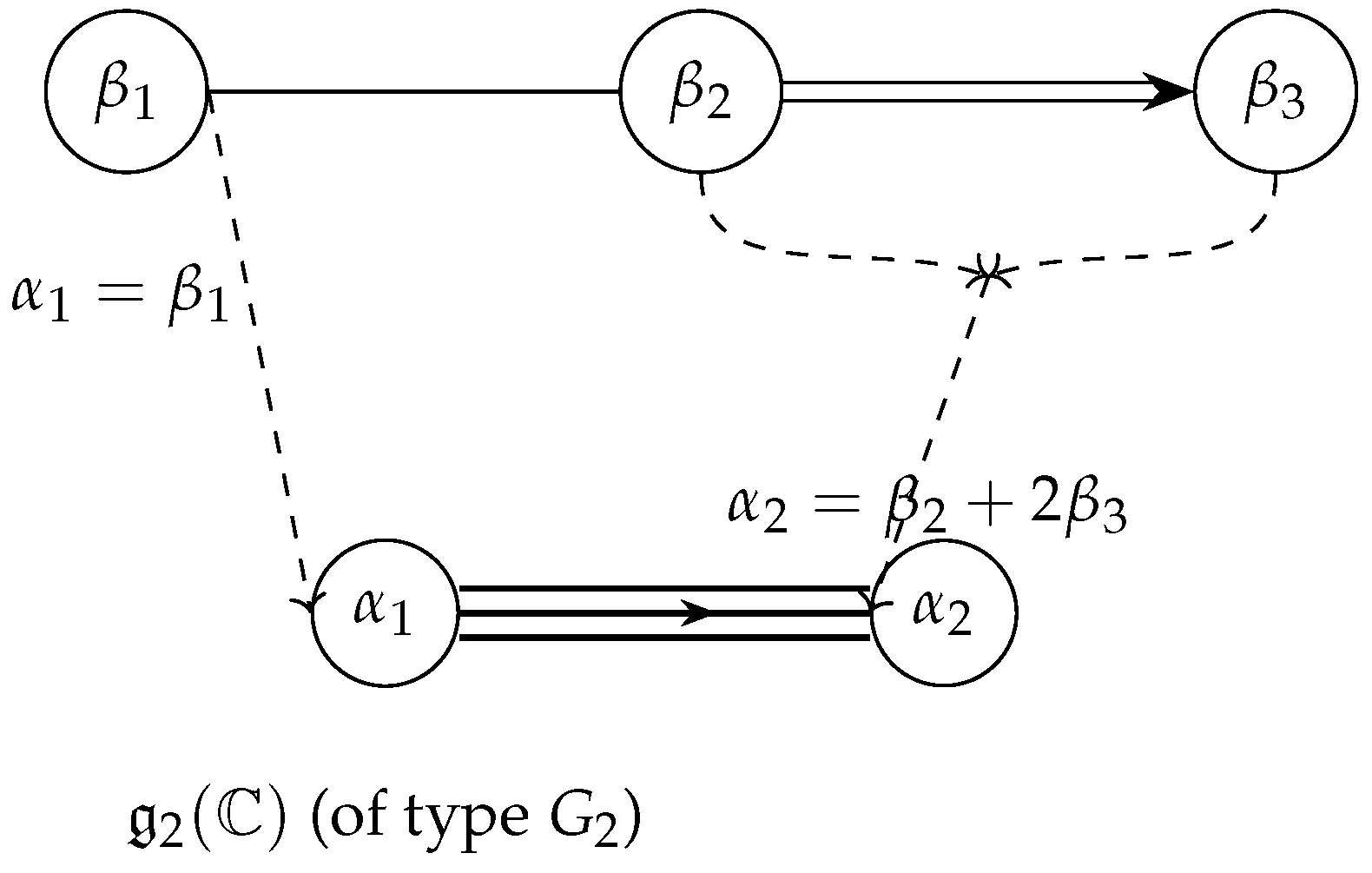
The root system of G 2 ( C ) consists of 12 roots, with simple roots { α 1 , α 2 } , where α 1 is the short simple root and α 2 is the long simple root. The root system of SO ( 7 , C ) (of type B 3 ) consists of 18 roots, with simple roots { β 1 , β 2 , β 3 } following the Bourbaki conventions [18]. Under the standard embedding G 2 ( C ) SO ( 7 , C ) , the simple roots of G 2 ( C ) are expressed in terms of the simple roots of SO ( 7 , C ) by
α 1 = β 1 , α 2 = β 2 + 2 β 3 ,
as documented in [3] (Section 5.4). The Cartan subalgebra of G 2 ( C ) is contained in the Cartan subalgebra of SO ( 7 , C ) [3].
The natural embedding of G 2 ( C ) into SO ( 7 , C ) (Figure 1) arises from the fact that G 2 ( C ) can be realized as the subgroup of SO ( 7 , C ) that preserves a specific three-form on C 7 . Specifically, the fundamental irreducible seven-dimensional representation of G 2 ( C ) allows viewing an element of G 2 ( C ) as an automorphism of C 7 that preserves both a non-degenerate alternating 3-form Ω and a non-degenerate symmetric bilinear form ω , defining the inclusion G 2 ( C ) SO ( 7 , C ) .
Lemma 2.
For every maximal parabolic subgroup Q G 2 ( C ) , there exists a maximal parabolic subgroup Q SO ( 7 , C ) such that
 1. 
Q = Q G 2 ( C ) .
 2. 
If χ : Q C is a strictly dominant character, then its restriction χ | Q : Q C is also strictly dominant.
Proof. 
The group G 2 ( C ) has rank two, so it has exactly two maximal parabolic subgroups (up to conjugation), corresponding to the two simple roots [19,20]. Similarly, SO ( 7 , C ) has rank three with three maximal parabolic subgroups [20].
Let { α 1 , α 2 } be the simple roots of G 2 ( C ) and { β 1 , β 2 , β 3 } the simple roots of SO ( 7 , C ) . For the maximal parabolic Q 1 G 2 ( C ) corresponding to { α 2 } (containing the Borel subgroup and the root subgroup of α 2 ), choose the maximal parabolic Q 1 SO ( 7 , C ) corresponding to { β 2 , β 3 } . For the maximal parabolic Q 2 G 2 ( C ) corresponding to { α 1 } , choose Q 2 SO ( 7 , C ) corresponding to { β 1 } .
Using the relations in (2), one verifies that Q i = Q i G 2 ( C ) for i = 1 , 2 . Under the embedding g 2 ( C ) so ( 7 , C ) , the positive roots of g 2 ( C ) not in the Levi subalgebra of Q i are precisely the restrictions of certain positive roots of so ( 7 , C ) not in the Levi subalgebra of Q i . This ensures that strictly dominant characters of Q restrict to strictly dominant characters of Q. □
Lemma 3.
Let I { α 1 , α 2 } be a subset of simple roots of G 2 ( C ) , and P I the corresponding parabolic subgroup. Then there exists a subset J { β 1 , β 2 , β 3 } such that P I = P J G 2 ( C ) , where P J is the parabolic subgroup of SO ( 7 , C ) corresponding to J.
Proof. 
For I = { α 2 } , take J = { β 2 , β 3 } ; for I = { α 1 } , take J = { β 1 } . The Lie algebras of P I and P J G 2 ( C ) coincide with (2). □
Lemma 4.
Let Q G 2 ( C ) be a maximal parabolic subgroup and Q SO ( 7 , C ) a maximal parabolic subgroup such that Q = Q G 2 ( C ) . Then,
 1. 
The character groups Char ( Q ) and Char ( Q ) are both isomorphic to Z .
 2. 
The restriction map Char ( Q ) Char ( Q ) is multiplication by some positive integer.
Proof. 
For a maximal parabolic subgroup, the character group is isomorphic to Z [21,22].
For a pair of compatible maximal parabolic subgroups Q G 2 ( C ) , Q SO ( 7 , C ) with Q = Q G 2 ( C ) , the restriction map Char ( Q ) Char ( Q ) sends the positive generator of Char ( Q ) Z to a positive multiple of the positive generator of Char ( Q ) Z . This follows from the general theory of restrictions of characters for compatible parabolics in an inclusion of reductive groups [22] (II.1): the embedding G 2 ( C ) SO ( 7 , C ) is a regular embedding of reductive groups in the sense of Dynkin, and hence strictly dominant characters of Q restrict to strictly dominant characters of Q with positive multiplicity, establishing the second claim. □
We now establish the set-theoretic injectivity of the forgetful map and its behavior with respect to semistability.
Proposition 1.
The forgetful map ι SO ( 7 , C ) is injective on closed points. Moreover, a principal G 2 ( C ) -bundle P is semistable if and only if P × G 2 ( C ) SO ( 7 , C ) is semistable.
Proof. 
Let P be a principal G 2 ( C ) -bundle. If P is semistable, then P × G 2 ( C ) SO ( 7 , C ) is semistable according to Lemma 3.
Conversely, suppose P × G 2 ( C ) SO ( 7 , C ) is semistable but P is not. Then there exists a parabolic Q G 2 ( C ) and reduction σ : X P / Q such that for some strictly dominant character χ : Q C , we have deg ( L χ ) > 0 . We may assume Q is maximal.
According to Lemma 2, there exists maximal parabolic Q SO ( 7 , C ) with Q = Q G 2 ( C ) . The reduction σ induces σ : X ( P × G 2 ( C ) SO ( 7 , C ) ) / Q .
According to Lemma 4, there exists strictly dominant χ of Q with χ | Q = χ n for some n > 0 . Then deg ( L χ ) = n · deg ( L χ ) > 0 , contradicting semistability of P × G 2 ( C ) SO ( 7 , C ) .
For injectivity on closed points: if ι SO ( 7 , C ) ( P 1 ) = ι SO ( 7 , C ) ( P 2 ) , then their graded objects as SO ( 7 , C ) -bundles are isomorphic. Since admissible reductions for SO ( 7 , C ) restrict to admissible reductions for G 2 ( C ) , the graded objects as G 2 ( C ) -bundles are isomorphic, so P 1 and P 2 define the same point in M Oct ( X ) . □

3.2. Injectivity of the Differential at Smooth Points

As a second step, we will now prove that the differential of the forgetful map is injective at smooth points using deformation-theoretic techniques.
Proposition 2.
For every stable G 2 ( C ) -bundle E over X, the differential
d ι [ E ] : T [ E ] M Oct ( X ) T [ ι ( E ) ] M SO ( 7 , C ) ( X )
is injective.
Proof. 
When E is stable, both moduli spaces are smooth at [ E ] and [ ι ( E ) ] [5]. The tangent spaces are
T [ E ] M Oct ( X ) H 1 ( X , ad ( E ) ) , T [ ι ( E ) ] M SO ( 7 , C ) ( X ) H 1 ( X , ad ( ι ( E ) ) ) ,
where ad ( E ) = E × G 2 ( C ) g 2 ( C ) and ad ( ι ( E ) ) = ι ( E ) × SO ( 7 , C ) so ( 7 , C ) .
At the Lie algebra level, we have the decomposition
so ( 7 , C ) = g 2 ( C ) m ,
where m denotes the orthogonal complement of g 2 ( C ) in so ( 7 , C ) with respect to the Killing form of so ( 7 , C ) [20]. Since G 2 ( C ) preserves this Killing form, the adjoint action of G 2 ( C ) stabilises m , endowing it with the structure of a G 2 ( C ) -module. As a G 2 ( C ) -representation, m is isomorphic to the irreducible seven-dimensional fundamental representation of G 2 ( C ) [3,20].
This yields the short exact sequence of vector bundles
0 ad ( E ) ad ( ι ( E ) ) E × G 2 ( C ) m 0 .
Taking the long exact sequence in cohomology:
H 0 X , E × G 2 ( C ) m H 1 ( X , ad ( E ) ) d ι [ E ] H 1 ( X , ad ( ι ( E ) ) ) .
To show injectivity of d ι [ E ] in (4), we prove that H 0 X , E × G 2 ( C ) m = 0 .
Since E is a stable G 2 ( C ) -bundle and m is the irreducible seven-dimensional fundamental representation of G 2 ( C ) , the associated vector bundle E × G 2 ( C ) m is a stable vector bundle according to the theorem of Ramanan and Ramanathan [23], which asserts that if P is a stable principal G-bundle and ρ : G GL ( V ) is an irreducible representation, then the associated vector bundle P × G V is stable.
Since E × G 2 ( C ) m is a stable vector bundle of degree zero over a curve of genus g 2 , it has no nonzero global sections. Indeed, the standard vanishing theorem for stable bundles of slope zero [4] asserts that such a bundle admits no nonzero global sections when g 2 , and the degree-zero property is verified below.
We verify that E × G 2 ( C ) m has a degree of zero. The representation m appears as the complement in the adjoint representation of SO ( 7 , C ) . Since the adjoint representation of SO ( 7 , C ) has a trivial determinant, and E × G 2 ( C ) SO ( 7 , C ) is topologically trivial (being the extension of scalars from the topologically trivial G 2 ( C ) -bundle E according to Lemma 1), the bundle ad ( ι ( E ) ) has a trivial determinant and therefore a degree of zero. Similarly, ad ( E ) has degree zero. From the exact sequence (3) we deduce that deg ( E × G 2 ( C ) m ) = 0 . Since E × G 2 ( C ) m is stable of rank 7, slope 0, and g 2 , the vanishing H 0 X , E × G 2 ( C ) m = 0 follows from the standard fact that a stable vector bundle of slope zero over a curve of genus g 2 has no non- zero global sections [4].
Therefore H 0 X , E × G 2 ( C ) m = 0 , and the differential d ι [ E ] is injective. □

3.3. Extension to Singular Points

To complete the proof, we must verify that the differential is injective at singular points corresponding to strictly semistable bundles. At such a point [ E ] , the Zariski tangent space may be larger than H 1 ( X , ad ( E ) ) , and the argument of Proposition 2 does not apply directly. The strategy, inspired by the approach of Serman [17] for orthogonal and symplectic bundles, is to use the local description of the moduli space provided by Luna’s étale slice theorem [5,6], and then reduce injectivity of the differential to the same cohomological vanishing already established for stable bundles, now applied to the polystable graded object E 0 = gr ( E ) .
Proposition 3.
For every point [ E ] M Oct ( X ) , the differential
d ι [ E ] : T [ E ] M Oct ( X ) T [ ι ( E ) ] M SO ( 7 , C ) ( X )
is injective.
Proof. 
For stable bundles, this is Proposition 2. We now treat the case of a strictly semistable bundle E.
Step 1: Local description via Luna’s slice theorem. Let E 0 = gr ( E ) denote the polystable graded object associated with E. According to Luna’s étale slice theorem applied to the GIT construction of M G 2 ( C ) ( X ) [5,6], there exist an affine Γ G 2 -stable slice S G 2 H 1 ( X , ad ( E 0 ) ) through the origin and an étale neighbourhood of [ E ] in M Oct ( X ) isomorphic to S G 2 s s / / Γ G 2 , the GIT quotient of the semistable locus of S G 2 by the reductive group Γ G 2 = Aut ( E 0 ) 0 . The Zariski tangent space at [ E ] is therefore
T [ E ] M Oct ( X ) H 1 ( X , ad ( E 0 ) ) Γ G 2 .
Similarly, setting E 0 = ι ( E 0 ) , there is a Γ SO ( 7 ) -stable slice
S SO ( 7 ) H 1 ( X , ad SO ( 7 , C ) ( E 0 ) )
with Γ SO ( 7 ) = Aut ( ι ( E 0 ) ) 0 , and
T [ ι ( E ) ] M SO ( 7 , C ) ( X ) H 1 ( X , ad SO ( 7 , C ) ( E 0 ) ) Γ SO ( 7 ) .
Step 2: The map on full cohomology is injective. The forgetful map ι sends E 0 to E 0 = ι ( E 0 ) , and at the level of slices induces the linear map
d ϕ 0 : H 1 ( X , ad ( E 0 ) ) H 1 ( X , ad SO ( 7 , C ) ( E 0 ) )
given by the map on first cohomology induced by the inclusion of adjoint bundles ad ( E 0 ) ad SO ( 7 , C ) ( E 0 ) . From the short exact sequence
0 ad ( E 0 ) ad SO ( 7 , C ) ( E 0 ) E 0 × G 2 ( C ) m 0 ,
the long exact sequence in cohomology gives
H 0 ( X , E 0 × G 2 ( C ) m ) H 1 ( X , ad ( E 0 ) ) d ϕ 0 H 1 ( X , ad SO ( 7 , C ) ( E 0 ) ) .
Since E 0 is polystable and m is a representation of G 2 ( C ) , the associated vector bundle E 0 × G 2 ( C ) m is polystable of degree zero. The polystability of associated bundles to polystable principal bundles is a standard consequence of the results of Ramanan and Ramanathan [23]: if P is a polystable G-bundle and ρ : G GL ( V ) is any representation, then P × G V is a polystable vector bundle; moreover, deg ( E 0 × G 2 ( C ) m ) = 0 because E 0 is topologically trivial according to Lemma 1. A polystable vector bundle of slope zero over a curve of genus g 2 has no nonzero global sections unless it contains the trivial line bundle O X as a direct summand. However, a summand isomorphic to O X in E 0 × G 2 ( C ) m would correspond to a G 2 ( C ) -invariant vector in m , which does not exist since m is the irreducible seven-dimensional fundamental representation of G 2 ( C ) and contains no nonzero fixed vector. Therefore H 0 ( X , E 0 × G 2 ( C ) m ) = 0 , and d ϕ 0 is injective.
The relationship between the Zariski tangent spaces and the cohomology groups is made precise by the following commutative diagram, in which the vertical arrows are the isomorphisms provided by Luna’s étale slice theorem (Step 1 above) and the horizontal arrows are the maps induced by the Lie algebra inclusion g 2 ( C ) so ( 7 , C ) :
Mathematics 14 01330 i001
The Zariski tangent space at [ E ] is identified via the Luna slice with the Γ G 2 -invariant subspace of H 1 ( X , ad ( E 0 ) ) , and not with the full group H 1 ( X , ad ( E 0 ) ) ; the latter may be strictly larger when [ E ] is a singular point. The key point is that d ϕ 0 is injective on the full cohomology H 1 ( X , ad ( E 0 ) ) (Step 2), so its restriction to the invariant subspace is a fortiori injective, regardless of the size of the Zariski tangent space or of the relationship between Γ G 2 and Γ SO ( 7 ) .
Step 3: Restricting to invariants preserves injectivity. The inclusion G 2 ( C ) SO ( 7 , C ) induces an inclusion Γ G 2 Γ SO ( 7 ) , and d ϕ 0 is Γ G 2 -equivariant. The differential of ι at [ E ] is the restriction of d ϕ 0 to invariants:
d ι [ E ] : H 1 ( X , ad ( E 0 ) ) Γ G 2 H 1 ( X , ad SO ( 7 , C ) ( E 0 ) ) Γ SO ( 7 ) .
Suppose v H 1 ( X , ad ( E 0 ) ) Γ G 2 satisfies d ι [ E ] ( v ) = 0 . Since d ι [ E ] ( v ) = d ϕ 0 ( v ) and d ϕ 0 is injective according to Step 2, it follows that v = 0 . Hence d ι [ E ] is injective.
Observe that the injectivity follows solely from the injectivity of d ϕ 0 on the full cohomology groups; it does not require any comparison between Γ G 2 and Γ SO ( 7 ) . □
Theorem 1.
Let X be a compact Riemann surface of genus g 2 . The forgetful map
ι SO ( 7 , C ) : M Oct ( X ) M SO ( 7 , C ) ( X )
is a closed embedding.
Proof. 
According to Proposition 1, ι SO ( 7 , C ) is injective on points. According to Propositions 2 and 3, the differential is injective at every point. Both moduli spaces are projective [6].
We verify the valuative criterion for properness. Let R be a DVR with fraction field K. Given a diagram
Mathematics 14 01330 i002
we must show the family extends uniquely to Spec ( R ) .
According to the extension theorem of Balaji and Seshadri [14], any family of semistable principal SO ( 7 , C ) -bundles parametrised by Spec ( K ) extends to a family of semistable SO ( 7 , C ) -bundles over Spec ( R ) , after possibly passing to a finite extension of R. It remains to show that if the generic fiber carries a G 2 ( C ) -reduction, this reduction extends to the special fiber.
A G 2 ( C ) -reduction in ι ( E ) over the generic point is a section of the associated bundle ι ( E ) × SO ( 7 , C ) ( SO ( 7 , C ) / G 2 ( C ) ) over X × Spec ( K ) . According to the results of Drinfeld and Simpson [15], reductions in structure group to a closed subgroup extend over DVR base changes when the base is a projective curve. Since SO ( 7 , C ) / G 2 ( C ) is an affine homogeneous space, the obstruction to extending the G 2 ( C ) -reduction from the generic fiber to the special fiber lies in a cohomology group of the form H 2 ( X × Spec ( R ) , F ) for a coherent sheaf F on X × Spec ( R ) . Because X is a smooth projective curve, it has cohomological dimension one, meaning H i ( X , G ) = 0 for all i 2 and all coherent sheaves G . According to the Künneth formula and the acyclicity of coherent sheaves over Spec ( R ) in positive degrees (as R is a DVR, hence affine), the relevant obstruction group vanishes. The affineness of the quotient SO ( 7 , C ) / G 2 ( C ) ensures that sections of the associated bundle extend whenever the obstruction vanishes [15], giving the required extension to the special fiber.
Uniqueness follows from the fact that G 2 ( C ) is the full automorphism group of the octonion structure, so two G 2 ( C ) -reductions in the same SO ( 7 , C ) -bundle agreeing on the generic fiber must agree everywhere.
A morphism between projective varieties that is injective with injective differential everywhere and satisfies the valuative criterion is a closed embedding. This follows from standard algebraic geometry (see [6] for the moduli-theoretic context). □
Remark 1.
The closed embedding ι SO ( 7 , C ) identifies M Oct ( X ) with a proper subvariety of M SO ( 7 , C ) ( X ) : not every principal SO ( 7 , C ) -bundle over X admits a reduction in structure group to G 2 ( C ) . Such a reduction exists if and only if the bundle lies in the image of ι SO ( 7 , C ) , that is, if and only if it arises from a G 2 ( C ) -bundle via extension of scalars. This reflects the fact that the inclusion G 2 ( C ) SO ( 7 , C ) is a proper inclusion of Lie groups, and the associated forgetful functor is not essentially surjective.

4. The Normal Bundle Structure

Given a closed embedding of complex varieties ι : Y Z , the normal bundle N ι is defined at each smooth point y Y as the cokernel of the differential [24]:
( N ι ) y = T ι ( y ) Z / d ι y ( T y Y ) .
Understanding the normal bundle provides geometric information about how Y sits inside Z.
We study the normal bundle of the embedding
ι SO ( 7 , C ) : M Oct ( X ) M SO ( 7 , C ) ( X )
established in Theorem 1.
Theorem 2.
Let X be a compact Riemann surface of genus g 2 . At a smooth point [ E ] M Oct ( X ) corresponding to a stable G 2 ( C ) -bundle E, the fiber of the normal bundle to the embedding ι SO ( 7 , C ) : M Oct ( X ) M SO ( 7 , C ) ( X ) is canonically isomorphic to
( N ι ) [ E ] H 1 X , E × G 2 ( C ) m ,
where m is the orthogonal complement of g 2 ( C ) in so ( 7 , C ) with respect to the Killing form, isomorphic as a G 2 ( C ) -representation to the irreducible seven-dimensional fundamental representation.
In particular, the normal bundle has rank 7 ( g 1 ) .
Proof. 
At a smooth point [ E ] where E is stable, both moduli spaces are smooth, and the tangent spaces are given by
T [ E ] M Oct ( X ) H 1 ( X , ad ( E ) ) , T [ ι ( E ) ] M SO ( 7 , C ) ( X ) H 1 ( X , ad ( ι ( E ) ) ) ,
where ad ( E ) = E × G 2 ( C ) g 2 ( C ) is the adjoint bundle and ad ( ι ( E ) ) = ι ( E ) × SO ( 7 , C ) so ( 7 , C ) E × G 2 ( C ) so ( 7 , C ) .
The Lie algebra decomposition so ( 7 , C ) = g 2 ( C ) m , where m is the orthogonal complement of g 2 ( C ) with respect to the Killing form of so ( 7 , C ) (stable under the adjoint action of G 2 ( C ) and isomorphic to the irreducible seven-dimensional fundamental representation of G 2 ( C ) [3,20]), induces the short exact sequence of vector bundles over X established in (3).
Taking the long exact sequence in cohomology induced by the short exact sequence (3) and using that
H 0 X , E × G 2 ( C ) m = 0
(established in the proof of Proposition 2), we obtain
0 H 1 ( X , ad ( E ) ) d ι [ E ] H 1 ( X , ad ( ι ( E ) ) ) H 1 X , E × G 2 ( C ) m 0 ,
where the sequence terminates at zero because H 2 ( X , F ) = 0 for every locally free sheaf F on a compact Riemann surface X, which has complex dimension 1 and hence cohomological dimension 1 according to Serre duality.
Since the differential d ι [ E ] is injective according to Theorem 1, the fiber of the normal bundle at [ E ] is
( N ι ) [ E ] coker d ι [ E ] H 1 X , E × G 2 ( C ) m .
To compute the rank of the normal bundle, we apply the Riemann–Roch theorem. The vector bundle E × G 2 ( C ) m has rank seven and degree zero. The degree is zero because both adjoint bundles ad ( E ) and ad ( ι ( E ) ) have trivial determinants (being adjoint bundles of topologically trivial principal bundles for semisimple groups, according to Lemma 1), and therefore from the exact sequence we deduce that deg ( E × G 2 ( C ) m ) = 0 .
According to Riemann–Roch, for a rank seven bundle of degree zero over a curve of genus g:
χ ( E × G 2 ( C ) m ) = 0 + 7 ( 1 g ) = 7 ( 1 g ) .
Since H 0 X , E × G 2 ( C ) m = 0 , we obtain
dim H 1 X , E × G 2 ( C ) m = χ ( E × G 2 ( C ) m ) = 7 ( g 1 ) .
Therefore, the normal bundle has rank 7 ( g 1 ) . □
Remark 2.
The rank established in Theorem 2 is consistent with the global dimension count: the closed embedding ι SO ( 7 , C ) maps a variety of dimension 14 ( g 1 ) into a variety of dimension 21 ( g 1 ) , so the expected codimension is
21 ( g 1 ) 14 ( g 1 ) = 7 ( g 1 ) .
The normal bundle computation thus provides an independent, infinitesimal confirmation of this codimension, showing that the cokernel of the differential has constant dimension 7 ( g 1 ) at every smooth point, which implies that the embedding is regular (in the sense that the codimension equals the rank of the normal bundle everywhere on the stable locus).
Corollary 1.
Let X be a compact Riemann surface of genus g 2 . The image of the map ι SO ( 7 , C ) forms a subvariety of M SO ( 7 , C ) ( X ) of codimension 7 ( g 1 ) .
Proof. 
The dimension of M SO ( 7 , C ) ( X ) is dim SO ( 7 , C ) · ( g 1 ) = 21 ( g 1 ) , since dim SO ( 7 , C ) = 21 . The dimension of M Oct ( X ) is dim G 2 ( C ) · ( g 1 ) = 14 ( g 1 ) , since dim G 2 ( C ) = 14 . Since ι SO ( 7 , C ) is a closed embedding according to Theorem 1, the codimension of the image is ( 21 14 ) ( g 1 ) = 7 ( g 1 ) , which equals the rank of the normal bundle computed in Theorem 2. □
Remark 3.
The computation of the codimension can also be verified using infinitesimal deformation theory. The tangent space to M SO ( 7 , C ) ( X ) at a point [ E ] coming from a G 2 ( C ) -bundle is H 1 ( X , ad SO ( 7 , C ) ( E ) ) , while the tangent space to M Oct ( X ) at [ E ] is H 1 ( X , ad G 2 ( C ) ( E ) ) . The exact sequence
0 g 2 ( C ) so ( 7 , C ) m 0
induces a long exact sequence in cohomology. Applying the Riemann–Roch theorem shows that dim H 1 ( X , ad G 2 ( C ) ( E ) ) = 14 ( g 1 ) and dim H 1 ( X , ad SO ( 7 , C ) ( E ) ) = 21 ( g 1 ) , confirming that the codimension equals 7 ( g 1 ) .
Remark 4.
The smooth locus of M Oct ( X ) is dense. A stable G 2 ( C ) -bundle E gives a smooth point of the moduli space if and only if H 0 ( X , ad ( E ) ) = 0 , which is equivalent to E having no non-trivial automorphisms.
For generic stable bundles over curves of genus g 2 , we have H 0 ( X , ad ( E ) ) = 0 since the adjoint representation of G 2 ( C ) is irreducible. The locus where
H 0 ( X , ad ( E ) ) 0
has a codimension of at least one according to the semicontinuity of cohomology dimensions.
Therefore, all results of this section apply to a dense open subset of the moduli space M Oct ( X ) .

5. Deformation Theory and Tangent Spaces

The closed embedding ι SO ( 7 , C ) : M Oct ( X ) M SO ( 7 , C ) ( X ) established in Theorem 1 allows us to analyze the tangent spaces and deformation theory of octonionic bundles by exploiting the known structure of the moduli space M SO ( 7 , C ) ( X ) .
Proposition 4.
Let X be a compact Riemann surface of genus g 2 , and let [ E ] M Oct ( X ) be a point corresponding to a stable octonionic bundle E over X. Then
 1. 
The tangent space T [ E ] M Oct ( X ) is canonically isomorphic to H 1 ( X , ad ( E ) ) , where ad ( E ) = E × G 2 ( C ) g 2 ( C ) is the adjoint bundle.
 2. 
We have dim C H 1 ( X , ad ( E ) ) = 14 ( g 1 ) .
 3. 
The differential of the embedding
d ι [ E ] : T [ E ] M Oct ( X ) T [ ι ( E ) ] M SO ( 7 , C ) ( X )
is injective, and the image is a 14 ( g 1 ) -dimensional subspace of the 21 ( g 1 ) -dimensional space T [ ι ( E ) ] M SO ( 7 , C ) ( X ) H 1 ( X , E × G 2 ( C ) so ( 7 , C ) ) .
Proof. 
First, we establish Part (1). According to Ramanathan’s deformation theory for moduli spaces of principal bundles [5], the tangent space to the moduli space M G ( X ) at a point [ P ] corresponding to a stable principal G-bundle P is canonically isomorphic to H 1 ( X , ad ( P ) ) , where ad ( P ) = P × G g is the adjoint bundle.
Since M Oct ( X ) M G 2 ( C ) ( X ) and E is a stable G 2 ( C ) -bundle, we have
T [ E ] M Oct ( X ) H 1 ( X , ad ( E ) ) ,
where ad ( E ) = E × G 2 ( C ) g 2 ( C ) .
To compute the dimension stated in Part (2), we apply the Riemann–Roch theorem. Since g 2 ( C ) has dimension 14, the vector bundle ad ( E ) has rank 14. According to Lemma 1, all octonionic bundles over X are topologically trivial, which implies that ad ( E ) has degree zero (the degree of an associated bundle depends only on the topology of the principal bundle and the representation, and the adjoint representation of a semisimple group has a trivial determinant).
The Riemann–Roch theorem gives
χ ( ad ( E ) ) = dim H 0 ( X , ad ( E ) ) dim H 1 ( X , ad ( E ) ) = deg ( ad ( E ) ) + rk ( ad ( E ) ) ( 1 g ) = 0 + 14 ( 1 g ) = 14 ( 1 g ) .
For a stable principal G 2 ( C ) -bundle E over a curve of genus g 2 , we have H 0 ( X , ad ( E ) ) = 0 . To see this, note that H 0 ( X , ad ( E ) ) is the Lie algebra of infinitesimal automorphisms of E. For a stable bundle, the automorphism group is finite [5], so its Lie algebra is zero-dimensional, giving H 0 ( X , ad ( E ) ) = 0 .
Therefore,
dim H 1 ( X , ad ( E ) ) = χ ( ad ( E ) ) = 14 ( g 1 ) .
For the embedding assertion, consider the map
ι SO ( 7 , C ) : M Oct ( X ) M SO ( 7 , C ) ( X )
defined by ι ( [ E ] ) = [ E × G 2 ( C ) SO ( 7 , C ) ] . According to Theorem 1, this is a closed embedding, so the differential
d ι [ E ] : T [ E ] M Oct ( X ) T [ ι ( E ) ] M SO ( 7 , C ) ( X )
is injective at every point [ E ] .
The tangent space at [ ι ( E ) ] is canonically isomorphic to
T [ ι ( E ) ] M SO ( 7 , C ) ( X ) H 1 ( X , ad ( ι ( E ) ) ) ,
where ad ( ι ( E ) ) = ι ( E ) × SO ( 7 , C ) so ( 7 , C ) .
Now, there is a natural isomorphism
ι ( E ) × SO ( 7 , C ) so ( 7 , C ) E × G 2 ( C ) so ( 7 , C )
of vector bundles over X. This follows from the fact that ι ( E ) = E × G 2 ( C ) SO ( 7 , C ) , so
ι ( E ) × SO ( 7 , C ) so ( 7 , C ) = E × G 2 ( C ) SO ( 7 , C ) × SO ( 7 , C ) so ( 7 , C ) E × G 2 ( C ) SO ( 7 , C ) × SO ( 7 , C ) so ( 7 , C ) E × G 2 ( C ) so ( 7 , C ) ,
where the last isomorphism uses the natural SO ( 7 , C ) -equivariant identification SO ( 7 , C ) × SO ( 7 , C ) so ( 7 , C ) so ( 7 , C ) .
The embedding of Lie algebras g 2 ( C ) so ( 7 , C ) induces an inclusion of vector bundles
ad ( E ) = E × G 2 ( C ) g 2 ( C ) E × G 2 ( C ) so ( 7 , C ) = ad ( ι ( E ) ) .
This inclusion is G 2 ( C ) -equivariant: for any g G 2 ( C ) and ξ g 2 ( C ) , we have
Ad SO ( 7 ) ( g ) ( ξ ) = Ad G 2 ( g ) ( ξ ) g 2 ( C ) so ( 7 , C ) ,
where Ad SO ( 7 ) denotes the adjoint action of SO ( 7 , C ) restricted to G 2 ( C ) SO ( 7 , C ) , and Ad G 2 denotes the adjoint action of G 2 ( C ) .
Considering cohomology, we obtain an injective linear map
H 1 ( X , ad ( E ) ) H 1 ( X , ad ( ι ( E ) ) ) .
According to the functoriality of Ramanathan’s construction of tangent spaces, this cohomological map is precisely the differential d ι [ E ] .
According to the same Riemann–Roch computation as in part (2), the vector bundle E × G 2 ( C ) so ( 7 , C ) has rank 21 and degree zero, and therefore
dim H 1 ( X , ad ( ι ( E ) ) ) = 21 ( g 1 ) .
Therefore, T [ E ] M Oct ( X ) embeds as a 14 ( g 1 ) -dimensional subspace of the 21 ( g 1 ) -dimensional space T [ ι ( E ) ] M SO ( 7 , C ) ( X ) . □
Corollary 2.
At any smooth point [ E ] of M Oct ( X ) corresponding to a stable bundle, the codimension of the image of ι SO ( 7 , C ) in M SO ( 7 , C ) ( X ) equals the difference in tangent space dimensions, which is 7 ( g 1 ) .
Proof. 
From Proposition 4, at a smooth point [ E ] where E is stable, we have
dim T [ E ] M Oct ( X ) = 14 ( g 1 ) , dim T [ ι ( E ) ] M SO ( 7 , C ) ( X ) = 21 ( g 1 ) .
Since ι is a closed embedding according to Theorem 1, at smooth points the codimension equals the difference in tangent space dimensions:
codim = 21 ( g 1 ) 14 ( g 1 ) = 7 ( g 1 ) .
This confirms the global codimension computed in Corollary 1. □
Remark 5.
The results of this section apply to the open dense subset of M Oct ( X ) consisting of stable bundles. For stable bundles, the automorphism group is finite [5], the moduli space is smooth at the corresponding point, and the tangent space identification T [ E ] M Oct ( X ) H 1 ( X , ad ( E ) ) is classical.
For strictly semistable bundles, the moduli space may have singularities, and the Zariski tangent space may be larger than H 1 ( X , ad ( E ) ) . However, according to Theorem 1, the differential of ι remains injective even at these singular points, as proved in Section 3.
Remark 6.
The tangent space computation provides a cohomological interpretation of infinitesimal deformations. A class [ ξ ] H 1 ( X , ad ( E ) ) corresponds to an infinitesimal deformation of the G 2 ( C ) -bundle structure on E, while its image d ι ( [ ξ ] ) H 1 ( X , E × G 2 ( C ) so ( 7 , C ) ) corresponds to the induced infinitesimal deformation of the associated SO ( 7 , C ) -bundle.
The fact that this map is injective reflects that the G 2 ( C ) -structure is more rigid than the underlying SO ( 7 , C ) -structure, in the sense that every infinitesimal deformation of a G 2 ( C ) -bundle induces a unique infinitesimal deformation of the associated SO ( 7 , C ) -bundle, but not every infinitesimal deformation of an SO ( 7 , C ) -bundle preserves the G 2 ( C ) -structure.

6. Consequences of the Embedding

The closed embedding ι SO ( 7 , C ) : M Oct ( X ) M SO ( 7 , C ) ( X ) established in Theorem 1 has geometric consequences for the position of the moduli space of octonionic bundles within the ambient space and for the characteristic classes of its tangent bundle. For any reductive group H, we write M H s ( X ) M H ( X ) for the open dense subvariety parametrizing stable bundles, and ι as shorthand for ι SO ( 7 , C ) when the target group is clear from context. Throughout this section we denote by M Oct s ( X ) M Oct ( X ) and M SO ( 7 , C ) s ( X ) M SO ( 7 , C ) ( X ) the open dense subsets parametrizing stable bundles, on which both moduli spaces are smooth [5,6].
Proposition 5.
Let X be a compact Riemann surface of genus g 2 . The image ι SO ( 7 , C ) ( M Oct ( X ) ) is a closed irreducible subvariety of M SO ( 7 , C ) ( X ) of codimension 7 ( g 1 ) . Moreover, the image intersects the smooth locus M SO ( 7 , C ) s ( X ) in a dense open subset of the image, and in particular is not contained in the singular locus of M SO ( 7 , C ) ( X ) .
Proof. 
Since ι SO ( 7 , C ) is a closed embedding according to Theorem 1, the image is a closed subvariety of M SO ( 7 , C ) ( X ) isomorphic to M Oct ( X ) as an algebraic variety. According to Ramanathan’s construction of the moduli space [5,6], the moduli space M G 2 ( C ) ( X ) is irreducible; since M Oct ( X ) M G 2 ( C ) ( X ) and the image is isomorphic to it as an algebraic variety, the image is irreducible. The codimension statement follows from Corollary 1.
For the second assertion, we show that the image of M Oct s ( X ) under ι SO ( 7 , C ) is contained in M SO ( 7 , C ) s ( X ) . Let E be a stable G 2 ( C ) -bundle. Since G 2 ( C ) acts irreducibly on C 7 [20], the group G 2 ( C ) is not contained in any proper parabolic subgroup of SO ( 7 , C ) . Therefore, as shown in Section 3, every reduction in structure of ι ( E ) to a proper parabolic Q SO ( 7 , C ) induces a reduction in E to a proper parabolic of G 2 ( C ) . Since E is stable, this induced reduction has strictly negative associated degree, and therefore the associated degree of the original reduction in ι ( E ) to Q is also strictly negative, since according to the character analysis of Section 3 that degree is a positive integer multiple of the degree of the induced reduction in E. According to Ramanathan’s criterion [5], ι ( E ) is therefore stable.
Therefore ι SO ( 7 , C ) ( M Oct s ( X ) ) M SO ( 7 , C ) s ( X ) . Since M Oct s ( X ) is dense in the ambient space M Oct ( X ) and ι SO ( 7 , C ) is an isomorphism onto its image as algebraic varieties, the image of M Oct s ( X ) is a dense open subset of the image of M Oct ( X ) , contained in the smooth locus of M SO ( 7 , C ) ( X ) . In particular the image is not contained in the singular locus. □
Proposition 6.
Let X be a compact Riemann surface of genus g 2 . Denote by T the tangent bundle of M Oct s ( X ) , by T amb = ι SO ( 7 , C ) T M SO ( 7 , C ) s ( X ) the pullback of the tangent bundle of M SO ( 7 , C ) s ( X ) to M Oct s ( X ) , and by N the normal bundle of the embedding ι SO ( 7 , C ) over the smooth locus. Then
 1. 
There is an exact sequence of holomorphic vector bundles over M Oct s ( X ) :
0 T T amb N 0 .
 2. 
The total Chern classes satisfy
c ( T amb ) = c ( T ) · c ( N )
in H ( M Oct s ( X ) , Z ) . In particular:
c 1 ( T amb ) = c 1 ( T ) + c 1 ( N ) ,
c 2 ( T amb ) = c 2 ( T ) + c 1 ( T ) · c 1 ( N ) + c 2 ( N ) .
Proof. 
(1) Since ι SO ( 7 , C ) is a closed embedding and M Oct s ( X ) and M SO ( 7 , C ) s ( X ) are both smooth, the differential of the embedding at each point [ E ] M Oct s ( X ) gives an injective linear map T [ E ] M Oct s ( X ) T [ ι ( E ) ] M SO ( 7 , C ) s ( X ) . The cokernel of this map is by definition the fiber of the normal bundle N [ E ] . Since the differential of ι SO ( 7 , C ) is a morphism of holomorphic vector bundles over M Oct s ( X ) , and the cokernel has constant rank 7 ( g 1 ) at every point according to Theorem 2, the cokernel is itself a holomorphic vector bundle, and the exact sequence of holomorphic vector bundles over M Oct s ( X ) follows.
(2) The relation c ( T amb ) = c ( T ) · c ( N ) is the Whitney sum formula for the exact sequence of part (1), which holds for any short exact sequence of complex vector bundles [25]. Expanding the product c ( T ) · c ( N ) = ( 1 + c 1 ( T ) + c 2 ( T ) + ) ( 1 + c 1 ( N ) + c 2 ( N ) + ) and equating graded components in H 2 ( M Oct s ( X ) , Z ) and H 4 ( M Oct s ( X ) , Z ) respectively yields the stated formulas for c 1 and c 2 . □
Remark 7.
The Whitney formula c ( T amb ) = c ( T ) · c ( N ) provides a constraint that any future computation of the characteristic classes of M Oct ( X ) or of the normal bundle must satisfy. In particular, the first Chern class of the normal bundle is completely determined by those of T and T amb :
c 1 ( N ) = c 1 ( T amb ) c 1 ( T )
in H 2 ( M Oct s ( X ) , Z ) . Since
c 1 ( T amb ) = ι SO ( 7 , C ) c 1 ( T M SO ( 7 , C ) s ( X ) )
is the pullback to M Oct s ( X ) of the anticanonical class of the ambient space, the formula expresses c 1 ( T ) —the anticanonical class of M Oct s ( X ) —as the difference between this pullback and c 1 ( N ) .

7. Conclusions and Open Questions

In this paper, we have established that the natural Lie group inclusion G 2 ( C ) SO ( 7 , C ) induces a closed embedding
ι SO ( 7 , C ) : M Oct ( X ) M SO ( 7 , C ) ( X )
of the moduli space of octonionic bundles as a closed irreducible subvariety of codimension 7 ( g 1 ) in the moduli space of SO ( 7 , C ) -bundles over a compact Riemann surface X of genus g 2 . The significance of this result is threefold: it provides a concrete algebro-geometric realization of the exceptional symmetry encoded according to G 2 ( C ) within the classical orthogonal moduli theory; it yields an explicit cohomological description of the normal bundle and the tangent spaces; and it produces structural constraints on the Chern classes of M Oct ( X ) via the Whitney formula c ( T amb ) = c ( T ) · c ( N ) . The proofs combine Ramanathan’s stability theory, the theorem of Ramanan–Ramanathan on associated bundles, Luna’s étale slice theorem, and the valuative criterion via Balaji–Seshadri and Drinfeld–Simpson.
Several natural directions for further investigation remain. Although the Whitney formula establishes relations among c 1 and c 2 of the tangent bundle, the pullback of the ambient tangent bundle, and the normal bundle, a complete determination of the individual Chern classes requires a more refined understanding of the global geometry. In particular, the global structure of the normal bundle is not yet fully understood, including the existence of a canonical splitting as a direct sum of simpler bundles, the determination of its degree as a vector bundle over M Oct ( X ) , and its possible semistability or polystability. Addressing these structural properties requires further analysis of the variation of the cohomology groups H 1 X , E × G 2 ( C ) m as E ranges over the moduli space.
Second, further study of the infinitesimal neighborhoods of M Oct ( X ) within M SO ( 7 , C ) ( X ) using formal deformation theory would be interesting, as it could provide insights into the structure of the formal completion of the ambient space along the subvariety, the obstruction groups controlling higher-order deformations, and the relationship between deformations that preserve the G 2 ( C ) -structure and those that only preserve the SO ( 7 , C ) -structure.
It would also be illuminating to compare the results of the present paper with similar embeddings for other exceptional groups, such as F 4 ( C ) E 6 ( C ) (which is covered by the preceding literature), to understand whether the phenomena we observe are specific to G 2 or represent general features.
From the perspective of mathematical physics, the moduli space of G 2 -bundles appears naturally in string theory and M-theory, particularly in compactifications on seven-dimensional manifolds with G 2 holonomy. Understanding the embedding into SO ( 7 , C ) -bundles may help analyze the effective physics of these compactifications and could have implications for understanding moduli stabilization and the landscape of string vacua.
Finally, several open problems remain to be addressed. These include the concrete computation of the cohomology groups H 1 X , E × G 2 ( C ) m in specific examples, the determination of explicit equations defining M Oct ( X ) as a subvariety of M SO ( 7 , C ) ( X ) , and the construction of explicit examples that realize the embedding in cases of low genus.

Funding

The author declares that no funds, grants, or other support were received during the preparation of this manuscript.

Data Availability Statement

The original contributions presented in this study are included in the article. Further inquiries can be directed to the corresponding author.

Conflicts of Interest

The author declares no conflicts of interest.

References

  1. Baez, J.C. The octonions. Bull. Am. Math. Soc. 2002, 39, 145–205. [Google Scholar] [CrossRef] [Scilit]
  2. Adams, J.F. Lectures on Exceptional Lie Groups; University of Chicago Press: Chicago, IL, USA, 1996. [Google Scholar]
  3. Yokota, I. Exceptional Lie groups. arXiv 2009, arXiv:0902.0431. [Google Scholar] [PubMed]
  4. Ramanathan, A. Stable principal bundles on a compact Riemann surface. Math. Ann. 1975, 213, 129–152. [Google Scholar] [CrossRef] [Scilit]
  5. Ramanathan, A. Moduli for principal bundles over algebraic curves I. Proc. Indian Acad. Sci. Math. Sci. 1996, 106, 301–328. [Google Scholar] [CrossRef] [Scilit]
  6. Ramanathan, A. Moduli for principal bundles over algebraic curves II. Proc. Indian Acad. Sci. Math. Sci. 1996, 106, 421–449. [Google Scholar] [CrossRef] [Scilit]
  7. Bryant, R. Metrics with exceptional holonomy. Ann. Math. 1987, 126, 525–576. [Google Scholar] [CrossRef] [Scilit]
  8. Antón-Sancho, Á. A construction of Shatz strata in the polystable G2-bundles moduli space using Hecke curves. Electron. Res. Arch. 2024, 32, 6109–6119. [Google Scholar] [CrossRef] [Scilit]
  9. Antón-Sancho, Á. Geometric realization of triality via octonionic vector fields. Symmetry 2025, 17, 1414. [Google Scholar] [CrossRef] [Scilit]
  10. Bazzoni, G.; Garvín, A.; Muñoz, V. Purely coclosed G2-structures on nilmanifolds. Math. Nachrichten 2023, 296, 2236–2257. [Google Scholar] [CrossRef] [Scilit]
  11. Antón-Sancho, Á. The moduli space of E6-Higgs bundles over a curve and subvarieties. J. Geom. Anal. 2025, 35, 280. [Google Scholar] [CrossRef] [Scilit]
  12. Antón-Sancho, Á. Higgs pairs with structure group E6 over a smooth projective connected curve. Results Math. 2025, 80, 42. [Google Scholar] [CrossRef] [Scilit]
  13. Atiyah, M.; Maldacena, J.; Vafa, C. An M-theory flop as a large N duality. J. Math. Phys. 2001, 42, 3209–3220. [Google Scholar] [CrossRef] [Scilit]
  14. Balaji, V.; Seshadri, C.S. Semistable principal bundles–I (characteristic zero). J. Algebra 2002, 258, 321–347. [Google Scholar] [CrossRef] [Scilit]
  15. Drinfeld, V.; Simpson, C. B-structures on G-bundles and local triviality. Math. Res. Lett. 1995, 2, 823–829. [Google Scholar] [CrossRef] [Scilit]
  16. Atiyah, M.F.; Bott, R. The Yang-Mills equations over Riemann surfaces. Philos. Transact. A Math. Phys. Eng. Sci. 1983, 308, 523–615. [Google Scholar] [CrossRef] [Scilit]
  17. Serman, O. Moduli spaces of orthogonal and symplectic bundles over an algebraic curve. Compos. Math. 2008, 144, 721–733. [Google Scholar] [CrossRef] [Scilit]
  18. Bourbaki, N. Lie Groups and Lie Algebras, Chapters 4–6; Elements of Mathematics; Springer: Berlin/Heidelberg, Germany, 2002. [Google Scholar] [CrossRef] [Scilit]
  19. Beckers, J.; Hussin, V.; Winternitz, P. Complex parabolic subgroups of G2 and nonlinear differential equations. Lett. Math. Phys. 1986, 11, 81–86. [Google Scholar] [CrossRef] [Scilit]
  20. Fulton, W.; Harris, J. Representation Theory: A First Course; Graduate Texts in Mathematics; Springer: New York, NY, USA, 2004. [Google Scholar] [CrossRef] [Scilit]
  21. Gyoja, A.; Nakajima, H.; Shinoda, K.-I.; Shoji, T.; Tanisaki, T. Representation Theory of Algebraic Groups and Quantum Groups; Birkhäuser: Boston, MA, USA, 2010. [Google Scholar] [CrossRef] [Scilit]
  22. Jantzen, J.C. Representations of Algebraic Groups: Second Edition; Mathematical Surveys and Monographs; American Mathematical Society: Providence, RI, USA, 2003; Volume 107. [Google Scholar]
  23. Ramanan, S.; Ramanathan, A. Some remarks on the instability flag. Tohoku Math. J. 1984, 36, 269–291. [Google Scholar] [CrossRef] [Scilit]
  24. Kobayashi, S.; Nomizu, K. Foundations of Differential Geometry; Wiley Classics Library; John Wiley & Sons: Hoboken, NJ, USA, 1996. [Google Scholar]
  25. Milnor, J.W.; Stasheff, J.D. Characteristic Classes; Annals of Mathematics Studies, No. 76; Princeton University Press: Princeton, NJ, USA, 1974. [Google Scholar]
Figure 1. Dynkin diagrams representing the embedding of G 2 ( C ) into SO ( 7 , C ) .
Mathematics 14 01330 g001
Disclaimer/Publisher’s Note: The statements, opinions and data contained in all publications are solely those of the individual author(s) and contributor(s) and not of MDPI and/or the editor(s). MDPI and/or the editor(s) disclaim responsibility for any injury to people or property resulting from any ideas, methods, instructions or products referred to in the content.