Article

Polarities of Exceptional Geometries of Type E6

by
Vincent Batens
and
Hendrik Van Maldeghem
*
Department of Mathematics, Computer Science and Statistics, Ghent University, Krijgslaan 299-S9, B-9000 Ghent, Belgium
*
Author to whom correspondence should be addressed.
Mathematics 2025, 13(23), 3804; https://doi.org/10.3390/math13233804
Submission received: 1 October 2025 / Revised: 21 November 2025 / Accepted: 25 November 2025 / Published: 27 November 2025

Abstract

A polarity of an exceptional geometry of type E 6  is called regularif its fixed structure, viewed as a simplicial complex, is a building. Polarities that do not act trivially on the underlying field were classified a long time ago by Jacques Tits. In the present paper, we classify the regular polarities of exceptional geometries of type E 6  that act trivially on the underlying (arbitrary) field. As a result, we discover new subgeometries of the exceptional geometry of type E 6 .

1. Introduction

The exceptional groups and corresponding exceptional geometries have, since their discovery, always been a rich source of beautiful connections and remarkable behavior. However, due to their rather restrictive accessibility, a lot of properties that should parallel properties of classical geometries remain yet undiscovered. One of these properties concerns polarities of exceptional geometries of type E 6 . Although polarities of the classical geometries such as projective spaces are well understood via their absolute geometry, there is, to the best of our knowledge, no result in the literature describing the possible absolute geometries of a polarity of an exceptional geometry of type E 6  over an arbitrary field. Partial results have been obtained, though. If the polarity induces a non-trivial involution of the ground field, then it defines a form of type E 6 , and those are treated in [1]. If the ground field is the complex number field C , then Wolf and Gray [2] (Theorem 5.10) classify the polarities inducing a trivial action on the ground field. We call such polarities linear.
Let Δ  be a geometry of type E 6 , defined over an arbitrary field K . To each polarity of Δ  is associated its absolute geometry, that is, the geometry of the fixed simplices. Let char K 2 . A first goal of the paper is to classify all linear polarities of Δ  according to their absolute geometries. In particular, we prove that each such absolute geometry is the geometry associated with a spherical building itself, and we provide an explicit list of all possibilities. If the absolute geometry is empty, then we content ourselves with proving that the polarity is anisotropic, that is, maps each simplex to an opposite simplex. Our classification is in accordance with [2] (Theorem 5.10), where the case K = C  is used. We will comment on this after we provide precise formulations of our main results in Section 2, and when we discuss the explicit constructions in Section 6. Now let char K = 2 . In this case, we restrict to absolute geometries that define buildings and prove a similar classification as in the case of characteristics different from 2. There is one exception: if the rank of the absolute geometry is 1, then we content ourselves with an example to only show existence. We consider the higher rank as more important. We also show that an empty absolute geometry is equivalent to an anisotropic polarity.

1.1. Motivation

The absolute geometry of a linear polarity is, in general, larger than the one of a non-linear polarity. So, our classification in particular exhibits relatively large subgeometries of geometries of type E 6 . This contributes to our knowledge of the structure of such geometries, just like the subgroup structure of a group provides very useful information. Moreover, the centralizers of the polarities are large subgroups of the groups of type E 6 , and our results contribute to the subgroup structure of those groups. As already mentioned, the classical case K = C  was performed by Wolf and Gray [2]. This case is applied in a recent study of involutions of the moduli space of principal E 6 -bundles over a compact Riemann surface by Antón-Sancho [3]. Our results offer applicability over other fields than C . In the same vein, let us also mention that there is quite some contemporary activity on structures of type E 6 , and with the present paper, we make our contribution. For recent results, we refer to additional work of Antón-Sancho [4,5] and to the paper [6] linking such structures with theoretical physics.

1.2. Structure of the Paper

In Section 2, we introduce the necessary notions in order to be able to state our main results more precisely. Then, in Section 3, we recall some known results that we will use in our proofs. Most of them will concern the standard exceptional geometry of type E 6  over an arbitrary field K , which fully describes the corresponding building of type E 6 . For the convenience of the reader, we also provide a short subsection gathering the notation we will use. Our method requires some knowledge about polarities in two other geometries: projective spaces of dimension 5 and hyperbolic quadrics in projective spaces of dimension 9, also called triality quadrics. We study the latter in Section 4. Then, in Section 5 we prove our main results. The last section is devoted to examples, which should also settle the existence of the different classes of polarities turning up in our main results.

2. Main Results

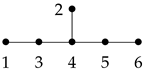
We assume the reader is familiar with the basics of (spherical) building theory; see [7,8], in particular with opposition, Coxeter and Dynkin diagrams and the Moufang condition. We will view a spherical building as a simplicial complex, numbering the types of the vertices with Bourbaki labeling [9]. In the present paper, we are concerned with buildings of type E 6 . Their symmetric Coxeter or Dynkin diagram, including the Bourbaki labeling, can be seen below.
  • Mathematics 13 03804 i001
It is proved in [8] that for each field K , there exists a unique building of type E 6 , which we denote by E 6 ( K ) , and call the building of type E 6  over K . The latter is sometimes also referred to as the ground field. It means that each projective space that turns up as a residue is defined from a vector space over K .
In order to state our main results, we need terminology and notation to describe the absolute geometry of a polarity within E 6 ( K )  and its abstract isomorphism type within the world of spherical buildings. We will do so with the help of fixed diagrams and Tits indices. The former, being more intuitive than the latter, helps to better understand the latter. Unfortunately, not every spherical building that we will encounter has a description using a Tits index, and we will need to introduce some buildings with explicit coordinates.

2.1. Fix Diagrams

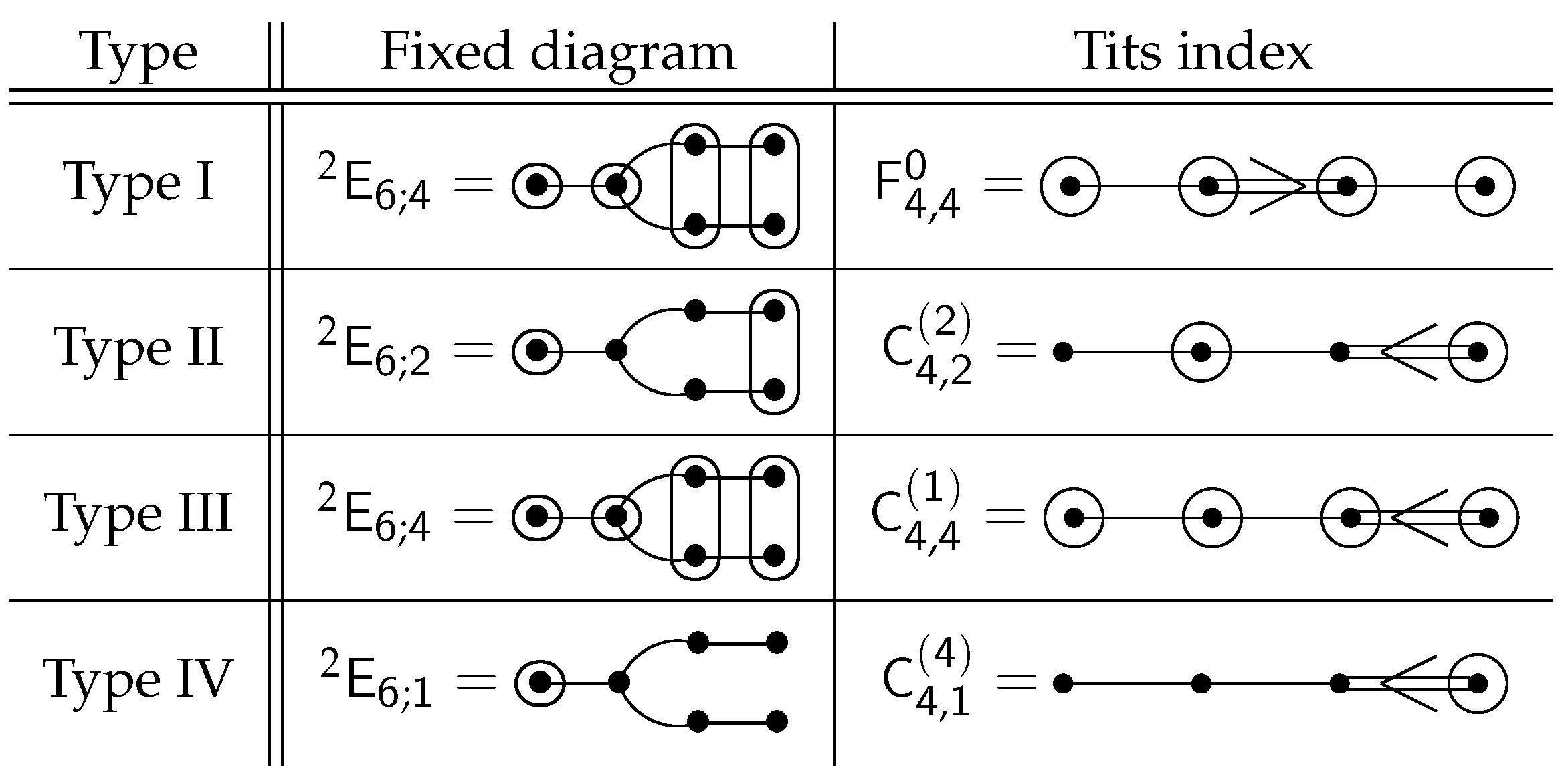
Let Δ  be an arbitrary irreducible spherical building, and let G be an automorphism group of Δ . Then the fix diagram for G is the Coxeter/Dynkin diagram of Δ  furnished with encircled orbits of nodes under the action of G on the diagram indicating the types of minimal simplices that are fixed by G. Note that, as soon as G preserves types and fixes a chamber, which is somehow the generic case, the fix diagram is trivial—all nodes are encircled. But in this case, the fixed diagram obviously does not provide useful information. However, if the fixed structure is a building again, then such diagrams are very useful, and we will only use fixed diagrams in that case. Some examples related to E 6  are given in Figure 1, where we also introduce the names of the various fix diagrams for later reference.
Fix diagrams in which each node is separately encircled are called full.

2.2. Tits Indices

Tits indices are introduced in [10], and therein called simply indices, as a generalization of the classical Witt index. They can be considered as a special case of a fixed diagram in the following way. Recall that each simple algebraic group G gives rise to a unique irreducible spherical building Δ ( G ) , see chapter 5 of [8]. Now let G be defined over an algebraically closed field F . Let Ψ  be an automorphism group of F . Denote the fixed field by K . Note that Π  is a Galois group for the extension F / K . Then one can let Ψ  act on G as an outer automorphism group. The fixed point group—also called the group of rational points in the literature—is a simple algebraic group H over K . The spherical building Δ ( H )  arises from Δ ( G )  as the fixed structure of the group Ψ . The corresponding Tits index is the fixed diagram furnished with some other data regarding the algebraic groups, such as dimensions of anisotropic kernels and the like; see [10]. Since for our purposes, it is enough to understand the connection with fixed diagrams, we refer to [10] for more precise information. We note that if a spherical building arises from a Tits index, then the latter is unique for the building. A building is called split if it arises from a Tits index that is full as a fixed diagram. Written in the symbols of [10] the Tits index is of the form X n , n ( 1 ) 1 , if X { A , B , C , D } , and X n , n 0 1 , if X { E , F } . For instance, every building of type E 6  is split, as follows from the tables in [10]. The type of the building Δ ( G )  is called the absolute type of Δ ( H ) , whereas the actual type of Δ ( H )  is sometimes referred to as the relative type. We say that Δ ( H )  arises from Δ ( G )  by Galois descent.

2.3. Moufang Buildings

Although we will not need a formal definition, it is instructive to mention the notion of a Moufang (spherical) building. This is a spherical building whose automorphism group satisfies certain transitivity properties; see [8] (Addendum). All spherical buildings of rank at least 3 are Moufang, and they arise either from Galois descent, from a classical group, or from a group of mixed type F 4 . This is explained in [11]. However, in the rank of 2, there are exotic examples of buildings. Rank 2 simplicial complexes are just graphs, and irreducible thick spherical buildings of rank 2 are graphs with diameter n and girth 2 n , n 3 , without vertices of valency 2. These are the thick generalized n-gons. The Moufang condition [12] distinguishes the exotic ones from the ones that behave just like the higher-rank irreducible spherical buildings. For instance, the Moufang rank 2 buildings also arise either from Galois descent, from a classical group, or from groups of mixed type B 2 , F 4  or G 2 . We note that some Moufang buildings can arise both from Galois descent and from a classical group. A group of mixed type is a phenomenon in low characteristic using purely inseparable field extensions. It only applies to buildings of type B 2  and F 4  in characteristic 2 and type G 2  in characteristic 3.
The importance of the Moufang condition for the present paper is that if the fixed structure of a polarity is a building, then it is a Moufang building; see [13] (Theorem 24.31). Hence the fixed building either arises from Galois descent, from a classical group, or from a group of mixed type.
We now present a construction of a building that arises from a classical group, but not from Galois descent. It uses an inseparable field extension in characteristic 2, hence the corresponding group can also be seen as one of mixed type; see again [11]. We construct a generalized quadrangle. Let K  be a field with characteristic 2, and suppose there are elements a , b K  such that { 1 , a , b }  is an independent set of vectors of K , considered as a vector space over the field K 2  of squares of K . Let V K K K K K K K  be a 7-dimensional vector space over K  and let
q : V K : ( x 2 , x 1 , x 1 , x 2 , x 0 , y 0 , z 0 ) x 2 x 2 + x 1 x 1 + x 0 2 + a y 0 2 + b z 0 2
be a quadratic form. Let C 2 ( K , K 2 + a K 2 + b K 2 )  be the simplicial complex defined by the graph with vertex set the set of isotropic 1- and 2-spaces of q, adjacent when the 1-space is contained in the 2-space. Then C 2 ( K , K 2 + a K 2 + b K 2 )  is a (Moufang) generalized quadrangle, as follows from Chapter 7 of [8].

2.4. Preview of the Main Results

Finally, before stating our main results, we discuss the way we present them. Both theorems contain information about different types of linear polarities of buildings of type E 6 . This information is given in tabular form. For a given polarity, we provide two data. The first one is the fix diagram, as discussed in Section 2.1. This explains how the fixed structure sits into the ambient building of type E 6  by revealing which types of simplices are fixed. The second one is the Tits index. This provides the abstract isomorphism type of the fixed building as explained above in Section 2.2. In case the fixed building does not arise from Galois descent, we refer to an explicit construction, namely, the one of C 2 ( K , K 2 + a K 2 + b K 2 )  above. This only happens in characteristic 2. In two cases, the fixed building has rank 1, which we did not yet discuss. In that case, ref. [13] (Theorem 24.31) asserts that the fixed building is a Moufang set, as defined and discussed by Tits in [11]. The ones that we will encounter will all arise from Galois descent, and hence, again, they correspond to Tits indices.
In characteristic 2, there are only two classes of polarities having as fixed structure a (thick) building of rank at least 2. In the other cases the fixed structure could be called a degenerate building, just like pseudo-polarities in projective space over fields with characteristic 2 have a degenerate polar space as a fixed structure.

2.5. Main Results

We can now state our main results. We distinguish between the case of characteristic 2 and distinct from 2. We assign each class of polarities a type for further reference. We begin with the latter.
Theorem 1.
Let Δ be a building of type E 6  over a field K  with char K 2 . Let ρ be a polarity of Δ, that is, an involution interchanging the types 1 and 6, and 3 and 5. Suppose ρ is not anisotropic, that is, it maps at least one object not to an opposite object. Then its fixed structure is a building (possibly of rank 1) and the associated fixed diagram and corresponding Tits index are given as in Figure 2.
Theorem 2.
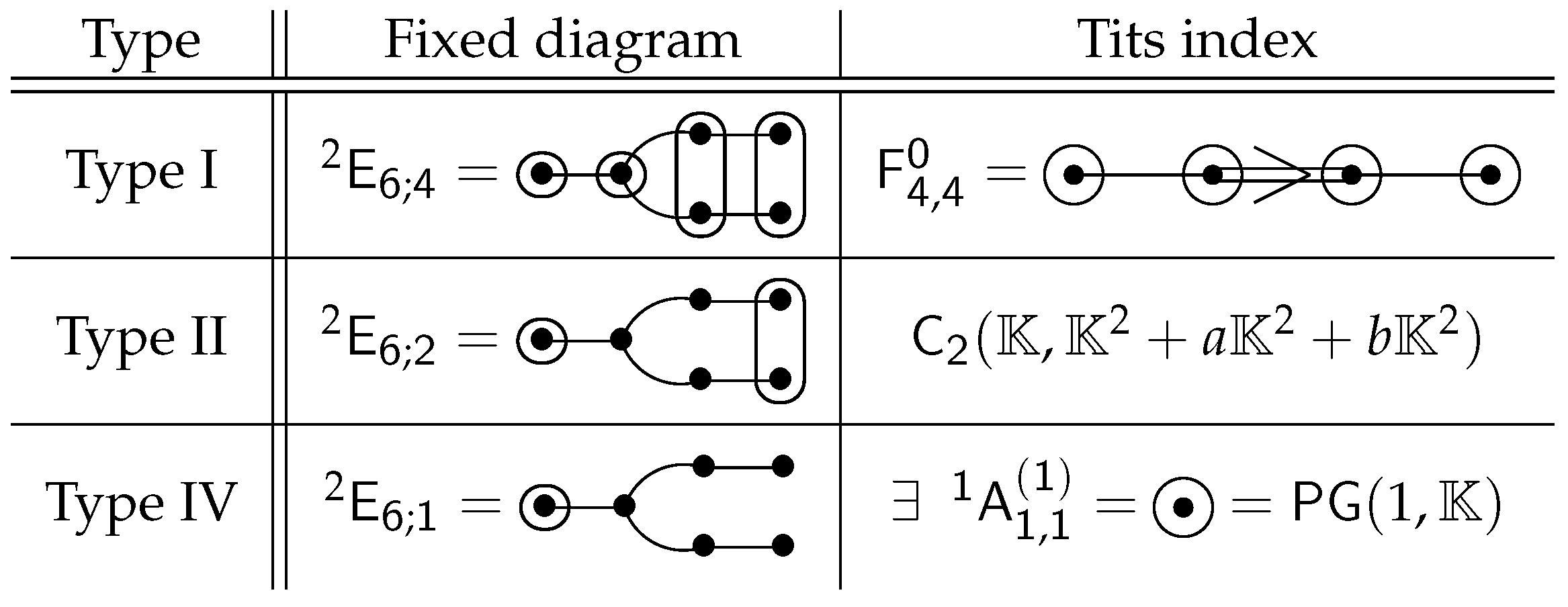
Let Δ be a building of type E 6  over a field K  with char K = 2 . Let ρ be a polarity of Δ, and suppose that ρ is not anisotropic. If the fixed structure for ρ is a (thick) building (possibly of rank 1), then the associated fixed diagram and corresponding Tits index or isomorphism type are given as in Figure 3, where a , b K  such that { 1 , a , b }  is linearly independent in the vector space K  over K 2 .

2.6. Some More Discussion

Concerning the last row of Figure 3, there are presumably different possibilities for the isomorphism type of the fixed building of rank 1, but we will establish one with the given type. This shows the different behavior compared with the case of the characteristic different from 2.
Concerning our results, to the best of our knowledge, the polarities of type II over a field with characteristic 2 are the first examples of automorphisms of any split building with a fixed structure, a classical generalized quadrangle of mixed type that does not arise from Galois descent. Other buildings admitting automorphisms with a fixed structure, a generalized quadrangle of mixed type, are themselves of mixed type; see, e.g., [14].
Furthermore, it is interesting to note that almost all absolute types of the fixed structures in the case of characteristic different from 2 are C 4 . Somehow the authors would have expected type B 4  to turn up, since split buildings of that type occur as large subgeometry of buildings of type F 4 —and the latter is the absolute type for the polarities of type I.
If K = C , the complex numbers, then the results reproduce the E 6  entry of the table in (3) of Theorem 5.10 in [2]. Moreover, it will follow from the constructions and examples in Section 6.3 that polarities of type I and III exist over any field K  (for type III only for char K 2 ). This is in contrast to the other types. Whereas type II polarities exist over the reals R , but not over C , we will see that polarities of type IV do not even exist over R .
Let us mention once again that Tits [1] classified all polarities of any building of type E 6  that are not linear; see also [10]. So our paper can be considered as a complement to these results.
As already mentioned, we refer to Section 6 for (the construction of) examples. We use the model of a building of type E 6  based on a cubic form in a 27-dimensional vector space. The same cubic form was used by Aschbacher [15] to describe maximal subgroups of the exceptional groups of type E 6  over a finite and algebraically closed field. In Section 4 of [15], Aschbacher uses a polarity of type I, and in Section 9 of [15] he describes the corresponding fixed geometry. Cohen [16] deduced from the cubic form an explicit construction of the geometry E 6 , 1 ( K )  (see below) as the intersection of 27 quadrics in 26-dimensional projective space. As a side result, Theorem 4 provides a way to explicitly calculate the subspace of dimension 9 spanned by an arbitrary symplecton of E 6 , 1 ( K )  in this representation. This by itself could be useful in other situations, in particular in computational environments.

3. Preliminaries

3.1. Buildings and Point-Line Geometries

As already mentioned, we assume familiarity with the basic notions in the theory of spherical buildings. We say that an automorphism is anisotropic if it maps every simplex to an opposite simplex. We have the following characterization of anisotropic automorphisms. It basically says that it suffices to look at the images of vertices of any given type in order to check whether an automorphism is anisotropic or not.
Lemma 1
(Theorem 3.1 of [17]). An automorphism of a spherical building maps every element of a given type to an opposite element if, and only if, it is anisotropic.
The way we are going to approach buildings in this paper is via their most standard geometry. More precisely, we turn them into point-line geometries using a well-known recipe. Before quickly describing that recipe, we define point-line geometries.
Definition 1.
A point-line geometry Γ is a bipartite graph where the vertices of a given class X are called points and the vertices of the other class Y are called lines. Points x , y  adjacent to a common line are called collinear, and we denote x y . The set of points collinear to a given point x is denoted as x . A repeated line is a set of points that is the neighborhood of two distinct lines. A subgeometry is an induced subgraph, and it is called full if it contains the full neighborhood in Γ of any of its lines. A subgeometry is called convex if it contains all vertices of each shortest path between every pair of its vertices. A subgeometry is called a geometric hyperplane if for each line L, the neighbor set Γ ( L )  either is contained in it or intersects the subgeometry in a unique point.
For a given point-line geometry Γ with classes X and Y, we define L = { Γ ( y ) y Y } . Then the bipartite graph Γ  with classes X and L , where a point x X  is adjacent to any member L of L  containing x, is a point-line geometry without repeated lines. We call Γ  the reduction of Γ. The graph Γ  is completely determined by the sets X and L .
Definition 2.
Now let Δ be an irreducible spherical building. Recall that, for the type set, we always use the Bourbaki labeling [9] of vertices of the corresponding diagram. Let X be the set of vertices of some given type, say i. Define Y to be the set of panels of cotype i. A vertex v of type i is adjacent to a panel P of cotype i if P { v }  is a chamber. This defines a point-line geometry Γ, the reduction in which is called the i-Grassmannian of Δ. If the diagram of Δ is simply laced, and Δ has rank n 3 , then Δ is determined by its diagram, say X n , and a given skew field K . In that case we denote Δ by X n ( K )  and its i-Grassmannian Γ by X n , i ( K ) . In general, we say that Γ  is a Lie incidence geometry of type X n , i .

3.2. Projective Spaces

With the conventions of Definition 2, the projective space of dimension n over a skew field K , which is usually denoted PG ( n , K ) , is also denoted by A n , 1 ( K ) . Projective planes are Lie incidence geometries of type A 2 , 1 . A collineation of PG ( n , K )  is a permutation of the point set preserving the line set. An involution is a collineation of order 2. A duality is an automorphism of the underlying building A n ( K )  that interchanges the types i and n i + 1 . A polarity is a duality of order 2.
We will need the following two lemmas for projective spaces:
Lemma 2
(Theorem 4.4 of [18]). An involution of a projective plane fixes at least three points and at least three lines.
The next lemma immediately follows from [19] (Proposition 3.3).
Lemma 3.
Let σ be an involution of PG ( d , K ) , d 2 . Suppose σ is induced by a linear transformation of the underlying vector space. Suppose also that σ admits at least one fixed point. Then exactly one of the following occurs:
(i)
char K = 2 , the set of fixed points is a subspace U p , the set of hyperplanes is the set of hyperplanes containing a given subspace U h U p , and dim U p + dim U h = d 1 .
(ii)
char K 2  and the set of fixed points is the union of two disjoint subspaces U and U , with dim U + dim U = d 1 .
We also introduce the following notation: for a set S of points of a projective space, we denote by S  the projective subspace generated by the elements of S.

3.3. Hyperbolic Quadrics

In the present paper, we will approach buildings of type E 6  via their Lie incidence geometries of type E 6 , 1 . An important ingredient to define such geometries and list their properties is the notion of a hyperbolic quadric and the related building of type D n , for some natural n 3 .
Definition 3.
A hyperbolic quadric Q (over the field K   is the set of points of a projective space PG ( 2 n 1 , K ) , n 2 , whose coordinates with respect to a suitable basis, satisfy the quadratic equation
X n X n + X n + 1 X n 1 + + X 2 X 2 + X 1 X 1 = 0 ,
where we work with generic coordinates ( x n , , x 1 , x 1 , , x n ) . The maximum (projective) dimension of subspaces entirely contained in Q is n 1 , and such subspaces are called generators. They fall into two classes in such a way that subspaces belonging to distinct classes intersect each other in a projective subspace of dimension n i , with i even. We call these classes the oriflamme classes. Subspaces contained in Q are usually called singular subspaces. The vertices of the corresponding building D n ( K )  of type D n  are the singular subspaces of projective dimension 0 , 1 , , n 3 , n 1 , and the maximal singular subspaces comprise two types of vertices according to the oriflamme class they are contained in. Two vertices corresponding to a singular subspace of dimension n 1  form a simplex if they intersect in a subspace of dimension n 2  (see [8]). A duality of D n ( K )  is a collineation of PG ( 2 n 1 , K )  preserving Q and interchanging the two oriflamme classes. As usual, a polarity is a duality of order 2.
Note that the points and lines of Q define the geometry D n , 1 ( K ) .
In general, quadratic equations define quadrics, and the Witt index of a quadric is one more than the maximum projective dimension of a singular subspace. A quadric is non-degenerate if there exist disjoint maximal singular subspaces. A non-degenerate quadric of Witt index n in PG ( 2 n , K )  is called a parabolic quadric. It defines a Lie incidence geometry of type B n , 1 .
Example 1.
Let Q be the hyperbolic quadric defined in Definition 3. Let H be a hyperplane of PG ( 2 n 1 , K ) , which is not a tangent hyperplane to Q. Then there is a unique involution ρ of PG ( 2 n 1 , K )  pointwise fixing H and preserving Q, and it is called a parabolic polarity. An explicit description of ρ is given by x n x n  if H has equation x n = x n .
In general, we have the following property of polarities in D 4 , 1 ( K ) .
Lemma 4.
Every polarity ρ of a hyperbolic quadric D 4 , 1 ( K )  fixes at least one point.
Proof. 
Let U be an arbitrary maximal singular subspace. Then either U U ρ  is a point (which is fixed under ρ ), or U U ρ  is a plane π . In the latter case ρ  induces an involution in π . Then the result follows from Lemma 2. □

3.4. Geometries of Type E 6 , 1

Now let Δ  be a building of type E 6  over the field K . We are going to work with the Lie incidence geometry E 6 , 1 ( K ) , the 1-Grassmannian of Δ . A good reference is [20]; see also [21]. Additional properties of E 6 , 1 ( K )  will be derived using an apartment of the corresponding building. We gather them in this preliminary section as they are independent of a polarity. This way they do not interrupt the flow of the proof of the main results in Section 4 and Section 5.
We begin with describing the elements of E 6 , 1 ( K )  and linking them to the Coxeter diagram. The points of E 6 , 1 ( K )  are the vertices of type 1 of the building E 6 ( K ) , by the very definition. The lines correspond to the vertices of type 3. Vertices of type 4 are planes of E 6 , 1 ( K ) , whereas vertices of type 5 and 2 are projective subspaces of dimension 4 and 5, respectively. We refer to them as 4-spaces and 5-spaces, respectively. Finally, vertices of type 6 correspond to convex subspaces of E 6 , 1 ( K )  isomorphic to D 5 , 1 ( K )  and will be called symplecta, or briefly symps, as in the theory of parapolar spaces. But we avoid introducing the latter theory here and refer instead to the later chapters of [22].
We display the basic properties of E 6 , 1 ( K )  (which can be found in [20]).
Proposition 1.
Let x , y  be two points of E 6 , 1 ( K )  and let ξ , ζ  be two symps. Then the following properties hold:
(i)
Either x = y , or there is a unique line containing both x and y, or x and y are not collinear and there is a unique symp containing both x and y;
(ii)
Either ξ = ζ , or ξ ζ  is a 4-space, or ξ ζ  is a point;
(iii)
Either x ξ , or x is contained in a unique 5-space that intersects ξ in a maximal singular subspace distinct from a 4-space, or x is not collinear to any point of ξ.
The intersection of the unique 5-space in ( i i i )  with the symp ξ  will be referred to as a 4 -space. It follows from [20] that 4-spaces and 4 -spaces of a symp belong to different oriflamme classes. The unique symp through x and y in ( i )  is sometimes denoted as ξ ( x , y ) .
Definition 4.
Two symps of E 6 , 1 ( K )  are called adjacent if they intersect in a 4-space. A point x and a symp ξ are called far if no point of ξ is collinear to x; they are called close if x is collinear to a 4 -space of ξ.
In fact, the properties in Proposition 1 can easily be checked inside an apartment, keeping in mind that every pair of simplices is contained in a common apartment. We now present an explicit construction of such an apartment Σ , based on [23] (§10.3.4), and we call it the standard apartment. The point set of Σ  is
{ 1 , 2 , 3 , 4 , 5 , 6 } { 1 , 2 , 3 , 4 , 5 , 6 } { { i , j } 1 i < j 6 } .
To avoid confusion, for instance, between the point { 1 , 2 }  and the pair of points 1 and 2, we will denote the former shorthand as 12. Lines, or vertices of type 3, in Σ  are the pairs { i , j }  and { i , j } , 1 i < j 6 , the pairs { i , i } , i = 1 , 2 , , 6 , the pairs { i , j k }  and { i , j k } , with { i , j , k } { 1 , 2 , 3 , 4 , 5 , 6 }  and | { i , j , k } | = 3 , and the pairs { i j , k } , with { i , j , k , } { 1 , 2 , 3 , 4 , 5 , 6 }  and | { i , j , k , } | = 3 . This now defines a graph Γ . The vertices of type 4 correspond to the cliques of size 3, those of type 2 to the cliques of size 6, those of type 5 to the maximal cliques of size 5, and those of type 6 to the sets of vertices not adjacent to a given vertex. Each such set forms a so-called pentacross, that is, an apartment of a building of type D 5  consisting of 10 points arranged in a complete graph minus a perfect matching.
Let us, for instance, check Proposition 1 ( i i i ) . As symp ξ , we can take the set of vertices of Γ  not adjacent to 1 . This is the set
ξ = { 12 , 13 , 14 , 15 , 16 , 2 , 3 , 4 , 5 , 6 } .
Now the vertex 1  is not adjacent to any of the vertices of ξ . The vertex 1 is adjacent to the vertices 2 , 3 , 4 , 5 , 6 , which indeed form a 4 -space as they are contained in the 5-space defined by { 1 , 2 , 3 , 4 , 5 , 6 } . Any other vertex not contained in ξ  is of the form i j  with 2 i < j 6 . Such a vertex is adjacent to the vertices 1 i , 1 j , k ,  and m, with { i , j , k , , m } = { 2 , 3 , 4 , 5 , 6 } . Each such set of vertices again forms a 4 -space as it is contained in a 5-space by adding the vertex i j  itself.
From now one we leave such straightforward checks to the reader.
Similarly, one proves the following basic property.
Proposition 2.
A point x of E 6 , 1 ( K )  is either contained in a given 5-space W of E 6 , 1 ( K ) , or it is collinear to all points of a 3-space inside W, or it is collinear to a unique point of W.
If a point x is collinear to (all points of) a 3-space contained in a 5-space W, then we say that x is close to W; if it is collinear to a unique point of W, then we say that x is far from W.
The diagram of E 6 , 1 ( K )  shows a symmetry. This reflects into a principle of duality for E 6 , 1 ( K ) . Interchanging the roles of points and symps, and of lines and 4-spaces, gives us new properties out of old ones. If two vertices of E 6 ( K )  form a simplex, then we call the corresponding elements of the geometry E 6 , 1 ( K ) incident. For instance, a 5-space is incident with a symp if they intersect in a 4 -space. A 5-space is incident with a 4-space if they intersect in a 3-space. Other incidences are given by inclusion.
The dual of Proposition 2 is the following:
Proposition 3.
A symp ξ of E 6 , 1 ( K )  is either incident with a given 5-space W  of E 6 , 1 ( K ) , or it intersects it in a line, or it is disjoint from it.
Likewise, we use the terminology of a symp ξ  being close or far from a given 5-space W, meaning that ξ W  is a line or the empty set, respectively.
The mutual position of two 5-spaces can also be seen in Σ . This leads to the following observation:
Lemma 5.
Two distinct 5-spaces of E 6 , 1 ( K )  either intersect in a plane, or intersect in a unique point, or are disjoint and there exists a unique 5-space intersecting both 5-spaces in respective planes, or are opposite. If they intersect in a unique point x, then they are incident with a unique common symp, which automatically contains x. If they are opposite, then every point of either is far from the other.
If two 5-space W , W  intersect in a unique point, then we denote the unique symp incident with both as ξ ( W , W ) . A pencil of 5-spaces with base plane π is the set of 5-spaces containing the given plane π . The next lemma follows directly from the Coxeter diagram and its geometric interpretation.
Lemma 6.
Let ( p , ξ )  be an incident point-symp pair of E 6 , 1 ( K ) . Define X as the set of 5-spaces containing p and intersecting ξ in a 4 -space. Define L  as the set of pencils of 5-spaces with base plane some plane containing p and itself contained in ξ. Then ( X , L )  is a Lie incidence geometry isomorphic to D 4 , 1 ( K ) . One oriflamme class of maximal singular subspaces corresponds to the set of lines through x in ξ; the other to the set of 4-spaces through x in ξ.
The geometry ( X , L )  will be referred to as the residue at ( p , ξ )  in E 6 , 1 ( K ) .
Lemma 7.
If a symp ξ through a point x close to a 5-space W in E 6 , 1 ( K )  is close to W, then the line ξ W  is contained in x .
Proof. 
We check this in Σ . We can take for W the 5-space defined by { 1 , 2 , 3 , 4 , 5 , 6 } , and x = 12 . Then an arbitrary symp ξ  containing x and close to W is given by the set of vertices not collinear to a point of the form i j , with 3 i < j 6 . Then ξ W = { i , j }  and the points i and j are clearly collinear to 1 . □
Lemma 8.
Let ξ be a symp far from some 5-space W in E 6 , 1 ( K )  and let ξ  be the unique symp adjacent to ξ and incident to W. Then each point of ξ far from W is collinear to a (unique) point of ξ W .
Proof. 
This can be checked inside Σ , but there is also a short direct argument. Indeed, let x be a point of ξ  far from W. Since x is collinear to points of ξ ξ , it is collinear to all points of a 4 -space U of ξ . Since 4 -spaces of ξ  form an oriflamme class, U intersects ξ W , which is also a 4 -space, in a point, which is automatically the unique point of W collinear to x. □
For the final lemma of this section, we recall from Lemma 5 that two 5-spaces W , W , with W W = { x } , are incident with a common symp ξ ( W , W )  that contains x.
Lemma 9.
Let W , W , W  be three 5-spaces such that the following apply:
(i)
W W = { x }  and W W = { x } ;
(ii)
x ξ ( W , W )  and x ξ ( W , W ) .
Then, W and W  are opposite.
Proof. 
Let y be an arbitrary point of the 4 -space W ξ ( W , W ) . Suppose for a contradiction that y is collinear to at least a 3-space S of W . Then y is collinear to at least a plane π  of W ξ ( W , W ) . Now, since ξ ( W , W ) ξ ( W , W )  contains a 3-space T in W , the two symps ξ ( W , W )  and ξ ( W , W )  intersect in a 4-space U. Suppose, for a contradiction, that U W  contains a point z. By assumption x U . Hence z is collinear to T { x } , contradicting Proposition 2. Consequently U W = . So, y is collinear to a 3-space of U and a disjoint plane π  in W , all contained in ξ ( W , W ) , contradicting Proposition 2 again.
Hence, we have proved that every point of the 4 -space W ξ ( W , W )  is far from W . It follows from Lemma 5 that, if W and W  are not opposite, then they share a unique point p. But then p is collinear to both x and x , hence to a 3-space of W , hence to a plane of W ξ ( W , W ) . Since it is also collinear to the 4 -space W ξ ( W , W ) , this leads to a contradiction in view of Proposition 1.
The lemma is proved. □

3.5. Summary of Notation

For the convenience of the reader, we here summarize some notation that we already introduced as follows:
*
Collinear points x and y are denoted as x y , and the set of points collinear to x is denoted as x . A point is always collinear to itself.
*
A building of simply laced type X n , defined over the field K , is denoted as X n ( K ) . The corresponding Lie incidence geometry using the vertices of type i as points is denoted as X n , i ( K ) .
*
The projective space of dimension n over the field K  is denoted by PG ( n , K )  and is isomorphic to the Lie incidence geometry A n , 1 ( K ) .
*
The subspace generated by a set S of points in a projective space is denoted by S ; it is the intersection of all subspaces containing S.
*
The unique symp in E 6 , 1 ( K )  containing two given non-collinear points x and y is denoted as ξ ( x , y ) .
*
The unique symp in E 6 , 1 ( K )  incident with two given 5-spaces intersecting in a unique point is denoted as ξ ( W , W ) .

4. Linear Polarities of the Triality Quadric

This section is devoted to prove auxiliary results about polarities in the polar space D 4 , 1 ( K ) . The reason why we need some properties of those is Lemma 6. If a polarity of E 6 , 1 ( K )  maps a point x to a symp ξ  that contains x, then ρ  induces a polarity in the residue at ( x , ξ ) .
Each collineation φ  of D 4 , 1 ( K )  is induced by a unique collineation of the ambient projective space PG ( 7 , K ) . We call φ  linear if its extension to PG ( 7 , K )  does not involve a field automorphism, that is, is induced by a linear map of the underlying vector space. Recall that a polarity of a hyperbolic quadric is an involutive collineation that interchanges the oriflamme classes of maximal singular subspaces. Also, note that a parabolic polarity ρ  is the unique non-trivial collineation of D 4 , 1 ( K )  pointwise fixing a given subspace isomorphic to a parabolic quadric of Witt index n 1 . Indeed, since ρ  is axial in PG ( 7 , K ) , it is central, say with center c. Since lines through c intersect the polar space in at most two points, ρ  has order 2 and so is a polarity.
We have the following characterization.
Lemma 10.
A collineation ρ of D 4 , 1 ( K )  is a parabolic polarity if, and only if, for every maximal singular subspace W the intersection W ρ W  is a plane.
Proof. 
The “only if” part followed by the definition of parabolic polarity. We now show the “if” part. Let W be a maximal singular subspace, and suppose for a contradiction that some line L of W not contained in W = W ρ  is mapped onto a disjoint line L = L ρ . An arbitrary maximal singular subspace X intersecting W in precisely L is mapped onto a maximal singular subspace X  with X W = L . Since the only point of L collinear to L  is L W , we find that X X  is at most a line, a contradiction. Hence L L  is a point, and it easily follows, by varying L, that W W  is fixed pointwise. This, in turn, implies that the set of fixed points is a geometric hyperplane, which clearly does not coincide with x , for any point x. Hence ρ  is a parabolic polarity by definition. □
Proposition 4.
Let ρ be a linear polarity of D 4 , 1 ( K ) , char K 2 . Then, either one of the following applies:
(i)
ρ is a parabolic polarity;
(ii)
The fix structure of ρ is a subquadric of Witt index 1 which is the intersection with D 4 , 1 ( K )  of a 4-dimensional subspace of PG ( 7 , K ) , and no maximal singular subspace is adjacent to its image under ρ;
(iii)
The set of fixed points is the union of a conic and its perp. The latter is a subspace isomorphic to B 2 , 1 ( K ) .
Proof. 
We denote the involution of the ambient projective space PG ( 7 , K )  inducing ρ  in D 4 , 1 ( K )  also by ρ . Since char K 2 , there is a polarity η  of PG ( 7 , K )  whose set of absolute points is precisely the hyperbolic quadric Q defined by D 4 , 1 ( K ) . Since char K 2 , Lemma 3 implies that the set of fixed points of ρ  is the union of two disjoint subspaces U and U  with dim U + dim U = 6 . We review all possibilities. We may assume 0 dim U dim U . Note that, since ρ  preserves Q, we always have U U η  or U = U η . The following apply:
(0)
dim U = 0 . If U U η , then U Q  and every singular 3-space of Q through U is preserved, implying that ρ  is type-preserving, a contradiction. Hence U = U η  and U does not belong to Q. Then we have situation ( i ) .
(1)
dim U = 1 . As in ( 0 ) , U U η  leads to a contradiction. Hence U = U η  again. Since U η U = , we find that | U Q | { 0 , 2 } . Suppose first that U intersects Q in two points x , y . Then every singular 3-space of Q through x intersects x y = x η y η = U  in a plane and hence is stabilized by ρ . This again implies that ρ  is type-preserving, a contradiction. Suppose now that U and Q are disjoint. Set Q = U Q . Since U Q = , Q  is non-degenerate. Since dim U = 5 , the Witt index of Q  is at least 2. Suppose Q  contains a plane π . Then U π η . The latter is a 4-space containing the two singular 3-spaces of Q through π . Hence U intersects each of these singular 3-spaces, a contradiction. Consequently Q  has Witt index 2. Now let W be a maximal singular subspace of Q containing a line L of Q U . Since L is fixed pointwise and ρ  is a polarity, we deduce that α : = W ρ W L  is a plane, stabilized by ρ . Since char K 2  and ρ  pointwise fixes the line L of α , it fixes an additional point of α , which necessarily has to lie in U U . But this is impossible as α ( U U ) = L . This shows that this case does not arise.
(2)
dim U = 2 . As in ( 0 ) , U U η  leads to a contradiction. Hence, U η U =  and so U Q  is a non-degenerate conic. If that conic is non-empty, then we have situation ( i i i ) . So, we may assume that U Q  is empty. Similarly as in ( 1 ) , one shows that U Q  is a non-degenerate quadric of Witt index 1. Each maximal singular subspace W of Q intersects U  in a point. Reference Lemma 3 implies that W W ρ  is either a point or a line. If W W ρ  is a line, ρ  is type-preserving, a contradiction. Hence W W ρ  is always a point, leading to ( i i ) .
(3)
dim U = 3 . As in ( 2 ) , U Q  is non-degenerate. Using similar arguments as above, one shows that the Witt indices of U Q  and U Q  coincide. If this Witt index is 0, then there are no fixed points, contradicting Lemma 4. If the Witt index is 1, then consider a line L intersecting U and U  non-trivially, say in the respective points u and u . Since L is stabilized by ρ , similarly to above, we find a fixed plane, which only contains two fixed points (u and u ), contradicting Lemma 2. Finally, assume that the Witt index of both U Q  and U Q  is equal to 2. Then each maximal singular subspace spanned by a line of Q U  and one of Q U  is fixed. This implies that ρ  would be type-preserving, a contradiction.
Proposition 5.
Let ρ be a linear polarity of D 4 , 1 ( K ) , char K = 2 . We consider D 4 , 1 ( K )  in its ambient projective space PG ( 7 , K ) . Then either one of the following applies:
(i)
ρ is a parabolic polarity, that is, ρ is the unique non-trivial collineation pointwise fixing a given non-degenerate hyperplane of D 4 , 1 ( K ) ;
(ii)
The fixed structure of ρ is a subquadric P of Witt index 1, which is the intersection with D 4 , 1 ( K )  of a 4-dimensional subspace of PG ( 7 , K ) ; it has a plane nucleus, and no maximal singular subspace is adjacent to its image under ρ;
(iii)
The set of fixed points is the intersection of D 4 , 1 ( K )  with a 4-dimensional subspace U and has the structure of a cone with vertex some point x and base a quadric of Witt index 1 in a hyperplane of U. No maximal singular subspace not through x is mapped onto an adjacent one, whereas each maximal singular subspace through x is mapped onto an adjacent one.
(iv)
The set of fixed points is the intersection of D 4 , 1 ( K )  with a 4-dimensional subspace U and has the structure of a cone with vertex some line K and base a non-degenerate conic in some plane of U. A maximal singular subspace is mapped onto an adjacent one if, and only if, it is not disjoint from the line K.
Proof. 
Let again Q be a quadric in PG ( 7 , K )  corresponding to D 4 , 1 ( K ) . Now Q is embedded in a unique symplectic polar space C 4 , 1 ( K )  with corresponding symplectic polarity η . The polarity ρ  of Q extends to a unique involution of C 4 , 1 ( K ) , which we keep denoting as ρ . Note that ρ  is also a collineation of PG ( 7 , K ) , which commutes with η . Let U h  be the intersection of all stabilized hyperplanes. Then, by Lemma 3, each hyperplane through U h  is stabilized by ρ . Also, each point of U h η  is fixed because, for each x U h , we have x ρ = x η ρ η = ( ( x η ) ρ ) η = ( x η ) η = x . Hence the subspace U p  consisting of all fixed points of ρ  is precisely U h η . It follows that U h U h η , so U h  is a singular subspace of C 4 , 1 ( K ) . If U h  were contained in Q, then all maximal singular subspaces of Q through U h  would be fixed; in particular, ρ  would be type-preserving, a contradiction. We review the possibilities for U h . Note dim U h { 0 , 1 , 2 , 3 } . The following apply:
(0)
dim U h = 0 . Here, U h  is a point off Q, and this leads to situation ( i ) .
(1)
dim U h = 1 . Here, U h  is a line. Then U p  is 5-dimensional and hence intersects every maximal singular subspace in at least a line, which is consequently fixed by ρ . Hence, since ρ  is type-interchanging, corresponding maximal singular subspaces intersect in a plane. Reference Lemma 10 leads to ( i ) .
(2)
dim U h = 2 . Suppose first U h Q = . Since dim U p = 4 , at least one point per maximal singular subspace is fixed. If a singular line L were pointwise fixed, then, since L U p = U h η , we would find U h L η . The latter is a 5-space intersecting Q in a quadric with radical L. This implies that L , U h , and hence also U h , is not disjoint from Q, a contradiction. Using Lemma 2, this leads to ( i i ) . Now suppose U h Q = { x } . Similarly as in the previous case, one shows that no line disjoint from U h  is pointwise fixed by ρ . Hence, also similarly, each maximal singular subspace W not containing x contains exactly one fixed point x W . So, using Lemma 2 again, we deduce that W W ρ  is not a plane. We conclude W W ρ = { x } . Now let W be a maximal singular subspace containing x. Then W U p = W M , with M a line in U h  not through x. This implies that some line of W through x is pointwise fixed, and so, W W ρ  is a plane π . That plane cannot be pointwsie fixed, as otherwise π η Q , which is the union of two hyperplanes, contains U h , contradicting M Q = . This is situation ( i i i ) . Similarly, dim U h Q = 1  leads to situation ( i v ) .
(3)
dim U h = 3 . Since every maximal singular subspace of Q is also singular with respect to C 4 , 1 ( K ) , the intersection U h Q  is a singular subspace of Q. Hence there exists a maximal singular subspace W of Q disjoint from U h = U p . This implies that no point of W W ρ , which is globally stabilized, is fixed. Hence W W ρ  is not a point, and, by Lemma 2, it is not a plane either. This contradicts the fact that ρ  is not type-preserving.
Definition 5.
We say that a linear polarity of D 4 , 1 ( K )  has type I, II, III or IV, respectively, if situation ( i ) , ( i i ) , ( i i i )  or ( i v ) , respectively, of either Proposition 4 or Proposition 5 occurs.

5. Proofs of Theorems 1 and 2

Now that we have gathered all necessary general properties of Δ  in Section 3 and studied polarities in polar spaces of type D 4 , 1  in Section 4, we can embark on the proofs of Theorem 1 and Theorem 2. For the rest of this section, Δ = ( X , L )  is a Lie incidence geometry of type E 6 , 1  over the field K , and ρ  is a given linear polarity of Δ .

5.1. Fix Diagrams

We first show that the fix diagram of a polarity is one of E 6 ; 0 2 , E 6 , 1 2 , E 6 ; 2 2  or E 6 ; 4 2 .
Lemma 11.
Each absolute point is contained in a fixed 5-space.
Proof. 
This follows directly from Lemma 6 combined with Lemma 4. □
Proposition 6.
If ρ does not fix any 5-space, then it is anisotropic.
Proof. 
Suppose for a contradiction that ρ  is not anisotropic. Then there is a 5-space W such that W ρ  is not opposite W. There are three possibilities described below. Note that W ρ W  by assumption:
(i)
W W ρ  is a plane π.
Select x π . Then π x ρ , since ρ  preserves the incidence relation. Hence x is absolute, and ρ  fixes a 5-space by Lemma 11, a contradiction to our assumptions.
(ii)
W W ρ  is a point x. Then clearly x is mapped onto the unique symp incident with both W and W ρ , which contains x. Again, Lemma 11 leads to a contradiction.
(iii)
W W ρ =  and W is not opposite W ρ .
Then there is a unique 5-space W *  that intersects both W and W ρ  in some plane. Clearly, ρ  fixes W * , again a contradiction.
This completes the proof of the proposition. □
From now on, we assume that ρ  is not anisotropic. We introduce the following notation:
Notation 1.
  • Let W be a 5-space, fixed by ρ. Then ρ induces a polarity in W, and we denote that polarity as ρ W . Every absolute point for ρ in W is an absolute point for ρ W , and, conversely, every absolute point for ρ W  is an absolute point for ρ. Note that planes of W fixed under ρ correspond to planes of Δ fixed under ρ W .
  • Let x be an absolute point for ρ. Then ρ induces a polarity in the residue at ( x , x ρ )  and we denote that polarity as ρ x . A fixed point for ρ x  corresponds to a stabilized 5-space for ρ through x and incident with x ρ . Also, a line of the residue at ( x , x ρ )  fixed by ρ x  corresponds to a plane of Δ fixed by ρ. Remember also that the two oriflamme classes of maximal singular subspaces of the residue at ( x , x ρ )  correspond to the set of lines of x ρ  through x and the set of 4-spaces in x ρ  through x, respectively.
Since we assume that ρ  is not anisotropic, Proposition 6 implies that ρ  fixes at least one 5-space W. We now prove that the Witt index of the polarity ρ W  is restricted to three possibilities.
Proposition 7.
With the above notation, let w be the Witt index of ρ W . Then w { 0 , 1 , 3 } .
Proof. 
We have to show that w 2 , so suppose for a contradiction that w = 2 . Then there exists an absolute point x W  and an absolute line L with x L W . In the residue of ( x , x ρ ) , the line L corresponds to a maximal singular subspace U, and W to a point. Since L is absolute for ρ , the 3-space U is absolute for ρ x . Also, W is clearly fixed by ρ x . Since U is absolute, U U ρ x  is a plane α , and ρ x  induces an involution in α . Now Lemma 2 implies that ρ x  fixes some line. Such a line corresponds in Δ  to a plane in W through x, fixed under both ρ W  and ρ . This contradicts w = 2  and the proof is complete. □
Lemma 12.
Let x be an absolute point of the polarity ρ and let W be a fixed 5-space. Assume that x is far from W. Then the unique point y W  collinear to x is also absolute, x y ρ , and there exists a unique 5-space in Δ fixed by ρ and containing both x and y.
Proof. 
Since x y , y ρ  is adjacent to x ρ  and incident to W. Hence Lemma 8 yields y y ρ  and y is absolute. Let U be the intersection of the symps x ρ  and y ρ . Note that y U  because x ρ  is far from W, and hence disjoint from W. Also, x U y ρ  as otherwise x would be close to W. Hence U x : = x U  and U y : = y U  are 3-spaces. If U x  did not coincide with U y , then there would exist a point u ( y x ρ ) x . This would imply y ξ ( u , x ) = x ρ , a contradiction. It follows that x , y , U  is a 5-space W . Note that W  is the unique 5-space containing y and incident to x ρ . Hence it is mapped onto the unique 5-space incident to y ρ  and containing x, which coincides with W . Thus, W  is fixed. It is also the unique fixed 5-space containing x and y, since such a 5-space is automatically incident with both x ρ  and y ρ . The lemma is proved. □
Lemma 13.
Let x be an absolute point of the polarity ρ and let W be a fixed 5-space. Assume that x is close to W. Let L be the intersection of W with x ρ . Then the plane x , L  is fixed by ρ.
Proof. 
The 4-space U : = x , x W  is mapped onto the line x ρ W  and is hence absolute by Lemma 7. The plane x , L  is then mapped onto the intersection of x ρ  with L ρ = U , and that is exactly x , L  itself. □
Lemma 14.
Let Γ be the graph with vertices the absolute points of the polarity ρ, adjacent when contained in a common 5-space, fixed under ρ. If Γ is not empty, then it is connected.
Proof. 
Let x and y be two absolute points. Lemma 11 yields a 5-space W containing y and fixed by ρ . If x W , then x is adjacent to y in Γ  (and we denote x y ). Suppose now that x is close to W. Then, by Lemma 13, denoting by L the intersection x ρ W , the plane π : = x , L  is fixed. It follows that each point z on L is absolute. Now in the residue of ( x , x ρ ) , the plane π  corresponds to a line in a fixed plane, and hence contains at least one fixed point. By Notation 1, the latter corresponds to a fixed 5-space W  containing π , and hence containing both of x and z. Now x z y  in Γ . At last, suppose that x is far from W and let z be the unique point of W collinear to x. Then z is absolute (so y z ) and x z  by Lemma 12. The lemma is proved. □
We record an immediate consequence of the proof of Lemma 14.
Corollary 1.
For every pair { x , y }  of absolute points of ρ, there exists an absolute point z not collinear to either x or y. In other words, { z , z ρ }  is a simplex opposite both { x , x ρ }  and { y , y ρ } .
The following is a direct consequence of the classification of polarities in finite-dimensional projective spaces.
Lemma 15.
With the above notation, one of the following holds:
(a)
ρ W  is a symplectic polarity;
(b)
char K 2  and ρ W  is an orthogonal polarity with absolute geometry D 3 , 1 ( K ) ;
(c)
char K 2  and ρ W  is an orthogonal polarity of Witt index 1, hence with absolute geometry a non-ruled non-degenerate non-empty quadric;
(d)
char K = 2  and ρ W  is a pseudo polarity with absolute point set an absolute hyperplane;
(e)
char K = 2  and ρ W  is a pseudo polarity with absolute point set an absolute 3-space;
(f)
char K = 2  and ρ W  is a pseudo polarity with absolute point set a plane fixed by ρ W ;
(g)
char K = 2  and ρ W  is a pseudo polarity with absolute point set a non-absolute line;
(h)
char K = 2  and ρ W  is a pseudo polarity with a unique absolute point;
(j)
ρ W  is an anisotropic polarity.
We say that ρ W  has type A, B, …, H, J, respectively, if situation ( a ) , ( b ) , …, ( h ) , ( j )  of Lemma 15 occurs. Now we treat the different cases of ρ W . We start with char K 2 .

5.2. Fixing Metasymplectic Spaces in Characteristic Different from 2

Suppose char K 2  and ρ  admits an absolute point x. Then it induces a polarity ρ x  in the residue of ( x , x ρ )  in Δ . By Proposition 4, there are at least two non-adjacent 5-spaces of Δ  incident with both x and x ρ  stabilized by ρ . Denote one of them by W. With that, we have the following result.
Lemma 16.
With the above notation, the types introduced below are compatible.
Type of  ρ x Type of  ρ W
Type IType A or D
Type IIType C, G or H
Type IIIType A, B, D, E or F
Type IVType A, D, E
In particular, if char K 2 , then ρ x  has type II if, and only if, ρ W  has type C. Also, if ρ x  has type III or IV, then there exists W such that the type of ρ W  is not A.
Proof. 
This follows from comparing the local behaviors of the different polarities. For example, all polarities of both types I and A are locally symplectic (every point is absolute), and hence they are compatible. However, all points of the conic in the description of type III in characteristic different from 2 also have this local structure; hence, type A is compatible with both types I and III. The rest is analogous. □
We now show that if char K 2 , for a given polarity ρ , the type of ρ x  is independent of the absolute point x.
Lemma 17.
Let ρ be a linear polarity of Δ, with char K 2 . Then for any pair { x , y }  of absolute points, the type of ρ x  coincides with the type of ρ y .
Proof. 
First suppose that, for some fixed 5-space W, the type of ρ W  is C. Let x and y be two absolute points contained in the same fixed 5-space. Proposition 4 yields a fixed 5-space W  through x such that W W = { x } . Then Lemma 15 yields an absolute point z W  such that z x ρ  (and x z ρ ). Again Proposition 4 yields a fixed 5-space W  such that W W = { z } . Lemma 9 implies that W is opposite W . Since the absolute structure in W is determined by a non-degenerate quadric, or a symplectic polar space, we find an absolute point u W  such that u is not contained in either x ρ  or y ρ . Denote by u  the unique point of W  collinear to u. Then it follows, just like in the proof of Lemma 14, that u  is absolute. Also, one deduces from this that u ρ  is the projection of u ρ  onto W . Then ref. [8] (Proposition 3.29) implies that ( u , u ρ )  is opposite both ( x , x ρ )  and ( y , y ρ ) . By projection, the fixed structure incident to ( x , x ρ )  is isomorphic to the one incident to ( u , u ρ ) , and the same thing holds for the fixed structures incident to ( u , u ρ )  and ( y , y ρ ) . The assertion now follows from Lemma 14. □
Definition 6.
Lemma 17 permits us to subdivide the linear polarities of E 6 , 1 ( K )  for char K 2  into three major classes. We designate these classes with the same type as the type of the polarity induced in the residue of the pair ( x , ξ ) , with x any absolute point and ξ its image. If there are no absolute points, but the polarity is not anisotropic, then we say that it has type IV.
Proposition 8.
Polarities of type I are symplectic polarities.
Proof. 
Suppose for a contradiction that the polarity ρ  is not a symplectic polarity. Then, since ρ  is not anisotropic, ref. [24] (Main Result 1.2) implies the existence of a point x close to its image x ρ . As follows from Proposition 1, there is a unique 5-space W incident with both x and x ρ . Since the pair { x , x ρ }  is mapped onto itself, W is fixed. But x is not an absolute point for ρ W , contradicting the fact that ρ W  is of type A. □
Remark 1.
If we define type I polarities in characteristic 2 as those for which ρ x  has type I and ρ W  has type A, for all absolute points x and all fixed 5-spaces W, then Proposition 8 also holds in characteristic 2.
Remark 2.
The arguments in the proof of Proposition 8, in particular the reference to [24], can be used to give a short proof of Proposition 6 as follows. If a polarity is not anisotropic, then, according to [24] (Main Result 1.2), it is either a symplectic polarity or there exists a point close to its image. In the former case, it certainly fixed some 5-space. In the latter case it follows from the proof of Proposition 8 that the unique 5-space incident to both is fixed. We record the latter for further reference.
Lemma 18.
If a point x of E 6 , 1 ( K )  is mapped by a polarity ρ to a symp ξ close to x, then the unique 5-space incident with both x and ξ is stabilized by ρ.
Proposition 9.
A polarity ρ of type III is characterized by the property that its fixed structure is a non-thick metasymplectic space of type C 4 , 2 , more precisely, it is the line Grassmannian of a symplectic polar space of rank 4.
Proof. 
Define the following point-line geometry Ω : The points are the 5-spaces W such that W ρ = W  and ρ W  is symplectic, the lines are the absolute points of ρ , and incidence is natural (symmetrized) inclusion. We prove that Ω  is a polar space isomorphic to C 4 , 1 ( K ) .
By Corollary 1, no point is collinear to all other points. By Notation 1, a line is the set of absolute points of ρ x  in the residue of ( x , x ρ ) , for an absolute point x. Hence, with the notation of Part (2) of the proof of Proposition 4, a line can be identified with the conic U Q . Thus, every line contains at least three points. Now we check the one-or-all axiom. Let x be an absolute point and W a fixed 5-space not containing x. If x is far, then Lemma 12 yields a unique fixed 5-space through x containing an absolute point y of W. Now suppose that x is close to W. Lemma 13 yields a fixed plane π  through x intersecting W in a line L. Let z L  be arbitrary. Recall that, by Proposition 4, the polarity ρ z  pointwise fixes a conic C and a generalized quadrangle Q 0  of type B 2 , 1  in the orthogonal complement of C with respect to the triality quadric Q. The 5-space W corresponds to a point w C . The line L corresponds to an absolute 3-space of Q through w. That absolute 3-space contains a line M fixed by ρ z  and corresponding to π , but not incident with w. This implies that M is contained in Q 0 . The line L corresponds to a(n absolute) 3-space of Q through M intersecting C in w. Likewise, the line x z  corresponds to such a 3-space, and its intersection with C corresponds to a fixed 5-space W z , with ρ W z  a symplectic polarity. Reversing the roles of x and z, and varying z over L, we see that each line of π  through x is contained in a unique fixed 5-space. The set of all such 5-spaces corresponds to the pointwise fixed conic in the residue of ( x , x ρ )  whose orthogonal complement is also pointwise fixed. Hence, in Ω , all points of the line corresponding to x are collinear to the point corresponding to W. The one-or-all axiom is proved.
Hence, Ω  is a polar space. To see its type, we consider the residue at a point, say W. The lines of Ω  incident with W are the absolute points of ρ W . From the previous paragraph we deduce that two such absolute points correspond to two lines in a common plane of Ω  if, and only if, they are contained in an absolute line of ρ . This proves that the residue in Ω  of the point corresponding to W is isomorphic to the symplectic polar space defined by ρ W . Hence Ω  is a symplectic polar space of rank 4 and the proposition is proved. □

5.3. Fixing a Generalized Quadrangle in Characteristic Different from 2

Here we handle the case that ρ  has type II. Note that in this case, there are no fixed planes and no absolute lines. Indeed, otherwise any point x on such an object would be absolute, and then ρ x  would have fixed lines, a contradiction to the assumption that ρ x  has type II.
Proposition 10.
A polarity ρ of type II is characterized by the property that its fixed structure is a generalized quadrangle. More precisely, the point-line geometry Ω with point set the set of absolute points of ρ and line set the set of fixed 5-spaces under ρ, with natural incidence, is the generalized quadrangle arising from the Tits index C 4 , 2 ( 2 ) .
Proof. 
We first prove that Ω  is a generalized quadrangle. It suffices to show the main axiom since clearly each line contains at least 3 points and each point is contained in at least 3 lines. So let x be an absolute point and W a fixed 5-space not containing x. By the fact that ρ  does not fix any plane, Lemma 13 implies that x is far from W. Then Lemma 12 yields a unique fixed 5-space W  through x intersecting W in an absolute point. Hence Ω  is a generalized quadrangle, as wanted.
Let W be a fixed 5-space and x an absolute point. Then ρ W  is an orthogonal polarity which, over a splitting field, determines a hyperbolic quadric of Witt index 3. Hence its Tits index is A 3 , 1 ( 2 ) 1 =  Mathematics 13 03804 i002. Also, the fixed points of ρ x  in the residue at ( x , x ρ )  form a quadric of Witt index 1 in a 4-dimensional space. Hence, over a suitable splitting field, this turns into a parabolic quadric of Witt index 2. Hence the Tits index of the fixed quadric is B 2 , 1 =  Mathematics 13 03804 i003, which coincides with C 2 , 1 ( 2 ) =   Mathematics 13 03804 i004. Note that there is, in fact, also a component of rank 1, type A 1 , which is determined by the orthogonal complement of the previously mentioned 4-space. This now implies that, over a common splitting field, ρ  becomes of type III and hence Ω  is a form of C 4 . The above Tits indices paste together as the index C 4 , 2 ( 2 ) :
  • Mathematics 13 03804 i005
and that concludes the proof of the proposition. □

5.4. Fixing a Rank 1 Building in a Characteristic Different from 2

In this paragraph we assume that the polarity ρ  is not anisotropic and has no absolute points. Then the fix diagram is E 6 ; 1 . We identified such polarity earlier as a polarity of type IV.
Proposition 11.
The fixed structure of a polarity ρ of type IV is a rank 1 building with Tits index C 4 , 1 ( 4 ) .
Proof. 
Let W be a fixed 5-space. Then ρ W  is a linear polarity which, over a suitable splitting field L , has maximal Witt index 3. It follows that ρ  has type III over L  and hence, by Proposition 10, the absolute type of the fixed structure of ρ  over K  is C 4 . The 5-spaces W  with ρ W  a hyperbolic polarity, correspond to vertices of type 4 in the associated building of type C 4 . Hence, the Tits index of the fixed structure of ρ  is C 4 , 1 ( 4 )  and the proposition is proved. □
This concludes our analysis in the case char K 2 , and Theorem 1 is proved.

5.5. Regular Polarities in Characteristic 2

Now we turn to the case char K = 2 . Note that we are only interested in regular polarities, that is, polarities the fixed structure of which defines a building. In particular, each element must have an opposite. Opposites in the fixed structure must also be opposites in Δ  because the fixed structure is convex and the convex closure of two simplices is empty precisely when they are opposite. This observation enables us to restrict the possibilities for ρ W  and ρ x , with W a fixed 5-space of ρ  and x an absolute point.
Lemma 19.
Let ρ be a polarity of E 6 , 1 ( K ) , with char K = 2 . Let x be an absolute point and W a fixed 5-space. If ρ x  has type III or IV, or if ρ W  has type D, E, F or H, then ρ is not regular.
Proof. 
Suppose first that ρ W  has one of the types D, E, F or H. Let A be the subspace of absolute points for ρ W . In each of the types, there exists a point p in A A ρ W . Since p A ρ W , we deduce A p ρ W p ρ . Now let q be an absolute point of ρ  such that { q , q ρ }  is opposite { p , p ρ }  in Δ . Then p ρ  is far from q and consequently, q is also far from W. Lemma 12 yields an absolute point p W  not contained in p ρ , a contradiction.
Now suppose ρ x  has type III or IV. Then Lemma 16 yields a fixed 5-space W of type D, E or F. The assertion now follows from the previous paragraph. □
There is an immediate consequence.
Corollary 2.
A regular polarity of E 6 , 1 ( K ) , with char K = 2 , satisfies exactly one of the following:
(Type I)
The type of ρ x  is I, for all absolute points x, and the type of ρ W  is A, for all fixed 5-spaces W;
(Type II)
The type of ρ x  is II, for all absolute points x, and the type of ρ W  is G, for all fixed 5-spaces W.
(Type IV)
There are no absolute points, but there are fixed 5-spaces W; all corresponding polarities ρ W  are anisotropic.
Remark 1 classifies polarities of type I. We now take a look at polarities of type II.
Proposition 12.
A polarity ρ of type II is characterized by the property that its fixed structure is a generalized quadrangle. More precisely, the point-line geometry Ω with point set the set of absolute points of ρ and line set the set of fixed 5-spaces under ρ, with natural incidence, is a rank 2 building C 2 ( K , K 2 + a K 2 + b K 2 ) , with { 1 , a , b }  linearly independent in K  as a vector space over K 2 . Moreover, all absolute points are contained in a common symp of Δ.
Proof. 
The first part of the proof of Proposition 10 can be taken over verbatim to show that Ω  is a generalized quadrangle, and every absolute point not contained in a given fixed 5-space is far from that 5-space. Notice also that lines of Ω , as sets of absolute points, are lines of Δ . Hence we can view Ω  as a full point-line subgeometry of Δ .
We now prove that Ω  is contained in a symplecton ξ . Indeed, let L , M  be opposite lines of Ω ; they are contained in unique respective fixed 5-spaces. Since each point of L is collinear to a unique point of M, there is a unique symp ξ  containing both L and M. It now suffices to prove that each line of Ω  through some point of L belongs to ξ . So, let x be any point on L and let K be any line of Ω  through x. Select a point y M  not collinear to x. Then there is a unique line N through y intersecting K in some point, say z. Since x z y , we conclude that z ξ ( x , y ) = ξ . Hence also K = x z ξ . Thus, Ω  is contained in ξ .
Now we consider the geometry x y D 4 , 1 ( K ) . With the above notation, the line K is the unique line of Δ  through x intersecting the fixed 5-space through N. Hence, the set S of points of Ω  lying in x y  is isomorphic to the set of fixed points of ρ y  in the residue at ( y , y ρ ) . We deduce from Proposition 5 ( i i )  that S is a quadric of Witt index 1 with plane nucleus. Since Ω  is a full subgeometry of ξ , it follows from [25] that Ω  is contained in the subspace spanned by x , y  and S. Hence Ω  is, by [26], the intersection of ξ  with a 6-dimensional subspace of its ambient projective space of dimension 9. Since S has a nucleus plane, it can be described as the set of points of a projective 4-space satisfying an equation of the form x 1 x 1 = x 0 2 + a y 0 2 + b z 0 2 , with { 1 , a , b }  a linearly independent set of elements of K  over K 2 . Note that the said nucleus plane then has equations x 1 = x 1 = 0 . The proposition is proved. □
The part of polarities of type IV in Theorem 2 will be proved in Section 6.3.4 when we write down an explicit form of any such polarity.

6. Concrete Constructions; Existence

6.1. Representation of Polarities

In order to construct examples of polarities of E 6 , 1 ( K ) , we view it as a full subgeometry of PG ( 26 , K ) . This has been achieved before by Aschbacher [15] using a trilinear form. We here follow the approach of [27] (§3.1), which is based on Aschbacher’s paper.
Let Σ  be the standard apartment. Viewed as a graph, the complement Σ ¯  is a bipartite graph and actually defines a building of rank 2—a generalized quadrangle Ξ  with 3 points per line and five lines through each point. We denote the set of lines of Ξ  by L . We consider the following partition S  of Ξ  into lines (equivalently, a partition of Σ  into cocliques of size 3).
S = { { 1 , 12 , 2 } , { 2 , 23 , 3 } , { 3 , 13 , 1 } , { 4 , 45 , 5 } , { 5 , 56 , 6 } , { 6 , 46 , 4 } , { 14 , 26 , 35 } , { 15 , 24 , 36 } , { 16 , 25 , 34 } } .
Such a partition is usually called a spread of the generalized quadrangle Ξ . The above one has the special property that no 3 × 3  subgrid of Ξ  contains exactly two members of S . Such spreads are called Hermitian, and one can easily check that they are characterized as follows.
Proposition 13.
Let S *  be a spread of Γ. Then the permutation of { 1 , 2 , , 6 }  that maps i to j if the line i j S * , consists of two disjoint 3-cycles if, and only if, S *  is Hermitian.
Let V be the 27-dimensional vector space over K  where the vectors of the standard basis are labeled by the points of Ξ . Hence the standard basis is of the form { e p p Ξ } . We denote the coordinate corresponding to e p  as x p . For every point p X , there is a quadratic form Q p : V K  defined by
Q p ( v ) = x q 1 x q 2 { p , r 1 , r 2 } L S x r 1 x r 2
where v = ( x p ) p Ξ  and  { p , q 1 , q 2 }  is the unique line of S  through p.
Let PG ( V )  be the 26-dimensional projective space arising from V (hence the points of PG ( V )  are the 1-spaces of V). Then it is shown in [27] (§3.1) that the set E 6  of projective points with coordinates x ¯ : = ( x p ) p Ξ  such that Q p ( x ¯ ) = 0 , for all p Ξ , together with all projective lines contained in it, defines the geometry E 6 , 1 ( K ) . It is unique for the given field K  as follows from the classification of irreducible thick spherical buildings in [8].
We denote the projective point corresponding to the vector v V  as v . Since we are interested in polarities, we want to see the symps of E 6 , 1 ( K )  as points of the dual space PG ( V * ) , where they also should form a set E 6 *  of points isomorphic to E 6 . To that end, we first show that every symp ξ  of E 6 , 1 ( K )  is contained in a unique hyperplane H ξ  of PG ( V )  that also contains all points close to ξ . This is easily checked for the base points e p , p Ξ , using the following straightforward lemma:
Lemma 20.
A point v PG ( V )  with v = ( x p ) p Ξ  is collinear to e q  for some q Ξ  if, and only if, x r = 0  for all r collinear to q in Ξ.
To prove, in general, the existence and uniqueness of H ξ , we use the type preserving automorphism group of E 6 , 1 ( K ) , which is the group of collineations of PG ( V )  preserving E 6  by combining [28,29].In fact, it suffices to use the group generated by the following collineations.
Definition 7.
Let { O , O }  be a pair of opposite 5-spaces of Σ and let a K . Using Proposition 13 we may assume that O = { 1 , 2 , 3 , 4 , 5 , 6 }  and O = { 1 , 2 , 3 , 4 , 5 , 6 } . Then, we define
φ ( O , O ) , a : V V : e p e p p O , e i e i + a e i i { 1 , 2 , 3 } , e i e i a e i i { 4 , 5 , 6 } .
This implies the following map on the coordinates of a vector v = ( x p ) p Ξ :
x p e p p O , x i e i + a e i i { 1 , 2 , 3 } , x i e i a e i i { 4 , 5 , 6 } .
One can check that this map preserves E 6  and hence defines a collineation of E 6 , 1 ( K ) .
The group G  generated by these collineations is sometimes also called the little projective group, because φ ( O , O ) , a  is a so-called long root elation.
Recall that the hyperplane of PG ( V )  with equation p Ξ a p x p = 0 , a p K , has dual coordinates [ a p ] p Ξ  (we use square brackets for clarity). We can now prove the following theorem.
Theorem 3.
A hyperplane with dual coordinates [ a p ] p Ξ  arises as  H ξ  for some symp ξ of E 6 , 1 ( K )  if, and only if, the vector v = ( a p ) p Ξ  satisfies  Q p ( v ) = 0 , for all p Ξ .
Proof. 
The assertion is obviously true for the base points e p , p Ξ . Now, noticing that the automorphism φ ( O , O ) , a  reads in dual coordinates as φ ( O , O ) , a , the assertion follows from applying G  to the base points. □
Theorem 3 implies that the matrix of a duality, that is, an isomorphism from E 6 , 1 ( K )  to its dual, is just the matrix of a collineation of PG ( V )  preserving E 6 .

6.2. The 9-Space Associated with a Dual Point

Most examples of polarities that we will present map each base point to the dual of a base point. Hence, viewed as collineations, they permute the base points. Such collineations are determined by the image of six base vectors, as we will see. This conforms to the torus of G  as an algebraic group being 6-dimensional. Extending to PG ( V ) , we obtain a polarity of PG ( V ) . However, not all absolute points for that polarity are absolute points for the polarity on E 6 , 1 ( K ) : Besides the absolute points that do not lie on E 6 , also the points of E 6  that are mapped onto a close symp are absolute for the extended polarity. So, one has to distinguish the hyperplane corresponding to the symp and the symp itself. Hence the following problem arises. Given a dual point [ a p ] p Ξ , which coincides with H ξ , for ξ  a symp of E 6 , 1 ( K ) , then we know ξ H ξ , but what is the 9-space ξ  of PG ( V )  spanned by ξ ? The answer is given by the following theorem.
Theorem 4.
The symp corresponding to a dual point p of E 6  lies in the 9-space spanned by the vectors, dual to the tangent hyperplanes in the dual point p of the quadrics Q r  with r X . In other words, if the point ( x q ) q Ξ  belongs to  E 6 , then the 9-space spanned by the symp defined by the dual point p = [ x q ] q Ξ  is equal to
Q r x q ( p ) q Ξ | r Ξ .
Proof. 
We will use the fact that G  acts transitively on the points. The theorem holds for the dual points e p , p Ξ  by a straight forward calculation. Now let p have coordinates ( x q ) q Ξ  and assume the theorem holds for p. Then we want to prove that it still holds for φ ( O , O ) , a ( p ) .
As before, we may, without loss of generality, assume
O = { 1 , 2 , 3 , 4 , 5 , 6 }   and   O = { 1 , 2 , 3 , 4 , 5 , 6 } .
Note that since p is a dual point, the (dual) coordinates of p are transformed using the dual map ϕ ( O , O ) , a , which corresponds to
x p = x p if p O , x i = x i a x i if i { 1 , 2 , 3 } , x i = x i + a x i if i { 4 , 5 , 6 } .
Define
v r : = Q r x q ( p ) q Ξ   and   u r : = Q r X p q ( φ ( O , O ) , a ( p ) ) q Ξ .
Then the 9-space corresponding to p is equal to v r r Ξ  and the 9-space corresponding to φ ( O , O ) , a ( p )  is equal to  V : = φ ( O , O ) , a ( v r ) r Ξ . The theorem claims that the latter space coincides with u r r Ξ . By symmetry, and interchanging φ ( O , O )  with its inverse, it suffices to prove that U V . For that we will show all the generically distinct cases; namely we will prove that all of u 1 , u 1 , u 12 , u 14  belong to V.
u 1 = x 12 e 2 x 13 e 3 x 14 e 4 x 15 e 5 x 16 e 6 + ( x 2 a x 2 ) e 12 ( x 3 a x 3 ) e 13 ( x 4 + a x 4 ) e 14 ( x 5 + a x 5 ) e 15 ( x 6 + a x 6 ) e 16 = x 12 ( e 2 + a e 2 ) x 13 ( e 3 + a e 3 ) x 14 ( e 4 a e 4 ) x 15 ( e 5 a e 5 ) x 16 ( e 6 a e 6 ) + x 2 e 12 x 3 e 13 x 4 e 14 x 5 e 15 x 6 e 16 a x 12 e 2 + a x 13 e 3 a x 14 e 4 a x 15 e 5 a x 16 e 6 a x 2 e 12 + a x 3 e 13 a x 4 e 14 a x 5 e 15 a x 6 e 16 = φ ( O , O ) , a ( v 1 ) + a φ ( O , O ) , a ( v 1 ) u 1 = x 13 e 3 x 12 e 2 x 14 e 4 x 15 e 5 x 16 e 6 + x 3 e 13 x 2 e 12 x 4 e 14 x 5 e 15 x 6 e 16 = φ ( O , O ) , a ( v 1 ) u 12 = x 1 e 2 + ( x 2 a x 2 ) e 1 x 2 e 1 ( x 1 a x 1 ) e 2 x 34 e 56 x 56 e 34 x 35 e 46 x 46 e 35 x 36 e 45 x 45 e 36 = φ ( O , O ) , a ( v 12 ) u 14 = x 26 e 35 + x 35 e 26 x 1 e 4 ( x 4 + a x 4 ) e 1 x 4 e 1 ( x 1 a x 1 ) e 4 x 23 e 56 x 56 e 23 x 25 e 36 x 36 e 25 = φ ( O , O ) , a ( v 14 )
One finds the following, by the same calculations with a permutation on the indices and by changing, in some cases, a to a :
u p = φ ( O , O ) , a ( v p ) if p O , u i = φ ( O , O ) , a ( v i ) + a φ ( O , O ) , a ( v i ) if i { 1 , 2 , 3 } , u i = φ ( O , O ) , a ( v i ) a φ ( O , O ) , a ( v i ) if i { 4 , 5 , 6 } .
Hence U V  and the theorem is proved. □
Let W 0  and W 0  be the 5-spaces of E 6 , 1 ( K )  contained in Σ  determined by { 1 , 2 , 3 , 4 , 5 , 6 }  and { 1 , 2 , 3 , 4 , 5 , 6 } , respectively. The following consequence will be very useful to determine the type of the polarity induced in W (when W is stabilized).
Corollary 3.
The symp associated with the dual point [ a p ] p Ξ , with a p = 0  if p W 0  intersects W 0  in the 4 -space with equation ( W 0  coordinatized with coordinates ( x 1 , , x 6 ) )
a 1 x 1 + a 2 x 2 + a 3 x 3 a 4 x 4 a 5 x 5 a 6 x 6 = 0 .

6.3. Explicit Form of Some Polarities of E 6 , 1 ( K )

We now provide the coordinate form of some polarities, not only proving existence of such polarities, but also ready-made for investigating further properties.

6.3.1. Polarities of Type I—Symplectic Polarities

In order to keep the oversight, we break up the coordinate tuple into suitable pieces. We denote the coordinates of a generic point as ( x p ) p Ξ , and those of a dual point, or hyperplane, as [ a p ] p Ξ . Then a symplectic polarity can be described by the following map from PG ( V )  to PG ( V * ) .
( x 1 , x 2 , x 3 , x 4 , x 5 , x 6 ) [ x 4 , x 5 , x 6 , x 1 , x 2 , x 3 ] , ( x 1 , x 2 , x 3 , x 4 , x 5 , x 6 ) [ x 4 , x 5 , x 6 , x 1 , x 2 , x 3 ] , ( x 12 , x 23 , x 13 , x 45 , x 56 , x 46 ) [ x 45 , x 56 , x 46 , x 12 , x 23 , x 13 ] , ( x 14 , x 25 , x 36 ) [ x 14 , x 25 , x 36 ] , ( x 15 , x 16 , x 26 , x 24 , x 34 , x 35 ) [ x 24 , x 34 , x 35 , x 15 , x 16 , x 26 ] .
This is indeed a symplectic polarity in characteristic unequal to 2 since it is easily checked that W 0  and W 0  are fixed and, by Corollary 3, every point of W 0 W 0  is absolute in E 6 , 1 ( K ) . Similarly, the 5-space W 1  of Σ  determined by { 1 , 2 , 3 , 45 , 56 , 46 }  is fixed, and every point is absolute. Since in the line Grassmannian of a symplectic polar space of rank 4 no two symplectic symps share more than a point, the fixed structure must be a thick metasymplectic space. The verification that a generic point is absolute happens over a ring of polynomials with integer coefficients. This also holds over a field with characteristic 2. Thus, the set of absolute points is a hyperplane defining a symplectic polarity.
From the expressions in coordinates, we deduce that these polarities exist over an arbitrary field.

6.3.2. Polarities of Type III in Characteristic Unequal to 2

The following polarity, described by a map on the coordinates, has type III over a field of odd characteristic or characteristic 0.
( x 1 , x 2 , x 3 , x 4 , x 5 , x 6 ) [ x 4 , x 5 , x 6 , x 1 , x 2 , x 3 ] , ( x 1 , x 2 , x 3 , x 4 , x 5 , x 6 ) [ x 4 , x 5 , x 6 , x 1 , x 2 , x 3 ] , ( x 12 , x 23 , x 13 , x 45 , x 56 , x 46 ) [ x 45 , x 56 , x 46 , x 12 , x 23 , x 13 ] , ( x 14 , x 25 , x 36 ) [ x 14 , x 25 , x 36 ] , ( x 15 , x 16 , x 26 , x 24 , x 34 , x 35 ) [ x 24 , x 34 , x 35 , x 15 , x 16 , x 26 ] .
Again, it can be verified using Corollary 3 that every point of W 0  is absolute. However, with the same notation as in the previous paragraph, a straightforward computation using Theorem 4 shows that the absolute points in W 1  form a hyperbolic quadric in W 1 . Hence, we have a polarity of type III.
Again, from the coordinate description, we deduce that such polarities exist over arbitrary fields of characteristic unequal to 2. We conclude that polarities of types I and III exist over arbitrary fields, as long as the characteristic is not 2 for type III. In particular, these polarities exist over the complex numbers, as already shown in [2].

6.3.3. Polarities of Type II in All Characteristics

The following polarity has type II, independent of the characteristic. Let k 2 , k 3 , k 4 , k 5  be such that the bilinear form
( x 2 , x 3 , x 4 . x 5 ) k 2 x 2 2 + k 3 x 3 2 + k 4 x 4 2 + k 5 x 5 2
is anisotropic, that is, has only the trivial vector as isotropic vector, and such that k 2 k 3 k 4 k 5  is a perfect square in K . For instance, k 2 = k 3 = k 4 = k 5 = 1  over the reals, or k 2 = s , k 3 = t , k 4 = s t  and k 5 = 1  over the Laurent series F ( ( s , t ) ) , with F  any field with characteristic 2. Let k , K  be such that ( k ) 2 = k 2 k 3 k 4 k 5 . Then we define the polarity as follows.
( x 1 , x 2 , x 3 , x 4 , x 5 , x 6 ) [ k x 6 , k 2 x 2 , k 3 x 3 , k 4 x 4 , k 5 x 5 , k x 1 ] , ( x 1 , x 2 , x 3 , x 4 , x 5 , x 6 ) [ k x 6 , k 2 x 2 , k 3 x 3 , k 4 x 4 , k 5 x 5 , k x 1 ] , ( x 12 , x 13 , x 14 , x 15 , x 26 , x 36 , x 46 , x 56 ) k k 2 x 26 , k k 3 x 36 , k k 4 x 46 , k k 5 x 56 , k k 2 x 12 , k k 3 x 13 , k k 4 x 14 , k k 5 x 15 , ( x 16 , x 23 , x 24 , x 25 , x 34 , x 35 , x 45 ) x 16 , k 2 k 2 k 3 x 23 , k 2 k 2 k 4 x 24 , k 2 k 2 k 5 x 25 , k 2 k 3 k 4 x 34 , k 2 k 3 k 5 x 35 , k 2 k 4 k 5 x 45 .
As before, one can check with some calculations that this really defines a polarity of type II. Clearly, such polarity does not exist over the complex numbers, as anisotropic quadratic forms with at least two variables do not exist over an algebraically closed field. And indeed, these polarities do not appear in [2]. However, over the reals we have examples, for instance k = = k 1 = k 2 = k 3 = k 4 = k 5 0 .

6.3.4. Polarities of Type IV

We now describe a polarity of type IV. In order to check that the polarity is really of type IV, one only has to verify that it fixes at least two 5-spaces and it has no absolute points in either. The following polarity obviously fixes W 0  and W 0 , and it has no absolute points in either if the form
( x 1 , x 2 , x 3 , x 4 . x 5 , x 6 ) k 1 x 1 2 + k 2 x 2 2 + k 3 x 3 2 + k 4 x 4 2 + k 5 x 5 2 + k 6 x 6 2
is anisotropic (use Corollary 3 again).
( x i ) [ k i x i ] , i { 1 , 2 , 3 } , ( x i ) [ k i x i ] , i { 1 , 2 , 3 } ( x i ) [ k i x i ] , i { 4 , 5 , 6 } , ( x i ) [ k i x i ] , i { 4 , 5 , 6 } ( x i j ) k i k j x i j , { i , j } { 1 , 2 , 3 } , i < j , ( x i j ) k i k j x i j , { i , j } { 4 , 5 , 6 } , i < j , ( x i j ) k i k j x i j , i { 1 , 2 , 3 } , j { 4 , 5 , 6 } ,
where 2 + k 1 k 2 k 3 k 4 k 5 k 6 = 0 . Clearly, this does not exist over C , but neither over R , as all k i , i = 1 , 2 , , 6 , have the same sign, and then there does not exist R  satisfying the stated equality. Over any field of characteristic distinct from 2, any non-degenerate quadratic form can be diagonalized, so that the expression above is generic. So, over R , no polarity of type IV exists. Such a polarity exits, for example, over the field Q ( s , t ) , where we can take k 1 = 2 , k 2 = 3 , k 3 = 6 , k 4 = s , k 5 = t , k 6 = s t  and = 6 s t .
We now prove that, if char K = 2 , then there exists an example with the property that the only fixed 5-spaces are contained in the space W 0 , W 0 , and hence they form a projective line over K , establishing the last row of Figure 3 of Theorem 2. Indeed, suppose K  and k 1 , , k 5  are such that K = F ( ( k 1 , , k 5 ) )  the field of Laurent series in the indeterminates k 1 , , k 5  over a field F  in characteristic 2, and set : = k 6 : = k 1 k 2 k 3 k 4 k 5 . One checks that the 5-space of E 6  contained in U : = W 0 , W 0  is given by k e i + e i i { 1 , 2 , 3 , 4 , 5 , 6 } . All points of U are absolute for the extended polarity in PG ( V ) , because the set of absolute points of a pseudo polarity is a subspace. Hence, by Lemma 18, each point of U E 6  is contained in a stabilized 5-space of E . It suffices to show that no point of E 6  outside U is absolute for the extended polarity. This, in turn, will follow if we show that the subspace U = e i j { i , j } { 1 , 2 , 3 , 4 , 5 , 6 } , i j  complementary to U does not admit any absolute point. The matrix of the polarity restricted to U  is diagonal with diagonal
k i k j { i , j } { 1 , 2 , 3 , 4 , 5 , 6 } , i j .
It now suffices to observe that the set
{ k 3 k 4 k 5 , k 2 k 4 k 5 , k 2 k 3 k 5 , k 2 k 3 k 4 , k 1 k 4 k 5 , k 1 k 3 k 5 , k 1 k 2 k 5 , k 1 k 3 k 4 , k 1 k 2 k 4 , k 1 k 2 k 3 , k 1 , k 2 , k 3 , k 4 , k 5 }
is linearly independent as a set of vectors of the vector space K  over K 2 .
This concludes the proof of Theorem 2.

Author Contributions

Investigation, V.B. and H.V.M.; writing—original draft, H.V.M.; writing—review and editing, V.B. and H.V.M. All authors have read and agreed to the published version of the manuscript.

Funding

Partly supported by the Fund for Scientific Research—Flanders (FWO—Vlaanderen) through Project G023121N.

Data Availability Statement

No new data were created or analyzed in this study. Data sharing is not applicable to this article.

Conflicts of Interest

The authors declare no conflicts of interest. The funders had no role in the design of the study, in the writing of the manuscript, or in the decision to publish the results.

References

  1. Tits, J. Les “formes réelles” des groupes de type E6. In Séminaire Bourbaki; 1957/1958, exp. no 162 (février 1958), 15 p., 2e éd. corrigée, Secrétariat mathématique, Paris 1958; reprinted in Séminaire Bourbaki 4; Société Mathématique de France: Paris, France, 1995; pp. 351–365. [Google Scholar]
  2. Wolf, J.A.; Gray, A. Homogeneous spaces defined by Lie groups automorphisms I. J. Differ. Geom. 1968, 2, 77–114. [Google Scholar] [PubMed]
  3. Antón-Sancho, Á. Involutions of the moduli space of principal E6-bundles over a compact Riemann surface. Axioms 2025, 14, 423. [Google Scholar] [CrossRef]
  4. Antón-Sancho, Á. Fixed points of principal E6-bundles over a compact algebraic curve. Quaest. Math. 2024, 47, 501–513. [Google Scholar] [CrossRef]
  5. Antón-Sancho, Á. Higgs pairs with structure group E6 over a smooth projective connected curve. Results Math. 2025, 80, 42. [Google Scholar] [CrossRef]
  6. Babu, K.S.; Bajc, B.; Susič, V. A realistic theory of E6 unification through novel intermediate symmetries. J. High Energy Phys. 2024, 2024, 18. [Google Scholar] [CrossRef]
  7. Abramenko, P.; Brown, K. Buildings: Theory and Applications; Graduate Texts in Mathematics 248; Springer: New York, NY, USA, 2008. [Google Scholar]
  8. Tits, J. Buildings of Spherical Type and Finite BN-Pairs; Springer Lecture Notes Series; Springer: Berlin/Heidelberg, Germany, 1974; Volume 396. [Google Scholar]
  9. Bourbaki, N. Lie Groups and Lie Algebras, Chapters 4–6. Elements of Mathematics; Springer: New York, NY, USA, 2002. [Google Scholar]
  10. Tits, J. Classification of simple algebraic groups. In Algebraic Groups and Discontinuous Subgroups, Proceedings of the Summer Mathematical Institute, Boulder, Colorado, 5 July–6 August 1965; Proceedings of Symposia in Pure Mathematics, Volume 9; American Mathematical Society: Providence, RI, USA, 1966; pp. 33–62. [Google Scholar]
  11. Tits, J. Groupes de rang 1 et ensembles de Moufang. Annu. Coll. Fr. 2000, 100, 93–109. [Google Scholar]
  12. Tits, J.; Weiss, R. Moufang Polygons; Springer Monographs in Mathematics; Springer: Berlin/Heidelberg, Germany, 2002. [Google Scholar]
  13. Mühlherr, B.; Petersson, H.P.; Weiss, R.M. Descent in Buildings; Annals of Mathematics Studies; Princeton University Press: Princeton, NJ, USA; Oxford, UK, 2015; Volume 190. [Google Scholar]
  14. Mühlherr, B.; Van Maldeghem, H. Exceptional Moufang quadrangles of type F 4 . Canad. J. Math. 1999, 51, 347–371. [Google Scholar] [CrossRef]
  15. Aschbacher, M. The 27-dimensional module for E 6 , I. Invent. Math. 1987, 89, 159–195. [Google Scholar] [CrossRef]
  16. Cohen, A.M. Point-line spaces related to buildings. In Handbook of Incidence Geometry: Buildings and Foundations; Buekenhout, F., Ed.; Elsevier: Amsterdam, The Netherlands, 1995; Chapter 12; pp. 647–737. [Google Scholar]
  17. Devillers, A.; Parkinson, J.; Van Maldeghem, H. Automorphisms and opposition in twin buildings. J. Aust. Math. Soc. 2013, 94, 189–201. [Google Scholar] [CrossRef][Green Version]
  18. Hughes, D.R.; Piper, F.C. Projective Planes; Springer: New York, NY, USA; Heidelberg/Berlin, Germany, 1973. [Google Scholar]
  19. Parkinson, J.; Van Maldeghem, H. Automorphisms and opposition in spherical buildings of classical type. Adv. Geom. 2024, 24, 287–321. [Google Scholar]
  20. Tits, J. Sur la géometrie des R-espaces. J. Math. Pure Appl. 1957, 36, 17–38. [Google Scholar]
  21. Springer, T.A.; Veldkamp, F. On Hjelmslev-Moufang planes. Math. Z. 1968, 107, 249–263. [Google Scholar] [CrossRef]
  22. Shult, E.E. Points and Lines: Characterizing the Classical Geometries; Springer: Berlin/Heidelberg, Germany, 2011. [Google Scholar]
  23. Brouwer, A.E.; Cohen, A.M.; Neumaier, A. Distance-Regular Graphs; Springer: Berlin/Heidelberg, Germany; New York, NY, USA, 1989. [Google Scholar]
  24. Van Maldeghem, H. Symplectic polarities in buildings of type E 6 . Des. Codes Cryptogr. 2012, 65, 115–125. [Google Scholar] [CrossRef]
  25. Dienst, K.J. Verallgemeinerte Vierecke in Pappusschen projektiven Räumen. Geom. Dedicata 1980, 9, 199–206. [Google Scholar] [CrossRef]
  26. Cardinali, I.; Giuzzi, L.; Pasini, A. Nearly all subspaces of a classical polar space arise from its universal embedding. Lin. Alg. Appl. 2021, 627, 287–307. [Google Scholar] [CrossRef]
  27. Van Maldeghem, H.; Victoor, M. On Severi varieties as intersections of a minimum number of quadrics. Cubo 2022, 24, 307–331. [Google Scholar] [CrossRef]
  28. Cooperstein, B.N.; Shult, E.E. Frames and bases of Lie incidence geometries. J. Geom. 1997, 60, 17–46. [Google Scholar] [CrossRef]
  29. Kasikova, A.; Shult, E.E. Absolute embeddings of point-line geometries. J. Algebra 2001, 238, 265–291. [Google Scholar] [CrossRef][Green Version]
Figure 1. The possible fixed diagrams for involutions in E 6 ( K ) .
Mathematics 13 03804 g001
Figure 2. Polarities of E 6 ( K )  with char K 2 .
Mathematics 13 03804 g002
Figure 3. Regular polarities of E 6 ( K )  with char K = 2 .
Mathematics 13 03804 g003
Disclaimer/Publisher’s Note: The statements, opinions and data contained in all publications are solely those of the individual author(s) and contributor(s) and not of MDPI and/or the editor(s). MDPI and/or the editor(s) disclaim responsibility for any injury to people or property resulting from any ideas, methods, instructions or products referred to in the content.