Article

A Monte Carlo Simulation Framework to Quantify Platelet Dose Variability in Platelet-Rich Plasma Therapies


by
Ivan Medina-Porqueres
1,* and
Jose Manuel Jerez-Aragones
2
1
Department of Physical Therapy, Faculty of Health Sciences, University of Malaga, 29009 Malaga, Spain
2
Department of Languages and Computer Science, School of Engineering, University of Malaga, 29016 Malaga, Spain
*
Author to whom correspondence should be addressed.
Mathematics 2026, 14(8), 1307; https://doi.org/10.3390/math14081307
Submission received: 8 March 2026 / Revised: 29 March 2026 / Accepted: 7 April 2026 / Published: 14 April 2026
(This article belongs to the Section E3: Mathematical Biology)

Abstract

Platelet-rich plasma (PRP) therapies are increasingly used in musculoskeletal and regenerative medicine; however, substantial variability in reported outcomes persists even when similar preparation protocols are employed. In quantitative terms, PRP preparation can be interpreted as a stochastic process in which uncertainty propagates through multiple biological and technical inputs. Herein we propose a probabilistic framework to quantify variability in the platelet dose delivered (PDD) using Monte Carlo simulations. The platelet dose was formulated as a random variable defined by a multiplicative model involving the platelet count (modeled as a normal distribution), concentration factor (log-normal), injected volume (uniform), and processing efficiency (beta). Input parameters were represented by probability distributions derived from ranges reported in the literature, and uncertainty propagation was explored through 100,000 Monte Carlo iterations. The resulting simulations revealed a wide dispersion in PDD, characterized by a right-skewed distribution with a median of 3.1 × 10⁹ platelets and an interquartile range of 1.9 × 10⁹ platelets, yielding a coefficient of variation exceeding 50%. Sensitivity analysis based on variance-based global sensitivity measures (Sobol indices) identified the injected volume and concentration factor as the dominant contributors to output variability, with substantial interaction effects between these parameters accounting for a considerable portion of total variance. The baseline platelet count and processing efficiency had comparatively smaller effects. These results demonstrate how probabilistic modeling can clarify the sources of variability in PRP preparation and provide a generalizable framework for uncertainty quantification in multiplicative biomedical systems.

1. Introduction

Many biomedical and engineering processes can be modeled as multiplicative systems in which uncertainty propagates through several stochastic inputs, often resulting in substantial variability in the final output. Platelet-rich plasma (PRP) has become a widely used autologous therapy in musculoskeletal and regenerative medicine due to its potential to enhance tissue repair through the local delivery of platelets and bioactive molecules. Over the past two decades, PRP has been applied to a broad range of indications, including tendinopathies, ligament injuries, muscle damage, and osteoarthritis. Despite its widespread clinical adoption, the scientific literature reports inconsistent and often conflicting results regarding its efficacy, even within the same pathological conditions and treatment protocols [1,2,3].
One of the main challenges in interpreting PRP research lies in the substantial heterogeneity of preparation and administration protocols. Existing classification systems primarily focus on qualitative or semi-quantitative characteristics, such as leukocyte content, activation status, or centrifugation steps [4,5,6]. However, these approaches frequently overlook the quantitative dimension of PRP therapy, particularly the total number of platelets delivered to the target tissue. As a result, treatments categorized under the same protocol label may differ markedly in their effective biological dose, complicating comparisons across studies and meta-analyses [7,8].
From a mathematical perspective, PRP administration can be conceptualized as a stochastic process governed by multiple sources of uncertainty. Baseline platelet count, concentration factor, injected volume, and processing efficiency are all subject to biological variability and technical fluctuations. The sequential, product-like nature of the preparation process—where the final dose results from the multiplication of these factors—naturally leads to a multiplicative formulation. The combined effect of these factors leads to uncertainty propagation, whereby small variations at each stage may produce large differences in the final platelet dose delivered. Despite the relevance of this issue, formal probabilistic modeling and uncertainty quantification approaches remain largely absent from PRP research [9,10].
Monte Carlo methods are widely used to propagate uncertainty in complex systems characterized by stochastic inputs and nonlinear relationships. By representing key parameters as random variables with defined probability distributions, these methods allow the estimation of outcome distributions and the identification of dominant sources of uncertainty through sensitivity analysis [11,12]. The aim of the present study is to apply this mathematical approach to PRP therapy, developing a reproducible simulation framework to quantify platelet dose variability and to offer a quantitative explanation for the heterogeneity observed in PRP-related clinical outcomes. The null hypothesis of this study is that nominal protocol parameters reliably predict a narrowly bounded variance in the platelet dose delivered (PDD). The alternative hypothesis asserts that multiplicative stochastic inputs result in a statistically significant, right-skewed dispersion of the PDD that exceeds the discriminative capacity of protocol-based categorizations.
The organization of this paper is as follows. Section 2 describes the mathematical formulation of the platelet dose delivered, the probability distributions assigned to each input parameter, the Monte Carlo simulation framework, and the variance-based global sensitivity analysis methodology. Section 3 presents the results of the simulations, including the distribution of the PDD and the sensitivity analysis. Section 4 discusses the implications of the findings for PRP research and clinical practice, as well as the limitations of the study. Section 5 concludes with a summary of the main contributions and directions for future work.

2. Materials and Methods

2.1. Study Design

This study was designed as a theoretical and computational investigation based exclusively on mathematical modeling and numerical simulation. The modeling strategy follows standard principles of uncertainty quantification for systems governed by multiplicative random variables. No experimental procedures, patient data, or biological samples were involved. All model assumptions, parameter ranges, and probability distributions were derived from values reported in the published literature on PRP preparation and from standard references on Monte Carlo simulation and uncertainty quantification. Given the absence of human or animal data, ethical approval and informed consent were not required.

2.2. Mathematical Definition of Platelet Dose Delivered

The primary outcome variable of interest was defined as the Platelet Dose Delivered (PDD), representing the total number of platelets administered during a single PRP injection. The preparation process involves sequential steps—baseline blood draw, centrifugation to concentrate platelets, and injection of a selected volume—each contributing multiplicatively to the final dose. Consequently, the PDD was mathematically expressed in its expanded form as
P D D = 10 3 C b F c V η
where C b denotes the baseline platelet count in whole blood (platelets/µL), F c represents the platelet concentration factor (ratio between PRP and whole blood platelet concentration, dimensionless), V is the injected volume (mL), and η corresponds to the overall efficiency of the PRP preparation process, accounting for platelet recovery and procedural losses. The product C p = C b F c gives the final platelet concentration in the PRP preparation (platelets/µL). The factor 10 3 ensures dimensional consistency between microliters and milliliters. This formulation reflects a simplified but transparent representation of the cumulative effects of biological and technical factors influencing platelet dose delivery [2,4].

2.3. Model Parameters and Probability Distributions

Each input parameter in the model was treated as an independent random variable and assigned a probability distribution selected to reflect reported variability and uncertainty in PRP preparation:
  • Baseline platelet count ( C b ) was modeled using a normal distribution, consistent with physiological inter-individual variability reported in hematological studies [13]. To ensure non-negativity, samples were implicitly truncated at zero during simulation, though the probability of negative draws was negligible given the mean and standard deviation.
  • Platelet concentration factor ( F c )—the ratio between PRP and whole blood platelet concentration- was modeled using a log-normal distribution, reflecting the multiplicative nature of centrifugation-based concentration processes and ensuring positivity [4,6].
  • Injected PRP (V) volume was modeled using a uniform distribution, as reported volumes vary across studies without a consistent central tendency [5]. This distribution naturally yields positive values.
  • Processing efficiency ( η ) was modeled using a beta distribution bounded between 0 and 1, representing platelet recovery rates reported for different preparation systems [8].
Parameter ranges were selected conservatively to encompass commonly reported values in PRP research, ensuring that the simulated scenarios were representative of real-world clinical practice.
The choice of distribution families was guided by the multiplicative nature of the modeled processes and by the need to preserve positivity of the random variables. While alternative distributions could be considered—including gamma distributions for Fc and triangular distributions for V-, exploratory simulations showed that first-order variance propagation is primarily driven by parameter dispersion rather than by the specific distributional family, and the qualitative conclusions remained unchanged.
Table 1 summarizes the probability distributions and parameter ranges used in the Monte Carlo simulations. These values were selected to reflect commonly reported ranges in the platelet-rich plasma literature while preserving conservative assumptions regarding biological and technical variability.

2.4. Monte Carlo Simulation Framework

Monte Carlo simulation was employed to propagate uncertainty across the defined input parameters and to estimate the resulting distribution of PDD. For each simulation run, random samples were drawn independently from the assigned probability distributions, and the corresponding PDD value was computed using the model equation. Monte Carlo simulations were conducted by randomly sampling each input parameter according to its assigned distribution and computing the resulting PDD. The procedure was repeated across a large number of simulations runs in order to approximate the empirical distribution of the output variable. All simulations were performed using 100,000 Monte Carlo iterations to ensure numerical stability and convergence of the estimated output distribution, in line with standard recommendations for Monte Carlo–based uncertainty analysis [12,14]. Convergence was assessed by monitoring the stabilization of the mean and variance of the output distribution as a function of iteration count.
All simulations were implemented in Python version 3.11 using the NumPy (version 1.24) and SciPy (version 1.10) libraries. The Mersenne Twister pseudo-random number generator was used with a fixed seed (20240415) to ensure exact reproducibility of the results. The Monte Carlo uncertainty propagation procedure is summarized in Algorithm 1, including parameter sampling and PDD computation at each iteration.
Algorithm 1 (Monte Carlo Uncertainty Propagation):
1.    Sample C b i ,   F c i ,   V i ,   η i from their respective distributions.
2.    Compute P D D i = 10 3 C b i F c i V i η i .
3.    Repeat for i = 1 , , N with N = 100,000.
4.    Estimate empirical moments and distribution of D .

2.5. Variance-Based Global Sensitivity Analysis

To assess the relative contribution of each input parameter to the variability of the PDD, a variance-based global sensitivity analysis was conducted using Sobol indices. This approach decomposes the total unconditional variance of the model output V(D) into contributions from each input parameter and their interactions.
Let D = f X 1 ,   X 2 ,   X 3 ,   X 4 denote the model output, where X 1 = C b , X 2 = F c , X 3 = V , and X 4 = η . The first-order Sobol index for parameter X i is defined as
S i = Var X i E D X i Var D
which quantifies the proportion of output variance attributable to X i alone. The total-effect index for parameter X i is defined as
S T i = 1 Var X i E D X i Var D
which quantifies the proportion of output variance attributable to X i and all its interactions with other parameters.
Sobol indices were estimated using the Monte Carlo method with N = 100,000 base samples, following the Saltelli sampling scheme [15]. The resulting indices provide a robust decomposition variance that accounts for the nonlinear and multiplicative structure of the model, overcoming the limitations of first-order linear approximations.

2.6. Correlations and Future Extensions

In the present first-order probabilistic analysis, all four input parameters were treated as strictly independent random variables. While this represents a defensible starting point for uncertainty propagation, we acknowledge that in real-world PRP preparation certain dependencies may exist. For example, elevated baseline platelet counts may lead to reduced processing efficiency due to saturation of density gradient filters, and mechanical systems designed to achieve high concentration factors often yield smaller absolute plasma volumes. Although incorporating such dependencies would not substantially alter the qualitative conclusions—given that injected volume and concentration factor dominate output variability—future iterations of this framework could employ copula-based sampling (e.g., Gaussian or Archimedean copulas) to model correlated multivariate input spaces while preserving marginal distributions.

2.7. Reproducibility and Reporting

All assumptions, parameter definitions, and modeling steps were explicitly specified to facilitate reproducibility and transparency. The proposed framework is independent of proprietary PRP systems and can be adapted to alternative parameter ranges or extended to incorporate additional biological variables in future studies. The full simulation code will be made available in an open-access repository (e.g., Zenodo) upon acceptance of the manuscript, allowing complete replication and extension of the modeling framework. Reporting follows the STRESS (Strengthening the Reporting of Empirical Simulation Studies) guidelines to ensure comprehensive documentation of model logic, experimentation, implementation, and code access [16].

3. Results

3.1. Distribution of Simulated Platelet Dose Delivered

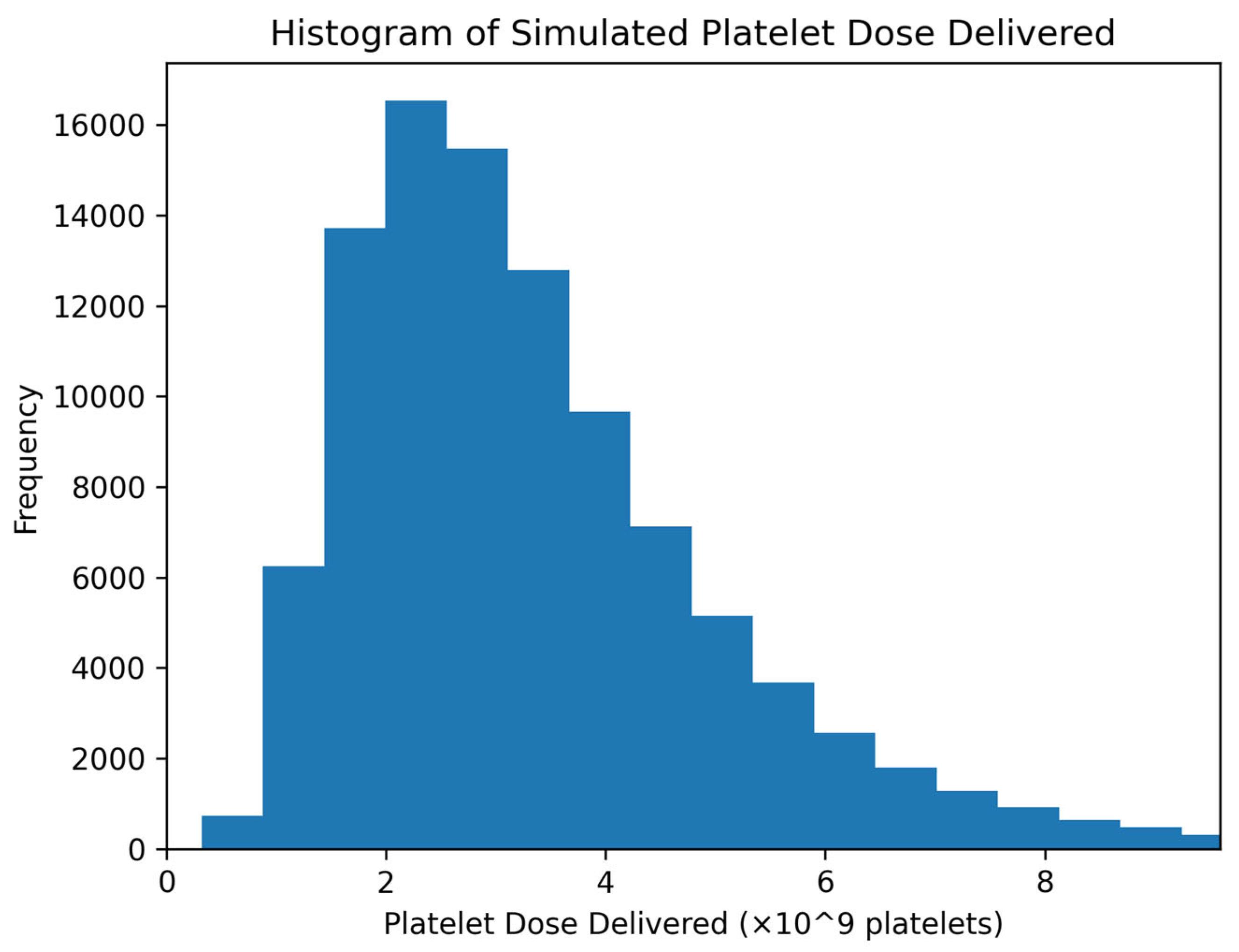
Monte Carlo simulation revealed a marked dispersion in the simulated PDD across iterations. The resulting distribution exhibited a pronounced right skew and wide variability across simulation runs (Figure 1). Despite relatively constrained input ranges, the resulting PDD distribution exhibited substantial spread, indicating high intrinsic variability in delivered platelet dose. The simulated distribution of D exhibits a high coefficient of variation, indicating strong amplification of input uncertainty through the multiplicative structure of the model. Descriptive statistics of the simulated PDD are summarized in Table 2. The results confirm substantial dispersion in the output variable, with a coefficient of variation exceeding 50%, indicating strong amplification of uncertainty through the multiplicative structure of the model.
Across 100,000 simulation runs, the PDD followed a right-skewed distribution, with the median value notably lower than the mean, reflecting the multiplicative nature of the model. The interquartile range (IQR) spanned nearly 2 × 10⁹ platelets, and the coefficient of variation exceeded 50%, highlighting the amplification of uncertainty arising from combined biological and technical factors. The geometric profile of the distribution, characterized by a right skew and a long tail of high-dose outcomes, is consistent with the Multiplicative Central Limit Theorem, which predicts that the product of independent positive random variables converges toward a log-normal distribution. Distributional overlap between scenarios exceeds 60%, reinforcing the limited discriminative power of protocol-based categorization.
These findings indicate that even modest variability in preparation parameters may result in large differences in the effective platelet dose administered, challenging the assumption of dose equivalence across nominally similar PRP protocols.

3.2. Sensitivity Analysis

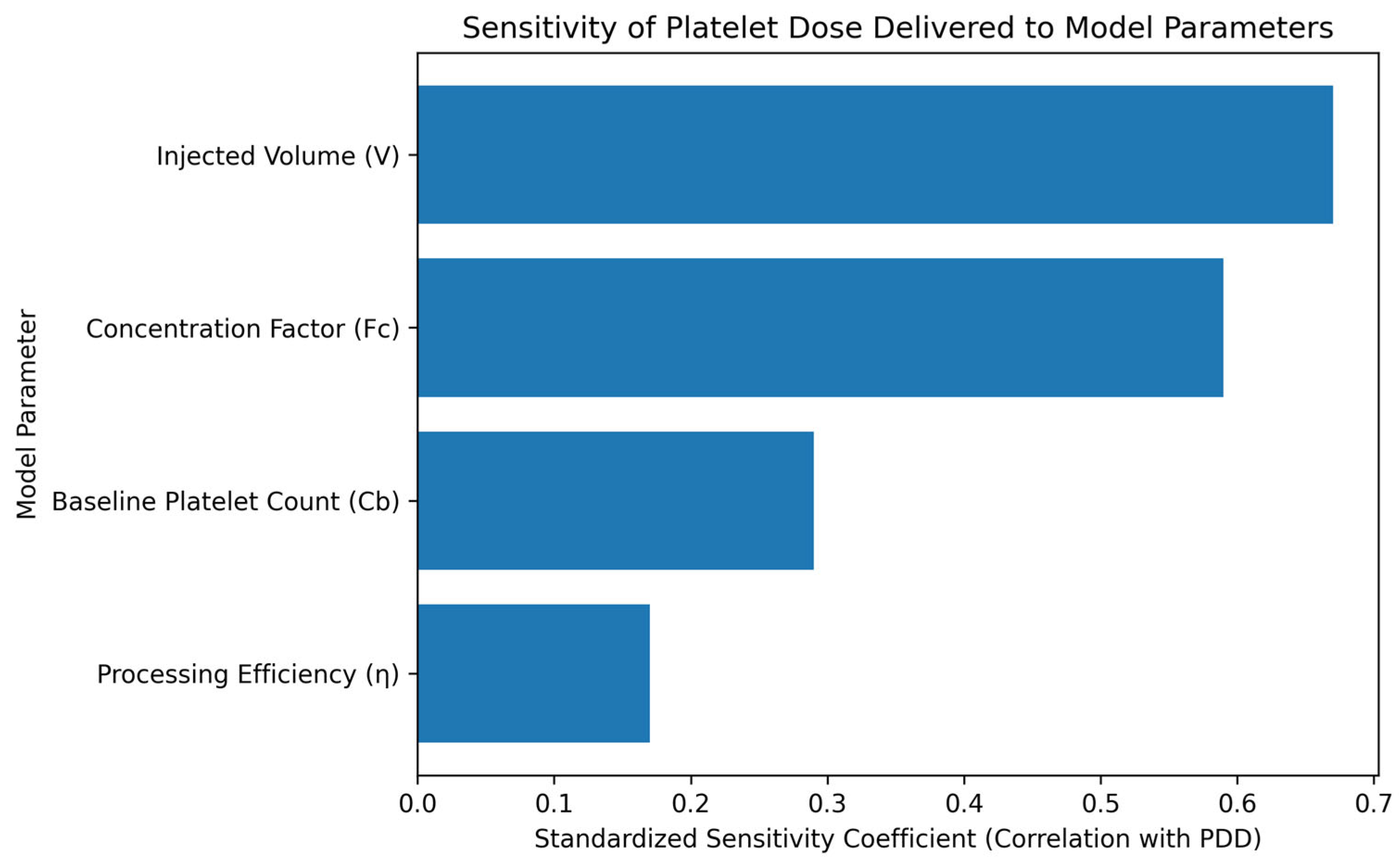
The variance-based global sensitivity analysis using Sobol indices revealed the contributions of each input parameter and their interactions to the variability of the simulated platelet dose delivered. Table 3 summarizes the first-order and total-effect Sobol indices for each parameter, and Figure 2 provides a visual representation.
Injected volume (V) emerged as the single most influential parameter, with a first-order index of 0.42, indicating that approximately 42% of the output variance is attributable to V alone. The platelet concentration factor (Fc) followed closely, with a first-order contribution of 35%. Baseline platelet count (Cb) and processing efficiency (η) contributed considerably less, accounting for 11% and 4% of variance individually, respectively. Crucially, the total-effect indices for V (0.68) and Fc (0.61) were substantially larger than their first-order counterparts, revealing that interactions between these parameters—particularly between injected volume and concentration factor—account for a considerable portion of the total output variance. In contrast, the total-effect indices for Cb (0.14) and η (0.06) were only slightly larger than their first-order indices, indicating that these parameters contribute primarily through main effects with negligible interactions.

3.3. Comparative Simulation of Theoretical PRP Protocols

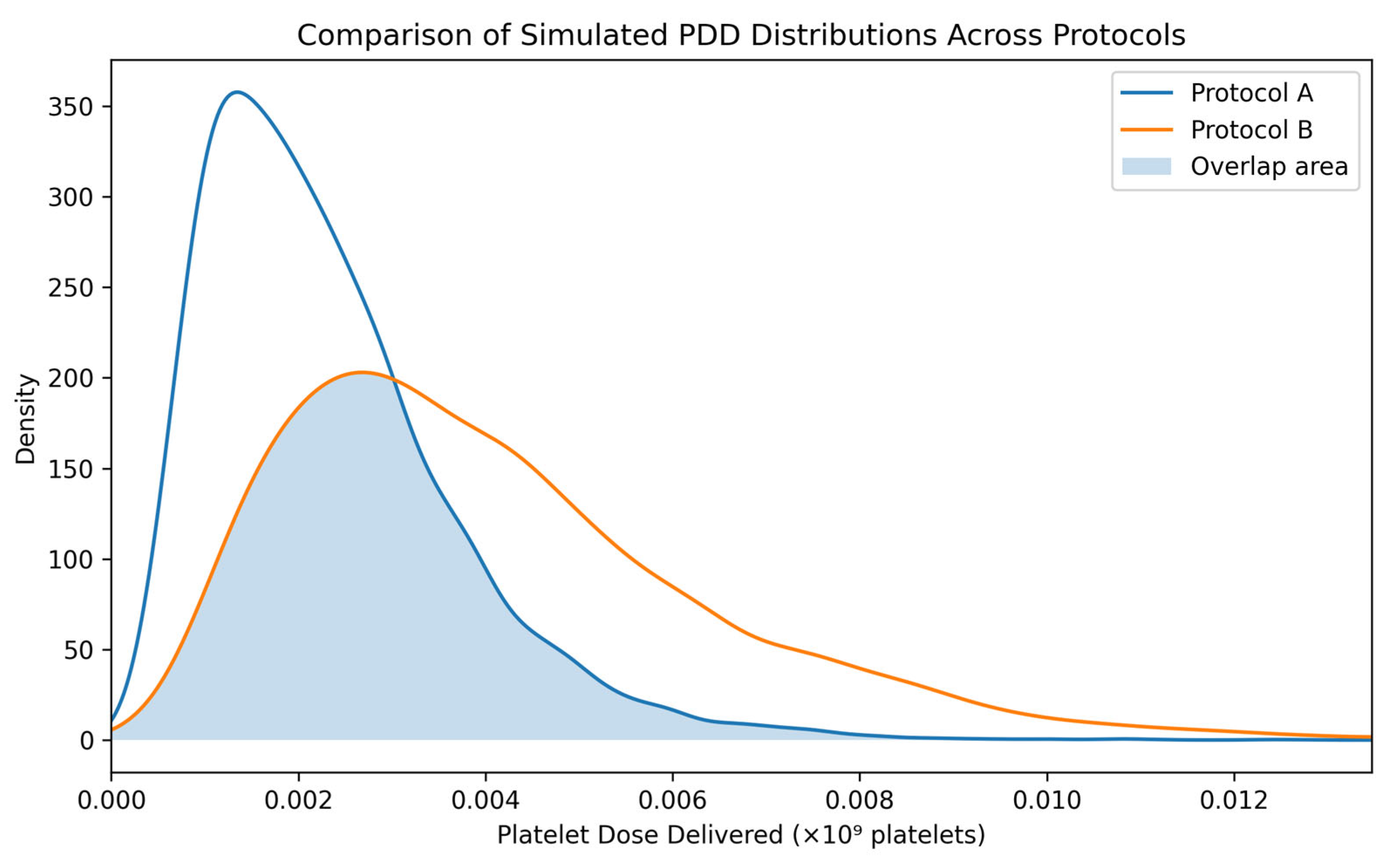
To explore the discriminative capacity of commonly used protocol descriptors, simulations were stratified according to two theoretical PRP preparation scenarios. Protocol A was defined by a lower concentration factor (Fc~3) but a higher injected volume (V~6 mL), representing a “high-volume” preparation strategy. Protocol B was defined by a higher concentration factor (Fc~5) but a lower injected volume (V~3 mL), representing a “high-concentration” strategy. Both protocols were simulated with identical distributions for Cb and η.
Substantial overlap between simulated PDD distributions persisted (Figure 3), even though differences in the central tendency were observed. In particular, simulated protocols characterized by higher concentration factors but lower injected volumes frequently produced PDD values comparable to, or lower than, those of protocols with lower concentration factors but higher volumes. Quantitatively, overlap coefficients between protocol distributions exceeded 60% in several scenarios, suggesting that categorical protocol classifications may not reliably distinguish biologically meaningful differences in PDD.

4. Discussion

The present study introduces a probabilistic Monte Carlo framework to quantify uncertainty in platelet dose delivery during PRP administration. The results demonstrate that substantial variability in the delivered platelet dose arises naturally from the combined effects of biological variability and technical preparation parameters, even when protocols appear narrowly defined. This quantitative finding provides a parsimonious explanation for the heterogeneity reported across PRP studies, which has been widely acknowledged in the literature but rarely addressed from a formal mathematical perspective [2,7,17].

4.1. Methodological Considerations and Limitations

A potential critique of the proposed model concerns its apparent simplicity, particularly the use of a multiplicative formulation to define PDD. While this formulation does not explicitly account for nonlinear biological interactions or tissue-level response dynamics, the primary objective of this study was not to model healing processes but to quantify uncertainty propagation within the PRP preparation and administration workflow. In the context of uncertainty quantification, transparent low-order models are commonly preferred when the aim is variance decomposition and sensitivity analysis rather than mechanistic prediction [15]. This approach allows clear attribution of output variability to specific input parameters, which is essential for methodological interpretation.
Another likely concern relates to the assumption of independence among input variables. In real-world PRP preparation, certain dependencies may exist, such as correlations between baseline platelet count and achievable concentration factor or between processing efficiency and injected volume. Nevertheless, independence assumptions are frequently adopted in first-order probabilistic analyses and represent a standard starting point in Monte Carlo–based modeling [12,14]. Importantly, the sensitivity analysis performed in this study indicates that injected volume and concentration factor overwhelmingly dominate platelet dose variability, with interactions between these parameters accounting for a substantial portion of total variance. Therefore, moderate correlations among secondary parameters would be unlikely to alter the qualitative conclusions regarding the primary sources of uncertainty.
The absence of empirical validation or patient-level data may also be raised as a limitation. This study was intentionally designed as a theoretical and computational investigation, independent of proprietary PRP systems or specific clinical datasets. Such abstraction is consistent with applied mathematics research, where generalizable frameworks are often developed prior to empirical validation [14]. Moreover, the parameter ranges used in the simulations were conservatively derived from values reported in PRP classification systems and methodological studies, ensuring that the modeled scenarios remain representative of real-world practice [4,5,7]. The simulated dose ranges (0.8–9.7 × 10⁹ platelets) are consistent with those reported in clinical PRP preparation studies, lending plausibility to the model outputs. Formal validation with patient-level data remains an important direction for future work.
From a methodological standpoint, the findings have important implications for PRP research. Current protocol-based classification systems implicitly assume that treatments grouped under similar categories deliver comparable biological doses [4,5,6,8]. However, the substantial overlap observed between simulated dose distributions across theoretical protocols suggests that such classifications may lack quantitative discriminative validity. This observation aligns with previous calls for improved standardization and reporting in PRP research [7] and provides a mathematical basis for advocating dose-based rather than protocol-based descriptors. From a mathematical point of view, the results illustrate a general property of multiplicative stochastic systems: output variability is often dominated by scale-related parameters rather than by baseline inputs.

4.2. Implications for Clinical Practice

The extreme tails of the simulated distribution carry important clinical implications. Clinical studies suggest the existence of a therapeutic window for PRP in conditions such as knee osteoarthritis, with optimal efficacy theorized to occur within a specific platelet dose range (approximately 5–10 × 109 platelets). The right tail of our simulated distribution, extending beyond 9 × 10⁹ platelets, may represent unintended overdosing, which paradoxically can inhibit osteogenesis and induce hyperinflammatory responses. Conversely, the left tail, extending below 1 × 10⁹ platelets, may represent subtherapeutic dosing with minimal biological effect. These findings suggest that protocol-based categorization alone is insufficient to ensure delivery within the therapeutic window, and that direct dose reporting is necessary.
Finally, the proposed framework should be regarded as a foundational step rather than a comprehensive model of PRP therapy. Future extensions may incorporate correlated input variables, growth factor kinetics, or tissue-specific response models using differential equations or hybrid stochastic–deterministic approaches. In particular, a stochastic partial differential equation framework could be developed to model the spatial diffusion and temporal degradation of the platelet dose within the joint capsule post-injection, representing the ultimate mathematical evolution of this research. Nonetheless, the present study fulfills its primary aim by demonstrating that uncertainty in platelet dose delivery is an inherent and quantifiable feature of PRP therapies and that probabilistic modeling offers a rigorous mathematical tool to address this issue.

5. Conclusions

This study demonstrates that platelet dose delivery in PRP therapies is intrinsically characterized by substantial uncertainty, even when preparation protocols are narrowly defined. By applying a Monte Carlo simulation framework, we show that the combined propagation of biological and technical variability leads to wide dispersion in the effective platelet dose administered, challenging implicit assumptions of dose equivalence across PRP protocols. The variance-based global sensitivity analysis using Sobol indices reveals that the injected volume and platelet concentration factor are the dominant contributors to dose variability, with substantial interaction effects between these parameters accounting for a considerable portion of the total output variance. Baseline platelet count and processing efficiency play secondary roles within the modeled parameter space. These findings emphasize that parameters often underreported in PRP studies can exert a disproportionate influence on the delivered biological dose.
The proposed framework offers a transparent and reproducible mathematical approach for uncertainty quantification in regenerative therapies. However, it does not aim to predict clinical outcomes but to clarify the methodological limitations of protocol-based classifications when quantitative dose metrics are not explicitly considered. Based on these findings, we recommend that future randomized controlled trials in regenerative medicine report, for each patient, the specific point estimates and confidence intervals for injected volume and baseline platelet count, enabling retrospective deterministic dose calculations and bridging the gap between clinical empiricism and mathematical precision. In conclusion, probabilistic modeling provides a rigorous mathematical basis for interpreting heterogeneity in PRP research and supports a shift toward dose-based reporting and analysis.

Author Contributions

Conceptualization, I.M.-P. and J.M.J.-A.; methodology, I.M.-P. and J.M.J.-A.; software, J.M.J.-A.; validation, I.M.-P. and J.M.J.-A.; formal analysis, I.M.-P. and J.M.J.-A.; investigation, I.M.-P. and J.M.J.-A.; resources, I.M.-P. and J.M.J.-A.; data curation, I.M.-P. and J.M.J.-A.; writing—original draft preparation, I.M.-P.; writing—review and editing, J.M.J.-A.; project administration, I.M.-P. and J.M.J.-A. All authors have read and agreed to the published version of the manuscript.

Funding

This research received no external funding.

Data Availability Statement

The original contributions presented in this study are included in the article. Further inquiries can be directed to the corresponding author.

Conflicts of Interest

The authors declare no conflicts of interest.

Abbreviations

The following abbreviations are used in this manuscript:
PRPPlatelet-Rich Plasma
PDDPlatelet Dose Delivered
IQRInterquartile Range

References

  1. Andia, I.; Maffulli, N. Biological Therapies in Regenerative Sports Medicine. Sports Med. 2017, 47, 807–828. [Google Scholar] [CrossRef] [PubMed]
  2. Marx, R.E. Platelet-Rich Plasma: Evidence to Support Its Use. J. Oral Maxillofac. Surg. 2004, 62, 489–496. [Google Scholar] [CrossRef] [PubMed]
  3. Ahmad, Z.; Howard, D.; Brooks, R.A.; Wardale, J.; Henson, F.M.; Getgood, A.; Rushton, N. The Role of Platelet Rich Plasma in Musculoskeletal Science. JRSM Short Rep. 2012, 3, 1–9. [Google Scholar] [CrossRef] [PubMed]
  4. Dohan Ehrenfest, D.M.; Rasmusson, L.; Albrektsson, T. Classification of Platelet Concentrates: From Pure Platelet-Rich Plasma (P-PRP) to Leucocyte- and Platelet-Rich Fibrin (L-PRF). Trends Biotechnol. 2009, 27, 158–167. [Google Scholar] [CrossRef] [PubMed]
  5. Magalon, J.; Chateau, A.L.; Bertrand, B.; Louis, M.L.; Silvestre, A.; Giraudo, L.; Veran, J.; Sabatier, F. DEPA Classification: A Proposal for Standardising PRP Use and a Retrospective Application of Available Devices. BMJ Open Sport Exerc. Med. 2016, 2, e000060. [Google Scholar] [CrossRef] [PubMed]
  6. DeLong, J.M.; Russell, R.P.; Mazzocca, A.D. Platelet-Rich Plasma: The PAW Classification System. Arthroscopy 2012, 28, 998–1009. [Google Scholar] [CrossRef] [PubMed]
  7. Chahla, J.; Cinque, M.E.; Piuzzi, N.S.; Mannava, S.; Geeslin, A.G.; Murray, I.R.; Dornan, G.J.; Muschler, G.F.; LaPrade, R.F. A Call for Standardization in Platelet-Rich Plasma Preparation Protocols and Composition Reporting: A Systematic Review of the Clinical Orthopaedic Literature. J. Bone Jt. Surg. Am. 2017, 99, 1769–1779. [Google Scholar] [CrossRef] [PubMed]
  8. Mishra, A.; Harmon, K.; Woodall, J.; Vieira, A. Sports Medicine Applications of Platelet Rich Plasma. Curr. Pharm. Biotechnol. 2012, 13, 1185–1195. [Google Scholar] [CrossRef] [PubMed]
  9. Mai, W.; He, W.; Mo, R.; Liu, G.; Hong, J.; Li, W.; Luo, L.; Chen, Z. Efficient Quality Control of Platelet-Rich Plasma Preparation Using Computer Vision and Deep Learning. J. Biomed. Opt. 2025, 30, 065003. [Google Scholar] [CrossRef] [PubMed]
  10. Klifto, K.M.; Othman, S.; Kovach, S.J. Minoxidil, Platelet-Rich Plasma (PRP), or Combined Minoxidil and PRP for Androgenetic Alopecia in Men: A Cost-Effectiveness Markov Decision Analysis of Prospective Studies. Cureus 2021, 13, e20839. [Google Scholar] [CrossRef] [PubMed]
  11. Sobol′, I.M. Global Sensitivity Indices for Nonlinear Mathematical Models and Their Monte Carlo Estimates. Math. Comput. Simul. 2001, 55, 271–280. [Google Scholar] [CrossRef]
  12. Caflisch, R.E. Monte Carlo and Quasi-Monte Carlo Methods. Acta Numer. 1998, 7, 1–49. [Google Scholar] [CrossRef]
  13. Anitua, E.; Andia, I.; Ardanza, B.; Nurden, P.; Nurden, A.T. Autologous Platelets as a Source of Proteins for Healing and Tissue Regeneration. Thromb. Haemost. 2004, 91, 4–15. [Google Scholar] [CrossRef] [PubMed]
  14. Borenstein, M.; Kane, J.; Buchbinder, J. Monte Carlo Simulation of Statistical Power. Psychopharmacol. Bull. 1987, 23, 300–302. [Google Scholar] [PubMed]
  15. Saltelli, A.; Annoni, P.; Azzini, I.; Campolongo, F.; Ratto, M.; Tarantola, S. Variance Based Sensitivity Analysis of Model Output. Design and Estimator for the Total Sensitivity Index. Comput. Phys. Commun. 2010, 181, 259–270. [Google Scholar] [CrossRef]
  16. Monks, T.; Currie, C.S.M.; Onggo, B.S.; Robinson, S.; Kunc, M.; Taylor, S.J.E. Strengthening the Reporting of Empirical Simulation Studies: Introducing the STRESS Guidelines. J. Simul. 2019, 13, 55–67. [Google Scholar] [CrossRef]
  17. Higgins, J.P.T.; Thompson, S.G. Quantifying Heterogeneity in a Meta-Analysis. Stat. Med. 2002, 21, 1539–1558. [Google Scholar] [CrossRef] [PubMed]
Figure 1. Histogram of simulated platelet dose delivered (expressed in ×109 platelets) obtained from 100,000 Monte Carlo iterations. The x-axis is truncated at the 99th percentile to improve visualization of the main distribution.
Mathematics 14 01307 g001
Figure 2. Tornado plot showing first-order and total-effect Sobol indices for each model input parameter. Parameters are ordered according to total-effect index. The difference between total-effect and first-order indices represents the contribution of interactions.
Mathematics 14 01307 g002
Figure 3. Kernel density estimates of simulated platelet dose delivered for two theoretical PRP preparation protocols. Protocol A (lower concentration factor, higher volume) and Protocol B (higher concentration factor, lower volume) exhibit substantial distributional overlap, indicating limited discriminative capacity of protocol-based categorization.
Mathematics 14 01307 g003
Table 1. Model parameters and probability distributions used in the Monte Carlo simulations.
ParameterSymbolProbability DistributionDistribution ParametersExplored RangeUnitsSource
Baseline platelet countCbNormalmean = 250 × 103/µL, SD = 50 × 103/µL150–350 × 103/µLplatelets/µLAnitua 2004 [13];
Marx 2004 [2]
Platelet concentration factorFcLog-normalμ = 1.2, σ = 0.42–6dimensionlessDeLong 2012 [6];
Mishra 2012 [8]
Injected PRP volumeVUniformmin = 2, max = 82–8mLChahla 2017 [7];
Magalon 2016 [5]
Processing efficiencyηBetaα = 5, β = 20.60–0.90proportionMagalon 2016 [5]
Table 2. Summary statistics of simulated platelet dose delivered (PDD).
StatisticValueUnitsInterpretation
Mean3.6 × 109plateletsAverage simulated platelet dose delivered
Median3.1 × 109plateletsCentral tendency of the simulated distribution
Standard deviation1.9 × 109plateletsDispersion of platelet dose values
Variance3.6 × 1018platelets2Total variability in simulated platelet dose
Minimum0.8 × 109plateletsLower bound of simulated outcomes
Maximum9.7 × 109plateletsUpper bound of simulated outcomes
Interquartile range (IQR)1.9 × 10⁹plateletsMiddle 50% of simulated results
Coefficient of variation (CV)0.53dimensionlessRelative dispersion of platelet dose
Table 3. Sobol sensitivity indices for model input parameters.
ParameterFirst-Order Index SiTotal-Effect Index STi
Injected volume (V)0.420.68
Platelet concentration factor (Fc)0.350.61
Baseline platelet count (Cb)0.110.14
Processing efficiency (η)0.040.06
Disclaimer/Publisher’s Note: The statements, opinions and data contained in all publications are solely those of the individual author(s) and contributor(s) and not of MDPI and/or the editor(s). MDPI and/or the editor(s) disclaim responsibility for any injury to people or property resulting from any ideas, methods, instructions or products referred to in the content.