2. Background and Fundamentals
2.1. Concept of Adaptive Control
Adaptive control is a class of control strategies that modify controller parameters automatically in real time to ensure the desired performance of a system, particularly when the system model is uncertain or varies with time. This approach is especially valuable for nonlinear systems, where exact mathematical modeling is often challenging due to system complexity, changing operating conditions, and unknown disturbances [
20,
21]. The primary objective of adaptive control is to maintain stability and achieve performance goals such as tracking or regulation, even when the plant parameters are unknown or vary unpredictably. Unlike fixed-gain controllers, adaptive controllers continuously adjust their parameters during operation, making them suitable for applications where plant characteristics are not constant or fully known [
22,
23,
24].
There are two typical scenarios where adaptive control becomes essential. In the first, the system parameters are unknown but remain constant within a certain operating range. In such cases, adaptive control can automatically tune the controller gains to optimal values. Once the desired performance is reached, the effect of adaptation reduces over time. In the second scenario, the parameters vary over time due to factors such as load changes, environmental effects, or wear and tear. Here, the adaptation must operate continuously to cope with the evolving dynamics and maintain control objectives.
An adaptive control system typically includes three key components
- (a)
Performance measurement;
- (b)
Comparison and decision mechanism;
- (c)
Adaptation mechanism.
These components work together to monitor the current system behavior, compare it with the desired performance, and update the controller parameters based on the observed error. What differentiates adaptive control from other methods such as robust control is its use of real-time information to actively tune the controller in a closed-loop manner, rather than relying on pre-designed margins of robustness.
Two fundamental types of adaptive control frameworks are widely used. The first is model reference adaptive control, where a reference model defines the ideal response of the system. The controller is designed to minimize the difference between the plant output and the reference model output by adjusting its parameters online. This ensures that the actual system behavior closely follows the desired reference. The second type is indirect adaptive control, where the plant parameters are estimated in real time using input and output data. Based on these estimates, the controller is then reconfigured accordingly [
25,
26,
27]. This two-stage process allows the control law to be adapted indirectly through model identification. Adaptive control strategies are often implemented using either direct or indirect approaches, depending on the nature of the system and the control objectives. The performance criteria may be defined in terms of time-domain characteristics such as settling time, overshoot, and tracking error, or frequency-domain behavior such as stability margins. In the context of nonlinear systems, adaptive control provides a flexible and systematic framework for dealing with complex dynamics and uncertainties. Its integration with learning-based tools such as fuzzy logic systems and neural networks further enhances its ability to approximate unknown functions and respond to uncertain conditions effectively. These features make adaptive control a key methodology in modern nonlinear control system design [
28,
29,
30].
2.2. Basics of Fuzzy Logic Systems (FLSs)
Fuzzy logic control (FLC) has received increasing attention in recent years due to its model-free nature and ability to handle system uncertainties and nonlinearities. Unlike traditional control methods that rely on precise mathematical models, FLC operates based on human-like reasoning using linguistic rules. It offers advantages such as flexibility, robustness, parallel processing, and the capability to incorporate expert knowledge [
12,
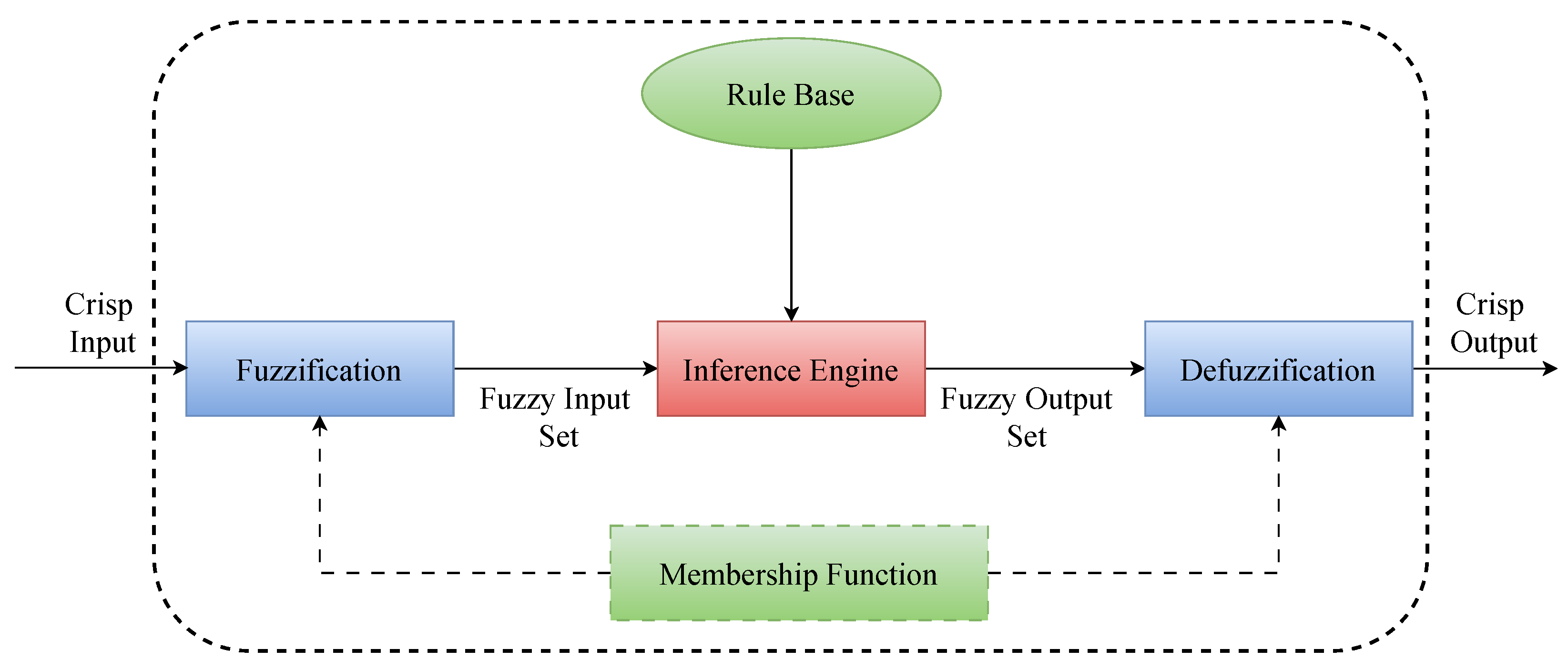
31]. A typical fuzzy logic system consists of four main components:
- 1.
Fuzzification: Converts crisp inputs into fuzzy sets using membership functions.
- 2.
Rule Base: A set of if–then rules that define the control strategy using linguistic variables.
- 3.
Inference Mechanism: Evaluates rules and combines their outcomes based on fuzzy logic principles.
- 4.
Defuzzification: Translates the fuzzy output into a crisp control signal.
The overall basic fuzzy logic architecture is illustrated in
Figure 1.
FLC systems have been recognized for their ability to design controllers and identifiers that can perceive the environment and imitate human operator behavior. However, one key challenge in fuzzy control is the lack of a systematic approach for adaptive implementation. The shapes and positions of membership functions often need to be determined through trial and error or heuristics. Moreover, if an expert cannot express knowledge effectively in the form of if–then rules, constructing a reliable rule base becomes difficult [
13,
14]. The strengths and limitations of FLSs are summarized in
Table 1.
Fuzzy logic systems, particularly when combined with adaptive mechanisms or integrated with learning-based approaches, offer a promising direction for controlling complex nonlinear systems without relying on exact models. In subsequent sections, we explore how fuzzy systems have been applied to nonlinear, stochastic, and switched systems with actuator or sensor faults, dead zones, and hysteresis effects.
2.3. Basics of Neural Networks (NNs)
2.3.1. Overview of Neural Networks
Artificial Neural Networks (ANNs) are data-driven computational models inspired by the structure and functionality of biological neural networks. Designed to learn complex patterns from data, they are capable of performing tasks such as classification, regression, prediction, filtering, and control. Neural networks are especially valuable in systems where analytical models are difficult to derive or when uncertainties and nonlinearities dominate system dynamics [
9,
10,
32].
2.3.2. Why Neural Networks in Control?
The fundamental strength of neural networks lies in their ability to approximate any continuous nonlinear function with arbitrary precision, making them suitable for modeling and control of nonlinear systems. Their salient features include
Nonlinear mapping capabilities;
Learning and generalization from data;
Robustness to noise and disturbances;
Real-time adaptability and fault tolerance.
These properties enable NN-based controllers to learn and adapt in uncertain or time-varying environments without requiring exact knowledge of the system model.
2.3.3. Biological vs. Artificial Neural Networks
Artificial neurons emulate key mechanisms of biological neurons, such as receiving inputs, integrating signals, and generating outputs. The analogy between biological and artificial neural systems is outlined in
Table 2.
2.3.4. Neural Network Structure and Operation
Neural networks are multi-input, multi-output systems composed of interconnected processing units known as artificial neurons. The primary objective of a neural network is to transform input data into meaningful output by learning complex patterns and relationships inherent in the data [
33,
34,
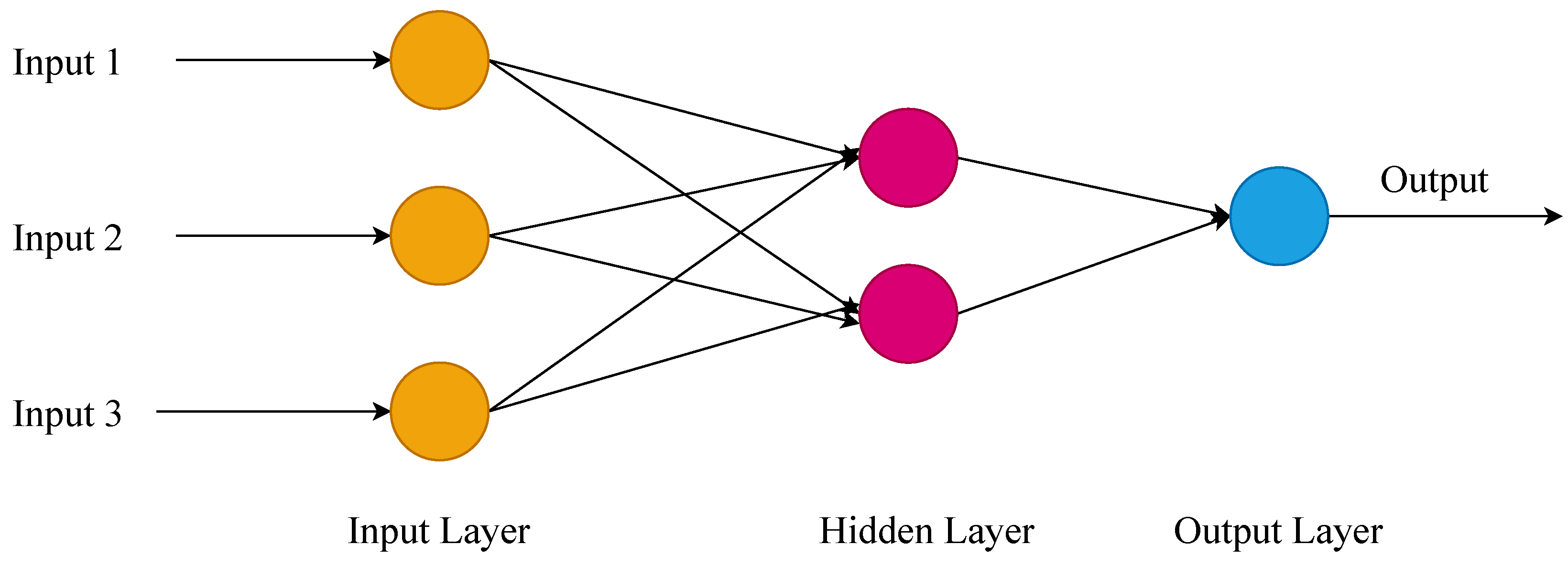
35]. A neural network typically consists of three main types of layers
Input Layer: Accepts raw input features and forwards them to the subsequent layer.
Hidden Layer(s): Performs nonlinear transformations on inputs via weighted connections and activation functions.
Output Layer: Produces the final prediction or control signal.
There are two major types of network architectures based on the direction of data flow
- 1.
Feedforward Neural Networks (FNNs): Information flows unidirectionally from the input layer to the output layer. These are widely used in pattern recognition, classification, and regression tasks.
- 2.
Feedback (Recurrent) Neural Networks (RNNs): These networks contain loops, allowing information to persist. They are effective for sequential data processing and tasks requiring memory, such as time-series forecasting or language modeling.
Each neuron processes inputs using three components:
Weights: Each connection between neurons is associated with a numerical weight, which determines the strength of influence. Weights are initially assigned randomly and updated during the learning process.
Activation Function: A nonlinear function that determines the neuron’s output. It introduces nonlinearity and helps in learning complex mappings. Common activation functions include sigmoid, hyperbolic tangent (tanh), and rectified linear unit (ReLU).
Bias: An additional trainable parameter that shifts the activation function to improve model flexibility.
The mathematical representation of a feedforward neural network with a single hidden layer is given by
where
is the input vector,
are output layer weights,
are hidden layer weights,
are biases,
N is the number of hidden neurons, and
is the activation function. The network learns by minimizing a cost function that measures the discrepancy between the predicted and desired output. Learning involves adjusting weights and biases using algorithms such as gradient descent or backpropagation.
The overall basic NN architecture is illustrated in
Figure 2.
2.3.5. Neural Network Architectures
Several NN architectures are used in control applications, as shown in
Table 3.
2.3.6. Advantages and Limitations in Nonlinear Control
Neural networks have been widely used in adaptive control frameworks to approximate unknown nonlinearities in plant dynamics. However, their effectiveness depends on proper training, structure selection, and stability guarantees.
Table 4 summarizes key advantages and challenges.
In adaptive control of nonlinear systems, neural networks are commonly used to estimate unknown functions or compensate for dynamic uncertainties. For instance, in NN-based adaptive backstepping, the neural network is trained online to approximate the unknown nonlinearities, and its weights are updated using Lyapunov-based adaptation laws to guarantee stability and convergence. Their flexible structure and learning capabilities make neural networks a key enabler of intelligent, model-free control strategies in complex nonlinear systems.
2.4. Comparison: FLS, NN, and Neuro-Fuzzy Systems in Control Applications
Fuzzy logic systems (FLSs) and data-driven approximators such as neural-based models are widely utilized in adaptive control of nonlinear systems due to their strong approximation capabilities. In addition, hybrid neuro-fuzzy systems have emerged as an effective framework that integrates the advantages of both approaches, particularly for handling complex nonlinearities and system faults.
Fuzzy Logic Systems (FLSs): FLSs are suitable for systems where qualitative knowledge or expert experience is available. They employ linguistic variables, membership functions, and rule-based inference mechanisms to approximate unknown nonlinear dynamics. The design of FLSs typically involves constructing appropriate fuzzy rules and selecting membership functions. From a stability perspective, adaptive FLS-based controllers are often analyzed using Lyapunov theory, where parameter adaptation laws are derived to ensure boundedness of all closed-loop signals and convergence of tracking errors. Despite their interpretability and simplicity, FLSs may face limitations in highly dynamic environments due to the lack of inherent learning capability and reliance on manual rule design.
Neural-Based Approximators (NNs): Neural-based approaches provide a powerful framework for approximating complex nonlinear functions without requiring prior system knowledge. Their design involves selecting suitable network architectures and updating parameters through adaptive or learning-based laws. In control applications, stability is typically guaranteed by constructing Lyapunov functions and deriving weight update laws that ensure uniform boundedness and tracking performance. These models exhibit strong generalization ability and adaptability, making them effective in uncertain and time-varying environments. However, their black-box nature reduces interpretability, and their performance depends on appropriate parameter tuning and computational resources.
Neuro-Fuzzy Systems: Neuro-fuzzy systems combine the transparency of FLSs with the adaptive learning capability of neural-based models, providing a structured yet flexible approximation framework. In such systems, fuzzy inference structures are embedded within adaptive learning mechanisms, allowing automatic tuning of membership functions and rule parameters. The design typically involves integrating fuzzy rule bases with adaptive update laws, which can be derived using Lyapunov stability theory to ensure convergence and boundedness of all signals.
From a theoretical standpoint, neuro-fuzzy systems offer enhanced capability in handling coupled uncertainties, complex nonlinearities, and time-varying faults. Their hybrid structure enables simultaneous utilization of expert knowledge and data-driven learning, which improves approximation accuracy and robustness. In particular, the adaptive tuning mechanism allows the controller to compensate for actuator faults, dead-zone effects, and hysteresis nonlinearities more effectively than standalone FLSs or neural-based approaches. The comparative characteristics of these approaches are summarized in
Table 5.
In summary, while FLSs provide interpretability and simplicity, and neural-based approaches offer strong learning capability, neuro-fuzzy systems achieve a balanced trade-off by combining both features, making them particularly suitable for adaptive fault-tolerant control of complex nonlinear systems, where both approximation accuracy and robustness are critical. To further emphasize their practical relevance, it is essential to evaluate these approximation methods not only based on theoretical capability but also in terms of real-time performance, computational load, online adaptation, and implementation feasibility. While the FLS offers interpretable rule-based control and NNs provide high adaptability and learning capacity, hybrid Neuro-Fuzzy approaches combine these strengths, offering a balance between interpretability, accuracy, and online learning. The following remark and
Table 6 summarize these aspects and highlight their suitability for real-world implementations.
This comparison emphasizes that the FLS is advantageous when interpretability and simplicity are critical, NNs excel for complex nonlinear systems with abundant data but at higher computational cost, and Neuro-Fuzzy methods provide a practical compromise, suitable for systems requiring online adaptation with manageable computation while maintaining interpretability.
4. Nonlinearities and Faults
In practical engineering systems, nonlinear behaviors are often unavoidable due to inherent characteristics of physical components and environmental factors. These nonlinearities, if unaddressed, may lead to performance degradation or even instability of the overall control system. Among the most critical nonlinearities are input nonlinearities such as saturation, dead-zone, and hysteresis including backlash effects. In addition, actuator faults such as bias and loss of effectiveness, and sensor faults such as measurement noise and uncertainty, frequently occur in real-world systems and complicate the control design. Accurately modeling and compensating for these nonlinearities and faults is essential for achieving reliable and robust performance. In the upcoming section, we discuss these one by one.
4.1. Input Nonlinearities
Input nonlinearities are commonly encountered in practical control systems due to limitations or nonlinear behavior of actuators and mechanical components. Typical types include saturation, dead-zone, and backlash-like hysteresis. These nonlinearities can significantly degrade system performance and may even lead to instability if not properly addressed. Each type exhibits distinct characteristics and requires dedicated modeling and compensation strategies. We discuss these nonlinearities one by one in the following subsections.
4.1.1. Saturation Nonlinearity
Saturation nonlinearity is one of the most common forms of input nonlinearities encountered in control systems. It occurs when the output of a system component cannot increase beyond a certain maximum or minimum level, regardless of further increases or decreases in the input. This nonlinearity is often observed in actuators, amplifiers, and magnetic devices [
37,
38]. A classical example of saturation can be found in the magnetization curve of a DC motor. Initially, as the excitation current increases, the magnetic flux increases linearly. However, beyond a certain point, the iron core of the motor becomes magnetically saturated, and further increases in the input current yield diminishing increases in flux. This results in a curve that transitions from a linear slope to a flat region—an evident sign of saturation. This behavior can be modeled using a piecewise-linear function that limits the output to a maximum or minimum value. Similarly, in electronic systems, operational amplifiers exhibit saturation characteristics. The amplifier output is proportional to the input only within a limited input range. When the input exceeds this range, the output voltage saturates at the supply voltage levels (either positive or negative), and the linear input-output relationship no longer holds [
39,
40].
Mathematically, saturation nonlinearity can be described by the following function [
41]:
where
u is the control input, and
and
are the lower and upper bounds of the saturation limits, respectively.
4.1.2. Dead-Zone Nonlinearity
Dead-zone nonlinearity arises in systems where there exists a range of input values for which the output remains zero or unchanged. This phenomenon is typical in many electromechanical actuators, such as DC motors and servo systems, where mechanical friction or slack prevents movement until the input torque or voltage exceeds a certain threshold. In practical terms, when the control input remains within the dead-zone, the actuator does not respond, causing a loss of control sensitivity and increasing tracking error in precision applications. Dead-zone nonlinearities are especially problematic in low-speed or low-torque regimes [
29,
32,
37].
A commonly encountered input nonlinearity in actuators is the dead-zone, which can be mathematically described as [
28]
where
is the input signal to the dead-zone, and
u is the output. In this formulation,
and
are the right and left slopes of the dead-zone characteristic, while
and
represent the right and left breakpoints, respectively. All the coefficients
are assumed to be unknown but strictly positive. This model captures the behavior where the output remains zero for small input values within the interval
, and increases linearly outside this range. Dead-zone nonlinearities are frequently observed in systems such as DC servo motors, actuators, and other mechanical devices, and they significantly complicate control design due to their inherent non-smooth and non-invertible nature.
4.1.3. Backlash-like Hysteresis Nonlinearity
Backlash is a type of input nonlinearity characterized by a position-dependent discontinuity in the input-output relationship. Specifically, it refers to a range of input values over which changes in input do not result in any change in the output. In other words, when the direction of the input is reversed, the output does not respond immediately; instead, it remains stationary for a small range before eventually changing [
42,
43]. This nonlinearity typically arises in mechanical systems such as gear transmissions, screw drives, or linkage mechanisms, where there is clearance or slack between mating parts. The lost motion between connected components due to mechanical looseness causes this effect. Backlash introduces several undesirable dynamic behaviors into control systems, including phase lag, oscillations, and limit cycles, especially when high-gain feedback is applied. Unlike magnetic hysteresis, which depends on the rate of input change (rate-dependent), backlash is dependent on the position and direction of input change (position-dependent), making it a special case of hysteresis that exhibits memory-like behavior [
44,
45].
An unknown backlash-like hysteresis nonlinearity can be described by the following dynamic model [
43]
where
v denotes the input signal to the hysteresis block, and
u is the output affected by the backlash. The parameters
c and
are unknown constants, where
c is the slope of the linear segments in the backlash characteristic, and
is a rate-dependent coefficient. The conditions
and
must be satisfied to ensure the physical validity and stability of the model. This dynamic formulation captures the essential features of backlash-like hysteresis: the lagging behavior of the output relative to the input and the memory-dependent nature of the response. It is widely used in the analysis and control design for systems where backlash significantly impacts performance, such as robotic actuators, gear trains, and electro-mechanical systems.
4.2. Actuator and Sensor Faults
Faults are unexpected changes or malfunctions in system components that can significantly impair the stability and performance of nonlinear control systems. When such faults remain undetected or unaddressed, they may lead to degraded tracking accuracy, increased control effort, or even complete system failure. In the context of nonlinear systems, the effects of faults are often more pronounced due to the intrinsic complexity and sensitivity of system dynamics. Therefore, designing fault-tolerant control schemes that can maintain acceptable performance in the presence of faults is essential. Next, we discuss actuator and sensor faults in detail.
4.2.1. Actuator Faults
Actuators are responsible for applying control commands to the system, thereby playing a crucial role in ensuring desired system behavior. However, due to aging, wear, harsh operating conditions, or physical damage, actuators are prone to faults that can alter their effectiveness. In nonlinear systems, actuator faults can exacerbate the effects of intrinsic nonlinearities, leading to severe degradation in performance or even instability. Typical actuator faults include loss of effectiveness (LOE), bias faults, stuck faults, and total failures [
17]. In LOE faults, the actuator delivers only a fraction of the intended input, often due to degradation or partial hardware failure [
16]. Bias faults introduce a constant offset into the control input, resulting in steady-state tracking errors. Stuck faults occur when the actuator output becomes fixed at a constant value, regardless of the control signal. In extreme cases, actuators may undergo complete failure and cease to respond entirely. Such faults can seriously compromise the performance of high-gain feedback systems. For instance, an LOE fault may result in insufficient control authority, and a bias fault can lead to persistent output deviation [
46]. Therefore, it is crucial to design adaptive and fault-tolerant control strategies capable of identifying and compensating for these faults in real-time. Recently, intelligent approximators such as fuzzy logic systems and neural networks have been employed to estimate and mitigate actuator faults in nonlinear control settings.
A widely accepted model for describing actuator faults combines both loss of effectiveness and additive fault components. Let
represent the actual control input applied to the system. The actuator fault model can be described as [
47]
where
is the control signal generated by the controller,
is a time-varying effectiveness factor, and
represents an uncontrollable additive fault. The variable
denotes the time at which the LOE fault begins, while
is the instant an additive fault is introduced. Here, the term
captures the actuator’s degraded effectiveness. If
, the actuator operates normally; if
, it indicates total failure. The additive term
accounts for unknown disturbances or abrupt deviations. This model is general and captures a wide range of actuator anomalies. Effective fault-tolerant controllers must estimate or adapt to these faults to preserve stability and desired system performance.
4.2.2. Sensor Faults
Sensors play an essential role in feedback control systems by providing state and output measurements used in the computation of control laws. In nonlinear systems, where accurate measurement is critical for performance, sensor faults can significantly impair stability, estimation accuracy, and control response. Sensor faults commonly arise due to hardware degradation, environmental disturbances, electromagnetic interference, or signal transmission errors. These faults can lead to incorrect system feedback, causing inappropriate control actions and, in turn, deteriorating system performance or causing instability [
48,
49]. The most prevalent types of sensor faults include bias faults, drift, scaling errors, intermittent faults, and total signal loss. A bias fault introduces a constant error in the measurement. Drift faults cause a slow, time-dependent deviation from the actual value. Scaling faults distort the gain of the sensor, making the output either exaggerated or attenuated. Intermittent faults lead to sporadic and unpredictable signal dropouts, while total failure results in the complete absence of sensor data [
50].
One typical model of a bias fault can be expressed as [
46]
where
is the measured signal,
is the actual system output, and
is an unknown fault signal representing the bias. The bias fault
may originate from sensor offset, aging, noise, or interference. Since
is generally unknown and potentially time-varying, it introduces significant uncertainty into the feedback loop. If not properly handled, this can lead to poor control performance or system instability. To address sensor faults, various fault detection, isolation, and estimation (FDIE) techniques are employed. Observer-based methods, analytical redundancy using models, and data-driven approaches help reconstruct the correct system states. In safety-critical applications, redundant hardware sensors or soft sensors based on learning algorithms may be deployed to ensure system robustness and continuity of operation.
In summary, nonlinearities such as dead-zone, saturation, and hysteresis, along with actuator and sensor faults, pose significant challenges in the modeling, analysis, and control of nonlinear systems. These challenges are further amplified in stochastic and switched systems due to the presence of random disturbances and abrupt structural variations. The coexistence of uncertainties, unknown dynamics, and system faults demands the development of robust and adaptive control strategies capable of ensuring stability, accuracy, and reliability. As such, addressing nonlinearities and faults in these complex systems remains a critical area of research, with intelligent approximation methods and fault-tolerant designs playing a central role in enhancing system resilience and performance.
5. Overview of Relevant Studies
The control of nonlinear systems has been a central topic in modern control theory due to its wide range of applications in engineering systems such as robotic manipulators, electrical circuits, and chemical processes [
4,
51]. Owing to the inherent complexity of nonlinear dynamics, a variety of control methodologies have been developed, including Lyapunov-based design, adaptive control, and recursive backstepping strategies [
7]. Among these, adaptive backstepping has gained significant attention as a systematic framework for handling unknown parameters while guaranteeing closed-loop stability [
8,
52]. To provide a clearer understanding of the development of this field, the existing literature can be broadly classified based on system structures, nonlinearities, and fault conditions, as discussed below.
5.1. Control Based on System Structures
Deterministic Nonlinear Systems: Early developments in nonlinear control primarily focused on deterministic systems, where uncertainties arise from unknown parameters rather than stochastic effects. In this context, Lyapunov-based adaptive control and backstepping techniques have been widely employed to ensure stability and tracking performance. These methods provide a systematic procedure for controller design and have laid the foundation for more advanced control strategies.
Stochastic Nonlinear Systems: In many practical scenarios, nonlinear systems are influenced by stochastic disturbances caused by environmental noise, modeling uncertainties, or random external inputs [
9]. Such systems are commonly modeled using Itô-type stochastic differential equations. To address these challenges, adaptive and fuzzy control techniques have been extended to stochastic frameworks, ensuring probabilistic stability and robust tracking performance [
10,
11,
32]. For instance, adaptive backstepping methods have been further developed to handle state and input constraints in stochastic environments [
53].
Switched Nonlinear Systems: Switched systems constitute another important class, characterized by multiple subsystems governed by a switching signal. These systems naturally arise in applications involving mode transitions, such as automotive systems and networked control systems. A key challenge is that the stability of individual subsystems does not guarantee the stability of the overall system under arbitrary switching [
12,
33,
36]. To overcome this issue, various approaches, including adaptive neural-based controllers and resilient control schemes, have been proposed to ensure stability and performance under switching conditions and uncertainties [
13,
14,
34,
54,
55].
5.2. Control in the Presence of Nonlinearities
Unknown Nonlinear Dynamics: To address unknown system dynamics, approximation techniques based on intelligent methods have been extensively studied. In particular, fuzzy logic systems (FLSs) and neural-based approximators, such as radial basis function models, have demonstrated strong capability in approximating unknown nonlinear functions with high accuracy [
35,
56,
57]. These approaches eliminate the need for precise mathematical models and enhance adaptability. For example, adaptive neural-based controllers have been developed for strict-feedback systems with output constraints [
58], while fuzzy-based methods have been applied to systems with input nonlinearities and uncertainties [
59]. These designs have also been extended to nonstrict-feedback systems, where challenges such as algebraic loop avoidance are addressed using variable separation techniques and learning-based frameworks [
22,
23,
24].
Input Nonlinearities: In practical systems, input nonlinearities such as actuator saturation, dead-zone, and hysteresis are unavoidable due to physical limitations [
28,
37,
51]. These nonlinearities can significantly degrade system performance and may lead to instability if not properly addressed. Input saturation limits the control signal within physical bounds [
29,
30,
60], while dead-zone effects reduce control sensitivity for small inputs. To handle these issues, various adaptive control strategies have been developed. For instance, barrier Lyapunov function-based methods combined with intelligent approximators have been proposed for stochastic systems with input constraints [
38,
39]. Additionally, command-filtering techniques have been employed to simplify backstepping design and achieve finite-time convergence [
40]. In multi-input multi-output systems, asymmetric saturation and dead-zone nonlinearities have been effectively managed using adaptive fuzzy and neural-based approaches [
41].
Hysteresis Nonlinearity: Hysteresis, particularly backlash-like hysteresis, introduces memory-dependent nonlinear behavior that complicates control design [
42]. Traditional inverse-based compensation methods are often computationally expensive and difficult to implement [
43]. As a result, adaptive and intelligent control approaches have been developed to address hysteresis effects without requiring explicit inverse models. For example, adaptive neural-based controllers have been applied to stochastic systems with unknown hysteresis and performance constraints [
44], while adaptive sliding mode control strategies have been utilized to improve robustness and transient performance in systems with hysteresis [
45].
5.3. Recent Developments in NN- and FLS-Based Adaptive Control
Recent research has extensively explored neural network (NN)- and fuzzy logic system (FLS)-based controllers to enhance the adaptability and robustness of nonlinear systems under various challenges. Neural networks have been employed to approximate unknown nonlinear dynamics and achieve precise tracking performance in multi-agent, non-affine, and constrained systems. For example, adaptive fixed-time control scheme for nonlinear multi-agent non-affine systems has been proposed [
61], demonstrating rapid convergence and robustness to parametric uncertainties. Neural network-based adaptive controller has been developed for systems with unknown backlash-like hysteresis and unmodeled dynamics, showing effective compensation for actuator faults [
62]. Adaptive asymptotic control for hydraulic manipulators has been investigated using neural networks via prescribed performance, ensuring high-precision control under uncertainty [
63]. Neural network-based adaptive control has also been applied to full-state constrained switched nonlinear systems with actuator saturation and periodic disturbances [
64], highlighting applicability to complex switching systems.
Fuzzy logic-based controllers have also seen notable advances in recent years. Adaptive fuzzy asymptotic tracking controller has been introduced for uncertain nonlinear systems with full state constraints, emphasizing interpretability and smooth control action [
65]. Command-filter-based adaptive fuzzy finite-time tracking scheme for fractional-order nonlinear systems have demonstrated fast convergence under input constraints [
66]. Adaptive fuzzy fixed-time controller has been designed for high-order systems subject to sensor and actuator faults, ensuring fault-tolerant performance [
67]. Adaptive fuzzy tracking control approach has been developed for systems with multiple actuator and sensor faults, illustrating enhanced robustness and practical feasibility [
68].
These recent studies illustrate the continued relevance of NN- and FLS-based approximators in adaptive control design. Neural networks provide strong learning capabilities for complex, high-dimensional systems, while fuzzy logic offers interpretable and structured control solutions. Hybrid strategies combining both approaches are increasingly adopted to leverage the advantages of each, particularly in scenarios involving input nonlinearities, stochastic effects, and component faults. This body of work complements the foundational methodologies discussed earlier and highlights the ongoing trend toward robust, adaptive, and practically implementable control solutions.
5.4. Control Under Fault Conditions
Actuator Faults: Actuator faults, including loss of effectiveness, bias, and partial failures, pose significant challenges to system reliability and performance [
26,
27]. To address these issues, various fault-tolerant control strategies have been proposed. Adaptive fuzzy-based controllers have been designed for strict-feedback systems with actuator failures [
69], while neural-based adaptive methods have been developed to compensate for input constraints and dead-zone effects in large-scale systems [
70,
71]. Furthermore, finite-time and fixed-time adaptive control schemes have been introduced to ensure rapid fault recovery and improved robustness [
72]. Hybrid approaches combining fuzzy and neural-based methods have also been explored to enhance fault compensation capabilities under uncertainty [
73].
Sensor Faults: Sensor faults, such as bias, drift, and complete failure, can significantly degrade system performance and compromise stability. To mitigate these effects, observer-based fault estimation combined with adaptive compensation has been widely adopted. For instance, robust fuzzy control strategies for networked nonlinear systems have demonstrated effective fault reconstruction and performance recovery under both actuator and sensor faults [
16,
17,
46].
5.5. Summary and Research Trends
The reviewed literature demonstrates substantial progress in adaptive control of nonlinear systems under a wide range of practical challenges, including stochastic disturbances, switching dynamics, unknown nonlinearities, input constraints, and actuator or sensor faults. The integration of intelligent approximation techniques, such as fuzzy logic systems and neural networks, with adaptive control frameworks has significantly enhanced system robustness, flexibility, and tracking performance. Despite these advancements, unified control strategies that can simultaneously handle multiple complexities—such as stochastic effects, switching behavior, input nonlinearities, and component faults—remain an active and challenging research area. Current approaches often address subsets of these issues, highlighting the need for more integrated solutions.
Remark 1. In practical nonlinear systems, stochastic disturbances, arbitrary switching signals, and actuator faults are inherently coupled and jointly influence the system dynamics. Stochastic disturbances introduce probabilistic variations, while switching mechanisms cause abrupt changes in subsystem structures. Meanwhile, actuator faults, such as loss of effectiveness and bias, further distort the control input. The interaction among these factors leads to compounded uncertainties, making the control design and stability analysis more challenging. To address such coupled effects, intelligent approximators, including fuzzy logic systems and neural networks, are employed due to their universal approximation capability. These methods can capture the aggregated impact of multiple uncertainties within a unified framework. Furthermore, adaptive learning laws enable real-time parameter tuning, allowing the approximators to respond effectively to time-varying stochastic behaviors, switching-induced dynamics, and fault-related nonlinearities. As a result, they play a crucial role in the development of robust and fault-tolerant adaptive control strategies for complex nonlinear systems.
6. Comparative Stability and Convergence Analysis of Adaptive Control Schemes
Stability and convergence characteristics are crucial for assessing controller performance in advanced nonlinear control applications, especially when uncertainties like time-varying faults, disturbances, and nonlinear input effects are present. Although Lyapunov stability theory is the foundation for the majority of adaptive control systems, the chosen Lyapunov functions and design frameworks result in essentially diverse convergence behaviors and robustness qualities. Asymptotic stability, in which the system states converge to equilibrium as time approaches infinity, is usually guaranteed by classical adaptive control systems. These methods guarantee boundedness and robustness under minor uncertainties, but their rate of convergence is typically slow and cannot be measured explicitly. This restriction becomes important in systems that are susceptible to time-varying disruptions and actuator failures, as delayed convergence may impair performance or potentially jeopardize safety.
Finite-time control techniques have been developed to improve convergence speed. By creating non-smooth Lyapunov functions, these techniques guarantee that the system states attain equilibrium in a limited amount of time. Despite this benefit, their utility in situations where the beginning state is unclear or highly variable is limited because the convergence time is intrinsically dependent on the original conditions. By adding Lyapunov requirements that guarantee an upper bound on the settling time independent of initial conditions, fixed-time control further reinforces convergence guarantees. This feature greatly increases resilience and predictability, especially in systems that are prone to errors. However, the controller settings indirectly determine the convergence bound, which restricts the versatility of actual implementations. In more recent times, predefined-time control has become a sophisticated framework that allows the convergence time to be explicitly specified in the controller architecture. This method ensures convergence within a user-defined time bound, independent of beginning conditions and parameter choice, by suitably building Lyapunov functions with time-scaling techniques. For time-sensitive applications and systems impacted by actuator faults, hysteresis, and external disturbances, this feature’s increased tunability makes it ideal.
Faster convergence generally enhances the system’s capacity to mitigate the consequences of time-varying errors and uncertainties from a robustness standpoint. Because the system states are pushed quickly in the direction of the intended trajectory, fixed-time and predefined-time techniques, in particular, show better disturbance rejection capabilities than asymptotic methods. Furthermore, these control algorithms can efficiently adjust for unknown nonlinearities and linked uncertainties when paired with intelligent approximators like fuzzy logic systems or data-driven models. A comparative summary of these control approaches is provided in
Table 7.
Remark 2. The convergence rate and resilience characteristics of adaptive control systems are directly impacted by the choice of Lyapunov function. Specifically, by requiring fast error convergence, time-constrained control schemes, such fixed-time and predefined-time techniques, offer greater guarantees in the presence of time-varying actuator defects and disturbances. Among these, predefined-time control allows for explicit assignment of the convergence time, which is very desirable in real-world engineering applications and provides an extra degree of design flexibility.
Remark 3. In recent years, the integration of network-induced effects with fault-tolerant control has attracted significant attention in nonlinear control systems. In particular, the composite anti-disturbance control framework proposed in [74] provides an effective strategy for handling external disturbances and actuator attacks in networked environments. By employing an event-triggered output feedback mechanism, this approach reduces communication burden while maintaining system stability and robustness. From a control design perspective, such methods extend traditional adaptive control schemes by explicitly considering network constraints, including communication delays, packet dropouts, and cyber-physical attacks. Moreover, the incorporation of disturbance observers and event-triggered strategies enhances the system’s ability to reject disturbances and compensate for actuator faults in a resource-efficient manner. Therefore, this class of approaches represents an important advancement in modern networked control systems and complements existing adaptive and intelligent control techniques discussed in this review.
Remark 4. In many practical nonlinear systems, input nonlinearities such as saturation, dead-zone, and hysteresis often coexist with actuator faults, leading to compounded effects on system performance. The simultaneous presence of these factors introduces significant challenges in control design, as they collectively distort the control input and degrade tracking accuracy. Recent advances in adaptive control have shown that intelligent approximators, such as fuzzy logic systems and neural-based models, can effectively compensate for these combined effects within a unified framework. By leveraging their universal approximation capability, these methods are able to capture the aggregated influence of input nonlinearities and actuator faults. Furthermore, adaptive learning laws derived from Lyapunov stability theory ensure the boundedness of all closed-loop signals while achieving satisfactory tracking performance. In particular, integrated control schemes that combine adaptive backstepping with fuzzy or neural-based approximation have demonstrated strong robustness against simultaneous input constraints and actuator faults. These approaches avoid the need for explicit inverse models of nonlinearities and provide a practical solution for complex nonlinear systems affected by multiple uncertainties.
Remark 5. In practical control applications, real-time performance and computational complexity are critical factors that directly affect the feasibility of adaptive control schemes. Although fuzzy logic systems and neural-based methods offer strong function approximation capabilities, their real-time applicability depends on the efficiency of implementation and the speed of parameter adaptation. Fuzzy logic systems typically exhibit relatively low computational complexity during online operation, especially when designed with a limited number of rules. Similarly, neural-based methods, when implemented with simplified architectures such as radial basis function models or shallow networks, can also achieve fast computation and real-time adaptability. However, as system complexity increases, both approaches may face computational challenges due to parameter tuning and adaptation requirements. To address these issues, recent research has focused on developing lightweight structures, efficient learning algorithms, and reduced-order approximators that enable rapid online adaptation while maintaining satisfactory approximation accuracy. These advancements improve the suitability of both fuzzy and neural-based control methods for real-time industrial applications.
Remark 6. Different approximation tools exhibit distinct advantages depending on the characteristics of the nonlinear system under consideration. Fuzzy logic systems (FLSs) are particularly effective for systems where qualitative knowledge or expert rules are available, and where the system dynamics are moderately nonlinear and can be described using interpretable linguistic structures. They are well suited for applications requiring transparency and ease of implementation. Neural-based methods are more suitable for highly complex and strongly nonlinear systems with unknown dynamics, especially when sufficient data is available. Their strong approximation and learning capabilities enable them to handle high-dimensional and time-varying uncertainties, making them effective in adaptive and data-driven control scenarios. Hybrid neuro-fuzzy approaches become advantageous when both interpretability and adaptability are required. By integrating rule-based inference with adaptive learning mechanisms, these systems can automatically tune parameters while preserving structural transparency. As a result, neuro-fuzzy methods are particularly effective in systems involving complex nonlinearities, coupled uncertainties, and fault conditions, where standalone FLSs or neural-based approaches may not achieve the desired balance between accuracy, robustness, and interpretability.
Remark 7. Many adaptive control designs in the literature are developed under certain standard assumptions, such as Lipschitz continuity of nonlinear functions, bounded external disturbances, availability of full state measurements, and known control directions [3,48,75]. These assumptions simplify the analysis and enable the application of Lyapunov-based stability methods. However, in practical engineering systems, such conditions may not always be satisfied due to unmodeled dynamics, measurement limitations, and complex uncertainties. As a result, the performance of these control strategies may be affected when applied to real-world scenarios, highlighting the gap between theoretical development and practical implementation. 7. Conclusions and Future Work
This review presented a structured overview of adaptive control strategies for nonlinear systems facing challenges such as stochastic disturbances, switching dynamics, input nonlinearities, and system faults. Fuzzy logic systems and neural networks were highlighted as essential tools for approximating unknown nonlinearities and enhancing control performance. The classification of nonlinear systems and the contributions of learning-based approaches in adaptive control were analyzed, providing insights into current methodologies and their practical relevance. Future research may focus on strengthening the approximation capabilities of neural networks through advanced weight optimization techniques. Integration of nature-inspired optimization algorithms, such as swarm intelligence, within adaptive control frameworks can improve convergence speed, reduce computational complexity, and enhance robustness. Hybrid strategies combining interpretability and learning capacity hold significant promise for real-time control of high-dimensional, uncertain nonlinear systems. Additionally, modular or distributed learning schemes can provide scalable and efficient solutions for complex engineering applications, while ensuring formal stability guarantees even with deep, data-driven, and less interpretable learning modules.