Article

Robust Voltage Stability Enhancement of DFIG Systems Using Deadbeat-Controlled STATCOM and ADRC-Based Supercapacitor Support


by
Ahmed Muthanna Nori
1,
Ali Kadhim Abdulabbas
1,
Omar Alrumayh
2,* and
Tawfiq M. Aljohani
3
1
Electrical Engineering Department, University of Basrah, Basrah 61001, Iraq
2
Department of Electrical Engineering, College of Engineering, Qassim University, Buraydah 51452, Saudi Arabia
3
Department of Electrical Engineering, College of Engineering at Yanbu, Taibah University, Yanbu 41911, Saudi Arabia
*
Author to whom correspondence should be addressed.
Mathematics 2026, 14(8), 1254; https://doi.org/10.3390/math14081254
Submission received: 5 March 2026 / Revised: 3 April 2026 / Accepted: 5 April 2026 / Published: 9 April 2026

Abstract

The increasing penetration of Doubly Fed Induction Generator (DFIG)-based wind energy systems raises major concerns regarding voltage stability and Fault Ride-Through (FRT) capability under grid disturbances and wind speed variations. This paper proposes a coordinated control framework for a grid-connected DFIG system, where a Static Synchronous Compensator (STATCOM) based on discrete-time deadbeat current control is integrated with a Supercapacitor Energy Storage System (SCES) connected to the DC link through a bidirectional DC-DC converter governed by cascaded Active Disturbance Rejection Control (ADRC). The deadbeat-controlled STATCOM provides fast reactive current injection for voltage support during sag and swell events, while the cascaded ADRC enhances DC-link voltage regulation and suppresses rotor-speed oscillations. Comprehensive MATLAB/Simulink simulations are carried out under variable wind speed and severe grid disturbances up to 80% voltage sag and 50% voltage swell. For voltage regulation, the proposed method is compared with SVC and PI-based STATCOM. In addition, SCES control performance is evaluated by comparing PI, single ADRC, and cascaded ADRC in terms of DC-link voltage overshoot, undershoot, and ripple. The results show clear improvements in voltage response and transient performance. Under a 20% voltage sag, the proposed deadbeat-controlled STATCOM significantly improves the dynamic response, where the undershoot is reduced from 0.125 p.u. (with SVC) to 0.04 p.u., and the settling time is shortened from 0.04 s to 0.025 s. Under a severe 80% sag, the overshoot is limited to 0.02 p.u., compared with 0.13 p.u. for the SVC and 0.15 p.u. for the PI-based STATCOM. Similarly, under a 50% voltage swell, the overshoot is reduced to 0.20 p.u., compared with 0.46 p.u. for the SVC and 0.27 p.u. for the PI-based STATCOM. Regarding the DC-link performance under 80% sag, the proposed cascaded ADRC-based SCES limits the overshoot and undershoot to 6 V and 2 V, respectively, compared with 39 V and 32 V for the PI-based SCES. These results confirm the superior damping, disturbance rejection, and FRT enhancement achieved by the proposed strategy.

1. Introduction

The capacity of renewable energy generation worldwide is increasing at an unprecedented rate. This rapid growth is largely driven by the declining cost of renewable energy sources (RESs) and their relatively low environmental impact [1]. Among the various RES technologies, wind energy systems (WESs) are considered one of the most promising and mature solutions, with their design, control, and maintenance approaches approaching the standards of conventional power plants [2]. However, ensuring a stable and reliable power supply is becoming increasingly challenging as power grids rely more heavily on WESs, whose output is inherently intermittent and partially unpredictable [3]. To maximize wind energy capture, variable-speed wind turbine generators (WTGs), particularly those based on the Doubly Fed Induction Generator (DFIG), are widely deployed in large-scale wind power plants (WPPs) [4]. DFIG-based turbines hold a significant share of the global wind power market due to their cost-effectiveness, compact size, and moderate converter rating requirements [5].
The Doubly Fed Induction Generator (DFIG) is widely employed in wind power plants due to its technical and economic advantages. Its stator windings are directly connected to the grid, while the rotor is interfaced through a back-to-back bidirectional converter (BTBC), consisting of a rotor-side converter (RSC) and a Grid-Side Converter (GSC). This configuration enables independent control of active and reactive power. The RSC is primarily responsible for optimizing wind energy capture and regulating power flow, whereas the GSC maintains DC-link voltage stability and manages power exchange between the rotor and the grid through a filter. Compared with permanent magnet synchronous generator (PMSG) solutions, the DFIG offers reduced converter rating, lower power losses, and high operating efficiency [6]. Despite these advantages, integrating DFIG-based wind power plants into the grid introduces significant operational challenges. The output power of DFIG turbines fluctuates with wind speed variations and becomes particularly vulnerable during grid disturbances or voltage sags [7]. Such fluctuations may lead to voltage and frequency deviations, deterioration of power quality, and reduced grid stability. Furthermore, they complicate the balance between generation and demand, decrease forecasting accuracy, and increase the complexity of maintaining reliable and secure system operation [8]. Consequently, advanced control and compensation strategies are essential to enhance the dynamic performance and stability of DFIG-based wind energy systems, especially under variable wind conditions and fault scenarios.
Power fluctuations in DFIG-based wind turbines remain a critical challenge due to the inherent intermittency of wind energy. Mitigation strategies can generally be classified into two main categories: internal self-regulation techniques within the wind energy conversion system and external Energy Storage System (ESS)-based solutions [9]. Self-regulation approaches typically rely on rotor inertia or pitch control mechanisms to smooth output power variations. While inertia-based control can enhance short-term dynamic response, it is ineffective in compensating for long-term power fluctuations [10]. Pitch angle control provides additional kinetic buffering capability; however, frequent activation increases mechanical stress and accelerates component degradation, thereby reducing turbine lifespan [11,12]. To overcome these limitations, various energy storage technologies have been integrated into wind energy systems, including flywheels, pumped hydro storage, supercapacitors, superconducting magnetic storage, compressed-air systems, hydrogen storage, and battery Energy Storage Systems [13,14]. These technologies can be deployed on either the AC or DC side of the wind farm to enhance power smoothing and stability [15]. Supercapacitors are widely used as high-power energy storage devices owing to their rapid charge–discharge capability, high efficiency, and long service life, making them suitable for transient compensation and power quality improvement [16,17].
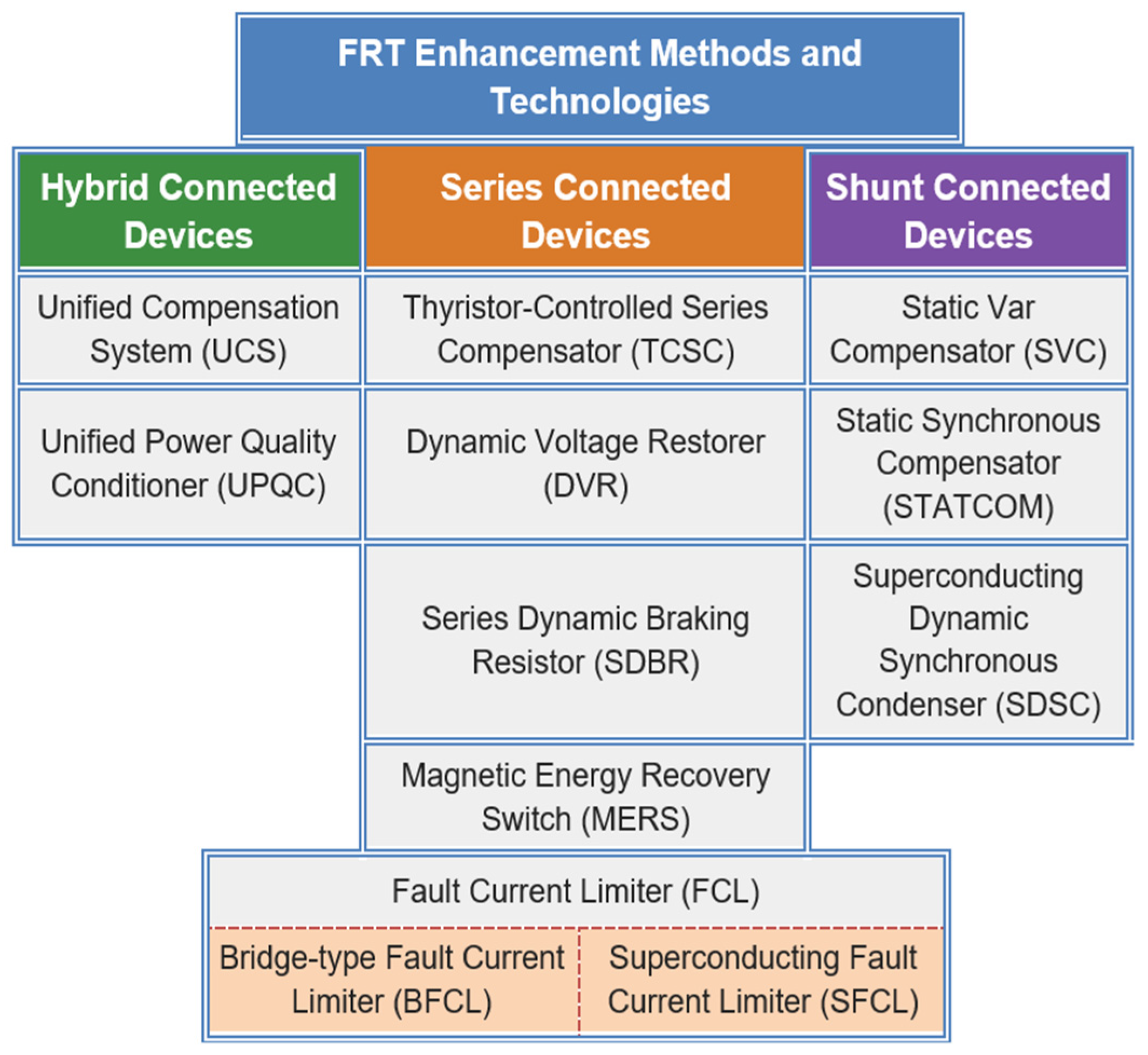
Ensuring the Fault Ride-Through (FRT) capability of DFIG-based wind turbines requires a combination of strategies, typically categorized into crowbar protection, surplus energy storage, pitch control, and reactive power compensation techniques, as summarized in Figure 1 [18]. Due to their large rotor inertia, DFIGs exhibit slow pitch angle response, limiting their dynamic fault response. Advanced control strategies, such as Robust Model Predictive Control (RMPC) for Maximum Power Point Tracking (MPPT) and second-order sliding mode control, can improve dynamic response, but additional FRT enhancement measures remain necessary for reliable grid support [19,20].
Centralized reactive power compensation devices, particularly Static VAR Compensators (SVCs) and STATCOMs, are extensively employed to improve the transient voltage stability of wind farms. Comparative analyses indicate that STATCOMs provide faster and more reliable dynamic reactive power support than SVCs, thereby mitigating post-fault voltage deviations and enhancing overall system stability [21]. Research efforts have focused on improving STATCOM hardware configurations and their integration within DFIG-based wind energy systems. Coordinated control of the DFIG converters, including the RSC and GSC, together with an external STATCOM, significantly enhances transient voltage recovery. This is particularly effective during severe grid faults when the RSC may be blocked [22]. In addition, advanced converter topologies such as cascaded H-bridge (CHB)-based STATCOM structures have demonstrated improved voltage regulation and reduced capacitance requirements compared to conventional configurations [23]. Furthermore, integrating energy storage elements, such as supercapacitor-supported STATCOM systems, has been shown to strengthen dynamic voltage support during grid disturbances [24].
Beyond hardware development, significant research has focused on enhancing STATCOM control strategies to improve Low-Voltage Ride-Through (LVRT) and overall FRT performance in DFIG-based wind farms. Coordinated control between the STATCOM and DFIG converters has been shown to effectively limit fault-induced current surges, stabilize rotor dynamics, and accelerate voltage recovery during severe grid disturbances [25,26]. Optimization-based controller tuning methods, including hybrid metaheuristic techniques, have demonstrated significant improvements in voltage stability, oscillation damping, reactive power regulation, and LVRT performance under fault conditions [27]. In addition, evolutionary optimization methods have also been applied to improve STATCOM controller performance, leading to better voltage and reactive power regulation and faster dynamic response in complex power systems [28]. Furthermore, intelligent and nonlinear control approaches have been introduced to enhance dynamic response and improve both LVRT and High-Voltage Ride-Through (HVRT) capabilities, confirming the effectiveness of advanced STATCOM control frameworks in strengthening overall system resilience [29].
More recently, adaptive deadbeat- and ADRC-based control strategies have attracted growing interest for improving dynamic performance under disturbed operating conditions. In [30], an adaptive deadbeat current controller for STATCOM was developed based on online controller-bandwidth measurement. The study showed that the proposed method can maintain stable and responsive operation under parameter variations, and its effectiveness was experimentally validated on a three-phase STATCOM. In a related work, ref. [31] presented a discrete-time deadbeat current control method for STATCOM systems in the dq reference frame. By formulating the controller directly in the digital domain, the proposed approach achieved fast, accurate, and robust performance without requiring iterative parameter tuning, confirming its suitability for high-performance STATCOM applications. In addition, a dual-loop Active Disturbance Rejection Control (ADRC) strategy was proposed in [32] for a parallel interleaved buck converter supplying a PEM electrolyzer. The reported results demonstrated improved disturbance rejection, enhanced stability, and better voltage regulation, with a settling time of 10 ms, zero undershoot, an overshoot of 20.06%, and a steady-state error of 0.05%.
Despite these advances, previous studies have primarily focused on active power smoothing in wind turbines, whereas other works have concentrated on improving FRT performance and voltage support during grid disturbances. To address both challenges within a unified framework, this study integrates a grid-connected Supercapacitor Energy Storage System (SCES) and a STATCOM with a DFIG-based wind energy conversion system (WECS), enabling coordinated active and reactive power management under variable operating conditions and grid contingencies.
The main contributions of this work are summarized as follows:
  • An integrated control architecture is proposed for a grid-connected DFIG-based WECS by incorporating a STATCOM and a DC-link-interfaced SCES, each operating independently to enhance voltage stability and mitigate active-power fluctuations under wind variability and grid disturbances.
  • A discrete-time deadbeat current control strategy is developed for the STATCOM to enable ultra-fast and precise reactive current injection and to improve voltage restoration during symmetrical voltage sag and swell conditions.
  • A cascaded ADRC scheme is designed for the SCES bidirectional DC–DC converter to ensure robust DC-link voltage regulation and strong disturbance rejection capability, and superior performance to conventional PI-based control is demonstrated.
  • The proposed DFIG–STATCOM–SCES control framework is validated through MATLAB/Simulink R2023a simulations under variable-wind-speed profiles and severe voltage sag/swell disturbances, and enhanced dynamic performance, improved damping characteristics, and strengthened grid-code-compliant FRT capability are demonstrated.
  • A comprehensive comparative study is conducted under severe grid faults and variable-wind-speed conditions. For voltage regulation, the proposed method is compared with SVC and PI-based STATCOM. For DC-link voltage regulation, the SCES performance is evaluated using PI, single ADRC, and cascaded ADRC. The results show improved voltage recovery, better reactive-power dynamics, reduced overshoot and undershoot, shorter settling times, smaller DC-link voltage deviations, and reduced rotor-speed oscillations.
The remainder of this paper is organized as follows: Section 2 presents the Description and Mathematical Modeling of the Studied System. Section 3 describes the control strategies for the SCES and STATCOM. Section 4 presents simulation results and comparative analysis, and Section 5 concludes the paper.

2. Description and Mathematical Modeling of the Studied System

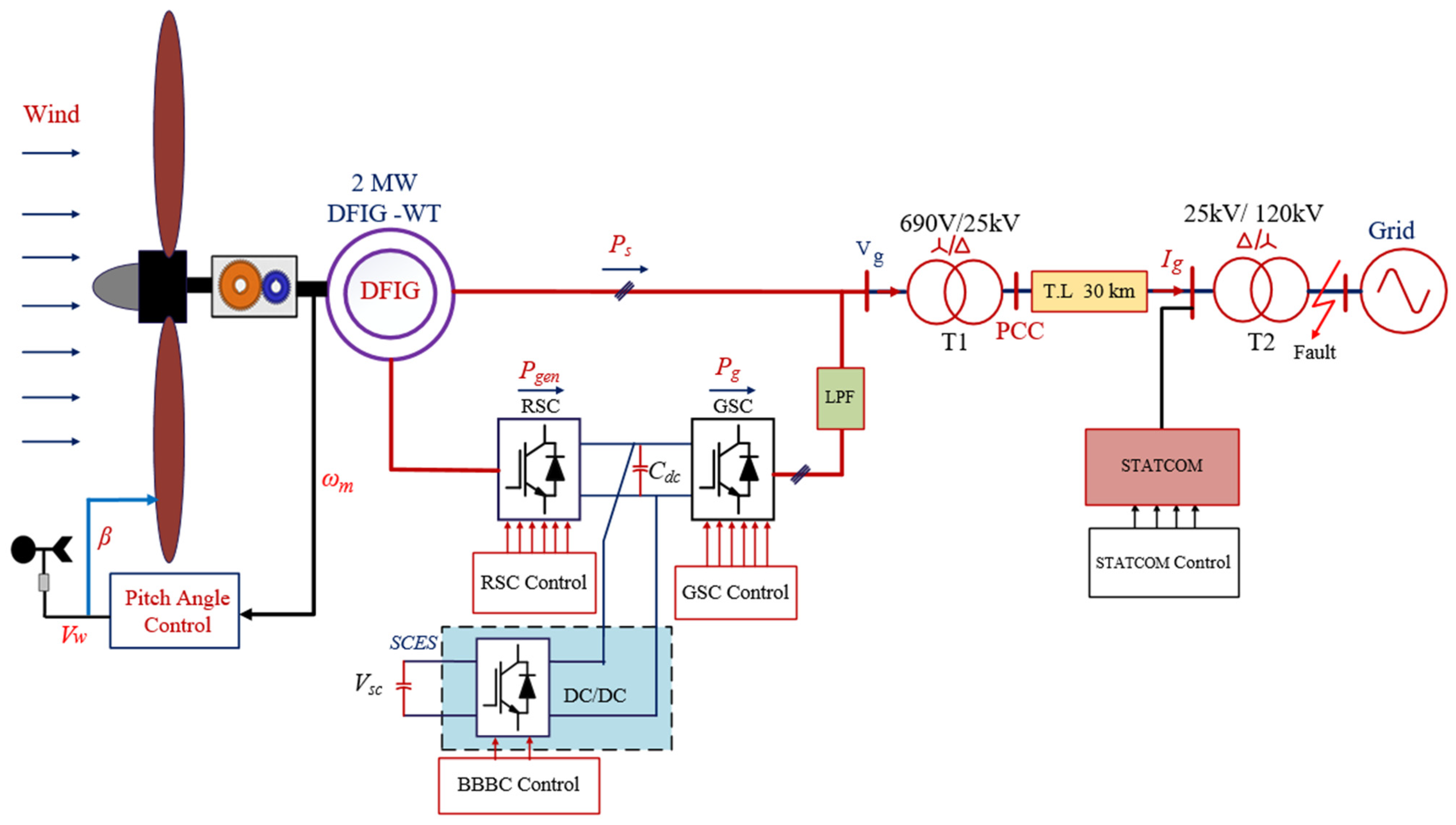
The investigated system consists of a single 2 MW wind turbine generator operating at a power factor of 0.9. Power is transmitted through a 30 km overhead line, while a 120/25 kV transformer is used to represent the grid-side interface, as shown in Figure 2. On the wind turbine side, a 25/0.69 kV, 4 MVA step-up transformer is connected to the wind turbine generator terminals. The external grid is modeled as a balanced three-phase AC voltage source with a nominal voltage of 120 kV, a short-circuit power of 2500 MVA, and an X/R ratio of 3. The DFIG is connected to the grid through a back-to-back converter consisting of an RSC and a GSC linked by a common DC link. To improve DC-link voltage stability and provide fast active-power balancing during disturbances, an SCES is connected to the DC link through a bidirectional buck–boost DC/DC converter. In addition, a STATCOM is installed at the 25 kV bus to provide dynamic reactive-power support and improve voltage recovery under fault conditions. In this way, the proposed configuration combines SCES-based DC-link support with STATCOM-based voltage support, leading to improved dynamic performance under both wind and grid disturbances.

2.1. DFIG-WT Dynamic Modeling Under Wind and Grid Disturbances

A DFIG-WT is an integrated aero-electro-mechanical energy conversion system in which aerodynamic power capture, drive-train dynamics, and generator–converter electrodynamics are strongly coupled. Consequently, wind speed variability and grid voltage disturbances can induce noticeable transients in rotor-speed and electromagnetic torque [33]. In variable-speed operation, MPPT regulates the generator-referred speed to maximize energy extraction in the below-rated region. Wind disturbances perturb the aerodynamic torque, causing rotor acceleration or deceleration; the associated speed deviations modify slip and rotor electrical frequency, thereby influencing electromagnetic torque production. Moreover, because the stator is directly connected to the grid, voltage disturbances excite rapid stator flux transients that couple into the rotor circuit and affect converter-controlled torque dynamics [34].
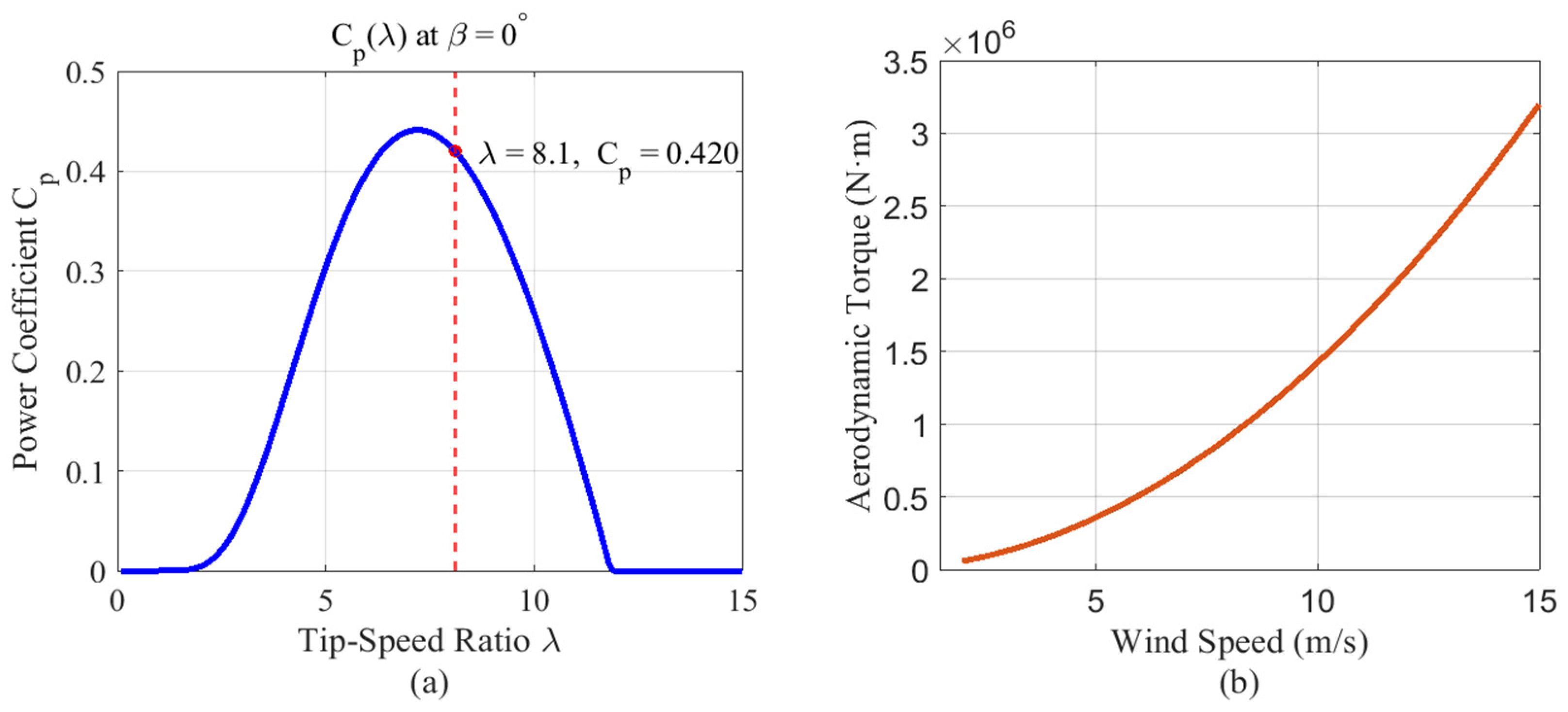
In the below-rated operating region, where the blade pitch angle is maintained at approximately zero ( β = 0 ), the power coefficient C p depends primarily on the tip-speed ratio λ and reaches its maximum value at the optimal tip-speed ratio λ opt , as shown in Figure 3a. Accordingly, the MPPT strategy regulates the generator speed to enforce λ = λ opt , thereby maximizing aerodynamic energy capture. Under this condition, the extracted mechanical power follows the well-established cubic relationship with generator speed, expressed as follows [35]:
P t , m a x t = K opt   ω g 3 t , T aero   t = P t , m a x t ω g t
where K opt is the optimal power coefficient constant determined by turbine parameters, and ω g ( t ) denotes the generator angular speed.
Under these operating conditions, aerodynamic torque increases with wind speed at zero pitch, consistent with the trend shown in Figure 3b. The lumped turbine generator rotational dynamics are described by:
J d ω g ( t ) d t = T a e r o ( t ) T e ( t ) B ω g ( t )
where J is the equivalent inertia referred to the generator side, B is the viscous damping coefficient, and T e is the electromagnetic torque.
Electromechanical coupling in the DFIG is characterized by the slip s = ω s ω g / ω s , which determines the rotor electrical frequency ω r = s ω s . Accordingly, any variation in the generator speed ω g modifies the slip and directly affects rotor electrical variables, including the induced EMF, rotor current frequency, and electromagnetic torque production. To explicitly incorporate wind disturbances into the dynamic model, the aerodynamic torque is represented as a nonlinear function of generator speed and rotor-effective wind speed:
T aero = T aero   ω g , v w
where v w denotes the rotor-effective wind speed.
Linearizing Equation (2) around an operating point ( ω g 0 , v w 0 ) and defining Δ ω = ω g ω g 0 and Δ v w = v w v w 0 yields the small-signal model
J d Δ ω d t = Δ T a e r o Δ T e B Δ ω
Using first-order Taylor expansions about the operating point,
Δ T a e r o = T a e r o ω g Δ ω + T a e r o v w Δ v w ,   Δ T e = T e ω g c l Δ ω
where T e ω g c l denotes the effective closed-loop torque–speed slope imposed by the RSC torque/current control in the vicinity of the operating point.
Substituting Equation (5) into (4) yields the reduced-order disturbance-driven rotor-speed dynamics:
J d Δ ω d t + B + T e ω g c l T aero   ω g Δ ω = T aero   v w Δ v w
The net electromechanical damping coefficient is defined as follows:
D eff   = B + T e ω g c l T aero   ω g
Accordingly, the perturbation dynamics can be expressed in compact form as follows:
J d Δ ω d t + D e f f Δ ω = T aero   v w Δ v w
Local small-signal stability requires D eff   > 0 , which is equivalently written as T e ω g c l > T aero   ω g . Because this condition is obtained from a linearization around a fixed operating point, it ensures convergence only for small perturbations in the vicinity of that equilibrium. For large wind speed variations, the system equilibrium shifts according to the action of the MPPT controller, while Equation (6) characterizes the dynamic convergence behavior around the updated operating point. Under stiff-grid conditions, a reduction in wind speed decreases the rotor-speed, electromagnetic torque, and injected current, resulting in a lower generated active power. Since the grid voltage remains essentially constant, wind power variations are reflected in the magnitude of the injected active power.
To mitigate this power fluctuation and ensure continuous and regulated power delivery, thereby maintaining a constant grid-injected current during wind speed variations, an SCES is employed in this work. The SCES compensates for the difference between the grid power demand and the generated wind power, thereby smoothing the active power delivered at the point of common coupling (PCC), as expressed by the following:
P S C E S   t = P g r i d   t P g e n   t P P C C t = P g e n   t + P S C E S   t
where P S C E S   t is limited by converter rating and SOC bounds.
While the above discussion focused on wind speed variations, the DFIG can also be affected by grid disturbances, especially voltage sags. In this case, the main problem is no longer the mechanical response, but the fast electrical transient inside the machine. During grid voltage sags, however, the dominant limitation is the reduced PCC voltage and the resulting electromagnetic transients. Flux continuity prevents instantaneous changes in stator flux, producing a natural (free) flux component immediately after fault inception. The stator voltage–flux dynamics are as follows [36]:
v s ( t ) = R s i s ( t ) + d ψ s ( t ) d t
Over the short transient interval, a common approximation is that the stator current is largely flux-determined, i.e., i s ( t ) ψ s ( t ) / L s , which yields
v s t = R s L s ψ s t + d ψ s t d t
Rewriting in standard first-order form makes the stator time constant explicit:
d ψ s ( t ) d t + 1 τ s ψ s t = v s t ,   τ s = L s R s
Hence, τ s is the stator electrical time constant governing the decay rate of the post-fault flux offset.
In particular, for the natural response immediately after a deep sag (when the driving voltage term is strongly reduced), the flux offset decays approximately as follows:
ψ s ,   n a t u r a l   ( t ) e t t 0 / τ s
showing that a larger τ s implies a slower decay and a more persistent flux transient.
The transient stator flux couples into the rotor circuit through the mutual inductance L m , inducing a rotor EMF whose magnitude is governed by both the flux transient and the slip frequency. A compact scaling relation that highlights these contributions is
e r t L m L s d ψ s t d t + j ω s l ψ s t
Therefore, τ s affects rotor EMF transients indirectly through ψ s ( t ) and d ψ s ( t ) / d t : a slower flux decay (larger τ s ) sustains the transient contribution for longer, while deep voltage sags increase d ψ s / d t at fault inception and can produce severe rotor EMF and current surges that challenge rotor-side converter (RSC) and DC-link limits. To mitigate these effects, a STATCOM can provide fast reactive-power support at the PCC to improve voltage recovery and reduce sag depth, thereby attenuating the stator flux disturbance and indirectly limiting induced rotor EMF and rotor current stress, which enhances Fault-Ride-Through capability.

2.2. Supercapacitor Energy Storage System Model and Sizing

The SCES is connected to the DC link through a bidirectional DC-DC converter to provide fast bidirectional power support during wind power fluctuations and grid voltage disturbances. Owing to its high-power density, low internal resistance, rapid charge/discharge capability, and long cycle life, the SCES is well suited for short-duration transient compensation [17].
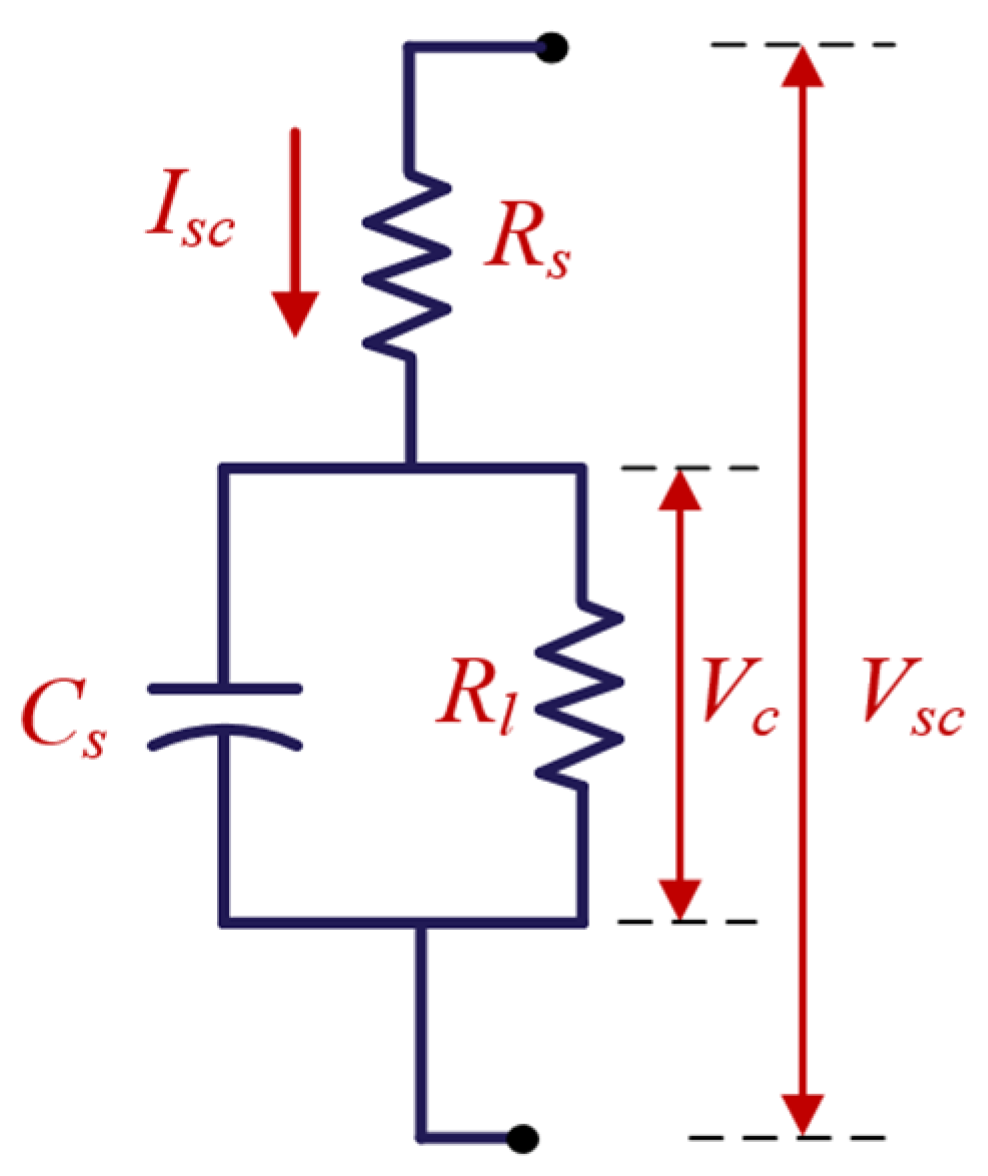
The equivalent circuit adopted in this work is shown in Figure 4. The SCES is represented by an equivalent series resistance R s , a leakage resistance R l , and an equivalent capacitance C s . Let V s c denote the terminal voltage, V c the capacitor voltage, and I s c the terminal current. The terminal-voltage relation is written as
V s c = V c R s I s c
and the current balance at the internal node is
I s c = I c + I l
with
I c = C s V ˙ c , I l = V c R l
Hence, the capacitor voltage dynamics become
V ˙ c = 1 C s I s c V c R l
The stored energy of the SCES is
E s c = 1 2 C s V c 2
and the usable energy over the allowable voltage range V c , m i n , V c , m a x is
Δ E s c = 1 2 C s V c , m a x 2 V c , m i n 2
The SCES is sized according to the maximum transient energy required during wind power variations and severe voltage sag/swell events. Defining
E r e q = m a x t 1 t 2   P s c ( t ) d t
the capacitance is selected such that
C s 2 E r e q V c , m a x 2 V c , m i n 2
In addition, the converter current rating must satisfy
I s c , m a x m a x P s c ( t ) V s c ( t )
The state of charge is defined on an energy basis as
S O C s c = V c 2 V c , m i n 2 V c , m a x 2 V c , m i n 2
Since the present application concerns short transient support at the DC-link level, the adopted SCES model and sizing criterion are sufficient for the proposed DFIG-STATCOM-SCES.

2.3. STATCOM Modeling and Operating Principles

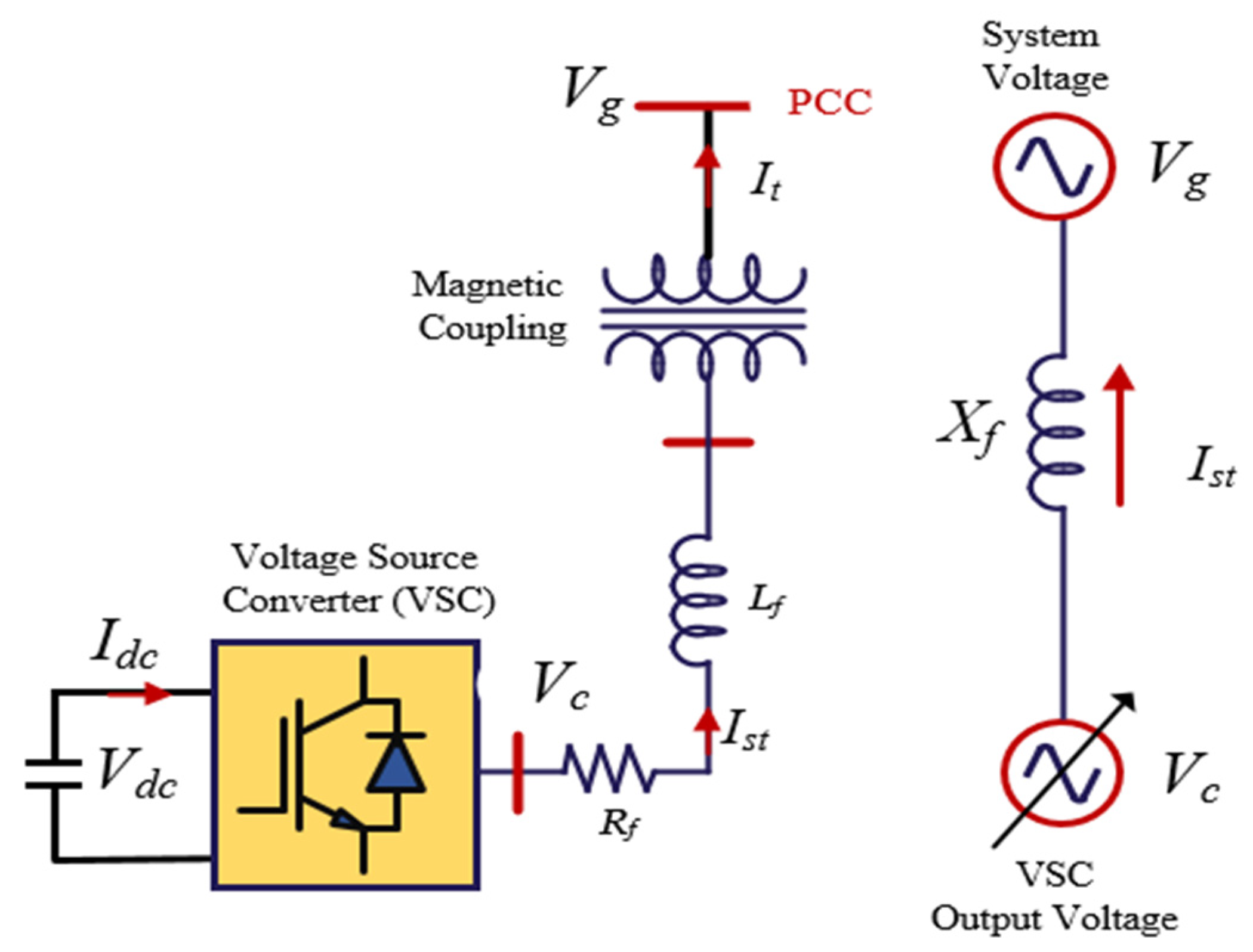
A STATCOM is a shunt-connected FACTS device designed to enhance voltage stability through fast reactive power compensation. It is typically implemented using a voltage source converter (VSC) supplied by a DC link capacitor and connected to the AC network through a coupling impedance. As illustrated in Figure 5, the VSC is interfaced with the grid at the PCC through the Rf  Lf coupling filter and magnetic coupling, whereas the dc side is supported by the dc-link capacitor voltage Vdc. By regulating the magnitude and phase of its fundamental output voltage relative to the grid voltage at the PCC, the STATCOM controls the injected current and consequently the exchanged reactive power [37].
In steady-state phasor representation, the STATCOM can be modeled as a controllable voltage source V c connected to the grid voltage V g through the coupling impedance
Z f = R f + j X f
The injected current at the PCC is
I s t = V c V g Z f
and the exchanged complex power is
S P C C = P P C C + j Q P C C = V g I s t *
If the coupling resistance is small compared to the reactance ( R f X f ), the classical steady-state relations follow:
P P C C = V g V c X f s i n   δ
Q P C C = V g V g V c c o s   δ X f
where δ denotes the phase angle difference between the converter and grid voltages.
For dynamic analysis, the positive-sequence grid voltage is defined as follows:
V g = V g e j θ g
The injected current is decomposed in a voltage-synchronous reference frame as follows:
I s t = i d + j i q e j θ g
which links active and reactive powers to the synchronous current components.
To capture the electromagnetic behavior of the R f L f coupling branch, the system is formulated in a synchronous d q reference frame rotating at electrical angular speed ω . The averaged AC-side current dynamics are expressed as follows:
L f i ˙ d q = v c , d q v g , d q R f i d q + ω L f J i d q
The converter output voltage is parameterized using the modulation vector m d q and the DC-link voltage V d c :
v c , d q = V d c 2 m d q
The instantaneous three-phase active and reactive powers at the PCC are given by
P P C C = 3 2 v g , d q T i d q , Q P C C = 3 2 v g , d q T J i d q
The DC-link dynamics are derived from the capacitor energy balance,
C d c V d c V ˙ d c = P d c 3 2 v c , d q T i d q P l o s s
Physical feasibility is ensured through current and modulation constraints,
i d q 2 I m a x , m d q 2 m m a x
The resulting formulation provides a continuous-time, energy-consistent STATCOM model that coherently integrates steady-state phasor behavior with dynamic synchronous reference-frame dynamics within a unified analytical framework, independent of the specific control strategy.

3. Control Approaches

This section presents the control approaches of the converters used in the DFIG-based WES with the STATCOM and SCES. The BTBC employs conventional vector control. The STATCOM is controlled by a deadbeat current controller, whereas the SCES converter is controlled using an ADRC-based strategy. The STATCOM and SCES are responsible for regulating the DFIG terminal voltage and the DC-link voltage, respectively, and they operate independently through separate control loops. The control strategy of each converter is described in the following subsections.

3.1. BTBC Control

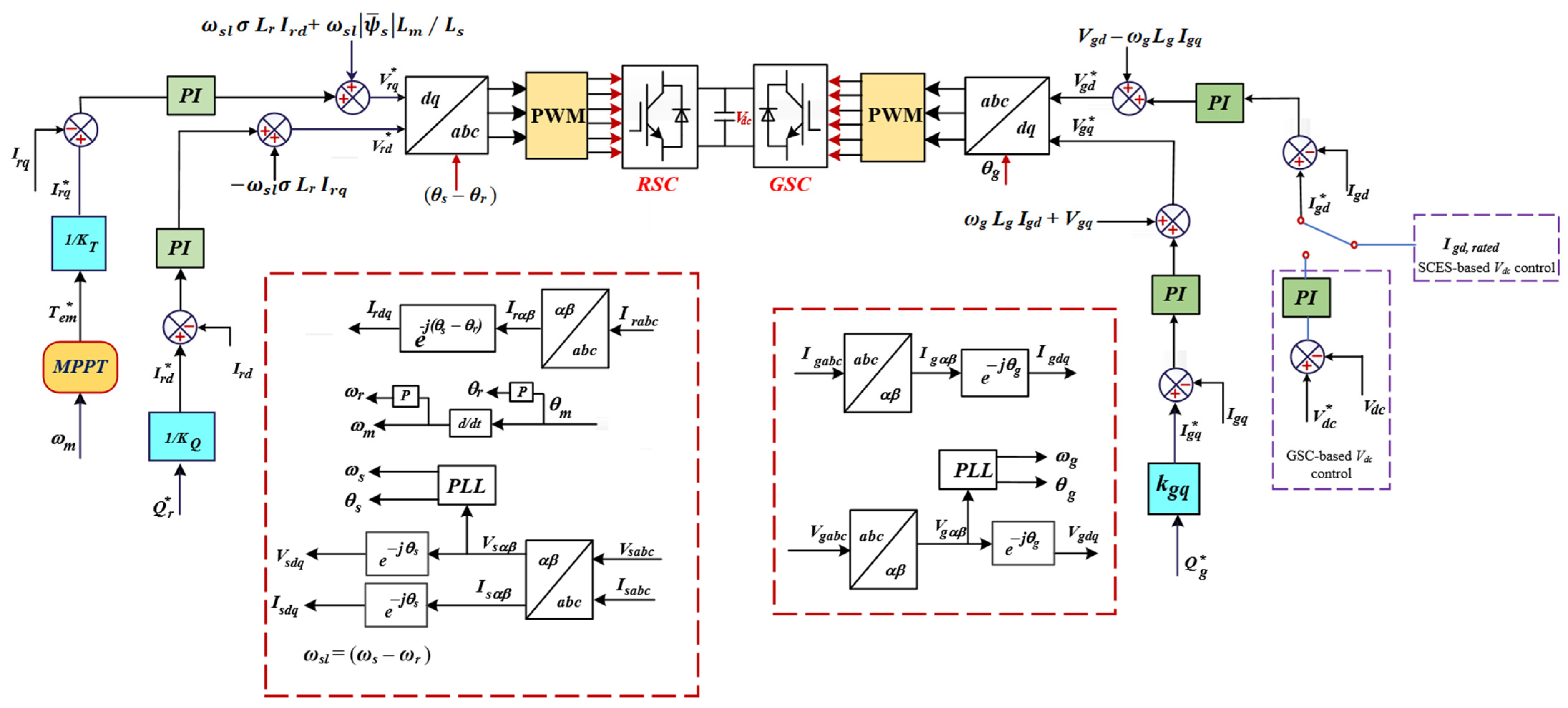
The control system of the BTBC is shown in Figure 6, including the control structures of both the RSC and GSC. A vector control scheme is adopted to achieve decoupled control of active and reactive power. On the RSC side, the controller is mainly designed to track the maximum power point through the MPPT loop and to regulate the generator reactive power. The torque and reactive-power references are converted into the rotor current references I r d * and I r q * , which are processed by PI controllers. After inclusion of the decoupling terms, the resulting voltage commands are transformed from the d q frame to the a b c frame to generate the PWM switching signals for the RSC.
On the GSC side, the control structure is conventionally used to regulate the DC-link voltage and the reactive power exchanged with the grid when the SCES is absent. In the proposed configuration, however, once the SCES is integrated, it takes responsibility for regulating the DC-link voltage V d c , while the GSC maintains the i g d current at its reference value. The q -axis current reference is obtained from the reactive-power control loop, whereas the inner current controllers regulate the grid currents in the synchronous reference frame. After adding the decoupling terms, the corresponding switching signals are generated through PWM.

3.2. Cascaded ADRC of the Supercapacitor Energy Storage System

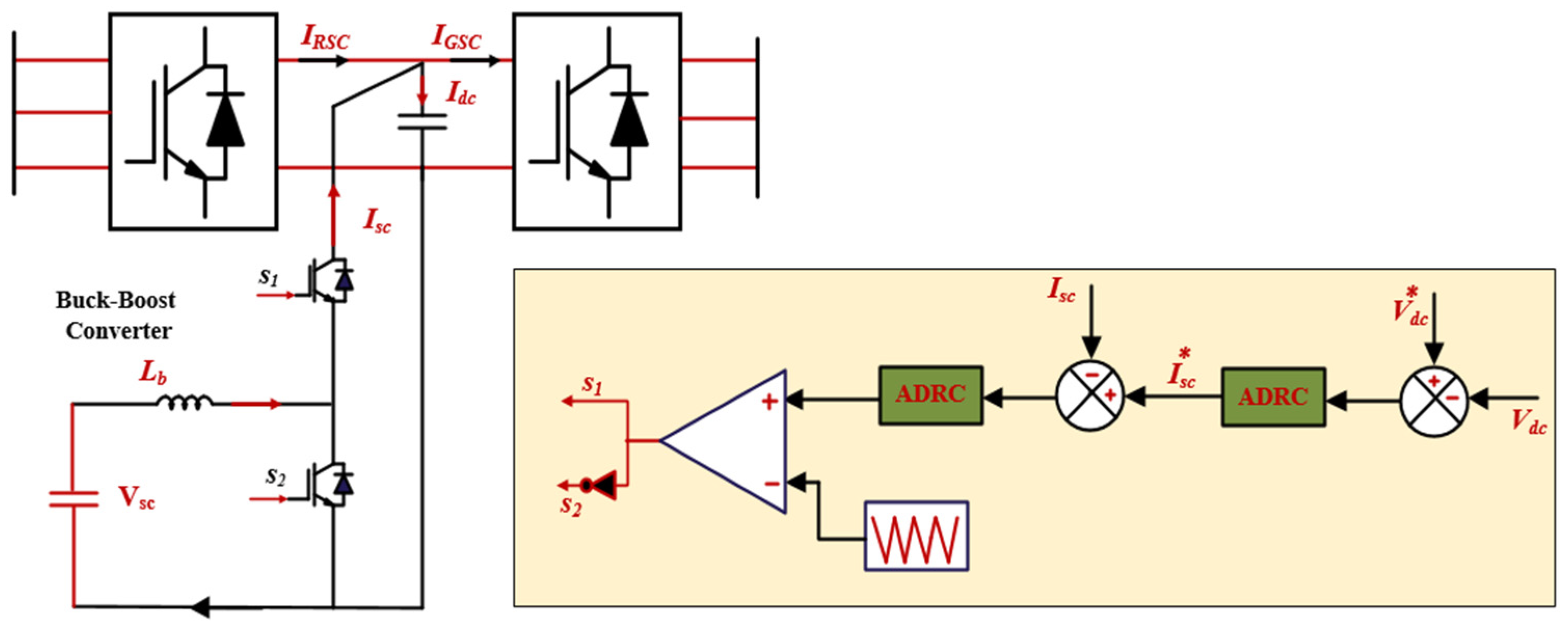
The SCES is interfaced with the DC-link through a bidirectional DC-DC converter to regulate the DC-link voltage while enabling fast bidirectional power exchange. Due to the high-power density, low internal resistance, and rapid dynamic characteristics of supercapacitors, the control strategy must ensure robust voltage stabilization, fast current tracking, and strong disturbance rejection under load variations and parameter uncertainties. The overall cascaded ADRC structure is illustrated in Figure 7.
The proposed control system consists of two hierarchical loops. The outer loop regulates the DC-link voltage and generates the reference supercapacitor current I sc   * , while the inner loop forces the actual supercapacitor current I sc to track this reference. The resulting control command is processed by a PWM modulator to generate the switching signals of the bidirectional converter, enabling both charging and discharging operation. The DC-link capacitor dynamics are described by the following:
C d c V ˙ d c = I d c , c o n v I G S C + Δ v ( t )
where C d c is the DC-link capacitance, I d c ,   conv is the converter current injected into the DC-link, I GSC represents the DC current drawn by the grid-side converter, and Δ v ( t ) denotes lumped uncertainties and unmodeled dynamics.
Assuming sufficiently fast current tracking in the inner loop such that I d c , c o n v I s c , the voltage dynamics can be rewritten in standard ADRC form as follows:
V ˙ d c = f v ( t ) + b 0 v I s c *
where b 0 v = 1 / C d c is the nominal input gain and f v ( t ) represents the aggregated disturbance including load variations, converter nonlinearities, and modeling errors.
To estimate both the DC-link voltage and the total disturbance in real time, a second-order Extended State Observer (ESO) is designed as follows:
V ˆ ˙ d c = f ˆ v + b 0 v I s c * + 2 ω 0 v V d c V ˆ d c f ˆ ˙ v = ω 0 v 2 V d c V ˆ d c
where V ˆ d c and f ˆ v denote the estimated voltage and disturbance, respectively, and ω 0 v is the observer bandwidth.
The outer ADRC controller generates the reference current according to
I s c * = k p v V d c * V d c f ˆ v b 0 v
where V d c * is the reference DC-link voltage and k p v is the proportional gain of the voltage controller.
A current limitation block is included to ensure safe operation within hardware constraints. The inner loop regulates the inductor current, which corresponds to the supercapacitor current I sc . The bidirectional converter dynamics, valid for both charging and discharging modes, can be expressed as follows:
L s c L ˙ s c = ϕ V s c , V d c , d r L I s c + Δ i ( t )
where L b is the buck–boost inductance, r L is the parasitic resistance, ϕ ( ) represents the duty-cycle-dependent voltage relationship, and Δ i ( t ) aggregates switching ripple, delays, and parameter uncertainties.
For ADRC design, the model is reformulated as follows:
I ˙ s c = f i ( t ) + b 0 i v c m d
where b 0 i = 1 / L according to the adopted polarity convention, and f i ( t ) denotes the lumped disturbance affecting the current loop.
A second-order ESO is implemented for the inner loop to estimate both the current and its total disturbance:
I ˆ ˙ sc = f ˆ i + b 0 i v c m d + 2 ω 0 i I sc   I ˆ sc f ˆ ˙ i = ω 0 i 2   I sc   I ˆ sc
where ω 0 i is the observer bandwidth of the current loop. The inner-loop ADRC law is given by
v c m d = k p i I s c * I s c f ˆ i b 0 i
where k p i is the proportional gain of the current controller.
To clarify the effectiveness of the proposed cascaded ADRC, the coupling between the inner current loop and the outer voltage loop can be made explicit through the inner-loop tracking error
e i = I s c I s c *
Using the exact relation I s c = I s c * + e i , Equation (38) can be rewritten as
V ˙ d c = f v ( t ) + b 0 v I s c = f v ( t ) + b 0 v I s c * + b 0 v e i
Hence, the equivalent disturbance seen by the outer voltage loop can be expressed as
d e q ( t ) = f v ( t ) + b 0 v e i
Equation (47) shows that the influence of converter-side dynamics on the voltage loop appears through the additional term b 0 v e i . Since the inner ADRC loop is designed with a bandwidth significantly higher than that of the outer voltage loop, the tracking error e i is rapidly attenuated, and the contribution of b 0 v e i remains limited during transients. Therefore, the outer loop is subjected to a reduced equivalent disturbance, which improves damping, reduces DC-link voltage excursion, and enhances robustness against load disturbances, converter nonlinearities, and parameter variations [32].
By contrast, in a single-loop ADRC used only for DC-link voltage regulation, the controller acts directly on the converter duty cycle, so that the slow voltage dynamics and the fast converter current dynamics are handled within the same loop. In compact form, this can be written as
V ˙ d c = f ˜ v ( t ) + b ˜ u
where f ˜ v ( t ) includes not only external disturbances but also the fast internal converter current dynamics.
Consequently, the cascaded arrangement provides a structured separation between the inner current loop and the outer DC-link voltage loop, which can support improved disturbance handling and DC-link regulation under varying operating conditions.

3.3. Conventional STATCOM Control

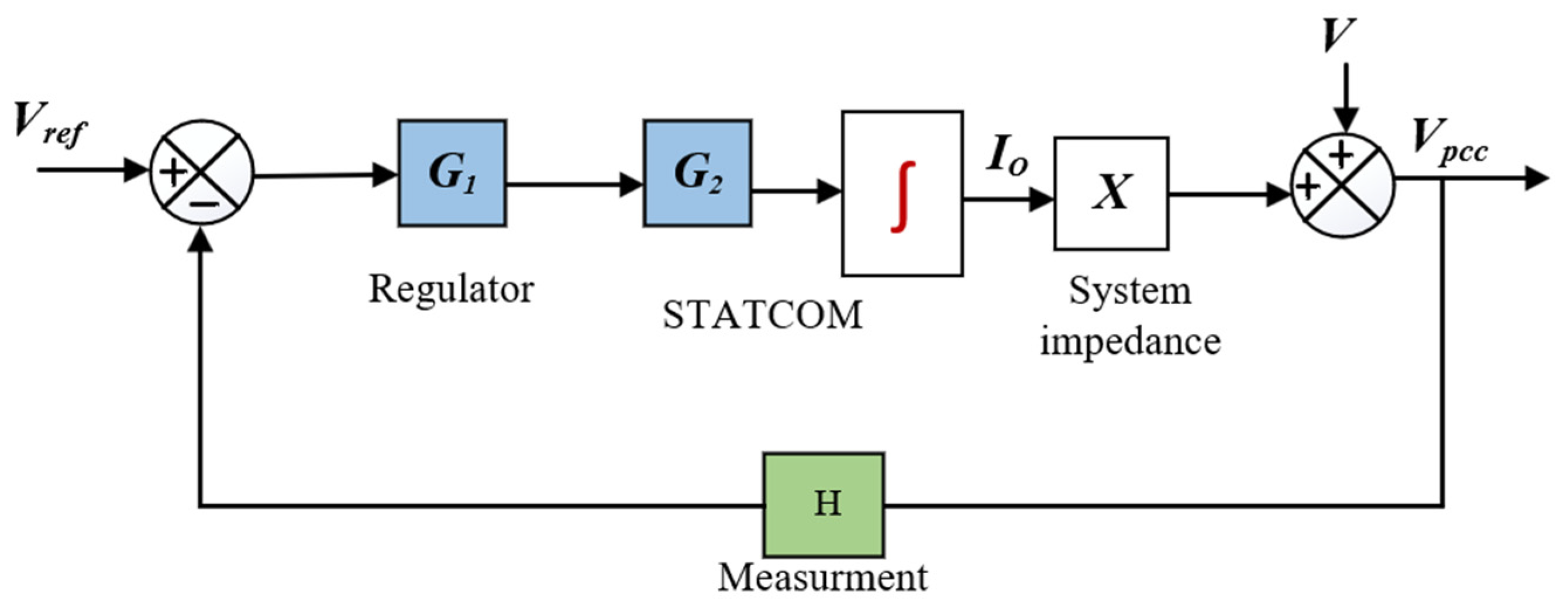
The conventional STATCOM control structure adopted in this study is shown in Figure 8. By regulating the magnitude of the converter AC output voltage V stat , reactive-power exchange with the grid is controlled, and the PCC voltage is maintained within the desired operating range. To assess the STATCOM voltage regulation capability, a transfer function-based small-signal framework is employed. The simplified block diagram in Figure 9 captures the interaction among the outer regulator, the STATCOM internal response, the measurement dynamics, and the network impedance. The forward path is represented by the cascaded blocks G 1 ( s ) and G 2 ( s ) , followed by the network (system-impedance) gain X , whereas the feedback path is modeled by the measurement block H ( s ) .
For transfer function derivation, the integrator is absorbed into an aggregated STATCOM dynamics block, denoted G 2 ,   agg   ( s ) , and the combined STATCOM-and-integrator behavior is represented by a single equivalent transfer function. Accordingly, the forward-path transfer function is defined as P ( s ) = G 1 ( s ) G 2 ,   agg   ( s ) X , and the loop gain is defined as L ( s ) = P ( s ) H ( s ) .
Under linearized operating conditions, with the system voltage disturbance V ( s ) injected additively at the output, the PCC voltage is expressed as
V p c c ( s ) = P ( s ) 1 + P ( s ) H ( s ) V r e f ( s ) + 1 1 + P ( s ) H ( s ) V ( s )
and, by setting V ref   ( s ) = 0 to isolate the disturbance response, the PCC voltage is obtained as
V p c c ( s ) = 1 1 + P ( s ) H ( s ) V ( s )
Hence, for small perturbations around an operating point, the disturbance-to-PCC-voltage transfer function is given by
Δ V p c c Δ V = 1 1 + P ( s ) H ( s ) = 1 1 + L ( s )
The constituent blocks are modeled as
G 1 ( s ) = 1 / k p 1 + T 1 s , G 2 ( s ) = e T d s , H ( s ) = 1 1 + T 2 s
For numerical evaluation, the parameter values are adopted as
G 1 ( s ) = 41.67 1 + 12 s , G 2 ( s ) = e 0.15 s , H ( s ) = 1 1 + 5 s ,
and the equivalent open-loop model is written as
L ( s ) = 295.31 e 0.15 s ( 1 + 12 s ) ( 1 + 5 s )
Therefore, the closed-loop disturbance transfer function is expressed as
Δ V p c c Δ V = 1 1 + L ( s )
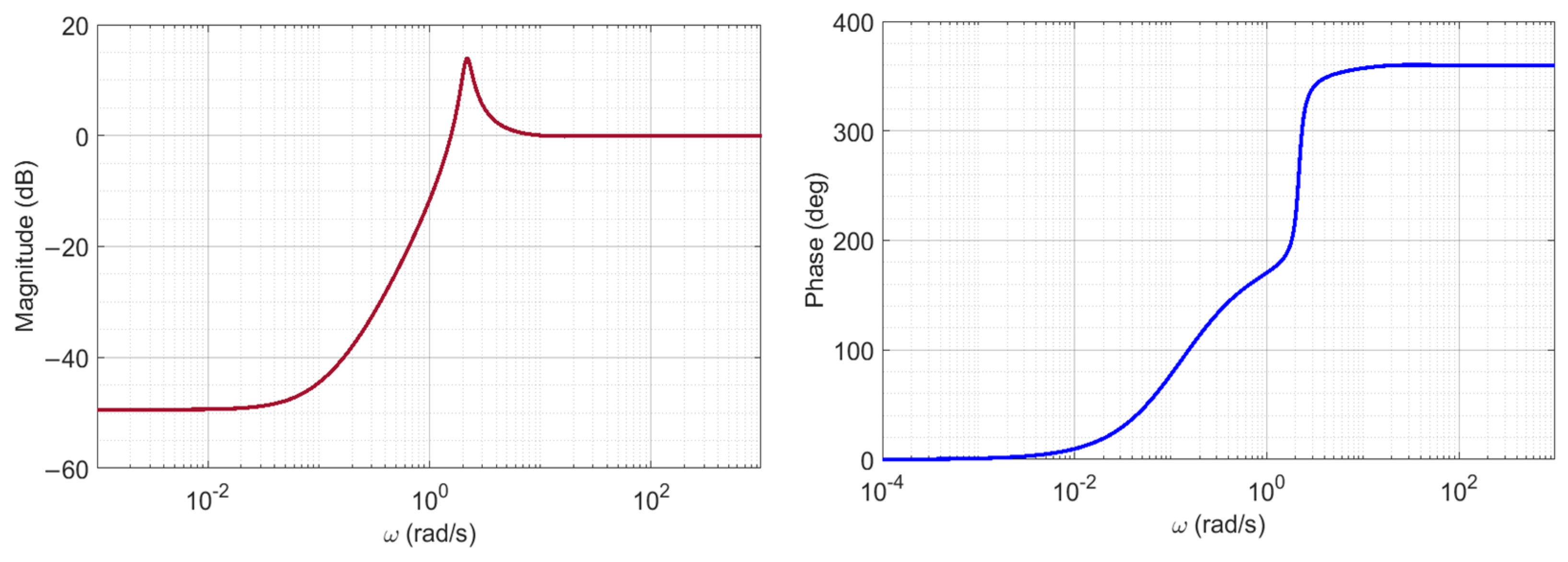
This transfer function characterizes the extent to which V p c c is insulated from variations in the system voltage V . The MATLAB Bode plot of Δ V p c c / Δ V is shown in Figure 10, where strong low-frequency attenuation (approximately −50 dB) is indicated for slow voltage disturbances, the magnitude is shown to approach 0 dB as the loop gain diminishes with increasing frequency, and a limited resonance peak is observed around the transition region, which reflects the closed-loop damping characteristics.

3.4. Discrete-Time Deadbeat Control of the STATCOM

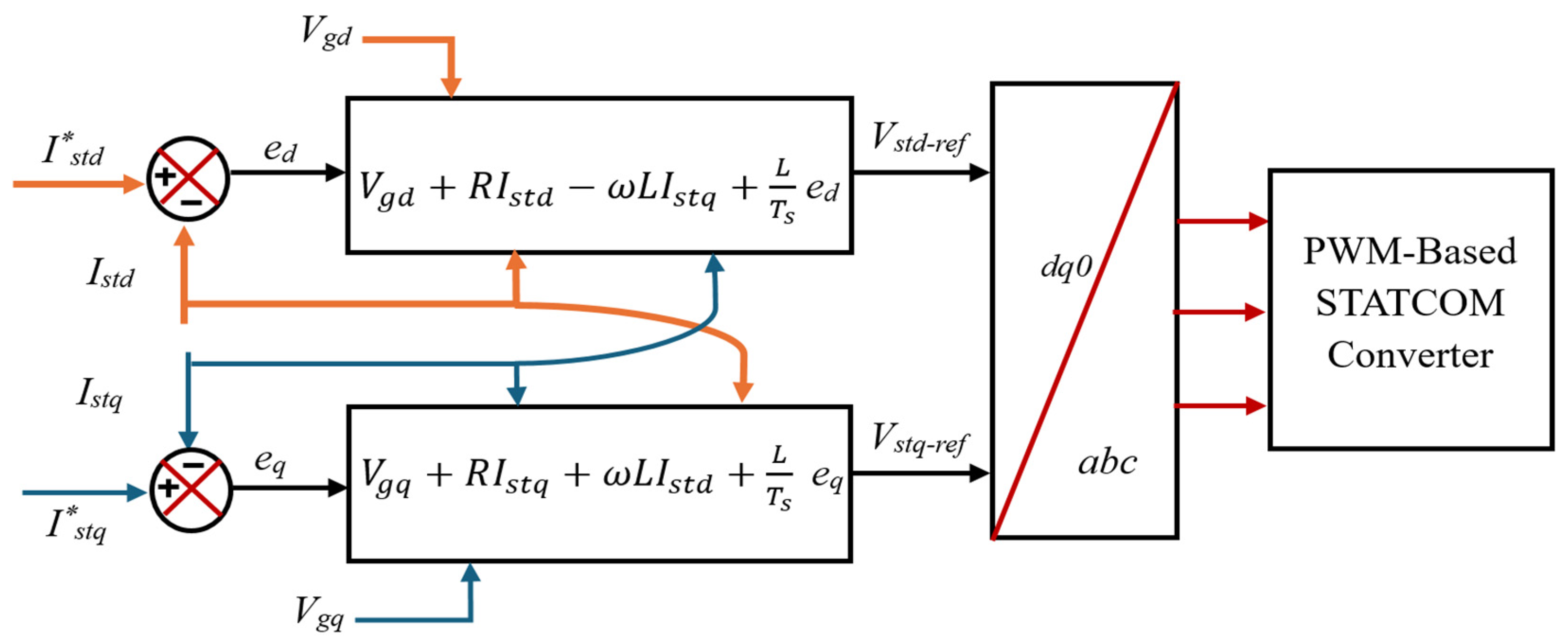
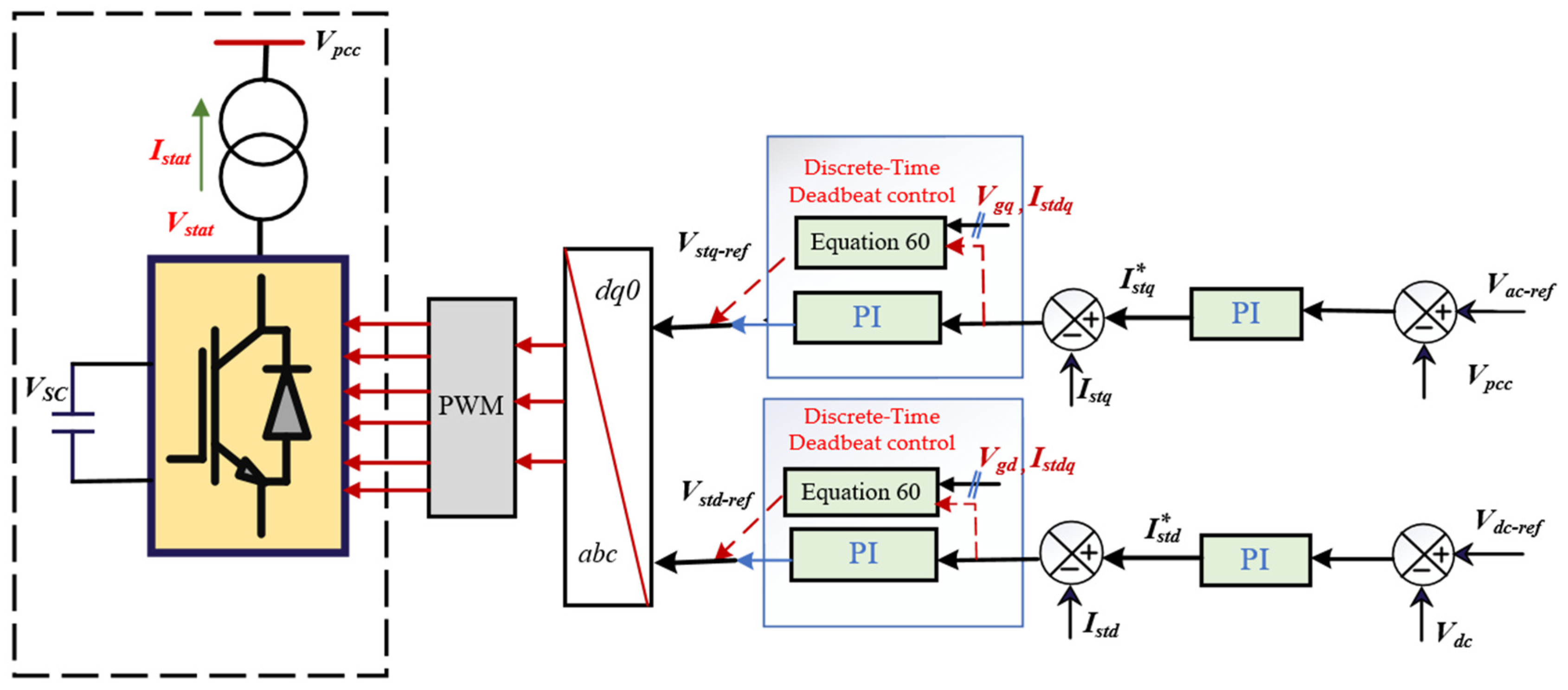
Discrete-time deadbeat control is an effective approach for STATCOM current regulation because of its fast dynamic response and simple digital implementation [31]. In this study, the inner current loop of the STATCOM shown in Figure 11 is implemented using a deadbeat controller, while the outer voltage loop is kept unchanged. The controller generates the d- and q-axis voltage references from the current tracking errors, including the grid voltage feedforward and decoupling terms, and then applies them to the PWM-based STATCOM converter through the dq0-to-abc transformation.
In the synchronous d q -reference frame, the current dynamics of the STATCOM converter are expressed as follows:
I ˙ s t d   = 1 L V s t d R I s t d + ω L I s t q V g d I ˙ s t q   = 1 L V s t q R I s t q ω L I s t d V g q
where I s t d and I s t q denote the STATCOM converter currents along the d - and q -axes, respectively; V s t d and V s t q are the inverter output voltages; V g d and V g q are the grid voltages at the point of common coupling (PCC); L and R represent the interfacing inductance and resistance; and ω is the synchronous angular frequency.
For digital implementation, (56) is discretized using the forward Euler approximation with sampling period T s , yielding the following discrete-time model:
I s t d q k + 1 = I s t d q k + T s L V s t d q k R I s t d q k + ω L J I s t d q k V g d q k
with
I s t d q = I s t d I s t q , V s t d q = V s t d V s t q , V g d q = V g d V g q , J = 0 1 1 0
One-step current tracking is enforced by imposing
I s t d q ( k + 1 ) = I s t d q * ( k )
where I s t d q * ( k ) is the reference STATCOM current vector generated by the outer voltage regulator.
By substituting (59) into (57) and solving for the control input, the inverter voltage commands are obtained as
V s t d , r e f = V g d + R I s t d ω L I s t q + L T s I s t d * I s t d V s t q , r e f = V g q + R I s t q + ω L I s t d + L T s I s t q * I s t q
Equation (60) represents the discrete-time deadbeat current control law for the inner STATCOM current loop. Under ideal modeling assumptions, with negligible computational delay and in the absence of saturation, the current tracking error can be eliminated within a single sampling interval.

4. Simulation and Analysis

A 2 MW DFIG-based WECS is implemented and analyzed using MATLAB/Simulink. To improve power quality and reduce variability, an SCES is connected to the DC-link of the WTG. The electrical power produced by the system is supplied to a 120 kV utility grid through a 30 km transmission line.
To enhance grid support capability, a STATCOM is installed at the 25 kV bus, and dynamic voltage regulation and reactive-power compensation are provided. The SCES is controlled using an ADRC strategy, whereas the STATCOM is operated under a discrete-time deadbeat control scheme to ensure fast and accurate response. The detailed simulation parameters are listed in Table 1. System performance is evaluated under variable-wind-speed conditions and grid-fault scenarios to assess voltage stability and transient performance. In addition, an SVC-based compensator is used for comparison under the same operating conditions. It is connected to the same PCC as the STATCOM. Since the SVC only provides conventional reactive power compensation for voltage support, it is used as a reference to evaluate the performance of the proposed STATCOM-SCES scheme. The SVC rating is chosen to ensure a fair comparison with the STATCOM-based system.

4.1. Scenario 1: Wind Speed Variation

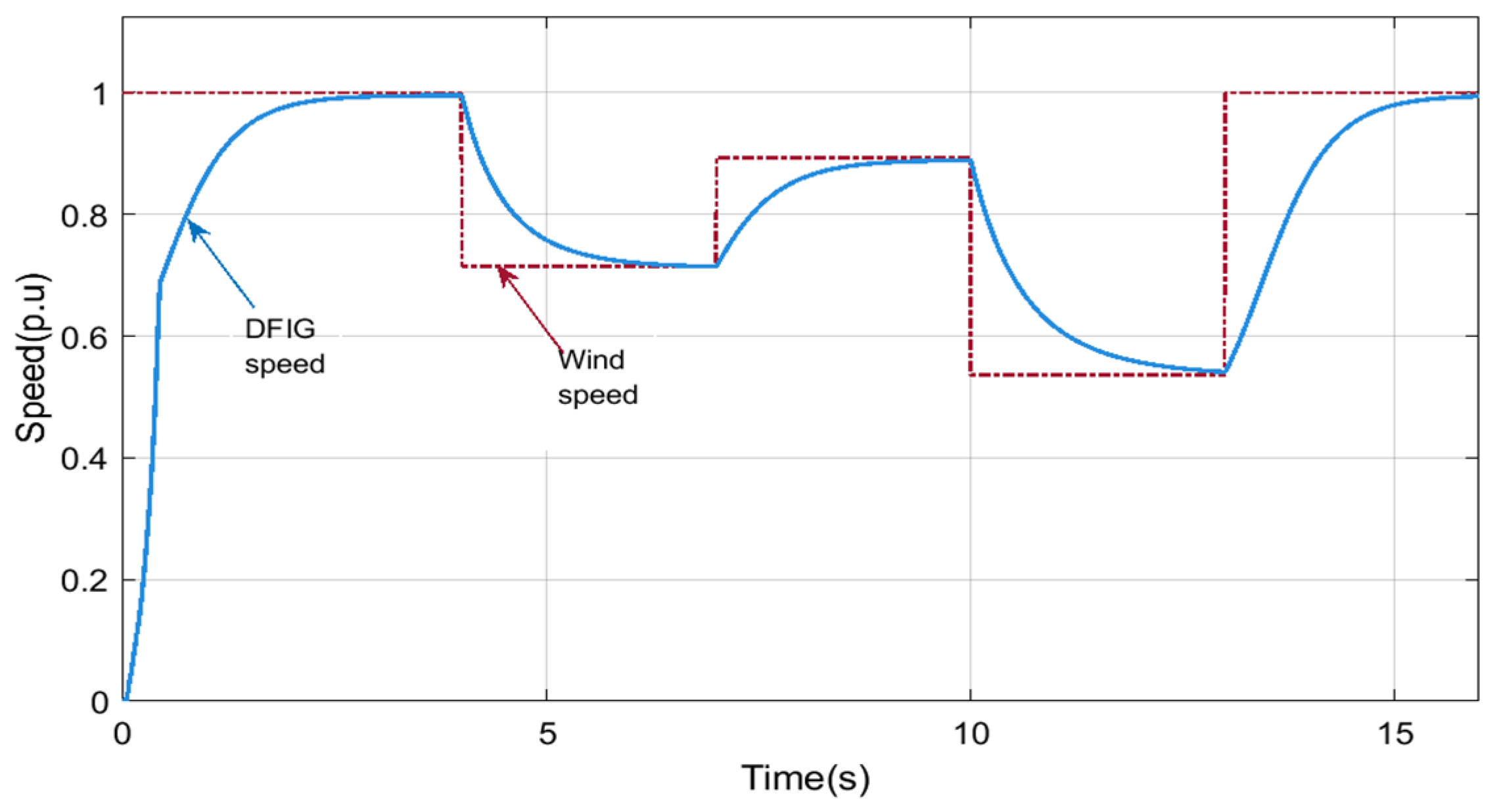
Under the prescribed wind speed variation, the dynamic response of the WT is analyzed. To maintain clarity and uniformity in the simulation procedure, several simplifying assumptions are applied. Power quality disturbances are neglected during the simulation intervals, and a wind speed of 11 m/s is selected to represent the nominal operating condition of the DFIG. Based on the wind speed profile shown in Figure 12, the generator speed is varied accordingly. This wind speed pattern is used to evaluate the impact of step-up and step-down variations on the turbine dynamic performance.
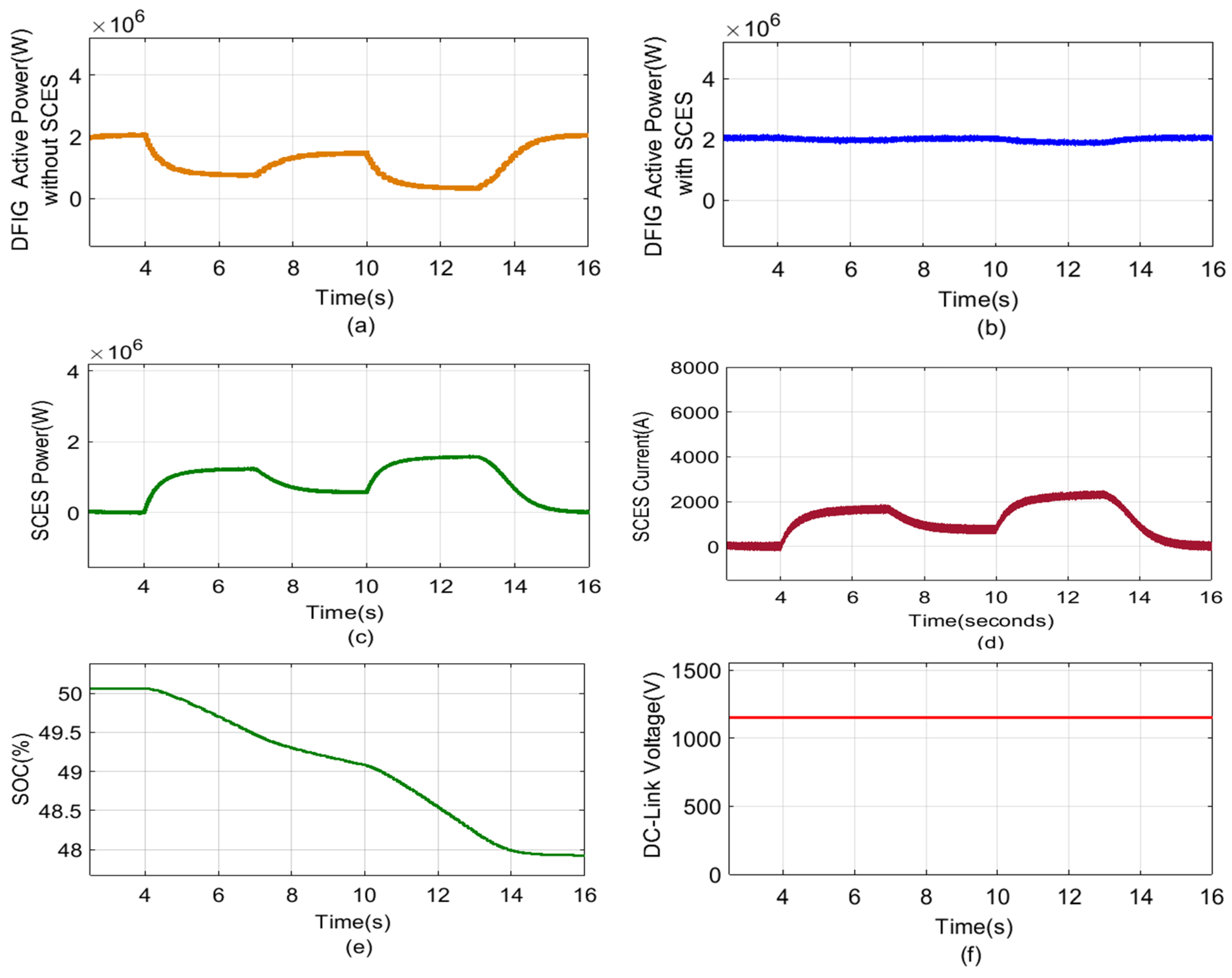
A comparative analysis is presented in Figure 13. In the absence of the proposed protection mechanism, significant fluctuations are observed in the DFIG output power in response to wind speed changes, as depicted in Figure 13a, which is consistent with the wind power characteristic in Figure 12; consequently, the total system output power is varied between 0.4 MW and 2 MW under the examined wind speed profiles. When the proposed control strategy is applied, the SCES is used to smooth the overall output power by supplying or absorbing complementary power through the GSC, and the total output power is maintained close to 2 MW over the 16 s simulation, as shown in Figure 13b. The compensating power provided by the SCES is illustrated in Figure 13c, and the SC current is shown in Figure 13d, by which the active-power exchange between the SCES and the grid is indicated.
In this scenario, the SCES mainly operates in discharge mode to compensate for the reduction in generated power when the wind speed falls below the rated value. For wind speeds above the rated value, the pitch angle controller limits the turbine speed and output power, so that no significant excess power is available for charging the SCES under the selected operating conditions. Therefore, the response shown in Figure 13c appears mainly in the form of active-power injection. The SOC of the SC is maintained between 48% and 50%, as shown in Figure 13e, by which the effectiveness of the SC configuration in mitigating power fluctuations under variable wind conditions is confirmed. In addition, the DC-link voltage response is shown in Figure 13f, by which the robustness of the bidirectional buck–boost converter control strategy in maintaining voltage stability during wind speed changes is demonstrated.

4.2. Scenario Two: Dynamic Response Under Voltage Sag Conditions

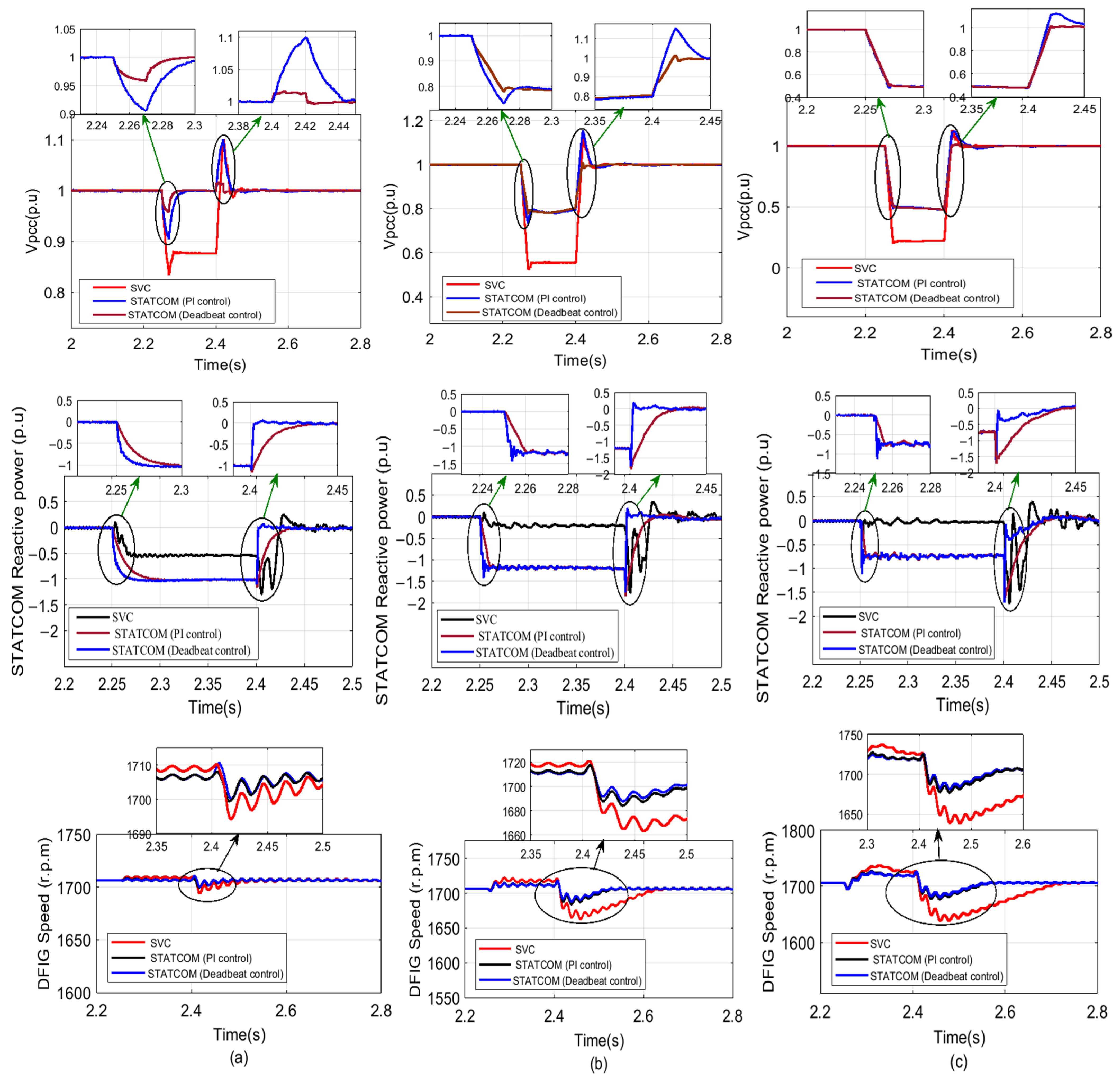
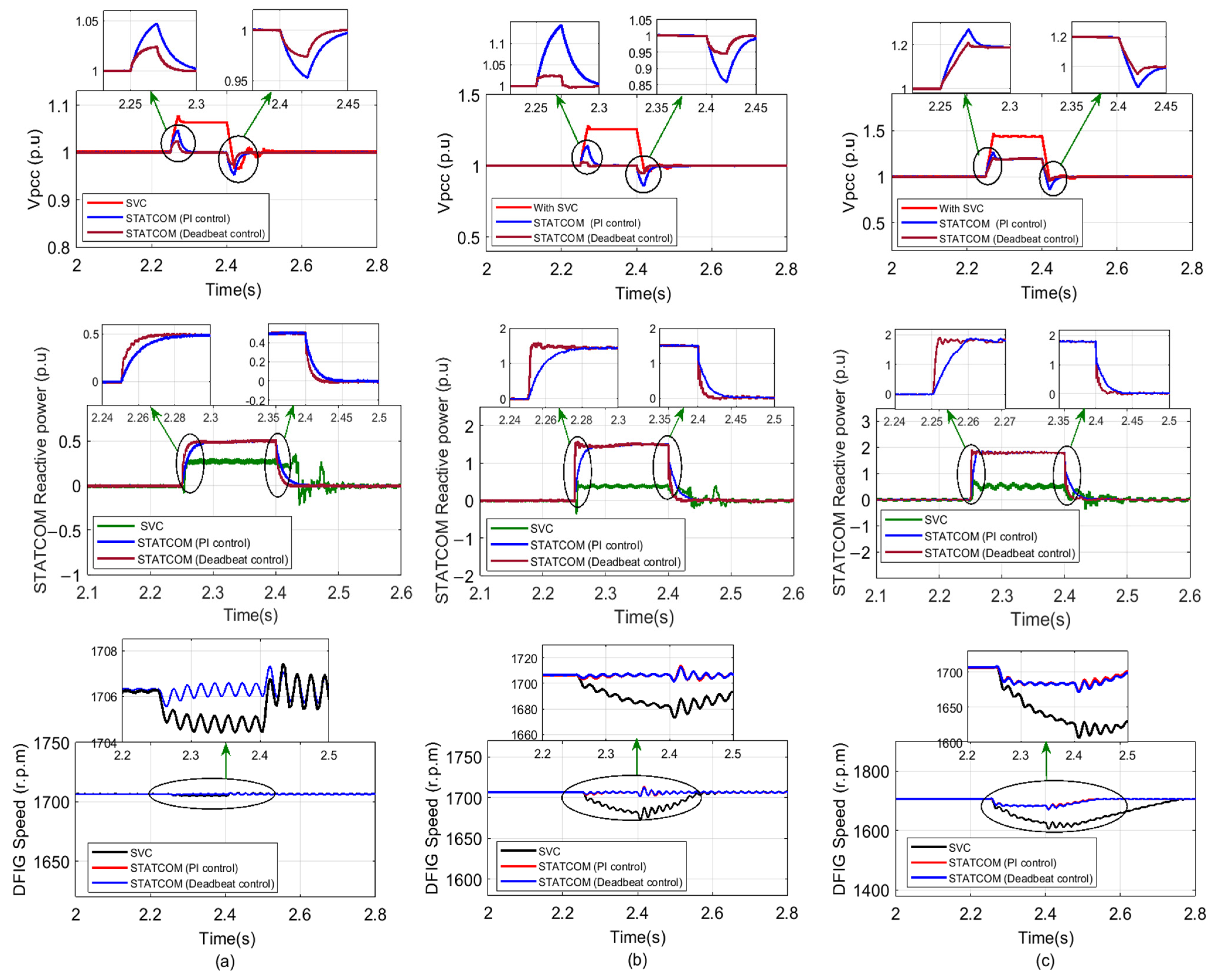
To evaluate the dynamic behavior of the proposed wind energy conversion system during grid disturbances, three-phase-to-ground voltage sags of 20%, 50%, and 80% are applied at t = 2.25 s and cleared at t = 2.40 s, while the wind speed is kept constant at 11 m/s. A detailed comparison of the system response is presented in Figure 14a–c under three compensation scenarios: an SVC, a STATCOM with conventional PI control, and a STATCOM with deadbeat control. The PCC voltage Vpcc, STATCOM reactive power, and DFIG rotor-speed responses are illustrated for each sag level. For the 20% voltage sag, shown in Figure 14a, a moderate dip is observed in Vpcc during the fault interval. With the SVC, the voltage drop is only partially compensated. When the STATCOM is employed, the voltage profile is significantly improved. However, the PI-controlled STATCOM exhibits a noticeable overshoot during voltage recovery after fault clearance, whereas the deadbeat-controlled STATCOM provides a smoother response with reduced transient peaks. The reactive-power response confirms that the STATCOM injects reactive power faster and with a higher magnitude than the SVC. Moreover, the DFIG rotor-speed deviation is smaller with the STATCOM than with the SVC, and the smoothest rotor-speed response is obtained with the deadbeat controller.
For the 50% voltage sag, illustrated in Figure 14b, a deeper voltage depression is observed. The SVC provides limited compensation, and Vpcc remains significantly below the nominal level during the fault. In contrast, the STATCOM offers stronger voltage support and improves post-fault voltage recovery. Compared with the deadbeat controller, the PI-controlled STATCOM shows a larger overshoot and more oscillatory behavior after fault clearance, while the deadbeat-controlled STATCOM achieves smoother voltage restoration and better damping. The reactive-power response also shows that the STATCOM delivers faster and stronger reactive-power injection than the SVC, with the deadbeat controller exhibiting a more stable dynamic response. As a result, rotor-speed excursions are reduced, and the DFIG speed returns more smoothly to its steady-state value. Under the severe 80% voltage sag, shown in Figure 14c, a sharp drop is observed in Vpcc during the fault period. The SVC demonstrates limited mitigation capability for such a deep disturbance. By contrast, the STATCOM significantly reduces the sag depth and enhances voltage recovery after fault clearance. Although the PI-controlled STATCOM improves the response compared with the SVC, it still produces larger transient oscillations and overshoot than the deadbeat-controlled STATCOM. The deadbeat strategy provides the smoothest voltage recovery and the best damping performance among the compared cases. In addition, rapid and substantial reactive-power injection is provided by the STATCOM, while the rotor-speed deviation is effectively constrained. The smallest rotor-speed excursion and the fastest stabilization are achieved with the deadbeat-controlled STATCOM.
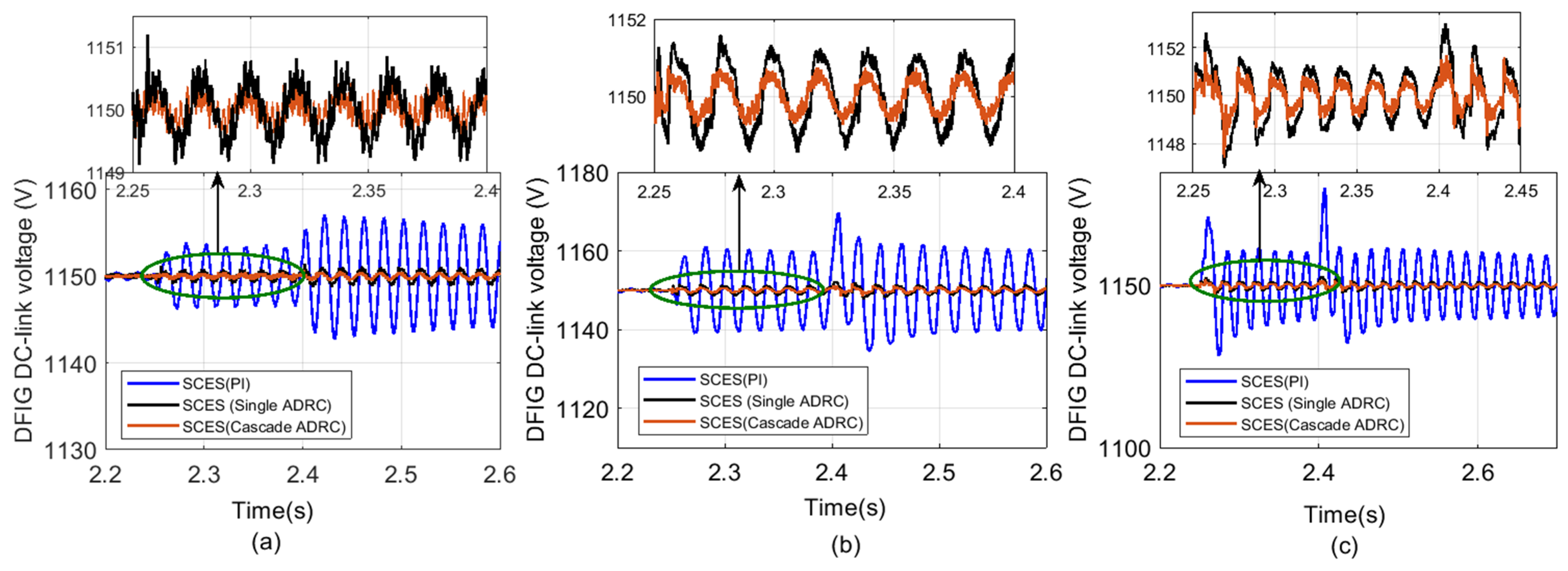
As mentioned earlier, the STATCOM is mainly responsible for supporting the generator terminal voltage through reactive-power compensation, while the supercapacitor-based SCES is mainly responsible for regulating and stabilizing the DC-link voltage. Therefore, the results shown in Figure 15 mainly highlight the role of the SCES control strategy in reducing DC-link voltage fluctuations during voltage sag conditions. For comparison, the single ADRC used in this study refers to a control structure with an outer ADRC and an inner PI controller, whereas the proposed cascaded ADRC uses ADRC in both the outer and inner control loops. The DC-link voltage response is compared under 20%, 50%, and 80% three-phase-to-ground voltage sag conditions using PI, single ADRC, and cascaded ADRC strategies, as shown in Figure 15a–c. In all cases, the PI controller shows the largest voltage oscillations and the poorest damping, and this becomes more noticeable as the sag level increases. The single ADRC improves the DC-link voltage response by reducing the oscillations and giving a better transient performance than the PI controller. However, the cascaded ADRC provides the smoothest and most stable response, with the smallest voltage deviations and the best damping, especially under the severe 80% sag. These results show that the proposed cascaded ADRC offers better disturbance rejection and stronger robustness for DC-link voltage regulation under fault conditions.

4.3. Scenario Three: Dynamic Response Under Voltage Swell Conditions

To examine how the proposed DFIG-based wind energy conversion system behaves during voltage swell events, three-phase voltage swells of 10%, 30%, and 50% are applied at t = 2.25 s and cleared at t = 2.40 s, while the wind speed is kept constant at 11 m/s. Figure 16a–c presents the system response under three compensation methods: SVC, STATCOM with conventional PI control, and STATCOM with deadbeat control. The results show the PCC voltage Vpcc, STATCOM reactive-power response, and DFIG rotor-speed for each swell level. For the 10% voltage swell shown in Figure 16a, the PCC voltage rises slightly above its nominal value during the disturbance. The SVC reduces this rise only partially, and the voltage returns more slowly to normal. In comparison, the STATCOM gives better voltage regulation and restores Vpcc more quickly. Between the two STATCOM controllers, the conventional PI control produces larger transient deviations, while the deadbeat controller gives a smoother response with smaller peaks and faster settling. The reactive-power response shows that the swell is mainly controlled by absorbing reactive power, and this is done more effectively by the STATCOM than by the SVC. As a result, rotor-speed oscillations are reduced, and the best speed response is obtained with the deadbeat-controlled STATCOM.
When the swell increases to 30%, as shown in Figure 16b, the overvoltage becomes more noticeable. The SVC still provides some compensation, but the PCC voltage remains above the nominal value for a longer time. On the other hand, the STATCOM absorbs reactive power faster and brings the voltage closer to its rated value. The PI-controlled STATCOM still shows more oscillations after the disturbance, whereas the deadbeat-controlled STATCOM gives a smoother recovery and better damping. This can also be seen in the rotor-speed response, where smaller deviations and faster stabilization are achieved with the deadbeat controller. For the severe 50% voltage swell in Figure 16c, the overvoltage becomes much higher and the weakness of the SVC becomes clear. Although the SVC can reduce the swell slightly, its performance is limited under this condition. In contrast, the STATCOM provides much stronger support and reduces the voltage rise more effectively. Both STATCOM-based methods perform better than the SVC, but the deadbeat controller gives the best overall response. It shows lower oscillations, better damping, and faster recovery than the conventional PI controller. The reactive-power response confirms that the STATCOM absorbs a larger amount of reactive power with faster dynamics, which helps improve the overall system stability and limit rotor-speed deviations. Overall, the best performance under voltage swell conditions is achieved by the deadbeat-controlled STATCOM.
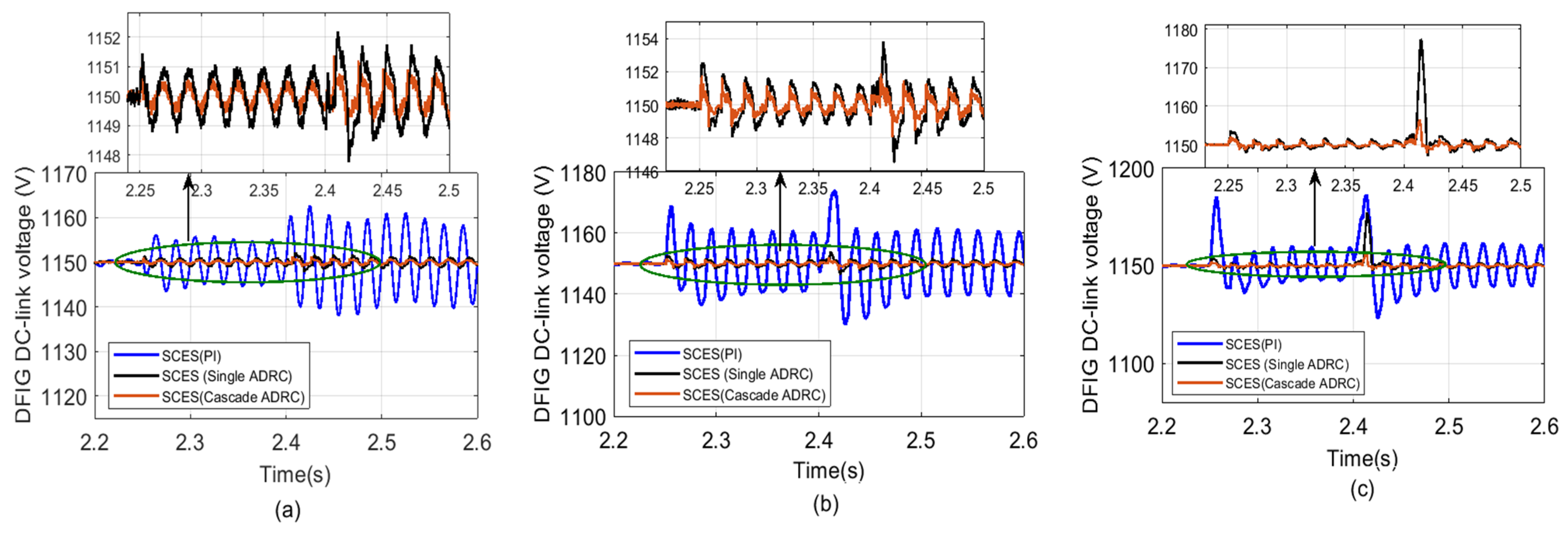
For the DC-link voltage response, Figure 17a–c presents the performance of the STATCOM-SCES under 10%, 30%, and 50% voltage swell conditions using PI, single-ADRC, and cascaded-ADRC controllers. In all cases, the PI controller shows the largest DC-link voltage oscillations and the weakest damping, and this behavior becomes more severe as the swell level increases. The single ADRC improves the response and reduces the voltage fluctuations compared with the PI controller. However, the cascaded ADRC provides the smoothest and most stable DC-link voltage response, with the smallest oscillations and the best damping performance. This improvement becomes more evident under the 50% swell condition, where the cascaded ADRC keeps the DC-link voltage closer to its nominal value and limits the transient deviations more effectively than the other controllers. These results confirm that the proposed cascaded ADRC provides better disturbance rejection and stronger robustness for DC-link voltage regulation under voltage swell conditions.

4.4. Dynamic Performance Evaluation of the Proposed Control Strategies

The dynamic performance of the proposed STATCOM control scheme is further assessed using the time-domain indices listed in Table 2 for the PCC voltage Vpcc, including the voltage level during the fault, overshoot, undershoot, rise time (tr), and settling time (ts). These indices provide a quantitative comparison of the voltage regulation capability under voltage sag and swell conditions. Under voltage sag conditions, the results in Table 2 clearly show that the SVC gives the weakest dynamic response in all tested cases.
For the 20% sag, the SVC produces an undershoot of 0.125 p.u. with a settling time of 0.04 s, whereas the STATCOM with deadbeat control reduces the undershoot to 0.04 p.u. and the settling time to 0.025 s. The PI-controlled STATCOM also improves the response compared with the SVC, but its overshoot and undershoot remain higher than those obtained with deadbeat control. When the sag level increases to 50%, the same trend is observed. The SVC maintains the lowest fault voltage level and shows the largest undershoot, reaching 0.47 p.u., while the deadbeat-controlled STATCOM limits the undershoot to 0.22 p.u. and shortens the settling time from 0.06 s to 0.035 s. The PI-controlled STATCOM again gives intermediate performance between the SVC and the deadbeat controller. For the severe 80% sag, the superiority of the deadbeat strategy becomes more evident. Although both STATCOM-based strategies keep the fault voltage higher than the SVC, the deadbeat controller gives the smallest overshoot and the fastest recovery, with an overshoot of only 0.02 p.u. and a settling time of 0.045 s. In contrast, the SVC and PI-controlled STATCOM show larger overshoot values of 0.13 p.u. and 0.15 p.u., respectively. A similar behavior can be observed under voltage swell conditions. For the 10% swell, the deadbeat-controlled STATCOM achieves the lowest overshoot and undershoot, together with the shortest settling time. At 30% swell, the SVC shows the largest voltage rise, with an overshoot of 0.28 p.u., while the deadbeat controller reduces it to 0.025 p.u. and improves the settling time to 0.03 s. Under the severe 50% swell, the deadbeat-controlled STATCOM still provides the best overall performance, limiting the overshoot to 0.20 p.u. compared with 0.46 p.u. for the SVC and 0.27 p.u. for the PI-controlled STATCOM. It also gives the lowest undershoot and the fastest settling response.
Table 3 summarizes the dynamic performance of the DFIG DC-link voltage, Vdc, under voltage sag and swell conditions for three SCES control strategies: PI, single ADRC, and cascaded ADRC. The comparison is based on overshoot, undershoot, and peak-to-peak ripple during the fault, since these indices clearly show the ability of each controller to suppress disturbances and maintain DC-link voltage stability. Under voltage sag conditions, the PI-controlled SCES gives the worst performance in all tested cases. For 20% sag, the PI controller produces 12 V overshoot, 10 V undershoot, and 12 V ripple, whereas the single ADRC reduces these values to 2 V, 2 V, and 2 V, respectively, and the cascaded ADRC gives the best result with only 1 V overshoot, 1 V undershoot, and 1 V ripple. For 50% sag, the same trend is observed: the PI controller shows large fluctuations (25 V overshoot, 20 V undershoot, and 20 V ripple), while the single ADRC improves the response (4 V, 3.7 V, and 3.2 V), and the cascaded ADRC provides the best overall performance (2.8 V, 3 V, and 2 V). Under the severe 80% sag, the difference becomes more pronounced. The PI controller gives the largest deviations (39 V overshoot, 32 V undershoot, and 22 V ripple). Although the single ADRC reduces the undershoot and ripple to 3 V and 3 V, its overshoot remains high at 29 V. In contrast, the cascaded ADRC achieves the best regulation, limiting the overshoot, undershoot, and ripple to 6 V, 2 V, and 2 V, respectively. A similar trend can be seen under voltage swell conditions. For 10% swell, the PI controller produces 7 V overshoot, 6 V undershoot, and 11 V ripple, while the single ADRC improves the response to 1.3 V, 1 V, and 2 V, and the cascaded ADRC gives the smallest deviations (0.5 V, 0.5 V, and 1 V). For 30% swell, the PI strategy again shows the largest oscillations (21 V overshoot, 12 V undershoot, and 22 V ripple), whereas the single ADRC reduces them to 1.6 V, 1.8 V, and 3 V, and the cascaded ADRC provides the best performance with 0.9 V overshoot, 0.8 V undershoot, and 1.7 V ripple. Under the severe 50% swell, the PI controller still exhibits the largest voltage deviations (21 V overshoot, 23 V undershoot, and 25 V ripple). The single ADRC improves the response (2.9 V, 3 V, and 1.9 V), but the cascaded ADRC remains the best strategy, with the lowest overall values of 1.9 V overshoot, 2.5 V undershoot, and 1 V ripple. Overall, the results confirm that the cascaded ADRC offers the most effective DC-link voltage regulation and the smoothest dynamic response under both sag and swell disturbances.
Overall, the numerical results in Table 2 are shown to confirm that superior grid-side performance is achieved with the proposed STATCOM control based on discrete-time deadbeat control. Tighter PCC voltage regulation, lower overshoot and undershoot, and consistently shorter settling times are obtained across all tested sag and swell levels compared with the SVC and the conventional PI-based STATCOM. Similarly, the results in Table 3 are shown to indicate that, although dc-link voltage regulation is improved with STATCOM-only operation relative to SVC-only operation, the integrated STATCOM–SCES configuration, particularly with ADRC, yields the smallest dc-link voltage deviations and the fastest settling times under all disturbance conditions. Consequently, enhanced converter stability, improved damping, and reduced transient stress are ensured by the proposed integrated strategy.

5. Conclusions

This study proposes a robust control scheme of a grid-connected DFIG-based system of wind energy conversion, where a STATCOM is controlled by a discrete-time deadbeat current controller and an SCES is controlled using a cascaded ADRC approach. The system is tested for both the variation in the wind speed and for the severe disturbance of the voltage sag and swell. The power discrepancy during changes in wind speed is complemented by the SCES, and the generator output power is regulated by the ADRC-controlled exchange of the power; as a result, the power smoothing is enhanced and power transients are significantly reduced. With the voltage sag events (20%, 50%, and 80%) and the voltage swell events (10%, 30% and 50%), improved PCC voltage regulation is achieved, and lower overshoot/undershoot values and shorter settling times are obtained compared with the SVC and traditional PI-based STATCOM schemes. On the converter side, better regulation of the dc-link voltage is obtained with SCES coordination, where smaller voltage variations and quicker damping are realized, and consequently, the power converter is not subjected to transient stress. Overall, the coordinated deadbeat–ADRC approach is demonstrated to offer improved damping behavior, faster dynamic response, better voltage regulation, and increased FRT capability, thereby enhancing the stability and resilience of DFIG-based wind energy systems in contemporary power grids. Future efforts are under HIL/real-time experimental validation and controller-parameter tuning and optimization, such that the operation of large-scale wind farms can be made possible and the robustness of the work can be evaluated in the framework of broader operating uncertainties.

Author Contributions

Conceptualization, A.M.N.; Methodology, A.M.N.; Software, A.K.A.; Formal analysis, A.K.A.; Investigation, O.A. and T.M.A.; Resources, O.A. and T.M.A.; Writing—original draft, O.A. and T.M.A.; Writing—review & editing, T.M.A.; Supervision, A.K.A. and T.M.A.; Project administration, O.A.; Funding acquisition, O.A. All authors have read and agreed to the published version of the manuscript.

Funding

The Researchers would like to thank the Deanship of Graduate Studies and Scientific Research at Qassim University for financial support (QU-APC-2026).

Data Availability Statement

The original contributions presented in this study are included in the article. Further inquiries can be directed to the corresponding author.

Conflicts of Interest

The authors declare no conflicts of interest.

References

  1. Loza, B.; Minchala, L.I.; Ochoa-Correa, D.; Martínez, S. Grid-Friendly Integration of Wind Energy: A Review of Power Forecasting and Frequency Control Techniques. Sustainability 2024, 16, 9535. [Google Scholar] [CrossRef]
  2. Thota, K.; Velpula, S.; Basetti, V. A Scientometric Analysis on DFIG-Based Wind Energy Conversion System Research Trends. SN Appl. Sci. 2024, 6, 1151. [Google Scholar] [CrossRef]
  3. Cavus, M. Advancing Power Systems with Renewable Energy and Intelligent Technologies: A Comprehensive Review on Grid Transformation and Integration. Electronics 2025, 14, 1159. [Google Scholar] [CrossRef]
  4. Behabtu, H.A.; Vafaeipour, M.; Kebede, A.A.; Berecibar, M.; Van Mierlo, J.; Fante, K.A.; Messagie, M.; Coosemans, T. Smoothing Intermittent Output Power in Grid-Connected Doubly Fed Induction Generator Wind Turbines with Li-ion Batteries. Energies 2023, 16, 7637. [Google Scholar] [CrossRef]
  5. Bensalah, A.; Barakat, G.; Amara, Y. Electrical Generators for Large Wind Turbine: Trends and Challenges. Energies 2022, 15, 6700. [Google Scholar] [CrossRef]
  6. Dhouib, B.; Zdiri, M.A.; Khan, B.; Guerrero, J.M.; Abdallah, H.H. Fault Analysis Addressing the Combined Influence of High Penetration of DFIG, SCIG, PMSG Wind Farms, and PV Farms in Power Grid Integration. Sci. Rep. 2025, 15, 34324. [Google Scholar] [CrossRef]
  7. Loulijat, A.; Hilali, A.; Makhad, M.; Chojaa, H.; Mahfoud, S.; Almalki, M.M.; Abdelaziz, A.Y.; Mossa, M.A. Transient Stability Improvement of a DFIG-Based Network-Connected Wind Power Plant by Control of the Flux Neutralization Current During Voltage Drop. Sci. Afr. 2025, 28, e02745. [Google Scholar] [CrossRef]
  8. Itouchene, H.; Amrane, F.; Boudries, Z.; Mekhilef, S.; Benbouhenni, H.; Bizon, N. Enhancing the Performance of Grid-Connected DFIG Systems Using Prescribed Convergence Law. Sci. Rep. 2025, 15, 28550. [Google Scholar] [CrossRef]
  9. Li, C.; Cao, Y.; Li, B.; Wang, S.; Chen, P. A Novel Power Control Scheme for Distributed DFIG Based on Cooperation of Hybrid Energy Storage System and Grid-Side Converter. Int. J. Electr. Power Energy Syst. 2024, 157, 109801. [Google Scholar] [CrossRef]
  10. Do, J.-H.; Kim, Y.-C.; Song, S.-H. Periodic Power Fluctuation Smoothing Control Using Blade Inertia and DC-Link Capacitor in Variable-Speed Wind Turbine. Energies 2025, 18, 3763. [Google Scholar] [CrossRef]
  11. Zhao, X.; Yan, Z.; Xue, Y.; Zhang, X.-P. Wind Power Smoothing by Controlling the Inertial Energy of Turbines with Optimized Energy Yield. IEEE Access 2017, 5, 23374–23382. [Google Scholar] [CrossRef]
  12. Jannati, M.; Hosseinian, S.H.; Vahidi, B.; Li, G.-J. ADALINE-Based Coordinated Control for Wind Power Fluctuations Smoothing with Reduced BESS Capacity. Energy 2016, 101, 1–8. [Google Scholar] [CrossRef]
  13. Elalfy, D.A.; Gouda, E.; Kotb, M.F.; Bureš, V.; Sedhom, B.E. Comprehensive Review of Energy Storage Systems Technologies, Objectives, Challenges, and Future Trends. Energy Strategy Rev. 2024, 54, 101482. [Google Scholar] [CrossRef]
  14. Behabtu, H.A.; Messagie, M.; Coosemans, T.; Berecibar, M.; Anlay Fante, K.; Kebede, A.A.; Mierlo, J.V. A Review of Energy Storage Technologies’ Application Potentials in Renewable Energy Sources Grid Integration. Sustainability 2020, 12, 10511. [Google Scholar] [CrossRef]
  15. Liu, X.; Li, W.; Guo, X.; Su, B.; Guo, S.; Jing, Y.; Zhang, X. Advancements in Energy-Storage Technologies: A Review of Current Developments and Applications. Sustainability 2025, 17, 8316. [Google Scholar] [CrossRef]
  16. Dissanayake, K.; Kularatna-Abeywardana, D. A review of supercapacitors: Materials, technology, challenges, and renewable energy applications. J. Energy Storage 2024, 96, 112563. [Google Scholar] [CrossRef]
  17. Zhang, J.; Min, G.; Xi, C. Supercapacitors for renewable energy applications: A review. Micro Nano Eng. 2023, 21, 100229. [Google Scholar] [CrossRef]
  18. Nori, A.M.; Abdulabbs, A.K.; Al-Shammaa, A.A.; Farh, H.M. Enhancing Fault Ride-Through and Power Quality in Wind Energy Systems Using Dynamic Voltage Restorer and Battery Energy Storage System. Electronics 2025, 14, 2760. [Google Scholar] [CrossRef]
  19. Ali, M.M.; Youssef, A.-R.; Ali, A.S.; Abdel-Jaber, G.T. Comparative Study of Different Pitch Angle Control Strategies for DFIG Based on Wind Energy Conversion System. Int. J. Renew. Energy Res. 2019, 9, 157–163. [Google Scholar] [CrossRef]
  20. Shuaibu, M.; Abubakar, A.S.; Shehu, A.F. Techniques for Ensuring Fault Ride-Through Capability of Grid-Connected DFIG-Based Wind Turbine Systems: A Review. Niger. J. Technol. Dev. 2021, 18, 39–46. [Google Scholar] [CrossRef]
  21. Qi, J.; Zhao, W.; Bian, X. Comparative study of SVC and STATCOM reactive power compensation for prosumer microgrids with DFIG-based wind farm integration. IEEE Access 2020, 8, 209878–209885. [Google Scholar] [CrossRef]
  22. Zheng, Z.; Yang, G.; Geng, H. Coordinated control of a doubly-fed induction generator-based wind farm and a static synchronous compensator for low voltage ride-through grid code compliance during asymmetrical grid faults. Energies 2013, 6, 4660–4681. [Google Scholar] [CrossRef]
  23. Camargo, R.S.; Amorim, A.E.A.; Bueno, E.J.; Encarnaçao, L.F. Novel Multilevel STATCOM for Power System Stability Enhancement on DFIG-Based Wind Farms. Electr. Power Syst. Res. 2021, 197, 107316. [Google Scholar] [CrossRef]
  24. Döşoğlu, M.K. Enhancement of LVRT capability in DFIG-based wind turbines with STATCOM and supercapacitor. Sustainability 2023, 15, 2529. [Google Scholar] [CrossRef]
  25. Hannoon, N.M.S.; Ananth, D.V.N.; Hidayat, M.N.B.; Chowdary, P.S.R.; Chakravarthy, V.V.S.S.S.; Sivashankar, K. A Common Capacitor-Based Three-Level STATCOM and Design of DFIG Converter for a Zero-Voltage Fault Ride-Through Capability. IEEE Access 2021, 9, 105153–105179. [Google Scholar] [CrossRef]
  26. Hete, R.R.; Mishra, S.K.; Dash, R.; Jyotheeswara Reddy, K.; Subburaj, V.; C, D. Design and analysis of DFIG-STATCOM coordinated P2P grid connected system using RMSprop. Sustainability 2022, 14, 15105. [Google Scholar] [CrossRef]
  27. Muisyo, I.N.; Muriithi, C.M.; Kamau, S.I. Enhancing Low Voltage Ride-Through Capability of Grid-Connected DFIG-Based WECS Using WCA–PSO Tuned STATCOM Controller. Heliyon 2022, 8, e09999. [Google Scholar] [CrossRef]
  28. Bhol, R.; Swain, S.C.; Dash, R.; Reddy, K.J.; Dhanamjayulu, C.; Kotb, H.; Emara, A. Performance analysis of DFIG support microgrid using GA optimized restricted Boltzmann Machine algorithm. Heliyon 2024, 10, e30669. [Google Scholar] [CrossRef] [PubMed]
  29. Kumar, V.; Pandey, A.S.; Sinha, S.K. Stability improvement of DFIG-based wind farm integrated power system using ANFIS controlled STATCOM. Energies 2020, 13, 4707. [Google Scholar] [CrossRef]
  30. Basnet, H.; Tran, M.; Roinila, T. Adaptive non-linear deadbeat current control of statcom based on online controller-bandwidth measurement. IEEE Trans. Ind. Appl. 2024, 60, 7893–7901. [Google Scholar] [CrossRef]
  31. Liang, H.; Minfu, A.; Zhang, Y.; Zhang, Y.; Zhan, S.; Zhang, Y.; Zhang, Y.; Tian, Z. Discrete-time deadbeat control for STATCOMs based on dq reference frame: A high-speed, tuning-free strategy for reactive current regulation. Front. Energy Res. 2025, 13, 1667565. [Google Scholar] [CrossRef]
  32. Chhab, N.; Abouloifa, A.; Elbouchikhi, E.; Houari, A.; Lachkar, I. ADRC-based dual-loop control and stability analysis of stacked interleaved DC–DC buck converter for hydrogen production using PEM electrolyzer. Energy Rep. 2026, 15, 109154. [Google Scholar] [CrossRef]
  33. Wang, Z.; Yimin, L. Mechanical–electrical-grid model for the doubly fed induction generator wind turbine system considering oscillation frequency coupling characteristics. Wind Energy 2024, 27, 33–52. [Google Scholar] [CrossRef]
  34. Mbuli, N. Improvement of Low Voltage Ride-Through (LVRT) of Doubly Fed Induction Generator (DFIG)-Based Wind Energy Conversion Systems (WECSs) by STATCOMs: A Systematic Literature Review. Energies 2026, 19, 443. [Google Scholar] [CrossRef]
  35. Bennia, I.; Baghli, L.; Pierfederici, S.; Mechernene, A. Implementation and Performance Assessment of a DFIG-Based Wind Turbine Emulator Using TSR-Driven MPPT for Enhanced Power Extraction. Appl. Sci. 2025, 15, 12966. [Google Scholar] [CrossRef]
  36. Nori, A.M.; Abdulabbas, A.K.; Aljohani, T.M. Coordinated Sliding Mode and Model Predictive Control for Enhanced Fault Ride-Through in DFIG Wind Turbines. Energies 2025, 18, 4017. [Google Scholar] [CrossRef]
  37. Rodriguez-Amenedo, J.L.; Montilla-DJesus, M.E.; Arnaltes, S.; Arredondo, F. RMS modeling and control of a grid-forming E-STATCOM for power system stability in isolated grids. Appl. Sci. 2025, 15, 3014. [Google Scholar] [CrossRef]
Figure 1. FRT enhancement methods and technologies [20].
Mathematics 14 01254 g001
Figure 2. System configuration of grid-connected DFIG with SCES and STATCOM.
Mathematics 14 01254 g002
Figure 3. Wind turbine aerodynamics: (a) Power coefficient vs. tip-speed ratio (zero pitch). (b) Aerodynamic torque vs. wind speed (MPPT, zero pitch).
Mathematics 14 01254 g003
Figure 4. Simplified equivalent circuit of the supercapacitor.
Mathematics 14 01254 g004
Figure 5. Schematic diagram of the STATCOM.
Mathematics 14 01254 g005
Figure 6. Control block diagram of RSC and GSC.
Mathematics 14 01254 g006
Figure 7. Schematic diagram of the SCES control.
Mathematics 14 01254 g007
Figure 8. STATCOM control model.
Mathematics 14 01254 g008
Figure 9. Basic transfer function block diagram.
Mathematics 14 01254 g009
Figure 10. Bode plot of Δ V T / Δ V for the STATCOM voltage-control system.
Mathematics 14 01254 g010
Figure 11. Proposed discrete-time deadbeat controller for the STATCOM.
Mathematics 14 01254 g011
Figure 12. Wind speed profile and DFIG rotor-speed.
Mathematics 14 01254 g012
Figure 13. Dynamic response of the DFIG-WT system under variable-wind-speed conditions: (a) DFIG output power without SCES; (b) DFIG output power with SCES; (c) supercapacitor (SC) power; (d) SCES current; (e) state of charge (SOC) of the SCES; (f) DC-link voltage of the DFIG-WT.
Mathematics 14 01254 g013
Figure 14. PCC voltage Vpcc, STATCOM reactive power, and DFIG rotor-speed responses under three-phase-to-ground voltage sags of (a) 20%, (b) 50%, and (c) 80% for the SVC, STATCOM with PI control, and STATCOM with deadbeat control.
Mathematics 14 01254 g014
Figure 15. DFIG DC-link voltage response under three-phase-to-ground voltage sags of (a) 20%, (b) 50%, and (c) 80% for STATCOM-SCES with PI, single ADRC, and cascaded ADRC controllers.
Mathematics 14 01254 g015
Figure 16. PCC voltage Vpcc, STATCOM reactive-power response, and DFIG rotor-speed response under symmetric voltage swell conditions of (a) 10%, (b) 30%, and (c) 50% for the SVC, STATCOM with PI control, and STATCOM with deadbeat control.
Mathematics 14 01254 g016
Figure 17. DFIG DC-link voltage response under symmetric voltage swell conditions of (a) 10%, (b) 30%, and (c) 50% for STATCOM-SCES with PI, single ADRC, and cascaded ADRC controllers.
Mathematics 14 01254 g017
Table 1. Parameters of the studied system.
ParametersValues
WTBlade radius (R)42 m
Nominal wind speed12 m/s
Gear ratio (N)1680/18.1
Air density1.225 kg/m3
Pitch angle0
DFIGRated power2 MW
Rated voltage690 V
Rated wind speed11 m/s
Rated frequency50 Hz
Stator resistance2.6 × 10−3
Rotor resistance2.9 × 10−3
Stator leakage inductance87 × 10−6 H
Magnetizing inductance2.5 × 10−3 H
Turns ratio0.34
STATCOMNominal voltage25 kV
Three-phase base power3 MVA
Reactive power limits±3 MVAr
Table 2. Dynamic performance indices of Vpcc under voltage sag and swell conditions.
EventLevelStrategyVpcc During Fault (p.u.) Overshoot (p.u.)Undershoot (p.u.)Rise Time (s)Settling Time (s)
Sag20%SVC0.8750.0850.1250.020.04
STATCOM (PI control)0.9970.10.0980.0180.035
STATCOM (Deadbeat control)0.9970.020.040.0120.025
50%SVC0.560.130.470.030.06
STATCOM (PI control)0.780.150.270.0250.055
STATCOM (Deadbeat control)0.780.020.220.0180.035
80%SVC0.220. 130.790.0350.07
STATCOM (PI control)0.490.150.520.030.06
STATCOM (Deadbeat control)0.490.020.50.0220.045
Swell10%SVC1.0640.0780.0350.0180.05
STATCOM (PI control)1.00.0450.0450.0150.04
STATCOM (Deadbeat control)1.00.0230.0250.0120.03
30%SVC1.2550.280.0550.020.055
STATCOM (PI control)1.020.140.140.0180.05
STATCOM (Deadbeat control)1.020.0250.060.0120.03
50%SVC1.440.460.050.0220.06
STATCOM (PI control)1.20.270.150.020.055
STATCOM (Deadbeat control)1.20.20.040.0150.035
Table 3. Dynamic performance indices of Vdc under voltage sag and swell conditions.
EventLevelStrategyOvershoot (V)Undershoot (V)Peak-to-Peak Ripple (V) During Fault
Sag20%SCES (PI)121012
SCES (Single ADRC)222
SCES (Cascaded ADRC)111
50%SCES (PI)252020
SCES (Single ADRC)43.73.2
SCES (Cascaded ADRC)2.832
80%SCES (PI)393222
SCES (Single ADRC)2933
SCES (Cascaded ADRC)622
Swell10%SCES (PI)7611
SCES (Single ADRC)1.312
SCES (Cascaded ADRC)0.50.51
30%SCES (PI)211222
SCES (Single ADRC)1.61.83
SCES (Cascaded ADRC)0.90.81.7
50%SCES (PI)212325
SCES (Single ADRC)2.931.9
SCES (Cascaded ADRC)1.92.51
Disclaimer/Publisher’s Note: The statements, opinions and data contained in all publications are solely those of the individual author(s) and contributor(s) and not of MDPI and/or the editor(s). MDPI and/or the editor(s) disclaim responsibility for any injury to people or property resulting from any ideas, methods, instructions or products referred to in the content.