Article

Generalized Quasi-Continuities of Multifunctions on Bitopological Spaces

Department of Mathematics and Computer Science, Faculty of Education, Trnava University in Trnava, Priemyselná 4, 918 43 Trnava, Slovakia
Mathematics 2026, 14(8), 1253; https://doi.org/10.3390/math14081253
Submission received: 11 February 2026 / Revised: 1 April 2026 / Accepted: 7 April 2026 / Published: 9 April 2026
(This article belongs to the Section B: Geometry and Topology)

Abstract

The aim of the article is to introduce a few variants of the generalized quasi-continuity of multifunctions defined on a bitopological space and to study their mutual relationship. The results known for functions are extended to multifunctions, which provide a wider range of relationships, mainly in terms of upper and lower semi-continuities and corresponding continuities with respect to a dual bitopology. The proof procedures are based on a notion of the pseudo-refinement of two topologies and the Baire property in a bitopological space. A characterization of some continuities depending on two topologies by continuities depending only on one topology and the structure of the sets of semi-discontinuity points are given. The equivalence between the upper and lower Baire continuity and upper and lower quasi-continuity (upper and lower continuity with respect to ideal topology) of compact-valued multifunction from a Baire space into a regular one has an important position. The end of this article is dedicated to several interpretations that facilitate and clarify orientation in the achieved results.

1. Introduction

This article is dedicated to the theory of continuous multifunctions, which has been intensively developed in recent decades. The theory of multifunctions was first codified by Kuratowski [1], and it has advanced in a variety of ways. Applications of this theory can be found, for example, in economic theory, noncooperative games, artificial intelligence, medicine, information sciences and decision theory [2].
Many different types of generalized continuities have been introduced for functions, e.g., quasi-continuity [3], α -continuity [4], β -continuity [5,6], semi-continuity [7], B-continuity, B r -continuity [8,9], B -continuity [10,11,12], some further generalizations of B -continuity, namely, contra B -continuity, slight B -continuity, weak B -continuity [13], somewhat continuity [14], cliquishness [15], and many more. Similar continuities can also be introduced for multifunctions, for which each generalized type of continuity can be introduced in a lower and an upper variant; see the comprehensive article [16].
The definition of quasi-continuity was introduced in [3]. Nevertheless, a function of two variables being quasi-continuous under the assumption that it is continuous in each variable separately was mentioned by Baire [17]. Many results have been obtained for functions as well as for multifunctions. The most-studied issues include the structure of continuity points of quasi-continuous functions (quasi-continuous multifunctions), the joint quasi-continuity of separately quasi-continuous functions, decomposition theorems, selection theorems, various applications of quasi-continuity in other areas of mathematics, and, last but not least, quasi-continuity variants in a bitopological space. Relevant results can be found in earlier published works [8,9,18,19,20,21,22,23,24,25], and recently published works [26,27,28] document the continued interest in quasi-continuity research. We bring to the reader’s attention an overview article [16] and a recently published book [29] that summarizes the results devoted to the quasi-continuity of functions and multifunctions from various aspects.
As for the bitopological case, a typical example is the strong quasi-continuity of real functions for the density topology and the Euclidean topology on real numbers [30,31,32,33]. For two arbitrary topologies, where one is finer than the other, the strong quasi-continuity of functions was studied in [27]. Another motivation is the work of Rychlewicz [34], where, in a bitopological space, two types of generalized notions of the quasi-continuity of multifunctions are defined, namely, the upper (lower) intersection quasi-continuity and the upper (lower) inclusion quasi-continuity.
The objectives of the article are the following:
(1)
To investigate the basic relations between three defined continuities with respect to two topologies (Definition 2, Remark 1);
(2)
To investigate the relations between quasi-continuity, Baire continuity and continuities with respect to a given ideal (Theorems 1 and 2);
(3)
To characterize continuities depending on two topologies by continuities depending on one topology (Theorems 7 and 8);
(4)
To investigate the structure of the sets of upper and lower semi-discontinuity points (Theorems 3, 5, and 9, Corollaries 7 and 9);
(5)
To investigate the relations between the continuities with respect to a given bitopological space and the continuities with respect to its dual bitopological space (Theorem 10, Corollaries 9 and 12);
(6)
To provide a unifying interpretation of the results using diagrams and formal symbolism (Section 5).

2. Definitions and Basic Observations

This chapter is a survey of some basic notions concerning semi-continuity, quasi-continuity, and Baire continuity. We also introduce three variants of the quasi-continuity of multifunctions with respect to two topologies that are the focus of our attention.
Let ( X , τ ) , Y be two topological spaces. The closure (the interior) of A X and the closure (the interior) of B Y are denoted by clτ ( A ) (intτ ( A ) ) and cl ( B ) (int ( B ) ), respectively. By I τ we denote the set of all subsets of X that are of τ -first category, and a set is called τ -residual if its complement is of τ -first category. By R we denote the real numbers.
A multifunction F : X Y is any set-valued mapping from X to 2 Y { } . For any set W Y , the upper and lower inverse images are defined as
F + ( W ) = { x X : F ( x ) W } , F ( W ) = { x X : F ( x ) W } .
Let us note that
X F ( W ) = F + ( Y W ) ,
X F + ( W ) = F ( Y W ) .
A function f : X Y is understood as a strictly nonempty single-valued multifunction with values { f ( x ) } , x X .
Definition 1. 
Let ( X , τ ) be a topological space and F : X Y be a multifunction. Then, F is said to be the following:
(1) 
Lower (upper) semi-τ-continuous (for short, τ- l s c (τ- u s c )) [1,16] at x X if, for any open set V for which F ( x ) V   ( F ( x ) V ), there is a τ-open set U containing x such that F ( u ) V ( F ( u ) V ) for any u U . F is τ- l s c (τ- u s c ) if it is so at any point x X . That means F ( V ) ( F + ( V ) ) is τ-open for any open set V Y . In the case of a single-valued mapping, the lower (upper) semi-τ-continuity coincides with τ-continuity.
By C τ ( f ) ( C τ l ( F ) , C τ u ( F ) ) we denote the set of all points in which a function f is τ-continuous (a multifunction F is τ- l s c , τ- u s c ), and D τ ( f ) = X C τ ( f ) ( D τ l ( F ) = X C τ l ( F ) , D τ u ( F ) = X C τ u ( F ) ) is the set of discontinuity points of f (semi-discontinuity points of F).
(2) 
Lower (upper) quasi-τ-continuous [16,25] (lower (upper) Baire τ-continuous [9]) at x X if, for any open set V for which F ( x ) V ( F ( x ) V ) and any τ-open set H containing x, there is a nonempty τ-open set (a set of τ-second category with the τ-Baire property) U H such that F ( u ) V ( F ( u ) V ) for any u U . In the case of a single-valued mapping, the lower (upper) quasi-τ-continuity (the lower (upper) Baire τ-continuity) coincides with quasi-τ-continuity (Baire τ-continuity). Note that, in the case of the lower (upper) Baire τ-continuity, the set U can be replaced by a set G A , where G is a set of τ-second category and τ-open and A is of τ-first category.
By Q τ ( f ) ( Q τ l ( F ) , Q τ u ( F ) ) we denote the set of all points in which a function f is quasi-τ-continuous (a multifunction F is lower quasi-τ-continuous, upper quasi-τ-contunuous).
By B τ ( f ) ( B τ l ( F ) , B τ u ( F ) ) we denote the set of all points in which a function f is Baire τ-continuous (a multifunction F is lower Baire τ-continuous, upper τ-Baire contunuous).
A bitopological space ( X , τ , σ ) is a set X with two topologies τ , σ on X. A bitopological space ( X , σ , τ ) is called a dual of ( X , τ , σ ) . A typical example of a bitopological space is the space ( R , τ , σ ) with the upper topology τ = { ( a , ) : a R } { , R } and the lower topology σ = { ( , a ) : a R } { , R } on the real line R . The usual Euclidean topology on R is the join topology τ σ = { H G : H τ , G σ } of τ and σ .
Denote
I τ = { A : A is of τ -first category},
I σ = { A : A is of σ -first category},
β ( τ , I ) = { G A : G τ and A I } , where I is an ideal on X,
β ( σ , I ) = { G A : G σ and A I } , where I is an ideal on X,
τ I —an ideal topology generated by the base β ( τ , I ) ,
σ I —an ideal topology generated by the base β ( σ , I ) ,
τ —an ideal topology generated by β ( τ , I τ ) ,
σ I τ —an ideal topology generated by β ( σ , I τ ) .
Note H τ if and only if H = G A , where G τ and A I τ .
The following definition introduces six variants of the generalized quasi-continuity of multifunction with respect to a bitopological space ( X , τ , σ ) :
Lower/upper quasi-continuity (denoted by q l ( τ , σ ) / q u ( τ , σ ) ) ;
Sectional lower/upper quasi-continuity (denoted by s q l ( τ , σ ) / s q u ( τ , σ ) ) ;
Weak sectional lower/upper quasi-continuity (denoted by w s q l ( τ , σ ) / w s q u ( τ , σ ) ) .
 
Definition 2. 
Let ( X , τ , σ ) be a bitopological space and F : X Y be a multifunction. Then, F is said to be one of the following:
(1) 
q l ( τ , σ ) -continuous ( q u ( τ , σ ) -continuous) at a X if, for any open set V for which V F ( a ) ( F ( a ) V ) and any τ-open set U containing a, there is a nonempty σ-open set G such that G U and F ( x ) V ( F ( x ) V ) for any x G .
(2) 
s q l ( τ , σ ) -continuous ( s q u ( τ , σ ) -continuous) at a X if, for any open set V for which V F ( a ) ( F ( a ) V ) and any τ-open set U containing a, there is a σ-open set G such that G U and F ( x ) V ( F ( x ) V ) for any x G .
(3) 
w s q l ( τ , σ ) -continuous ( w s q u ( τ , σ ) -continuous) at a X if, for any open set V for which V F ( a ) ( F ( a ) V ) and any τ-open set U containing a, there is a σ-open set G such that G U and F ( x ) V ( F ( x ) V ) for any x G U .
The global definitions are given by the local ones at each point. In the case of a single-valued mapping, both the upper and the lower versions defined above coincide with q ( τ , σ ) -continuity, s q ( τ , σ ) -continuity, and w s q ( τ , σ ) -continuity, respectively [35]. By Q τ , σ l ( F ) , s Q τ , σ l ( F ) , w s Q τ , σ l ( F ) , Q τ , σ u ( F ) , s Q τ , σ u ( F ) , w s Q τ , σ u ( F ) we denote the corresponding sets of continuity points.
In the sequel, we will consider the same notions with respect to a dual bitopological space ( X , σ , τ ) .
In Definition 2, item (1) is a natural generalization of the lower (upper) quasi- τ -continuity (for τ = σ ). Items (1) and (2) are motivated by the Richlewicz definition of lower (upper) inclusion and lower (upper) intersection quasi-continuity in a bitopological space ( X , τ , σ ) [34]. Item (3) is a generalization of a lower (upper) strong quasi-continuity that was introduced for a function (multifunction) defined on ( R , τ , σ ) , where τ is the density topology and σ is the Euclidean topology on the real line R [30,31,32,33].
Remark 1. 
Let ( X , τ , σ ) be a bitopological space. The next inclusions and equalities are clear (note, all inclusions can be strict [35]):
(1) 
(a) 
Q τ , σ l ( F ) s Q τ , σ l ( F ) w s Q τ , σ l ( F ) ,
Q τ , σ u ( F ) s Q τ , σ u ( F ) w s Q τ , σ u ( F ) .
(b) 
C σ l ( F ) s Q τ , σ l ( F ) , C τ l ( F ) s Q σ , τ l ( F ) ,
C σ u ( F ) s Q τ , σ u ( F ) , C τ u ( F ) s Q σ , τ u ( F ) .
(2) 
If σ 1 σ 2 and τ 1 τ 2 , then
w s Q τ 2 , σ 1 l ( F ) w s Q τ 1 , σ 2 l ( F ) , s Q τ 2 , σ 1 l ( F ) s Q τ 1 , σ 2 l ( F ) , Q τ 2 , σ 1 l ( F ) Q τ 1 , σ 2 l ( F ) ,
w s Q τ 2 , σ 1 u ( F ) w s Q τ 1 , σ 2 u ( F ) , s Q τ 2 , σ 1 u ( F ) s Q τ 1 , σ 2 u ( F ) , Q τ 2 , σ 1 u ( F ) Q τ 1 , σ 2 u ( F ) .
(3) 
If τ = σ , then
C τ l ( F ) Q τ , τ l ( F ) = s Q τ , τ l ( F ) = w s Q τ , τ l ( F ) = Q τ l ( F ) ,
C τ u ( F ) Q τ , τ u ( F ) = s Q τ , τ u ( F ) = w s Q τ , τ u ( F ) = Q τ u ( F ) .
If σ τ , then
Q σ , τ l ( F ) = s Q σ , τ l ( F ) = w s Q σ , τ l ( F ) , Q σ , τ u ( F ) = s Q σ , τ u ( F ) = w s Q σ , τ u ( F ) ,
Q σ l ( F ) Q τ l ( F ) Q σ , τ l ( F ) , w s Q τ , σ l ( F ) Q τ l ( F ) Q σ l ( F ) ,
Q σ u ( F ) Q τ u ( F ) Q σ , τ u ( F ) , w s Q τ , σ u ( F ) Q τ u ( F ) Q σ u ( F ) .
(4) 
A multifunction F is lower σ-somewhat continuous (upper σ-somewhat continuous) [14] if, for any open set V Y , int σ ( F ( V ) )   ( int σ ( F + ( V ) ) ) is nonempty, provided F ( V )   ( F + ( V ) ) is nonempty. If F is w s q l ( τ , σ ) -continuous ( w s q u ( τ , σ ) -continuous), then F is lower σ-somewhat continuous (upper σ-somewhat continuous). It is clear, since F is w s q l ( τ , σ ) -continuous ( w s q u ( τ , σ ) -continuous), then, for any open set V Y such that F ( V )   ( F + ( V ) ) is nonempty and for X τ , there is a nonempty σ-open set U such that U X = U and F ( u ) V   ( F ( u ) V ) for any u U X = U . That means U F ( V )   ( U F + ( V ) ) , so int σ ( F ( V ) )   ( int σ ( F + ( V ) ) ) is nonempty.
(5) 
In [35], we defined another type of continuity for a function called a s q ( τ , σ ) -continuity. Two variants of this notion can be introduced for a multifunction. It is easy te see that F is w s q l ( τ , σ I τ ) -continuous ( w s q u ( τ , σ I τ ) -continuous) if and only if F is a s q l ( τ , σ ) -continuous ( a s q u ( τ , σ ) -continuous). The w s q l ( τ , σ I τ ) -continuity ( w s q u ( τ , σ I τ ) -continuity) is the most general type of continuity for which it is still possible to achieve relevant results; see Section 4.
Lemma 1. 
Let ( X , τ , σ ) be a bitopological space and F : X Y be a multifunction. Then, we have the following:
(1) 
F is s q l ( τ , σ ) -continuous ( s q u ( τ , σ ) -continuous) at a X if and only if a cl τ ( int σ ( F ( V ) ) )   ( a cl τ ( int σ ( F + ( V ) ) ) ) for any open set V intersecting (containing)  F ( a ) .
(2) 
F is s q l ( τ , σ ) -continuous ( s q u ( τ , σ ) -continuous) if and only if F ( V ) cl τ ( int σ ( F ( V ) ) )   ( F + ( V ) cl τ ( int σ ( F + ( V ) ) ) ) for any open set V Y .
Proof. 
(1) Suppose F is s q l ( τ , σ ) -continuous ( s q u ( τ , σ ) -continuous) at a. Let a F ( V )   ( a F + ( V ) ) , V be open, and a U τ . From s q l ( τ , σ ) -continuity ( s q u ( τ , σ ) -continuity) of F at a there is a set G σ such that G U and G F ( V )   ( G F + ( V ) ) . Since G int σ ( F ( V ) )   ( G int σ ( F + ( V ) ) ) , G U int σ ( F ( V ) ) U   ( int σ ( F + ( V ) ) U ) . Thus, a cl τ ( int σ ( F ( V ) ) )   ( a cl τ ( int σ ( F + ( V ) ) ) ) .
Suppose a cl τ ( int σ ( F ( V ) ) ) ( a cl τ ( int σ ( F + ( V ) ) ) ) for any open set V intersecting (containing)  F ( a ) . Let a U τ . Then, U int σ ( F ( V ) )   ( U int σ ( F + ( V ) ) ) . Put G = int σ ( F ( V ) ) ( G = int σ ( F + ( V ) ) ). Then, U G and, for any x G F ( V )   ( x G F + ( V ) ) , F ( x ) V   ( F ( x ) V ) , so F is s q l ( τ , σ ) -continuous ( s q u ( τ , σ ) -continuous) at a.
(2) follows from (1). □

3. Ideal Topological Setting and Baire Continuity

This section discusses the Baire continuity, which is closely related to quasi-continuity that can be understood as a special case of the Baire property (Theorem 4). For the functions, the Baire continuity is equivalent to the quasi-continuity (Corollary 2), but, for multifunctions, the upper/lower Baire continuity is a more general type of continuity than the upper/lower quasi-continuity (Example 1(3)). Although it is more general than the upper/lower quasi-continuity, the upper Baire continuity guarantees the existence of a quasi-continuous selector [8,9] and the set of semi-continuity points of upper/lower Baire continuous multifunction is a residual set (Corollary 3).
The main objectives of this section are the equivalence between the upper and lower quasi-continuity, the upper and lower Baire continuity, and other pairs of continuities with respect to a given ideal. Also, the points of continuity of upper and lower Baire continuous multifunctions are investigated. The results of this section are used in Section 4.
Let I be an ideal on X. Recall, I is called τ -codence if any nonempty τ -open set is not from I . For example, if τ is the density topology ( σ is the Euclidean topology) on the real line R , then I τ ( I σ ) is τ -codence ( σ -codence). The family β ( τ , I ) = { G A : G τ and A I } is a base for an ideal topology τ I finer than τ . Similar notions can be considered with respect to a topolofy σ . The next remark is clear.
Remark 2. 
Let F : X Y be a multifunction. The next Conditions (1)–(3) are equivalent:
(1) 
F is q l ( τ , τ I ) -continuous ( q u ( τ , τ I ) ) -continuous at a.
(2) 
F is s q l ( τ , τ I ) -continuous ( s q u ( τ , τ I ) ) -continuous at a.
(3) 
F is w s q l ( τ , τ I ) -continuous ( w s q u ( τ , τ I ) ) -continuous at a.
(4) 
F is w s q l ( τ , σ I ) -cotinuous, s q l ( τ , σ I ) -continuous, q l ( τ , σ I ) -continuous ( w s q u ( τ , σ I ) -continuous, s q l ( τ , σ I ) -continuous, q l ( τ , σ I ) -continuous) at a X if and only if, for any open set V and any τ-open set U such that V F ( a ) ( F ( a ) V ) and a U , there is a nonempty set E β ( σ , I ) such that E U , E U , E U and V F ( e ) ( F ( e ) V ) for any e E U , E , E , respectively.
(5) 
It is clear, if F is upper Baire τ-continuous or lower Baire τ-continuous, then F is q u ( τ , τ ) -continuous or q l ( τ , τ ) -continuous, respectively. Suppose ( X , τ ) is τ-Baire. Then, F is q u ( τ , τ ) -continuous or q l ( τ , τ ) -continuous if and only if F is upper Baire τ-continuous or lower Baire τ-continuous, respectively.
(6) 
If X is finite and ( X , τ ) is τ-Baire, then F is upper Baire τ-continuous or lower Baire τ-continuous if and only if F is upper or lower quasi-τ-continuous, respectively.
Proof. 
Suppose X is finite. The implication “⇐” is clear. Suppose F is lower (upper) Baire τ -continuous at a X . Let V be open intersecting F ( a ) (containing F ( a ) ) and H τ , a H . Since F is lower Baire τ -continuous at a, there is a set H 0 τ and A 0 I τ such that H 0 A 0 H and F ( x ) V ( F ( x ) V ) for any x H 0 A 0 . Since X is finite, A 0 is τ -nowhere dense and cl τ ( A 0 ) is also τ -nowhere dense. As such, H 0 cl τ ( A 0 ) is τ -open nonempty and, for any x H 0 cl τ ( A 0 ) H 0 A 0 H , F ( x ) V ( F ( x ) V ). That means F is lower quasi- τ -continuous at a. □
Theorem 1. 
Let Y be regular, I be τ-codense, and F : X Y be a compact-valued multifunction. The next conditions are equivalent:
(1) 
F is upper and lower quasi-τ-continuous;
(2) 
F is q u ( τ , τ I ) -continuous and q l ( τ , τ I ) -continuous;
(3) 
F is s q u ( τ , τ I ) -continuous and s q l ( τ , τ I ) -continuous;
(4) 
F is w s q u ( τ , τ I ) -continuous and w s q l ( τ , τ I ) -continuous.
Proof. 
(1) ⇒ (2) is trivial.
(2) ⇒ (1) Let a X , V be open such that F ( a ) V ( V F ( a ) ) and a U τ . Since Y is regular and F is compact-valued, there is a nonempty open set V 0 V such that cl ( V 0 ) V and F ( a ) V 0 ( V 0 F ( a ) ).
Since F is q u ( τ , τ I ) -continuous ( q l ( τ , τ I ) -continuous) at a, there is a nonempty set E = G A β ( τ , I ) , E U , G τ , A I (see Remark 2(4)) such that F ( e ) V 0   ( F ( e ) V 0 ) for any e E . We will show F ( e ) cl ( V 0 )   ( F ( e ) cl ( V 0 ) ) for any e G . Suppose there is e 0 G such that F ( e 0 ) ( Y cl ( V 0 ) )   ( F ( e 0 ) X cl ( V 0 ) ) . Since F is q l ( τ , τ I ) -continuous ( q u ( τ , τ I ) -continuous), there is a nonempty set E 0 = G 0 A 0 , E 0 G , G 0 τ , A 0 I (see Remark 2(4)) such that F ( e ) ( Y cl ( V 0 ) )   ( F ( e ) X cl ( V 0 ) ) for any e E 0 . It is clear G G 0 (if G G 0 = , then G ( G 0 A 0 ) = , a contradiction with E 0 = G 0 A 0 G ). Since I is τ -codense, ( G G 0 ) ( A A 0 ) = ( G A ) ( G 0 A 0 ) = E E 0 . Thus, for e E E 0 , we have F ( e ) V 0 and F ( e ) ( Y cl ( V 0 ) )   ( F ( e ) V 0 and F ( e ) X cl ( V 0 ) ) , a contradiction. Therefore, F ( e ) cl ( V 0 )   ( F ( e ) cl ( V 0 ) ) for any e G . Since E = G A U , G U U . Thus, F is upper (lower) quasi- τ -continuous at a.
The equivalences ( 2 ) ( 3 ) ( 4 ) follow from items (1) (2), (3) in Remark 2. □
Corollary 1. 
Let Y be regular, I be τ-codense, and f : X Y be a function. The next conditions are equivalent:
(1) 
f is quasi-τ-continuous;
(2) 
f is q ( τ , τ I ) -continuous;
(3) 
f is s q ( τ , τ I ) -continuous;
(4) 
f is w s q ( τ , τ I ) -continuous.
Example 1. 
The assumption “ I is τ-codense”, the regularity of Y and one variant of continuity in Theorem 1 cannot be omitted:
(1) 
Let X = { a , b } , I = { , { a } } , τ = { X , , { a } } . Then, I is not τ-codense and τ I = { X , , { a } , { b } } . Put f : X R  ( R with the Euclidean topology) defined by f ( a ) = 1 and f ( b ) = 0 . Then, f is q ( τ , τ I ) -continuous but it is not quasi-τ-continuous.
(2) 
Let X = R with the Euclidean topology τ and Y = { 0 , 1 } with topology { , Y , { 0 } } . It is clear Y is not regular. Then, a function f : R Y defined as f ( x ) = 0 if x is irrational and f ( x ) = 1 otherwise is q ( τ , τ I ) -continuous, where I = { A R : A is of τ-first category} but it is not quasi-τ-continuous.
(3) 
A multifunction F : R R   ( G : R R ) defined as F ( x ) = [ 0 , 1 ] if x is rational and F ( x ) = { 0 } otherwise ( G ( x ) = { 0 } if x is rational and G ( x ) = [ 0 , 1 ] otherwise) is q u ( τ , τ I ) -continuous ( q l ( τ , τ I ) -continuous), but F ( G ) is not upper nor lower quasi-τ-continuous, where τ is the Euclidean topology on R and I = { A R : A is of τ-first category}.
Theorem 1 holds for any τ -codense ideal. Thus, it also holds for an ideal I τ = { A X : A is of τ -first category}, provided ( X , τ ) is τ -Baire. If ( X , τ ) is τ -Baire, then the upper Baire τ -continuity and the lower Baire τ -continuity are equivalent to the q u ( τ , τ ) -continuity and the q l ( τ , τ ) -continuity, respectively; see Remark 2(5). As such, we have the next result that is a spacial case of Theorem 1, since τ I τ = τ . Note I τ is τ -codense if and only if ( X , τ ) is τ -Baire.
Theorem 2. 
Let Y be regular, ( X , τ ) be τ-Baire and F : X Y be a compact-valued multifunction. The next conditions are equivalent:
(1) 
F is upper Baire τ-continuous and lower Baire τ-continuous;
(2) 
F is upper and lower quasi-τ-continuous;
(3) 
F is q u ( τ , τ ) -continuous and q l ( τ , τ ) -continuous;
(4) 
F is s q u ( τ , τ ) -continuous and s q l ( τ , τ ) -continuous;
(5) 
F is w s q u ( τ , τ ) -continuous and w s q l ( τ , τ ) -continuous.
Note, under the conditions that Y is regular, ( X , τ ) is τ -Baire, I is a τ -codense ideal and F : X Y is a compact-valued multifunction, all items from Theorems 1 and 2 are equivalent. This is a special case when the second topology is finer then the first one, and further combinations are solved in Section 4.
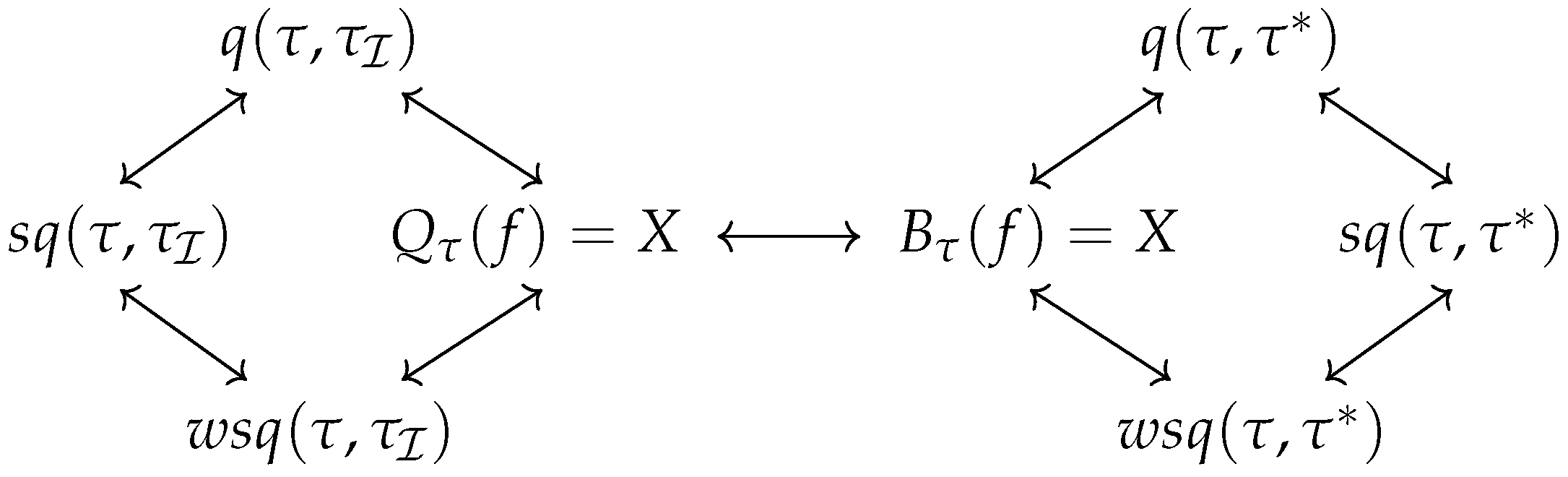
In function setting, by Theorems 1 and 2, we have the next corollary.
Corollary 2. 
Let Y be regular, ( X , τ ) be τ-Baire, I be a τ-codense ideal and f : X Y be a function. Then, we can express all equivalences by the following diagram.
Mathematics 14 01253 i001
Theorem 3. 
Let ( X , τ ) be a topological space, Y be a regular second countable topological space and F : X Y be a multifunction:
(1) 
If F is q u ( τ , τ ) -continuous ( s q u ( τ , τ ) -continuous, w s q u ( τ , τ ) -continuous), then F is τ- l s c except for a set of τ-first category ( D τ l ( F ) I τ ) .
(2) 
If F is q l ( τ , τ ) -continuous ( s q l ( τ , τ ) -continuous, w s q l ( τ , τ ) -continuous) and compact-valued, then F is τ- u s c except for a set of τ-first category ( D τ u ( F ) I τ ) .
Proof. 
Let B = { B n : n = 1 , 2 , } be a base of Y.
(1) For a set A X , put D τ ( A ) = { x X : A G is of τ -second category for any G τ containing x}. Let S τ l ( F ) = { x X : x int τ ( D τ ( F ( V ) ) ) for any open set V such that V F ( x ) }.
Let a S τ l ( F ) . We show F is τ - l s c at a. Let V be open and V F ( a ) . Since Y is regular, there is an open set V 0 such that cl ( V 0 ) V and V 0 F ( a ) . Denote H = int τ ( D τ ( F ( V 0 ) ) . It is clear a int τ ( D τ ( F ( V 0 ) ) . We will show cl ( V 0 ) F ( x ) for any x H . Suppose there is x 0 H such that F ( x 0 ) Y cl ( V 0 ) . Since F is q u ( τ , τ ) -continuous, there is a nonempty set G A H , where G τ , A I τ (see Remark 2(4)) and F ( x 0 ) Y cl ( V 0 ) for any x G A . (★)
It is clear H G . Since H G int τ ( D τ ( F ( V 0 ) ) D τ ( F ( V 0 ) ) , there is a set S H G which is of τ -second category and F ( x ) V 0 for any x S . Since S A (otherwise S A , so S is of τ -first category, a contradiction), there is s S A ( H G ) A G A , for which F ( s ) V 0 . Simultaneously, F ( s ) Y cl ( V 0 ) (see (★)), a contradiction.
Now, it is sufficient to show that X S τ l ( F ) is of τ -first category. It is clear
X S τ l ( F ) n = 1 [ F ( B n ) int τ ( D τ ( F ( B n ) ) ) ] = : R .
Denote
A n = F ( B n ) D τ ( F ( B n ) ) ,
C n = [ D τ ( F ( B n ) ) int τ ( D τ ( F ( B n ) ) ) ] F ( B n ) .
Since the sets A n and C n are of τ -first category, the set
R = n = 1 A n C n
is of τ -first category, so X S τ l ( F ) is of τ -first category.
(2) Let S τ u ( F ) = { x X : x int τ ( D τ ( F + ( V ) ) for any open set V such that F ( x ) V }. Similar to case (1), we can show that F is τ - u s c at x if x S τ u ( F ) . Since F is compact-valued, for any open set V containing F ( x ) , there are B n 1 , , B n k from B such that F ( x ) s = 1 k B n s V . So,
X S τ u ( F ) n = 1 [ F + ( G n ) int τ ( D τ ( F + ( G n ) ) ) ] = : R
where { G 1 , G 2 , G 3 , } is a sequence of all finite unions of sets from B . Similar to case (1), we can show R is of τ -first category, so X S τ u ( F ) is of τ -first category.
The other cases in brackets follow from the equations Q τ , τ u = s Q τ , τ u = w s Q τ , τ u and Q τ , τ l = s Q τ , τ l = w s Q τ , τ l ; see Remark 1(3). □
Theorem 3 has two applications. It can be applied for the upper (lower) τ -quasi-continuity and the upper (lower) Baire τ -continuity (see Remark 2(5)).
Corollary 3 
([8,18]). Let Y be a regular second countable topological space and F : X Y be a multifunction:
(1) 
If F is upper τ-quasi-continuous, upper Baire τ-continuous, then F is τ- l s c except for a set of τ-first category ( D τ l ( F ) I τ ) .
(2) 
If F is compact-valued and lower τ-quasi-continuous, lower Baire τ-continuous, then F is τ- u s c except for a set of τ-first category ( D τ u ( F ) I τ ) .
Proof. 
If F is upper τ -quasi-continuous (lower τ -quasi-continuous and compact-valued), then F is q u ( τ , τ ) -continuous ( q l ( τ , τ ) -continuous) and, by Theorem 3, F is τ - l s c ( τ - u s c ) except for a set of τ -first category.
If F is upper Baire τ -continuous (lower Baire τ -continuous and compact-valued), then F is q u ( τ , τ ) -continuous ( q l ( τ , τ ) -continuous) and ( X , τ ) -Baire. By Remark 2(5), F is q u ( τ , τ ) -continuous ( q l ( τ , τ ) -continuous) and, by Theorem 3, F is τ - l s c ( τ - u s c ) except for a set of τ -first category. □
By Corollary 2, for a function, we have the next result.
Corollary 4. 
Let Y be a regular second countable topological space, X be τ-Baire, I be a τ-codense ideal and f : X Y be a function. If f is τ-quasi-continuous, Baire τ-continuous, q ( τ , τ ) -continuous, w s q ( τ , τ I ) -continuous, s q ( τ , τ I ) -continuous, q ( τ , τ I ) -continuous, then f is τ-continuous except for a set of τ-first category ( D τ ( f ) I τ ) , respectively.
The next theorem shows that the lower and upper τ -Baire continuities are very close to a multifunction having the τ -Baire property.
Theorem 4. 
Let ( X , τ ) be a τ-Baire topological space, Y be a regular second countable topological space and F : X Y be a compact-valued multifunction. Suppose any open subset of Y is an F σ -set:
(1) 
F is lower Baire τ-continuous if and only if, for any open set V, F ( V ) = ( G A ) B , where G τ , A , B I τ and B cl τ ( G ) .
(2) 
F is upper Baire τ-continuous if and only if, for any open set V, F + ( V ) = ( G A ) B , where G τ , A , B I τ and B cl τ ( G ) .
Proof. 
(1) ⇒: Let F be lower Baire τ -continuous and V be an open subset of Y. Since any open subset of Y is an F σ -set, V = n = 1 F n , where F n is closed for any n = 1 , 2 , , then,
F ( V ) = n = 1 F ( F n ) = X n = 1 F + ( X F n ) .
By Corollary 3, F is τ - u s c except for a set A, which is of τ -first category. Thus, F + ( X F n ) ( X A ) is open in the subspace X A . That means F + ( X F n ) has the τ -Baire property; consequently, F ( V ) has the τ -Baire property. Let F ( V ) = ( G A ) B , where G τ and A , B are of τ -first category. We show B cl τ ( G ) . Suppose there is x B cl τ ( G ) . Since F is lower Baire τ -continuous, there is a set C which is of τ -second category with the τ -Baire property and C F ( V ) ( X cl τ ( G ) ) = ( ( G A ) B ) ( X cl τ ( G ) ) B . As such, C is of τ -first category, a contradiction.
⇐: Let a X , U be τ -open containing a and V be open intersecting F ( a ) . Then, a F ( V ) U = [ ( G A ) B ] U = [ ( G A ) U ] [ B U ] , where G τ , A , B I τ and B cl τ ( G ) . We show ( G A ) U is of τ -second category. If a ( G A ) U , then ( G A ) U is of τ -second category, since ( X , τ ) is τ -Baire. If a B U , then G U , since B cl τ ( G ) . Therefore, ( G A ) U is of τ -second category. Moreover, ( G A ) U has the τ -Baire property. Since ( G A ) U F ( V ) U , F is lower Baire τ -continuous at a.
Item (2) is similar. □

4. Bitopological Setting

This section presents the main results of this article. In particular, we study the continuities depending on two topologies and their properties depending on one topology. Namely, let F be q l ( τ , σ ) -continuous ( q u ( τ , σ ) -continuous), s q l ( τ , σ ) -continuous ( s q u ( τ , σ ) -continuous), and w s q l ( τ , σ ) -continuous ( w s q u ( τ , σ ) -continuous). All continuities depend on two topologies. The following questions are of interest:
(1)
Is F lower/upper quasi-continuous or lower/upper Baire contnuous with respect to τ or σ ? (Theorem 6, Corollary 7);
(2)
What is the structure of the sets of discontinuity points D τ l ( F ) , D τ u ( F ) , D σ l ( F ) , D σ u ( F ) of F? (Theorems 5 and 9, Corollary 9);
(3)
Is there a characterization of a continuity depending on two topologies by continuity/continuities depending only on one topology? (to find one topological decomposition theorem; Theorems 7 and 8);
(4)
What are the continuity properties of F with respect to the corresponding dual bitopological space? (Theorem 10, Corollaries 9 and 12).
We focus mainly on the following combinations of two continuities:
(5)
w s q l ( τ , σ ) and w s q u ( τ , σ ) / s q l ( τ , σ ) and s q u ( τ , σ ) (the same topological order and the different versions of continuities, Corollaries 7 and 10);
(6)
w s q u ( τ , σ ) and w s q u ( σ , τ ) / s q l ( τ , σ ) and s q l ( σ , τ ) (the different topological order and the same versions of continuities—see the last two diagrams in Section 5);
(7)
w s q l ( τ , σ ) and w s q u ( σ , τ ) / s q l ( τ , σ ) and s q u ( σ , τ ) (the different topological order and different versions of continuities, Corollaries 9 and 12).
Let us note a few known facts in a bitopological setting, provided σ τ .
Lemma 2. 
Let ( X , τ , σ ) be a bitopological space, σ τ and F : X Y be a multifunction:
(1) 
If F is w s q l ( τ , σ ) -continuous at a, then F is lower quasi-τ-continuous at a and lower quasi-σ-continuous at a.
(2) 
If F is w s q u ( τ , σ ) -continuous at a, then F is upper quasi-τ-continuous at a and upper quasi-σ-continuous at a.
Suppose Y is second countable:
(3) 
If F is w s q l ( τ , σ ) -continuous, then
D τ l ( F ) I τ I σ , D σ l ( F ) I σ .
Moreover, if F is compact-valued and Y is regular, then
D τ u ( F ) I τ I σ , D σ u ( F ) I σ .
(4) 
If F is w s q u ( τ , σ ) -continuous and compact-valued, then
D τ u ( F ) I τ I σ , D σ u ( F ) I σ .
Moreover, if Y is regular, then
D τ l ( F ) I τ I σ , D σ l ( F ) I σ .
Proof. 
Since σ τ , (1) and (2) hold; see Remark 1(3).
(3) Suppose F is w s q l ( τ , σ ) -continuous and Y is second countable. By (1), F is lower quasi- τ -continuous and lower quasi- σ -continuous, and, by [16], D τ l ( F ) is of τ -first category and D σ l ( F ) is of σ -first category. Since C σ l ( F ) C τ l ( F ) , D τ l ( F ) is also of σ -first category. Moreover, if F is compact-valued and Y is regular, then (by [16]) D τ u ( F ) is of τ -first category and D σ u ( F ) is of σ -first category. Since C σ u ( F ) C τ u ( F ) , D τ u ( F ) is also of σ -first category.
(4) Suppose F is compact-valued w s q u ( τ , σ ) -continuous and Y is second countable. By (2), F is upper quasi- τ -continuous and upper quasi- σ -continuous, and, by [16], D τ u ( F ) is of τ -first category and D σ u ( F ) is of σ -first category. Since C σ u ( F ) C τ u ( F ) , D τ u ( F ) is also of σ -first category. Moreover, if Y is regular, then (by [16]) D τ l ( F ) is of τ -first category and D σ l ( F ) is of σ -first category. Since C σ l ( F ) C τ l ( F ) , D τ l ( F ) is also of σ -first category. □
A question is if, in Lemma 2, w s q l ( τ , σ ) -continuity ( w s q u ( τ , σ ) -continuity) can be changed by a dual continuity, namely, by w s q l ( σ , τ ) -continuity ( w s q u ( σ , τ ) -continuity). The next example shows it is not possible.
Example 2. 
The function F (G) in Example 1(3) is w s q u ( τ , τ ) -continuous (G is w s q l ( τ , τ ) -continuous), but C τ u ( F ) ( C τ l ( G ) ) is the set of all rational numbers.
In Lemma 2, the structure of the sets D τ u ( F ) , D τ l ( F ) , D σ u ( F ) , D σ l ( F ) follows from the condition σ τ , which guarantees the lower (upper) quasi- τ -continuity and the lower (upper) quasi- σ -continuity. When the condition σ τ is omitted, the structure of the sets D τ u ( F ) , D τ l ( F ) , D σ u ( F ) , D σ l ( F ) may vary, as the next example shows.
Example 3. 
(1) Let X = { a , b , c , d } . Put σ = { , X , { d } , { a , b } , { a , b , d } } , τ = { , X , { b } , { c , d } , { b , c , d } } , σ τ , τ σ . The sets of σ-first category: , { c } . The sets of τ-first category: , { a } . A multifunction F : X R   ( R with the Euclidean topology), defined as F ( a ) = F ( c ) = { 1 , 2 } and F ( b ) = F ( d ) = { 1 } , is w s q u ( τ , σ ) -continuous but D σ u ( F ) = { b } , D σ l ( F ) = { a , c } , D τ u ( F ) = { d } , D τ l ( F ) = { a , c } are not of τ-first category nor σ-first category.
A multifunction G : X R defined as G ( a ) = G ( c ) = { 1 } and G ( b ) = G ( d ) = { 1 , 2 } is w s q l ( τ , σ ) -continuous but D σ u ( G ) = { a , c } , D σ l ( G ) = { b } , D τ u ( G ) = { a , c } , D τ l ( G ) = { d } are not of τ-first category nor σ-first category.
(2) Even for a s q ( τ , σ ) -continuous function, the set D σ ( f ) does not have to be from I τ . Let X = { a , b , c } . Put σ = { , X , { a } , { c } , { a , c } , { b , c } } , τ = { , X , { a , b } } , σ τ , τ σ . The sets of σ-first category: , { b } . The sets of τ-first category: , { c } . A function f : X R   ( R with the Euclidean topology) defined as f ( a ) = f ( b ) = 1 and f ( c ) = 2 is s q ( τ , σ ) -continuous but D σ ( f ) = { b } is not of τ-first category.
(3) Let X = { a , b , c , d } . Put σ = { , X , { a } , { b , c } , { d } , { a , b , c } , { b , c , d } , { a , d } } , τ = { , X , { a } ,   { b } , { d } , { a , b } , { b , d } , { a , d } , { a , b , d } } , σ τ , τ σ . The sets of τ-first category: ∅, { c } . The sets of σ-first category: ∅. Let f : X R , f ( a ) = f ( c ) = 1 , f ( b ) = f ( d ) = 2   ( R with the Euclidean topology). Then, f is w s q ( τ , σ ) -continuous, f is quasi-τ-continuous, D τ ( f ) = { c } is of τ-first category, D σ ( f ) = { b , c } is of τ-second category. Note, the conditions τ σ , B ( τ , σ ) hold (see Definition 3 below) and this example shows the sets D σ u ( F ) and D σ l ( F ) in Corollary 7(3) are not necessary from I τ .
A question is whether D σ u ( F ) and D σ l ( F ) in Lemma 2 are of τ -first category, provided σ τ . The next example shows it does not apply.
Example 4. 
Let X = { a , b , c } . Put σ = { , X , { a } , { b } , { a , b } } , τ = 2 X , σ τ .
The sets of σ-first category: , { c } .
The sets of τ-first category: ∅.
A multifunction F 1 : X R  ( R with the Euclidean topology) defined as F 1 ( a ) = F 1 ( b ) = { 0 , 1 } and F 1 ( c ) = { 0 } is w s q l ( τ , σ ) -continuous but D σ l ( F 1 ) = { c } is not of τ-first category. Note, F 1 is not w s q u ( τ , σ ) -continuous at c.
A multifunction F 2 : X R defined as F 2 ( a ) = F ( b ) = { 1 } and F 2 ( c ) = { 1 , 2 } is w s q u ( τ , σ ) -continuous but D σ u ( F 2 ) = { c } is not of τ-first category. Note, F 2 is not w s q l ( τ , σ ) -continuous at c. A case when F is w s q l ( τ , σ ) -continuous and w s q u ( τ , σ ) -continuous is solved in Corollary 10, provided σ τ and in Corollary 7(3) and provided τ σ .
In the following, we show that the condition σ τ can be replaced by a more general condition (see Definition 3 below) that guarantees satisfactory results concerning the set of discontinuity points and the mutual relations between the studied continuities.
Definition 3 
([35]). Let ( X , τ , σ ) be a bitopological space. A set A is τ-pseudo open if A = G Z , where G τ and Z is of τ-first category. A topology τ pseudo refines σ, denoted by τ σ , if any σ-closed set is τ-pseudo open. By B ( τ , σ ) we denote the next property: for any H τ and any G σ , the intersection H G is of τ-second category, provided H G .
The condition τ σ states that every σ -closed set has a specific τ -Baire property, namely, it is of the form ( G ) A , where G τ and A I τ . It is a far more general condition than literal refinement σ τ . The condition B ( τ , σ ) says any nonempty intersection G H , where G σ and H τ is big with respect to τ , ( X , τ ) is τ -Baire and any G σ is of τ -second category.
Lemma 3 
([35]). Let ( X , τ , σ ) be a bitopological space:
(1) 
If τ σ , then H G has the τ-Baire property for any H τ and G σ (since any σ-closed set is τ-pseudo open (so, it has τ-Baire property), any σ-open set has the τ-Baire property, so H G has τ-Baire property).
(2) 
Since any τ-closed set F can be expressed as F = intτ ( F ) ( F intτ ( F ) ) , where F intτ ( F ) is τ-nowhere dense, τ τ .
(3) 
Let σ τ . Then, B ( τ , σ ) holds if and only if ( X , τ ) is τ-Baire.
If F is σ-closed, then F is also τ-closed. Since F intτ ( F ) is τ-nowhere dense, F can be expressed as F = intτ ( F ) ( F intτ ( F ) ) . Thus, τ σ . As a special case, we obtain τ I τ for any ideal I and for I τ we have τ τ .
Suppose F is τ -closed in ( X , τ ) . Then, F F , where F is a set of all points at which F is of τ-second category and F is τ-closed. As such, F = int τ ( F ) [ F int τ ( F ) ] [ F F ] . Since F F is of τ-first category and F int τ ( F ) is τ-first category, F is τ-pseudo open. This means τ τ .
(4) 
If B ( τ , σ ) holds, then ( X , τ ) is τ-Baire and any nonempty σ-open set is of τ-second category. The condition B ( τ , τ ) holds if and only if ( X , τ ) is τ-Baire.
Theorem 5. 
Let ( X , τ , σ ) be a bitopological space, τ σ , Y be a second countable topological space, and F : X Y be a multifunction:
(1) 
If F is s q l ( τ , σ ) -continuous, except for a set of τ-first category ( F is s q l ( τ , σ ) -continuous), then F is σ- l s c , except for a set of τ-first category ( D σ l ( F ) I τ ) .
(2) 
Suppose Y is regular. If F is compact-valued s q u ( τ , σ ) -continuous except for a set of τ-first category ( F is compact-valued s q u ( τ , σ ) -continuous), then F is σ- u s c except for a set of τ-first category ( D σ u ( F ) I τ ) .
Proof. 
We prove item (1).
Let B = { B n : n = 1 , 2 , } be a base of Y. Then, the set of all points at which F is not σ - l s c can be expressed as
n = 1 [ F ( B n ) int σ ( F ( B n ) ) ] .
We prove that A n = F ( B n ) int σ ( F ( B n ) ) is of τ -first category for any n = 1 , 2 , Assume there is a value of n such that A n is of τ -second category. Denote G = X int σ ( F ( B n ) ) . Since τ σ and G is σ -closed, there are H τ and I that is of τ -first category such that G = H I . Since A n ( A n H I ) is of τ -second category, there is a point a H A n and F is s q l ( τ , σ ) -continuous at a. Moreover, H int σ ( F ( B n ) ) = .
Since F is s q l ( τ , σ ) -continuous at a, there is a nonempty set U σ such that U H and F ( x ) B n for any x U . That means U int σ ( F ( B n ) ) . Since H int σ ( F ( B n ) ) = , U H = , a contradiction.
(2) is similar. Since Y is regular and F is compact-valued, the set of all points at which F is not σ - u s c can be expressed as n = 1 [ F + ( V n ) int σ ( F + ( V n ) ) ] , where { V 1 , V 2 , V 3 , } is a sequence of all finite unions of sets from B . □
The assumption τ σ in Theorem 5 cannot be omitted—see Example 3—where f is s q ( τ , σ ) -continuous but D σ ( f ) = { b } is not of τ -first category. The set { b } is σ -closed but it is not τ -pseudo open, so τ σ .
Theorem 5 does not hold for a w s q l ( τ , σ ) -continuous or w s q u ( τ , σ ) -continuous multifunction. In Example 4, F 1 ( F 2 ) is w s q l ( τ , σ ) -continuous ( w s q u ( τ , σ ) -continuous) but D σ l ( F 1 )   ( D σ u ( F 2 ) ) is of τ -second category (it holds in some special cases; see the next corollary). A case when a multifunction F is w s q l ( τ , σ ) -continuous and w s q u ( τ , σ ) -continuous is solved in Corollary 10.
From Theorem 5, we can obtain two consequences. It is worth comparing item (3) in Corollary 5 concerning ( X , τ , τ ) with Theorem 3 concerning ( X , τ , τ ). Note, Corollary 5 is a special case of Lemma 2 ( τ τ I ) and a generalization is solved in Corollary 10.
Corollary 5. 
Let I be an ideal on X, Y be a second countable topological space and F : X Y be a multifunction:
(1) 
If F is w s q l ( τ I , τ ) -continuous, except for a set of τ I -first category (except for a set of τ-first category), then F is τ I - l s c , except for a set of τ I -first category ( τ - l s c except for a set of τ-first category).
(2) 
Suppose Y is regular. If F is compact-valued w s q u ( τ I , τ ) -continuous, except for a set of τ I -first category (except for a set of τ-first category), then F is τ I - u s c , except for a set of τ I -first category ( τ - u s c , except for a set of τ-first category).
(3) 
Suppose Y is regular and F is compact-valued. If F is w s q l ( τ , τ ) -continuous, except for a set of τ-first category ( w s q u ( τ , τ ) -continuous, except for a set of τ-first category), then D τ l ( F ) I τ   ( D τ u ( F ) I τ ) .
Proof. 
(1) Since F is w s q l ( τ I , τ ) -continuous, except for a set of τ I -first category (except for a set of τ -first category), F is w s q l ( τ I , τ I ) -continuous, except for a set of τ I -first category ( w s q l ( τ , τ ) -continuous, except for a set of τ -first category), by Remark 1(2). Therefore, F is s q l ( τ I , τ I ) -continuous, except for a set of τ I -first category ( s q l ( τ , τ ) -continuous, except for a set of τ -first category), by Remark 1(3). Since τ I τ I   ( τ τ ) , by Theorem 5, F is τ I - l s c , except for a set of τ I -first category ( τ - l s c , except for a set of τ -first category).
Item (2) is similar.
(3) Since τ = τ I τ , it follows from (1) and (2). □
In fact, Corollary 5 involves the next known result.
Corollary 6 
([16]). Let Y be a second countable topological space and F : X Y be a multifunction:
(1) 
If F is lower quasi-τ-continuous, except for a set of τ-first category ( F is lower quasi-τ-continuous), then F is τ- l s c , except for a set of τ-first category ( D τ l ( F ) I τ ) .
(2) 
If F is compact-valued upper quasi-τ-continuous, except for a set of τ-first category ( F is upper quasi-τ-continuous), then F is τ- u s c , except for a set of τ-first category ( D τ u ( F ) I τ ) .
Proof. 
Consider τ = σ . Then, the lower quasi- τ -continuity (upper quasi- τ -continuity) is equivalent to the s q l ( τ , τ ) -continuity ( s q u ( τ , τ ) -continuity), by Remark 1(3). Since τ τ , we can use Theorem 5. □
Recall, σ I τ is a topology generated by a base { G A : G σ and A is of τ -first category}.
Theorem 6. 
Let B ( τ , σ ) hold, τ σ and F : X Y be a multifunction:
(1) 
If F is w s q l ( τ , σ I τ ) -continuous ( w s q l ( τ , σ ) -continuous) at a point a, then F is lower Baire τ-continuous at a. Moreover, if X is finite, then F is lower quasi τ-continuous at a.
(2) 
If F is w s q u ( τ , σ I τ ) -continuous ( w s q u ( τ , σ ) -continuous) at a point a, then F is upper Baire τ-continuous at a. Moreover, if X is finite, then F is upper quasi τ-continuous at a.
Proof. 
We prove item (1); the second one is similar.
Recall ( X , τ ) is τ -Baire and any nonempty σ -open set is of τ -second category, by Lemma 3(4). Let a H τ and V be open, F ( a ) V . Since F is w s q l ( τ , σ I τ ) -continuous at a, there is a set E = G A such that G A , G σ , A is of τ -first category, H E and F ( x ) V for all x H E .
It is clear that H G . Since B ( τ , σ ) holds and τ σ (see Lemma 3(1)), H G is of τ -second category and it has the τ -Baire property. That means ( H G ) A = H ( G A ) is of τ -second category with the τ -Baire property, and H ( G A ) H and F ( x ) V for any x H ( G A ) = H E . So, F is lower Baire τ -continuous at a.
Suppose X is finite. Since F is lower Baire τ -continuous at a, F is lower quasi- τ -continuous at a, by Remark 2(6).
The case in brackets follows from the inclusion σ σ I τ ; see Remark 1(2). □
By Lemma 3(3), if ( X , τ ) is τ -Baire, then all conditions B ( τ , τ ) , τ τ , B ( τ , τ ) , τ τ hold. This is a trivial example. The next example shows there is a non-trivial bitopological space in which all conditions B ( τ , σ ) , τ σ , B ( σ , τ ) , σ τ hold. It also shows that the lower (upper) Baire τ -continuuity in Theorem 6 cannot be replaced by the lower (upper) quasi- τ -continuity, provided X is infinite.
Example 5. 
Let X 0 = { 1 n : n = 2 , 3 , 4 , } , X = X 0 { 0 } ,
X 1 = { 1 2 n + 1 : n = 1 , 2 , 3 , } , X 2 = { 1 2 n : n = 1 , 2 , 3 , 4 , } ,
G 1 = { 0 } , G 2 = { 0 , 1 2 , 1 4 , 1 6 , } , G 3 = { 0 , 1 3 , 1 5 , 1 7 , } , G 4 = { 0 , 1 4 , 1 6 , 1 8 , } ,
G 5 = { 0 , 1 5 , 1 7 , 1 9 , } , G 6 = { 0 , 1 6 , 1 8 , 1 10 , } , G 7 = { 0 , 1 7 , 1 9 , 1 11 , } , …
τ = { , X , G 2 , G 4 , G 6 , } ,   σ = { , X , G 1 , G 3 , G 5 , G 7 } .
All finite subsets of X 0 are τ- and σ-nowhere dense; any infinite subset of X 0 is of τ- and σ-first category. Any subset of X has the τ- and σ-Baire property.
Any set containing 0 is of τ- and σ-second category; both topological spaces are Baire. Moreover, the conditions B ( τ , σ ) , τ σ , B ( σ , τ ) , σ τ hold.
Consider Y = R with the Euclidean topology. Define a multifunction F : X R   ( G : X R ) as F ( x ) = { 0 } ( G ( x ) = { 0 , 1 } ) , if x X 1 { 0 } and F ( x ) = { 0 , 1 }   ( G ( x ) = { 0 } ) otherwise. Then, F is w s q u ( τ , σ ) -continuous (even s q u ( τ , σ ) -continuous) (G is w s q l ( τ , σ ) -continuous (even s q l ( τ , σ ) -continuous)) but it is not upper quasi-τ-continuous at any point x X 1 { 0 } (lower quasi-τ-continuous at any point x X 1 { 0 } ). Thus, the lower (upper) Baire τ-continuity in Theorem 6 cannot be replaced by the lower (upper) quasi-τ-continuity, provided X is infinite. The sets of continuities are summarized below.
( X , τ , σ ) ( X , σ , τ ) C τ l ( F ) = X 1 { 0 } C τ u ( F ) = X 2 C σ l ( F ) = X 1 { 0 } C σ u ( F ) = X Q τ l ( F ) = X 1 { 0 } Q τ u ( F ) = X 2 Q σ l ( F ) = X 1 { 0 } Q σ u ( F ) = X B τ l ( F ) = X 1 { 0 } B τ u ( F ) = X B σ l ( F ) = X 1 { 0 } B σ u ( F ) = X Q τ , σ l ( F ) = X 1 { 0 } Q τ , σ u ( F ) = X Q σ , τ l ( F ) = Q σ , τ u ( F ) = X 2 s Q τ , σ u ( F ) = X 1 { 0 } s Q τ , σ u ( F ) = X s Q σ , τ u ( F ) = X 1 { 0 } s Q σ , τ u ( F ) = X 2 w s Q τ , σ l ( F ) = X 1 { 0 } w s Q τ , σ u ( F ) = X w s Q σ , τ l ( F ) = X 1 { 0 } w s Q σ , τ u ( F ) = X ( X , τ , σ ) ( X , σ , τ ) C τ l ( G ) = X 2 C τ u ( G ) = X 1 { 0 } C σ l ( G ) = X C σ u ( G ) = X 1 { 0 } Q τ l ( G ) = X 2 Q τ u ( G ) = X 1 { 0 } Q σ l ( G ) = X Q σ u ( G ) = X 1 { 0 } B τ l ( G ) = X B τ u ( G ) = X 1 { 0 } B σ l ( G ) = X B σ u ( G ) = X 1 { 0 } Q τ , σ l ( G ) = X Q τ , σ u ( G ) = X 1 { 0 } Q σ , τ l ( G ) = X 2 Q σ , τ u ( G ) = s Q τ , σ u ( G ) = X s Q τ , σ u ( G ) = X 1 { 0 } s Q σ , τ u ( G ) = X 2 s Q σ , τ u ( G ) = X 1 { 0 } w s Q τ , σ l ( G ) = X w s Q τ , σ u ( G ) = X 1 { 0 } w s Q σ , τ l ( G ) = X w s Q σ , τ u ( G ) = X 1 { 0 }
The assumption B ( τ , σ ) or τ σ in Theorem 6 cannot be omitted, as the next two examples show.
Example 6. 
Let X = { a , b } , τ = { , X , { b } } , σ = 2 X . The intersection of { a } σ and X τ is equal to { a } , that is, of τ-first category, so B ( τ , σ ) does not hold and τ σ is fulfilled. Define F : X R  ( R with the Euclidean topology) as F ( a ) = { 1 } , F ( b ) = { 0 , 1 } . Then, F is w s q u ( τ , σ ) -continuous, but it is not upper quasi-τ-continuous nor upper Baire τ-continuous at a.
Example 7. 
Let X be a set containing at least two points and τ, σ be the indiscrete and the discrete topology on X, respectively. A set A is of τ-first category (σ-first category) if and only if A = , so the condition B ( τ , σ )   ( B ( σ , τ ) ) holds. It is clear τ σ . Let f : X Y be any bijection, where Y = X with the discrete topology. Then, f is w s q ( τ , σ ) -continuous (even q ( τ , σ ) -continuous), but it is not quasi-τ-continuous nor Baire τ-continuous at any point.
The opposite implications in Theorem 6 are not valid, as the next example shows.
Example 8. 
Let X be a set containing at least two points and τ, σ be the discrete and the indiscrete topology on X, respectively. The sets of σ-first category: ∅. The sets of τ-first category: ∅. It is clear that τ σ and B ( τ , σ ) hold.
Let f : X Y be any bijection, where Y = X with the discrete topology. Then, f is Baire τ-continuous (even τ-continuous and quasi-τ-continuous) but it is not w s q ( τ , σ ) -continuous at any point.
Remark 3. 
Examples 5 and 8 show in general there is no connection between the upper/lower quasi-τ-continuity and w s q u ( τ , σ ) -continuity/ w s q l ( τ , σ ) -continuity. Lemma 2 shows w s q l ( τ , σ ) -continuity ( w s q u ( τ , σ ) -continuity) implies the lower quasi-τ-continuity and the lower quasi-σ-continuity (the upper quasi-τ-continuity and the upper quasi-σ-continuity), provided σ τ . The opposite implication does not hold. By [27], there is even a function f : ( R , τ , σ ) ( R , σ ) that is quasi-τ-continuous and quasi-σ-continuous but it is not w s q ( τ , σ ) -continuous, where τ is the density topology and σ is the Euclidean topology on the real line R ; see also [35].
By Theorem 6 and Corollary 3, we have the next corollary.
Corollary 7. 
Let B ( τ , σ ) hold, τ σ , Y be regular second countable, and F : X Y be a multifunction:
(1) 
If F is w s q l ( τ , σ I τ ) -continuous ( w s q l ( τ , σ ) -continuous) and compact-valued, then F is lower Baire τ-continuous and D τ u ( F ) I τ . Consequently, F is s q u ( σ , τ ) -continuous on a τ-residual set by Remark 1(1)(b).
(2) 
If F is w s q u ( τ , σ I τ ) -continuous ( w s q u ( τ , σ ) -continuous), then F is upper Baire τ-continuous and D τ l ( F ) I τ . Consequently, F is s q l ( σ , τ ) -continuous on a τ-residual set by Remark 1(1)(b).
(3) 
If F is compact-valued w s q l ( τ , σ I τ ) -continuous ( w s q l ( τ , σ ) -continuous) and w s q u ( τ , σ I τ ) -continuous ( w s q u ( τ , σ ) -continuous), then F is lower and upper quasi τ-continuous and D τ u ( F ) , D τ l ( F ) I τ   ( by ( 1 ) , ( 2 ) and Theorem 2).
Example 3(3) shows the sets D σ u ( F ) , D σ l ( F ) in Corollary 7(3) are not necessary from I τ . Compare with Corollary 10, where, among other things, it is shown that F is w s q l ( τ , σ I τ ) -continuous and w s q u ( τ , σ I τ ) -continuous if and only if F is lower and upper quasi τ -continuous and D σ u ( F ) , D σ l ( F ) I τ , provided σ τ .
By Theorem 6 and Corollary 2, in the function setting, we have the next result.
Corollary 8. 
Let B ( τ , σ ) hold, τ σ and Y be regular. If a function f : X Y is w s q ( τ , σ I τ ) -continuous ( w s q ( τ , σ ) -continuous), then f is quasi-τ-continuous.
From Theorem 5 and Remark 1(1)(b), we have the next topological decomposition theorem.
Theorem 7. 
Let ( X , τ , σ ) be a bitopological space, τ σ , Y be a second countable topological space and F : X Y be a multifunction:
(1) 
F is s q l ( τ , σ ) -continuous, except for a set of τ-first category, if and only if F is σ- l s c , except for a set of τ-first category ( D σ l ( F ) I τ ) .
(2) 
Suppose F is compact-valued. Then, F is s q u ( τ , σ ) -continuous, except for a set of τ-first category, if and only if F is σ- u s c , except for a set of τ-first category ( D σ u ( F ) I τ ) .
The next theorem deals with the global characterization (the equivalence (a) ⇔ (b) in items (1) and (2) represents one topological decomposition). Item (3) in Theorem 8 characterizes the s q l ( τ , σ ) -continuity and s q u ( τ , σ ) -continuity that generalizes the equivalence (3) ⇔ (4) given in Corollary 10.
Theorem 8. 
Let B ( τ , σ ) hold, τ σ , Y be a second countable topological space and F : X Y be a multifunction. Then, conditions ( a ) , ( b ) , ( c ) , ( d ) in ( 1 ) , ( 2 ) are equivalent:
(1) 
 
(a) 
F is s q l ( τ , σ ) -continuous;
(b) 
F is lower Baire τ-continuous and D σ l ( F ) I τ ;
(c) 
F is w s q l ( τ , σ ) -continuous and D σ l ( F ) I τ ;
(d) 
F is w s q l ( τ , σ I τ ) -continuous and D σ l ( F ) I τ ;
(2) 
Suppose Y is regular and F is compact valued:
(a) 
F is s q u ( τ , σ ) -continuous;
(b) 
F is upper Baire τ-continuous and D σ u ( F ) I τ ;
(c) 
F is w s q u ( τ , σ ) -continuous and D σ u ( F ) I τ ;
(d) 
F is w s q u ( τ , σ I τ ) -continuous and D σ u ( F ) I τ ;
(3) 
Suppose Y is regular and F is compact-valued; then, the next conditions are equivalent:
(a) 
F is s q l ( τ , σ ) -continuous and s q u ( τ , σ ) -continuous;
(b) 
F is lower and upper quasi-τ-continuous and D σ l ( F ) I τ , D σ u ( F ) I τ ;
(4) 
Suppose Y is regular: a function f is s q ( τ , σ ) -continuous if and only if f is quasi-τ-continuous and f is σ-continuous, except for a set of τ-first category.
Proof. 
(1) ( a ) ( b ) : Suppose F is s q l ( τ , σ ) -continuous. By Theorem 5(1), F is σ - l s c , except for a set of τ -first category, and, by Theorem 6, F is lower Baire τ -continuous.
( b ) ( c ) : Let a X , a H τ and V be open intersecting F ( a ) . From the lower Baire τ -continuous, there is a set G τ and A that is of τ -first category such that G A H and F ( x ) V for any x G A . Since G A is of τ -second category, there is b G A and F is σ - l s c at b. That means there is a set G 0 σ containing b such that F ( x ) V for any x G 0 . Thus, H G 0 and F ( x ) V for any x H G 0 . That means F is w s q l ( τ , σ ) -continuous at a.
( c ) ( d ) follows from the inclusion σ σ I τ ; see Remark 1(2).
( d ) ( a ) : Let a X , a H τ and V be open intersecting F ( a ) . From the w s q u ( τ , σ I τ ) -continuity, there is a set G A β ( σ , I τ ) such that H ( G A ) and F ( x ) V for any x H ( G A ) . Since H ( G A ) is τ -second category, there is b H ( G A ) such that F is σ - l s c at b. Thus, there is a set G 0 σ containing b such that F ( x ) V for any x G 0 . Since H G 0 , F is s q l ( τ , σ ) -continuous at a.
Item (2) is similar.
(3) follows from (1), (2) and Theorem 2.
(4) follows from (3). □
In Theorem 8, the lower (upper) Baire τ -continuous cannot replaced by the lower (upper) τ -quasi-continuity; see Example 5.
By Theorem 5 and Corollary 7, we have the next result.
Theorem 9. 
Let B ( τ , σ ) hold, τ σ , Y be a regular second countable topological space and F : X Y be a compact-valued multifunction:
(1) 
If F is s q l ( τ , σ ) -continuous, then F lower Baire τ-continuous and F is both σ- l s c and τ- u s c , except for a set of τ-first category ( D σ l ( F ) , D τ u ( F ) I τ ) .
(2) 
If F is s q u ( τ , σ ) -continuous, then F is upper Baire τ-continuous and F is both σ- u s c and τ- l s c , except for a set of τ-first category ( D σ u ( F ) , D τ l ( F ) I τ ) .
In the following, we study the connection between the properties of multifunction with respect to ( X , τ , σ ) and with respect to ( X , σ , τ ) . To be as general as possible, let us define the next Denjoy property in a bitopological setting.
Definition 4 
(see [36] for the Euclidean topology and the sets of positive measure). Let ( X , τ , σ ) be a bitopological space. A multifunction F : X Y has the lower (upper) Denjoy ( σ , τ ) -property (denoted by d l ( σ , τ ) -property, ( d u ( σ , τ ) -property) at a point x if, for any open set V for which V F ( x ) ( F ( x ) V ) and any σ-open set U containing x, there is a τ-second category set B U such that V F ( b ) ( F ( b ) V ) for any b B . The global definition of the lower (upper) Denjoy ( σ , τ ) -property is given by the local ones at each point.
Remark 4. 
The next two easy items are used in Theorem 10:
(1) 
Let B ( τ , σ ) hold. It is clear that, if F is w s q l ( σ , τ ) -continuous ( w s q u ( σ , τ ) -continuous) at a point a, then F has the lower (upper) Denjoy ( σ , τ ) -property at a.
(2) 
Suppose σ τ and ( X , τ ) is τ-Baire. If F is w s q l ( τ , σ I τ ) -continuous ( w s q u ( τ , σ I τ ) -continuous) at a point a, then F has the lower (upper) Denjoy ( σ , τ ) -property at a.
Proof. 
Let a X be arbitrary, U σ containing a and V be open intersecting (containing) F ( a ) . Since σ τ and F is w s q l ( τ , σ I τ ) -continuous ( w s q u ( τ , σ I τ ) -continuous) at a, there is a set G A β ( σ , I τ ) such that U ( G A ) and U ( G A ) F ( V )   ( U ( G A ) F + ( V ) ) . Thus, U G and U G is of τ -second category (since ( X , τ ) is τ -Bare and σ τ ); consequently, ( U G ) A = U ( G A ) is of τ -second category. Since U ( G A ) U , F has the lower (upper) ( σ , τ ) -Denjoy property at a. □
Theorem 10. 
Let ( X , τ , σ ) be a bitopological space, B ( τ , σ ) hold, τ σ , Y be a regular topological space and F : X Y be a compact-valued multifunction:
(1) 
Let F have the upper Denjoy ( σ , τ ) -property ( F be w s q u ( σ , τ ) -continuous). Then, F is w s q l ( τ , σ I τ ) -continuous ( w s q l ( τ , σ ) -continuous) at a if and only if F is s q l ( τ , σ ) -continuous at a.
(2) 
Let F have the lower Denjoy ( σ , τ ) -property ( F be w s q l ( σ , τ ) -continuous). Then, F is w s q u ( τ , σ I τ ) -continuous ( w s q u ( τ , σ ) -continuous) at a if and only if F is s q u ( τ , σ ) -continuous at a.
Proof. 
(1) Case (i): Let F have the upper Denjoy ( σ , τ ) -property.
“⇒” (a) Suppose F is w s q l ( τ , σ I τ ) -continuous at a. We prove F is s q l ( τ , σ ) -continuous at a. Let a H 1 τ and V be open intersecting F ( a ) .
(1) Since Y is regular, there is an open set V 0 intersecting F ( a ) and cl ( V 0 ) V . Put A = F + ( Y cl ( V 0 ) and H 0 = int τ ( D τ ( A ) ) , where D τ ( A ) is the set of all points in which A is of τ -second category. We will prove G 0 H 0 A is of τ -second category, provided H 0 G 0 for some G 0 σ .
Since B ( τ , σ ) holds and τ σ , H 0 G 0 is of τ -second category with the τ -Baire property by Lemma 3. Let H 0 G 0 = ( U S ) T , where U τ and S , T are of τ -first category. Then, U H 0 τ . Thus, U H 0 A is of τ -second category; consequently, U A is of τ -second category. Moreover, H 0 G 0 A = [ ( U S ) T ] A = [ ( U A ) ( S A ) ] ( T A ) , so H 0 G 0 A is of τ -second category. We have proven (1).
(2) Let H : = H 1 H 0 τ . Since a H and F is w s q l ( τ , σ I τ ) -continuous at a, there is a set G I 1 β ( σ , I τ ) such that H ( G I 1 ) and F ( x ) V 0 for x H ( G I 1 ) .
(3) Since H ( G I 1 ) , H G .
(4) We will show H 0 G = .
If H 0 G , then G H 0 A is of τ -second category, by (1). Thus, there is b ( G I 1 ) H 0 A H ( G I 1 ) for which F ( b ) Y cl ( V 0 ) , a contradiction with the fact that F ( x ) V 0 for any x H ( G I 1 ) (see (2)). That means H 0 G = .
(5) By (3) and (4), H G = H 1 G H 0 G = H 1 G .
(6) We will show F ( x ) cl ( V 0 ) for any x G .
Suppose F ( x 0 ) X cl ( V 0 ) for some x 0 G . Since F has the upper Denjoy ( σ , τ ) -property at x 0 , there is a set B G that is of τ -second category such that F ( x ) Y cl ( V 0 ) for any x B . We show int τ ( D τ ( B ) ) G . If int τ ( D τ ( B ) ) G = , then B int τ ( D τ ( B ) ) = B , a contradiction, since B int τ ( D τ ( B ) ) is of τ -first category. Since B A , int τ ( D τ ( B ) ) int τ ( D τ ( A ) ) = H 0 . Thus, int τ ( D τ ( B ) ) G H 0 G , a contradiction with (4).
We have proven there is a set G σ such that H 1 G (see (5)) and F ( x ) cl ( V 0 ) F ( x ) V for any x G (see (6)). Thus, F is s q l ( τ , σ ) -continuous at a.
(b) Suppose F is w s q l ( τ , σ ) -continuous at a. Since σ σ I τ , F is w s q l ( τ , σ I τ ) -continuous at a. By (a), F is s q l ( τ , σ ) -continuous at a.
“⇐” is trivial.
Case (ii): Let F be F w s q u ( σ , τ ) -continuous. Then, by Remark 4(1), F has the upper Denjoy ( σ , τ ) -property. Thus, by Case (i), item (1) holds.
Similarly, we can prove (2). □
From Theorem 10, Theorem 8 and Corollary 3, we have the next results.
Corollary 9. 
Let ( X , τ , σ ) be a bitopological space, B ( τ , σ ) hold, τ σ , Y be a regular second countable topological space and F : X Y be a compact-valued multifunction:
(1) 
If F is w s q u ( σ , τ ) -continuous and w s q l ( τ , σ I τ ) -continuous ( w s q l ( τ , σ ) -continuous), then F is s q l ( τ , σ ) -continuous, lower Baire τ-continuous, and σ- l s c , except for a set of τ-first category and τ- u s c except for a set of τ-first category ( D σ l ( F ) , D τ u ( F ) I τ ) .
(2) 
If F is w s q l ( σ , τ ) -continuous and w s q u ( τ , σ I τ ) -continuous ( w s q u ( τ , σ ) -continuous), then F is s q u ( τ , σ ) -continuous, upper Baire τ-continuous, and σ- u s c , except for a set of τ-first category and τ- l s c except for a set of τ-first category ( D σ u ( F ) , D τ l ( F ) I τ ) .
At first glance, by Lemma 2, if Y is regular second countable and F is compact-valued w s q u ( τ , σ ) -continuous and w s q l ( τ , σ ) -continuous, then D τ l ( F ) , D τ u ( F ) I τ I σ and D σ l ( F ) , D σ u ( F ) I σ , provided σ τ . In fact, the w s q u ( τ , σ ) -continuity and w s q l ( τ , σ ) -continuity yield far stronger results, as the next corollary shows. Example 4 shows that item (4) in the next corollary does not hold for one of these continuities: w s q u ( τ , σ ) -continuity or w s q l ( τ , σ ) -continuity.
Corollary 10. 
Let ( X , τ , σ ) be a bitopological space, σ τ , ( X , τ ) be τ-Baire and F : X Y be a compact-valued multifunction:
(a) 
If Y is regular, then conditions (1), (2), (3) are equivalent:
(1) 
F is w s q u ( τ , σ I τ ) -continuous and w s q l ( τ , σ I τ ) -continuous.
(2) 
F is w s q u ( τ , σ ) -continuous and w s q l ( τ , σ ) -continuous.
(3) 
F is s q u ( τ , σ ) -continuous and s q l ( τ , σ ) -continuous.
From any conditions (1), (2), (3), it follows that F is upper and lower quasi-τ-continuous and upper and lower quasi-σ-continuous.
(b) 
Consider the next two conditions:
(4) 
F is upper and lower quasi-τ-continuous and D σ l ( F ) , D σ u ( F ) I τ .
(5) 
F is upper and lower Baire τ-continuous and D σ l ( F ) , D σ u ( F ) I τ .
If Y is regular second countable, then conditions (1)–(5) are equivalent and, from any condition (1)–(5), it follows that D τ l ( F ) , D τ u ( F ) , D σ l ( F ) , D σ u ( F ) I τ I σ .
Proof. 
The implications ( 3 ) ( 2 ) ( 1 ) are clear.
( 1 ) ( 3 ) :
Since F is w s q u ( τ , σ I τ ) -continuous, F has the upper Denjoy ( σ , τ ) -property by Remark 4(2). Then, by Theorem 10(1), F is s q l ( τ , σ ) -continuous.
Since F is w s q l ( τ , σ I τ ) -continuous, F has the lower Denjoy ( σ , τ ) -property by Remark 4(2). Then, by Theorem 10(2), F is s q u ( τ , σ ) -continuous.
Suppose Y is regular second countable and F is compact-valued. By Lemma 2 and Theorem 5, D τ l ( F ) , D τ u ( F ) , D σ l ( F ) , D σ u ( F ) I τ I σ . Moreover, by Theorems 2 and 8, conditions (3) and (4) are equivalent. Finally, by Theorems 1 and 2, (4) and (5) are equivalent. □
For a function, from Corollary 10, we have the next corollary, which confirms some continuities for functions are equivalent—compare with Corollary 1. It also confirms that introducing lower and upper continuities in Definition 2 for multifunctions yields to more diversified results.
Corollary 11 
([35]). Let ( X , τ , σ ) be a bitopological space, σ τ , ( X , τ ) be τ-Baire and f : X Y be a function:
(a) 
If Y is regular, then conditions (1), (2), (3) are equivalent:
(1) 
f is w s q ( τ , σ I τ ) -continuous.
(2) 
f is w s q ( τ , σ ) -continuous.
(3) 
f is s q ( τ , σ ) -continuous.
From any conditions (1), (2), (3), it follows that f is quasi-τ-continuous and quasi-σ-continuous.
(b) 
Consider the next two conditions:
(4) 
f is quasi-τ-continuous and D σ ( f ) I τ .
(5) 
f is Baire τ-continuous and D σ ( f ) I τ .
If Y is regular second countable, then conditions (1)–(5) are equivalent and, from any condition (1)–(5), it follows that D τ ( f ) , D σ ( f ) I τ I σ .
Note, in Corollary 11 (also in Corollary 10), the inclusion σ τ cannot be omitted; see function f from Example 3. Also, the τ -Baireness of ( X , τ ) is necessary and it does not apply locally; see [35].
Corollary 10 deals with the continuities with respect to ( X , τ , σ ) . The next corollary combines the continuities with respect to ( X , τ , σ ) and its dual, and the condition σ τ is replaced by the conditions B ( τ , σ ) , τ σ , B ( σ , τ ) , σ τ .
Corollary 12. 
Let ( X , τ , σ ) be a bitopological space, Y be a regular second countable topological space and F : X Y be a compact-valued multifunction. Suppose all conditions B ( τ , σ ) , τ σ , B ( σ , τ ) , σ τ hold. Then, in (a), (b), conditions (1), (2), (3) are equivalent:
(a) 
 
(1) 
F is w s q u ( σ , τ ) -continuous and w s q l ( τ , σ ) -continuous;
(2) 
F is s q u ( σ , τ ) -continuous and s q l ( τ , σ ) -continuous;
(3) 
F is upper σ-Baire continuous, D τ u ( F ) I σ , lower τ-Baire continuous, D σ l ( F ) I τ ;
(b) 
 
(1) 
F is w s q l ( σ , τ ) -continuous and w s q u ( τ , σ ) -continuous;
(2) 
F is s q l ( σ , τ ) -continuous and s q u ( τ , σ ) -continuous;
(3) 
F is lower σ-Baire continuous, D τ l ( F ) I σ , upper τ-Baire continuous, D σ u ( F ) I τ ;
(c) 
If F is w s q u ( σ , τ ) -continuous and w s q l ( τ , σ ) -continuous, then D σ l ( F ) , D τ u ( F ) I τ I σ ;
If F is w s q l ( σ , τ ) -continuous and w s q u ( τ , σ ) -continuous, then D σ u ( F ) , D τ l ( F ) I τ I σ .
Proof. 
(a) ( 1 ) ( 2 ) : If F is w s q u ( σ , τ ) -continuous and w s q l ( τ , σ ) -continuous, then F is s q l ( τ , σ ) -continuous (by Theorem 10(1) for B ( τ , σ ) , τ σ ) and s q u ( σ , τ ) -continuous (by Theorem 10(2) for B ( σ , τ ) , σ τ ).
( 2 ) ( 1 ) is trivial.
( 2 ) ( 3 ) follows from Theorem 8.
(b) is similar.
(c) follows from items (a), (b) and Corollary 3. □

5. Conclusions, Summary of Results, and Symbolic Interpretation

The problems of bitopological spaces bring many combinations to address how to generalize some types of sets and continuities. For example, a β -open set A, which is defined by inclusion A cl ( int ( cl ( A ) ) ) , can be defined in a bitopological space three ways: A cl τ ( int σ ( cl τ ( A ) ) ) , A cl σ ( int σ ( cl τ ( A ) ) ) , A cl τ ( int σ ( cl σ ( A ) ) ) and three ones in a dual bitopological space. Similar problems arise in the case of generalized continuities defined in a bitopological space. Moreover, the situation is complicated by two variants of upper and lower continuity. The reader may feel that, even in our article, there are many results and complicated connections. In Definition 2, there are twelve continuities (six with respect to ( X , τ , σ ) and six with respect to ( X , σ , τ ) ). Theoretically, studding the sets of discontinuity points D τ l ( F ) , D τ u ( F ) , D σ l ( F ) , D σ u ( F ) of these twelve continuities leads to 48 results. If we assume two different continuities from twelve (66 pairs), we have 264 results (of course, some of them are duplicated and trivial). Also, the study of the relationships between continuities leads to many combinations. In general, the number of questions increases rapidly and the number of results is enormous. Building upon the results of this paper, the following avenues present directions for further work:
1.
To transform bitopological notions into concepts in terms of one topology. For example, similar to Theorems 7 and 8, to find a characterization of other continuities (namely, the upper/lower q ( τ , σ ) -continuity and the upper/lower w s q ( τ , σ ) -continuity) by suitable continuities dependent on one topology.
2.
To generalize the results of the work to a space ( X , τ , σ ) in which one topology is replaced by a more general structure, for example, by a generalized topology, a soft topology, a fuzzy topology, or a cluster system; see [9].
3.
To look for a selection of multifunction with suitable continuity properties. For example, if F is w s q u ( τ , σ ) -continuous, is there a function f that is quasi- τ -continuous, D σ ( f ) I τ and f ( x ) F ( x ) for any x X ?

Symbolic Interpretation

Let us try to summarize the results and to find a simple and comprehensive view about how to obtain such a large number of results by simple rules. We present a series of relevant implications, a symbolic interpretation of the sets of discontinuity points, and the relations between twelve studied continuities.
To better understand the symbolic interpretation below (see Table 1), it is useful to make a few notes. Let , { l , u } , and , { τ , σ } , .
If B ( , ) , , then the first topology is called a dominant topology. This topology often determines how the topologies , and the versions of continuities , from the assumptions are transferred to the resulting continuities and the sets of discontinuity points. The dominant topology is usually preserved. We can also observe changes of • and ∘.
For example, if B ( , ) , (⊠ is the dominant topology), then
w s q ( , ) Baire continuity ( B ( F ) = X ) , D ( F ) I
w s q ( , ) + w s q ( , ) Q ( F ) = Q ( F ) = X .
Sometimes, we can omit w.
If B ( , ) , , then ⊠ is the dominant topology and
w s q ( , ) + w s q ( , ) s q ( , ) .
On the other hand, if B ( , ) , , then □ is the dominant topology and
w s q ( , ) + w s q ( , ) s q ( , ) .
If B ( , ) , , B ( , ) , (both topologies are dominant), then
w s q ( , ) + w s q ( , ) D ( F ) , D ( F ) I I
w s q ( , ) + w s q ( , ) s q ( , ) and s q ( , ) .
There is one exceptional case when the dominant topology is not preserved:
s q ( , ) D ( F ) I .
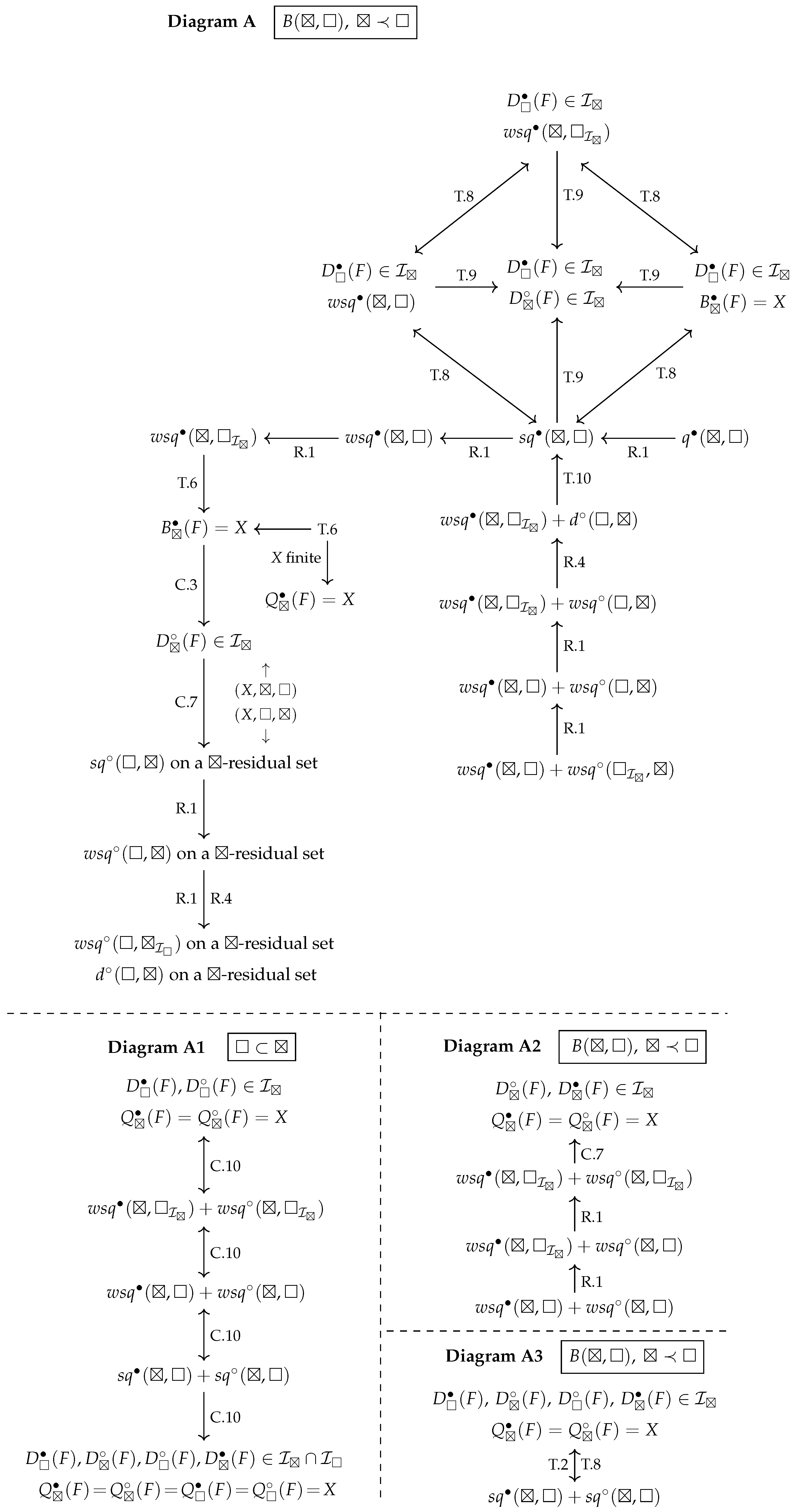
Let us describe the content of the following diagrams. The most comprehensive of them is Diagram A, and the others (Diagrams B1, B2, C1 and C2) visually better express the relationships between two continuities and their consequences for the structure of the sets of discontinuity points.
Under conditions B ( , ) , , Diagram A below summarizes the series of implications from the q ( , ) -continuity to the condition D I with respect to ( X , , ) , and further from the s q ( , ) -continuity on a ⊠-residual set to the w s q ( , I ) -continuity on a ⊠-residual set and the d ( , ) -property on a ⊠-residual set with respect to ( X , , ) .
It contains three characterizations of the s q ( , ) -continuity and the equivalence between the • Baire ⊠-continuity ( B ( F ) = X ) and the • quasi-⊠-continuity ( Q ( F ) = X ) , provided X is finite (the conditions B ( , ) , can be omitted). Also, the equivalences between two continuities with the same topological order and the different versions of continuities are given, provided , in Diagram A1.
Moreover, Diagram A, we can see the combinations of two continuities and their consequences, namely, two continuities with the different topological order and the different versions of continuities, i.e., the implications starting with
w s q ( , ) + w s q ( I , ) .
In Diagrams A2 and A3, we can see two continuities with the same topological order and the different versions of continuities, namely, the implications starting with
w s q ( , ) + w s q ( , ) and s q ( , ) + s q ( , )
It is useful to mention that the first topology ⊠ in the triplet ( X , , ) (called a dominant topology) determines the continuity properties of F and the dominant topology is preserved. For example (see Diagrams A and A2),
q ( , ) s q ( , ) w s q ( , ) w s q ( , I ) B ( F ) D ( F ) I
w s q ( , ) + w s q ( , ) Q ( F ) = Q ( F ) = X , D ( F ) , D ( F ) I
Diagram B1 deals with two weak sectional quasi-continuities under conditions B ( , ) , / B ( , ) , . Namely, two continuities with the different topological order and the different versions of continuities
w s q ( , ) + w s q ( , ) , w s q ( , ) + w s q ( , )
and with the same topological order and the different versions of continuities 0.6
w s q ( , ) + w s q ( , ) .
Diagram B2 deals with the same continuities under all conditions B ( , ) , , B ( , ) , .
In Diagrams C1 and C2, we can see the consequences of two sectional quasi-continuities under conditions B ( , ) , / B ( , ) , and under all conditions B ( , ) , , B ( , ) , .
In the next example we use symbolic interpretation.
Example 9. 
Find the structure of discontinuity points of a compact-valued multifunction F that is w s q l ( σ , τ ) -, w s q l ( τ , σ ) -, w s q u ( τ , σ ) -, and s q l ( τ , σ ) -continuous, provided the following:
(a) 
B ( τ , σ ) , τ σ ;
(b) 
B ( σ , τ ) , σ τ ;
(c) 
B ( τ , σ ) , τ σ , B ( σ , τ ) , σ τ .
We proceed strictly according to the rules of the symbolic interpretation even though some of them are duplicated.
(a) 
B ( τ , σ ) , τ σ . By symbolic interpretation,
1. 
w s q l ( τ , σ ) D τ u ( F ) I τ ,
2. 
w s q u ( τ , σ ) D τ l ( F ) I τ ,
3. 
s q l ( τ , σ ) D τ u ( F ) I τ , D σ l ( F ) I τ ,
4. 
w s q u ( τ , σ ) and w s q l ( σ , τ ) s q u ( τ , σ ) D τ l ( F ) I τ , D σ u ( F ) I τ .
Thus, D τ u ( F ) , D τ l ( F ) , D σ u ( F ) , D σ l ( F ) I τ .
Moreover, w s q l ( τ , σ ) and w s q u ( τ , σ ) F is upper and lower quasi- τ-continuous.
(b) 
B ( σ , τ ) , σ τ . By symbolic interpretation,
1. 
w s q l ( σ , τ ) D σ u ( F ) I σ .
2. 
w s q l ( σ , τ ) and w s q u ( τ , σ ) s q l ( σ , τ ) D σ u ( F ) I σ , D τ l ( F ) I σ .
Thus, D σ u ( F ) , D τ l ( F ) I σ . Moreover, w s q l ( σ , τ ) F is lower Baire σ-continuous.
(c) 
B ( τ , σ ) , τ σ , B ( σ , τ ) , σ τ .
By (a) and (b), D σ u ( F ) , D τ l ( F ) I σ I τ and D τ u ( F ) , D σ l ( F ) I τ .
To state all relevant results in a compact form, in the following diagrams, we assume Y is a regular second countable topological space and F : X Y is a compact-valued multifunction.
Mathematics 14 01253 i002
Mathematics 14 01253 i003
Mathematics 14 01253 i004

Funding

The article was supported by Faculty of Education, Trnava University in Trnava, Slovak Republic, Grant No. B1/2026. This research received no external funding.

Institutional Review Board Statement

This article does not contain any studies with human participants or animals performed by the author.

Data Availability Statement

No new data were created or analyzed in this study. Data sharing is not applicable to this article.

Conflicts of Interest

The author declares no conflicts of interest.

References

  1. Kuratowski, K. Topology; Academic Press: New York, NY, USA, 1968; Volume II. [Google Scholar]
  2. Aubin, J.P.; Frankowska, H. Set-Valued Analysis; Birkhauser: Boston, MA, USA, 1990. [Google Scholar]
  3. Kempisty, S. Sur les fonctions quasicontinus. Fund. Math. 1932, 19, 184–197. [Google Scholar] [CrossRef]
  4. Noiri, T. On α-continuous functions. Čas. Pro Pěstování Mat. 1984, 109, 118–126. [Google Scholar] [CrossRef]
  5. Abd El-Monsef, M.E.; El-Deeb, S.N.; Mohmoud, R.A. β-open sets and β-continuous mapping. Bull. Fac. Sci. Assiut Univ. 1983, 12, 77–90. [Google Scholar]
  6. Popa, V.; Noiri, T. On upper and lower β-continuous multifunctions. Real Anal. Exchange 1996, 22, 362–376. [Google Scholar] [CrossRef]
  7. Levine, N. Semi-open sets and semi-continuity in topological spaces. Am. Math. Mon. 1963, 70, 36–41. [Google Scholar] [CrossRef]
  8. Matejdes, M. Sur les sélecteurs des multifonctions. Math. Slovaca 1987, 37, 111–124. [Google Scholar]
  9. Matejdes, M. Continuity of multifunctions. Real Anal. Exchange 1993, 19, 394–413. [Google Scholar] [CrossRef]
  10. Ganguly, D.K.; Mallick, P. On convergence preserving generalized continuous multifunctions. Quest. Answ. Gen. Top. 2009, 27, 125–132. [Google Scholar]
  11. Ganguly, D.K.; Mitra, C. B*-continuity and other generalized continuity. Rev. Acad. Canar. Cienc. 2000, XII, 9–17. [Google Scholar]
  12. Ganguly, D.K.; Mitra, C. Some remarks on B*-continuous functions. Anal. St. Univ. ALI Cuza Isai 2000, XLVI, 331–336. [Google Scholar]
  13. Jain, P.; Basu, C.; Panwar, V. On generalized B*-continuity, B*-coverings and B*-separations. Eurasian Math. J. 2019, 10, 28–39. [Google Scholar] [CrossRef]
  14. Gentry, K.R.; Hoyle, H.B. Somewhat continuous functions. Czech. Math. J. 1971, 21, 5–12. [Google Scholar] [CrossRef]
  15. Neubrunnová, A. On quasicontinuous and cliquish functions. Čas. Pro Pěstování Mat. 1974, 99, 109–114. [Google Scholar] [CrossRef]
  16. Neubrunn, T. Quasi-continuity. Real. Anal. Exchange 1988, 14, 259–306. [Google Scholar] [CrossRef]
  17. Baire, R. Sur les fonctions des variables réelles. Ann. Mat. Pura Appl. 1899, 3, 1–123. [Google Scholar] [CrossRef]
  18. Ewert, J. On points of lower and upper quasi continuity of multivalued maps. Math. Slovaca 1987, 37, 255–261. [Google Scholar]
  19. Ewert, J. Almost quasicontinuity of multivalued maps on product spaces. Math. Slovaca 1996, 46, 279–284. [Google Scholar]
  20. Ewert, J.; Lipinski, T. Quasi-continuous multivalued mappings. Math. Slovaca 1983, 33, 69–74. [Google Scholar]
  21. Holá, Ľ.; Holý, D. Pointwise convergence of quasicontinuous mappings and Baire spaces. Rocky Mt. J. Math. 2011, 41, 1883–1894. [Google Scholar] [CrossRef]
  22. Mirmostafaee, A.K. Strong quasi-continuity of set valued functions. Topol. Appl. 2014, 164, 190–196. [Google Scholar] [CrossRef]
  23. Neubrunn, T. A generalized continuity and product spaces. Math. Slovaca 1976, 26, 97–99. [Google Scholar]
  24. Neubrunn, T. On quasi continuity of multifunctions. Math. Slovaca 1982, 32, 147–154. [Google Scholar]
  25. Popa, V. On a decomposition of quasicontinuity for multifunctions. Stud. Cerc. Mat. 1973, 27, 323–328. (In Romanian) [Google Scholar]
  26. Holá, Ľ.; Mirmostafaee, A.K. On continuity of set-valued mappings. Topol. Appl. 2022, 320, 108–200. [Google Scholar] [CrossRef]
  27. Matejdes, M. Quasi-continuity of multifunctions on bitopological spaces. Eur. J. Math. 2021, 7, 390–395. [Google Scholar] [CrossRef]
  28. Neghaban, N.; Mirmostafaee, A.K. Points of continuity of quasi-continuous functions. Tatra Mt. Math. Publ. 2020, 76, 53–62. [Google Scholar] [CrossRef]
  29. Holá, Ľ.; Holý, D.; Moors, W. USCO and Quasicontinuous Mappings; Series De Gruyter Studies in Mathematics; Walter de Gruyter GmbH: Berlin, Germany; Boston, MA, USA, 2021; Volume 81. [Google Scholar]
  30. Grande, Z. On strong quasi continuity of functions of two variables. Real Anal. Exchange 1995, 21, 236–243. [Google Scholar] [CrossRef]
  31. Kwiecińska, G. A note on strong quasi continuity of multifunctions. Eur. J. Math. 2019, 5, 186–193. [Google Scholar] [CrossRef]
  32. Wesołowska, J. On the strong quasi continuity of multivalued maps of two variables. Tatra Mt. Math. Publ. 2000, 19, 213–218. Available online: https://www.sav.sk/?lang=en&doc=journal-list&part=article_response_page&journal_article_no=971 (accessed on 6 April 2026).
  33. Wesołowska, J. On the strong quasi continuity of multivalued maps. Tatra Mt. Math. Publ. 1998, 14, 169–175. Available online: https://www.sav.sk/?lang=en&doc=journal-list&part=article_response_page&journal_article_no=1164 (accessed on 6 April 2026).
  34. Rychlewicz, R. On generalizations of the notion of continuity of multifunctions in bitopological spaces. Tatra Mt. Math. Publ. 2008, 40, 1–11. [Google Scholar]
  35. Matejdes, M. A few variants of quasi continuity in bitopological spaces. Tatra Mt. Math. Publ. 2023, 85, 27–44. [Google Scholar] [CrossRef]
  36. Šalát, T. Some generalizations of the notion of continuity and Denjoy property of functions. Čas. Pro Pěstování Mat. 1974, 99, 380–385. [Google Scholar] [CrossRef]
Table 1. Notation.
Table 1. Notation.
( X , , ) bitopological space, ⊠ is the dominant topology: ( X , τ , σ ) , ( X , σ , τ )
B ( , ) Baireness: B ( τ , σ ) , B ( σ , τ )
⊠ pseudo refines □ : τ σ , σ τ
I the family of ⊠-first category sets: I τ , I σ
q ( , ) quasi-continuity: q u ( τ , σ ) , q l ( τ , σ ) , q u ( σ , τ ) , q l ( σ , τ )
s q ( , ) sectional quasi-continuity: s q u ( τ , σ ) , s q l ( τ , σ ) , s q u ( σ , τ ) , s q l ( σ , τ )
s q ( , ) upper and lower sectional quasi-continuity: s q ( τ , σ ) , s q ( σ , τ )
w s q ( , ) weak sectional quasi-continuity: w s q u ( τ , σ ) , w s q l ( τ , σ ) , w s q u ( σ , τ ) , w s q l ( σ , τ )
w s q ( , ) upper and lower weak sectional quasi-continuity: w s q ( τ , σ ) , w s q ( σ , τ )
w s q ( , I ) weak sectional quasi-continuity: w s q u ( τ , σ I τ ) , w s q l ( τ , σ I τ ) , w s q u ( σ , τ I σ ) , w s q l ( σ , τ I σ )
d ( , ) Denjoy property: d u ( τ , σ ) , d l ( τ , σ ) , d u ( σ , τ ) , d l ( σ , τ )
D ( F ) the set of semi-discontinuity points of F: D τ u ( F ) , D τ l ( F ) , D σ u ( F ) , D σ l ( F )
Q ( F ) the set of quasi-continuity points of F: Q τ u ( F ) , Q τ l ( F ) , Q σ u ( F ) , Q σ l ( F )
B ( F ) the set of Baire continuity points of F: B τ u ( F ) , B τ l ( F ) , B σ u ( F ) , B σ l ( F )
R., T., C.references to the relevant Remark, Theorem, Corollary supporting implication/arrow
Disclaimer/Publisher’s Note: The statements, opinions and data contained in all publications are solely those of the individual author(s) and contributor(s) and not of MDPI and/or the editor(s). MDPI and/or the editor(s) disclaim responsibility for any injury to people or property resulting from any ideas, methods, instructions or products referred to in the content.