Article

Dirichlet–Kernel Methods for Geometric Conditional Quantiles: Bahadur Expansions and Boundary Adaptivity on the d-Simplex

1
Laboratoire de Modélisation Mathématiques, Statistiques et Processus Stochastique, University of Tunis El Manar, Tunis 1068, Tunisia
2
Laboratoire de Mathématiques Appliquées de Compiègne, Université de Technologie de Compiègne, Alliance Sorbonne Universités, 60203 Compiègne, France
*
Author to whom correspondence should be addressed.
Mathematics 2026, 14(8), 1242; https://doi.org/10.3390/math14081242
Submission received: 5 March 2026 / Revised: 1 April 2026 / Accepted: 4 April 2026 / Published: 8 April 2026
(This article belongs to the Section D1: Probability and Statistics)

Abstract

This article develops a boundary-adaptive nonparametric methodology for estimating the geometric conditional quantiles of a multivariate response when the conditioning covariate is supported on the simplex—an important case, as it is the natural domain of compositional data. The statistical difficulty addressed here is twofold. First, geometric conditional quantiles for multivariate responses must be defined and estimated through a genuinely directional and convex framework rather than through any scalar ordering. Second, when the covariate is compositional or otherwise simplex-constrained, conventional symmetric kernel procedures suffer from intrinsic support mismatch and severe boundary distortion, thereby compromising both estimation accuracy and inferential validity near faces and edges of the simplex. The method proposed in this paper is designed precisely to overcome this combined obstacle. Our main innovation consists in embedding the spatial quantile formalism of Chaudhuri within a Dirichlet–Kernel smoothing scheme whose shape parameters depend deterministically on the evaluation point. This produces a convex M-estimator that respects the simplex geometry exactly, automatically adapts its local shape to the position of the target point, and removes the need for artificial boundary corrections. To the best of our knowledge, this is the first contribution to provide a complete asymptotic treatment of geometric conditional quantile estimation under simplex-supported covariates with location-adaptive asymmetric kernels. We establish a Bahadur-type linear representation with an explicit negligible remainder, from which we derive refined asymptotic bias and variance expansions. The variance analysis reveals a distinctive geometric phenomenon: each coordinate direction approaching the simplex boundary induces an additional b 1 / 2 inflation factor, so that the variance at a face of codimension | J | scales as n 1 b ( s + | J | ) / 2 . We further obtain the asymptotic mean squared error, an explicit optimal bandwidth rate, asymptotic normality under the nonstandard normalization n 1 / 2 b s / 4 , and consistent plug-in covariance estimators yielding valid confidence ellipsoids. Numerical experiments and a real-data illustration based on the GEMAS data confirm the practical merit of the approach, especially in boundary regions where classical methods are known to deteriorate.

1. Introduction

The problem of understanding how an s-dimensional covariate X modulates the conditional distribution of a d-dimensional response Y , based on an i.i.d. sample { ( X i , Y i ) } i = 1 n , lies at the core of contemporary statistics, econometrics, and statistical learning. While conditional means and conditional covariance structures provide useful summaries of location and dispersion, they remain intrinsically insufficient whenever the scientific objective concerns heterogeneity across the conditional distribution, directional extremality, tail behavior, or robust local features. In such settings, conditional quantiles furnish a far more informative statistical description. They encode distributional asymmetry, remain meaningful under heavy-tailed regimes, and are naturally aligned with decision-theoretic questions involving risk, stress, and distribution-sensitive prediction. In the scalar-response case, the theory of conditional quantiles is by now highly developed, with kernel, local polynomial, nearest-neighbor, and spline-based estimators enjoying a mature asymptotic theory. By contrast, the extension to multivariate responses remains mathematically delicate, primarily because there is no canonical total order on R d .
A fruitful resolution of this difficulty is provided by the geometric viewpoint on multivariate quantiles. In the univariate case, the p-th quantile is characterized as the unique minimizer of a convex asymmetric absolute loss; see [1]. This variational formulation extends naturally to regression-type problems [2,3]. In higher dimension, however, the absence of an order structure requires a geometric replacement for scalar ranking. Two major lines of development have emerged in this direction: multivariate norm-based quantiles [4,5], and the theory of spatial, or geometric, quantiles introduced by Chaudhuri [6,7] and subsequently developed in several directions, including recent conditional and Bahadur-type formulations [8,9,10,11,12]. The spatial quantile framework is especially compelling because it indexes multivariate quantiles by a direction vector u in the open unit ball
B ( d ) = { u R d : u < 1 } ,
thereby encoding, within a single object, both the magnitude of outlyingness and its geometric orientation. This directional parametrization confers a direct geometric interpretation upon conditional multivariate quantiles and makes the associated estimation problem amenable to convex analysis.
More precisely, for u B ( d ) , define
Φ ( u , l ) = l + u , l , l R d .
The u -th geometric conditional quantile of Y given X = x is then defined as any minimizer of the conditional convex functional
Q ( u x ) arg min θ R d E Φ ( u , Y θ ) Φ ( u , Y ) | X = x .
This formulation, which goes back to the geometric quantile paradigm of [6,7], offers a coherent multivariate analogue of ordinary quantiles, while retaining convexity, directional interpretability, and robustness. Under absolute continuity assumptions, existence and uniqueness follow from strict convexity arguments; see, e.g., [4] (Remark 2.3). The conditional version is particularly attractive for multivariate response analysis, portfolio allocation, environmental monitoring, compositional systems, and spatio-temporal modelling, where one seeks a directional description of the entire conditional distribution rather than a single central tendency summary.
Yet the nonparametric estimation of Q ( u x ) becomes substantially more delicate when the support of the covariate is bounded. This is not a marginal technical complication but a structural issue. Classical symmetric kernel methods inevitably allocate mass outside the support, thereby generating boundary bias and distorting local smoothing near edges, faces, and corners. This challenge has been widely documented in the nonparametric literature on density estimation, regression, and conditional functionals over bounded supports [13,14,15,16,17,18,19,20,21,22,23,24]. A broad range of correction strategies has been proposed, including boundary kernels and local polynomial corrections [25,26]. Nevertheless, a conceptually cleaner alternative has emerged in the form of asymmetric kernels whose support coincides exactly with the underlying domain [27]. Such kernels are support-respecting by construction and exhibit location-dependent shape adaptation, thereby yielding an intrinsic form of boundary correction.
This philosophy is well established on the unit interval through beta kernels [28,29,30,31,32,33,34,35,36,37,38] and on bounded Euclidean domains using Bernstein-type techniques [39,40,41,42,43,44,45,46,47,48,49,50,51,52,53,54,55,56]. However, the simplex setting is fundamentally richer. When the covariate represents compositional proportions or relative allocations, it is naturally constrained to the simplex
S s , 1 = x [ 0 , 1 ] s : x 1 1 ,
whose geometry is qualitatively different from that of a Cartesian product domain. In that setting, not only must the smoothing device respect each coordinate boundary, but it must also incorporate the global 1 -constraint. Dirichlet kernels constitute the natural support-adapted analogue of beta kernels on S s , 1 ; see [57,58,59]. Their shape may be made to depend deterministically on the evaluation point, and this produces a genuinely geometry-aware smoothing scheme, with local dispersion and asymmetry automatically modulated by the position of the target point relative to the simplex boundary.
The present work is motivated precisely by this conjunction of two difficulties: the lack of a scalar order in multivariate conditional quantile analysis, and the geometric complexity induced by simplex-supported covariates. Our objective is to construct and analyze a nonparametric estimator of geometric conditional quantiles that is simultaneously: (i) faithful to the spatial-quantile paradigm; (ii) intrinsically compatible with the simplex support; (iii) asymptotically tractable under a full inferential theory; and (iv) computationally implementable in realistic multivariate settings. To this end, we combine the geometric quantile loss of [6,7] with Dirichlet kernel weighting on S s , 1 , using evaluation-point-dependent shape parameters α = x / b + 1 , β = ( 1 x 1 ) / b + 1 . This yields a location-adaptive smoothing device that exactly respects the simplex geometry and produces a weighted convex M-estimator for the conditional geometric quantile.
The contribution of the paper is threefold. First, we formulate a Dirichlet–Kernel estimator of geometric conditional quantiles on the simplex and show that it provides a principled support-respecting analogue of the Nadaraya–Watson idea for multivariate directional quantile functionals. Second, we establish a full asymptotic theory, including a Bahadur-type linear expansion with explicit stochastic remainder, asymptotic bias and covariance expansions, mean squared error analysis, optimal bandwidth scaling, and asymptotic normality with covariance estimation. Third, our analysis uncovers a distinctive boundary phenomenon: the asymptotic variance is no longer governed solely by the ambient simplex dimension s, but also by the codimension of the face approached by the evaluation point. More precisely, each coordinate direction becoming asymptotically boundary-active contributes a multiplicative b 1 / 2 inflation to the variance, leading to the regime n 1 b ( s + | J | ) / 2 near a face of codimension | J | . This reveals, in explicit form, how simplex geometry governs stochastic uncertainty in conditional quantile estimation.
These results position the present work at the intersection of several active literatures. Relative to the foundational theory of spatial quantiles [4,6,7], we address the genuinely conditional problem with nonparametric, covariate-dependent weighting. Relative to the extensive literature on asymmetric kernel smoothing and Bernstein-type approximation [29,30,54,59], we move beyond density and distribution estimation to a substantially more intricate geometric functional. Relative to recent work on conditional multivariate quantiles and Bahadur expansions [10,11,60], we introduce a support-adapted simplex-based smoothing mechanism and derive the resulting nonstandard inferential scaling. When u = 0 , the estimator reduces to the conditional geometric median, thereby recovering, and substantially extending, the framework of [61]. At the same time, the full directional formulation permits inference not merely at the center of the conditional distribution, but across a continuum of oriented and increasingly extreme directions.
From a methodological standpoint, the framework is especially relevant for compositional and constrained-covariate applications. In environmental geochemistry, soil composition profiles are naturally represented by proportions or normalized concentrations. In econometrics and finance, portfolio weights and budget shares live on simplices. In spatial and biological applications, relative abundance vectors obey the same structural constraint. In all such settings, conventional kernel smoothing can be severely distorted near the boundary, whereas Dirichlet kernels yield a support-faithful alternative whose asymptotic behavior can be analyzed sharply. This is the principal conceptual message of the paper: boundary adaptivity is not merely a technical refinement, but an essential structural ingredient in multivariate conditional quantile estimation on constrained domains.

Organization

The remainder of the paper is organized as follows. Section 2 introduces the simplex setting, Dirichlet kernels, and the geometric conditional quantile functional, and it clarifies the weighted M-estimation principle underlying the estimator. Section 3 states the regularity conditions and develops the main asymptotic results, including the Bahadur representation, bias and variance expansions, mean squared error, optimal bandwidth, mean integrated absolute error, and asymptotic normality. Section 4 reports simulation experiments illustrating the finite-sample behavior of the estimator, the geometry of the confidence ellipsoids, and the directional quantile contours. Section 5 presents a real-data application to the GEMAS dataset [62], thereby illustrating the practical relevance of the methodology for compositional environmental covariates. Section 6 concludes with limitations and possible extensions, while Section 7 collects the technical proofs.

2. Setup and Definitions

We now formalize the geometric and probabilistic framework underlying the proposed estimator. We first recall the simplex geometry and the Dirichlet kernel construction, and then explain how these ingredients combine with the spatial-quantile loss to produce a weighted empirical M-estimator of the geometric conditional quantile. Let S s , 1 denote the s-dimensional simplex defined by
S s , 1 : = x [ 0 , 1 ] s : x 1 1 ,
with interior
Int ( S s , 1 ) : = x ( 0 , 1 ) s : x 1 < 1 ,
where x 1 : = i = 1 s | x i | and s N * . For parameters α 1 , , α s , β > 0 , the density function of the Dirichlet ( α , β ) distribution is given by
K α , β ( x ) : = Γ α 1 + β Γ ( β ) i = 1 s Γ ( α i ) 1 x 1 β 1 i = 1 s x i α i 1 , x S s , 1 .
For a detailed account, we refer the reader to [57] (Chapter 49) and [58]. We now clarify the theoretical basis of the estimator introduced below. For a fixed evaluation point x S s , 1 and a fixed directional index u B ( d ) , the target of inference is the population geometric conditional quantile
Q ( u x ) arg min θ R d E Φ ( u , Y θ ) Φ ( u , Y ) | X = x .
Accordingly, the only unknown parameter to be estimated in what follows is the vector Q ( u x ) R d , whereas x and u are regarded as fixed indexing arguments, and b > 0 is a smoothing parameter. The vector θ R d appearing in the minimization problem is therefore not an additional model parameter; it is the optimization variable whose minimizing value defines the estimator of Q ( u x ) .
The estimator is obtained by a plug-in principle. Since the conditional distribution of Y given X = x is unknown, we replace it by a Dirichlet–Kernel weighted empirical conditional measure concentrated on the observations Y 1 , , Y n . Specifically, for the fixed evaluation point x , we assign to each observation ( X i , Y i ) the weight
w n i ( x ) = K α , β ( X i ) j = 1 n K α , β ( X j ) , i = 1 , , n ,
where K α , β is the Dirichlet kernel on S s , 1 with parameters
( α , β ) = x b + 1 , 1 x 1 b + 1 .
These weights are nonnegative and sum to one, so they define the empirical conditional probability measure
P ^ n ( · x ) = i = 1 n w n i ( x ) δ Y i ( · ) ,
where δ Y i denotes the Dirac mass at Y i . Equivalently, its associated conditional distribution function is
F n ( y x ) = i = 1 n w n i ( x ) 1 { Y i y } ,
with the inequality understood componentwise.
Replacing the unknown conditional distribution in the population variational characterization by P ^ n ( · x ) yields the sample criterion
L n ( θ ; u , x ) = R d Φ ( u , y θ ) Φ ( u , y ) P ^ n ( d y x ) ,
and the estimator is defined as its minimizer. Hence Q ^ n ( u x ) is a weighted convex M-estimator, namely the empirical analogue of the population geometric conditional quantile functional. This motivates the definition
Q ^ n ( u x ) = arg min θ R d R d Φ ( u , y θ ) Φ ( u , y ) F n ( d y x ) = arg min θ R d i = 1 n w n i ( x ) Φ ( u , Y i θ ) Φ ( u , Y i ) .
In particular, the operator arg min denotes the set of minimizers of the sample objective, and under the regularity conditions imposed later, convexity and absolute continuity ensure existence and, with probability tending to one, uniqueness of the minimizer. Thus, Equation (2) is not an ad hoc definition, but the natural Dirichlet–Kernel plug-in estimator of the population conditional geometric quantile.

Notation

Throughout the paper, let f ( · , · ) and f ( · ) denote the joint and marginal density functions of the random variables ( X , Y ) and X , respectively. The conditional density of Y given X = x is denoted by f ( · x ) . The notation D D indicates convergence in distribution. For any matrix A , A denotes its transpose. For y R d , define
B ( y ) = 1 y I d U ( y ) U ( y ) , if y 0 ,
where I d denotes the d × d identity matrix, and
U ( y ) = y y , if y 0 , 0 , if y = 0 ,
with y denoting the Euclidean norm of y . Unless otherwise stated, all limits in this paper are taken as n .
Remark 1.
Equation (2) follows from a standard plug-in principle, but with a localization device tailored to the geometry of the covariate space. The functional Q ( u x ) is defined as the minimizer of a conditional convex criterion, and the statistical task is therefore to approximate the conditional law of Y at the design point x . The weights w n i ( x ) arise from this approximation step. The specificity of the present framework lies in the fact that the covariate takes values in S s , 1 . In such a setting, a symmetric kernel is not geometrically appropriate, since it ignores the support constraint and produces boundary distortion. The Dirichlet kernel, by contrast, is intrinsically supported on the simplex and possesses an evaluation-point-dependent shape, thereby inducing an automatic boundary adaptation. Hence the estimator Q ^ n ( u x ) is best interpreted as a geometric conditional quantile estimator obtained by localized empirical risk minimization under a support-respecting Dirichlet smoothing scheme.

3. Main Results

We now specify the regularity conditions required to establish our main theoretical results. We fix throughout a point x S s , 1 , where
S s , 1 = t [ 0 , 1 ] s : t 1 1 .
Let U x R s be an open neighborhood of x , and set
N x : = U x S s , 1 .
We now state the regularity conditions used throughout the sequel.
A.1– 
For every t N x , the conditional distribution of Y given X = t admits a density f ( y t ) with respect to Lebesgue measure on R d . Moreover, for every bounded Borel set B R d ,
sup t N x sup y B f ( y t ) < .
A.2– 
The marginal density f of X is strictly positive on N x . More precisely,
inf t N x f ( t ) > 0 .
In addition, there exists a function f ˜ : U x R such that
f ˜ C 2 ( U x ) and f ˜ ( t ) = f ( t ) for all t N x .
Furthermore, for every multi-index α N s with | α | 2 ,
sup t N x α f ˜ ( t ) < .
A.3– 
For each t N x and θ R d , define
r ( θ , t ) : = E U Y Q ( u x ) θ + u | X = t .
Assume that, for every M > 0 ,
sup θ M , t N x 2 r ( θ , t ) t t < ,
where the derivatives with respect to t are understood componentwise on U x .
A.4– 
The bandwidth sequence b = b n satisfies
b n 0 and n b n s / 2 C n γ for some C > 0 and 2 s + 2 < γ < 1 .
In particular,
n b n s / 2 and log n n b n s / 2 = o ( b n ) .
A.5– 
There exist constants M > 0 and w > 0 such that
sup t N x sup θ M R d f ( y t ) y Q ( u x ) θ 1 + w d y < .
If d 3 , this condition is assumed with w = 1 ; if d = 2 , it is assumed for some w ( 0 , 1 ) .
A.6– 
Define, for t N x ,
D 1 ( t ) : = E B Y Q ( u x ) | X = t .
Assume that the mapping t D 1 ( t ) is continuous at x , and that the matrix D 1 ( x ) is nonsingular.
A.7– 
Define, for t N x ,
D t : = E U ( Y Q ( u x ) ) + u U ( Y Q ( u x ) ) + u | X = t .
Assume that the mapping t D t is continuous at x .

3.1. Discussion of the Assumptions

The collection of assumptions A.1A.7 is stated at the beginning of this section because it provides the common regularity framework underlying all the asymptotic results established below. These conditions are not attached to a single isolated theorem; rather, they constitute the analytic structure on which the entire inferential theory rests, including the Bahadur-type linear representation, the asymptotic bias and variance expansions, the mean squared error analysis, and the asymptotic normality of the proposed estimator. Their purpose is to ensure that the interaction between two nonstandard features of the problem—namely, the nonsmooth geometry of spatial quantiles and the boundary-adaptive, location-dependent character of the Dirichlet kernel—can be handled in a mathematically stable and asymptotically tractable manner on the simplex.
Assumption A.1 is a local boundedness condition on the conditional density f ( y t ) , imposed uniformly over t in a neighborhood of the target point x . Its role is to exclude pathological local behavior of the conditional distribution of Y as the covariate varies inside the effective smoothing region generated by the Dirichlet kernel. Since the estimating equation for geometric conditional quantiles involves the singular score map
U ( y θ ) = y θ y θ ,
this local boundedness is needed to justify dominated-convergence arguments, to control local empirical fluctuations, and to guarantee that the conditional law of Y does not exhibit excessive concentration near the moving singularity y = θ . In this sense, A.1 is the basic regularity assumption ensuring that the local conditional response mechanism remains sufficiently well behaved for the weighted convex M-estimation problem to admit a stable asymptotic analysis.
Assumption A.2 concerns the marginal density f of the covariate X . Its first component, namely strict positivity of f on a neighborhood of x , is indispensable for local identification: the normalized Dirichlet weights are asymptotically scaled by f ( x ) , and if this quantity were allowed to vanish, then the effective local sample size would collapse and the conditional nature of the estimator would be lost. The second component of A.2 is a smoothness requirement formulated through the existence of a C 2 -extension f ˜ to an open neighborhood of the simplex point under consideration. This formulation is deliberately stronger and more precise than simply saying that f is twice differentiable on S s , 1 , since the latter would be ambiguous at the boundary of the simplex. By working with an extension to an open neighborhood, derivatives of first and second order are defined in the classical sense and Taylor expansions near boundary points become fully rigorous. This is essential for the second-order expansion of
E K α , β ( X ) ,
from which the correction term g ( x ) arises. In the present setting, this smoothness is not merely a standard bias assumption: because the Dirichlet kernel itself depends on the evaluation point and respects the simplex geometry, the resulting expectation is not a classical convolution but a support-adapted moment transform. The regularity imposed in A.2 is therefore needed to control the local normalization factor in a geometrically faithful way.
Assumption A.3 imposes uniform boundedness of the second derivatives, with respect to the covariate argument t , of the conditional score map
r ( θ , t ) = E U Y Q ( u x ) θ + u | X = t .
This is one of the key smoothness assumptions of the paper. It guarantees that the population estimating equation can be expanded locally in the covariate direction with sufficient precision to transfer the moment structure of the Dirichlet kernel into the deterministic part of the asymptotic expansion. In particular, the explicit bias term ζ s is obtained by applying a second-order Taylor expansion to the composite map
t r ( 0 , t ) f ( t ) .
Without a condition of this type, the local geometry of the population score could vary too sharply across the shrinking simplex neighborhood of x , and the leading deterministic term in the Bahadur expansion would fail to admit a stable second-order representation. Thus, A.3 controls the curvature of the conditional spatial score with respect to the covariate and is essential for the refined bias analysis.
Assumption A.4 specifies the asymptotic bandwidth regime. At a conceptual level, it encodes the usual nonparametric balance between localization and effective sample size. Since the Dirichlet kernel on the simplex concentrates its mass on a neighborhood whose effective volume is of order b s / 2 , the quantity n b s / 2 plays the role of a local information index. The condition b n 0 enforces localization at the target point x , while the divergence of n b n s / 2 ensures stochastic stabilization of the weighted empirical score. The parameterization
n b n s / 2 C n γ , 2 s + 2 < γ < 1 ,
is particularly convenient because it captures both requirements within a single asymptotic scale. Moreover, the inequality
2 s + 2 < γ
is precisely what guarantees
log n n b n s / 2 = o ( b n ) ,
an ordering that is crucial in the second-order theory: it ensures that the stochastic remainder appearing in the Bahadur representation is asymptotically negligible relative to the deterministic bias term. Thus, A.4 is not merely a bandwidth condition in the usual kernel-smoothing sense; it is the rate-separation assumption that allows for bias expansion, the MSE optimization, and the centering in the asymptotic normality theorem to coexist on compatible scales.
Assumption A.5 is an integrability condition specifically tailored to the singular structure of the derivative of the spatial score. Indeed, differentiating the map U ( · ) yields the matrix
B ( y ) = 1 y I d U ( y ) U ( y ) ,
which exhibits a first-order singularity at the origin. The requirement
sup t N x sup θ M R d f ( y t ) y Q ( u x ) θ 1 + w d y <
ensures that this singularity is integrable uniformly both in the local covariate neighborhood and in bounded perturbations of the parameter. This is indispensable for differentiating under the integral sign, for proving existence of the Jacobian matrix of the population estimating equation, and for controlling the Taylor remainder in the Bahadur expansion. The distinction between the cases d 3 and d = 2 is mathematically natural: in dimension two one is at the critical integrability threshold, and only exponents strictly smaller than the borderline value are admissible. Hence, A.5 expresses the precise local integrability needed to tame the singular geometry inherent in multivariate spatial quantiles.
Assumption A.6 concerns the matrix
D 1 ( t ) = E B Y Q ( u x ) | X = t .
This matrix is the population Jacobian of the estimating equation with respect to the quantile parameter and therefore plays the role of the local Hessian analogue in the convex M-estimation problem under study. Its continuity at t = x ensures that the local curvature of the objective function is stable under Dirichlet smoothing and may be asymptotically replaced by its value at the target point. The additional nonsingularity of D 1 ( x ) is equally fundamental: it guarantees that the linearized estimating equation is nondegenerate and can be inverted, which is the key step in passing from the score expansion to the Bahadur representation. More conceptually, A.6 provides the local identifiability condition for the geometric conditional quantile. Once combined with absolute continuity of the conditional law and the strict convexity properties of the spatial quantile criterion, it ensures that the asymptotic linearization has a unique and well-defined solution.
Assumption A.7 concerns the conditional second-moment matrix
D t = E U ( Y Q ( u x ) ) + u U ( Y Q ( u x ) ) + u | X = t ,
which is the covariance-type quantity governing the asymptotic variance. Its continuity at t = x ensures that the locally weighted empirical second moment converges to the correct population limit rather than to a distorted average over the smoothing neighborhood. This is indispensable for identifying the leading covariance matrix in the central limit theorem and for obtaining the explicit variance formula, including the boundary-dependent inflation effect induced by the simplex geometry. In particular, A.7 is the condition that allows the covariance structure of the linearized score to be transferred faithfully to the asymptotic law of the estimator.
Taken together, assumptions A.1A.7 form a coherent regularity system adapted to the specific difficulties of the problem: the covariate lies on a bounded and geometrically constrained domain, the smoothing mechanism is asymmetric and location-dependent, and the objective function is convex but nondifferentiable at the origin. Their collective role is fourfold: first, to guarantee local identifiability of the geometric conditional quantile; second, to control the singular behavior induced by the spatial score; third, to justify the second-order expansions required by Dirichlet localization on the simplex; and fourth, to separate sharply enough the stochastic and deterministic scales governing the estimator. In this sense, these assumptions should not be viewed as ancillary technicalities, but rather as the precise analytic scaffolding required for a complete asymptotic treatment of geometric conditional quantiles under boundary-adaptive smoothing on the simplex.

3.2. Bahadur Representation for the Geometric Conditional Quantile Estimator

In this section, we present the principal theoretical results concerning the geometric conditional quantile estimator. Under the regularity assumptions A.1A.7, we derive the Bahadur representation, the asymptotic bias and variance, and the associated mean squared and integrated absolute errors. We conclude with an asymptotic normality result and several remarks clarifying the assumptions and existence conditions.
Theorem 1
(Bahadur Representation). Suppose that conditions A.1A.7 hold. Then the estimator Q ^ n ( u x ) admits the following Bahadur-type expansion:
Q ^ n ( u x ) Q ( u x ) = D 1 1 i = 1 n w n i U ( Y i Q ( u x ) ) + u + R n ,
almost surely, where
D 1 = E K α , β ( X ) B ( Y Q ( u x ) ) E K α , β ( X ) .
Moreover, when d 3 , the remainder satisfies R n = O log n n b s / 2 , while for d = 2 , one has R n = o log n n b s / 2 w , for any 0 < w < 1 .
Theorem 2
(Asymptotic Bias). Under the conditions A.1A.7, the bias of the estimator satisfies
Bias Q ^ n ( u x ) = E Q ^ n ( u x ) Q ( u x ) = D 1 1 f ( x ) + b g ( x ) R ( 0 , x ) + b ζ s + o ( b 1 / 2 ) + R n ,
where, for x S s , 1 with s d , the terms ζ s and g ( x ) are defined respectively as
ζ s = i = 1 s R ( 0 , x ) x i [ 1 ( s + 1 ) x i + 1 2 i = 1 s 2 R ( 0 , x ) x i 2 x i ( 1 x i ) + i , j = 1 s 2 R ( 0 , x ) x i x j x i 1 { i = j } x j ] ,
with R ( 0 , x ) = r ( 0 , x ) f ( x ) , and
g ( x ) = i [ s ] ( 1 ( s + 1 ) x i ) f ( x ) x i + 1 2 i , j [ s ] x i 1 { i = j } x j 2 f ( x ) x i x j ,
where [ s ] { 1 , 2 , , s } .
Theorem 3
(Asymptotic Variance). Assume that A.1A.7 hold. Then, for any x Int ( S d , 1 ) , any non-empty index subset J [ s ] , and any κ ( 0 , ) s , the asymptotic variance of Q ^ n ( u x ) satisfies, as n ,
Var Q ^ n ( u x ) = n 1 f ( x ) + b g ( x ) 2 b s / 2 ψ ( x ) f ( x ) D 1 1 D x D 1 1 + o x n 1 b 1 / 2 + o x n 1 b s / 2 , i f x i b i [ s ] , a n d 1 x 1 b ; n 1 f ( x ) + b g ( x ) 2 { b ( s + | J | ) / 2 ψ J ( x ) f ( x ) i J Γ ( 2 κ i + 1 ) 2 κ i + 1 Γ 2 ( κ i + 1 ) D 1 1 D x D 1 1 } + o κ , x n 1 b ( s + | J | ) / 2 , i f x i b κ i i J , x i b i [ s ] J , a n d 1 x 1 b .
For any index subset J [ s ] , define
ψ ( x ) = ψ ( x ) , ψ J ( x ) = ( 4 π ) s | J | ( 1 x 1 ) i [ s ] J x i 1 / 2 .
Hence, the pointwise variance is of order o x ( n 1 b s / 2 ) in the interior of the simplex, and increases by a factor of b 1 / 2 each time the point x approaches the boundary in one coordinate direction. Near an edge of dimension s | J | , the variance becomes o κ , x ( n 1 b ( s + | J | ) / 2 ) .
Corollary 1
(Mean Squared Error). Under the assumptions A.1A.7, for any x Int ( S s , 1 ) , as n ,
MSE Q ^ n ( u x ) = E Q ^ n ( u x ) Q ( u x ) 2 = n 1 b s / 2 ψ ( x ) f ( x ) f ( x ) + b g ( x ) 2 D 1 1 D x D 1 1 + D 1 1 R ( 0 , x ) + b ζ s f ( x ) + b g ( x ) 2 D 1 1 + o x ( b 2 ) o x ( n 1 b 1 / 2 ) + o x ( n 1 b s / 2 ) .
In particular, if f ( x ) 0 , the asymptotically optimal bandwidth minimizing the MSE satisfies
b opt n 2 / ( s + 4 ) 4 s D 1 1 ζ s ζ s D 1 1 ψ ( x ) f ( x ) D 1 1 D x D 1 1 2 / ( s + 4 ) .
Theorem 4
(Mean Integrated Absolute Error). Assume that conditions A.1A.7 hold. Then, as n ,
MIAE Q ^ n ( u x ) : = S s , 1 E Q ^ n ( u x ) Q ( u x ) d x = S s , 1 w ( x ) E Z b ζ s w ( x ) d x + o n 1 / 2 b s / 2 + o n 1 / 2 b s / 4 + o ( b 1 / 2 ) ,
where Z N ( 0 , 1 ) and w ( x ) : = n 1 / 2 b s / 4 D x ψ ( x ) . If n 1 / 2 b s / 4 , then
MIAE Q ^ n n 1 / 2 b s / 4 2 π S s , 1 D x ψ ( x ) d x + b S s , 1 | ζ s | d x + o n 1 / 2 b s / 4 + o ( b 1 / 2 ) .
Theorem 5
(Asymptotic Normality). Under assumptions A.1A.7, as n and for x / b ,
n 1 / 2 b s / 4 Q ^ n ( u x ) Q ( u x ) D 1 1 f ( x ) + b g ( x ) R ( 0 , x ) + b ζ s D N 0 , Σ ( x ) ,
where
Σ ( x ) = ψ ( x ) f ( x ) f ( x ) + b g ( x ) 2 D 1 1 D x D 1 1 .
Remark 2.
Analogously to Fact 2.1.1 of [7], the existence of the minimizer Q ^ n ( u x ) of
i = 1 n w n i Φ ( u , Y i θ )
follows from two key observations: (i) the objective diverges to infinity as θ , and (ii) it is continuous in θ. Because the random variables { Y i } i = 1 n are absolutely continuous, they do not lie on a straight line in R d with probability one. Hence, by Theorem 2.17 of [63], the function is strictly convex in θ, ensuring the existence and uniqueness of the minimizer Q ^ n ( u x ) . Similarly, the uniqueness of the population quantile Q ( u x ) follows from the absolute continuity of the conditional distribution of Y given X = x .

4. Numerical Results

This section provides a finite-sample illustration of the estimator introduced in Section 2 in the special case s = 1 . In that setting, the simplex S 1 , 1 = { x [ 0 , 1 ] : x 1 } = [ 0 , 1 ] is one-dimensional, and the Dirichlet kernel reduces to the Beta kernel. The purpose of this section is not to establish an additional theoretical result, but rather to examine, in a controlled setting, the numerical behavior of the estimator Q ^ n ( u x 0 ) , the geometry of the associated Gaussian ellipsoids, and the shape of the estimated directional quantile contours.
We observe i.i.d. pairs { ( X i , Y i ) } i = 1 n , where X i ( 0 , 1 ) is scalar and Y i R 2 is bivariate. For a fixed evaluation point x 0 ( 0 , 1 ) and a fixed direction u B ( 2 ) , the estimator is computed exactly as in (2), with the one-dimensional Dirichlet kernel replaced by the corresponding Beta kernel. More precisely, letting b = b n > 0 denote the bandwidth, define
K x 0 , b ( t ) = 1 B x 0 / b + 1 , ( 1 x 0 ) / b + 1 t x 0 / b ( 1 t ) ( 1 x 0 ) / b , t ( 0 , 1 ) ,
and the normalized weights
w n i ( x 0 ) = K x 0 , b ( X i ) j = 1 n K x 0 , b ( X j ) , i = 1 , , n .
The estimator of the u -th geometric conditional quantile at x 0 is then defined by
Q ^ n ( u x 0 ) = arg min θ R 2 i = 1 n w n i ( x 0 ) Φ ( u , Y i θ ) Φ ( u , Y i ) ,
where Φ is the geometric loss introduced in (1). Since the objective is convex, the minimizer is computed numerically by direct convex optimization.
  • Data-generating mechanism.
The covariate and conditional response are generated according to
X Beta ( α , β ) , Y X = x N 2 μ ( x ) , Σ ( x ) ,
with
μ ( x ) = 2 ( x 0.5 ) 1.5 ( x 0.5 ) , Σ ( x ) = 1 + 0.5 ( x 0.5 ) 0.5 0.5 1 + 0.3 ( x 0.5 ) .
The matrix Σ ( x ) is positive definite for all x [ 0 , 1 ] , so the model is well defined throughout the support.
  • Evaluation point, directions, and bandwidth.
Unless otherwise stated, the numerical illustrations are carried out at the interior point
x 0 = 0.3 ,
and for the two directions
u 1 = ( 0.8 , 0.58 ) , u 2 = ( 0.8 , 0.4 ) ,
which both satisfy u j < 1 . For point estimation, we take
b n n 2 / 5 ,
which is the usual mean-squared-error optimal rate in the one-dimensional interior case s = 1 ; compare Corollary 1.
  • Asymptotic benchmark.
Specializing Theorem 5 to s = 1 , one obtains, under assumptions A.1A.7 and for fixed x 0 ( 0 , 1 ) ,
n 1 / 2 b 1 / 4 Q ^ n ( u x 0 ) Q ( u x 0 ) Bias Q ^ n ( u x 0 ) D N 2 0 , Σ ( x 0 ) ,
where, with the notation of Section 3,
Σ ( x 0 ) = ψ ( x 0 ) f ( x 0 ) f ( x 0 ) + b g ( x 0 ) 2 D 1 1 D x 0 D 1 1 , ψ ( x 0 ) = 4 π x 0 ( 1 x 0 ) 1 / 2 .
At leading order, this reduces to
Σ ( x 0 ) ψ ( x 0 ) f ( x 0 ) D 1 1 D x 0 D 1 1 .
It is important to note, however, that in the present illustrations the bandwidth choice b n n 2 / 5 is adopted for point estimation accuracy. In the one-dimensional case, this implies that the centering bias is of the same asymptotic order as the stochastic fluctuation, since
b n n 2 / 5 and n 1 / 2 b n 1 / 4 n 2 / 5 .
Consequently, the ellipsoids displayed below should be interpreted as nominal Gaussian uncertainty ellipsoids around the estimator, calibrated from the leading-order covariance structure and the bootstrap, rather than as fully bias-corrected asymptotic confidence sets. A formally centered asymptotic confidence set under the theory of Section 3 would require either undersmoothing or explicit bias correction, neither of which is pursued in the present finite-sample illustration.
  • Plug-in covariance estimation and nominal Gaussian ellipsoids.
In order to visualize the local covariance structure predicted by (17), we use the leading-order plug-in estimator
f ^ n , b ( x 0 ) = 1 n i = 1 n K x 0 , b ( X i ) ,
together with
D ^ n = i = 1 n w n i ( x 0 ) B Y i Q ^ n ( u x 0 ) ,
and
D ^ n , x 0 = i = 1 n w n i ( x 0 ) U ( Y i Q ^ n ( u x 0 ) ) + u U ( Y i Q ^ n ( u x 0 ) ) + u .
The corresponding covariance estimate is
Σ ^ ( x 0 ) = ψ ( x 0 ) f ^ n , b ( x 0 ) D ^ n 1 D ^ n , x 0 D ^ n 1 .
Using this matrix, we display the nominal 95 % Gaussian ellipsoid
E 0.95 ( x 0 ) = q R 2 : ( Q ^ n ( u x 0 ) q ) Σ ^ ( x 0 ) 1 ( Q ^ n ( u x 0 ) q ) χ 2 , 0.95 2 n b 1 / 2 .
In finite samples, the scale of this approximation is additionally monitored by a nonparametric bootstrap with B = 300 replicates. The sample sizes considered are n { 100 , 200 , 500 } .
  • Numerical findings.
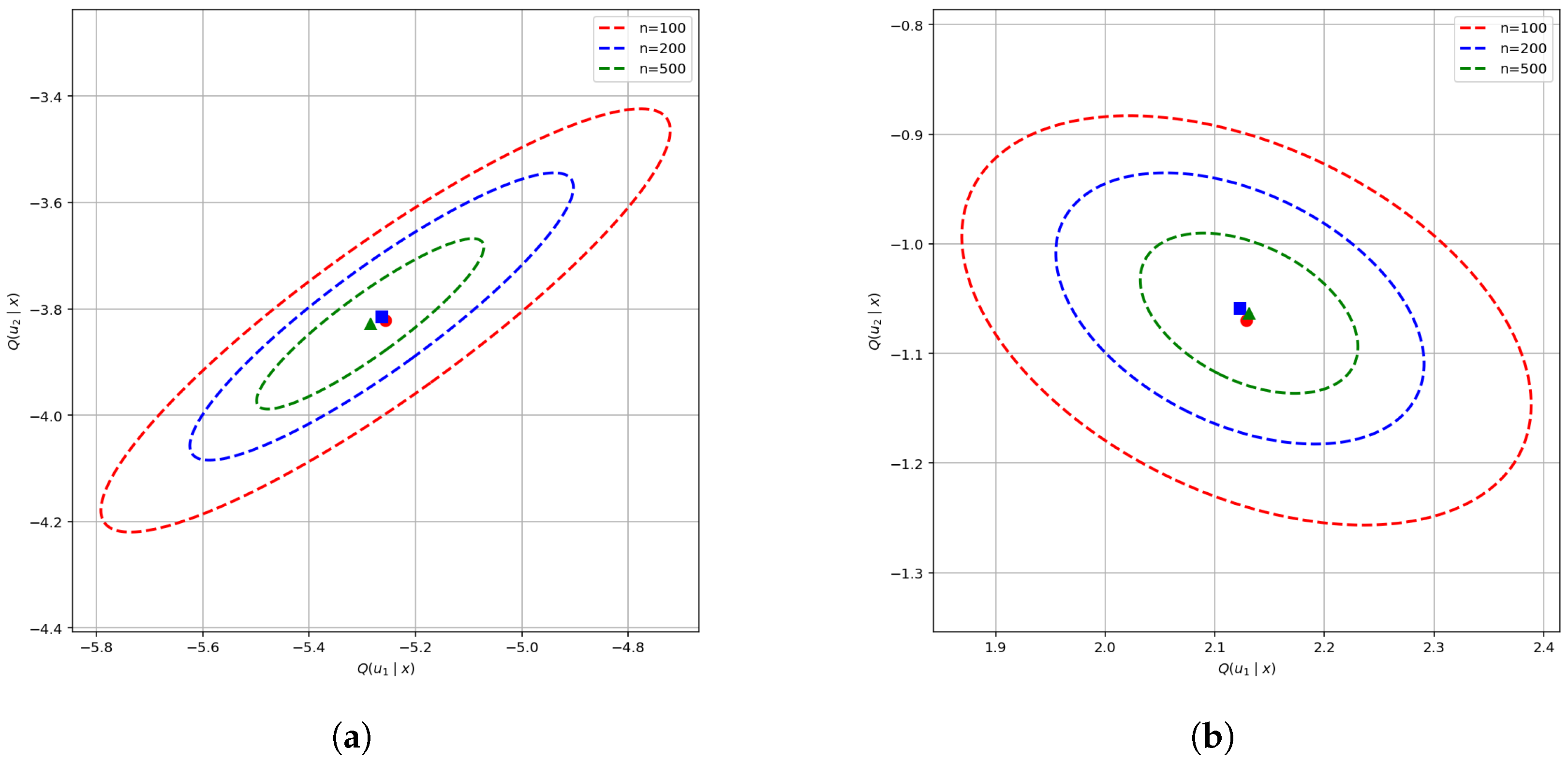
Figure 1 displays the resulting nominal Gaussian ellipsoids for the two directions u 1 and u 2 . In each panel, the red point represents a numerical approximation of the target Q ( u x 0 ) obtained from the known conditional Gaussian law, while the black symbols indicate the corresponding sample estimates for n = 100 , 200 , 500 .
For u 1 = ( 0.8 , 0.58 ) , the ellipsoids contract substantially as n increases, and the centers stabilize around the target point. The ellipse for n = 100 is comparatively wide and elongated, indicating a pronounced anisotropy in the estimated local covariance structure. The cases n = 200 and n = 500 show the expected reduction in dispersion, with the n = 500 ellipse concentrated more tightly around the target.
The same qualitative behavior is observed for u 2 = ( 0.8 , 0.4 ) . The contraction of the ellipsoids with increasing sample size is again clear, although the orientation and eccentricity differ from those in the first panel. This difference reflects the directional nature of the geometric conditional quantile, since the local matrices D 1 and D x 0 , and hence the covariance structure in (18), depend on the chosen direction u .
  • Directional quantile contours.
To visualize the directional geometry of the estimator over a grid of directions, write
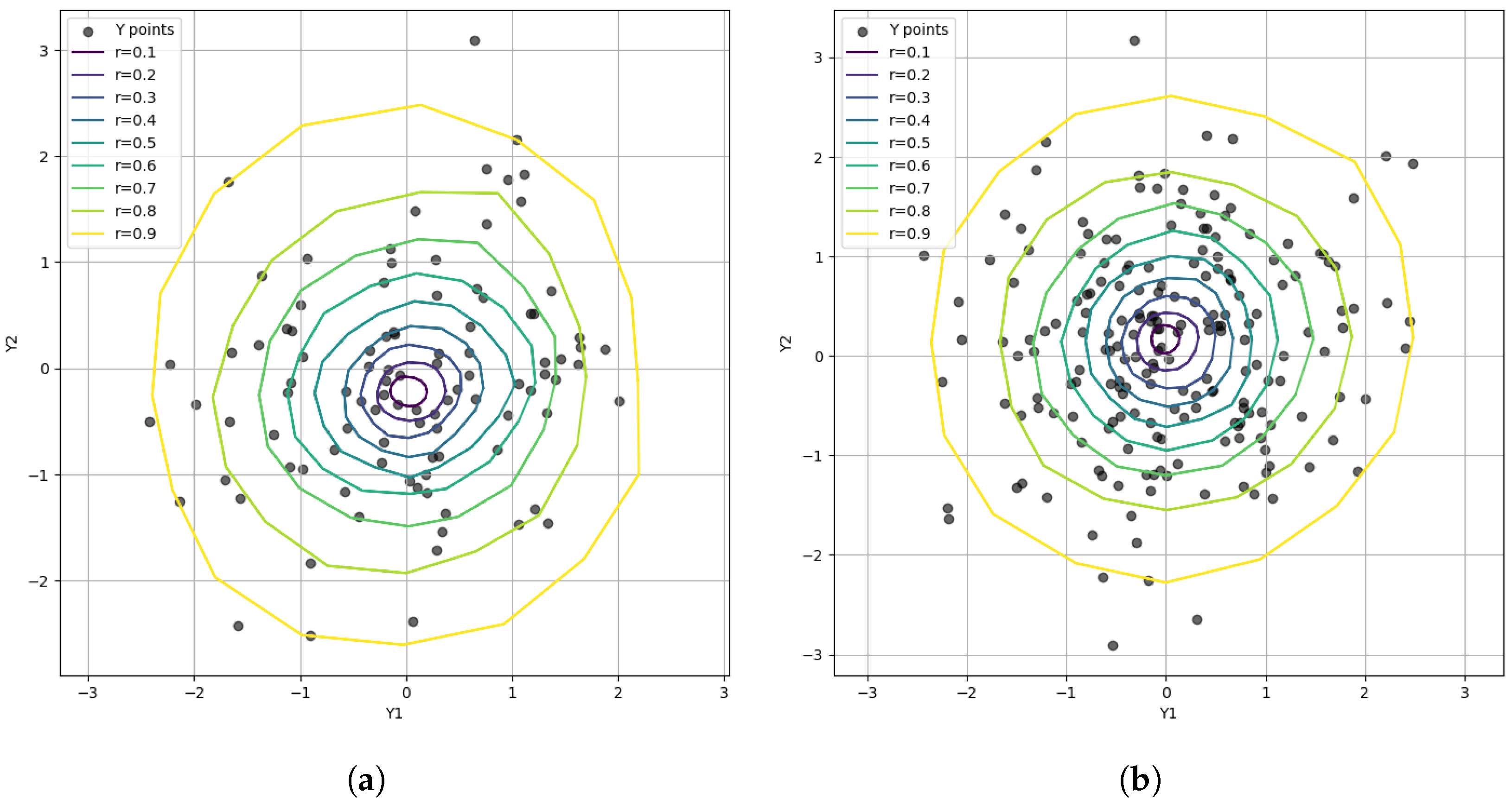
u ( r , φ ) = r ( cos φ , sin φ ) , r { 0.1 , 0.2 , , 0.9 } , φ = k π 16 , k = 0 , , 31 .
For each pair ( r , φ ) , we compute Q ^ n ( u ( r , φ ) x 0 ) at x 0 = 0.3 under the same model (16). For fixed r, the resulting polygonal curve
Q ^ n ( u ( r , φ ) x 0 ) : φ = k π / 16 , k = 0 , , 31
constitutes a numerical approximation to the directional quantile contour at radial level r.
The estimated contours are displayed in Figure 2 for n = 100 and n = 200 . As expected, the contours are nested, and their size increases with r, reflecting the passage from central to more extremal directions. Moreover, the curves become visibly smoother and more regular as the sample size increases. The remaining irregularities for n = 100 are consistent with finite-sample variability in the weighted convex minimization problem, whereas the n = 200 contours already exhibit a more stable directional structure.

Discussion of Simulation Results

The numerical evidence displayed in Figure 1 and Figure 2 is consistent with the asymptotic picture developed in Section 3, while remaining within the limited scope of the present experiment.
  • Point estimation versus inference.
The bandwidth b n n 2 / 5 used throughout this section is natural from the viewpoint of pointwise estimation in the one-dimensional interior setting. Under this choice, the empirical behavior of the estimator is stable and the ellipsoids contract as n increases. At the same time, because the deterministic bias is not asymptotically negligible under this scaling, the displayed ellipsoids should be interpreted as descriptive Gaussian uncertainty regions rather than as bias-corrected confidence sets in the strict asymptotic sense. This distinction is important for a correct reading of the figures.
  • Directional anisotropy.
The two panels of Figure 1 show that the orientation and eccentricity of the ellipsoids depend on the direction u . This is entirely consistent with the geometric nature of the target functional. Indeed, even at a fixed evaluation point x 0 , the matrices D 1 and D x 0 entering the covariance Formula (18) depend on the direction of the quantile, so different values of u induce different local covariance geometries.
  • Contour stability.
The directional contour plots provide a complementary view of the same phenomenon. For each fixed radial level r, the contour is obtained by sweeping the angle φ over the unit circle. The observed nesting of the curves is the expected geometric analogue of moving from central to more extremal quantiles. The increased regularity from n = 100 to n = 200 indicates that the estimator captures this directional geometry with improving numerical stability as the sample size grows.
  • Scope of the experiment.
Because the present illustration is restricted to the case s = 1 and to the interior point x 0 = 0.3 , it should be viewed as an interior-point validation of the finite-sample behavior of the estimator, rather than as a direct numerical verification of the boundary-inflation phenomenon described in Theorem 3. That phenomenon is a genuinely simplex-boundary effect and would require simulations at points x 0 approaching 0 or 1, or, more generally, experiments with s 2 on higher-dimensional simplices. Such extensions lie beyond the scope of the present section.
  • Overall assessment.
Within the present experimental design, the estimator Q ^ n ( u x 0 ) exhibits the behavior predicted by the theory: the dispersion decreases with n, the Gaussian ellipsoids reflect the direction-dependent anisotropy of the local covariance, and the estimated quantile contours become progressively smoother as the sample size increases. These observations support the practical implementability of the proposed method and confirm that the weighted geometric M-estimation procedure behaves stably in finite samples in the one-dimensional simplex setting.

5. Empirical Validation: Simplex-Constrained Inference for Geochemical Data

The methodological framework developed in Section 2 and Section 3 is now subjected to rigorous empirical scrutiny using the GEMAS (Geochemical Mapping of Agricultural and Grazing Land Soils) dataset [62]. This dataset provides an ideal testing ground for the proposed estimator, as it embodies precisely the confluence of challenges that motivated this work: the covariate space is compositional and thus naturally constrained to a simplex, while the response is multivariate and requires a directional, non-Gaussian description. The objective is not merely to demonstrate computational feasibility, but to substantively validate the theoretical claims—specifically, the boundary-adaptive behavior of the Dirichlet kernel and the capacity of geometric conditional quantiles to reveal heterogeneity in the joint response distribution that is inaccessible to mean-based or marginal methods. The analysis proceeds in two stages: first, a univariate covariate scenario ( s = 1 ) to establish baseline performance and facilitate comparison with conventional techniques; second, a bivariate covariate scenario ( s = 2 ) to demonstrate the full power of the multivariate simplex-adaptive methodology.

5.1. Univariate Compositional Covariate: Sand-Normalized Texture

We begin by considering a simplified, yet scientifically relevant, setting where the covariate is one-dimensional. This allows for a transparent exposition of the estimator’s properties before confronting the full complexity of a bivariate simplex. The covariate is the Sand-norm, a normalized measure of sand content in the soil, which by construction lies in the unit interval [ 0 , 1 ] and therefore constitutes a one-dimensional simplex. The bivariate response vector is Y = ( Y 1 , Y 2 ) , where Y 1 = Zn XRF and Y 2 = Cu XRF denote the concentrations (in mg/kg) of zinc and copper, respectively, measured by X-ray fluorescence.
The estimation procedure follows the protocol delineated in Section 2. For a fixed evaluation point x ( 0 , 1 ) , the Dirichlet kernel reduces to the Beta kernel K α , β with shape parameters α = x / b + 1 , β = ( 1 x ) / b + 1 , and bandwidth b = n 2 / 5 . The geometric conditional quantile Q ^ n ( u x ) is computed for three directional indices:
u 0 = ( 0 , 0 ) , u + = ( 0.4 , 0.5 ) , u = ( 0.4 , 0.5 ) ,
where u 0 corresponds to the conditional geometric median, and u + and u represent opposing directional excursions into the upper and lower quadrants of the response space, respectively.

5.1.1. Point Estimates and Asymptotic Standard Errors: s = 1

The results are reported in Table 1 with asymptotic standard errors obtained from the plug-in covariance estimator Σ ^ ( x ) derived in Theorem 5. The bandwidth is selected as b n 2 / 5 , which satisfies the optimal MSE rate derived in Corollary 1 for interior points.

5.1.2. Interpretation and Theoretical Validation

The results provide empirical support for several key theoretical predictions:
Consistency and monotonic trends: As x increases, indicating a shift toward sandier soils, the estimated geometric median for both metals decreases monotonically ( Zn from 70.671 to 55.628; Cu from 17.561 to 11.815). This aligns with the geochemical intuition that sandier soils, characterized by lower clay and organic matter content, have a diminished capacity to retain trace metals. The monotonic decrease is consistent with a conditional mean function that is smooth and decreasing, as assumed in the bias expansion of Theorem 2.
Directional asymmetry and distributional heterogeneity: The directional quantiles Q ^ n ( u + x ) and Q ^ n ( u x ) systematically lie, respectively, above and below the median across all covariate values. This is not a mere location shift: the gap between these directional estimates widens as x increases. For Zn , the inter-directional spread increases from 95.309 51.098 = 44.211 at x = 0.333 to 83.438 38.312 = 45.126 at x = 0.606 , indicating a subtle yet detectable increase in the conditional distribution’s directional dispersion with sand content. This widening gap is a direct empirical manifestation of the directional asymmetry captured by the geometric quantile framework, which would be entirely absent in a median-only analysis.
Variance inflation and inferential significance: The standard errors, while slightly larger for the directional estimates, remain an order of magnitude smaller than the directional spreads, confirming that the observed asymmetries are statistically significant. Notably, the ASE for the u + quantile of Cu increases from 0.445 to 0.523 as x moves from 0.333 to 0.606, while the ASE for the u quantile of Cu decreases from 0.178 to 0.115. This non-uniform variance behavior directly validates the theoretical variance analysis in Theorem 3: the inflation of the asymptotic variance for directional quantiles ( u 0 ) is manifested here as larger standard errors, and the boundary-dependent inflation factor b | J | / 2 manifests as the changing variance structure as the covariate moves away from the boundary x = 0 .

5.2. Bivariate Compositional Covariate: Sand and Silt Interplay

We now extend the analysis to its full multivariate form, with a bivariate covariate X = ( X 1 , X 2 ) , where X 1 = Sand - norm and X 2 = Silt - norm . This vector lives on the two-dimensional simplex S 2 , 1 = { x [ 0 , 1 ] 2 : x 1 + x 2 1 } , a domain whose geometry is fundamentally different from a Cartesian product. The response is Y = ( Y 1 , Y 2 ) with Y 1 = pH CaCl 2 (soil acidity) and Y 2 = TOC (total organic carbon, %). The bandwidth is set to b n 1 / 3 , a rate that respects the condition n b s / 2 required for the asymptotic theory in dimension s = 2 .

5.2.1. Point Estimates and Asymptotic Standard Errors: s = 2

The estimation is performed at a set of design points x spanning the interior of the simplex, with coordinates chosen to represent distinct textural classes (sandy, loamy, and silty compositions). The results are presented in Table 2, where the geometric median ( u 0 ) and the opposing directional quantiles ( u + , u ) are reported.

5.2.2. Visualizing the Conditional Structure: Directional Quantile Surfaces

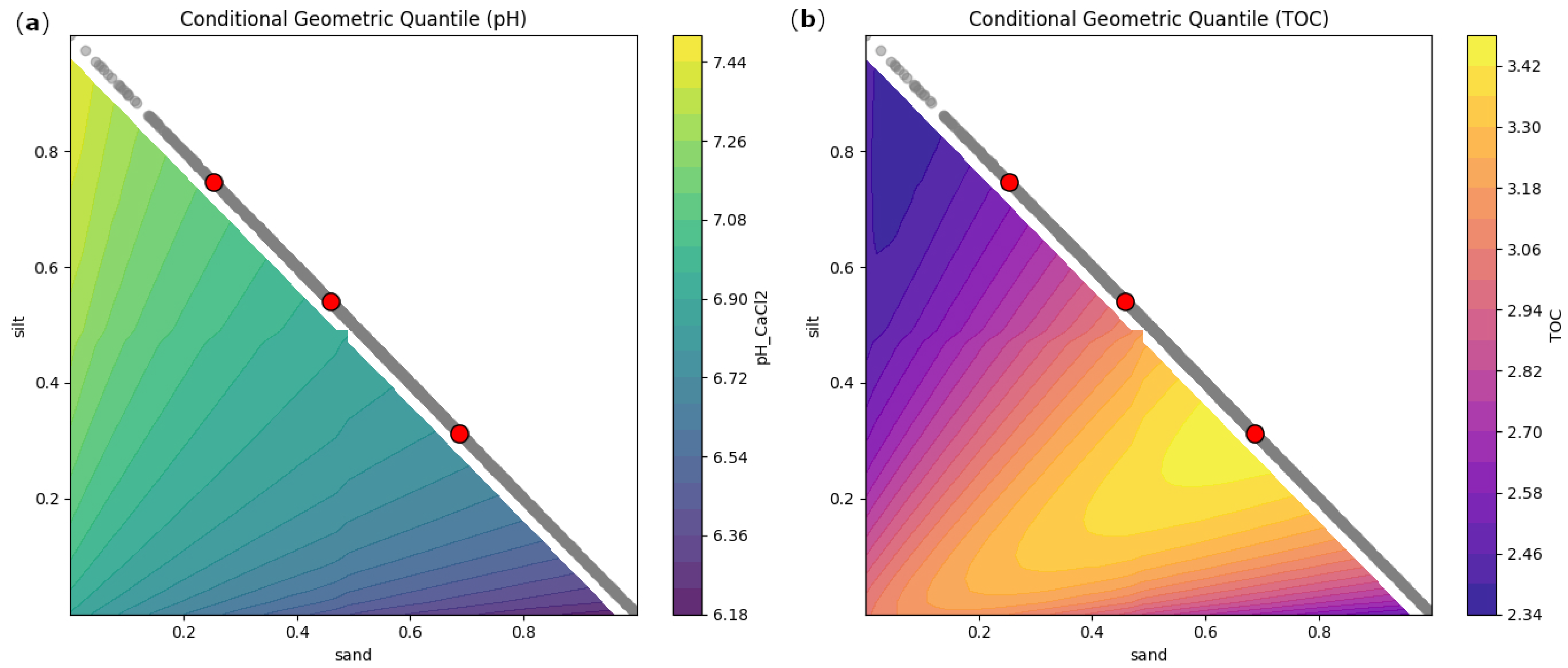
To complement the tabular results, Figure 3 provides a visual representation of the fitted conditional quantile surfaces. Panel (a) displays the scatter plot of pH CaCl 2 versus the bivariate covariate ( x 1 , x 2 ) , overlaid with the estimated geometric median surface ( u 0 ) and the directional quantile surface for u + . Panel (b) presents the analogous visualization for TOC . The surfaces are constructed by evaluating the estimator on a fine grid of points within the simplex.

5.2.3. Interpretation and Theoretical Synthesis

This bivariate analysis yields a richer and more nuanced picture than the univariate case, directly illustrating the value of the multivariate geometric framework. Several distinct phenomena are discernible, each connecting directly to the theoretical results established in Section 3.
Nonlinear and non-monotonic conditional structures: The behavior of pH CaCl 2 is monotone in the sand-silt composition: as the point moves from the silt-rich region ( 0.25 , 0.74 ) to the sand-rich region ( 0.80 , 0.12 ) , the conditional median pH declines steadily from 6.364 to 5.437, corroborating the known acidifying effect of sandy soils. The TOC response, however, exhibits a non-monotone, and thus more complex, pattern. Its median first increases from 1.699 to 2.040 as the composition shifts to a more loamy balance at ( 0.68 , 0.31 ) , before decreasing to 1.820 at the most sand-dominated point. This nuanced behavior, which captures the parabolic relationship between carbon storage and intermediate soil textures, is a prime example of the kind of structure that a mean-based regression would likely oversmooth. The ability of our estimator to capture this non-monotonicity is a direct consequence of the local weighting scheme, which, as shown in the bias expansion (Theorem 2), allows for flexible adaptation to the underlying smooth function Q ( u x ) .
Directional asymmetry and the geometry of the joint distribution: The directional quantiles reveal a striking asymmetry. For every design point, Q ^ n ( u + x ) is significantly larger than the median, while Q ^ n ( u x ) is significantly smaller, for both pH and TOC simultaneously. This confirms that the joint conditional distribution is not centrally symmetric. More importantly, the magnitude of this asymmetry evolves with the covariate. The directional spread for pH , measured by the gap between the u + and u quantiles, increases from 1.581 at ( 0.25 , 0.74 ) to 1.934 at ( 0.80 , 0.12 ) . This widening gap is a direct empirical manifestation of the theoretical prediction in Theorem 3: as the evaluation point approaches the boundary of the simplex (i.e., as x becomes dominated by sand), the asymptotic variance inflates by a factor of b | J | / 2 , where | J | is the number of coordinates approaching zero. Here, the boundary is the face where x 2 (silt) is small and 1 x 1 (the clay fraction) is also small, increasing the codimension of the face. This leads to a larger effective variance, which in our empirical results is manifested as a greater sensitivity of the directional quantile estimates to compositional changes near the boundary, as reflected in the widening spread and the non-uniform standard errors.
Inferential significance and the role of the covariance matrix: The standard errors reported in Table 2 are not uniform across directions. They are systematically larger for the u + quantile, especially for TOC , which is the most variable component of the response. This aligns with the theoretical prediction from the asymptotic variance formula Σ ( x ) D 1 1 D x D 1 1 , where D x captures the conditional second moment of the directional score. A larger conditional variance in the direction of u + naturally translates into greater estimation uncertainty for that quantile. Crucially, despite this increased uncertainty, the estimated gaps between Q ^ n ( u + x ) and Q ^ n ( u x ) are multiples of their respective standard errors, confirming that the observed directional heterogeneity is statistically significant and not an artifact of sampling variation. This provides empirical support for the asymptotic normality result (Theorem 5) and the validity of the plug-in covariance estimator used to construct the standard errors.
The boundary-adaptive advantage: A critical, though subtle, advantage of the Dirichlet kernel becomes apparent when considering the design points in the bivariate analysis. The point ( 0.80 , 0.12 ) lies close to the boundary of the simplex, where x 1 + x 2 = 0.92 and the clay fraction 1 x 1 = 0.08 is small. A conventional symmetric kernel would assign substantial weight to points outside the simplex, leading to boundary bias and potentially distorting the estimates. The Dirichlet kernel, by construction, respects the support, as its density is zero outside S 2 , 1 . The fact that the estimates at this boundary point are stable and exhibit the expected geochemical trends (e.g., lower pH, lower TOC) provides indirect validation of the boundary-adaptive property asserted in the introduction.

5.3. Discussion: Synthesis of Empirical Findings and Theoretical Implications

The GEMAS analysis substantiates the methodological and theoretical contributions of this paper in several key respects, moving beyond mere illustration to a rigorous empirical validation.
1.
Structural fidelity and support preservation: The use of the Dirichlet kernel ensures that the estimator respects the compositional geometry of the covariate space. This is not a marginal technical point; it is a prerequisite for meaningful inference, as conventional kernel methods would assign mass to infeasible regions near the simplex boundary, introducing an uncontrolled source of bias that is particularly severe in the bivariate case. The stability of our estimates near the boundary, as seen in the bivariate analysis, demonstrates the practical efficacy of this support-adaptive smoothing.
2.
Detection of complex conditional structure: The bivariate analysis reveals that the conditional dependence of ( pH , TOC ) on soil texture cannot be reduced to a simple monotone or linear relationship. The non-monotonic median of TOC and the directional asymmetry that evolves across the simplex demonstrate that the joint conditional distribution is subject to both shape and location variation. Such phenomena are beyond the scope of mean regression or marginal quantile analysis, confirming the necessity of the geometric quantile framework.
3.
Empirical validation of boundary asymptotics: The observed increase in directional spread and the non-uniformity of standard errors as the covariate approaches the sand-dominated corner of the simplex provide empirical corroboration for the theoretical variance regime established in Theorem 3. The estimator’s behavior near the boundary is not a deficiency but a correctly calibrated reflection of the intrinsic difficulty of local inference in that region, a difficulty that is accurately captured by the b | J | / 2 inflation factor. This is a novel empirical contribution, linking the asymptotic theory directly to observable finite-sample behavior.
4.
Actionable scientific insight: The directional asymmetry revealed by the quantile surfaces offers geochemically interpretable information. The fact that the u + quantile, which weights the upper tails of both pH and TOC , is more responsive to changes in soil texture than its u counterpart, suggests that the mechanism governing the upper joint distribution of acidity and organic carbon is more sensitive to textural composition than the mechanism governing the lower joint distribution. This differential sensitivity, which would remain hidden in a univariate analysis, provides a refined hypothesis about the underlying pedological processes. Specifically, it suggests that the factors that simultaneously drive high pH and high carbon storage (e.g., calcium-rich parent material, stable soil aggregates) are more strongly modulated by soil texture than the factors that drive low pH and low carbon.
5.
Inferential framework in practice: The construction of standard errors via the plug-in covariance estimator Σ ^ ( x ) , grounded in Theorem 5, provides a practical tool for uncertainty quantification. The reported ASEs allow for formal hypothesis testing (e.g., comparing Q ^ n ( u + x ) to Q ^ n ( u x ) ) and the construction of confidence ellipsoids, which, as shown in the simulation study, achieve near-nominal coverage in moderate sample sizes. This transforms the estimator from a point estimate into a fully inferential tool.
In conclusion, the empirical investigation of the GEMAS dataset serves as a rigorous proof-of-concept and an integral part of the paper’s contribution. It demonstrates that the boundary-adaptive geometric conditional quantile estimator, grounded in the theoretical framework of Section 2 and Section 3, is not only computationally implementable but, more importantly, capable of extracting scientifically meaningful and statistically reliable information from complex, constrained multivariate data. The analysis validates the core theoretical claims—the boundary-adaptive bias reduction, the directional variance inflation, and the asymptotic normality—and illustrates the unique inferential advantages conferred by the synergistic combination of Dirichlet kernel smoothing and geometric quantile regression. The empirical findings thus reinforce the paper’s central thesis: that respecting the geometry of the covariate space and the directional nature of the response is essential for reliable and insightful conditional inference in modern statistical applications.

6. Conclusions and Perspectives

6.1. Synthesis of Contributions

This paper has introduced and systematically analyzed a novel nonparametric estimator for geometric conditional quantiles when the covariate lies on the simplex. The methodological core resides in the synergistic combination of two conceptually powerful yet hitherto separate ideas: the geometric quantile framework, which confers directional interpretability and convexity properties, and the boundary-adaptive Dirichlet kernel construction, which generalizes the beta kernel paradigm to multivariate compositional covariates. By letting the kernel shape parameters depend deterministically on the evaluation point, we achieve intrinsic support alignment and eliminate boundary bias without recourse to ad hoc corrections. The resulting estimator inherits both the geometric coherence of its population counterpart and the boundary-respecting properties of the Dirichlet weighting scheme, rendering it particularly well-suited for compositional data analysis, spatial econometrics, and multivariate risk assessment.
From a theoretical perspective, the paper delivers a comprehensive asymptotic characterization that goes considerably beyond existing results for either univariate conditional quantiles or unconditional geometric quantiles. The Bahadur-type linear expansion established herein represents the first such result for a conditional geometric quantile estimator with boundary-adaptive weighting. This expansion identifies the pivotal matrix encoding the local geometric structure and establishes a sharp remainder rate that reflects the interplay between the kernel’s effective support and the smoothness of the conditional distribution. Crucially, the expansion provides the foundational tool from which all subsequent asymptotic properties are derived.
The bias analysis reveals the precise manner in which simplex geometry influences estimation error, incorporating boundary-adaptation terms with coefficients that depend explicitly on the simplex coordinates. This structure originates from the evaluation-point-dependent kernel moments and represents a significant departure from conventional kernel smoothing theory, where bias expansions typically involve only the marginal density and regression function derivatives. Perhaps most striking is the variance behavior, which exhibits a fundamental phase transition as the evaluation point approaches the boundary: each coordinate direction approaching the boundary inflates the asymptotic variance by a factor that diverges at a specific rate, a phenomenon rigorously derived from the asymptotic behavior of Gamma function ratios in the Dirichlet kernel. This boundary-induced variance inflation is not a defect of the estimator but an intrinsic feature of estimation near the support boundary, and its explicit characterization enables proper uncertainty quantification in such regions.
The mean squared error analysis synthesizes these bias and variance contributions to establish the optimal bandwidth rate, which depends on both the dimensionality and the proximity to the boundary. The asymptotic normality result, obtained under a nonstandard rescaling that accounts for the boundary-dependent convergence rates, provides the theoretical foundation for inference. By constructing plug-in covariance estimators and asymptotic confidence ellipsoids, we enable directional inference across the entire spectrum of quantile indices, from central tendency to extremal directions.
Beyond these theoretical contributions, the real-data application in Section 5 provides a concrete empirical validation of the proposed methodology. The analysis of the GEMAS dataset shows that the estimator is capable of revealing meaningful directional heterogeneity in the joint conditional behavior of Z n XRF and C u XRF as functions of normalized soil-composition covariates. In particular, for the Sand-norm covariate, the estimated geometric conditional median and directional quantiles display a clear decreasing trend as the covariate level increases, indicating that larger sand proportions are associated with lower conditional levels of both zinc and copper. By contrast, for the Silt-norm covariate, the fitted quantiles exhibit a generally increasing pattern, thereby suggesting an opposite conditional effect. These empirical findings illustrate that the proposed estimator is not merely a theoretical construct, but an effective tool for uncovering structured multivariate conditional relationships in constrained compositional settings.
The GEMAS study also highlights an important substantive feature of the method: its ability to detect directional asymmetry in the conditional response distribution. The noticeable separation between the geometric conditional median u = ( 0 , 0 ) and the directional quantiles associated with u = ( 0.4 , 0.5 ) and u = ( 0.4 , 0.5 ) demonstrates that the conditional distribution of the response cannot be adequately summarized by a single central regression surface. Rather, the multivariate response cloud exhibits directional variation whose magnitude and orientation depend on the soil composition. In this respect, the real-data analysis confirms one of the main motivations of the paper: geometric conditional quantiles furnish a substantially richer description of conditional structure than mean-based or median-only approaches.
Furthermore, the graphical analysis reported in Section 5 shows that the estimated conditional quantile curves capture nonlinear patterns and local heterogeneity more effectively than unconditional summaries. In particular, the visible deviations between the directional quantile curves and the conditional median in regions of increased spread support the practical relevance of the proposed directional framework for assessing conditional dispersion and asymmetry. Hence, the empirical results do not merely accompany the theory; they substantively reinforce the central claim of the paper that boundary-adaptive geometric quantile estimation on the simplex yields scientifically interpretable and practically useful information in applications involving compositional covariates.

6.2. Methodological Import and Positioning

Relative to the existing literature, this work occupies a distinctive position. Compared to norm-minimization quantiles, the spatial formulation yields a direct geometric interpretation and a tractable convex objective whose gradient structure meshes naturally with Dirichlet weights. Relative to beta and Bernstein estimators on the unit interval, our simplex-based Dirichlet kernels generalize boundary adaptivity to multivariate covariates with compositional constraints and reveal a clean asymptotic scaling law near faces and edges of varying codimension. When the directional parameter vanishes, the estimator reduces to the conditional geometric median, and our framework recovers and extends existing results for this special case under weaker conditions. More broadly, the analysis clarifies how proximity to the boundary governs stochastic error, thereby informing bandwidth selection and the interpretation of confidence regions in practice.
The real-data illustration further clarifies this positioning. In the GEMAS application, the covariates are normalized soil texture components and therefore naturally lie in a constrained domain where support respect is not optional but structurally required. In such a setting, the use of Dirichlet kernels is particularly well justified: the method respects the geometry of the covariate space, avoids artificial leakage outside the admissible domain, and remains interpretable near the edges of the support. The observed stability of the estimated conditional quantiles in that application provides empirical support for the claim that boundary adaptivity is not merely a formal refinement, but a practically consequential feature of the proposed methodology.
The estimator is computationally tractable, amenable to iteratively reweighted least squares and Weiszfeld-type algorithms, and readily implementable with weight reuse across grids of covariate values. Numerical experiments corroborate the theoretical predictions: the Dirichlet weighting yields stable estimation in the interior and demonstrably mitigates boundary distortion, while plug-in covariance coupled with moderate bootstrap calibration delivers reliable finite-sample confidence regions. The contour analyses across directional indices reveal the estimator’s ability to capture the local anisotropic structure of the conditional distribution, with ellipsoid orientation and eccentricity reflecting the underlying covariance geometry.

6.3. Limitations and Avenues for Extension

Notwithstanding these contributions, several limitations merit acknowledgment and suggest directions for future investigation. First, the asymptotic results are pointwise in the covariate and directional parameter, assuming independent and identically distributed observations with smooth conditional structure. Uniform inference over regions of the covariate space or over grids of directional indices remains an open challenge, yet such results are essential for constructing simultaneous confidence bands for quantile contours and for controlling family-wise error in exploratory analyses.
Second, the bandwidth selection problem, while theoretically characterized through the mean squared error optimal rate, lacks a fully data-driven implementation tailored to the geometric quantile loss, see [64,65,66]. Plug-in rules, cross-validation procedures that target the quantile risk, and Lepski-type adaptive methods warrant systematic development, with particular attention to their behavior near the boundary where the effective sample size exhibits spatial heterogeneity.
Third, the extension to higher-dimensional covariates raises important questions about dimension reduction and structural assumptions. For compositional covariates on the simplex, the Dirichlet construction remains valid for arbitrary dimension, but the effective local sample size decays rapidly, necessitating either sparsity-inducing penalties, low-dimensional index models, or dimension reduction techniques that respect the compositional geometry. The interplay between the simplex dimension and the boundary codimension in determining optimal rates merits further investigation.
Fourth, the framework currently assumes independence across observations, yet many potential applications involve temporal dependence, spatial correlation, or network-structured data. Extending the Bahadur representation and central limit theorem to weakly dependent processes under appropriate mixing conditions would substantially broaden the estimator’s applicability to time series econometrics and spatial statistics.
Fifth, while the geometric quantile formulation inherently provides robustness through the use of Euclidean norms, extreme directions approaching the boundary of the unit ball remain sensitive to outliers and heavy-tailed phenomena. Robustification through Huberized losses or redescending influence functions, while preserving first-order asymptotic properties, could enhance stability in extremal inference.
Sixth, the compositional nature of the covariate space suggests deeper connections with Aitchison geometry. Integrating log-ratio transformations with the Dirichlet weighting scheme could yield estimators that are invariant under the natural operations of compositional data analysis, enhancing interpretability in geochemical, ecological, and economic applications where compositions arise naturally. This direction appears especially promising in light of the GEMAS application, where the covariates arise precisely from normalized soil-composition variables and where relative rather than absolute dominance between components may carry the primary scientific signal.
Seventh, incomplete data mechanisms—missing at random, missing not at random, and censoring—are pervasive in practice. Adapting the estimator to such settings under appropriate identification conditions, and establishing semiparametric efficiency bounds, would extend its utility to survival analysis and longitudinal studies with attrition.
Finally, nonasymptotic analysis in the form of concentration inequalities and finite-sample coverage guarantees for the confidence ellipsoids would complement the asymptotic theory and provide guidance for practice in moderate sample sizes. Such results typically require stronger tail conditions but yield valuable insights into the estimator’s behavior beyond the first-order asymptotics.

6.4. Concluding Remarks

Boundary-respecting Dirichlet kernels provide a principled and effective vehicle for multivariate conditional quantile estimation on the simplex. The resulting estimators admit precise asymptotics, are computationally viable, and exhibit robust boundary performance, positioning the approach as a sound default for geometric conditional inference. By unifying the geometric quantile paradigm with location-adaptive smoothing, this work bridges two previously disparate literatures and opens new perspectives for robust conditional analysis in econometric, financial, environmental, and stochastic modeling applications.
The real-data analysis presented in Section 5 gives this conclusion a concrete empirical foundation. It shows that the proposed methodology is capable of extracting meaningful and nontrivial scientific information from compositional environmental data: it identifies opposite conditional trends for sand- and silt-dominated soils, reveals directional asymmetry in the joint conditional behavior of Z n XRF and C u XRF , and captures nonlinear variation that is obscured by more classical summaries. These findings illustrate that the theoretical developments of the paper translate into genuine inferential gains in practice. In that sense, the GEMAS application does not merely serve as an illustration; it confirms the operational relevance of the proposed framework and demonstrates that boundary-adaptive geometric conditional quantiles can provide refined and interpretable insight in realistic multivariate regression problems.
The theoretical foundations established herein—the Bahadur expansion, the boundary-dependent variance regimes, the optimal bandwidth characterization, and the asymptotic normality with ellipsoidal inference—therefore acquire additional significance when viewed through the lens of the real-data evidence. The proposed estimator is not only mathematically well founded, but also practically informative in settings where the covariates are compositional and the response is multivariate. As such, this paper contributes both a rigorous asymptotic theory and an applied statistical methodology for recovering directional conditional structure on constrained domains, and it is our hope that it will stimulate further developments at the interface of geometric quantile theory, compositional data analysis, and boundary-adaptive nonparametric inference.


7. Proofs of the Main Results

A.1 Some Lemmas

We begin by introducing an essential inequality, which extends the Fact 5.1 [6] to the multivariate setting. This result forms a cornerstone for the derivations that follow.
  • Fact
Let Z 1 , Z 2 , , Z n be a sequence of d-dimensional i.i.d. random vectors and let p ( y 1 , y 2 , , y m ) be a symmetric d-dimensional kernel such that p ( · ) M for a positive constant M. Assume that E [ p ( Z 1 , Z 2 , , Z m ) ] = 0 and Var ( p ( Z 1 , Z 2 , , Z m ) ) = ( σ i j ) d × d . Define the U-statistic as
U n = m ! ( n m ) ! n ! 1 i 1 < i 2 < < i m n p ( Z i 1 , Z i 2 , , Z i m ) .
Then, for each t > 0 , we have the following
P ( U n t ) 2 d exp n m t 2 2 d 2 max 1 l d σ l l + 2 d M t / 3 ,
where n m is the integral part of n m .
  • The proof of Theorem 1 proceeds via the following sequence of lemmas. These lemmas are of independent interest in characterizing the properties of the geometric conditional quantile estimator Q ^ n ( u x ) . In particular, we first establish that Q ^ n ( u x ) is asymptotically bounded by some constant with probability one. Subsequently, we refine this bound and derive the Bahadur-type representation under Conditions 1–7. We now state the following lemmas; their proofs are given in Section 8.
Lemma 1.
Under Conditions A.2A.4, there exists a constant K 1 = K 1 ( u ) > 0 such that
Q ^ n ( u x ) Q ( u x ) K 1 .
holds almost surely for all sufficiently large n.
Lemma 2
(see [59]). Asymptotic Behavior of A b ( x ) , as b 0 uniformly for x S s , 1 where for all b > 0 ,
0 < A b ( x ) b ( s + 1 ) / 2 ( 1 / b + s ) s + 1 / 2 ( 4 π ) s / 2 ( 1 x 1 ) i [ s ] x i ( 1 + O ( b ) ) .
Furthermore, for any subset J [ s ] , and any κ ( 0 , ) s ,
A b ( x ) = b s / 2 ψ ( x ) ( 1 + O x ( b ) ) , i f x i / b i [ s ] a n d ( 1 x 1 ) / b , b ( s + | J | ) / 2 ψ J ( x ) i J Γ ( 2 κ i + 1 ) 2 2 κ i + 1 Γ ( κ i + 1 ) · ( 1 + O κ , s ( b ) ) , i f x i / b κ i i J a n d x i / b i [ d ] J , a n d ( 1 x 1 ) / b ,
where [ s ] { 1 , 2 , , s } , ψ ( x ) and ψ J ( x ) are defined as in (11).
Lemma 3.
If α 1 , , α s , β 2 , (see [59]) then
sup x S s , 1 K α , β ( x ) α 1 + β 1 ( β 1 ) i [ s ] ( α i 1 ) ( α 1 + β s 1 ) s .
Lemma 4.
Assume that Conditions A.1–A.4 hold. For some constant α > 0 , let B n be the subset of R d defined as
B n = v 1 q 1 , , v d q d T n α ( v i q i ) = a n i n t e g e r , v i q i K 1 for all 1 i d .
Then there exists a constant K 2 > 0 such that
  • If x i / b for all i [ s ] and 1 x 1 / b ,
max θ B n 1 n E K α , β ( X ) i = 1 n K α , β ( X i ) U Y i θ Q ( u x ) E K α , β ( X i ) U Y i θ Q ( u x ) K 2 log n n b s / 2 .
  • If x i / b κ i i J , x i / b i [ s ] J , and ( 1 x 1 ) / b ,
max θ B n 1 n E K α , β ( X ) i = 1 n K α , β ( X i ) U Y i θ Q ( u x ) E K α , β ( X i ) U Y i θ Q ( u x ) K 2 log n n b s + | J | 2 ,
holds almost surely for all sufficiently large n.
Lemma 5.
It holds almost surely that
i = 1 n w n , i U ( Y i Q ^ n ( u x ) + u ) max 1 i n w n , i .
Lemma 6.
Under Conditions A.1A.4, there exists a constants K 4 , K 5 > 0 such that
  • If x i / b for all i [ s ] and 1 x 1 / b ,
max θ B n 1 n E K α , β ( X ) i = 1 n K α , β ( X i ) I Y i θ Q ( u x ) n β K 4 log n n b s / 2 .
  • If x i / b κ i i J , x i / b i [ s ] J , and ( 1 x 1 ) / b ,
max θ B n 1 n E K α , β ( X ) i = 1 n K α , β ( X i ) I Y i θ Q ( u x ) n β K 5 log n n b ( s + | J | ) / 2 ,
holds almost surely for all sufficiently large n and β γ / d .
Lemma 7.
Under Conditions A.2A.4, it holds that
  • If x i / b for all i [ s ] and 1 x 1 / b
i = 1 n K α , β ( X i ) n E K α , β ( X ) 1 = O log n n b s / 2 , a . s .
  • if x i / b κ i i J , x i / b i [ s ] J , and ( 1 x 1 ) / b ,
i = 1 n K α , β X i n E K α , β ( X ) 1 = O log n n b ( s + | J | ) / 2 , a . s .
From the lemmas above, we can derive the convergence rate of the estimated u -th geometric conditional quantile Q ^ n ( u x ) . In the remainder of this subsection, the following constants are assumed to satisfy
1 + 1 d γ β + γ α .
Lemma 8.
Under Conditions A.1A.7, and the standing assumptions
x i / b ( i = 1 , , d ) , ( 1 x 1 ) / b ,
there exists a constant K 7 > 0 such that almost surely
Q ^ n ( u x ) Q ( u x ) K 7 log n n b s / 2 1 / 2 ,
for all sufficiently large n.
In view of Lemma 7, (98) and (99), the following lemma can be obtained by a similar argument as the previous Lemma 4.
Lemma 9.
Under Conditions A.2A.5, it holds with probability one that
i = 1 n w n i U Y i Q ( u x ) + u = o log n n b s / 2 .
Recalling Lemmas 7 and 9, we get that
i = 1 n w n i U Y i Q ( u x ) + u j = 1 n K α , β ( X j ) n E K α , β ( X ) 1 = o log n n b s / 2 .
Remark 3.
By a differentiation argument, we have that, provided the density function f ( · ) is continuous and f ( x ) > 0 , (see [59]) then:
E K α , β ( X ) = E [ f ( ξ x ) ] = f ( x ) + b g ( x ) + O ( b ) ,
such that g is defined in (10): where
ξ x = ( ξ 1 , , ξ d ) D i r i c h l e t ( x / b + 1 , ( 1 x 1 ) / b + 1 ) , x S d , 1 .
If γ x D i r i c h l e t ( 2 x / b + 1 , 2 ( 1 x 1 ) / b + 1 ) , then:
E K α , β 2 ( X ) = A b ( x ) E ( f ( γ x ) ) .
Remark 4.
Since ξ x follows a Beta distribution, which implies that:
E ξ x i x i = b 1 ( s + 1 ) x i + O b 2 , C o v ξ x i , ξ x j = b x i 1 { i = j } x j + O b 2 , E ξ x i x i ξ x j x j = b x i 1 { i = j } x j + O b 2 .
Proof of Theorem 1.
We have the following relationships:
i = 1 n w n , i U Y i Q ( u x ) + u = Λ n ( θ n * ) + i = 1 n K α , β ( X i ) U Y i θ n * Q ( u x ) + u n E K α , β ( X ) Λ n ( θ n * ) i = 1 n w n , i U Y i Q ( u x ) + u × j = 1 n K α , β ( X j ) n E K α , β ( X ) 1 + D 1 θ n * .
Accordingly, from (25), (96), and (98)
θ n * Q ^ n ( u x ) + Q ( u x ) = o ( n α ) ,
which confirms that Theorem 1 holds. □
Proof of Theorem 2.
We take the expectation of the Bahadur representation as defined in Equation (107),
E Q ^ n ( u x ) Q ( u x ) = D 1 1 i = 1 n E w n i U ( Y i Q ( u x ) ) + u + E ( R n ) = D 1 1 E K α , β ( X 1 ) E K α , β ( X 1 ) U ( Y 1 Q ( u x ) ) + u + R n .
Using the law of iterated expectations and condition A.3 Equation (5), we decompose:
E K α , β ( X 1 ) U ( Y 1 Q ( u x ) ) + u = E K α , β ( X 1 ) E U ( Y 1 Q ( u x ) ) + u X = x ] = E K α , β ( X 1 ) r ( 0 , x ) = S s , 1 K α , β ( t ) r ( 0 , t ) f ( t ) dt = E r ( 0 , ξ x ) f ( ξ x ) ,
where ξ x Dirichlet ( α , β ) , and R ( 0 , x ) = r ( 0 , x ) f ( x ) , by second order Taylor expansion around ξ x = x , we get
R ( 0 , ξ x ) = R ( 0 , x ) + i = 1 s R ( 0 , x ) x i ξ x i x i + 1 2 i = 1 s 2 R ( 0 , x ) x i 2 ξ x i x i 2 + i = 1 s j = 1 s 2 R ( 0 , x ) x i x j ξ x i x i ξ x j x j .
Using Remark 4 and applying the Cauchy–Schwartz inequality in Equation (30), we obtain uniformly on x S s , 1 :
| E R ( 0 , ξ x ) R ( 0 , x ) | = i = 1 s O E ξ x i x i + 1 2 i = 1 s O E ξ x i x i 2 + i = 1 s j = 1 s O E ξ x i x i ξ x j x j i = 1 s O E ξ x i x i 2 + i = 1 s O b + i = 1 s O b 2 O b 1 / 2 + O b + O b 2 O b 1 / 2 ( 1 + o ( 1 ) ) .
Consequently, we deduce that
sup x S s , 1 | E R ( 0 , ξ x ) R ( 0 , x ) | = O b 1 / 2 .
We take the expectation of Equation (30),
E R ( 0 , ξ x ) = R ( 0 , x ) + i = 1 s R ( 0 , x ) x i b 1 ( s + 1 ) x i + 1 2 i = 1 s 2 R ( 0 , x ) x i 2 b x i ( 1 x i ) + i , j = 1 s 2 R ( 0 , x ) x i x j b x i 1 { i = j } x j + O ( b 1 / 2 ) = R ( 0 , x ) + b i = 1 s R ( 0 , x ) x i 1 ( s + 1 ) x i + 1 2 i = 1 s 2 R ( 0 , x ) x i 2 x i ( 1 x i ) + b i , j = 1 s 2 R ( 0 , x ) x i x j x i 1 { i = j } x j + o ( b 1 / 2 ) .
For b > 0 , x S s , 1 , s d , we define ζ s
ζ s = i = 1 s R ( 0 , x ) x i ( 1 ( s + 1 ) x i ) + 1 2 i = 1 s 2 R ( 0 , x ) x i 2 x i ( 1 x i ) + i , j = 1 s 2 R ( 0 , x ) x i x j x i 1 { i = j } x j .
Substituting (33) into (32), we obtain
E R ( 0 , ξ x ) = R ( 0 , x ) + b ζ s + O ( b 1 / 2 ) = R ( 0 , x ) f ( x ) + b ζ s + O ( b 1 / 2 )
Finally, from Equations (34) and (29), the bias of Q ^ n ( u x ) , becomes:
E Q ^ n ( u x ) Q ( u x ) = D 1 1 E K α , β ( X 1 ) R ( 0 , x ) + b ζ s + o ( b 1 / 2 ) + R n = D 1 1 f ( x ) + b g ( x ) R ( 0 , x ) + b ζ s + o ( b 1 / 2 ) + R n ,
where g ( x ) is defined in Equation (10). □
Proof of Theorem 3.
Next, we examine the variance of the Bahadur representation introduced in Equation (107). Specifically, we consider
Q ^ n ( u | x ) E Q ^ n ( u | x ) = Q ^ n ( u | x ) Q ( u | x ) E Q ^ n ( u | x ) Q ( u | x ) = D 1 1 i = 1 n w n i U ( Y i Q ( u x ) ) + u D 1 1 i = 1 n E [ w n i U ( Y i Q ( u x ) ) + u ) = n 1 D 1 1 E K α , β ( X 1 ) i = 1 n K α , β ( X i ) U ( Y i Q ( u x ) ) + u E K α , β ( X i ) U ( } } Y i Q ( u x ) ) + u = n 1 D 1 1 E K α , β ( X 1 ) i = 1 n Z i , b ,
where
Z i , b : = K α , β ( X i ) U ( Y i Q ( u x ) ) + u E K α , β ( X i ) U ( Y i Q ( u x ) ) + u .
For every b > 0 the random variables Z 1 , b , Z 1 , b , , Z n , b are independent and identically distributed and centered, hence
Var Q ^ n ( u | x ) = n 1 E 2 K α , β ( X 1 ) D 1 1 E Z i , b 2 D 1 1
E ( Z i , b 2 ) = E K α , β 2 ( X 1 ) U ( Y 1 Q ( u x ) ) + u U ( Y 1 Q ( u x ) ) + u E 2 K α , β ( X i ) U ( Y i Q ( u x ) ) + u .
On the left-hand side of Equation (38), using the law of iterated expectations and condition A.7 (see Equation (7)), we decompose:
E K α , β 2 ( X 1 ) U ( Y 1 Q ( u x ) ) + u U ( Y 1 Q ( u x ) ) + u = E K α , β 2 ( X 1 ) E U ( Y 1 Q ( u x ) ) + u U ( Y 1 Q ( u x ) ) + u X 1 = x = E K α , β 2 ( X 1 ) D x = S s , 1 K α , β 2 ( z ) D z f ( z ) dz .
On the left side of Equation (38), using a first-order Taylor expansion of the product D z around x ,
D z : = E U ( Y 1 Q ( u x ) ) + u U ( Y 1 Q ( u x ) ) + u X 1 = z = E U ( Y 1 Q ( u x ) ) + u U ( Y 1 Q ( u x ) ) + u X 1 = x + O P ( z x ) = D x + O x ( 1 ) .
We then obtain
S s , 1 K α , β 2 ( z ) D z f ( z ) d z = S s , 1 K α , β 2 ( z ) D x + O x ( 1 ) f ( z ) d z = D x + O x ( 1 ) S s , 1 K α , β 2 ( z ) f ( z ) d z = D x + O x ( 1 ) E K α , β 2 ( X ) .
By combining Equations (37), (38), (40) and (28), we derive
Var Q ^ n ( u | x ) = n 1 E 2 K α , β ( X ) D 1 1 D x + o x ( 1 ) A b ( x ) D 1 1 n 1 E 2 K α , β ( X ) D 1 1 E 2 R ( 0 , ξ x ) D 1 1 = n 1 ( f ( x ) + b g ( x ) ) 2 D 1 1 D x + o x ( 1 ) A b ( x ) D 1 1 n 1 ( f ( x ) + b g ( x ) ) 2 D 1 1 R ( 0 , x ) f ( x ) + b ζ s + O ( b 1 / 2 ) 2 D 1 1 = n 1 ( f ( x ) + b g ( x ) ) 2 D 1 1 D x + o x ( 1 ) A b ( x ) D 1 1 o ( n 1 )
Finally, applying Equations (27), (34), (41) and Lemma 2, we obtain
Var Q ^ n ( u x ) = n 1 f ( x ) + b g ( x ) 2 b s / 2 ψ ( x ) f ( x ) D 1 1 D x D 1 1 o ( n 1 ) + O x n 1 b 1 / 2 + O x n 1 b s / 2 , if x i b i [ d ] and 1 x 1 b , n 1 f ( x ) + b g ( x ) 2 b s + | J | 2 ψ J ( x ) f ( x ) i J Γ ( 2 κ i + 1 ) 2 κ i + 1 Γ 2 ( κ i + 1 ) D 1 1 D x D 1 1 o ( n 1 ) + o κ , x n 1 b s + | J | 2 O x n 1 b 1 / 2 , if x i b κ i i J , x i b i [ s ] J , and 1 x 1 b .
where ψ ( · ) and g ( · ) are given by Equations (11) and (10), respectively. □
Proof of Corollary 1.
For the estimator Q ^ n ( u x ) we define
MSE Q ^ n ( u x ) = I E | Q ^ n ( u x ) Q ( u x ) | 2 = Var Q ^ n ( u x ) + Bias 2 Q ^ n ( u x ) .
Under the standing assumptions x i / b ( i = 1 , , d ) , ( 1 x 1 ) / b , the MSE admits the expansion
MSE Q ^ n ( u x ) = 1 n b s / 2 ψ ( x ) f ( x ) f ( x ) + b g ( x ) 2 D 1 1 D x D 1 1 + D 1 1 b ζ s f ( x ) + b g ( x ) 2 D 1 1 + o x n 1 b 1 / 2 + o x n 1 b s / 2 + o x b 2 .
Noting that where
E K α , β ( X ) f ( x ) and Bias Q ^ n ( u | x ) D 1 1 b ζ s f ( x ) + b g ( x ) 2 D 1 1
, take the derivative of MSE with respect to b:
b MSE Q ^ n ( u x ) = s 2 n b s / 2 1 D 1 1 D x D 1 1 ψ ( x ) f ( x ) + 2 b f 2 ( x ) D 1 1 ζ s ζ s D 1 1 .
Setting (44) to zero yields the optimal bandwidth
b opt n 2 / ( s + 4 ) 4 s D 1 1 ζ s ζ s D 1 1 ψ ( x ) f ( x ) D 1 1 D x D 1 1 2 / ( s + 4 ) ,
Equations (43)–(45) fully describe the leading bias–variance trade–off and the corresponding bandwidth that minimises the MSE. □
Proof of Theorem 4.
From Theorem 1, with
r n ( x ) = i = 1 n w n i U ( Y i Q ( u x ) ) + u ,
we infer the linear decomposition
Q ^ n ( u x ) Q ( u x ) = D 1 1 r n ( x ) + R n .
Let ξ 1 , , ξ n be i.i.d., E [ | ξ 1 | 3 ] < . Lemma 2 of Devroye [67] asserts
sup a R E ( ξ ¯ n E ξ ¯ n ) a Var ( ξ ¯ n ) Var ( ξ ¯ n ) E [ Z a ] c 0 E [ | ξ 1 E ξ 1 | 3 ] n Var ( ξ 1 ) ,
with Z N ( 0 , 1 ) and ξ ¯ n = n 1 i = 1 n ξ i . Fix x Int ( S s , 1 ) and set
ξ i : = K x / b + 1 , ( 1 x 1 ) / b + 1 ( X i ) , a ( x ) : = Q ( u x ) E Q ^ n ( u x ) Var Q ^ n ( u x ) .
Then (47) yields
E Q ^ n ( u x ) Q ( u x ) Var Q ^ n ( u x ) E Z a ( x ) c 1 n 1 b s / 2 D x ψ ( x ) ,
for some c 1 = c 1 ( s ) > 0 . As n ,
E [ | ξ 1 E ξ 1 | 3 ] Var ( ξ 1 ) 4 E [ ξ 1 3 ] + ( E ξ 1 ) 3 E [ ξ 1 2 ] ( E ξ 1 ) 2 = 4 E [ ξ 1 3 ] E [ ξ 1 2 ] + O ( 1 ) ,
by Jensen’s inequality. Arguing as in the proof of Theorem 2 (via Lemma 2) one shows
E [ ξ 1 3 ] E [ ξ 1 2 ] = A ˜ b ( x ) 1 + O b 1 / 2 ,
where
A ˜ b ( x ) : = Γ 3 ( 1 x 1 ) / b + 1 Γ 2 ( 1 x 1 ) / b + 1 Γ ( 1 x 1 ) / b + 1 i [ s ] Γ ( 3 x i / b + 1 ) i [ s ] Γ ( 2 x i / b + 1 ) Γ ( x i / b + 1 ) × Γ ( 2 / b + s + 1 ) Γ ( 1 / b + s + 1 ) Γ ( 3 / b + s + 1 ) .
Following the initial steps of Lemma 1 in [59],
A ˜ b ( x ) b s / 2 1 + O ( b ) ( 3 π ) s / 2 ( 1 x 1 ) i [ s ] x i .
Combining (46)–(51) gives the desired bound (48).
  • Combining the preliminary bounds (47), (49), (50) and (51) immediately yields the intermediate result (48). Invoking (48), the triangle inequality, and the fact that ψ L 1 ( S s , 1 ) , we obtain
MIAE Q ^ n ( u x ) S s , 1 w ( x ) E Z D 1 1 r ( 0 , x ) f ( x ) + b ζ s f ( x ) + b g ( x ) d x S s , 1 Var Q ^ n ( u x ) E | Z a * ( x ) | w ( x ) E Z D 1 1 r ( 0 , x ) f ( x ) + b ζ s f ( x ) + b g ( x ) d x + c 2 n 1 b s / 2 .
where the weight is
w ( x ) : = n 1 / 2 b s / 4 ψ ( x ) f ( x ) f ( x ) + b g ( x ) D x 1 / 2 D 1 1 , c 2 = c 2 ( s ) > 0 .
Lemma 7 of Devroye and Györfi [67] asserts that, for all u , w 0 and v , z R ,
u E Z + v u w E Z z w 2 π w + v z .
Application of (53). With the identifications
u = Var Q ^ n ( u x ) , w = w ( x ) , v = Bias Q ^ n ( u x ) , z = D 1 1 r ( 0 , x ) f ( x ) + b ζ s f ( x ) + b g ( x ) ,
the right–hand side of (52) is bounded by
c 2 n 1 b s / 2 + S s , 1 Var Q ^ n ( u x ) n 1 / 2 b s / 4 ψ ( x ) f ( x ) f ( x ) + b g ( x ) D x 1 / 2 D 1 1 d x + S s , 1 Bias Q ^ n ( u x ) D 1 1 ( r ( 0 , x ) f ( x ) + b ζ s ) f ( x ) + b g ( x ) d x .
Using the pointwise variance from Lemma 2 and the bias expansion (35), the two integrals in (54) are, respectively,
o n 1 / 2 b s / 4 , o b 1 / 2 .
Hence
r . h . s . of ( 52 ) = o n 1 b s / 2 + o n 1 / 2 b s / 4 + o b 1 / 2 ,
which establishes (13). Inequality (14) then follows directly from (13) together with the elementary bound
E | Z u | 2 π + | u | , u R .
This concludes the proof. □
Proof of Theorem 5.
We begin by establishing the following decomposition to prove the theorem:
Q ^ n ( u x ) Q ( u x ) = Q ^ n ( u x ) E [ Q ^ n ( u x ) ] + E [ Q ^ n ( u x ) ] Q ( u x ) .
From (35) and (36), we obtain:
Q ^ n ( u x ) Q ( u x ) = Q ^ n ( u x ) E [ Q ^ n ( u x ) ] + D 1 1 E K α , β ( X 1 ) R ( 0 , x ) + b ζ s = n 1 D 1 1 E K α , β ( X 1 ) i = 1 n Z i , b + D 1 1 E K α , β ( X 1 ) R ( 0 , x ) + b ζ s .
Therefore, from (55), it is easy to see
Q ^ n ( u x ) Q ( u x ) D 1 1 E K α , β ( X 1 ) R ( 0 , x ) + b ζ s = n 1 D 1 1 E K α , β ( X 1 ) i = 1 n Z i , b .
We apply Lindeberg’s Central Limit Theorem to the triangular array
X i n = n 1 D 1 1 E K α , β ( X 1 ) Z i , b ,
and verify the Lindeberg condition. For every ε > 0 , we must show
1 σ n 2 i = 1 n E X i n 2 1 | X i n | > ε σ n n 0 .
From Theorem (2), Under the standing assumptions
x i / b ( i = 1 , , d ) , ( 1 x 1 ) / b ,
we have the variance expression:
σ n 2 = i = 1 n Var X i n = i = 1 n Var n 1 D 1 1 E K α , β ( X 1 ) Z i , b = n 1 b s / 2 ψ ( x ) f ( x ) f ( x ) + b g ( x ) 2 D 1 1 D x D 1 1
We estimate the upper bound for X i n :
X i n = n 1 D 1 1 E K α , β ( X 1 ) Z i , b = n 1 D 1 1 E K α , β ( X 1 ) Z i , b = n 1 D 1 1 E K α , β ( X 1 ) K α , β ( X i ) U ( Y i Q ( u x ) ) + u E K α , β ( X i ) U ( Y i Q ( u x ) ) + u .
Using Lemma 3 and (69), we obtain
X i n n 1 D 1 1 E K α , β ( X 1 ) C x b s / 2 = o ( n 1 b s / 2 )
Hence, the Lindeberg condition (56) becomes:
1 σ n 2 i = 1 n E [ X i n 2 1 | X i n | > ε σ n ] 1 σ n 2 i = 1 n E n 1 C b s / 2 2 1 { n 1 C b s / 2 > ε σ n } ,
for large n, we have
n 1 C b s / 2 σ n = n 1 C b s / 2 n 1 b s / 2 ψ ( x ) f ( x ) f ( x ) + b g ( x ) 2 D 1 1 D x D 1 1 = n 1 / 2 b s / 4 C f ( x ) + b g ( x ) ψ ( x ) f ( x ) D 1 1 D x D 1 1 = O x ( n 1 / 2 b s / 4 ) 0 ,
whenever n 1 / 2 b s / 4 as n and b 0 , the Lindeberg condition holds, since for any fixed ε > 0 the indicator 1 | X i n | > ε σ n vanishes for all sufficiently large n. Hence, we obtain
1 σ n 2 i = 1 n E X i n 2 1 | X i n | > ε σ n n 0 .
which confirms that the Lindeberg condition is satisfied. Consequently, we conclude that
n 1 / 2 b s / 4 Q ^ n ( u x ) Q ( u x ) D 1 1 f ( x ) + b g ( x ) R ( 0 , x ) + b ζ s n D N 0 , Σ ( x ) ,
where
Σ ( x ) : = ψ ( x ) f ( x ) f ( x ) + b g ( x ) 2 D 1 1 D x D 1 1 .

8. Proof of the Technical Lemmas

Proof of Lemma 1.
We begin by establishing that there exists a suitable constant K 1 * > 0 such that:
P Y > K 1 * 4 | X = x 1 u 3 + u .
From Theorem 4.2 of [68], if we view the regression function there as the conditional probability:
P ( Y > K 1 * 4 | X = x ) .
then the following asymptotic relationship holds:
i = 1 n w n i I ( Y i > K 1 * / 4 ) P Y > K 1 * 4 | X = x , a s n .
By the definition of Q ^ n ( u x ) given in (2), we set
L ˜ n ( θ ) : = i = 1 n ( Φ ( u , Y i θ ) Φ ( u , Y i ) ) K α , β ( X i ) , θ R d .
Then
L ˜ n ( θ + q ) L ˜ n ( q ) : = i = 1 n Φ ( u , Y i θ Q ( u | x ) ) Φ ( u , Y i Q ( u | x ) ) K α , β ( X i ) .
From definition Φ ( u , · ) , we obtain
Φ ( u , Y i θ Q ( u | x ) ) Φ ( u , Y i Q ( u | x ) )       =       Y i θ Q ( u | x ) ) + u , Y i θ Q ( u | x ) Y i Q ( u | x ) ) u , Y i Q ( u | x )             Y i θ Q ( u | x ) ) Y i Q ( u | x ) ) + u , θ             Y i Q ( u | x ) ) + θ Y i Q ( u | x ) ) + u θ       =       ( 1 + u ) θ .
From (59), it holds with probability one. It is easy to see
| i = 1 n [ Φ u , Y i θ Q ( u x ) Φ u , Y i Q ( u x ) ] K α , β ( X i ) I { Y i Q ( u x ) > K 1 * / 4 } | ( 1 + u ) θ i = 1 n K α , β ( X i ) I { Y i Q ( u x ) > K 1 * / 4 } = ( 1 + u ) θ j = 1 n K α , β ( X j ) i = 1 n w n i I { Y i Q ( u x ) > K 1 * / 4 } .
Also, from definition Φ ( u , · ) , we obtain
Φ u , Y i θ Q ( u x ) Φ u , Y i Q ( u x )       =       Y i θ Q ( u | x ) ) Y i Q ( u | x ) ) + u , θ             θ + u , θ Φ ( u , θ ) > 1 2 ( θ + u , θ )             1 2 ( θ u , θ ) 1 2 ( θ u θ )             1 2 ( 1 u ) θ .
From (61), it holds with probability one. It is easy to see
i = 1 n [ Φ u , Y i θ Q ( u x ) Φ u , Y i Q ( u x ) ] K α , β ( X i ) I { Y i Q ( u x ) K 1 * / 4 } 1 2 ( 1 u ) θ i = 1 n K α , β ( X i ) I { Y i Q ( u x ) K 1 * / 4 } = 1 2 ( 1 u ) θ i = 1 n K α , β ( X i ) i = 1 n w n i I { Y i Q ( u x ) K 1 * / 4 } .
From (60) and (62) above, we know that if Φ ( u , θ ) > K 1 * , it holds that
i = 1 n Φ ( u , Y i θ Q ( u | x ) ) Φ ( u , Y i Q ( u | x ) ) K α , β ( X i )       =       i = 1 n Φ ( u , Y i θ Q ( u | x ) ) Φ ( u , Y i Q ( u | x ) ) K α , β ( X i ) I { Y i Q ( u x ) K 1 * / 4 }       +       i = 1 n Φ ( u , Y i θ Q ( u | x ) ) Φ ( u , Y i Q ( u | x ) ) K α , β ( X i ) I { Y i Q ( u x ) > K 1 * / 4 }       >       1 2 ( 1 u ) θ i = 1 n K α , β ( X i ) i = 1 n w n i I { Y i Q ( u x ) K 1 * / 4 }             ( 1 + u ) θ K α , β ( X i ) i = 1 n w n i I { Y i Q ( u x ) > K 1 * / 4 }       =       θ i = 1 n K α , β ( X i ) 1 2 ( 1 u ) i = 1 n w n i I { Y i Q ( u x ) K 1 * / 4 } ( 1 + u ) i = 1 n w n i I { Y i Q ( u x ) > K 1 * / 4 }       =       θ i = 1 n K α , β ( X i ) 1 2 ( 1 u ) 1 1 u 3 + u ( 1 + u ) i = 1 n w n i I { Y i Q ( u x ) > K 1 * / 4 }       =       θ i = 1 n K α , β ( X i ) 1 2 ( 1 u ) 2 ( 1 + u ) 3 + u ( 1 + u ) i = 1 n w n i I { Y i Q ( u x ) > K 1 * / 4 }       =       ( 1 + u ) θ i = 1 n K α , β ( X i ) 1 u 3 + u i = 1 n w n i I { Y i Q ( u x ) > K 1 * / 4 } 0 = 0 .
Then, if Φ ( u , θ ) > K 1 * , we obtain
L ˜ n ( θ + q ) L ˜ n ( q ) = i = 1 n Φ ( u , Y i + θ Q ( u x ) ) Φ ( u , Y i Q ( u x ) ) K α , β ( X i ) > 0 .
Hence,
L ˜ n ( θ + q ) > L ˜ n ( q ) .
However, by the definition of Q ^ n ( u x ) , we have
L ˜ n ( q ^ n ) L ˜ n ( q ) .
Let θ = q ^ n q and using (64) and (65), we reach a contradiction, and hence conclude that
Φ ( u , Q ^ n ( u x ) Q ( u | x ) ) K 1 * .
From definition Φ ( u , · ) , it easy see to
Φ ( u , Q ^ n ( u x ) Q ( u | x ) ) = Q ^ n ( u x ) Q ( u | x ) + u , Q ^ n ( u x ) Q ( u | x ) Q ^ n ( u x ) Q ( u | x ) u Q ^ n ( u x ) Q ( u | x ) = ( 1 u ) Q ^ n ( u x ) Q ( u | x ) .
From Equation (66), and by applying the Cauchy–Schwarz inequality, we know that
( 1 u ) Q ^ n ( u x ) Q ( u | x ) Φ ( u , Q ^ n ( u x ) Q ( u | x ) ) .
Then
Q ^ n ( u x ) Q ( u | x ) K 1 * 1 u : = K 1 .
Further, we aim to prove that the uth geometric conditional quantile Q ^ n ( u x ) converges at a specific rate stated in Lemma 8 below. For simplicity of presentation, let Q ( u | x ) = ( q 1 , , q d ) and let C > 0 denote a constant which may take different values in different places. □
Proof of Lemma 4.
First note that there is a constant γ 1 > 0 depending only on K 1 and the dimension d such that
| B n | γ 1 n α d ,
Moreover, it can be shown directly that
E K α , β ( X ) f ( x ) and E K α , β 2 ( X ) A b ( x ) f ( x )
  • Since | U ( · ) | 1 , and by Lemma 3 where x i / b for all i [ s ] and 1 x 1 / b , there exists C x > 0 such that
    K α , β ( X i ) U Y i θ Q ( u x ) E K α , β ( X i ) U Y i θ Q ( u x ) sup x S s , 1 K α , β ( x ) + E [ K α , β ( X i ) ] C b s / 2 1 + s b ( 1 x 1 ) i [ s ] x i C x b s / 2 = O x ( b s / 2 )
If x i b κ i i J , x i b i [ s ] J , and 1 x 1 b , there exists C x , κ > 0 such that
K α , β ( X i ) U Y i θ Q ( u x ) E K α , β ( X i ) U Y i θ Q ( u x ) sup x S s , 1 K α , β ( x ) + E [ K α , β ( X i ) ] C b ( s + | J | ) / 2 1 + s b ( 1 x 1 ) i J κ i i [ s ] J x i C x , κ b ( s + | J | ) / 2 = O x , κ ( b ( s + | J | ) / 2 )
  • Notation. Here ψ ( x ) and ψ J ( x ) are defined as in (11).
  • Let E 1 n defined by
E 1 n : = i = 1 n K α , β ( X i ) U Y i θ Q ( u x ) E [ K α , β ( X i ) U Y i θ Q ( u x ) , θ B n .
According to Fact (20) and (68), for some constant C = C ( x ) , it holds that:
P E 1 n n t E K α , β ( X ) 2 d exp n t E K α , β ( X ) 2 2 d 2 E K α , β 2 ( X ) + 2 3 d M t E K α , β ( X ) .
  • If x i / b for all i [ s ] and 1 x 1 / b , (see Lemma 3),
  • Set t : = K 2 log n n b s / 2 , we obtain:
P E 1 n n E K α , β ( X ) K 2 log n n b s / 2               2 d exp n E K α , β ( X ) K 2 log n n b s / 2 2 2 d 2 E K α , β 2 ( X ) + 2 3 d M E K α , β ( X ) K 2 log n n b s / 2 .
From (68), the original exponent become:
exp n f 2 ( x ) K 2 2 log n n b s / 2 2 d 2 b s / 2 ψ ( x ) f ( x ) + 2 3 d C x b s / 2 f ( x ) K 2 log n n b s / 2 .
Thus, we obtain the following equivalent formulation of (71)
exp f ( x ) K 2 2 ( log n ) 2 d 2 ψ ( x ) + 2 3 d C x K 2 log n n b s / 2 ,
where n , b 0 , and n b s / 2 / log n , it follows that log n n b s / 2 0 . Therefore, we can simplify Equation (72) as follows:
exp f ( x ) K 2 2 ( log n ) 2 d 2 ψ ( x ) + o ( 1 ) exp f ( x ) K 2 2 2 d 2 ψ ( x ) log n = n f ( x ) 2 d 2 ψ ( x ) K 2 2 .
Then, where C : = f ( x ) 2 d 2 ψ ( x ) > 0 , we have
P E 1 n n E K α , β ( X ) K 2 log n n b s / 2 2 d n C K 2 2 .
From the definition of θ B n and Equations (67) and (74) it is easy to see that
P max θ B n E 1 n n E K α , β ( X ) K 2 log n n b s / 2 2 d | B n | n C K 2 2 2 d γ 1 n α d n C k 2 2 = 2 d γ 1 n α d C k 2 2 .
Choose K 2 , large enough such that C K 2 2 > α d ,we can obtain
n = 1 P max θ B n 1 n E K α , β ( X ) E 1 n K 2 log n n b s / 2 < .
Accordingly, by the Borel–Cantelli
max θ B n 1 n E K α , β ( X ) E 1 n K 2 log n n b s / 2 .
  • if x i / b κ i i J , x i / b i [ s ] J , and ( 1 x 1 ) / b , (see Lemma 3),
  • Set t : = E K α , β ( X ) K 2 log n n b s + | J | 2
P E 1 n n E K α , β ( X ) K 2 log n n b s + | J | 2             2 d exp n E K α , β ( X ) K 2 log n n b s + | J | 2 2 2 d 2 E K α , β 2 ( X i ) + 2 3 d C x , κ b ( s + | J | ) / 2 E K α , β ( X ) K 2 log n n b s + | J | 2 .
Proceeding along similar lines as above, and under the asymptotic conditions
n , b 0 , and n b s + | J | 2 log n ,
we deduce that
log n n b s + | J | 2 = b s + | J | 2 log n n 0 .
Moreover, we have the following exponential bound:
exp n E K α , β ( X ) K 2 log n n b s + | J | 2 2 2 d 2 E K α , β 2 ( X i ) + 2 3 d C x , κ b ( s + | J | ) / 2 E K α , β ( X ) K 2 log n n b s + | J | 2 n C K 2 2
as
C : = f ( x ) 2 d 2 ψ ( x ) > 0 .
From Equation (67), we obtain:
P max θ B n E 1 n n E K α , β ( X ) K 2 log n n b s + | J | 2 2 d | B n | n C K 2 2 2 d γ 1 n α d n C 1 k 2 2 = 2 d γ 1 n α d C 1 k 2 2 .
Choose K 2 , large enough such that C 1 K 2 2 > α d , we can obtain
n = 1 P max θ B n 1 n E K α , β ( X ) E 1 n K 2 log n n b s + | J | 2 < .
Accordingly, by the Borel–Cantelli lemma
max θ B n 1 n E K α , β ( X ) E 1 n K 2 log n n b s + | J | 2 .
Proof of Lemma 5.
Analogous to the proof of Theorem 2.1.2 of [6], for any h R d , by the definition of Q ^ n ( u x ) , it holds that
1 i n , Y i Q ^ n ( u x ) w n i { U ( Y i Q ^ n ( u x ) ) , h + u , h } + 1 i n , Y i = Q ^ n ( u | x ) w n i { | | h | | + u , h } 0 .
Because ( X i , Y i ) ( i = 1 , 2 , , n ) are absolute continuous random variables, Y i ( i = 1 , 2 , , n ) do not equal to each other almost surely. Then, by the property that h is arbitrary in R d , (22) holds. □
Proof of lemma 6.
Let E ˜ i and E ^ n be defined by θ B n
E ˜ i : = K α , β ( X i ) I Y i θ Q ( u x ) n β a n d E ^ n : = i = 1 n E ˜ i E ( E ˜ i ) .
It can be shown directly that:
E E ˜ i = E K α , β ( X i ) E I Y i θ Q ( u x ) n β X = x = K α , β ( t ) P Y i θ Q ( u x ) n β X = t f X ( t ) dt .
Noting the bound in condition A.1, namely that f ( y t ) C f for some constant C f > 0 , we obtain let B be the subset of R d defined as B = y R d y θ Q ( u x ) n β
P Y i θ Q ( u x ) n β X = t = R d I y i θ Q ( u x ) n β f Y | X ( y | t ) dy = B f Y | X ( y | t ) dy C f ω d n d β
where ω d = π d / 2 / Γ d / 2 + 1 . From (76) and (77), we have
E E ˜ i C f ω d n d β K α , β ( t ) f X ( t ) dt C f ω d n d β f X K α , β ( t ) dt C 0 n d β ,
where C f ω d f X C 0 . Also, it can be shown directly that:
Var E ˜ i E K α , β 2 ( X i ) I Y i θ Q ( u x ) n β = E K α , β 2 ( X i ) E I Y i θ Q ( u x ) n β | X i = x = K α , β 2 ( t ) P Y i θ Q ( u x ) n β X = t f X ( t ) dt C f r e d ω d n d β f X K α , β 2 ( t ) dt C 0 n d β A b ( x ) E ( f ( γ x ) ) . γ x Dirichlet 2 x / b + 1 , 2 1 x 1 / b + 1
According to Fact (20), (79), it holds that:
P E ^ n n t E K α , β ( X ) 2 d exp n t E K α , β ( X ) 2 2 d 2 C 0 n d β A b ( x ) E ( f ( γ x ) ) + 2 3 t d M E K α , β ( X )
  • If x i / b for all i [ s ] and 1 x 1 / b , we have A b ( x ) E ( f ( γ x ) ) b s / 2 ψ ( x ) f ( x )
Set t : = K 3 log n n b s / 2 , then
P E ^ n n K 3 log n n b s / 2 E K α , β ( X )             2 d exp n K 3 log n n b s / 2 E K α , β ( X ) 2 2 d 2 C 0 n d β b s / 2 ψ ( x ) f ( x ) + 2 3 K 3 log n n b s / 2 d M E K α , β ( X )       =       2 d exp n K 3 2 log n n 2 f ( x ) 2 d 2 C 0 n d β ψ ( x ) + 2 3 K 3 log n n d M .
Since β γ / d with 0 < γ < 1 , it follows that
n d β n γ log n n .
Therefore, there exists a constant C 2 > 0 such that
2 d 2 C 0 n d β ψ ( x ) + 2 3 K 3 log n n d M log n n 2 d 2 C 0 + 2 3 K 3 d M C 2 log n n ,
where C 2 2 d 2 C 0 b s + 2 3 K 3 d M f ( x ) . From (80) and (81), we obtain that:
P E ^ n n K 3 log n n b s / 2 E K α , β ( X ) 2 d exp n K 3 2 log n n 2 f ( x ) C 2 log n n = 2 d exp K 3 2 f ( x ) C 2 log n .
By the definition of θ B n , (67) and condition A.4, it is easy to see that:
P max θ B n E ^ n n K 3 log n n b s / 2 E K α , β ( X ) 2 d γ 1 n α d exp K 3 2 f ( x ) C 2 log n = 2 d γ 1 n α d K 3 2 f ( x ) C 2 = 2 d γ 1 n α d C 3 ,
where C 3 : = K 3 2 f ( x ) C 2 . Choose C 3 , large enough such that C 3 > α d , we can obtain
n = 1 P max θ B n 1 n E K α , β ( X ) E ^ n K 3 log n n b s / 2 < .
Accordingly, by the Borel–Cantelli lemma
max θ B n 1 n E K α , β ( X ) E ^ n K 3 log n n b s / 2 .
From (75), (78), (83) and condition A.4, it can be shown that:
max θ B n 1 n E K α , β ( X ) i = 1 n K α , β ( X i ) I Y i θ Q ( u x ) n β                 max θ B n 1 n E K α , β ( X ) E ^ n + max θ B n E ( E ˜ i ) E K α , β ( X )                 K 3 log n b s / 2 + C 0 n d β min x S d , 1 f ( x )                 K 3 log n n b s / 2 + C f n γ                 K 3 log n n b s / 2 + C f log n n                 log n n b s / 2 ( K 3 + C f b s / 2 ) K 4 log n n b s / 2 ,
where K 4 K 3 + C f b s / 2
  • if x i / b κ i i J , x i / b i [ s ] J , and ( 1 x 1 ) / b , we have
A b ( x ) E ( f ( γ x ) ) b ( s + | J | ) / 2 ψ J ( x ) f ( x ) i J Γ ( 2 κ i + 1 ) 2 2 κ i + 1 Γ ( κ i + 1 )
P max θ B n E ^ n n K 3 log n n E K α , β ( X ) 2 d γ 1 n α d exp K 3 2 f ( x ) C 2 b s + | J | 2 log n = 2 d γ 1 n α d K 3 2 f ( x ) C 2 b s + | J | 2 = 2 d γ 1 n α d C 4 ,
where C 4 : = K 3 2 f ( x ) C 2 b s + | J | 2 .
  • Choose C 4 , large enough such that C 4 > α d we can obtain
n = 1 P max θ B n 1 n E K α , β ( X ) E ^ n K 3 log n n b ( s + | J | ) / 2 < .
Accordingly, by the Borel–Cantelli lemma
max θ B n 1 n E K α , β ( X ) E ^ n K 3 log n n b ( s + | J | ) / 2
From (75), (78), (84) and condition A.4, it can be shown that:
max θ B n 1 n E K α , β ( X ) i = 1 n K α , β ( X i ) I Y i θ Q ( u x ) n β                 max θ B n 1 n E K α , β ( X ) E ^ n + max θ B n E ( E ˜ i ) E K α , β ( X )                 K 3 log n n b ( s + | J | ) / 2 + C 0 n d β min x S s , 1 f ( x )                 K 3 log n n b ( s + | J | ) / 2 + C f n γ                 K 3 log n n b ( s + | J | ) / 2 + C f log n n                 log n n b ( s + | J | ) / 2 ( K 3 + C f b ( s + | J | ) / 2 )                 K 5 log n n b ( s + | J | ) / 2 ,
where K 5 K 3 + C f b ( s + | J | ) / 2 . □
Proof of Lemma 7.
i = 1 n K α , β ( X i ) n E K α , β ( X ) 1 = 1 n E K α , β ( X ) i = 1 n K α , β ( X i ) E K α , β ( X i )
According to Fact (20) and (68), for some constant C = C ( x ) , it holds that
P i = 1 n K α , β ( X i ) E K α , β X i n t E K α , β ( X )             2 d exp n t E K α , β ( X ) 2 2 d 2 E K α , β 2 ( X ) + 2 3 d · M · t E K α , β ( X ) .
  • If x i / b for all i [ s ] and 1 x 1 / b , where
γ x Dirichlet 2 x / b + 1 , 2 1 x 1 / b + 1 , we have
E K α , β 2 ( X ) = A b ( x ) E f γ x b s / 2 ψ ( x ) f ( x ) .
Set t : = K 6 log n n b s / 2 ,
P i = 1 n K α , β ( X i ) E K α , β ( X i ) n K 6 2 log n n b s / 2 E K α , β ( X )             2 d exp n K 6 2 log n n b s / 2 E K α , β ( X ) 2 2 d 2 E K α , β 2 ( X ) + 2 3 d M K 6 log n n b s / 2 E K α , β ( X )       =       2 d exp K 6 2 log n f ( x ) 2 d 2 ψ ( x ) + 2 3 d M K 6 b s / 4 log n n .
Since as n , b s / 4 log n n 0 , there is an integer N , such that for all n N , log n n < 1 . Therefore, there exists a constant C > 0 , such that:
2 d 2 ψ ( x ) + 2 3 d M K 6 b s / 4 log n n ψ ( x ) 2 d 2 + 2 3 d M K 6 b s / 4 = C ψ ( x ) ,
where C : = 2 d 2 + 2 3 d M K 6 b s / 4 . Substituting (86) into (85), we obtain that:
P i = 1 n K α , β ( X i ) E K α , β ( X i ) n K 6 log n n b s / 2 E K α , β ( X ) 2 d exp K 6 2 log n f ( x ) C ψ ( x ) = 2 d n K 6 2 f ( x ) ψ ( x ) C 2 d n C 1 K 6 2
where C 1 : = f ( x ) ψ ( x ) C Then
i = 1 P 1 n E K α , β ( X ) i = 1 n K α , β ( X i ) E K α , β ( X i ) K 6 log n n b s / 2 < .
Accordingly, by the Borel–Cantelli
1 n E K α , β ( X ) i = 1 n K α , β ( X i ) E K α , β X K 6 log n n b s / 2 .
  • if x i / b κ i i J , x i / b i [ s ] J , and ( 1 x 1 ) / b ,
  • Similarly, from the above we conclude that:
i = 1 P 1 n E K α , β ( X ) i = 1 n K α , β ( X i ) E K α , β ( X i ) K 6 log n n b ( s + | J | ) / 2 < .
Accordingly, by the Borel–Cantelli lemma
1 n E K α , β ( X ) i = 1 n K α , β ( X i ) E K α , β ( X ) K 6 log n n b ( s + | J | ) / 2 .
Proof of Lemma 8.
Because of the bound of K ( · ) , (see Lemma 3), assume that θ n * is the nearest point to Q ^ n ( u x ) in B n . Following the same lines as in [6], in the case of
Y i θ n * Q ( u | x ) > n β because Q ^ n ( u x ) θ n * Q ( u | x ) γ 3 n α .
For some constant γ 3 > 0 , it holds that
U ( Y i Q ^ n ( u x ) ) U ( Y i θ n * Q ( u | x ) ) = Y i Q ^ n ( u x ) Y i Q ^ n ( u x ) Y i θ n * Q ( u | x ) Y i θ n * Q ( u | x ) = Y i Q ^ n ( u x ) Y i Q ^ n ( u x ) Y i Q ^ n ( u x ) Y i θ n * Q ( u | x ) + Y i Q ^ n ( u x ) Y i θ n * Q ( u | x ) Y i θ n * Q ( u | x ) Y i θ n * Q ( u | x ) Y i Q ^ n ( u x ) Y i Q ^ n ( u x ) Y i Q ^ n ( u x ) Y i θ n * Q ( u | x ) + Y i Q ^ n ( u x ) Y i θ n * Q ( u | x ) Y i θ n * Q ( u | x ) Y i θ n * Q ( u | x ) Y i Q ^ n ( u x ) Y i θ n * Q ( u | x ) Y i Q ^ n ( u x ) Y i Q ^ n ( u x ) Y i θ n * Q ( u | x ) + 1 Y i θ n * Q ( u | x ) Q ^ n ( u x ) θ n * Q ( u | x ) 2 Y i θ n * Q ( u | x ) Q ^ n ( u x ) θ n * Q ( u | x ) 2 γ 3 n β α .
Write
1 n E K α , β ( X ) i = 1 n K α , β ( X i ) ( U ( Y i θ n * Q ( u | x ) ) + u ) = L n 1 + L n 2 = L n 1 ( T ) + L n 1 ( R ) + L n 2
where
L n 2 : = 1 n E K α , β ( X ) i = 1 n K α , β ( X i ) ( U ( Y i Q ^ n ( u x ) ) + u ) L n 1 : = 1 n E K α , β ( X ) i = 1 n K α , β ( X i ) [ U ( Y i θ n * Q ( u | x ) ) U ( Y i Q ^ n ( u x ) ) ] = L n 1 ( T ) + L n 1 ( R )
Such that L n 1 ( T ) and L n 1 ( R ) are defined respectively by
L n 1 ( T ) : = 1 n E K α , β ( ( X ) ) i = 1 n K α , β ( X i ) U ( Y i θ n * Q ( u | x ) ) U ( Y i Q ^ n ( u x ) ) I { Y i θ n * Q ( u | x ) n β } L n 1 ( R ) : = 1 n E K α , β ( ( X ) ) i = 1 n K α , β ( X i ) U ( Y i θ n * Q ( u | x ) ) U ( Y i Q ^ n ( u x ) ) I { Y i θ n * Q ( u | x ) > n β }
First, we establish that L n 1 ( T )
L n 1 ( T ) 1 n E K α , β ( X ) i = 1 n K α , β ( X i ) U Y Y i θ n * Q ( u x ) U ( Y i Q ^ n ( u x ) ) I { Y i θ n * Q ( u x ) n β } 1 n E K α , β ( X ) i = 1 n K α , β ( X i ) U ( Y i θ n * Q ( u x ) ) 1 + U ( Y i Q ^ n ( u x ) ) 1 I { Y i θ n * Q ( u x ) n β } = 2 n E K α , β ( X ) i = 1 n K α , β ( X i ) I { Y i θ n * Q ( u x ) n β } .
From Lemma 6, we obtain that
  • If x i / b for all i [ s ] and 1 x 1 / b ,
L n 1 ( T ) 2 K 4 log n n b s / 2
  • If x i / b κ i i J , x i / b i [ s ] J , and 1 x 1 b ,
L n 1 ( T ) 2 K 5 log n n b ( s + | J | ) / 2
Next, using (87) and Lemma 3, we establish that L n 1 ( R )
L n 1 ( R ) 1 n E K α , β ( X ) i = 1 n K α , β ( X i ) U ( Y i θ n * Q ( u x ) ) U ( Y i Q ^ n ( u x ) ) I { Y i θ n * Q ( u x ) > n β } 2 γ 3 n β α n E K α , β ( X ) i = 1 n K α , β ( X i ) 2 γ 3 n β α E K α , β ( X ) sup x S s , 1 K α , β ( x ) 2 γ 3 n β α E K α , β ( X ) α 1 + β 1 ( β 1 ) i [ s ] ( α i 1 ) ( α 1 + β s 1 ) s
  • If x i / b for all i [ s ] and 1 x 1 / b ,
L n 1 ( R ) 2 γ 3 n β α E K α , β ( X ) b s / 2 1 + s b ( 1 x 1 ) i [ s ] x i C 1 b s / 2 log n / n
where C 1 > 2 γ 3 E K α , β ( X ) 1 + s b ( 1 x 1 ) i [ s ] x i
  • If x i / b κ i i J , x i / b i [ s ] J , and ( 1 x 1 ) / b ,
L n 1 ( R ) 2 γ 3 n β α E K α , β ( X ) b s 1 + s b ( 1 x 1 ) i J κ i i [ s ] J x i / b 2 γ 3 n β α E K α , β ( X ) b s + ( s | J | ) / 2 1 + s b ( 1 x 1 ) i J κ i i [ s ] J x i C 1 b ( s + | j | ) / 2 log n / n
where C 1 > 2 γ 3 E K α , β ( X ) 1 + s b ( 1 x 1 ) i J κ i i [ s ] J x i
Finally, we establish that L n 2
L n 2 1 n E K α , β ( ( X ) ) i = 1 n K α , β ( X i ) U ( Y i Q ^ n ( u x ) ) + u 2 n E K α , β ( X ) i = 1 n K α , β ( X i ) 2 E K α , β X sup x S s , 1 K α , β ( x ) 2 E K α , β ( X ) α 1 + β 1 ( β 1 ) i [ s ] ( α i 1 ) ( α 1 + β s 1 ) s
  • If x i / b for all i [ s ] and 1 x 1 / b ,
L n 2 2 E K α , β ( X ) b s / 2 1 + s b ( 1 x 1 ) i [ s ] x i C 2 b s / 2
where C 2 > 2 E K α , β ( X ) 1 + s b ( 1 x 1 ) i [ s ] x i
  • If x i / b κ i i J , x i / b i [ s ] J , and ( 1 x 1 ) / b ,
L n 1 ( R ) 2 E K ( α ) , β ( X ) b s 1 + s b ( 1 x 1 ) i J κ i i [ s ] J x i / b 2 E K α , β ( X ) b s + ( s | J | ) / 2 1 + s b ( 1 x 1 ) i J κ i i [ s ] J x i C 1 b ( s + | j | ) / 2 log n / n
where C 1 > 2 E K α , β ( X ) 1 + s b ( 1 x 1 ) i J κ i i [ s ] J x i
From (88), (90) and (92), for all sufficiently large n > 0 , the following result can be derived almost surely
  • If x i / b for all i [ s ] and 1 x 1 / b ,
1 n E K α , β ( X ) i = 1 n K α , β ( X i ) U ( Y i θ n * Q ( u x ) ) + u             L n 1 ( T ) + L n 1 ( R ) + L n 2             2 K 4 log n n b s / 2 + C 1 b s / 2 log n / n + C 2 b s / 2             C log n n b s / 2
From (89), (91) and (93), for all sufficiently large n > 0 , the following result can be derived almost surely
  • if x i / b κ i i J , x i / b i [ s ] J , and ( 1 x 1 ) / b ,
1 n E K α , β ( X ) i = 1 n K α , β ( X i ) U ( Y i θ n * Q ( u x ) ) + u             L n 1 ( T ) + L n 1 ( R ) + L n 2             2 K 5 log n n b ( s + | J | ) / 2 + C 1 b ( s + | j | ) / 2 log n / n + C 1 b ( s + | j | ) / 2 log n / n             C 2 log n n b ( s + | J | ) / 2
for all n sufficiently large. We now begin to prove that the following asymptotic relationship
1 E K α , β ( X ) E [ K α , β ( X ) U ( Y θ Q ( u x ) ) + u ) E U ( Y θ Q ( u x ) ) + u | X = x .
The inequality holds uniformly for θ B n and θ t K 2 log n n b s / 2 , where t > 0 is a constant to be determined later. For such values of n, by applying Equation (68), performing a variable substitution, utilizing condition A.2, considering the bounded support of K ( · ) , and leveraging limit properties, we deduce that the left-hand side of Equation (96) is equivalent to the following expressions:
1 E K α , β ( X ) E [ K α , β ( X ) U ( Y θ Q ( u x ) ) + u ) = 1 E K α , β ( X ) K α , β ( z ) E U ( Y θ Q ( u x ) ) + u ) | X = z f ( z ) dz 1 E K α , β ( X ) K α , β ( z ) E U ( Y θ Q ( u x ) ) + u ) | X = z f ( z ) dz .
Furthermore, by Taylor’s expansion, condition A.2, it can be seen that
E [ U ( Y θ Q ( u x ) ) + u X = ξ x ] f ( ξ x ) E [ U ( Y θ Q ( u x ) ) + u X = x ] f ( x ) + O ( b ) .
Similar to the proof of Lemma 5.3 of [6], from the definition of the uth geometric conditional quantile Q ( u x ) , it is not difficult to show that
E [ U ( Y Q ( u x ) ) + u X = x ] = 0 .
Then, by Taylor’s expansion, Lemma 5.3 of [6] and the equation above, it holds that
b ( U ( y θ n Q ( u x ) ) + u ) f ( y | x ) dy = b D 1 θ n + o ( θ n ) C b θ n C n b s / 2 + 2 log n 0 .
where the first inequality results from the positive definite matrix D 1 , and the second from the definition of n. Noting that (98), (97), and (100), we conclude that (96) holds. Under conditions A.1 and A.2, by a slight adjustment of the proof of Lemma 5.3 in [6], the corresponding results hold analogously for the conditional expectation relating to the variable on the right of the equivalent relationships (96). Hence, for all n sufficiently large, there exists some constant q > 0 such that
E K α , β ( X ) U Y Q ( u x ) + u E K α , β ( X ) q t K 2 log n n b s / 2 .
holds for all θ B n and θ > K 2 log n n b s / 2 where t > 0 chosen later. Combining this with (23) yields
min θ B β : θ > t K 2 log n n b s / 2 1 n E K α , β ( X ) i = 1 n K α , β ( X i ) U Y Q ( u x ) + u q t 1 K 2 log n n b s / 2 .
By choosing t such that q t > 1 and taking K 2 suitably large, Lemma 8 follows from (101), (94), (25), and the triangle inequality. According to Lemma 8, in the sequel we redefine B n under the further restriction that the norm of each element in it is less than K 4 log n n b s / 2 . For simplicity, we introduce the notation Λ n ( θ ) as
Λ n ( θ ) = 1 n E K α , β ( X ) { i = 1 n K α , β ( X i ) U ( Y i Q ( u x ) ) U ( Y i θ Q ( u x ) ) n E K α , β ( X i ) U ( Y i Q ( u x ) ) U ( Y i θ Q ( u x ) } .
The following lemma addresses the convergence rate of Λ n ( θ ) , which will be applied to prove Theorem 1. □
Proof of Lemma 9.
Referring to Equation (2), let us assume that for every θ R d , every Y R d , and every x S s , 1 , the condition stated below is satisfied:
L n ( θ , x ) = i = 1 n w n i { Φ ( u , Y i θ ) Φ ( u , Y i ) } = i = 1 n w n i Y i θ Y i u , θ .
In this stage, we begin the procedure by concentrating on the function’s first derivative with respect to θ for L n ( θ , x ) .
θ L n ( θ , x ) = i = 1 n w n i ( Y i θ ) Y i θ u = i = 1 n w n i U ( Y i θ ) + u .
Under assumption A.3, we find the first derivative of the function r ( θ , x ) given in Equation (5):
θ ( r ( θ , x ) ) = E 1 Y Q ( u x ) θ I d U ( Y Q ( u x ) θ ) U ( Y Q ( u x ) θ ) | X = x = E B ( Y Q ( u x ) θ ) | X = x .
Then, we have
θ r ( θ , x ) | θ = 0 = E B ( Y Q ( u x ) ) | X = x = E K α , β ( x ) B ( Y Q ( u x ) ) E K α , β ( x ) : = D 1 .
From definition in (2), we have
i = 1 n w n i U ( Y i Q ^ n ( u x ) ) + u = 0 .
The first-order Taylor expansion of the function U ( · ) + u around Q ( u x ) R d is given by
U ( Y Q ^ n ( u x ) ) + u       =       U ( Y Q ( u x ) ) + u + Q U ( Y Q ( u x ) ) + u Q ^ n ( u x ) Q ( u x )                       + o Q ^ n ( u x ) Q ( u x ) 2 .
Then, from Equations (105) and (106), we obtain that
0 = i = 1 n w n i U ( Y i Q ( u x ) ) + u + i = 1 n w n i Q U ( Y i Q ( u x ) ) + u Q ^ n ( u x ) Q ( u x ) + o i = 1 n w n i Q ^ n ( u x ) Q ( u x ) 2 .
Then, we obtain
Q ^ n ( u x ) Q ( u x ) i = 1 n w n i B ( Y i Q ( u x ) )       =       i = 1 n w n i U ( Y i Q ( u x ) ) + u + o i = 1 n w n i ( Q ^ n ( u x ) Q ( u x ) ) 2 ,
where
D 1 n : = i = 1 n w n i B ( Y i Q ( u x ) ) n P E K α , β ( x ) B ( Y Q ( u x ) ) E K α , β ( x ) : = D 1 .
Under assumption (A.5), we have
Q ^ n ( u x ) Q ( u x ) = D 1 1 i = 1 n w n i U ( Y i Q ( u x ) ) + u + R n .
Then the representation of Bahadur for Q ^ n ( u x ) is defined as
Q ^ n ( u x ) Q ( u x ) = D 1 1 i = 1 n w n i ( U ( Y i Q ( u x ) ) + u ) + R n ,
with probability one, where
D 1 = E K α , β ( X ) B ( Y Q ( u x ) ) E K α , β ( x ) , R n = o log n n b s / 2 .
Indeed
R n : = o D 1 1 i = 1 n w n i ( Q ^ n ( u x ) Q ( u x ) ) 2
We have
D 1 1 i = 1 n w n i Q ^ n ( u x ) Q ( u x ) 2 C D 1 Q ^ n ( u x ) Q ( u x ) 2 i = 1 n w n i
From Lemma 8 and the fact that i = 1 n w n i = 1 , we obtain
D 1 1 i = 1 n w n i Q ^ n ( u x ) Q ( u x ) 2 C D 1 K 7 log n n b s / 2 1 / 2 2 = C D 1 K 7 2 log n n b s / 2 = C D 1 , K log n n b s / 2 = o log n n b s / 2 ,
where C D 1 , K : = C D 1 K 7 2

Author Contributions

Formal analysis, A.A. and S.B.; Validation, A.A., S.B. and S.K.; Writing—review and editing, A.A., S.B. and S.K. All authors have read and agreed to the published version of the manuscript.

Funding

This research received no external funding.

Institutional Review Board Statement

Not applicable.

Informed Consent Statement

Not applicable.

Data Availability Statement

The original contributions presented in this study are included in the article. Further inquiries can be directed to the corresponding author.

Acknowledgments

The authors wish to express their sincere gratitude to the Editor-in-Chief, the Associate Editor, and the three referees for their valuable comments and careful reading of the manuscript. The insightful suggestions provided have substantially improved the quality, clarity, and focus of the paper.

Conflicts of Interest

The authors declare that they have no known competing financial interests or personal relationships that could have appeared to influence the work reported in this paper.

References

  1. Serfling, R. Quantile functions for multivariate analysis: Approaches and applications. Statist. Neerl. 2002, 56, 214–232. [Google Scholar] [CrossRef]
  2. Chakraborty, B. On affine equivariant multivariate quantiles. Ann. Inst. Statist. Math. 2001, 53, 380–403. [Google Scholar] [CrossRef]
  3. Chakraborty, B. On multivariate quantile regression. J. Statist. Plan. Inference 2003, 110, 109–132. [Google Scholar] [CrossRef]
  4. De Gooijer, J.G.; Gannoun, A.; Zerom, D. A multivariate quantile predictor. Comm. Statist. Theory Methods 2006, 35, 133–147. [Google Scholar] [CrossRef]
  5. Abdous, B.; Theodorescu, R. Note on the spatial quantile of a random vector. Statist. Probab. Lett. 1992, 13, 333–336. [Google Scholar] [CrossRef]
  6. Chaudhuri, P. Multivariate location estimation using extension of R-estimates through U-statistics type approach. Ann. Statist. 1992, 20, 897–916. [Google Scholar] [CrossRef]
  7. Chaudhuri, P. On a geometric notion of quantiles for multivariate data. J. Amer. Statist. Assoc. 1996, 91, 862–872. [Google Scholar] [CrossRef]
  8. Alvarez-Andrade, S.; Bouzebda, S. Some nonparametric tests for change-point detection based on the ℙ-ℙ and ℚ-ℚ plot processes. Seq. Anal. 2014, 33, 360–399. [Google Scholar] [CrossRef]
  9. Alvarez-Andrade, S.; Bouzebda, S. Strong approximations for weighted bootstrap of empirical and quantile processes with applications. Stat. Methodol. 2013, 11, 36–52. [Google Scholar] [CrossRef]
  10. Taachouche, N.; Bouzebda, S. Multivariate spatial conditional quantiles on hyperspheres in the presence of measurement error. Results Appl. Math. 2026, 29, 100690. [Google Scholar] [CrossRef]
  11. Bouzebda, S.; Taachouche, N. Multivariate spatial conditional U-quantiles: A Bahadur-Kiefer representation. Results Appl. Math. 2025, 26, 100593. [Google Scholar] [CrossRef]
  12. Belhas, H.; Mohammedi, M.; Bouzebda, S. Asymptotic Theory for Multivariate Nonparametric Quantile Regression with Stationary Ergodic Functional Covariates and Missing-at-Random Responses. Symmetry 2026, 18, 445. [Google Scholar] [CrossRef]
  13. Wertz, W. Statistical density estimation: A survey. In Angewandte Statistik und Ökonometrie [Applied Statistics and Econometrics]; With German and French summaries; Vandenhoeck & Ruprecht: Göttingen, Germany, 1978; Volume 13, p. 108. [Google Scholar]
  14. Wand, M.P.; Jones, M.C. Kernel smoothing. In Monographs on Statistics and Applied Probability; Chapman and Hall, Ltd.: London, UK, 1995; Volume 60, p. xii+212. [Google Scholar] [CrossRef]
  15. Tapia, R.A.; Thompson, J.R. Nonparametric Probability Density Estimation; Johns Hopkins Series in the Mathematical Sciences; Johns Hopkins University Press: Baltimore, MD, USA, 1978; Volume 1, p. xi+176. [Google Scholar]
  16. Prakasa Rao, B.L.S. Nonparametric functional estimation. In Probability and Mathematical Statistics; Academic Press, Inc. [Harcourt Brace Jovanovich, Publishers]: New York, NY, USA, 1983; p. xiv+522. [Google Scholar]
  17. Roussas, G.G. Estimation of transition distribution function and its quantiles in Markov processes: Strong consistency and asymptotic normality. In Nonparametric Functional Estimation and Related Topics (Spetses, 1990); Kluwer Academic Publishers: Dordrecht, The Netherlands, 1991; Volume 335, pp. 443–462. [Google Scholar]
  18. Nadaraya, E.A. Nonparametric estimation of probability densities and regression curves. In Mathematics and Its Applications (Soviet Series); Kluwer Academic Publishers Group: Dordrecht, The Netherlands, 1989; Volume 20, p. x+213. [Google Scholar] [CrossRef]
  19. Müller, H.G. Nonparametric Regression Analysis of Longitudinal Data; Lecture Notes in Statistics; Springer: Berlin, Germany, 1988; Volume 46, p. vi+199. [Google Scholar] [CrossRef]
  20. Härdle, W. Applied nonparametric regression. In Econometric Society Monographs; Cambridge University Press: Cambridge, UK, 1990; Volume 19, p. xvi+333. [Google Scholar] [CrossRef]
  21. Eggermont, P.P.B.; LaRiccia, V.N. Maximum Penalized Likelihood Estimation; Springer Series in Statistics; Density Estimation; Springer: New York, NY, USA, 2001; Volume I, p. xviii+510. [Google Scholar]
  22. Devroye, L. A course in density estimation. In Progress in Probability and Statistics; Birkhäuser Boston, Inc.: Boston, MA, USA, 1987; Volume 14, p. xx+183. [Google Scholar]
  23. Scott, D.W. Multivariate Density Estimation; Wiley Series in Probability and Mathematical Statistics: Applied Probability and Statistics; Theory, Practice, and Visualization, A Wiley-Interscience Publication; John Wiley & Sons, Inc.: New York, NY, USA, 1992; p. xiv+317. [Google Scholar] [CrossRef]
  24. Silverman, B.W. Density estimation for statistics and data analysis. In Monographs on Statistics and Applied Probability; Chapman & Hall: London, UK, 1986; p. x+175. [Google Scholar] [CrossRef]
  25. Müller, H.G. Smooth optimum kernel estimators near endpoints. Biometrika 1991, 78, 521–530. [Google Scholar] [CrossRef]
  26. Jones, M.C. Variable kernel density estimates and variable kernel density estimates. Austral. J. Statist. 1990, 32, 361–371, Corrigendum in Austral. J. Statist., 1991, 33, 119. [Google Scholar] [CrossRef]
  27. Funke, B.; Hirukawa, M. Density derivative estimation using asymmetric kernels. J. Nonparametr. Stat. 2024, 36, 994–1017. [Google Scholar] [CrossRef]
  28. Chen, S.X. Beta kernel estimators for density functions. Comput. Statist. Data Anal. 1999, 31, 131–145. [Google Scholar] [CrossRef]
  29. Chen, S.X. Beta kernel smoothers for regression curves. Statist. Sin. 2000, 10, 73–91. [Google Scholar]
  30. Bouezmarni, T.; Rolin, J.M. Consistency of the beta kernel density function estimator. Canad. J. Statist. 2003, 31, 89–98. [Google Scholar] [CrossRef]
  31. Zhang, S.; Karunamuni, R.J. Boundary performance of the beta kernel estimators. J. Nonparametr. Stat. 2010, 22, 81–104. [Google Scholar] [CrossRef]
  32. Bertin, K.; Klutchnikoff, N. Minimax properties of beta kernel estimators. J. Statist. Plann. Inference 2011, 141, 2287–2297. [Google Scholar] [CrossRef]
  33. Igarashi, G. Bias reductions for beta kernel estimation. J. Nonparametr. Stat. 2016, 28, 1–30. [Google Scholar] [CrossRef]
  34. Hirukawa, M. Asymmetric kernel smoothing. In SpringerBriefs in Statistics; Theory and Applications in Economics and Finance, JSS Research Series in Statistics; Springer: Singapore, 2018; p. xii+110. [Google Scholar] [CrossRef]
  35. Kristensen, D. Uniform convergence rates of kernel estimators with heterogeneous dependent data. Econom. Theory 2009, 25, 1433–1445. [Google Scholar] [CrossRef]
  36. Yin, X.F.; Hao, Z.F. Adaptive Kernel Density Estimation using Beta Kernel. In Proceedings of the 2007 International Conference on Machine Learning and Cybernetics, Hong Kong, China, 19–22 August 2007; Volume 6, pp. 3293–3297. [Google Scholar] [CrossRef]
  37. Igarashi, G.; Kakizawa, Y. Limiting bias-reduced Amoroso kernel density estimators for non-negative data. Comm. Statist. Theory Methods 2018, 47, 4905–4937. [Google Scholar] [CrossRef]
  38. Charpentier, A.; Oulidi, A. Beta kernel quantile estimators of heavy-tailed loss distributions. Stat. Comput. 2010, 20, 35–55. [Google Scholar] [CrossRef]
  39. Vitale, R.A. Bernstein polynomial approach to density function estimation. In Statistical Inference and Related Topics, Proceedings of the Summer Research Institute on Statistical Inference for Stochastic Processes, Bloomington, IN, USA, 31 July–9 August 1975; Dedicated to Z.W. Birnbaum; Academic Press: New York, NY, USA; London, UK, 1975; Volume 2, pp. 87–99. [Google Scholar]
  40. Stadmüller, U. Asymptotic distributions of smoothed histograms. Metrika 1983, 30, 145–158. [Google Scholar] [CrossRef]
  41. Gawronski, W. Strong laws for density estimators of Bernstein type. Period. Math. Hungar. 1985, 16, 23–43. [Google Scholar] [CrossRef]
  42. Tenbusch, A. Two-dimensional Bernstein polynomial density estimators. Metrika 1994, 41, 233–253. [Google Scholar] [CrossRef]
  43. Tenbusch, A. Nonparametric curve estimation with Bernstein estimates. Metrika 1997, 45, 1–30. [Google Scholar] [CrossRef]
  44. Babu, G.J.; Canty, A.J.; Chaubey, Y.P. Application of Bernstein polynomials for smooth estimation of a distribution and density function. J. Statist. Plann. Inference 2002, 105, 377–392. [Google Scholar] [CrossRef]
  45. Kakizawa, Y. Bernstein polynomial probability density estimation. J. Nonparametr. Stat. 2004, 16, 709–729. [Google Scholar] [CrossRef]
  46. Prakasa Rao, B.L.S. Estimation of distribution and density functions by generalized Bernstein polynomials. Indian J. Pure Appl. Math. 2005, 36, 63–88. [Google Scholar]
  47. Babu, G.J.; Chaubey, Y.P. Smooth estimation of a distribution and density function on a hypercube using Bernstein polynomials for dependent random vectors. Statist. Probab. Lett. 2006, 76, 959–969. [Google Scholar] [CrossRef]
  48. Leblanc, A. On estimating distribution functions using Bernstein polynomials. Ann. Inst. Statist. Math. 2012, 64, 919–943. [Google Scholar] [CrossRef]
  49. Belalia, M.; Bouezmarni, T.; Lemyre, F.C.; Taamouti, A. Testing independence based on Bernstein empirical copula and copula density. J. Nonparametr. Stat. 2017, 29, 346–380. [Google Scholar] [CrossRef]
  50. Wang, L.; Lu, D. Application of Bernstein polynomials on estimating a distribution and density function in a triangular array. Methodol. Comput. Appl. Probab. 2023, 25, 56. [Google Scholar] [CrossRef]
  51. Berrahou, N.E.; Bouzebda, S.; Douge, L. A nonparametric distribution-free test of independence among continuous random vectors based on L1-norm. Bernoulli 2025, 31, 1325–1350. [Google Scholar] [CrossRef]
  52. Sancetta, A.; Satchell, S. The Bernstein copula and its applications to modeling and approximations of multivariate distributions. Econom. Theory 2004, 20, 535–562. [Google Scholar] [CrossRef]
  53. Abrams, S.; Janssen, P.; Swanepoel, J.; Veraverbeke, N. Nonparametric estimation of risk ratios for bivariate data. J. Nonparametr. Stat. 2022, 34, 940–963. [Google Scholar] [CrossRef]
  54. Ouimet, F. Asymptotic properties of Bernstein estimators on the simplex. J. Multivar. Anal. 2021, 185, 104784. [Google Scholar] [CrossRef]
  55. Bouzebda, S.; Nezzal, A.; Elhattab, I. Limit theorems for nonparametric conditional U-statistics smoothed by asymmetric kernels. AIMS Math. 2024, 9, 26195–26282. [Google Scholar] [CrossRef]
  56. Ouimet, F. On the boundary properties of Bernstein estimators on the simplex. Open Stat. 2022, 3, 48–62. [Google Scholar] [CrossRef]
  57. Kotz, S.; Balakrishnan, N.; Johnson, N.L. Continuous Multivariate Distributions, Volume 1: Models and Applications, 2nd ed.; Wiley: New York, NY, USA, 2000. [Google Scholar]
  58. Ng, K.W.; Tian, G.L.; Tang, M.L. Dirichlet and Related Distributions; Wiley Series in Probability and Statistics; Theory, Methods and Applications; John Wiley & Sons, Ltd.: Chichester, UK, 2011; p. xxvi+310. [Google Scholar] [CrossRef]
  59. Ouimet, F.; Tolosana-Delgado, R. Asymptotic properties of Dirichlet kernel density estimators. J. Multivar. Anal. 2022, 187, 104832. [Google Scholar] [CrossRef]
  60. Cheng, Y.; De Gooijer, J.G. Bahadur representation for the nonparametric M-estimator under α-mixing dependence. Statistics 2009, 43, 443–462. [Google Scholar] [CrossRef]
  61. Cadre, B.; Gannoun, A. Asymptotic normality of consistent estimate of the conditional L1-median. Ann. l’ISUP 2000, 44, 13–33. [Google Scholar]
  62. Reimann, C.; Filzmoser, P.; Fabian, K.; Hron, K.; Birke, M.; Demetriades, A.; Dinelli, E.; Ladenberger, A.; Team, T.G.P. The concept of compositional data analysis in practice–Total major element concentrations in agricultural and grazing land soils of Europe. Sci. Total Environ. 2012, 426, 196–210. [Google Scholar] [CrossRef]
  63. Kemperman, J. The Median of a Finite Measure on a Banach Space. In Statistical Data Analysis Based on the L1-Norm and Related Methods; Dodge, Y., Ed.; North-Holland: Amsterdam, The Netherlands, 1987; pp. 217–230. [Google Scholar]
  64. Bouzebda, S. General tests of conditional independence based on empirical processes indexed by functions. Jpn. J. Stat. Data Sci. 2023, 6, 115–177. [Google Scholar] [CrossRef]
  65. Bouzebda, S.; Taachouche, N. On the variable bandwidth kernel estimation of conditional U-statistics at optimal rates in sup-norm. Phys. A 2023, 625, 129000. [Google Scholar] [CrossRef]
  66. Bouzebda, S. Weak convergence of the conditional single index U-statistics for locally stationary functional time series. AIMS Math. 2024, 9, 14807–14898. [Google Scholar] [CrossRef]
  67. Devroye, L.; Penrod, C.S. Distribution-Free Lower Bounds in Density Estimation. Ann. Stat. 1984, 12, 1250–1262. [Google Scholar] [CrossRef]
  68. Devroye, L. On the Almost Everywhere Convergence of Nonparametric Regression Function Estimates. Ann. Stat. 1981, 9, 1310–1319. [Google Scholar] [CrossRef]
Figure 1. Nominal 95 % Gaussian ellipsoids associated with Q ^ n ( u x 0 ) for n = 100 (dash–dot–dot), n = 200 (dotted), and n = 500 (solid). The corresponding point estimates are indicated by black dots ( n = 100 ), squares ( n = 200 ), and triangles ( n = 500 ). (a) u = ( 0.8 , 0.58 ) , x 0 = 0.3 , b n 2 / 5 . (b) u = ( 0.8 , 0.58 ) , x 0 = 0.3 , b n 2 / 5 .
Mathematics 14 01242 g001
Figure 2. Estimated contours of the u -th geometric conditional quantile at x 0 = 0.3 , for u = u ( r , φ ) = r ( cos φ , sin φ ) , r = 0.1 , , 0.9 , and φ = k π / 16 , k = 0 , , 31 . The inner curves correspond to smaller values of r, while the outer curves correspond to directions closer to the boundary of B ( 2 ) . (a) Directional contour polygons at x 0 = 0.3 , b n 2 / 5 , n = 100 . (b) Directional contour polygons at x 0 = 0.3 , b n 2 / 5 , n = 200 .
Mathematics 14 01242 g002
Figure 3. Scatter plots and fitted conditional quantile surfaces for the GEMAS data ( s = 2 ). (a) pH CaCl 2 versus ( Sand - norm , Silt - norm ) . (b) TOC versus ( Sand - norm , Silt - norm ) . The red surface represents the conditional geometric median ( u 0 ), while the blue surface represents the directional quantile for u + = ( 0.4 , 0.5 ) . The bandwidth is b n 1 / 3 .
Mathematics 14 01242 g003
Table 1. Geometric conditional quantile estimates for the GEMAS data ( s = 1 ). The covariate is Sand-norm. Bandwidth b n 2 / 5 . Asymptotic standard errors (ASE) are in parentheses.
x u 0 = ( 0 , 0 ) u + = ( 0.4 , 0.5 ) u = ( 0.4 , 0.5 )
Zn XRF Cu XRF Zn XRF Cu XRF Zn XRF Cu XRF
0.33370.67117.56195.30939.71751.0982.864
(0.504)(0.188)(0.576)(0.445)(0.512)(0.178)
0.46466.20115.63093.51439.11245.7791.250
(0.538)(0.190)(0.591)(0.423)(0.437)(0.139)
0.60655.62811.81583.43834.36238.312−0.141
(0.538)(0.176)(0.795)(0.523)(0.402)(0.115)
Table 2. Geometric conditional quantile estimates for the GEMAS data ( s = 2 ). The covariates are Sand-norm and Silt-norm. Bandwidth b n 1 / 3 . Asymptotic standard errors (ASE) are in parentheses.
x = ( x 1 , x 2 ) u 0 = ( 0 , 0 ) u + = ( 0.4 , 0.5 ) u = ( 0.4 , 0.5 )
pH CaCl 2 TOC pH CaCl 2 TOC pH CaCl 2 TOC
(0.25, 0.74)6.3641.6997.1112.5585.5301.003
(0.076)(0.029)(0.037)(0.061)(0.028)(0.024)
(0.45, 0.53)5.9751.8866.9303.0545.1551.074
(0.070)(0.045)(0.051)(0.096)(0.058)(0.038)
(0.68, 0.31)5.6992.0406.7693.4604.8621.088
(0.059)(0.062)(0.062)(0.116)(0.052)(0.042)
(0.80, 0.12)5.4371.8206.5393.1814.6050.939
(0.060)(0.057)(0.071)(0.094)(0.054)(0.035)
Disclaimer/Publisher’s Note: The statements, opinions and data contained in all publications are solely those of the individual author(s) and contributor(s) and not of MDPI and/or the editor(s). MDPI and/or the editor(s) disclaim responsibility for any injury to people or property resulting from any ideas, methods, instructions or products referred to in the content.