Article

Global Dynamics for a Distributed Delay SVEIR Model for Measles Transmission with Imperfect Vaccination: A Threshold Analysis


by
Mohammed H. Alharbi
1,† and
Ali Rashash Alzahrani
2,*,†
1
Department of Mathematics and Statistics, Faculty of Science, University of Jeddah, P.O. Box 80327, Jeddah 21589, Saudi Arabia
2
Mathematics Department, Faculty of Sciences, Umm Al-Qura University, Makkah 24382, Saudi Arabia
*
Author to whom correspondence should be addressed.
These authors contributed equally to this work.
Mathematics 2026, 14(7), 1219; https://doi.org/10.3390/math14071219
Submission received: 14 February 2026 / Revised: 31 March 2026 / Accepted: 1 April 2026 / Published: 5 April 2026
(This article belongs to the Special Issue Advances in Epidemiological and Biological Systems Modeling)

Abstract

Measles remains a significant public health threat despite widespread vaccination, with recent resurgences driven by vaccine hesitancy and coverage gaps. Existing mathematical models often fail to capture the substantial temporal heterogeneity in incubation periods, vaccine-induced protection, and recovery processes that characterize measles transmission. We develop and analyze an SVEIR epidemic model incorporating four independent distributed time delays with exponential survival factors, capturing the realistic variability in these epidemiological processes. The model features compartment-specific mortality rates, disease-induced mortality, and imperfect vaccination with failure probability θ . Using next-generation matrix methods adapted for delay kernels, we derive the delay-dependent reproduction number R 0 d and prove, via systematic construction of Volterra-type Lyapunov functionals, that it constitutes a sharp threshold: the disease-free equilibrium is globally asymptotically stable when R 0 d 1 , while a unique endemic equilibrium emerges and is globally stable when R 0 d > 1 . Normalized forward sensitivity analysis reveals that the transmission rate β and recruitment rate Λ exhibit maximal positive elasticity, while the vaccination rate p, vaccine failure probability θ , and incubation delay τ 3 possess the largest negative elasticities. Critically, τ 3 exerts exponential influence via e n 3 τ 3 , making interventions that delay infectiousness—such as post-exposure prophylaxis—unusually potent. We derive an explicit expression for the critical delay τ 3 cr at which R 0 d = 1 , demonstrating that prolonging the effective incubation period sufficiently can shift the system from endemic persistence to extinction. Numerical simulations using Dirac delta kernels confirm all theoretical predictions. These findings provide three actionable insights for public health: (1) maintaining high vaccination coverage among new birth cohorts remains paramount; (2) improving vaccine quality (reducing θ ) yields substantial returns; and (3) the incubation delay represents a quantifiable, measurable target for evaluating the population-level impact of time-sensitive interventions. The framework is broadly applicable to infectious diseases characterized by significant temporal heterogeneity.

1. Introduction

Measles remains a formidable global health challenge despite the availability of an effective vaccine for over five decades [1,2]. Caused by the measles virus (MeV), this disease is characterized by extraordinary transmissibility, profound immunosuppression, and severe complications including pneumonia, encephalitis, and subacute sclerosing panencephalitis [3,4]. After decades of progress—with mortality reduced from 2.6 million annual deaths to approximately 140,000 by 2018—recent years have witnessed a troubling resurgence [3]. Global coverage of the first measles-containing vaccine dose has plateaued at 85%, substantially below the 95% herd immunity threshold, while second-dose coverage languishes at 67% [2]. In the United States, 1024 cases were documented across 31 jurisdictions as of May 2025, with vaccination coverage among kindergarteners declining from 95.2% to 92.7% [5,6]. This resurgence stems primarily from vaccine hesitancy, misinformation, and access barriers rather than vaccine failure—two MMR doses remain 97% efficacious [7,8]. The consequences extend beyond individual morbidity; when coverage falls below the herd immunity threshold, vulnerable individuals who cannot be vaccinated face catastrophic risk [4].
Mathematical modeling has become indispensable for understanding transmission dynamics and evaluating intervention strategies [2,9]. The basic reproduction number R 0 serves as the central threshold parameter, determining whether infection is eradicated ( R 0 < 1 ) or becomes endemic ( R 0 > 1 ) [10,11]. Foundational SVEIR models [1,12,13,14] have established frameworks for assessing vaccination impact, while recent advances have incorporated fractional derivatives [3,15], reinfection dynamics [16], and time delays [17,18,19]. The incorporation of time delays is particularly important, as the incubation period, duration of vaccine protection, and recovery process all exhibit substantial inter-individual variability [20,21,22]. Distributed delays, wherein the temporal interval is characterized by a probability density function, provide a more faithful representation of biological reality than discrete delay models [17,18,19].
Despite these advances, critical gaps persist. First, while distributed delays have been applied to various diseases [17,18,19], no existing study has systematically incorporated four independent distributed delays into an SVEIR framework with explicit exponential survival probabilities Π i ( τ ) = ζ i ( τ ) e n i τ that account for attrition during delay intervals. Second, existing distributed delay models typically employ uniform survival probabilities—a feature absent from most prior formulations [15,17]. Third, the elasticity of R 0 with respect to delay parameters themselves ( τ i and n i ) has received insufficient attention, despite the operational urgency of interventions like post-exposure prophylaxis that extend the incubation period [2].
The present study addresses these gaps through five interconnected contributions:
1. Novel model formulation with four independent distributed delays: We develop an SVEIR model incorporating distinct delay kernels for the force of infection on susceptible individuals ( Π 1 ) and on vaccinated individuals ( Π 2 ), progression E I ( Π 3 ), and recovery ( Π 4 ). Each kernel incorporates exponential survival probabilities Π i ( τ ) = ζ i ( τ ) e n i τ , accounting for mortality during the delay interval—capturing temporal heterogeneity while remaining analytically tractable.
2. Compartment-specific mortality with delay–attrition coupling: Our framework assigns distinct natural mortality rates m s , m v , m e , m i , m r to each compartment and couples these with delay-specific attrition rates n i , distinguishing between baseline mortality risk and attrition during latent and infectious periods.
3. Rigorous global stability analysis: We provide the first complete global asymptotic stability analysis for a four-delay SVEIR model using Volterra-type Lyapunov functionals. For the non-delay system, we prove global stability of both equilibria via Lyapunov functions. For the delay system, we derive the delay-dependent reproduction number R 0 d = ϵ F 3 β ( F 1 S 0 + θ F 2 V 0 ) / [ ( m e + ϵ ) ( m i + ζ + γ ) ] and prove global stability of both equilibria under threshold conditions, demonstrating robustness of the threshold property to distributed delays.
4. Identification of incubation delay as a critical control parameter: Normalized forward sensitivity analysis reveals that the incubation delay τ 3 exerts exponential influence via e n 3 τ 3 —rendering it an extraordinarily potent intervention target. We derive the explicit critical delay τ 3 cr at which R 0 d = 1 , demonstrating that prolonging the effective incubation period sufficiently can shift the system from endemic persistence to extinction.
5. Quantifiable intervention target: The critical delay provides a concrete, measurable target: under baseline parameters, extending the effective non-infectious period to approximately 13.4 days is sufficient to drive R 0 d below unity. This quantifiable target bridges mathematical abstraction and operational public health planning for interventions such as post-exposure prophylaxis.
The remainder of this paper is structured as follows. Section 2 presents the distributed delay SVEIR model. Section 3 analyzes the baseline non-delay system. Section 4 extends analysis to the full delay system. Section 5 presents numerical simulations. Section 6 concludes with public health implications, limitations, and future directions.

2. Model Formulation: Compartmental Structure and Delay Mechanisms

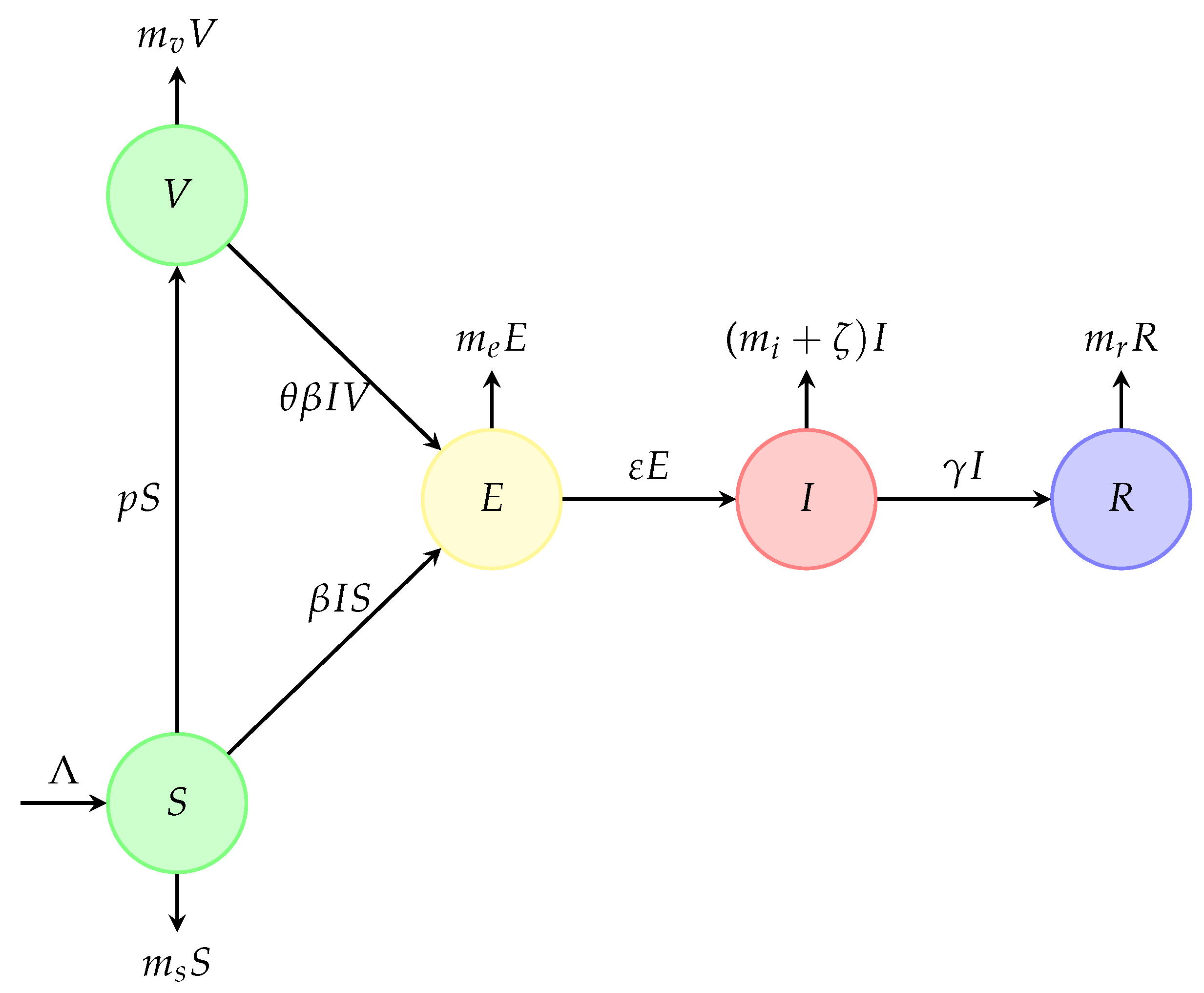
We consider a population stratified into five distinct epidemiological states according to disease status and vaccination history: susceptible individuals who are capable of acquiring infection (S), vaccinated individuals who have received vaccination but remain susceptible to breakthrough infection due to imperfect vaccine efficacy (V), exposed individuals who have been infected but are not yet infectious due to the intrinsic incubation period of the pathogen (E), infectious individuals capable of transmitting the pathogen to susceptible and vaccinated hosts (I), and recovered individuals who have cleared the infection and acquired permanent immunity (R). The total population size at time t is given by N ( t ) = S ( t ) + V ( t ) + E ( t ) + I ( t ) + R ( t ) . Recruitment into the susceptible class occurs at constant rate Λ , representing births and immigration. We include compartment-specific natural mortality rates m s , m v , m e , m i , m r as a general modeling framework that allows for heterogeneity in baseline mortality across epidemiological states. This formulation encompasses the classical assumption of uniform mortality as a special case ( m s = m v = m e = m i = m r ). For measles in developed countries, mortality differences across compartments may be negligible; however, in regions with limited healthcare access, infected individuals may face elevated mortality from secondary infections due to measles-induced immunosuppression. Since our goal is to provide a general mathematical framework applicable across settings, we retain this flexibility while noting that in applications, these parameters should be calibrated to the specific population under study.
Vaccination is administered to susceptible individuals at rate p, conferring partial protection quantified by the vaccine failure probability θ [ 0 , 1 ] , where θ = 0 corresponds to a perfectly protective vaccine and θ = 1 represents complete vaccine failure. Vaccinated individuals remain susceptible to infection, albeit with reduced probability, and upon infection progress through the exposed and infectious compartments analogously to naive susceptible hosts [23]. The force of infection acting upon susceptible and vaccinated individuals is modeled using a standard bilinear incidence formulation β I , where β represents the effective contact rate [24]. Exposed individuals progress to infectiousness at rate ϵ , yielding an average latent period of 1 / ϵ , while infectious individuals recover at rate γ , corresponding to an average infectious period of 1 / γ .
The distinctive feature of our modeling framework lies in the incorporation of four independent distributed delays that govern the temporal progression between epidemiological events [20,21,22]. In biological reality, the duration of the incubation period, the temporal window of vaccine-induced protection, and the time course of recovery are not fixed constants but exhibit substantial inter-individual variation. To capture this heterogeneity, we introduce four delay kernels Π i ( τ ) = ζ i ( τ ) e n i τ for i = 1 , 2 , 3 , 4 , where ζ i ( τ ) are probability density functions supported on [ 0 , ω i ] characterizing the distribution of delay durations, and the exponential factor e n i τ accounts for attrition during the delay interval due to mortality or other competing risks [25,26,27]. Specifically, Π 1 ( τ ) and Π 2 ( τ ) weight the historical contributions of infectious contacts with susceptible and vaccinated individuals, respectively, reflecting the fact that infection events occurring at time t τ contribute to the force of infection at time t only if the exposed individual survives the incubation period. Similarly, Π 3 ( τ ) governs the transition from the exposed to the infectious state, capturing variability in the incubation period, while Π 4 ( τ ) modulates the recovery process. The integrals of these kernels, F i = 0 ω i Π i ( τ ) d τ , satisfy 0 < F i 1 and represent the effective survival probability over the delay interval.
The resulting system (1)–(5) comprises five coupled integro-differential equations that generalize classical compartmental models while retaining analytical tractability. The susceptible and vaccinated dynamics incorporate instantaneous birth, vaccination, mortality, and infection processes, whereas the exposed, infected, and recovered compartments incorporate distributed delay integrals that aggregate the historical force of infection, progression, and recovery events. This formulation reduces to the conventional ordinary differential equation model (7)–(11) in the limiting case where the delay distributions are concentrated at zero and the survival factors equal unity, and it generalizes discrete delay models when the probability densities are taken as Dirac delta functions. The model is equipped with continuous initial conditions on the interval [ τ * , 0 ] , where τ * = max { ω 1 , ω 2 , ω 3 , ω 4 } , ensuring well-posedness and biological consistency. Through this mathematical formulation, we aim to bridge the gap between theoretical epidemic modeling and the complex temporal realities of host–pathogen interactions, thereby providing a robust foundation for the stability analyses, sensitivity investigations, and public health inferences that follow.
We define the state variables at time t as
( S , V , E , I , R ) = ( S , V , E , I , R ) ( t ) ,
and for a given delay τ 0 , the delayed variables are
( S τ , V τ , E τ , I τ , R τ ) = ( S , V , E , I , R ) ( t τ ) .
Extending the SVEIR framework proposed in [1,14], we incorporate four independent distributed delays to capture the temporal heterogeneity inherent in the incubation period, vaccine-induced protection, and recovery processes (Figure 1). The resulting system is given by
S ˙ = Λ ( m s + p ) S β I S ,
V ˙ = p S m v V θ β I V ,
E ˙ = β 0 ω 1 Π 1 ( τ ) S τ I τ d τ + θ β 0 ω 2 Π 2 ( τ ) V τ I τ d τ ( m e + ε ) E ,
I ˙ = ε 0 ω 3 Π 3 ( τ ) E τ d τ ( m i + ζ + γ ) I ,
R ˙ = γ 0 ω 4 Π 4 ( τ ) I τ d τ m r R .
For i = 1 , 2 , 3 , 4 , the functions ζ i ( τ ) are probability density functions supported on [ 0 , ω i ] , satisfying
ζ i ( τ ) > 0 , 0 ω i ζ i ( τ ) d τ = 1 , 0 ω i ζ i ( τ ) e l τ d τ < ( l > 0 ) .
The effective delay kernel is defined as
Π i ( τ ) = ζ i ( τ ) e n i τ ,
where the exponential factor e n i τ accounts for attrition (e.g., natural mortality) during the delay interval. The total effective survival probability over the delay period is
F i = 0 ω i Π i ( τ ) d τ , 0 < F i 1 .
The system is equipped with continuous initial functions on the maximal delay interval:
S ( ι ) = ϕ 1 ( ι ) , V ( ι ) = ϕ 2 ( ι ) , E ( ι ) = ϕ 3 ( ι ) , I ( ι ) = ϕ 4 ( ι ) , R ( ι ) = ϕ 5 ( ι ) , ι [ τ * , 0 ] ,
where τ * = max { ω 1 , ω 2 , ω 3 , ω 4 } and ϕ j C ( [ τ * , 0 ] , R 0 ) for j = 1 , , 5 .
  • Λ : Recruitment rate of susceptible individuals (births/immigration).
  • p: Vaccination rate of susceptible individuals.
  • θ [ 0 , 1 ] : Vaccine failure probability; θ = 0 corresponds to perfect protection and θ = 1 to complete vaccine failure.
  • m s , m v , m e , m i , m r : Compartment-specific natural mortality rates for susceptible, vaccinated, exposed, infected, and recovered classes, respectively. These compartment-specific natural mortality rates are assumed to be distinct to capture heterogeneity in baseline health and competing risks across disease states.
  • ζ : Disease-induced mortality rate, applied only to the infected compartment I.
  • β : Effective contact rate (bilinear incidence).
  • ε : Progression rate from exposed to infectious state; 1 / ε is the mean latency period.
  • γ : Recovery rate; 1 / γ is the mean infectious period.
  • ω 1 , ω 2 : Maximum delay in the force of infection acting on susceptible and vaccinated individuals, respectively (accounting for survival through incubation).
  • ω 3 : Maximum delay in progression from E to I (incubation period distribution).
  • ω 4 : Maximum delay in recovery (duration of infectiousness distribution).
  • n i : Attrition (mortality) rate specific to the i-th delay process.
  • τ 1 and τ 2 represent delays in the force of infection acting on susceptible and vaccinated individuals, respectively, accounting for survival through the incubation period; τ 3 corresponds to the incubation period (progression from E to I); and τ 4 represents the duration of infectiousness (recovery process).
A summary of state variables and parameters is given in Table 1. Vaccinated individuals remain partially susceptible; upon infection they progress through the exposed and infectious compartments analogously to naive hosts. Recovery confers permanent immunity (no reinfection).

3. Baseline Dynamics: The Instantaneous Transmission Model

Before introducing the biological complexity of distributed time lags, we first establish a foundational understanding of the SVEIR transmission dynamics under the conventional assumption of instantaneous transitions that is studied very well in [1,12,13,14,28]. The system presented in (7)–(11)—henceforth referred to as the non-delay model—represents a significant extension of classical SIR frameworks by incorporating a vaccinated compartment V, disease-induced mortality ζ , and distinct natural mortality rates across epidemiological classes. This formulation, while analytically more tractable than its delay counterpart, retains the essential biological features of measles transmission: susceptible individuals are recruited at rate Λ and may be vaccinated at rate p; vaccination confers partial protection quantified by the vaccine failure probability θ ; exposed individuals progress to infectiousness at rate ϵ ; and infectious individuals either recover at rate γ or succumb to disease-induced death at rate ζ . The model is rendered mathematically well-posed through Proposition 1, which establishes the existence of a compact, positively invariant set Γ that traps all forward trajectories and ensures biologically plausible boundedness of solutions. Using the next-generation matrix approach, we derive the basic reproduction number R 0 —a dimensionless threshold quantity that encapsulates the average number of secondary infections generated by a single infectious individual introduced into a fully susceptible population. This parameter elegantly synthesizes the competing effects of transmission efficiency β , vaccination coverage p and failure probability θ , progression and recovery rates, and mortality schedules into a single epidemiological metric. Proposition 2 demonstrates that R 0 governs not only the local stability of the disease-free equilibrium but also the existence and uniqueness of a positive endemic equilibrium, which emerges precisely when R 0 exceeds unity. The core of this section is devoted to a thorough global stability analysis, wherein we construct explicit Lyapunov functions to prove that R 0 serves as a sharp threshold parameter: below unity, the disease-free equilibrium attracts all solutions irrespective of initial conditions, while above unity, the unique endemic equilibrium is globally asymptotically stable within the interior of Γ . These results, established through the systematic application of Lyapunov’s direct method and LaSalle’s invariance principle, provide a mathematical foundation for the subsequent investigation of delay effects and serve as a critical baseline against which the more biologically realistic distributed delay model can be evaluated and interpreted.
The instantaneous transmission model (without distributed delay) is given as follows:
S ˙ = Λ ( m s + p ) S β I S ,
V ˙ = p S m v V θ β I V ,
E ˙ = β I ( S + θ V ) ( m e + ε ) E ,
I ˙ = ε E ( m i + ζ + γ ) I ,
R ˙ = γ I m r R ,
with positive initial condition ( S ( 0 ) , V ( 0 ) , E ( 0 ) , I ( 0 ) , R ( 0 ) ) R + 5 .

3.1. Well-Posedness, Threshold Parameter, and Steady-State Characterization

Before embarking on the stability analysis of the non-delay system (7)–(11), we first establish its fundamental qualitative properties to ensure that the model is mathematically and biologically coherent. This preliminary analysis addresses four interconnected and essential questions: the non-negativity of solutions, their boundedness and ultimate confinement to a compact absorbing set, the derivation of the basic reproduction number R 0 , and the existence and uniqueness of equilibrium points. We begin by demonstrating that all state variables remain non-negative for all positive time given non-negative initial conditions, a biological necessity since populations cannot assume negative values. Using a standard comparison argument and the construction of an auxiliary variable T = S + V + E + I + R Λ / m , we prove that the total population is ultimately bounded and that the compact set Γ = { ( S , V , E , I , R ) R + 5 : S + V + E + I + R Λ / m } is positively invariant, trapping all forward trajectories and preventing unbounded growth. This invariant region provides the essential domain within which all subsequent dynamical analysis takes place. We then compute the disease-free equilibrium E 0 = ( S 0 , V 0 , 0 , 0 , 0 ) explicitly and, using the next-generation matrix formalism applied to the subsystem of infected compartments ( E , I ) , derive the basic reproduction number R 0 . This dimensionless threshold quantity emerges as R 0 = ϵ β ( S 0 + θ V 0 ) / [ ( m e + ϵ ) ( m i + ζ + γ ) ] , which simplifies to a closed-form expression in terms of the fundamental epidemiological parameters: recruitment rate Λ , transmission coefficient β , vaccination rate p and failure probability θ , progression rate ϵ , recovery rate γ , and the suite of compartment-specific mortality rates. The quantity R 0 admits a clear biological interpretation: it represents the expected number of secondary infections generated by a single infectious individual introduced into a fully susceptible population in which vaccination is administered at baseline coverage. Finally, we prove that in addition to the disease-free equilibrium, the system admits a unique endemic equilibrium E * = ( S * , V * , E * , I * , R * ) with all components strictly positive if and only if R 0 > 1 . The proof relies on reducing the equilibrium conditions to a single scalar equation in the infected variable I and demonstrating, via monotonicity arguments and the intermediate value theorem, that the resulting function g ( I ) possesses exactly one positive root precisely when the basic reproduction number exceeds unity. This threshold condition establishes R 0 not merely as a local stability indicator but as a genuine bifurcation parameter governing the qualitative structure of the phase space. Collectively, these foundational results—positivity, boundedness, the existence of a compact global attractor, the explicit threshold parameter, and the complete characterization of steady states—provide the mathematical scaffolding upon which the global stability analysis of Section 3.2 is constructed.
In order to prove that system (7)–(11) is well-posed, we will give some general properties. Let m = min ( m s , m v , m e , m i + ζ , m r ) ; then the following hold.
Proposition 1. 
The compact set Γ = ( S , V , E , I , R ) R + 5 / S + V + E + I + R Λ m is positively invariant for system (7)–(11).
Proof. 
Since S ˙ | S = 0 = Λ > 0 , V ˙ | V = 0 = p S > 0 , E ˙ | E = 0 = β I ( S + θ V ) > 0 , I ˙ | I = 0 = ε E > 0 and R ˙ | R = 0 = γ I > 0 , the solution of system (7)–(11) is non-negative.
  • Consider a new variable T = S + V + E + I + R Λ m ; then by adding all equations of (7)–(11), T satisfies
    T ˙ = S ˙ + V ˙ + E ˙ + I ˙ + R ˙ = Λ m s S m v V m e E ( m i + ζ ) I m r R Λ m ( S + V + E + I + R ) m Λ m S V E I R m T .
    Hence
    T ( t ) T ( 0 ) e m t .
Since all variables are non-negative, all variables are bounded and thus Γ is positively invariant for system (7)–(11). □
Let S 0 = Λ m s + p , V 0 = p Λ m v ( m s + p ) , E 0 = 0 , I 0 = 0 and R 0 = 0 . The Jacobian of the subsystem ( E , I ) of the original system (7)–(11) at the disease-free equilibrium point E 0 = ( S 0 , V 0 , E 0 , I 0 , R 0 ) is given by
J ( E 0 ) = ( m e + ε ) β ( S 0 + θ V 0 ) ε ( m i + ζ + γ ) = F V
where F = 0 β ( S 0 + θ V 0 ) 0 0 and V = ( m e + ε ) 0 ε ( m i + ζ + γ ) .
The determinant of V is given by det ( V ) = ( m e + ε ) ( m i + ζ + γ ) > 0 and thus the inverse matrix of V is
V 1 = 1 ( m e + ε ) 0 ε ( m e + ε ) ( m i + ζ + γ ) 1 ( m i + ζ + γ )
and the next-generation matrix is given by
F V 1 = ε β ( S 0 + θ V 0 ) ( m e + ε ) ( m i + ζ + γ ) β ( S 0 + θ V 0 ) ( m i + ζ + γ ) 0 0 .
Then, the basic reproduction number of system (7)–(11) is calculated as the spectral radius of the matrix F V 1 :
R 0 = ε β ( S 0 + θ V 0 ) ( m e + ε ) ( m i + ζ + γ ) = Λ ε β ( m v + θ p ) m v ( m e + ε ) ( m i + ζ + γ ) ( m s + p ) .
Proposition 2. 
System (7)–(11) admits a trivial (disease-free) equilibrium point E 0 and if R 0 > 1 , system (7)–(11) admits a unique non-trivial (endemic) equilibrium point E * = ( S * , V * , E * , I * , R * ) with S * , V * , E * , I * , R * > 0 .
Proof. 
An equilibrium point for system (7)–(11) satisfies
0 = Λ ( m s + p ) S β I S , 0 = p S m v V θ β I V , 0 = β I ( S + θ V ) ( m e + ε ) E , 0 = ε E ( m i + ζ + γ ) I , 0 = γ I m r R ,
which reduces to
S = Λ ( m s + p + β I ) , V = p Λ ( m v + θ β I ) ( m s + p + β I ) , E = Λ β I ( m v + θ p + θ β I ) ( m e + ε ) ( m s + p + β I ) ( m v + θ β I ) , I = ε Λ β I ( m v + θ p + θ β I ) ( m i + ζ + γ ) ( m e + ε ) ( m s + p + β I ) ( m v + θ β I ) , R = γ m r I .
From the fourth equation of (15) one deduces that
I = ε Λ β I ( m v + θ p + θ β I ) ( m i + ζ + γ ) ( m e + ε ) ( m s + p + β I ) ( m v + θ β I ) .
Since all parameters are non-negative, either I = 0 or
ε Λ β I ( m v + θ p + θ β I ) = I ( ( m i + γ ) ( m e + ε ) m s + p + β I m v + θ β I )
  • If I = 0 then R = 0 , E = 0 , S = Λ m s + p = S 0 and V = p S m v = p Λ m v ( m s + p ) = V 0 . This equilibrium is known as the disease-free equilibrium, denoted here by E 0 = ( S 0 , V 0 , E 0 , I 0 , R 0 ) .
  • For I 0 , define the continuous function g,
    g ( I ) = 1 ε Λ β ( m v + θ p + θ β I ) ( m i + ζ + γ ) ( m e + ε ) ( m s + p + β I ) ( m v + θ β I ) .
    The derivative of g is given by
    g ( I ) = ε Λ β 2 ( ( m v + θ p + θ β I ) ( m v + θ β I ) + θ 2 p ( m s + p + β I ) ) ( m i + ζ + γ ) ( m e + ε ) ( m s + p + β I ) 2 ( m v + θ β I ) 2 .
    Since all parameters are non-negative, one can easily deduce that the function g is an increasing function. A simple calculus gives
    g ( 0 ) = 1 ε Λ β ( m v + θ p ) m v ( m i + ζ + γ ) ( m e + ε ) ( m s + p ) = 1 R 0 ,
    and
    g Λ m = 1 ε β Λ m v + θ p + θ β Λ m ( m i + ζ + γ ) ( m e + ε ) m s + p + β Λ m m v + θ β Λ m > 1 ε β Λ m v + θ p + θ β Λ m ε ( m i + ζ ) m s + p + β Λ m m v + θ β Λ m > 1 ε β Λ m v + θ p + θ β Λ m m ε m s + p + β Λ m m v + θ β Λ m > 1 ε β Λ m v + θ p + θ β Λ m ε β Λ m v + θ β Λ m + ε p θ β Λ + m ε m s m v = ε m s m v ε β Λ m m v + θ β Λ m + ε p θ β Λ m + ε m s m v > 0
    Since R 0 > 1 , g ( 0 ) < 0 and g Λ m > 0 , the equation g ( I ) = 0 admits a unique solution I * in 0 , Λ m and then the uniqueness of the endemic equilibrium E * = ( S * , V * , E * , I * , R * ) .

3.2. Global Asymptotic Behavior of the Non-Delay System

Having established the existence and uniqueness of both the disease-free and endemic equilibria for the ordinary differential equation model (7)–(11), we now characterize the global asymptotic stability of these steady states. The basic reproduction number R 0 derived in (13) has been shown to determine the local stability properties of the disease-free equilibrium; however, local analysis alone is insufficient to guarantee that all solutions, regardless of initial conditions, converge to the predicted equilibrium. To address this gap, we employ Lyapunov’s direct method in conjunction with LaSalle’s invariance principle, constructing suitable auxiliary functions that decrease monotonically along solution trajectories. We first refine the invariant set Γ by establishing that the susceptible and vaccinated compartments are asymptotically bounded above by their disease-free equilibrium values S 0 and V 0 , respectively, yielding a positively invariant subset Γ ˜ that captures all relevant dynamics. Using a simple linear Lyapunov function F 0 = ϵ E + ( m e + ϵ ) I , we demonstrate that when R 0 1 , every trajectory originating in Γ ˜ converges to the disease-free equilibrium E 0 , establishing its global asymptotic stability. For the case R 0 > 1 , we construct a nonlinear Lyapunov function F * based on logarithmic deviations from the endemic equilibrium E * . Through careful algebraic manipulation and repeated application of the arithmetic–geometric mean inequality, we show that F * is non-increasing along solutions and vanishes only at the endemic equilibrium itself. This analysis not only confirms that R 0 serves as a sharp global threshold parameter but also provides explicit analytical expressions that reveal how each biological process—vaccination, disease-induced mortality, recovery, and natural mortality—contributes to the overall stability of the system. The results established here for the non-delay model serve as essential benchmarks for the more complex distributed delay analysis presented in Section 4.
Corollary 1. 
The set Γ ˜ = { ( S , V , E , I , R ) R + 5 / S + V + E + I + R Λ m ; S S 0 , V V 0 } is positively invariant for system (7)–(11).
Proof. 
It has already been proved that Γ is invariant for system (7)–(11). Note that S ˙ ( t ) < 0 for S ( t ) > S 0 ; therefore lim inf S ( t ) S 0 . Let ξ > 0 be a constant and S ( 0 ) be an initial condition. Then T 0 ; S ( t ) S 0 + ξ t T . Therefore
V ˙ ( t ) < p ( S 0 + ξ ) m v V for all t T .
Consider V ˜ = V V 0 , which satisfies
V ˜ ˙ ( t ) < m v V ˜ for all t T .
Then
V ˜ ˙ ( t ) < V ˜ ( 0 ) e m v t for all t T .
Therefore lim inf V ˜ ( t ) 0 and lim inf V ( t ) p ( S 0 + ξ ) m v for all ξ > 0 ; thus lim inf V ( t ) p S 0 m v = V 0 . Furthermore, if a solution starts with S S 0 and V V 0 , it will remain so for all future time, using a comparison argument. This completes the proof. □
Theorem 1. 
E 0 is globally asymptotically stable if R 0 1 ; however it is unstable if R 0 > 1 .
Proof. 
Let the function F 0 be given by
F 0 = ε E + ( m e + ε ) I .
Since S S 0 and V V 0 in Γ ˜ , the time derivative of F 0 is given by
F ˙ 0 = ε E ˙ + ( m e + ε ) I ˙ = ε ( β I ( S + θ V ) ( m e + ε ) E ) + ( m e + ε ) ( ε E ( m i + ζ + γ ) I ) = ε β I ( S + θ V ) ( m e + ε ) ( m i + γ ) I ε β I ( S + θ V ) ( m e + ε ) ( m i + ζ + γ ) I ( ε β ( S + θ V ) ( m e + ε ) ( m i + ζ + γ ) ) I ( m e + ε ) ( m i + ζ + γ ) ε β ( S + θ V ) ( m e + ε ) ( m i + ζ + γ ) 1 I ( m e + ε ) ( m i + ζ + γ ) ε β ( S 0 + θ V 0 ) ( m e + ε ) ( m i + ζ + γ ) 1 I = ( m e + ε ) ( m i + ζ + γ ) ( R 0 1 ) I , ( S , V , E , I , R ) Γ ˜ .
If R 0 1 , then F ˙ 0 0 for all S , V , E , I , R > 0 . Let W 0 = { ( S , V , E , I , R ) : F ˙ 0 = 0 } = { E 0 } . Then by LaSalle’s invariance principle [29] E 0 is globally asymptotically stable once R 0 1 . Then the solution of system (7)–(11) converges to E 0 as t + . □
Let us define the non-negative function H : R + R + as H ( x ) = x 1 ln ( x ) , which satisfies H ( x ) 0 for all x > 0 and H ( x ) = 0 if and only if x = 1 . Hereafter, we study the global stability analysis for the endemic equilibrium E * .
Theorem 2. 
If R 0 > 1 , then the endemic equilibrium E * is globally asymptotically stable.
Proof. 
Let the function F * be given by
F * = S * H S S * + V * H V V * + E * H E E * + m e + ε ε I * H I I * .
The function F * admits its minimum value F 1 m i n = S * + V * + E * + m e + ε ε I * once S = S * , V = V * , E = E * , I = I * . The time derivative of F * , along solutions of system (7)–(11), is given by
F * = ( 1 S * S ) S ˙ + ( 1 V * V ) V ˙ + ( 1 E * E ) E ˙ + m e + ε ε ( 1 I * I ) I ˙ = ( 1 S * S ) ( Λ ( m s + p ) S β I S ) + ( 1 V * V ) ( p S m v V θ β I V ) + ( 1 E * E ) ( β I ( S + θ V ) ( m e + ε ) E ) + m e + ε ε ( 1 I * I ) ( ε E ( m i + ζ + γ ) I ) = m s S * m s S m s S * 2 S + m s S * + m v V * m v S * S V * + m v V * m v V + m v V * + m v V * m v V * 2 V S S * + β I * ( S * + θ V * ) β I * S * 2 S θ β I * V * S * S + θ β I * V * + β I * S * θ β I * V * 2 V S S * + θ β I V * β I ( S + θ V ) E * E + β I ( S * + θ V * ) m e + ε ε ( m i + ζ + γ ) I ( m e + ε ) E I * I + m e + ε ε ( m i + ζ + γ ) I * = m s S * ( 2 S S * S * S ) + m v V * ( 3 S * S V V * V * V S S * ) + 3 β I * S * β I * S * 2 S β I * S * E E * I * I β I S E * E 3 θ β I * V * + θ β I * V * θ β I * V * 2 V S S * θ β I V E * E θ β I * V * E E * I * I θ β I * V * S * S m e + ε ε ( m i + ζ + γ ) I + β I ( S * + θ V * ) = m s S * ( 2 S S * S * S ) + m v V * ( 3 S * S V V * V * V S S * ) + β I * S * ( 3 S * S I I * S S * E * E E E * I * I ) + θ β I * V * ( 4 V * V S S * I I * V V * E * E E E * I * I S * S ) .
If
x 1 + x 2 + x 3 + + x n n x 1 . x 2 . x 3 x n n , x 1 , x 2 , x 3 , , x n 0
then ( 2 S S * S * S ) 0 , ( 3 S * S V V * V * V S S * ) 0 , ( 3 S * S I I * S S * E * E E E * I * I ) 0 , ( 4 V * V S S * I I * V V * E * E E E * I * I S * S ) 0 . Therefore F ˙ * 0 . Using Lyapunov’s direct method and LaSalle’s invariance principle [29,30], E * is stable.
Now, we have to show the asymptotic stability of E * using LaSalle’s invariance principle.
Define A = ( 2 S S * S * S ) , B = ( 3 S * S V V * V * V S S * ) , C = ( 3 S * S I I * S S * E * E E E * I * I ) , D = ( 4 V * V S S * I I * V V * E * E E E * I * I S * S ) . Then F ˙ * ( S , V , E , I , R ) = 0 if and only if A = B = C = D = 0 .
A = 0 means that S = S * and B = 0 means that V = V * . If, moreover, C = 0 then E E * = I I * . To conclude,
F ˙ * ( S , V , E , I , R ) = 0 S = S * , V = V * , E E * = I I * .
Let a = E E * = I I * ; then E = a E * and I = a I * .
The endemic equilibrium satisfies
Λ = ( m s + p ) S * + β I * S * , p S * = m v V * + θ β I * V * , β I * ( S * + θ V * ) = ( m e + ε ) E * , ε E * = ( m i + ζ + γ ) I * .
Then
p S * = m v V * + θ β I * V * , a = 1
and thus I = I * and E = E * . Finally, the convergence of the recovered population R ( t ) is established by noting the asymptotic autonomy of the R equation, R ˙ = γ I m r R . Since it has been shown that I ( t ) I * as t , the solution R ( t ) of this linear differential equation approaches the equilibrium value R * = γ m r I * . Therefore, F ˙ * ( S , V , E , I , R ) = 0 ( S = S * , V = V * , E = E * , I = I * , R = R * ) . Thus { ( S , V , E , I , R ) | F ˙ * = 0 } = { E * } . Then by LaSalle’s invariance principle [29] E * is globally asymptotically stable once R 0 > 1 . □

4. Incorporation of Distributed Delays: Biological Realism and Mathematical Challenges

While the ordinary differential equation model analyzed in Section 3 provides valuable insights into measles transmission dynamics, it rests upon the simplifying assumption that transitions between epidemiological compartments occur instantaneously. In biological reality, however, critical processes exhibit substantial temporal heterogeneity: the incubation period, duration of vaccine-induced protection, and recovery time all vary considerably across individuals [20,21,22]. Moreover, during these intervals, individuals face competing risks—including natural or disease-induced mortality—that modulate their eventual contribution to transmission.
To capture these essential features, we extend the baseline SVEIR framework by incorporating four independent distributed delay kernels Π i ( τ ) = ζ i ( τ ) e n i τ , i = 1 , , 4 . These kernels weight the historical contributions of: (i) susceptible-infected contacts, (ii) vaccinated-infected contacts, (iii) exposed individuals progressing to infectiousness, and (iv) infected individuals recovering. Each kernel combines a probability density function ζ i ( τ ) —representing the distribution of delay durations—with an exponential decay factor e n i τ accounting for attrition during the delay interval.
This formulation, presented in system (1)–(5), generalizes both the non-delay model (7)–(11) and conventional discrete delay models while remaining analytically tractable. In this section, we systematically investigate its qualitative properties. We first establish well-posedness by proving non-negativity, boundedness, and the existence of a positively invariant absorbing set. We then derive the delay-modified reproduction number R 0 d using a next-generation approach adapted to a Volterra-type integral structure. Finally, we construct Lyapunov functionals incorporating system history to prove global asymptotic stability of both equilibria under threshold conditions. This analysis demonstrates that the core threshold dynamics are robust to the inclusion of realistic, heterogeneously distributed time lags.

4.1. Well-Posedness and Invariant Regions for the Delayed Model

Before analyzing the asymptotic behavior of the distributed delay system (1)–(5), we first establish its fundamental mathematical properties to ensure that the model is biologically meaningful and analytically tractable. The introduction of four independent distributed delays, each characterized by a probability density function ζ i ( τ ) and a decay-modulated kernel Π i ( τ ) = ζ i ( τ ) e n i τ , significantly complicates the qualitative analysis compared to the ordinary differential equation framework. In this subsection, we address three essential questions: the non-negativity of solutions, their ultimate boundedness, and the existence of a positively invariant compact set that traps all forward trajectories. Using a combination of recursive arguments, integral inequality techniques, and the construction of an auxiliary function ψ ( t ) that aggregates the delayed state variables, we demonstrate that solutions emanating from non-negative continuous initial conditions remain non-negative for all time. Furthermore, we derive explicit upper bounds for each compartment, establishing that the total population size is ultimately bounded and that the susceptible and vaccinated compartments are asymptotically bounded above by their respective disease-free equilibrium values S 0 and V 0 . These results culminate in the definition of the positively invariant set Γ d , a compact region in the space of continuous functions that contains the global attractor of the system. This invariant region provides the necessary theoretical foundation for the subsequent equilibrium analysis and Lyapunov-based stability investigations, ensuring that all dynamical behavior of interest occurs within a well-defined, biologically plausible domain.
Let us define some constants as follows: d 1 = min ( m s + p , m v , m e + ε ) , Γ 1 = F 1 Λ + p F 2 S 0 d 1 , Γ 2 = ε F 3 Γ 1 m i + ζ + γ , and Γ 3 = γ F 4 Γ 1 m r .
Lemma 1. 
Solutions of model (1)–(5) with the initial states (6) are non-negative and ultimately bounded. Furthermore, the set
Γ d = { ( S , V , E , I , R ) C + 5 : S S 0 , V V 0 , E Γ 1 , I Γ 2 , R Γ 3 }
is positively invariant with respect to model (1)–(5).
Proof. 
Let us show the non-negativity of solutions of model (1)–(5). Clearly, Equation (1) gives
S ˙ | S = 0 = Λ > 0 .
Hence, S ( t ) > 0 for any t 0 . Similarly, Equation (2) gives
V ˙ | V = 0 = p S > 0 .
Hence, V ( t ) > 0 for any t 0 . In addition, we have
E ( t ) = e ( m e + ε ) t ϕ 3 ( 0 ) + β 0 t e ( m e + ε ) ( t θ ) 0 ω 1 Π 1 ( τ ) S ( s τ ) I ( s τ ) d τ d s + θ β 0 t e ( m e + ε ) ( t s ) 0 ω 2 Π 2 ( τ ) V ( s τ ) I ( s τ ) d τ d s 0 , I ( t ) = e ( m i + ζ + γ ) t ϕ 4 ( 0 ) + ε 0 t e ( m i + ζ + γ ) ( t s ) 0 ω 3 Π 3 ( τ ) E ( s τ ) d τ 0 , R ( t ) = e m r t ϕ 5 ( 0 ) + γ 0 t e m r ( t θ ) 0 ω 4 Π 4 ( τ ) I ( s τ ) d τ d s 0 ,
for any t [ 0 , τ * ] . Hence, by recursive argumentation, we obtain that ( E , I , R ) ( t ) 0 for any t 0 .
Let us prove the ultimate boundedness of solution ( S , V , E , I , R ) . From Equation (1), we have lim sup t S ( t ) S 0 . Similarly, from Equation (2), we have lim sup t V ( t ) V 0 .
  • To prove the ultimate boundedness of E ( t ) , we define
ψ = 0 ω 1 Π 1 ( τ ) S τ d τ + 0 ω 2 Π 2 ( τ ) V τ d τ + E .
Then, we get
ψ ˙ = 0 ω 1 Π 1 ( τ ) S ˙ τ d τ + 0 ω 2 Π 2 ( τ ) V ˙ τ d τ + E ˙ = 0 ω 1 Π 1 ( τ ) Λ ( m s + p ) S τ β S τ I τ d τ + 0 ω 2 Π 2 ( τ ) p S τ m v V τ θ β V τ I τ d τ + β 0 ω 1 Π 1 ( τ ) S τ I τ d τ + θ β 0 ω 2 Π 2 ( τ ) V τ I τ d τ ( m e + ε ) E = 0 ω 1 Π 1 ( τ ) Λ ( m s + p ) S τ d τ + 0 ω 2 Π 2 ( τ ) p S τ m v V τ d τ ( m e + ε ) E = F 1 Λ + p 0 ω 2 Π 2 ( τ ) S τ d τ ( m s + p ) 0 ω 1 Π 1 ( τ ) S τ d τ m v 0 ω 2 Π 2 ( τ ) V τ d τ ( m e + ε ) E F 1 Λ + p F 2 Λ m s + p ( m s + p ) 0 ω 1 Π 1 ( τ ) S τ d τ m v 0 ω 2 Π 2 ( τ ) V τ d τ ( m e + ε ) E F 1 Λ + p F 2 Λ m s + p d 1 0 ω 1 Π 1 ( τ ) S τ d τ + 0 ω 2 Π 2 ( τ ) V τ d τ + E = F 1 Λ + p F 2 Λ m s + p d 1 ψ .
It follows that
lim sup t ψ ( t ) F 1 Λ + p F 2 S 0 d 1 = Γ 1 ,
and then
lim sup t E ( t ) Γ 1 .
I ˙ = ε 0 ω 3 Π 3 ( τ ) E τ d τ ( m i + ζ + γ ) I ε F 3 Γ 1 ( m i + ζ + γ ) I .
Consequently, lim sup t I ( t ) Γ 2 = ε F 3 Γ 1 m i + ζ + γ . Similarly,
R ˙ = γ 0 ω 4 Π 4 ( τ ) I τ d τ m r R γ F 4 Γ 1 m r R .
Consequently, lim sup t R ( t ) Γ 3 = γ F 4 Γ 1 m r . □

4.2. Equilibrium Characterization and Delayed Reproduction Number

We now turn to the analysis of the steady-state behavior of the distributed delay system (1)–(5). Unlike the ordinary differential equation model examined in Section 3, the presence of distributed delays necessitates a reformulation of the next-generation matrix approach to account for the probability kernels Π i ( τ ) that weight the historical contributions of infected individuals. These kernels, which incorporate both the probability density of the delay duration and an exponential survival factor e n i τ , fundamentally alter the effective transmissibility and progression rates at equilibrium. In this subsection, we derive the delay-modified matrices F d and V d that capture the average production and removal of new infections over the distributed delay intervals. From these matrices, we obtain an explicit expression for the delay-dependent basic reproduction number R 0 d , which serves as the threshold parameter governing the existence and stability of equilibria. We then systematically characterize the equilibrium points of the delayed system, demonstrating that the disease-free equilibrium E 0 d persists as a steady state for all parameter values, while a unique endemic equilibrium E d * = ( S * , V * , E * , I * , R * ) emerges strictly positive precisely when R 0 d exceeds unity. The proof of uniqueness relies on monotonicity arguments applied to a suitably defined function g ( I ) , whose zeroes correspond to non-trivial equilibrium infected densities. This analysis establishes that the fundamental threshold property of the reproduction number remains intact under the more biologically realistic assumption of distributed delays, thereby providing a thorough foundation for the stability investigations that follow.
Let us start by defining the matrices F d and V d that incorporate the delay factors as follows:
F d = 0 β ( F 1 S 0 + θ F 2 V 0 ) 0 0 , and V d = ( m e + ε ) 0 ε F 3 ( m i + ζ + γ ) .
First, compute the inverse of V d :
V d 1 = 1 m e + ε 0 ε F 3 ( m e + ε ) ( m i + ζ + γ ) 1 m i + ζ + γ .
Let K = β ( F 1 S 0 + θ F 2 V 0 ) . Then
F d V d 1 = 0 K 0 0 1 m e + ε 0 ε F 3 ( m e + ε ) ( m i + ζ + γ ) 1 m i + ζ + γ = ε F 3 K ( m e + ε ) ( m i + ζ + γ ) K m i + ζ + γ 0 0 .
The eigenvalues are ε F 3 K ( m e + ε ) ( m i + ζ + γ ) and 0. Therefore, the delay-dependent basic reproduction number (the spectral radius of F d V d 1 ) is given by
R 0 d = ε F 3 β ( F 1 S 0 + θ F 2 V 0 ) ( m e + ε ) ( m i + ζ + γ ) = ε F 3 β Λ ( m v F 1 + p θ F 2 ) m v ( m s + p ) ( m e + ε ) ( m i + ζ + γ ) .
It is important to note that the survival probability for the recovery delay, F 4 , does not appear in the expression for R 0 d . This is because the reproduction number quantifies the potential for new infections generated by an infectious individual. The recovery process, governed by F 4 , dictates the removal of infectious individuals but does not directly influence the rate of new infection events, which are captured by the upstream delays F 1 , F 2 , and F 3 .
Lemma 2. 
  • Dynamics (1)–(5) admits an infection-free equilibrium E 0 d = S 0 , V 0 , 0 , 0 , 0 .
  • If R 0 d > 1 , then dynamics (1)–(5) admits an endemic equilibrium E * d = S * , V * , E * , I * , R * .
Proof. 
An equilibrium point for the system (1)–(5) satisfies
0 = Λ ( m s + p ) S β I S ,
0 = p S m v V θ β I V ,
0 = β F 1 S I + θ β F 2 V I ( m e + ε ) E ,
0 = ε F 3 E ( m i + ζ + γ ) I ,
0 = γ F 4 I m r R .
This reduces to
{ S = Λ m s + p + β I , V = p Λ ( m v + θ β I ) ( m s + p + β I ) , E = Λ β I ( ( m v + θ β I ) F 1 + θ p F 2 ) ( m e + ε ) ( m v + θ β I ) ( m s + p + β I ) , R = γ m γ I .
From Equation (21), one deduces that
I = ε F 3 E ( m i + ζ + γ ) = ε F 3 Λ β I ( ( m v + θ β I ) F 1 + θ p F 2 ) ( m i + ζ + γ ) ( m e + ε ) ( m v + θ β I ) ( m s + p + β I ) ,
which can be written as follows:
I g ( I ) = I ε F 3 Λ β I ( ( m v + θ β I ) F 1 + θ p F 2 ) ( m i + ζ + γ ) ( m e + ε ) ( m v + θ β I ) ( m s + p + β I ) = 0 .
where
g ( I ) : = 1 ε F 3 Λ β ( ( m v + θ β I ) F 1 + θ p F 2 ) ( m i + ζ + γ ) ( m e + ε ) ( m v + θ β I ) ( m s + p + β I ) .
  • If I = 0 then E = 0 , R = 0 , S = S 0 and V = V 0 . This equilibrium is known as the disease-free equilibrium and denoted here by E 0 = ( S 0 , V 0 , 0 , 0 , 0 ) .
  • If I 0 , then g ( I ) = 0 . We prove that this equation provides a unique solution. The derivative of g is given by
    g ( I ) = ε F 3 Λ β β ( m v F 1 + θ β F 1 I ) ( m v + θ β I ) + θ p F 2 ( θ β ( m s + p + β I ) + β ( m v + θ β I ) ) ( m i + ζ + γ ) ( m e + ε ) ( m v + θ β I ) 2 ( m s + p + β I ) 2 .
    Since all parameters are non-negative, one can easily deduce that g ( I ) > 0 for all I > 0 and, thus, g is an increasing function.
    A simple calculus gives g ( 0 ) = 1 ε F 3 Λ β ( m v F 1 + θ p F 2 ) m v ( m i + ζ + γ ) ( m e + ε ) ( m s + p ) = 1 R 0 , and
    g ( Λ m i ) = 1 ε F 3 Λ β ( ( m v + θ β Λ m i ) F 1 + θ p F 2 ) ( m i + ζ + γ ) ( m e + ε ) ( m v + θ β Λ m i ) ( m s + p + β Λ m i ) > m s ( m i + ζ + γ ) ( m e + ε ) ( m v + θ β Λ m i ) ( m i + ζ + γ ) ( m e + ε ) ( m v + θ β Λ m i ) ( m s + p + β Λ m i ) = m s m s + p + β Λ m i > 0 .
    Because R 0 > 1 , g ( 0 ) < 0 , g Λ m i > 0 and the function g increases. Therefore, the equation g ( I ) = 0 admits a unique solution I * in 0 , Λ m i and the existence and uniqueness of the endemic equilibrium point E * = ( S * , V * , E * , I * , R * ) .

4.3. Lyapunov-Based Stability Analysis of the Delay System

Having established the existence and uniqueness of both the infection-free and endemic equilibria for the distributed delay model (1)–(5), we now investigate the global asymptotic stability properties of these equilibrium states. The presence of distributed delays introduces significant mathematical complexity, as the system’s dynamics depend not only on the current state but also on the entire history over the intervals defined by ω i , i = 1 , , 4 . To overcome this challenge, we construct appropriate Lyapunov functionals that incorporate Volterra-type integral terms to account for the delayed interactions. These functionals extend the classical Lyapunov functions employed in Section 3 for the non-delay system and are carefully designed to exploit the properties of the probability density functions ζ i ( τ ) and the kernel weights Π i ( τ ) . The analysis proceeds in two stages: first, we demonstrate that when the delay-dependent reproduction number R 0 d is below unity, the infection-free equilibrium E 0 d is globally asymptotically attractive within the positively invariant set Γ d ; second, we establish that when R 0 d exceeds unity, the endemic equilibrium E d * is globally asymptotically stable in the restricted region Γ ˜ d characterized by V * V and S S * . These results confirm that the threshold property of R 0 d persists despite the introduction of distributed time lags, thereby reinforcing the robustness of the basic reproduction number as a fundamental epidemiological parameter even under more realistic biological assumptions.
  • This threshold condition indicates that R 0 d = 1 is a transcritical bifurcation point, where the stability of the disease-free equilibrium E 0 d and the endemic equilibrium E d * are exchanged, marking the transition from disease extinction to persistence.
Theorem 3. 
The system (1)–(5) is globally asymptotically stable (GAS) around the infection-free equilibrium E 0 d if R 0 d 1 .
Proof. 
The definition of H is now also included in the construction of the Lyapunov functional F 0 d . Define F 0 d ( S , V , E , I , R ) as
F 0 d = F 1 F 3 S 0 H ( S / S 0 ) + F 2 F 3 V 0 H ( V / V 0 ) + F 3 E + m e + ε ε I + β F 3 0 ω 1 Π 1 ( τ ) t τ t S ( θ ) I ( θ ) d θ d τ + θ β F 3 0 ω 2 Π 2 ( τ ) t τ t V ( θ ) I ( θ ) d θ d τ + ( m e + ε ) 0 ω 3 Π 3 ( τ ) t τ t I ( θ ) d θ d τ .
Obviously, F 0 d ( S , V , E , I , R ) > 0 for any S , V , E , I , R > 0 , and F 0 d S 0 , V 0 , 0 , 0 , 0 = 0 .
Let us calculate d F 0 d d t along the solutions of model (1)–(5) as
d F 0 d d t = F 1 F 3 1 S S 0 Λ ( m s + p ) S β I S + F 2 F 3 1 V V 0 p S m v V θ β I V + β F 3 0 ω 1 Π 1 ( τ ) S τ I τ d τ + θ β F 3 0 ω 2 Π 2 ( τ ) V τ I τ d τ ( m e + ε ) F 3 E + ( m e + ε ) 0 ω 3 Π 3 ( τ ) E τ d τ ( m e + ε ) ( m i + ζ + γ ) ε I + β F 3 0 ω 1 Π 1 ( τ ) S I S τ I τ d τ + θ β F 3 0 ω 2 Π 2 ( τ ) V I V τ I τ d τ + ( m e + ε ) 0 ω 3 Π 3 ( τ ) I I τ d τ = F 1 F 3 1 S S 0 ( Λ ( m s + p ) S β S I ) + F 2 F 3 1 V V 0 ( p S m v V θ β V I ) + β F 1 F 3 S I + θ β F 2 F 3 V I ( m e + ε ) F 3 E + ( m e + ε ) F 3 E ( m e + ε ) ( m i + ζ + γ ) ε I = F 1 F 3 ( m s + p ) ( S S 0 ) 2 S 0 m v F 2 F 3 ( V V 0 ) 2 V 0 p F 2 F 3 ( S 0 S ) ( V 0 V ) V 0 + F 1 F 3 β S I S S 0 + θ β F 2 F 3 V I V V 0 ( m e + ε ) ( m i + ζ + γ ) ε I = F 1 F 3 ( m s + p ) ( S S 0 ) 2 S 0 m v F 2 F 3 ( V V 0 ) 2 V 0 p F 2 F 3 ( S 0 S ) ( V 0 V ) V 0 + ( m e + ε ) ( m i + ζ + γ ) ε ε F 3 β F 1 S 2 S 0 + θ F 2 V 2 V 0 ( m e + ε ) ( m i + ζ + γ ) 1 I .
Since we have S S 0 and V V 0 , we obtain
d F 0 d d t F 1 F 3 ( m s + p ) ( S S 0 ) 2 S 0 m v F 2 F 3 ( V V 0 ) 2 V 0 p F 2 F 3 ( S 0 S ) ( V 0 V ) V 0 + ( m e + ε ) ( m i + ζ + γ ) ε ε F 3 β F 1 S 0 + θ F 2 V 0 ( m e + ε ) ( m i + ζ + γ ) 1 I = F 1 F 3 ( m s + p ) ( S S 0 ) 2 S 0 m v F 2 F 3 ( V V 0 ) 2 V 0 p F 2 F 3 ( S 0 S ) ( V 0 V ) V 0 + ( m e + ε ) ( m i + ζ + γ ) ε R 0 d 1 I .
When R 0 d 1 , d F 0 d d t 0 . Furthermore, d F 0 d d t = 0 when S = S 0 , R = R 0 , and ( R 0 d 1 ) I = 0 . Solutions of model (1)–(5) converge to the largest invariant subset of ( S , V , E , I , R ) : d F 0 d d t = 0 = { E 0 d } . Applying the Lyapunov–LaSalle asymptotic stability theorem [31], we get that E 0 d is GAS. □
Theorem 4. 
If R 0 d > 1 , then the endemic equilibrium E d * of system (1)–(5) is asymptotically stable and attracts all solutions with initial conditions in the positively invariant region Γ ˜ d = ( S , V , E , I , R ) R 5 : V * V , a n d S S * .
Proof. 
The definition of H is now also included in the construction of the Lyapunov functional F d * . Construct a candidate Lyapunov function F d * ( S , V , E , I , R ) as
F d * = F 1 F 3 S * H S S * + F 2 F 3 V * H V V * + F 3 E * H E E * + m e + ε ε I * H I I * + β F 3 S * I * 0 ω 1 Π 1 ( τ ) t τ t H S ( θ ) I ( θ ) S * I * d θ d τ + θ β F 3 V * I * 0 ω 2 Π 2 ( τ ) t τ t H V ( θ ) I ( θ ) V * I * d θ d τ + ( m e + ε ) E * 0 ω 3 Π 3 ( τ ) t τ t H E ( θ ) E * d θ d τ .
Take the derivative of F d * along the solution of model (1)–(5) as
d F d * d t = F 1 F 3 1 S * S ( Λ ( m s + p ) S β S I ) + F 2 F 3 1 V * V p S m v V θ β V I + F 3 1 E * E β 0 ω 1 Π 1 ( τ ) S τ I τ d τ + θ β 0 ω 2 Π 2 ( τ ) V τ I τ d τ ( m e + ε ) E + m e + ε ε 1 I * I ε 0 ω 3 Π 3 ( τ ) E τ d τ ( m i + ζ + γ ) I + β F 3 S * I * 0 ω 1 Π 1 ( τ ) S I S * I * S τ I τ S * I * + ln S τ I τ S I d τ + θ β F 3 V * I * 0 ω 2 Π 2 ( τ ) V I V * I * V τ I τ V * I * + ln V τ I τ V I d τ + ( m e + ε ) E * 0 ω 3 Π 3 ( τ ) E E * E τ E * + ln E τ E d τ = F 1 F 3 1 S * S ( Λ ( m s + p ) S β S I ) + F 2 F 3 1 V * V ( p S m v V θ β V I ) F 3 ( m e + ε ) E 1 E * E m e + ε ε ( m i + ζ + γ ) I 1 I * I + β F 3 S * I * 0 ω 1 Π 1 ( τ ) S I S * I * S τ I τ E * S * I * E + ln S τ I τ S I d τ + θ β F 3 V * I * 0 ω 2 Π 2 ( τ ) V I V * I * V τ I τ E * V * I * E + ln V τ I τ V I d τ + ( m e + ε ) E * 0 ω 3 Π 3 ( τ ) E E * E τ I * E * I + ln E τ E d τ .
Summing the terms and using the following equilibrium conditions,
Λ = ( m s + p ) S * + β S * I * , p S * = m v V * + θ β V * I * , β F 1 S * I * + θ β F 2 V * I * = ( m e + ε ) E * , ε F 3 E * = ( m i + ζ + γ ) I * , γ F 4 I * = m r R * ,
we obtain
d F d * d t = F 1 F 3 1 S * S ( ( m s + p ) S * + β S * I * ( m s + p ) S β S I ) + F 2 F 3 1 V * V p S m v V θ β V I ( β F 1 F 3 S * I * + θ β F 2 F 3 V * I * ) E E * 1 E * E ( β F 1 F 3 S * I * + θ β F 2 F 3 V * I * ) I I * 1 I * I + β F 3 S * I * 0 ω 1 Π 1 ( τ ) S I S * I * S τ I τ E * S * I * E + ln S τ I τ S I d τ + θ β F 3 V * I * 0 ω 2 Π 2 ( τ ) V I V * I * V τ I τ E * V * I * E + ln V τ I τ V I d τ + ( β F 1 S * I * + θ β F 2 V * I * ) 0 ω 3 Π 3 ( τ ) E E * E τ I * E * I + ln E τ E d τ = F 1 F 3 ( m s + p ) S S * 2 S + F 1 F 3 1 S * S β S * I * β S I + F 2 F 3 m v 1 V * V V * S S * V + F 2 F 3 θ β V * I * S S * 1 V * V F 2 F 3 θ β V I 1 V * V + ( β F 1 F 3 S * I * + θ β F 2 F 3 V * I * ) 1 E E * + β F 1 F 3 S * I * + θ β F 2 F 3 V * I * 1 I I * + β F 3 S * I * 0 ω 1 Π 1 ( τ ) 1 S τ I τ E * S * I * E + ln S τ I τ E * S * I * E d τ + β F 1 F 3 S * I * S I S * I * 1 + ln S * I * E S I E * + θ β F 3 V * I * 0 ω 2 Π 2 ( τ ) 1 V τ I τ E * V * I * E + ln V τ I τ E * V * I * E d τ + θ β F 2 F 3 V * I * V I V * I * 1 + ln V * I * E V I E * + ( β F 1 S * I * + θ β F 2 V * I * ) 0 ω 3 Π 3 ( τ ) 1 E τ I * E * I + ln E τ I * E * I d τ + ( β F 1 F 3 S * I * + θ β F 2 F 3 V * I * ) E E * 1 + ln E * I E I * = F 1 F 3 ( m s + p ) ( S S * ) 2 S β F 3 S * I * 0 ω 1 Π 1 ( τ ) H S τ I τ E * S * I * E d τ θ β F 3 V * I * 0 ω 2 Π 2 ( τ ) H V τ I τ E * V * I * E d τ ( β F 1 S * I * + θ β F 2 V * I * ) 0 ω 3 Π 3 ( τ ) H E τ I * E * I d τ β F 1 F 3 S * I * H S * S θ β F 2 F 3 V * I * H V * V θ β F 2 F 3 V * I * 1 S S * 1 V * V F 2 F 3 m v V * V V * S S * 1 V * V .
Obviously, d F d * d t 0 for any S , V , E , I , R > 0 such that V * V and S S * . Moreover, d F d * d t = 0 if S = S * , V = V * , E = E * , I = I * , and R = R * . Solutions of the model converge to the largest invariant subset of ( S , V , E , I , R ) : d F d * d t = 0 , where S = S * , V = V * , E = E * , I = I * , and R = R * . Thus, by the Lyapunov–LaSalle asymptotic stability theorem, E d * is asymptotically stable in Γ ˜ d . □

5. Numerical Simulations

It is important to state that the primary goal of the following numerical simulations is to validate the mathematical theorems and illustrate the dynamical behavior predicted by our analysis. The parameter values used, while partially informed by the ranges found in the measles literature (see references in Table 2), are not the result of a formal calibration to a specific outbreak data-set. They are chosen to clearly demonstrate the theoretical results, such as the threshold behavior of R 0 d . Consequently, the quantitative outputs (e.g., the exact value of τ 3 cr ) should be interpreted as illustrative examples of the model’s properties, not as definitive public health estimates. In this section, we perform numerical simulations to validate the theoretical findings established in Section 3 and Section 4 and to investigate the dynamical behavior of both the non-delay system (7)–(11) and the distributed delay system (1)–(5). To facilitate numerical computation and illustrate the biological relevance of our model, we select a specific form for the probability density functions ζ i ( τ ) as Dirac delta distributions, thereby reducing the general distributed delays to discrete fixed lags. This transformation yields the simplified system (27), which retains the essential threshold dynamics while allowing for efficient simulation and clear visualization of the impact of time delays. We first confirm the global asymptotic stability results proven in Theorems 1–4, demonstrating that the basic reproduction number R 0 d serves as a sharp threshold parameter: below unity, the disease-free equilibrium is globally asymptotically stable, and above unity, a unique endemic equilibrium emerges and attracts all positive solutions under the specified invariant sets. Subsequently, we conduct a thorough sensitivity analysis of R 0 d using normalized forward sensitivity indices, quantifying the relative impact of epidemiological parameters and, critically, the four distributed delays on disease persistence. This analysis identifies the incubation delay τ 3 as a particularly potent control parameter due to its exponential influence via the factor e n 3 τ 3 . Finally, we explore the effect of varying τ 3 on the reproduction number and system dynamics, deriving an explicit expression for the critical delay τ 3 cr at which the infection is eradicated. These numerical experiments not only corroborate our analytical results but also provide practical insights for public health intervention strategies, highlighting which parameters and delays are most influential in managing the spread of measles.
By choosing the Dirac delta function δ ( · ) as a specific form of the probability distribution, we define
ζ i ( τ ) = δ ( τ τ i ) , i = 1 , , 4 .
In case ω i , i = 1 , , 4 , we get 0 ζ i ( τ ) d τ = 1 and F i = 0 δ ( τ τ i ) e η i τ d τ = e η i τ i , i = 1 , , 4 . Then,
0 δ ( τ τ 1 ) e n 1 τ S τ I τ d τ = e n 1 τ 1 S τ 1 I τ 1 , 0 δ ( τ τ 2 ) e n 2 τ V τ I τ d τ = e n 2 τ 2 V τ 2 I τ 2 , 0 δ ( τ τ 3 ) e n 3 τ E τ d τ = e n 3 τ 3 E τ 3 , 0 δ ( τ τ 4 ) e n 4 τ I τ d τ = e n 4 τ 4 I τ 4 .
Hence, model (1)–(5) can be written as
S ˙ = Λ ( m s + p ) S β I S , V ˙ = p S m v V θ β I V , E ˙ = β e n 1 τ 1 S τ 1 I τ 1 + θ β e n 2 τ 2 V τ 2 I τ 2 ( m e + ε ) E , I ˙ = ε e n 3 τ 3 E τ 3 ( m i + ζ + γ ) I , R ˙ = γ e n 4 τ 4 I τ 4 m r R .
The basic reproduction number of model (27) is given by
R 0 d = ε e n 3 τ 3 β Λ ( m v e n 1 τ 1 + p θ e n 2 τ 2 ) m v ( m s + p ) ( m e + ε ) ( m i + ζ + γ ) .
The parameter values used in numerical simulations (Table 2) are drawn from the measles epidemiology literature. The recruitment rate Λ = 100 individuals per unit time and mortality rates ( m s = 0.1 , m v = 0.2 , m e = 0.4 , m i = 0.6 , and m r = 0.3 ) are scaled for illustrative purposes while maintaining biologically plausible ratios [1,3,14]. The transmission rate β is varied between 0.01 and 0.1 to explore different epidemiological regimes, consistent with estimated R 0 values for measles ranging from 12 to 18 in naive populations [32]. The vaccination rate p = 0.7 reflects coverage levels observed in many regions [2], while θ = 0.6 represents vaccine failure probability (approximately 40% protection against infection) [7]. The progression rate ϵ = 0.2 corresponds to a mean latent period of 5 days, and γ = 0.24 corresponds to a mean infectious period of approximately 4 days [3]. Delay parameters τ i and attrition rates n i are chosen to illustrate the qualitative effects of delays; sensitivity analyses explore variations around these baseline values.

5.1. Validation of Threshold Dynamics

We now proceed to numerically verify the global stability results established in Theorems 3 and 4 for the discrete delay system (27). Using the baseline parameter values summarized in Table 2, we simulate the model under two distinct epidemiological scenarios characterized by different values of the transmission rate β . These simulations are designed to illustrate the sharp threshold behavior governed by the delay-dependent reproduction number R 0 d . In the first scenario, parameters are chosen such that R 0 d < 1 , and we examine the convergence of all solution trajectories to the disease-free equilibrium E 0 d . In the second scenario, the transmission rate is increased to yield R 0 d > 1 , and we demonstrate the asymptotic stability of the endemic equilibrium E d * . These numerical experiments serve to confirm the analytical predictions of Section 4.3 and provide a visual representation of the model’s threshold behavior under biologically plausible parameter regimes.
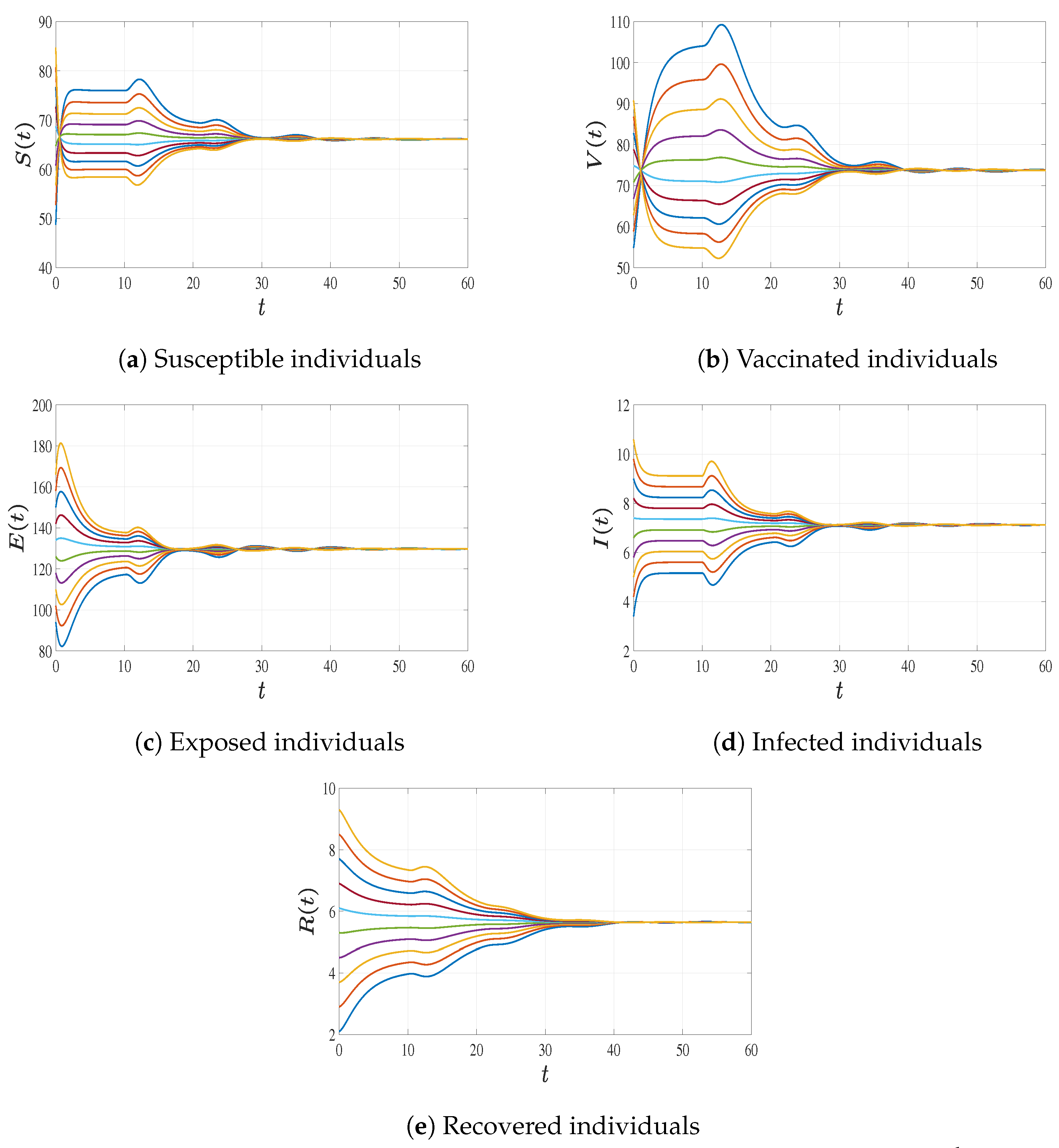
Figure 2 depicts the time evolution of the susceptible, vaccinated, exposed, infected, and recovered populations for a transmission rate of β = 0.01 , which yields a basic reproduction number R 0 d = 0.3511 < 1 . Biologically, this scenario corresponds to a situation where the pathogen’s transmissibility is insufficient to sustain transmission within the host population. Despite the presence of an initial infected cohort, the infection rapidly declines and eventually disappears entirely. The susceptible and vaccinated compartments converge to their respective disease-free equilibrium values S 0 and V 0 , indicating that the vaccination program, while imperfect, successfully contains the outbreak when coupled with the naturally low transmissibility. This regime reflects the desired public health outcome: the infection is driven to extinction without the need for additional interventions, and the population remains protected at baseline vaccination levels.
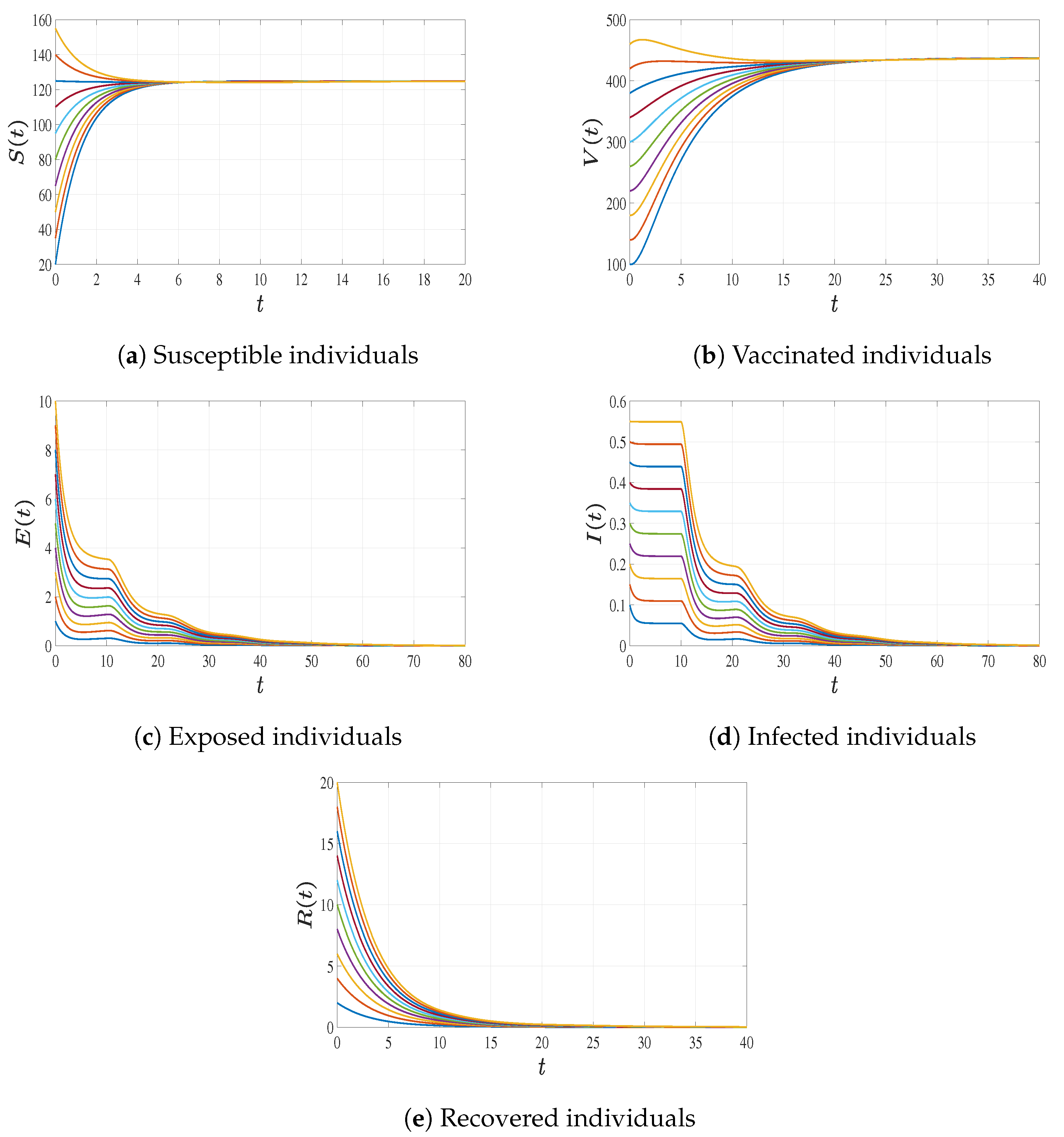
In contrast, Figure 3 presents the system dynamics for an increased transmission rate β = 0.1 , corresponding to R 0 d = 3.5108 > 1 . Here, a fundamentally different biological outcome emerges: the pathogen possesses sufficient infectiousness to establish persistent endemic circulation. Following an initial transient phase, all state variables converge to strictly positive endemic equilibrium values S * , V * , E * , I * , R * . The infected compartment I ( t ) does not return to zero but instead stabilizes at a non-zero level, indicating continuous disease circulation within the community. This endemic steady state represents a biological equilibrium wherein each new infection generated by the pathogen is exactly balanced by recovery, mortality, and the replenishment of susceptible individuals through recruitment. The sustained presence of infected individuals, even in the presence of ongoing vaccination, underscores the challenge of measles elimination in high-transmission settings and highlights the critical role of maintaining sufficient population immunity to push R 0 d below the critical threshold of unity.

5.2. Parameter Elasticity (Sensitivity) and Control Prioritization

Having established that the basic reproduction number R 0 d serves as the critical threshold governing disease extinction versus persistence, we now systematically quantify the relative contribution of each epidemiological parameter and delay to the value of R 0 d . To achieve this, we employ normalized forward sensitivity analysis [33,34], which computes the elasticity index S q = q R 0 d · R 0 d q for each parameter q. These dimensionless indices provide a biologically interpretable measure of the proportional change in R 0 d resulting from a proportional change in a given parameter, thereby enabling direct comparison of parameters with disparate units and scales. This analysis serves two primary purposes: first, it identifies which biological processes—whether transmission rates, vaccination parameters, mortality rates, or incubation delays—exert the greatest influence on epidemic potential, and second, it informs evidence-based resource allocation by highlighting the most impactful targets for public health intervention. Parameters exhibiting large positive elasticity represent high-leverage points for reducing transmission, while those with substantial negative elasticity indicate where enhancing existing control measures yields maximal benefit. The delay-specific elasticities are of particular interest, as they quantify the epidemiological returns on shortening the incubation period through early detection or reducing pathogen survival through environmental control.
  • The basic reproduction number for the delay model is given by
    R 0 d = ϵ e n 3 τ 3 β Λ ( m v e n 1 τ 1 + p θ e n 2 τ 2 ) m v ( m s + p ) ( m e + ϵ ) ( m i + ζ + γ ) .
    The normalized sensitivity indices [33,34] for the model key parameters are summarized in Table 3 as follows:
Table 3. Sensitivity indices of R 0 d with respect to the system parameters.
Parameter qSensitivity Index S q
β , Λ + 1
ϵ m e m e + ϵ
θ θ p e n 2 τ 2 m v e n 1 τ 1 + p θ e n 2 τ 2
p p θ e n 2 τ 2 m v e n 1 τ 1 + p θ e n 2 τ 2 p m s + p
m v m v e n 1 τ 1 m v e n 1 τ 1 + p θ e n 2 τ 2 1
m s m s m s + p
τ 1 , n 1 n 1 τ 1 m v e n 1 τ 1 m v e n 1 τ 1 + p θ e n 2 τ 2
τ 2 , n 2 n 2 τ 2 p θ e n 2 τ 2 m v e n 1 τ 1 + p θ e n 2 τ 2
τ 3 , n 3 n 3 τ 3
  • Parameters with positive sensitivity indices ( β , Λ , ε , θ ) increase R 0 d when increased.
  • Parameters with negative indices ( m v , p , m s , τ 3 , n 3 , τ 2 , n 2 , τ 1 , n 1 ) decrease R 0 d when increased.
  • The delay τ 3 (incubation delay) has an exponential negative impact via e n 3 τ 3 , making it a critical control parameter.
  • The analysis helps identify key parameters for intervention strategies (e.g., vaccination rate p, effectiveness θ , or reducing transmission β ).
It is crucial to interpret these sensitivity indices within the context of public health implementation. Parameters like the recruitment rate Λ and the natural mortality rates ( m s , m v , m e , m i , m r ) exhibit non-negligible sensitivity indices, indicating they are mathematically influential in determining the value of R 0 d . However, from an operational standpoint, these are not parameters that can be directly manipulated by short-term public health policy. The value of this mathematical finding lies in verifying the model’s consistency and highlighting the importance of demographic factors, rather than suggesting them as intervention targets. In contrast, parameters with high negative elasticities that are also controllable—such as the vaccination rate p, vaccine failure probability θ , and, critically, the incubation delay τ 3 —represent the most promising and realistic targets for intervention. The transmission rate β , while not directly controllable, can be reduced through indirect measures like social distancing and improved hygiene, making it a key proxy for non-pharmaceutical interventions.
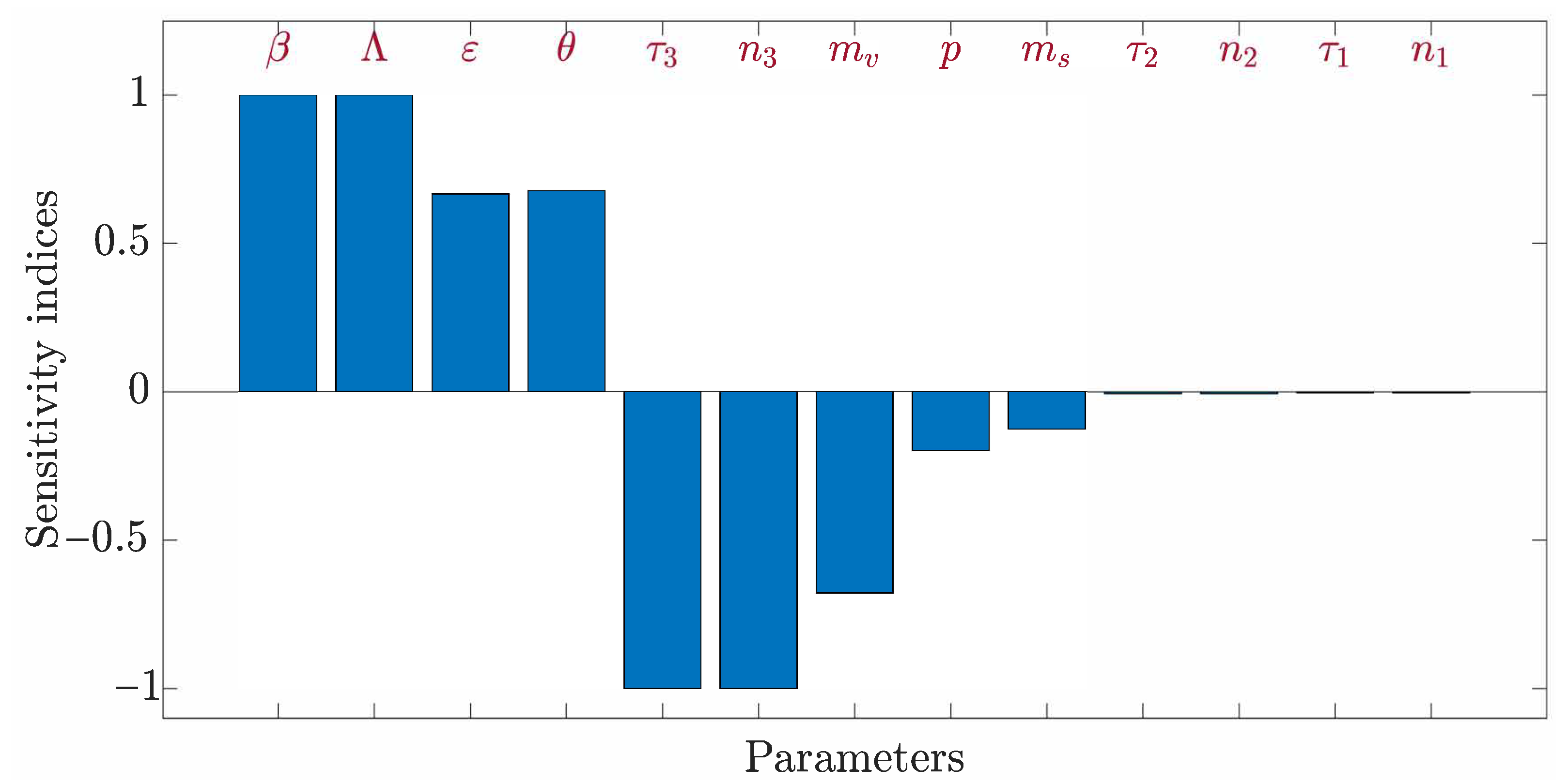
Figure 4 and Table 4 collectively provide a quantitative ranking of the relative influence of each model parameter on the delay-dependent reproduction number R 0 d . The normalized sensitivity indices presented in Table 4 reveal several biologically significant insights into measles transmission dynamics and the potential efficacy of various intervention strategies.
The transmission rate β exhibits a sensitivity index of + 1 , indicating a perfectly linear relationship with R 0 d : a 10 % reduction in contact-mediated transmission yields a corresponding 10 % decrease in the reproduction number. This finding underscores the direct epidemiological impact of interventions that reduce contact rates—such as social distancing, school closures, and improved ventilation—or those that directly lower infectiousness, such as prompt isolation of symptomatic cases. Similarly, the recruitment rate of susceptible individuals Λ displays a sensitivity index of + 1 , reflecting that each new birth or immigration into the susceptible pool proportionally amplifies the potential for epidemic propagation. This observation highlights the importance of maintaining high vaccination coverage among incoming birth cohorts to prevent erosion of herd immunity.
The progression rate from exposed to infectious states ϵ carries a sensitivity index of approximately + 0.67 , indicating that accelerating the transition through the latent period—for instance, via rapid diagnostic testing and early case identification—paradoxically increases R 0 d in the absence of concurrent isolation measures. This occurs because faster progression reduces the time during which exposed individuals are non-infectious, effectively compressing the generation interval and increasing the rate at which new infections arise. Conversely, the vaccine failure probability θ exhibits a positive index of + 0.68 , demonstrating that improvements in the quality of vaccine-induced protection substantially enhance population-level control.
Critically, the vaccination rate p and the natural mortality rate of vaccinated individuals m v both display negative sensitivity indices of 0.68 and 0.68 , respectively. The negative elasticity of p confirms that increasing vaccination coverage reliably suppresses R 0 d , albeit with diminishing returns at high coverage levels due to the saturation of susceptible depletion. The equally strong negative elasticity of m v is biologically distinct: it reflects that vaccinated individuals who experience lower mortality rates contribute to sustained population immunity for longer durations, thereby reducing the force of infection. This observation emphasizes that general improvements in child survival and population health directly strengthen vaccine-mediated protection.
The susceptible mortality rate m s and the vaccine efficacy delay parameters τ 1 , τ 2 exhibit modest negative elasticities ( 0.13 and approximately 0.07 to 0.03 , respectively), indicating secondary but non-negligible roles in modulating transmission. Most strikingly, the incubation delay τ 3 and its associated decay rate n 3 demonstrate exponential negative sensitivity, as visually emphasized in Figure 4. The sensitivity index for τ 3 is not constant but operates through the multiplicative factor e n 3 τ 3 ; a 10 % increase in the incubation period produces a proportional reduction in R 0 d governed by the magnitude of n 3 . This exponential relationship renders the incubation delay an extraordinarily potent target for intervention: strategies that prolong the time between infection and infectiousness—whether through chemoprophylaxis, post-exposure vaccination, or antiviral agents—can achieve dramatic reductions in transmissibility even with modest extensions of the latent period.
Figure 4 provides a visual synthesis of these relationships, displaying the relative magnitude and direction of each parameter’s influence. The bar lengths corresponding to β and Λ dominate the positive axis, while the substantial negative contributions of p, m v , and the delay-associated parameters are clearly visualized. The pronounced negative bar for τ 3 relative to τ 1 and τ 2 confirms the unique epidemiological leverage afforded by interventions targeting the incubation phase.
It is crucial to interpret these sensitivity indices within the context of public health implementation. Parameters like the recruitment rate Λ and natural mortality rates exhibit non-negligible sensitivity indices, indicating that they are mathematically influential in determining R 0 d . However, from an operational standpoint, these are not parameters that can be directly manipulated by short-term public health policy. The value of this mathematical finding lies in verifying the model’s consistency and highlighting the importance of demographic factors, rather than suggesting them as intervention targets. In contrast, parameters with high negative elasticities that are also controllable—such as the vaccination rate p, vaccine failure probability θ , and, critically, the incubation delay τ 3 —represent the most promising and realistic targets for intervention. The transmission rate β , while not directly controllable, can be reduced through indirect measures like social distancing and improved hygiene, making it a key proxy for non-pharmaceutical interventions.
Collectively, these sensitivity analyses indicate that optimal measles control strategies should prioritize: (i) maintaining high vaccination coverage among new birth cohorts, (ii) improving vaccine efficacy and durability of protection, (iii) implementing interventions that extend the incubation period or enable early post-exposure prophylaxis, and (iv) reducing transmission rates through environmental and behavioral modifications when outbreaks occur.

5.3. Critical Delay Thresholds and Infection Eradication

Among the four distributed delays incorporated into the model, the incubation delay τ 3 —representing the average time elapsed between exposure and the onset of infectiousness—emerges as the most epidemiologically influential, as evidenced by its substantial negative elasticity and exponential appearance in the expression for R 0 d . Unlike the vaccination-related delays τ 1 and τ 2 , which modulate the efficacy of pre-exposure immunity, τ 3 directly governs the duration of the non-infectious latent phase and fundamentally alters the pathogen’s generation interval. In this subsection, we systematically investigate the quantitative relationship between the incubation delay τ 3 and the threshold behavior of the system. We derive an explicit analytical expression for the critical delay τ 3 cr at which the reproduction number equals unity, demarcating the boundary between disease extinction and endemic persistence. Using the baseline parameter set, we compute this critical value and examine the behavior of the system on either side of the threshold. This analysis not only provides a thorough validation of the theoretical stability results but also yields a practically interpretable metric: the minimum prolongation of the incubation period required to drive R 0 d below unity in the absence of other interventions. Such a threshold offers a quantifiable target for pharmaceutical and non-pharmaceutical interventions aimed at delaying the onset of infectiousness, including post-exposure prophylaxis, antiviral therapy, and early immune modulation.
The basic reproduction number R 0 d depends exponentially on τ 3 via the factor e n 3 τ 3 , making this delay a critical modulator of infection persistence. We derive an explicit expression for the critical delay τ 3 cr by solving R 0 d ( τ 3 ) = 1 , yielding
τ 3 cr = max 0 , 1 n 3 ln ε β Λ ( m v e n 1 τ 1 + p θ e n 2 τ 2 ) m v ( m s + p ) ( m e + ε ) ( m i + ζ + γ ) .
If τ 3 τ 3 cr , then R 0 d 1 and the infection-free equilibrium is globally stable; conversely, if τ 3 < τ 3 cr , the endemic equilibrium prevails. Using baseline parameters, we compute τ 3 cr 13.3956 days.
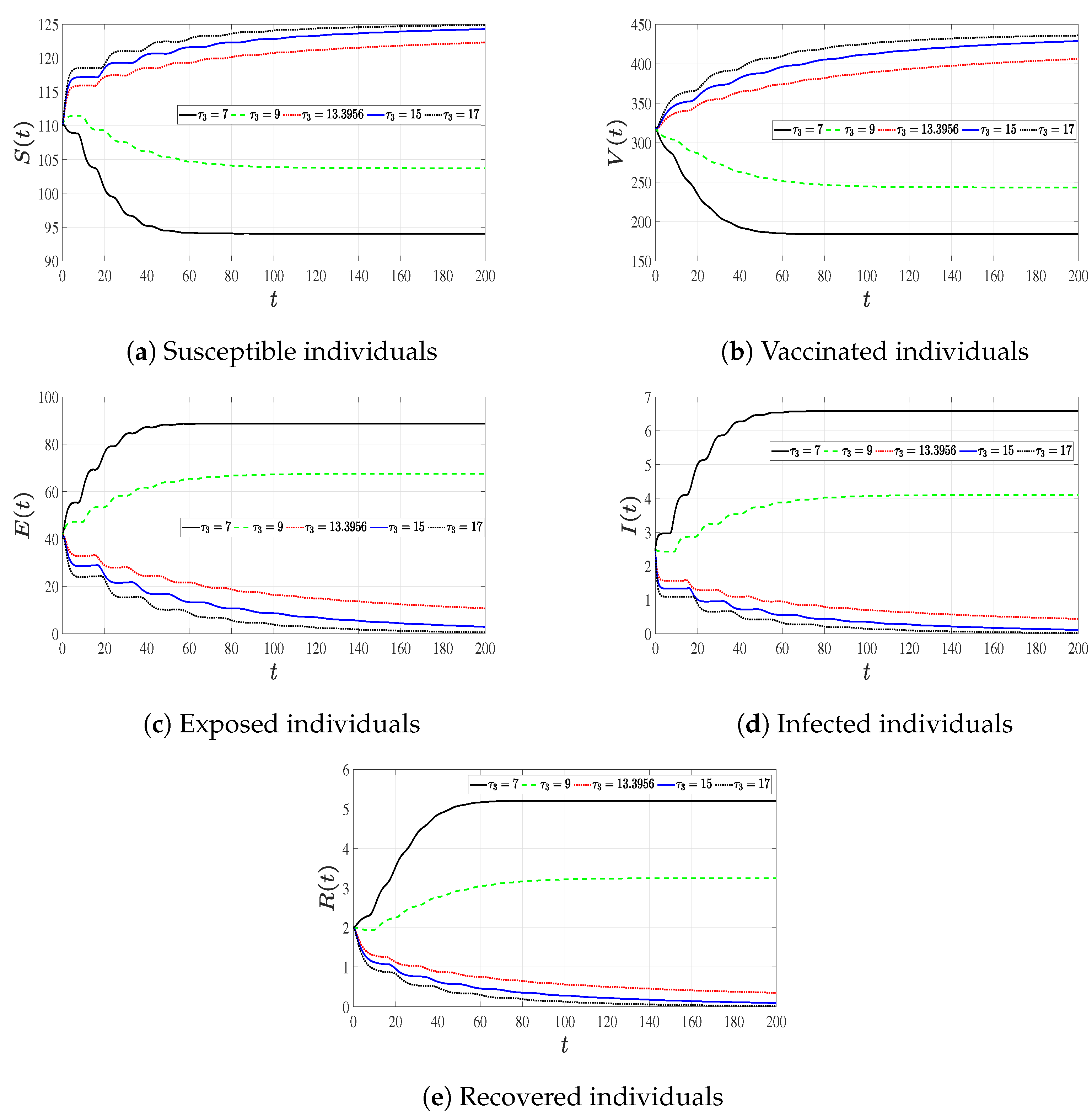
Table 5 and Figure 5 collectively elucidate the profound epidemiological consequences of prolonging the incubation period τ 3 , the average time spent in the exposed (E) compartment before becoming infectious. Table 5 presents the quantitative relationship between increasing values of τ 3 and the corresponding decline in the delay-dependent reproduction number R 0 d ( τ 3 ) . At τ 3 = 7 days, the reproduction number is 1.8956 , indicating sustained endemic transmission. As τ 3 increases to 9 days, R 0 d declines to 1.552 ; although still above unity, the force of infection is substantially attenuated. The critical threshold is reached at τ 3 cr = 13.3956 days, where R 0 d = 1 . Beyond this point, at τ 3 = 15 days, the reproduction number falls to 0.8518 , and at τ 3 = 17 days, it declines further to 0.6974 . This monotonic decreasing relationship is inherently nonlinear due to the exponential factor e n 3 τ 3 , with each incremental extension of the incubation period yielding progressively smaller absolute reductions in R 0 d but remaining epidemiologically significant.
Figure 5 provides a dynamic visualization of this threshold phenomenon, displaying the time evolution of the infected compartment I ( t ) for three distinct incubation delay values. When τ 3 = 7 days (black trajectory), corresponding to R 0 d > 1 , the infected population initially rises and subsequently converges to a positive endemic equilibrium I * 6.58 , indicating persistent disease circulation. At the critical delay τ 3 = 13.3956 days (red trajectory), the system exhibits marginal behavior, with the infected compartment approaching zero asymptotically. When τ 3 is increased to 17 days (dashed black trajectory), yielding R 0 d < 1 , the infection rapidly declines and is driven to extinction without sustained transmission.
The biological mechanism underlying this phenomenon is rooted in the concept of the generation interval—the average time between successive infections. Prolonging the incubation period τ 3 increases the time between an individual’s exposure and their subsequent contribution to secondary cases, effectively slowing the epidemic pace. This decoupling of infection events reduces the instantaneous reproductive rate, allowing host recovery and mortality to outpace pathogen transmission. From an immunological perspective, extending the latent period provides the host immune system with additional time to mount adaptive responses prior to peak viral shedding, potentially reducing infectiousness even after symptoms emerge. Moreover, delayed infectiousness increases the window of opportunity for post-exposure interventions, such as administration of immune globulin or antiviral agents, which can abort or attenuate the infectious phase entirely.
Critically, the sensitivity analysis revealed that τ 3 exerts its influence through the exponential factor e n 3 τ 3 , where n 3 represents the mortality or decay rate specific to the exposed compartment. Biologically, this formulation implicitly accounts for attrition during the incubation period: not all exposed individuals survive to become infectious, particularly in measles where severe cases may experience fatal outcomes prior to symptom onset. Thus, prolonging τ 3 serves two complementary epidemiological functions: it extends the non-infectious window, reducing transmission efficiency, and it increases the cumulative probability of mortality or recovery during the latent phase, further depleting the pool of future infectious individuals.
While the intrinsic biological incubation period of measles is not directly manipulable, the parameter τ 3 in our model represents the effective duration of the non-infectious latent phase, which can be extended through interventions such as post-exposure prophylaxis (PEP). Administration of intramuscular or intravenous immunoglobulin within 6 days of exposure can prevent or attenuate measles, effectively prolonging the time until infectiousness or aborting infection entirely. Similarly, a measles-containing vaccine administered within 72 h of exposure can provide protection. Thus, τ 3 serves as an aggregate parameter capturing the epidemiological impact of these time-sensitive interventions.

6. Conclusions

This work presented an analysis of a distributed delay SVEIR model tailored to the transmission dynamics of measles under imperfect vaccination. By incorporating four independent distributed delays with explicit exponential survival probabilities, the model captures the essential temporal heterogeneity of the incubation period, vaccine-induced protection, and recovery processes—a level of biological realism often neglected in classical frameworks. The analysis proceeded along two complementary tracks: a baseline non-delay system and the full distributed delay system. For the non-delay system, we established its well-posedness, derived the basic reproduction number R 0 via next-generation methods, and proved the global asymptotic stability of both the disease-free equilibrium (when R 0 1 ) and the unique endemic equilibrium (when R 0 > 1 ) through systematic Lyapunov function construction. Extending this analysis to the distributed delay system, we proved non-negativity, boundedness, and the existence of a positively invariant region. By reformulating the next-generation matrix to accommodate delay kernels, we obtained the delay-dependent reproduction number R 0 d , which preserves the sharp threshold property. Using Volterra-type Lyapunov functionals, we established global asymptotic stability of both equilibria under appropriate invariant subsets, demonstrating that the core threshold dynamics are robust to the inclusion of realistic, heterogeneously distributed time lags. Normalized forward sensitivity analysis revealed critical insights for public health decision-making. The transmission rate β and recruitment rate Λ exhibit maximal positive elasticity, indicating that reductions in contact rates or susceptible influx yield proportional decreases in R 0 d . Conversely, the vaccination rate p, vaccine failure probability θ , and incubation delay τ 3 possess the largest negative elasticities. From a public health perspective, this analysis distinguishes between parameters that are mathematically influential and those that are operationally controllable, highlighting the vaccination rate and incubation delay as the most promising levers for intervention. Notably, τ 3 exerts exponential influence via e n 3 τ 3 , rendering it an extraordinarily potent target for intervention. We derived an explicit expression for the critical delay τ 3 cr at which R 0 d = 1 and demonstrated that prolonging the incubation period is sufficient to shift the system from endemic persistence to extinction. This remarkably modest threshold provides a concrete, measurable target for biomedical interventions such as post-exposure prophylaxis and antiviral therapy. Numerical simulations using Dirac delta kernels validated all theoretical predictions, visually confirming the global stability theorems and the threshold behavior of R 0 d . The simulations further illustrated how incremental extensions of the incubation period systematically reduce the infected population, culminating in disease eradication when τ 3 exceeds its critical value. These findings carry substantial public health implications: they identify a quantifiable target for delaying infectiousness, prioritize parameters for intervention (vaccination rate and efficacy), and demonstrate that even modest extensions of the latent period can, when broadly applied, shift the epidemiological regime from endemicity to elimination.
Several limitations of this study suggest directions for future research. First, the model assumes permanent immunity upon recovery, which is a simplifying assumption; future work could incorporate waning immunity to refine long-term projections. Second, the current framework uses constant compartment-specific mortality rates; age-structured mortality would capture demographic heterogeneity more accurately. Third, the distributed delays are characterized by general kernels; future work could fit specific kernel shapes (e.g., gamma or lognormal distributions) to empirical incubation and recovery data. Fourth, the analysis assumes homogeneous mixing; incorporating spatial structure or contact networks could reveal additional intervention leverage points. Fifth, while we derived critical delays for a single parameter ( τ 3 ), a multi-parameter sensitivity analysis exploring interactions among delays and intervention combinations would inform integrated control strategies. Despite these limitations, the framework developed herein provides a thorough yet practically applicable tool for understanding measles transmission under realistic assumptions of temporal heterogeneity and imperfect vaccination. By quantifying the epidemiological impact of delays and identifying the incubation period as a critical control parameter, this study contributes to the evidence base for intervention prioritization, outbreak response, and the ultimate goal of measles eradication.

Author Contributions

Conceptualization, M.H.A. and A.R.A.; methodology, M.H.A. and A.R.A.; software, M.H.A. and A.R.A.; investigation, M.H.A. and A.R.A.; visualization, M.H.A. and A.R.A.; writing—original draft, M.H.A. and A.R.A.; writing—review and editing, M.H.A. and A.R.A. All authors have read and agreed to the published version of the manuscript.

Funding

This research work was funded by Umm Al-Qura University, Saudi Arabia, under grant number: 26UQU4320088GSSR01.

Data Availability Statement

The original contributions presented in the study are included in the article; further inquiries can be directed to the corresponding author.

Acknowledgments

The authors extend their appreciation to Umm Al-Qura University, Saudi Arabia, for funding this research work through grant number 26UQU4320088GSSR01. The authors are also grateful to the anonymous reviewers for their many constructive suggestions, which helped to improve the presentation of the paper.

Conflicts of Interest

The authors declare no conflicts of interest.

References

  1. El Hajji, M.; Albargi, A.H. A mathematical investigation of an “SVEIR” epidemic model for the measles transmission. Math. Biosci. Eng. 2022, 19, 2853–2875. [Google Scholar] [CrossRef] [PubMed]
  2. Zakirullah. Measles disease spread and control via vaccination and treatment: A mathematical framework. Chaos Solitons Fractals 2026, 203, 117703. [Google Scholar] [CrossRef]
  3. Khan, R.; Popa, I.L.; Ismail, E.A.; Awwad, F.A.; Ishtiaq, U. Deterministic and fractional-order modeling of measles dynamics with harmonic mean incidence rate and quarantine impact. Sci. Rep. 2025, 15, 30597. [Google Scholar] [CrossRef]
  4. Popofsky, S.; Romero, J. Measles: An Ongoing Threat. Pediatr. Ann. 2025, 54, e167–e173. [Google Scholar] [CrossRef]
  5. Edward, M. Resurgence of measles in the United States: Examining the outbreak, vaccine hesitancy, and future directions. Glob. Public Health 2026, 21, 2624148. [Google Scholar] [CrossRef]
  6. Centers for Disease Control and Prevention (CDC). Measles Cases and Outbreaks. 2026. Available online: https://www.cdc.gov/measles/data-research/index.html (accessed on 1 February 2026).
  7. Nasr, R.; Swaidan, E.; Hachem, S.; Yazbek, N.; Rizk, M.; Abdel Rahman, A.; Alami, N. Immunization safety monitoring: Addressing vaccine hesitancy and enhancing coverage in crisis-affected regions-insights from Lebanon, Ukraine, and Sudan. Ther. Adv. Vaccines Immunother. 2025, 13, 25151355251380220. [Google Scholar] [CrossRef]
  8. Lewandowsky, S.; Ecker, U.; Seifert, C.; Schwarz, N.; Cook, J. Misinformation and Its Correction: Continued Influence and Successful Debiasing. Psychol. Sci. Public Interest 2012, 13, 106–131. [Google Scholar] [CrossRef]
  9. Kermack, F.; McKendrick, D. A contribution to the mathematical theory of epidemics. Proc. R. Soc. Lond. Math. Phys. Eng. Sci. 1927, 115, 700–721. [Google Scholar] [CrossRef]
  10. Diekmann, O.; Heesterbeek, J. On the definition and the computation of the basic reproduction ratio R0 in models for infectious diseases in heterogeneous populations. J. Math. Bio. 1990, 28, 365–382. [Google Scholar] [CrossRef] [PubMed]
  11. Van den Driessche, P.; Watmough, J. Reproduction Numbers and Sub-Threshold Endemic Equilibria for Compartmental Models of Disease Transmission. Math. Biosci. 2002, 180, 29–48. [Google Scholar] [CrossRef] [PubMed]
  12. Gumel, A.B.; McCluskey, C.C.; Watmough, J. An SVEIR model for assessing potential impact of an imperfect antisars vaccine. Math. Biosci. Eng. 2006, 3, 485–512. [Google Scholar] [CrossRef]
  13. Wei, H.; Jiang, Y.; Song, X.; Su, G.; Qiu, S. Global attractivity and permanence of a SVEIR epidemic model with pulse vaccination and time delay. J. Comput. Appl. Math. 2009, 229, 302–312. [Google Scholar] [CrossRef]
  14. Nkamba, L.; Ntaganda, J.; Abboubakar, H.; Kamgang, J.; Castelli, L. Global Stability of a SVEIR Epidemic Model: Application to Poliomyelitis Transmission Dynamics. Open J. Model. Simul. 2017, 5, 98–112. [Google Scholar] [CrossRef]
  15. Çakan, S. Stability Analysis of a Fractional Epidemic Model Involving the Vaccination Effect. Fractal Fract. 2025, 9, 206. [Google Scholar] [CrossRef]
  16. Saputra, H.L.; Ansori, M.F. Analysis of an SVEIR with Reinfection Model of Tuberculosis Disease Spread with Saturated Infected Rate and Imperfect Vaccination. AppliedMath 2025, 5, 163. [Google Scholar] [CrossRef]
  17. Sun, Y.; Liu, C.; Cheung, L. Weak persistence and extinction of a stochastic epidemic model with distributed delay and Ornstein-Uhlenbeck process. Adv. Cont. Discr. Mod. 2025, 2025, 114. [Google Scholar] [CrossRef]
  18. Lv, L.; Yang, J.; Hu, Z.; Fan, D. Dynamics Analysis of a Delayed HIV Model with Latent Reservoir and Both Viral and Cellular Infections. Math. Methods Appl. Sci. 2025, 48, 6063–6080. [Google Scholar] [CrossRef]
  19. Almuallem, N.A. Global properties of a delayed model for the dynamics of lumpy skin disease with vaccination efficacy. AIMS Math. 2025, 10, 20642–20669. [Google Scholar] [CrossRef]
  20. El Hajji, M.; Al-Faidi, Y.A.; Alharbi, M.H. Modeling dual-colony Nosema transmission in honeybees: The role of distributed delays and antiviral treatment. AIMS Math. 2026, 11, 2645–2681. [Google Scholar] [CrossRef]
  21. Almuashi, H.H.; El Hajji, M. Global Dynamics of a Dual-Target HIV Model with Time Delays and Treatment Implications. Mathematics 2026, 14, 6. [Google Scholar] [CrossRef]
  22. Almuallem, N.A.; El Hajji, M. Global Dynamics of a Multi-Population Water Pollutant Model with Distributed Delays. Mathematics 2026, 14, 20. [Google Scholar] [CrossRef]
  23. Amanna, I.J.; Carlson, N.E.; Slifka, M.K. Duration of Humoral Immunity to Common Viral and Vaccine Antigens. N. Engl. J. Med. 2007, 357, 1903–1915. [Google Scholar] [CrossRef] [PubMed]
  24. Anderson, R.M.; May, R.M. Infectious Diseases of Humans: Dynamics and Control; Oxford University Press: Oxford, UK, 1991. [Google Scholar] [CrossRef]
  25. Blythe, S.; Nisbet, R.; Gurney, W. The dynamics of population models with distributed maturation periods. Theor. Popul. Biol. 1984, 25, 289–311. [Google Scholar] [CrossRef] [PubMed]
  26. MacDonald, N. Time Lags in Biological Models; Lecture Notes in Biomathematics; Springer: Berlin/Heidelberg, Germany, 1978. [Google Scholar] [CrossRef]
  27. Smith, H. An Introduction to Delay Differential Equations with Applications to the Life Sciences; Texts in Applied Mathematics; Springer: New York, NY, USA, 2011; Volume 57. [Google Scholar] [CrossRef]
  28. Adda, P.; Nkague Nkamba, L.; Sallet, G.; Castelli, L. A SVEIR model with Imperfect Vaccine. In Proceedings of the CMPD 3 Conference on Computational and Mathematical Population Dynamics, Bordeaux, France, 31 May–4 June 2010. [Google Scholar]
  29. LaSalle, J.P. The Stability of Dynamical Systems; SIAM: Philadelphia, PA, USA, 1976. [Google Scholar]
  30. Lyapunov, A.M. The general problem of the stability of motion. Int. J. Control 1992, 55, 531–534. [Google Scholar] [CrossRef]
  31. Korobeinikov, A. Global properties of basic virus dynamics models. Bull. Math. Biol. 2004, 66, 879–883. [Google Scholar] [CrossRef]
  32. Guerra, F.M.; Bolotin, S.; Lim, G.; Heffernan, J.; Deeks, S.L.; Li, Y.; Crowcroft, N.S. The basic reproduction number (R0) of measles: A systematic review. Lancet Infect. Dis. 2017, 17, e420–e428. [Google Scholar] [CrossRef]
  33. Chitnis, N.; Hyman, J.M.; Cushing, J.M. Determining Important Parameters in the Spread of Malaria Through the Sensitivity Analysis of a Mathematical Model. Bull. Math. Biol. 2008, 70, 1272–1296. [Google Scholar] [CrossRef]
  34. Marino, S.; Hogue, I.B.; Ray, C.J.; Kirschner, D.E. A Methodology for Performing Global Uncertainty and Sensitivity Analysis in Systems Biology. J. Theor. Biol. 2008, 254, 178–196. [Google Scholar] [CrossRef]
Figure 1. “SVEIR” epidemic compartmental model [1].
Mathematics 14 01219 g001
Figure 2. Global stability results confirming Theorem 3 for β = 0.01 , where we get R 0 d = 0.3511 < 1 ; therefore, E 0 d is GAS. The different colors correspond to different initial conditions used for each trajectory.
Mathematics 14 01219 g002
Figure 3. Global stability results confirming Theorem 4 for β = 0.1 , where we get R 0 d = 3.5108 > 1 ; therefore, E * d is GAS. The different colors correspond to different initial conditions used for each trajectory.
Mathematics 14 01219 g003
Figure 4. Sensitivity analysis for R 0 d where β = 0.1 providing a visual representation of the numerical sensitivity indices presented in Table 4.
Mathematics 14 01219 g004
Figure 5. Effect of the delay τ 3 on system (27) for β = 0.04 . The initial condition is fixed to (110, 320, 40, 2.5, 2).
Mathematics 14 01219 g005
Table 1. Summary of state variables and parameters for system (1)–(5).
VariableDescriptionParameterDescription
S ( t ) Susceptible Λ Recruitment rate of susceptibles
V ( t ) Vaccinated (partial)pVaccination rate
E ( t ) Exposed (latent) β Transmission rate
I ( t ) Infectious θ Vaccine failure probability
R ( t ) Recovered (immune) ε Progression rate E I
m s Mortality, susceptible 1 / ε Mean latency period
m v Mortality, vaccinated γ Recovery rate
m e Mortality, exposed 1 / γ Mean infectious period
m i Mortality, infectious ζ Disease-induced mortality
m r Mortality, recovered ω 1 , ω 2 Delay windows for infection terms
n 1 , n 2 Attrition rates (infection delay) ω 3 Delay window for E I
n 3 Attrition rate (incubation) ω 4 Delay window for recovery
n 4 Attrition rate (recovery) F 1 , , F 4 Effective survival probabilities
τ 1 , τ 2 Delays in the force of infection τ 3 Incubation period
τ 4 Duration of infectiousness
Table 2. Used parameters for numerical simulations. The parameter values are drawn from the measles epidemiology literature [1,3,14], and we note that values are scaled for illustrative purposes while maintaining biologically plausible ratios.
Parameter τ 1 τ 2 τ 3 τ 4 n 1 n 2 n 3 n 4
Value 0.1 0.1 10 0.1 0.1 0.1 0.1 0.1
Parameter Λ m s m v m e m i m r ζ θ
Value100 0.1 0.2 0.4 0.6 0.3 0.5 0.6
Parameterp ε γ
Value 0.7 0.2 0.24
Table 4. Numerical sensitivity indices for R 0 d (baseline parameters).
q β Λ ε θ τ 3 , n 3 m v p m s τ 2 , n 2 τ 1 , n 1
S q + 1 + 1 0.67 0.68 1 0.68 0.2 0.13 0.007 0.003
Table 5. Effect of the maturation delay τ 3 on R 0 d ( τ 3 ) .
τ 3 7913.39561517
R 0 d ( τ 3 ) 1.89561.55210.85180.6974
Disclaimer/Publisher’s Note: The statements, opinions and data contained in all publications are solely those of the individual author(s) and contributor(s) and not of MDPI and/or the editor(s). MDPI and/or the editor(s) disclaim responsibility for any injury to people or property resulting from any ideas, methods, instructions or products referred to in the content.