Article

Modeling and Simulation of Whooping Cough Transmission in Japan: A SEIRS Approach with LSTM and Latin Hypercube Sampling-Based Parameter Estimation


Department of Mathematics, Faculty of Science, Naresuan University, Phitsanulok 65000, Thailand
*
Author to whom correspondence should be addressed.
Mathematics 2026, 14(7), 1207; https://doi.org/10.3390/math14071207
Submission received: 9 March 2026 / Revised: 28 March 2026 / Accepted: 1 April 2026 / Published: 3 April 2026
(This article belongs to the Section E1: Mathematics and Computer Science)

Abstract

Whooping cough has re-emerged as a significant global public health concern. Hence, an SEIRS model for whooping cough transmission in Japan is proposed to capture the disease dynamics because of a strong resurgence of the epidemic. The model is analyzed mathematically, establishing the non-negativity and boundedness of its solutions and investigating both the disease-free and endemic equilibria with their local and global stability. The model is fitted to actual infection data by estimating the time-varying transmission rates using a Long Short-Term Memory (LSTM) network and calibrating vaccination and treatment rates via Latin Hypercube Sampling (LHS). Sensitivity analysis identifies the key parameters for optimal control, and results indicate that simultaneously enhancing the vaccination rate most effectively mitigates the epidemic, as supported by cost-effectiveness analysis.

1. Introduction

In the nineteenth century, whooping cough caused large-scale outbreaks approximately every 2–5 years. The infant mortality rate reached 5–10%. Although widespread immunization since the 1940s has dramatically reduced the overall disease burden, whooping cough has re-emerged in many countries in recent years. According to the World Health Organization (WHO) [1], the average annual number of reported infections was 156,840 during 2001–2010, which increased to 166,473 during 2011–2020. Moreover, the number of reported cases surged sharply in 2024, reaching 941,565, indicating a substantial global resurgence of whooping cough.
Whooping cough is characterized by prolonged episodes of paroxysmal coughing. The clinical course of whooping cough is classically divided into three distinct stages [2]:
(1)
Catarrhal stage. This initial phase presents with nonspecific symptoms resembling those of an upper respiratory tract infection, including sneezing, mild cough, and low-grade fever. Although patients are highly infectious during this period, the absence of characteristic manifestations often leads to misdiagnosis or delayed recognition, thereby facilitating transmission to susceptible individuals. Owing to the high transmissibility and concealed nature of the disease in this phase, we treat it as the incubation period in the present model.
(2)
Paroxysmal stage. This stage is characterized by paroxysmal, spasmodic bouts of coughing, frequently followed by a characteristic inspiratory “whoop.”
(3)
Convalescent stage. During this recovery phase, the frequency and intensity of coughing gradually diminish, and the “whoop” typically disappears. However, paroxysms may recur with subsequent respiratory infections.
In Japan [3], the number of reported infections remained below 1000 cases annually during 2021–2023. In 2024, this number increased to 4096 cases. Furthermore, from 31 March 2025 (week 14) to 28 September 2025 (week 39), a total of 62,953 cases were reported over a period of 26 weeks, indicating a strong resurgence of the epidemic.
Why has the whooping cough epidemic resurged? Studies conducted in Japan [4] suggest that the resurgence of whooping cough can be attributed to several key factors. First, waning vaccine-induced immunity plays an important role. Immunity acquired through vaccination or natural infection gradually declines over time. Consequently, individuals vaccinated in early childhood may become susceptible again during adolescence or adulthood, thereby sustaining the transmission chain. Second, insufficient booster vaccination coverage contributes to the problem. Although Japan’s routine immunization program provides vaccinations for children, booster coverage among adolescents and adults remains relatively low. This gap allows older age groups to act as reservoirs of infection and promote community transmission. Third, genetic variation among circulating strains may reduce vaccine effectiveness, thereby weakening population-level protection. Finally, the emergence of antibiotic-resistant strains has further complicated control efforts.
For a long time, mathematical modeling has been widely used to analyze the transmission dynamics of infectious diseases and to provide a theoretical basis for public health policy decisions [5]. Therefore, it is essential to develop mathematical models capable of describing and predicting the transmission dynamics of whooping cough. In [6], Butt A.I.K. constructed an Atangana–Baleanu fractional model for whooping cough to investigate the transmission dynamics of the disease and to propose optimal strategies for its elimination. The proposed model was proven to possess a unique, positive, and bounded solution. The basic reproduction number R 0 was derived and used to analyze the local and global stability of the equilibrium points. Sensitivity analysis was conducted to identify the parameters that most strongly influence R 0 . Furthermore, vaccination and quarantine compartments were incorporated into the model, and an optimal control problem was formulated to evaluate the effects of vaccination and quarantine rates on disease control under three different scenarios. In [7], an SVEIQRP model based on fractal fractional differential equations was developed to describe the transmission dynamics of whooping cough. This framework provides a comprehensive representation of individuals who acquire long-term immunity against the disease. The model was analyzed within the framework of fractal fractional differential equations, and numerical simulations were performed to support the theoretical results. In addition, the fixed point theorem was applied to establish the existence, uniqueness, and Hyers–Ulam stability of the proposed system. However, antibody levels decline over time, indicating that permanent immunity does not exist. Balderrama Rocío et al. [8] analyze the optimal control of infectious disease propagation using a classical susceptible–infected–recovered (SIR) model characterized by permanent immunity and the absence of vaccines.
Given the increasing severity of the whooping cough epidemic and the emergence of new epidemiological characteristics, we propose a novel mathematical model to investigate its transmission dynamics and to better understand the mechanisms driving its resurgence. Specifically, we develop a new SEIRS model for whooping cough transmission that incorporates optimal control strategies and a cost-effectiveness analysis. The remainder of this paper is organized as follows. Section 2 introduces the mathematical model. Section 3 establishes the non-negativity and boundedness of the solutions. Section 4 derives the disease-free and endemic equilibria and analyzes their local and global stability. Section 5 describes the data-fitting procedure using an LSTM network to estimate time-varying transmission rates and calibrates vaccination and treatment rates via Latin Hypercube Sampling (LHS). Section 6 presents a sensitivity analysis to identify key parameters for optimal control. Section 7 formulates and analyzes the optimal control problem. Section 8 provides the cost-effectiveness analysis of the control strategies. Finally, Section 9 concludes the paper.

2. Mathematical Model

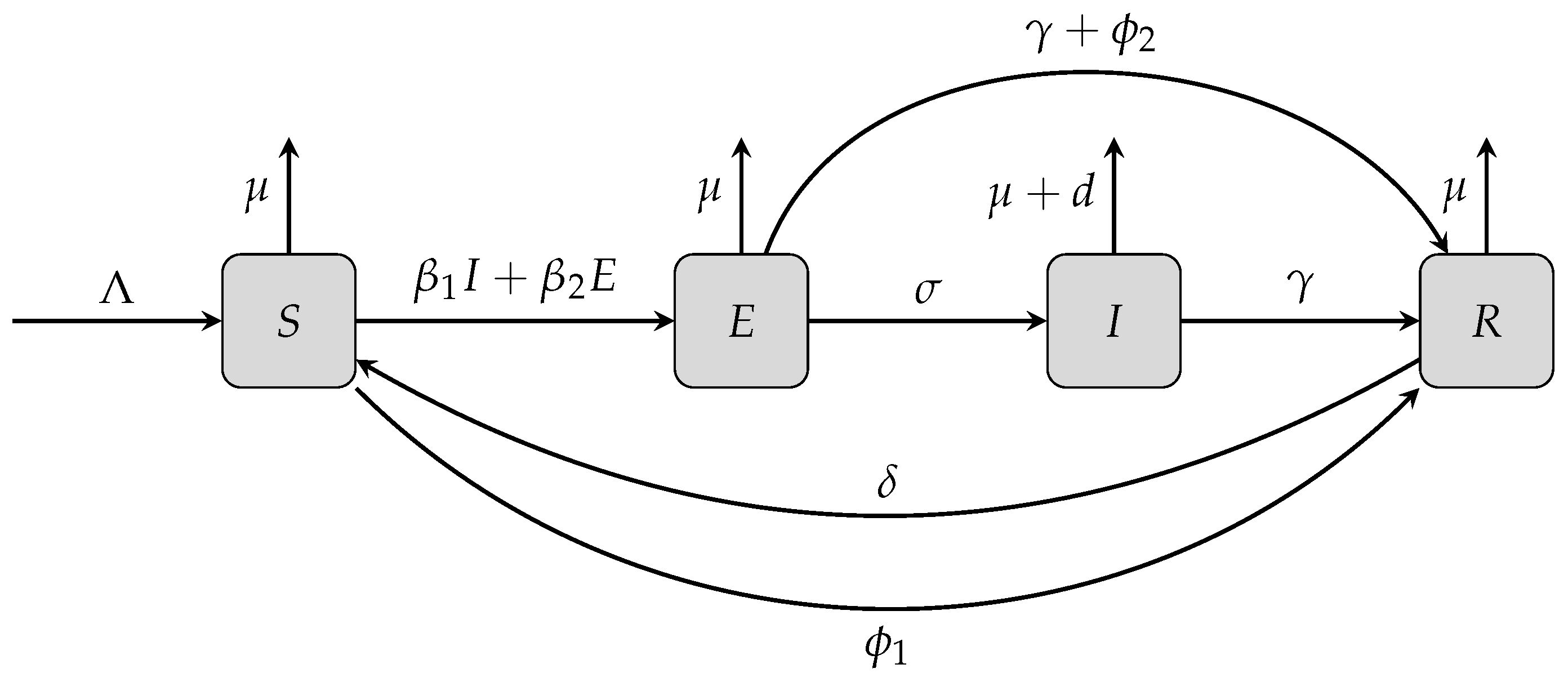
We divide the total population into four compartments:
(I)
S ( t ) denotes the susceptible population;
(II)
E ( t ) denotes the exposed population, consisting of individuals who are infected but exhibit nonspecific symptoms during the catarrhal stage of the disease;
(III)
I ( t ) denotes the infectious population, consisting of individuals showing characteristic symptoms during the paroxysmal stage of the disease;
(IV)
R ( t ) denotes the recovered population.
According to Figure 1 and Table 1, the corresponding system describing the transmission dynamics of whooping cough is given by
d S d t = Λ ( β 1 I + β 2 E ) S μ S ϕ 1 S + δ R , d E d t = ( β 1 I + β 2 E ) S σ E μ E γ E ϕ 2 E , d I d t = σ E γ I ( μ + d ) I , d R d t = γ I + γ E + ϕ 2 E + ϕ 1 S μ R δ R .
The initial population is
S ( 0 ) > 0 , E ( 0 ) 0 , I ( 0 ) 0 , R ( 0 ) 0 .
In order to better understand the model, we have some assumptions:
  • The term δ R reflects the possibility that recovered individuals may lose immunity and become susceptible again. Therefore, an immunity-waning (or reinfection) rate δ is introduced to describe the transition from the recovered class back to the susceptible class.
  • In some countries, booster vaccinations against whooping cough are routinely recommended during adulthood or pregnancy to enhance immunity and protect newborns. However, in Japan, booster vaccination among adults is not commonly practiced. Therefore, in the present model, individuals who receive booster vaccinations are assumed to have completed the vaccination process. Accordingly, we introduce a vaccination rate ϕ 1 to investigate the impact of vaccination on the transmission dynamics of the outbreak.
  • We assume that β 1 < β 2 for two main reasons. First, individuals infected with whooping cough are most contagious during the catarrhal stage, after which their infectiousness gradually declines [2]. Second, during the paroxysmal stage of whooping cough, individuals are typically aware of their illness due to the characteristic severe coughing episodes. This awareness usually leads to behavioral changes such as self-isolation, thereby reducing onward transmission. In contrast, during the catarrhal stage, infected individuals are often unaware that they have contracted Bordetella pertussis, since the symptoms closely resemble those of a common cold. Consequently, they do not adopt preventive measures, despite already being highly infectious. This asymptomatic or mildly symptomatic infectious period therefore represents one of the most critical phases for whooping cough transmission, which justifies the assumption β 1 < β 2 .
  • We do not have information about the vaccination rate ( ϕ 1 ) for people in the susceptible population who have completed the entire vaccination process or the treatment rate ( ϕ 2 ) for the exposed population because they are not recorded and reported. So we have to use LHS to calibrate these parameters.
  • In this study, we emphasize the epidemiological role of exposed individuals ( E ) and extend the model by introducing a treatment term ( ϕ 2 E ) for this compartment. This modification allows us to better capture the effect of early intervention and control during this critical stage of disease transmission.

3. Non-Negativity and Boundedness of the Solutions

For System (1), each component of the right-hand side is continuously differentiable with respect to the variables ( S , E , I , R ) . Therefore, by the Picard–Lindelöf theorem, there exists a unique solution for any given initial condition. We show that all solutions of the proposed System (1) satisfying the initial conditions remain non-negative and bounded for t 0 .
Theorem 1.
The solutions of System (1) are non-negative for t 0 .
Proof. 
Let
c 1 = μ + ϕ 1 , c 2 = σ + μ + γ + ϕ 2 , c 3 = γ + μ + d , c 4 = γ + ϕ 2 , c 5 = μ + δ .
Since
d S d t = Λ ( β 1 I + β 2 E ) S c 1 S + δ R Λ ( β 1 I + β 2 E + c 1 ) S ,
it follows that
d S d t + ( β 1 I + β 2 E + c 1 ) S Λ ,
Multiplying both sides by the integrating factor
exp 0 t ( β 1 I ( z ) + β 2 E ( z ) + c 1 ) d z
and integrating from 0 to t yields
S ( t ) S ( 0 ) e x p 0 t ( β 1 I ( z ) + β 2 E ( z ) + c 1 ) d z + Λ 0 t e x p t v ( β 1 I ( z ) + β 2 E ( z ) + c 1 ) d z d v .
Similarly, we obtain
E ( t ) E ( 0 ) e c 2 t , I ( t ) I ( 0 ) e c 3 t , R ( t ) R ( 0 ) e c 5 t .
Therefore,
S ( t ) > 0 , E ( t ) 0 , I ( t ) 0 , R ( t ) 0 ,
which proves that all variables remain non-negative for t 0 . □
Theorem 2.
The region
Ω : = { ( S , E , I , R ) R + 4 : 0 < S + E + I + R Λ μ }
is a positively invariant set with respect to System (1).
Proof. 
Let N = S + E + I + R . Then
d N d t = Λ μ N d I Λ μ N .
So
d N d t + μ N Λ .
Multiplying both sides by e μ t and integrating from 0 to t yields
e μ t N ( t ) N ( 0 ) Λ μ ( e μ t 1 ) ,
which means
N ( t ) ( N ( 0 ) Λ μ ) e μ t + Λ μ .
Hence,
lim t sup N ( t ) = Λ μ , 0 N ( t ) Λ μ ,
which implies that the region Ω is a positively invariant set with respect to System (1). □

4. Analysis of Equilibrium Points

4.1. The Disease-Free Equilibrium and Its Stability

The disease-free equilibrium is the steady state at which no infection is present in the system, and it is obtained as follows:
P 0 = ( S 0 , E 0 , I 0 , R 0 ) = Λ ( μ + δ ) μ ( μ + δ + ϕ 1 ) , 0 , 0 , ϕ 1 Λ μ ( μ + δ + ϕ 1 ) .
The basic reproduction number is ‘the expected number of secondary cases produced, in a completely susceptible population, by a typical infective individual’ [10]. Let F be the rate of appearance of new infections and V be the rate of transfer of individuals by all other means. Then
F = ( β 1 I + β 2 E ) S 0 , V = c 2 E σ E + c 3 I ,
and hence,
F = β 2 S 0 β 1 S 0 0 0 , V = c 2 0 σ c 3 ,
which yields
R 0 = ρ ( F V 1 ) = ( β 1 σ + c 3 β 2 ) S 0 c 2 c 3 = Λ ( μ + δ ) ( β 1 σ + β 2 ( d + γ + μ ) ) μ ( μ + δ + ϕ 1 ) ( d + γ + μ ) ( σ + γ + μ + ϕ 2 ) .
Biologically, R 0 increases with higher contact rates ( β 1 , β 2 ) and with a larger recruitment level of susceptibles ( Λ ) . The loss of immunity ( δ ) also contributes to increasing R 0 by replenishing the susceptible pool, thereby sustaining potential transmission. Conversely, R 0 decreases with faster progression from the exposed to the infectious class ( σ ) and with faster removal due to recovery, disease-induced death, or natural mortality ( γ , d , μ ) . In addition, effective control interventions ( ϕ 1 , ϕ 2 ) reduce susceptibility or infectiousness and thus lower R 0 . Overall, R 0 balances the rates of transmission and replenishment of susceptibles against the rates of removal and control, providing a measure of the potential for epidemic spread.
Theorem 3.
The disease-free equilibrium P 0 is locally asymptotically stable if R 0 < 1 and unstable if R 0 > 1 .
Proof. 
Computing the Jacobian J at P 0 = ( S 0 , E 0 , I 0 , R 0 ) yields
J ( P 0 ) = c 1 β 2 S 0 β 1 S 0 δ 0 β 2 S 0 c 2 β 1 S 0 0 0 σ c 3 0 ϕ 1 c 4 γ c 5 .
Let
| J ( P 0 ) λ I | = c 1 λ β 2 S 0 β 1 S 0 δ 0 β 2 S 0 c 2 λ β 1 S 0 0 0 σ c 3 λ 0 ϕ 1 c 4 γ c 5 λ = 0 ,
and hence we have
[ λ 2 + ( c 2 β 2 S 0 + c 3 ) λ + c 3 ( c 2 β 2 S 0 ) σ β 1 S 0 ] [ λ 2 + ( c 1 + c 5 ) λ + c 1 c 5 ϕ 1 δ ] = 0 .
If R 0 = ( β 1 σ + c 3 β 2 ) S 0 c 2 c 3 < 1 , then
( β 1 σ + c 3 β 2 ) S 0 < c 2 c 3 , c 3 β 2 S 0 < c 2 c 3 , β 2 S 0 < c 2 ,
which means
c 2 β 2 S 0 + c 3 > 0 .
Moreover,
c 3 ( c 2 β 2 S 0 ) σ β 1 S 0 = c 3 c 2 ( σ β 1 + c 3 β 2 ) S 0 = c 3 c 2 ( 1 R 0 ) > 0 .
Also,
c 1 + c 5 > 0 , c 1 c 5 ϕ 1 δ = μ ( μ + ϕ 1 + δ ) > 0 .
By the Routh–Hurwitz criteria, all roots of | J ( P 0 ) λ I | = 0 have negative real parts, so all eigenvalues of J ( P 0 ) have negative real parts. Hence, the system at P 0 is locally asymptotically stable if R 0 < 1 and unstable if R 0 > 1 . □
According to Castillo-Chavez and Huang [11], the following conditions must hold to guarantee the global asymptotic stability of the disease-free equilibrium:
(H1)
For the subsystem
d X d t = F ( X , 0 ) ,
the equilibrium point X * is globally asymptotically stable.
(H2)
G ^ ( X , Y ) = A Y G ( X , Y ) 0 , ( X , Y ) Ω ,
where A = D Y G ( X * , 0 ) is an M-matrix (i.e., the off-diagonal elements of A are non-negative).
Theorem 4.
The disease-free equilibrium P 0 of System (1) is globally asymptotically stable if R 0 < 1 .
Proof. 
Let X = ( S , R ) denote the number of uninfected individuals and Y = ( E , I ) be the number of infected individuals. Hence, we have
X * = ( S 0 , R 0 ) = Λ ( μ + δ ) μ ( μ + δ + ϕ 1 ) , ϕ 1 Λ μ ( μ + δ + ϕ 1 ) .
Now we verify the conditions ( H 1 ) and ( H 2 ) .
Condition ( H 1 ) : For the system
d X d t = F ( X , 0 ) = Λ ( μ + ϕ 1 ) S + δ R ϕ 1 S ( μ + δ ) R ,
setting S = S 0 + x , R = R 0 + y gives
d x d t = ( μ + ϕ 1 ) x + δ y , d y d t = ϕ 1 x ( μ + δ ) y .
Let
X = x y , M = ( μ + ϕ 1 ) δ ϕ 1 ( μ + δ ) .
The system is rewritten as
d X d t = M X = ( μ + ϕ 1 ) δ ϕ 1 ( μ + δ ) x y .
The characteristic equation is
u 2 + ( 2 μ + ϕ 1 + δ ) u + μ ( μ + δ + ϕ 1 ) = 0 ,
and thus u 1 = μ , u 2 = ( μ + ϕ 1 + δ ) . An eigenvector for u 1 = μ is v 1 = δ ϕ 1 , and an eigenvector for u 2 = ( μ + ϕ 1 + δ ) is v 2 = 1 1 . The general solution is
x y = D 1 δ ϕ 1 e μ t + D 2 1 1 e ( μ + ϕ 1 + δ ) t ,
where D 1 , D 2 are constants. Hence,
S = S 0 + D 1 δ e μ t + D 2 e ( μ + ϕ 1 + δ ) t , R = R 0 + D 1 ϕ 1 e μ t D 2 e ( μ + ϕ 1 + δ ) t ,
so
lim t S ( t ) = S 0 , lim t R ( t ) = R 0 .
Therefore, X * = ( S 0 , R 0 ) is globally asymptotically stable for the system d X d t = F ( X , 0 ) .
Condition ( H 2 ) : For
G ( X , Y ) = ( β 1 I + β 2 E ) S c 2 E σ E c 3 I ,
we have
A = D Y G ( X * , 0 ) = β 2 S 0 c 2 β 1 S 0 σ c 3 ,
so
G ^ ( X , Y ) = A Y G ( X , Y ) = β 1 I ( S 0 S ) + β 2 E ( S 0 S ) 0 .
Since S 0 S 0 , we have G ^ ( X , Y ) 0 , which implies that the disease-free equilibrium is globally asymptotically stable whenever R 0 < 1 . □

4.2. The Endemic Equilibrium and Its Stability

For System (1), setting the right-hand sides to zero, we obtain
S * = c 2 c 3 β 1 σ + β 2 c 3 , E * = c 3 [ c 5 Λ ( μ + δ + ϕ 1 ) μ S * ] μ c 2 c 3 + δ σ ( μ + d ) + μ δ c 3 , I * = σ c 3 E * , R * = ( γ σ + c 3 c 4 ) E * + c 3 ϕ 1 S * c 3 c 5 .
The endemic equilibrium P * = ( S * , E * , I * , R * ) exists and is biologically meaningful (i.e., all components are positive) if and only if the following condition holds:
c 5 Λ ( μ + δ + ϕ 1 ) μ S * > 0 , c 5 Λ > c 2 c 3 μ ( μ + δ + ϕ 1 ) β 1 σ + β 2 c 3 ,
which is equivalent to
R 0 = ( β 1 σ + c 3 β 2 ) S 0 c 2 c 3 = ( β 1 σ + c 3 β 2 ) Λ c 5 c 2 c 3 μ ( μ + δ + ϕ 1 ) > 1 .
Lemma 1.
The unique endemic equilibrium P * exists if and only if R 0 > 1 .
Theorem 5.
The endemic equilibrium P * is locally asymptotically stable.
Proof. 
The Jacobian determinant at P * is
| J ( P * ) λ I | = c 2 E * S * c 1 λ β 2 S * β 1 S * δ c 2 E * S * β 1 σ S * c 3 λ β 1 S * 0 0 σ c 3 λ 0 ϕ 1 c 4 γ c 5 λ ,
and hence the characteristic equation is
λ 4 + a 1 λ 3 + a 2 λ 2 + a 3 λ + a 4 = 0 ,
where
a 1 = c 2 E * S * + c 1 + β 1 σ S * c 3 + c 3 + c 5 , a 2 = c 5 c 2 E * S * + c 1 + β 1 σ S * c 3 + c 3 + c 2 E * S * + c 1 β 1 σ S * c 3 + c 3 + β 2 c 2 E * δ ϕ 1 , a 3 = c 5 c 2 E * S * + c 1 β 1 σ S * c 3 + c 3 + β 2 c 2 E * + c 2 2 c 3 E * S * δ c 2 c 4 E * S * + ϕ 1 β 1 σ S * c 3 + ϕ 1 c 3 , a 4 = c 2 E * S * c 2 c 3 c 5 δ ( c 3 c 4 + σ γ ) .
Since
a 1 > 0 , a 2 > 0 , a 3 > 0 , a 4 > 0 , a 1 a 2 a 3 > 0 , a 1 a 2 a 3 > a 3 2 + a 1 2 a 4 ,
by Routh–Hurwitz criteria, all roots of | J ( P * ) λ I | = 0 have negative real parts, so all eigenvalues of J ( P * ) have negative real parts; hence, the system at P * is locally asymptotically stable. □
We now discuss the global stability of the endemic equilibrium point. We analyze the point using the geometric approach proposed by Li and Muldowney [12] as follows (see Appendix A).
Theorem 6.
The endemic equilibrium point P * is globally stable in int Ω when R 0 > 1 and b ¯ > 0 , where
b ¯ = min { ( β 2 S β 1 I β 2 E σ E I c 1 c 2 + c 3 ) inf β 1 S , δ I E , ( σ + c 4 + E I ϕ 1 σ E I β 1 I β 2 E c 1 ) inf β 2 S , δ I E , ( σ + c 4 + γ + E I ( 2 ϕ 1 σ ) + c 3 c 1 c 5 ) I E inf { β 1 S , β 2 S } , ( σ + c 4 + γ + β 1 I + β 2 E + E I ( 2 ϕ 1 σ + β 1 I + β 2 E ) + β 2 S c 2 ) , ( σ + c 4 + γ + β 1 I + β 2 E + E I ( 2 ϕ 1 + β 1 I + β 2 E + γ + c 4 2 σ ) + β 1 I S E + β 2 S + 2 c 3 c 2 c 5 ) inf β 2 S + c 2 σ , β 1 S + c 3 } .
Proof. 
The Jacobian matrix J of System (1) is given by
J ( S , E , I , R ) = ( β 1 I + β 2 E ) c 1 β 2 S β 1 S δ β 1 I + β 2 E β 2 S c 2 β 1 S 0 0 σ c 3 0 ϕ 1 c 4 γ c 5 .
Its corresponding second additive compound matrix J[2] is
J [ 2 ] = A 1 β 1 S 0 β 1 S δ 0 σ A 2 0 β 2 S 0 δ c 4 γ A 3 0 β 2 S β 1 S 0 β 1 I + β 2 E 0 A 4 0 0 ϕ 1 0 β 1 I + β 2 E γ A 5 β 1 S 0 ϕ 1 0 c 4 σ A 6
where the diagonal entries are
A 1 = β 2 S β 1 I β 2 E c 1 c 2 , A 2 = β 1 I β 2 E c 1 c 3 , A 3 = β 1 I β 2 E c 1 c 5 , A 4 = β 2 S c 2 c 3 , A 5 = β 2 S c 2 c 5 , A 6 = c 3 c 5 .
We take the function
P = P ( S , E , I , R ) = diag ( 1 , 1 , 1 , 1 , E I , E I ) ,
and then we obtain
P f P 1 = diag ( 0 , 0 , 0 , 0 , E E I I , E E I I ) .
We define
C = P f P 1 + P J [ 2 ] P 1 ,
and then
C = A 1 β 1 S 0 β 1 S I E δ 0 σ A 2 0 β 2 S 0 I E δ c 4 γ A 3 0 I E β 2 S I E β 1 S 0 β 1 I + β 2 E 0 A 4 0 0 E I ϕ 1 0 E I ( β 1 I + β 2 E ) E I γ A 5 + E E I I β 1 S 0 E I ϕ 1 0 E I c 4 σ A 6 + E E I I = C 11 C 12 C 21 C 22 ,
where C11 = A1, C 12 = β 1 S 0 β 1 S I E δ 0 , C 21 = σ c 4 0 E I ϕ 1 0 ,
C 22 = A 2 0 β 2 S 0 I E δ γ A 3 0 I E β 2 S I E β 1 S β 1 I + β 2 E 0 A 4 0 0 0 E I ( β 1 I + β 2 E ) E I γ A 5 + E E I I β 1 S E I ϕ 1 0 E I c 4 σ A 6 + E E I I .
The Lozinskiĭ measure is defined as
μ ( C ) max { g 1 , g 2 }
where
g 1 = μ ( C 11 ) + C 12 , g 2 = C 21 + μ ( C 22 ) .
Since
μ ( C 11 ) = A 1 , C 12 = max | β 1 S | , | 0 | , | β 1 S | , I E δ , | 0 | = max β 1 S , I E δ ,
we have
g 1 = A 1 + max β 1 S , I E δ .
And
C 21 = | σ | + | c 4 | + | 0 | + E I ϕ 1 + | 0 | = σ + c 4 + E I ϕ 1 ,
so
g 2 = σ + c 4 + E I ϕ 1 + μ ( C 22 ) .
Next, compute μ ( C 22 ) . Partition C 22 as
C 22 = D = D 11 D 12 D 21 D 22 ,
where D 11 = A 2 , D 12 = 0 β 2 S 0 I E δ , D 21 = γ β 1 I + β 2 E 0 E I ϕ 1 ,
D 22 = A 3 0 I E β 2 S I E β 1 S 0 A 4 0 0 E I ( β 1 I + β 2 E ) E I γ A 5 + E E I I β 1 S 0 E I c 4 σ A 6 + E E I I .
The Lozinskiĭ measure is
μ ( D ) max { g 3 , g 4 }
where
g 3 = μ ( D 11 ) + D 12 , g 4 = D 21 + μ ( D 22 ) .
Since
μ ( D 11 ) = A 2 , D 12 = max | 0 | , | β 2 S | , | 0 | , I E δ = max β 2 S , I E δ , D 21 = | γ | + | β 1 I + β 2 E | + | 0 | + E I ϕ 1 = γ + β 1 I + β 2 E + E I ϕ 1 ,
we have
g 3 = A 2 + max β 2 S , I E δ , g 4 = γ + β 1 I + β 2 E + E I ϕ 1 + μ ( D 22 ) .
Now compute μ ( D 22 ) . Partition D 22 as
D 22 = E = E 11 E 12 E 21 E 22 ,
where
E 11 = A 3 , E 12 = 0 I E β 2 S I E β 1 S ,
E 21 = 0 E I ( β 1 I + β 2 E ) 0 , E 22 = A 4 0 0 E I γ A 5 + E E I I β 1 S E I c 4 σ A 6 + E E I I .
Then,
μ ( E ) max { g 5 , g 6 } ,
where
g 5 = μ ( E 11 ) + E 12 = A 3 + max | 0 | , I E β 2 S , I E β 1 S = A 3 + I E max { β 2 S , β 1 S } , g 6 = E 21 + μ ( E 22 ) = E I ( β 1 I + β 2 E ) + μ ( E 22 ) .
Again, partition E 22 as
E 22 = F = F 11 F 12 F 21 F 22 ,
where
F 11 = A 4 , F 12 = 0 0 ,
F 21 = E I γ E I c 4 , F 22 = A 5 + E E I I β 1 S σ A 6 + E E I I .
We have
μ ( F ) max { g 7 , g 8 } ,
where
g 7 = μ ( F 11 ) + F 12 = A 4 , g 8 = F 21 + μ ( F 22 ) , = E I γ + E I c 4 + μ ( F 22 ) = E I ( γ + c 4 ) + μ ( F 22 ) ,
And
μ ( F 22 ) = max A 5 + E E I I + σ , β 1 S + A 6 + E E I I = E E I I + sup A 5 + σ , β 1 S + A 6 .
Next, considering System (1), we get
E E = β 1 I S E + β 2 S c 2 , I I = σ E I c 3 .
Therefore, from (6), we have
μ ( F ) max { g 7 , g 8 } ,
where
g 7 = A 4 = β 2 S c 2 c 3 = I I + β 2 S c 2 σ E I , g 8 = E I ( γ + c 4 ) + μ ( F 22 ) = I I + E I ( γ + c 4 ) + E E 2 I I + sup A 5 + σ , β 1 S + A 6 = I I + E I ( γ + c 4 ) + β 1 I S E + β 2 S 2 σ E I + 2 c 3 c 2 + sup β 2 S c 2 c 5 + σ , β 1 S c 3 c 5 = I I + E I ( γ + c 4 ) + β 1 I S E + β 2 S 2 σ E I + 2 c 3 c 2 c 5 + sup β 2 S c 2 + σ , β 1 S c 3 .
Thus we obtain
μ ( F ) I I + max { β 2 S c 2 σ E I , E I ( γ + c 4 ) + β 1 I S E + β 2 S 2 σ E I + 2 c 3 c 2 c 5 + sup β 2 S c 2 + σ , β 1 S c 3 } .
Now, recalling (5), we get
μ ( E ) max { g 5 , g 6 } ,
where
g 5 = A 3 + I E max { β 1 S , β 2 S } = β 1 I β 2 E c 1 c 5 + I E max { β 1 S , β 2 S } = I I β 1 I β 2 E σ E I + c 3 c 1 c 5 + I E max { β 1 S , β 2 S } , g 6 = E I ( β 1 I + β 2 E ) + μ ( E 22 ) = E I ( β 1 I + β 2 E ) + μ ( F ) .
Thus
μ ( E ) I I + max { β 1 I β 2 E σ E I + c 3 c 1 c 5 + I E sup { β 1 S , β 2 S } , E I ( β 1 I + β 2 E ) + β 2 S σ E I c 2 , E I ( β 1 I + β 2 E + γ + c 4 ) + β 1 I S E + β 2 S 2 σ E I + 2 c 3 c 2 c 5 + sup β 2 S c 2 + σ , β 1 S c 3 } .
Now, recalling (4), we obtain
μ ( D ) max { g 3 , g 4 } ,
where
g 3 = A 2 + max β 2 S , I E δ = β 1 I β 2 E c 1 c 3 + max β 2 S , I E δ = I I σ E I β 1 I β 2 E c 1 + max β 2 S , δ I E , g 4 = γ + β 1 I + β 2 E + ϕ 1 E I + μ ( D 22 ) = γ + β 1 I + β 2 E + ϕ 1 E I + μ ( E ) .
Hence we have
μ ( D ) I I + max { σ E I β 1 I β 2 E c 1 + sup β 2 S , δ I E , γ + E I ( ϕ 1 σ ) + c 3 c 1 c 5 + I E sup { β 1 S , β 2 S } , γ + β 1 I + β 2 E + ϕ 1 E I + E I ( β 1 I + β 2 E ) + β 2 S σ E I c 2 , γ + β 1 I + β 2 E + E I ( ϕ 1 + β 1 I + β 2 E + γ + c 4 2 σ ) + β 1 I S E + β 2 S + 2 c 3 c 2 c 5 + sup β 2 S c 2 + σ , β 1 S c 3 } .
Again, (3) means that
μ ( C ) max { g 1 , g 2 } ,
where
g 1 = A 1 + max β 1 S , I E δ = β 2 S β 1 I β 2 E c 1 c 2 + max β 1 S , I E δ = I I + β 2 S β 1 I β 2 E σ E I c 1 c 2 + c 3 + max β 1 S , δ I E , g 2 = σ + c 4 + E I ϕ 1 + μ ( C 22 ) = σ + c 4 + E I ϕ 1 + μ ( D ) .
Therefore,
μ ( C ) I I + max { β 2 S β 1 I β 2 E σ E I c 1 c 2 + c 3 + sup β 1 S , δ I E , σ + c 4 + E I ϕ 1 σ E I β 1 I β 2 E c 1 + sup β 2 S , δ I E , σ + c 4 + γ + E I ( 2 ϕ 1 σ ) + c 3 c 1 c 5 + I E sup { β 1 S , β 2 S } , σ + c 4 + γ + β 1 I + β 2 E + E I ( 2 ϕ 1 σ + β 1 I + β 2 E ) + β 2 S c 2 , σ + c 4 + γ + β 1 I + β 2 E + E I ( 2 ϕ 1 + β 1 I + β 2 E + γ + c 4 2 σ ) + β 1 I S E + β 2 S + 2 c 3 c 2 c 5 + sup β 2 S c 2 + σ , β 1 S c 3 } .
Hence
μ ( C ) I I b ¯ ,
where
b ¯ = min { ( β 2 S β 1 I β 2 E σ E I c 1 c 2 + c 3 ) inf β 1 S , δ I E , ( σ + c 4 + E I ϕ 1 σ E I β 1 I β 2 E c 1 ) inf β 2 S , δ I E , ( σ + c 4 + γ + E I ( 2 ϕ 1 σ ) + c 3 c 1 c 5 ) I E inf { β 1 S , β 2 S } , ( σ + c 4 + γ + β 1 I + β 2 E + E I ( 2 ϕ 1 σ + β 1 I + β 2 E ) + β 2 S c 2 ) , ( σ + c 4 + γ + β 1 I + β 2 E + E I ( 2 ϕ 1 + β 1 I + β 2 E + γ + c 4 2 σ ) + β 1 I S E + β 2 S + 2 c 3 c 2 c 5 ) inf β 2 S + c 2 σ , β 1 S + c 3 } .
Finally, let us consider any solution S , E , I , R emanating from the compact absorbing set Γ Ω . Let t ¯ be large enough that the system is persistent and ( S , E , I , R ) Γ for all t t ¯ . For each solution S , E , I , R such that ( S ( 0 ) , E ( 0 ) , I ( 0 ) , R ( 0 ) ) Γ , for t > t ¯ ,
1 t ln I ( t ) ln I ( 0 ) < b ¯ 2 .
As a result,
1 t 0 t μ ( C ) d s 1 t 0 t I I b ¯ d s = 1 t ln I ( t ) ln I ( 0 ) b ¯ t = ln I ( t ) ln I ( 0 ) t b ¯ < b ¯ 2 .
which implies that
lim sup t sup 1 t 0 t μ ( C ) d s < b ¯ 2 < 0 .

5. Simulation for the System Parameters

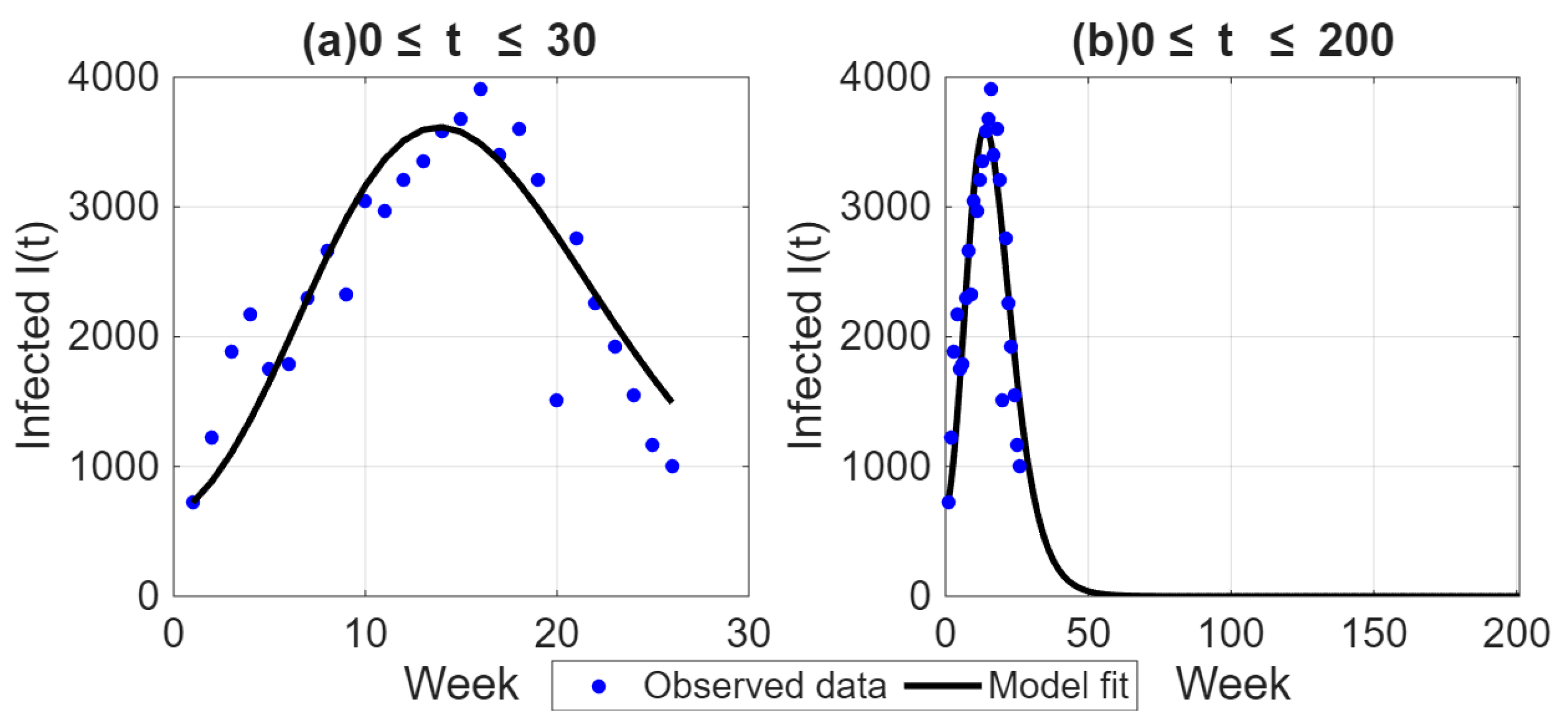
We fitted System (1) to surveillance data using weekly counts of whooping cough cases reported in Japan [13] from 31 March 2025 (week 14) to 28 September 2025 (week 39), a total of 26 weeks. The observed weekly cases began at 722 in week 14, rose steadily to a peak of 3908 in July (week 29), and declined to 1001 by week 39. Over this period, 62,953 cases were reported in total. The model was initialized using the data from week 14, with the following initial conditions [14]:
S ( 0 ) = 1.22 × 10 8 , E ( 0 ) = 2600 , I ( 0 ) = 722 , R ( 0 ) = 5647 .
For the most important parameters—the transmission rates—we employed the Long Short-Term Memory (LSTM) [15] network for dynamic fitting. The limitations of traditional ODE-based epidemic models lie in the fact that their parameters are usually treated as constants or simple functions, making them unable to capture the time-varying dynamics caused by government interventions, changes in public awareness, and seasonal variations in the real world. In contrast, the LSTM neural network serves as a dynamic parameter estimator that learns time-varying parameters directly from data, no longer treating the transmission rates as constants but as sequences that evolve over time.
Integrating LSTM with the SEIRS framework represents a deep fusion of traditional mechanistic modeling and modern data-driven artificial intelligence. The core idea of the LSTM-enhanced SEIRS model is to retain the mechanistic structure of the SEIRS system while allowing LSTM to learn complex, uncertain, or unobservable components such as β 1 ( t ) and β 2 ( t ) . Specifically, LSTM takes time series of external data (e.g., daily confirmed cases, policy stringency indices, mobility data) as input and outputs dynamic parameters at each time step, which are then substituted into the SEIRS model for a numerical solution. The joint training process compares simulated results with observed epidemic data to update both LSTM and SEIRS parameters simultaneously, thereby maintaining epidemiological interpretability while capturing nonlinear and time-dependent dynamics. Furthermore, LSTM can be employed to correct model residuals and improve forecasts by learning from historical errors and SEIRS output states.
For applications that demand interpretability and reliability, such as public health decision-making, the LSTM-enhanced SEIRS hybrid model provides a promising approach that combines mechanistic understanding with data-driven adaptability, achieving a “win–win” balance between scientific interpretability and predictive accuracy.
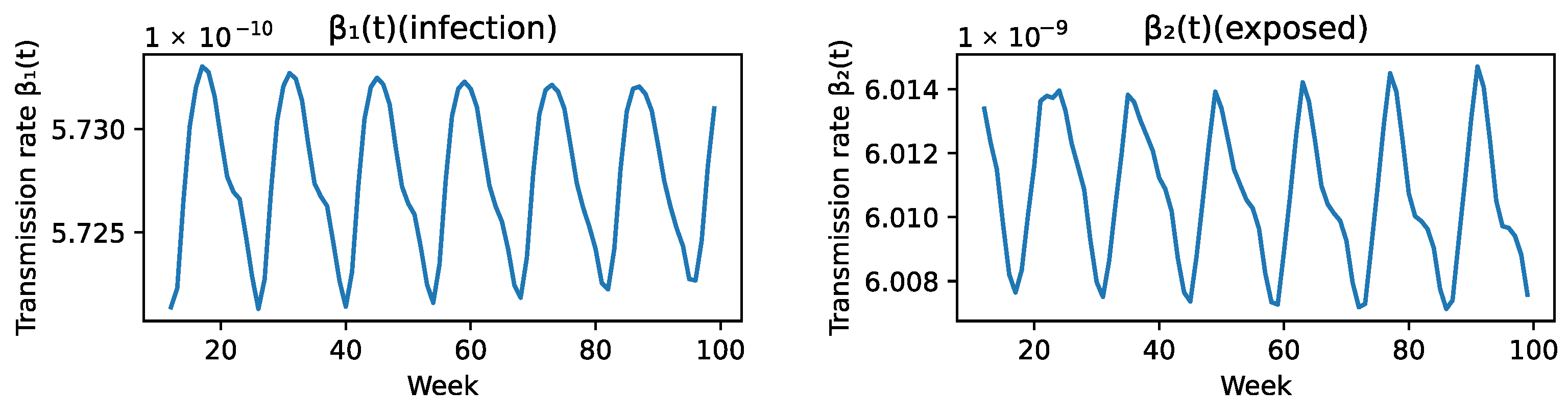
The temporal variations in β 1 ( t ) and β 2 ( t ) estimated by LSTM are shown in Figure 2. In the subsequent simulation analysis, we use the average values and obtain
β 1 = 0 100 β 1 ( t ) d t 100 = 5.7276 × 10 10 ; β 2 = 0 100 β 2 ( t ) d t 100 = 6.0107 × 10 09 .
The fitting results show that β 2 10 β 1 . This verifies our assumption that β 1 < β 2 .
Another set of equally important parameters is ϕ 1 and ϕ 2 , so we use Latin Hypercube Sampling (LHS). LHS is an efficient stratified sampling technique widely used in uncertainty quantification and sensitivity analysis. The core idea of LHS is to divide the range of each input parameter into n equally probable intervals and to randomly select one value from each interval. The selected values for different parameters are then combined in a way that ensures full coverage of the multidimensional parameter space with only n samples. Compared with simple random sampling, LHS achieves the same level of representativeness with significantly fewer samples, thereby reducing computational cost while maintaining statistical accuracy. Hence, we obtain ϕ 1 = 0.0598 , ϕ 2 = 0.1984 , and R M S E = 430.1664 (see Figure 3).
All these parameters are used in the following discussion, and their values remain constant. They ensure that the theoretical analysis aligns more closely with the actual situation, thereby increasing the reliability of our study.

6. Sensitivity Analysis

Sensitivity analysis is performed to assess the relative influence of model parameters on R 0 and to identify the most critical parameters. The sensitivity index K ξ of a parameter ξ with respect to R 0 is defined as [16]
K ξ = R 0 ξ · ξ R 0 .
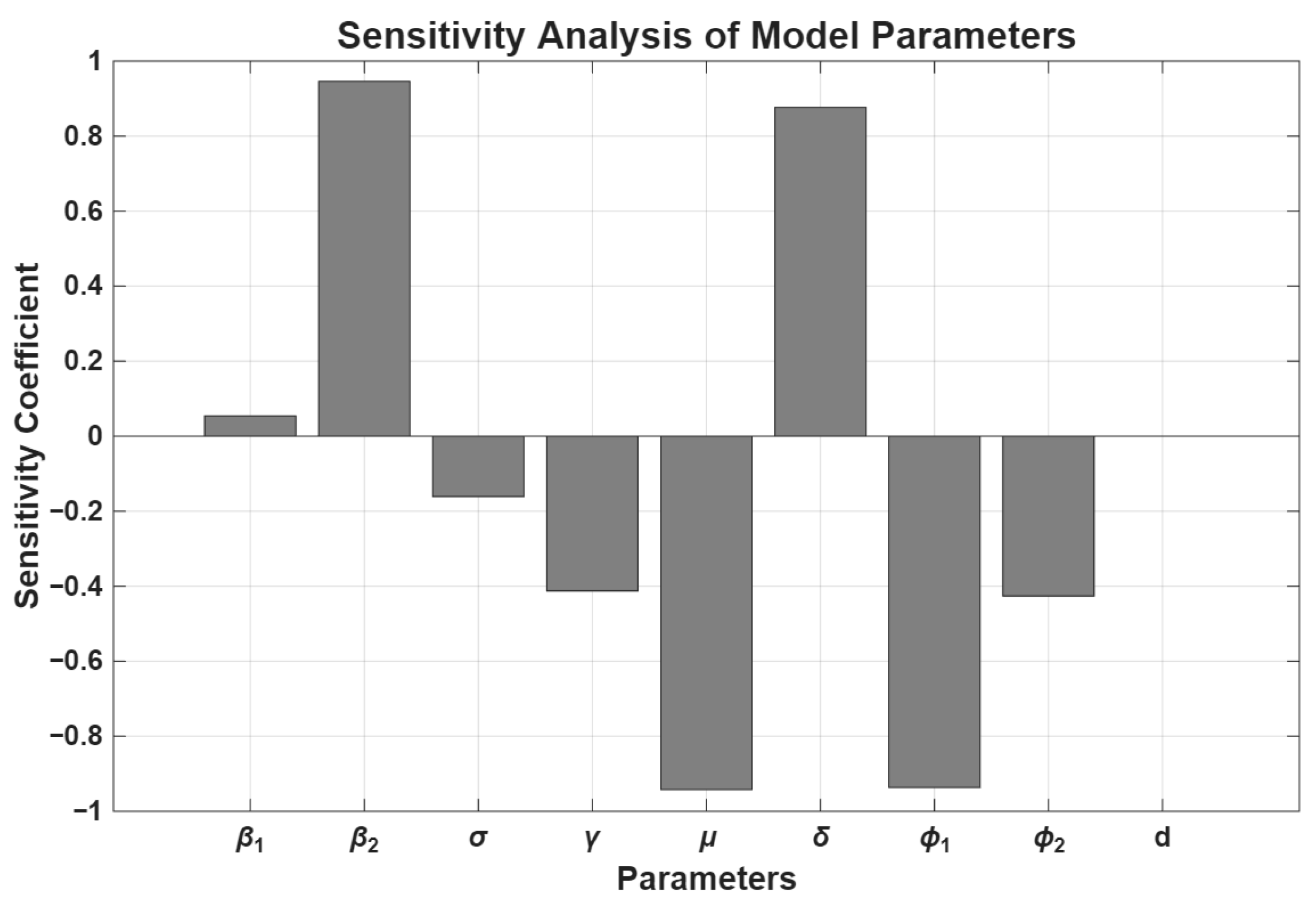
In the sensitivity analysis, as shown in Figure 4, we can conclude that:
  • The normalized sensitivity index of the contact rate β 2 with respect to the basic reproduction number R 0 is 0.9461 . This indicates a strong positive dependence of R 0 on β 2 . For small perturbations, the local sensitivity relationship satisfies
    Δ R 0 R 0 0.9461 Δ β 2 β 2 .
    Consequently, a 10 % increase in β 2 leads to an approximately 9.461 % increase in R 0 , whereas a 10 % reduction in β 2 results in a 9.461 % decrease in R 0 .
  • The parameters σ and γ represent natural disease characteristics, while μ and δ are demographic parameters governed by natural processes. These are generally considered uncontrollable factors.
  • Control strategies should therefore focus primarily on intervention-related parameters such as ϕ 1 and ϕ 2 , which have a more direct and significant impact on disease transmission dynamics.

7. Analysis of the Optimal Control

We apply an optimal control strategy to explore the health outcomes and cost-effective ways to control the spread of whooping cough. Pontryagin’s Maximum Principle is used to derive the necessary conditions that the optimal control must satisfy [17].
We choose ϕ 1 and ϕ 2 as control variables u = ( ϕ 1 ( t ) , ϕ 2 ( t ) ) , such that the associated state trajectories S , E , I , R are the solutions of System (1) on the time interval [ 0 , T ] with the initial conditions in (2). The optimal control system is
d S d t = Λ ( β 1 I + β 2 E ) S μ S ϕ 1 ( t ) S + δ R , d E d t = ( β 1 I + β 2 E ) S σ E μ E γ E ϕ 2 ( t ) E , d I d t = σ E γ I ( μ + d ) I , d R d t = γ I + γ E + ϕ 2 ( t ) E + ϕ 1 ( t ) S μ R δ R .
The objective function is defined as
J ( ϕ 1 , ϕ 2 ) = m i n 0 T [ c 11 E + c 12 I + 1 2 c 21 ϕ 1 2 + 1 2 c 22 ϕ 2 2 ] d t ,
where c 11 , c 12 , c 21 , c 22 > 0 . The optimal control pair ( ϕ 1 * , ϕ 2 * ) is to be found such that
J ( ϕ 1 * , ϕ 2 * ) = m i n { J ( ϕ 1 , ϕ 2 ) : ϕ 1 , ϕ 2 Φ } ,
where Φ : = { ( ϕ 1 , ϕ 2 ) : ϕ i is Lebesgue measurable on [ 0 , T ] , 0 ϕ i ( t ) 1 for all t [ 0 , T ] , for i = 1 , 2 } . It is clear that the integrand of the functional J is concave with respect to the controls ϕ 1 and ϕ 2 . The control System (7) is Lipschitz continuous with respect to the state variables ( S , E , I , R ) . These properties ensure the existence of an optimal control pair ( ϕ 1 * , ϕ 2 * ) .
Let x = ( S , E , I , R ) denote the state vector, and let λ x represent the adjoint variables corresponding to the respective state variables. The following result provides the necessary conditions for the optimal control.
Theorem 7.
For an optimal control ( ϕ 1 * , ϕ 2 * ) that minimizes J over Φ, there exist corresponding adjoint variables λ x satisfying the condition d λ x d t = H x , with the transversality conditions λ x ( T ) = 0 .
Proof. 
The Hamiltonian function is defined as
H = c 11 E + c 12 I + 1 2 c 21 ϕ 1 2 + + 1 2 c 22 ϕ 2 2 + λ S ( Λ ( β 1 I + β 2 E ) S μ S ϕ 1 ( t ) S + δ R ) + λ E ( ( β 1 I + β 2 E ) S σ E μ E γ E ϕ 2 ( t ) E ) + λ I ( σ E γ I ( μ + d ) I ) + λ R ( γ I + γ E + ϕ 2 ( t ) E + ϕ 1 ( t ) S μ R δ R ) .
We take partial derivatives of the Hamiltonian function with respect to the state variables, resulting in the adjoint system
d λ S d t = H S = ( λ S ( ( β 1 I + β 2 E ) μ ϕ 1 ) + λ E ( β 1 I + β 2 E ) + λ R ϕ 1 ) , d λ E d t = H E = ( c 11 λ S β 2 S + λ E ( β 2 S σ μ ( γ + ϕ 2 ) ) + λ I σ + λ R ( γ + ϕ 2 ) ) , d λ I d t = H I = ( c 12 λ S β 1 S + λ E β 1 S + λ I ( γ ( μ + d ) ) + λ R γ ) , d λ R d t = H R = ( λ S δ + λ R ( μ δ ) ) .
The transversality conditions are
λ S ( T ) = 0 , λ E ( T ) = 0 , λ I ( T ) = 0 , λ R ( T ) = 0 .
The characterizations of the optimal controls ϕ 1 , ϕ 2 are then based on the conditions
H ϕ 1 = c 21 ϕ 1 + λ S ( S ) + λ R S = 0 , H ϕ 2 = c 22 ϕ 2 + λ E ( E ) + λ R E = 0 ,
which yield
ϕ 1 = ( λ S λ R ) S c 21 , ϕ 2 = ( λ E λ R ) E c 22 .
Finally, we obtain the optimal control strategies given by
ϕ 1 * = m a x { 0 , m i n { 1 , ϕ 1 } } = m a x 0 , m i n 1 , ( λ S λ R ) S c 21 , ϕ 2 * = m a x { 0 , m i n { 1 , ϕ 2 } } = m a x 0 , m i n 1 , ( λ E λ R ) E c 22 .
For a minimization problem, the Legendre condition for an interior control requires that the Hamiltonian H be convex in the control vector u = ( ϕ 1 , ϕ 2 ) . Concretely, this requires the Hessian matrix to be positive definite. Since
2 H u 2 = 2 H ϕ 1 2 2 H ϕ 1 ϕ 2 2 H ϕ 2 ϕ 1 2 H ϕ 2 2 = c 21 0 0 c 22 ,
the Hessian is positive definite, and thus the Legendre condition holds. This guarantees that u * = ( ϕ 1 * , ϕ 2 * ) is a local minimizer in the control variables (i.e., the second variation has no negative components along any direction).

8. Numerical Simulation Analysis

8.1. Numerical Simulation for the Optimal Control Problem

We solve the model numerically over the time interval 0 t 200 (i.e., T = 200 ) using the classical fourth-order Runge–Kutta (RK4) method in conjunction with the forward–backward sweep algorithm to obtain the optimal control trajectories. All numerical simulations are performed in Matlab R2025a.
The weighting parameters are set as c 11 = 100 , c 12 = 10 and c 21 = c 22 = 6000 JPY [18] to balance the relative importance of minimizing the state and control variables. Specifically, c 21 represents the cost of a set of vaccines administered to susceptible individuals, whereas c 22 corresponds to the treatment cost for exposed individuals.
In Japan, the price of pertussis-containing vaccines varies across medical institutions [18]. The DPT (diphtheria–pertussis–tetanus) vaccine costs approximately 5000 JPY per dose, while the adult Tdap booster is typically priced between 5500 and 9900 JPY per dose. So we choose c 21 = c 22 = 6000 .
To better understand the dynamics of the control model (7), we examine the following three control strategies:
  • Strategy 1: ϕ 1 0 , ϕ 2 0 ;
  • Strategy 2: ϕ 1 = 0 , ϕ 2 0 ;
  • Strategy 3: ϕ 1 0 , ϕ 2 = 0 .
Strategy 1: ϕ 1 0 , ϕ 2 0
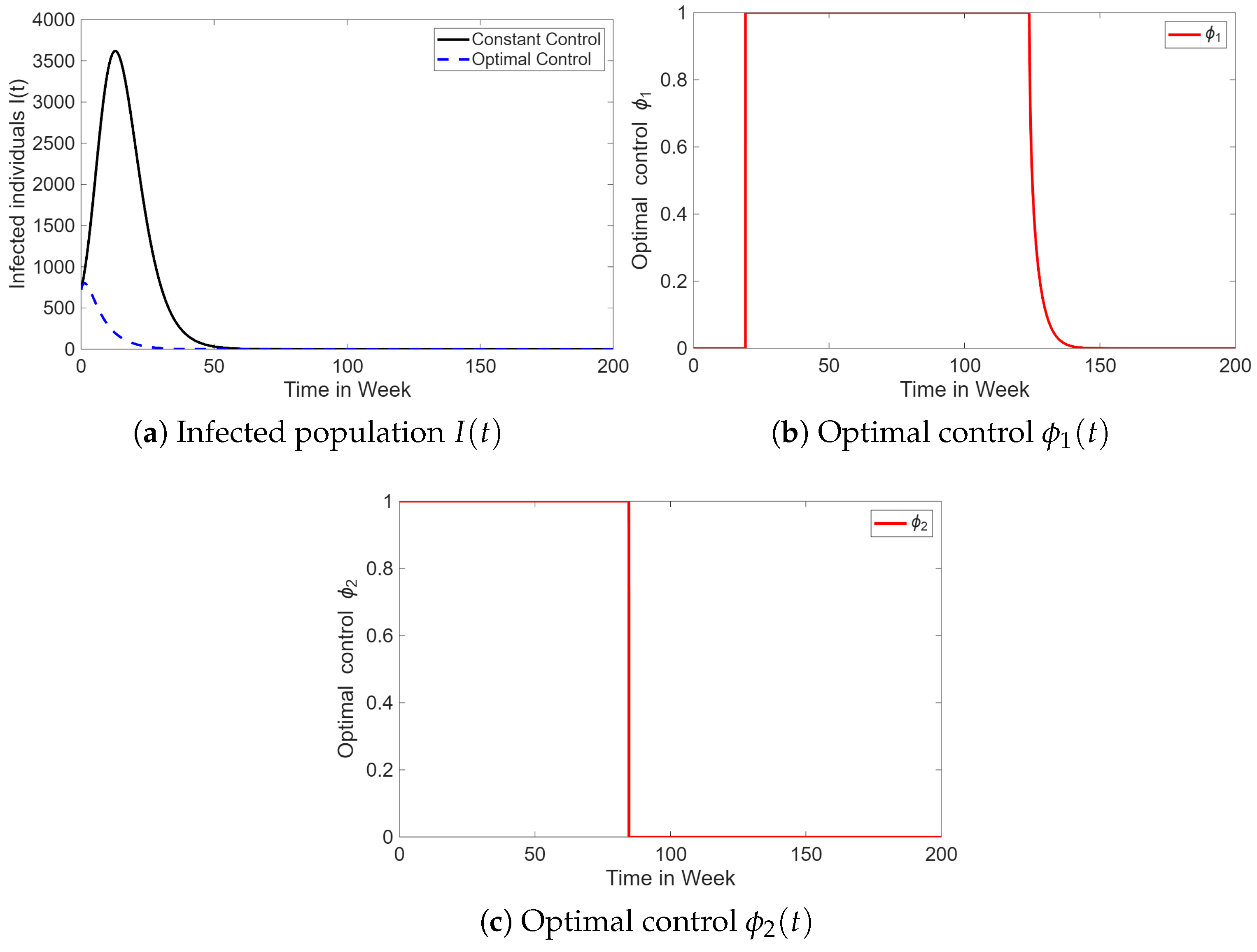
As shown in Figure 5, under constant control, the number of infected individuals I ( t ) initially increases and then declines. In contrast, under optimal control, the number decreases from the outset, making the initial value of 722 the peak. Moreover, compared with the constant control scenario, the optimal control strategy results in a significantly lower number of infections.
Strategy 2: ϕ 1 = 0 , ϕ 2 0
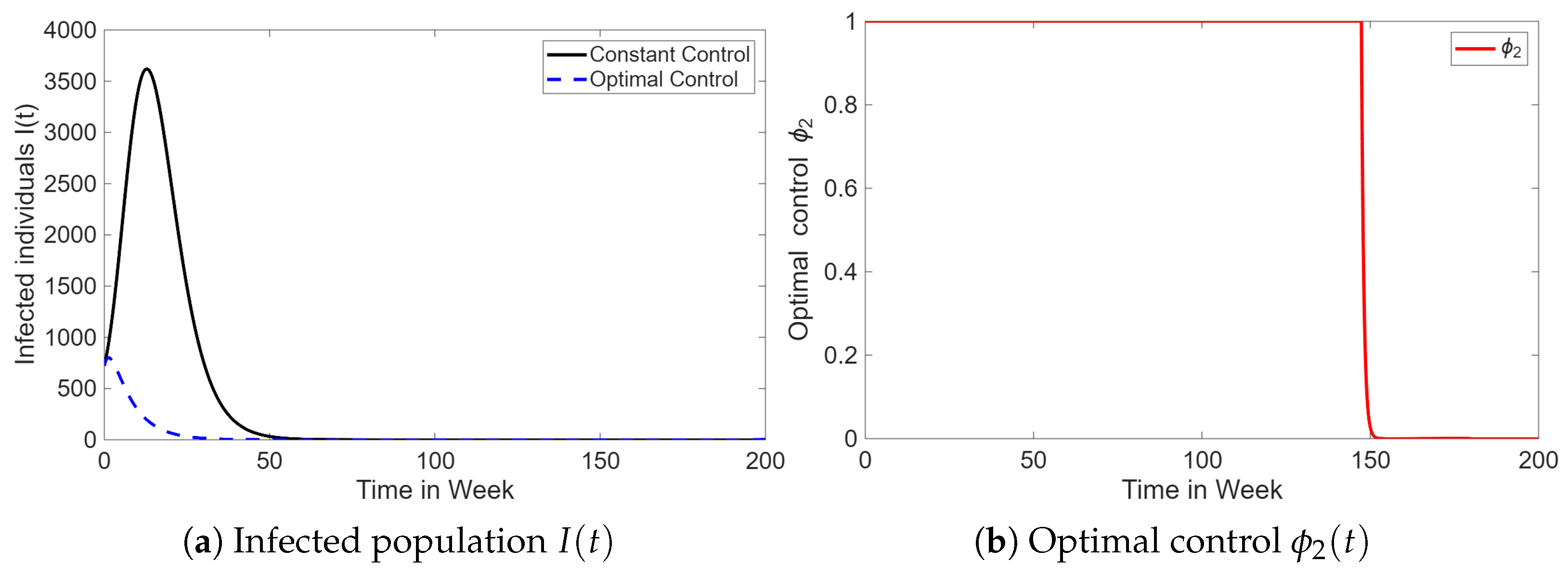
Comparing Figure 6 with Figure 5, it can be seen that the infected individuals I ( t ) do not change significantly. However, regarding the duration for which ϕ 2 = 1 , the time in Figure 6 is longer than that in Figure 5. This indicates that Strategy 2 requires a longer control time than Strategy 1 for ϕ 2 .
Strategy 3: ϕ 1 0 , ϕ 2 = 0
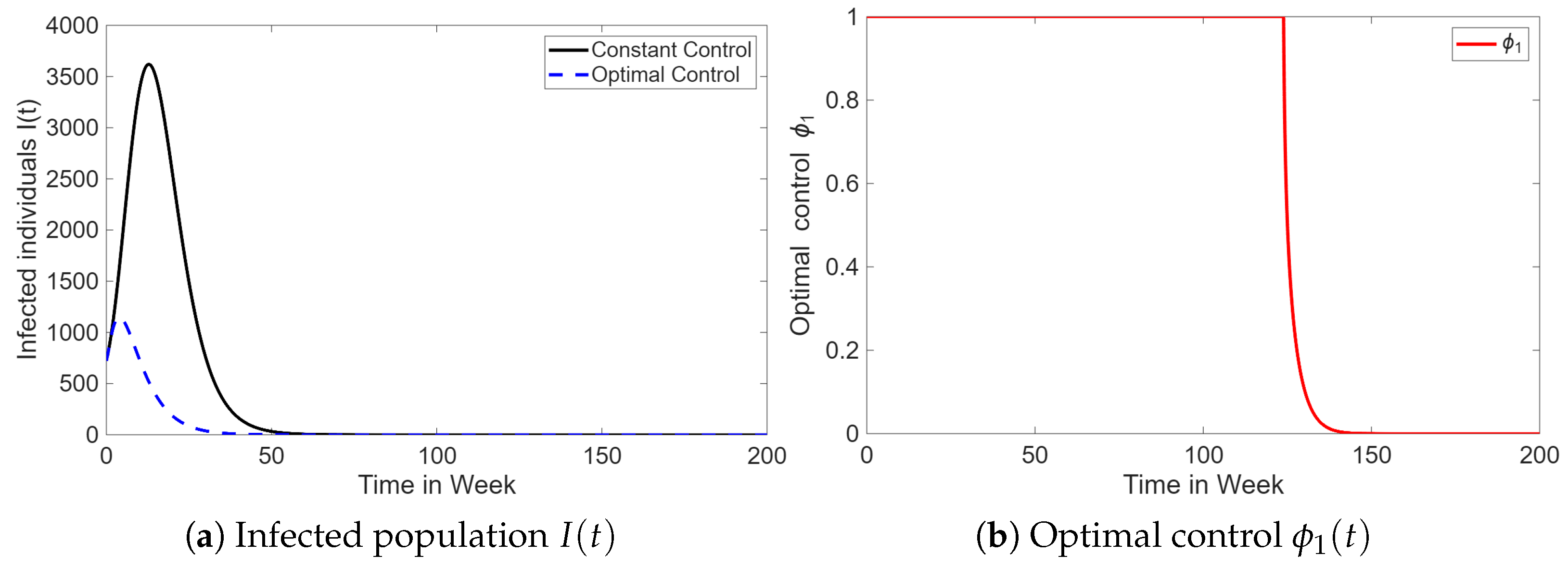
Comparing Figure 7 with Figure 5 and Figure 6, under optimal control, the infected population I ( t ) initially increases, reaches a peak of 1459 at week 4, and then decreases. Under constant control, the trend does not change.
Overall, these figures show that using optimal controls minimizes the number of infected individuals I ( t ) .

8.2. Cost-Effectiveness Analysis

We assess the financial implications of three intervention strategies to identify the approach that yields the most favorable health outcomes relative to cost. It is essential to prioritize strategies that provide the greatest public health benefit for the lowest economic investment.
In the context of simulating the optimal control problem, determining the most cost-effective intervention is crucial for guiding practical, evidence-based decision-making [19]. The average cost-effectiveness ratio (ACER) and the incremental cost-effectiveness ratio (ICER) are employed to evaluate and compare the economic feasibility of each strategy.
The ACER measures the cost-effectiveness of a single intervention relative to a baseline option by calculating the ratio of the total cost to the total number of infections averted. It is defined as follows:
ACER = Total cost produced by intervention Total number of infections averted .
ICER measures the additional cost required to prevent one additional infection when comparing two competing intervention strategies. It is defined as
ICER = Difference in total costs between strategies x and y Difference in infections averted between strategies x and y .
These indicators provide valuable insights into the relative efficiency of each strategy and facilitate the identification of the most economically viable option in resource-limited settings.
The three strategies are ranked according to their ACER values from lowest to highest. Table 2 demonstrates that Strategy 3 is both less costly and more effective than Strategy 2. Consequently, Strategy 2 is eliminated from consideration.
Table 3 shows that Strategy 1 is both more expensive and less effective than Strategy 3, so Strategy 1 is also excluded.
Therefore, Strategy 3 is identified as the most cost-effective optimal control strategy among the three alternatives. This finding shows that increasing the vaccination rate is the most cost-effective.
Optimal control and cost-effectiveness analysis play an important role in guiding the formulation of epidemic prevention and control policies. In [20], the authors introduced the Fraction of Immunized Agents (FIA) and the Final Epidemic Size (FES) to evaluate the impact of different intervention strategies. These indicators provide a framework for assessing the long-term effectiveness of control policies and offer useful insights for infectious disease prevention and control.

9. Conclusions and Future Work

This study develops an SEIRS model for whooping cough in Japan. We establish the local and global stability of the disease-free and endemic equilibria. Sensitivity analysis and cost-effectiveness analysis are also conducted.
Our optimal control analysis highlights the critical role of vaccination in reducing the number of infections. As the vaccination rate increases, transmission is more effectively suppressed, underscoring the importance of strategies that enhance population immunity. Based on our model results, we propose the following three key measures:
  • Include booster vaccinations for adolescents and adults in routine immunization programs, targeting high school students, healthcare workers, women of childbearing age, and childcare staff.
    Data analysis shows that the current booster vaccination rate in Japan is relatively low (vaccination rate ϕ 1 = 0.0598 week 1 ), which may contribute to the large-scale outbreak. In contrast, the coverage of pertussis booster vaccination among adolescents aged 13–17 years in the United States reached 91.3% in 2024 [21]. In European countries, booster coverage among adolescents is typically around 70–80% [22].
  • Implement short-term intensified immunization campaigns (e.g., catch-up or mass vaccination) in high-risk or outbreak-prone areas.
  • As recommended by the CDC [2], adults should receive a booster vaccination every ten years, as is the case in China and some other countries.
These measures directly enhance vaccination effectiveness, accelerate the attainment of herd immunity, and reduce the number of infectious individuals. Together, they provide a theoretical basis for the formulation of effective epidemic prevention and control policies.
We innovatively employed the SEIR–LSTM–PINNs framework for parameter estimation. The SEIR–LSTM–PINNs framework addresses this by embedding the SEIR dynamics as soft constraints in the loss function, combining mechanistic modeling with the ability of LSTM to capture time-varying parameters. This integration improves prediction stability and maintains reliable performance even when data are sparse or noisy, effectively bridging data-driven learning with physical realism. This also enables the model to fit real-world conditions and effectively capture the transmission dynamics of whooping cough.
Infectious diseases have long posed a major threat to human society. In recent years, significant progress has been made in the mathematical modeling of infectious diseases. The introduction of machine learning methods has further advanced research in this field to a new level. In the past, quantitative analysis of infectious disease models mainly relied on mathematical theory. Nowadays, however, various machine learning models can be employed to estimate parameters in infectious disease models, enabling these models to better fit real-world data. This, in turn, allows for a more accurate characterization of the underlying mechanisms of disease transmission and provides a more reliable basis for precise prevention and control strategies. In the future, more machine learning models, such as ARIMA and GARCH, may also be applied to the study of infectious disease models, as has been done in other fields. For example, neural networks have been employed to forecast future power generation in China by Zhu and Ding [23].
On the other hand, employing different types of mathematical models to investigate disease transmission is also an important research direction. For instance, multi-strain dynamic models, higher-order diffusion models, and fractional-order models have been widely considered. These approaches describe the transmission dynamics of infectious diseases from different perspectives, providing diverse analytical frameworks for disease control and enriching our understanding of disease transmission mechanisms.
Much work remains to be done. The prevention and control of infectious diseases is a shared responsibility for all of us.

Author Contributions

Y.C.: Methodology, Software, Writing—Original Draft Preparation, Visualization, and Validation. C.M.: Conceptualization, Investigation, Supervision, and Writing—Reviewing and Editing. All authors have read and agreed to the published version of the manuscript.

Funding

This work was supported by the Faculty of Science, Naresuan University, under Grant No. R2569E003.

Data Availability Statement

The raw data supporting the conclusions of this article will be made available by the authors on request.

Acknowledgments

We sincerely thank the Faculty of Science, Naresuan University, for supporting this work.

Conflicts of Interest

The authors declare that they have no conflicts of interest.

Abbreviations

The following abbreviations are used in this manuscript:
LSTMLong Short-Term Memory
LHSLatin Hypercube Sampling

Appendix A. Li and Muldowney Theorem

For completeness, we present a summary of the concept of the geometric approach of Li and Muldowney [12] below.
Theorem A1.
Consider a dynamical system
d X d t = f ( X ) ,
where f : Ω R n is a C 1 function and Ω R n is a simply connected domain. Assume that there exists a compact absorbing set K Ω and the system has a unique equilibrium point X * . Then X * is globally asymptotically stable in Ω if q ¯ 2 < 0 , where
q ¯ 2 = lim sup t sup X 0 K 1 t 0 t μ ( C ( X ( s , X 0 ) ) ) d s .
C is a matrix-valued function defined as
C = P f P 1 + P J [ 2 ] P 1 ,
where P ( X ) is a n 2 × n 2 matrix-valued C 1 function in Ω, P f is the derivative of P (entry-wise) along the direction of f, and J [ 2 ] is the second compound matrix of the Jacobian J ( X ) = D f ( X ) . Meanwhile, μ ( C ) is the Lozinskiĭ measure of C with respect to a matrix norm; i.e.,
μ ( C ) = lim h 0 + I + h C 1 h ,
where I represents the identity matrix.

References

  1. World Health Organization. Global Reported Cases of Vaccine-Preventable Diseases (VPDs). 2025. Available online: https://immunizationdata.who.int/ (accessed on 24 September 2025).
  2. Centers for Disease Control and Prevention (CDC). Pertussis. 2025. Available online: https://www.cdc.gov/infection-control/hcp/healthcare-personnel-epidemiology-control/pertussis.html (accessed on 24 September 2025).
  3. Japan Institute for Health Security (JIHS). Pertussis, Epidemiological Week 1–21. 2025 (as at 28 May 2025). 2025. Available online: https://id-info.jihs.go.jp/surveillance/idwr/en/attention/2025/22/index.html (accessed on 24 September 2025).
  4. Bricks, L.F.; Vargas-Zambrano, J.C.; Macina, D. Epidemiology of pertussis after the COVID-19 pandemic: Analysis of the factors involved in the resurgence of the disease in high-, middle-, and low-income countries. Vaccines 2024, 12, 1346. [Google Scholar] [CrossRef] [PubMed]
  5. Olayiwola, M.O.; Tijani, K.R.; Ogunniran, M.O.; Yunus, A.O.; Oluwafemi, E.A.; Abanikanda, M.O.; Alaje, A.I.; Adedeji, J.A. Modeling the booster vaccine effect on new COVID-19 variant management employing the Atangana–Baleanu–Caputo fractional derivative operator together with the Laplace–Adomian decomposition method. Vacunas 2025, 26, 500458. [Google Scholar] [CrossRef]
  6. Butt, A.I.K. Atangana–Baleanu fractional dynamics of predictive whooping cough model with optimal control analysis. Symmetry 2023, 15, 1773. [Google Scholar] [CrossRef]
  7. Begum, R.; Ali, S.; Fatima, N.; Shah, K.; Abdeljawad, T. Dynamical behavior of a whooping cough SVEIQRP model via a system of fractal fractional differential equations. Partial. Differ. Equ. Appl. Math. 2024, 12, 100990. [Google Scholar] [CrossRef]
  8. Balderrama, R.; Prieto, M.I.; de la Vega, C.S.; Vazquez, F. Optimal control for an SIR model with limited hospitalised patients. Math. Biosci. 2024, 378, 109317. [Google Scholar] [CrossRef] [PubMed]
  9. e-stat. Vital Statistics Bulletin June 2020. Available online: https://www.e-stat.go.jp/stat-search/files?page=1&layout=datalist&toukei=00450011&tstat=000001028897&cycle=1&year=20250&month=12040606&tclass1=000001053058&tclass2=000001053059&tclass3val=0 (accessed on 24 September 2025).
  10. van den Driessche, P.; Watmough, J. Reproduction numbers and sub-threshold endemic equilibria for compartmental models of disease transmission. Math. Biosci. 2002, 180, 29–48. [Google Scholar] [CrossRef] [PubMed]
  11. Castillo-Chavez, C.; Huang, W.; Feng, Z. On the computation of R0 and its role in global stability. In Mathematical Approaches for Emerging and Reemerging Infectious Diseases; IMA Volumes in Mathematics and its Applications; Springer: New York, NY, USA, 2002; Volume 125, pp. 229–250. [Google Scholar] [CrossRef]
  12. Li, M.Y.; Muldowney, J.S. A geometric approach to global-stability problems. SIAM J. Math. Anal. 1996, 27, 1070–1083. [Google Scholar] [CrossRef]
  13. Japan Institute for Health Security. IDWR Surveillance Data Table 2025. 2025. Available online: https://id-info.jihs.go.jp/en/surveillance/idwr/rapid/2025/index.html (accessed on 24 September 2025).
  14. Worldometers. Japan Population (Live). 2025. Available online: https://www.worldometers.info/world-population/japan-population/ (accessed on 24 September 2025).
  15. Hvitfeldt, E.; Silge, J. Supervised Machine Learning for Text Analysis in R; Chapman and Hall/CRC: New York, NY, USA, 2021. [Google Scholar]
  16. van den Driessche, P. Reproduction numbers of infectious disease models. Infect. Dis. Model. 2017, 2, 288–303. [Google Scholar] [CrossRef] [PubMed]
  17. Lenhart, S.; Workman, J.T. Optimal Control Applied to Biological Models; Chapman & Hall/CRC: London, UK, 2007. [Google Scholar] [CrossRef]
  18. National Center for Global Health and Medicine. Travel Clinic Vaccine Price List. 2025. Available online: https://travelclinic.jihs.go.jp/011 (accessed on 24 September 2025).
  19. Belay, M.A.; Abonyo, O.J.; Theuri, D.M. Mathematical model of hepatitis B disease with optimal control and cost-effectiveness analysis. Comput. Math. Methods Med. 2023, 2023, 5215494. [Google Scholar] [CrossRef]
  20. Haque, Z.; Adan, M.M.I.Y.; Zulfiker, M.S.; Khondaker, F.; Kamrujjaman, M. Bifurcations and optimal control in Nipah virus epidemiology. PLoS ONE 2026, 21, e0342764. [Google Scholar] [CrossRef]
  21. Pingali, C.; Yankey, D.; Chen, M.; Elam-Evans, L.D.; Markowitz, L.E.; DeSisto, C.L.; Schillie, S.F.; Hughes, M.; Valier, M.R.; Stokley, S.; et al. National vaccination coverage among adolescents aged 13–17 years—National Immunization Survey-Teen, United States, 2023. MMWR Morb. Mortal. Wkly. Rep. 2024, 73, 708–714. [Google Scholar] [CrossRef] [PubMed]
  22. Marchal, C.; Belhassen, M.; Guiso, N.; Jacoud, F.; Van Ganse, E.; Le Pannerer, M.; Cohen, R.; Verdier, R.; Uhart, M. Vaccination coverage rates for diphtheria-tetanus-polio-pertussis booster vaccination in France between 2013 and 2017. Vaccine 2021, 39, 505–511. [Google Scholar] [CrossRef] [PubMed]
  23. Zhu, L.; Ding, Y.; Shen, S. Green behavior propagation analysis based on statistical theory and intelligent algorithm in data-driven environment. Math. Biosci. 2025, 379, 109340. [Google Scholar] [CrossRef] [PubMed]
Figure 1. The transmission diagram of the SEIRS model.
Mathematics 14 01207 g001
Figure 2. The transmission rates β 1 ( t ) and β 2 ( t ) estimated by LSTM.
Mathematics 14 01207 g002
Figure 3. Comparison of observed data and model fit obtained using LHS. Different time ranges are considered: (a) 0 t 30 ; (b) 0 t 200 .
Mathematics 14 01207 g003
Figure 4. Numerical simulation curves showing the sensitivity indices with respect to R 0 .
Mathematics 14 01207 g004
Figure 5. Optimal control results with ϕ 1 0 and ϕ 2 0 , where 0 ϕ 1 , ϕ 2 1 ; 0 t 200 (weeks).
Mathematics 14 01207 g005
Figure 6. Optimal control results with ϕ 1 = 0 , ϕ 2 0 , where 0 ϕ 2 1 ; 0 t 200 (weeks).
Mathematics 14 01207 g006
Figure 7. Optimal control results with ϕ 1 0 , ϕ 2 = 0 , where 0 ϕ 1 1 ; 0 t 200 (weeks).
Mathematics 14 01207 g007
Table 1. The definitions and values of the parameters.
VariableDefinitionNumeric ValueReference
Λ Recruitment rate of susceptible13,049 week−1[9]
β 1 Transmission rate of infected individuals5.7276 × 10 10 week−1LSTM
β 2 Transmission rate of exposed individuals6.0107 × 10 9 week−1LSTM
μ Natural mortality rate2.6 × 10 4 week−1[9]
dDisease-induced mortality rate1 × 10 5 week−1[4]
σ Progression rate from exposed to infectious0.10 week−1[2]
δ Immunity-waning rate3.8 × 10 3 week−1[2]
γ Natural recovery rate0.167 week−1[2]
ϕ 1 Vaccination rate for susceptible population0.0598 week−1LHS
ϕ 2 Treatment rate for exposed population0.1984 week−1LHS
Table 2. Comparison of ICER values for Strategies 3, 2, and 1.
StrategyInfections AvertedCost Incurred (JPY)ACERICER
Strategy 31.5625 × 10 7 3.7445 × 10 7 2.39652.3965
Strategy 21.7575 × 10 7 4.4319 × 10 7 2.52173.5251
Strategy 11.7591 × 10 7 5.7100 × 10 7 3.2459798.8125
Table 3. Comparison of ICER values for Strategies 3 and 1.
StrategyInfections AvertedCost Incurred (JPY)ACERICER
Strategy 31.5625 × 10 7 3.7445 × 10 7 2.39652.3965
Strategy 11.7591 × 10 7 5.7100 × 10 7 3.24599.9975
Disclaimer/Publisher’s Note: The statements, opinions and data contained in all publications are solely those of the individual author(s) and contributor(s) and not of MDPI and/or the editor(s). MDPI and/or the editor(s) disclaim responsibility for any injury to people or property resulting from any ideas, methods, instructions or products referred to in the content.