Article

Modular Suprametric Spaces and Fixed-Point Principles with Applications in Fractional Burn-Healing Dynamics


by
Marija Paunović
1,*,
Abdurrahman Büyükkaya
2 and
Mahpeyker Öztürk
3,4
1
Department of Natural Sciences, Faculty of Hotel Management and Tourism, University of Kragujevac, 36210 Vrnjačka Banja, Serbia
2
Department of Mathematics, Karadeniz Technical University, Trabzon 61080, Türkiye
3
Department of Mathematics, Faculty of Sciences, Sakarya University, Sakarya 54050, Türkiye
4
Picode Software, Education Training Consultancy Research and Development and Trade Co., Ltd., Sakarya 54050, Türkiye
*
Author to whom correspondence should be addressed.
Mathematics 2026, 14(7), 1208; https://doi.org/10.3390/math14071208
Submission received: 23 February 2026 / Revised: 26 March 2026 / Accepted: 30 March 2026 / Published: 3 April 2026

Abstract

We introduce a new nonlinear distance structure, a modular suprametric space, that integrates modular metrics with perturbations characteristic of suprametrics. Within this framework, we develop a contraction principle tailored to its nonlinear geometry and demonstrate the existence of fixed points under a generalized iterative control. In order to showcase the practical application of this proposed structure, we analyze a burn-healing model driven by nonlinear recovery dynamics. The derived fixed-point conditions ensure both the existence and stability of the healing equilibrium. Our findings indicate that modular suprametric spaces serve as a versatile analytical tool for dynamical systems whose evolution exhibits nonstandard sensitivity, saturation effects, or exponential response behavior.

1. Introduction

Fixed-point theory, initiated by Banach [1] through his celebrated contraction principle in 1922, has become one of the most powerful analytical tools in nonlinear mathematics. It provides a unified framework for establishing the existence, uniqueness, and stability of solutions to a wide class of problems arising in functional, differential, and integral equations. Over time, the classical metric framework has been extended in various directions in order to better capture nonlinear, nonlocal, and scale-dependent phenomena.
Among these developments, modular metric spaces introduced by Chistyakov [2,3,4] play a central role due to their intrinsic scale-dependent structure. This framework allows the distance between two points to vary with respect to a parameter, making it particularly suitable for modeling processes involving varying intensity, resolution, or observation scales.
In recent years, modular metric spaces have been generalized in numerous ways to capture more refined nonlinear behaviors. Various extensions have been introduced in the literature, including but not limited to modular b-metric space [5], modular S-metric spaces [6], complex-valued modular metric spaces [7], modular ultrametric spaces [8], extended modular b-metric spaces [9], partial modular b-metric spaces [10], and R-modular b-metric-like spaces [11], among many others. These developments significantly enrich the theory by allowing for more flexible notions of convergence, stability, and interaction beyond the classical setting.
Parallel to these developments, Berzig [12] introduced the notion of a suprametric space as a nonlinear extension of the metric framework, wherein the triangle inequality is perturbed by an additional multiplicative term involving a control parameter. Suprametric structures have demonstrated strong analytical potential in modelling nonlinear, chaotic, and fractional-order dynamical systems.
In contrast to modular-type constructions, suprametric spaces have evolved as a nonlinear geometric framework designed to capture interaction-driven deviations from the classical triangle inequality. Over time, this approach has led to a variety of extensions that emphasize different forms of nonlinear coupling and structural flexibility. Representative examples include generalized suprametric spaces [13], b-suprametric spaces [14], strong b-suprametric spaces [15], graphical suprametric spaces [16], extended suprametric spaces [17], and several other variants incorporating additional constraints and interaction mechanisms [18,19]. These developments reflect the adaptability of the suprametric setting in modeling complex propagation effects and nonlinear dependencies, particularly in contexts where classical metric or modular structures are not sufficiently expressive.
Beyond its theoretical relevance, fixed-point theory has proven to be a powerful analytical tool in the study of models arising in applied sciences and interdisciplinary frameworks [20,21]. In particular, it plays an increasingly important role in the modeling of complex processes such as infectious disease dynamics, tissue regeneration, reaction–diffusion systems, and healing mechanisms. These applications often involve multiscale effects and nonlinear interactions that require analytical tools beyond standard metric approaches. In this context, mathematical models of wound healing have been extensively investigated, ranging from early reaction–diffusion formulations to simplified and clinically motivated models [22,23,24,25]. Such studies highlight the need for flexible analytical frameworks capable of capturing memory effects, nonlinear responses, and stability behavior in biological systems.
Despite the substantial progress achieved in both modular and suprametric settings, these two frameworks have largely been studied independently in the literature. However, many contemporary problems, especially those involving multiscale phenomena, nonlinear feedback mechanisms, and memory-dependent processes, naturally require a setting in which both scale-dependent behavior and nonlinear perturbations coexist.
From the perspective of fixed-point theory, combining different geometric structures is a well-established and fruitful approach that often leads to stronger contractive conditions and broader applicability of existence and uniqueness results. Motivated by this observation, it is natural to seek a unified framework that integrates the advantages of both modular and suprametric structures.
Inspiring these improvements, we introduce the concept of a modular suprametric space, which combines the scale-dependent mechanism of modular metrics with the nonlinear perturbation structure of suprametrics. This unified framework provides a new analytical environment in which both parameter-dependent geometry and nonlinear interaction effects can be treated simultaneously.
The proposed setting enables the formulation of contractive conditions that depend on both a modular parameter and a nonlinear perturbation term. As a consequence, we establish fixed-point results that extend several known theorems in the existing literature and provide a more flexible tool for analyzing nonlinear dynamical systems.
In order to demonstrate the applicability of the developed theory, we consider a fractional burn-healing model characterized by memory effects and nonlinear recovery dynamics. The corresponding operator is formulated within the modular suprametric framework and demonstrated to meet an appropriate contractive condition, ensuring the existence and uniqueness of a stable healing profile.
For the sake of consistency, we review some of the key definitions and characteristics that will be used throughout the article.

2. Preliminaries

In this section, we recall several notions and basic results related to modular metric spaces and suprametric structures that will be used throughout the paper. We also introduce some auxiliary concepts to establish our main results in the subsequent sections.
Our exposition begins with modular metric spaces and proceeds to suprametric-type structures, which together constitute the mathematical foundation of the newly introduced framework.
Definition 1 
([2,3]). Let X . A function d m : 0 , × X × X 0 , , defined by d m η , ϰ , y = d m η ϰ , y , is called a modular metric on X if it satisfies the following statements for all ϰ , y , z X :
  • d m 1 d m η ϰ , y = 0 for all η > 0 if and only if ϰ = y ,
  • d m 2 d m η ϰ , y = d m η y , ϰ for all η > 0 ,
  • d m 3 d m η + μ ϰ , y d m η ϰ , z + d m μ z , y for all η , μ > 0 ,
are satisfied. Therefore, X , d m is a modular metric space abbreviated as M M S .
Instead of d m 1 , if we consider the condition
  • d m 1 d m η ϰ , ϰ = 0 for all η > 0 ,
then d m is a (metric) pseudo-modular on X . Moreover, a modular metric d m on X has the property of regular if the new condition, which is a weaker version of d m 1 ,
  • d m 1 ϰ = y if and only if d m η ϰ , ϰ = 0 for some η > 0
is provided. Also, d m is called convex modular if for η , μ > 0 and ϰ , y , z X ,
d m η + μ ϰ , y η η + μ d m η ϰ , z + μ η + μ d m μ z , y .
Moreover, if we consider the below condition instead of d m 3 , then we gain the features of non-Archimedean space; that is, X d m is a non-Archimedean modular metric space (briefly non A rc - M M S ).
d m 3 d m max η , μ ϰ , y d m η ϰ , z + d m μ z , y .
On the other hand, the function η d m η ϰ , y is non-increasing on 0 , for any ϰ , y X , where d m is a metric pseudo-modular on a set X . Undoubtedly, for 0 < μ < η , it is verified by
d m η ϰ , y d m η μ ϰ , ϰ + d m μ ϰ , y = d m μ ϰ , y .
If d m is a modular metric on a set X , then a modular set is identified by
X d m = y X : y d m ϰ ,
where d m is a binary relation on X defined by ϰ y if and only if lim μ d m η ϰ , y = 0 for all ϰ , y X .
Definition 2 
([2,3]). Let d m be a pseudo-modular on X and ϰ 0 X be fixed. Thus, the following sets are mentioned as modular spaces (around ϰ 0 ):
  • X d m = X d m ( ϰ 0 ) = ϰ X : d m η ϰ , ϰ 0 0 as η ,
  • X d m * = X d m * ( ϰ 0 ) = ϰ X : η = η ( ϰ ) > 0 such that d m η ϰ , ϰ 0 < .
In connection with the modular framework, we recall that Berzig [12] introduced the notion of a suprametric space as a nonlinear perturbative extension of the classical triangle inequality.
Definition 3 
([12]). Let d s : X × X [ 0 , ) be a mapping defined on a nonempty set X that satisfies:
  • ( d s 1 ) d s ( ϰ , y ) = 0 ϰ = y ,
  • ( d s 2 ) d s ( ϰ , y ) = d s ( y , ϰ ) ,
  • ( d s 3 ) d s ( ϰ , z ) d s ϰ , y + d s y , z + ð d s ϰ , y d s y , z ,
for all ϰ , y , z X , where ð 0 ; then the pair ( X , d s ) is called a suprametric space.
Evidently, any metric is a suprametric, but several approaches exist to construct a suprametric from a metric that generally omits the triangle inequality.
Example 1 
([12]). Let ( X , d ) be a metric space and η , μ > 0 . Consider the mappings
d s 1 η ( ϰ , y ) = d ( ϰ , y ) d ( ϰ , y ) + η , d s 2 μ ( ϰ , y ) = μ e d ( ϰ , y ) 1 .
Both functions satisfy the axioms ( d s 1 ) ( d s 3 ) and hence define suprametrics with the constants ð = 2 η and ð = 1 μ , respectively.
To illustrate some suitable features, take X = R with the usual metric d ( ϰ , y ) = | ϰ y | . If we choose, for instance, d s = d s 2 1 or similarly d s = d s 1 1 , then neither d s 1 η nor d s 2 μ is a genuine metric. Indeed, the following:
d s ( 0 , 1 ) + d s ( 1 , 2 ) < d s ( 0 , 2 )
shows that the classical triangle inequality fails.
Moreover, in this setting, d s is not a suprametric for the value ð = 1 3 . This demonstrates that the admissible suprametric constant is not arbitrary. If a function is a suprametric for ð, then it is automatically a suprametric for any larger ð > ð but not necessarily for smaller ones. The example above provides a concrete case where the lower bound of admissible ð is strict.
The notions of convergence and completeness in suprametric spaces follow the usual ε -based definitions; however, the limit of a convergence sequence may fail to be unique unless the induced topology is Hausdorff. This non-Hausdorffness feature reflects the intrinsic flexibility of suprametric structures and has been observed in various recent studies on nonlinear and fractional dynamics [13,14,15,16].
Although the lack of uniqueness of limits may appear restrictive at first glance, it does not hinder the applicability of fixed-point techniques in this setting. Indeed, the contractive conditions considered in suprametric-type frameworks are formulated so as to ensure the existence and stability of fixed points independently of the Hausdorff property. Thus, the possible non-Hausdorffness of the induced topology should be interpreted not as a limitation but as a structural feature suitable for modeling nonlinear and multiscale phenomena.
Suprametric spaces, which capture nonlinear interactions through a relaxed triangular structure, together with modular metrics that provide scale-dependent control of convergence, naturally suggest a unified analytical framework. Motivated by this complementary behavior, we introduce the concept of a modular suprametric space, which combines these two approaches and extends the existing modular and suprametric settings. This framework will serve as the foundation for the fixed point results and applications developed in the subsequent sections.

3. Modular Suprametric Space and Some Topological Features

In this section, we introduce the modular suprametric space together with its basic topological properties and illustrative examples. In particular, we highlight that the induced topology may be non-Hausdorff and that d ð convergence can differ significantly from d ð Cauchy behavior.
Definition 4.
Let X . A mapping d ð : ( 0 , ) × X × X [ 0 , ) defined by d ð ( η , ϰ , y ) = d η ð ( ϰ , y ) is said to be a modular suprametric on X if for all ϰ , y , z X and η , μ > 0 , the following conditions hold:
  • ( d 1 ð )   d η ð ( ϰ , y ) = 0 for all η > 0 if and only if ϰ = y ;
  • ( d 2 ð )   d η ð ( ϰ , y ) = d η ð ( y , ϰ ) for all η > 0 ;
  • ( d 3 ð )   there exists a constant ð 0 such that
    d η + μ ð ( ϰ , y ) d η ð ( ϰ , z ) + d μ ð ( z , y ) + ð d η ð ( ϰ , z ) d μ ð ( z , y ) .
Then the pair ( X , d ð ) is called a modular suprametric space.
Remark 1.
The modular suprametric structure combines two distinct analytical principles with clear physical interpretations. The parameter η > 0 reflects a scale or observation window, inherited from the modular metric framework of Chistyakov. In many applied models, d m η ( x , y ) may represent a scale-dependent average variation, cost, propagation speed, or intensity between x and y. In many natural constructions including the exponential-type examples below, the map η d η ð ( x , y ) is non-increasing, so larger observation windows yield smaller effective separations, reflecting long-term stabilization or smoothing.
On the other hand, the suprametric perturbation term
ð d η ð ( x , z ) d μ ð ( z , y )
introduces a nonlinear interaction reflecting the presence of feedback, accumulation, or growth effects. This multiplicative contribution is consistent with phenomena such as reaction–diffusion dynamics, nonlinear transport, memory effects in fractional systems, and biological or physiological processes whose evolution accelerates or decelerates according to local intensity.
Hence, the modular suprametric d η ð ( x , y ) can be viewed as a generalized separation measure that simultaneously incorporates scale-dependent averaging, modular behavior, and nonlinear amplification or attenuation, as well as suprametric behavior. This makes the structure particularly suitable for modeling systems with multiscale interactions, including diffusion–reaction mechanisms, healing and regeneration processes, fractional dynamical models, and other settings where classical metric properties fail to encode nonlinear coupling.
Remark 2.
Taking ð = 0 in ( d 3 ð ) reduces the modular suprametric space to a modular metric space in the sense of [2].
Let ( X , d ð ) be a modular suprametric space. For a fixed parameter η > 0 , a point ϰ 0 X , and a radius ε > 0 , we define the corresponding d η ð -open and d η ð -closed balls by
B d η ð ( ϰ 0 , ε ) : = y X : d η ð ( ϰ 0 , y ) < ε , B ¯ d η ð ( ϰ 0 , ε ) : = y X : d η ð ( ϰ 0 , y ) ε .
It is obvious that ϰ 0 B d η ð ( ϰ 0 , ε ) B ¯ d η ð ( ϰ 0 , ε ) for every ε > 0 . The collection of all such open balls
B d η ð : = { B d η ð ( ϰ , ε ) : ϰ X , ε > 0 }
forms a basis for a topology on X , denoted by T d η ð and referred to as the topology induced by d η ð . A subset U X is said to be d η ð -open if and only if for each ϰ U there exists ε > 0 such that
B d η ð ( ϰ , ε ) U .
The corresponding d η ð -closed sets are the complements of d η ð -open sets, and the family T d η ð satisfies the usual topological axioms: ∅ and X are d η ð -open; arbitrary unions of d η ð -open sets are d η ð -open, and finite intersections of d η ð -open sets are d η ð -open.
This construction defines, for each ϰ X , a neighborhood system
N d η ð ( ϰ ) : = { B d η ð ( ϰ , ε ) : ε > 0 } ,
which characterizes local proximity with respect to the generalized distance d η ð . When ð = 0 , the topology T d η ð reduces to the usual modular metric topology associated with d m η .
Example 2.
Let ( X , d ) be a metric space. Define, for each η > 0 , the mapping d η ð : X × X [ 0 , ) as
d η ð ( ϰ , y ) : = e η e d ( ϰ , y ) 1 .
The axioms ( d 1 ð ) and ( d 2 ð ) are satisfied clearly. To verify ( d 3 ð ) , choose any ϰ , y , z X and η , μ > 0 . Using the triangle inequality, we obtain
d η + μ ð ( ϰ , y ) =   e ( η + μ ) e d ( ϰ , y ) 1   e ( η + μ ) e d ( ϰ , z ) + d ( z , y ) 1 =   e ( η + μ ) ( e d ( ϰ , z ) 1 ) + ( e d ( z , y ) 1 ) + ( e d ( ϰ , z ) 1 ) ( e d ( z , y ) 1 )   e η ( e d ( ϰ , z ) 1 ) + e μ ( e d ( z , y ) 1 ) + e η ( e d ( ϰ , z ) 1 ) e μ ( e d ( z , y ) 1 ) .
Hence,
d η + μ ð ( ϰ , y ) d η ð ( ϰ , z ) + d μ ð ( z , y ) + d η ð ( ϰ , z ) d μ ð ( z , y ) ,
which implies that ( d 3 ð ) holds with the nonlinear constant ð = 1 . Therefore, ( X , d ð ) is a modular suprametric space.
Example 3.
Let X = C ( [ 0 , 1 ] , R ) be the space of continuous real-valued functions on [ 0 , 1 ] , equipped with the uniform metric
d ( ϰ , y ) : = ϰ y = max t [ 0 , 1 ] | ϰ ( t ) y ( t ) | .
For each η > 0 , define
d η ð ( ϰ , y ) : = 1 η e η d ( ϰ , y ) 1 .
Clearly, ( d 1 ð ) and ( d 2 ð ) are satisfied. To verify ( d 3 ð ) , take any ϰ , y , z X , and η , μ > 0 . Using the triangle inequality and the identity
e a + b 1 = ( e a 1 ) + ( e b 1 ) + ( e a 1 ) ( e b 1 ) , a , b 0 ,
we compute
d η + μ ð ( ϰ , y ) =   1 η + μ e ( η + μ ) d ( ϰ , y ) 1   1 η + μ ( e η d ( ϰ , z ) 1 ) + ( e μ d ( z , y ) 1 ) + ( e η d ( ϰ , z ) 1 ) ( e μ d ( z , y ) 1 )   d η ð ( ϰ , z ) + d μ ð ( z , y ) + d η ð ( ϰ , z ) d μ ð ( z , y ) .
Hence ( d 3 ð ) holds with ð = 1 . Therefore, ( X , d ð ) is a modular suprametric space.
The following examples can be verified to be modular suprametric spaces by using a similar approach to that presented above.
Example 4.
Let ( X , · ) be a Banach space of all bounded real sequences ϰ = ( ϰ k ) k N , endowed with the supremum norm
ϰ y : = sup k N | ϰ k y k | .
For each η > 0 define
d η ð ( ϰ , y ) : = 1 η e η ϰ y 1 .
Then, it is obvious that ( , d ð ) is a modular suprametric space.
Example 5.
Let ( X , · ) be the matrix space R m × m endowed with the operator norm
A B : = sup v 2 = 1 ( A B ) v 2 .
For each η > 0 define
d η ð ( A , B ) : = 1 η e η A B 1 .
By the basic properties of the operator norm and the modular-exponential construction, one easily verifies that ( R m × m , d ð ) forms a modular suprametric space.
The previous examples demonstrate that the modular suprametric structure is flexible enough to operate on diverse functional, sequence, and matrix spaces. To analyze the induced topology more systematically, we now introduce several additional concepts related to pseudo-modularity, regularity, and convexity.
Definition 5.
Let ( X , d ð ) be a modular suprametric space as in Definition 4, that is, d ð : ( 0 , ) × X × X [ 0 , ) satisfies the axioms ( d 1 ð ) ( d 3 ð ) .
(i) 
If the condition ( d 1 ð ) is replaced by
( d 1 ð ) d η ð ( ϰ , ϰ ) = 0 for all η > 0 ,
then d ð is called a pseudo-modular suprametric on X .
(ii) 
A modular suprametric d ð is said to be regular if
d m 1 ϰ = y if and only if d m η ϰ , y = 0 , for some η > 0 .
(iii) 
The modular suprametric d ð is called convex if, for all ϰ , y , z X and η , μ > 0 ,
d η + μ ð ( ϰ , y ) η η + μ d η ð ( ϰ , z ) + μ η + μ d μ ð ( z , y ) + ð η μ ( η + μ ) 2 d η ð ( ϰ , z ) d μ ð ( z , y )
holds whenever ð is the same nonlinear constant as in ( d 3 ð ) .
(iv) 
The modular suprametric d ð is said to satisfy the Δ 2 condition if for any sequence { ϰ n } n N X and any ϰ X ,
lim n d η 0 ð ( ϰ n , ϰ ) = 0 for some η 0 > 0
implies
lim n d η ð ( ϰ n , ϰ ) = 0 for all η > 0 .
Remark 3.
1. 
If ð = 0 in (1), the convexity condition reduces exactly to the convex modular inequality of Chistyakov for d m , so every convex modular metric is a particular case of a convex modular suprametric.
2. 
For the exponential examples introduced above, such as
d η ð ( u , v ) = 1 η e η u v 1 ,
one can verify that (1) holds with ð = 1 ; the proof follows by combining the usual convex modular estimate with the identity e a + b 1 = ( e a 1 ) + ( e b 1 ) + ( e a 1 ) ( e b 1 ) in the same way as in ( d 3 ð ) .
Proposition 1.
If d ð is a pseudo-modular suprametric on X , then for every ϰ , y X , the function η d η ð ( ϰ , y ) is non-increasing on ( 0 , ) .
Proof. 
Fix ϰ , y X and take 0 < μ < η . Applying ( d 3 ð ) with z = ϰ yields
d η ð ( ϰ , y ) = d ( η μ ) + μ ð ( ϰ , y ) d η μ ð ( ϰ , ϰ ) + d μ ð ( ϰ , y ) + ð d η μ ð ( ϰ , ϰ ) d μ ð ( ϰ , y ) .
Using ( d 1 ð ) , we obtain d η ð ( ϰ , y ) d μ ð ( ϰ , y ) , which proves the claim.    □
Definition 6.
Let d ð be a modular suprametric on X and fix ϰ 0 X . We define the modular suprametric sets around ϰ 0 by
  • X d ð = X d ð ( ϰ 0 ) : = ϰ X : d η ð ( ϰ , ϰ 0 ) 0 as η ,
  • X d ð * = X d ð * ( ϰ 0 ) : = ϰ X : η = η ( ϰ ) > 0 such that d η ð ( ϰ , ϰ 0 ) < .
Moreover, we introduce a binary relation d ð on X by
ϰ d ð y lim η d η ð ( ϰ , y ) = 0 .
Using Proposition 1, it can be shown that d ð is an equivalence relation on X , and X d ð = { y X : y d ð ϰ 0 } .
Definition 7.
Let X d ð * be a modular suprametric space and { ϰ n } n N X d ð * be a sequence. We define the following notions:
(i) 
The sequence { ϰ n } n N is said to be  d ð -convergent to ϰ X d ð * , denoted by
ϰ n n d ð ϰ , whenever d η ð ( ϰ n , ϰ ) 0 as n , for all η > 0 .
(ii) 
The sequence { ϰ n } n N is called a d ð Cauchy sequence if
d η ð ( ϰ n , ϰ m ) 0 as n , m , for all η > 0 .
(iii) 
The space X d ð * is called d ð complete if every d ð Cauchy sequence in X d ð * is d ð -convergent to a point of X d ð * .
(iv) 
A mapping T : X d ð * X d ð * is said to be  d ð -continuous if
d η ð ( ϰ n , ϰ ) 0 d η ð ( T ϰ n , T ϰ ) 0 as n ,
for all η > 0 .
The preceding discussion describes the basic topological features induced by a modular suprametric. We now present an example that illustrates the influence of the parameter η and exhibits a nonclassical topological behavior, thereby highlighting a fundamental difference between modular suprametric spaces and classical metric spaces.
Example 6.
Let X = R and fix ð 0 . For each η > 0 , define d η ð : X × X [ 0 , ) by
d η ð ( ϰ , y ) = 0 , ϰ = y , 0 , ϰ y , η 1 , and ϰ , y belong to the same half - line , 1 , otherwise .
Then ( X , d ð ) is a modular suprametric space. Moreover, for every η 1 , the induced topology T d η ð is non-Hausdorff.
Proof. 
The conditions ( d 1 ð ) and ( d 2 ð ) follow immediately from the definition.
To verify ( d 3 ð ) , fix ϰ , y , z R and η , μ > 0 . If d η + μ ð ( ϰ , y ) = 0 , the inequality is trivially satisfied. Assume d η + μ ð ( ϰ , y ) = 1 . If both d η ð ( ϰ , z ) = 0 and d μ ð ( z , y ) = 0 were true, then ϰ , z and z , y would belong to the same half-line and η , μ 1 , implying d η + μ ð ( ϰ , y ) = 0 , which is a contradiction. Hence,
d η ð ( ϰ , z ) + d μ ð ( z , y ) 1 ,
and thus, ( d 3 ð ) holds.
Fix η 1 and take two distinct points ϰ , y X such that either ϰ , y 0 or ϰ , y > 0 . Then, by definition, we have d η ð ( ϰ , y ) = 0 . Hence every d η ð -ball centered at ϰ contains y and vice versa. Therefore, ϰ and y cannot be separated by disjoint open sets in the topology T d η ð induced by d η ð . This concludes that T d η ð is not Hausdorff.    □
Remark 4.
(i) 
The equivalence relation x y lim η d η ð ( x , y ) = 0 induces exactly two nontrivial equivalence classes, namely ( , 0 ] and ( 0 , ) .
(ii) 
The modular suprametric d ð is not regular, since η 1 distinct points lying in the same half-line have zero d η ð distance.
(iii) 
The Δ 2 condition does not hold in general. In particular, convergence with respect to a fixed parameter η 0 does not imply convergence for all η > 0 .
Having established the foundational structure and topological behavior of modular suprametric spaces, we now turn to the development of fixed-point principles compatible with this setting. The nonlinear interaction induced by the parameter-dependent modular suprametric distance naturally leads to generalized contraction notions, which will serve as the analytical core of our results.

4. Fixed-Point Results in the Sense of Modular Suprametric Space

In this section, we introduce a contraction framework adapted to modular suprametric spaces. The goal is to establish the existence and uniqueness of fixed points under conditions that capture both the modular scaling parameter and the nonlinear suprametric perturbation. The following auxiliary function class will play a central role in formulating such contractions.
Definition 8.
Let Φ : [ 0 , ) [ 0 , ) be a function that satisfies the following properties:
  • ( Φ 1 ) Φ is continuous and strictly increasing;
  • ( Φ 2 ) Φ ( 0 ) = 0 and Φ ( t ) > 0 for all t > 0 .
We denote by F the family of all such functions.
Remark 5.
A typical choice in applications is
Φ ( t ) = 0 t φ ( s ) d s ,
where φ : [ 0 , ) [ 0 , ) is continuous and 0 ε φ ( s ) d s > 0 for each ε > 0 . Such forms naturally arise in nonlinear integral inequalities.
Definition 9.
Let X d ð * be a modular suprametric space and Φ F . A mapping T : X d ð * X d ð * is called a ( Φ , λ ) -modular suprametric contraction if there exists λ ( 0 , 1 ) such that
Φ d η ð ( T ϰ , T y ) λ Φ d η ð ( ϰ , y ) , ϰ , y X d ð * , η > 0 .
Theorem 1.
Let ( X d ð * , d ð ) be a d ð -complete modular suprametric space satisfying the Δ 2 condition, and let Φ F . Assume that T : X d ð * X d ð * is a ( Φ , λ ) -modular suprametric contraction, that is, (2) holds for some λ ( 0 , 1 ) . Suppose that there exists ϰ 0 X d ð * such that
Φ d η ð ( ϰ 0 , T ϰ 0 ) < for all η > 0 .
Then T admits a unique fixed point ϰ * X d ð * . Moreover, the Picard iteration ϰ n + 1 = T ϰ n converges to ϰ * in the sense of d ð .
Proof. 
Let ϰ 0 X d ð * be an arbitrary point and set the iterative sequence as
ϰ n + 1 = T ϰ n , n N .
If there exists n 0 N such that ϰ n 0 = ϰ n 0 + 1 , then ϰ n 0 = T ϰ n 0 , that is, ϰ n 0 is a fixed point of T and the proof of the existence is achieved. Hence, without loss of generality, we may assume that ϰ n ϰ n + 1 for all n N . Fix η > 0 and by considering (2), for every n 1 , we have
Φ d η ð ( ϰ n , ϰ n + 1 ) = Φ d η ð ( T ϰ n 1 , T ϰ n ) λ Φ d η ð ( ϰ n 1 , ϰ n ) .
By iteration of (3), it follows that
Φ d η ð ( ϰ n , ϰ n + 1 ) λ n Φ d η ð ( ϰ 0 , ϰ 1 )
for every n N and for all η > 0 . Since λ ( 0 , 1 ) , we obtain λ n Φ ( d η ð ( ϰ 0 , ϰ 1 ) ) 0 as n . Therefore,
Φ d η ð ( ϰ n , ϰ n + 1 ) 0 ( n ) .
Because Φ is strictly increasing and Φ ( 0 ) = 0 , we conclude that
d η ð ( ϰ n , ϰ n + 1 ) 0 ( n ) .
Since d ð satisfies the Δ 2 condition, the statement (5), which holds for some fixed parameter, implies that
d ξ ð ( ϰ n + 1 , ϰ n ) 0 ( n )
for every ξ > 0 .
Fix η > 0 and take integers q > p 0 . Set ξ : = η q p so that η = ξ + + ξ q p times . Using the condition ( d 3 ð ) with the split parameter ξ at each step, we obtain
d η ð ( ϰ q , ϰ p ) =   d ξ + + ξ ð ( ϰ q , ϰ p )   d ξ ð ( ϰ q , ϰ p + 1 ) + d ξ + + ξ ð ( ϰ p + 1 , ϰ p ) + ð d ξ ð ( ϰ q , ϰ p + 1 ) d ξ + + ξ ð ( ϰ p + 1 , ϰ p ) =   d ξ + + ξ ð ( ϰ p + 1 , ϰ p ) + 1 + ð d ξ + + ξ ð ( ϰ p + 1 , ϰ p ) d ξ ð ( ϰ q , ϰ p + 1 ) d ξ ð ( ϰ p + 1 , ϰ p ) + 1 + ð d ξ ð ( ϰ p + 1 , ϰ p ) d ξ + + ξ ð ( ϰ q , ϰ p + 1 )   d ξ ð ( ϰ p + 1 , ϰ p ) + 1 + ð d ξ ð ( ϰ p + 1 , ϰ p ) [ d ξ ð ( ϰ q , ϰ p + 2 ) + d ξ + + ξ ð ( ϰ p + 2 , ϰ p + 1 ) + ð d ξ ð ( ϰ q , ϰ p + 2 ) d ξ + + ξ ð ( ϰ p + 2 , ϰ p + 1 ) ] =   d ξ ð ( ϰ p + 1 , ϰ p ) + 1 + ð d ξ ð ( ϰ p + 1 , ϰ p ) d ξ + + ξ ð ( ϰ p + 2 , ϰ p + 1 ) + 1 + ð d ξ ð ( ϰ p + 1 , ϰ p ) 1 + ð d ξ + + ξ ð ( ϰ p + 2 , ϰ p + 1 ) d ξ ð ( ϰ q , ϰ p + 2 )   d ξ ð ( ϰ p + 1 , ϰ p ) + 1 + ð d ξ ð ( ϰ p + 1 , ϰ p ) d ξ ð ( ϰ p + 2 , ϰ p + 1 ) + 1 + ð d ξ ð ( ϰ p + 1 , ϰ p ) 1 + ð d ξ ð ( ϰ p + 2 , ϰ p + 1 ) d ξ + + ξ ð ( ϰ q , ϰ p + 2 )   .
Iterating the same procedure up to the index q 1 , we arrive at
d η ð ( ϰ q , ϰ p ) k = p q 1 j = p k 1 1 + ð d ξ ð ( ϰ j + 1 , ϰ j ) d ξ ð ( ϰ k + 1 , ϰ k ) ,
where, by convention, j = p p 1 ( · ) = 1 .
Now, by (5) and Proposition 1, the mapping η d η ð ( x , y ) is non-increasing; since ξ η , it follows that
d ξ ð ( ϰ n + 1 , ϰ n ) d η ð ( ϰ n + 1 , ϰ n ) 0 ( n ) .
Hence, for any ε > 0 , there exists N N such that d ξ ð ( ϰ n + 1 , ϰ n ) < ε for all n N . Therefore, for q > p N , considering statement (6), we obtain
d η ð ( ϰ q , ϰ p ) k = p q 1 ( 1 + ð ε ) k p d ξ ð ( ϰ k + 1 , ϰ k ) .
Since d ξ ð ( ϰ k + 1 , ϰ k ) 0 as k , the right-hand side tends to 0 as p , q . Consequently, { ϰ n } n N is a d ð Cauchy sequence in X d ð * . By the d ð -completeness of X d ð * , there exists a point ϰ * X d ð * such that
d η ð ( ϰ n , ϰ * ) 0 ( n ) , for all η > 0 .
We now show that ϰ * is a fixed point of T . Using the ( Φ , λ ) -contractive condition (2) for the pair ( ϰ n , ϰ * ) , we obtain
Φ d η ð ( T ϰ n , T ϰ * ) λ Φ d η ð ( ϰ n , ϰ * ) , η > 0 .
Letting n and using the continuity and monotonicity of Φ , we get
Φ d η ð ( T ϰ * , ϰ * ) = 0 ,
which implies
d η ð ( T ϰ * , ϰ * ) = 0 for all η > 0 .
By the condition ( d 1 ð ) , we conclude that T ϰ * = ϰ * . Hence, ϰ * is a fixed point of T .
Assume that y * X d ð * is another fixed point of T . Applying (2) to the pair ( ϰ * , y * ) , we obtain
Φ d η ð ( ϰ * , y * ) = Φ d η ð ( T ϰ * , T y * ) λ Φ d η ð ( ϰ * , y * ) , η > 0 .
Since λ ( 0 , 1 ) , the above inequality yields
Φ d η ð ( ϰ * , y * ) = 0 ,
and hence
d η ð ( ϰ * , y * ) = 0 for all η > 0 .
Again by ( d 1 ð ) , we conclude that ϰ * = y * . Therefore, the fixed point of T is unique.    □
Example 7.
Let X d ð * = [ 0 , 1 ] and consider the usual metric
d ( ϰ , y ) : = | ϰ y | , ϰ , y X d ð * .
For each η > 0 define
d η ð ( ϰ , y ) : = e η e d ( ϰ , y ) 1 , ϰ , y X d ð * .
Hence, X d ð * is clearly a modular suprametric space.
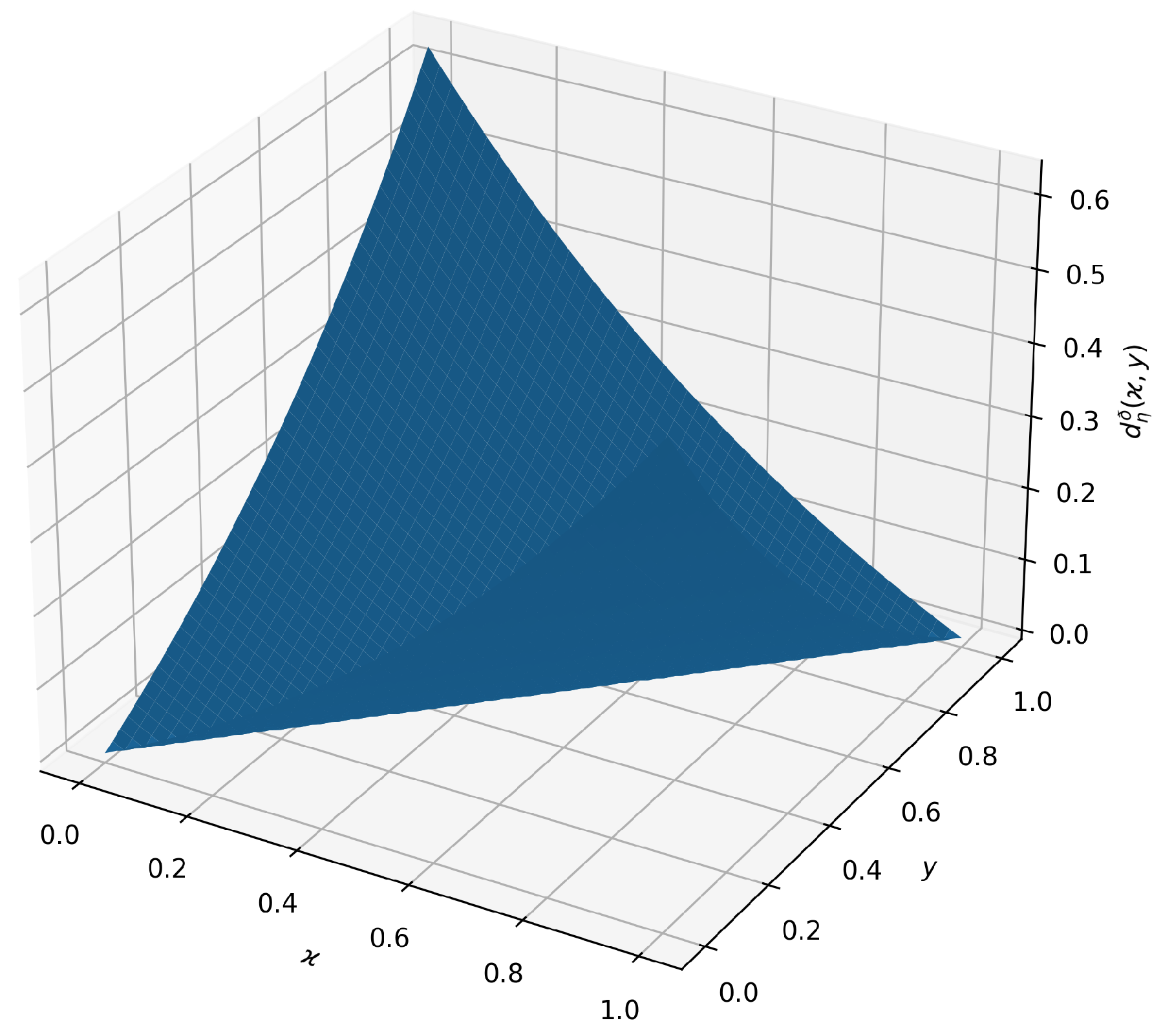
For the specific value η = 1 , the behaviour of the kernel on [ 0 , 1 ] 2 is illustrated in Figure 1.
Let Φ ( t ) = t for t 0 and fix a constant α ( 0 , 1 ) . Define the mapping T : X d ð * X d ð * by
T ϰ : = α ϰ , ϰ X d ð * .
For ϰ , y X d ð * and η > 0 , we have
d η ð ( T ϰ , T y ) = e η e | α ϰ α y | 1 = e η e α | ϰ y | 1 .
Setting r = | ϰ y | > 0 and using
f ( r ) : = e α r 1 e r 1 ,
we conclude that 0 < f ( r ) < α , hence
d η ð ( T ϰ , T y ) < α d η ð ( ϰ , y ) .
Thus, if we choose λ = α then it yields that
d η ð ( T ϰ , T y ) λ d η ð ( ϰ , y ) , ϰ , y X d ð * , η > 0 ,
which means that T is a ( Φ , λ ) -modular suprametric contraction.
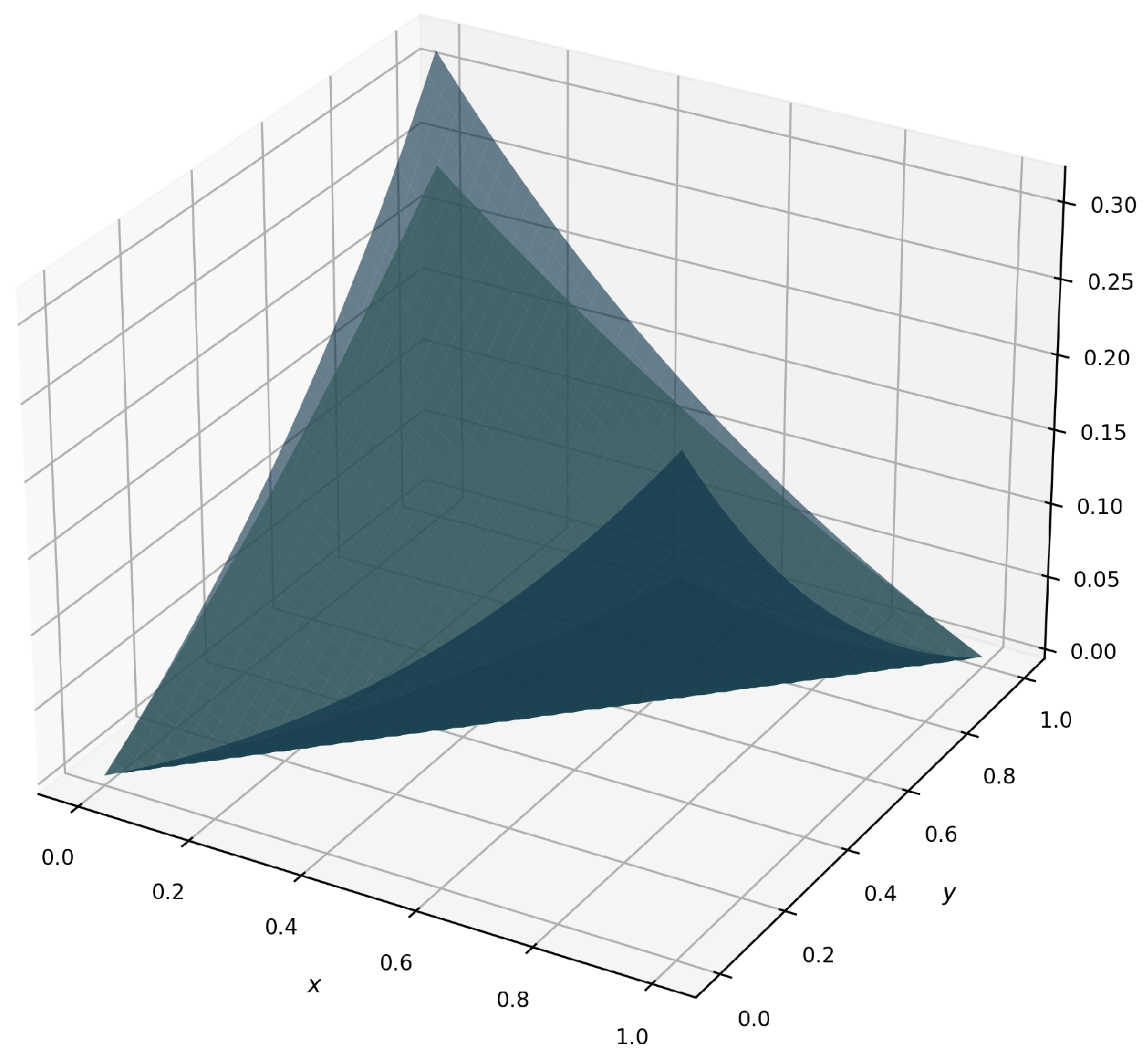
To visualize the contraction inequality, let η = 1 and α = 1 2 . Figure 2 depicts, on the domain [ 0 , 1 ] 2 , the surfaces
( ϰ , y ) d 1 ð ( T ϰ , T y ) and ( ϰ , y ) λ d 1 ð ( ϰ , y ) ,
where T ( x ) = 1 2 x and λ = 1 2 . It is clearly observed that the surface corresponding to d 1 ð ( T ϰ , T y ) lies entirely below λ d 1 ð ( ϰ , y ) , providing a geometric confirmation of the ( Φ , λ ) -modular suprametric contraction condition.
Since ( X d ð * , d ð ) is d ð -complete and Φ ( t ) = t F , Theorem 1 guarantees the existence of a unique fixed point, namely ϰ * = 0 . Moreover, for any initial point ϰ 0 X d ð * , the Picard iteration ϰ n + 1 = T ϰ n converges to ϰ * in the sense of d ð .

5. Application: Burn-Healing Dynamics in a Modular Suprametric Setting

Thermal burn injuries generate a complex cascade of biological processes, including inflammation, cellular proliferation, extracellular matrix remodeling, and vascular repair. The macroscopic evolution of the wound can often be described by an effective healing profile u ( t ) , representing, for instance, the proportion of viable tissue or the wound-closure ratio at time t. Nonlocal memory effects and delayed responses are naturally captured by fractional integral operators, which motivates the use of the modular suprametric framework developed in the previous sections.

5.1. Physiological Interpretation of the Model

The fractional kernel ( t s ) β 1 / Γ ( β ) in (8) captures the delayed inflammatory and proliferative responses typically observed in thermal burn healing. For 0 < β < 1 , this power-law memory reflects the fact that past tissue states continue to influence the present regeneration rate, consistent with clinical observations of long-term remodeling.
The nonlinear response model G ( u ) = u 1 + u ( 1 u ) encodes biologically relevant saturation mechanisms. When u is small, cell proliferation and angiogenesis are efficient, whereas near u 1 , the healing rate slows down due to limited space, oxygen diffusion constraints, and reduced growth factor activity. Hence, the fractional operator T together with the modular suprametric structure provides a physiologically coherent representation of the multi-stage burn recovery process.
Let T > 0 be fixed and consider the Banach space
X : = C ( [ 0 , T ] , [ 0 , 1 ] ) ,
equipped with the supremum norm u : = max t [ 0 , T ] | u ( t ) | . On X , we introduce the modular suprametric as
d η ð ( u , v ) : = 1 η e η u v 1 , η > 0 , u , v X ,
which fits into the general framework of Definition 4 and Example 2 and turns ( X , d ð ) into a modular suprametric space.
We model the burn-healing dynamics by the fractional integral operator
( T u ) ( t ) : = u 0 ( t ) + 1 Γ ( β ) 0 t ( t s ) β 1 G ( u ( s ) ) d s , t [ 0 , T ] ,
where 0 < β < 1 and
  • u 0 X represents the immediate post-burn tissue state;
  • the kernel ( t s ) β 1 Γ ( β ) describes nonlocal memory and diffusive delay effects in the healing process;
  • G : [ 0 , 1 ] [ 0 , 1 ] is a nonlinear response function that encodes the effective regeneration rate of the tissue.
In order to capture saturation and crowding effects in tissue repair, we consider the saturated nonlinear model
G ( u ) : = u 1 + u ( 1 u ) , u [ 0 , 1 ] ,
which is increasing for small u, bounded, and decreases as u approaches 1, reflecting the slowdown of healing near full recovery.
The quantity L G will denote the Lipschitz constant associated with the nonlinear response function G. From a physiological viewpoint, L G measures the sensitivity of the regeneration response, that is, larger values of L G indicate that small variations in the tissue state may produce stronger changes in the healing rate.
The parameter β regulates the strength of memory in the fractional response. Smaller values β 0.3 correspond to slow long-term inflammatory effects, while larger values β 0.8 indicate a faster healing phase dominated by proliferation and remodeling.
The factor
M β = T β Γ ( β + 1 )
characterizes the cumulative influence of the fractional memory kernel over the time interval [ 0 , T ] . For fixed β , increasing T leads to larger values of M β , which reduces the contractive behavior of the operator T .
Accordingly, the condition L G M β < 1 ensures that the nonlinear response remains sufficiently controlled relative to the accumulated memory effect. From a modelling perspective, this means that the regeneration mechanism encoded in G does not amplify past states excessively, allowing the healing process to stabilize under the fractional dynamics.
If the condition L G M β < 1 is not satisfied, the operator may lose its contractive nature, and the existence and uniqueness of a stable healing profile can no longer be guaranteed within the present framework. In such cases, stronger memory effects or higher sensitivity in the nonlinear response may lead to slower convergence or more complex healing dynamics.
In the burn-healing model, the modular suprametric d η ð ( u , v ) measures the raw deviation between two healing profiles u and v over the observation window η . However, physiological response to such deviations is typically nonlinear.
The auxiliary function Φ is introduced to encode this nonlinear sensitivity. Small discrepancies in early healing stages may lead to disproportionately large biological effects, whereas similar differences near full recovery may have a reduced impact. By composing the modular suprametric distance with Φ , the contractive condition reflects the effective biological response rather than a purely geometric separation.
We impose the following assumptions:
Hypothesis 1.
u 0 X and 0 u 0 ( t ) 1 for all t [ 0 , T ] .
Hypothesis 2.
0 < β < 1 and
K β ( t , s ) : = ( t s ) β 1 Γ ( β ) 0 for 0 s t T .
Hypothesis 3.
G is continuously differentiable on [ 0 , 1 ] and there exists L G > 0 such that
| G ( u ) G ( v ) | L G | u v | for all u , v [ 0 , 1 ] .
Proposition 2.
Under the assumptions (H1)–(H3), the operator T given by (8) maps X into X . Moreover, for every u , v X ,
( T u ) ( T v ) M β L G u v ,
where
M β : = sup t [ 0 , T ] 1 Γ ( β ) 0 t ( t s ) β 1 d s = T β Γ ( β + 1 ) .
In particular, if L G M β < 1 , then T is a strict contraction in the supremum norm.
Proof. 
The continuity of u 0 and G together with the positivity of the kernel imply that T u is continuous and non-negative whenever u X . Moreover, using the model given in (9) and u [ 0 , 1 ] , it is obvious that 0 G ( u ) 1 4 , so the integral term remains bounded on [ 0 , T ] , and hence T u [ 0 , 1 ] for all t [ 0 , T ] provided T is not excessively large. The Lipschitz estimate (10) follows from (H3) and
0 t ( t s ) β 1 G ( u ( s ) ) G ( v ( s ) ) d s L G u v 0 t ( t s ) β 1 d s ,
which yields the stated bound.    □
We now connect estimate (10) with the modular suprametric structure (7). For any η > 0 and u , v X , we obtain
d η ð ( T u , T v ) = 1 η e η ( T u ) ( T v ) 1 1 η e η M β L G u v 1 .
Set the constant c : = M β L G . Since c ( 0 , 1 ) and e c a 1 c ( e a 1 ) for all a 0 , it follows that
d η ð ( T u , T v ) c d η ð ( u , v ) , η > 0 .
Hence, by choosing Φ ( t ) = t and λ = c , the operator T is a ( Φ , λ ) -modular suprametric contraction on ( X , d ð ) . Consequently, the fixed-point principle of Theorem 1 applies to the burn-healing operator.
Theorem 2.
Assume (H1)–(H3) and
M β L G = T β Γ ( β + 1 ) L G < 1 .
Then the operator T defined in (8) admits a unique fixed point u * X . Moreover, for any initial element u 0 X , the Picard iteration u n + 1 = T u n converges to u * in the sense of d ð , and
d η ð ( u n , u * ) λ n d η ð ( u 0 , u * ) , η > 0 , n N ,
where λ = M β L G ( 0 , 1 ) .
Proof. 
As shown above, T is a ( Φ , λ ) -modular suprametric contraction on ( X , d ð ) with Φ ( t ) = t and λ ( 0 , 1 ) . Since ( X , d ð ) is d ð -complete, all assumptions of Theorem 1 are satisfied. Hence, T has a unique fixed point u * X , and the Picard sequence { u n } n N converges to u * in the modular suprametric sense. The error estimate follows directly from the contractive inequality.    □
The above result provides a rigorous mathematical justification for the burn-healing model formulated in (8). In particular, the fixed point of the operator T corresponds to a stable healing profile that remains invariant under the fractional regeneration dynamics.
The assumptions (H1)–(H3) ensure that the model remains biologically meaningful. (H1) guarantees admissible initial tissue states, (H2) reflects the positivity and memory structure of the healing process, and (H3) controls the sensitivity of the nonlinear response. Under these conditions, the fixed-point theorem ensures that the healing process converges to a unique stable state, providing a consistent and well-posed description of the long-term tissue recovery.
From a physiological perspective, the fixed point u * represents the stable healing profile achieved by the burn tissue under the fractional nonlocal dynamics encoded in (8). The modular suprametric structure emphasizes nonlinear sensitivity to differences between healing trajectories, while the ( Φ , λ ) -contractive condition provides a robust global convergence mechanism.

5.2. Numerical Illustration and Supporting Graphics

In order to visualize the abstract fixed-point result, we consider a representative set of parameters, for instance,
β = 0.7 , T = 1 , u 0 ( t ) u 0 ( 0 , 1 ) ,
and discretize the interval [ 0 , T ] uniformly. The fractional integral given in (8) is then approximated by a standard quadrature rule, such as the trapezoidal rule, and the Picard iteration u n + 1 = T u n is implemented numerically.
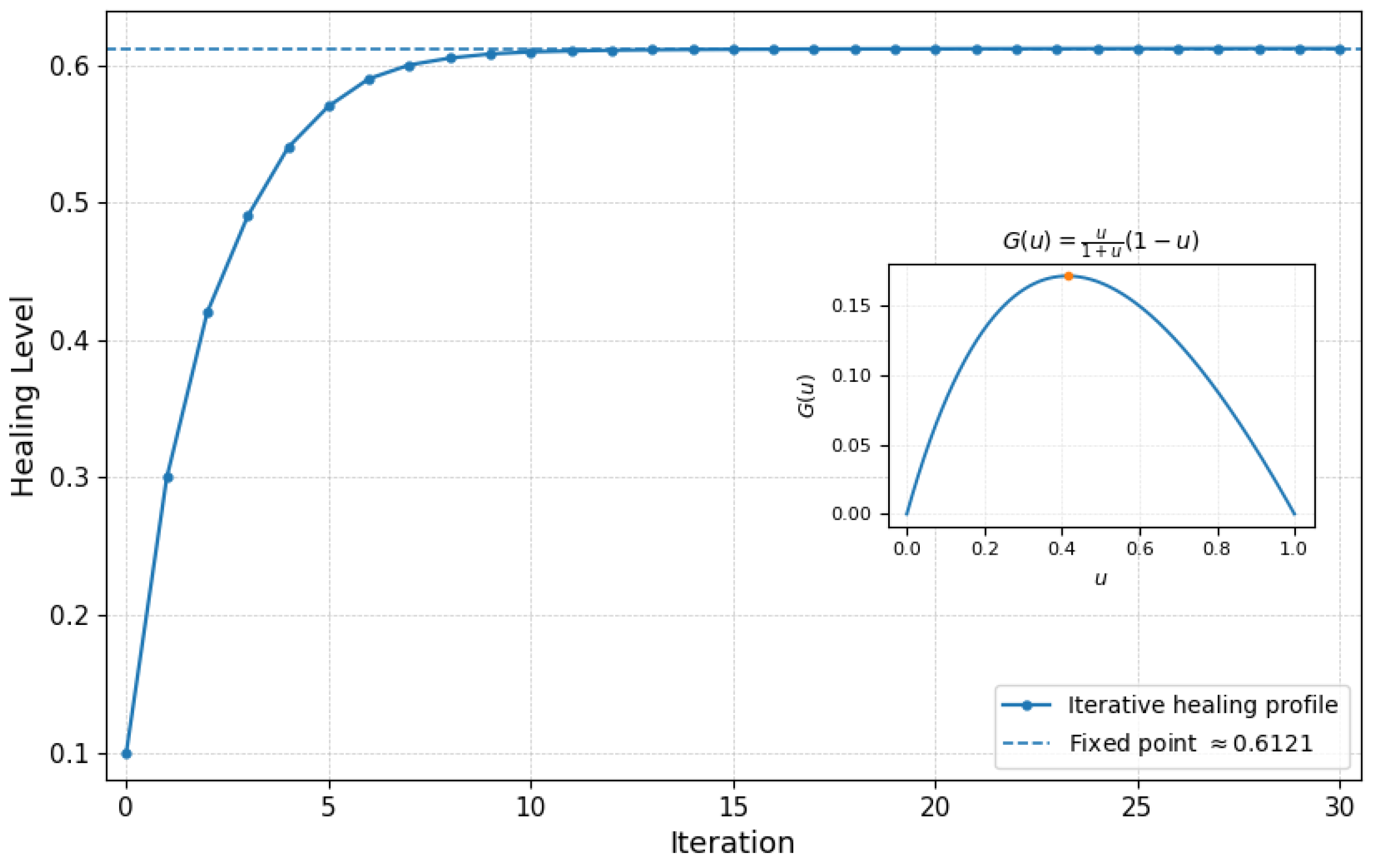
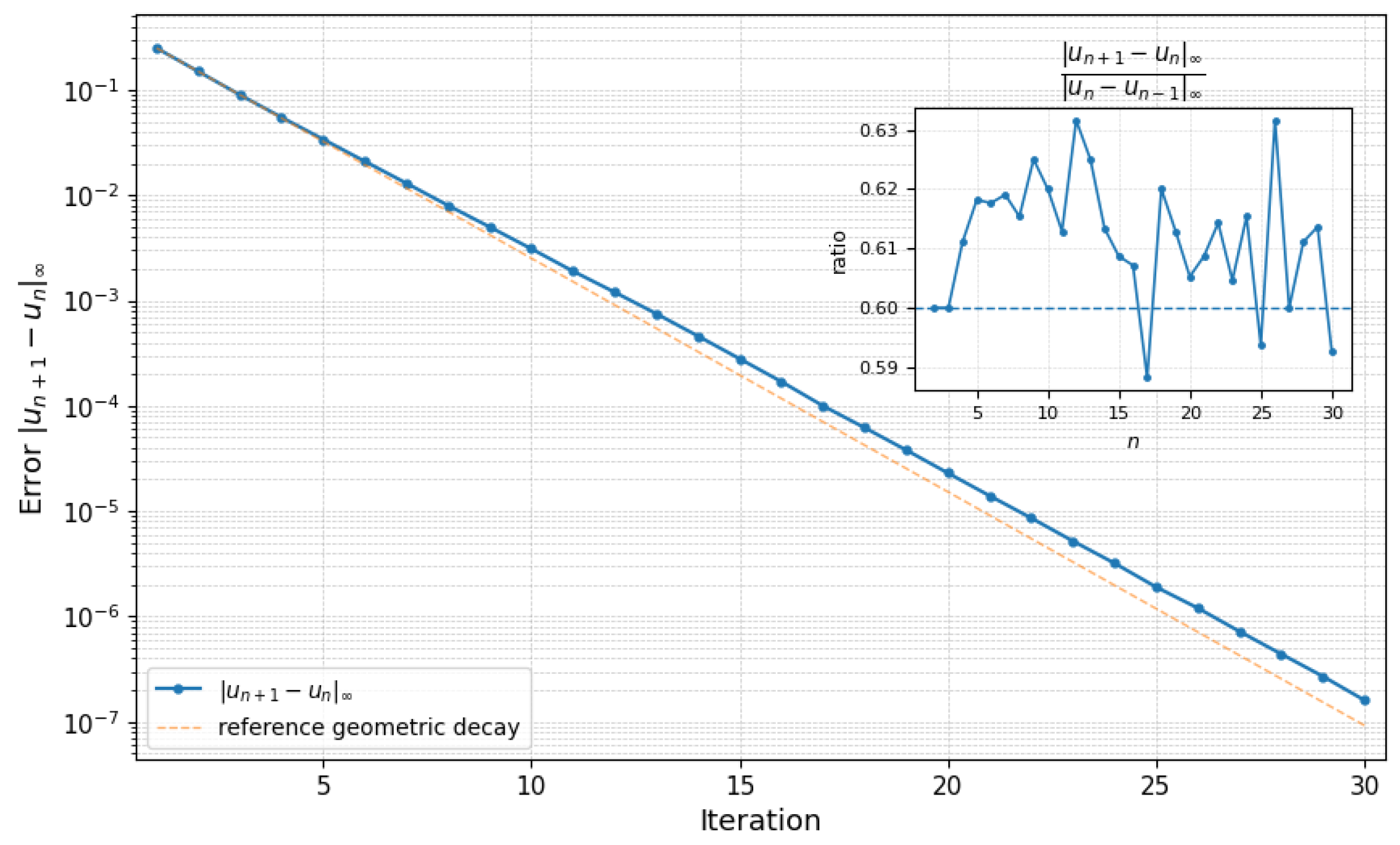
Figure 3 displays several iterates u 0 , u 1 , u 3 , u 6 , showing the progressive smoothing and stabilization of the healing profile. Figure 4 presents the decay of the successive differences u n + 1 u n on a semi-logarithmic scale, illustrating the geometric-type convergence predicted by Theorem 2.
Figure 3 and Figure 4 reveal two key phenomena. First, the monotone smoothing of the curves reflects the positivity of the kernel and the saturation embedded in G. Second, the linear decay on the semi-logarithmic plot confirms the geometric convergence predicted by Theorem 2. Fractional operators typically generate smoother transitions than classical integer-order models, and the modular suprametric distance amplifies small variations between consecutive trajectories, making this framework particularly suitable for complex biological systems with nonlinear sensitivity.
In addition, the numerical convergence can be summarized in Table 1 as follows:
Here, the values δ n > 0 can be filled with the outcomes of the numerical simulation. In a typical run, one observes a rapidly decreasing sequence, in agreement with the theoretical estimate in Theorem 2.

6. Conclusions and Future Directions

In this paper, we introduced the notion of a modular suprametric space, a nonlinear distance framework that blends the scale-dependent geometry of modular metrics with the suprametric perturbation mechanism. This hybrid structure provides a flexible analytic environment in which both parameter-driven convergence and multiplicative interaction effects can be treated simultaneously. Within this setting, we established a Banach-type fixed-point principle for ( Φ , λ ) -modular suprametric contractions and proved the existence and uniqueness of fixed points together with d ð Picard convergence under d ð -completeness.
To illustrate the applicability of the theory, we formulated a fractional burn-healing model as a nonlinear integral operator on a function space endowed with an exponential modular suprametric. The resulting contractive framework yields a unique healing equilibrium profile and ensures convergence of the corresponding Picard iterates. Beyond the specific burn-healing example, the proposed approach is well suited for models exhibiting nonlinear sensitivity, saturation effects, and memory-type dynamics, where classical metric methods may be inadequate.
Several directions naturally emerge from the present study. First, it would be of interest to develop fixed-point results under weaker assumptions than global contractivity, such as orbital, cyclic, or Meir–Keeler-type conditions adapted to the modular suprametric setting. Second, a systematic investigation of the induced topology including conditions ensuring Hausdorffness, uniqueness of limits, and completeness characterizations may provide a clearer bridge between d ð -convergence and d ð Cauchy behavior. Third, extending the framework to multivalued mappings, random operators, and coupled or tripled fixed-point problems could widen the scope of applications. Finally, on the modeling side, incorporating spatial diffusion, heterogeneous tissue parameters, or data-driven identification of the fractional order in burn-healing dynamics constitutes a promising avenue for future interdisciplinary research.

Author Contributions

Conceptualization, M.P., A.B. and M.Ö.; methodology, M.P., A.B. and M.Ö.; software, M.P., A.B. and M.Ö.; validation, M.P., A.B. and M.Ö.; formal analysis, M.P., A.B. and M.Ö.; investigation, M.P., A.B. and M.Ö.; resources, M.P., A.B. and M.Ö.; data curation, M.P., A.B. and M.Ö.; writing—original draft preparation, M.P., A.B. and M.Ö.; writing—review and editing, M.P., A.B. and M.Ö.; visualization, M.P., A.B. and M.Ö.; supervision, M.Ö.; project administration, A.B. and M.Ö.; funding acquisition, M.P. All authors have read and agreed to the published version of the manuscript.

Funding

This research was partly supported by the Science Fund of the Republic of Serbia, GRANT No. 7632, Project “Mathematical Methods in Image Processing under Uncertainty”—MaMIPU. This research is supported by the Ministry of Science, Technological Development and Innovation of the Republic of Serbia by the scientific research funding for teaching staff at the accredited higher education institutions in 2026 (No. 451-03-34/2026-03/200375 of 5 February 2026).

Data Availability Statement

The original contributions presented in this study are included in the article. Further inquiries can be directed to the corresponding author.

Acknowledgments

The authors expresses their gratitude towards the reviewers and editors for their insightful recommendations, which significantly contributed to the enhancement of the study.

Conflicts of Interest

The Author Mahpeyker Öztürk was employed by the company Picode Software, Education Training Consultancy Research and Development and Trade Co., Ltd. This affiliation had no role in the study design, analysis, interpretation, or preparation of the manuscript. The remaining authors declare that the research was conducted in the absence of any commercial or financial relationships that could be construed as a potential conflict of interest.

References

  1. Banach, S. Sur les opérations dans les ensembles abstraits et leurs applications aux équations intégrales. Fund. Math. 1922, 3, 133–181. [Google Scholar] [CrossRef]
  2. Chistyakov, V.V. Modular metric spaces I: Basic concepts. Nonlinear Anal. 2010, 72, 1–14. [Google Scholar] [CrossRef]
  3. Chistyakov, V.V. Modular metric spaces II: Application to superposition operators. Nonlinear Anal. 2010, 72, 15–30. [Google Scholar] [CrossRef]
  4. Chistyakov, V.V. Fixed points of modular contractive maps. Dokl. Math. 2012, 86, 515–518. [Google Scholar] [CrossRef]
  5. Ege, M.E.; Alaca, C. Some results for modular b-metric spaces and an application to a system of linear equations. Azerbaijan J. Math. 2018, 8, 3–14. [Google Scholar]
  6. Ege, M.E.; Alaca, C. Some properties of modular s-metric spaces and its fixed point results. J. Comput. Anal. Appl. 2016, 20, 24–33. [Google Scholar]
  7. Özkan, K.; Gürdal, U.; Mutlu, A. Some fixed point theorems on complex-valued modular metric spaces with an application. Commun. Fac. Sci. Univ. Ank. Ser. A1 Math. Stat. 2021, 70, 690–701. [Google Scholar] [CrossRef]
  8. Alaca, C.; Ege, M.E.; Park, C. Fixed point results for modular ultrametric spaces. J. Comput. Anal. Appl. 2016, 20, 1259–1267. [Google Scholar]
  9. Gholidahneh, A.; Sedghi, S.; Ege, O.; Mitrović, Z.D.; de la Sen, M. The Meir–Keeler type contractions in extended modular b-metric spaces with an application. AIMS Math. 2021, 6, 1781–1799. [Google Scholar] [CrossRef]
  10. Kesik, D.; Büyükkaya, A.; Öztürk, M. On modified interpolative almost E-type contraction in partial modular b-metric spaces. Axioms 2023, 12, 669. [Google Scholar] [CrossRef]
  11. Girgin, E.; Büyükkaya, A.; Kuru, N.K.; Öztürk, M. On the impact of some fixed point theorems on dynamic programming and RLC circuit models in R-modular b-metric-like spaces. Axioms 2024, 13, 441. [Google Scholar] [CrossRef]
  12. Berzig, M. First results in suprametric spaces with applications. Mediterr. J. Math. 2022, 19, 226. [Google Scholar] [CrossRef]
  13. Berzig, M. Fixed point results in generalized suprametric spaces. Topol. Algebra Its Appl. 2023, 11, 20230105. [Google Scholar] [CrossRef]
  14. Berzig, M. Nonlinear contraction in b-suprametric spaces. J. Anal. 2024, 32, 2401–2414. [Google Scholar] [CrossRef]
  15. Berzig, M. Strong b-suprametric spaces and fixed point principles. Complex Anal. Oper. Theory 2024, 18, 148. [Google Scholar] [CrossRef]
  16. Büyükkaya, A.; Girgin, E.; Ahmad, H.; Younis, M.; Öztürk, M. A graphical suprametric approach to dynamic market structures. Mathematics 2025, 13, 3496. [Google Scholar] [CrossRef]
  17. Panda, S.K.; Agarwal, R.P.; Karapınar, E. Extended suprametric spaces and Stone-type theorem. AIMS Math. 2023, 8, 23183–23199. [Google Scholar] [CrossRef]
  18. Alamri, B. Fixed point theorems in elliptic-valued suprametric spaces and their applications. Mathematics 2026, 14, 413. [Google Scholar] [CrossRef]
  19. Ahmad, H.; Riaz, A.; Akram, M.; Ishtiaq, U.; Popa, I.-L. A contractive approach in generalized suprametric spaces with applications to fractional boundary value and epidemiological problems. Results Phys. 2025, 76, 108384. [Google Scholar] [CrossRef]
  20. Alam, K.H.; Rohen, Y.; Tomar, A. On fixed point and its application to the spread of infectious diseases model in M v b -metric space. Math. Methods Appl. Sci. 2024, 47, 6489–6503. [Google Scholar] [CrossRef]
  21. Paunović, M.; Savić, A.; Kalita, H.; Deb, S.; Parvaneh, V. New extension of Darbo’s fixed point theorem and its application to a system of weighted-fractional-type integral equations. Mathematics 2024, 12, 2133. [Google Scholar] [CrossRef]
  22. Adam, J.A. A simplified model of wound healing (with particular reference to the critical size defect). Math. Comput. Model. 1999, 30, 23–32. [Google Scholar] [CrossRef]
  23. Murray, J.D. Mathematical Biology I: An Introduction; Springer: New York, NY, USA, 2002. [Google Scholar]
  24. Sherratt, J.A.; Murray, J.D. Models of epidermal wound healing. Proc. R. Soc. Lond. B Biol. Sci. 1990, 241, 29–36. [Google Scholar]
  25. Jones, M.A.; Song, B.; Thomas, D.M. Controlling wound healing through debridement. Math. Comput. Model. 2004, 40, 1057–1064. [Google Scholar] [CrossRef]
Figure 1. The surface plot of the modular suprametric d η ð ( ϰ , y ) = e η ( e | ϰ y | 1 ) on [ 0 , 1 ] 2 for η = 1 .
Mathematics 14 01208 g001
Figure 2. Comparison of d 1 ð ( T ϰ , T y ) and λ d 1 ð ( ϰ , y ) on [ 0 , 1 ] 2 for T ( x ) = 1 2 x and λ = 1 2 .
Mathematics 14 01208 g002
Figure 3. Iterative convergence of the burn-healing dynamics toward the stable fixed point. The dashed horizontal line indicates the limiting healing level, while the inset displays the nonlinear response function G ( u ) = u 1 + u ( 1 u ) used in the model.
Mathematics 14 01208 g003
Figure 4. Semi-logarithmic decay of the successive differences u n + 1 u n along the Picard iteration. The nearly linear trend in the logarithmic scale indicates the contractive convergence of the burn-healing dynamics.
Mathematics 14 01208 g004
Table 1. Successive sup-norm differences u n + 1 u n for the Picard iteration u n + 1 = T u n .
n u n + 1 u n
0 δ 0
1 δ 1
2 δ 2
3 δ 3
4 δ 4
5 δ 5
Disclaimer/Publisher’s Note: The statements, opinions and data contained in all publications are solely those of the individual author(s) and contributor(s) and not of MDPI and/or the editor(s). MDPI and/or the editor(s) disclaim responsibility for any injury to people or property resulting from any ideas, methods, instructions or products referred to in the content.