Article

Efficient Method for Solving Systems of Coupled Nonlinear Fractional Partial Differential Equations


by
Mariam Al-Mazmumy
*,
Mona Alsulami
and
Norah Sharif Al-Yazidi
Department of Mathematics and Statistics, Faculty of Science, University of Jeddah, Jeddah 23218, Saudi Arabia
*
Author to whom correspondence should be addressed.
Mathematics 2026, 14(7), 1149; https://doi.org/10.3390/math14071149
Submission received: 9 December 2025 / Revised: 28 January 2026 / Accepted: 9 February 2026 / Published: 29 March 2026

Abstract

The current manuscript presents an application of the Sumudu decomposition method (SDM) in efficiently tackling the systems of coupled nonlinear partial fractional differential equations. The technique combines the strengths of the Adomian decomposition method and the Sumudu transform, enabling the transformation of complex systems into rapidly converging series solutions. The efficacy of the technique is then portrayed on various nonlinear coupled fractional models, where approximate solutions are successfully obtained. Furthermore, the computational results indicate efficient numerical performance of the proposed approach for the cases considered. Certainly, the study’s results demonstrate that SDM is an effective and reliable technique for solving the examined class of fractional-order systems.

1. Introduction

Fractional calculus, which deals with integrals and derivatives of non-integer (arbitrary) orders, has a rich and intricate history that dates back to the late 17th century. The initial ideas were introduced by renowned mathematicians such as Gottfried Wilhelm Leibniz and Leonhard Euler, who laid the foundational principles for this field [1,2,3]. Over the years, fractional calculus has become increasingly important in modeling and analyzing various dynamic phenomena across numerous scientific and engineering disciplines. These phenomena are observed in diverse areas such as physics, chemistry, continuum mechanics [4], chaos theory [5], biotechnology [6], viscoelastic materials [7], and many others [8,9]. Its growing application in these domains underscores the rising significance of fractional calculus in contemporary scientific research. Moreover, with the emergence of fractional partial differential equations (FPDEs), this class of equations has been widely used to model diverse physical phenomena with greater precision. Certainly, fields like modern engineering science [10,11] were able to perfectly model various scenarios that were previously impossible with the classical integer-order differential equations. Additionally, the models that feature FPDEs are more appealing and general, both theoretically and physically. In this regard, various scientists have delved into proposing reliable mathematical methods for tackling this class of fractional models, including analytical and computational semi-analytical methods equally exist in the open literature. In particular, one may find several promising methods, including multi-step generalized transform technique [12], integral Laplace transform approach [13], the famous Fourier integral transform technique [14], the Adomian decomposition method (ADM) [15], the method due to iterative variation [16], the analysis method due to Homotopy [17], lastly, the Sumudu transform (ST) method among others [18]. In parallel, analytical and semi-analytical methods for solving such equations have been widely studied. Among them, the ADM and its variants have been proven to be effective for handling nonlinear terms. Since its introduction by George Adomian in 1984 [19,20], the ADM has gained widespread recognition for its effectiveness in handling the wider class of functional equations. Over the years, the method has undergone significant refinements to enhance its accuracy, speed, and computational efficiency, as well as to extend its applicability to a broader range of equations. These advancements have greatly improved the efficiency of obtaining solutions compared to the original ADM, highlighting substantial progress in the method’s development. In [21], authors have employed the ADM with variational iteration method (VIM) to tackle nonlinear FPDEs, and in [22], a latest enhanced version of the ADM was devised to solve initial-boundary value problems for FPDEs, while in [23], a modified approach was introduced to solve nonlinear fractional models using the ST and the ADM. In addition, recent research has introduced various analytical and numerical techniques to solve systems of FPDEs, reflecting the growing interest in this area. As an instance, authors in [24] presented an effective approach to handling systems of nonlinear time-FPDEs using the Laplace transform and the ADM, while ref. [25] deployed the Homotopy-ST technique to tackle such systems of fractional models; see also the submission in [9] that proposed a natural decomposition method for treating ( 2 + 1 ) -dimensional fractional coupled Burger’s equations. Additionally, some computational schemes for handling fractional models include the methods proposed for coupled Burgers equations in [26], and other numerical approaches for systems of FPDEs [27].
Early applications of the Sumudu Decomposition Method (SDM), appeared in the literature around 2012. For example, Kumar et al. [28] applied SDM to nonlinear equations, while Eltayeb and Kılıçman [29] used it for nonlinear systems of partial differential equations. These studies are among the first applications of SDM as an analytical tool, laying the foundation for later extensions to fractional partial differential equations (FPDEs). However, the current study employed the SDM to iteratively handle the class of coupled systems of FPDEs. This method combines the strengths of the ADM and the ST, offering an effective analytical approach. The ADM facilitates the decomposition of complex nonlinear equations into rapidly convergent series, while the ST simplifies the original equations by transforming them into a more manageable form. The effectiveness of the SDM has been demonstrated by various examples, in which accurate solutions were obtained using only a few terms of the series. The motivation for this study arises from the inherent complexity of coupled nonlinear FPDEs and the need to present a clear analytical framework for handling such models. This work aims to highlight the applicability of the SDM in treating these systems and constructing series solutions within a systematic formulation. It should be noted that the stability of the SDM has been previously examined through Picard-type stability analysis in Banach spaces [30]. Additionally, the convergence properties of the Adomian series solution have been well-studied across various problem classes. The first rigorous convergence proof for the ADM was provided by Cherruault using fixed-point theorems for abstract functional equations [31]. Subsequent studies extended these convergence results to more general functional equations [32,33], while certain specific classes of equations were further investigated in [34,35,36]. In addition, the paper is organized as follows: Section 2 outlines some basics. Section 3 presents the methodology of the proposed approach and explains its details. In Section 4, the derived computational schemes are applied to a range of diverse examples to portray the ability of the devised SDM. Section 5 offers a conclusion that summarizes the key findings and provides final remarks on the work.

2. Preliminaries

Some fractional calculus concepts, such as the Riemann–Liouville (RL) and Caputo thoughts on fractional calculus, and the ST definitions with notations needed in this work are discussed in this section.

2.1. Some Preliminaries in Fractional Calculus [37]

Definition 1.
The left I a + α f ( x ) ( for   x > a ) and right I b α f ( x ) ( for   x < b ) Riemann–Liouville fractional integrals of order α C ( R ( α ) > 0 ) are respectively defined as follows:
I a + α f ( x ) : = 1 Γ ( α ) a x f ( t ) ( x t ) 1 + α d t , ( R ( α ) > 0 ) ,
and
I b α f ( x ) : = 1 Γ ( α ) x b f ( t ) ( t x ) 1 + α d t , ( R ( α ) > 0 ) .
Definition 2.
The left D a + α y ( x ) ( for   x > a ) and right D b α y ( x ) ( for   x < b ) Riemann–Liouville fractional derivatives of order α C ( R ( α ) 0 ) are respectively defined as follows:
D a + α y ( x ) = : d d x n ( I a + n α y ) ( x )   = 1 Γ ( n α ) d d x n a x y ( t ) ( x t ) α + n 1 d t , ( n = [ ( α ) ] + 1 ) ,
and
D b α y ( x ) = : d d x n ( I b n α y ) ( x )   = 1 Γ ( n α ) d d x n x b y ( t ) ( t x ) α + n 1 d t , ( n = [ ( α ) ] + 1 ) .
Definition 3. 
The left D a + α C y ( x ) ( for   x > a ) and right D b α C y ( x ) ( for   x < b ) Caputo fractional derivatives of order α exist almost everywhere on [ a , b ] . Thus, for the smallest integer n greater than α , and α N 0 , the earlier fractional derivatives are defined as follows [38]:
D a + α C y ( x ) = : I a + n α D n y ( x ) = 1 Γ ( n α ) a x y ( n ) ( t ) ( x t ) α + n 1 d t ,
and
D b α C y ( x ) = : ( 1 ) n I b n α D n y ( x ) = ( 1 ) n Γ ( n α ) x b y ( n ) ( t ) ( t x ) α + n 1 d t .
Moreover, when α = n N 0 , the above Caputo fractional derivatives then take the following expressions:
D a + α C y ( x ) = y ( n ) ( x ) , and D b α C y ( x ) = ( 1 ) n y ( n ) ( x ) , ( n N ) ,
if α = 0 , one gets the following:
D a + 0 C y ( x ) = y ( x ) = D b 0 C y ( x ) .
Property 1. 
For β 0 ,   m 1 < α , β < m ,   m N , together with k as a real constant, some of the important properties for the fractional differential and integral operators are as follows:
  • I α I β y ( x ) = I α + β y ( x ) ;
  • I α D * α C y ( x ) = y ( x ) k = 0 m 1 y ( k ) 0 + x k Γ ( k + 1 ) ;
  • I α D * β C y ( x ) = I β α y ( x ) k = 0 m 1 y ( k ) 0 + x k α + β Γ ( k α + β + 1 ) ;
  • I α x n = Γ ( n + 1 ) Γ ( α + n + 1 ) x n + α ,   x > 0 ,   n > 1 ;
  • D * α C k = 0 ; where k is a real constant
  • D * α C x n = 0 , n < m 1 Γ ( n + 1 ) Γ ( n + 1 α ) x n α , n m 1 .
Definition 4. 
The one-parameter Mittag-Leffler function E α ( z ) with α > 0 is defined by the following series representation:
E α ( z ) = k = 0 z k Γ ( α k + 1 ) , α > 0 , z C .
Definition 5. 
For α , β , z C , and ( α ) , ( β ) > 0 , the two-parameter Mittag-Leffler function E α , β ( z ) is defined by the following series representation:
E α , β ( z ) = k = 0 1 Γ ( β + α k ) z k .

2.2. Some Preliminaries Associated with the Sumudu Transform

Definition 6 
([39]). Consider the set of function:
A = u ( t )   /     M , a 1 , a 2 > 0 , | u ( t ) | < M e | t | / a j ,   if   t ( 1 ) j × [ 0 , ) .
Then, the formal definition for the ST of the function u ( t ) is expressed through the following integral:
S [ u ( t ) ] ( a ) = G ( a ) = 0 e t u ( a t ) d t ,
where a a 1 , a 2 is the ST parameter, real or complex, and independent of x. In addition, the formula for inverting the S T is expressed as follows:
S 1 [ G ( a ) ] = u ( t ) = 1 2 π i λ i λ + i e a t a G 1 a d a , i 2 = 1 .
Hence, what follows presents the ST for the set of functions that play a role in the current study [40]:
  • S [ 1 ] = 1 ;
  • S [ t n 1 Γ ( n ) ] = a n 1 ,   n 2 ,   n N ;
  • S [ e c t ] = 1 1 c a ,   a R .
Lemma 1 
([39]). The ST for the Caputo fractional derivative takes the following representation:
S D t m α C u ( x , t ) = a m α S u ( x , t ) k = 0 m 1 a ( m α + k ) u ( k ) ( x , 0 ) , m 1 < α < m .

3. SDM for Solving System of FPDEs

This section presents the formal analysis of the adopted SDM for coupled FPDE systems. Thus, in doing so, let us consider three coupled systems of FPDEs, with the Caputo fractional-orders m 1 < α ,   β , γ m , where the governing model is featured as follows:
D t α u ( x , y , t ) + R 1 [ u ( x , y , t ) ] + N 1 [ ( u , v , ω ) ] = g 1 ( x , y , t ) , D t β v ( x , y , t ) + R 2 [ v ( x , y , t ) ] + N 2 [ ( u , v , ω ) ] = g 2 ( x , y , t ) , D t γ ω ( x , y , t ) + R 3 [ ω ( x , y , t ) ] + N 3 [ ( u , v , ω ) ] = g 3 ( x , y , t ) ,
together with the prescribed generalized initial conditions as follows:
u ( x , y , 0 ) = f 1 ( x , y ) , v ( x , y , 0 ) = f 2 ( x , y ) , ω ( x , y , 0 ) = f 3 ( x , y ) .
In particular, D t α ,   D t β , and D t γ are the fractional derivatives with respect to t variable; the operators R 1 , R 2 , and R 3 are linear operators, while the operators N 1 , N 2 , and N 3 are nonlinear. In addition, the functions g 1 , g 2 , and g 3 are prescribed source-input functions; the functions f 1 , f 2 , and f 3 are equally prescribed functions. Moreover, what follows gives the precise steps to the full implementation of the method.
Step 1: applying the ST to both sides of (15) using (14) and (16) to obtain the following:
S u ( x , y , t ) = f 1 ( x , y ) + a α S g 1 ( x , y , t ) a α S R 1 u ( x , y , t ) + N 1 ( u , v , ω ) ,   S v ( x , y , t ) = f 2 ( x , y ) + a β S g 2 ( x , y , t ) a β S R 2 v ( x , y , t ) + N 2 ( u , v , ω ) ,   S ω ( x , y , t ) = f 3 ( x , y ) + a γ S g 3 ( x , y , t ) a γ S R 3 ω ( x , y , t ) + N 3 ( u , v , ω ) .
Step 2: Applying the inverse ST on both sides of (17) yields the following:
u ( x , y , t ) = f 1 ( x , y ) + S 1 a α S g 1 ( x , y , t ) S 1 a α S R 1 u ( x , y , t ) + N 1 ( u , v , ω ) ,   v ( x , y , t ) = f 2 ( x , y ) + S 1 a β S g 2 ( x , y , t ) S 1 a β S R 2 v ( x , y , t ) + N 2 ( u , v , ω ) ,   ω ( x , y , t ) = f 3 ( x , y ) + S 1 a γ S g 3 ( x , y , t ) S 1 a γ S R 3 ω ( x , y , t ) + N 3 ( u , v , ω ) .
Step 3: The ADM defines the solutions u ( x , y , t ) , v ( x , y , t ) ,   ω ( x , y , t ) by the infinite series representations as follows:
u ( x , y , t ) = n = 0 u n ( x , y , t ) , v ( x , y , t ) = n = 0 v n ( x , y , t ) , ω ( x , y , t ) = n = 0 ω n ( x , y , t ) ,
while the nonlinear terms N 1 , N 2 , and N 3 are replaced with a finite series of Adomian polynomials representation as follows:
N 1 [ ( u , v , ω ) ] = n = 0 A n , N 2 [ ( u , v , ω ) ] = n = 0 B n , N 3 [ ( u , v , ω ) ] = n = 0 C n ,
where A n , B n and C n are the Adomian polynomials that are iteratively computed through the help of the following algorithms:
A n = 1 n ! d n d λ n N 1 k = 0 λ k u k , k = 0 λ k v k , k = 0 λ k ω k λ = 0 ,   B n = 1 n ! d n d λ n N 2 k = 0 λ k u k , k = 0 λ k v k , k = 0 λ k ω k λ = 0 ,   C n = 1 n ! d n d λ n N 3 k = 0 λ k u k , k = 0 λ k v k , k = 0 λ k ω k λ = 0 .
Accordingly, substituting (19) and (20) into (18) gives the following:
n = 0 u n ( x , y , t ) = f 1 ( x , y ) + S 1 a α S [ g 1 ( x , y , t ) ] S 1 a α S R 1 n = 0 u n + n = 0 A n ,   n = 0 v n ( x , y , t ) = f 2 ( x , y ) + S 1 a β S [ g 2 ( x , y , t ) ] S 1 a β S R 2 n = 0 v n + n = 0 B n ,   n = 0 ω n ( x , y , t ) = f 3 ( x , y ) + S 1 a γ S [ g 3 ( x , y , t ) ] S 1 a γ S R 3 n = 0 ω n + n = 0 C n ,
such that the overall recurrent scheme for the governing coupled fractional model is obtained from the latter equation as follows:
u 0 ( x , y , t ) = f 1 ( x , y ) + S 1 a α S [ g 1 ( x , y , t ) ] , u n + 1 ( x , y , t ) = S 1 a α S R 1 u n + A n ,   n 0 ,
v 0 ( x , y , t ) = f 2 ( x , y ) + S 1 a β S [ g 2 ( x , y , t ) ] , v n + 1 ( x , y , t ) = S 1 a β S R 2 v n + B n ,   n 0 ,
ω 0 ( x , y , t ) = f 3 ( x , y ) + S 1 a γ S [ g 3 ( x , y , t ) ] , ω n + 1 ( x , y , t ) = S 1 a γ S R 3 ω n + C n ,   n 0 .
Step 4: The resulting approximate analytical solution, given by the set u ( x , y , t ) , v ( x , y , t ) , ω ( x , y , t ) of the governing fractional coupled model, is obtained by summing the respective solution components from (19) through the constructed recurrent scheme (22).

4. Numerical Test Examples

In this section, the effectiveness of the proposed method is demonstrated through three examples. The first two examples involve nonlinear three-dimensional partial-fractional systems, while the last example studies the nonlinear Burgers equation in two dimensions. These examples are selected to illustrate the applicability of the method to different types of coupled fractional systems with varying nonlinear structures.
Example 1. 
Consider the coupled system of nonlinear FPDEs as follows:
D t α u + v x ω y v y ω x = u , D t β v + u x ω y + u y ω x = v , D t γ ω + u x v y + u y v x = ω ,
where 0 < α , β , γ 1 , together with the following initial data
u ( x , y , 0 ) = e x + y , v ( x , y , 0 ) = e x y , ω ( x , y , 0 ) = e x + y .
Initially, apply the ST to both sides of (23), alongside using the initial conditions and through (14) to obtain the following:
S [ u ] = e x + y + a α S v x ω y + v y ω x u , S [ v ] = e x y + a β S u x ω y u y ω x + v , S [ ω ] = e x + y + a γ S u x v y u y v x + ω .
Now, applying the inverse ST on the latter equation yields the following:
u = e x + y + S 1 a α S v x ω y + v y ω x u , v = e x y + S 1 a β S u x ω y u y ω x + v , ω = e x + y + S 1 a γ S u x v y u y v x + ω .
Accordingly, when the ADM is deployed as presented, the overall recurrent scheme for the examining coupled model is derived as follows:
u 0 ( x , y , t ) = e x + y , u n + 1 ( x , y , t ) = S 1 a α S A n + B n u n ,   n 0 .
v 0 ( x , y , t ) = e x y , v n + 1 ( x , y , t ) = S 1 a β S C n D n + v n ,   n 0 ,
ω 0 ( x , y , t ) = e x + y , ω n + 1 ( x , y , t ) = S 1 a γ S E n F n + ω n ,   n 0 ,
where A n , B n , C n , D n , E n , and F n are the Adomian polynomials associated with the involving nonlinear terms; some of the few terms are respectively expressed from (21) as follows:
A 0 = v 0 x · ω 0 y B 0 = v 0 y · ω 0 x A 1 = v 1 x · ω 0 y + v 0 x · ω 1 y B 1 = v 1 y · ω 0 x + v 0 y · ω 1 x A 2 = v 2 x · ω 0 y + v 1 x · ω 1 y + v 0 x · ω 2 y B 2 = v 2 y · ω 0 x + v 1 y · ω 1 x + v 0 y · ω 2 x
C 0 = u 0 x · ω 0 y D 0 = u 0 y · ω 0 x C 1 = u 1 x · ω 0 y + u 0 x · ω 1 y D 1 = u 1 y · ω 0 x + u 0 y · ω 1 x C 2 = u 2 x · ω 0 y + u 1 x · ω 1 y + u 0 x · ω 2 y D 2 = u 2 y · ω 0 x + u 1 y · ω 1 x + u 0 y · ω 2 x
E 0 = u 0 x · v 0 y F 0 = u 0 y · v 0 x E 1 = u 1 x · v 0 y + u 0 x · v 1 y F 1 = u 1 y · v 0 x + u 0 y · v 1 x E 2 = u 2 x · v 0 y + u 1 x · v 1 y + u 0 x · v 2 y F 2 = u 2 y · v 0 x + u 1 y · v 1 x + u 0 y · v 2 x
Consequently, some of the solution components are recurrently determined as follows:
u 0 ( x , y , t ) = e x + y , v 0 ( x , y , t ) = e x y , ω 0 ( x , y , t ) = e x + y ,
u 1 ( x , y , t ) = S 1 a α S e x y ( e x + y ) e x y e x + y e x + y = e x + y t α Γ α + 1 , v 1 ( x , y , t ) = S 1 a α S e x + y e x + y e x + y ( e x + y ) + e x y = e x y t β Γ ( β + 1 ) , ω 1 ( x , y , t ) = S 1 a α S e x + y ( e x y ) e x + y e x y + e x + y = e x + y t γ Γ ( γ + 1 ) ,
u 2 ( x , y , t ) = S 1 [ a α S [ e x y e x + y t γ Γ ( γ + 1 ) e x + y e x y t β Γ ( β + 1 ) + ( e x y e x + y t γ Γ ( γ + 1 ) + e x + y e x y t β Γ ( β + 1 ) ) + e x + y t α Γ ( α + 1 ) ] ] = e x + y t 2 α Γ ( 2 α + 1 ) , v 2 ( x , y , t ) = S 1 [ a α S [ e x + y e x + y t γ Γ ( γ + 1 ) + e x + y e x + y t α Γ ( α + 1 ) ( e x + y e x + y t γ Γ ( γ + 1 ) e x + y e x + y t α Γ ( α + 1 ) ) + e x y t β Γ ( β + 1 ) ] = e x y t 2 β Γ ( 2 β + 1 ) , ω 2 ( x , y , t ) = S 1 [ a α S [ e x + y e x y t β Γ ( β + 1 ) e x y e x + y t α Γ ( α + 1 ) e x + y e x y t β Γ ( β + 1 ) e x y e x + y t α Γ ( α + 1 ) + e x + y t γ Γ ( γ + 1 ) ] ] = e x + y t 2 γ Γ ( 2 γ + 1 ) ,
and so on. Furthermore, upon taking the net sums of the latter components, one obtains the following:
u ( x , y , t ) = e x + y e x + y t α Γ ( α + 1 ) + e x + y t 2 α Γ ( 2 α + 1 ) e x + y t 3 α Γ ( 3 α + 1 ) + , = e x + y 1 + m = 1 t α m Γ ( m α + 1 ) = e x + y E α t α , v ( x , y , t ) = e x y + e x y t β Γ ( β + 1 ) + e x y t 2 β Γ ( 2 β + 1 ) + e x y t 3 β Γ ( 3 β + 1 ) + , = e x y 1 + m = 1 t β m Γ ( m β + 1 ) = e x y E β t β , ω ( x , y , t ) = e x + y + e x + y t γ Γ ( γ + 1 ) + e x + y t 2 γ Γ ( 2 γ + 1 ) + e x + y t 3 γ Γ ( 3 γ + 1 ) + , = e x + y 1 + m = 1 t γ m Γ ( m γ + 1 ) = e x + y E γ t γ ,
with all the solution components converging to the earlier stated two-parameter Mittag-Leffler function (10). Notably, when α = β = γ = 1 , the latter fractional-order solution reduces to the known closed-form solution for the corresponding integer-order model as follows:
u ( x , y , t ) = e x + y E 1 ( t ) = e x + y t , v ( x , y , t ) = e x y E 1 ( t ) = e x y + t , ω ( x , y , t ) = e x + y E 1 ( t ) = e x + y + t .
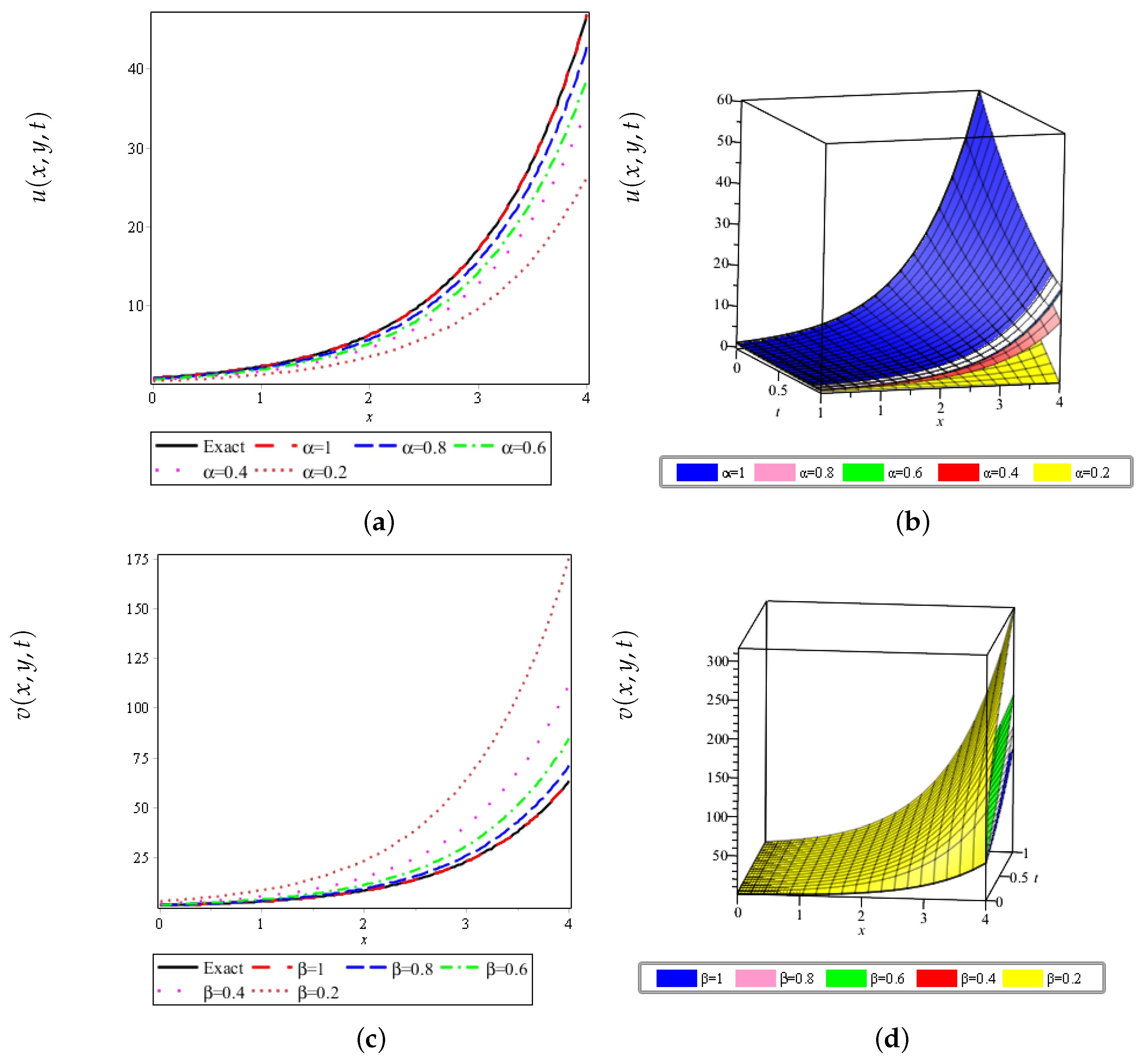
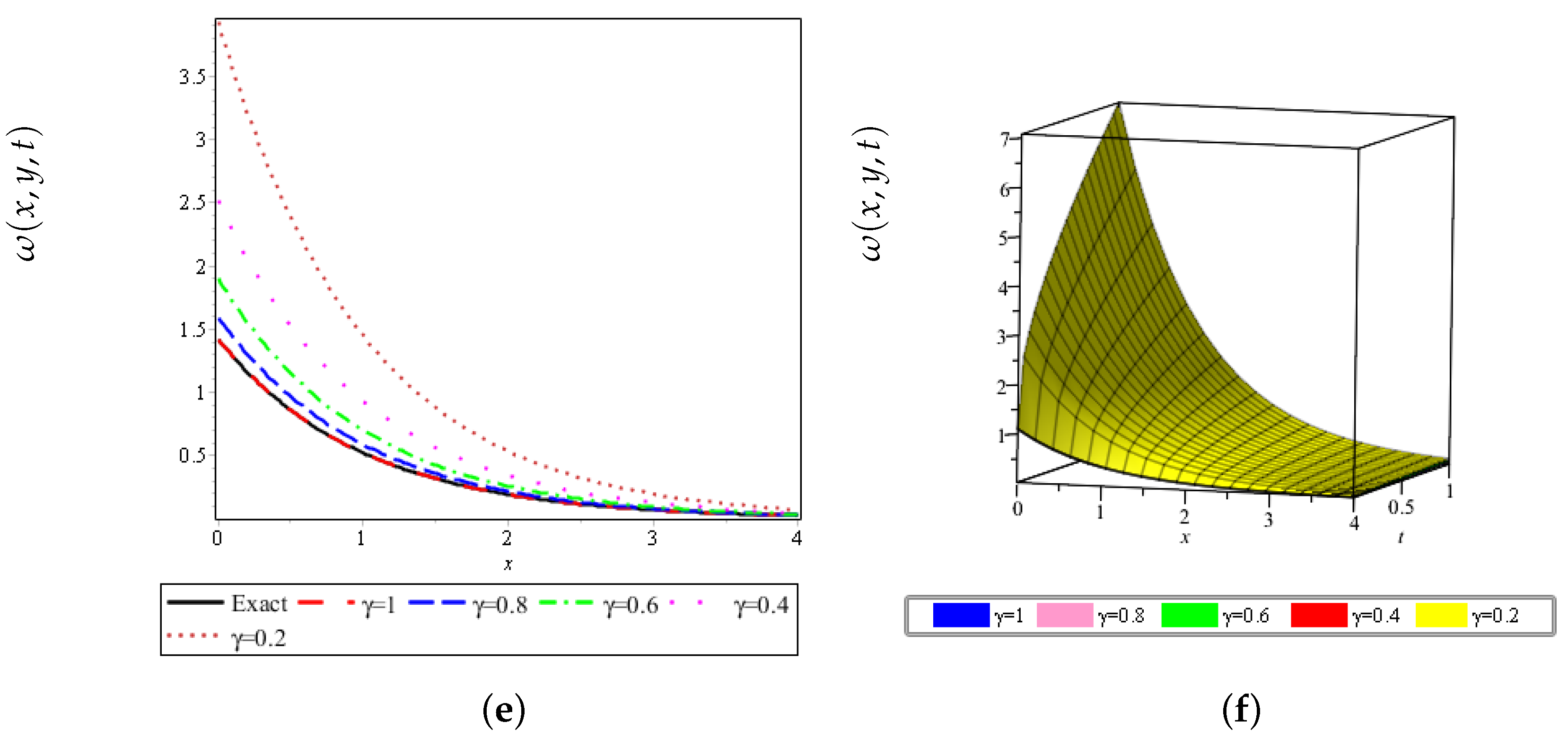
It is evident that the closed-form solution obtained is in complete agreement with the solutions previously derived using the Aboodh Tamimi Ansari transform method ( ( A T ) 2 ) [41] and Homotopy analysis method (HAM) [42], respectively. Table 1 presents the point-wise errors of the 6th iterative estimated solutions obtained by the SDM for Example 1. The table shows that the SDM produces errors very close to those obtained by the HAM method, confirming the accuracy and reliability of the proposed approach. Moreover, the impact of the fractional orders on the respective fields of the model is studied graphically in Figure 1, through the two-dimensional (2D) and three-dimensional (3D) depictions. Notably, the impact of the related functional orders have been captured in the sub-Figures of Figure 1; certainly, an increase in α has been noted to increase the solution field u ( x , y , t ) , while the increase in the fractional-orders β and γ decreases the respective v ( x , y , t ) and ω ( x , y , t ) , fields; see the respective 3D plots when y = 0.1 and 2D plots when t = 0.25 and y = 0.1 .
Example 2. 
Consider the following coupled inhomogeneous system of nonlinear FPDEs:
D t α u v x ω y = 1 , D t β v ω x u y = 5 , D t γ ω u x v y = 5 ,
where 0 < α , β , γ 1 , together with the initial data as follows:
u ( x , y , 0 ) = x + 2 y , v ( x , y , 0 ) = x 2 y ω ( x , y , 0 ) = x + 2 y .
In the same way, upon applying ST to both sides in (30), alongside utilizing the initial data, and the application of (14), one thus obtains the following:
S [ u ] = x + 2 y + a α S 1 + v x ω y , S [ v ] = x 2 y + a β S 5 + ω x u y , S [ ω ] = x + 2 y + a γ S 5 + u x v y .
Next, the application of the inverse ST on the latter equations yields the following:
u ( x , y , t ) = x + 2 y + S 1 a α S 1 + v x ω y , v ( x , y , t ) = x 2 y + S 1 a β S 5 + ω x u y , ω ( x , y , t ) = x + 2 y + S 1 a γ S 5 + u x v y .
Moreover, upon implementing the classical ADM technique on the last equation, the formal recursive relationship is thus derived as follows:
u 0 ( x , y , t ) = x + 2 y + S 1 a α S 1 , u n + 1 ( x , y , t ) = S 1 a α S A n ,   n 0 ,
v 0 ( x , y , t ) = x 2 y + S 1 a β S 5 , v n + 1 ( x , y , t ) = S 1 a β S B n ,   n 0 ,
ω 0 ( x , y , t ) = x + 2 y + S 1 a γ S 5 , ω n + 1 ( x , y , t ) = S 1 a γ S C n ,   n 0 ,
with A n , B n , and C n as the involving Adomian polynomials in favor of the nonlinear terms, which are expressed accordingly as follows:
A 0 = v 0 x · ω 0 y B 0 = u 0 y · ω 0 x A 1 = v 1 x · ω 0 y + v 0 x · ω 1 y B 1 = u 1 y · ω 0 x + u 0 y · ω 1 x A 2 = v 2 x · ω 0 y + v 1 x · ω 1 y + v 0 x · ω 2 y B 2 = u 2 y · ω 0 x + u 1 y · ω 1 x + u 0 y · ω 2 x
C 0 = u 0 x · v 0 y , C 1 = u 1 x · v 0 y + u 0 x · v 1 y , C 2 = u 2 x · v 0 y + u 1 x · v 1 y + u 0 x · v 2 y ,
Accordingly, expressing the acquired recurrent scheme in (34) for the early iterates, one thus obtains as follows:
u 0 ( x , y , t ) = x + 2 y + t α Γ ( α + 1 ) , v 0 ( x , y , t ) = x 2 y + 5 t β Γ ( β + 1 ) , ω 0 ( x , y , t ) = x + 2 y + 5 t γ Γ ( γ + 1 ) ,
u 1 ( x , y , t ) = S 1 a α S A 0 = S 1 a α S 2 = 2 t α Γ ( α + 1 ) , v 1 ( x , y , t ) = S 1 a α S B 0 = S 1 a β S 2 = 2 t β Γ ( β + 1 ) , ω 1 ( x , y , t ) = S 1 a α S C 0 = S 1 a γ S 2 = 2 t γ Γ ( γ + 1 ) ,
u n ( x , y , t ) = 0 ,   n 2 , v n ( x , y , t ) = 0 ,   n 2 , ω n ( x , y , t ) = 0 ,   n 2 .
Therefore, on summing the above solution components, one obtains the resulting closed-form solution as follows:
u ( x , y , t ) = x + 2 y + 3 t α Γ ( α + 1 ) , v ( x , y , t ) = x 2 y + 3 t β Γ ( β + 1 ) , ω ( x , y , t ) = x + 2 y + 3 t γ Γ ( γ + 1 ) ,
or equally, the corresponding integer-order solution when α = β = γ = 1 as follows:
u ( x , y , t ) = x + 2 y + 3 t , v ( x , y , t ) = x 2 y + 3 t , ω ( x , y , t ) = x + 2 y + 3 t .
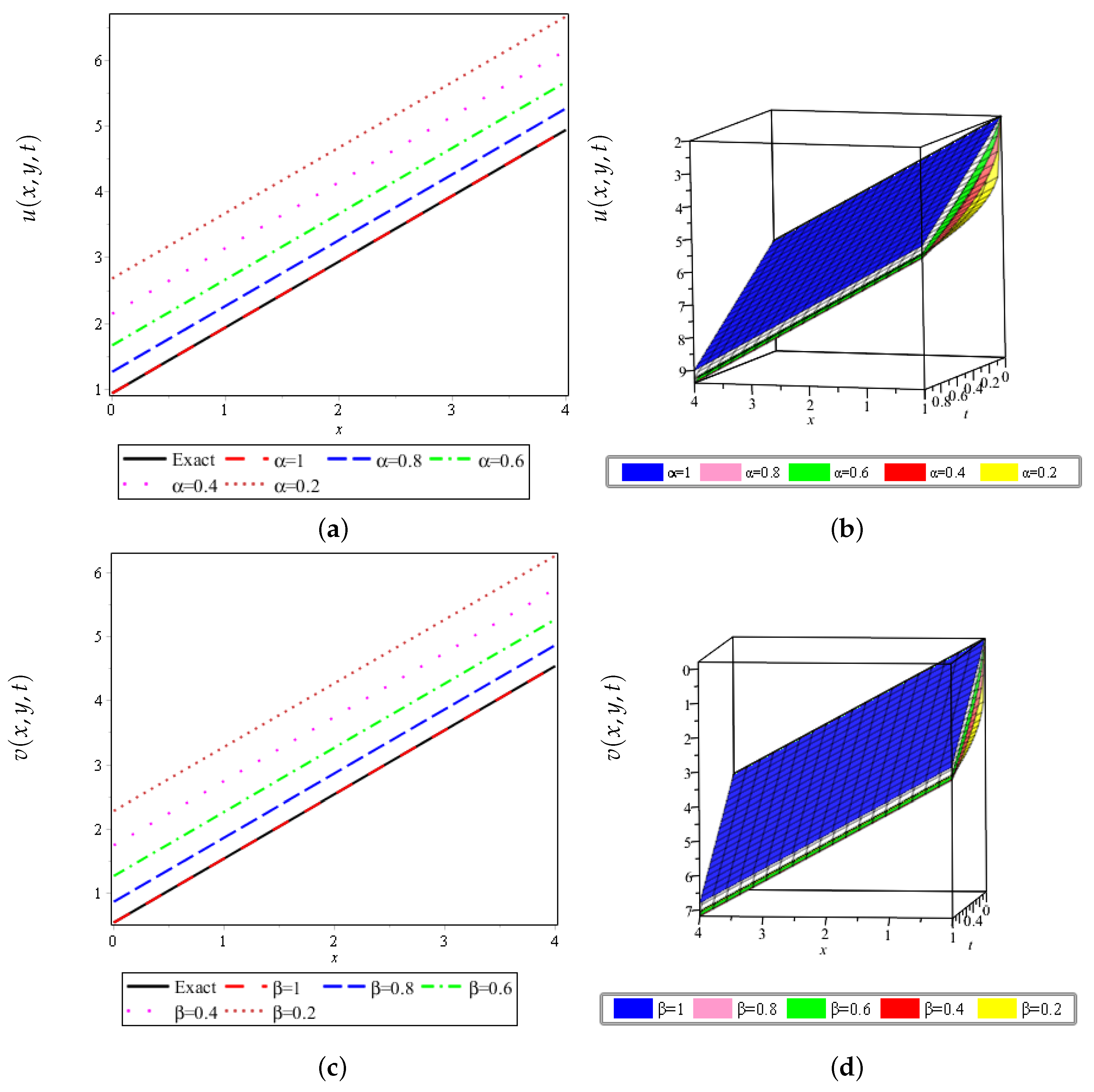
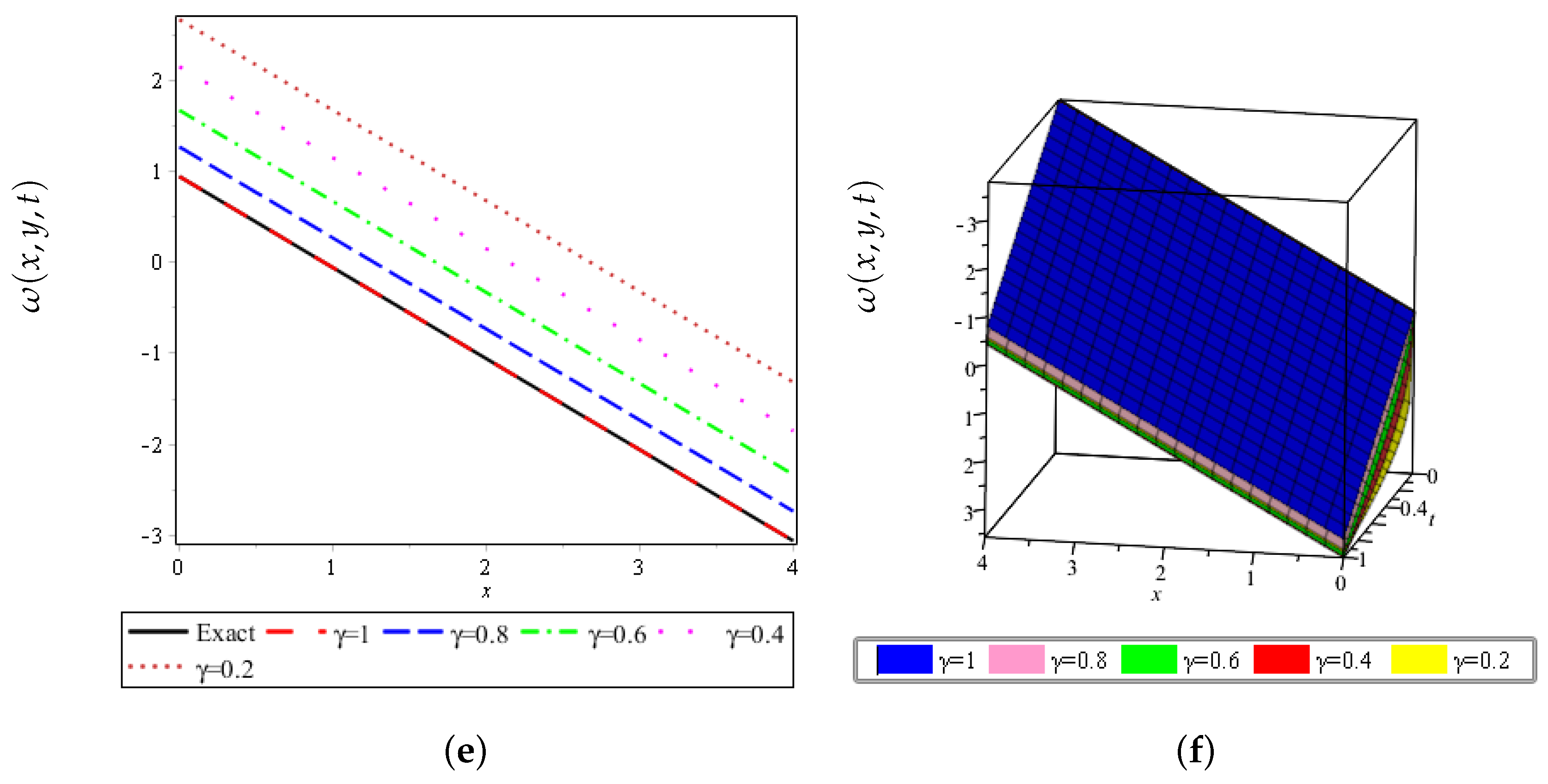
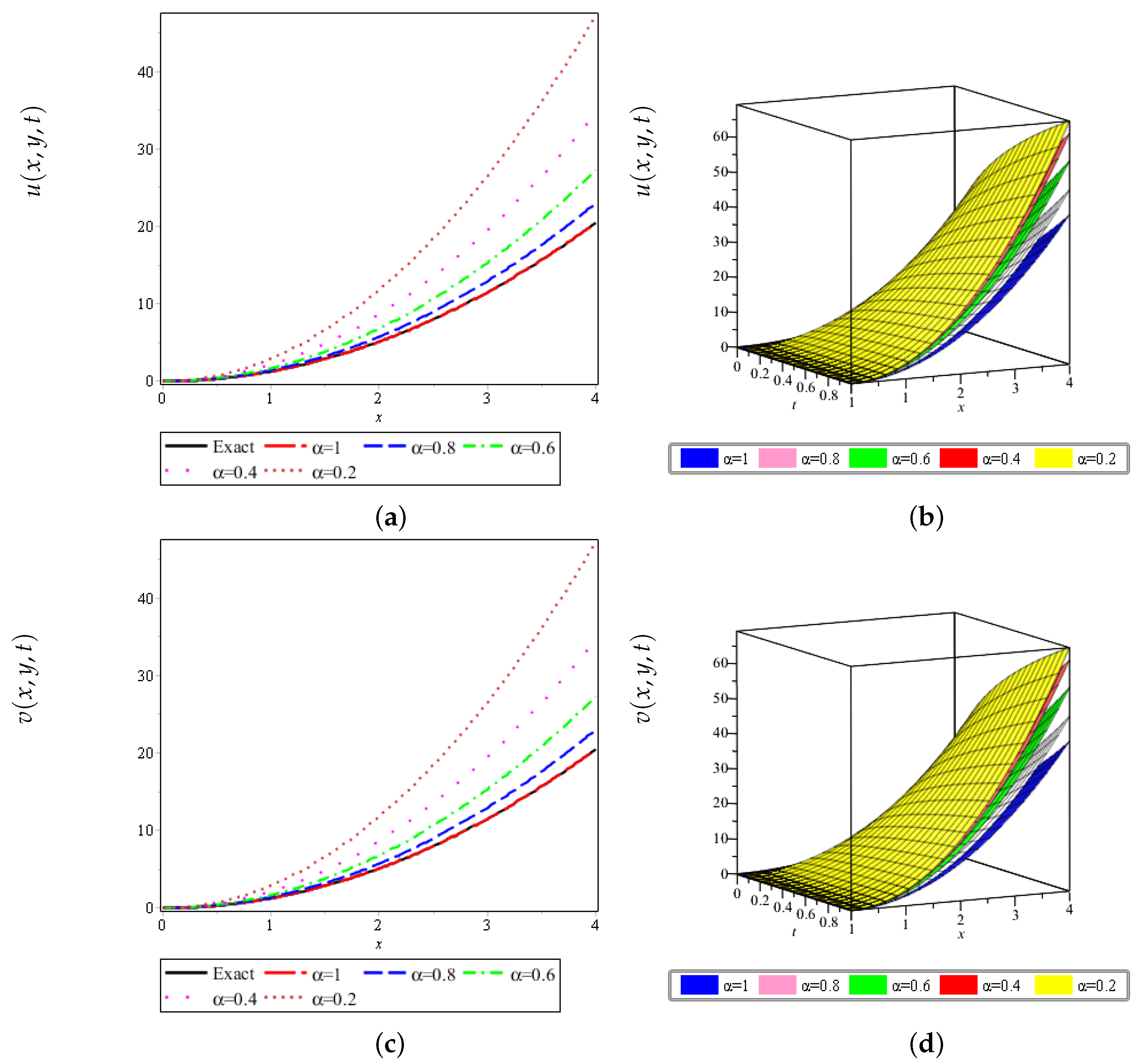
In addition, the above-obtained solution is in full agreement with the results reported in [41], which employed the ( A T ) 2 method. Moreover, the fractional-order solution (37) is examined graphically in Figure 2, showing the impact of varying the fractional-order through 2D and 3D depictions. Besides, as the acquired fractional solutions (37) happened to be linear in both x and y variables, the depictions along x in Figure 2 equally portray linear plots, including all 3D plots along the x-axis. In addition, one notes that increasing the fractional orders reduces the number of solution fields in the system. What is more, as the model is time-fractional, the behavior of the solution has also been noted to be parabolic along the t-axis as the fractional orders decrease; see the respective 3D plots when y = 0.1 and the 2D plots when t = 0.25 and y = 0.1 .
Example 3. 
Consider the coupled inhomogeneous system of singular nonlinear FPDEs of Burger’s equations as follows:
D t α u + 1 x u u x + 1 y v u y 1 x ( x u x ) x 1 y ( y u y ) y = ( x 2 y 2 ) e t , D t α v + 1 x u v x + 1 y v v y 1 x ( x v x ) x 1 y ( y v y ) y = ( x 2 y 2 ) e t ,
where x , y , t > 0 and 0 < α 1 , together with the following initial conditions
u ( x , y , 0 ) = x 2 y 2 , v ( x , y , 0 ) = x 2 y 2 .
Accordingly, the application of the (14), together with its inverse on (39), alongside the utilization of the initial conditions yields the following:
u ( x , y , t ) = x 2 y 2 + S 1 a α S ( x 2 y 2 ) e t 1 x u u x 1 y v u y + 1 x x u x x + 1 y ( y u y ) y , v ( x , y , t ) = x 2 y 2 + S 1 a α S ( x 2 y 2 ) e t 1 x u v x 1 y v v y + 1 x x v x x + 1 y ( y v y ) y .
Furthermore, the application of the ADM technique on the latter coupled equations yields the resultant recursive relation as follows:
u 0 ( x , y , t ) = x 2 y 2 + S 1 a α S [ ( x 2 y 2 ) e t ] , u n + 1 ( x , y , t ) = S 1 a α S 1 x F n 1 y G n + 1 x ( x u n x ) x + 1 y ( y u n y ) y , n 0 ,
v 0 ( x , y , t ) = x 2 y 2 + S 1 a α S ( x 2 y 2 ) e t , v n + 1 ( x , y , t ) = S 1 a α S 1 x H n 1 y I n + 1 x ( x v n x ) x + 1 y ( y v n y ) y , n 0 ,
with F n , G n , H n , and I n as the Adomian polynomials associated with the nonlinear terms that take the following representations:
F 0 = u 0 · u 0 x , G 0 = v 0 · u 0 y , F 1 = u 1 · u 0 x + u 0 · u 1 x , G 1 = v 1 · u 0 y + v 0 · u 1 y , F 2 = u 2 · u 0 x + u 1 · u 1 x + u 0 · u 2 x , G 2 = v 2 · u 0 y + v 1 · u 1 y + v 0 · u 2 y , H 0 = u 0 · v 0 x , I 0 = v 0 · v 0 y , H 1 = u 1 · v 0 x + u 0 · v 1 x , I 1 = v 1 · v 0 y + v 0 · v 1 y , H 2 = u 2 · v 0 x + u 1 · v 1 x + u 0 · v 2 x , I 2 = v 2 · v 0 y + v 1 · v 1 y + v 0 · v 2 y ,
Furthermore, some of the explicit components are accordingly expressed from the above solution scheme as follows:
u 0 ( x , y , t ) = x 2 y 2 + ( x 2 y 2 ) t α E 1 , α + 1 ( t ) , v 0 ( x , y , t ) = x 2 y 2 + ( x 2 y 2 ) t α E 1 , α + 1 ( t ) ,
u 1 ( x , y , t ) = S 1 a α S 1 x ( ( x 2 y 2 + ( x 2 y 2 ) t α E 1 , α + 1 ( t ) ) ( 2 x + 2 x t α E 1 , α + 1 ( t ) ) ) 1 y ( ( x 2 y 2 + ( x 2 y 2 ) t α E 1 , α + 1 ( t ) ) ( 2 y 2 y t α E 1 , α + 1 ( t ) ) )   + 1 x 4 x + 4 x t α E 1 , α ( t ) + 1 y 4 y 4 y t α E 1 , α ( t ) = 0 , v 1 ( x , y , t ) = S 1 a α S 1 x ( ( x 2 y 2 + ( x 2 y 2 ) t α E 1 , α + 1 ( t ) ) ( 2 x + 2 x t α E 1 , α + 1 ( t ) ) ) 1 y ( ( x 2 y 2 + ( x 2 y 2 ) t α E 1 , α + 1 ( t ) ) ( 2 y 2 y t α E 1 , α + 1 ( t ) ) )   + 1 x 4 x + 4 x t α E 1 , α ( t ) + 1 y 4 y 4 y t α E 1 , α ( t ) = 0 ,
and
u n ( x , y , t ) = 0 , n 1 , v n ( x , y , t ) = 0 , n 1 .
Therefore, the above solution converged to the following closed-form fractional-order solution
u ( x , y , t ) = ( x 2 y 2 ) ( 1 + t α E 1 , α + 1 ( t ) ) , v ( x , y , t ) = ( x 2 y 2 ) ( 1 + t α E 1 , α + 1 ( t ) ) ,
where E 1 , α + 1 ( t ) = k = 0 t k Γ ( k + α + 1 ) or equally when setting α = 1 the Mittag-Leffler function reduces to the following form:
E 1 , 2 ( t ) = e t 1 t .
Accordingly, the corresponding solution for the integer-order takes the form:
u ( x , y , t ) = ( x 2 y 2 ) ( e t ) , v ( x , y , t ) = ( x 2 y 2 ) ( e t ) ,
which is the same solution acquired in [43,44,45].
Moreover, the results indicate that both the SDM and the Double Sumudu–Laplace Decomposition Method (DSLDM) [44] yield the same solution with identical accuracy, confirming the mathematical validity of both approaches. However, the SDM is characterized by a simpler algorithmic structure, as it avoids the use of multiple integral transforms and auxiliary operations required by the DSLDM. In contrast, the DSLDM involves successive applications of the Sumudu and generalized Laplace transforms, which increases the procedural complexity of the method. As a result, the SDM requires fewer implementation steps. Consequently, the SDM requires fewer implementation steps, which enhances its computational efficiency and reduces the overall complexity when solving this class of problems. This highlights the importance of simplicity and computational performance in selecting an appropriate method for similar fractional-order models. In the same vein, Figure 3 illustrates the graphical representation of the fractional-order solution, showing the influence of varying the fractional orders, as observed in the previous models. The corresponding three-dimensional plots are presented for y = 0.1 , while the two-dimensional plots are shown for t = 0.25 and y = 0.1 .

5. Conclusions

In this study, we proposed the SDM as an effective analytical technique for solving coupled FPDE systems. By combining the ST with the ADM, SDM serves as a practical analytical tool for handling complex nonlinear problems. The validity and efficiency of the proposed method were demonstrated through several illustrative examples, supported by graphical results generated using Maple software. These results confirmed that SDM not only yields highly accurate approximations but also significantly reduces the computational burden, as hugely experienced in classical approaches. It is worth noting that the SDM, like other series-based methods, has inherent limitations, such as increased computational cost when higher-order Adomian polynomials are required and a restricted convergence range. Nevertheless, within these limitations, the SDM remains effective and reliable for the problems considered in this study. Overall, the findings of this research affirm that SDM is a powerful, reliable, and versatile method, making it a valuable, in addition to being an analytical toolkit for solving both integer-order and fractional-order models in applied mathematics, physics, and engineering.

Limitations and Future Work

It is worth noting that the SDM, like other series-based methods, has inherent limitations, such as increased computational cost when higher-order Adomian polynomials are required and a restricted convergence range. Nevertheless, within these limitations, the SDM remains effective and reliable for the problems considered in this study. Furthermore, the proposed approach opens promising avenues for future research, including its application to higher-dimensional problems and equations involving variable-order fractional derivatives. Continued exploration in this direction could lead to the development of even more robust and general-purpose solvers for complex dynamical systems.

Author Contributions

M.A.-M.: conceptualization; N.S.A.-Y.: formal analysis; writing—original draft; N.S.A.-Y., M.A.-M., and M.A.: methodology, investigation, writing—review and editing; N.S.A.-Y. and M.A.-M.: software. All authors have read and agreed to the published version of the manuscript.

Funding

This work was funded by the University of Jeddah, Jeddah, Saudi Arabia, under grant No. (UJ-25-DR-2294). Therefore, the authors thank the University of Jeddah for its technical and financial support.

Data Availability Statement

The original contributions presented in the study are included in the article; further inquiries can be directed to the corresponding author.

Conflicts of Interest

The authors declare no conflicts of interest.

Abbreviations

The following abbreviations are used in this manuscript:
ADMAdomian decomposition method
STSumudu transform
SDMSumudu decomposition method
FPDEsFractional partial differential equations
HAMHomotopy analysis method
( A T ) 2 Aboodh Tamimi Ansari transform method
DSLDMDouble Sumudu–Laplace decomposition method

References

  1. Lazarevic, M.P.; Rapaić, M.R.; Šekara, T.B. Introduction to fractional calculus with brief historical background. In Advanced Topics on Applications of Fractional Calculus on Control Problems, System Stability and Modeling; WSEAS Press: Athens, Greece, 2014; pp. 3–16. [Google Scholar]
  2. Oldham, K.; Jerome, S. The Fractional Calculus Theory and Applications of Differentiation and Integration to Arbitrary Order; Elsevier: Amsterdam, The Netherlands, 1974. [Google Scholar]
  3. Podlubny, I. Fractional Differential Equations: An Introduction to Fractional Derivatives, Fractional Differential Equations, to Methods of Their Solution and Some of Their Applications; Elsevier: Amsterdam, The Netherlands, 1998. [Google Scholar]
  4. Drapaca, C.S.; Sivaloganathan, S. A fractional model of continuum mechanics. J. Elast. 2012, 107, 105–123. [Google Scholar] [CrossRef]
  5. Baleanu, D.; Wu, G.-C.; Zeng, S.-D. Chaos analysis and asymptotic stability of generalized Caputo fractional differential equations. Chaos Solitons Fractals 2017, 102, 99–105. [Google Scholar] [CrossRef]
  6. Kumar, D.; Seadawy, A.R.; Joardar, A.K. Modified Kudryashov method via new exact solutions for some conformable fractional differential equations arising in mathematical biology. Chin. J. Phys. 2018, 56, 75–85. [Google Scholar] [CrossRef]
  7. Bonfanti, A.; Kaplan, J.L.; Charras, G.; Kabla, A. Fractional viscoelastic models for power-law materials. Soft Matter 2020, 16, 6002–6020. [Google Scholar] [CrossRef]
  8. Prakasha, D.G.; Veeresha, P.; Baskonus, H.M. Residual power series method for fractional Swift-Hohenberg equation. Fractal Fract. 2019, 3, 9. [Google Scholar] [CrossRef]
  9. Prakasha, D.G.; Veeresha, P.; Rawashdeh, S. Numerical solution for (2 + 1)-dimensional time-fractional coupled Burger equations using fractional natural decomposition method. Math. Methods Appl. Sci. 2019, 42, 3409–3427. [Google Scholar] [CrossRef]
  10. Asjad, M.I.; Karim, R.; Hussanan, A.; Iqbal, A.; Eldin, S.M. Applications of fractional partial differential equations for MHD Casson fluid flow with innovative ternary nanoparticles. Processes 2023, 11, 218. [Google Scholar] [CrossRef]
  11. Zhao, M.; He, S.; Wang, H.; Qin, G. An integrated fractional partial differential equation with molecular dynamics simulation modeling of anomalous diffusive transport in nano porous materials. J. Comput. Phys. 2018, 373, 1000–1012. [Google Scholar] [CrossRef]
  12. Al-Smadi, M.; Djeddi, N.; Momani, S.; Al-Omari, S.; Araci, S. An attractive numerical algorithm for solving nonlinear Caputo-Fabrizio fractional Abel differential equation in a Hilbert space. Adv. Differ. Equ. 2021, 2021, 271. [Google Scholar] [CrossRef]
  13. Sharma, N.; Mittal, E.; Agarwal, S.K.; Suthar, D.L. Local fractional Laplace transform method to analyze fractional heat equation. Partial. Differ. Equ. Appl. Math. 2024, 10, 100738. [Google Scholar] [CrossRef]
  14. Mahor, T.C.; Mishra, R.; Jain, R. Analytical solutions of linear fractional partial differential equations using fractional Fourier transform. J. Comput. Appl. Math. 2021, 385, 113202. [Google Scholar] [CrossRef]
  15. Guo, P. The Adomian decomposition method for a type of fractional differential equations. J. Appl. Math. Phys. 2019, 7, 2459–2466. [Google Scholar] [CrossRef]
  16. Odibat, Z.; Momani, S. The variational iteration method: An efficient scheme for handling fractional partial differential equations in fluid mechanics. Comput. Math. Appl. 2009, 58, 2199–2208. [Google Scholar] [CrossRef]
  17. Qu, H.; She, Z.; Liu, X. Homotopy analysis method for three types of fractional partial differential equations. Complexity 2020, 2020, 7232907. [Google Scholar] [CrossRef]
  18. Qazza, A.; Burqan, A.; Saadeh, R.; Khalil, R. Applications on double ARA-Sumudu transform in solving fractional partial differential equations. Symmetry 2022, 14, 1817. [Google Scholar] [CrossRef]
  19. Adomian, G. Nonlinear Stochastic Systems Theory and Applications to Physics; Springer Science & Business Media: Dordrecht, The Netherlands, 1988; Volume 46. [Google Scholar]
  20. Wazwaz, A.-M. Partial Differential Equations and Solitary Waves Theory; Springer Science & Business Media: Berlin/Heidelberg, Germany, 2010. [Google Scholar]
  21. Odibat, Z.; Momani, S. Numerical methods for nonlinear partial differential equations of fractional order. Appl. Math. Model. 2008, 32, 28–39. [Google Scholar] [CrossRef]
  22. Al-Mazmumy, M.; Alsulami, M.; AL-Yazidi, N. Algorithms and applications of the new modified decomposition method to solve initial-boundary value problems for fractional partial differential equations. AIMS Math. 2025, 10, 5806–5829. [Google Scholar] [CrossRef]
  23. Mousa, M.G.; Altaie, H.O. A new technique for solving fractional nonlinear equations by sumudu transform and Adomian decomposition method. Ibn -Haitham J. Pure Appl. Sci. 2022, 35, 128–134. [Google Scholar] [CrossRef]
  24. Ali, H.M.; Ahmad, H.; Askar, S.; Ameen, I.G. Efficient approaches for solving systems of nonlinear time-fractional partial differential equations. Fractal Fract. 2022, 6, 32. [Google Scholar] [CrossRef]
  25. Alomari, A.K. Homotopy-Sumudu transforms for solving system of fractional partial differential equations. Adv. Differ. Equ. 2020, 2020, 222. [Google Scholar] [CrossRef]
  26. Prakash, A.; Kumar, M.; Sharma, K.K. Numerical method for solving fractional coupled Burgers equations. Appl. Math. Comput. 2015, 260, 314–320. [Google Scholar] [CrossRef]
  27. Ahmed, H.F.; Bahgat, M.S.M.; Zaki, M. Numerical approaches to system of fractional partial differential equations. J. Egypt. Math. Soc. 2017, 25, 141–150. [Google Scholar] [CrossRef]
  28. Kumar, D.; Singh, J.; Rathore, S. Sumudu decomposition method for nonlinear equations. Int. Math. Forum 2012, 7, 515–521. [Google Scholar]
  29. Eltayeb, H.; Kılıçman, A. Application of Sumudu Decomposition Method to Solve Nonlinear System of Partial Differential Equations. Abstr. Appl. Anal. 2012, 2012, 412948. [Google Scholar] [CrossRef]
  30. Khan, H.; Tunç, C.; Khan, R.A.; Shirzoi, A.G.; Khan, A. Approximate Analytical Solutions of Space-Fractional Telegraph Equations by Sumudu Adomian Decomposition Method. Appl. Appl. Math. Int. J. 2018, 13, 12. [Google Scholar]
  31. Cherruault, Y. Convergence of Adomian’s Method. Kybernetes 1989, 18, 31–38. [Google Scholar] [CrossRef]
  32. Abbaoui, K.; Cherruault, Y. New ideas for proving convergence of decomposition methods. Comput. Math. Appl. 1995, 29, 103–108. [Google Scholar] [CrossRef]
  33. Hosseini, M.M.; Nasabzadeh, H. On the convergence of Adomian decomposition method. Appl. Math. Comput. 2006, 182, 536–543. [Google Scholar] [CrossRef]
  34. Abbaoui, K.; Cherruault, Y. Convergence of Adomian’s method applied to differential equations. Comput. Math. Appl. 1994, 28, 103–109. [Google Scholar] [CrossRef]
  35. Rajaram, R.; Najafi, M. Analytical treatment and convergence of the Adomian decomposition method for a system of coupled damped wave equations. Appl. Math. Comput. 2009, 212, 72–81. [Google Scholar] [CrossRef]
  36. El-Kalla, I.L. Piece-wise continuous solution to a class of nonlinear boundary value problems. Ain Shams Eng. J. 2013, 4, 325–331. [Google Scholar] [CrossRef]
  37. Kilbas, A.A.; Srivastava, H.M.; Trujillo, J.J. Theory and Applications of Fractional Differential Equations; Elsevier: Amsterdam, The Netherlands, 2006; Volume 204. [Google Scholar]
  38. Caputo, M. Linear models of dissipation whose Q is almost frequency independent–II. Geophys. J. Int. 1967, 13, 529–539. [Google Scholar] [CrossRef]
  39. Jassim, H.K.; Kadmim, H. Fractional Sumudu decomposition method for solving PDEs of fractional order. J. Appl. Comput. Mech. 2020, 7, 302–311. [Google Scholar]
  40. Belgacem, F.B.M.; Karaballi, A.A. Sumudu transform fundamental properties investigations and applications. Int. J. Stoch. Anal. 2006, 2006, 091083. [Google Scholar]
  41. Sultana, M.; Waqar, M.; Ali, A.H.; Lupaş, A.A.; Ghanim, F.; Abduljabbar, Z.A. Numerical investigation of systems of fractional partial differential equations by new transform iterative technique. AIMS Math. 2024, 9, 26649–26670. [Google Scholar] [CrossRef]
  42. Jafari, H.; Seifi, S. Solving a system of nonlinear fractional partial differential equations using homotopy analysis method. Commun. Nonlinear Sci. Numer. Simul. 2009, 14, 1962–1969. [Google Scholar] [CrossRef]
  43. Eltayeb, H.; Mesloub, S. Solution for Time-Fractional Coupled Burgers Equations by Generalized-Laplace Transform Methods. Fractal Fract. 2024, 8, 692. [Google Scholar] [CrossRef]
  44. Eltayeb, H. Application of double Sumudu-generalized Laplace decomposition method and two-dimensional time-fractional coupled Burger’s equation. Bound. Value Probl. 2024, 2024, 48. [Google Scholar] [CrossRef]
  45. Eltayeb, H.; Bachar, I. A note on singular two-dimensional fractional coupled Burgers’ equation and triple Laplace Adomian decomposition method. Bound. Value Probl. 2020, 2020, 129. [Google Scholar] [CrossRef]
Figure 1. Graphical views of the 6th term approximate solution of Example 1 for different values of the fractional orders α , β , and γ . (a) 2D plot for u ( x , y , t ) at different values of α . (b) 3D plot for u ( x , y , t ) at different values of α . (c) 2D plot for v ( x , y , t ) at different values of β . (d) 3D plot for v ( x , y , t ) at different values of β . (e) 2D plot for ω ( x , y , t ) at different values of γ . (f) 3D plot for ω ( x , y , t ) at different values of γ .
Mathematics 14 01149 g001aMathematics 14 01149 g001b
Figure 2. Graphical views of the solution of Example 2 for different values of the fractional orders α , β , and γ . (a) 2D plot for u ( x , y , t ) at different values of α . (b) 3D plot for u ( x , y , t ) at different values of α . (c) 2D plot for v ( x , y , t ) at different values of β . (d) 3D plot for v ( x , y , t ) at different values of β . (e) 2D plot for ω ( x , y , t ) at different values of γ . (f) 3D plot for ω ( x , y , t ) at different values of γ .
Mathematics 14 01149 g002aMathematics 14 01149 g002b
Figure 3. Graphical views of the approximate solution of Example 3 for different values of the fractional-orders α . (a) 2D plot for u ( x , y , t ) at different values of α . (b) 3D plot for u ( x , y , t ) at different values of α . (c) 2D plot for v ( x , y , t ) at different values of α . (d) 3D plot for v ( x , y , t ) at different values of α .
Mathematics 14 01149 g003
Table 1. The point-wise error of the 6th iterative estimated and exact solution of Example 1 at t = 0.2 and y = 1 .
xSDM (u)(AT)2 [41]HAM [42]SDM (v)(AT)2 [41]HAM [42]SDM ( ω )(AT)2 [41]HAM [42]
0.1 2.59 × 10 7 7.44 × 10 9 2.59 × 10 7 3.73 × 10 9 1.05 × 10 10 3.71 × 10 9 2.25 × 10 7 2.25 × 10 7 2.48 × 10 7
0.2 2.88 × 10 7 8.22 × 10 9 2.86 × 10 7 4.11 × 10 8 1.18 × 10 9 4.11 × 10 8 2.03 × 10 7 5.79 × 10 9 2.03 × 10 7
0.3 3.18 × 10 7 9.09 × 10 9 3.17 × 10 7 4.54 × 10 8 1.29 × 10 9 4.54 × 10 8 1.85 × 10 7 5.24 × 10 9 1.84 × 10 7
0.4 3.50 × 10 7 1.00 × 10 8 3.50 × 10 7 5.03 × 10 8 1.42 × 10 9 5.02 × 10 8 1.66 × 10 7 4.74 × 10 9 1.66 × 10 7
0.5 3.88 × 10 7 1.11 × 10 8 3.87 × 10 7 5.56 × 10 8 1.57 × 10 9 5.54 × 10 8 1.50 × 10 7 4.29 × 10 9 1.50 × 10 7
0.6 4.28 × 10 7 1.22 × 10 8 4.27 × 10 7 6.14 × 10 8 1.74 × 10 9 6.13 × 10 8 1.35 × 10 7 3.88 × 10 9 1.36 × 10 7
0.7 4.72 × 10 7 1.35 × 10 8 4.73 × 10 7 6.78 × 10 8 1.92 × 10 9 6.77 × 10 8 1.22 × 10 7 3.51 × 10 9 1.23 × 10 7
0.8 5.23 × 10 7 1.49 × 10 8 5.22 × 10 7 7.48 × 10 8 2.13 × 10 9 7.49 × 10 8 1.12 × 10 7 3.18 × 10 9 1.11 × 10 7
0.9 5.78 × 10 7 1.65 × 10 8 5.77 × 10 7 8.30 × 10 8 2.35 × 10 9 8.28 × 10 8 1.02 × 10 7 2.87 × 10 9 1.01 × 10 7
1.0 6.36 × 10 7 1.83 × 10 8 6.38 × 10 7 9.10 × 10 8 2.60 × 10 9 9.14 × 10 8 9.10 × 10 8 8.27 × 10 8 9.10 × 10 8
Disclaimer/Publisher’s Note: The statements, opinions and data contained in all publications are solely those of the individual author(s) and contributor(s) and not of MDPI and/or the editor(s). MDPI and/or the editor(s) disclaim responsibility for any injury to people or property resulting from any ideas, methods, instructions or products referred to in the content.