Next Article in Journal
Optimizing Preventive and Treatment Strategies for Obesity Reduction: A Mathematical Modeling and Cost-Effectiveness Analysis
Previous Article in Journal
A Fuzzy Satisfaction-Based Intelligent Framework for Multiobjective Design of a Buck DC-DC Converter Under Uncertain Operating Conditions
Previous Article in Special Issue
Generalized Synchronization of a Novel Hyperchaotic System and Application in Secure Communication
 
 
Due to scheduled maintenance work on our servers, there may be short service disruptions on this website between 11:00 and 12:00 CEST on March 28th.
Article

High-Speed Image Compression–Encryption Scheme Based on a New Chaotic Map and Improved Lifting Wavelet Transform

1
School of Computer Science and Engineering, Central South University, Changsha 410083, China
2
Department of Information Technology, Hunan Police Academy, Changsha 410138, China
3
School of Computer Science, Xiangtan University, Xiangtan 411105, China
4
College of Sports Science, Changsha Normal University, Changsha 410100, China
*
Author to whom correspondence should be addressed.
Mathematics 2026, 14(7), 1114; https://doi.org/10.3390/math14071114
Submission received: 20 February 2026 / Revised: 21 March 2026 / Accepted: 24 March 2026 / Published: 26 March 2026
(This article belongs to the Special Issue Chaotic Systems and Their Applications, 2nd Edition)

Abstract

In resource-constrained communication environments, important image data needs to be compressed before encrypted transmission. This paper proposes effective solutions to this issue. Firstly, a new one-dimensional discrete chaotic system model was constructed based on the logistic system and fractional structure. Through theoretical analysis combined with numerical simulation experiments, it has been proven that the proposed new system has excellent chaotic characteristics. Compared with some traditional one-dimensional chaotic systems, the new system has a wider range of chaotic parameters and stronger complexity, making it more suitable for image data encryption. Secondly, a high-compression-ratio image compression method based on improved lifting wavelet transform and a fast image encryption algorithm based on the new chaotic map are proposed. Simulation experiments and security analysis results show that the proposed image compression–encryption scheme has excellent performance and less time overhead. It has good resistance to various cryptanalysis attacks and strong robustness to noise and data loss attacks, which indicates that the proposed image compression–encryption scheme has good application potential in resource-constrained communication environments. The main contribution of this article is the design of a new chaotic system model with practical performance and the development of a new application case. The main novelty of this paper is the proposal of a fast algorithm for high compression ratio and encryption of images.

1. Introduction

With the popularization of computer network communication and the widespread application of big data, multimedia data exchange is becoming increasingly frequent. Among numerous multimedia information, images are often used for network transmission due to their visual and intuitive characteristics. In the field of artificial intelligence, high-performance visual deep neural network models cannot do without the support of a large number of image datasets. Images have also been widely used in fields such as healthcare, military warfare, transportation, social media, economics, and finance. In these many application scenarios, the secure storage and confidential transmission of important image data are becoming increasingly important, which remains a relatively basic network security issue. Image encryption is an effective method, and the most fundamental one for protecting the security of image data. For example, common medical images usually require partial disclosure of information, but in order to prevent the leakage of patient personal information, the images must be encrypted, etc. Compared with textual information, digital images have the characteristics of large data volume, high redundancy, and strong correlation between adjacent pixels [1]. Traditional block ciphers, such as AES, were originally designed for text or binary data streams. However, when dealing with multimedia data with high redundancy, large data volumes, and strong correlations, they may face issues of insufficient efficiency or mismatched security. Therefore, traditional block ciphers do not match the real-time encryption requirements of multimedia information (images, videos) [2,3]. Chaos cryptography provides a lightweight, high-strength native solution for these scenarios. The core advantage of chaotic cryptography lies in its inherent randomness derived from deterministic chaotic systems, extreme sensitivity to initial conditions, and long-term unpredictability. In the current data environment, a chaos-based encryption scheme is often chosen, especially for multimedia data such as images and videos, because it can provide high security, high efficiency, and natural compatibility with data characteristics that traditional methods find difficult to balance. Of course, chaotic cryptography is not intended to completely replace traditional encryption techniques such as AES, but rather to provide a specialized solution with better performance and comparable security in specific encryption scenarios such as images and videos. It utilizes the natural characteristics of chaotic dynamics to achieve a better balance between security and efficiency and is a powerful tool for addressing current multimedia security challenges. The encryption methods for ensuring the secure transmission of digital images have attracted widespread attention from researchers, and many chaos-based encryption methods continue to emerge [4,5,6].
Although chaotic cryptography has obvious advantages in multimedia information encryption, chaos-based encryption methods also have a security vulnerability, which is that chaotic systems can be cracked through phase space reconstruction methods, including parameter and structure identification. In order to enhance the performance of chaotic systems and reduce the performance degradation of digital chaotic systems, some new methods such as adaptive symmetric maps [7], adaptive chaos-based image encryption [8], and symmetric perturbation [9] have been proposed. In Ref. [7], Tutueva et al. studied adaptive symmetric chaotic maps and their application to pseudo-random number generation. They proposed a novel technique utilizing the chaotic maps with adaptive symmetry to create chaos-based encryption schemes with larger parameter space. Moreover, the study indicates that chaotic maps with adaptive symmetry are suitable for stream ciphers. Dey et al. [8] proposed an adaptive chaos-based image encryption scheme that integrates spiral pixel shuffling, chaos-driven dynamic S-box substitution, and hybrid chaotic diffusion. Xie et al. [9] proposed a novel image encryption framework that addresses the challenges of high plaintext sensitivity, resistance to statistical attacks, and key security. The method enhances the confusion and diffusion effects by utilizing the principle of symmetric perturbation. Recently, some other new chaotic encryption technologies have also been proposed. For example, Duan et al. [10] proposed a hyper-chaotic color image encryption scheme based on 3D bit-level permutation and a diffusion model. Li et al. [11] proposed a 1D Chebyshev-hyperbolic composite chaotic map (1D-CHCCM) and a visual security image encryption algorithm based on the 1D-CHCCM. Demirta et al. [12] proposed a hyperbolic Chirp-signal-based chaotic map and a robust encryption algorithm for DICOM image protection.
In addition, due to the large amount of image data, joint image compression and encryption technology has a clear application background for resource-constrained environments [13]. In recent years, the use of compressive sensing in image compression and encryption has attracted the attention of many scholars [14,15,16,17,18]. For example, Yao et al. [19] proposed an image compression and encryption scheme based on compressive sensing and a four-dimensional hyperchaotic system. Li et al. [20] proposed an image encryption algorithm based on compressive sensing and a two-dimensional linear canonical transform. However, using compressive sensing methods to compress images requires a high computational cost, and the reconstruction effect of a compressed image is not satisfactory under high compression ratios. Therefore, it is necessary to explore lighter image compression methods in resource-constrained environments and applications that require higher compression ratios. Wavelet transform provides an alternative approach for image compression. The traditional wavelet transform calculation method proposed by SWELDENS in 1996 has been widely applied in the field of signal processing. With the development of wavelet transform theory, especially after the emergence of lifting wavelet transform (LWT) based on a lifting algorithm, wavelet transform has been increasingly widely applied in image matching, image segmentation, image filtering, image compression, and other fields. Lifting wavelet transform belongs to the second-generation wavelet transform, which has a smaller computational complexity and much faster calculation speed than traditional wavelet transform. It also uses fewer resources in hardware implementation, which to some extent expands the application field of wavelet transform. The JPEG2000 still image compression standard uses discrete LWT as the core transformation algorithm. In recent years, some researchers have proposed image compression encryption methods based on integer wavelet transform [21,22].
Among numerous image encryption methods, the study of using chaotic systems for image encryption is the most popular. Due to the advantages of sensitivity to initial values, non-repeatability, and unpredictability, chaotic systems are often combined with other types of algorithms to encrypt images. In the process of image encryption, many scholars often use traditional scrambling diffusion structures, combining different scrambling and diffusion algorithms to ensure security. Common scrambling algorithms include magic square transformation [23], Arnold-based matrix transformation [24], Baker transformation [25], etc. Common diffusion algorithms include XOR-based [26], cyclic-shift-based [27], etc. To improve the security of image encryption, many scholars have cracked some traditional scrambling diffusion encryption algorithms. In the process of searching for new encryption methods, some scholars have found that wavelets have the characteristics of multi-resolution and decorrelation and have obvious advantages in time–frequency analysis. Wavelet transform technology can also be introduced in the field of image encryption. Specifically, the improved lifting wavelet transform not only has great potential for application in image compression, but can also be used in image encryption [28,29].
Chaotic systems can be classified into discrete time systems and continuous time systems based on mathematical models. Discrete time systems, especially one-dimensional discrete chaotic maps, have the advantages of simple structure and easy hardware implementation, making them more practical for real-time image encryption scenarios. Some studies have shown that discrete chaotic maps have higher complexity than continuous systems [30,31]. However, some traditional one-dimensional discrete chaotic maps, such as the Logistic map, do not have continuous chaotic characteristics for system parameters, and the range of chaotic parameters is narrow, which is not conducive to the security of information encryption applications. Therefore, it is necessary to construct new, higher-security chaotic systems that are more suitable for cryptographic applications.
Based on the above analysis, this paper designs a new one-dimensional fractionally structured chaotic map and proposes a new image compression–encryption scheme by applying the improved lifting wavelet transform and the new chaotic map. The main contributions of this article are as follows:
(1)
A new one-dimensional chaotic system model with a larger chaotic interval and stronger complexity has been designed.
(2)
A novel image compression algorithm based on the improved lifting wavelet transform is proposed.
(3)
A fast image encryption algorithm based on the new chaotic map is proposed.
(4)
A series of complexity criteria have demonstrated the complex chaotic characteristics of the new chaotic map, and the security of the proposed image compression–encryption scheme and the effectiveness of image reconstruction have been verified through extensive experiments and security analysis.
The rest of this paper is organized as follows. In Section 2, the new system model of the one-dimensional fractionally structured chaotic map is presented, and its complexity of chaotic behavior is analyzed. In Section 3, an image compression–encryption scheme based on lifting wavelet transform and the new chaotic map is proposed. In Section 4, the image decryption and reconstruction algorithm based on lifting wavelet transform and the new chaotic map are elaborated. Section 5 provides experimental results and security analysis of the proposed image compression–encryption scheme. Finally, Section 6 presents the conclusion.

2. The New 1D Chaotic Map

Let f(x) be a function that maps x ∈ (0, 1) → f(x) ∈ (0, 1). The newly designed one-dimensional (1D) chaotic map with a fractal structure is presented in this section. Its mathematical model is as follows:
x n + 1 = f ( x n ) = 4 b x n ( 1 x n ) a x n + b ,   x n ( 0 , 1 ) .
where a > 0 and b > 0 are controlling parameters of the system. In Equation (1), we adopt the iterative function of the fractional structure to separate the points of adjacent orbits in the state space (phase space) of the dynamical system. The following content of this section will use both theoretical proof and experimental analysis to demonstrate the complexity of the chaotic behavior of system (1).

2.1. Boundedness Analysis

From Equation (1), one can obtain the following results:
(1)
If xn = 0 or xn = 1, then f(xn) = 0. If 0 < xn < 1, then f(xn) > 0. This fact indicates that the function f(xn) has a lower bound of f(xn) > 0 in the domain of xn ∈ (0, 1).
(2)
Since 4 b x n ( 1 x n ) 4 b × 0.5 × ( 1 0.5 ) b , we can deduce that f(xn) ≤ b/(axn + b) < b/b = 1 for axn > 0. This indicates that the function f(xn) has an upper bound of f(xn) < 1 when xn ∈ (0, 1).

2.2. Fixed Point and Its Stability Analysis

The derivative of f(x) at point x is:
f ( x ) = 4 b ( a x 2 a x 2 x + 1 ) ( a x + b ) 2 .
Let x ^ be the fixed point (equilibrium point) of system (1), then f( x ^ ) = x ^ hold. Thus, x ^ meets the following condition:
4 b x ^ ( 1 x ^ ) a x ^ + b = x ^ .
Solving Equation (3) yields x ^ = 3 b a + 4 b . Then, the derivative of the function f(x) at the fixed point x ^ is:
f ( x ^ ) = 2 + 9 a 4 ( a + b ) .
Proposition 1.
Given the assumption a < 0.8b, the equilibrium point of system (1) must satisfy  x ^ > 0.625 .
Proof. 
For x ^ = 3b/(a + 4b), if a < 0.8b, then x ^ > 3b/(0.8b + 4b) = 0.625. □
Proposition 2.
The fixed points  x ^  of system (1) are unstable if  a < 0.8 b .
Proof. 
Considering that a > 0 and b > 0, if a < 0.8b, then b/a > 1.25. According to Equation (4), we have  f ( x ^ ) < 1 . That is,  lim Δ x n 0 Δ x n + 1 / Δ x n x n = x ^ = f ( x ^ ) > 1  holds at any fixed points of  x ^  when  a < 0.8 b , which means that  Δ x n + 1 > Δ x n . The results prove that the map becomes unstable at any fixed points of  x ^ > 0.625 . □
According to Ref. [32], when all the fixed points of a dynamical system are unstable, the system is chaotic. Therefore, Proposition 2 actually proves that system (1) is chaotic when its parameters satisfy the condition a < 0.8b.

2.3. The Diagram of Bifurcation and Lyapunov Exponent

In order to visually observe how many state values the system can generate through iteration under different parameter conditions, it is necessary to draw a bifurcation diagram of the system state values versus the system parameters. If the system can only have a limited number of state values under certain parameter conditions, then the system is periodic. On the contrary, if there are infinitely many state values, the system is chaotic. The Lyapunov exponent is also an important criterion for the chaotic characteristics of a system. If the Lyapunov exponent (LE) of a dynamical system is positive under certain parameter conditions, then the system under that parameter condition is chaotic. The Lyapunov exponent of a one-dimensional discrete iterative system can be calculated by
L E = lim N 1 N ( n = 1 N ln f ( x n ) )
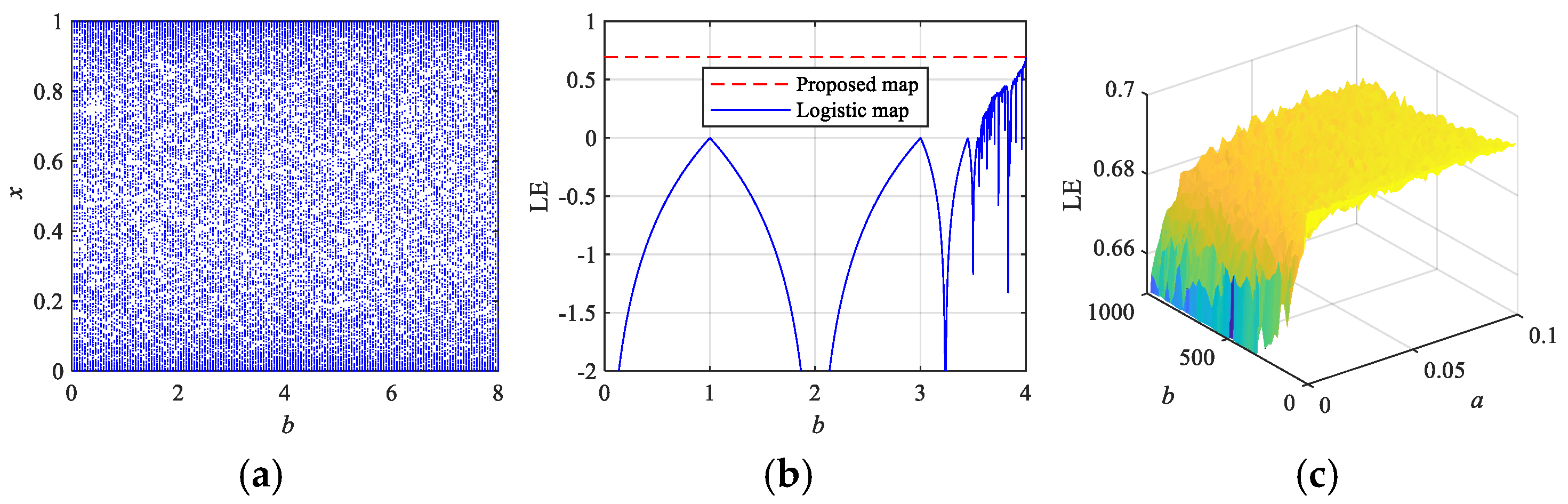
where f ( x n ) is the value of the derivative of the mapping function at x n . N is an integer number that is large enough. Figure 1a is the bifurcation diagram of the state quantity of system (1) changing with parameter b. Figure 1b is the graph of the Lyapunov exponent of system (1) changing with parameter b, where a is set to a fixed value of 0.0001. Figure 1b also shows the Lyapunov exponent of the Logistic map. Figure 1c shows the 3D representations of the Lyapunov exponent of system (1), in which a and b are the control parameters. From the results in Figure 1, it can be seen that the Lyapunov exponent of system (1) is always positive in the entire value space of parameters, and its state values also fill the entire (0, 1) interval. In the experiment, we took the parameter change step size of 0.05. At such a small parameter step size, no periodic window was observed in the bifurcation diagram, and no zero or negative Lyapunov exponent values appeared. In addition, the chaotic interval is much larger than that of the Logistic system. The chaotic characteristics are continuous in the parameter value space.

2.4. The Time Series Diagram and Cobweb Graph

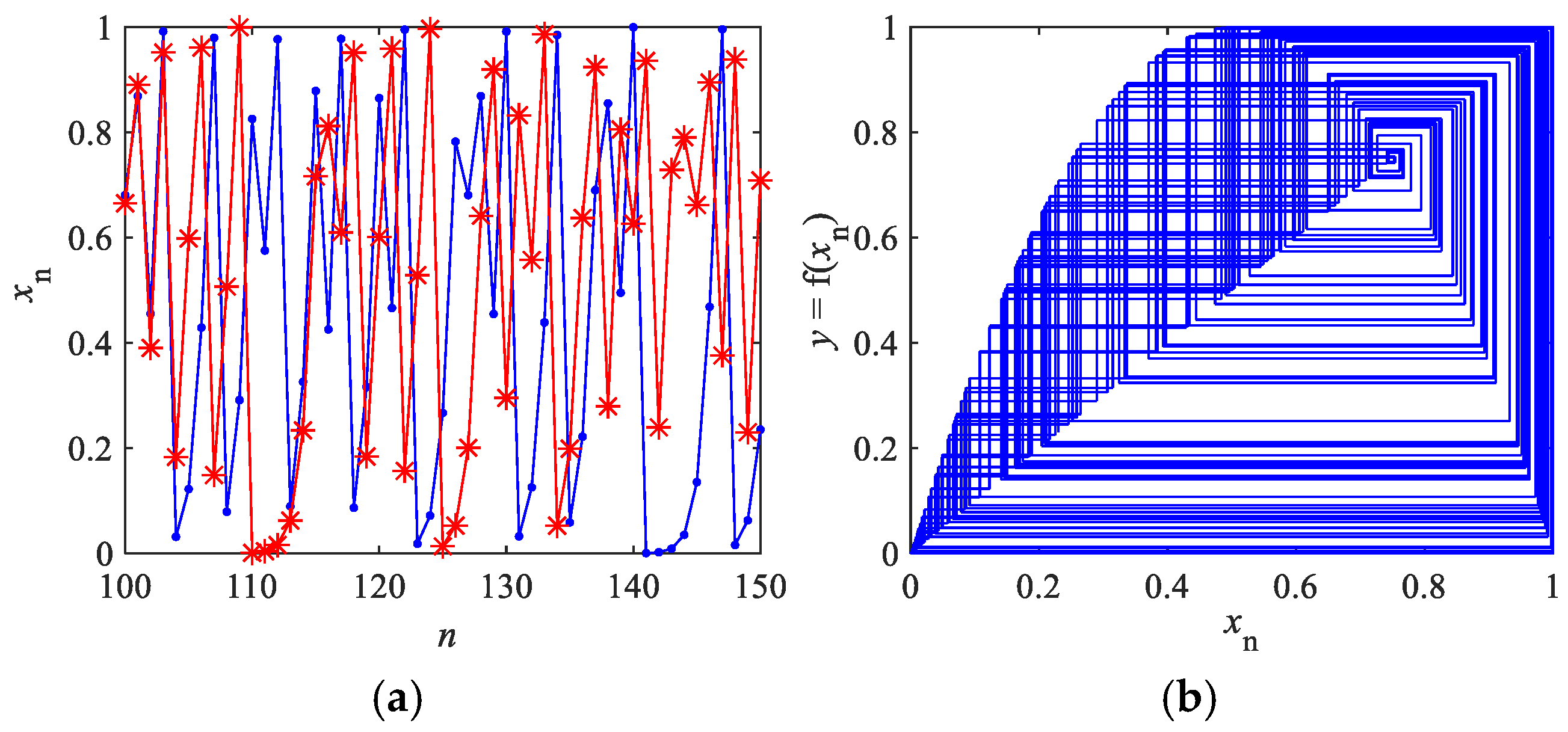
In order to further investigate the chaotic characteristics of system (1), Figure 2a,b depict the sensitivity of the system time series against the initial state and the non-periodicity of the system orbit, respectively. Figure 2a shows two time series generated by system (1). The initial values of the system states that generate these two time series differ by only 10−12. It can be seen that the orbits formed by the nuance in the initial state after long-term iteration are very different, indicating that system (1) is extremely sensitive to the initial conditions. Figure 2b is the cobweb diagram generated by system (1), that is, given any initial value x0 belongs to (0, 1), and the orbits generated by the system after long-time iteration are infinite chaotic orbits. The above facts further confirm the chaos of system (1). The parameters used in Figure 2 are: a = 0.0004 and b = 4.

2.5. Correlation Function Analysis

The correlation of time series can be described by the correlation coefficient. Time series with strong randomness should have a δ function for their autocorrelation, and their cross-correlation should be infinitely close to zero. The autocorrelation coefficient at lag k of a series {x(1), x(2), …, x(N)} of length N is normally given as:
a u t o c o r r ( k ) = i = 1 N k ( x ( i ) x ¯ ) ( x ( i + k ) x ¯ ) i = 1 N k ( x ( i ) x ¯ ) 2 .
where x ¯ is the average value of the series {x(1), x(2), …, x(N)}.
The cross-correlation of two series, {x(1), x(2), …, x(N)} and {y(1), y(2), …, y(N)}, of length N at lag k is defined as:
c r o s s c o r r ( k ) = i = 1 N k ( x ( i ) x ¯ ) ( y ( i + k ) y ¯ ) i = 1 N k ( x ( i ) x ¯ ) 2 i = 1 N k ( y ( i ) y ¯ ) 2 .
where y ¯ is the average value of the series {y(1), y(2), …, y(N)}.
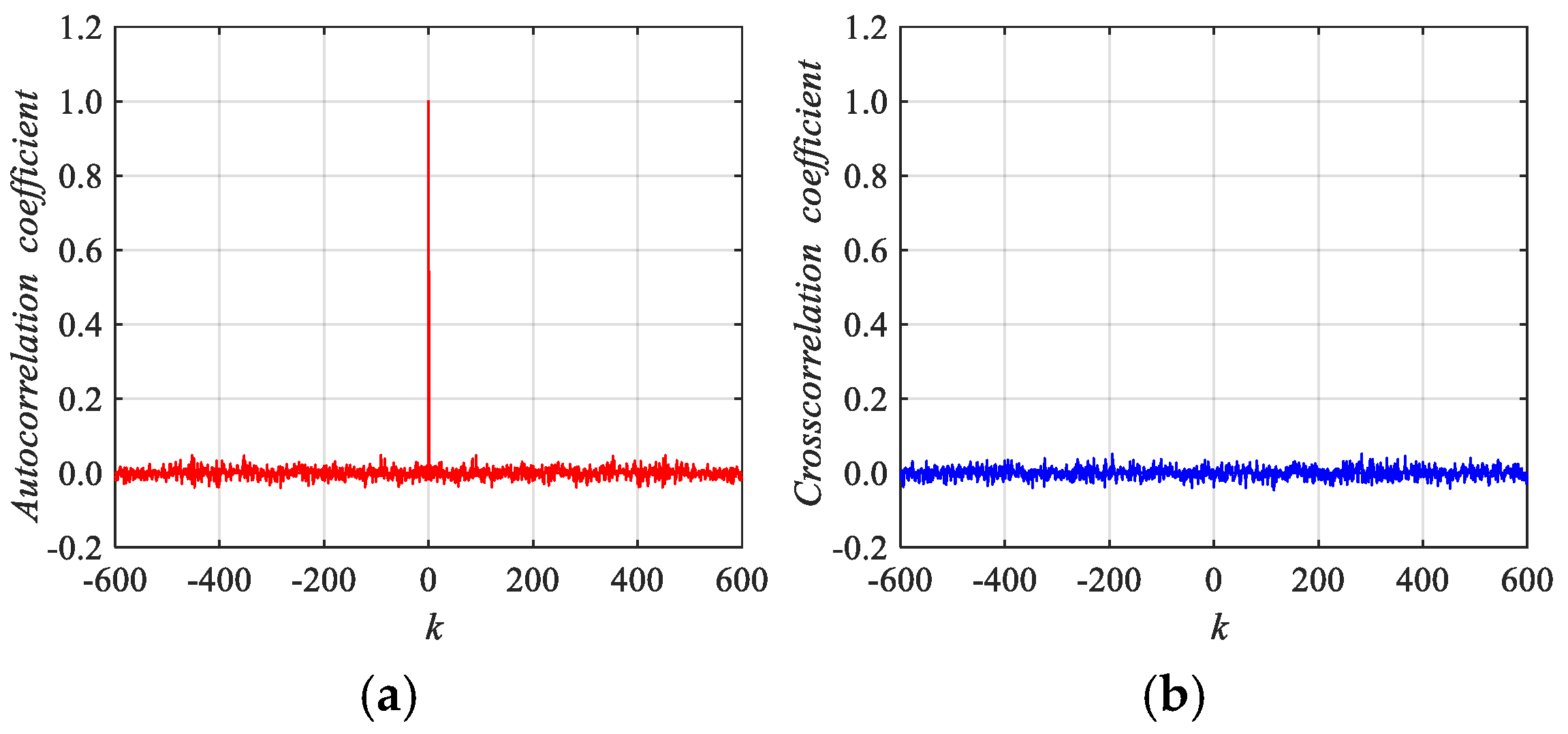
For system (1), the autocorrelation coefficient curve of the chaotic sequence {x(i)} generated with the system parameters a = 0.0001, b = 5.80, and initial state value x(0) = 0.23 is shown in Figure 3a, and the cross-correlation coefficient curve of two chaotic sequences, {x(i)} and {y(i)}, generated when a = 0.0001, b = 5.80, and y(0) = 0.27 is shown in Figure 3b.

2.6. Approximate Entropy Analysis

Approximate entropy (ApEn) is also a means to measure the complexity of time series. Approximate entropy describes the probability of generating new patterns in a sequence with an increase in the embedding dimension [33]. Suppose a time series of length N is u = [u(1), u(2), …, u(N)], and presume a positive real number r (called the time delay) and a positive integer m (called the embedding dimension). The algorithm of calculating ApEn can be described as follows:
Select (Nm + 1) subsequences v of length m from the sequence u:
v ( i ) = [ u ( i ) , u ( i + 1 ) , , u ( i + m 1 ) ] ,   i = 1 , 2 , , N m + 1 .
The distance d(i, j) between the vector v(i) and v(j) is defined as:
d ( i , j ) = max ( u ( i + k 1 ) u ( j + k 1 ) k = 1 , 2 , , m )
Calculate the following scalars C i m ( r ) for a fixed i:
C i m ( r ) = # { d ( i , j ) < r } / ( N m + 1 )
where # { d ( i , j ) < r } represents the number of j satisfying the condition d ( i , j ) < r .
Then calculate the following scalars ϕ m ( r ) :
ϕ m ( r ) = i = 1 N m + 1 log e [ C i m ( r ) ] / ( N m + 1 )
Finally, the approximate entropy of sequence u corresponding to (r, m) is obtained:
A p E n ( u , r , m ) = ϕ m ( r ) ϕ m + 1 ( r ) .
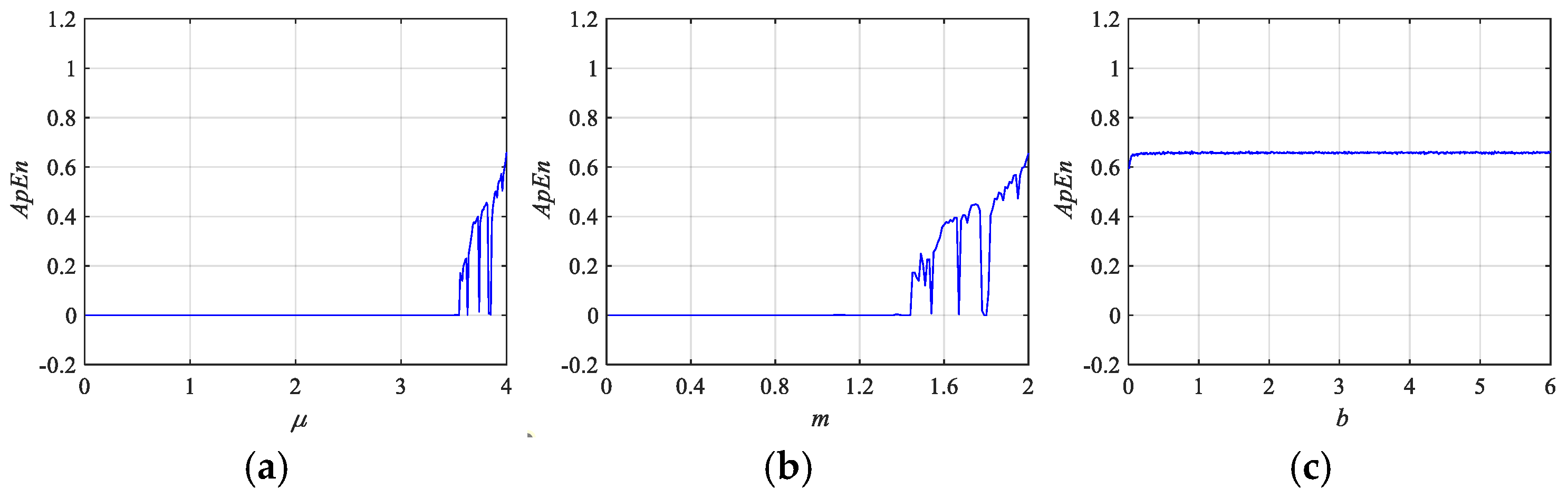
In the experiment, we introduced two chaotic maps for comparison: one was the famous Logistic map [34], and the other was the quadratic polynomial map [33]. Then the ApEn values of the chaotic systems (1) and the comparable chaotic maps were drawn, as shown in Figure 4. From Figure 4, one can see that system (1) has more stable ApEn values and a larger parameter range. Therefore, this result indicates that the sequence generated by system (1) has better randomness performance than the sequences generated by the other comparable maps.

2.7. Correlation Dimension Analysis

Correlation dimension (CD) is applied to measure the geometric complexity of chaotic systems [35]. It can distinguish chaotic aperiodic sequences from periodic sequences. Let X = {X(1), X(2), …} be a time series and E be the embedded dimension. The CD of X can be computed by
C D = lim r 0 lim N log C E ( r ) log r ,
where C E ( r ) = lim N i = 1 N ( E 1 ) ζ j = i + 1 N ( E 1 ) ζ θ ( r s ¯ i s ¯ j ) [ N ( E 1 ) ζ ] [ N ( E 1 ) ζ 1 ] . θ ( · ) is the Heaviside step function, ζ is the time delay, and s ¯ i = ( s i , s i + ζ , s i + 2 ζ , , s i + ( E 1 ) ζ ) i = 1 , 2 , , N ( E 1 ) ζ . Generally, the embedding dimension E = 2 and time delay ζ = 1 for a 1D system [36].
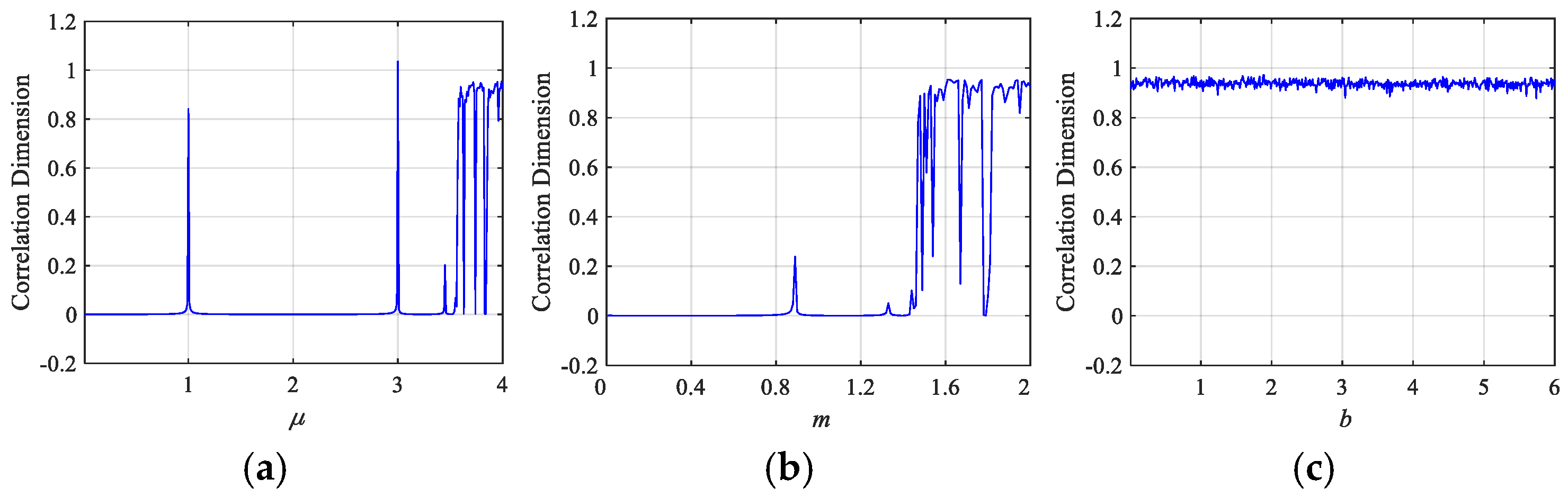
In this test, we used the toolbox function correlationDimension(X) in Matlab to calculate the correlation dimension of time series X generated by system (1) with different parameters b; the results are shown in Figure 5. Figure 5 also shows the results of two comparable chaotic maps: the Logistic map [34] and the quadratic map [33]. The results indicate that as long as the parameter b of system (1) is greater than zero, the system is chaotic. It can also be seen that system (1) has higher maximum correlation dimension values when b > 0. Therefore, the phase space of the system (1) has better chaotic performance than the two comparable maps.

3. The Proposed Image Compression–Encryption Scheme

3.1. 1D Improved Lifting Wavelet Transform and Its Inverse Transformation

The lifting wavelet transform (LWT) is a new generation of the first-generation wavelet transform, which includes the following three basic steps: splitting, prediction, and updating. By modifying the prediction function and updating function, different improvement lifting schemes can be obtained. Assume that the original input signal is a one-dimensional data sequence represented by x = { x i } , i = 1, 2, …, n, where n is the length of the sequence, and n is required to be an even integer number without loss of generality. After one wavelet transform, the original signal sequence is decomposed into a low-frequency component sequence s = { s j } and a high-frequency component sequence d = { d j } , where, j = 1, 2, …, n/2. The length of both component sequences is half of the original sequence length, so lifting wavelet transform is sometimes called lifting wavelet decomposition. The following are the algorithm steps for the improved lifting wavelet transform:
Step 1: Splitting process. Split sequence x = { x 1 , x 2 , , x n } into two subsequences consisting of even and odd subscript elements of x, namely e = { e 1 , e 2 , , e n / 2 } and o = { o 1 , o 2 , , o n / 2 } , where
e j = x 2 j ,   o j = x 2 j 1 ,   j   =   1 ,   2 , ,   n / 2 .
Step 2: Prediction process. The prediction process uses odd and even subscript element subsequences in the input sequence to calculate the high-frequency component d output by the wavelet transform. The prediction algorithm is shown in Equation (11):
d j = e j ( o j + o j + 1 ) × u ,   for j = 1 , 2 , , n / 2 1 d j = e j ( o j + o j ) × u ,   for j = n / 2 .
where u is a specific constant, and x represents finding integers less than or equal to x .
Step 3: Update process. The update process uses the elements in the high-frequency component d to update the elements in the o sequence, obtaining the approximate components of the wavelet transform output. The update algorithm is shown in Equation (12):
s j = o j + ( d j 1 + d j + 2 ) × v for j = 2 , 3 , , n / 2 s j = o j + ( d j + d j + 2 ) × v for j = 1 .
where v is a specific constant.
Step 4: Merge process. The merge process connects the low-frequency and high-frequency components obtained above to obtain the output wavelet transformed sequence { s 1 , s 2 , , s n / 2 , d 1 , d 2 , , d n / 2 } , which is also known as a sequence of wavelet coefficients.
From the above transformation Formulas (11) and (12), it can be seen that integer operations are used in the transformation process. Therefore, for an input integer sequence, the transformed result is also an integer sequence, so lifting wavelet transform is also called integer wavelet transform. The wavelet coefficient sequence obtained by performing a lifting wavelet transform on a row vector is still a row vector, with the left half of the wavelet coefficient sequence being low-frequency coefficients and the right half being high-frequency coefficients. Similarly, lifting wavelet transform can be applied to a column vector, and the upper half of the transformed sequence consists of low-frequency coefficient subsequences, while the lower half consists of high-frequency coefficient subsequences.
Inverse lifting wavelet transform is the operation of recovering the original sequence from the wavelet coefficient sequence, which is the inverse operation of lifting wavelet transform. The algorithm steps are as follows:
Step 1: Splitting. Split the sequence of wavelet coefficients { s 1 , s 2 , , s n / 2 , d 1 , d 2 , , d n / 2 } into the low-frequency subsequence { s 1 , s 2 , , s n / 2 } and the high-frequency subsequence { d 1 , d 2 , , d n / 2 } .
Step 2: Undo update. Recover the odd index elements of the original sequence through the inverse operation of Formula (13):
o j = s j ( d j 1 + d j + 2 ) × v j = 2 , 3 , , n / 2 o 1 = s 1 ( d 1 + d 1 + 2 ) × v .
Step 3: Undo prediction. Recover the even index elements of the original sequence through the inverse operation of Formula (14):
e j = d j + ( o j + o j + 1 ) × u j = 1 , 2 , , n / 2 1 e n / 2 = d n / 2 + ( o n / 2 + o n / 2 ) × u .
Step 4: Merge operation. Use sequence e = { e 1 , e 2 , , e n / 2 } and o = { o 1 , o 2 , , o n / 2 } to recover the original sequence x = { x 1 , x 2 , , x n } , where
x 2 j = e j ,   x 2 j 1 = o j ,   j   =   1 ,   2 , ,   n / 2 .

3.2. The Overall Framework of Image Compression and Encryption Scheme

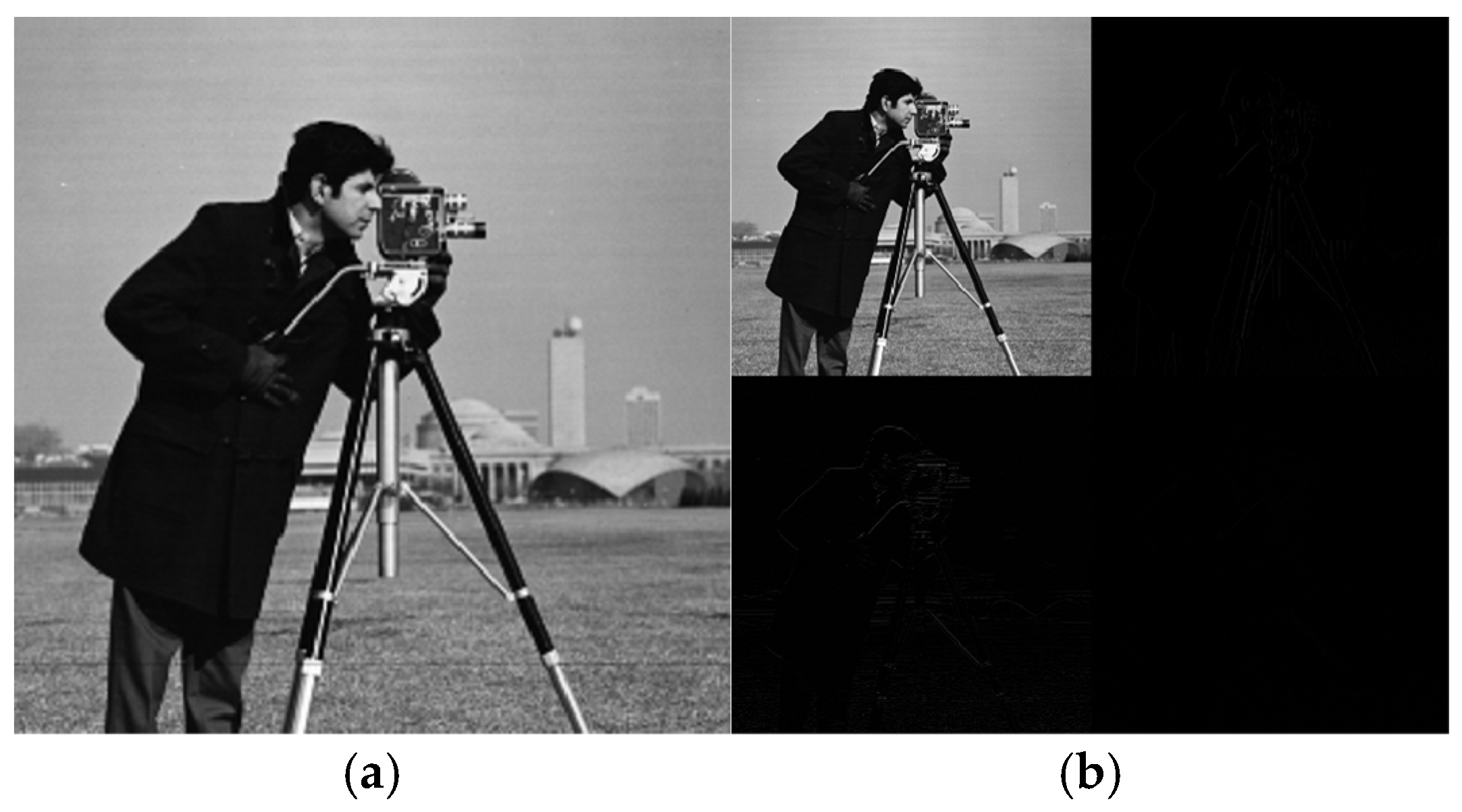
We can apply 1D lifting wavelet transform to 2D image transformation. Firstly, one-dimensional lifting wavelet transform is performed on each row of data in the image. After completing all row transformations, a wavelet coefficient image consisting of two subgraphs on the left and right will be obtained, with low-frequency coefficients on the left and high-frequency coefficients on the right. Then, each column of data in the image is subjected to 1D lifting wavelet transform. After completing the transformation of rows and columns, the 2D lifting wavelet transform of the image is achieved and a wavelet coefficient image consisting of four sub-images will be obtained. Among them, the sub-image coefficients in the upper left corner (LL) are low-frequency in both horizontal and vertical directions. The sub-image coefficients in the upper right corner (HL) are high-frequency in the horizontal direction and low-frequency in the vertical direction. The sub-image coefficients in the bottom left corner (LH) are low-frequency in the horizontal direction and high-frequency in the vertical direction. The sub-image coefficients in the bottom right corner (HH) are high-frequency in both horizontal and vertical directions. Figure 6 shows the wavelet coefficient image obtained from the Cameraman image after the lifting wavelet transform, where Figure 6a is the original Cameraman image and Figure 6b is the wavelet coefficient image of Cameraman. The low-frequency subgraph in the upper left corner of the wavelet coefficient image can be regarded as an approximate sub-image of the original image. And the other four sub-images are all detailed sub-images of the original image. If the inverse 2D lifting wavelet transform is directly applied to the image composed of wavelet coefficients, we can fully and accurately restore the original image. As shown in Figure 6b, the low-frequency sub-image obtained after lifting wavelet transform is visually very similar to the original image, but its size is only one fourth of the size of the original image. Due to the generally small values of high-frequency wavelet coefficients, the grayscale values of the four detailed sub-images are very close to 0. If the approximate sub-image is used as the transmitted image, its data volume is only one fourth of the original image, which is equivalent to achieving an image compression effect with a compression ratio of 25%.
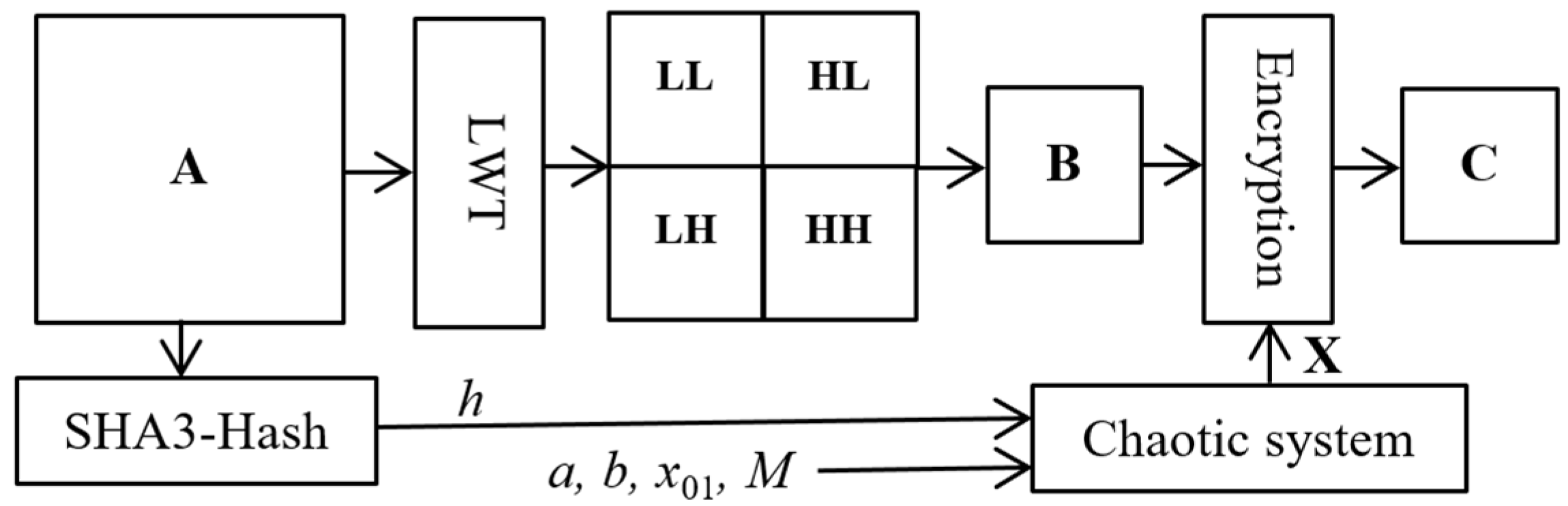
The image compression–encryption algorithm proposed in this paper includes three major processes: firstly, the process of generating chaotic sequences; secondly, image compression processing based on improved lifting wavelet transform; thirdly, a fast image encryption algorithm based on chaotic keys. Figure 7 shows the overall framework of the proposed image compression and encryption scheme. In Figure 7, A represents the original image, B represents the compressed image, and C represents the compressed and encrypted final image.

3.3. Generation of Chaotic Secret Key Streams

The algorithm steps to generate chaotic secret key streams are as follows:
Step 1: Input the external secret keys of {a, b, x01, M}.
Step 2: The original image A to be compressed and encrypted is input into the SHA3-256 algorithm to generate a SHA3-256 hash value h with a length of 64 hexadecimal characters: h = h 1 h 2 h 64 .
Step 3: The 64 hexadecimal characters are transformed to 32 positive decimal integers, i.e., num(1), num(2), …, and num(32), where, num(i) = hex2dec( h 2 i 1 h 2 i ), i = 1, 2, …, 32.
Step 4: The 32 decimal integers are transformed to a fraction number x 02 as
x 02 = ( i = 1 32 n u m ( i ) / 32 ) / 255
Step 5: Calculate the initial state value x 0 of chaotic system (1) from x 01 and x 02
x 0 = x 01 × x 02
Step 6: Iterate chaotic system (1) for (M × M + 1000) times with parameters of {x0, a, b} to generate a chaotic sequence X1 with a length of (M × M + 1000).
Step 7: Remove the first 1000 values in sequence X1 to get the final output sequence X of the algorithm.

3.4. Image Compression Scheme Based on Improved Lifting Wavelet Transform

The specific steps of the image compression algorithm based on the improved lifting wavelet transform are shown in Algorithm 1.
Algorithm 1: The proposed image compression algorithm.
Input: The original image A.
Output: The compressed image B.
Step 1:
Implement two-dimensional lifting wavelet transform on the original image A and obtain four wavelet coefficient sub-images.
Step 2:
Extract the low-frequency sub-image of wavelet coefficients, and convert the wavelet coefficients of the low-frequency sub-image into 8-bit unsigned integers to obtain the compressed image B and output B.

3.5. The High-Speed Image Encryption Scheme

The algorithm steps of the high-speed image encryption scheme are described as follows:
Input: The image B to be encrypted and the chaotic sequence X.
Output: The cipher image C.
Step 1: Get the pixel number L of the image B.
Step 2: Convert the pixel matrix of image B into a one-dimensional sequence B of length L.
Step 3: Split the pixel sequence B into two sub-sequences: one is a sub-sequence e = {B(2), B(4), …, B(L − 2), B(L)}, which is composed of even index elements of B; and another sub-sequence is o = {B(1), B(3), …, B(L − 3), B(L − 1)}, which is composed of odd index elements of B.
Step 4: Split the chaotic sequence X into two sub-sequences: one is a sub-sequence xe = {x(2), x(4), …, x(L − 2), x(L)}, which is composed of even index elements of X; and another sub-sequence is xo = {x(1), x(3), …, x(L − 3), x(L − 1)}, which is composed of odd index elements of X.
Step 5: Generate equivalent key sequences Ke and Ko from the two chaotic subsequences xe and xo according to Formula (18):
K e ( i ) = mod ( x e ( i ) × 10 m , 256 ) ,   i = 1 , 2 , , L / 2 K o ( i ) = mod ( x o ( i ) × 10 m , 256 ) ,   i = 1 , i = 1 , 2 , , L / 2
Step 6: Use Formula (19) to perform diffusion encryption on pixel sequence o:
o ( i ) = mod ( e ( i ) + K e ( i ) , 256 ) o ( L / 2 ) × x e ( i ) ,   i = 1 o ( i ) = mod ( e ( i ) + K e ( i ) , 256 ) o ( i 1 ) × x e ( i ) ,   i = 2 , 3 , , L / 2
Step 7: Use Formula (20) to perform diffusion encryption on pixel sequence e:
e ( i ) = mod ( o ( i ) + K o ( i ) , 256 ) e ( L / 2 ) × x o ( i ) ,   i = 1 e ( i ) = mod ( o ( i ) + K o ( i ) ,   256 ) e ( i 1 ) × x o ( i ) ,   i = 2 , 3 , ,   L / 2
Step 8: Obtain the encrypted ciphertext pixel sequence C = { c(1), c(2), …, c(L)}, where
c ( 2 i ) = e ( i ) ,   i = 1 , 2 , , L / 2 c ( 2 i 1 ) = o ( i ) ,   i = 1 , 2 , , L / 2
Step 9: Convert the one-dimensional pixel sequence C into a two-dimensional matrix to obtain the ciphertext image to be output.

4. The Proposed Image Decryption and Reconstruction Scheme

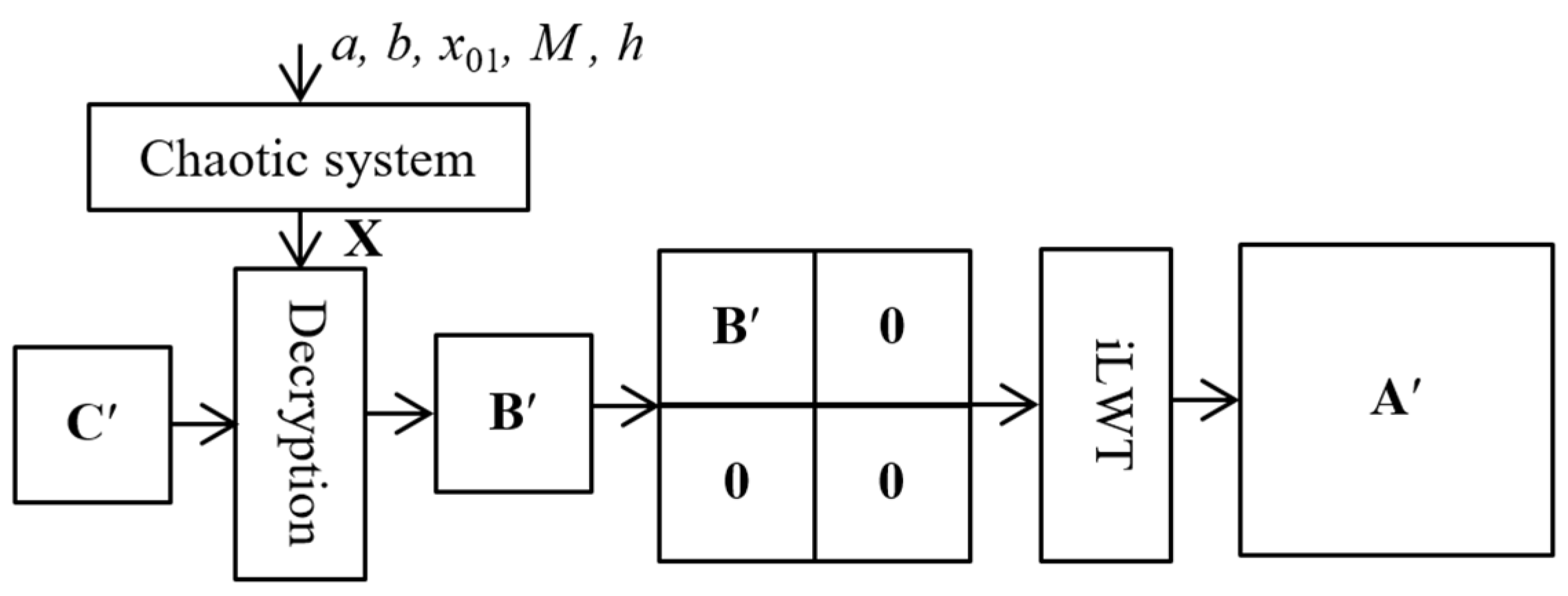
The entire process of the image decryption and reconstruction scheme includes three major steps: the generation of the chaotic key sequence, image decryption, and image reconstruction. The overall process of the image decryption and reconstruction scheme is shown in Figure 8. Among them, the algorithm for generating chaotic key sequences is the same as described in Section 3.3 and will not be repeated here. And the image reconstruction algorithm is based on the improved inverse lifting wavelet transformation (iLWT).

4.1. The High-Speed Image Decryption Scheme

The algorithm steps of the high-speed image decryption scheme are described as follows:
Input: The cipher image C’ and the chaotic sequence X.
Output: The decrypted image B’.
Step 1: Get the pixel number L of image C’.
Step 2: Convert the pixel matrix of image C’ into a one-dimensional sequence C of length L.
Step 3: Split the pixel sequence C into two sub-sequences: one is a sub-sequence e = {C(2), C(4), …, C(L − 2), C(L)}, which is composed of even index elements of C; and another sub-sequence is o = {C(1), C(3), …, C(L − 3), C(L − 1)}, which is composed of odd index elements of C.
Step 4: Split the chaotic sequence X into two sub-sequences: one is a sub-sequence xe = {x(2), x(4), …, x(L − 2), x(L)}, which is composed of even index elements of X; and another sub-sequence is xo = {x(1), x(3), …, x(L − 3), x(L − 1)}, which is composed of odd index elements of X.
Step 5: Generate equivalent key sequences Ke and Ko from the two chaotic subsequences xe and xo according to the previous Formula (18).
Step 6: Use the following Formula (22) to decrypt pixel sequence e:
e ( i ) = mod ( o ( i ) + K o ( i ) ,   256 ) e ( L / 2 ) × x o ( i ) ,   i = 1 e ( i ) = mod ( o ( i ) + K o ( i ) ,   256 ) e ( i 1 ) × x o ( i ) ,   i = 2 , 3 , , L / 2
Step 7: Use Formula (23) to decrypt pixel sequence o:
o ( i ) = mod ( e ( i ) + K e ( i ) , 256 ) o ( L / 2 ) × x e ( i ) ,   i = 1 o ( i ) = mod ( e ( i ) + K e ( i ) , 256 ) o ( i 1 ) × x e ( i ) ,   i = 2 , 3 , , L / 2
Step 8: Obtain the decrypted pixel sequence B = {B(1), B(2), …, B(L)}, where
B ( 2 i ) = e ( i ) ,   i = 1 , 2 , , L / 2 B ( 2 i 1 ) = o ( i ) ,   i = 1 , 2 , , L / 2
Step 9: Convert the one-dimensional pixel sequence B into a two-dimensional matrix to obtain the decrypted image B’ to be output.

4.2. The Image Reconstruction Scheme

The steps of image reconstruction based on the improved inverse lift wavelet transform are shown in Algorithm 2.
Algorithm 2: The image reconstruction algorithm.
Input: The compressed image B’.
Output: The reconstructed original image A’.
Step 1:
Obtain the number of rows and columns of image B’, which should be equal. Let the number of rows or columns be a.
Step 2:
Construct an attempt image T with a size of 2a × 2a and composed of all zero elements, and then replace the a × a sized sub-image in the upper left corner of image T with the element values of image B’. The resulting image is represented by T’.
Step 3:
Implement inverse lift wavelet transform to image T’ to obtain the reconstructed original image A’ and output A’.

5. Experimental Results and Security Analysis

We used MATLAB 2022b to verify the proposed encryption algorithm on a PC with an Intel(R) Core i7-9700 @ 3.00 GHz CPU and 16.0 GB memory. The test images are from the famous standard test images databases, CVG-UGR and USC-SIPI. The external secret keys were set as a = 0.0001, b = 5.80; x02 = 0.272. The improved lifting wavelet transformation parameters were set as u = 0.5, v = 0.305.

5.1. Image Compression and Reconstruction Performance Analysis

5.1.1. Subjective Visual Quality of Reconstructed Images

Classical 512 × 512 grayscale images (M = 512), including Lena, Barbara, Peppers, and Cameraman were used for the experiments. As a comparison experiment, the compressive sensing method [16,17] was introduced. The experiments compared the difference in the quality of reconstructed images between the LWT method in this paper and the compressive sensing method. Considering that the number of rows or columns in the low-frequency sub-image after lift wavelet transform is half of the number of rows or columns in the original image, the compression ratio obtained by replacing the original image with the low-frequency sub-image is S R = ( 0.5 N × 0.5 N ) / ( N × N ) = 0.25 .
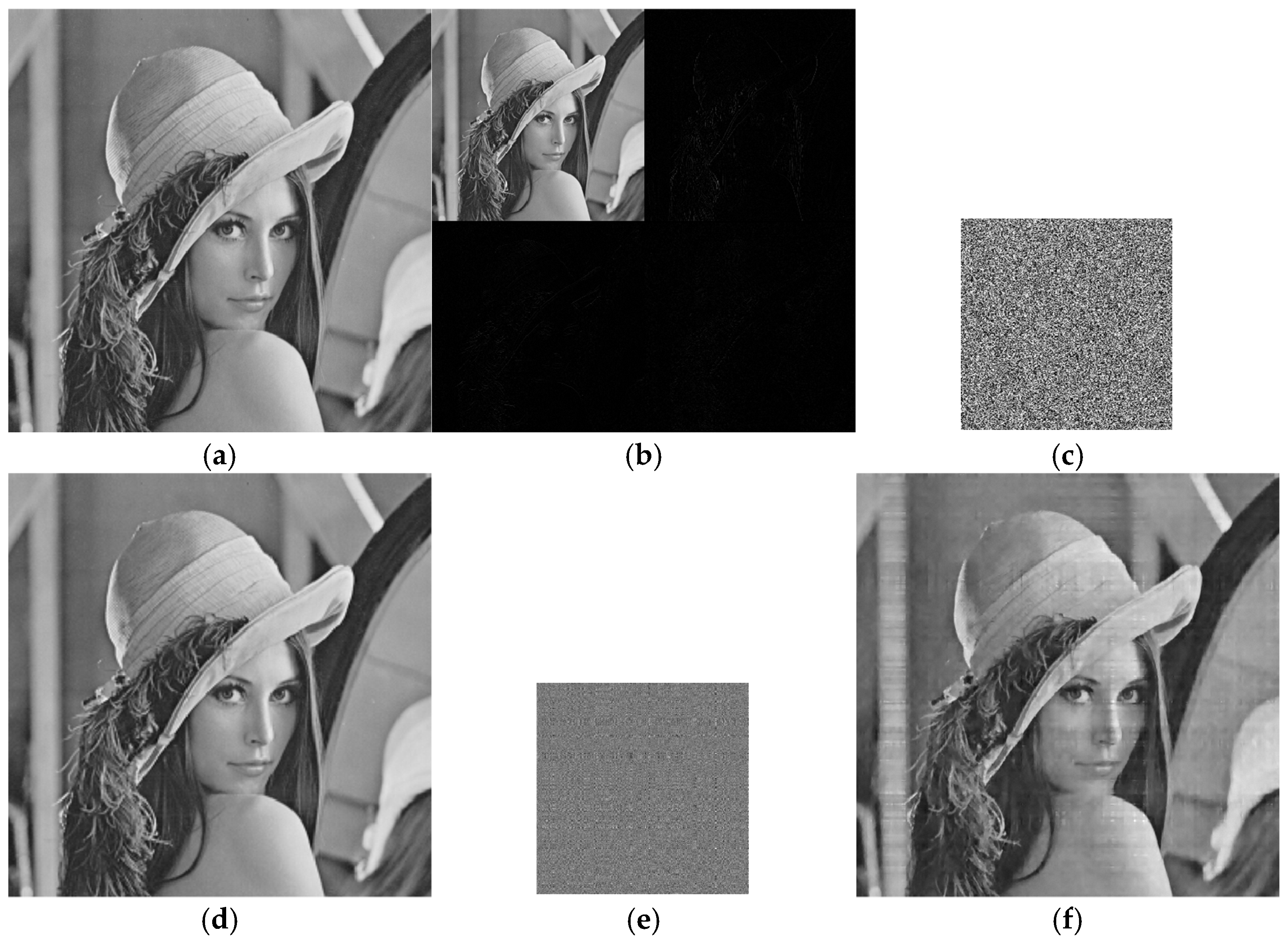
Figure 9 shows a comparison of the intuitive effects of compressed and reconstructed images using the Lena image as an example. Comparing Figure 9d,f, it can be seen that under the same compression ratio of 0.25, the reconstructed image obtained by using the wavelet transform compression method in this paper has much better visual effects than the compressive sensing method. Moreover, comparing Figure 9a,d, there is no significant visual difference between the reconstructed image and the original image.

5.1.2. Structural Similarity and Peak Signal-to-Noise Ratio Analysis

Due to the fact that the image compression method based on improved lifting wavelet transform proposed in this paper belongs to lossy compression, in addition to the compression ratio indicator, the quality of reconstructed image is also an important indicator.
Here, the recovery quality of the reconstructed image is measured by calculating two metrics, peak signal-to-noise ratio (PSNR) and structural similarity (SSIM), between the reconstructed image and the original image, and the larger the value of the two metrics, the better the quality of the reconstructed image. The PSNR is calculated based on the maximum possible power of the signal, which correlates with the signal-to-noise ratio (SNR) of the image. The PSNR is calculated using the following formula:
P S N R = 10 × log 10 [ I max 2 M S E ] .
where Imax is the maximum of pixel value of the image. The higher the PSNR value, the better the quality of the reconstructed image. SSIM is used to measure the structural similarity index of image quality. One can use the MATLAB function ssim(R, A) to calculate the structural similarity of a grayscale image A by using R as a reference image. The closer the SSIM value is to 1, the more similar the images A and R.
To determine the quality of the reconstructed image, the PSNR and SSIM values are computed for the reconstructed images of Lena, Baboon, Cameraman, and Peppers. And SSIM values are also computed for the reconstructed images by using their original images. Table 1 presents the PSRN and SSIM values of reconstructed images at two different compression ratios. If only low-frequency subgraphs are used as transmission images, the compression ratio is 0.25. At such a high compression ratio, the reconstructed image can still obtain satisfactory PSRN and SSIM values, which is generally better than the reconstructed image quality of compressive sensing methods [16,17]. When the compression ratio coefficient increases to 0.5, the PSRN and SSIM values of the reconstructed image are also higher.

5.2. Image Encryption Performance Analysis

This section analyzes and presents the experimental tests of the algorithm performance of the encryption module proposed in this paper.

5.2.1. Key Space Analysis

The performance of a cryptographic system against brute force attacks depends on its key space. The external key set of the proposed scheme in this paper includes the parameters of {a, b, x01, x02}. The key set contains four double precision parameters, and each parameter has 15 decimal places. Therefore, the total key space is 1015 × 1015 × 1015 × 1015 = 1060 > 2199. According to reference [37], currently, encryption systems are secure when the key space is greater than 2100. Therefore, the proposed scheme has a sufficiently large key space to effectively resist brute force attacks.

5.2.2. Histogram Analysis

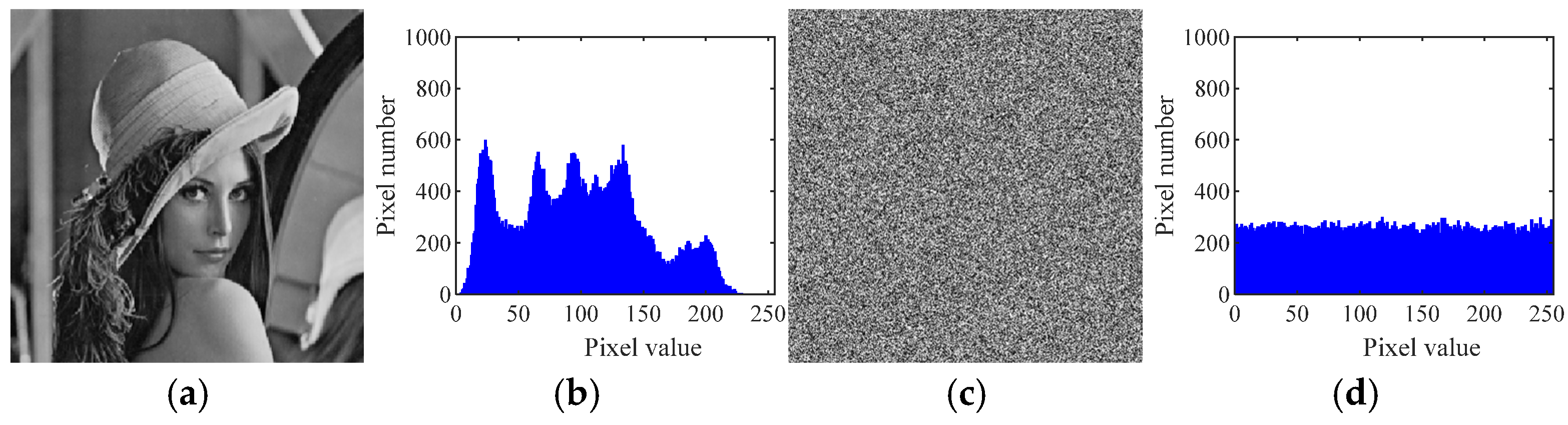
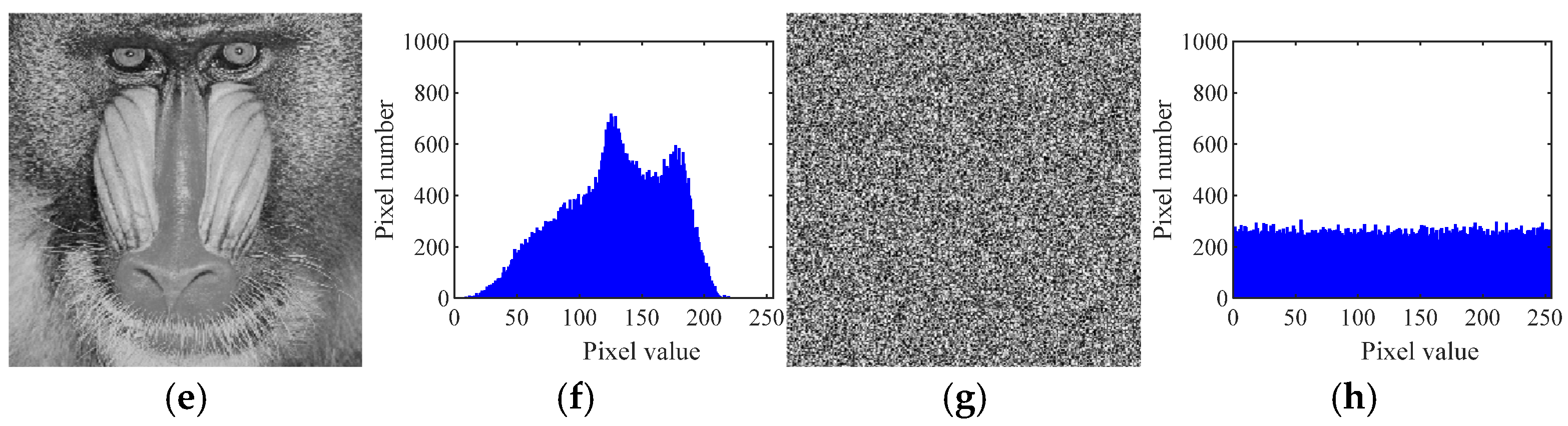
The statistical histogram of an image can intuitively display the distribution of pixel values in the image. In fact, the histogram of a meaningful natural image usually has a non-uniform distribution pattern. A good encryption algorithm should ensure that the histogram of an encrypted image has a uniformly distributed style. Figure 10 shows the statistical histograms of two test images and the ciphertext image obtained using the encryption algorithm proposed in this paper. By comparison, it can be seen that the encrypted image and its corresponding plaintext image have completely different histograms. Although the histograms of the original image have an uneven distribution pattern, the encrypted ciphertext images have uniformly distributed histograms. Therefore, encrypted images can effectively resist statistical analysis attacks.

5.2.3. Correlation Analysis

For meaningful natural images, the grayscale values of adjacent pixels are very close, which means there is a strong correlation between adjacent pixels. A good encryption algorithm should weaken the correlation between adjacent pixels, so that the grayscale values between adjacent pixels are no longer close. The correlation strength between adjacent pixels can be quantitatively described using correlation coefficients. Therefore, this paper introduces the correlation coefficient to test the correlation between adjacent pixels in an image. The correlation coefficient can be calculated using the following formulas:
E ( x ) = 1 N x y i = 1 N x y x i
D x = 1 N x y i = 1 N x y x i E ( x ) 2
cov x , y = 1 N x y i = 1 N x y x i E ( x ) y i E ( y )
r x y = cov x , y / D x D y
Among them, (xi, yi) represents the grayscale value of any pair of adjacent pixels in the image, Nxy represents the total number of randomly selected pixel pairs from the image, and r x y represents the correlation coefficient of adjacent pixels in the image. The smaller the absolute value of r x y , the weaker the correlation between adjacent pixels. Table 2 lists the correlation coefficients between adjacent pixels in different directions of the Lena image encrypted by the proposed algorithm. Table 2 also lists the results of some recently published algorithms. Compared with the results of other algorithms, the proposed algorithm achieved satisfactory results.

5.2.4. Information Entropy Analysis

Information entropy is used to measure the strength of randomness or uncertainty of an information source. If an information source has stronger randomness or uncertainty, then its information entropy value is also greater. Therefore, the greater the information entropy, the more difficult it is to predict or decipher the information source. The formula for calculating the information entropy of an information source S is as follows:
H ( S ) = i = 1 n p i log 2 ( p i ) .
where S = { s 1 , s 2 , , s n } represents the information source, and p i represents the probability of s i occurrence. According to the maximum information entropy principle, when each s i has the equal probability, i.e., p i = 1 / n , the information source has the maximum information entropy log 2 n . For the information source of an 8-bit grayscale image, there are 256 gray levels and n = 256. Therefore, the maximum information entropy that can be reached by a grayscale image is log 2 256 = 8. Therefore, the closer the information entropy of an encrypted image is to 8, the stronger its randomness and the higher its security. The information entropy of various standard test images encrypted by the proposed high-speed image encryption algorithm and some recently published algorithms are listed in Table 3. The results show that the information entropy of ciphertext images is very close to the ideal value 8. Moreover, compared with other algorithms, the images encrypted by the proposed algorithm have more advantages in many cases.

5.2.5. Sensitivity Analysis

When a plaintext image undergoes slight changes, the encrypted ciphertext image should undergo significant changes. Similarly, when there is a slight change in the key, the ciphertext image should also be completely different. Only encryption algorithms with this performance can effectively resist differential attacks. Generally, the number of pixels change rate (NPCR) and the unified average changing intensity (UACI) are used to measure the performance of an encryption algorithm against differential attacks. The values of NPCR and UACI can be calculated by the following formulas:
D ( i , j ) = 1 , i f C ( i , j ) C ( i , j ) 0 , i f C ( i , j ) = C ( i , j ) ,
N P C R = 1 M × N i = 1 M j = 1 N D ( i , j ) × 100 % ,
U A C I = 1 M × N ( i = 1 M j = 1 N C ( i , j ) C ( i , j ) 255 ) × 100 %
where M and N are the row and column number of the image. The ideal values of NPCR and UACI are 99.6094% and 33.4635%, respectively.
To test the sensitivity of encrypted images to secret keys, we conducted separate tests for each initial key. In each experiment, the same plaintext image was encrypted twice to obtain two encrypted images. Only one key parameter was changed by 10−15 during the two encryption processes. Then, the NPCR and UACI values were calculated using the two encrypted images obtained in sequence. The results are listed in Table 4. The experimental results show that the values of NPCR and UACI are very close to the ideal values, indicating that the encryption algorithm is very sensitive to each key parameter. Compared with the results in Ref. [16], the key sensitivity of the proposed algorithm in this paper is satisfactory. The test grayscale image has a size of 256 × 256.
To test the sensitivity of ciphertext images to plaintext image content, we conducted three groups of experiments, each group consisting of two runs of the proposed encryption algorithm. The only difference between the two encryption processes was that the plaintext image had only one pixel value that differed by 1. Then, we used the two ciphertext images obtained successively to calculate the NPCR and UACI values, and the results are shown in Table 5. The experimental results show that the values of NPCR and UACI are very close to the ideal values, indicating that the encryption algorithm is very sensitive to plaintext. Compared with the results in Refs. [3,42], the plaintext sensitivity of the encryption algorithm in this paper is satisfactory.

5.2.6. Robustness Analysis

A good encryption algorithm should tolerate encrypted images being contaminated by noise or experiencing partial data loss during transmission. When the encrypted image is contaminated by noise or some data is lost, a visually recognizable decrypted image can still be obtained, which means that the encryption algorithm is robust.
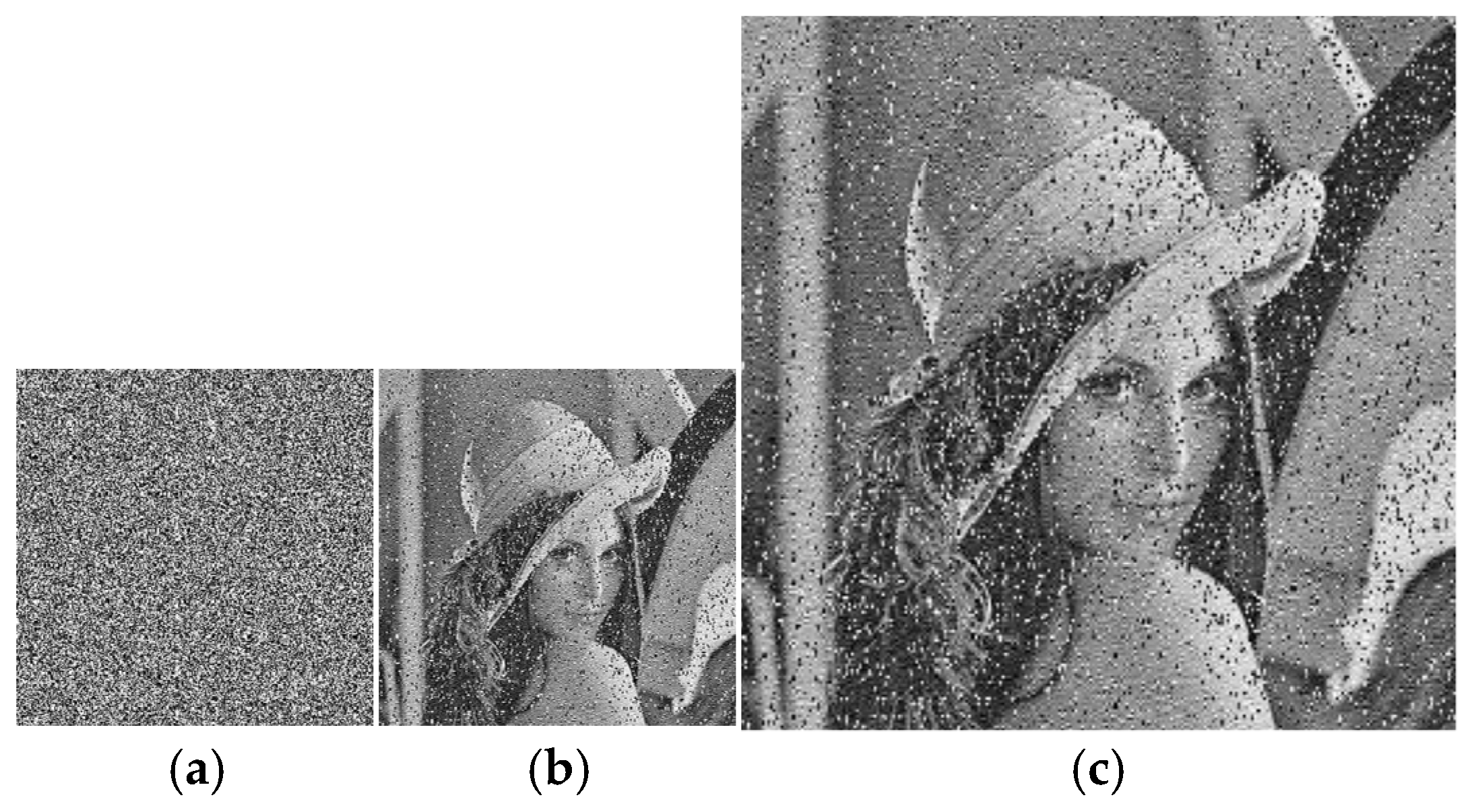
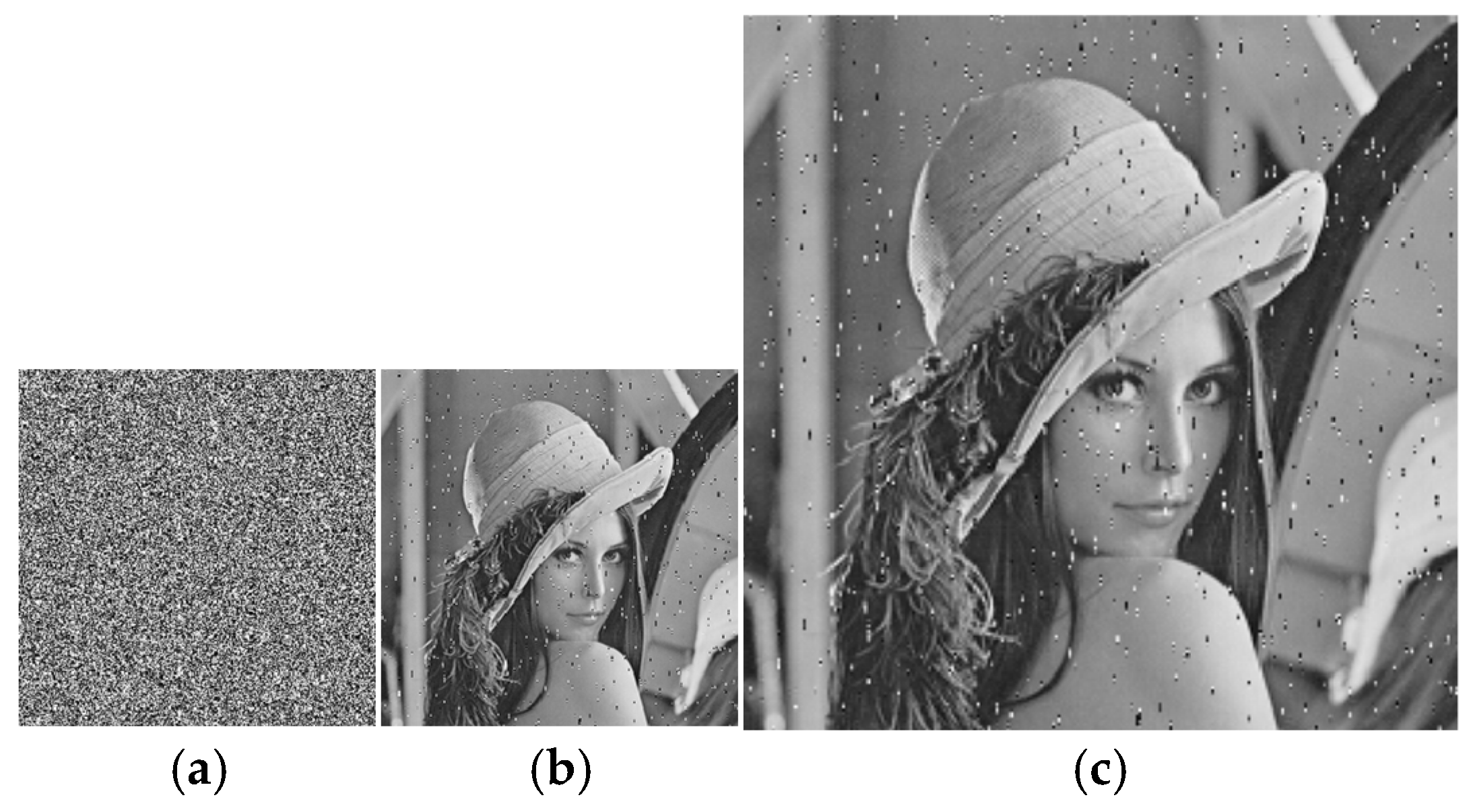
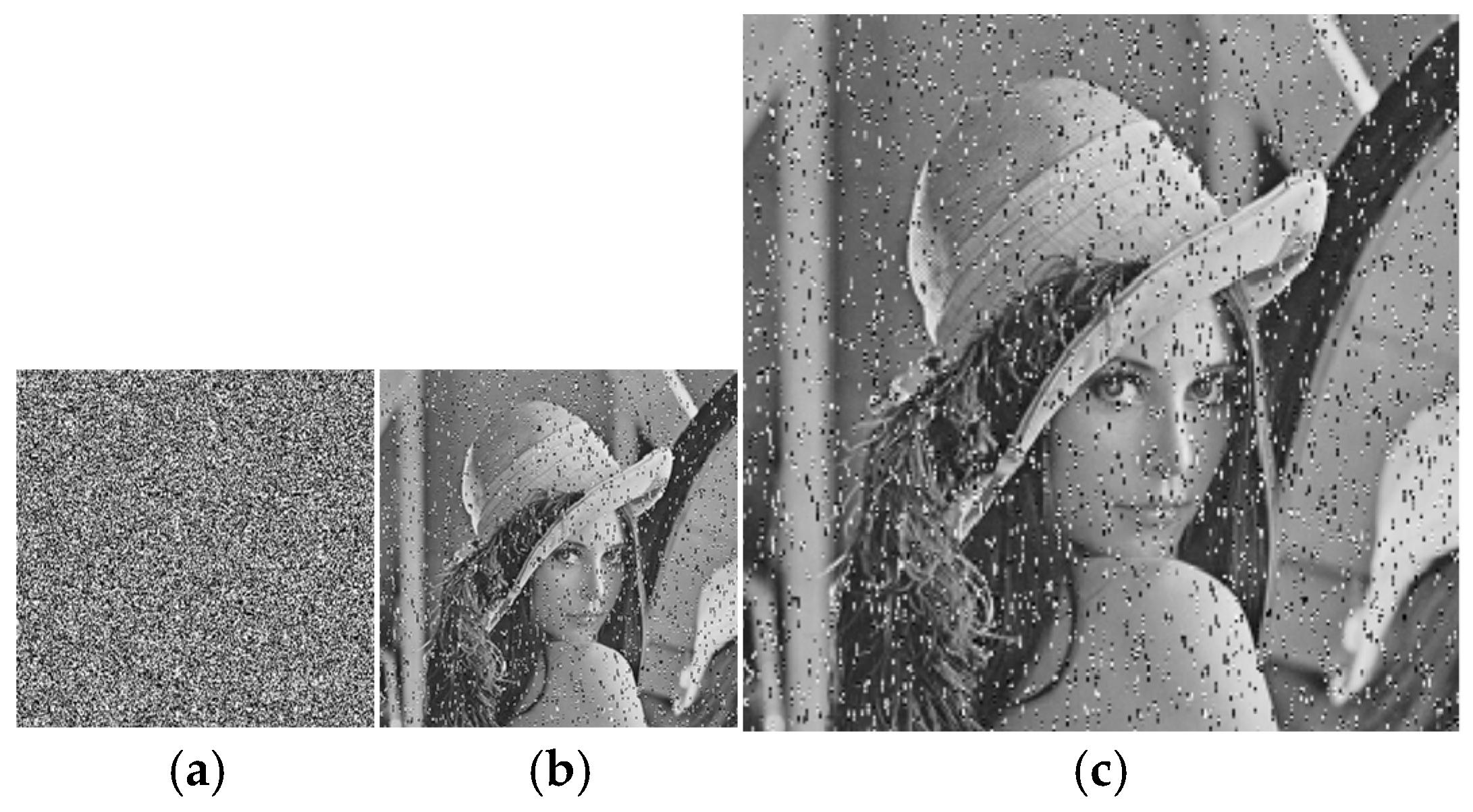
To test the performance of the algorithm against noise attacks, we added 1% and 5% salt-and-pepper noise to the encrypted Lena image. The decrypted and reconstructed images produced using the proposed algorithm are shown in Figure 11 and Figure 12. In comparison, when the encrypted image in Ref. [3] is contaminated with 0.05% salt-and-pepper noise, the decrypted image is worse than the image in Figure 12b, indicating that the proposed algorithm has 100 times the ability to resist salt-and-pepper noise attacks compared to the algorithm in Ref. [3].
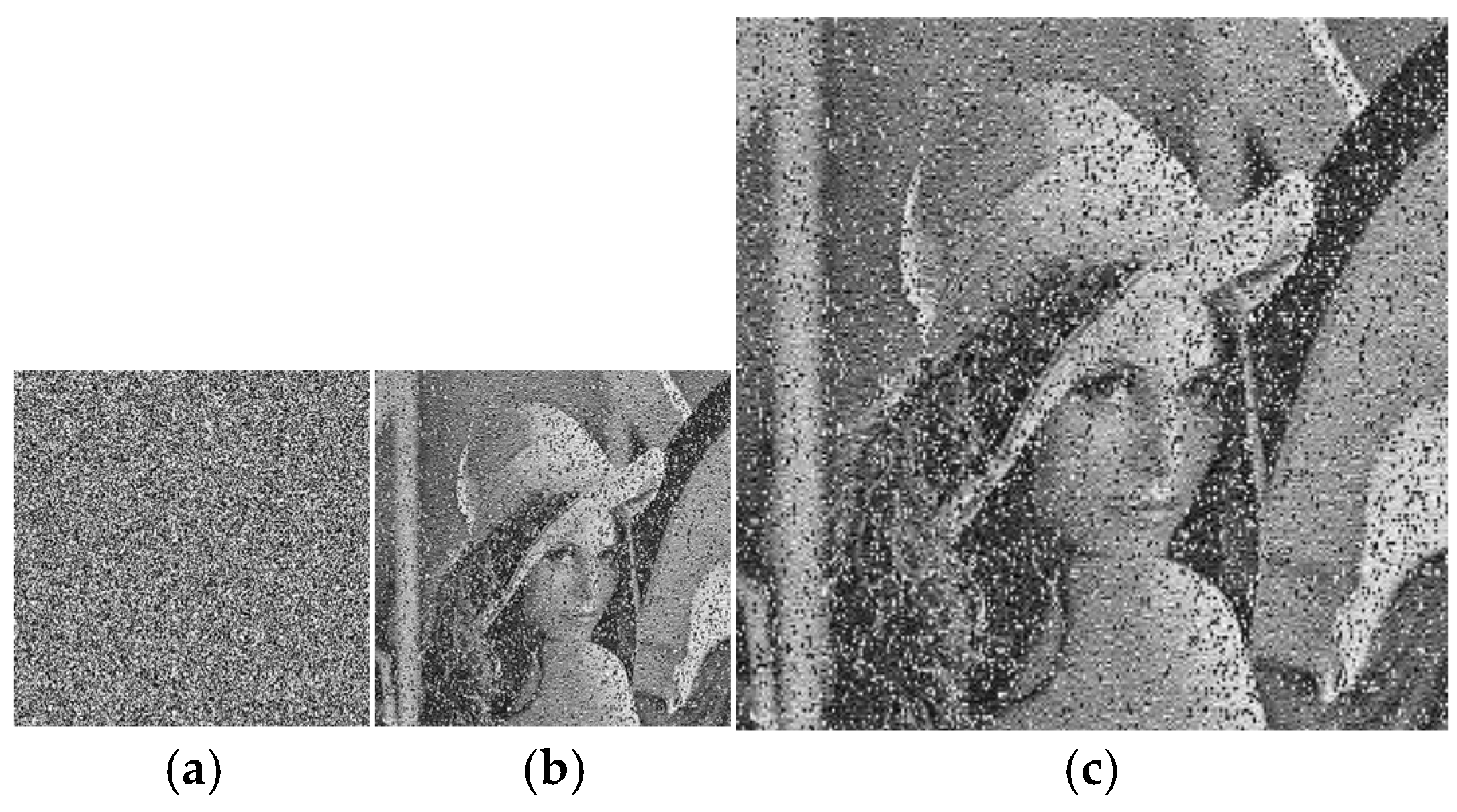
We also tested the performance of the algorithm against Gaussian noise attacks by adding 0.1% and 0.3% Gaussian noise to the encrypted Lena image. Then we produced decrypted and reconstructed images using the proposed algorithm. The results are shown in Figure 13 and Figure 14. In comparison, the encrypted image in Ref. [3] cannot resist Gaussian noise attacks.
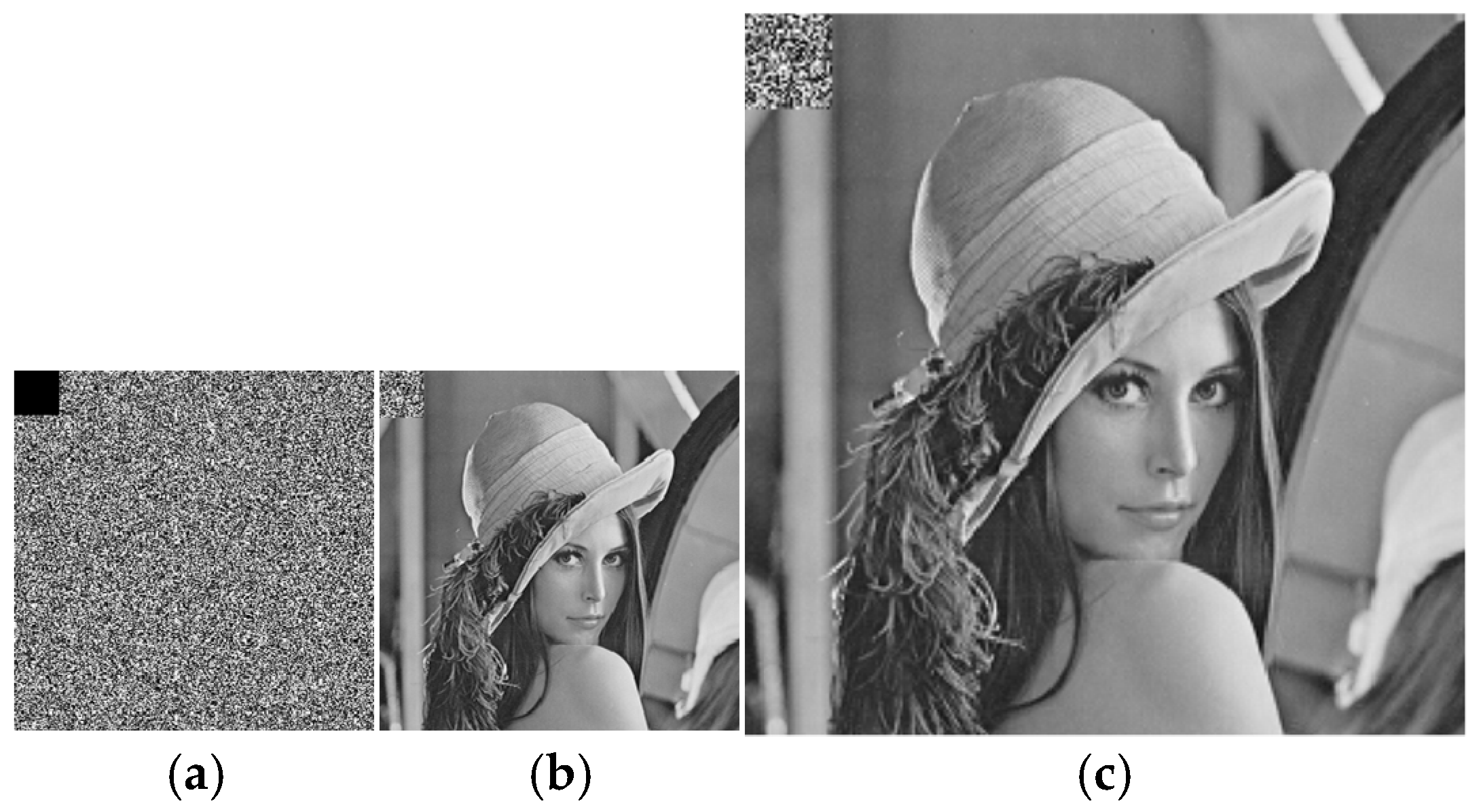
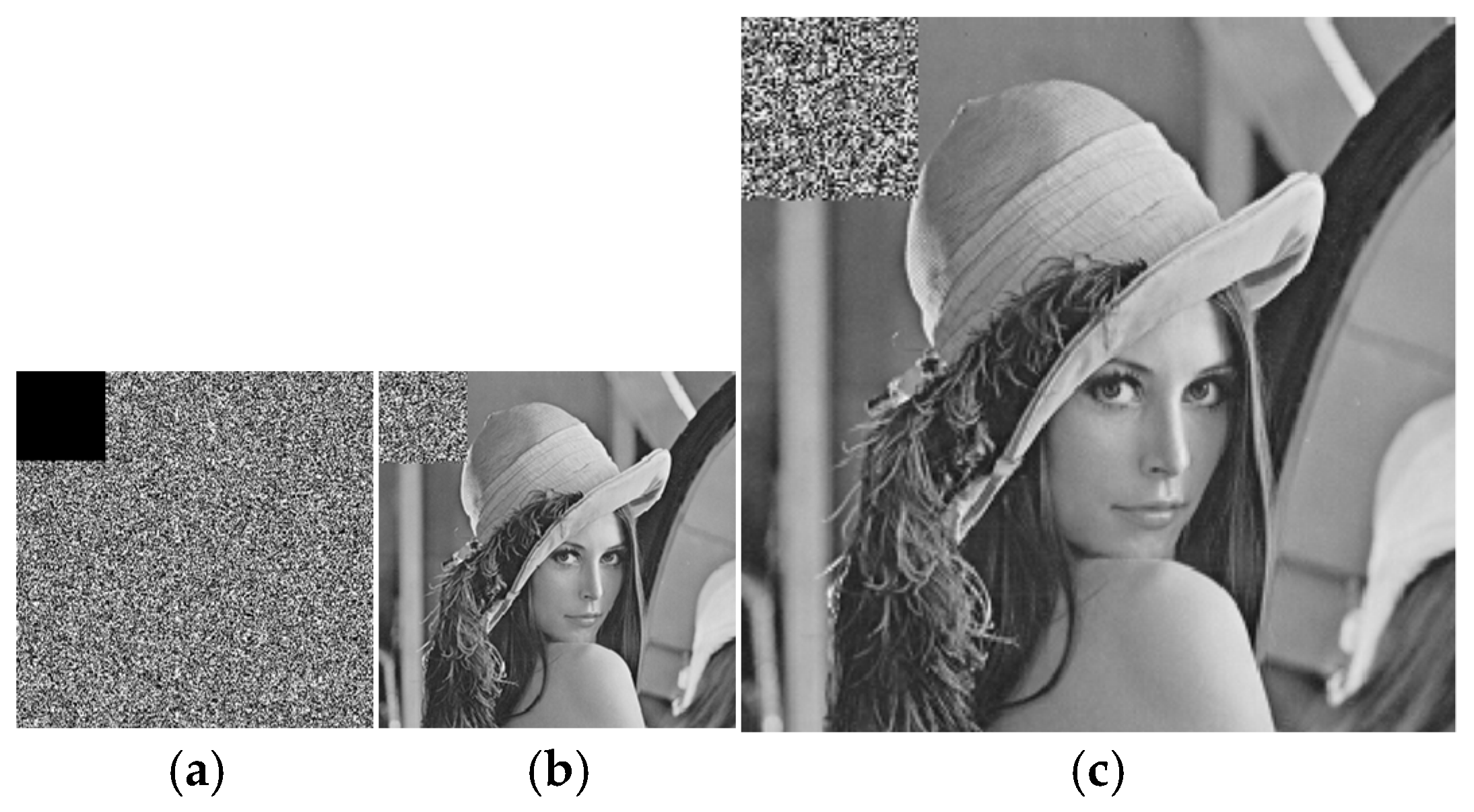
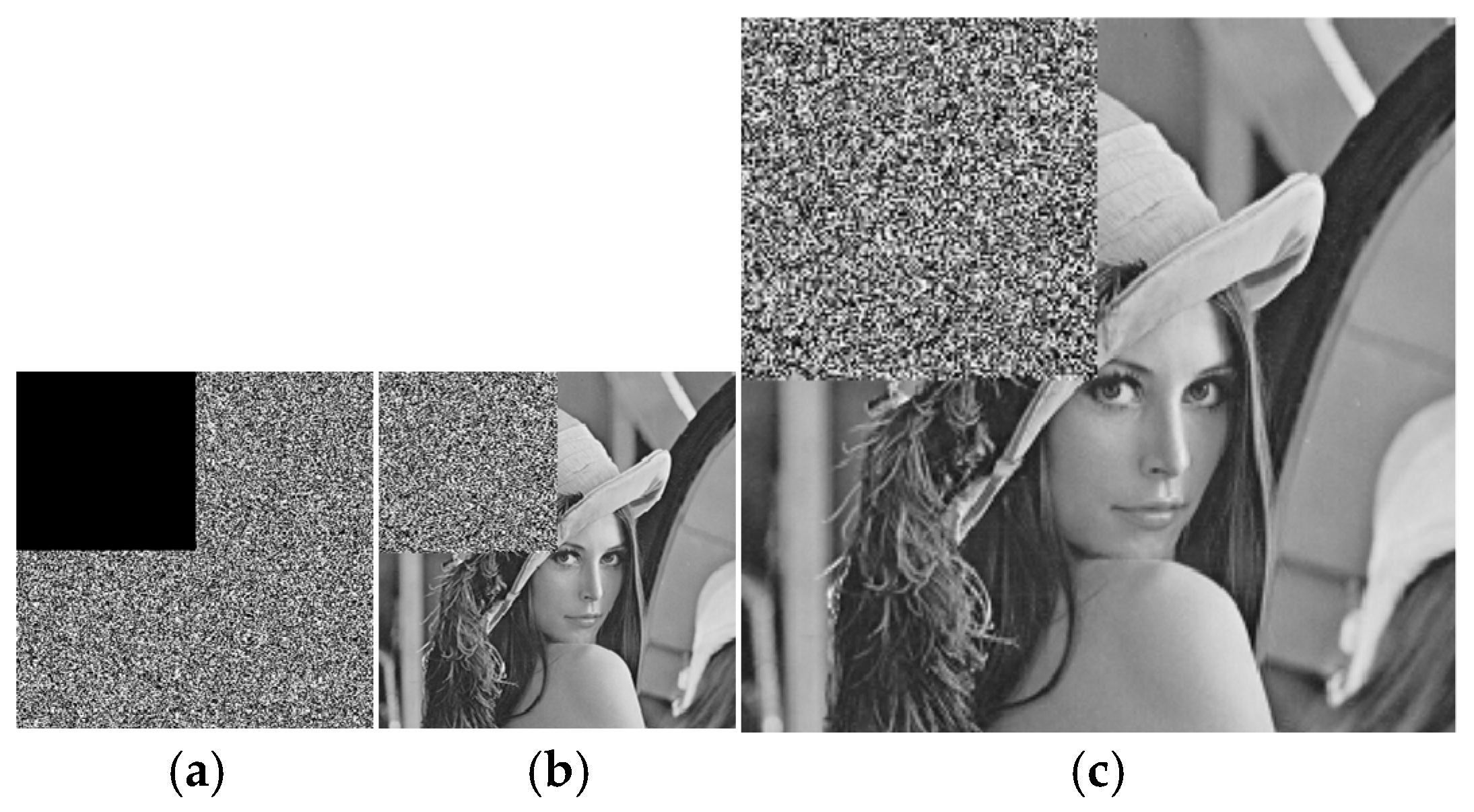
In order to test the robustness of the algorithm against data loss, four sets of experiments were conducted using a 512 × 512 grayscale Lena image. We applied 32 × 32, 64 × 64, and 128 × 128 region cropping to the compressed and encrypted images and then decrypted and reconstructed the original image. The experimental results are shown in Figure 15, Figure 16 and Figure 17. The experimental results show that when the cut area reaches 128 × 128, the algorithm can still restore the original image well. By contrast, the algorithm in Ref. [3] can only tolerate data loss size of 8 × 16 in ciphertext images at most. The algorithm in Ref. [15] can only tolerate data loss size of 8 × 8 of important information in the plain image. The results indicate that the algorithm proposed in this paper has relatively satisfactory performance in resisting data loss.

5.2.7. Time Complexity Analysis

The encryption process of the proposed algorithm includes the following three stages: chaotic secret key stream generation, image compression based on improved lifting wavelet transformation, and high-speed image encryption. In a speed test of the algorithm, the 256 × 256 grayscale image was used for compression–encryption, decryption, and reconstruction. We took the average encryption and decryption times of 10 tests, and the results are listed in Table 6. Table 6 also lists the time cost results of several algorithms based on compressive sensing reported in recently published references. The results demonstrate that the proposed method has faster encryption and decryption speed than that of the algorithms reported in the Refs. [3,42,43,44]. The time complexity data is based on the system hard- and software environment that is mentioned at the beginning of Section 5.

6. Conclusions

This paper proposes a new one-dimensional fractionally structured chaotic system and uses this chaotic system combined with an improved lifting wavelet transform to design a fast image compression–encryption scheme. For the new chaotic system, we have demonstrated its excellent chaotic properties through a series of chaos criteria. Compared with traditional one-dimensional chaotic systems, the new chaotic system has a larger range of chaotic parameters and more complex chaotic behavior. Although “excellent chaotic properties” themselves cannot be directly equated with a secure cryptographic system, using systems with strong chaotic characteristics as entropy sources, combined with rigorous cryptographic structure design, can more efficiently construct secure and performance-balanced encryption schemes. The proposed scheme adopts an improved lifting wavelet transform to design an image compression scheme. Compared to compressive sensing methods, the proposed scheme can obtain higher-quality reconstructed images at high compression ratios with lower computational resource overhead. A fast image encryption algorithm was designed based on the new chaotic system, which can significantly improve the speed of encryption and decryption algorithms. The initial key of the cryptographic system is designed to be related to the SHA-3 hash value of the plaintext image, enabling the algorithm to resist chosen-plaintext attacks. The simulation experiments and security analysis results show that the proposed image compression and encryption scheme has better encryption performance, higher reconstructed image quality, and less time overhead. It has strong robustness against noise and data loss attacks, indicating that the proposed image compression–encryption scheme has good application potential for achieving secure image communication in resource-constrained environments.
The encryption system based on one-dimensional chaotic map does have theoretical limitations; for example, the phase space reconstruction method may weaken its security against reverse engineering, and the dynamic degradation caused by finite precision effects (such as quasi periodic states) is a core challenge in engineering implementation. Upgrading one-dimensional systems to two-dimensional chaotic systems and introducing parameters or symmetric perturbations is an effective way to solve these problems, which is a direction worthy of further in-depth research.

Author Contributions

Conceptualization, Q.L. and C.Z.; methodology, Q.L. and J.W.; software, Q.L.; validation, J.W., L.Y. and C.Z.; formal analysis, J.W. and C.Z.; investigation, C.Z.; resources, Q.L.; data curation, Q.L.; writing—original draft preparation, Q.L.; writing—review and editing, J.W., L.Y. and C.Z.; visualization, L.Y.; supervision, C.Z.; project administration, Q.L.; funding acquisition, Q.L. All authors have read and agreed to the published version of the manuscript.

Funding

This work is partially supported by the Hunan Police College Highlevel Talent-ResearchLaunch Fund (No. 2025-09), Key R&D Program for Science and Technology Innovation in Hunan Province (No. 2024AQ2022), Hunan Provincial Natural Science Foundation of China (2026JJ81155) and Major Science and Technology Research Projects in Hunan Province (No. 2025QK2008).

Data Availability Statement

The original contributions presented in this study are included in the article. Further inquiries can be directed to the corresponding authors.

Conflicts of Interest

The authors declare no conflicts of interest.

References

  1. Darwish, S.M.; Noori, Z.H. Secure image compression approach based on fusion of 3D chaotic maps and arithmetic coding. IET Signal Process. 2019, 13, 286–295. [Google Scholar] [CrossRef]
  2. Alghamdi, Y.; Munir, A. Image Encryption Algorithms: A Survey of Design and Evaluation Metrics. J. Cybersecur. Priv. 2024, 4, 126–152. [Google Scholar] [CrossRef]
  3. Zang, H.; Tai, M.; Wei, X. Image Encryption Schemes Based on a Class of Uniformly Distributed Chaotic Systems. Mathematics 2022, 10, 1027. [Google Scholar] [CrossRef]
  4. Malik, D.S.; Shah, T. Color multiple image encryption scheme based on 3D-chaotic maps. Math. Comput. Simul. 2020, 178, 646–666. [Google Scholar] [CrossRef]
  5. Öztürk, İ.; Kılıç, R. Utilizing true periodic orbits in chaos-based cryptography. Nonlinear Dyn. 2021, 103, 2805–2818. [Google Scholar] [CrossRef]
  6. Zhu, S.; Wang, G.; Zhu, C. A Secure and Fast Image Encryption Scheme based on Double Chaotic S-Boxes. Entropy 2019, 21, 790. [Google Scholar] [CrossRef]
  7. Tutueva, A.V.; Nepomuceno, E.G.; Karimov, A.I.; Andreev, V.S.; Butusov, D.N. Adaptive chaotic maps and their application to pseudo-random numbers generation. Chaos Solitons Fractals 2020, 133, 109615. [Google Scholar] [CrossRef]
  8. Dey, D.; Bhunia, P.; Jana, D.K.; Diyasi, S.; Maity, S. Lightweight Hybrid Chaotic Image Encryption with Spiral Shuffling and S-Box Diffusion. Secur. Priv. 2025, 8, e70123. [Google Scholar] [CrossRef]
  9. Xie, X.; Zhang, K.; Zheng, B.; Ning, H.; Zhou, Y.; Peng, Q.; Li, Z. A CML-ECA Chaotic Image Encryption System Based on Multi-Source Perturbation Mechanism and Dynamic DNA Encoding. Symmetry 2025, 17, 1042. [Google Scholar] [CrossRef]
  10. Duan, Y.; Li, T.Y.; Liang, S.J.; Wang, X.C.; Zhang, D.Z. Hyper-chaotic color image encryption based on 3D bit-level permutation and diffusion model. J. Electron. Imaging 2025, 34, 043030. [Google Scholar] [CrossRef]
  11. Li, W.; Zhou, Y.; Cao, L.; Li, W.; Chai, X. A visual security image encryption algorithm based on 1D-CHCCM and super-resolution reconstruction. Digit. Signal Process. 2026, 174, 105981. [Google Scholar] [CrossRef]
  12. Demirtaş, M.; Altunkaya, S. A robust encryption algorithm for DICOM image protection using a new chaotic map and O-shaped scanning. Eur. Phys. J. Plus 2025, 140, 797. [Google Scholar] [CrossRef]
  13. Lu, Y.; Mehmood, A.; Khan, A.N.; Natgunanathan, I.; Shafique, A.; Khan, I.A.; Khan, A.U.R. Enhanced lightweight and compromised-resilient image encryption for resource constrained environments. PLoS ONE 2025, 20, e0320046. [Google Scholar] [CrossRef]
  14. Jiang, D.; Liu, L.; Zhu, L.; Wang, X.; Chen, Y.; Rong, X. An efficient meaningful double-image encryption algorithm based on parallel compressive sensing and FRFT embedding. Multimed. Tools Appl. 2023, 82, 27337–27363. [Google Scholar] [CrossRef]
  15. Hadj Brahim, A.; Ali Pacha, A.; Hadj Said, N. A new image compression-encryption scheme based on compressive sensing & classical AES algorithm. Multimed. Tools Appl. 2023, 82, 42087–42117. [Google Scholar] [CrossRef]
  16. Qiu, J.; Zhu, S.; Liu, Y.; Luo, X.; Liu, D.; Zhou, H.; Zhu, C.; Qin, Z. An Efficient Image Encryption Scheme Based on DNA Mutations and Compression Sensing. Mathematics 2025, 14, 5. [Google Scholar] [CrossRef]
  17. Liu, M.; Ning, C.; Zhu, C. A Secure Image Encryption Scheme Based on a New Hyperchaotic System and 2D Compressed Sensing. Entropy 2024, 26, 603. [Google Scholar] [CrossRef]
  18. Ye, G.; Liu, S.; Xiao, X.; Hunag, X. Image hiding algorithm based on local binary pattern and compressive sensing. Math. Comput. Simul. 2025, 237, 316–334. [Google Scholar] [CrossRef]
  19. Yao, M.; Deng, H.; Chen, Z.; Zhang, P. Efficient and secure image compression and encryption based on compressive sensing and four-dimensional hyperchaotic system. Inf. Sci. 2025, 719, 122430. [Google Scholar] [CrossRef]
  20. Li, Y.M.; Jiang, M.J.; Wei, D.Y.; Deng, Y. A Novel Image Encryption Algorithm Based on Compressive Sensing and a Two-Dimensional Linear Canonical Transform. Fractal Fract. 2024, 8, 92. [Google Scholar] [CrossRef]
  21. Srinivas, R.; Mayur, N. Image Compression and Encryption Based on Integer Wavelet Transform and Hybrid Hyperchaotic System. Int. J. Inf. Secur. Priv. 2022, 16, 21. [Google Scholar] [CrossRef]
  22. Huang, X.L.; Dong, Y.X.; Ye, G.D.; Shi, Y. Meaningful image encryption algorithm based on compressive sensing and integer wavelet transform. Front. Comput. Sci. 2023, 17, 173804. [Google Scholar] [CrossRef]
  23. Hazzazi, M.M.; Rehman, M.U.; Shafique, A.; Aljaedi, A.; Bassfar, Z.; Usman, A.B. Enhancing image security via chaotic maps, Fibonacci, Tribonacci transformations, and DWT diffusion: A robust data encryption approach. Sci. Rep. 2024, 14, 12277. [Google Scholar] [CrossRef] [PubMed]
  24. Qu, G.; Meng, X.; Yin, Y.; Wu, H.; Yang, X.; Peng, X.; He, W. Optical color image encryption based on Hadamard single-pixel imaging and Arnold transformation. Opt. Lasers Eng. 2021, 137, 106392. [Google Scholar] [CrossRef]
  25. Wang, X.Y.; Sun, H.H.; Gao, H. An image encryption algorithm based on improved baker transformation and chaotic S-box*. Chin. Phys. B 2021, 30, 060507. [Google Scholar] [CrossRef]
  26. Masood, F.; Driss, M.; Boulila, W.; Ahmad, J.; Rehman, S.U.; Jan, S.U.; Qayyum, A.; Buchanan, W.J. A Lightweight Chaos-Based Medical Image Encryption Scheme Using Random Shuffling and XOR Operations. Wirel. Pers. Commun. 2021, 127, 1405–1432. [Google Scholar] [CrossRef]
  27. Zhang, G.; Zhao, Y.; Zheng, Y.; Shen, Y.; Huang, J. A Fast Image Encryption Scheme Based on a Four-Dimensional Variable-Parameter Hyperchaotic Map and Cyclic Shift Strategy. Mathematics 2025, 13, 1497. [Google Scholar] [CrossRef]
  28. Zhang, Y. The fast image encryption algorithm based on lifting scheme and chaos. Inf. Sci. 2020, 520, 177–194. [Google Scholar] [CrossRef]
  29. Zhang, Y. A new unified image encryption algorithm based on a lifting transformation and chaos. Inf. Sci. 2021, 547, 307–327. [Google Scholar] [CrossRef]
  30. Sun, K.H.; He, S.B.; He, Y.; Yin, L.Z. Complexity analysis of chaotic pseudo-random sequences based on spectral entropy algorithm. Acta Phys. Sin. 2013, 62, 010501. [Google Scholar] [CrossRef]
  31. Sun, K.H.; He, S.B.; Yin, L.Z.; Li-Kun, A. Application of FuzzyEn algorithm to the analysis of complexity of chaotic sequence. Acta Phys. Sin. 2012, 61, 130507. [Google Scholar] [CrossRef]
  32. Hua, Z.; Zhou, B.; Zhou, Y. Sine Chaotification Model for Enhancing Chaos and Its Hardware Implementation. IEEE Trans. Ind. Electron. 2019, 66, 1273–1284. [Google Scholar] [CrossRef]
  33. Liu, L.; Wang, J. A cluster of 1D quadratic chaotic map and its applications in image encryption. Math. Comput. Simul. 2023, 204, 89–114. [Google Scholar] [CrossRef]
  34. May, R.M. Simple mathematical models with very complicated dynamics. Nature 1976, 261, 459–467. [Google Scholar] [CrossRef] [PubMed]
  35. Zhu, H.; Ge, J.; Qi, W.; Zhang, X.; Lu, X. Dynamic analysis and image encryption application of a sinusoidal-polynomial composite chaotic system. Math. Comput. Simul. 2022, 198, 188–210. [Google Scholar] [CrossRef]
  36. Ma, Y.; Li, C.; Ou, B. Cryptanalysis of an image block encryption algorithm based on chaotic maps. J. Inf. Secur. Appl. 2020, 54, 102566. [Google Scholar] [CrossRef]
  37. Alvarez, G.; Li, S. Some basic cryptographic requirements for chaos-based cryptosystems. Int. J. Bifurc. Chaos 2006, 16, 2129–2151. [Google Scholar] [CrossRef]
  38. Zhang, Z.Z.; Tang, J.E.; Ni, H.; Huang, T.T. Image adaptive encryption algorithm using a novel 2D chaotic system. Nonlinear Dyn. 2023, 111, 10629–10652. [Google Scholar] [CrossRef]
  39. Jiang, X.M.; Jiang, G.Y.; Wang, Q.K.; Shu, D.D. Image encryption algorithm based on 2D-CLICM chaotic system. IET Signal Process. 2023, 17, 2127–2141. [Google Scholar] [CrossRef]
  40. Zhou, S.; Qiu, Y.Y.; Wang, X.Y.; Zhang, Y.Q. Novel image cryptosystem based on new 2D hyperchaotic map and dynamical chaotic S-box. Nonlinear Dyn. 2023, 111, 9571–9589. [Google Scholar] [CrossRef]
  41. Ma, X.J.; Wang, C.H. Hyper-chaotic image encryption system based on N+2 ring Joseph algorithm and reversible cellular automata. Multimed. Tools Appl. 2023, 82, 38967–38992. [Google Scholar] [CrossRef]
  42. Zhu, S.; Deng, X.; Zhang, W.; Zhu, C. Image Encryption Scheme Based on Newly Designed Chaotic Map and Parallel DNA Coding. Mathematics 2023, 11, 231. [Google Scholar] [CrossRef]
  43. Yan, X.; Wang, X.; Xian, Y. Chaotic image encryption algorithm based on arithmetic sequence scrambling model and DNA encoding operation. Multimed. Tools Appl. 2021, 80, 10949–10983. [Google Scholar] [CrossRef]
  44. Lu, Q.; Yu, L.; Zhu, C. A New Conservative Hyperchaotic System-Based Image Symmetric Encryption Scheme with DNA Coding. Symmetry 2021, 13, 2317. [Google Scholar] [CrossRef]
Figure 1. Bifurcation diagram and Lyapunov exponent graph of system (1): (a) bifurcation diagram of system state value versus parameter b; (b) the graph of Lyapunov exponent versus parameter b; (c) the 3D representation of Lyapunov exponent versus parameters a and b.
Mathematics 14 01114 g001
Figure 2. The time series diagram and cobweb graph of system (1): (a) the time series diagram; (b) the cobweb graph of system (1).
Mathematics 14 01114 g002
Figure 3. Correlation function of chaotic sequences: (a) autocorrelation function; (b) cross-correlation function.
Mathematics 14 01114 g003
Figure 4. The values of approximate entropy for different maps. (a) Logistic map; (b) the quadratic map; (c) the proposed system.
Mathematics 14 01114 g004
Figure 5. The values of correlation dimension for different maps. (a) Logistic map; (b) the quadratic map; (c) the proposed system.
Mathematics 14 01114 g005
Figure 6. Cameraman image and its wavelet coefficient image: (a) cameraman image; (b) the wavelet coefficient image of (a).
Mathematics 14 01114 g006
Figure 7. Overall block diagram of the image compression and encryption scheme.
Mathematics 14 01114 g007
Figure 8. Overall block diagram of image decryption and reconstruction scheme.
Mathematics 14 01114 g008
Figure 9. The test Lena image and its compressed and reconstructed images: (a) original Lena image, (b) Lena image after LWT, (c) the compressed and encrypted image obtained using the method described in this article, (d) reconstructed image of (c), (e) the compressed and encrypted image obtained by using the compressive sensing method, (f) reconstructed image of (e).
Mathematics 14 01114 g009
Figure 10. Plaintext/ciphertext images and their histograms. (a) Plaintext Lena image. (b) Histogram of (a). (c) Ciphertext Lena image. (d) Histogram of (c). (e) Plaintext Baboon image. (f) Histogram of (e). (g) Ciphertext Baboon image. (h) Histogram of (g).
Mathematics 14 01114 g010aMathematics 14 01114 g010b
Figure 11. Salt-and-pepper noise intensity of 1%: (a) the encrypted image with 1% salt-and-pepper noise, (b) the decrypted image, (c) the reconstructed image.
Mathematics 14 01114 g011
Figure 12. Salt-and-pepper noise intensity of 5%: (a) the encrypted image with 5% salt-and-pepper noise, (b) the decrypted image, (c) the reconstructed image.
Mathematics 14 01114 g012
Figure 13. Gaussian noise intensity of 0.1%: (a) the encrypted image with 0.1% Gaussian noise, (b) the decrypted image, (c) the reconstructed image.
Mathematics 14 01114 g013
Figure 14. Gaussian noise intensity of 0.3%: (a) the encrypted image with 0.3% Gaussian noise, (b) the decrypted image, (c) the reconstructed image.
Mathematics 14 01114 g014
Figure 15. Attack where a 32 × 32 sub-block is cut: (a) the compressed and encrypted image subjected to cropping attacks, (b) the decrypted image of (a), (c) the reconstructed image.
Mathematics 14 01114 g015
Figure 16. Attack where a 64 × 64 sub-block is cut: (a) the compressed and encrypted image subjected to cropping attacks, (b) the decrypted image of (a), (c) the reconstructed image.
Mathematics 14 01114 g016
Figure 17. Attack where a 128 × 128 sub-block is cut: (a) the compressed and encrypted image subjected to cropping attacks, (b) the decrypted image of (a), (c) the reconstructed image.
Mathematics 14 01114 g017
Table 1. The SSIM and PSNR values of reconstructed images with different SR.
ImagesSSIMPSNR
SR = 0.25SR = 0.50SR = 0.25SR = 0.50
Lena0.929110.9488534.507736.0921
Baboon0.762450.8267123.896825.3332
Cameraman0.974490.9792437.281938.3864
Peppers0.901410.9201532.874434.7750
Table 2. Correlation coefficients of cipher images encrypted by different algorithms.
AlgorithmHorizontalVerticalDiagonal
This work−0.000519220.00071788−0.0018262
Ref. [17]−0.00031181−0.000374050.00015204
Ref. [38]−0.000620.0022−0.0015
Ref. [39]−0.00060.0010−0.0012
Table 3. Information entropy of encrypted images for several algorithms.
Image NameThis WorkRef. [16]Ref. [17]Ref. [40]Ref. [41]
Lena7.99937.99767.99897.99777.9967
Baboon7.99927.99717.9992\7.9992
Peppers7.99947.99787.99877.9976\
Cameraman7.99937.99837.9968\7.9975
Table 4. Sensitivity of the proposed algorithm to secret keys.
The Proposed Method in This PaperThe Method Proposed in Ref. [16]
Changes of KeyNPCR (%)UACI (%)Changes of KeyNPCR (%)UACI (%)
Δx01 = 10−1599.649033.4343Δx = 10−1599.611233.4243
Δx02 = 10−1599.638433.4791\\\
Δa = 10−1599.612433.6157Δa = 10−1599.608733.4921
Δb = 10−1599.580433.4658Δb = 10−1599.606833.4213
Table 5. Sensitivity of different methods to plaintext image content.
Image NPCR UACI
Ref. [3]Ref. [42]OursRef. [3]Ref. [42]Ours
Lena98.164499.617099.578831.331233.419933.3784
Baboon98.010399.639999.605331.188633.302733.4573
Peppers99.966499.618599.602335.627533.421133.4418
Table 6. Comparison of time complexity for the 256 × 256 grayscale image (in seconds).
StageOursRef. [3]Ref. [42]Ref. [43]Ref. [44]
Encryption0.029912.65000.60071.73511.0770
Decryption0.021612.84100.38043.46891.1144
Disclaimer/Publisher’s Note: The statements, opinions and data contained in all publications are solely those of the individual author(s) and contributor(s) and not of MDPI and/or the editor(s). MDPI and/or the editor(s) disclaim responsibility for any injury to people or property resulting from any ideas, methods, instructions or products referred to in the content.