1. Introduction
In literary studies, identifying the major themes and recurring motifs that run through an author’s long novels is a basic task: it helps readers and scholars describe what an author repeatedly returns to, how different works relate to each other, and how an author’s thematic concerns evolve over time [
1,
2]. Traditionally, such claims are built through
close reading, which means a careful, line-by-line interpretation of an author’s works, focusing on details such as wording, imagery, and style. This approach is powerful, but it does not scale well when the research object is large, for example, dozens of novels, or a full archive spanning many years.
Distant reading [
3,
4], on the other hand, addresses this scale issue by stepping back: instead of reading every page in full detail, one summarizes texts using quantitative features (such as word usage patterns) and looks for regularities across many works. In this sense, distant reading is a new way to formulate measurable questions and generate testable signals that can later be checked by close reading. Mathematically, distant reading turns a collection of long works by an author into structured data (vectors, matrices, or tensors) and then uses statistical or low-rank models to extract latent patterns from that data [
5,
6].
A common method for text data mining is topic modeling. Consider a document-term matrix: Each document is represented by word counts or weighted counts, and the goal of topic modeling is to find a small set of latent patterns that explain the main co-occurrence structure in the data. Each pattern is usually read as a topic that is represented by a group of words, and each text is represented by how strongly it uses those topics. In digital humanities (DH) [
5,
6,
7,
8], topic modeling is often used as an exploratory step that helps researchers form hypotheses, compare groups of texts, and decide where closer reading might be most informative.
Among many topic models, latent Dirichlet allocation (LDA) [
9] is one of the most popular tools. LDA treats a text as a mixture of topics, and each topic as a probability distribution over words. The model explains the observed word counts by assuming that words are generated by repeatedly choosing a topic and then choosing a word from that topic. For example, a study by Moretti and related distant-reading projects used LDA on large novel corpora to sketch broad thematic trends linked to issues like genre, nation, and social categories [
4]. Jockers applied LDA-style models to 19th-century fiction to support macro-level claims in literary history [
5]. Buurma used LDA to “machine read” Trollope’s Barsetshire series [
10]. In poetry studies, Navarro-Colorado used LDA on a corpus of Spanish poetry to extract themes and motifs [
11]. These applications also motivate ongoing methodological discussion about what topics capture, and how topic outputs should be validated against literary interpretation rather than taken as themes by default [
6,
12,
13].
Another popular topic modeling tool is nonnegative matrix factorization (NMF) [
14]. Built upon low-rank approximation, NMF factorizes the nonnegative document-term matrix into two nonnegative factors: one can be interpreted as topic–word weights and the other as document-topic weights, so each document is explained as an additive mixture of topics. Recent DH reviews treat NMF as a practical alternative to probabilistic topic models in literary analysis [
6]. Empirical comparisons on literary corpora also suggest that NMF can be competitive, and sometimes preferable, when interpretability is the main goal. For instance, Sherstinova et al. studied early 19th-century Russian fiction and compared NMF topics against expert topic annotations, reporting that NMF produced clearer topics that aligned more closely with expert judgments [
15]. Mihajlov et al. performed a direct comparison of NMF, LDA, and BERTopic on the SrpELTeC Serbian fiction corpus and found that NMF achieved the strongest topic-coherence results among the tested models [
16]. Greene et al. applied NMF to The Paris Review literary interviews and highlighted that matrix-factorization approaches can be effective for this corpus [
17].
Most topic modeling models are developed and commonly used in settings where the corpus contains many documents, each of which is relatively short (e.g., news articles, abstracts, reviews, or social-media posts). However, in our setting, an author’s long-form novels represent a different regime: the number of works is limited (usually, an author may publish only around 10 long novels), but each work is long and internally diverse. Within one novel, vocabulary and subject matter can change substantially as the plot develops, characters enter or exit, and settings shift. If a long novel is compressed into a single bag-of-words vector, such within-text variation is averaged out. In practice, this may blur distinctions between motifs that are concentrated in different parts of a book, making the resulting topics harder to interpret and less consistent when comparing across works.
A practical remedy is to segment a long document into contiguous passages and analyze the segmented text, which has been adopted in prior studies on long documents [
18,
19,
20]. After the preprocessing, the segments are treated as separate documents, and a segment–word matrix is constructed. Standard topic models such as LDA or NMF are then applied to analyze the texts.
Motivated by this practice, to analyze an author’s long novels, we also segment each novel into contiguous passages. However, in our setting, the work identity is essential: pooling segments across works discards which passages come from which novel, and makes cross-work analysis hard to control. We therefore keep the work index explicit and represent the corpus as a third-order nonnegative tensor indexed by
work ×
segment ×
word, which preserves coarse within-novel variation while still enabling cross-work comparison. Note that tensor decompositions have been used for topic modeling with multi-way count data where an additional mode is
native to the dataset, e.g.,
time ×
document ×
word, or
reviewer ×
paper ×
word [
21,
22,
23]. In contrast, in our setting, the third mode is not naturally observed but deliberately induced by segmenting long novels, thereby making within-text heterogeneity structurally accessible to multi-way factorization.
We build upon standard nonnegative tensor factorization (NTF) to analyze the resulting work × segment × word tensor. To reflect structural characteristics of long narrative texts, we augment the standard NTF formulation with two task-motivated regularization terms. First, we add an orthogonality-promoting penalty on the vocabulary–topic factor to reduce redundancy among topic–word distributions and improve topic distinctiveness. Second, we impose a smoothness regularization on the segment–topic factor to encourage gradual thematic variation across contiguous narrative segments. In this way, the proposed formulation can be viewed as a task-oriented regularized extension of standard NTF for long-novel analysis. Such regularization is not new in the literature of NTF and related models; the point here is that the two terms are introduced for specific modeling reasons, namely topic distinctiveness and gradual thematic variation along contiguous narrative segments. To solve the resulting optimization problem, we develop a block proximal linearization algorithm and prove that every limit point generated by the algorithm is a KKT point of the model.
We apply the proposed model to the long novels of Toni Morrison. The extracted cross-work themes show qualitative patterns that are broadly consistent with thematic concerns frequently discussed in Morrison scholarship, and relative to NMF and LDA, they are more readily interpretable as cross-work thematic patterns in the present corpus. To further examine the proposed model, we also apply it to the long novels of Ernest Hemingway and Graham Swift. In both cases, the model yields shared topics whose lexical and distributional patterns are broadly consistent with critical discussions of the authors’ recurring thematic concerns.
The remainder of this paper is organized as follows. In
Section 3, we describe how to construct the narrative tensor and present the proposed NTF model. In
Section 4, we develop an algorithm to solve the model and establish its convergence properties. In
Section 5, we first present the main case study on the novels of Toni Morrison, compare the results with those obtained by NMF, LDA, and standard NTF, and then report additional validations on the novels of Ernest Hemingway and Graham Swift.
Section 6 concludes the paper.
2. Preliminaries
Notation 1. Scalars are written in plain letters (e.g., ). Vectors are denoted by bold lowercase letters (e.g., ), matrices by bold uppercase letters (e.g., ), and tensors by calligraphic letters (e.g., ). The inner product between two objects of the same size (vectors, matrices, or tensors) is denoted by . The Euclidean norm of a vector is , and the Frobenius norm of a matrix/tensor is . denotes the spectral norm of a matrix. and denote the sets of real matrices and nonnegative real matrices of size , respectively.
Kronecker product. Given
and
, their Kronecker product
is defined blockwise by
Outer product. For vectors
and
, we use
to denote the rank-one matrix
. More generally, for vectors
(
), their outer product
is a rank-one
d-th order tensor with entries
Khatri–Rao product. Let
and
share the same number of columns. Their Khatri–Rao product (i.e., column-wise Kronecker product) is
Mode- unfolding. For a tensor , its mode-i unfolding is a matrix obtained by arranging the entries of into columns according to a fixed ordering (used consistently throughout the paper). Unfolding does not change the Frobenius norm, i.e., .
5. Numerical Validation
In this section, we use the factorization results to operationalize the literary goal of identifying major themes and recurring motifs across an author’s long novels. Specifically, components whose work loadings are broadly distributed across multiple novels are referred to as shared (global) topics, serving as candidates for cross-work major themes; components that are concentrated in a single novel are treated as work-specific (local) topics. Whether a global topic represents a major theme is assessed mainly through the interpretability of its representative words and the distribution across works, and is then considered in relation to existing literary scholarship.
In the discussion below, we distinguish three levels of analysis. First, the model provides quantitative outputs, including representative words, work–topic loadings, and topic profiles over narrative position. Second, based on these outputs, we give an operational interpretation of whether a component behaves more like a cross-work shared topic or a work-specific topic. Third, we relate these interpreted patterns to broader literary scholarship. In this sense, the literary discussion is used as an interpretive reference for reading the extracted patterns.
We first focus on Toni Morrison’s novels as the main case study and compare the results with those obtained by NMF, LDA, and standard NTF. We then further examine the proposed model on the corpora of Ernest Hemingway and Graham Swift as additional validations of its applicability beyond a single author corpus.
5.1. Dataset: Toni Morrison’s Novels
We evaluate the proposed model on the complete set of Toni Morrison’s eleven book-length novels, spanning from
The Bluest Eye (1970) to
God Help the Child (2015), as summarized in
Table 1. Morrison (1931–2019), a Nobel Laureate in Literature, is widely recognized for her innovative narrative techniques and for depicting African American history through the textures of everyday life. Across her fiction, critics have often noted recurring themes of racialized identity, kinship and motherhood, and the endurance of memory and loss across generations [
28,
29,
30]. Such themes are repeatedly mediated by domestic and material settings, embodied and sensory details, and patterns of movement and return that connect private experience with place [
31,
32,
33].
To preserve narrative progression within each long novel, we represent the corpus as a third-order tensor, as introduced in
Section 3.1: after standard text preprocessing and stopword removal, each novel is tokenized and then partitioned into
contiguous segments of approximately equal length in tokens. We construct a shared vocabulary of the top
most frequent tokens across the entire corpus, and form the tensor
.
5.2. Parameter Selection
We apply the proposed NTF model (
5) to the constructed tensor
. The parameters are selected as follows.
Choice of and . We select the regularization parameters and using a two-stage tuning strategy based on the trade-off between data fidelity and regularization effects.
In the first stage, we fix
and vary
over a prescribed range. For each fixed
, we plot the relative data fitting error
and the orthogonality loss
in the same figure. The values of
are chosen on a logarithmic grid
, resulting in ten such curves. We observed that for different values of
, the curves of both the data fitting term and the orthogonality loss term with respect to
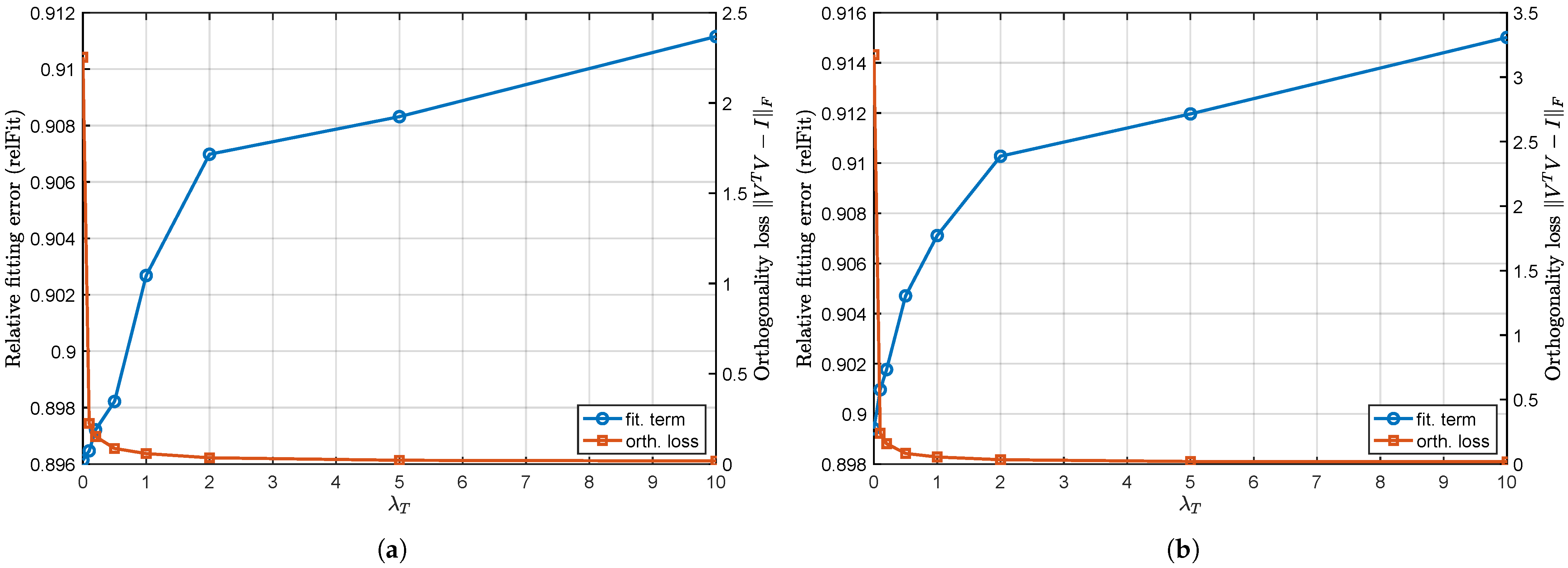
exhibit highly consistent trends: the data fitting error increases monotonically, while orthogonality loss first decreases rapidly and then becomes flat. We thus only plot two representative figures with
and
in
Figure 1.
As shown in
Figure 1, the orthogonality loss decreases rapidly as
increases from zero, but becomes nearly flat for
. Beyond this point, further increasing
yields only marginal improvement in orthogonality, while the data fitting error continues to increase. Therefore, we select
, which achieves near-saturated orthogonality with a limited increase in fitting error.
After fixing
, we further tune the TV regularization parameter
.
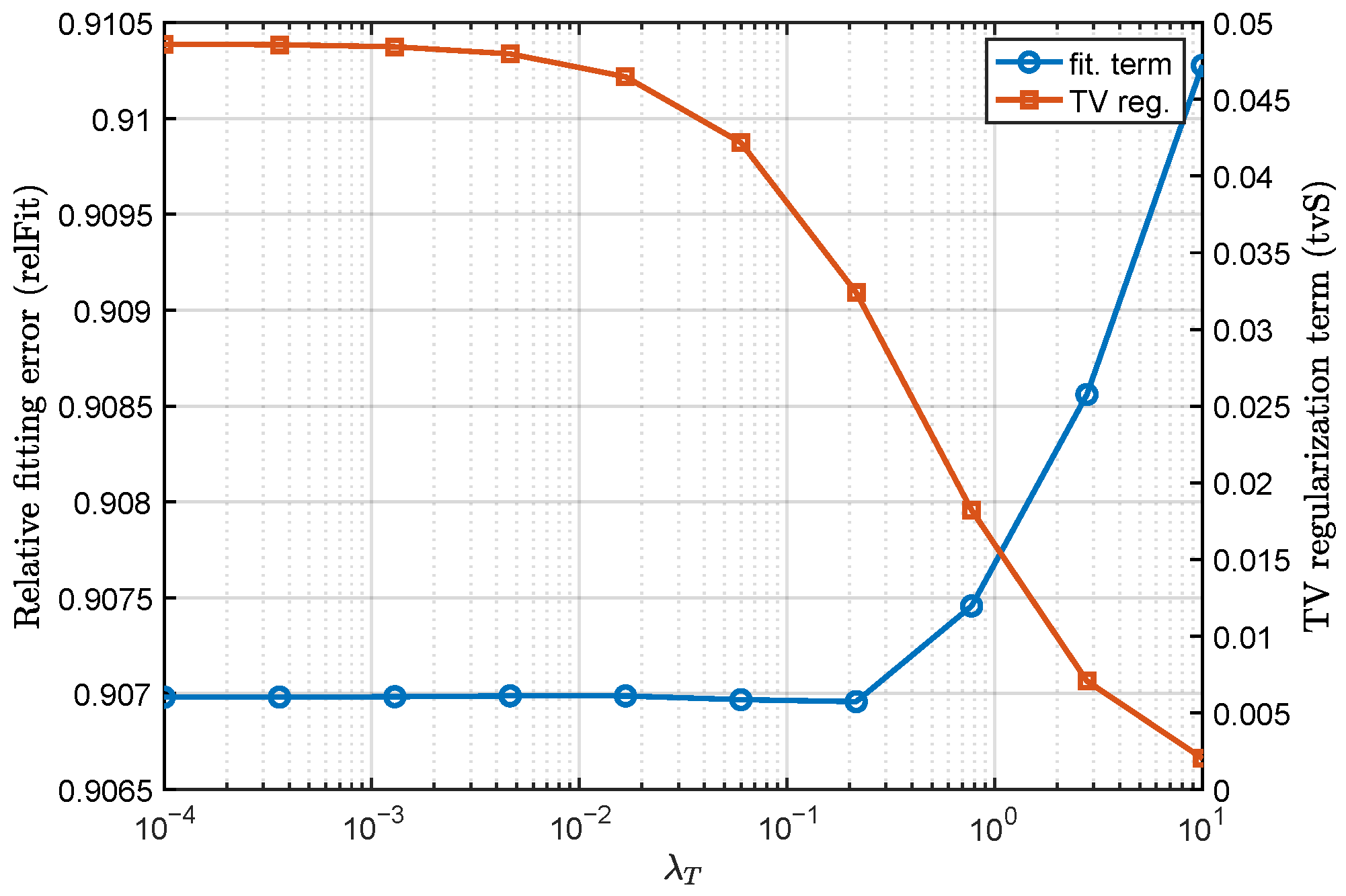
Figure 2 shows the curves of the relative data fitting error
and the TV regularization term
(
3) as
varies on a logarithmic scale. When
, the fitting error remains almost unchanged, indicating that the TV regularization has a negligible effect on the solution. As
increases beyond this range, the TV regularization term starts to decrease rapidly. However, for larger values of
(e.g.,
), the relative fitting error increases noticeably, implying an over-regularization effect that deteriorates data fidelity.
Based on this trade-off, we select , which corresponds to the elbow point of the curve, where a substantial reduction in the TV term is achieved, while the data fitting error is less affected.
Choice of R. The choice of rank R is guided by both modeling considerations and common practice in topic modeling. On one hand, a small rank tends to produce overly coarse topics that merge distinct narrative motifs. On the other hand, too large a rank leads to many fragmented topics that contain repeated and duplicated information.
In LDA and related models, the number of topics is typically specified a priori and chosen to balance interpretability and topic resolution, rather than being optimized based on likelihood or reconstruction error. In many empirical studies, values around 6∼12 are usually adopted for exploratory analysis, especially when identifying a small number of coherent and interpretable topics. Following this convention and considering the scale of our corpus, we set in our experiments.
Algorithm. Algorithm 1 is applied to solve the model (
5) with random initialization. The algorithm is stopped either when
or when 5000 iterations are reached.
5.3. Results
5.3.1. Topic Semantics: Top Vocabulary Words
We first examine the semantic content of each topic through its most representative words. Recall that the vocabulary–topic factor matrix
encodes the contribution of each vocabulary term to each topic. Each column
of
thus corresponds to a topic-specific distribution over the vocabulary, with larger values indicating stronger association between a word and the topic. For interpretability, we rank words within each topic according to their weights in the corresponding column, and report the top-ranked terms as indicative topic descriptors.
Table 2 reports the most representative words for each topic.
Notably, Topics 1 and 2 appear to be the strongest candidates for cross-work shared topics in the Morrison corpus, as will be further supported in the next subsection. Topic 1 is characterized by words such as ‘mother’, ‘black’, ‘white’, ‘remember’, and ‘die’. These lexical patterns may be read as pointing to the persistent negotiation of identity, lineage, and the haunting presence of history (‘rememory’) that transcends any single plot; in this interpretive sense, Topic 1 may be read as reflecting an ontological dimension. Topic 2 includes ‘house’, ‘kitchen’, ‘door’, and ‘window’. These words suggest the centrality of domestic space as a recurring site where historical trauma is enacted and endured. In Morrison’s work, the house is rarely just a setting; it can be read as a witness to the bodily experiences associated with Topic 1. In this sense, Topic 2 may be read as reflecting a spatial/material dimension.
The coherence of these two topics, together with their distinct lack of character-specific names, suggests that they may be interpreted as functioning more like
global/shared semantic themes than local ones. This will be further supported by the work–topic heatmap in the next subsection. The emergence of these cross-work topics also suggests that the proposed model is able to recover shared components whose lexical patterns are broadly consistent with thematic concerns frequently discussed in Morrison scholarship [
28,
29,
30], especially the articulation of racialized identity through everyday bodily experience and domestic life.
On the other hand, a subset of topics appears to be more novel-specific, characterized by the presence of character names and plot-related terms. For example, Topic 3 prominently features Pecola and Frieda, indicating its specificity to The Bluest Eye, while Topics 4 and 5 are dominated by character vocabularies from Song of Solomon and Sula, respectively. Some topics combine character-specific and more general social vocabulary, suggesting partial overlap across novels.
5.3.2. Work–Topic Associations
We next examine how the identified topics are associated with individual works through the work–topic factor matrix
. Each entry of
represents the overall intensity of a topic within a given work. We normalize each column of
by applying a z-score transformation to each topic; namely, for each topic, we subtract the mean across works and divide by the corresponding standard deviation.
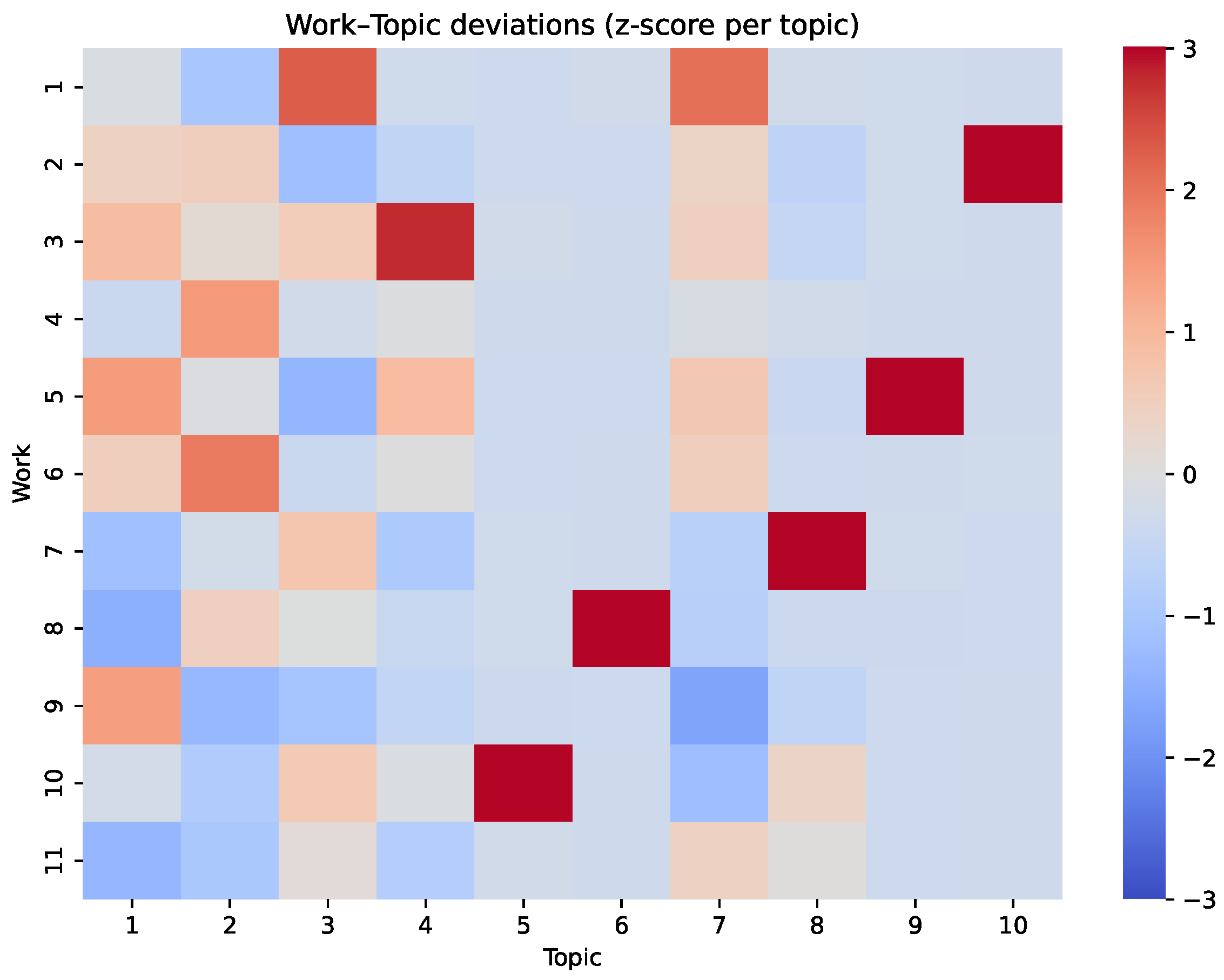
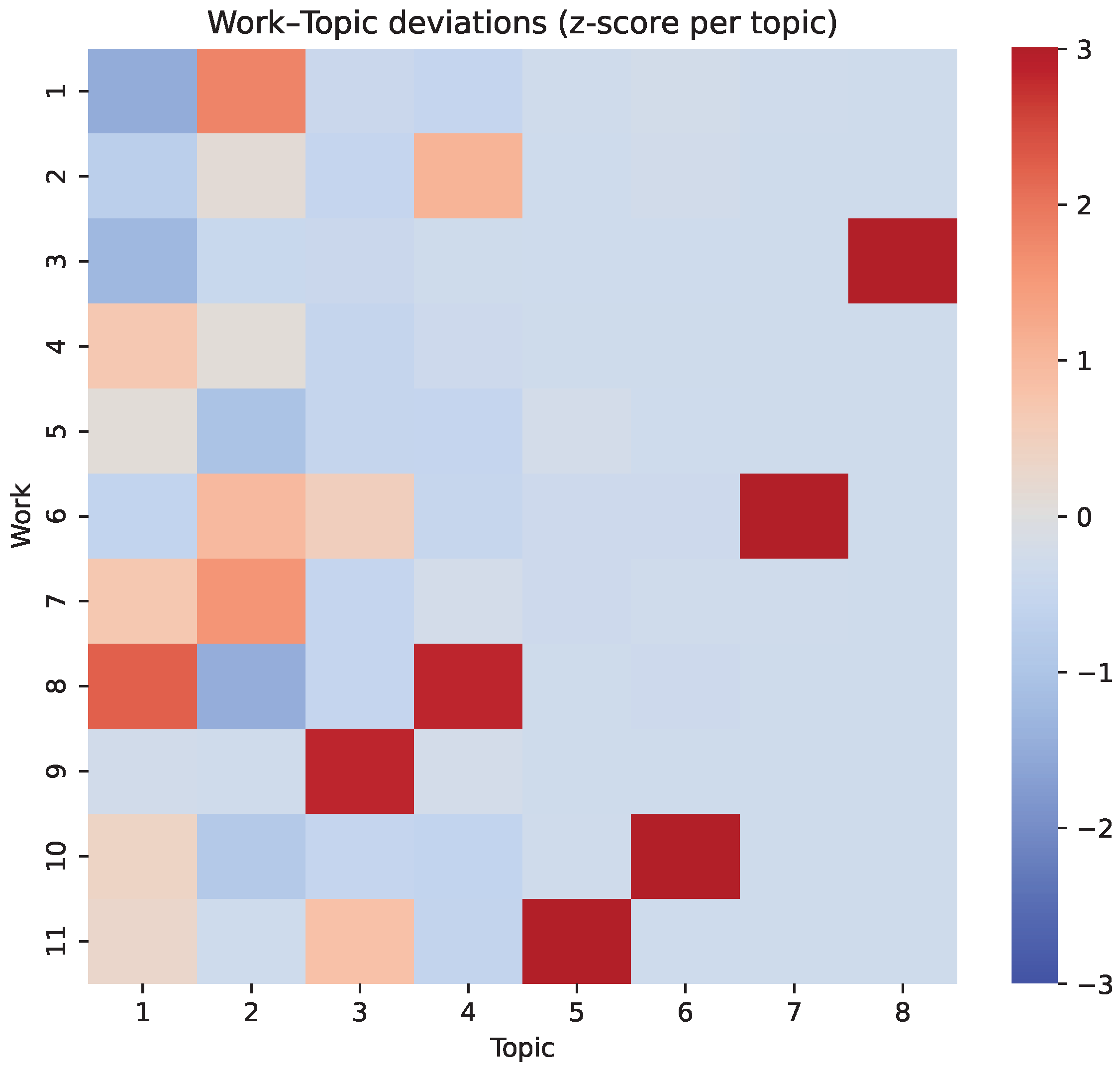
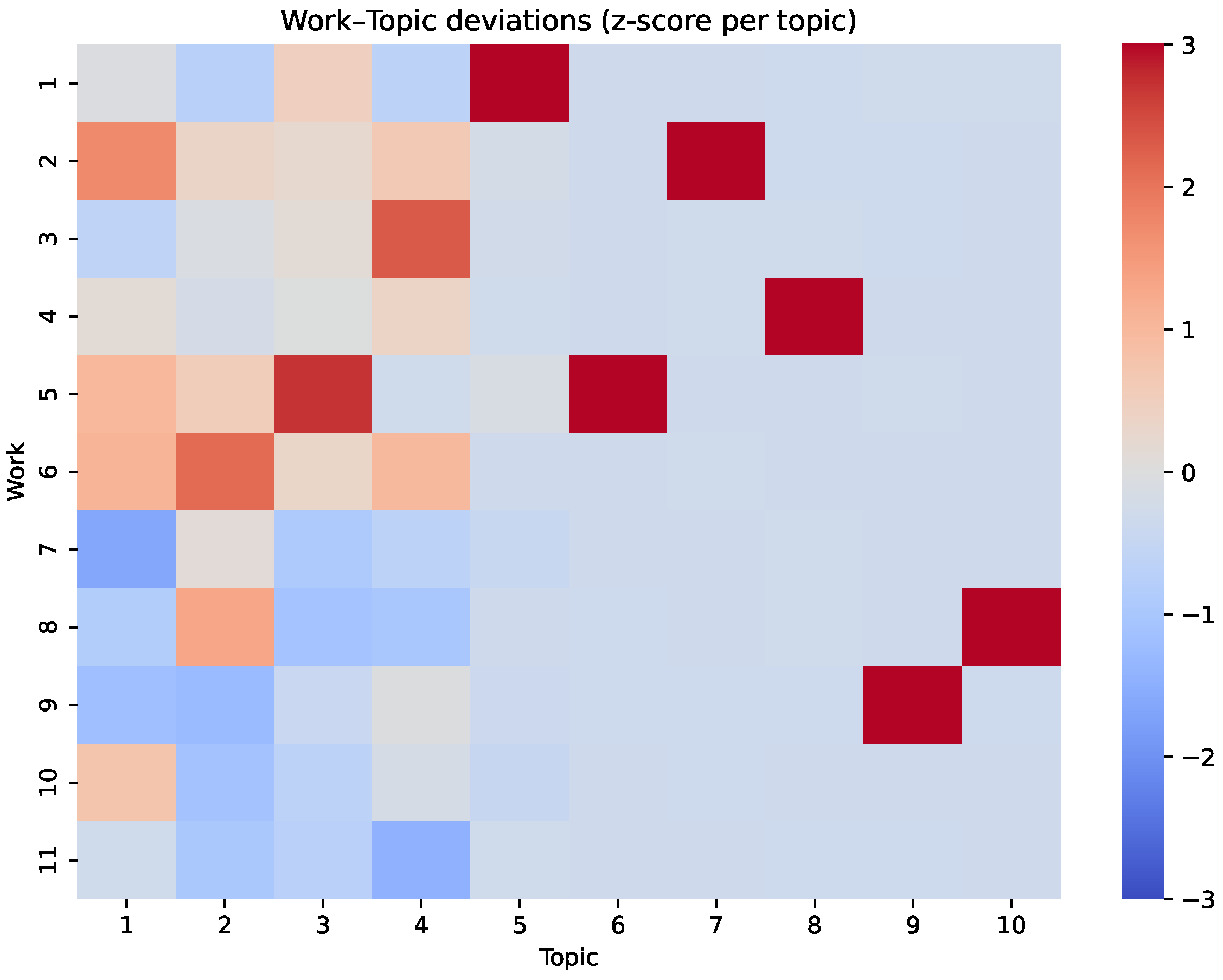
Figure 3 visualizes the normalized factor matrix as a heatmap. Positive (red) and negative (blue) values indicate above- and below-average emphasis of a topic within a given work, respectively. This representation allows us to distinguish cross-work themes from work-specific ones.
From the figure, we observe that the first two topics (the first two columns) exhibit a more distributed intensity pattern. Unlike the later topics, Topics 1 and 2 do not concentrate exclusively on a single work. Instead, they show moderate to high activation across multiple novels. This quantitative distribution is consistent with interpreting Topics 1 and 2 as cross-work shared components rather than novel-specific ones, in line with the lexical observations in
Section 5.3.1.
On the other hand, other topics display highly concentrated deviations, characterized by strong positive values in a single novel and near-average values elsewhere. For example, Topic 3 exhibits a pronounced peak associated with
The Bluest Eye (Work 1), while Topics 4 and 5 are strongly aligned with
Song of Solomon (Work 3) and
Sula (Work 2), respectively. In contrast to the vocabulary-based inspection in
Section 5.3.1, these concentrated deviations provide a quantitative perspective on the work-specific nature of these topics.
From the perspective of individual works, we also observe that some works (e.g., Works 7 and 11) exhibit z-scores close to zero across all topics. This indicates that, with respect to the extracted topics, these works do not show pronounced deviations from the corpus-level mean for any single topic.
5.3.3. Topic Profiles over Narrative Position
To analyze how topics evolve along the narrative timeline, we focus on how each topic is actually realized within individual works at different narrative positions. Recall that in the proposed model, the factor
encodes narrative templates that are shared across works, while the factor
controls the overall participation strength of each topic within a specific work. Neither factor alone captures how a topic manifests at a concrete narrative position. We therefore consider their combined contribution. For each work
i, narrative segment
j, and topic
r, the realized topic intensity is given by the product
. To remove scale ambiguity and enable meaningful comparison across topics and works, we define the topic responsibility
which measures the relative emphasis of topic
r at narrative position
j within work
i. This representation provides a descriptive view of how topic emphasis is distributed along the narrative timeline, allowing one to distinguish between topics that have relatively stable presence and those showing more localized variation.
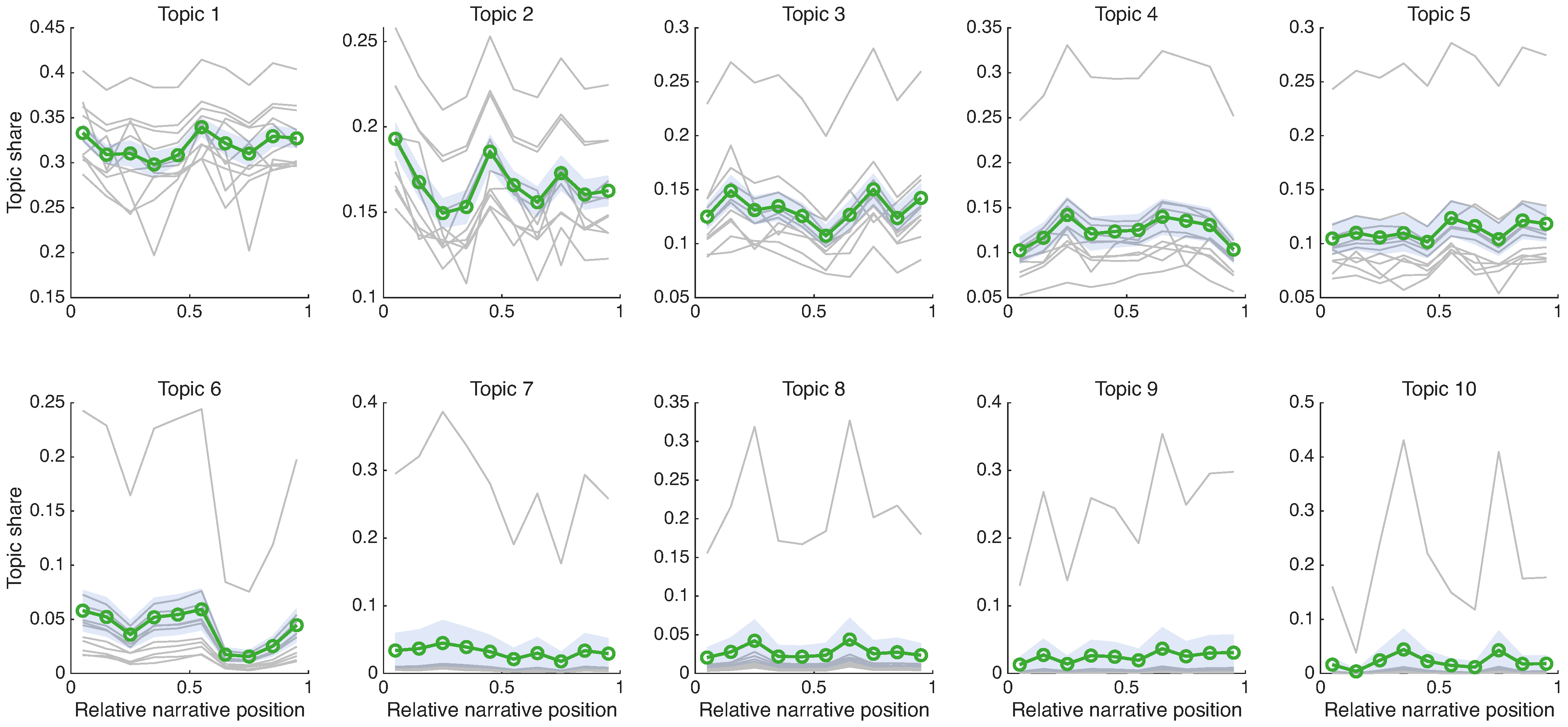
Figure 4 visualizes the topic curves
over the narrative timeline for all topics. Thin gray curves represent individual works, while thick colored curves show the average trajectory across works, with shaded regions indicating standard errors. We make several descriptive observations:
Topics 1 and 2 exhibit relatively stable trajectories across the narrative timeline, with only mild fluctuations around their mean levels. Combined with their distributed presence across works, observed in
Section 5.3.2, and their vocabulary profiles highlighted in
Section 5.3.1, this stability is consistent with their interpretation as cross-work themes that permeate narratives rather than concentrating on specific events or plot points.
For Topics 3–10, a markedly different pattern can be observed. In these cases, we can observe that one individual work exhibits consistently higher values across narrative positions, while the remaining works stay much lower. As a result, the average trajectory remains low despite the presence of a prominent curve in a single work.
For some work-specific topics (e.g., Topics 6–10), the dominant curves exhibit noticeable fluctuations across narrative positions. This indicates that, within the associated work, the relative emphasis of the topic is not uniformly distributed along the narrative timeline. Such variations reflect localized differences in how the topic is realized within a single work, under the overall dominance of that work.
Overall, the topic curves offer a complementary, coarse-grained summary of how topic emphasis is distributed along narrative position, supporting the distinction between relatively stable cross-work themes and more localized, work-dependent components.
5.3.4. Summary
Taken together, the analyses of topic vocabularies, work–topic associations, and narrative topic curves support the distinction between cross-work shared topics and work-specific topics in Morrison’s fiction.
Topics 1 and 2 emerge as the strongest candidates for broadly shared topics across the corpus. They are characterized by words related to bodily experience, family relations, domestic spaces, and everyday social interactions, including recurrent references to black–white identity (
Section 5.3.1). At the work level, they exhibit relatively uniform intensity across novels (
Section 5.3.2), and at the narrative level, their topic curves show stable profiles with only mild fluctuations (
Section 5.3.3). These patterns are also broadly consistent with thematic concerns frequently discussed in Morrison scholarship, suggesting that the proposed model is able to recover cross-work components that are interpretable in a literary context.
In contrast, Topics 3–10 consistently display strong concentration within individual novels. Their vocabularies are dominated by character names and plot-related terms, their work–topic associations show sharp peaks for specific works, and their narrative curves are largely driven by a single dominant trajectory. These topics may be interpreted as reflecting more localized thematic structures that are specific to individual narratives.
5.4. Comparisons with NMF Model
We consider a nonnegative matrix factorization (NMF) model constructed from the same corpus as a comparison. We first construct the matrix. Following the preprocessing steps described in
Section 3.1, including tokenization, stopword removal, and vocabulary selection, we first build a global vocabulary of size
K shared across all works. Unlike the tensor construction, we do not distinguish narrative segments. Instead, for each work, all word occurrences are aggregated into a single bag-of-words representation. This yields a nonnegative work–vocabulary matrix
, where each entry records the normalized frequency of a vocabulary word within a given work.
To ensure a fair comparison with the tensor-based model, we also impose the orthogonality regularization on
. The resulting NMF model is thus formulated as
We also solve it using an algorithm similar to Algorithm 1. We tune
in the above model in a similar way to that described in
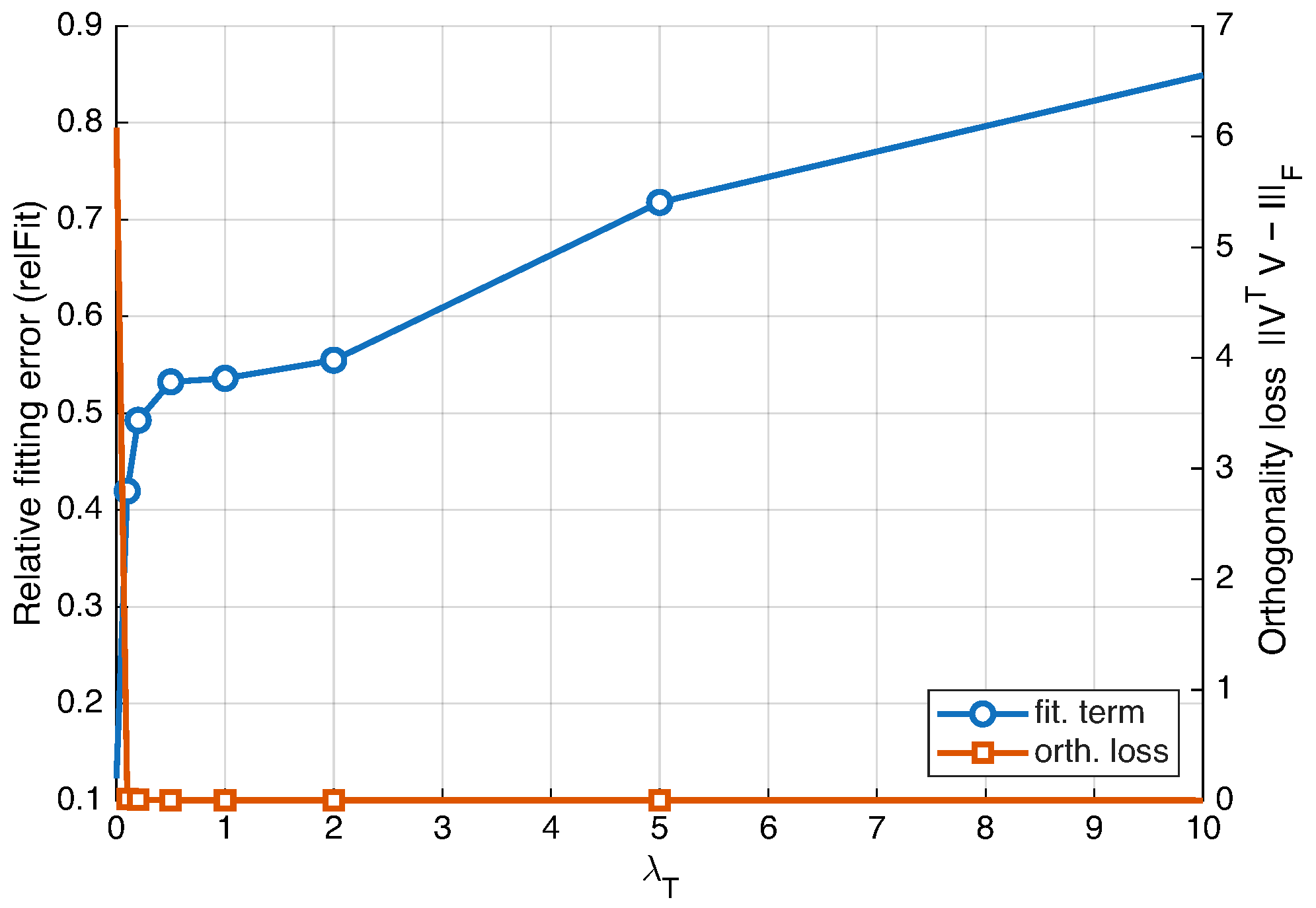
Section 5.2. The curves are plotted in
Figure 5, based on which we choose
in the model.
The top vocabulary words and the work–topic association heat map are respectively provided in
Table 3 and
Figure 6. Upon comparing the proposed model with the NMF-based model, we have the following observations:
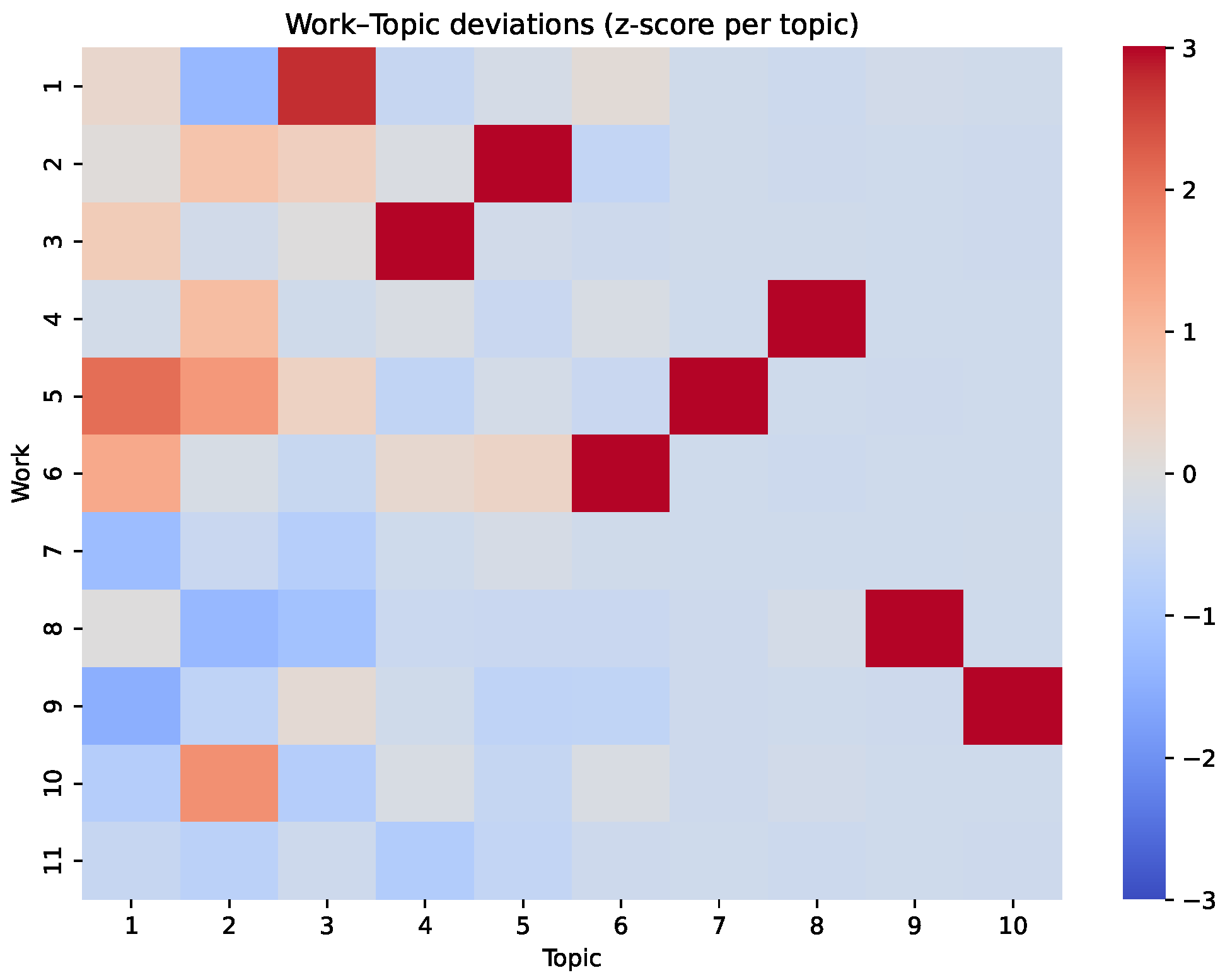
Both the NTF and NMF models yield a similar macroscopic structure in the work–topic association heatmaps (
Figure 3 and
Figure 6). In both cases, we observe that the first two topics behave as global (author-level) themes, whereas the remaining topics are predominantly work-specific. This commonality suggests that the Morrison corpus simultaneously contains (i) a small number of shared thematic structures and (ii) several work-specific cores, and that such a global-local mixture is robust to the choice of factorization model.
Despite this shared global–local pattern, the two models differ substantially in what they place into the global themes. Inspecting the representative words (
Table 2 and
Table 3), we find that the global topics extracted by our NTF model are more readily interpretable as corpus-level shared thematic patterns in Morrison’s fiction. Noticeably, NTF Topic 1 aggregates words directly tied to Morrison’s recurrent themes: racial polarity and social structure (‘black’, ‘white’), kinship and home (‘mother’, ‘home’), and the ethical weight of memory and mortality (‘remember’, ‘die’, ‘dead’). These lexical cues can be read as forming a more coherent thematic pattern that is consistent with a corpus-level reading of Morrison’s oeuvre. In contrast, the corresponding global topic in NMF is dominated by broadly ubiquitous narrative vocabulary (e.g., generic human referents and body-related terms such as ‘man’, ‘child’, ‘eye’ (which may be specific to the novel
The Bluest Eye), ‘head’, and ‘face’, together with common verbs and everyday descriptors). While such words naturally appear across all novels and produce a global topic under work-level co-occurrence, they are less indicative of a Morrison-specific shared thematic pattern and instead more closely resemble a corpus-agnostic narrative “background” component.
A similar but subtler difference appears in the second global topic. Both models identify a shared topic organized around domestic and spatial lexicons (e.g., ‘house’, ‘door’, ‘room’, ‘window’, ‘kitchen’, ‘bed’), but NTF yields a more structured semantic field that links interior spaces to movement and recurrence (e.g., ‘road’, ‘step’, ‘follow’, ‘return’), and to embodied perception (e.g., ‘smell’, ‘body’). This coupling is broadly consistent with existing discussions in literary studies that treat space not merely as a setting but as a carrier of social relations and narrative progression. By comparison, NMF’s analogous topic tends to mix household objects and everyday descriptors in a less coherent directed manner, again reflecting document-level aggregation effects.
In a nutshell, NMF compresses each long novel into a single document-term vector, so its “global” topics tend to be dominated by corpus-agnostic, high-frequency narrative vocabulary. In contrast, NTF incorporates an additional mode for narrative progression, which provides extra structure for aligning recurrent patterns across works beyond overall co-occurrence (even though the heatmap visualizes the work–topic marginal). This may partly explain why the global topics extracted by NTF are more interpretable as cross-novel shared thematic patterns, e.g., race (black/white), kinship/home, memory and mortality, and domestic space, whereas NMF’s shared topics more closely resemble a generic narrative background component.
5.5. Comparison with LDA Model
We further compare our NTF model with the standard LDA model, which is widely used in digital humanities and text mining. The LDA model is also trained on the same Morrison corpus under the same preprocessing as in
Section 3.1. We also build a global vocabulary shared across all works and represent each novel as a single bag-of-words document, resulting in a work–vocabulary matrix similar to that in the NMF model. We run LDA using the Gensim package in Python 3.12 (Gensim is an open-source Python library designed for unsupervised topic modeling, document indexing, and similarity retrieval) with the number of topics also set to 10 for a direct comparison. The top vocabulary words and the work–topic heatmap are respectively presented in
Table 4 and
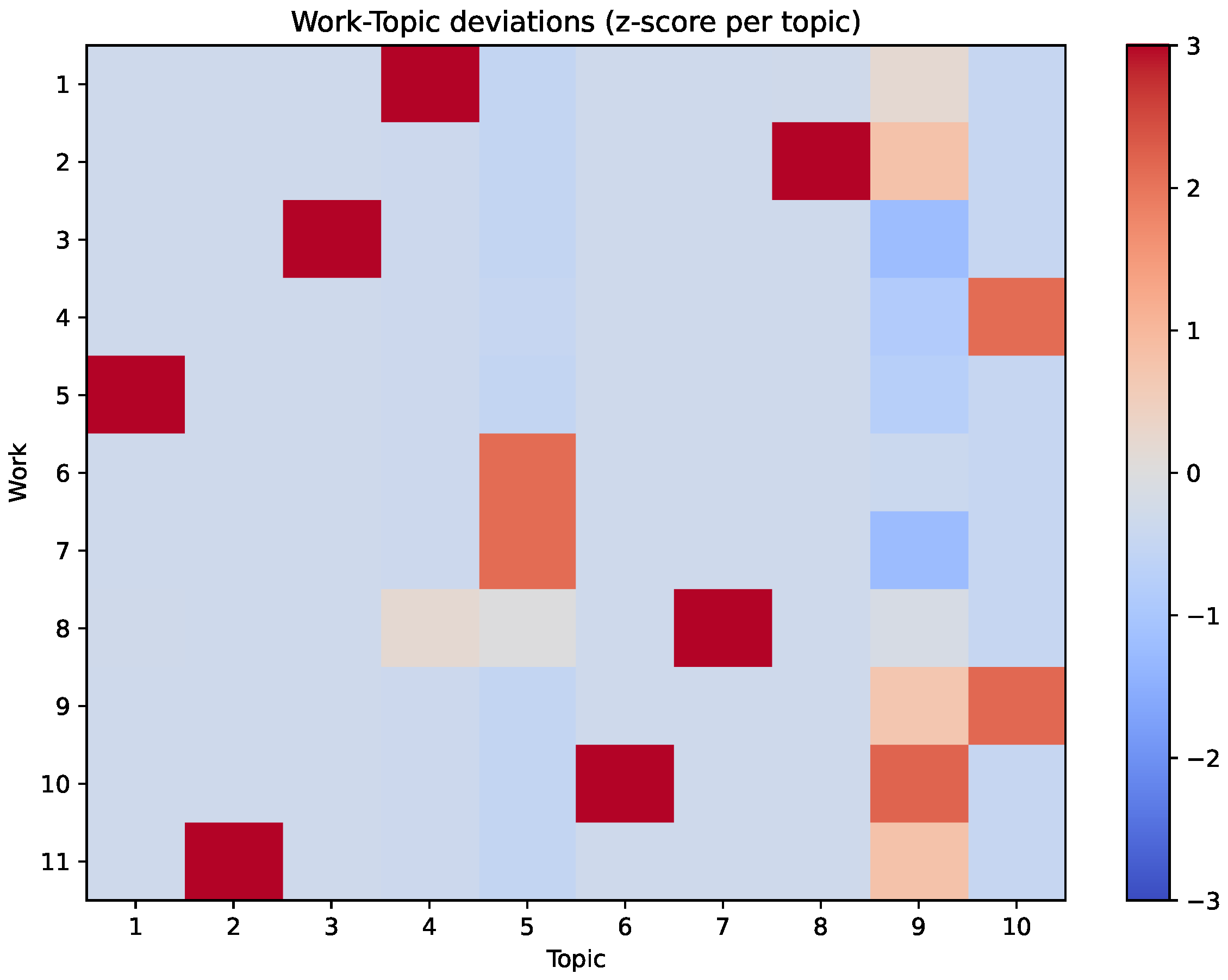
Figure 7. We make the following observations:
Table 4 shows that several LDA topics are dominated by character names and plot-specific entities (e.g., Sethe, Denver, Beloved, Sula, Nel, Eva, Milkman, Pilate, Macon), indicating that LDA can effectively identify work-specific lexical clusters. This is also reflected in the heatmap in
Figure 7 (see, e.g., Topics 1–4, and 6–8), where several topics exhibit a pronounced positive deviation concentrated on a single work.
In
Figure 7, Topics 5, 9, and 10 appear more like “global” themes in the sense that they do not show an equally sharp peak for a single work, as is the case with some other topics. However, their top words (
Table 4) do not form a coherent thematic cluster that can be easily interpreted as a Morrison-specific cross-novel thematic pattern. For example, Topic 5 is dominated by a set of character names and plot entities (e.g., ‘Florens’, ‘Blacksmith’, ‘Jacob’, ‘Rebekka’, ‘Lina’, ‘Sorrow’), which strongly suggests that it is a novel-anchored signature (here closely tied to
A Mercy) rather than an author-level structure; its seemingly non-peaked pattern can be described as a diffuse or mixed assignment in the document-topic proportions. A similar phenomenon appears in Topic 10, which is driven by character names (‘Macon’, ‘Pilate’, ‘Hagar’, ‘Reba’, ‘Ruth’) together with generic social vocabulary (e.g., ‘family’, ‘money’, ‘buy’, ‘store’). By contrast, Topic 9 consists almost entirely of generic nature-and-setting vocabulary (e.g., ‘mountain’, ‘trees’, ‘river’, ‘flowers’, ‘sun’, ‘sky’, ‘wind’, ‘water’, ‘morning’, ‘night’). Such scenic terms naturally recur across many novels and are thus prone to appear as a broad “global” component in the LDA results, but they are corpus-agnostic and only weakly indicative of Morrison’s thematic concerns. In summary, these “global-looking” topics do not align with the Morrison-diagnostic global themes (e.g., racialized identity, kinship/home, memory/mortality, and domestic space).
5.6. Comparison with the Standard NTF Model
We also consider a standard nonnegative tensor factorization (NTF) model as a baseline. Specifically, we solve
The top vocabulary words and the work–topic association heat map are respectively provided in
Table 5 and
Figure 8. Upon comparing this model with with the proposed NTF model, we make the following observations:
Table 5 shows that the standard NTF model can also identify several work-specific topics. This is reflected in
Figure 8, where Topics 5–10 exhibit pronounced positive deviations concentrated on individual works.
Compared with the proposed NTF model, the main difference lies in the organization of the shared-theme topics. In
Figure 8, Topics 1–4 show some cross-work distribution, but their representative words overlap substantially and form relatively broad lexical fields. For example, words such as ‘hand’, ‘house’, ‘mother’, ‘child’, ‘white’, ‘black’, ‘feel’, and ‘life’ recur across Topics 1–4. By contrast, in the proposed model, the first two topics (see
Table 2 and
Figure 3) are more clearly separated and are more readily interpretable as two complementary cross-work themes, as discussed in
Section 5.3.1. This difference may reflect that, without additional structural constraints, the shared themes extracted by standard NTF are more likely to overlap, whereas the proposed model appears to yield a more clearly organized shared-theme layer.
5.7. Additional Validations on Works of Hemingway and Swift
To further examine the effectiveness of the proposed model beyond the Morrison corpus, we additionally apply it to the long novels of Ernest Hemingway and Graham Swift in the following two subsections.
5.7.1. Hemingway’s Novels
Ernest Hemingway’s corpus consists of ten book-length novels, spanning from
The Torrents of Spring (1926) to
True at First Light (1999), as summarized in
Table 6. Hemingway (1899–1961), a Nobel Laureate in Literature, is widely recognized for portraying modern experience through emotional restraint, bodily states, and understated interpersonal relations. Across his fiction, critics have repeatedly noted a focus on fatigue, injury, intimacy, and the difficulty of articulation, with meaning often conveyed through silence, repetition, and everyday routines rather than explicit psychological explanation [
34,
35].
The data tensor constructed from Hemingway’s works is of size
. We set
to balance interpretability and thematic coherence. In contrast, we observed that larger
R produces unmeaningful topics (e.g., when
, the model produces a topic that includes the numbers of the chapters, such as ‘vii’, ‘xviii’, ‘xiv’, ‘ix’, and so on). The top vocabulary words and the work–topic heatmap are respectively presented in
Table 7 and
Figure 9. We make the following observations:
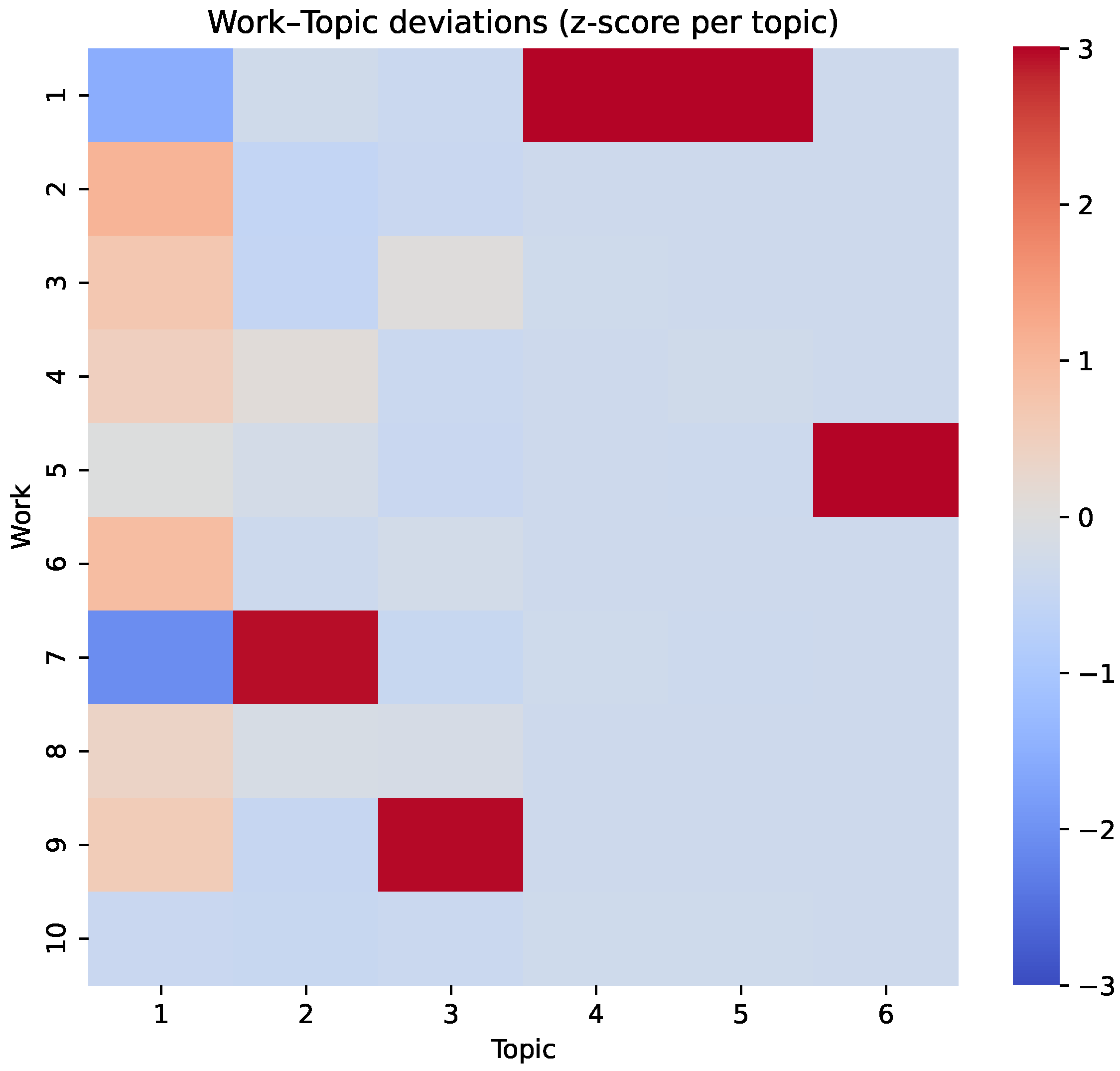
From
Figure 9, we observe that Topic 1 exhibits a global pattern across Hemingway’s novels.
Table 7 illustrates that Topic 1 is characterized by affective and everyday-state vocabulary such as ‘feel’, ‘drink’, ‘love’, ‘sleep’, ‘dark’, ‘room’, ‘road’, ‘face’, and ‘lie’. These terms describe recurrent bodily and emotional conditions and the subdued interpersonal tensions through which experience is registered. In interpretive terms, this topic is broadly consistent with a widely recognized feature of Hemingway’s fiction: a restrained affective undercurrent in which meaning is staged through fatigue, silence, and everyday routines rather than explicit exposition.
On the other hand, the heatmap shows that the remaining topics display local themes. A clear example is Topic 2. It is dominated by sea-fishing and embodied action vocabulary (e.g., ‘fish’, ‘sea’, ‘boat’, ‘line’, ‘hook’, ‘pull’, ‘hand’). As shown in the heatmap, this topic exhibits a strong positive deviation in Work 7 (The Old Man and the Sea). This pattern is broadly consistent with common literary discussions: The Old Man and the Sea focuses almost entirely on sea fishing and physical endurance, whereas similar motifs play a much less prominent role in Hemingway’s other novels. The model therefore identifies this topic as more novel-specific than corpus-wide.
5.7.2. Graham Swift’s Novels
Graham Swift’s corpus consists of eleven book-length novels, summarized in
Table 8. Swift (b. 1949) is widely recognized for narratives that look backward: his fiction repeatedly returns to memory, family bonds, and the way private lives are shaped by larger histories. Rather than relying on grand plot turns, Swift often builds meaning through recollection, everyday detail, and the uneasy gap between what is told and what is withheld [
36,
37].
The data tensor constructed from Swift’s works is of size
. We set
. The top vocabulary words and the work–topic heatmap are respectively presented in
Table 9 and
Figure 10. We make the following observations:
Via
Figure 10, we observe that Topics 1 and 2 seem to exhibit a global pattern.
Table 9 illustrates that Topic 1 is characterized by words such as ‘life’, ‘remember’, ‘story’, ‘war’, ‘love’, ‘father’, ‘mother’, ‘home/house’, and ‘lie’. These terms point to recurring themes of family life, retrospective narration, and the pressure of history, where “truth” is frequently negotiated through storytelling and imperfect remembrance. In interpretive terms, this topic is broadly consistent with common literary discussions of Swift as a novelist of memory and inheritance, with personal relationships set against wider historical and moral contexts.
Topic 2 is dominated by concrete scene and perception vocabulary, including ‘face’, ‘eye’, ‘door’, ‘window’, ‘street’, ‘road’, ‘car’, ‘inside’, and ‘step’. These words suggest a shared narrative surface across the corpus: Swift repeatedly anchors reflection in ordinary spaces and small observed actions—moving through rooms, looking out of windows, traveling along roads—so that everyday settings become the stage where memory and tension accumulate. In this sense, Topic 2 complements Topic 1 by reflecting a relatively consistent way of writing, not just a recurring subject matter.
On the other hand, the heatmap shows that the remaining topics appear to be more local themes. In
Table 9, Topics 3–8 are filled with proper names and tightly clustered story-specific terms, and in the heatmap, each of these topics shows a strong positive deviation in only one (or very few) works.
6. Conclusions
This paper targets a basic task in literary studies: identifying the major themes and recurring motifs that run through an author’s long novels via topic modeling. Instead of directly modeling an author’s corpus as a work × vocabulary matrix, we model it as a work × segment × vocabulary tensor and propose a modified nonnegative NTF model that encourages distinct topics (via orthogonality regularization) and smooth narrative progression (via -TV regularization). We develop a block proximal linearization algorithm to solve the model and show that any limit point satisfies the KKT condition.
In our experiments, we use Toni Morrison’s eleven long novels as the main case study. The extracted cross-work themes exhibit qualitative patterns that are broadly consistent with thematic concerns frequently discussed in Morrison scholarship, and relative to NMF and LDA, they are more readily interpretable as cross-work thematic patterns in the present corpus. We further test the model on the long novels of Ernest Hemingway and Graham Swift as additional validations. In both cases, the model also yields shared topics whose lexical and distributional patterns are broadly consistent with critical discussions of the authors’ recurring thematic concerns.
More broadly, the proposed framework is intended as a distant-reading tool for long-novel corpora. Its scholarly relevance lies in offering a way to screen recurring themes across an author’s works and to distinguish them from more local, work-specific topics. At the same time, the model does not replace close reading or final literary judgment; rather, it may serve as a practical tool for identifying cross-work shared themes and work-specific topics for further literary examination.