A Procedure of Perturbation Leading to a New Class of Asymmetric Copulas

Abstract
1. Introduction
2. Preliminaries
- 0 and 1 are, respectively, its zero element and identity argument; i.e.,
- It is 2-increasing; i.e., for all where and , the volume over the rectangle is
- 1.
- Condition may be compactly written as follows:
- 2.
- The transformation corresponds to the involutive transformation ;
- The transformation corresponds to the involutive transformation ;
- The transformation corresponds to the involutive transformation ;
- The transformation corresponds to the involutive transformation ;
- The transformation corresponds to the involutive transformation ;
- The transformation corresponds to the involutive transformation .
- , C is called symmetric;
- , C is called radially symmetric.
- 1.
- 2.
- The Fréchet copulas , are also both symmetric and radially symmetric.
- (i)
- M is the unique copula C satisfying ;
- (ii)
- W is the unique copula C satisfying ;
- (iii)
- There exist numerous copulas C satisfying
- (i)
- Let C be a copula such that ; then . We thus obtain two functions and , one negative and the other positive, which are equal. This allows us to conclude that , hence the uniqueness.
- (ii)
- The same reasoning as above applies.
- (iii)
- For this proposition, they only proposed a parametric family of asymmetric copulas satisfying , given byfor every , with . □
- (i)
- (i.e., );
- (ii)
- ;
- (iii)
- for all rectangles .
3. New Class of Copulas Based on Antisymmetric Perturbations
3.1. Characterization of the New Class of Copulas
- (i)
- ;
- (ii)
- .
- From we have for all , and we thus obtain
- If exactly one of the two functions does not vanish at 0, this means that or .For and with , the hypothesis implies that for every , and therefore, , which is absurd (since g is considered a continuous non-zero function; i.e., there exists such that ). The same reasoning applies to the other case: and with .
- If both functions do not vanish at 0, then there exist two non-zero real numbers and such that with , and substituting the last two equalities into (8), we find that , where . Hence, for every , which is impossible since P is assumed to be non-identically zero.Thus, .
- By following the same steps as above for Equation (9), we obtain . In addition, one may deduce the second point in Lemma 1 by considering the functions and .It follows that . □
- ;
- f and g are absolutely continuous;
- almost everywhere .
- By hypothesis (), we obtain
- So, and .Then, and .Hence, and .It follows that defines a copula.
- So, and .Then, and .Hence, and .It follows that .Thus, defines a copula.
3.2. Subclass and Some Examples
- ;
- g is absolutely continuous;
- .
- If , then . Hence,
- In this case,
- we have . Then,
3.3. An Asymmetric Extension of the FGM Family Through Parametric Perturbation
3.4. Illustrations
4. Properties of the New Subclass
4.1. Preliminaries on Measures of Concordance
- Symmetry, .
- Monotonicity in each argument (meaning that a stronger concordance ordering between copulas implies a higher concordance value).Formally, if and , then
- The concordance function Q remains unchanged when the copulas are replaced by their survival copulas or by their transposes, while it changes sign when they are replaced by their reflections:For more details, see [18].
- (C1)
- ;
- (C2)
- ;
- (C3)
- ;
- (C4)
- For every where , ;
- (C5)
- If a sequence of copulas converges uniformly to , then .
- Kendall’s : ;
- Spearman’s : ;
- Gini’s : ;
- Spearman’s footrule : ;
- On the other hand, Blomqvist’s is given by
4.2. Single Point-Generated Convex Weak Concordance Measures
- which confirms that there is no lower bound for convex weak concordance measures.
4.3. Representation of Basic Weak Convex Concordance Measures via and
- If and , ,then (Spearman’s ρ).
- Ifandwhere and ,then (Gini’s γ).
- Ifandthen (Spearman’s footrule ϕ).
- Consider the probability measure on with density , as . Then, the corresponding convex weak concordance measure introduced in (20) can be determined as follows:The same result can be obtained using the representation given in (21).
- Let be a probability measure on whose support is the set and densityThen,
- The support of the probability measure is the set . We directly obtain
4.4. Dependence Properties
4.4.1. Measures of Concordance
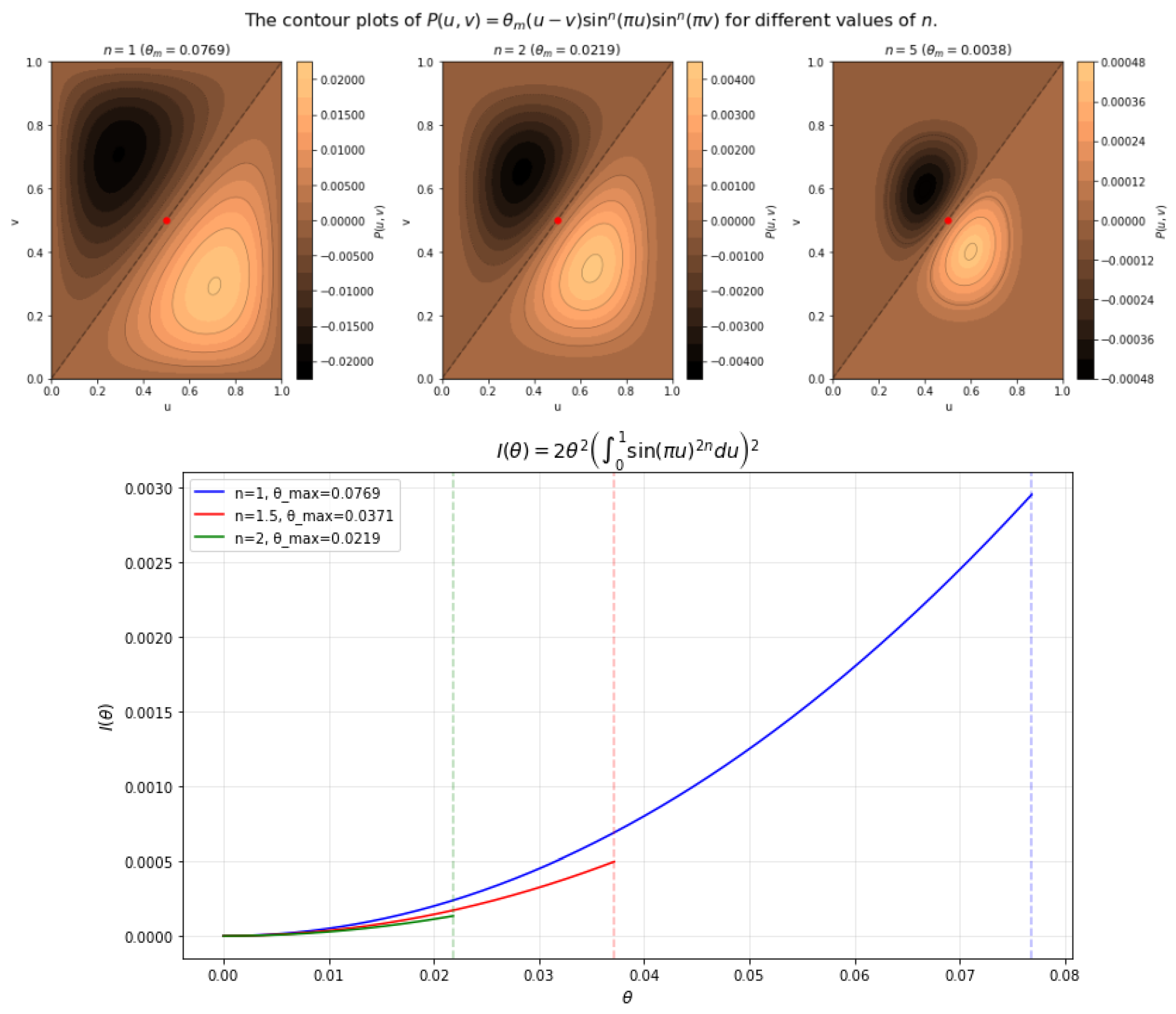
- Figure 2 also illustrates the evolution of , whose graph displays three curves, each corresponding to a specific value of n and its associated . The vertical dashed lines indicate the value of for each n.
- For , is the largest (approximately 0.0769).
- For the other two cases, and , decreases (approximately 0.0371 and 0.0219, respectively).
4.4.2. Positive Dependence
- 1.
- Y is left-tail decreasing in X () if and only if for almost all u, and holds if and only if either and or for almost all v.
- 2.
- Y is right-tail increasing in X () if and only if either and or for almost all u, and () holds if and only if for almost all v.
- 3.
- Y is stochastically increasing in X () if and only if, for any , for almost all u, and () holds if and only if, for any , for almost all v.
- Thus, we have .In addition, .The inequality (28) therefore becomes by rearranging the terms. Furthermore, from , we obtain .Let (an affine function with respect to v).If , this implies that is increasing and, consequently, reaches its maximum at .Hence, is equivalent to for almost all u.If , this implies that is decreasing; hence, reaches its maximum at .Therefore, is equivalent to , which contradicts for almost all u.The proof is similar for . Following the same steps as before, we find thatwhich leads to .Let .If , which implies that is increasing, then reaches its minimum at .Then, is equivalent to for almost all v.If , then is decreasing and, consequently, reaches its minimum at .Thus, is equivalent to for almost all v.
- holds if and only if, for any ,which leads to .Let .If , then reaches its maximum at . is equivalent to for almost all u.If , then reaches its maximum at .Then, is equivalent to for almost all u (where ).can be proved using similar arguments.
- holds if and only if, for any , is a concave function of u.We haveThen, implies that, for any ,Let . As ,this means that is increasing; i.e., reaches its maximum at .Hence, is equivalent to , for almost all .The same reasoning applies to , and the desired result follows. □
4.4.3. Tail Dependence
5. Asymmetry Analysis of Our New Class of Family of Copulas
- (A1)
- There exists such that, for all , we have ;
- (A2)
- if and only if (C is symmetric);
- (A3)
- ;
- (A4)
- If and C are in , and if converges uniformly to C, then converges to .
- For :
- For :
- If , by the 1-increasing property, we have .If , by the 1-Lipschitz property, we obtain
- and, consequently,
- Incorporating the Fréchet–Hoeffding bounds completes the proof. □
- In particular:
- For , we have , where
- For , we have , where
- For , we have , whereand
- For , we have , whereand
- For each copula of the form , where , we have . Corollary 2 directly implies that .
6. Conclusions and Directions for Further Research
Author Contributions
Funding
Institutional Review Board Statement
Informed Consent Statement
Data Availability Statement
Acknowledgments
Conflicts of Interest
Abbreviations
| FGM | Farlie–Gumbel–Morgenstern |
| PQD | Positively Quadrant-Dependent |
| LTD | Left-Tail Decreasing |
| RTI | Right-Tail Increasing |
| SI | Stochastically Increasing |
References
- Blier-Wong, C.; Cossette, H.; Marceau, E. Risk aggregation with FGM copulas. Insur. Math. Econ. 2023, 111, 102–120. [Google Scholar] [CrossRef]
- Kupka, I.; Kisel’ák, J.; Ishimura, N.; Yoshizawa, Y.; Salazar, L.; Stehlik, M. Time evolutions of copulas and foreign exchange markets. Inf. Sci. 2018, 467, 163–178. [Google Scholar] [CrossRef]
- De Kort, J. Modeling Tail Dependence Using Copulas-Literature Review; Faculty of Electrical Engineering, Mathematics and Computer Science (EEMCS), Delf University of Technology: Delft, The Netherlands, 2007. [Google Scholar]
- Oussama, E.; Mohamed, E.; Ahmed, S. An analytic treatment of evolution copulas. Asia Pac. J. Math. 2024. [Google Scholar] [CrossRef]
- Yoshizawa, Y.; Ishimura, N. Evolution of multivariate copulas in continuous and discrete processes. Intell. Syst. Account. Financ. Manag. 2018, 25, 44–59. [Google Scholar] [CrossRef]
- Durante, F.; Sánchez, J.F.; Flores, M.Ú. Bivariate copulas generated by perturbations. Fuzzy Sets Syst. 2013, 228, 137–144. [Google Scholar] [CrossRef]
- Komorník, J.; Komorníková, M.; Kalická, J. Dependence measures for perturbations of copulas. Fuzzy Sets Syst. 2017, 324, 100–116. [Google Scholar] [CrossRef]
- Rodrıguez-Lallena, J.A.; Úbeda-Flores, M. A new class of bivariate copulas. Stat. Probab. Lett. 2004, 66, 315–325. [Google Scholar] [CrossRef]
- Amblard, C.; Girard, S. A new extension of bivariate FGM copulas. Metrika 2009, 70, 1–17. [Google Scholar] [CrossRef]
- Mesiar, R.; Komorníková, M.; Komorník, J. Perturbation of bivariate copulas. Fuzzy Sets Syst. 2015, 268, 127–140. [Google Scholar] [CrossRef]
- Manstavičius, M.; Bagdonas, G. A class of bivariate independence copula transformations. Fuzzy Sets Syst. 2022, 428, 58–79. [Google Scholar] [CrossRef]
- Mohamed, E.; Ahmed, S. New asymmetric perturbations of FGM bivariate copulas and concordance preserving problems. Moroc. J. Pure Appl. Anal. MJPAA 2023, 9, 111–126. [Google Scholar]
- Saminger-Platz, S.; Kolesárová, A.; Šeliga, A.; Mesiar, R.; Klement, E.P. The impact on the properties of the FGM copulas when extending this family. Fuzzy Sets Syst. 2021, 415, 1–26. [Google Scholar] [CrossRef]
- Mesiar, R.; Kolesárová, A.; Sheikhi, A.; Shvydka, S. Convex weak concordance measures and their constructions. Fuzzy Sets Syst. 2024, 478, 108841. [Google Scholar] [CrossRef]
- Trivedi, P.K.; Trivedi, P.K.; Zimmer, D.M. Copula modeling: An introduction for practitioners. Found. Trends® Econom. 2007, 1, 1–111. [Google Scholar] [CrossRef]
- Nelsen, R.B. An Introduction to Copulas; Springer: Berlin/Heidelberg, Germany, 2006. [Google Scholar]
- Durante, F.; Sempi, C. Principles of Copula Theory; CRC Press: Boca Raton, FL, USA, 2016; Volume 474. [Google Scholar]
- Fuchs, S.; Schmidt, K.D. Bivariate copulas: Transformations, asymmetry and measures of concordance. Kybernetika 2014, 50, 109–125. [Google Scholar] [CrossRef]
- El maazouz, M.; Sani, A. Stability of copulas under survival transform. Electron. J. Math. Anal. Appl. 2022, 10, 115–123. [Google Scholar] [CrossRef]
- Klement, E.P.; Kolesárová, A.; Mesiar, R.; Sempi, C. Copulas constructed from horizontal sections. Commun. Stat. Methods 2007, 36, 2901–2911. [Google Scholar] [CrossRef]
- Kruskal, W.H. Ordinal measures of association. J. Am. Stat. Assoc. 1958, 53, 814–861. [Google Scholar] [CrossRef]
- Scarsini, M. On measures of concordance. Stochastica 1984, 8, 201–218. [Google Scholar]
- Liebscher, E. Copula-based dependence measures. Depend. Model. 2014, 2, 49–64. [Google Scholar] [CrossRef]
- Spearman, C. Footrule for measuring correlation. Br. J. Psychol. 1906, 2, 89. [Google Scholar] [CrossRef]
- Edwards, H.; Taylor, M. Characterizations of degree one bivariate measures of concordance. J. Multivar. Anal. 2009, 100, 1777–1791. [Google Scholar] [CrossRef]
- Fuchs, S.; Tschimpke, M. Total positivity of copulas from a Markov kernel perspective. J. Math. Anal. Appl. 2023, 518, 126629. [Google Scholar] [CrossRef]
- Bukovšek, D.K.; Košir, T.; Mojškerc, B.; Omladič, M. Relation between non-exchangeability and measures of concordance of copulas. J. Math. Anal. Appl. 2020, 487, 123951. [Google Scholar] [CrossRef]
- Siburg, K.F.; Stehling, K.; Stoimenov, P.A.; Weiß, G.N. An order of asymmetry in copulas, and implications for risk management. Insur. Math. Econ. 2016, 68, 241–247. [Google Scholar] [CrossRef][Green Version]
- Fernandez-Sanchez, J.; Ubeda-Flores, M. On degrees of asymmetry of a copula with respect to a track. Fuzzy Sets Syst. 2019, 354, 104–115. [Google Scholar] [CrossRef]
- Karbil, L.; Maazouz, M.E.; Sani, A.; Daoudi, I. Asymmetry quantification in cross modal retrieval using copulas. J. Math. Comput. Sci. 2022, 12, 96. [Google Scholar] [CrossRef]
- De Baets, B.; De Meyer, H.; Jwaid, T. On the degree of asymmetry of a quasi-copula with respect to a curve. Fuzzy Sets Syst. 2019, 354, 84–103. [Google Scholar] [CrossRef]
- Nelsen, R.B. Extremes of nonexchangeability. Stat. Pap. 2007, 48, 329–336. [Google Scholar] [CrossRef]
- Durante, F.; Klement, E.P.; Sempi, C.; Úbeda-Flores, M. Measures of non-exchangeability for bivariate random vectors. Stat. Pap. 2010, 51, 687–699. [Google Scholar] [CrossRef]
- Beliakov, G.; De Baets, B.; De Meyer, H.; Nelsen, R.; Úbeda-Flores, M. Best-possible bounds on the set of copulas with given degree of non-exchangeability. J. Math. Anal. Appl. 2014, 417, 451–468. [Google Scholar] [CrossRef]


Disclaimer/Publisher’s Note: The statements, opinions and data contained in all publications are solely those of the individual author(s) and contributor(s) and not of MDPI and/or the editor(s). MDPI and/or the editor(s) disclaim responsibility for any injury to people or property resulting from any ideas, methods, instructions or products referred to in the content. |
© 2026 by the authors. Licensee MDPI, Basel, Switzerland. This article is an open access article distributed under the terms and conditions of the Creative Commons Attribution (CC BY) license.
Share and Cite
Elamrani, O.; Sani, A. A Procedure of Perturbation Leading to a New Class of Asymmetric Copulas. Mathematics 2026, 14, 1093. https://doi.org/10.3390/math14071093
Elamrani O, Sani A. A Procedure of Perturbation Leading to a New Class of Asymmetric Copulas. Mathematics. 2026; 14(7):1093. https://doi.org/10.3390/math14071093
Chicago/Turabian StyleElamrani, Oussama, and Ahmed Sani. 2026. "A Procedure of Perturbation Leading to a New Class of Asymmetric Copulas" Mathematics 14, no. 7: 1093. https://doi.org/10.3390/math14071093
APA StyleElamrani, O., & Sani, A. (2026). A Procedure of Perturbation Leading to a New Class of Asymmetric Copulas. Mathematics, 14(7), 1093. https://doi.org/10.3390/math14071093