1. Introduction
The global energy transition is accelerating the development of DC microgrids, which are increasingly regarded as key platforms for integrating renewable energy sources such as photovoltaic cells and wind turbines and modern DC loads such as electric vehicle chargers and data centers. Compared with AC microgrids, DC microgrids offer several inherent advantages that make them a key enabling technology for future power systems. These include higher overall system efficiency due to the reduction of multiple AC/DC conversion stages, simpler control structures as there are no requirements for the reactive power, frequency, or phase synchronization, and better inherent compatibility with a growing number of DC-based sources (e.g., photovoltaic cells, fuel cells, and battery storage) and loads (e.g., data centers, electric vehicle chargers, and LED lighting) [
1,
2,
3,
4]. This natural alignment with modern energy resources and consumption patterns underscores the critical importance of advancing DC microgrid control and optimization technologies. However, the stochastic nature of renewable generation and the negative impedance characteristics of constant power loads introduce non-convexity into the power flow optimization problem, posing significant challenges to optimal system operation and control [
5,
6].
In DC power systems, the optimal power flow (OPF) problem lies at the core of operational control. Its accurate solution is of considerable theoretical importance and practical value for ensuring safe and reliable grid operation. For non-convex and nonlinear power flow problems, traditional optimization methods often struggle to find the global optimum [
7], while local solutions may violate physical constraints. This has become a key bottleneck that restricts the optimal operation of power systems. Although traditional centralized optimization methods can provide global optimal solutions, they suffer from high computational complexity, reliance on global communication, and poor reliability, making them unsuitable for large-scale DC microgrids [
8,
9,
10].
Distributed optimization methods, which coordinate the system through local information exchange, combine the global optimization capacity of centralized methods with the robustness of decentralized methods and have attracted significant research interest [
11,
12,
13]. Nevertheless, most existing distributed optimization methods often ignore the complex characteristics of the power flow, such as the coupling between line losses, load power, and node voltages, leading to suboptimal operating points [
14,
15]. For example, the consensus algorithms proposed in [
16] exhibit high robustness but do not adequately account for the complex power flow properties of DC microgrids, leading to an inaccurate OPF model that cannot guarantee global optimality. Similarly, ADMM-based methods relying on linear approximations fail to ensure optimality because they ignore nonlinear constraints [
17]. Therefore, a more exact OPF model that reflects complex power flow characteristics is required.
To address non-convexity, convex relaxation techniques, such as semidefinite programming (SDP) and second-order cone programming (SOCP), have been widely used to transform non-convex original OPF problems into convex ones [
18,
19,
20,
21,
22]. However, existing relaxation approaches may lose exactness under complex network topologies, and the relaxed solution is often not guaranteed to match the optimal solution of the original problem. This makes it impossible to simultaneously satisfy optimality and feasibility of the solution. Therefore, it is essential to propose an exact convex relaxation strategy based on the exact OPF model.
The method proposed in our previous conference paper [
23] enables the system to achieve voltage recovery and optimal power flow in steady state operation. However, since the optimal synchronization term in that control strategy involves global variables such as the voltages and powers of all DG nodes, the proposed distributed global optimal control strategy relies on a fully connected communication network. This leads to high communication costs and poor scalability [
15] as well as relative fragility in the event of faults. To overcome these limitations, this paper extends our previous conference work with the following contributions: (1) For a DC microgrid with maximum power point tracking controlled distributed generators (MPPT-DGs) and constant power loads (CPLs), an accurate distributed optimal power flow model is established, and an exact second-order cone convex relaxation method is proposed. Theoretically, it has been proven that the relaxed problem has the same optimal solution as the original non-convex problem. (2) The KKT conditions for the relaxed convex problem are derived and equivalently transformed into a consensus-based optimality condition. Then, a distributed global optimal control strategy is proposed. Through small-signal stability analysis, the local asymptotic stability of the closed-loop system is rigorously proven. (3) To reduce communication requirements, a distributed observer-based control strategy is designed, allowing each node to estimate global average values through sparse communication with neighbors, thus achieving global optimal control under a sparse communication network. In addition, the impact of communication delays on system stability is analyzed. (4) The simulation results verify the exactness of the convex relaxation, the effectiveness of the proposed control strategy, and its performance under communication delays.
The remainder of this paper is organized as follows.
Section 2 presents the system modeling and problem formulation.
Section 3 introduces the exact convex relaxation method and derives the distributed control strategy from the KKT conditions.
Section 4 presents the small-signal stability analysis.
Section 5 designs the distributed observer-based control strategy for sparse communication and analyzes the effect of communication delay.
Section 6 provides extensive simulation results. Finally,
Section 7 and
Section 8 discuss and conclude the paper with future research directions, respectively.
2. System Modeling and Problem Formulation
2.1. DC Microgrid Model
Consider a DC microgrid consisting of
n droop-controlled distributed generators (Droop-DGs),
m MPPT-DGs, and
h CPLs. The system can be abstracted as an undirected graph
, where the node set
represents Droop-DG nodes, MPPT-DG nodes, and CPL nodes, respectively; and the edge set
represents lines with resistances
. The admittance matrix
is defined as follows:
Assuming that the graph is connected,
Y is a Laplacian matrix, and all its principal submatrices are positive definite. Let
,
, and
denote the voltage vectors of the Droop-DG, MPPT-DG, and CPL nodes, respectively, and
,
, and
be the injected current vectors. According to Kirchhoff’s law and Ohm’s law, we have
MPPT-DG nodes operate at a constant power and can be equivalently modeled as a current source in parallel with a resistance
, while CPL nodes are constant power loads and can be modeled as negative impedances
. Thus, we have
By substituting Equation (
3) into Equation (
2) and eliminating
and
, we obtain the reduced network equation for the Droop-DG nodes:
where the equivalent admittance matrix is
MPPT-DG nodes operate at a constant power and can be equivalently modeled as a current source in parallel with a resistance , while CPL nodes are constant power loads. To accurately incorporate their behavior into the nodal admittance framework, they are modeled as negative impedances .
Since
and
are positive definite,
is symmetric positive definite. The injected power of the Droop-DG nodes is
where
.
Remark on Stochasticity: It is important to clarify the handling of stochasticity from MPPT-DGs. In this work, the power output of an MPPT-DG is modeled as a constant power source at any given instant, reflecting its maximum power point. This value can change over time due to environmental conditions (e.g., irradiance or wind speed). Our proposed framework treats this variable output as an exogenous input. The distributed optimal control strategy then dynamically and optimally adjusts the power outputs of the controllable Droop-DGs to ensure the new operating point, post-perturbation, remains optimal and satisfies the system constraints. While the current paper focuses on the deterministic steady state optimization and control, this real-time adaptation to changing conditions provides a robust response to stochastic variations. A rigorous stochastic optimization framework that incorporates probability distributions of renewable generation is a valuable direction for future research, as mentioned in the conclusions.
2.2. Optimal Power Flow Problem Formulation
The operation cost of Droop-DGs is typically a convex quadratic function:
The fundamental necessity of incorporating an explicit optimal power flow (OPF) formulation lies in overcoming the inherent economic and physical inefficiencies of traditional heuristic control methodologies. Decentralized and purely consensus-based secondary approaches lack a mathematical mechanism to account for heterogeneous generation costs and complex, nonlinear
transmission losses across a meshed topology. To address this deficiency, an optimal cost function is intrinsically woven into the core problem formulation. As formally defined in Equation (
7), the operational cost of each dispatchable Droop-DG is modeled as a strictly convex quadratic function
, where the coefficients
dictate the specific economic penalty and efficiency degradation of power generation at node
i. The determination of cost characteristics for (7) are shown in
Appendix A.
The primary algorithmic role of the OPF analysis is to minimize the aggregate network generation cost, , while strictly adhering to the physical equality constraints of the DC power flow. Because the original power flow constraint is inherently non-convex, the proposed SOCP relaxation is mathematically necessary to ensure that the optimization algorithm does not trap the system in suboptimal local minima. Within the dynamic control strategy, the partial derivative of the optimal cost function—representing the real-time marginal cost —is embedded directly into the Karush–Kuhn–Tucker (KKT) optimality conditions. This novel integration yields the distributed synchronization term , which continuously maps the overarching nonlinear economic optimization objective into a localized, implementable voltage regulation command, seamlessly merging economic dispatch with real-time transient stability control.
The objective is to minimize the total generation cost. Considering voltage regulation as a reference value
, the precise original OPF problem is formulated as follows:
where
is the vector of the voltages of the source node.
The first constraint of the above OPF problem is the non-convex quadratic power flow equality; this problem is non-convex. The second constraint enforces the regulation of the average voltage to a reference value . Traditional distributed methods often ignore the terms and , leading to inexact optimal conditions. This paper aims to transform it into a convex problem via convex relaxation and design a distributed control law that drives the system to the global optimal solution.
4. Small-Signal Stability Analysis
By setting the differential terms on the left side of Equation (
17) to zero and summing the resulting equations, it follows that
. Through substitution, we get
. Therefore, the equilibrium point is a set of
.
By linearizing the system around the equilibrium point, we have
where
is the vector of small-signal perturbation of the synchronization term. We rewrite
as
, with the elements of matrix
A satisifying
and
.
Then, the Jacobian matrix of the system yields
Theorem 2 (Small-Signal Stability). If the communication graph is connected, and the gain is sufficiently large, then the equilibrium point of the system is locally asymptotically stable. Stability is ensured if all eigenvalues of the matrix J have negative real parts (i.e., matrix J is negative definite).
Proof of Theorem 2. The matrix has one eigenvalue at and eigenvalues at zero. For a connected graph, has one zero eigenvalue, and the rest are positive. The product introduces damping related to optimality dynamics. For sufficiently large values, the dominant negative eigenvalue from the voltage averaging term ensures that J is a Hurwitz matrix. Robustness can be verified via root locus analysis as parameters vary. □
Remark 1. Compared with traditional droop control, which relies on no communication but suffers from steady state voltage errors and suboptimal load sharing, our proposed method achieves global optimality at the cost of introducing communication dependencies. Conventional droop controllers define local voltage setpoints purely as a linear, uncoupled function of local current injections. This rudimentary approach exhibits profound vulnerability to network parameter uncertainties. Specifically, unmodeled variations in line impedance or abrupt load fluctuations frequently cause severe steady state voltage deviations and degrade power-sharing accuracy. More critically, traditional linear droop methods often fail to maintain stability margins when exposed to the severe negative incremental impedance characteristics of constant power loads (CPLs). In stark contrast, the proposed KKT-based distributed optimal control strategy integrates the complex physical power flow characteristics—via the exact equivalent admittance matrix —directly into the control law’s synchronization term . By mathematically framing the control action as a continuous dynamic pursuit of the globally optimized KKT conditions, the system intrinsically and automatically compensates for parametric shifts.
Robustness Verification via Root Locus: To practically verify stability under parameter variations (e.g., load changes affecting
), a root locus analysis is conducted. The characteristic equation of
J is examined as a key system parameter, with the total load conductance varying over a wide range. The simulation results in
Section 6.4 show that all eigenvalues remained in the left half plane, confirming robust stability against operational variations.
5. Distributed Observer-Based Strategy for Sparse Communication
Traditional distributed optimal control strategies typically rely on a fully connected communication network, which is costly and susceptible to single points of failure. To alleviate these limitations, reduce communication costs, and improve scalability, we propose a distributed observer-based control framework that operates over sparse communication topologies. This control framework incorporates a dynamic consensus algorithm to estimate the global average locally, thereby maintaining optimality while reducing communication overhead.
5.1. Distributed Observer Design
Let the communication network among the controllers be represented by an undirected graph
, where
is the set of controller nodes and
is the set of communication links. Denote
as the adjacency matrix of the undirected graph
, where
if there is a communication link between nodes
i and
j and
otherwise. The corresponding Laplacian matrix is defined as
, where
Each controller node i needs to obtain global average signals, such as the average system voltage and the average squared voltage , to implement the optimal control law. To estimate these averages using only local communication, a distributed observer (or dynamic consensus algorithm) is used for each signal of interest.
Let
be a scalar signal with local measurement
available at node
i. Each node maintains an observer state
with the following dynamics when communication delays are neglected:
where
is an adjustable observer gain and
denotes the set of neighbors of node
i in
. In vector form, the observer dynamics can be rewritten as
It can be shown that under a connected communication graph,
asymptotically converges to the global average
as
[
25]. Therefore, each node can estimate global averages locally without omnidirectional communication.
5.2. System Stability Analysis Under Communication Delays
In practical networks, communication delays are inevitable. Assume that agent
i receives a message from its neighbor
j with a delay of
. This means that there exists a uniform delay
in all communication channels. The observer dynamics becomes
We define the estimation error vector
, where
. Assuming that
(or
varies slowly), the error dynamics are given by
Then, by taking the Laplace transform of Equation (
23), we get
where there is a proper transfer function
.
Then, the characteristic equation is as follows:
It is obvious that the stability of the delayed error system is determined by the characteristic equation. Next, Theorem 3, proposed by Olfati-Saber and Murray 2004, is introduced as follows:
Theorem 3 (Olfati-Saber and Murray [
26])
. (1) Nyquist criterion: For the scalar equation , the poles of the system move from the left half plane toward the imaginary axis as the delay τ increases.(2) Critical condition: Critical stability occurs when the pole reaches the imaginary axis, i.e., . Substitution into the characteristic equation yields Separating the real and imaginary parts yields We then derive Proposition 1 from Theorem 3.
Proposition 1 (Delay Tolerance)
. The distributed observer remains asymptotically stable if and only if the communication delay τ satisfiesThis bound indicates that faster observers (larger γ) or denser communication networks (larger ) are more sensitive to delays. The overall control system’s delay tolerance is primarily governed by this observer stability margin.
Proof of Proposition 1. Let the eigenvalues of
be arranged in increasing order as
. Denote the corresponding normalized eigenvectors by
, where
is the
kth normalized eigenvector associated with the
kth eigenvalue
. According to the second theorem in Theorem 3, for
, the following equation holds:
The above equation is a Nyquist criterion for time delay systems. Next, in order to find the smallest
such that the root crosses the imaginary axis, we set
. Substitution into the characteristic equation yields
Making the real and imaginary parts equal means and . The first crossing occurs at , which gives . By substituting back, we obtain , i.e., . To ensure stability for all modes, the delay must be less than the smallest limit imposed by the largest eigenvalue . This corrects the standard bound by explicitly including the observer gain factor . □
This condition explicitly highlights that the maximum tolerable delay depends on the spectral properties of the Laplacian matrix (specifically its largest eigenvalue) and the observer gain but not directly on the adjacency matrix .
Remark 2. (1) A larger observer gain γ accelerates convergence but reduces the delay margin. (2) A denser communication graph (larger ) also reduces the delay tolerance, indicating a trade-off between connectivity robustness and delay resilience. The stability condition in Equation (26) corrects the standard delay limit by introducing the observer gain γ. This is crucial for adjusting the observer’s dynamic characteristics in practice. 5.3. Integrated Control Strategy Based on Sparse Communication
The distributed optimal control strategy with distributed observers is summarized as follows. (1) Local measurement: Each controller
i measures its local voltage
and power injection
. (2) Distributed observation: Each node runs two observers to estimate
and
, exchanging only the observer states
with its neighboring nodes in
. (3) Local control action: The control input for each Droop-DG is computed as follows:
(4) Delay robustness: To ensure the system is stable under communication delays, the network must meet the condition in Equation (
26). If the delay
exceeds
, then the observers become unstable, which in turn compromises the stability of the overall control system.
This integrated strategy enables DC microgrids to achieve globally optimal operation solely through sparse local communication while explicitly considering communication delays. This theoretical delay bound provides a practical guideline for network design and observer tuning.
6. Case Study and Simulation Results
In this section, a modified test system is used to validate the proposed convex relaxation, distributed control strategy, small-signal stability, and observer-based operation in sparse communication with delays. This modified 10-node DC microgrid is structured according to the standard IEEE 14-node test system and is designed to simulate a real, mesh-structured low-voltage DC distribution network.
6.1. Simulation Test System
The system operates at a nominal voltage of
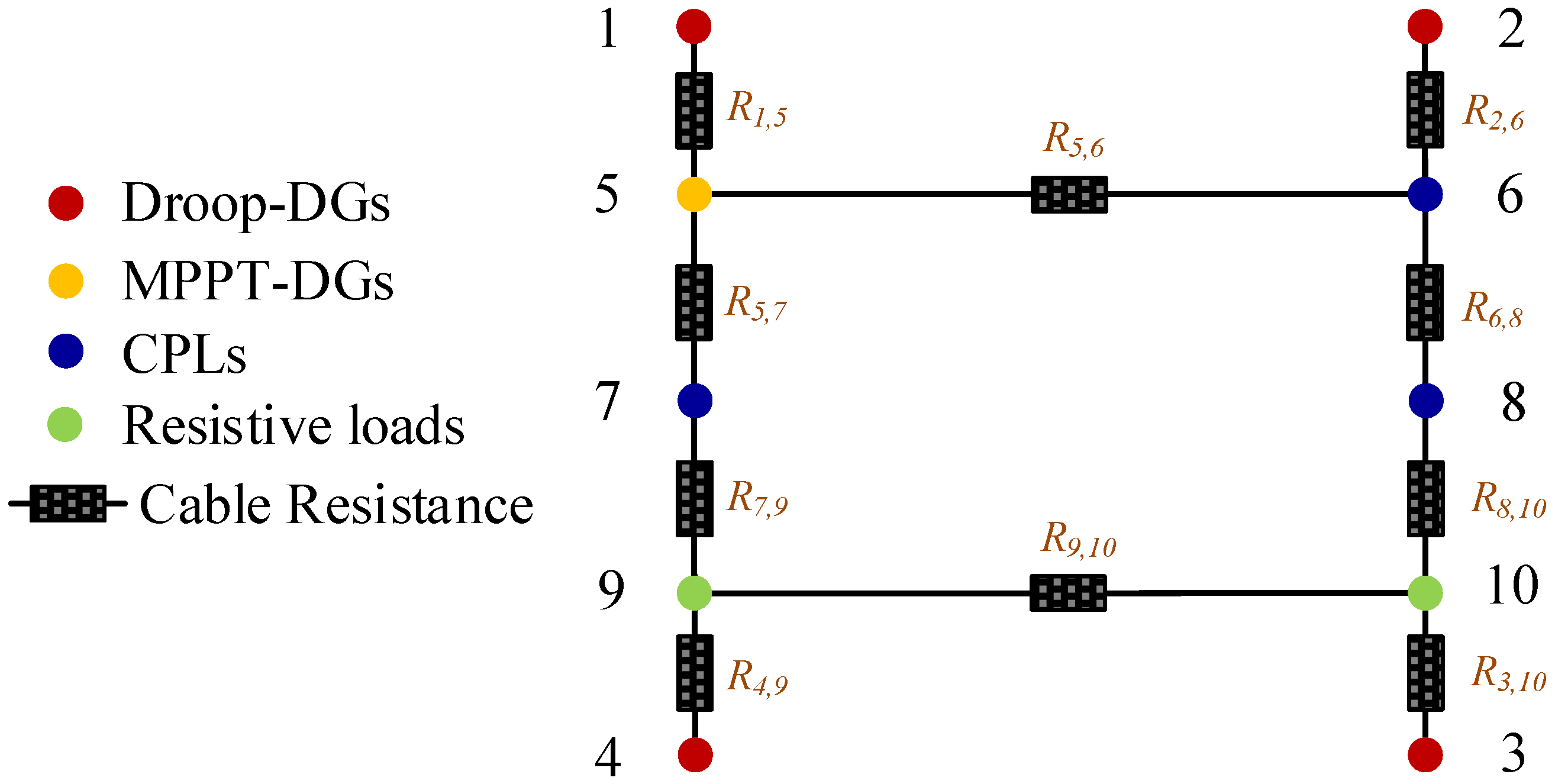
V. The modified 10-node system contains four Droop-DGs (nodes 1–4), one MPPT-DG (node 5), and five loads (nodes 6–10), as shown in
Figure 1. The DC microgrid test system consisted of four distributed generation (DG) units and four load nodes. The nominal DC bus voltage was 48 V. The line resistances were
,
,
,
,
,
,
,
,
, and
. The constant power loads were set as
W,
W, and
W.
In this 10-node DC microgrid, four Droop-DGs are responsible for voltage regulation and economic dispatch, which are modeled as voltage sources with controllable internal references. The MPPT-DG node is modeled as a stochastic current source in parallel with a resistance . The MPPT-DG provides power based on intermittent generation patterns, introducing stochasticity into the system. Nodes 6–10 represent a mix of resistive loads and constant power loads (CPLs). The CPLs are modeled as negative incremental impedances (), providing the main challenge for the analysis of small-signal stability.
We set the cost coefficients
of the cost functions
as
. The other parameters of the 10-node DC microgrid are listed in
Table 1.
In this configuration, nodes 1–4 are designated as droop-controlled DGs, representing the controllable dispatchable units. Node 5 is designated as an MPPT-DG, representing a renewable source. It is important to note that the placement of these DGs was a predefined design choice for this case study. The primary objective of our proposed optimal control strategy was not to determine the optimal locations but to find the economically optimal operating setpoints (i.e., power outputs and voltages) for these given DG locations, which was inherently achieved by solving the OPF problem.
6.2. Validation of Convex Relaxation Exactness
Case 1: This case was designed to verify the exactness of the convex relaxation strategy (Theorem 1).
The goal of Case 1 was to demonstrate that for a modified configured 10-node system, the optimal solution obtained from the proposed convex relaxation technique naturally satisfies . This means that can be perfectly decomposed into a voltage vector , ensuring that the solution is physically feasible and globally optimal. To verify this, the OPF problem was formulated and solved using the CVX toolbox in 2024b MATLAB.
The simulation results obtained with the 2024b MATLAB CVX optimization toolbox are shown in
Table 2.
According to the results in
Table 2,
indicates the exactness of the proposed convex relaxation technique. This means that the obtained optimal solution was consistent with the global optimal solution of the original OPF problem.
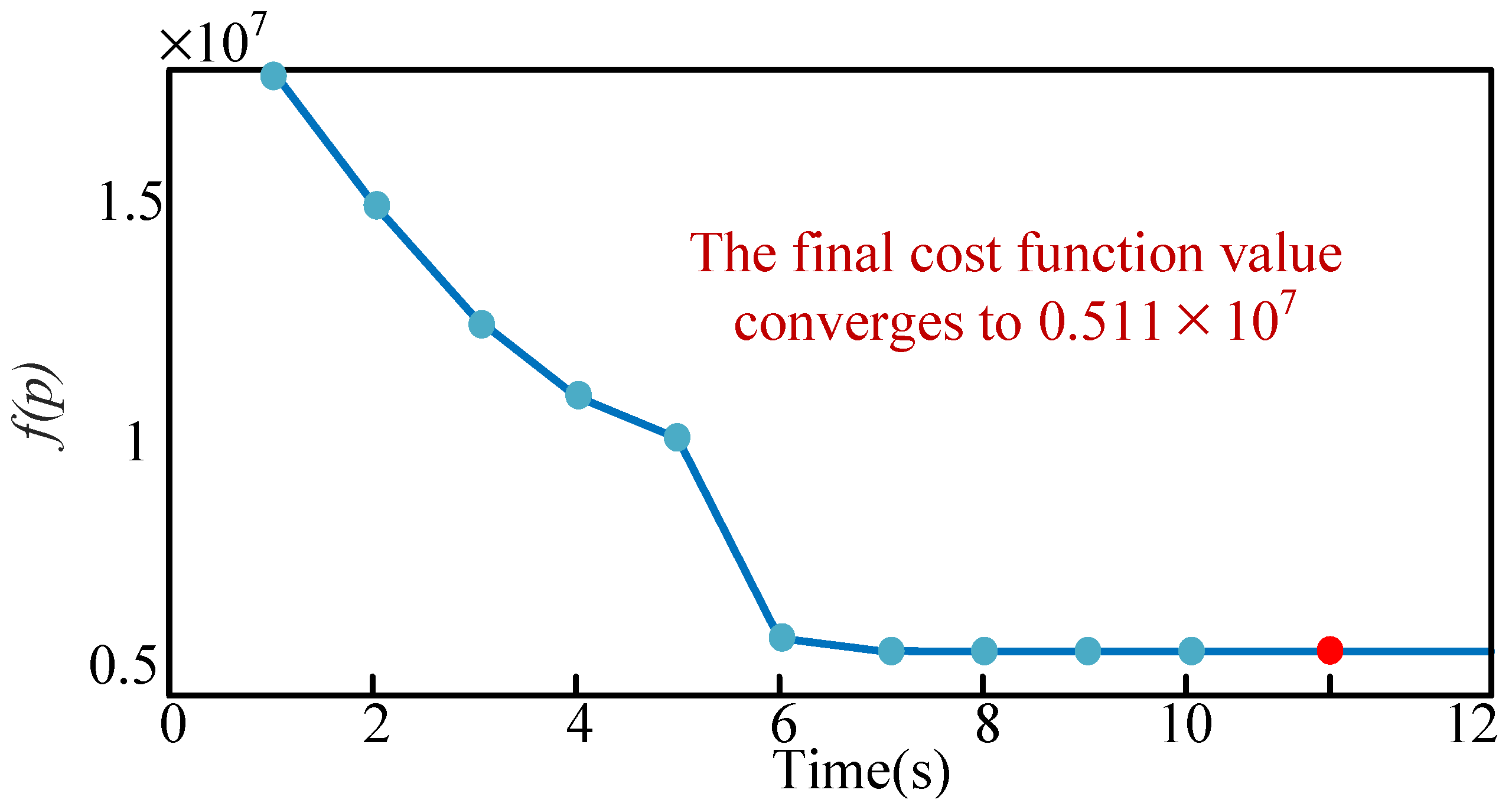
Figure 2 illustrates the iterative convergence process during optimization. As shown in
Figure 2, the power flow optimization problem of a 10-node DC microgrid converged to a minimum value of
after 11 iterations, indicating a relatively fast convergence speed. This offline optimization, solved via the MOSEK solver on a standard desktop computer, completed in approximately
s, demonstrating the computational efficiency of the convex relaxation approach.
6.3. Verification of Distributed Optimal Control Performance
This section designs Cases 2 and 3 to verify the proposed distributed control strategy. Its purpose is to verify that the control law based on the KKT criterion (which accounts for line losses and voltage-dependent loads) converges to the exact global optimal solution obtained in Case 1, unlike traditional droop control, which suffers from steady state deviation. Case 2 adopts the proposed distributed control strategy that accounts for complex power flow conditions. In contrast, Case 3 uses a conventional control strategy based on an approximate economic scheduling formula (i.e., ). In both cases, we set the control gains to and .
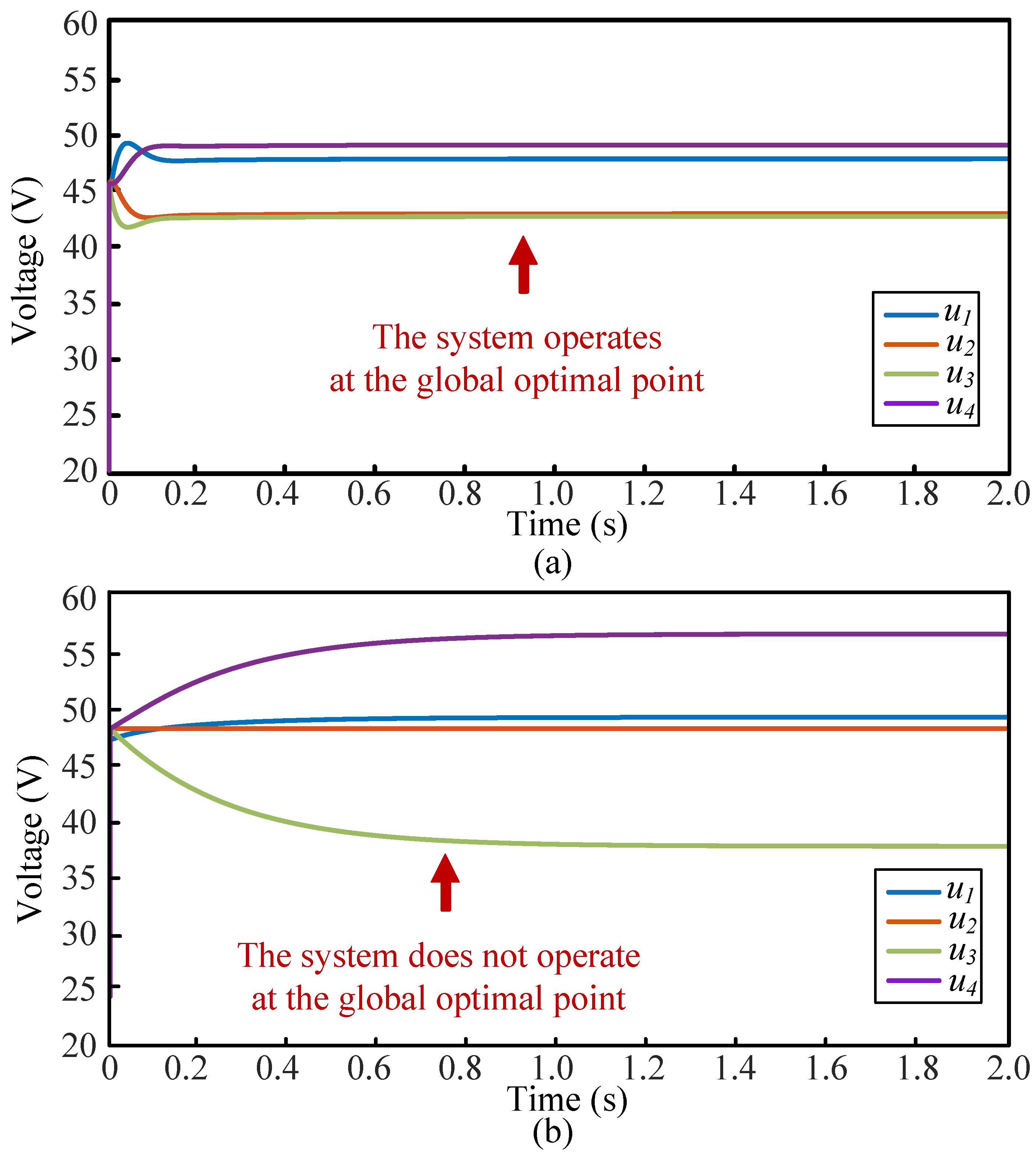
Figure 3 illustrates the voltage under the proposed control strategy and the comparative control strategy. The convergence of the optimal synchronization term
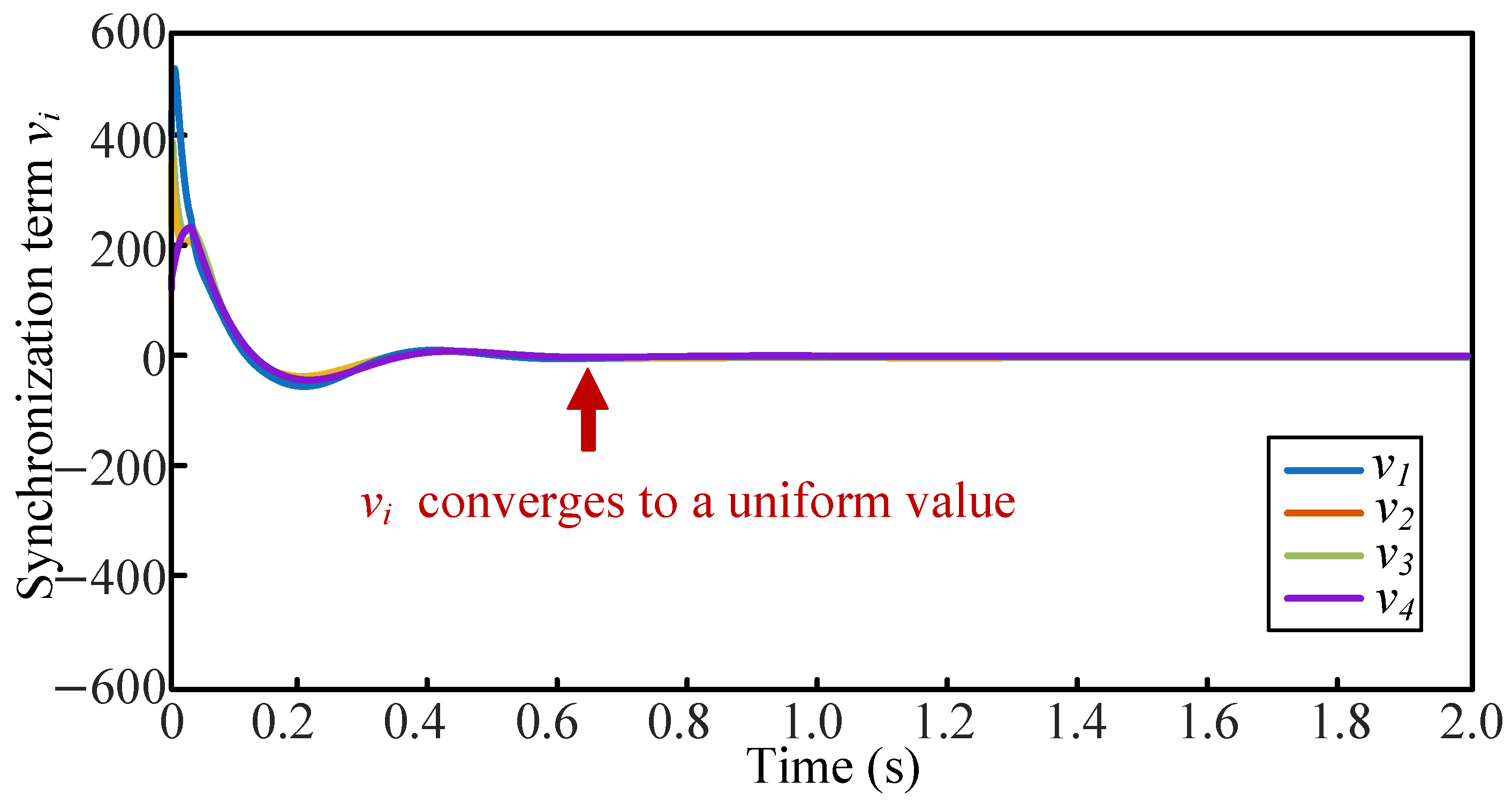
for Case 2 is shown in
Figure 4. The convergence time for the proposed distributed controller is to the order of 1 s. This timescale is appropriate for secondary control applications in DC microgrids, which correct voltage deviations and optimize power sharing over a longer period than the primary droop control.
It is obvious that the system in Case 2 operates at the global optimal equilibrium, while the system in Case 3 does not.
Figure 4 shows that
converges to a consistent value in a relatively short time. The convergence and cost comparison results for Cases 2 and 3 are shown in
Table 3. The convergence time for the proposed distributed controller was to the order of 1 s. This timescale is appropriate for secondary control applications in DC microgrids, which correct voltage deviations and optimize power sharing over a longer period than the primary droop control.
A critical observation from the voltage waveforms in
Figure 3 is the divergent transient behavior of specific node voltages, notably the significant decrease in
concomitant with the increase in
. This phenomenon represents the direct physical execution of the exact economic dispatch mechanism inherent in the proposed distributed KKT-based controller. Unlike traditional consensus control, which seeks merely to equalize current sharing ratios (resulting in uniform voltage profiles), the proposed strategy dynamically shifts the power generation burden across the spatial network to minimize the aggregate quadratic cost function.
Based on the designated system parameters, the marginal generation cost at node 4 () was substantially lower than that at node 3 (). Consequently, to achieve global cost optimality, the consensus-driven synchronization term dictates that DG4 must supply a massively larger proportion of the network’s total power demand. According to Ohm’s law and the structure of the network equivalent admittance matrix , for DG4 to inject a higher current vector into the meshed network, its local terminal voltage must increase relative to the network average to overcome the intrinsic line impedance. Conversely, the control algorithm commands DG3 to aggressively curtail its power output to lower the overall operational costs. This rapid reduction in injected current results in a localized voltage drop, causing to decrease. This orchestrated voltage divergence confirms that the distributed observer network was actively manipulating local voltage setpoints to push the power flows toward the analytically defined global economic optimum, all while ensuring the network-wide average voltage strictly adhered to the 48 V reference constraint.
Clearly, the optimal value obtained by using the proposed control method was the same as that in Case 1, but the total cost of Case 3 exceeded that of Case 1.
6.4. The Verification of Small-Signal Robustness
In
Section 3, small-signal analysis was used to analyze the system’s stability. In this section, the stability of the proposed distributed control strategy will be verified using a root locus plot.
For the modified 10-node DC microgrid system, the matrix for nodes 9 and 10 is a diagonal matrix whose entries are the load impedances.
Case 4: This case aims to investigate the impact on the system’s stability as
gradually increases.
is set to increase from
to
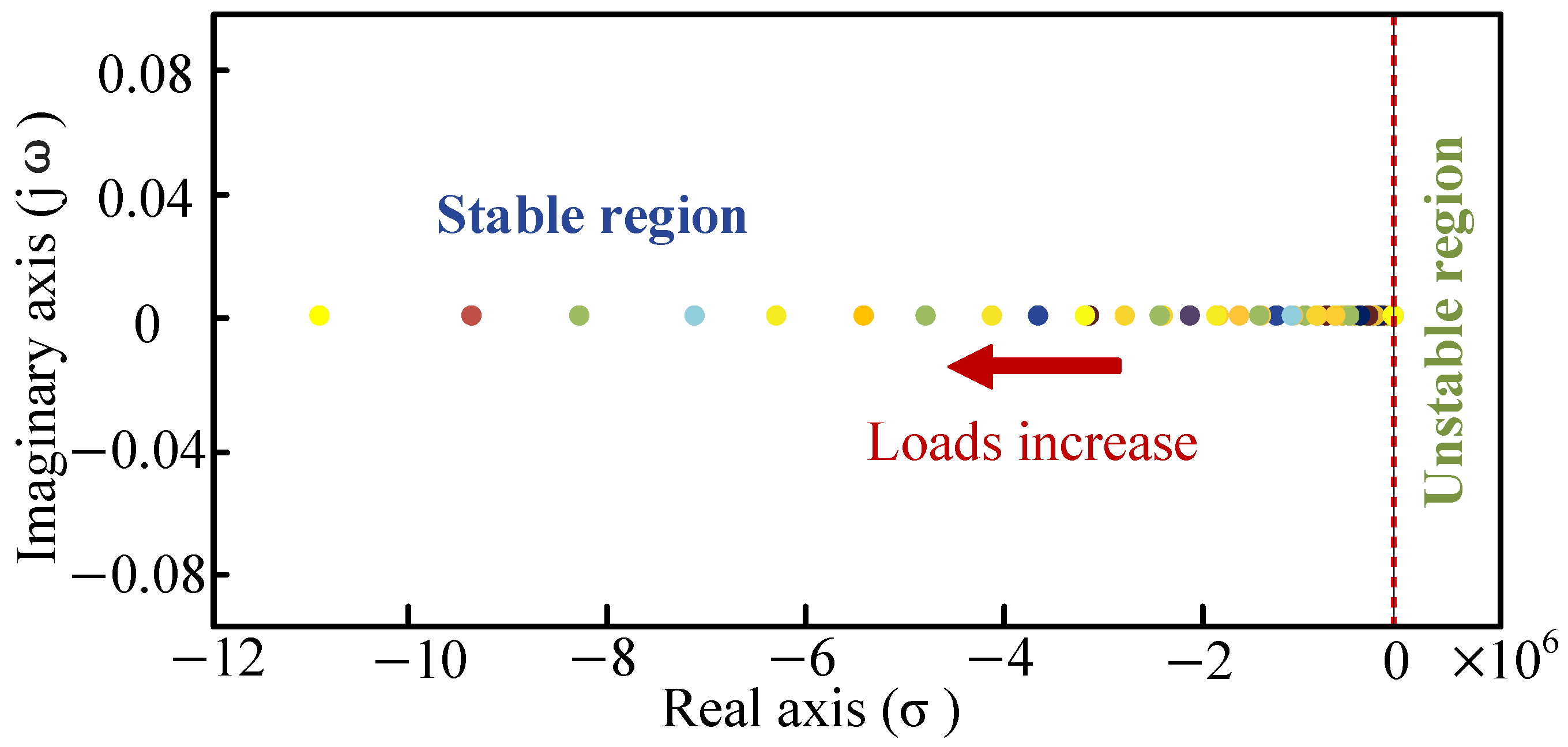
. The root locus plot of the system’s Jacobian matrix as the load
changes is shown in
Figure 5.
Acccording to the root locus plot, regardless of the load change, the eigenvalues of the system’s Jacobian matrix remained in the left half plane (i.e., the stable region). In other words, the system was robustly stable at equilibrium, and its stability was not affected by load changes.
6.5. Performance of Distributed Observers for Sparse Communication Networks Under Communication Delay
Communication networks inevitably introduce delay. This section will verify the theoretical stability limits, particularly the delay margin
. To verify the impact of communication delay on stability, a corresponding delay module was introduced into the simulated communication links. According to Equation (
27), the maximum tolerable delay is inversely proportional to the observation gain
and the spectral radius of the communication graph:
We set the observer gain . For the 10-node ring topology, , . Then, the limit value can be calculated as .
Next, two cases were simulated to define this theoretical limit.
Case 5: Introduce the delay module with .
Case 6: Introduce the delay module with .
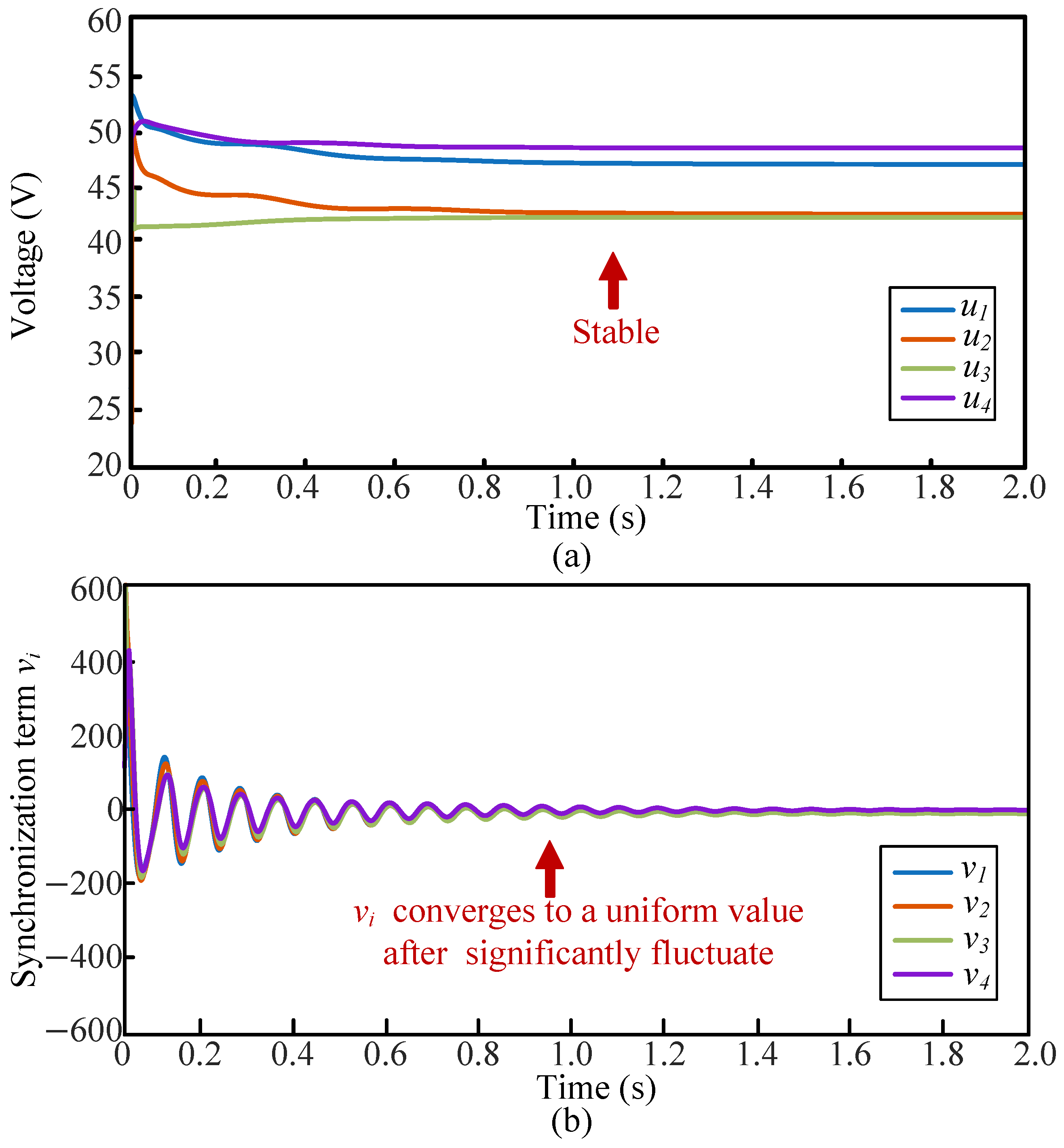
The Droop-DG voltage waveforms for
are shown in
Figure 6. As can be seen in
Figure 6a, the voltages remained similar to the delay-free case, indicating that a delay within the bound in Equation (
26) had no significant impact on the steady state voltages. However,
Figure 6b shows that the optimal synchronization terms
fluctuated considerably and only stabilized around
, confirming that while the delay did not affect the steady state accuracy, it slowed convergence and degraded dynamic performance.
Although the voltages in
Figure 6a converge to their optimal steady state values, a transient overshoot beyond the 48 V reference was observed. This overshoot was more pronounced than in the delay-free case shown in
Figure 3. The underlying mechanism can be explained by the control-theoretic analysis presented in
Section 5.2. The introduction of a communication delay
ms reduced the phase margin of the closed-loop system, according to the Nyquist criterion for time-delayed consensus protocols. This reduction in phase margin directly translated into a decrease in the system’s effective damping ratio. Consequently, while the delay did not compromise the steady state accuracy (as can be seen in the final values), it degraded the dynamic performance by causing a larger and more prolonged oscillatory transient, as evident in both the voltage waveforms (
Figure 6a) and the synchronization terms
(
Figure 6b). The fluctuations in
took approximately
s to settle, confirming the slower convergence and reduced damping caused by the sub-critical delay.
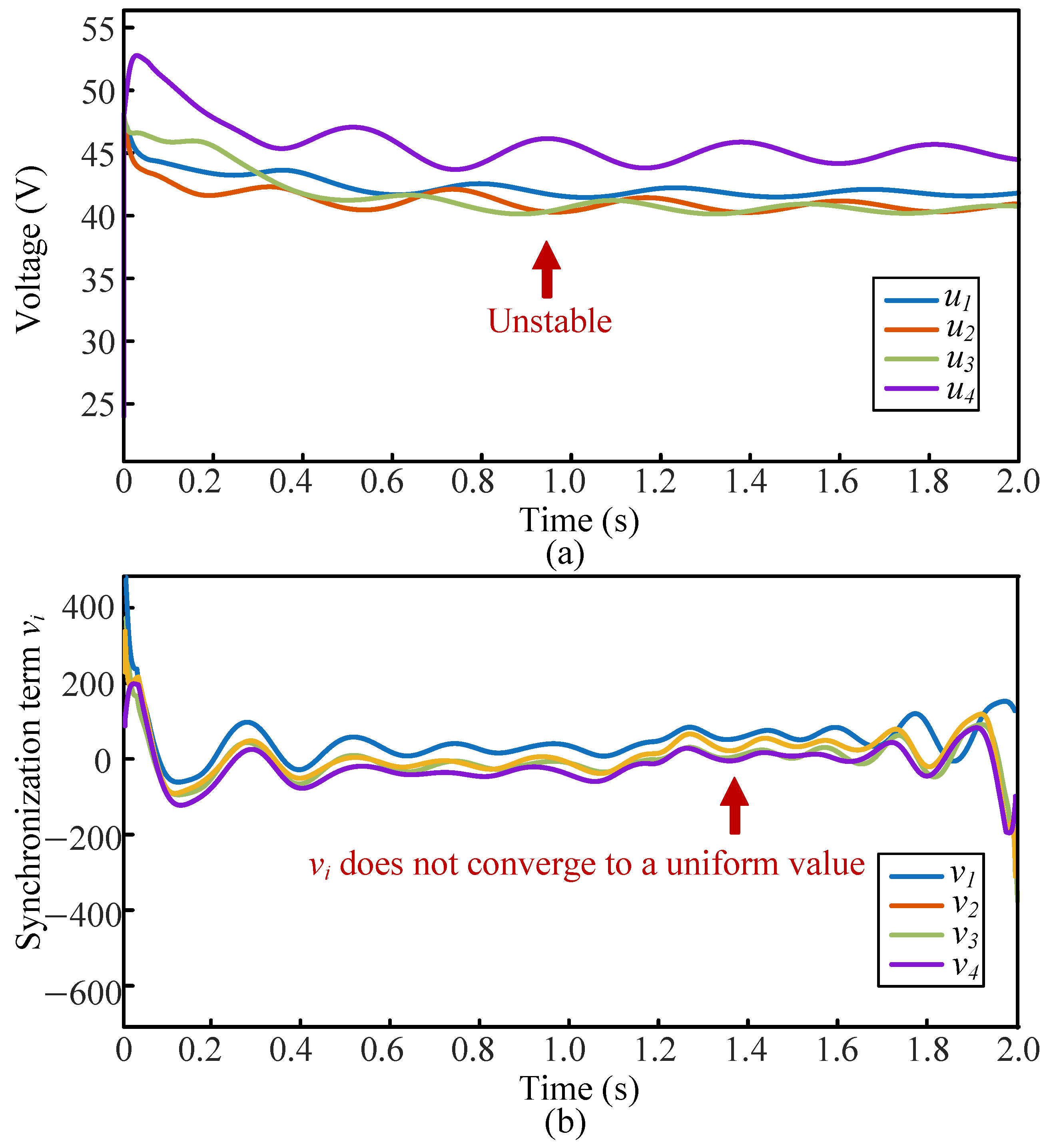
The voltage waveforms of the Droop-DGs for the case where
ms are depicted in
Figure 7. At this time, this communication delay exceeded the delay range described in Proposition 1. From the simulation results in
Figure 7a,b, it can be seen that the voltage at each DG node fluctuated, indicating instability. Furthermore, the waveforms of each optimal synchronization term exhibited divergent oscillations, also indicating instability. Therefore, the entire control system was unstable. This shows that when the communication delay
, the system under this distributed control strategy will become unstable.
8. Conclusions
This paper presented a comprehensive distributed optimal control framework for DC microgrids that fully accounts for the integration of renewable energy sources with high proportional stochasticity, significantly extending our previous conference work. The core contributions are threefold. First, an exact SOCP relaxation was used to solve the non-convex OPF problem, providing a solid foundation for global optimality. Second, a distributed control strategy derived from the KKT conditions was proposed, and its small-signal stability was formally proven and validated, ensuring robust performance against load variations. Third, to enable practical implementation, a novel distributed observer-based strategy was developed that dramatically reduced the communication requirements in a sparse network while maintaining optimality. The tolerable limit for communication delays in this set-up was also established.
The simulation results validated all theoretical claims, demonstrating exact optimality, stability, superior economic performance compared with conventional methods, and effective operation under sparse communication with delays. This work provides a comprehensive and practical solution for the safe, optimal, and efficient operation of future DC microgrids.
This work opens several avenues for future research. Key directions include the following. (1) integration of energy storage systems (ESSs): Incorporating the dynamics and state of charge of batteries into the OPF framework can enable multi-temporal optimization and enhance system flexibility. (2) Extension to hybrid AC/DC microgrids: The proposed convex relaxation and distributed control strategy can be generalized to interconnected AC and DC subgrids, addressing the challenges of interfacing converters and coordinating different control objectives. (3) Resilient communication protocols: Event-triggered communication and consensus algorithms that are robust to practical challenges such as intermittent packet loss, time-varying delays, and cyber-attacks can be investigated. (4) Data-driven and stochastic approaches: Measurement data can be leveraged to learn system parameters or directly predict optimal setpoints, in addition to extending the deterministic OPF to a stochastic or robust formulation that explicitly accounts for the probabilistic nature of renewable generation and loads.




 ,
,