Article

Optimization and H Performance Analysis for Load Frequency Control of Power System with Transmission Delay Under DoS Attacks

1
School of Automation, Guangdong Polytechnic Normal University, Guangzhou 510665, China
2
School of Electrical Engineering, Yancheng Institute of Technology, Yancheng 224051, China
*
Author to whom correspondence should be addressed.
Mathematics 2026, 14(5), 822; https://doi.org/10.3390/math14050822
Submission received: 23 December 2025 / Revised: 15 February 2026 / Accepted: 20 February 2026 / Published: 28 February 2026
(This article belongs to the Special Issue Artificial Intelligence and Game Theory)

Abstract

This paper addresses the stability and H performance of a single-area discrete-time power system with time-varying transmission delays under Denial-of-Service (DoS) attacks. First, the power system is modeled as a discrete-time delay system that integrates both DoS-induced delays and transmission delays, with PI controllers incorporated for Load Frequency Control (LFC). Using advanced summation inequality techniques, a Lyapunov–Krasovskii Functional (LKF) is constructed to capture comprehensive system state information, enabling the derivation of less conservative stability criteria. The proposed stability criterion based on linear matrix inequalities (LMI) ensures asymptotic stability and meets the H performance index, while considering norm-bounded external load disturbances. Two convex optimization algorithms are designed to obtain optimal controller gains, either for a given H index or by searching within a specified index range. Numerical examples and MATLAB simulations validate the effectiveness of the method. The results demonstrate that the maximum allowable delay upper bounds (MADUBs) estimated by the proposed criterion are larger than those obtained by existing methods, with an increase of at least 1 s. This indicates a reduction in conservatism. Simulation trajectories of frequency deviation ( Δ f ) and area control error (ACE) confirm that the system remains stable under DoS attacks, with responses converging to zero after transient oscillations.

1. Introduction

Load frequency control (LFC) is widely used in frequency regulation of power systems. The main function of LFC is to ensure the stable and reliable operation of power systems. Power system is a kind of typical network control system [1,2]. However, due to the limit of network resources, there are phenomena such as delay and packet loss in the power systems, which will make the power systems oscillate or even unstable [3,4]. Unlike the traditional dedicated communication networks, the modern power systems use open networks to transmit control signals. However, the use of open networks makes power systems more vulnerable to network attacks. These network attacks will destroy the stable operation of power systems and even seriously affect the production and life security of human society. An increasing number of network attacks have caused severe power outages in the power systems. For example, Ukraine’s power systems were hit by network attacks in 2015, causing widespread blackouts affecting about 225,000 customers [5,6]. In March 2019, Denial of Service (DoS) attacks hit a power company in Utah, USA, which disrupted the connection between the company’s control center and devices at the end point, causing serious impact. The security and stability of networked power systems have always been the focus of researchers [7,8,9]. However, it is important to note that securing power systems is not solely a control engineering problem but also involves complex strategic interactions and market mechanisms. Grid operations are increasingly shaped by adaptive decision-making and game-theoretical dynamics between defenders and adversaries [10]. While such frameworks focus on optimizing governance and defensive investments to reduce vulnerability exposure, the LFC system must serve as the robust execution layer. Ensuring H performance under DoS attacks provides the essential resilience margin required to support these broader socio-technical optimization strategies. Therefore, an effective LFC scheme is urgently needed to maintain the stability of the power systems under network attacks.
Common network attacks include tampering with forged data injection attacks [11,12,13], DoS attacks [14,15], input delay attacks [15], and so on. Among these network attacks, DoS attack is the easiest to implement and the most common network attack. The attacker transmits a large amount of spam information to the communication network, which causes network congestion. The network congestion causes the normal state signal and control signal to be unable to transmit, thereby destabilizing the system. This problem has led scholars to conduct extensive research. For example, in [16,17], an event-triggered H LFC scheme is proposed for power systems under mixed network attacks to ensure systems performance and reduce network resource usage. An elastic distributed LFC method for low-inertia interconnected power systems with mixed attacks is proposed considering continuous communication in [18,19]. Considering the existence of long-term DoS attacks, the Model Predictive Control (MPC) technology is applied to the multi-area power systems including electric vehicles, which fills the gap of MPC technology in this area in [20,21]. For the security control of power systems under DoS attacks, research primarily focuses on the following two aspects: (1) For continuous-time systems. The communication adjustment strategy is proposed to model the average resident time to obtain output to state stability under DoS attacks [22]. For periodic DoS attacks, a flexible synthesis method based on event-triggered feedback control is proposed. A joint design method for determing the parameters of event trigger and controller has been proposed by utilizing piecewise Lyapunov–Krasovskii functional method and switched system theory [23,24]. (2) For discrete-time systems, the event-based security control problem has been studied by using stochastic analysis method to achieve mean-square security under random DoS attacks [25,26]. Additionally, in order to defend against the DoS attacks, the maximum tolerable number of DoS attacks has been derived by using the Lyapunov functional method. However, the high-frequency of DoS attacks also lead to system instability. In [27], researchers considered not only the duration but also the frequency of DoS attacks.
Research on the stability of power systems under DoS attacks has developed rapidly, and many excellent results have been published [28,29,30]. However, existing studies tend to focus primarily on DoS attacks while overlooking the inherent transmission delays in power systems. Little literature addresses both the delays induced by DoS attacks and the inherent transmission delays simultaneously. This paper aims to contribute to bridging this gap.
This paper is organized as follows. Section 2 presents the problem formulation along with some useful definitions, hypotheses, and lemmas. Section 3 introduces the stability criteria and the H performance analysis, respectively, in the form of theorems and corollaries. Section 4 provides numerical examples. Finally, conclusions are drawn in Section 5.
Notation: The notations used in this paper are standard. The n-dimensional Euclidean space is expressed as R n ; The set of all n × m real matrices is expressed as R n × m ; For P R n × m , P > 0 means that P is a positive definite matrix. nth-order diagonal matrix is expressed as diag a 1 , a 2 , , a n and diagonal elements are a 1 , a 2 , , a n . The  column vector is expressed as col · . The sets of diagonal positive definite and symmetric positive definite matrices of R n × n are expressed as D + n and S + n , respectively. The symmetric matrix is expressed as A B C , where ∗ is the symmetric term. Sym A = A + A T .

2. Problem Formulation

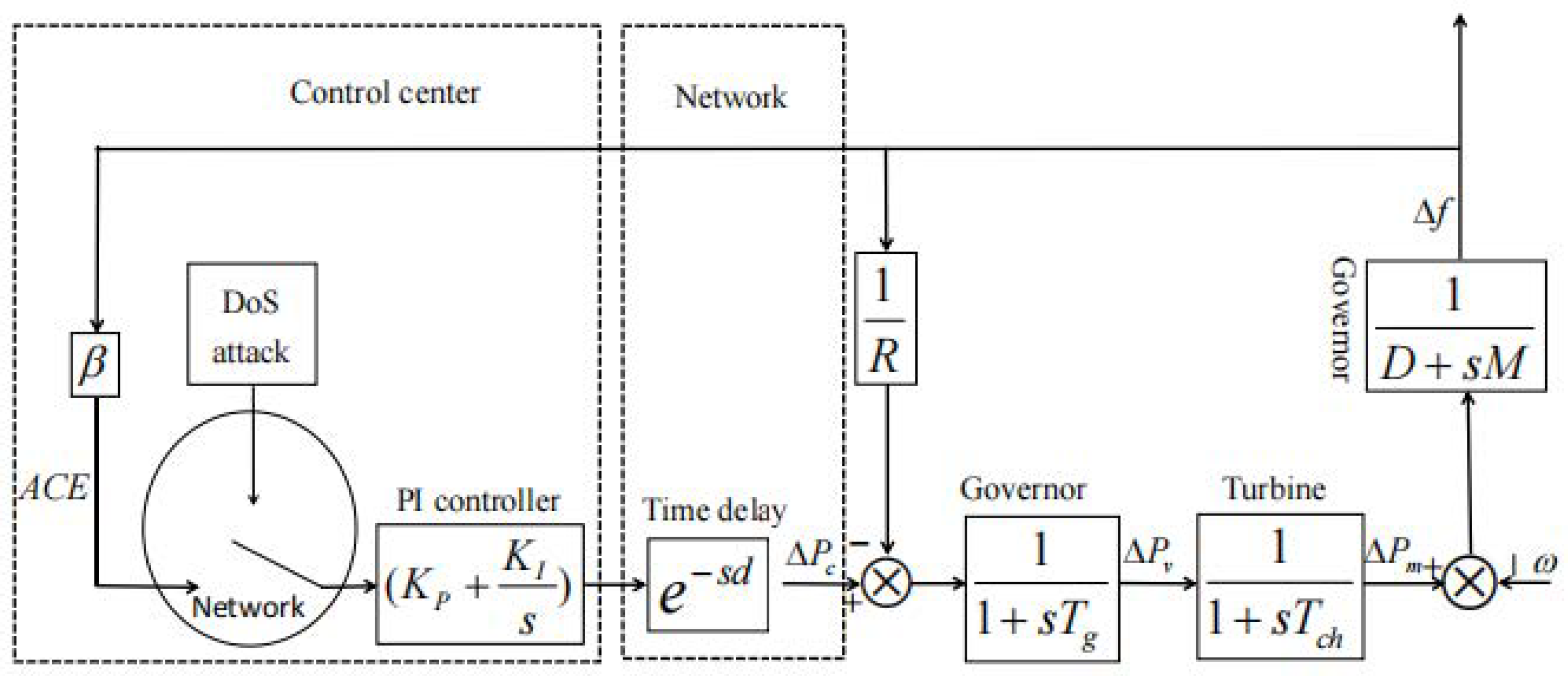
In this section, the LFC model of power system under DoS attack equipped with PI controllers and taking into account the time-varying transmission delays is given. The basic diagram of the simplified LFC of one-area power system under DoS attack is shown in Figure 1, where e s d is time delay, arising during the control signal sent from the control center to the governor. Explanations of key terms are provided in Table 1.

2.1. The Model of Single-Area Power System

Δ f ˙ = 1 M D Δ f + Δ P m Δ P d , Δ P ˙ m = 1 T c h Δ P m + Δ P v , Δ P ˙ v = 1 T g 1 R Δ f Δ P v K p A C E K I A C E d t , A C E = β Δ f ,
The linear continuous-time model of a single-area power system can be described as
x ˜ ˙ t = A ˜ x ˜ t + B ˜ u t + F ˜ Δ P ˜ d t , y ˜ t = C ˜ x ˜ t ,
where
x ˜ = col Δ f ( t ) , Δ P m ( t ) , Δ P v ( t ) , y ˜ = c o l [ A C E ( t ) , A C E ( t ) d t ] , A ˜ = D M 1 M 0 0 1 T c h 1 T c h 1 R T g 0 1 T g , B ˜ = col 0 , 0 , 1 T g , F ˜ = col 1 M , 0 , 0 , C ˜ = [ β 0 0 ] .
Combined with the LFC scheme, the PI LFC can be written as
u t = K y ˜ t
where K = [ K P , K I ] , K P and K I are proportional gain and integral gain respectively. It can be seen from Figure 1 that the LFC of a single-area power system is implemented by a controller with ACE as input
u t = K P A C E K I A C E d t
In addition, it is clear from Figure 1 that there is a significant transmission delay between the controller and the governor. We define the transmission delay h t h 1 , h 2 . Then, Equation (3) can be rewritten as:
u t = K y ˜ t h t
Adding Equation (5) to Equation (2), the LFC power system can take the following form
x ˙ t = A c x t + B c K C x t h t + F c Δ P d t , y t = C x t ,
where
x t = col Δ f Δ P m Δ P v A C E d t , y t = col A C E A C E d t ,
A c = D M 1 M 0 0 0 1 T c h 1 T c h 0 1 R T g 0 1 T g 0 β 0 0 0 , B c = col 0 , 0 , 1 T g , 0 , F c = 1 M 0 0 0 , C = β 0 0 0 0 0 0 1 .

2.2. The Discrete-Time Power System Under DoS Attacks

The power system is usually described as above continuous-time power system. In order to enhance anti-interference and stability, the continuous-time power system can be discretized. The discrete-time power system can be described as the following:
x k + 1 = A x k + B K C x k h k + F ω k , y k = C x k ,
where A = e A c h , B = 0 h e A c s d s B c , F = 0 h e A c s d s F c . ω k = Δ P d k .  h is the sampling period.
It can be seen from Figure 1 that DoS attacks exist in the feedback channel to prevent the output signal y t from reaching the control center. It can be considered that the DoS attacks can be represented by a switching signal. Define sleep intervals I 1 = t k , t k + b k and attack intervals I 2 = t k + b k , t k + 1 . The switching signal can be expressed as
κ k = 1 , k t k , t k + b k , 0 , k t k + b k , t k + 1 .
where t k denotes the moment of successful transmission to the controller side, b k denotes the length of the nth sleep interval, t k + b k is the beginning time of the nth attack interval.
Introduce the time-varying delay d k caused by DoS attacks. Define
d k = k t k , k t k + d τ k , t k + d M + h k t k l h , k t k + l h + d M , t k + l h + h + d M , l = 1 , 2 , , m k 1 k t k m k h , k t k + m k h + d M , t k + 1 + d τ k + 1 ,
where d τ k represents the transmission delay from sensor to controller, and its boundary is [ d τ , d M ] , l h represents the sampling time, l is the number of samples and its maximum value is m k . Then, we can get d τ < d k < d ¯ with d ¯ = h + d M , considering the transmission time-varying delay h k in the process of information transmission.
Combined with the above analysis, when k t k + d τ k , t k + 1 + d τ k + 1 , system (1) can be written as
Ξ 1 : x k + 1 = A x k + B K C x k h k d k + F ω k y k = C x k , k I 1 t k + d τ , t k + 1 + d τ + 1 Ξ 0 : x k + 1 = A x k + B K C x k h k + F ω k y k = C x k , k I 2 .
For established discrete-time power system (9), the main purpose of this paper is to study the stability of discrete-time power system under DoS attacks.
Remark 1. 
Research on the stability of LFC Power System under DoS attacks is quite popular. However, most studies mainly focus on the impact of DoS attacks on the stability or performance of the system, while ignoring the inherent communication delay phenomenon in the power system based on the Internet. Based on this, this paper not only considers DoS attacks, but also takes into account the influence of communication delay on the stability and H-infinity performance of the power system. This approach is more general.
Definition 1 
([31]). The system is considered to be asymptotically stable and meets the  H  performance index γ if the following conditions are met.
  • The system is asymptotically stable when the disturbance input is not taken into account (i.e.,  ω ( k ) 0 ).
  • For any nonzero disturbance  ω ( k ) , given a positive scalar γ, the following inequality is satisfied under zero initial conditions ( x ( k ) = 0 ):
    i = 0 y T ( i ) y ( i ) γ 2 i = 0 ω T ( i ) ω ( i ) .
Lemma 1 
([32]). Let the vector function  x k R n , a 1 , a 2 Z  with  a 12 = a 2 a 1 .  For the positive definite  R R n × n , we have:
i = a 1 a 2 1 x T i R x i 1 a 12 ζ T Λ T Ξ T R ¯ Ξ Λ ζ ,
i = a 1 a 2 1 y T i R y i 1 a 12 ξ T Λ T Ξ T R ¯ Ξ Λ ξ ,
where
ζ = col x a 2 , i = a 1 a 2 x i , i 2 = a 1 a 2 i 1 = i 2 a 2 x i 1 , i 3 = a 1 a 2 i 2 = i 3 a 2 i 1 = i 2 a 2 x i 1 , ξ = col x a 2 , x a 1 , i = a 1 a 2 x i , i 2 = a 1 a 2 i 1 = i 2 a 2 x i 1 , Ξ = I I 0 0 I I 2 I 0 I I 6 I 6 I , Λ = diag I , I , 1 s 1 a 12 I , 1 s 2 a 12 I , R ¯ = R , 3 R , 5 R , y i = x i + 1 x i .
Lemma 2 
([33]). Let the vector function  x k R n , a 1 , a 2 Z  with  a 12 = a 2 a 1 .  For the positive definite  R R n × n ,  S 1 , S 2 , T 1 , T 2  are arbitrary matrices with suitable dimension, and  b a 1 , a 2 ,  with  b a 1 = n , a 2 b = m ,  the following inequalities hold for any vectors  ϑ 1 , ϑ 2 :
i = a 1 a 2 1 x T i R x i Sym ϑ 1 T S 1 Ξ S 2 Ξ φ + ϑ 1 T n S 1 R ¯ 1 S 1 T + m S 2 R ¯ 1 S 2 T ϑ 1 ,
i = a 1 a 2 1 y T i R y i Sym ϑ 2 T T 1 Ξ T 2 Ξ ϖ + ϑ 2 T n T 1 R ¯ 1 T 1 T + m T 2 R ¯ 1 T 2 T ϑ 2 ,
where  φ = col Λ 1 ζ 1 , Λ 2 ζ 2 , ϖ = col Λ 1 ξ 1 , Λ 2 ξ 2  with
Λ 1 = diag I , I , 1 s 1 n I , 1 s 2 n I , Λ 2 = diag I , I , 1 s 1 m I , 1 s 2 m I , ζ 1 = col x b , i = a 1 b x i , i 2 = a 1 b i 1 = i 2 b x i 1 , i 3 = a 1 b i 2 = i 3 b i 1 = i 2 b x i 1 , ζ 2 = col x a 2 , i = b a 2 x i , i 2 = b a 2 i 1 = i 2 a 2 x i 1 , i 3 = b a 2 i 2 = i 3 a 2 i 1 = i 2 a 2 x i 1 , ξ 1 = col x b , x a 1 , i = a 1 b x i , i 2 = a 1 b i 1 = i 2 b x i 1 , ξ 2 = col x a 2 , x b , i = b a 2 x i , i 2 = b a 2 i 1 = i 2 a 2 x i 1 .

3. Main Results

In this section, we will develop a new stability criterion for the system (9). In order to make vectors and matrices easy to represent, we use the following notations:
h k = h k , d k = d k , h 1 k = h k h 1 , h 2 k = h 2 h k , d τ k = d k d τ , d d k = d ¯ d k , h 12 = h 2 h 1 , d 12 = d ¯ d τ , h ¯ k = h k + d k , h ¯ 1 = h 1 + d τ , h ¯ 2 = h 2 + d ¯ , η 1 k = col x k , i = k h 1 k 1 x i , i = k h k k h 1 1 x i + i = k h 2 k h k 1 x i , i = k d τ k 1 x i , i = k d k k d τ 1 x i + i = k d ¯ k d k 1 x i , i = k h 1 k 1 j = i k 1 x j , i = k d τ k 1 j = i k 1 x j , η 2 ( k ) = col { x ( k ) , y ( k ) } , y k = x k + 1 x k , s 1 κ = κ + 1 , s 2 κ = κ + 1 κ + 2 2 , ζ k = col x k , x k h 1 , x k h k , x k h 2 , x k d τ , x k d k , x k d ¯ , x k h ¯ k , x k h ¯ 2 , ρ 1 k , ρ 2 k , ρ 3 k , μ 1 k , μ 2 k , μ 3 k , ν 1 k , ν 2 k , ν 3 k , ϱ 1 k , ϱ 2 k , ϱ 3 k , ϕ 1 k , ϕ 2 k , ϕ 3 k , ϕ 4 k , ω k , x ( k + 1 ) , ρ 1 k = i = k h k k h 1 x i s 1 h 1 k , ρ 2 k = i = k h 2 k h k x i s 1 h 2 k , ρ 3 k = i = k h 1 k x i s 1 h 1 , μ 1 k = i = k d k k d τ x i s 1 d τ k , μ 2 k = i = k d ¯ k d k x i s 1 d d k , μ 3 k = i = k d τ k x i s 1 d τ , υ 1 k = i = k h 1 k j = i k x j s 2 h 1 , υ 2 k = i = k h k k h 1 j = i k h 1 x j s 2 h 1 k , υ 3 k = i = k h 2 k h k j = i k h k x j s 2 h 2 k , ϱ 1 k = i = k d τ k j = i k x j s 2 d τ , ϱ 2 k = i = k d k k d τ j = i k d τ x j s 2 d τ k , ϱ 3 k = i = k d ¯ k d k j = i k d k x j s 2 d d k , ϕ 1 k = i = k h ¯ 2 k h 2 x i s 1 d ¯ , ϕ 2 k = i = k h ¯ 2 k d ¯ x i s 1 h 2 , ϕ 3 k = i = k h ¯ 2 k h 2 j = i k h 2 x j s 2 d ¯ , ϕ 4 k = i = k h ¯ 2 k d ¯ j = i k d ¯ x j s 2 h 2 .

3.1. H Performance Analysis

Theorem 1. 
For given positive scalars  h 1 , h 2 , d τ , d ¯ , γ  and  ε i , ( i = 1 , 2 , 3 ) if there exists positive definite matrices  R S + 7 n , Q i S + 2 n , P i S + n , Z i S + n , i 1 , 2 , . . . , 6 .  For any matrices  M , N , S , T R 7 n × 4 n ,  U R n × n  and  X , Y , J , K R 7 n × 3 n ,   Q i > 0 ( i = 1 , . . . , 4 ) ,  Q 2 > 0 ,  Q 4 > 0  and the following inequalities hold. The system (9) with transmission delays  h k  under DoS attack is stable and meets the  H  performance index γ.
Π h 1 , d τ h 12 ϑ 1 M h 12 ϑ 1 Y d 12 ϑ 2 N d 12 ϑ 2 K h 12 Q ¯ 2 0 0 0 h 12 Z ¯ 2 0 0 d 12 Q ¯ 4 0 d 12 Z ¯ 4 < 0 ,
Π h 2 , d τ h 12 ϑ 1 S h 12 ϑ 1 X d 12 ϑ 2 N d 12 ϑ 2 K h 12 Q ¯ 2 0 0 0 h 12 Z ¯ 2 0 0 d 12 Q ¯ 4 0 d 12 Z ¯ 4 < 0 ,
Π h 1 , d ¯ h 12 ϑ 1 M h 12 ϑ 1 Y d 12 ϑ 2 T d 12 ϑ 2 J h 12 Q ¯ 2 0 0 0 h 12 Z ¯ 2 0 0 d 12 Q ¯ 4 0 d 12 Z ¯ 4 < 0 ,
Π h 2 , d ¯ h 12 ϑ 1 S h 12 ϑ 1 X d 12 ϑ 2 T d 12 ϑ 2 J h 12 Q ¯ 2 0 0 0 h 12 Z ¯ 2 0 0 d 12 Q ¯ 4 0 d 12 Z ¯ 4 < 0 ,
Thus, the controller gain matrix calculated by
K = ( U B ) + K 0 ,
where the generalized inverse of  U B  is expressed as  ( U B ) + .
Π h k , d k = Γ 1 h k , d k + Γ 2 + Sym Γ 3 h k , d k + 2 Δ 0 T U ˜ Π 0 + ( τ 27 τ 1 ) I ( τ 27 τ 1 ) T γ 2 τ 26 I τ 26 T , Γ 1 h k , d k = Θ R Θ T + Sym Ψ h k , d k R Θ T , Γ 2 = τ 1 P 1 τ 1 T + τ 2 P 2 P 1 τ 2 T τ 4 P 2 τ 4 T + τ 1 P 2 τ 1 T + τ 5 P 4 P 3 τ 5 T τ 7 P 4 τ 7 T + τ 4 P 5 τ 4 T τ 9 P 5 τ 9 T + τ 7 P 6 τ 7 T τ 9 P 6 τ 9 T + τ 1 M 1 + M 4 τ 1 T + τ 2 M 2 M 1 τ 2 T + τ 3 M 3 M 2 τ 3 T τ 4 M 3 τ 4 T + τ 5 M 5 M 4 τ 5 T + τ 6 M 6 M 5 τ 6 T τ 7 M 6 τ 7 T + τ 1 τ s τ 1 ( h 1 Q 1 + h 12 Q 2 + d τ Q 3 + d 12 Q 4 + d ¯ Q 5 + h 2 Q 6 ) τ 1 τ s τ 1 T + τ s τ 1 h 1 Z 1 + h 12 Z 2 + d τ Z 3 + d 12 Z 4 + d ¯ Z 5 + h 2 Z 6 τ s τ 1 T 1 h 1 ς 10 Q ¯ 1 ς 10 T 1 d τ ς 20 Q ¯ 3 ς 20 T 1 h 1 χ 10 Ξ T Z ¯ 1 Ξ χ 10 T 1 d τ χ 20 Ξ T Z ¯ 3 Ξ χ 20 T 1 d ¯ ς 30 Q ¯ 5 ς 30 T 1 h 2 ς 31 Q ¯ 6 ς 31 T 1 d ¯ χ 30 Ξ T Z ¯ 5 Ξ χ 30 T 1 h 2 χ 31 Ξ T Z ¯ 6 Ξ χ 31 T , Γ 3 h k , d k = ϑ 1 S M ς 11 ς 12 T + ϑ 2 T N ς 21 ς 22 T + ϑ 1 X Ξ Y Ξ χ 11 χ 12 T + ϑ 2 J Ξ K Ξ χ 21 χ 22 T , Θ = τ s τ 1 τ 1 τ 2 τ 2 τ 4 τ 1 τ 5 τ 5 τ 7 s 1 h 1 τ 1 τ 12 s 1 d τ τ 1 τ 15 , Ψ h k , d k = τ 1 s 1 h 1 τ 12 τ 1 s 1 h 1 k τ 10 + s 1 h 2 k τ 11 τ 2 τ 3 s 1 d τ τ 15 τ 1 s 1 d τ k τ 13 + s 1 d d k τ 14 τ 5 τ 6 s 2 h 1 τ 16 s 1 h 1 τ 1 s 2 d τ τ 19 s 1 d τ τ 1 , ς 10 = s 1 h 1 τ 12 τ 1 τ 1 τ 2 h 1 + 2 τ 16 s 1 h 1 τ 12 τ 1 τ 1 + τ 2 2 τ 12 , ς 20 = s 1 d τ τ 15 τ 1 τ 1 τ 5 d τ + 2 τ 19 s 1 d τ τ 15 τ 1 τ 1 + τ 5 2 τ 15 , ς 11 = s 1 h 1 k τ 10 τ 2 τ 2 τ 3 h 1 k + 2 τ 17 s 1 h 1 k τ 10 τ 2 τ 2 + τ 3 2 τ 10 , ς 12 = s 1 h 2 k τ 11 τ 3 τ 3 τ 4 h 2 k + 2 τ 18 s 1 h 2 k τ 11 τ 3 τ 3 + τ 4 2 τ 11 , ς 21 = s 1 d τ k τ 13 τ 5 τ 5 τ 6 d τ k + 2 τ 20 s 1 d τ k τ 13 τ 5 τ 5 + τ 6 2 τ 13 , ς 22 = s 1 d d k τ 14 τ 6 τ 6 τ 7 d d k + 2 τ 21 s 1 d d k τ 14 τ 6 τ 6 + τ 7 2 τ 14 , ς 30 = s 1 d ¯ τ 22 τ 4 τ 4 τ 9 d ¯ + 2 τ 24 s 1 d ¯ τ 22 τ 4 τ 4 + τ 9 2 τ 22 , ς 31 = s 1 h 2 τ 23 τ 7 τ 7 τ 9 h 2 + 2 τ 25 s 1 h 2 τ 23 τ 7 τ 7 + τ 9 2 τ 23 , χ 10 = τ 1 τ 2 τ 12 τ 16 , χ 11 = τ 2 τ 3 τ 10 τ 17 , χ 12 = τ 3 τ 4 τ 11 τ 18 , χ 20 = τ 1 τ 5 τ 15 τ 19 , χ 21 = τ 5 τ 6 τ 13 τ 20 , χ 22 = τ 6 τ 7 τ 14 τ 21 , χ 30 = τ 4 τ 9 τ 22 τ 24 , χ 31 = τ 7 τ 9 τ 23 τ 25 , ϑ 1 = τ 2 τ 3 τ 4 τ 10 τ 11 τ 17 τ 18 , ϑ 2 = τ 5 τ 6 τ 7 τ 13 τ 14 τ 20 τ 21 , Q i = Q i + 0 M i M i M i , i = 1 , 2 , 3 , 4 , Q 2 = Q 2 + 0 M 5 M 5 M 5 , Q 4 = Q 4 + 0 M 6 M 6 M 6 , Q ¯ i = diag Q i , 3 Q i , i = 1 , 2 , 3 , 4 , Q ¯ j = diag Q j , 3 Q j , j = 5 , 6 , Q ¯ p = diag Q p , 3 Q p , p = 2 , 4 , Z ¯ q = diag Z q , 3 Z q , 5 Z q , τ i = [ 0 n × i 1 n I n × n 0 n × 26 i n ] T , i 1 , 2 , , 26 , Δ 0 T = c o l { τ 1 , τ 8 , τ 26 , τ 27 } , U ˜ = c o l U , ε 1 U , ε 2 U , ε 3 U , Π 0 = A τ 1 + B K C τ 8 + F τ 26 τ 27 , K 0 = U B K , τ s = τ 1 A T + τ 8 C T K T B T + τ 26 F T .
Proof of Theorem 1. 
For the discrete-time power system (9), construct the candidate LKF as follows:
V k = i = 1 5 V i k ,
where
V 1 k = η 1 T k R η 1 k , V 2 k = i = k h 1 k 1 x T i P 1 x i + i = k h 2 k h 1 1 x T i P 2 x i + i = k d τ k 1 x T i P 3 x i + i = k d ¯ k d τ 1 x T i P 4 x i , V 3 k = i = h 1 1 j = k + i k 1 η 2 T j Q 1 η 2 j + i = h 2 h 1 1 j = k + i k 1 η 2 T j Q 2 η 2 j + i = d τ 1 j = k + i k 1 η 2 T j Q 3 η 2 j + i = d ¯ d τ 1 j = k + i k 1 η 2 T j Q 4 η 2 j , V 4 k = i = h 1 1 j = k + i k 1 y T j Z 1 y j + i = h 2 h 1 1 j = k + i k 1 y T j Z 2 y j + i = d τ 1 j = k + i k 1 y T j Z 3 y j + i = d ¯ d τ 1 j = k + i k 1 y T j Z 4 y j , V 5 k = i = k h ¯ 2 k h 2 1 x T i P 5 x i + i = k h ¯ 2 k d ¯ 1 x T i P 6 x i + i = h ¯ 2 h 2 1 j = k + i k 1 η 2 T j Q 5 η 2 j + i = h ¯ 2 d ¯ 1 j = k + i k 1 η 2 T j Q 6 η 2 j + i = h ¯ 2 h 2 1 j = k + i k 1 y T j Z 5 y j + i = h ¯ 2 d ¯ 1 j = k + i k 1 y T j Z 6 y j .
When k I 1 t k + d τ k , t k + 1 + d τ k + 1 , calculate the forward differences of V k
Δ V 1 k = η 1 T k + 1 R η 1 k + 1 η 1 T k R η 1 k = η 1 k + 1 η 1 k T R η 1 k + 1 η 1 k + Sym η 1 k + 1 η 1 k T R η 1 k , = ζ T k Θ R Θ T + Sym Θ R Ψ T h k , d k ζ k ,
Δ V 2 k = ζ T k τ 1 P 1 τ 1 T + τ 2 P 2 P 1 τ 2 T τ 4 P 2 τ 4 T + τ 1 P 2 τ 1 T + τ 5 P 4 P 3 τ 5 T τ 7 P 4 τ 7 T ζ k ,
Δ V 3 k = η 2 T k h 1 Q 1 + h 12 Q 2 + d τ Q 3 + d 12 Q 4 η 2 k i = k h 1 k 1 η 2 T i Q 1 η 2 i i = k h 2 k h 1 1 η 2 T i Q 2 η 2 i i = k d τ k 1 η 2 T i Q 3 η 2 i i = k d ¯ k d τ 1 η 2 T i Q 4 η 2 i ,
Δ V 4 k = y T k h 1 Z 1 + h 12 Z 2 + d τ Z 3 + d 12 Z 4 y k i = k h 1 k 1 y T i Z 1 y i i = k h 2 k h 1 1 y T i Z 2 y i i = k d τ k 1 y T i Z 3 y i i = k d ¯ k d τ 1 y T i Z 4 y i ,
Δ V 5 k = ζ T k τ 4 P 5 τ 4 T + τ 7 P 6 τ 7 T τ 9 P 5 + P 6 τ 9 T ζ k + η 2 T k d ¯ Q 5 + h 2 Q 6 η 2 k + y T k d ¯ Z 5 + h 2 Z 6 y k i = k h ¯ 2 k h 2 1 η 2 T i Q 5 η 2 i i = k h ¯ 2 k d ¯ 1 η 2 T i Q 6 η 2 i i = k h ¯ 2 k h 2 1 y T i Z 5 y i i = k h ¯ 2 k d ¯ 1 y T i Z 6 y i ,
If M i , i = 1 , 2 , . . . , 6 are symmetric matrices, the following equations hold:
0 = x T k M 1 x k x T k h 1 M 1 x k h 1 i = k h 1 k 1 y T i M 1 y i + 2 y T i M 1 x i ,
0 = x T k h 1 M 2 x k h 1 x T k h k M 2 x k h k i = k h k k h 1 1 y T i M 2 y i + 2 y T i M 2 x i ,
0 = x T k h k M 3 x k h k x T k h 2 M 3 x k h 2 i = k h 2 k h k 1 y T i M 3 y i + 2 y T i M 3 x i ,
0 = x T k M 4 x k x T k d τ M 4 x k d τ i = k d τ k 1 y T i M 4 y i + 2 y T i M 4 x i ,
0 = x T k d τ M 5 x k d τ x T k d k M 5 x k d k i = k d k k d τ 1 y T i M 5 y i + 2 y T i M 5 x i ,
0 = x T k d k M 6 x k d k x T k d ¯ M 6 x k d ¯ i = k d ¯ k d k 1 y T i M 6 y i + 2 y T i M 6 x i .
This can be obtained by Δ V 3 k and the previous zero equations:
Δ V 3 k = η 2 T k h 1 Q 1 + h 12 Q 2 + d τ Q 3 + d 12 Q 4 η 2 k + ζ T k τ 1 M 1 + M 4 τ 1 T + τ 2 M 2 M 1 τ 2 T + τ 3 M 3 M 2 τ 3 T τ 4 M 3 τ 4 T + τ 5 M 5 M 4 τ 5 T + τ 6 M 6 M 5 τ 6 T τ 7 M 6 τ 7 T ζ k i = k h 1 k 1 η 2 T i Q 1 η 2 i i = k h k k h 1 1 η 2 T i Q 2 η 2 i i = k h 2 k h k 1 η 2 T i Q 2 η 2 i i = k d τ k 1 η 2 T i Q 3 η 2 i i = k d k k d τ 1 η 2 T i Q 4 η 2 i i = k d ¯ k d k 1 η 2 T i Q 4 η 2 i .
The following Q 1 , Q 3 , Z 1 , Z 3 , Q 5 , Q 6 , Z 5 and Z 5 dependent summation inequalities in Δ V k can be obtained according to 11 and 12 :
i = k h 1 k 1 η 2 T i Q 1 η 2 i 1 h 1 ζ T k ς 10 Q ¯ 1 ς 10 T ζ k ,
i = k d τ k 1 η 2 T i Q 3 η 2 i 1 d τ ζ T k ς 20 Q ¯ 3 ς 20 T ζ k ,
i = k h 1 k 1 y T i Z 1 y i 1 h 1 ζ T k χ 10 Ξ T Z ¯ 1 Ξ χ 10 T ζ k ,
i = k d τ k 1 y T i Z 3 y i 1 d τ ζ T k χ 20 Ξ T Z ¯ 3 Ξ χ 20 T ζ k ,
i = k h ¯ 2 k h 2 1 η 2 T i Q 5 η 2 i 1 d ¯ ζ T k ς 30 Q ¯ 5 ς 30 T ζ k ,
i = k h ¯ 2 k d ¯ 1 η 2 T i Q 6 η 2 i 1 h 2 ζ T k ς 31 Q ¯ 6 ς 31 T ζ k ,
i = k h ¯ 2 k h 2 1 y T i Z 5 y i 1 d ¯ ζ T k χ 30 Ξ T Z ¯ 5 Ξ χ 30 T ζ k ,
i = k h ¯ 2 k d ¯ 1 y T i Z 6 y i 1 h 2 ζ T k χ 31 Ξ T Z ¯ 6 Ξ χ 31 T ζ k .
Thus, the following Q 2 , Q 4 , Z 2 and Z 4 dependent summation inequalities can be estimated by using the summation inequalities based on free matrices (13) and (14).
i = k h 2 k h 1 1 η 2 T i Q 2 η 2 i ζ T k Sym ϑ 1 S M ς 11 ς 12 T ζ ( k ) + h 1 k ζ T k ϑ 1 S Q ¯ 2 1 S T ϑ 1 T ζ k + h 2 k ζ T k ϑ 1 M Q ¯ 2 1 M T ϑ 1 T ζ k ,
i = k d ¯ k d τ 1 η 2 T i Q 4 η 2 i ζ T k Sym ϑ 2 T N ς 21 ς 22 T ζ ( k ) + d τ k ζ T k ϑ 2 Q ¯ 4 1 T T ϑ 2 T ζ k + d d k ζ T k ϑ 2 N Q ¯ 4 1 N T ϑ 2 T ζ k ,
i = k h 2 k h 1 1 y T i Z 2 y i ζ T k Sym ϑ 1 X Ξ Y Ξ χ 11 χ 12 T ζ ( k ) + h 1 k ζ T k ϑ 1 X Z ¯ 2 1 X T ϑ 1 T ζ k + h 2 k ζ T k ϑ 1 Y Z ¯ 2 1 Y T ϑ 1 T ζ k ,
i = k d ¯ k d τ 1 y T i Z 4 y i ζ T k Sym ϑ 2 J Ξ K Ξ χ 21 χ 22 T ζ ( k ) + d τ k ζ T k ϑ 2 J Z ¯ 4 1 J T ϑ 2 T ζ k + d d k ζ T k ϑ 2 K Z ¯ 4 1 K T ϑ 2 T ζ k .
The arguments above suggest that Δ V k is computed as
Δ V k ζ T k Γ 1 h k , d k + Γ 2 + Sym Γ 3 h k , d k ζ k + ζ T k ϑ 1 h 1 k S Q ¯ 2 1 S T + X Z ¯ 2 1 X T ϑ 1 T ζ k + ζ T k ϑ 1 h 2 k M Q ¯ 2 1 M T + Y Z ¯ 2 1 Y T ϑ 1 T ζ k + ζ T k ϑ 2 d τ k T Q ¯ 4 1 T T + J Z ¯ 4 1 J T ϑ 2 T ζ k + ζ T k ϑ 2 d d k N Q ¯ 4 1 N T + K Z ¯ 4 1 K T ϑ 2 T ζ k
When k I 2 , the proof is similar to when k I 1 t k + d τ k , t k + 1 + d τ k + 1 .
For an appropriate matrix U R n × n , ε i > 0 , ( i = 1 , 2 , 3 ) , we can get
0 = 2 [ x ( k ) x ( k d ( k ) h ( k ) ) ω ( k ) x ( k + 1 ) ] col [ U , ε 1 U , ε 2 U , ε 3 U ] ( τ s τ 27 ) T ζ ( k ) = 2 ζ T ( k ) Δ 0 T U ˜ Π 0 ζ ( k ) .
Thus,
y T ( k ) y ( k ) γ 2 ω T ( k ) ω ( k ) + Δ V ( k ) ζ T ( k ) Φ ˜ ( h k , d k ) ζ ( k ) ,
where
ζ T ( k ) Φ ˜ ( h k , d k ) ζ ( k ) = ζ T k [ Γ 1 ( h k , d k ) + Γ 2 + Sym Γ 3 ( h k , d k ) + 2 Δ 0 T U ˜ Π 0 + ( τ 27 τ 1 ) I ( τ 27 τ 1 ) T γ 2 τ 26 I τ 26 T ] ζ k + ζ T k ϑ 1 h 1 k S Q ¯ 2 1 S T + X Z ¯ 2 1 X T ϑ 1 T ζ k + ζ T k ϑ 1 h 2 k M Q ¯ 2 1 M T + Y Z ¯ 2 1 Y T ϑ 1 T ζ k + ζ T k ϑ 2 d τ k T Q ¯ 4 1 T T + J Z ¯ 4 1 J T ϑ 2 T ζ k + ζ T k ϑ 2 d d k N Q ¯ 4 1 N T + K Z ¯ 4 1 K T ϑ 2 T ζ k .
Therefore, y T ( k ) y ( k ) γ 2 ω T ( k ) ω ( k ) + Δ V ( k ) 0 holds if Φ ˜ ( h k , d k ) < 0 holds. Since Φ ˜ ( h k , d k ) is the affine of time delay h ( k ) , d ( k ) , the endpoint limits of Φ ˜ ( h 1 , d τ ) < 0 , Φ ˜ ( h 2 , d τ ) < 0 , Φ ˜ ( h 1 , d ¯ ) < 0 and Φ ˜ ( h 2 , d ¯ ) < 0 must guarantee Φ ˜ ( h k , d k ) < 0 . Using the Schur complement, we can obtain that the inequalities (15)–(18) are equivalent to Φ ˜ ( h k , d k ) < 0 , respectively.
Finally, from the above derivations and Definition 1, we have the following result for 0 < k <
V ( ) V ( 0 ) + i = 1 y T ( i ) y ( i ) γ 2 i = 1 ω ( i ) ω ( i ) < 0 .
V ( ) > 0 and V ( 0 ) = 0 , then,
i = 1 y T ( i ) y ( i ) γ 2 i = 1 ω ( i ) ω ( i ) < 0
which can guarantee that the system (9) meets the H performance index. This completes the proof.    □
Remark 2. 
When constructing the LKF (23), the summation inequalities in Lemmas 1 and 2 are mainly used to estimate the upper bounds of the difference terms. To make full use of the summation inequalities (14)–(17) based on free matrices, some additional summation terms are introduced into the LKF (23). The main improvements are as follows: The non-summation item is augmented by double summations  i = k h 1 k 1 j = i k 1 x ( j )  and  i = k d τ k 1 j = i k 1 x ( j ) . The double summation terms, which are the additional summation terms required in the inequalities of Lemmas 1 and 2 but are ignored in the LKFs of [34,35], are introduced. Therefore, Theorem 1 proposed in this paper has less conservatism than that in [34,35].
Remark 3. 
When determining the LKF difference terms, by applying the summation inequality technique based on Lemmas 1 and 2, the incorporation of more free-weight matrices enhances the degree of freedom in solving the matrix inequalities, thus, further reducing the conservativeness of the solution.
Remark 4. 
This paper employs the stability analysis method for additive time-delay systems, in combination with the newly constructed LKF and the novel summation inequality lemmas 1 and 2, to derive the stability Theorem 1 based on LMI that satisfies the H-infinity performance. However, Theorem 1 uses the generalized inverse matrix to solve the controller gain matrix, which involves certain solving difficulties and is also a common problem in current solutions [36]. Currently, many authors have proposed improved methods to avoid the appearance of the augmented matrix [37,38]. Recently, B. Kürkçü et al. [39] proposed Complete Stable Inversion with Necessary and Sufficient Conditions, providing a better solution method for the solution of the controller gain matrix. Indeed, inspired by Theorem 2 in [38], let  B N = U B K ,  B M = U B , and B is full column rank, then the controller solution problem can be converted into a W-problem as in [37,38,40], which will be further analyzed in future research works.

3.2. Optimization of the Controller Gain

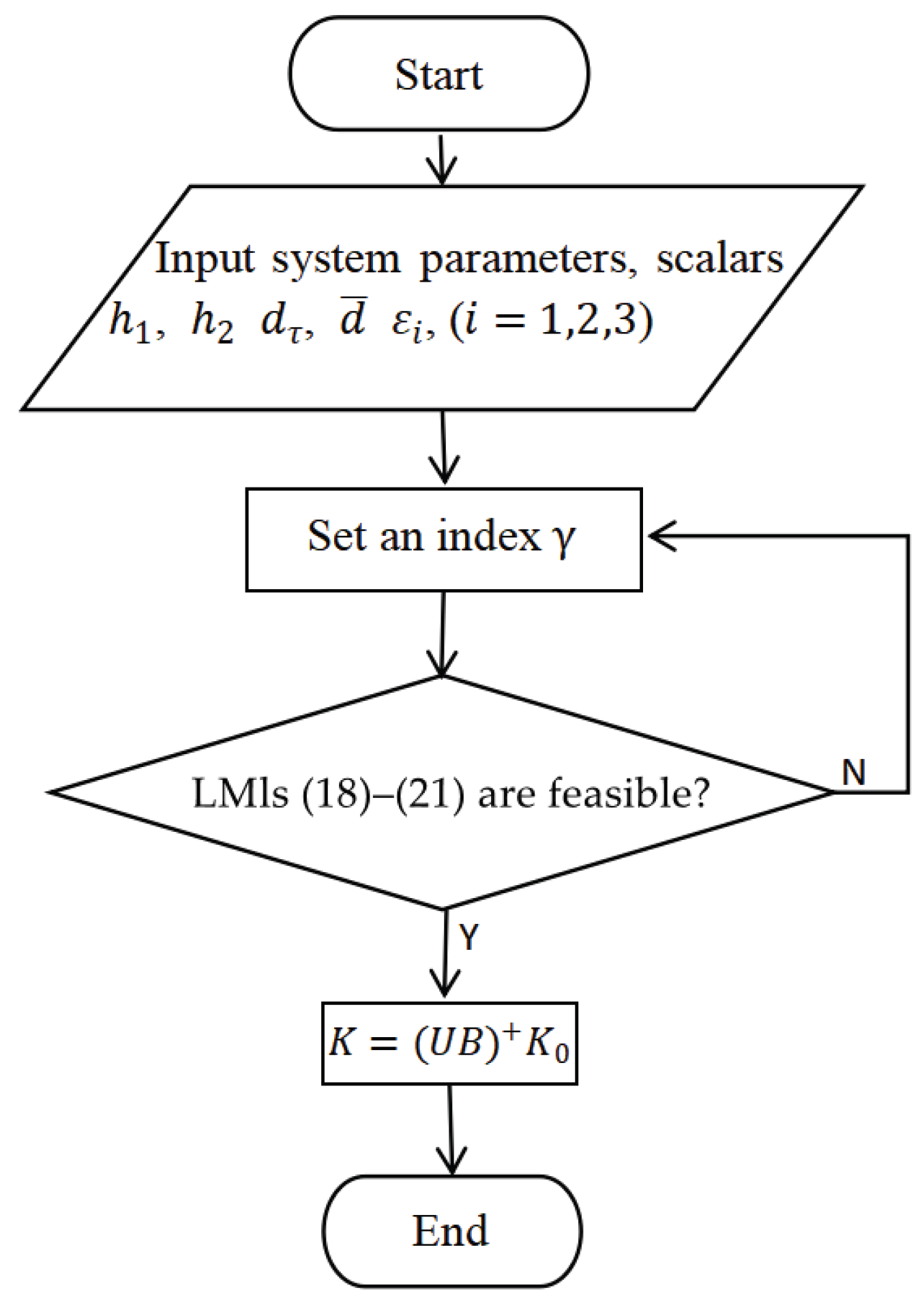
Obviously, the matrix inequalities in Theorem 1 are LMIs, which can be easily solved by the MATLAB LMI-Toolbox (R2023b). That is, for a given H performance index γ , the acquisition of the controller gain K can be processed simply by the convex optimization algorithm described as Algorithm 1 and Figure 2:
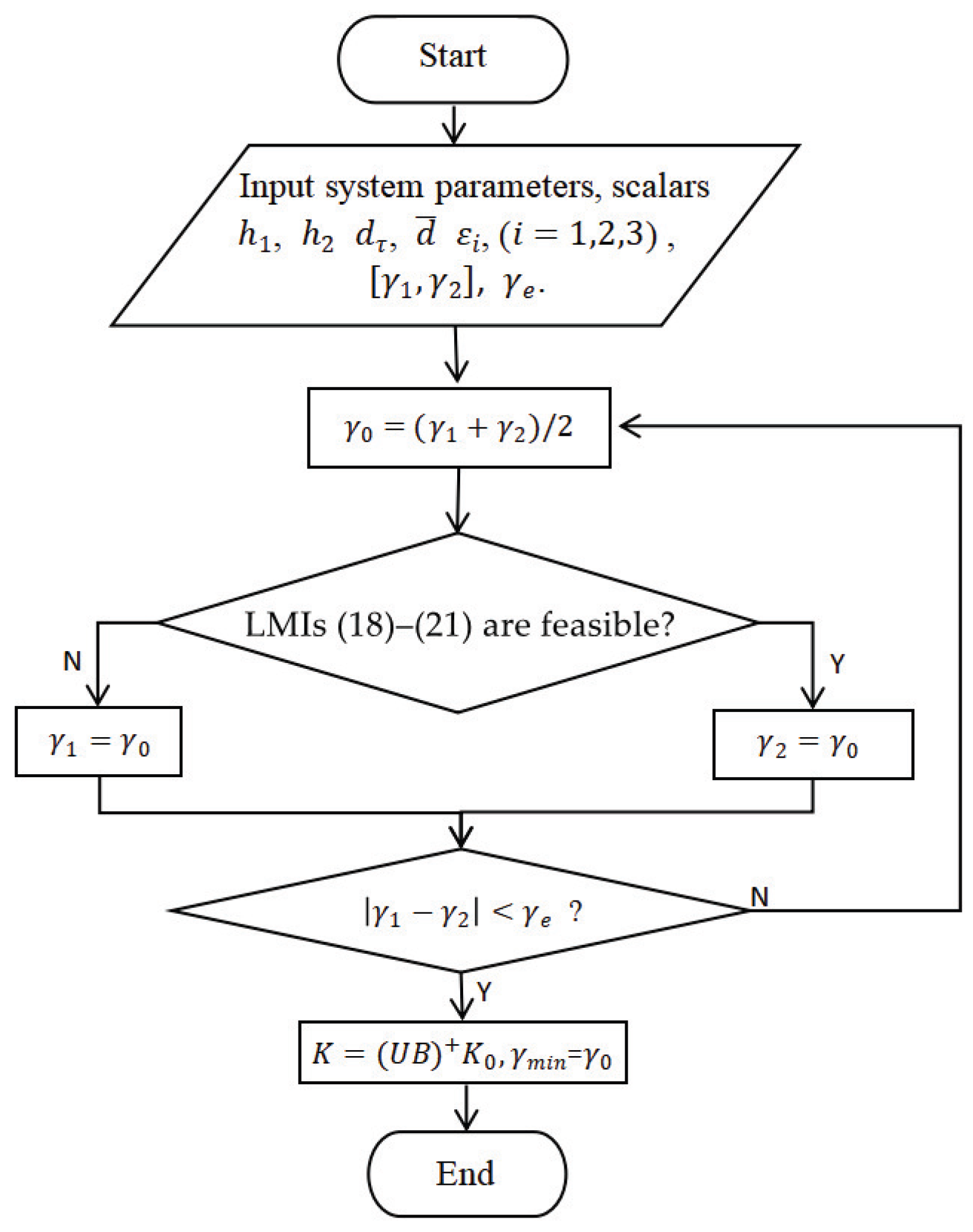
For a given H performance index set [ γ 1 , γ 2 ] , the acquisition of the controller gain K can be processed simply by the convex optimization algorithm described as Algorithm 2 [41] and Figure 3:
Algorithm 1: Acquisition of the Controller Gain
Input:     System parameters, scalars h 1 , h 2 , d τ , d ¯ , ε i , ( i = 1 , 2 , 3 ) and H performance index γ .
Output:  The controller gain K.
1:             Construct LMIs (18)–(21);
2:             Run the LMI solver to solve the LMIs (18)–(21);
3:             if LMIs (18)–(21) are feasible, then proceed to the step 6;
4:             else reset the Input;
5:             end if
6:             Solve the controller gain K by using the Formula (22);
7:             Return K.
Algorithm 2: Optimization of the Controller Gain
Input:        System parameters, scalars h 1 , h 2 , d τ , d ¯ , ε i , ( i = 1 , 2 , 3 )
                    H performance index set [ γ 1 , γ 2 ] and an accuracy coefficient γ e ;
Output:     The controller gain K.
1:                Construct LMIs (18)–(21);
2:                Set γ 0 = γ 2 , C o u n t = 0 ;
3:                Run the LMI solver to solve the LMIs (18)–(21);
4:                if LMIs (18)–(21) are feasible, then proceed to the step 7;
5:                else
6:                    if  C o u n t = 0 , then cannot find a suitable solution, end algorithm;
                       else go to step 8;
                   end if
7:                Set C o u n t = 1 and solve the controller gain K by using the formula (22);
                    γ m i n = γ 0 ;
8:                 γ 1 = γ 0 ;
9:                if  | γ 1 γ 2 | < γ e , then go to step 12;
10:              else  γ 0 = | γ 1 + γ 2 | / 2 , and reverse back to step 3;
11:              end if
12:              Return K.

4. Case Studies

In this section, numerical examples and simulation results are used to prove the effectiveness of the stability criterion for one-area discrete-time delay power system under DoS attacks. Through the Matlab LMI toolbox, the LMIs in Theorem 1 are solved, and the d ¯ ( MADUB ) under d k = 0 and d k 0 can be obtained respectively. In Table 2, the parameters of one-area LFC power system are given.

4.1. Maximum Allowable Delay Upper Bound

When d k = 0 , the system can be switched to the discrete power system only considering the transmission delay, that is, the system only has h k . The stability of the LFC scheme is analyzed from the DoS attack duration and sensor sampling period. Let the sampling period h = 0.1 s and take different controller gains K P and K I . It can be seen from Table 3 that when d k = 0 , the values h 2 of MADUBs increase with the increase of h 1 . With fixed K P , the values h 2 of MADUBs decrease with the increase of K I . Fixed K I , and the values of MADUBs h 2 increase as K P increase.
When d k 0 , the stability of the LFC scheme is analyzed from the perspective of the time delays caused by the DoS attacks. Let the sampling period h = 0.1 s , given controller gain K P = 0.02 , K I = 0.02 . In Table 4, h ¯ 1 = d τ + h 1 . From the results in Table 4, it can be seen that for a given PI controller, when the upper bound of the system transmission delay h 2 = 2 is given, and the lower bound d τ of the delays caused by DoS attacks and transmission delays h 1 both exist, MADUBs, that is d ¯ = h + d M , can get different values. They are similar in values to Remark 5 and Theorem 1 in reference but larger than them. The results show that this method can be used to estimate the duration of DoS attacks under the consideration of transmission delay and a given PI controller, and this method has less conservatism. - indicates that the corresponding results are not given in the references. When the transmission delay of the power system is within a certain range, the attack time that the system can withstand is also within the predictable range. The results show that the stability criterion can be used to analyze the estimation of the duration of DoS attacks considering the transmission delay and given PI controller.
In Table 5, when d k 0 , the impact of transmission delay on system stability is considered. The sampling period h = 0.1 s , the controller gain K P = 0.02 , K I = 0.02 , and the transmission delays h k of the system are also within the given range. In Table 5, for a given PI controller, the lower bound of the transmission delays h 1 is given. When the time-delays caused by DoS attacks are the same, the attack time that the power system can withstand decreases with the increase of the upper bounds h 2 of the transmission delays.

4.2. Optimization and H Performance Discussion

In this section, set h ¯ 1 = 0.4 / 0.8 / 1.2 , and present the discussions for the following two cases.
Case I: For the given performance index γ = 0.4 , transmission delay h ¯ 2 = 35 , h 2 = 9 / 11 / 13 and d τ = 0.4 / 0.8 / 1.2 , the maximum allowable upper d M for different control gains can be given in Table 6.
Case II: For the given performance index set γ [ 0 , 2 ] , γ e = 0.1 , transmission delay h ¯ 2 = 35 , h 1 = 0.2 , h 2 = 13 and d ¯ = 23 , using Algorithm 2, the optimal controller gains can be obtained for different values d τ , which are listed in Table 7.

4.3. Simulation

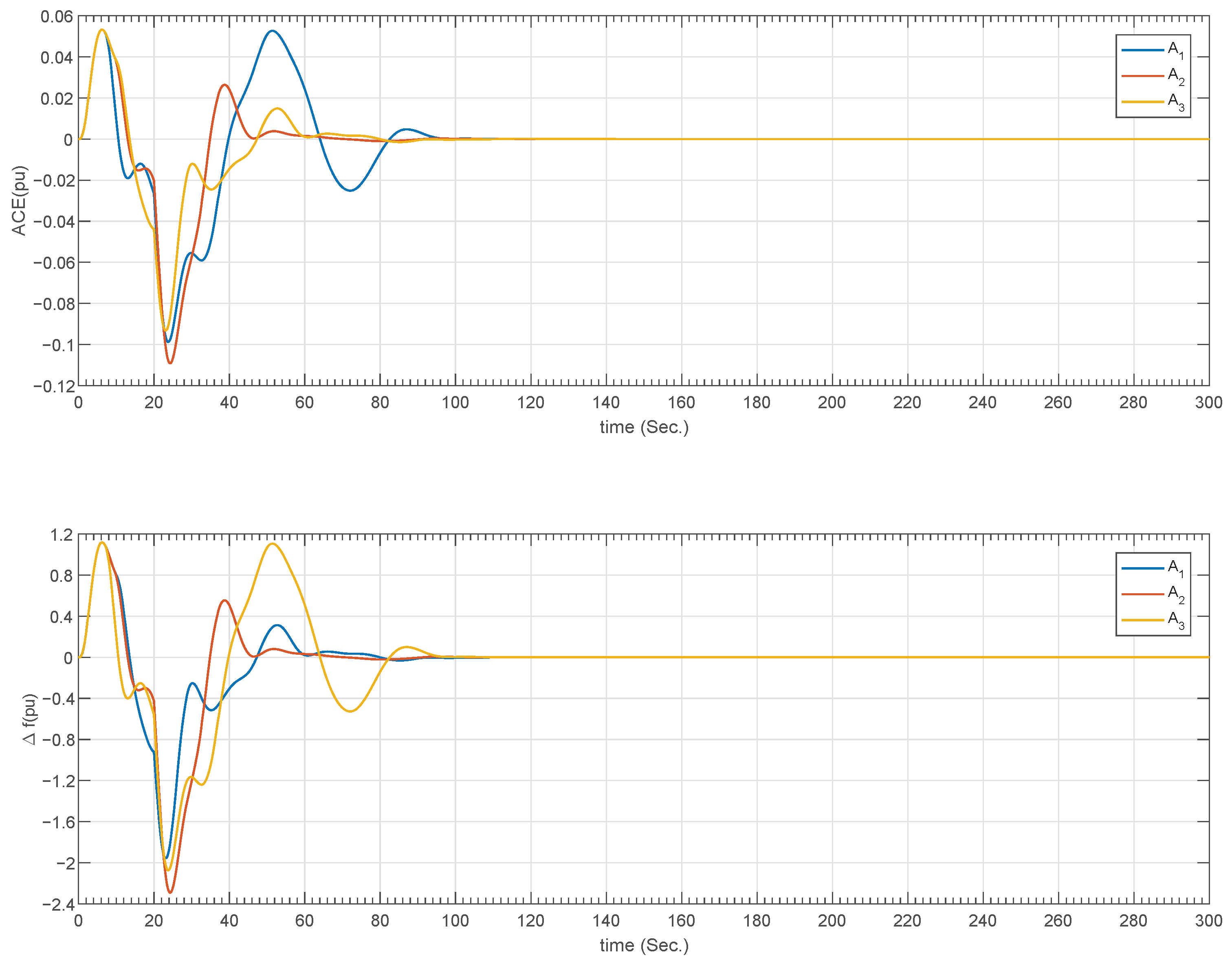
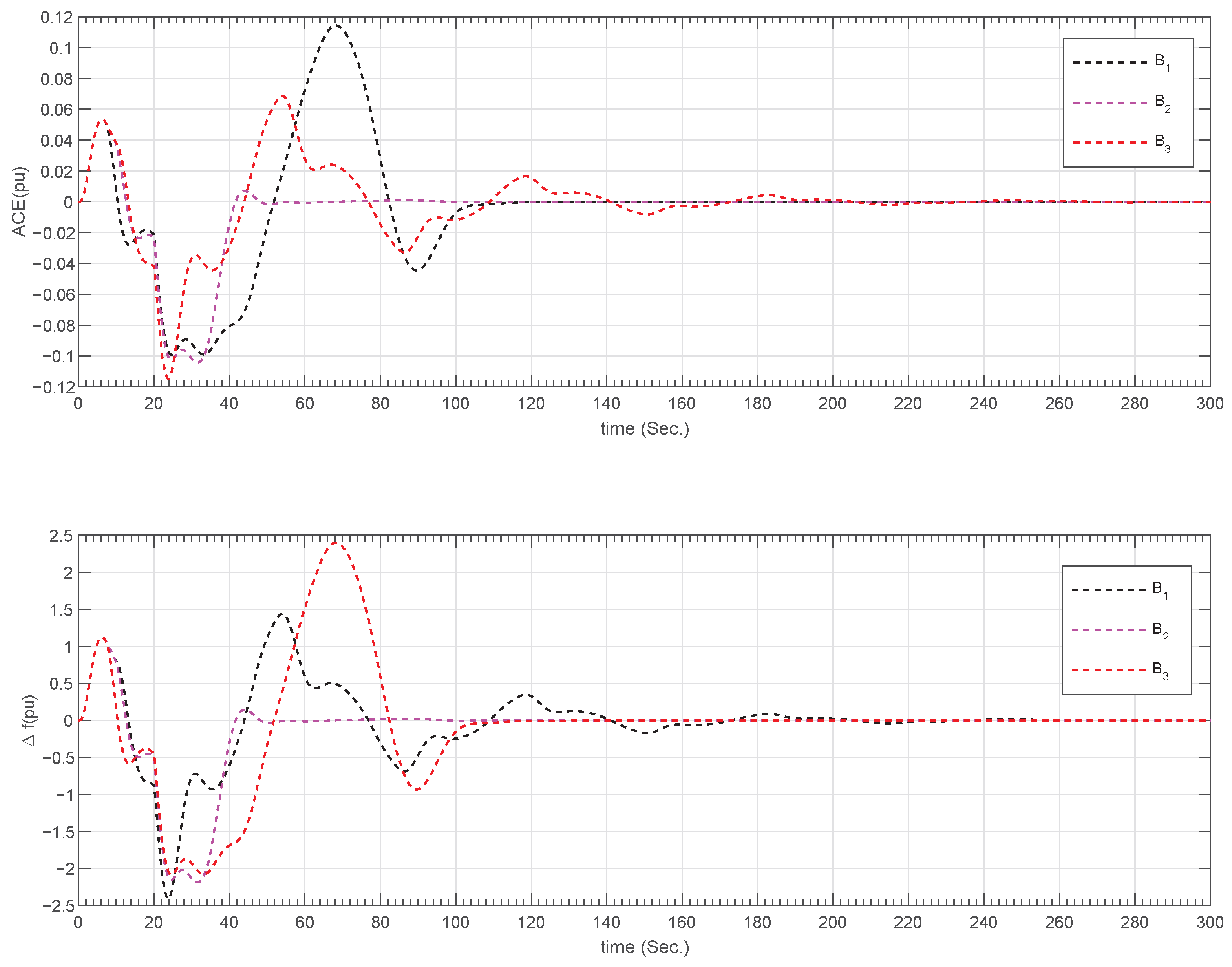
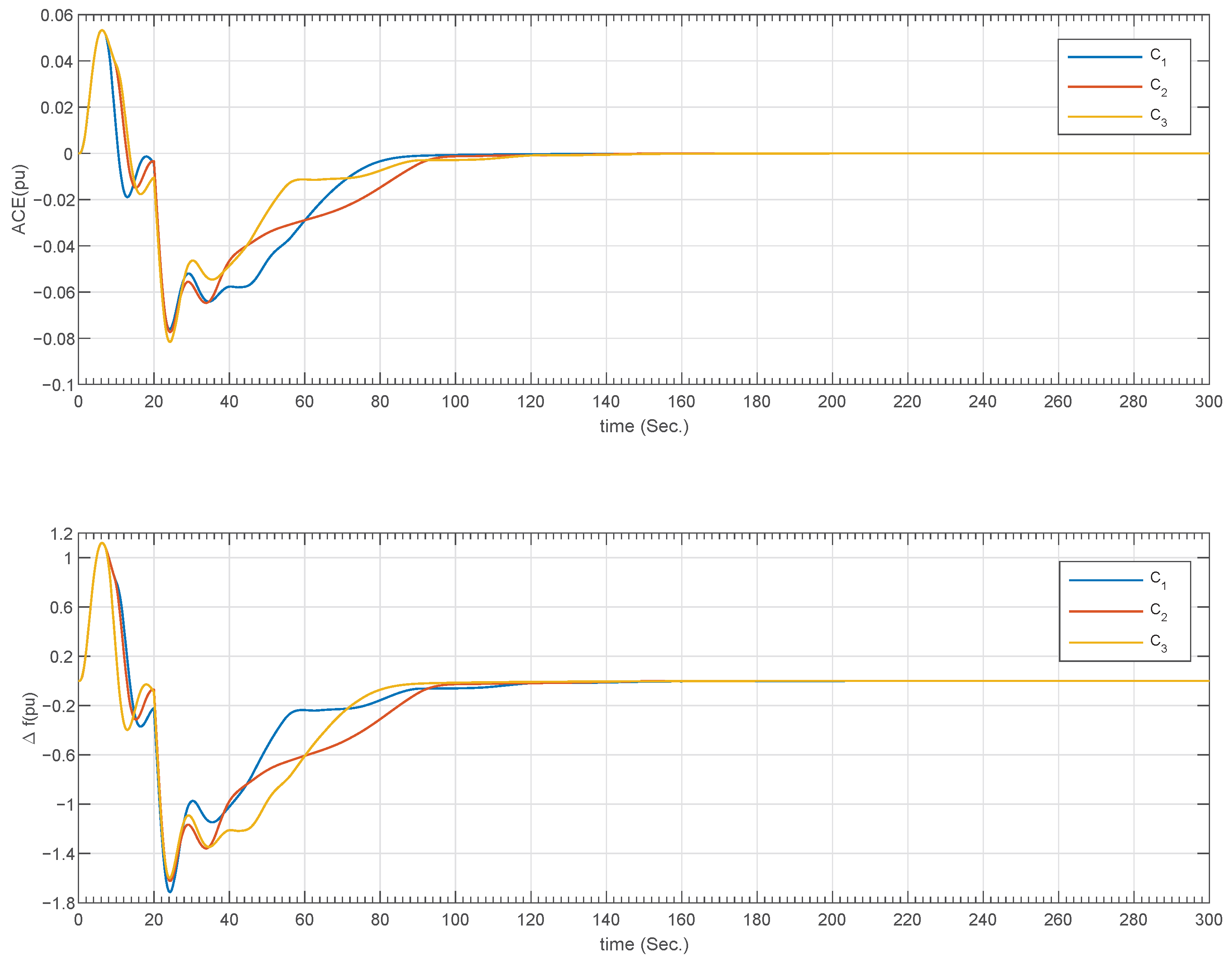
According to the results obtained in Table 3, Table 4 and Table 5, the following MATLAB simulation model of the power system in the one-area under DoS attacks is established. The system is subjected to a step load change of 0.1 pu at the 3rd second. From Figure 4, Figure 5 and Figure 6, it can be seen that in different cases, the trajectories of frequency deviation Δ f and regional error A C E return to zero after oscillation. These results prove that the system is stable under DoS attacks. In MATLAB simulation, some detailed simulation conditions are as follows:
Figure 4: h = 0.1 s, d k = 0
A 1 : K P = 0.253 , K I = 0.253 , h k = 24.2 2 + 21.8 2 sin 0.4 k 21.8 , 1.2 < h k < 23
A 2 : K P = 0.253 , K I = 0.264 , h k = 24.2 2 + 21.8 2 sin 0.8 k 21.8 , 1.2 < h k < 23
A 3 : K P = 0.324 , K I = 0.264 , h k = 24.2 2 + 21.8 2 sin 1.2 k 21.8 , 1.2 < h k < 23
Figure 5: h = 0.1 s, K P = 0.02 , K I = 0.02 , h 2 = 2
B 1 : h 1 = 0.2 , d τ = 0.8 , h ¯ k = 23 2 + 21 2 sin 0.4 k 21
B 2 : h 1 = 0.3 , d τ = 0.7 , h ¯ k = 23 2 + 21 2 sin 0.4 k 21
B 3 : h 1 = 0.4 , d τ = 0.6 , h ¯ k = 23 2 + 21 2 sin 0.4 k 21
Figure 6: h = 0.1 s, K P = 0.02 , K I = 0.02
C 1 : h 1 = 0.4 , h 2 = 9 , d τ = 0.8 , h ¯ k = 39.8 2 + 38.2 2 sin 0.4 k 38.2
C 2 : h 1 = 0.4 , h 2 = 11 , d τ = 0.8 , h ¯ k = 37.8 2 + 36.2 2 sin 0.4 k 36.2
C 3 : h 1 = 0.4 , h 2 = 13 , d τ = 0.8 , h ¯ k = 35.8 2 + 34.2 2 sin 0.4 k 34.2
Curves A 1 , A 2 and A 3 in Figure 4 correspond to simulation conditions A 1 , A 2 and A 3 , respectively. Curves B 1 , B 2 and B 3 in Figure 5 correspond to simulation conditions B 1 , B 2 and B 3 , respectively. Curves C 1 , C 2 and C 3 in Figure 6 correspond to simulation conditions C 1 , C 2 and C 3 , respectively. As time increases, the curve tends to be stable after oscillation. This proves that the maximum allowable delay range obtained by Theorem 1 is within the practical range. This method can be used to evaluate the effect of DoS attacks on the stability of LFC power system with transmission delays.
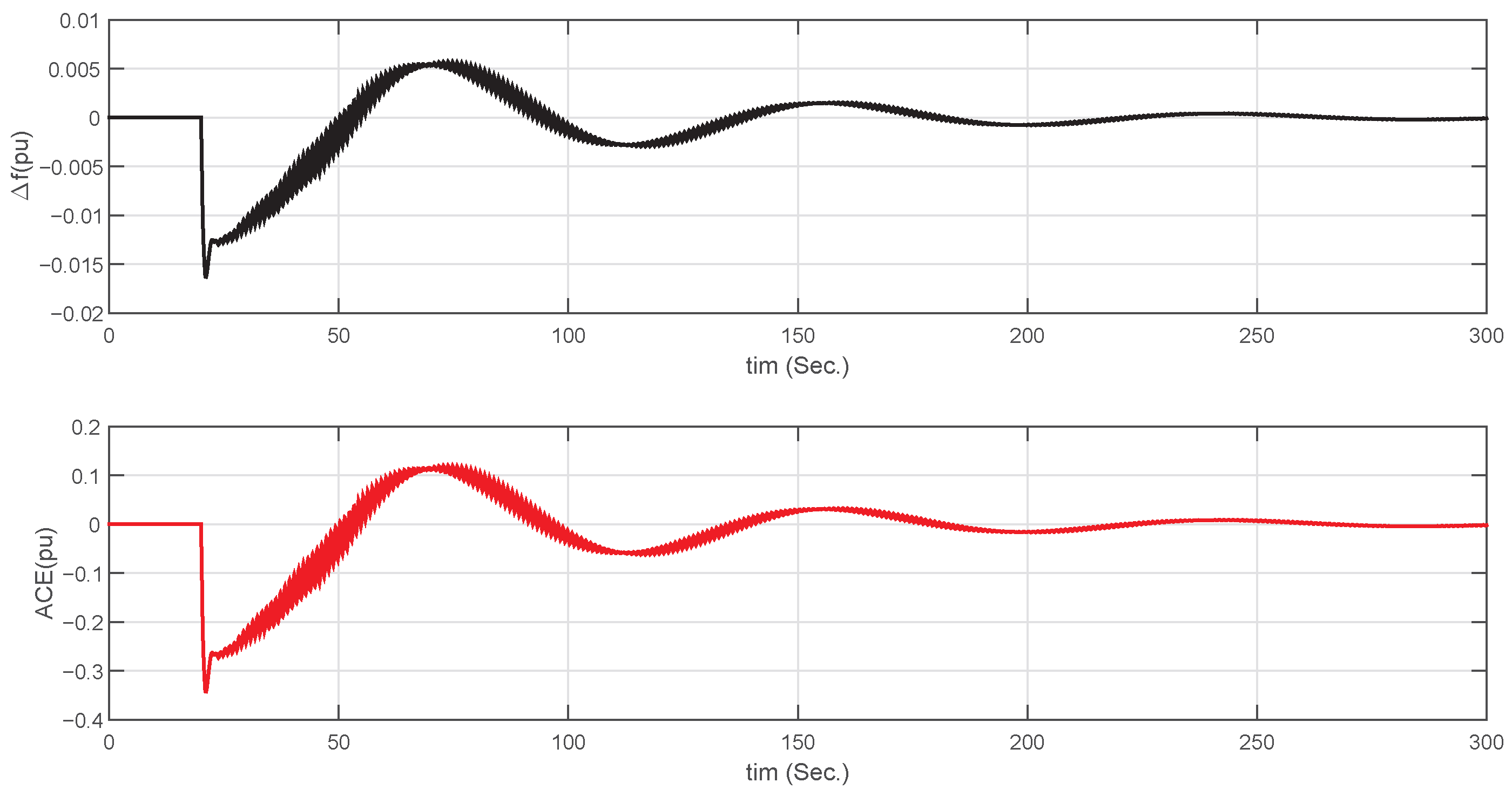
Let the sampling period be h = 0.1 . According to the conditions and results in Table 7, set K P = 0.0257 and K I = 0.0837 for the simulation. The system status response curve is shown in Figure 7. The results indicate that the system is stable within the given H performance index range.

5. Conclusions

In this paper, we have addressed the LFC problem for a one-area discrete-time power system under DoS attacks with time-varying transmission delays. By constructing an improved LKF and utilizing novel summation inequalities, we derived less conservative stability criteria in the form of LMIs, which guarantee both the asymptotic stability and the prescribed H performance of the closed-loop system. Two convex optimization algorithms were proposed to obtain the optimal PI controller gains, either for a given H performance index or within a specified interval. The quantitative results from extensive numerical simulations demonstrate the effectiveness and superiority of the proposed method:
Enhanced Robustness to Delays: The MADUBs estimated by our method are at least 1 s higher than those reported in some existing literature (see Table 4 for detailed comparisons), significantly improving the system’s tolerance to time-varying transmission delays. Specifically, when d ( k ) = 0 (no DoS attack), the MADUBs increase with the proportional gain K P and the upper bound of the inherent delay h 1 , while they decrease as the integral gain K I increases (as illustrated in Table 3). When d ( k ) 0 (under DoS attack), the tolerable attack-induced delay bound decreases linearly with the increase of h 2 , revealing the critical coupling constraint between the two types of delays (see Table 5).
Optimized H Performance: For a given H performance index γ , the designed PI controller ensures that the frequency deviation Δ f and area control error ( A C E ) converge to zero after a transient process under a 0.1 p u load disturbance (as shown in Figure 7). When optimizing γ within a specified interval, our method yields the minimal γ and the corresponding optimal controller parameters (see Table 7), achieving the best trade-off between stability and disturbance rejection.
The modeling and analysis framework developed in this study can be directly extended to multi-area interconnected power systems, offering theoretical support for the secure and stable operation of complex power networks. Future work will focus on extending the results to multi-area LFC systems, considering the coupling effects of tie-line power flows, and incorporating more sophisticated stochastic DoS attack models to design adaptive robust control strategies.

Author Contributions

Conceptualization, Z.C. and X.Z.; methodology, Z.C., X.Z. and L.L.; software, W.D. and L.L.; validation, Z.C., X.Z. and L.L.; formal analysis, Z.C., X.Z. and W.D.; investigation, X.Z. and L.L.; data curation, X.Z. and W.D.; writing—original draft preparation, Z.C., X.Z. and W.D.; writing—review and editing, Z.C., W.D. and L.L.; visualization, Z.C. and X.Z.; supervision, L.L. All authors have read and agreed to the published version of the manuscript.

Funding

This research is supported by Guangdong Basic and Applied Basic Research Foundation under grant number 2022A1515110650, and the Jiangsu Province “333” high-level talent project, the NSF of Yancheng City under grant number YCBK2024063 and the Yellow Sea Rookie of Yancheng Institute of Technology.

Data Availability Statement

The original contributions presented in this study are included in the article material.

Conflicts of Interest

The authors declare no conflicts of interest.

References

  1. Bevrani, H.; Hiyama, T. Robust decentralised PI based LFC design for time delay power systems. Energy Convers. Manag. 2008, 49, 193–204. [Google Scholar] [CrossRef]
  2. Gulzar, M.M.; Sibtain, D.; Alqahtani, M.; Alismail, F.; Khalid, M. Load frequency control progress: A comprehensive review on recent development and challenges of modern power systems. Energy Strategy Rev. 2025, 57, 101604. [Google Scholar] [CrossRef]
  3. Zhao, J.; Mili, L.; Wang, M. A generalized false data injection attacks against power system nonlinear state estimator and countermeasures. IEEE Trans. Power Syst. 2018, 33, 4868–4877. [Google Scholar] [CrossRef]
  4. Lin, J.; Lin, D. Robust frequency control for power systems considering unknown delay and parameter uncertainties. Energy Rep. 2025, 13, 1728–1738. [Google Scholar] [CrossRef]
  5. Case, D.U. Analysis of the cyber attack on the Ukrainian power grid. Electr. Inf. Shar. Anal. Cent. (E-ISAC) 2016, 388, 1–29. [Google Scholar]
  6. Abraham, D.; Houmb, S.; Erdodi, L. Cyber-Attacks on Energy Infrastructure—A Literature Overview and Perspectives on the Current Situation. Appl. Sci. 2025, 15, 9233. [Google Scholar] [CrossRef]
  7. Teixeira, A.; Shames, I.; Sandberg, H.; Johansson, K.H. A secure control framework for resource-limited adversaries. Automatica 2015, 51, 135–148. [Google Scholar] [CrossRef]
  8. Ding, D.; Han, Q.L.; Xiang, Y.; Ge, X.; Zhang, X.M. A survey on security control and attack detection for industrial cyber-physical systems. Neurocomputing 2018, 275, 1674–1683. [Google Scholar] [CrossRef]
  9. Islam, M.M.; Yu, T.; Giannoccaro, G.; Mi, Y.; La Scala, M.; Nasab, M.R.; Wang, J. Improving reliability and stability of the power systems: A comprehensive review on the role of energy storage systems to enhance flexibility. IEEE Access 2024, 12, 152738–152765. [Google Scholar] [CrossRef]
  10. Cheng, L.; Huang, P.; Zhang, M.; Yang, R.; Wang, Y. Optimizing electricity markets through game-theoretical methods: Strategic and policy implications for power purchasing and generation enterprises. Mathematics 2025, 13, 373. [Google Scholar] [CrossRef]
  11. Ameli, A.; Hooshyar, A.; Yazdavar, A.H.; El-Saadany, E.F.; Youssef, A. Attack detection for load frequency control systems using stochastic unknown input estimators. IEEE Trans. Inf. Forensics Secur. 2018, 13, 2575–2590. [Google Scholar] [CrossRef]
  12. Liu, X.; Li, Z.; Li, Z. Optimal protection strategy against false data injection attacks in power systems. IEEE Trans. Smart Grid 2016, 8, 1802–1810. [Google Scholar] [CrossRef]
  13. Chang, Z.; Wu, J.; Liang, H.; Wang, Y.; Wang, Y.; Xiong, X. A review of power system false data attack detection technology based on big data. Information 2024, 15, 439. [Google Scholar] [CrossRef]
  14. Ahmadi, A.; Sadabadi, M.S.; Shafiee, Q. Modelling False Data Injection and Denial of Service Attacks in Cyber-Physical Microgrids. IET Cyber-Phys. Syst. Theory Appl. 2025, 10, e70025. [Google Scholar] [CrossRef]
  15. Ansari Bonab, P.; Javidi-Niroumand, F.; Sargolzaei, A. Secure control design for cooperative adaptive cruise control with a time-varying input delays under false data injection attacks. Int. J. Syst. Sci. 2025, 56, 375–393. [Google Scholar] [CrossRef]
  16. Zhong, Q.; Yang, J.; Shi, K.; Zhong, S.; Li, Z.; Sotelo, M.A. Event-triggered H load frequency control for multi-area nonlinear power systems based on non-fragile proportional integral control strategy. IEEE Trans. Intell. Transp. Syst. 2021, 23, 12191–12201. [Google Scholar] [CrossRef]
  17. Wang, Y.; Xi, Z.; Zhang, B.; Zhang, T.; He, C. Resilient Event-Triggered H Control for a Class of LFC Systems Subject to Deception Attacks. Electronics 2025, 14, 2713. [Google Scholar] [CrossRef]
  18. Cheng, Z.; Hu, S.; Yue, D.; Dou, C.; Shen, S. Resilient distributed coordination control of multiarea power systems under hybrid attacks. IEEE Trans. Syst. Man, Cybern. Syst. 2021, 52, 7–18. [Google Scholar] [CrossRef]
  19. He, C.; Geng, H.; Rajashekara, K.; Chandra, A. Analysis and control of frequency stability in low-inertia power systems: A review. IEEE/CAA J. Autom. Sin. 2024, 11, 2363–2383. [Google Scholar] [CrossRef]
  20. Hossain, M.M.; Peng, C. Observer-based event triggering H LFC for multi-area power systems under DoS attacks. Inf. Sci. 2021, 543, 437–453. [Google Scholar] [CrossRef]
  21. Ma, M.; Cui, J.; Chen, H.; Lee, K.Y. Load Frequency Control of Multiarea Interconnected Power System Based on Distributed Economic Model Predictive Control with Guaranteed Stability. IEEE Trans. Ind. Inform. 2025, 21, 9093–9103. [Google Scholar] [CrossRef]
  22. De Persis, C.; Tesi, P. Input-to-state stabilizing control under denial-of-service. IEEE Trans. Autom. Control 2015, 60, 2930–2944. [Google Scholar] [CrossRef]
  23. Hu, S.; Yue, D.; Xie, X.-P.; Chen, X.; Yin, X. Resilient event-triggered controller synthesis of networked control systems under periodic DoS jamming attacks. IEEE Trans. Cybern. 2018, 49, 4271–4281. [Google Scholar] [CrossRef]
  24. Guo, D.T.; Zhao, Y.X.; Shi, K.B.; Zhu, M. Dynamic Event-Triggered Switching of LFC Scheme Under DoS Attacks Based on a Predictive Model. Electronics 2025, 14, 2838. [Google Scholar] [CrossRef]
  25. Ding, D.; Wang, Z.; Wei, G.; Alsaadi, F. Event-based security control for discrete-time stochastic systems. IET Control Theory Appl. 2016, 10, 1808–1815. [Google Scholar] [CrossRef]
  26. Hu, S.; Ge, X.; Zhang, W.; Yue, D. DoS-Resilient Load Frequency Control of Multi-Area Power Systems: An Attack-Parameter-Dependent Approach. IEEE Trans. Inf. Forensics Secur. 2024, 19, 3423–3434. [Google Scholar] [CrossRef]
  27. Cheng, Z.; Hu, S.; Ma, J. Resilient Event-Triggered Control for LFC-VSG Scheme of Uncertain Discrete-Time Power System under DoS Attacks. Energies 2020, 13, 1820. [Google Scholar] [CrossRef]
  28. Giapantzis, K.; Zarras, A.; Kalafatidis, S.; Lalas, A.; Votis, K.; Xenakis, C. GORGO: A Reinforcement Learning Model for DoS Vulnerability Analysis on 5G and Beyond Networks. J. Netw. Syst. Manag. 2026, 34, 10. [Google Scholar] [CrossRef]
  29. Li, N.; He, D.; Shen, J.; Shi, Z. Cluster Secure Synchronization of Complex Networks with Cooperative-Competitive Interaction Under DoS Attacks. IEEE Trans. Netw. Sci. Eng. 2025, 13, 3224–3239. [Google Scholar] [CrossRef]
  30. Wang, X.; Kong, L.; Zhu, Q.; Niu, B. Secure optimal control of Itô stochastic Markov jump systems subject to DoS attacks: A hybrid learning algorithm. Automatica 2026, 183, 112681. [Google Scholar] [CrossRef]
  31. Chen, M.; Sun, J. H finite time control for discrete time-varying system with interval time-varying delay. J. Frankl. Inst. 2018, 355, 5037–5057. [Google Scholar] [CrossRef]
  32. Chen, J.; Park, J.; Xu, S. Stability analysis of discrete-time neural networks with an interval-like time-varying delay. Neurocomputing 2019, 329, 248–254. [Google Scholar] [CrossRef]
  33. Zhu, L.; Zhu, C. Enhanced stability criteria for discrete-time systems with time-varying delay. Int. J. Control Autom. Syst. 2021, 19, 2385–2394. [Google Scholar] [CrossRef]
  34. Xu, H.; Zhang, C.; Jiang, L. Delay-dependent stability for Load Frequency Control with constant delays via delay-product-type Lyapunov Functional. Appl. Math. Model. 2017, 45, 955–964. [Google Scholar] [CrossRef]
  35. Yang, H.; Bo, X.; Chen, C.; Duan, W. An Improved Stability Criterion for Discrete-Time Linear Systems with Two Additive Time-Varying Delays. IEEE Access 2022, 10, 126787–126801. [Google Scholar] [CrossRef]
  36. Wen, S.; Yu, X.; Zeng, Z.; Wang, J. Event-triggering load frequency control for multi-area power systems with communication delays. IEEE Trans. Indus. Elect. 2016, 63, 1308–1317. [Google Scholar] [CrossRef]
  37. Peng, C.; Zhang, J.; Yan, H. Adaptive Event-Triggering H Load Frequency Control for Network-Based Power Systems. IEEE Trans. Ind. Electron. 2018, 65, 1685–1694. [Google Scholar] [CrossRef]
  38. Chen, P.; Yu, L.; Zhang, D. Event-triggered sliding mode control of power systems with communication delay and sensor faults. IEEE Trans. Circuits Syst. I Regul. Pap. 2020, 68, 797–807. [Google Scholar] [CrossRef]
  39. Kürkçü, B.; Tomizuka, M. Algebraic control: Complete stable inversion with necessary and sufficient conditions. IEEE Trans. Autom. Control 2026, 71, 1239–1246. [Google Scholar] [CrossRef]
  40. Crusius, C.; Trofino, A. Sufficient LMI conditions for output feedback control problems. IEEE Trans. Autom. Control 1999, 44, 1053–1057. [Google Scholar] [CrossRef]
  41. Su, K.; Li, Y.; Chen, J.; Duan, W. Optimization and H performance analysis for load frequency control of power systems with time-varying delays. Front. Energy Res. 2021, 9, 762480. [Google Scholar] [CrossRef]
Figure 1. The model of power system in one-area under DoS attacks.
Mathematics 14 00822 g001
Figure 2. Binary search the controller gain K for a given H index.
Mathematics 14 00822 g002
Figure 3. Binary search optimization for solving optimal performance index.
Mathematics 14 00822 g003
Figure 4. When d k = 0 , frequency deviation and control error response curve.
Mathematics 14 00822 g004
Figure 5. When d k 0 , for given h 2 = 2 , frequency deviation and control error response curve.
Mathematics 14 00822 g005
Figure 6. Frequency deviation and control error response curve under different h 1 and h 2 .
Mathematics 14 00822 g006
Figure 7. Frequency deviation and control error response curve under γ = 0.28 .
Mathematics 14 00822 g007
Table 1. The explanations of model parameters.
Parameter NotationsPhysical Meanings
DLoad damping constant
MInertia constant
Δ f Deviation of frequency
Δ P v Governor valve position
Δ P m Generator mechanical output
β Frequency bias coefficient
RRotational speed
A C E Area control error
K P Proportional gain
K I Integral gain
T g Governor time constant
T c h Turbine time constant
Table 2. Model parameters of one-area power system.
Parameters T g T ch R β MD
Values0.10.30.05211.010
Table 3. h 2 for d k = 0 and different h 1 , K P and K I system.
d k = 0
K P , K I h 1 0.20.40.811.2
0.253 , 0.253 2222232323
0.253 , 0.264 2121222223
0.324 , 0.264 2222222323
0.324 , 0.332 1919191920
0.358 , 0.332 2323232424
0.358 , 0.376 2121212222
Table 4. d ¯ is the maximum for given h ¯ 1 , h 2 = 2 .
Values h 2 = 2
h ¯ 1 Theorem 1 [34]Remark 5 [35]Theorem 1 [35]Theorem 1
15202222
1.5---23
26202223
Table 5. For a given h 1 and h 2 , d ¯ as d τ varies.
h 1 , h 2 d τ = 0.2 d τ = 0.4 d τ = 0.6 d τ = 0.8
0.4 , 9 22273339
0.4 , 11 20253137
0.4 , 13 18232935
Table 6. The optimal controller gains for different d τ .
( h 1 , h 2 ) ( 0.2 , 9 ) ( 0.3 , 11 ) ( 0.4 , 13 )
( K P , K I ) d τ 0.40.81.20.40.81.20.40.81.2
( 0 , 0.05 ) 303133252627222324
( 0 , 0.1 ) 242728202122181920
( 0 , 0.4 ) 171920151617131416
( 0.1 , 0.05 ) 313232262727232424
( 0.1 , 0.1 ) 252828212222192020
( 0.1 , 0.4 ) 181919161717151616
Table 7. The maximum allowable upper d M for different control gains.
d τ K K P K I γ min
0.20.02570.08370.28
0.50.04280.27890.39
0.90.01080.42680.42
Disclaimer/Publisher’s Note: The statements, opinions and data contained in all publications are solely those of the individual author(s) and contributor(s) and not of MDPI and/or the editor(s). MDPI and/or the editor(s) disclaim responsibility for any injury to people or property resulting from any ideas, methods, instructions or products referred to in the content.