Article

Bilevel Mixed-Integer Model and Efficient Algorithm for DER Aggregator Bidding: Accounting for EV Aggregation Uncertainty and Distribution Network Security


by
Wentian Lu
,
Junwei Chen
,
Lefeng Cheng
* and
Wenjie Liu
*
School of Mechanical and Electric Engineering, Guangzhou University, Guangzhou 510006, China
*
Authors to whom correspondence should be addressed.
Mathematics 2026, 14(4), 631; https://doi.org/10.3390/math14040631
Submission received: 6 January 2026 / Revised: 2 February 2026 / Accepted: 9 February 2026 / Published: 11 February 2026
(This article belongs to the Special Issue Artificial Intelligence and Game Theory)

Abstract

This paper proposes a robust bilevel mixed-integer profit maximization model for an independent distributed energy resource (DER) aggregator participating in the wholesale electricity market, considering the uncertain aggregation of electric vehicles (EVs) to the grid, as well as the discrete security check of the distribution system conducted by the non-market-participating distribution company. Regarding the uncertainty in EV–grid connectivity caused by stochastic transportation behavior, we characterize the robust connectivity at the lower level to ensure that the energy required for their daily transportation can be met. Solving the proposed bilevel mixed-integer profit maximization model is challenging due to the integer variables involved in the lower-level security check and robust connectivity problem, which makes the traditional strong duality and KKT method inapplicable. Thus, we propose using the total unimodularity property, multi-value-function approach, and strong duality method to transform the original bilevel model into an equivalent single-level model. Moreover, a sampling-based accelerated optimization algorithm is proposed to solve the equivalent single-level model efficiently. Case studies on a real-world transmission–distribution system verify that: (1) the proposed robust model outperforms deterministic models in profit by accommodating EV aggregation uncertainty; (2) the algorithm significantly reduces computational time compared to stochastic modeling approaches, while ensuring compliance with distribution network discrete security constraints.

1. Introduction

1.1. Background

Against the backdrop of global energy system transformation, distributed energy resources (DERs) have garnered growing attention, and numerous countries around the world have issued a series of measures and policies to promote the marketization of DERs [1]. Given that the capacity of an individual DER is insufficient to meet the capacity criteria for electricity market participation, DERs are typically aggregated by a DER aggregator to satisfy the market’s capacity requirements, thereby enabling their participation in the electricity market [2,3]. While this approach facilitates the participation of DERs in the electricity market, it also poses numerous challenges. On one hand, the large-scale integration of DERs may lead to line overload and voltage violations in the distribution system (DS) [4]. On the other hand, the substantial number of electric vehicles (EVs) and the stochasticity of their transportation behavior not only affect the accuracy of aggregator’s strategy but also increase computational complexity [5]. Therefore, ensuring the network security of the DS and considering the stochastic transportation behavior of large-scale EVs are of great significance during aggregator’s participation in the electricity market.

1.2. Related Works

In recent years, researchers have conducted extensive research on the issue of DER aggregators participating in wholesale electricity markets. Based on the bilevel optimization theory, Bahramara et al. [6] established a bilevel model to optimize the DERs’ aggregated bidding behavior for the distribution company participating in wholesale energy-reserve markets. References [7,8] have respectively utilized bilevel optimization theory and game theory to evaluate the economic advantages of the aggregated bidding mode for DERs in wholesale electricity markets. M. Foroughi [9] et al. formulated the optimal bidding behavior of a Virtual Power Plant in local and wholesale electricity markets as a bilevel optimization model to derive its optimal bidding strategy. Some research has further explored the impact of DER uncertainties on DER aggregators’ participation in wholesale electricity markets. Building on Reference [6], Reference [10] further accounted for the uncertainties of renewable energy and demand and proposed a risk-based two-stage stochastic bilevel approach to obtain the optimal bidding strategy. Reference [11] used information gap decision theory to handle wind power output uncertainty during aggregator’s participation in non-cooperative electricity markets. G. Sun et al. [12] proposed a scenario-based stochastic bilevel approach to address photovoltaics uncertainty when a prosumer aggregator participates in electricity market bidding. Reference [13] employed a scenario-based stochastic bilevel optimization approach to derive the optimal bidding strategy for a prosumer aggregator, accounting for the output uncertainty of flexible loads and photovoltaics when participating in wholesale energy and regulation markets. S. Haghifam et al. [14] proposed a scenario-based two-stage stochastic bilevel optimization scheme to overcome the stochasticity of wind power and photovoltaics when the DER aggregator participates in local and wholesale electricity markets. The above-mentioned uncertainty-related studies [10,11,12,13,14] have mainly focused on the impact of wind power and photovoltaics on the aggregator’s bidding strategy but have overlooked the uncertainty of EV transportation.
EV adoption has experienced exponential growth, with global stock exceeding 64 million by the end of 2024 [15]. As a flexible energy storage device, EVs can not only compensate for the uncertainty of renewable energy but also provide auxiliary services for the system, yet they also pose certain challenges. For instance, when large-scale EVs participate in the electricity market, the DER aggregator needs to solve a high-dimensional optimization problem, leading to a heavy computational burden, and the uncertainty of their transportation will also affect the accuracy of the aggregator’s strategy [16,17]. For the above challenge, the stochastic optimization method [18,19,20,21,22,23,24] and robust optimization method [25,26,27,28,29] are adopted to address the uncertain aggregation problem of EVs. However, the stochastic optimization method in [18,19,20,21,22,23,24] requires a large number of scenarios to more accurately model the uncertainty of EVs, which not only leads to a heavy computational burden but also brings the risk of losing important scenarios. The robust optimization method [25,26,27,28,29] employed historical travel data to characterize EV transportation uncertainty and manage EV aggregated bidding based on a multi-level optimization model, which significantly reduced computational burden and scenario-loss risks.
The above studies [6,7,8,9,10,11,12,13,14,18,19,20,21,22,23,24,25,26,27,28,29] attempt to design optimal strategies for the DER aggregator to participate in electricity markets from multiple perspectives, but all of them overlook the network security limit of the DS. This oversight may result in an over-optimal strategy adopted by the DER aggregator, potentially leading to issues such as line overload, overvoltage, and threatening the safe and stable operation of DS. Therefore, a portion of researchers have begun to pay attention to the network security limit of the DS. References [30,31,32,33,34,35,36] have considered network security limits of DS during the aggregator’s participation in electricity market bidding to ensure the network security of the DS. Specifically, References [30], [31,32,33], and [34,35,36] respectively incorporated nonlinear, linearized, and second-order cone power flow constraints during the aggregator’s market bidding to devise optimal bidding strategies that are compliant with the network security requirements of DS.
Nevertheless, References [30,31,32,33,34,35,36] fail to account for the optimization capabilities of discrete control devices within the DS (e.g., substation transformer taps and capacitor bank groups), which play a crucial role in optimizing DS operations. Besides, in studies [30,31,32,33,34,35,36], distribution companies are permitted to act as aggregators to participate in the wholesale electricity market, and this mode is only applicable to countries where distribution companies hold the authorization to participate in the wholesale electricity market. However, in some countries, such as China and Europe, distribution companies only have the authority to manage distribution networks and are not permitted to participate in the wholesale electricity market. Moreover, distribution network data are regarded as confidential by distribution companies, and thus the aggregator’s direct use of such data to solve network-secure bidding problems would violate data-privacy agreements. Thus, in these countries, the aggregated bidding of DERs is conducted by independent aggregators, while distribution companies perform security checks and control optimization on the distribution network [37].
To bridge the research gaps in the latter group of countries, Z. Shen et al. [38] proposed a bilevel mixed integer model with a single-leader and multi-follower structure to describe the interactions between the independent aggregator, non-market-participating distribution company, and the wholesale electricity market. In this model, the aggregator acts as an upper-level leader to execute the aggregated bidding and dispatch of DERs, while the transmission system operator (TSO) and distribution system operator (DSO) serve as lower-level followers, respectively performing market clearing and discrete security checks for the distribution network. Due to the solution challenge of the non-convex bilevel model caused by the discrete security check at the lower level, they proposed an accelerated relaxed bilevel reconstruction and decomposition (A-RBRD) algorithm to solve it. However, the A-RBRD algorithm exhibits low computational efficiency. In study [39], although distribution network security checks were considered, the discrete control constraints were directly removed, and thus the associated computational difficulty did not arise. Focusing on the computational efficiency challenge of the non-convex bilevel model with integer variables at the lower level proposed in [38], studies [40,41,42] have respectively proposed three data-driven hybrid algorithms for its solution. However, these data-driven intelligent algorithms demonstrated low solution efficiency and were prone to getting trapped in a local optimum. Yan S. et al. [43] circumvented the computational challenges posed by the lower-level discrete security check subproblem by reformulating the subproblem as a two-stage model: Stage I determines the secure operating power, and the distribution locational marginal prices obtained in Stage II jointly guide aggregators in adjusting their bidding strategies. In addition, studies [38,39,40,41,42,43] overlooked the scheduling potential of EVs in the aggregator’s participation model for wholesale electricity markets. Therefore, to bridge the research gap in studies [38,39,40,41,42,43], this paper aims to further consider the uncertain aggregation of EVs by a robust method and propose an efficient algorithm for solving this non-convex bilevel model with integer variables at the lower level due to the discrete security check.
Current algorithms for bilevel optimization with lower-level integer variables include the A-RBRD algorithm [38], data-driven intelligent algorithms [40,41,42], relaxation-based primal-dual reformulation algorithm [44], branch-and-bound exact algorithm [45], and value-function exact algorithm [46]. A-RBRD and data-driven intelligent algorithms already show low computational efficiency even without accounting for EVs [38,40,41,42]. Pimal-dual relaxation algorithms relax lower-level integer variables into continuous variables but sacrifice optimality [44]. The branch-and-bound exact algorithm is not suitable for the bilevel mixed-integer case we study [45]. The value-function exact algorithm proposed in [46] applies to single-leader-single-follower cases, whereas our problem features single-leader multi-follower cases. Thus, we extend the value-function exact algorithm [46] to solve the single-leader-multi-follower problem, enabling efficient solution of our proposed model.
The comparisons between this paper and related research can be summarized in Table 1.

1.3. Contribution and Organization

This paper proposes a robust bilevel mixed-integer profit maximization model for an independent DER aggregator participating in the wholesale electricity market, with dual core focuses: the uncertain aggregation of EVs (driven by stochastic transportation behavior) and the discrete security check of distribution networks (implemented by non-market distribution companies). To address the computational challenges of this model, an optimal and efficient algorithm is developed. The main contributions are summarized as follows:
(1) Robust Bidding Model Accounting for EV Aggregation Uncertainty: A robust optimal bidding model is proposed to characterize uncertainty in EV-grid connectivity caused by stochastic transportation behavior, outperforming deterministic approaches in terms of profit while enhancing robustness against EV aggregation uncertainty and reducing computational time compared with stochastic models.
(2) Total Unimodularity-Based Equivalent Conversion: Based on the total unimodularity property, we prove that the lower-level integer programming (IP) problem for EVs’ daily transportation demand is equivalent to a linear programming (LP) problem, thereby enabling the equivalent substitution via the strong duality theorem.
(3) Multi-Value-Function-Based Model Reformulation: We propose a multi-value-function approach for the equivalent reformulation of the lower-level discrete security check problems, thus enabling the conversion of the original bilevel problem into a single-level model.
(4) Sampling-based Acceleration Strategy: To enhance computational efficiency, a sampling-based accelerated optimization algorithm is proposed, which maintains optimality while significantly reducing computational burden.
The remainder of this paper is organized as follows. Section 2 presents the proposed robust bilevel mixed-integer optimization model. Section 3 details the solution approach and methodology for solving the proposed model. Section 4 conducts simulation verification and analysis. Section 5 presents the discussion of this work. Section 6 concludes this paper.

2. Robust Bilevel Bidding Model for the DER Aggregator in the Wholesale Electricity Markets

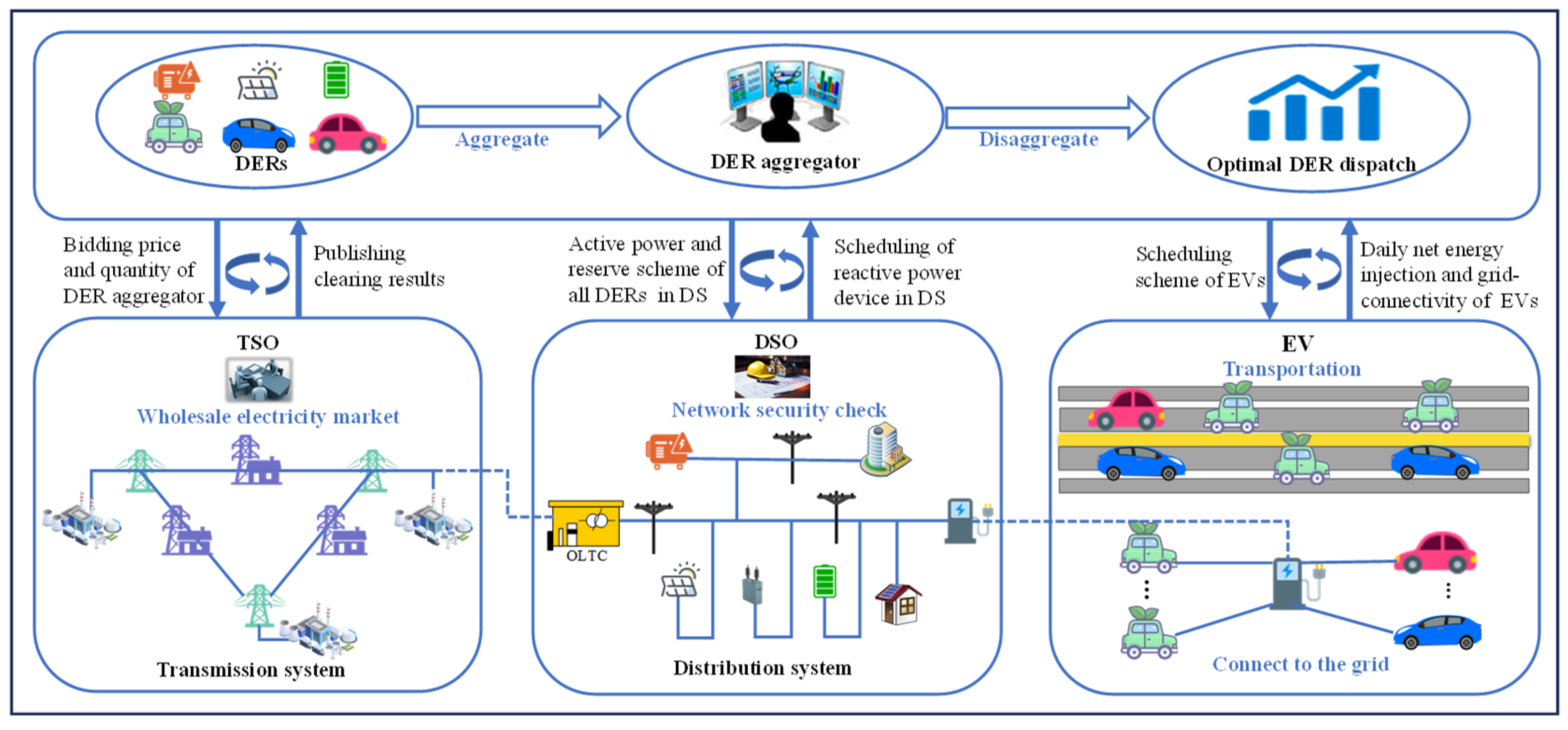
The optimal bidding of the DER aggregator in the wholesale electricity market can be described by a single-leader-multi-follower bilevel optimization model, where the aggregator acts as the leader, and the TSO and DSO serve as the followers. The detailed process of the DER aggregator participating in the electricity market is illustrated in Figure 1. Specifically, (1) the DER aggregator aggregates the bidding offers of individual DERs and submits the aggregated price–quantity bids to the TSO for transactions in the energy and reserve market. (2) After receiving the aggregated bidding information, the TSO conducts energy and reserve clearing in the wholesale market and notifies the aggregator of the clearing results. (3) Based on the clearing results of energy and reserve in the wholesale market, the aggregator formulates a scheduling scheme for DERs. (4) To verify whether the aggregator’s scheduling scheme for DERs complies with the network security of the DS, the DSO conducts a security check on the distribution network. It should be noted that the DERs in the DS include controllable distributed generators (CDGs), energy storage systems (ESSs), electric vehicles (EVs), and photovoltaic systems (PVs). Among these, the output power of PVs and EVs is stochastic.
Considering the uncertainty in the power output of inflexible DERs, we have designed three scenarios for the security check of the distribution network, namely the normal scheduling scenario (NR), upward reserve scenario (UP), and downward reserve scenario (DN). The upward reserve and downward reserve scenarios refer to two extreme scenarios that are established to address the uncertainty of inflexible DERs (e.g., PV), in which the active power output of inflexible DERs is at the upper and lower bounds of the forecast interval, respectively. Specifically, when the active power output of inflexible DERs is at the upper (lower) bound of the forecast interval, inflexible DERs cannot provide upward (downward) reserves, so the maximum scheduled upward (downward) reserves of flexible DERs are activated.
The grid connectivity of EVs is also inherently uncertain, stemming from the stochastic nature of EV transportation behavior: during driving, EVs are unable to perform energy charging and discharging or serve as a reserve for the power grid. Critically, transportation remains the primary function of EVs—thus, when DER aggregators dispatch EV resources, they must account for the uncertainty in EV-grid connectivity while prioritizing the fulfillment of daily transportation demands. To address this dual requirement (upholding EVs’ core purpose and accommodating connectivity uncertainty), we integrate a robust connectivity problem for EVs into the lower level of the above bilevel bidding model, thus forming a robust bilevel bidding model for a DER aggregator participating in wholesale electricity markets. The detailed upper and lower optimization models and the corresponding nomenclature are presented below.

2.1. Uncertain Connectivity of EVs to the Power Grid

This subsection elaborates on the modeling framework for the uncertain grid connectivity of electric vehicles (EVs). EVs exhibit stochastic transportation behavior: during operation (i.e., when in use for travel), they are disconnected from the power grid and thus unable to participate in charging/discharging or provide reserve services. For the DER aggregator, the stochastic transportation behavior of EVs exerts an impact on its bidding strategy.
Based on historical EV data obtained from the National Household Travel Survey website and the method proposed in Reference [28], the uncertain connectivity of EVs to the grid can be modeled by the following uncertainty set:
β e v , i , t | t T β e v , i , t K e v , i , β _ e v , i , t β e v , i , t β ¯ e v , i , t , β e v , i , t { 0 , 1 }
K e v , i , β _ e v , i , t , and β ¯ e v , i , t are parameters derived from historical EV data, where β _ e v , i , t and β ¯ e v , i , t are binary parameters and K e v , i is an integer parameter. K e v , i represents the average connectivity duration of i-th EV within a day. In the historical data of EVs, if β _ e v , i , t and β ¯ e v , i , t are both 1, the i-th EV is connected to the power grid at period t; if β _ e v , i , t and β ¯ e v , i , t are both 0, the i-th EV is in transit at period t; if β _ e v , i , t = 0 and β ¯ e v , i , t = 1 , the EV may either be in transit or connected to the power grid at this period. β e v , i , t is a binary decision variable indicating whether the i-th EV is connected to the grid at period t. If β e v , i , t = 0 , it indicates that the i-th EV is driving and cannot be connected to the power grid at period t; If β e v , i , t = 1 , the i-th EV is connected to the power grid at period t.

2.2. Upper-Level Optimization Model for the DER Aggregator

Based on the operational flexibility of DERs, the aggregator classifies its integrated resources into two categories: (i) flexible suppliers—comprising CDGs, ESSs, and EVs, these resources can adjust their energy output and reserve capacity in response to market signals; (ii) inflexible suppliers—represented by PVs, whose energy and reserve capacities are pre-determined by day-ahead forecasts (with adjustments limited to curtailment only). The DER aggregator aims to maximize its profit in the wholesale energy-reserve market by optimizing the aggregated bidding price–quantity and the scheduling scheme of flexible and inflexible suppliers. Therefore, the upper-level model’s decision variables include: (1) energy and reserve bidding quantity-price of the DER aggregator, specifically including flexible suppliers’ minimum/maximum energy bidding quantity P _ f l e x , a g g , t , P ¯ f l e x , a g g , t , inflexible suppliers’ energy bidding quantity P i n f l , a g g , t , flexible suppliers’ upward/downward reserve bidding quantity r ¯ u p , a g g , t , r ¯ d n , a g g , t , and energy/upward reserve/downward reserve bidding prices O f l e x , a g g , t , O u p , a g g , t , O d n , a g g , t ; (2) the scheduling scheme of DERs, specifically including CDG’s active power/upward reserve/downward reserve arrangements P c d g , i , t , r c d g u p , i , t , r c d g d n , i , t , ESS’s charging power/discharging power/upward reserve/downward reserve arrangements P e s s c h , i , t , P e s s d i s , i , t , r e s s u p , i , t , r e s s d n , i , t , EVs’ charging power/discharging power/upward reserve/downward reserve arrangements P e v c h , i , t , P e v d i s , i , t , r e v u p , i , t , r e v d n , i , t and PV’s curtailed active power P c v , i , t s .

2.2.1. Objective of DER Aggregator

max   F 1 F 2 F 3 F 4 F 5
F 1 = t T λ e n , a g g , t P f l e x , a g g , t + P i n f l , a g g , t P c v , a g g , t + λ u p , t r u p , a g g , t + λ d n , t r d n , a g g , t
F 2 = t T i N C D G b c d g p , i P c d g , i , t + s Ω b c d g q , i s Q c d g , i , t s
F 3 = t T i N P V s Ω b c v , i s P c v , i , t s + b p v q , i s Q p v , i , t s
F 4 = t T i N E S S b e s s c h , i P e s s c h , i , t + b e s s d i s , i P e s s d i s , i , t
F 5 = t T i N E V b e v , i N e f c ( P e v c h , i , t + P e v d i s , i , t ) E e v , i , max
where (2b) represents the profit obtained by the aggregator from the day-ahead wholesale energy-reserve markets; (2c) denotes the active and reactive power output cost of the CDGs; (2d) stands for the penalty cost for active and reactive power output curtailment of the PVs; (2e) indicates the charging and discharging cost of the ESSs; and (2f) signifies the battery charging and discharging degradation cost of EVs. The clearing prices of energy ( λ e n , a g g , t ) , upward reserve ( λ u p , t ) , and downward reserve ( λ d n , t ) originate from the lower-level TSO, whereas the reactive power of DERs ( Q c d g , i , t s , Q p v , i , t s ) is derived from the lower-level DSO.

2.2.2. Constraints of DER Aggregator

When participating in the electricity market bidding, the DER aggregator must comply with two types of constraints: (1) the market rules regarding energy and reserve bidding (including price and quantity limits); and (2) the technical operational constraints of integrated DERs. Specifically, the upper-level optimization model for the aggregator encompasses seven constraint categories:
(1) Aggregated energy and reserve scheduling constraints;
(2) Energy bidding quantity and price constraints;
(3) Reserve bidding quantity and price constraints;
(4) CDGs’ operational constraints;
(5) ESSs’ operational constraints;
(6) PVs’ operational constraints;
(7) EVs’ operational constraints.
As the core focus of this paper is addressing the uncertain grid connectivity of EVs during the aggregator’s market participation, only the EV-relevant constraints are elaborated in detail herein. Constraints (1)–(6) are omitted from the main text to maintain focus, and their complete formulations are provided in Appendix A. The relevant constraints of EVs are as follows:
  • Transportation constraints of EVs
Let P e v t r a , i , t and ξ e v t r a , i denote the energy consumed by the i-th EV for transportation at period t and the daily expected energy consumption of the i-th EV for transportation, respectively. To guarantee the energy required for EVs to satisfy daily transportation demand, P e v t r a , i , t and ξ e v t r a , i need to satisfy the following constraints:
t T P e v t r a , i , t = ξ e v t r a , i ,       i N E V
0 P e v t r a , i , t P e v t r a , i , t max ( 1 β e v , i , t ) ,       i N E V
β e v , i , t τ e v , i ( P e v c h , i , t , P e v d i s , i , t ) ,       i N E V
where P e v t r a , i , t max represents the maximum energy consumption of the i-th EV at period t, β e v , i , t denotes the grid connectivity status of the i-th EV at period t, and τ e v , i denotes its decision feasible set. τ e v , i is the output of the lower-level robust connectivity problem that determines the availability of EVs based on the charging/discharging active power decision ( P e v c h , i , t , P e v d i s , i , t ) provided by the upper-level aggregator.
Beyond this, EVs are dispatched by the aggregator to charge, discharge, or provide reserve services. To ensure the EVs’ daily expected energy consumption is met, the daily net energy injection of EVs must be greater than or equal to the daily expected energy consumption. Let ψ e v , i denote the daily net energy injection of i-th EV. ψ e v , i and ξ e v t r a , i should satisfy the following constraints:
ψ e v , i ξ e v t r a , i ,   i N E V
ψ e v , i τ e v , i ( P e v c h , i , t , P e v d i s , i , t ) ,   i N E V
The daily net energy injection of EVs ψ e v , i is associated with their uncertain connectivity to the power grid and is determined in the following robust connectivity problem.
  • Charging and discharging constraints of EVs
0 P e v c h , i , t P e v c h , i , max I e v c h , i , t β e v , i , t ,       i N E V
0 P e v d i s , i , t P e v d i s , i , max I e v d i s , i , t β e v , i , t ,       i N E V
I e v c h , i , t + I e v d i s , i , t 1 ,       i N E V
Equation (5a,b) impose constraints on the maximum and minimum bounds on the EVs’ charging power and discharging power, respectively, with charging and discharging operations only feasible when EVs are connected to the power grid. Equation (5c) ensures that the EV cannot charge and discharge simultaneously.
  • Energy capacity constraints of EVs
E e v , i , t = E e v , i , t 1 + η e v c , i P e v c h , i , t 1 η e v d , i P e v d i s , i , t P e v t r a , i , t ,       i N E V
E e v , i , min E e v , i , t E e v , i , max ,       i N E V
E e v , i , 0 = E e v , i , 24 ,       i N E V
Equation (6a) calculates the energy capacity of EVs at period t after energy charging, discharging or transiting at period t − 1. Equation (6b) imposes the maximum and minimum constraints on the energy capacity of the EVs. Equation (6c) ensures that EVs’ final energy capacity is equal to its initial energy capacity.
  • Reserve constraints of EVs
0 r e v u p , i , t min β e v , i , t ( P e v d i s , i , max P e v d i s , i , t + P e v c h , i , t ) , β e v , i , t η e v d , i E e v , i , t 1 E e v , i , min ,   ,   i N E V
0 r e v d n , i , t min β e v , i , t ( P e v c h , i , max + P e v d i s , i , t P e v c h , i , t ) , β e v , i , t E e v , i , max E e v , i , t 1 / η e v c , i ,   ,   i N E V
Equation (7a,b) impose constraints on the upper and lower bounds of EVs’ upward and downward reserve capacities, respectively, with EVs only feasible to serve as reserve when connected to the power grid.

2.3. Lower-Level Optimization Problem of TSO

After the DER aggregator submits the aggregated bidding of DERs to the wholesale electricity market, TSO is responsible for the clearing of energy and reserve in the wholesale market. The objective of TSO is to minimize the procurement cost of energy and reserve:
min t T i N G O g , i P g , i , t + O g u p , i r g u p , i , t + O g d n , i r g d n , i , t +   t T O f l e x , a g g , t P f l e x , a g g , t + O c v , a g g P c v , a g g , t + O u p , a g g , t r u p , a g g , t + O d n , a g g , t r d n , a g g , t ,
where the first component refers to the generation costs of conventional generators in the TS, while the second component corresponds to the procurement costs of energy and reserve that the TSO procures from the DER aggregator in the wholesale electricity market.
The optimization problem of the TSO is subject to the following constraints, which ensure the safe and reliable operation of the TS: (1) active power balance constraint of the TS; (2) upward reserve demand constraints for the TS; (3) downward reserve demand constraints for the TS; (4) limits for the active power of conventional generators in the TS; (5) limits for the upward reserve of conventional generators in the TS; (6) limits for the downward reserve of conventional generators in the TS; (7) quantity constrains for aggregated flexible energy; (8) quantity constrains for aggregated upward reserve; (9) quantity constrains for aggregated downward reserve; (10) constrains for the active power reduction of aggregated inflexible energy; (11) transmission capacity constraint for the power lines in the TS. The detailed mathematical formulations of the TSO’s constraints are provided in Appendix B.

2.4. Lower-Level Optimization Problems of DSO

Once the TSO has completed the clearing of the wholesale electricity market and notified the aggregator of the day-ahead energy and reserve clearing prices and quantities, the DER aggregator formulates the day-ahead scheduling scheme for each DER based on the clearing quantities. To ensure the network security of the DS, the DSO is required to conduct security checks and reactive power optimization on the DS under the aggregator’s scheduling scheme. Considering the uncertainty of PV power output, the security check and reactive power optimization are conducted under three operational scenarios: normal scheduling scenario, upward reserve scenario, and downward reserve scenario. The core objective of the DSO is to minimize magnitude of all DS’s nodal voltage deviations in each scenario. For the scenario s, the objective of the DSO can be defined as:
min i N D S V i , t s 1 .
Under each scenario, the DSO conducts the network security check on the DS and optimizes node voltages. This voltage optimization can be achieved by adjusting the reactive power from DERs and CBs, as well as modifying the tap ratios of transformers. Of these adjustment measures, the control of CBs and transformers is inherently discrete—this introduces integer variables into the lower-level optimization problem of DSO, rendering it a mixed-integer programming (MIP) problem.
The DSO’s optimization problem is subject to the following constraints, which ensure the secure operation of the DS while enabling voltage regulation: (1) DER power injected equations for three operational scenarios; (2) linearized power flow constraints considering transformer taps; (3) the equations for active and reactive net injected power on the DS’s nodes; (4) minimum and maximum limits for the reactive power output of the CDG; (5) minimum and maximum limits for the reactive power output of the PV; (6) reactive power output limits of the CBs; (7) allowable adjust range limit for the DS’s substation transformer tap ratio; (8) DS’s bus voltage magnitude limits; (9) line current constraints based on the outer approximation method. The detailed constraints of the DSO optimization problem are provided in Appendix C.

2.5. Lower-Level Robust Connectivity Problem for EVs to Satisfy Transportation Tasks

Beyond being dispatched by the DER aggregator to participate in the electricity market, it is more crucial for EVs to meet their daily transportation demands. To ensure that the expected daily energy consumption of EVs for transportation is satisfied, we propose a robust connectivity problem to determine the daily net energy injection of EVs ( ψ e v , i ) and their availability to the power grid ( β e v , i , t ). The core principle underlying this model is: if the worst-case daily net energy injection of EVs is greater than or equal to their daily expected energy consumption, the transportation tasks of EVs can be reliably guaranteed. Thus, the objective of the robust connectivity problem for EVs is to minimize the daily net energy injection—this formulation ensures that the aggregator avoids over-allocating EV energy to market participation while safeguarding the core transportation function. The model is specifically formulated as follows:
ψ e v , i = min β e v , i , t t T β e v , i , t ( η e v c , i P e v c h , i , t 1 η e v d , i P e v d i s , i , t )
s . t . ( 1 )
Equation (10) represents the uncertain connectivity constraint of EVs to the power grid, where η e v c , i and η e v d , i are the charging and discharging efficiency of the i-th EV, respectively. The charging and discharging active power variables P e v c h , i , t and P e v d i s , i , t for i-th EV at period t are specified by the upper-level aggregator.

2.6. Bilevel Mixed Integer Optimization Model

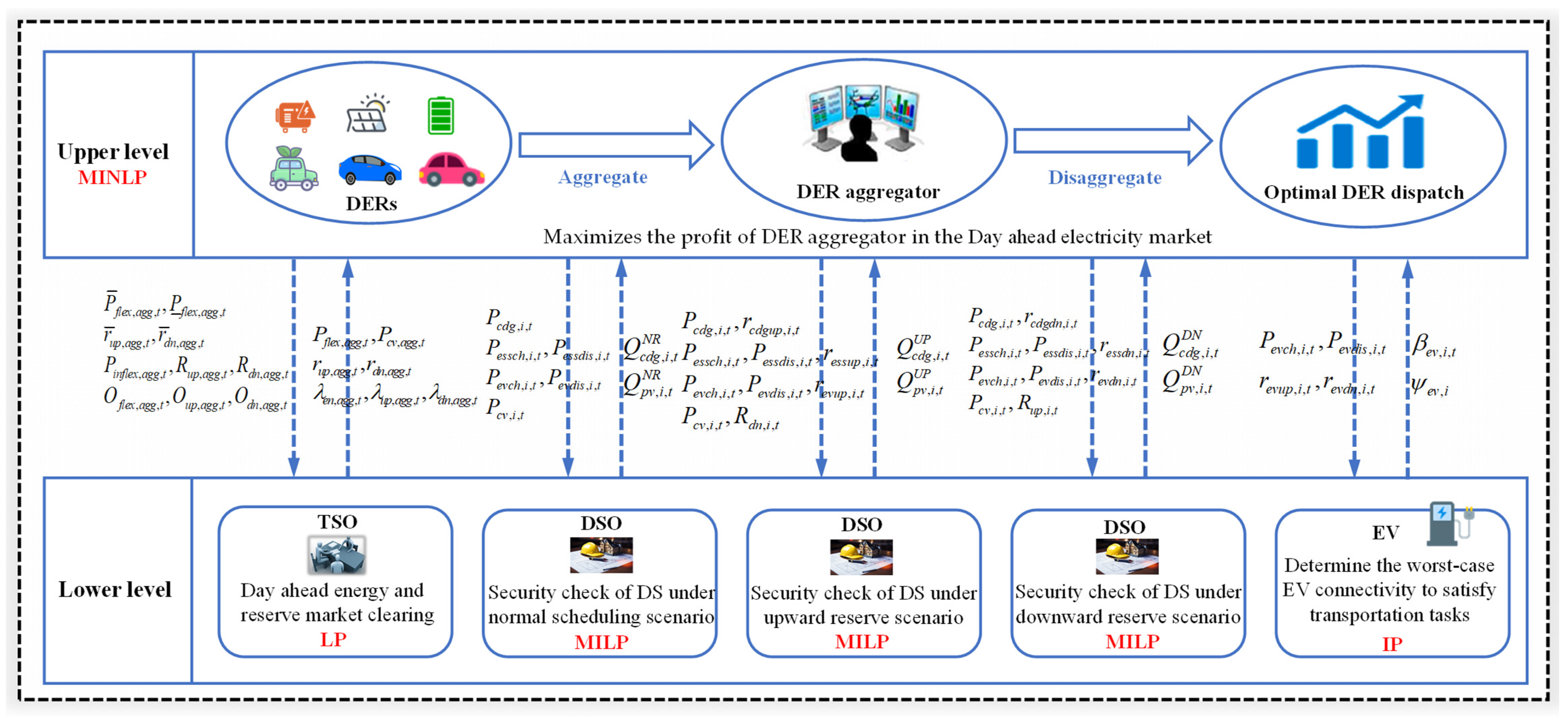
Based on the above definitions, the robust bilevel optimization framework accounting for the uncertain connectivity of EVs for DER aggregator participating in wholesale electricity markets is illustrated in Figure 2. At the upper level, the DER aggregator maximizes its profit in the wholesale energy-reserve market. At the lower level, TSO conducts energy and reserve clearing in wholesale electricity market, DSO performs security check and reactive power optimization for distribution network, and the robust connectivity problem ensures that the daily transportation demands of EVs can be met and determines their availability to the power grid. Mathematically, the upper-level aggregator optimization problem is a mixed integer nonlinear programming (MINLP) problem, the TSO optimization problem is a linear programming (LP) problem, the DSO optimization problem is a mixed integer linear programming (MILP) problem, and the robust connectivity problem is an integer programming (IP) problem. Solving the above bilevel mixed integer nonlinear programming (BMINLP) problem is challenging due to the presence of discrete variables in the lower level. Furthermore, the growing penetration of EVs exacerbates the computational complexity of the solution, making efficient algorithm design imperative.

3. Methods

The above lower-level TSO optimization problem is an LP problem, which can be equivalently replaced with the KKT conditions. For the dual complementary slackness constraints in the KKT conditions, as well as the nonlinear constraints within the upper-level model, we utilize the Big-M technique for linearization (regarding the choice of the constant M in the linearization of the KKT conditions, we followed the approach proposed by Reference [47]). Additionally, the nonlinear objective function of the upper-level aggregator can be linearized based on the strong duality theorem (detailed derivations are omitted herein due to space limitations and the core focus of this study). Through these transformations, the original BMINLP model is converted into an equivalent BMILP model: the upper level is a MILP problem, while the lower level consists of MILP problems (i.e., the DSO optimization) and an IP problem (i.e., the EV robust connectivity problem). Notably, due to the presence of integer variables in the lower-level MILP and IP sub-problems, the traditional strong duality theorem cannot be applied to derive their equivalent single-level reformulations. This constitutes a critical bottleneck in solving the proposed bilevel model, which is also the core challenge addressed in this study.

3.1. Transforming the Lower-Level IP Problem into an LP Problem and Substituting It with Optimality Conditions

To address the computational challenge posed by the lower-level IP problem (i.e., the EV robust connectivity problem), this subsection proposes a reformulation strategy: we convert the lower-level IP problem into an equivalent LP problem, which can then be replaced by its optimality conditions. A key theoretical foundation of this transformation is the total unimodularity property: leveraging this property, the lower-level IP problem can be rigorously proven to be equivalent to an LP problem. Before the proof, we first introduce the definition of total unimodularity and the Lemmas that will be utilized in the subsequent discussion.
Definition 1 (Total Unimodularity).
A matrix A is defined as totally unimodular if the determinant of every square submatrix of A equals 0, 1, or −1.
Lemma 1.
If matrix A and B are totally unimodular matrices with the same number of columns, then the block matrix formed by vertically concatenating A and B is also totally unimodular.
Lemma 2.
If A is totally unimodular and b has integer entries, the LP problem (11) will have integer optimal solutions for any c.
min x   c x s . t .   A x b ,   x 0
Based on Lemma 2, the lower-level IP problem (10) can be relaxed into an equivalent LP problem as shown below:
ψ e v , i = min β e v , i , t t T β e v , i , t ( η e v c , i P e v c h , i , t 1 η e v d , i P e v d i s , i , t )
s . t .   t T β e v , i , t K e v , i : e v , i
β _ e v , i , t β e v , i , t β ¯ e v , i , t : γ _ e v , i , t , γ ¯ e v , i , t
β e v , i , t R ,   i N E V ,   t T ,
where e v , i , γ _ e v , i , t and γ ¯ e v , i , t are the dual variables corresponding to the constraints on (12b) and (12c), respectively, and R denotes the set of real number. These dual variables will be used in the subsequent formulation of the dual problem.
Proof of above transformation.
First, we rewrite constraints (12b) and (12c) in the following form:
t T β e v , i , t K e v , i
β e v , i , t β _ e v , i , t
β e v , i , t β ¯ e v , i , t
Subsequently, constraints (12b) and (12c) can be compactly expressed in the following matrix form:
1 1 1 1 0 0 0 1 0 0 0 1 1 0 0 0 1 0 0 0 1 49 × 24 β e v , i , 1 β e v , i , 2 β e v , i , 3 β e v , i , 22 β e v , i , 23 β e v , i , 24 24 × 1 K e v , i β _ e v , i , 1 β _ e v , i , 24 β ¯ e v , i , 1 β ¯ e v , i , 24 49 × 1
Finally, for ease of analysis and discussion, we express it in the following compact form:
A e v , i β e v , i , 1     β e v , i , 24 B e v , i ,
A e v , i = [ A e v , 1 i ; I ; I ] ,   A e v , 1 i = [ 1 1 ] ,
B e v , i = [ K e v , i ; β _ e v , i , 1 ; ; β _ e v , i , 24 ; β ¯ e v , i , 1 ; ; β ¯ e v , i , 24 ] ,
A e v , i is the constraint matrix of the EV robust connectivity problem, and it is clear that it is independent of arbitrary historical EV data. Here, A e v , 1 i is a 1 × 24 column vector with all elements equal to 1, and I is an 24 × 24 identity matrix. It can be derived from Definition 1 that A e v , 1 i , I and I are totally unimodular matrix. Furthermore, by Lemma 1, we can conclude that A e v , i is also a totally unimodular matrix. Therefore, the constraint matrix A e v , i is totally unimodular for arbitrary historical EV data. Moreover, all elements of B e v , i are integers. Based on the above analysis and Lemma 2, the LP problem (12) has only integer optimal solutions. In addition, constraint (12c) restricts the integer optimal solutions of Problem (10) to the range [0, 1]. Therefore, the IP optimization problem (10) and the LP optimization problem (12) have the same integer optimal solutions and are proven to be equivalent. □
Once the lower-level IP problem (10) is converted into an equivalent LP problem (12), it can be equivalently replaced by optimality conditions. Thus, subsequently, we infer the optimality conditions for Problem (12) based on the primal-dual method, where the optimality conditions consist of the primal constraints, dual constraints, and the equality constraint that makes the primal objective function equal to the dual objective function.
After derivation, the dual problem of Problem (12) is expressed as follows:
max e v , i , γ _ e v , i , t , γ ¯ e v , i , t K e v , i e v , i + t T ( γ _ e v , i , t β _ e v , i , t γ ¯ e v , i , t β ¯ e v , i , t )
s . t . η e v c , i P e v c h , i , t 1 η e v d , i P e v d i s , i , t = e v , i + γ _ i , t γ ¯ i , t
e v , i 0       γ _ e v , i , t 0       γ ¯ e v , i , t 0
Thus, based on the above analysis, the optimality conditions for Problem (12) include
K e v , i e v , i + t T ( γ _ e v , i , t β _ e v , i , t γ ¯ e v , i , t β ¯ e v , i , t ) = t T β e v , i , t ( η e v c , i P e v c h , i , t 1 η e v d , i P e v d i s , i , t ) ; Primal   constraints   12 b 12 c 12 d ; Dual   constraints   13 b 13 c .
Furthermore, the undetermined constraint (4) of the upper-level model can be transformed into the following form:
K e v , i e v , i + t T ( γ _ e v , i , t β _ e v , i , t γ ¯ e v , i , t β ¯ e v , i , t ) ξ e v t r a , i .
By equivalently substituting the lower-level IP problem with the optimality conditions (14), the original bilevel problem can be transformed into a bilevel problem with only MILP problems in its lower level. However, the MILP problems involving integer variables in the lower level also pose difficulty for solving the bilevel model.
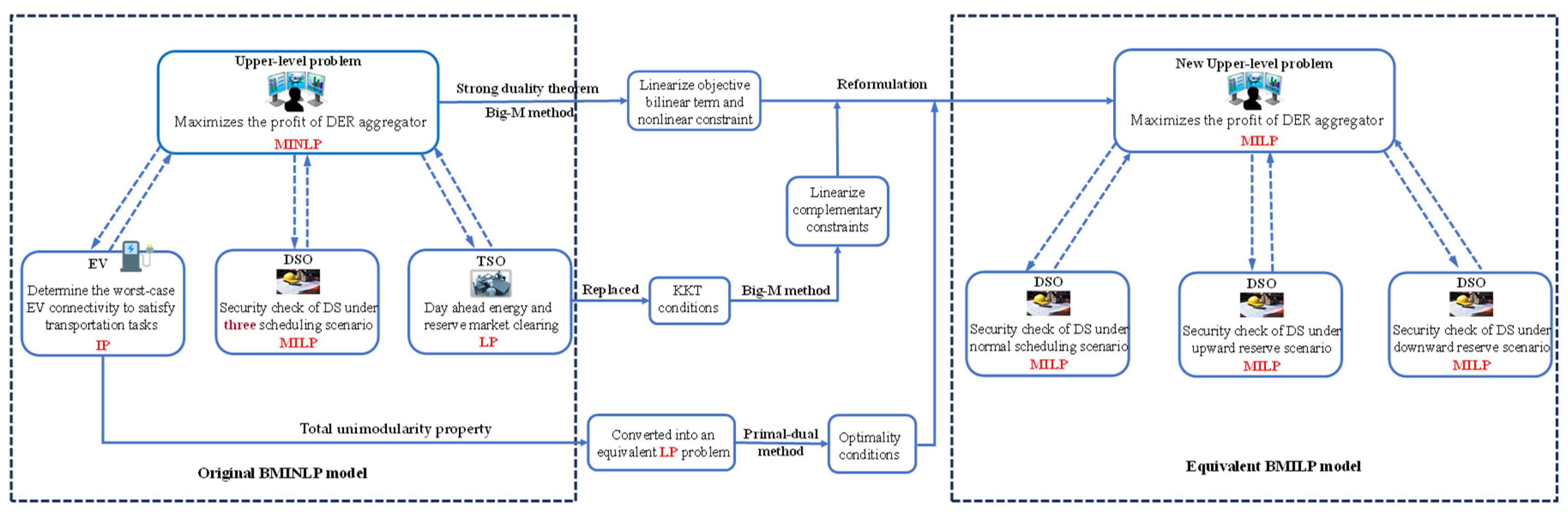
The transformation process of the original bilevel model mentioned above is illustrated in Figure 3. To facilitate the handling of the lower-level MILP problems, the bilevel problem after the above transformation can be written in the following compact form:
max x   Φ l ( x , y s , s Ω ) s . t .   A l ( x ) + B l ( y s , s Ω ) c l , y s arg min y s f { Φ s f ( x , y s f ) | A s f ( x ) + B s f ( y s f ) c s f } , s Ω
The leader is a MILP problem, while the followers are three non-convex MILP problems. x and y s f represent the decision variables of the leader and the followers under scenario s, respectively. y s are the optimal decision variables of the followers. A l , B l , Φ l , A s f , B s f and Φ s f denote the functions defined over x and y s .

3.2. Transforming the Bilevel Problem (16) into an Equivalent Single-Level Problem

To address the computational challenge of the bilevel model arising from the lower-level mixed-integer linear programming (MILP) problems (i.e., the DSO optimization problem), this section proposes a transformation method based on the multi-value function approach. The goal is to convert the original bilevel optimization problem (16) into an equivalent single-level formulation. Before proceeding with the transformation, we first introduce the definitions and lemmas that will be employed in the discussion.
Define
Θ ( y s , s Ω ) = { x | A l ( x ) c l B l ( y s , s Ω ) }
as the upper-level feasible region given the lower-level decision variable y s , s Ω .
Define
ζ s ( x ) = { y s | B s f ( y s ) c s f A s f ( x ) }
as the lower-level feasible region under scenario s given the upper-level decision variables x.
Define
Π = { ( x , y s , s Ω ) | x Θ ( y s , s Ω ) , y s ζ s ( x ) ) }
as the feasible region of problem (16) after relaxing the lower-level objectives’ optimality requirement.
Define
Π ( Θ ) = { x |   y s , s Ω   such   that   ( x , y s , s Ω ) Π }
as the projection of Π onto the upper-level decision space.
Define
Ψ s ( x ) = arg min y s { Φ s f ( x , y s ) | y s ζ s ( x ) }
as the optimal solution set of the lower-level problem under scenario s given upper-level decision variable x.
Definition 2 (Bilevel Feasibility).
If the solution  ( x , y s , s Ω ) satisfies  x Π ( Θ )  and  y s Ψ s ( x )   s Ω , the solution  ( x , y s , s Ω )  is bilevel feasible.
Based on the definitions provided above, problem (16) can be equivalently rewritten in the following form:
max ( x , y s , s Ω ) { Φ l ( x , y s , s Ω ) | x Π ( Θ ) , y s Ψ s ( x )   s Ω }
Next, we transform the bilevel problem (17) into a single-level problem based on the multi-value function approach. The multi-value function approach is presented as Lemma 3.
Lemma 3.
A solution  ( x , y s , s Ω ) is bilevel feasible if and only if  Φ s f ( x , y s ) Φ s f ( x , y s f )   holds for  y s f Z s , where  Z s  denotes the lower-level decision space.
Based on Lemma 3, the bilevel problem (17) can be transformed into the following equivalent single-level problem:
max x   Φ l ( x , { y s , s Ω } )
s t . ( x , y s , s Ω ) Π
Φ s f ( x , y s ) Φ s f ( x , y s f )   y s f Z s
Proof of above transformation.
We first prove that any feasible solution ( x , y s , s Ω ) of (18) is also feasible for (17). Constraint (18b) makes x Π ( Θ ) hold. It can be deduced from (18c) and Lemma 3 that ( x , y s , s Ω ) is bilevel feasible. Furthermore, based on Definition 2, we can deduce y s Ψ s ( x )   s Ω . . Thus, both x Π ( Θ ) and y s Ψ s ( x )   s Ω hold, so the solution ( x , y s , s Ω ) is feasible to problem (17).
Next, we prove that any feasible solution ( x , y s , s Ω ) of (17) is also feasible for (18). It is obvious that ( x , y s , s Ω ) satisfies constraint (18b), since the feasible region of (17) is a subset of Π . Finally, we employ proof by contradiction to demonstrate that ( x , y s , s Ω ) satisfies constraint (18c). Assume ( x , y s , s Ω ) violates constraint (18c), and there will then exist a y s f Z s such that Φ s f ( x , y s ) > Φ s f ( x , y s f ) holds. Φ s f ( x , y s ) > Φ s f ( x , y s f ) is inconsistent the premise that ( x , y s , s Ω ) is feasible for (17). Thus, ( x , y s , s Ω ) satisfies (18c). Hence, the solution ( x , y s , s Ω ) of (17) is feasible for problem (18). □
Based on the above proof, problem (18) is equivalent to problem (17). In the equivalent single-level problem (18), constraints (18b) ensure that the upper-level and lower-level constraints are satisfied, while (18c) guarantees that the solution y s is the optimal solution to the lower-level problems. To obtain the optimal solution of problem (18), it is necessary to know all the decision space Z s of lower-level problems. However, enumerating all decision space Z s is computationally intensive. To tackle this challenge, we propose a sample-based acceleration algorithm to exactly solve the optimization problem (18).

3.3. Sampling-Based Acceleration Algorithm

In this section, we detail how to efficiently solve problem (18) using a sample-based acceleration algorithm. The sample-based acceleration algorithm leverages a BMILP relaxation incorporating disjunctive constraints, which are derived from a sample of feasible follower responses. Based on the sample-based acceleration algorithm, the optimization problem (18) can be decomposed into the following subproblems:
max x   Φ l ( x , { y s , s Ω } )
s t . ( x , y s , s Ω ) Π
Φ s f ( x , y s ) Φ s f ( x , y s f )   y s f Z s k
where k denotes the iteration index. The sample Z s k is the subset of follower’s decision space Z s , with one element of Z s added to the sample at each iteration. The algorithm iteratively solves the subproblems to obtain an upper bound for the BMILP, derives lower bounds from uncovered bilevel feasible solutions, and expands the sample in each iteration to potentially achieve tighter upper bounds in subsequent steps.
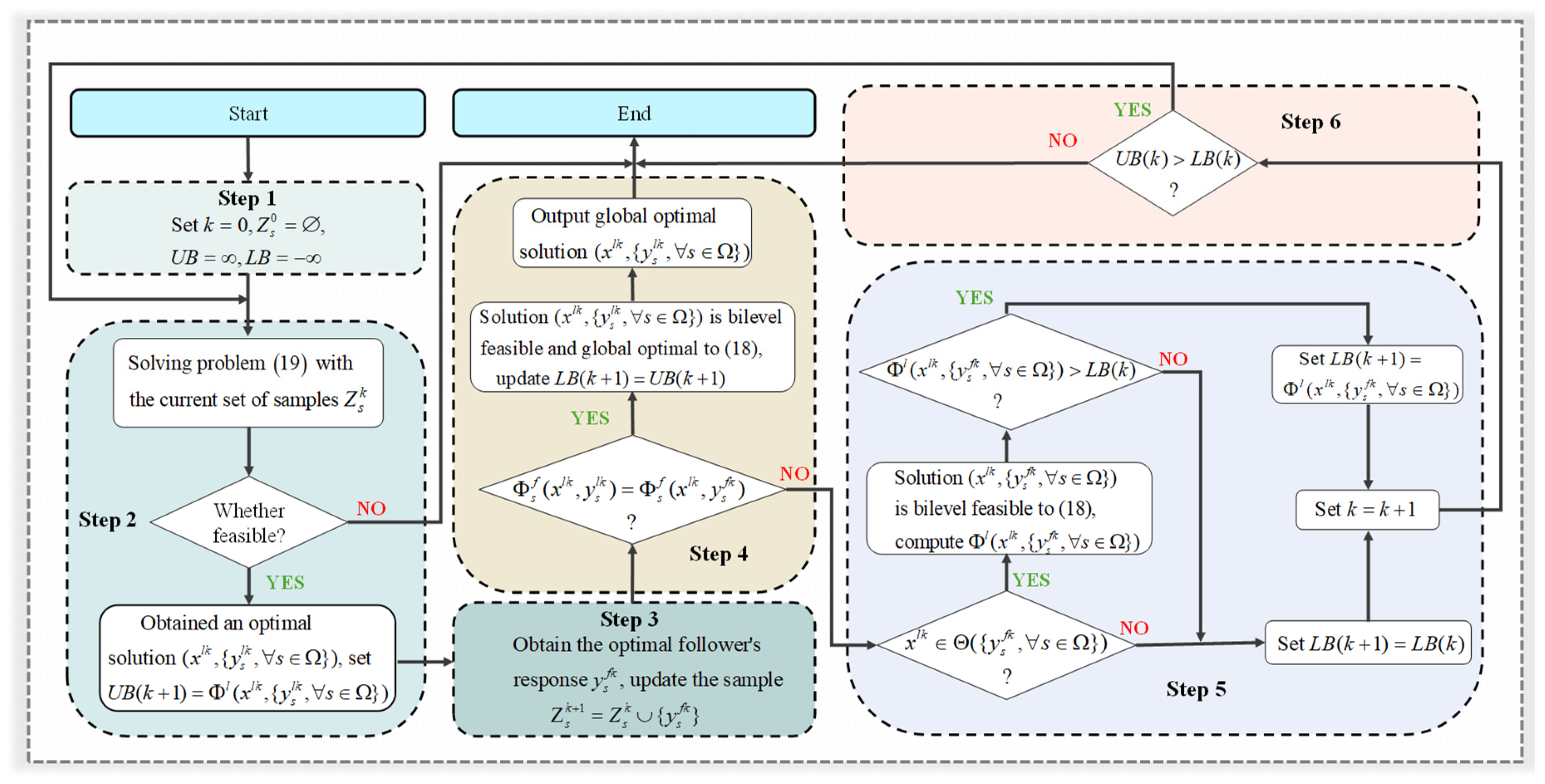
The iterative process of the proposed algorithm is detailed as follows:
Step 1: Initializing parameters
Set k = 0 , U B 0 = , L B 0 = and Z s 0 = .
Step 2: Solving subproblem (19) with  Z s k
If the optimization subproblem (19) is infeasible on the sample set Z s k at the k-th iteration, the original optimization problem (18) is also infeasible, and the algorithm terminates. Otherwise, an optimal solution ( x l k , y s l k , s Ω ) to the subproblem (18) can be obtained, and the new upper bound U B ( k + 1 ) is updated to Φ l ( x l k , y s l k , s Ω ) .
Step 3: Updating the sample set
For given leader’s decision variables x l k , the follower’s optimal response y s f k can be obtained by solving the follower’s optimization problem min y s { Φ s f ( x l k , y s ) | y s Z s } . Then, the follower’s optimal response y s f k is added to the sample, and the sample set can be updated to Z s k + 1 = Z s k { y s f k } .
Step 4: Checking if the solution  ( x l k , y s l k , s Ω )  to subproblem (19) is bilevel feasible for (18)
Bilevel feasibility can be determined by checking whether Φ s f ( x l k , y s l k ) = Φ s f ( x l k , y s f k ) holds. If this holds, the solution ( x l k , y s l k , s Ω ) is bilevel feasible and global optimal for (18). In this case, we set L B k + 1 = U B k + 1 , and the algorithm terminates with a globally optimal solution ( x l k , y s l k , s Ω ) .
Step 5: If the check in Step 4 fails, checking whether  ( x l k , y s f k , s Ω )  is bilevel feasible for (18)
Bilevel feasibility of ( x l k , y s f k , s Ω ) can be determined by checking whether x l k Θ ( y s f k , s Ω ) holds. If it holds, ( x l k , y s f k , s Ω ) is bilevel feasible. In this case, we compute Φ l ( x l k , y s f k , s Ω ) and check whether Φ l ( x l k , y s f k , s Ω ) > L B ( k ) holds. If it holds, the new lower bound is updated to L B ( k + 1 ) = Φ l ( x l k , y s f k , s Ω ) ; otherwise, L B k + 1 = L B k .
Step 6: Convergence criterion
At each iteration, U B k and L B k are compared. If U B k L B k , the algorithm terminates with the global optimal solution. Otherwise, the algorithm reverts to step 2 and continues iterating.
The iterative process and calculation flowchart of the proposed algorithm are summarized in Table 2 and Figure 4, respectively.
Remark: The detailed convergence and optimality proofs of the proposed algorithm can be found in Reference [46], while a concise proof is presented in Appendix D.

4. Results

In this section, we validate the effectiveness of the proposed model and method based on China’s actual 431-bus transmission and 42-bus distribution system. The model and algorithm were implemented in the MATLAB R2023a/YALMIP environment, utilizing GUROBI 11.0 as the solver, and executed on a computer equipped with an Intel Core i5-9300H CPU and 16 GB of RAM.

4.1. Simulation System and Parameter Settings

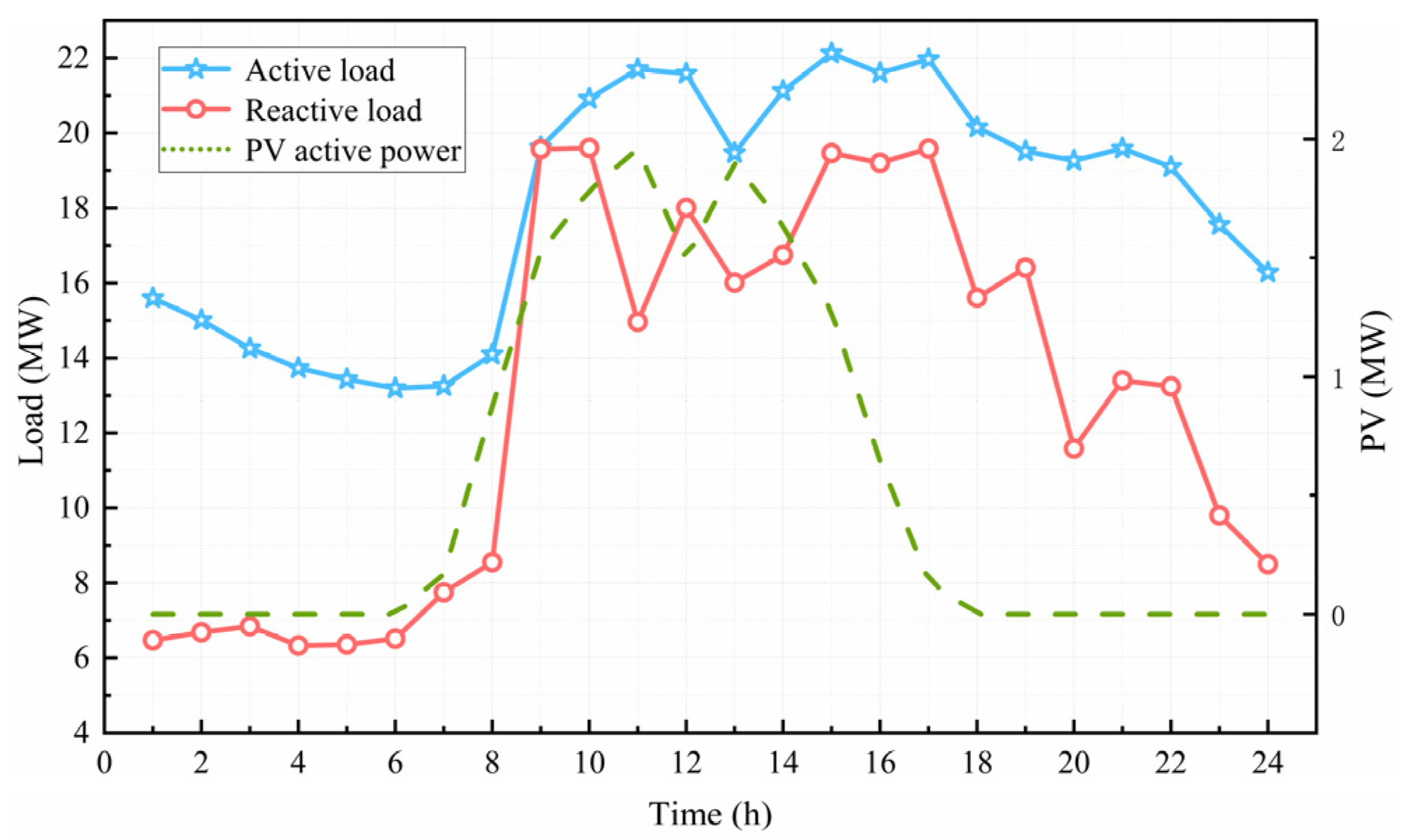
The operational data utilized in the simulation system were obtained from the Shenzhen Power Grid of China. There are 45 conventional generators in the transmission system (TS). The distribution system (DS) incorporates 4 CDGs, 4 PVs, 3 ESSs, 2 CBs, 1 OLTC transformer, and 1 EV charging station. The TS and DS are interconnected via an OLTC transformer, which is equipped with 17 adjustable taps and features a ratio adjustment range of 1 ± 8 × 1.25%. The base capacity of the transmission and distribution system is set to 100 MVA. Each CDG is rated at a maximum active power of 3 MW with a power factor of 0.9. Each CB is composed of 5 capacitor units, providing a total reactive power compensation capacity of 0.5 Mvar. Each ESS is characterized by a maximum charge/discharge power of 500 kW, a maximum capacity of 1500 kWh, and a charge/discharge efficiency of 0.95. Each PV is equipped with an installed capacity of 2 MVA, a prediction error ratio of 0.2, and a power factor of 0.85. For the safe operation of the distribution network, under three security check scenarios, the bus voltage magnitude shall be confined to the range of 0.96–1.04 p.u., while the current in line 2–28 must not exceed the maximum permissible limit of 6.0 p.u. The cost coefficients of DERs are as follows: b c d g p , i = 150 ¥/MWh, b c d g q , i N R = 15 ¥/Mvarh, b c d g q , i U P = b c d g q , i D N = 1.875 ¥/Mvarh, b c v , i N R = 100 ¥/MWh, b c v , i U P = b c v , i D N = 12.5 ¥/MWh, b p v q , i N R = 10 ¥/MWh, b p v q , i U P = b p v q , i D N = 1.25 ¥/MWh, b e s s c h , i = b e s s d i s , i = 3 ¥/MWh, b e v , i = 20,000 ¥, N e f c = 2000. The daily loads of the DS and the active power output of the PV are illustrated in Figure 5. The EVs considered in this study are the Tesla Model 3, with their specific parameters presented in Table 3. The energy consumption of an EV is 0.14 kWh per kilometer. The historical data of EV grid connections and energy demands for transportation are derived from the National Household Travel Survey website.

4.2. Analysis of Simulation Results Under the Proposed Robust DER Aggregator Bidding Model Accounting for EV Uncertain Connectivity

In this subsection, we analyze the impact of the proposed robust method accounting for EV uncertain connectivity on the DER aggregator’s bidding in the electricity market. The analysis specifically covers three aspects: the proposed model’s effectiveness, market impacts, and implications for the network security of the distribution system.
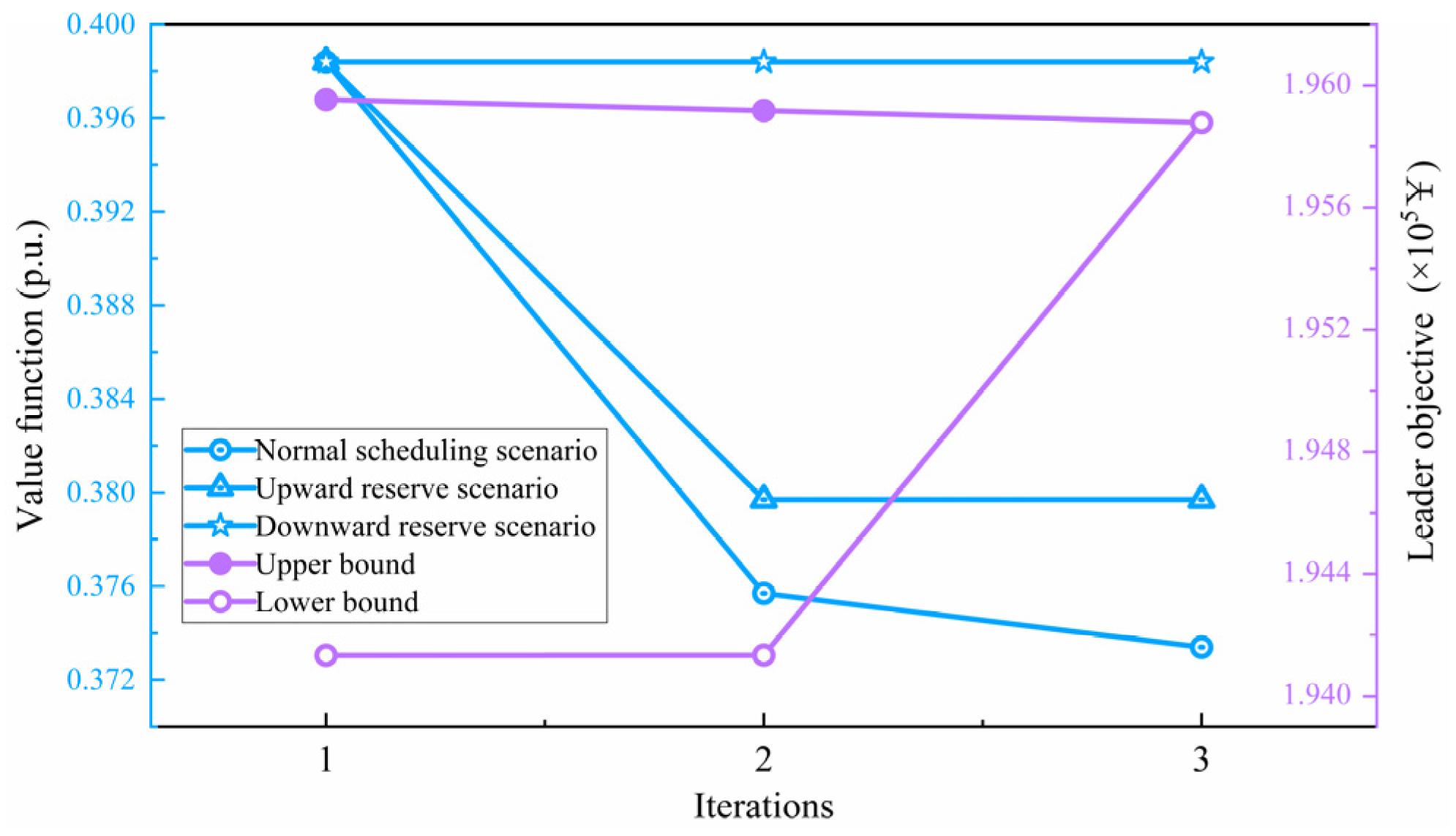
With the number of EVs configured as 100, we develop a non-convex bilevel mixed-integer model for DER aggregator bidding in the wholesale energy and reserve markets by adopting the proposed method—one that explicitly accounts for the uncertainty of EV grid connectivity. The complexity characteristics of the model for this case are presented in Table 4. Specifically, scheduling a large number of EVs introduces numerous variables into the upper problem, while the discrete security check of the distribution network renders the lower problem non-convex, jointly increasing the model’s computational complexity. The proposed algorithm successfully converges to the optimal solution of the bilevel model after only 3 iterations, with a total computation time of 6,158 s. Figure 6 demonstrates the evolution of the follower DSO’s value functions under three predefined operational scenarios, as well as the upper/lower bounds of the leader DER aggregator’s objective over the iterative process of the algorithm. As shown in Figure 6, the follower DSO’s value functions decrease continuously with the iteration. Simultaneously, the smaller value functions are incorporated as a tighter optimization cut into the relaxed single-level problem. As a result, the upper and lower bounds of the leader DER aggregator’s objective gradually approach each other and eventually converge. These results collectively validate the effectiveness and feasibility of the proposed model and algorithm.
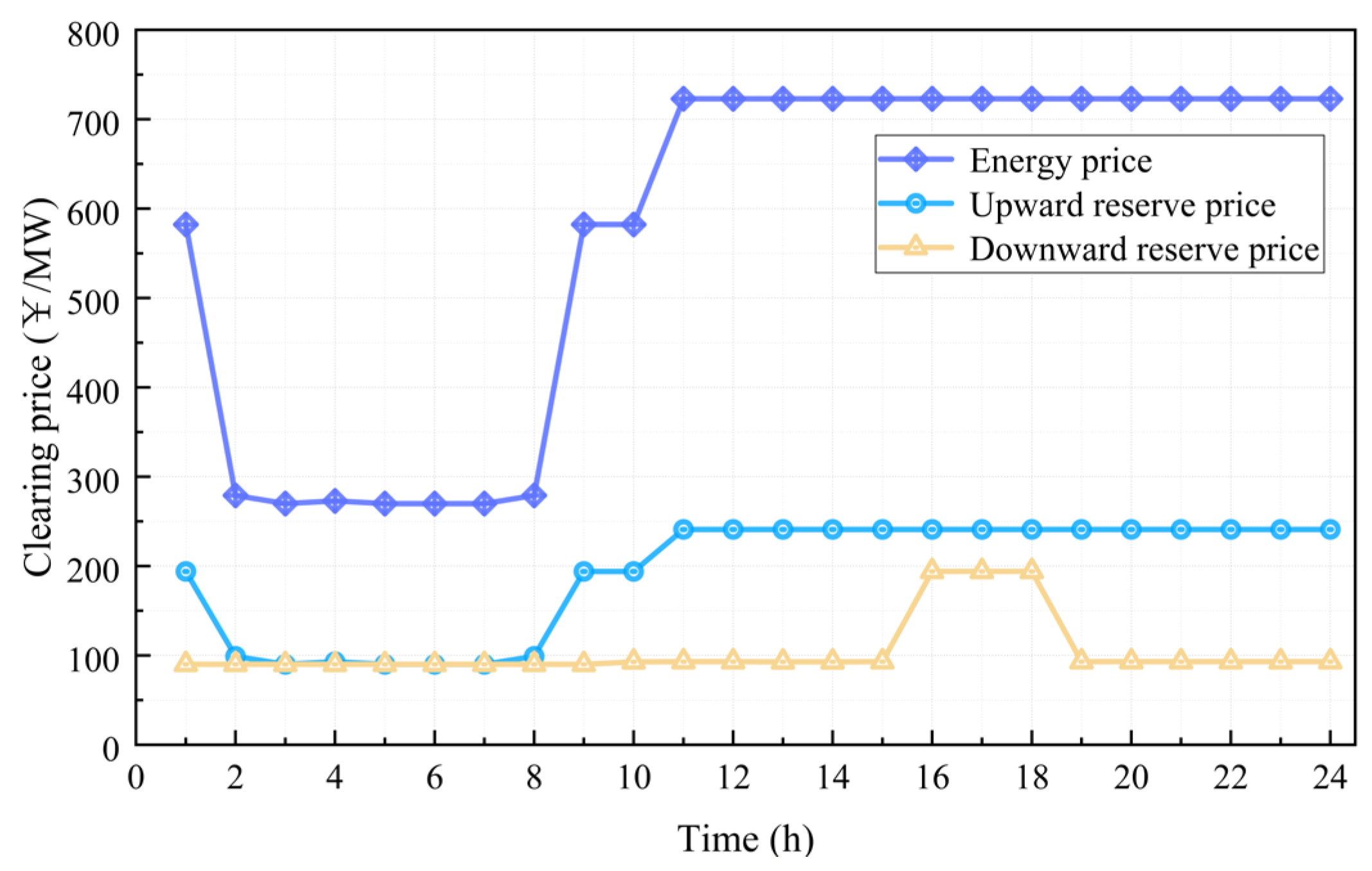
The day-ahead optimal clearing prices of energy, upward reserve, and downward reserve for the DER aggregator in the wholesale electricity market are presented in Figure 7. As observed in both Figure 5 and Figure 7, the clearing price exhibits a positive correlation with load levels, with the price trajectory exhibiting a consistent alignment with that of the load. These results indicate that the optimal clearing price design for the DER aggregator is consistent with the fundamental operating principles of the electricity market.
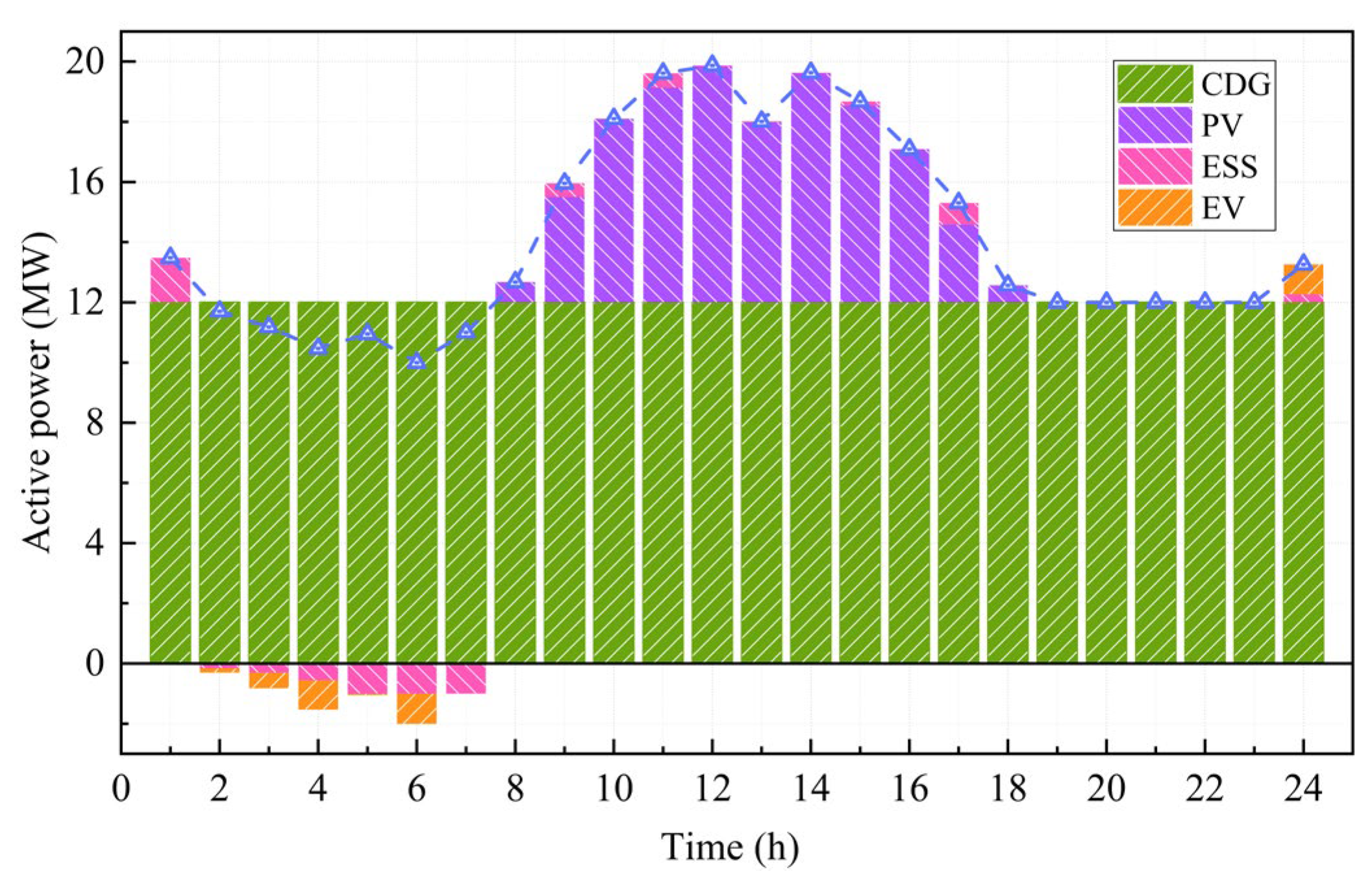
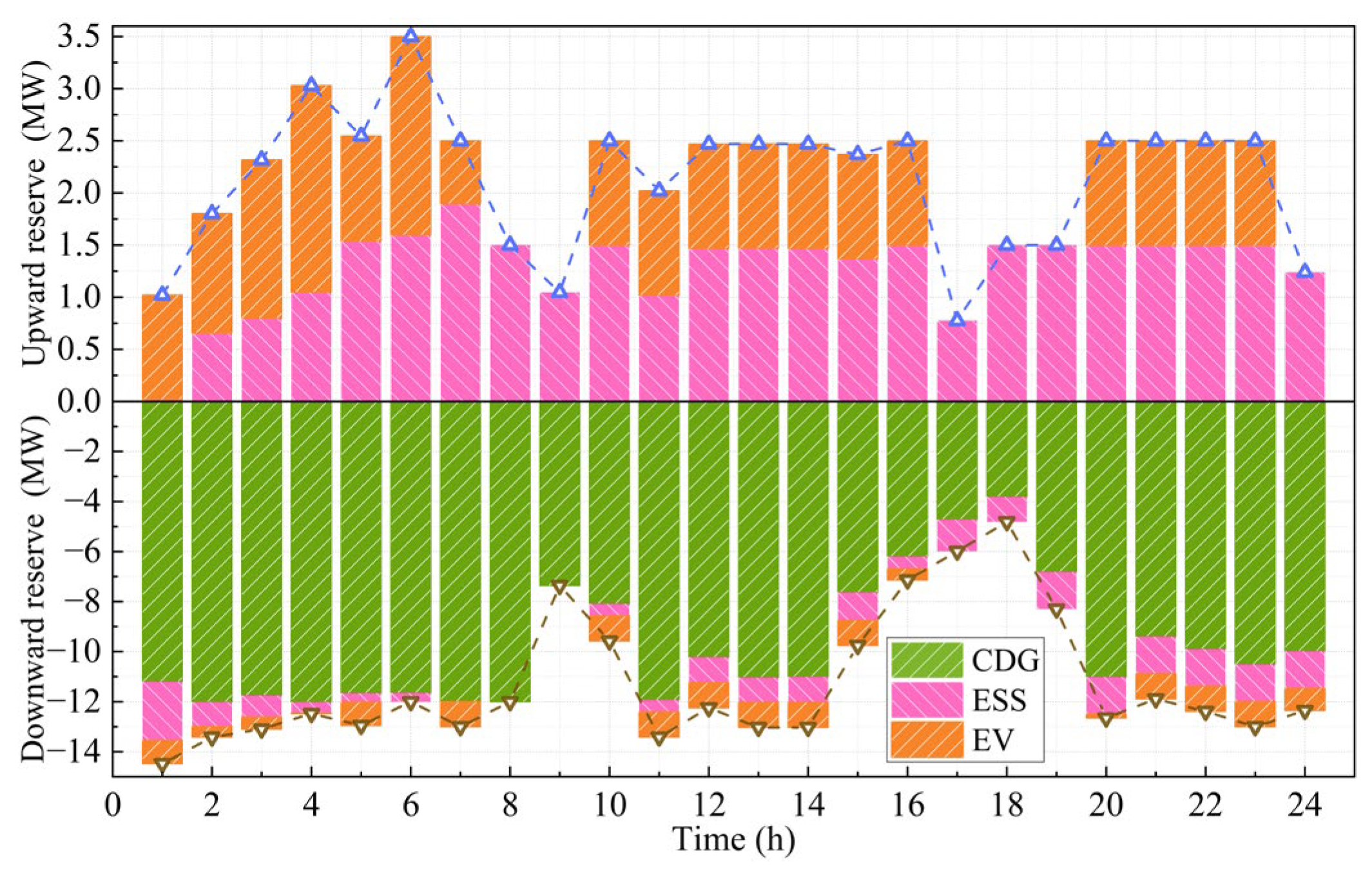
The DER aggregator’s day-ahead optimal scheduling scheme for integrated DERs (supporting wholesale market clearing) is illustrated in Figure 8 and Figure 9, with distinct roles for each resource across energy and reserve markets:
Figure 8 (energy scheduling): CDGs (green area) and PV (purple area) dominate energy supply—serving to address high load volatility and peak demands. In contrast, ESSs (pink area) and EVs (orange area) contribute minimally to energy supply (only small bidirectional flows in off-peak periods).
Figure 9 (reserve scheduling): ESSs (pink area) and EVs (orange area) become the core participants—they account for most of the upward reserve capacity across all time periods. CDGs (green area) primarily participate in downward reserve markets, and PV does not participate in the reserve market.
Furthermore, during the peak travel periods of 8:00–9:00 and 17:00–19:00, EVs neither participate in the energy market nor in the reserve market, which aligns with their regular transportation demand.
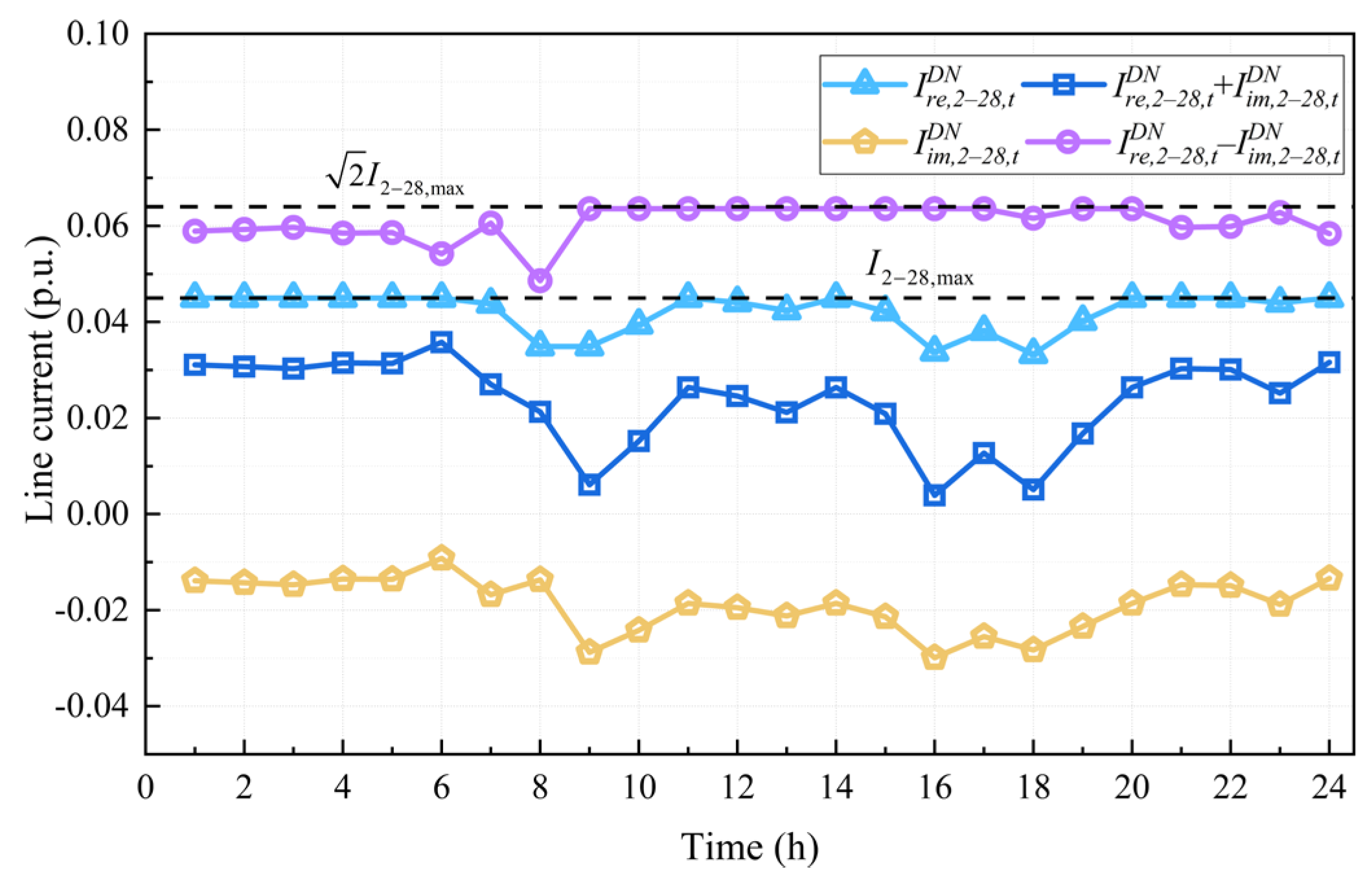
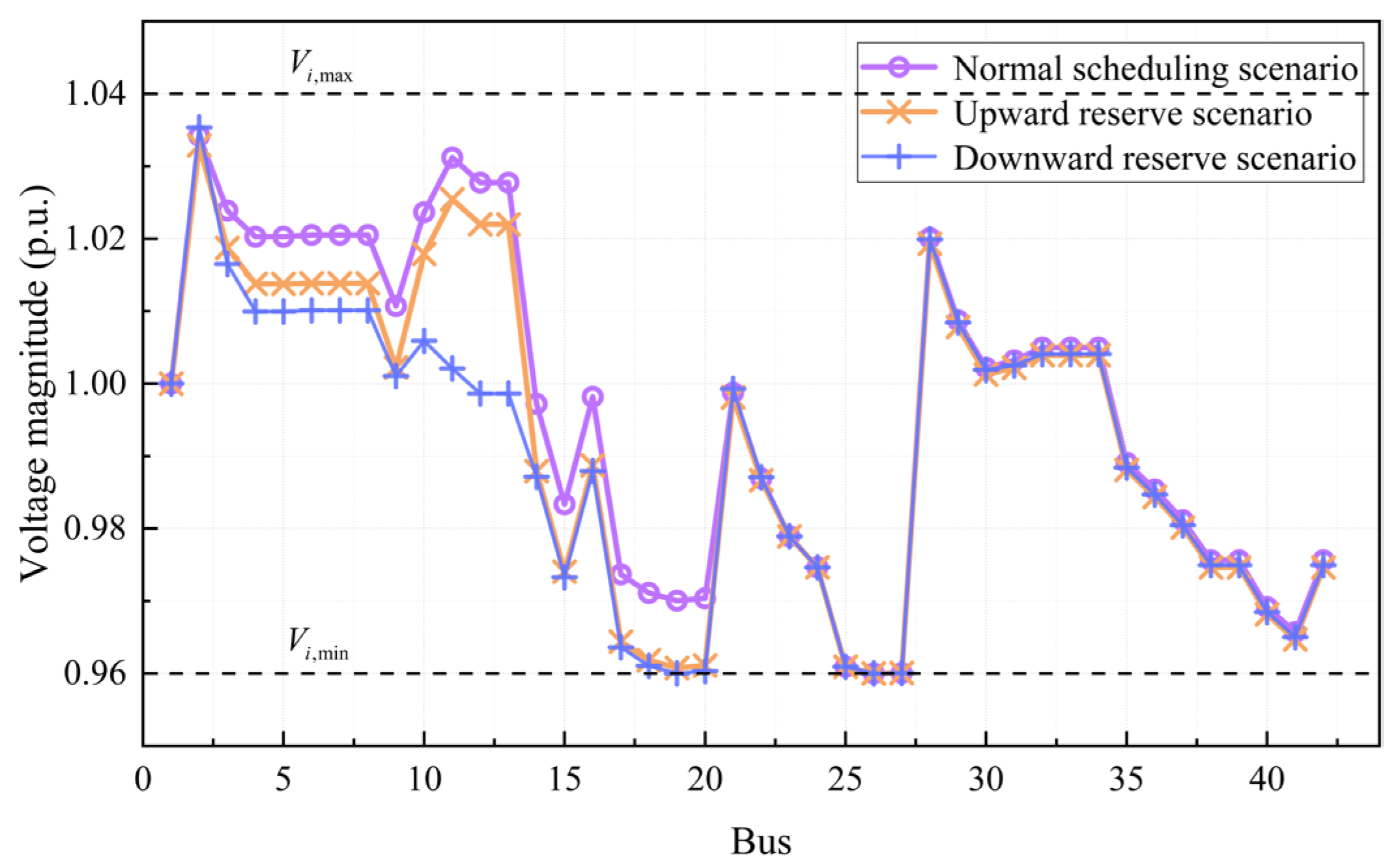
To verify whether the aggregator’s scheduling scheme for DERs complies with the network security constraints of the DS, we check the node voltage magnitudes under three scenarios during peak load periods (t = 17), as well as the current magnitude of line 2–28 under the downward reserve scenario, which are shown in Figure 10 and Figure 11, respectively. It can be seen from Figure 10 that all node voltage magnitudes remain within the allowable range of 0.96–1.04 p.u. Similarly, Figure 11 shows that the current magnitude of line 2–28 also remains within the allowable operational range. These results confirm that the aggregator’s DER scheduling scheme (designed for market clearing) fully complies with the network security constraints of the DS.

4.3. Comparison with Simplified Deterministic DER Aggregator Bidding Model

In this section, we consider a simplified deterministic DER aggregator bidding model in the wholesale energy and reserve markets, where the transportation behavior of EVs and their grid-connection status are treated as deterministic parameters rather than optimization variables. The transportation behavior of EVs and their grid-connection status are derived from historical data. For period t in historical data, β e v , i , t takes a value of 0 if an EV is in transit, and 1 if the EV is grid-connected. Notably, in the deterministic DER aggregator bidding model, the worst-case EV connectivity optimization problem for ensuring the transportation requirements of EVs is removed. To verify the advantages of the proposed model that explicitly accounts for EV grid-connectivity uncertainty, we compare the simulation results of DER aggregators’ bidding in the wholesale energy and reserve markets under the proposed model and the deterministic model. Specifically, the comparison focuses on three aspects: computation time, the DER aggregator’s profit, and the profit of EVs.
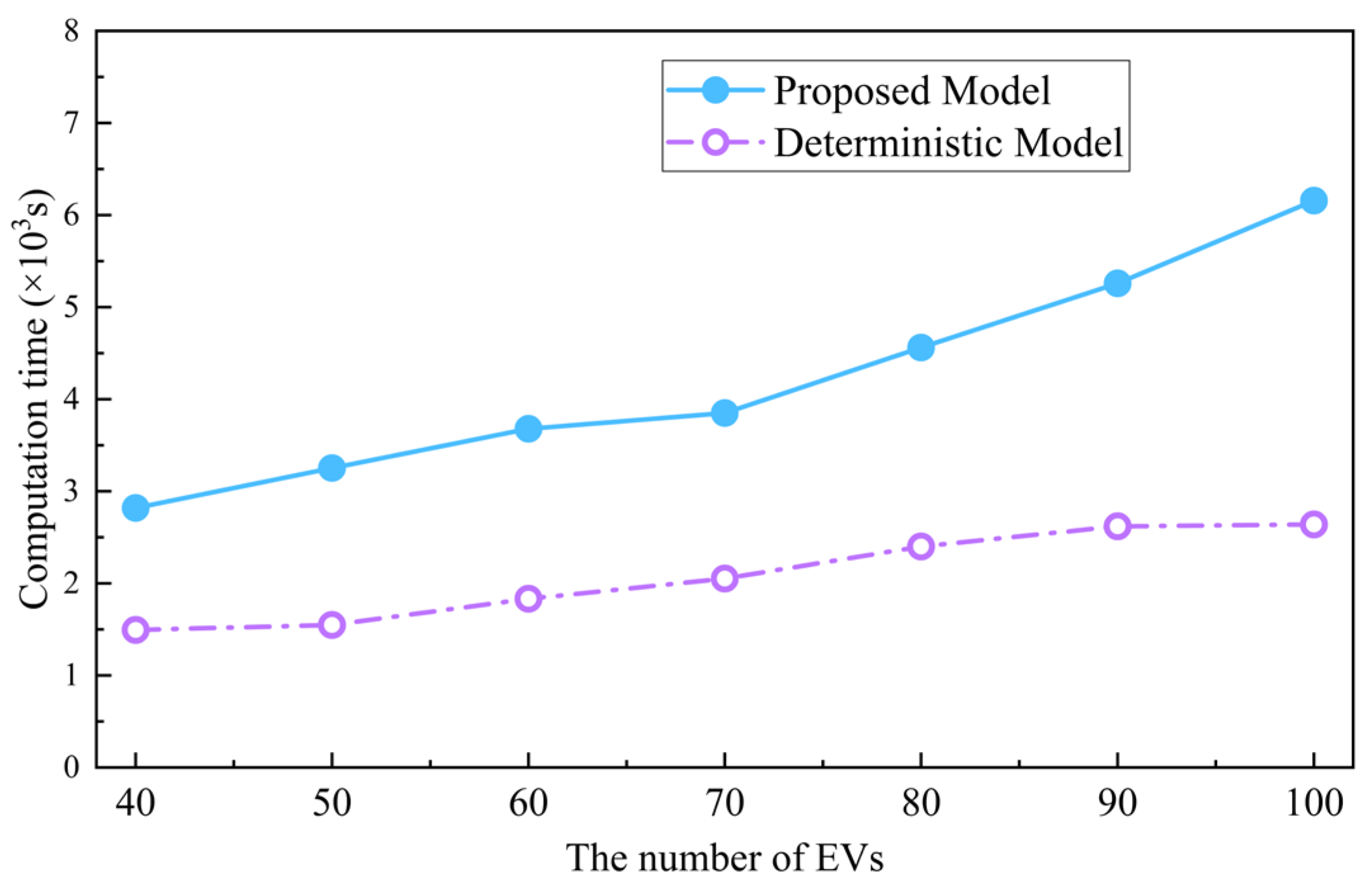
The computational time comparison of the two models is presented in Figure 12. As observed from Figure 12, the proposed model requires slightly longer computational time than the deterministic model. This discrepancy stems from the fact that, unlike the deterministic model, our proposed model incorporates an additional worst-case EV connectivity optimization subproblem to ensure that EVs’ core transportation needs are always satisfied. Furthermore, since DER aggregator bidding in the wholesale energy and reserve markets is a day-ahead optimization task, the computational efficiency of the proposed model is fully aligned with practical engineering requirements.
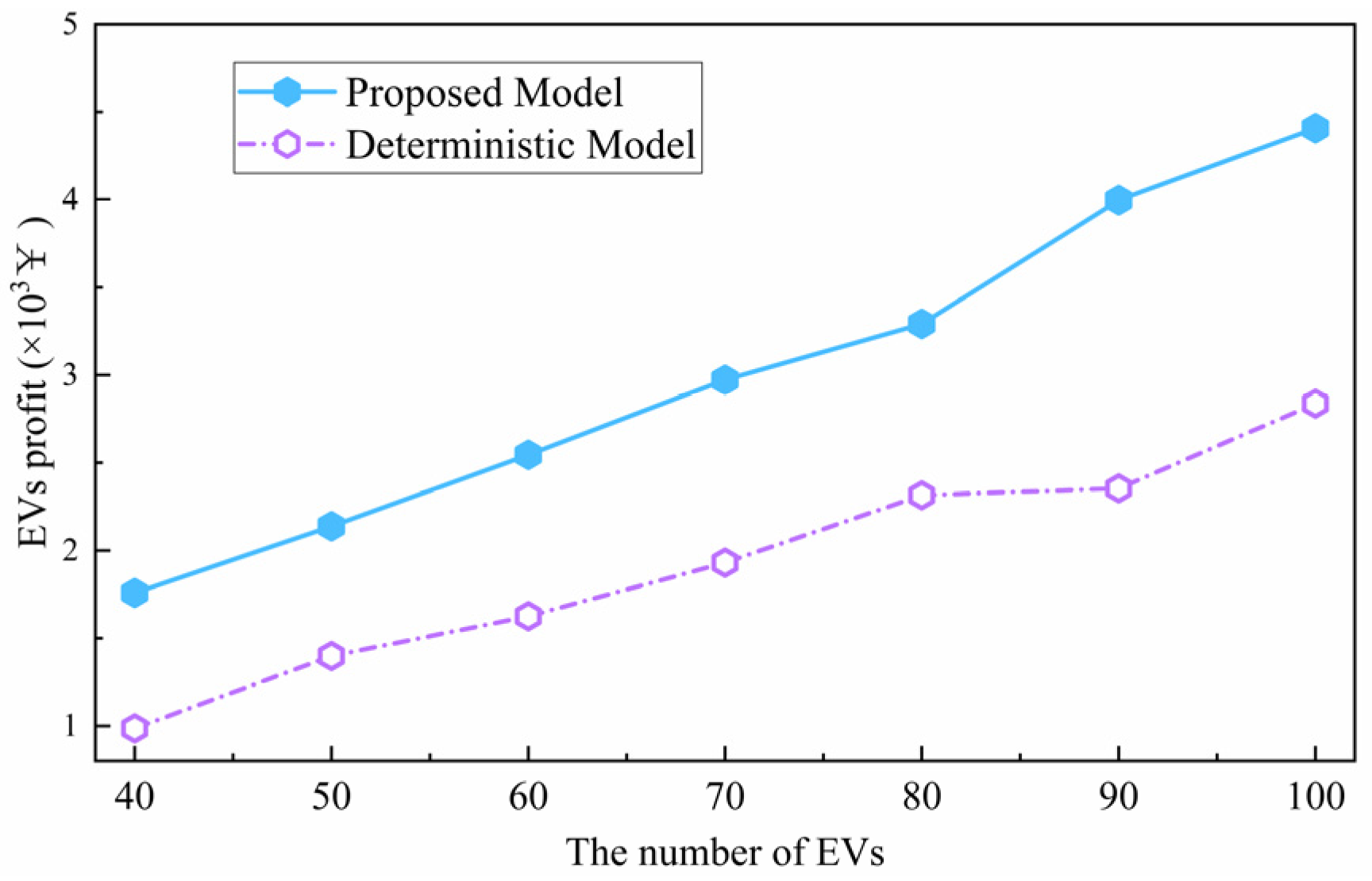
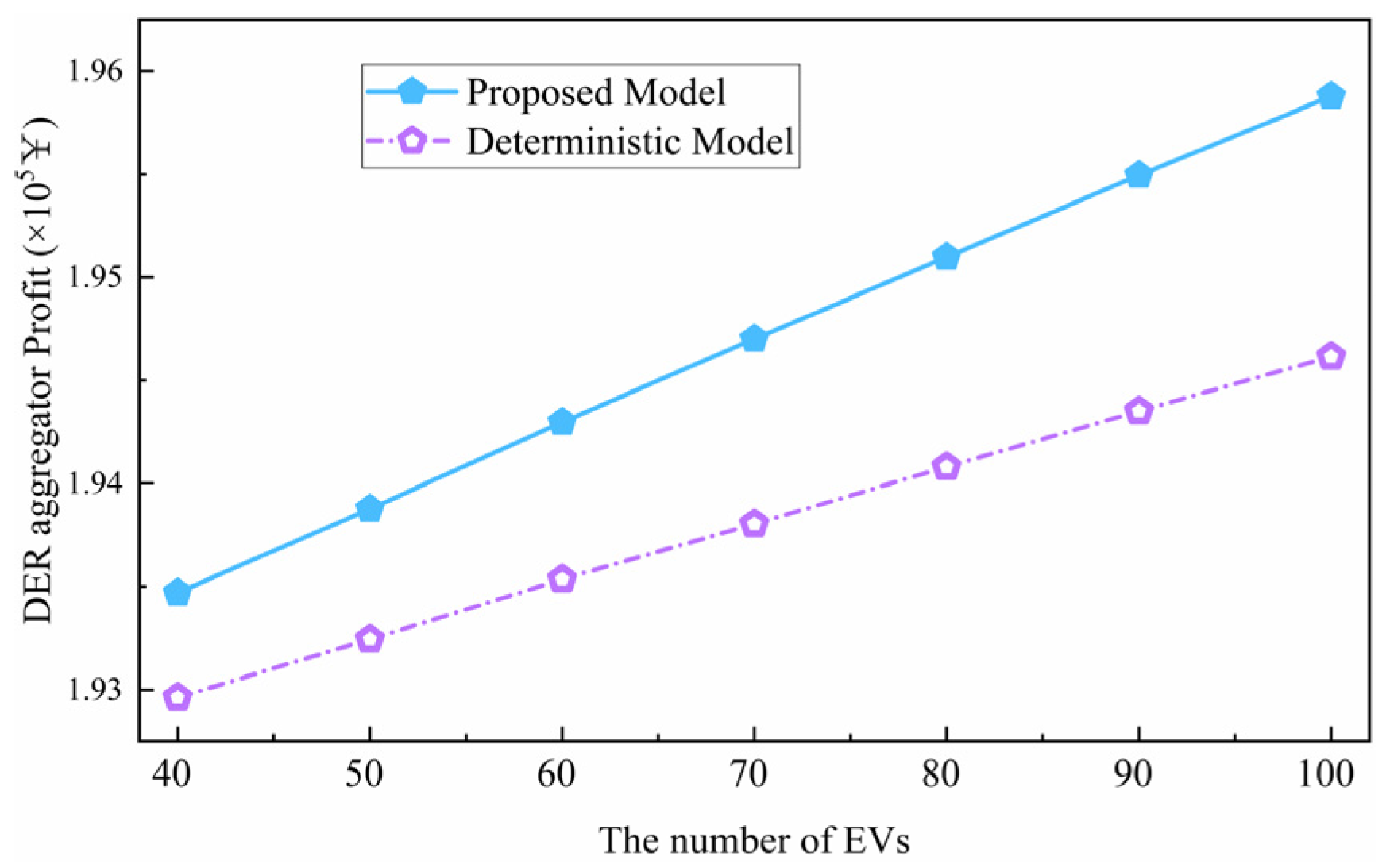
Figure 13 and Figure 14 present the profit comparisons for EVs and DER aggregators, respectively, under the two models. Both EVs and the DER aggregator achieve higher profit levels under the proposed model than under the deterministic model. This can be attributed to the fact that, under the deterministic model, the transportation and grid connectivity status of EVs are fixed on historical data, which restricts their market participation during certain time windows and thus limits profit opportunities. By contrast, our proposed model takes EV grid-connectivity uncertainty into account; it not only guarantees that EVs fulfill their core transportation requirements but also enables flexible market participation. This allows EVs to capitalize on favorable price signals for charging and discharging, thereby boosting the profit of both EVs and the DER aggregator.

4.4. Computational Efficiency Comparison with Scenario-Based Stochastic DER Aggregator Bidding Model

Besides the proposed robust method, the scenario-based stochastic optimization method is also frequently employed to tackle uncertainty problems. To verify the computational advantages of the proposed method and the corresponding model, we develop a scenario-based stochastic DER aggregator bidding model, where EV grid-connectivity uncertainty is characterized by multiple stochastic scenarios.
For the scenario-based stochastic model, we configure 5 stochastic scenarios to characterize EV grid-connectivity uncertainty. Table 5 summarizes the computational time comparison between the proposed model and the stochastic model under different EV fleet sizes (ranging from 40 to 100). As observed in Table 5, the proposed model exhibits substantially shorter computational time than the stochastic model across all test cases. More notably, as the model scale expands (i.e., with an increase in the number of EVs), the computational advantages of the proposed model become more prominent: the time gap between the two models widens from 2146 s (for 40 EVs) to 6274 s (for 100 EVs). This phenomenon arises because stochastic model requires solving multiple stochastic scenarios, which results in a higher computational burden compared to robust model. It is worth noting that only 5 stochastic scenarios were set for the stochastic model for this comparison. In practical applications, a larger number of scenarios is often required in stochastic optimization method to ensure the accuracy of uncertainty characterization. If the number of stochastic scenarios is further increased, the computational burden of the stochastic model will escalate exponentially—this further highlights the superior computational efficiency of the proposed model.

4.5. The Impact of Parameter K e v , i

The parameter, average connectivity duration K e v , i , sets the minimum availability period for the i-th EV. As K e v , i increases, the availability of the EV for charging, discharging, and reserve services improves. To evaluate the impact of K e v , i , we conducted two additional cases by adjusting the average connectivity duration, with K e v , i being decreased and increased by 3 time periods. Under the configuration of 50 EVs, we set them to K e v , i 3 and K e v , i + 3 , respectively. The aggregator and EV profits under the two additional cases and the base case are summarized in Table 6. As shown in Table 6, when K e v , i increases, both the profits of the EVs and the aggregator in the electricity market improve compared to the base case. This is because, with higher availability of the EVs, the aggregator adopts a risk-taking strategy aimed at maximizing profits. Conversely, when K e v , i decreases, the profits of both the EVs and the aggregator decline. This happens as the reduced availability of the EVs prompts the aggregator to adopt a more robust strategy.

4.6. Computational Efficiency Trends with Increasing Numbers of Discrete Control Devices

To further verify the computational efficiency of the proposed algorithm, we evaluated its computational performance under varying numbers of discrete control devices. With the number of EVs configured as 50, we conducted a sensitivity study by increasing the number of capacitor banks from 2 to 7 and installing them at different nodes in the distribution network. The complexity of the lower-level discrete integer variables in the developed bilevel model and the computation time of the proposed algorithm are summarized in Table 7. As shown in Table 7, as the number of discrete control devices and the corresponding discrete decision variables increases, the proposed algorithm maintains relatively stable computational efficiency.

4.7. Computational Performance Comparison with A-RBRD Algorithm

To further verify the computational efficiency of the proposed algorithm, we compared its computational performance with the A-RBRD algorithm under the same experimental settings as in Section 4.1 and Section 4.2. The computational performances of the two algorithms are summarized in Table 8. As shown in Table 8, despite requiring one more iteration than the A-RBRD algorithm, the proposed algorithm achieves a 0.83% higher profit and reduces computation time by 64.5%. This is because A-RBRD algorithm must search and eliminate non-active constraints in each iteration, so the time required per iteration is significantly longer than that of our method.

5. Discussion

The proposed model framework is specifically designed for the Chinese electricity market. Under the regulatory framework of the Chinese electricity market, the TSO is responsible for wholesale electricity market, while the DSO is tasked solely with managing distribution networks and does not have the authority to participate in the wholesale market. Consequently, the aggregated bidding of DERs is conducted by aggregators who are authorized to participate in the wholesale market. Additionally, as distribution network data are treated as confidential information by the DSO, aggregators have no access to such data. Thus, the security check of the distribution network and bidding of aggregator must be modeled as two independent decision-making entities. Regarding the extensibility of the proposed model framework, it is applicable to electricity market regulatory environments in which distribution network data are regarded as confidential by distribution companies and thus are unavailable to aggregators (e.g., in Europe). The framework can be practically applied with only the relevant constraints modified as needed.

6. Conclusions and Future Work

This paper proposes a robust bilevel mixed-integer profit maximization model for an independent DER aggregator participating in the wholesale electricity market, considering the uncertain aggregation of EVs to the grid, as well as the discrete security check of the distribution system conducted by the non-market-participating distribution company. To address the solution challenges of the proposed bilevel model, the total unimodularity property, multi-value-function approach, and strong duality method are employed to transform the original bilevel model into an equivalent single-level model. Furthermore, a sampling-based accelerated optimization algorithm is proposed to solve the equivalent single-level model efficiently. Case studies based on a real-world transmission and distribution system validate the superiority of the proposed robust model: it outperforms the deterministic model in terms of profit gains and achieves a substantial reduction in computational time compared with the scenario-based stochastic model. Future work will extend the model to accommodate real-time market dynamics, further enhancing its adaptability to evolving power systems.

Author Contributions

Conceptualization, W.L. (Wentian Lu) and J.C.; methodology, W.L. (Wenjie Liu); software, J.C.; validation, W.L. (Wentian Lu) and J.C.; formal analysis, L.C.; investigation, L.C.; resources, W.L. (Wenjie Liu); data curation, W.L. (Wentian Lu) and J.C.; writing—original draft preparation, J.C.; writing—review and editing, W.L. (Wentian Lu); visualization, J.C.; supervision, L.C. and W.L. (Wenjie Liu); project administration, L.C. and W.L. (Wenjie Liu); funding acquisition, W.L. (Wentian Lu). All authors have read and agreed to the published version of the manuscript.

Funding

This research was funded by Basic and Applied Basic Research Foundation of Guangdong Province (grant number 2022A1515240038) and Guangzhou Education Bureau University Research Project—Graduate Research Project (grant number 2024312278).

Data Availability Statement

The datasets presented in this article are not available because the grid datasets used in this study (network data of real-world transmission and distribution system) contains proprietary information of our research team and privacy-sensitive content, and the authors are still conducting further follow-up studies and in-depth data analysis.

Acknowledgments

The authors gratefully acknowledge the financial support provided by the Basic and Applied Basic Research Foundation of Guangdong Province (grant number 2022A1515240038) and Guangzhou Education Bureau University Research Project—Graduate Research Project (grant number 2024312278), the authors also wish to thank Guangzhou University for providing laboratory facilities to support this work.

Conflicts of Interest

The authors declare no conflicts of interest.

Abbreviations and Nomenclatures

The following abbreviations and nomenclatures are used in this manuscript:
AbbreviationLower-level TSO’s parameters
DERDistributed energy resource O g , i , O g u p , i , O g d n , i Conventional generator’s energy/upward reserve/downward reserve offer price
CDGControllable distributed generator P g , i , max Conventional generator’s maximum energy output
ESSEnergy storage system r g u p , i , max , r g d n , i , max Conventional generator’s maximum upward/downward reserve capacity
EVElectric vehicle O c v , a g g DER aggregator’s aggregated inflexible energy curtailment penalty coefficient
PVPhotovoltaic P d , i , t Demand on bus i
TSTransmission system R u p , t , R d n , t Upward/downward reserve of the TS at period t
DSDistribution system G l , a g g , G l , i , D l , i Shift factors of DER aggregator, generator i, and demand i to line l
T&DTransmission and distribution P l , max TS’s line l maximum capacity
DSODistribution system operatorLower-level DSO’s parameters
TSOTransmission system operator φ c d g , i , φ p v , i CDG/PV maximum power factor angles on bus i
CBCapacitor bank Q c b , i CB’s each group reactive power output on bus i
OLTCOn Load Tap Changer Q c b , i , min , Q c b , i , max CB minimum/maximum reactive power output on bus i
IPInteger programming k DS’s substation transformer tap ratio increment per step
LPLinear programming k min , k max DS’s substation transformer minimum/maximum tap ratio
MILPMixed integer linear programming g i j , b i j DS’s line ij conductance/susceptance
MINLPMixed integer nonlinear programming I i j , max DS’s ij-th line current maximum value
BMILPBilevel mixed integer linear programmingUpper-level DER aggregator’s variables
BMINLPBilevel mixed integer nonlinear programming P c d g , i , t CDG active power output on bus i
KKTKarush-Kuhn-Tucker r c d g u p , i , t , r c d g d n , i , t CDG scheduled upward/downward reserve on bus i
RBRDRelaxation-based bilevel reformulation and decomposition P c v , i , t s PV curtailed active power on bus i
A-RBRDAccelerated relaxation-based bilevel reformulation and decomposition P e s s c h , i , t , P e s s d i s , i , t ESS charging/discharging active power on bus i
Sets r e s s u p , i , t , r e s s d n , i , t ESS scheduled upward/downward reserve on bus i
  T Set of time periods, T = [1, 2, …, 24] I e s s c h , i , t , I e s s d i s , i , t ESS charging/discharging state on bus i
N C D G Set of CDG buses E e s s , i , t ESS energy capacity on bus i
N P V Set of PV buses P e v c h , i , t , P e v d i s , i , t EV charging/discharging active power on bus i
N E S S Set of ESS buses r e v u p , i , t , r e v d n , i , t EV scheduled upward/downward reserve on bus i
N E V Set of EV buses I e v c h , i , t , I e v d i s , i , t EV charging/discharging State on bus i
N G Set of conventional generator buses E e v , i , t EV energy capacity on bus i
N L Set of lines in TS P e v t r a , i , t The energy consumed by the i-th EV for transportation at period t
N D S Set of buses in the DS O f l e x , a g g , t DER aggregator’s flexible energy bidding price
N C B Set of CB buses P _ f l e x , a g g , t , P ¯ f l e x , a g g , t DER aggregator’s minimum/maximum flexible energy bidding quantity
N D L Set of lines in the DS P i n f l , a g g , t DER aggregator’s inflexible energy bidding quantity
Ω Set of Security check scenarios, where Ω = { N R , U P , D N } O u p , a g g , t , O d n , a g g , t DER aggregator’s upward/downward reserve bidding price
τ e v , i Outcome of the lower-level robust connectivity problem r ¯ u p , a g g , t , r ¯ d n , a g g , t DER aggregator’s upward/downward reserve bidding quantities
Superscripts and subscriptsLower-level TSO’s variables
( ) S Parameters, variables in scenario s, s Ω P f l e x , a g g , t DER aggregator’s scheduled aggregated flexible energy
( ) * , t Parameters, variables at period t P c v , a g g , t DER aggregator’s scheduled aggregated inflexible energy curtailment
Upper-level DER aggregator’s parameters r u p , a g g , t , r d n , a g g , t DER aggregator’s scheduled upward/downward reserve
b c d g p , i , b c d g q , i s CDG coefficients on bus i P g , i , t Conventional generator’s scheduled energy on bus i
P c d g , i , max CDG maximum active power on bus i r g u p , i , t , r g d n , i , t Conventional generator’s scheduled upward/downward reserve on bus i
r c d g u p , i , max r c d g d n , i , max CDG maximum upward/downward reserve capacity on bus i v _ * , t , v ¯ * , t Dual variables corresponding to TSO’s inequality constraints
b c v , i s , b p v q , i s PV cost coefficients on bus i λ * , t Clearing price
P a v , i , t PV available active power on bus iLower-level DSO’s variables
ε p v PV prediction error Q c d g , i , t s CDG reactive power output on bus i
P p v , i , max PV installed capacity on bus i Q p v , i , t s PV reactive power output on bus i
b e s s c h , i ESS charging cost coefficients on bus i Q c b , i , t s CB reactive power output on bus i
b e s s d i s , i ESS discharging cost coefficients on bus i k t s Substation transformer tap ratio
P e s s c h , i , max P e s s d i s , i , max ESS maximum charging/discharging active power on bus i v i , t s Voltage magnitude on bus i
E e s s , i , min E e s s , i , max ESS minimum/maximum capacity on bus i θ i , t s Voltage angle on bus i
η e s s c , i η e s s d , i ESS charging/discharging efficiency on bus i I i j , t s DS’s Current of line ij
b e v , i EV battery cost C c b , i , t s CBs installations quantity on bus i in scenario s
N e f c Number of charge-discharge cycles of the EV battery w n , t s Transformer tap ratio binary decision variable
P e v c h , i , max P e v d i s , i , max EV maximum charging/discharging active power of the i-th EVLower-level EV robust connectivity problem’s parameters
E e v , i , min E e v , i , max Minimum/maximum capacity of the i-th EV K e v , i Average connectivity duration of i-th EV within a day
η e v c , i Charging efficiency of the i-th EV β _ e v , i , t , β ¯ e v , i , t Lower/upper bounds of the i-th EV’s connectivity at period t.
η e v d , i Discharging efficiency of the i-th EVLower-level EV robust connectivity problem’s variables
P e v t r a , i , t max Maximum energy consumption of the i-th EV at period t β e v , i , t Grid connectivity status of the i-th EV at period t
ξ e v t r a , i Daily expected energy consumption of the i-th EV for transportation ψ e v , i Daily net energy injection of i-th EVs
R u p , a g g , t DER aggregator’s aggregated upward reserve of inflexible DERs e v , i Dual variable corresponding to the i-th EV average connectivity duration constraint
R d n , a g g , t DER aggregator’s aggregated downward reserve of inflexible DERs γ _ e v , i , t , γ ¯ e v , i , t Dual variables corresponding to the lower/upper bounds constraints of the i-th EV’s connectivity at period t.

Appendix A

(1) DER aggregator’s scheduled aggregated energy and reserve scheduling constraints
P f l e x , a g g , t = i N C D G P c d g , i , t + i N E S S P e s s d i s , i , t P e s s c h , i , t + i N E V P e v d i s , i , t P e v c h , i , t
P c v , a g g , t = i N P V P c v , i , t N R
r u p , a g g , t = i N C D G r c d g u p , i , t + i N E S S r e s s u p , i , t + + i N E V r e v u p , i , t
r d n , a g g , t = i N C D G r c d g d n , i , t + i N E S S r e s s d n , i , t + i N E V r e v d n , i , t
Equation (A1a) describes the relationship between the aggregated flexible energy quantity and the energy dispatch of individual flexible DERs. Equation (A1b) indicates the relationship between the aggregated curtailed energy quantity and the curtailment allocation for each inflexible DER. Equations (A1c) and (A1d) respectively characterize the relationship between the aggregated upward/downward flexible reserve capacity and the upward/downward reserve capacity allocations of individual flexible DERs. The scheduled aggregated energy and reserve quantity P f l e x , a g g , t , P c v , a g g , t , r u p , a g g , t and r d n , a g g , t are from the lower-level TSO.
(2) DER aggregator’s energy bidding quantity and price constraints
P ¯ f l e x , a g g , t i N C D G P c d g , i , max + i N E S S P e s s d i s , i , max I e s s d i s , i , t + i N E V P e v d i s , i , max I e v d i s , i , t
P _ f l e x , a g g , t i N E S S P e s s c h , i , max I e s s c h , i , t i N E V P e v c h , i , max I e v c h , i , t
P i n f l , a g g , t i N P V P a v , i , t
O f l e x , a g g , t 0
Equation (A2a,b) gives the aggregated flexible energy bidding quantity limits, which are determined by individual flexible DERs. Equation (A2c) gives the aggregated inflexible energy bidding quantity limits, which are determined by individual inflexible DERs. Equation (A2d) guarantees the aggregated flexible energy bidding price remains non-negative.
(3) DER aggregator’s reserve bidding quantity and price constraints
0 r ¯ u p , a g g , t i N C D G min P c d g , i , max P c d g , i , t , r c d g u p , i , max + i N E V min P e v d i s , i , max P e v d i s , i , t + P e v c h , i , t , η e v d , i E e v , i , t 1 E e v , i , min + i N E S S min P e s s d i s , i , max P e s s d i s , i , t + P e s s c h , i , t , η e s s d , i E e s s , i , t 1 E e s s , i , min
0 r ¯ d n , a g g , t i N C D G min P c d g , i , t P c d g , i , min , r c d g d n , i , max + i N E V min P e v c h , i , max + P e v d i s , i , t P e v c h , i , t , E e v , i , max E e v , i , t 1 η e v c , i + i N E S S min P e s s c h , i , max + P e s s d i s , i , t P e s s c h , i , t , E e s s , i , max E e s s , i , t 1 η e s s c , i
R u p , a g g , t = i N P V R u p , i , t = i N P V ε p v P a v , i , t
R d n , a g g , t = i N P V R d n , i , t = i N P V min P p v , i , max P a v , i , t , ε p v P a v , i , t
O u p , a g g , t 0 , O d n , a g g , t 0
Equations (A3a) and (A3b) respectively give the aggregated flexible upward and downward reserve bidding capacity limits, which are determined by individual flexible DERs. Equations (A3c) to (A3d) respectively specify the aggregated inflexible upward and downward reserve capacity, which are determined by individual inflexible DERs. Equation (A3e) guarantees the aggregated reserve bidding prices are non-negative.
(4) CDG operational constraints
0 P c d g , i , t P c d g , i , max ,       i N C D G
0 r c d g u p , i , t r c d g u p , i , max ,       i N C D G
0 r c d g d n , i , t r c d g d n , i , max ,       i N C D G
P c d g , i , t + r c d g u p , i , t P c d g , i , max ,       i N C D G
P c d g , i , min + r c d g d n , i , t P c d g , i , t ,       i N C D G
Equation (A4a–c) define the minimum and maximum operational capacity for the active power output, upward reserve, and downward reserve of CDG, respectively. Equation (A4d,e) restricts the active power output and reserve capacity of the CDG to be within the permissible range, respectively.
(5) ESS operational constraints
0 P e s s c h , i , t P e s s c h , i , max I e s s c h , i , t ,       i N E S S
0 P e s s d i s , i , t P e s s d i s , i , max I e s s d i s , i , t ,       i N E S S
E e s s , i , min E e s s , i , t E e s s , i , max ,       i N E S S
E e s s , i , t = E e s s , i , t 1 + η e s s c , i P e s s c h , i , t 1 η e s s d , i P e s s d i s , i , t ,       i N E S S
I e s s c h , i , t + I e s s d i s , i , t 1 ,       i N E S S
E e s s , i , 0 = E e s s , i , 24 ,       i N E S S
0 r e s s u p , i , t min P e s s d i s , i , max P e s s d i s , i , t + P e s s c h , i , t , η e s s d , i E e s s , i , t 1 E e s s , i , min , i N E S S
0 r e s s d n , i , t min P e s s c h , i , max + P e s s d i s , i , t P e s s c h , i , t , E e s s , i , max E e s s , i , t 1 / η e s s c , i , i N E S S
Equation (A5a–c) define the minimum and maximum limits for the charging power, discharging power, and energy capacity of ESS, respectively. Equation (A5d) calculates ESS’s energy capacity at period t. Equation (A5e) guarantees that ESS cannot charge and discharge simultaneously. Equation (A5f) ensures that the energy capacity of ESS at the start time is consistent with its final energy capacity. Equation (A5g,h) impose lower and upper limits on the ESS’s upward and downward reserves, respectively.
(6) PV operational constraints
0 P c v , i , t N R P a v , i , t ,       i N P V
0 P c v , i , t U P 1 + ε p v P a v , i , t ,       i N P V
0 P c v , i , t D N 1 ε p v P a v , i , t ,       i N P V
Equation (A6a–c) represent the minimum and maximum curtailment of active power in PV generation under the normal scheduling scenario, upward reserve scenario, and downward reserve scenario, respectively.

Appendix B

The constraints for the TSO optimization problem are presented as follows:
P f l e x , a g g , t + P i n f l , a g g , t P c v , a g g , t + i N G P g , i , t = i N D P d , i , t :   λ e n , t
r u p , a g g , t + i N G r g u p , i , t = R u p , t + R u p , a g g , t :   λ u p , t
r d n , a g g , t + i N G r g d n , i , t = R d n , t + R d n , a g g , t :   λ d n , t
r g d n , i , t P g , i , t P g , i , max r g u p , i , t :   ν _ g , i , t , ν ¯ g , i , t ,       i N G
0 r g u p , i , t r g u p , i , max :   ν _ g u p , i , t , ν ¯ g u p , i , t ,       i N G
0 r g d n , i , t r g d n , i , max :   ν _ g d n , i , t , ν ¯ g d n , i , t ,       i N G
P _ f l e x , a g g , t + r d n , a g g , t P f l e x , a g g , t P ¯ f l e x , a g g , t r u p , a g g , t : ν _ f l e x , a g g , t , ν ¯ f l e x , a g g , t
0 r u p , a g g , t r ¯ u p , a g g , t :   ν _ u p , a g g , t , ν ¯ u p , a g g , t
0 r d n , a g g , t r ¯ d n , a g g , t :   ν _ d n , a g g , t , ν ¯ d n , a g g , t
0 P c v , a g g , t P i n f l , a g g , t :   ν _ c v , a g g , t , ν ¯ c v , a g g , t
P l , max G l , a g g P f l e x , a g g , t + P i n f l , a g g , t P c v , a g g , t +   i N G G l , i P g , i , t i N D D l , i P d , i , t P l , max :   ν _ l , t , ν ¯ l , t ,       l N L
Equation (A7a) guarantees the active power balance for TS, and the corresponding dual variable ( λ e n , t ) denotes the day-ahead energy clearing price under transmission congestion-free. Equation (A7b,c) represent the upward/downward reserve demand constraints for TS, and the corresponding dual variables ( λ u p , t / λ d n , t ) are the upward/downward reserve clearing prices. Equation (A7d–f) define the minimum and maximum limits for the active power, upward reserve, and downward reserve of conventional generators in TS, respectively. Equation (A7g–i) define the minimum and maximum quantities for aggregated flexible energy, upward reserve, and downward reserve, respectively. Equation (A7j) limits the active power reduction for aggregated inflexible energy. Constraint (A7k) defines the transmission capacity constraint for the power lines in TS.

Appendix C

The constraints for the DSO problems are presented as follows:
(1) DER power injected equations for three operational scenarios
P c d g , i , t s = P c d g , i , t ,       i N C D G P e s s , i , t s = P e s s d i s , i , t P e s s c h , i , t ,       i N E S S P e v , i , t s = P e v d i s , i , t P e v c h , i , t ,       i N E V P p v , i , t s = P a v , i , t P c v , i , t N R ,       i N P V ,   s = N R
P c d g , i , t s = P c d g , i , t + r c d g u p , i , t ,       i N C D G P e s s , i , t s = P e s s d i s , i , t P e s s c h , i , t + r e s s u p , i , t ,       i N E S S P e v , i , t s = P e v d i s , i , t P e v c h , i , t + r e v u p , i , t ,       i N E V P p v , i , t s = P a v , i , t + R d n , i , t P c v , i , t U P ,       i N P V ,   s = U P
P c d g , i , t s = P c d g , i , t r c d g d n , i , t ,       i N C D G P e s s , i , t s = P e s s d i s , i , t P e s s c h , i , t r e s s d n , i , t ,       i N E S S P e v , i , t s = P e v d i s , i , t P e v c h , i , t r e v d n , i , t ,       i N E V P p v , i , t s = P a v , i , t R u p , i , t P c v , i , t D N ,       i N P V ,   s = D N
Equation (A8a) indicates the scheduled energy quantity of CDG, ESS, EV, and PV under the normal scheduling scenario. Equation (A8b) indicates the scheduled energy quantity of CDG, ESS, EV, and PV under the upward reserve scenario in which the maximal scheduled upward reserves of CDG, ESS, and EV are launched when PV encounters maximal downward reserve requirements. Equation (A8c) indicates the scheduled energy quantity of CDG, ESS, EV, and PV under the downward reserve scenario in which the maximal scheduled downward reserves of CDG, ESS, and EV are launched when PV encounters maximal upward reserve requirements.
(2) Security operation constraints
k t s V i , t s ( t ) k t s e i , t s ( t ) = ( k t s ) 2 + j N D S ( R i j P j , t s + X i j Q j , t s )   s Ω
k t s θ i , t s ( t ) k t s f i , t s ( t ) = j N D S ( X i j P j , t s R i j Q j , t s )   s Ω
P i , t s = P c d g , i , t s + P p v , i , t s + P e s s , i , t s + P e v , i , t s P d , i , t ,       s Ω
Q i , t s = Q c d g , i , t s + Q p v , i , t s + Q c b , i , t s Q d , i , t ,     s Ω
P c d g , i , t s tan φ c d g , i Q c d g , i , t s P c d g , i , t s tan φ c d g , i ,     i N C D G ,     s Ω
P p v , i , t s tan φ p v , i Q p v , i , t s P p v , i , t s tan φ p v , i ,     i N P V ,     s Ω
Q c b , i , t s = Q c b , i C c b , i , t s ,     i N C B ,     s Ω
0 Q c b , i , t s Q c b , i , max ,     i N C B ,     s Ω
k t s = k min + k n N k 2 n w n , t s ,     w n , t s 0 , 1 ,     s Ω
k min k t s k max ,     s Ω
V i , min V i , t s V i , max ,     i N D S ,     s Ω
I r e , i j , t s = g i j V i , t s V j , t s b i j θ i , t s θ j , t s ,     i j N D L ,     s Ω
I i m , i j , t s = b i j V i , t s V j , t s + g i j θ i , t s θ j , t s ,     i j N D L ,     s Ω
I i j , max I r e , i j , t s I i j , max ,     i j N D L ,     s Ω
I i j , max I i m , i j , t s I i j , max ,     i j N D L ,     s Ω
2 I i j , max I r e , i j , t s + I i m , i j , t s 2 I i j , max ,     i j N D L ,     s Ω
2 I i j , max I r e , i j , t s I i m , i j , t s 2 I i j , max ,     i j N D L ,     s Ω
Equation (A9a,b) represent the DS’s linear power flow equations that take into account the transformer taps. Equation (A9c,d) describe the active and reactive net injection power on the DS’s nodes. Equation (A9e,f) define the minimum and maximum limits for the reactive power output of the CDG and PV, respectively. Equation (A9g,h) defines the reactive power output limits of the CBs, where the number of CBs is an integer variable. Equation (A9i,j) defines the allowable adjust range for the DS’s substation transformer tap ratio, where the substation transformer tap ratio k t s is a discrete variable. Equation (A9k) ensures that the DS’s bus voltage magnitude is confined within the permissible limits. The outer approximation method is used to represent the line current constraints, where Equation (A9l,m) denotes the line current’s real and imaginary components, respectively. Equation (A9n–q) imposes constraints to ensure that the line current remains within the allowable range.

Appendix D

Define | Π ( Θ ) | as the total number of the aggregator’s decision variables. If the algorithm completes | Π ( Θ ) | + 1 iterations, then   j , k   ( 1 j k | Π ( Θ ) | + 1 ) such that x l j = x l k . In line 8 of iteration j, the followers’ optimal response y s f j Ψ ( x l j ) is added to the sample set Z s j + 1 . Moreover, because Z s j + 1 Z s k holds, we can have y s f j Z s k . Since y s f j Z s k holds, constraint (19c) guarantees the satisfaction of inequality Φ s f ( x l k , y s l k ) Φ s f ( x l k , y s f j )   s Ω . Additionally, from x l j = x l k , we can deduce Ψ s ( x l j ) y s f j = y s f k Ψ s ( x l k )   s Ω , consequently obtain Φ s f ( x l k , y s f j ) = Φ s f ( x l k , y s f k )   s Ω . Thus, we can obtain Φ s f ( x l k , y s l k ) Φ s f ( x l k , y s f k )   s Ω . Therefore, the algorithm runs at line 10 at iteration k, and terminates with the optimal solution ( x l k , y s l k , s Ω ) .

References

  1. Song, T.; Li, H.; Feng, Z. Policy and market mechanisms for promoting sustainable energy transition: Role of government and private sector. Econ. Chang. Restruct. 2024, 57, 153. [Google Scholar] [CrossRef]
  2. Stekli, J.; Bai, L.; Cali, U. Distributed energy resource participation in electricity markets: A review of approaches, modeling, and enabling information and communication technologies. Energy Strategy Rev. 2022, 43, 100940. [Google Scholar] [CrossRef]
  3. Gao, Z.; Alshehri, K.; Birge, J. Aggregating distributed energy resources: Efficiency and market power. Manuf. Serv. Oper. Manag. 2024, 26, 834–852. [Google Scholar] [CrossRef]
  4. Sperstad, I.B.; Degefa, M.Z.; Kjølle, G. The impact of flexible resources in distribution systems on the security of electricity supply: A literature review. Electr. Power Syst. Res. 2020, 188, 106532. [Google Scholar] [CrossRef]
  5. Wang, Q.; Huang, C.; Wang, C. An optimal competitive bidding and pricing strategy for electric vehicle aggregator considering the bounded rationality of users. IEEE Trans. Ind. Appl. 2025, 61, 4898–4912. [Google Scholar] [CrossRef]
  6. Bahramara, S.; Yazdani-Damavandi, M.; Contreras, J.; Shafie-Khah, M.; Catalão, J.P.S. Modeling the strategic behavior of a distribution company in wholesale energy and reserve markets. IEEE Trans. Smart Grid 2017, 9, 3857–3870. [Google Scholar] [CrossRef]
  7. Asimakopoulou, G.E.; Hatziargyriou, N.D. Evaluation of economic benefits of DER aggregation. IEEE Trans. Sustain. Energy 2018, 9, 499–510. [Google Scholar] [CrossRef]
  8. Alshehri, K.; Ndrio, M.; Bose, S. Quantifying market efficiency impacts of aggregated distributed energy resources. IEEE Trans. Power Syst. 2020, 35, 4067–4077. [Google Scholar] [CrossRef]
  9. Foroughi, M.; Pasban, A.; Moeini-Aghtaie, M.; Fayaz-Heidari, A. A bi-level model for optimal bidding of a multi-carrier technical virtual power plant in energy markets. Int. J. Electr. Power Energy Syst. 2021, 125, 106397. [Google Scholar] [CrossRef]
  10. Sheikhahmadi, P.; Bahramara, S.; Moshtagh, J.; Damavandi, M.Y. A risk-based approach for modeling the strategic behavior of a distribution company in wholesale energy market. Appl. Energy 2018, 214, 24–38. [Google Scholar] [CrossRef]
  11. Li, B.; Wang, X.; Shahidehpour, M.; Jiang, C.; Li, Z. DER aggregator’s data-driven bidding strategy using the information gap decision theory in a non-cooperative electricity market. IEEE Trans. Smart Grid 2019, 10, 6756–6767. [Google Scholar] [CrossRef]
  12. Sun, G.; Shen, S.; Chen, S. Bidding strategy for a prosumer aggregator with stochastic renewable energy production in energy and reserve markets. Renew. Energy 2022, 191, 278–290. [Google Scholar] [CrossRef]
  13. Xiao, X.; Wang, J.; Lin, R.; Hill, D.; Kang, C. Large-scale aggregation of prosumers toward strategic bidding in joint energy and regulation markets. Appl. Energy 2020, 271, 115159. [Google Scholar] [CrossRef]
  14. Haghifam, S.; Dadashi, M.; Laaksonen, H.; Zare, K.; Shafie-khah, M. A two-stage stochastic bilevel programming approach for offering strategy of DER aggregators in local and wholesale electricity markets. IET Renew. Power Gener. 2022, 16, 2732–2747. [Google Scholar] [CrossRef]
  15. Han, D.; Lee, J.; Won, D. Game Theory-Based EV Aggregator Operation Framework to Provide Flexibility Considering Transportation Conditions. In Proceedings of the 2024 IEEE Texas Power and Energy Conference, College Station, TX, USA, 12–13 February 2024; pp. 1–6. [Google Scholar]
  16. Sovacool, B.K.; Kester, J.; Noel, L.; De Rubens, G.Z. Actors business models and innovation activity systems for vehicle-to-grid (V2G) technology: A comprehensive review. Renew. Sustain. Energy Rev. 2020, 131, 109963. [Google Scholar] [CrossRef]
  17. Zhou, M.; Wu, Z.; Wang, J.; Li, G. Forming dispatchable region of electric vehicle aggregation in microgrid bidding. IEEE Trans. Ind. Inform. 2021, 17, 4755–4765. [Google Scholar] [CrossRef]
  18. Alipour, M.; Mohammadi-Ivatloo, B.; Moradi-Dalvand, M.; Zare, K. Stochastic scheduling of aggregators of plug-in electric vehicles for participation in energy and ancillary service markets. Energy 2017, 118, 1168–1179. [Google Scholar] [CrossRef]
  19. Shafie-Khah, M.; Siano, P.; Fitiwi, D.Z.; Mahmoudi, N.; Catalao, J.P.S. An innovative two-level model for electric vehicle parking lots in distribution systems with renewable energy. IEEE Trans. Smart Grid 2018, 9, 1506–1520. [Google Scholar] [CrossRef]
  20. Tavakoli, A.; Negnevitsky, M. Self-scheduling of a generating company with an EV load aggregator under an energy exchange strategy. IEEE Trans. Smart Grid 2019, 10, 4253–4264. [Google Scholar] [CrossRef]
  21. Zheng, Y.; Yu, H.; Shao, Z.; Jian, L. Day-ahead bidding strategy for electric vehicle aggregator enabling multiple agent modes in uncertain electricity markets. Appl. Energy 2020, 280, 115977. [Google Scholar] [CrossRef]
  22. Gao, X.; Chan, K.; Xia, S.; Zhang, X.; Zhang, K.; Zhou, J. A multiagent competitive bidding strategy in a pool-based electricity market with price-maker participants of WPPs and EV aggregators. IEEE Trans. Ind. Inform. 2021, 17, 7256–7268. [Google Scholar] [CrossRef]
  23. Lyu, R.; Guo, H.; Zheng, K.; Sun, M.; Chen, Q. Co-optimizing bidding and power allocation of an EV aggregator providing real-time frequency regulation service. IEEE Trans. Smart Grid 2023, 14, 4594–4606. [Google Scholar] [CrossRef]
  24. Chen, Y.; Zheng, Y.; Hu, S.; Xie, S.; Yang, Q. Optimal operation of fast charging station aggregator in uncertain electricity markets considering onsite renewable energy and bounded EV user rationality. IEEE Trans. Ind. Inform. 2024, 20, 13384–13395. [Google Scholar] [CrossRef]
  25. Zeng, B.; Dong, H.; Sioshansi, R.; Xu, F.; Zeng, M. Bilevel robust optimization of Electric Vehicle charging stations with distributed energy resources. IEEE Trans. Ind. Appl. 2020, 56, 5836–5847. [Google Scholar] [CrossRef]
  26. Calafiore, G.C.; Ambrosino, L.; Nguyen, K.M.; Zorgati, R.; Nguyen-Ngoc, D.; El Ghaoui, L. Robust power scheduling for smart charging of Electric Vehicles. In Proceedings of the 2025 European Control Conference, Thessaloniki, Greece, 24–27 June 2025; pp. 2796–2801. [Google Scholar]
  27. García-Cerezo, Á.; Bonilla, D.; Baringo, L.; García-González, J. A stochastic adaptive robust optimization approach to build day-ahead bidding curves for an EV aggregator. IEEE Trans. Ind. Appl. 2026, 62, 244–256. [Google Scholar] [CrossRef]
  28. Porras, Á.; Fernández-Blanco, J.M.; Morales, J.M.; Pineda, S. An efficient robust approach to the day-ahead operation of an aggregator of electric vehicles. IEEE Trans. Smart Grid 2020, 11, 4960–4970. [Google Scholar] [CrossRef]
  29. Liu, W.; Chen, S.; Huo, Y.; Yang, Z. Trilevel mixed integer optimization for day-ahead spinning reserve management of electric vehicle aggregator with uncertainty. IEEE Trans. Smart Grid 2022, 13, 613–625. [Google Scholar] [CrossRef]
  30. Zhang, C.; Wang, Q.; Wang, J.; Korpás, M.; Pinson, P.; Ostergaard, J. Trading strategies for distribution company with stochastic distributed energy resources. Appl. Energy 2016, 177, 625–635. [Google Scholar] [CrossRef]
  31. Ravi, A.; Bai, L.; Cecchi, V.; Ding, F. Stochastic strategic participation of active distribution networks with high-penetration DERs in wholesale electricity markets. IEEE Trans. Smart Grid 2023, 14, 1515–1527. [Google Scholar] [CrossRef]
  32. Chen, H.; Wang, D.; Zhang, R.; Jiang, T.; Li, X. Optimal participation of ADN in energy and reserve markets considering TSO-DSO interface and DERs uncertainties. Appl. Energy 2022, 308, 118319. [Google Scholar] [CrossRef]
  33. Cadre, L.H.; Mezghani, I.; Papavasiliou, A. A game-theoretic analysis of transmission-distribution system operator coordination. Eur. J. Oper. Res. 2019, 274, 317–339. [Google Scholar] [CrossRef]
  34. Sheikhahmadi, P.; Bahramara, S.; Mazza, A.; Chicco, G.; Catalào, J.P.S. Bi-level optimization model for the coordination between transmission and distribution systems interacting with local energy markets. Int. J. Electr. Power Energy Syst. 2021, 124, 106392. [Google Scholar] [CrossRef]
  35. Bahramara, S.; Sheikhahmadi, P.; Mazza, A.; Chicco, G.; Shafie-khah, M.; Catalão, J.P.S. A risk-based decision framework for the distribution company in mutual interaction with the wholesale day-ahead market and microgrids. IEEE Trans. Ind. Inform. 2020, 16, 764–778. [Google Scholar] [CrossRef]
  36. Ravi, A.; Bai, L.; Cecch, V.; Xue, Y.; Ding, F. Modeling the Strategic Behavior of an Active Distribution Network in the ISO Markets. In Proceedings of the 2021 IEEE Power & Energy Society General Meeting, Washington, DC, USA, 25–29 July 2021; pp. 1–5. [Google Scholar]
  37. Iria, J.; Coelho, A.; Soares, F. Network-secure bidding strategy for aggregators under uncertainty. Sustain. Energy Grids Netw. 2022, 30, 100666. [Google Scholar] [CrossRef]
  38. Shen, Z.; Liu, M.; Xu, L.; Lu, W. An accelerated Stackelberg game approach for distributed energy resource aggregator participating in energy and reserve markets considering security check. Int. J. Electr. Power Energy Syst. 2022, 142, 108376. [Google Scholar] [CrossRef]
  39. Sun, Y.; Jiang, Y.; Lv, J. Bidding optimization of aggregators considering safety check in a distribution network. Electr. Eng. 2023, 105, 3813–3824. [Google Scholar] [CrossRef]
  40. Lei, Z.; Liu, M.; Shen, Z.; Lu, W.; Lu, Z. A data-driven Stackelberg game approach applied to analysis of strategic bidding for distributed energy resource aggregator in electricity markets. Renew. Energy 2023, 215, 118959. [Google Scholar] [CrossRef]
  41. Lei, Z.; Liu, M.; Shen, Z. Analysis of strategic bidding of a DER aggregator in energy markets through the Stackelberg game model with the mixed-integer lower-level problem. Int. J. Electr. Power Energy Syst. 2023, 152, 109237. [Google Scholar] [CrossRef]
  42. Lei, Z.; Liu, M.; Shen, Z.; Lu, J.; Lu, Z. A Nash-Stackelberg game approach to analyze strategic bidding for multiple DER aggregators in electricity markets. Sustain. Energy Grids Netw. 2023, 35, 101111. [Google Scholar] [CrossRef]
  43. Sun, Y.; Jiang, Y. Optimizing aggregators bidding with distribution locational marginal pricing and safe operation power co-leading. Electr. Eng. 2025, 107, 15119–15132. [Google Scholar] [CrossRef]
  44. Ye, Y.; Papadaskalopoulos, D.; Kazempour, J.; Strbac, G. Incorporating non-convex operating characteristics into bi-level optimization electricity market models. IEEE Trans. Power Syst. 2020, 35, 163–176. [Google Scholar] [CrossRef]
  45. Xu, P.; Wang, L. An exact algorithm for the bilevel mixed integer linear programming problem under three simplifying assumptions. Comput. Oper. Res. 2014, 41, 309–318. [Google Scholar] [CrossRef]
  46. Lozano, L.; Smith, J.C. A value-function-based exact approach for the bilevel mixed-integer programming problem. Oper. Res. 2017, 65, 768–786. [Google Scholar] [CrossRef]
  47. Ruiz, C.; Conejo, A. Pool strategy of a producer with endogenous formation of locational marginal prices. IEEE Trans. Power Syst. 2009, 24, 1855–1866. [Google Scholar] [CrossRef]
Figure 1. The interactions between the DER aggregator, TSO, and DSO.
Mathematics 14 00631 g001
Figure 2. Hierarchical structure and the interaction of the developed robust bilevel optimization model.
Mathematics 14 00631 g002
Figure 3. The transformation process of the original bilevel model.
Mathematics 14 00631 g003
Figure 4. The calculation flowchart of the proposed algorithm.
Mathematics 14 00631 g004
Figure 5. The daily Loads and PVs’ active power output in actual 42-bus DS.
Mathematics 14 00631 g005
Figure 6. The evolution of the value functions for the follower DSO’s objective under three scenarios and the upper/lower bound of the leader DER aggregator’s objective during the algorithm’s iterative process.
Mathematics 14 00631 g006
Figure 7. The day-ahead optimal clearing prices of energy, upward reserve, and downward reserve for DER aggregator.
Mathematics 14 00631 g007
Figure 8. The DER aggregator’s day-ahead energy scheduling scheme for the CDG, PV, ESS, and EV.
Mathematics 14 00631 g008
Figure 9. The DER aggregator’s day-ahead reserve scheme for the CDG, ESS, and EV.
Mathematics 14 00631 g009
Figure 10. The DS’s node voltage magnitudes under three scenarios during peak load periods (t = 17).
Mathematics 14 00631 g010
Figure 11. The current magnitude of DS’s line 2–28 under the downward reserve scenario during peak load periods (t = 17).
Mathematics 14 00631 g011
Figure 12. Comparison of computational time between the proposed model and the deterministic model.
Mathematics 14 00631 g012
Figure 13. Comparison of EVs’ profit between the proposed model and the deterministic model.
Mathematics 14 00631 g013
Figure 14. Comparison of DER aggregator’s profit between the proposed model and the deterministic model.
Mathematics 14 00631 g014
Table 1. The comparisons between this paper and related research.
ReferenceDistribution Network
Security
Electric
Vehicle
Transportation Uncertainty
Non-Market-Participating Distribution CompanyBilevel Model with
Non-Convex Lower Level
Problem
High
Computation
Efficiency
for Non-Convex
Bilevel Model
[6,7,8,9,10,11,12,13,14]-
[18,19,20,21,22,23,24,25,26,27,28,29]-
[30,31,32,33,34,35,36]-
[38,40,41,42]
[39,43]-
Proposed
Table 2. The proposed algorithm’s detailed iterative process.
Proposed Algorithm for Optimization Problem (18)
1:Initialize k = 0 ,   U B ( 0 ) = ,   L B ( 0 ) = ,   Z s 0 = ;
2:while  U B k > L B k  do
3:   if  problem (19) about   Z s k  is infeasible then
4:       Terminate; the original problem (18) is infeasible;
5:   else
6:       Obtain optimal solution ( x l k , y s l k , s Ω ) to (19)
       set U B ( k + 1 ) = Φ l ( x l k , y s l k , s Ω ) ;
7:       Solve min y s { Φ s f ( x l k , y s ) | y s Z s } and
       obtain the optimal follower response y s f k Ψ ( x l k ) ;
8:       Update sample Z s k + 1 = Z s k { y s f k } ;
9:       if Φ s f ( x l k , y s l k ) = Φ s f ( x l k , y s f k ) then
10:      Update  L B k + 1 = U B k + 1 and
       ( x ¯ , y ¯ s , s Ω ) ( x l k , y s l k , s Ω ) ;
11:     else if x l k Θ ( y s f k , s Ω )  and
         Φ l ( x l k , y s f k , s Ω ) > L B ( k ) then
12:      Update L B ( k + 1 ) = Φ l ( x l k , y s f k , s Ω ) ;
13:       else
14:       L B k + 1 = L B k ;
15:       end if
16:   end if
17:   Set k = k + 1 ;
18:end while
19:return  ( x ¯ , y ¯ s , s Ω )
Table 3. Parameters of EVs.
EV ParameterValue
P e v c h , i , max (kW)10
P e v d i s , i , max (kW)10
P e v d r i , i , max (kWh)10
E e v , i , min (kWh)0
E e v , i , max (kWh)75
E e s s , i , 0 (kWh)15 (20% E e v , i , max )
η e v c , i 0.95
η e v d , i 0.95
Table 4. The complexity of the bilevel model for the case study.
Hierarchical ElementsQuantity
Upper-level continuous variables16,104
Upper-level integer variables4944
Upper-level equality constraints2771
Upper-level inequality constraints35,212
Lower-level TSO continuous variables15,984
Lower-level TSO integer variables0
Lower-level TSO equality constraints72
Lower-level TSO inequality constraints12,576
Lower-level DSO continuous variables51,408
Lower-level DSO integer variables504
Lower-level DSO equality constraints18,000
Lower-level DSO inequality constraints156,528
Lower-level EV robust connectivity problem integer variables2400
Lower-level EV robust connectivity problem continuous variables100
Lower-level EV robust connectivity problem inequality constraints4900
Note: TSO: Transmission system operator; DSO: Distribution system operator; EV: Electric vehicle.
Table 5. Computation time under the proposed model and the stochastic model.
EV
Number
405060708090100
Proposed
model (s)
2818325236803851456152586158
Stochastic
model (s)
496474738418960711,04411,64912,432
Table 6. Impact of the parameter K e v , i .
Average Connectivity Duration K e v , i 3 K e v , i K e v , i + 3
Aggregator profit (¥)193,874.844193,877.490193,883.355
EV profit (¥)2026.4072138.3302267.980
Table 7. Computational performance under different numbers of discrete control devices.
Number of Discrete Control Devices234567
Lower-level DSO
integer variables
504576648720792864
Computational time (s)325244014101416236813409
Table 8. Computational performance comparison.
AlgorithmObjective (¥)IterationTime (s)
A-RBRD 194,264.246217,324
Proposed195,878.69036158
Disclaimer/Publisher’s Note: The statements, opinions and data contained in all publications are solely those of the individual author(s) and contributor(s) and not of MDPI and/or the editor(s). MDPI and/or the editor(s) disclaim responsibility for any injury to people or property resulting from any ideas, methods, instructions or products referred to in the content.