Advanced Graph Neural Networks for Smart Mining: A Systematic Literature Review of Equivariant, Topological, Symplectic, and Generative Models



Abstract
1. Introduction
1.1. Background and Motivation
1.2. Mathematically Grounded Graph Learning as a Synthesis Label
- 1.
- Geometric Algebra (Clifford) equivariant GNNs. Vector features are lifted to multivectors in a Clifford algebra , enabling unified representations of scalars, vectors, and oriented subspaces. Rotations are represented by rotors R acting by conjugation,which improves compositional stability and avoids fragile coordinate parameterizations. This direction has produced practical equivariant architectures and efficient implementations [32,33,34], and it connects to broader developments in equivariant representation learning [27,28].
- 2.
- Simplicial and cell complex neural networks (topological deep learning). To capture polyadic interactions beyond edges, the underlying domain is lifted from graphs to simplicial or cellular complexes. Boundary operators and the Hodge Laplacians,enable information flow across dimensions, so that cycles and cavities can act as carriers of signal. This has been formalized in topological message passing frameworks and surveys [17,26,35,36,37,38].Let denote the space of k-chains (formal linear combinations of oriented k-simplices) in a simplicial complex. The boundary operator maps each oriented k-simplex to the signed sum of its -dimensional faces. In matrix form, is the oriented incidence matrix between -simplices (rows) and k-simplices (columns), with entries indicating whether the -simplex i is a face of the k-simplex j and whether the induced orientation agrees () or disagrees () with the chosen reference orientation (and 0 otherwise). A fundamental identity is (the boundary of a boundary is empty), which ensures a valid chain complex and underlies topological consistency. These operators also induce the (Hodge) k-Laplacian, e.g., , which is commonly used for higher-order message passing on simplicial and cellular complexes.
- 3.
- Symplectic/Hamiltonian graph learning for dynamics. Standard neural predictors can accumulate error and violate invariants in long-horizon simulation. Hamiltonian and symplectic networks instead learn a Hamiltonian and constrain dynamics in phase space by Hamilton’s equations,While Hamiltonian/symplectic models target conservative dynamics, many industrial processes are forced and/or dissipative (e.g., actuation, friction, damping). A common extension is to decompose the dynamics into a conservative Hamiltonian component plus a non-conservative forcing/dissipation term, , so that the symplectic structure is preserved by construction for the conservative part, while captures losses and external inputs. In practice, one can integrate the conservative component with a symplectic step and handle additively (e.g., via operator splitting), which yields controlled long-horizon rollouts even when energy is not strictly conserved. For strongly dissipative regimes, closely related structure-preserving formulations (e.g., port-Hamiltonian and conformal-symplectic variants) can be more appropriate and are increasingly explored in the recent literature.These models are typically coupled with symplectic integration to preserve the symplectic form. This structure-preserving approach improves qualitative fidelity and stability [39,40,41,42]. It aligns with physics-informed modeling objectives in scientific machine learning [43,44]. Related dynamical-systems analyses of delayed and fractional-order neural networks further highlight the need for explicit stability guarantees in engineering-oriented learning. For instance, Xing et al. [45] derive stability and Hopf bifurcation conditions for a high-dimensional double-ring neural network with multiple time delays, whereas Jia et al. [46] study finite-time synchronization in uncertain fractional-order delayed memristive neural networks using adaptive sliding-mode control.
- 4.
- Generative Flow Networks (GFlowNets) on graphs. Many engineering problems require diverse high-quality solutions rather than a single optimum. GFlowNets learn a stochastic construction policy that induces a distribution over terminal objects x proportional to a nonnegative reward,
1.3. Scope and Contribution of This Review
1.4. Objectives, Research Questions, and Scope (PRISMA 2020)
- Research questions (RQs).
- RQ1 (Mathematical structure): Which mathematical structures (group actions, geometric algebras, simplicial/cellular complexes, symplectic geometry, and generative flow principles) formally define each family, and which guarantees are implied (equivariance, expressivity, conservation, diversity)?
- RQ2 (Architectures and training): Which architectural designs and training objectives dominate recent structure-aware graph learning, and which trade-offs arise in complexity, scalability, and numerical stability?
- RQ3 (Mining relevance): Which mining value-chain problems (e.g., geomechanics, ventilation, planning, predictive maintenance, robotics) align naturally with each family and under which modeling assumptions?
- RQ4 (Gaps and deployment): Which open challenges remain for industrial adoption (end-to-end composition, validation, interpretability, and real-time deployment)?
- 1.
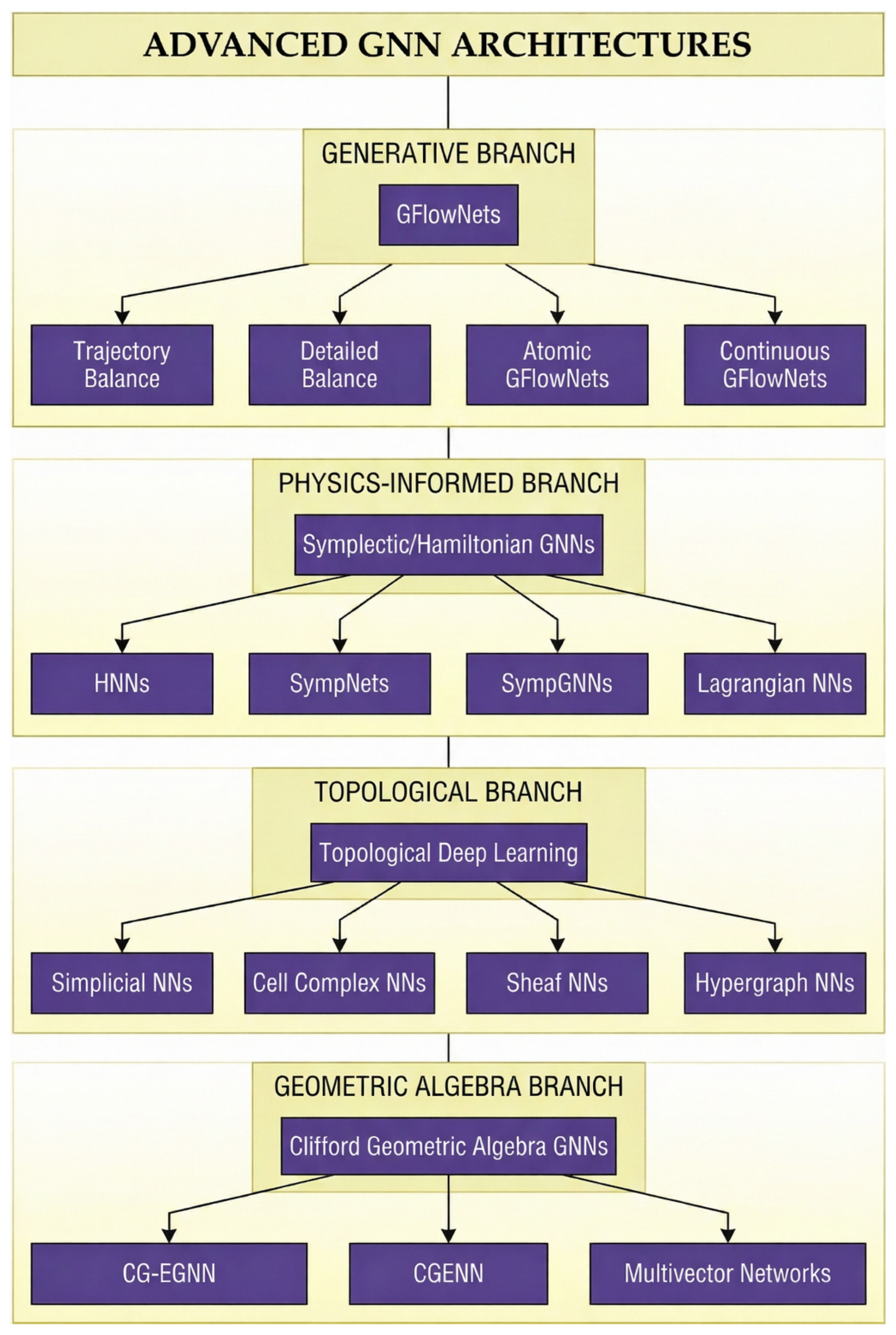
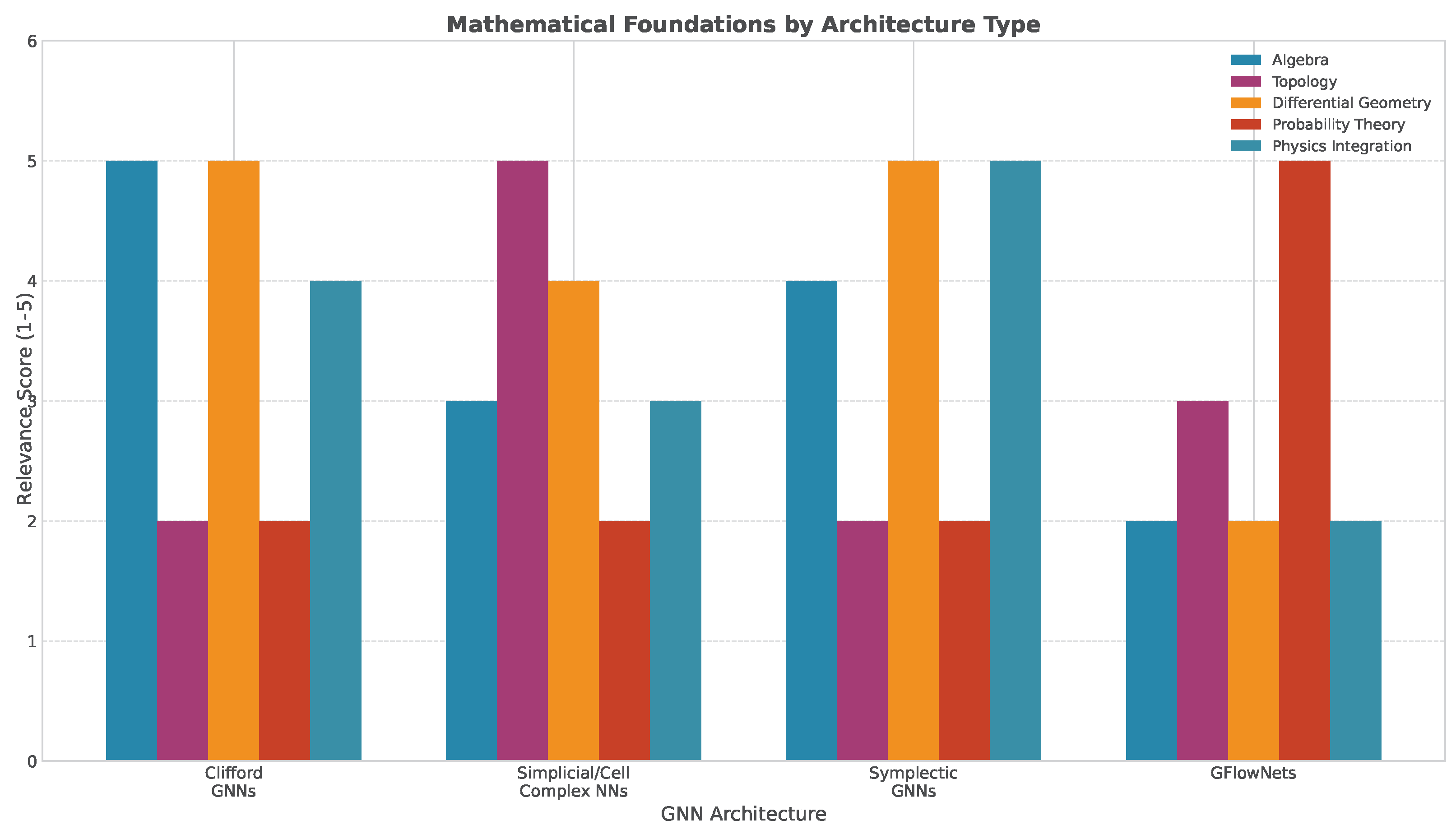
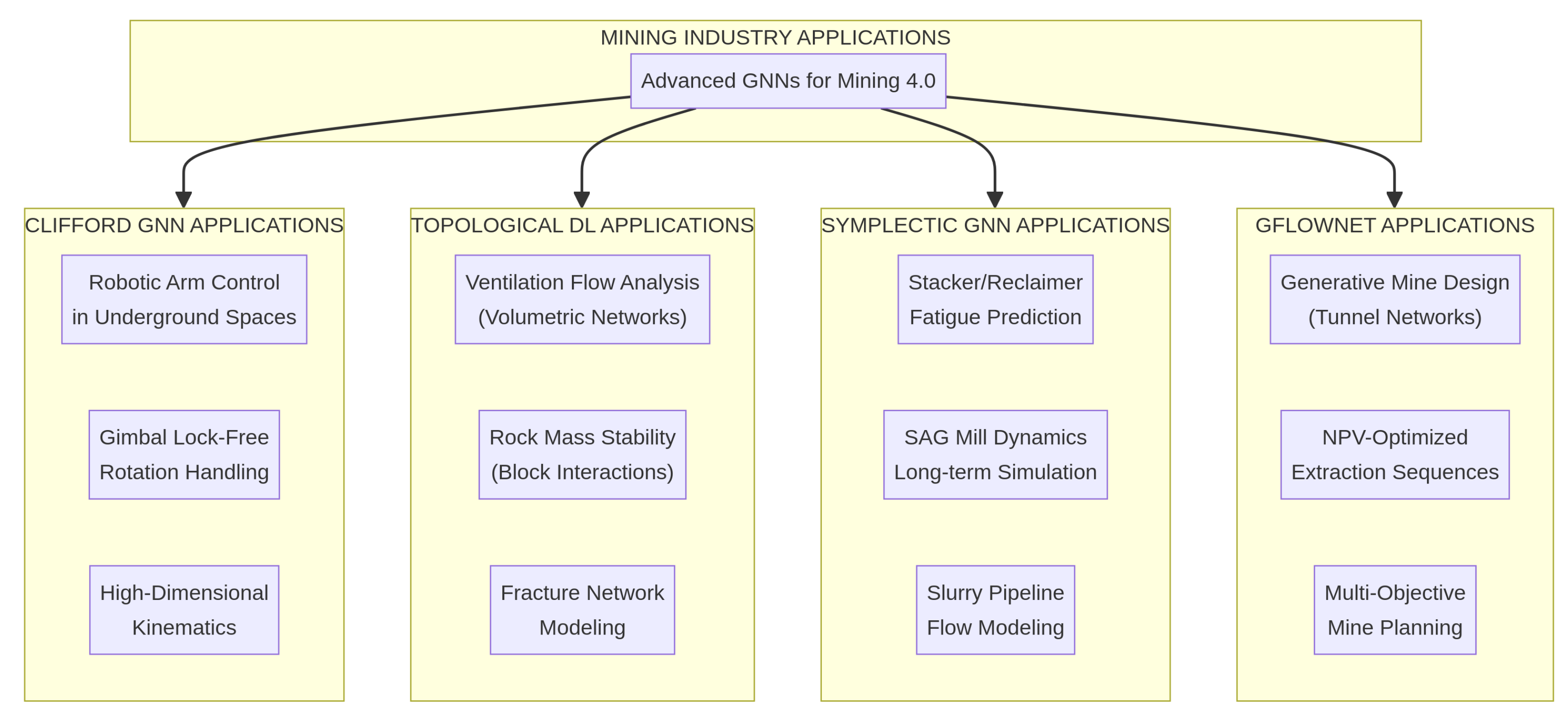
- A taxonomy of advanced GNN architectures (Figure 1) organized by dominant mathematical principle and by the type of constraint enforced (symmetry, topology, conservation, generation).
- 2.
- A formal synthesis of the mechanisms that explain performance gains over standard MPNNs: group equivariance, topological operators, symplectic preservation, and generative flow balance.
- 3.
- 4.
- Identification of technology gaps and future directions oriented to implementation (scalability, hybrid composition, operational validation, and traceability).
2. Materials and Methods
2.1. PRISMA 2020 Protocol
2.2. Search Strategy
2.3. Information Sources
- Journal databases: Web of Science (WoS) and Scopus.
- Conference proceedings: NeurIPS, ICML, ICLR, AAAI, IJCAI.
- Preprint servers: arXiv (used primarily for highly cited papers or works later published in peer-reviewed venues).
2.4. Query Strings
- (‘Clifford algebra’ OR ‘geometric algebra’) AND (‘graph neural network’ OR ‘deep learning’)
- (‘simplicial complex’ OR ‘cell complex’) AND ‘neural network’
- ‘symplectic’ AND (‘graph neural network’ OR ‘neural network’) AND ‘Hamiltonian’
- (‘GFlowNet’ OR ‘generative flow network’) AND ‘graph’
3. Inclusion and Exclusion Criteria
3.1. Inclusion Criteria
- 1.
- Publication quality: Papers published in Q1 or Q2 journals (according to Journal Citation Reports or Scimago Journal Rank) or accepted at Tier-1 conferences. In this review, Tier-1 refers to flagship, highly selective peer-reviewed venues in ML/AI—specifically NeurIPS, ICML, ICLR, AAAI, and IJCAI—operationalized using external conference-ranking standards (such as CORE A* and A) as a transparency aid for venue quality.
- 2.
- Language: Publications written in scientific English only. This criterion was introduced to ensure consistent full-text interpretability during the extraction of technical assumptions, equations, and reproducibility details, thereby reducing translation-induced uncertainty in fine-grained algorithmic formulations. Operationally, a study was included if a complete English full text was available; works written primarily in other languages were excluded if only metadata or abstracts were accessible in English, representing a scope-based decision rather than a judgment of research quality.
- 3.
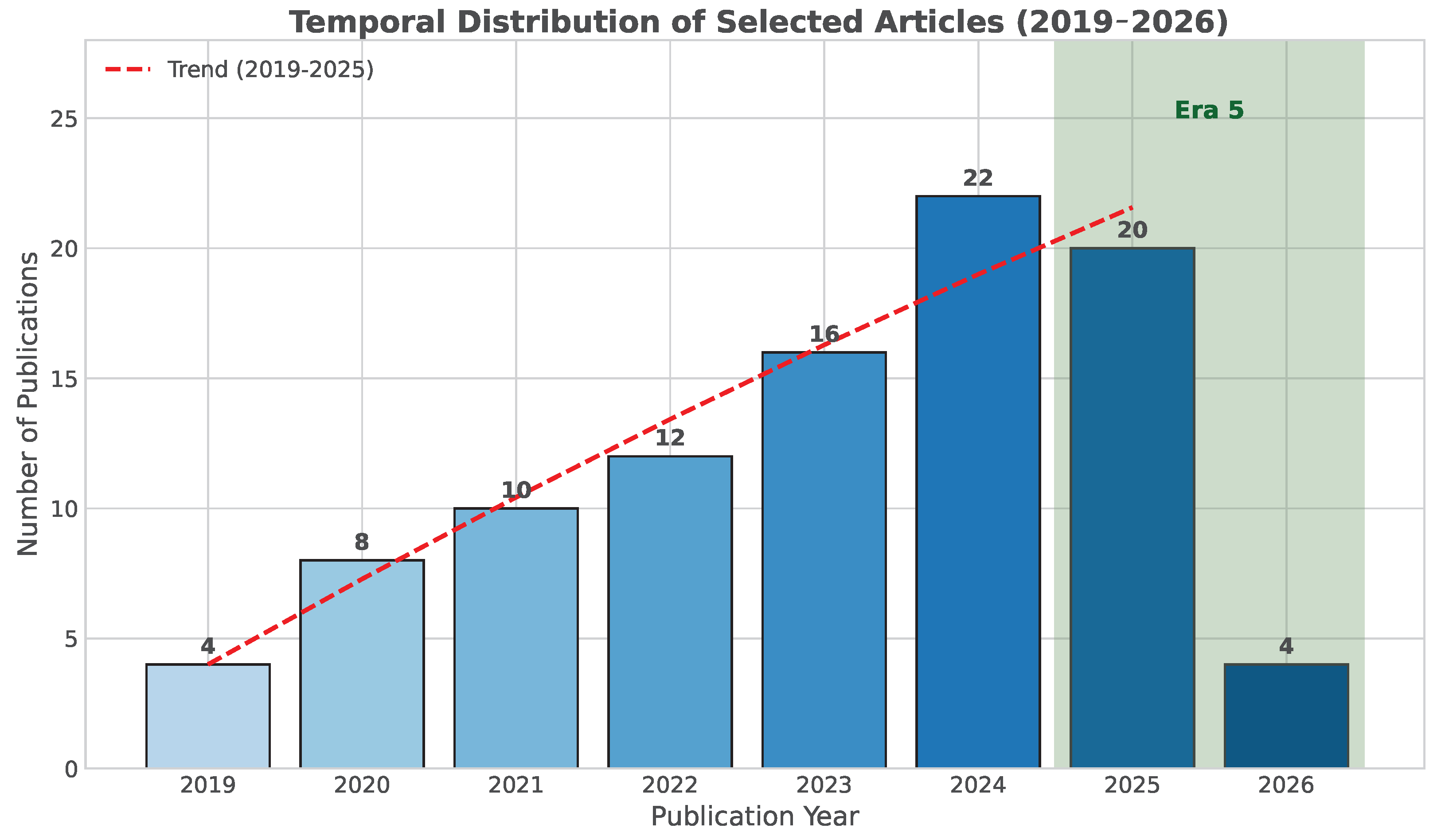
- Time window: Papers published between 1 January 2019 and 19 January 2026. While the quantitative analysis covers the full period, the narrative synthesis places a qualitative emphasis on recent studies (2024–2026) to capture the immediate state of the art. This ensures that the discussion focuses on the latest architectural frontiers without excluding foundational eligible works from 2019–2023 from the corpus.
- 4.
- Topic relevance: The study explicitly developed, analyzed, or applied at least one of the four advanced GNN families defined in this review.
- 5.
- Availability: Full text access was available.
3.2. Exclusion Criteria
- 1.
- Studies without a verifiable peer-review process (with the exception of arXiv preprints that had accumulated substantial citations and were regarded as seminal by the community).
- 2.
- Duplicate publications reporting the same study.
- 3.
- Studies with unclear or non-reproducible methodology. To reduce subjectivity, we operationalized this exclusion criterion using a minimal reproducibility checklist during full-text screening. A study was considered reproducible if it met the following minimum reporting requirements: (i) a clearly specified method (model architecture or algorithmic procedure) and training objective, (ii) a sufficiently described dataset or data-generating process (source, preprocessing, and evaluation split/setup), and (iii) an evaluable experimental protocol (metrics and baselines or comparative references). Additional reproducibility signals were recorded when available (code or repository link, hyperparameters/training details, ablation or sensitivity analyses), but lack of these signals alone was not sufficient for exclusion. Studies were excluded under this criterion only when the minimum requirements (i)–(iii) were not met to a degree that prevented reconstructing the method or verifying the main claims.
- 4.
- Papers that only mentioned the target architectures superficially, without substantive development.
- 5.
- JCR/SJR quartile snapshot and disagreement rule: Whenever journal quartiles are referenced (“according to JCR or SJR”), we use a fixed quartile snapshot aligned with the review cut-off date (the 2025 releases of JCR and SJR, reflecting 2024 citation metrics). If JCR quartiles are available for a venue, JCR is used; if JCR is unavailable, SJR is used. When both quartiles are available but differ (e.g., due to different subject-category assignments), both values are recorded for transparency and the more conservative quartile (i.e., the numerically larger quartile value, e.g., Q2 over Q1) is adopted for screening and any single-quartile labeling to avoid optimistic bias.
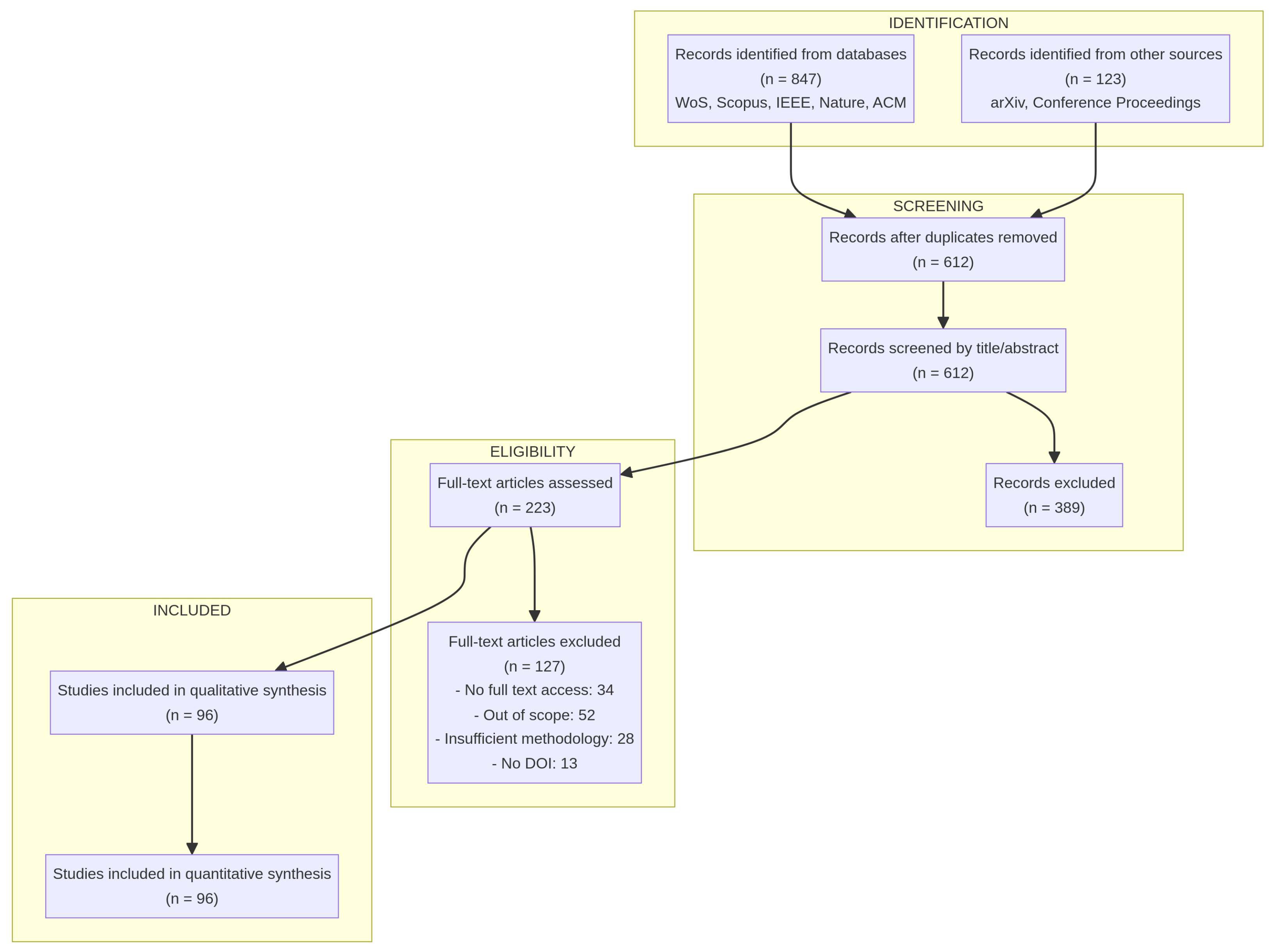
3.3. Study Selection Process
3.4. Data Extraction and Evidence Synthesis
4. Results
4.1. Clifford GNNs (Geometric Algebra GNNs)
4.1.1. Foundations: From Vector Spaces to Geometric Algebra
4.1.2. Architectures for Clifford GNNs
4.1.3. Clifford and Geometric Algebra Applications in Mining
4.2. Generative Flow Networks on Graphs (GFlowNets)
4.2.1. Foundations: Beyond Prediction Toward Generation
4.2.2. GFlowNet Architectures for Graphs
4.2.3. Generative Flow Networks for Mining and Molecular Design
4.3. Simplicial and Cell Complex Neural Networks (Topological Deep Learning)
4.3.1. Foundations: Beyond Graphs Toward Topology
4.3.2. Architectures of Topological Neural Networks
4.3.3. Topological and Cellular Complex Applications in Mining
4.4. Symplectic/Hamiltonian Graph Neural Networks (SympGNN)
4.4.1. Foundations: Why Physical Conservation Is Needed
4.4.2. Architectures of Physics-Informed Neural Networks
4.4.3. Applications in Mining and Physical Systems
4.5. Challenges and Real-World Deployment Barriers
- Clifford GNNs impose a significant memory footprint due to the multivector representation, where feature dimension scales as with the space dimension n. Although grade factorization reduces this cost [32], the multiply–accumulate (MAC) operations for geometric products remain heavier than standard scalar products, potentially limiting real-time inference on edge devices.
- Simplicial and Cellular Networks require the pre-computation and storage of incidence matrices and boundary operators for high-order structures (faces, volumes). For large-scale mine topologies, this leads to a combinatorial explosion in memory usage, which necessitates the use of sparse adjacency structures and dimension-restricted message passing [17].
- Symplectic and Hamiltonian GNNs, while stable for long-term simulation, are sensitive to the choice of time-stepping integrators. Stiff dynamics, common in rock mechanics, may require implicit solvers that are computationally expensive to differentiate through during training [101].
- Generative Flow Networks (GFlowNets) face a distinct bottleneck in sample efficiency. Unlike supervised learning, they require extensive exploration of the combinatorial action space to converge to the target distribution. Reward engineering and the calibration of temperature parameters are non-trivial and often require domain-specific heuristics to prevent mode collapse [48].
5. Discussion
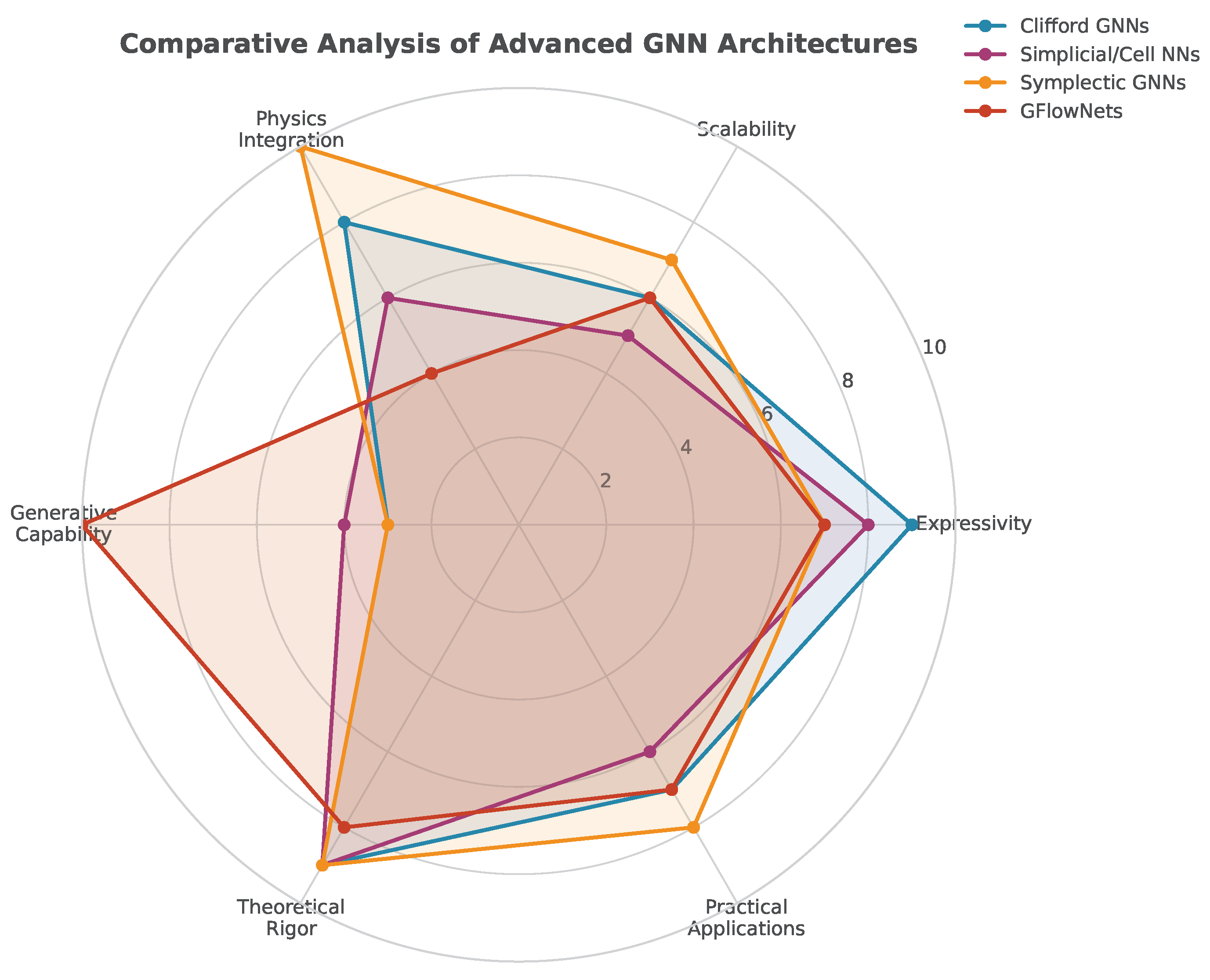
5.1. Comparative Synthesis of the Four Families
- 1.
- Symmetry check. Identify the relevant group G acting on the inputs and decide whether the model must be equivariant:
- 2.
- 3.
- 4.
5.2. Compositional Perspective
5.3. Implications for Mining and Digital Twins
5.4. Challenges and Future Directions
6. Conclusions
- 1.
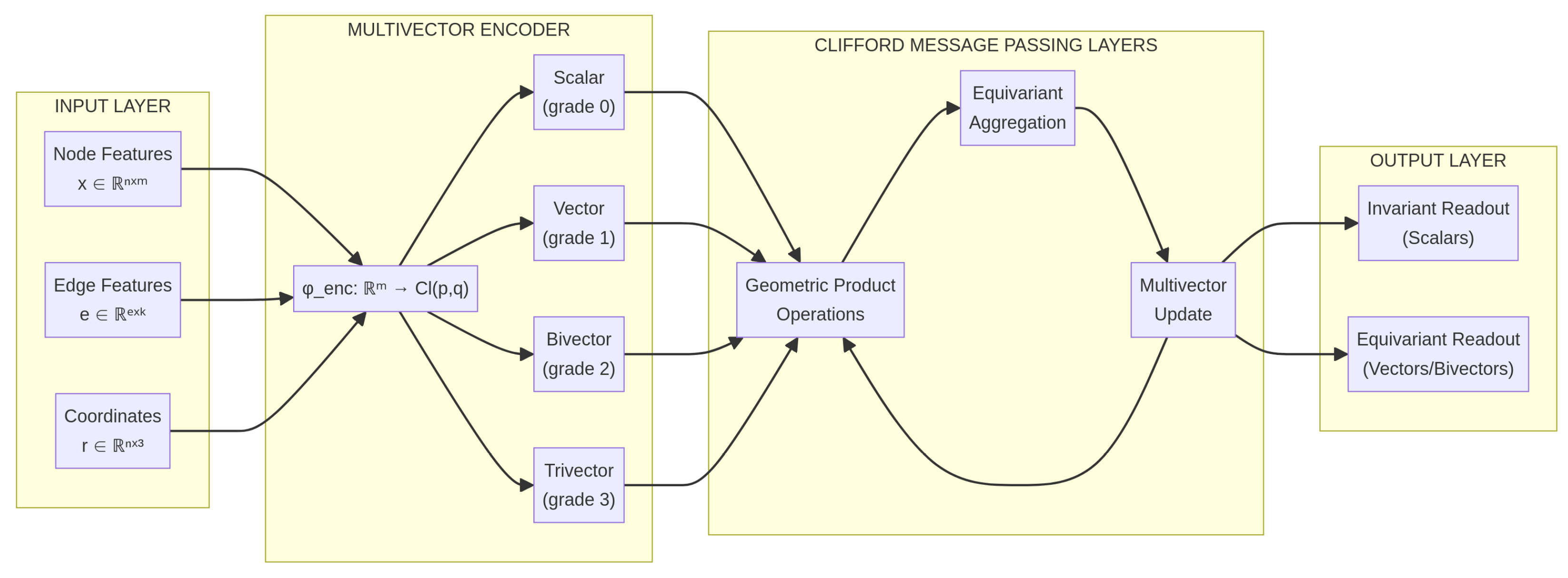
- When geometry and frame changes dominate: Clifford GNNs. In underground robotics, inertial instrumentation, 3D perception, and equipment kinematics, performance depends on consistency under rotations and rigid transformations. Clifford GNNs replace purely vectorial features with multivectors and use geometric algebra operations (Figure 5 and Figure 6), so that rotations are represented by rotors,avoiding fragile parameterizations and enabling coherent state estimation and control in environments with strong geometric uncertainty.
- 2.
- When collective interactions and volumetric structure dominate: simplicial and cell complex neural networks. Rock-mass stability, ventilation, and underground hydrology are not purely pairwise phenomena; they depend on couplings across surfaces and volumes. Topological deep learning lifts the domain from graphs to complexes (Figure 8), where information propagation is organized by dimension through boundary operators and Hodge Laplacians:This supports models that respect the edge–face–volume hierarchy and capture emergent mechanisms such as stress propagation through contact faces, improving fidelity for risk evaluation and control design.
- 3.
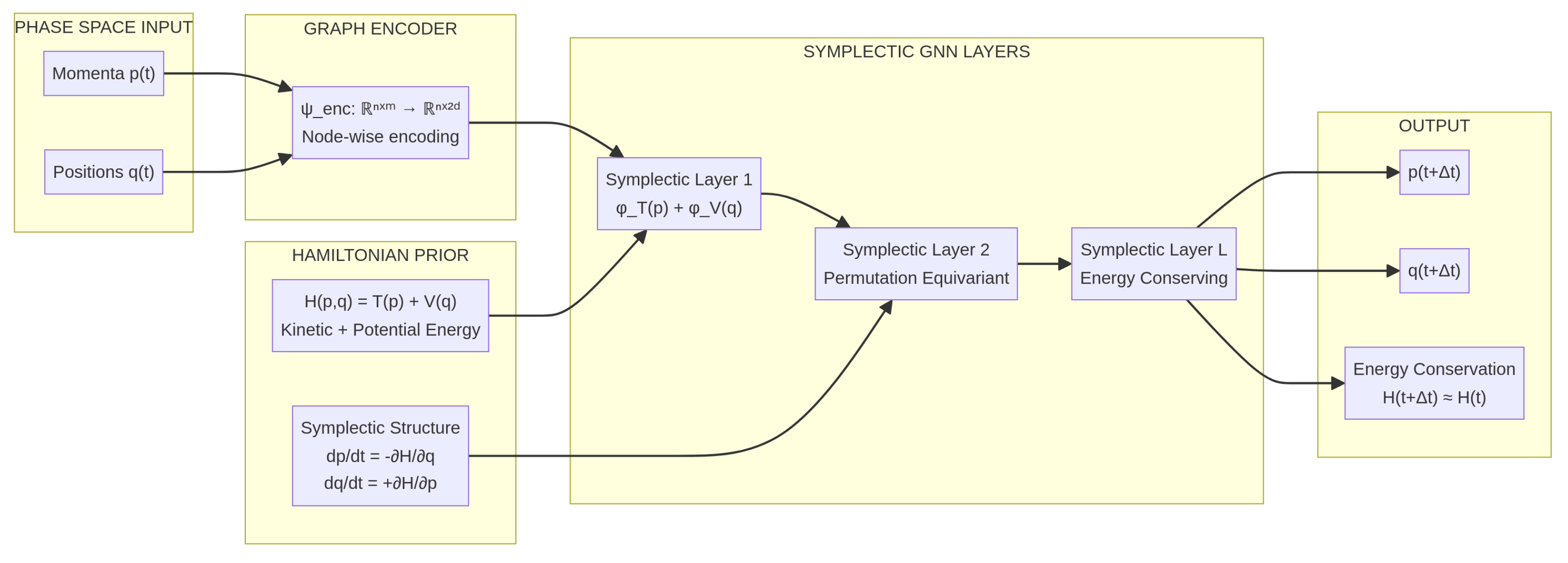
- When long-horizon dynamics dominate: symplectic and Hamiltonian graph learning. For critical assets (mills, conveyors, pumps), useful prediction requires long time horizons; without structural preservation, small errors accumulate. Symplectic GNNs (Figure 9) incorporate Hamiltonian or symplectic structure as an architectural constraint. For a learned phase-space map with , the key condition iswhich stabilizes surrogate simulation and supports operational digital twins for predictive maintenance and long-term degradation forecasting under cyclic loads.
- 4.
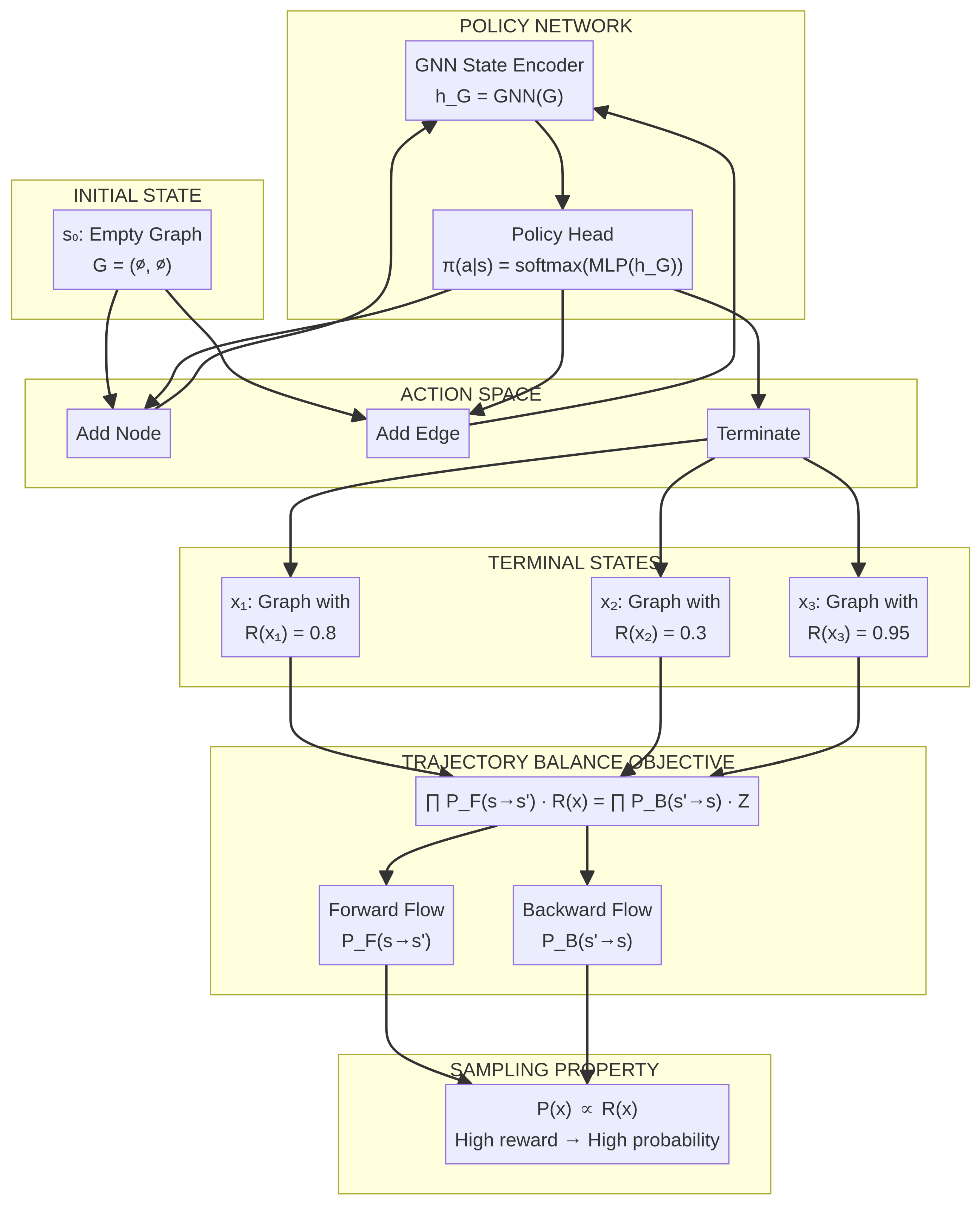
- When the objective is to design and explore, not only to predict: GFlowNets. Mine planning lives in discrete combinatorial spaces. GFlowNets (Figure 7) shift the objective toward sampling diverse high-quality solutions G proportional to a positive reward :where penalizes geotechnical and operational risk and accounts for environmental impact. This enables the generation of portfolios of feasible alternatives for scenario analysis rather than a single potentially brittle plan.
Author Contributions
Funding
Data Availability Statement
Acknowledgments
Conflicts of Interest
Abbreviations
| AI | Artificial Intelligence |
| CCNN | Cell Complex Neural Network |
| CG-EGNN | Clifford Group Equivariant Graph Neural Network |
| Cl(p,q) | Clifford Algebra of signature |
| CW | Closure-finite Weak (CW) complex |
| DAG | Directed Acyclic Graph |
| DFT | Density Functional Theory |
| DL | Deep Learning |
| DOAJ | Directory of Open Access Journals |
| E(n) | Euclidean group in n dimensions |
| E(3) | Euclidean group in three dimensions |
| EGNN | -Equivariant Graph Neural Network |
| FEM | Finite Element Method |
| GAN | Generative Adversarial Network |
| GA | Geometric Algebra |
| GFlowNet | Generative Flow Network |
| GNN | Graph Neural Network |
| HNN | Hamiltonian Neural Network |
| Hodge- | k-th Hodge Laplacian |
| IoT | Internet of Things |
| IPU | Intelligence Processing Unit |
| LD | Linear Dichroism |
| LNN | Lagrangian Neural Network |
| ML | Machine Learning |
| MLP | Multilayer Perceptron |
| MPNN | Message Passing Neural Network |
| MDPI | Multidisciplinary Digital Publishing Institute |
| MSE | Mean Squared Error |
| NPV/VAN | Net Present Value/Valor Actual Neto |
| O(n) | Orthogonal group in n dimensions |
| ODE | Ordinary Differential Equation |
| PDE | Partial Differential Equation |
| PINN | Physics-Informed Neural Network |
| PRISMA | Preferred Reporting Items for Systematic Reviews and Meta-Analyses |
| RUL | Remaining Useful Life |
| SAG | Semi-Autogenous Grinding |
| SE(3) | Special Euclidean group in three dimensions |
| SHM | Structural Health Monitoring |
| SNN | Simplicial Neural Network |
| SympGNN | Symplectic Graph Neural Network |
| SympNet | Symplectic Neural Network |
| TDA | Topological Data Analysis |
| TB | Trajectory Balance |
| TLA | Three-Letter Acronym |
| VAE | Variational Autoencoder |
Appendix A. Full Database Query Strings and Query-Construction Protocol
Appendix A.1. Reproducible Query Engineering Protocol (PRISMA 2020-Compliant)
Appendix A.2. Core Synonym Families (Concept Blocks)


Appendix A.3. Database-Specific Implementation Notes
Appendix A.4. Exact Final Query Strings (Copy–Paste Reproducible)
Appendix A.4.1. Web of Science (Advanced Search)

Appendix A.4.2. Scopus and Arxiv (TITLE-ABS-KEY)

Appendix A.5. Optional Targeted Secondary Queries
“digital twin*” OR “smart mining” OR “mining industry” OR “process optimization”
Appendix A.6. Replicability Checklist (Audit Trail)
References
- LeCun, Y.; Bengio, Y.; Hinton, G. Deep learning. Nature 2015, 521, 436–444. [Google Scholar] [CrossRef]
- Hochreiter, S.; Schmidhuber, J. Long Short-Term Memory. Neural Comput. 1997, 9, 1735–1780. [Google Scholar] [CrossRef] [PubMed]
- Vaswani, A.; Shazeer, N.; Parmar, N.; Uszkoreit, J.; Jones, L.; Gomez, A.N.; Kaiser, L.; Polosukhin, I. Attention Is All You Need. Adv. Neural Inf. Process. Syst. 2017, 30, 5998–6008. [Google Scholar]
- Bronstein, M.M.; Bruna, J.; Cohen, T.; Veličković, P. Geometric Deep Learning: Grids, Groups, Graphs, Geodesics, and Gauges. arXiv 2021, arXiv:2104.13478. [Google Scholar] [CrossRef]
- Gerken, J.E.; Aronsson, J.; Carlsson, O.; Linander, H.; Ohlsson, F.; Petersson, C.; Persson, D. Geometric deep learning and equivariant neural networks. Artif. Intell. Rev. 2023, 56, 8391–8445. [Google Scholar] [CrossRef]
- Zhou, J.; Cui, G.; Hu, S.; Zhang, Z.; Yang, C.; Liu, Z.; Wang, L.; Li, C.; Sun, M. Graph neural networks: A review of methods and applications. AI Open 2020, 1, 57–81. [Google Scholar] [CrossRef]
- Scarselli, F.; Gori, M.; Tsoi, A.C.; Hagenbuchner, M.; Monfardini, G. The Graph Neural Network Model. IEEE Trans. Neural Netw. 2009, 20, 61–80. [Google Scholar] [CrossRef]
- Kipf, T.N.; Welling, M. Semi-Supervised Classification with Graph Convolutional Networks. arXiv 2017, arXiv:1609.02907. [Google Scholar] [CrossRef]
- Veličković, P.; Cucurull, G.; Casanova, A.; Romero, A.; Liò, P.; Bengio, Y. Graph Attention Networks. arXiv 2018, arXiv:1710.10903. [Google Scholar] [CrossRef]
- Gilmer, J.; Schoenholz, S.S.; Riley, P.F.; Vinyals, O.; Dahl, G.E. Neural Message Passing for Quantum Chemistry. Proc. Mach. Learn. Res. 2017, 70, 1263–1272. [Google Scholar]
- Battaglia, P.W.; Hamrick, J.B.; Bapst, V.; Sanchez-Gonzalez, A.; Zambaldi, V.; Malinowski, M.; Tacchetti, A.; Raposo, D.; Santoro, A.; Faulkner, R.; et al. Relational inductive biases, deep learning, and graph networks. arXiv 2018, arXiv:1806.01261. [Google Scholar] [CrossRef]
- Hamilton, W.L.; Ying, R.; Leskovec, J. Inductive Representation Learning on Large Graphs. Adv. Neural Inf. Process. Syst. 2017, 30, 1024–1034. [Google Scholar]
- Wu, Z.; Pan, S.; Chen, F.; Long, G.; Zhang, C.; Yu, P.S. A Comprehensive Survey on Graph Neural Networks. IEEE Trans. Neural Netw. Learn. Syst. 2021, 32, 4–24. [Google Scholar] [CrossRef]
- Rojas, L.; Yepes, V.; Garcia, J. Complex Dynamics and Intelligent Control: Advances, Challenges, and Applications in Mining and Industrial Processes. Mathematics 2025, 13, 961. [Google Scholar] [CrossRef]
- Weisfeiler, B.; Lehman, A. A reduction of a graph to a canonical form and an algebra arising during this reduction. Nauchno-Tech. Informatsia 1968, 2, 12–16. Available online: https://www.iti.zcu.cz/wl2018/pdf/wl_paper_translation.pdf (accessed on 20 January 2026).
- Xu, K.; Hu, W.; Leskovec, J.; Jegelka, S. How Powerful are Graph Neural Networks? arXiv 2019, arXiv:1810.00826. [Google Scholar] [CrossRef]
- Bodnar, C.; Frasca, F.; Wang, Y.; Otter, N.; Montúfar, G.; Liò, P.; Bronstein, M. Weisfeiler and Lehman Go Topological: Message Passing Simplicial Networks. Proc. Mach. Learn. Res. 2021, 139, 1026–1037. [Google Scholar]
- Besta, M.; Scheidl, F.; Gianinazzi, L.; Kwasniewski, G.; Klaiman, S.; Müller, J.; Hoefler, T. Demystifying higher-order graph neural networks. IEEE Trans. Pattern Anal. Mach. Intell. 2026, 48, 2544–2565. [Google Scholar] [CrossRef]
- Jung, D.; Choi, Y. Systematic Review of Machine Learning Applications in Mining: Exploration, Exploitation, and Reclamation. Minerals 2021, 11, 148. [Google Scholar] [CrossRef]
- McCoy, J.T.; Auret, L. Machine learning applications in minerals processing: A review. Miner. Eng. 2019, 132, 95–109. [Google Scholar] [CrossRef]
- Cortés, N.; Hekmatnejad, A.; Pan, P.; Mohtarami, E.; Pena, A.; Taheri, A.; González, C. Empirical approaches for rock burst prediction: A comprehensive review and application to the new level of El Teniente Mine, Chile. Heliyon 2024, 10, e26515. [Google Scholar] [CrossRef] [PubMed]
- Grieves, M.; Vickers, J. Digital Twin: Mitigating Unpredictable, Undesirable Emergent Behavior in Complex Systems. In Transdisciplinary Perspectives on Complex Systems; Springer: Cham, Switzerland, 2017; pp. 85–113. [Google Scholar] [CrossRef]
- Rasheed, A.; San, O.; Kvamsdal, T. Digital Twin: Values, Challenges and Enablers From a Modeling Perspective. IEEE Access 2020, 8, 21980–22012. [Google Scholar] [CrossRef]
- Fuller, A.; Fan, Z.; Day, C.; Barlow, C. Digital Twin: Enabling Technologies, Challenges and Open Research. IEEE Access 2020, 8, 108952–108971. [Google Scholar] [CrossRef]
- Jones, D.; Snider, C.; Nassehi, A.; Yon, J.; Hicks, B. Characterising the Digital Twin: A systematic literature review. CIRP J. Manuf. Sci. Technol. 2020, 29, 36–52. [Google Scholar] [CrossRef]
- Papamarkou, T.; Birdal, T.; Bronstein, M.; Carlsson, G.; Curry, J.; Gao, Y.; Hajij, M.; Kwitt, R.; Lio, P.; Di Lorenzo, P.; et al. Position: Topological deep learning is the new frontier for relational learning. Proc. Mach. Learn. Res. 2024, 235, 39529. [Google Scholar]
- Cohen, T.; Welling, M. Group Equivariant Convolutional Networks. Proc. Mach. Learn. Res. 2016, 48, 2990–2999. [Google Scholar]
- Kondor, R.; Trivedi, S. On the Generalization of Equivariance and Convolution in Neural Networks to the Action of Compact Groups. Proc. Mach. Learn. Res. 2018, 80, 2747–2755. [Google Scholar]
- Satorras, V.G.; Hoogeboom, E.; Welling, M. E(n) Equivariant Graph Neural Networks. Proc. Mach. Learn. Res. 2021, 139, 9323–9332. [Google Scholar]
- Thomas, N.; Smidt, T.; Kearnes, S.; Yang, L.; Li, L.; Kohlhoff, K.; Riley, P. Tensor field networks: Rotation- and translation-equivariant neural networks for 3D point clouds. arXiv 2018, arXiv:1802.08219. [Google Scholar] [CrossRef]
- Fuchs, F.; Worrall, D.; Fischer, V.; Welling, M. SE(3)-Transformers: 3D Roto-Translation Equivariant Attention Networks. Adv. Neural Inf. Process. Syst. 2020, 33, 1970–1981. [Google Scholar]
- Ruhe, D.; Brandstetter, J.; Forré, P. Clifford Group Equivariant Neural Networks. Adv. Neural Inf. Process. Syst. 2023, 36, 62922–62990. [Google Scholar]
- Brehmer, J.; de Haan, P.; Behrends, S.; Cohen, T. Geometric Algebra Transformer. Adv. Neural Inf. Process. Syst. 2023, 36, 35472–35496. [Google Scholar]
- Rojas, L.; Hernandez, B.; Garcia, J. A Systematic Review of Intelligent Agents, Language Models, and Recurrent Neural Networks in Industrial Maintenance: Driving Value Creation for the Mining Sector. Int. J. Intell. Syst. 2025, 2025, 9953223. [Google Scholar] [CrossRef]
- Bodnar, C.; Frasca, F.; Otter, N.; Wang, Y.; Liò, P.; Montúfar, G.; Bronstein, M. Weisfeiler and Lehman Go Cellular: CW Networks. Adv. Neural Inf. Process. Syst. 2021, 34, 2625–2640. [Google Scholar]
- Hajij, M.; Zamzmi, G.; Papamarkou, T.; Miolane, N.; Guzmán-Sáenz, A.; Ramamurthy, K.N.; Birdal, T.; Dey, T.K.; Mukherjee, S.; Samaga, S.N.; et al. Topological Deep Learning: Going Beyond Graph Data. arXiv 2023, arXiv:2206.00606. [Google Scholar] [CrossRef]
- Lim, L.H. Hodge Laplacians on graphs. SIAM Rev. 2020, 62, 685–715. [Google Scholar] [CrossRef]
- Schaub, M.T.; Benson, A.R.; Horn, P.; Lippner, G.; Jadbabaie, A. Random walks on simplicial complexes and the normalized Hodge 1-Laplacian. SIAM Rev. 2020, 62, 353–391. [Google Scholar] [CrossRef]
- Greydanus, S.; Dzamba, M.; Yosinski, J. Hamiltonian Neural Networks. Adv. Neural Inf. Process. Syst. 2019, 32, 15379–15389. [Google Scholar]
- Jin, P.; Zhang, Z.; Zhu, A.; Tang, Y.; Karniadakis, G.E. SympNets: Intrinsic structure-preserving symplectic networks for identifying Hamiltonian systems. Neural Netw. 2020, 132, 88–101. [Google Scholar] [CrossRef]
- Chen, Z.; Zhang, J.; Arjovsky, M.; Bottou, L. Symplectic Recurrent Neural Networks. arXiv 2020, arXiv:1909.13334. [Google Scholar] [CrossRef]
- Hernández, Q.; Badías, A.; González, D.; Chinesta, F.; Cueto, E. Structure-preserving neural networks. J. Comput. Phys. 2021, 426, 109950. [Google Scholar] [CrossRef]
- Raissi, M.; Perdikaris, P.; Karniadakis, G.E. Physics-informed neural networks: A deep learning framework for solving forward and inverse problems involving nonlinear partial differential equations. J. Comput. Phys. 2019, 378, 686–707. [Google Scholar] [CrossRef]
- Karniadakis, G.E.; Kevrekidis, I.G.; Lu, L.; Perdikaris, P.; Wang, S.; Yang, L. Physics-informed machine learning. Nat. Rev. Phys. 2021, 3, 422–440. [Google Scholar] [CrossRef]
- Xing, R.; Xiao, M.; Zhang, Y.; Qiu, J. Stability and Hopf Bifurcation Analysis of an (n + m)-Neuron Double-Ring Neural Network Model with Multiple Time Delays. J. Syst. Sci. Complex. 2022, 35, 159–178. [Google Scholar] [CrossRef]
- Jia, T.; Chen, X.; He, L.; Zhao, F.; Qiu, J. Finite-Time Synchronization of Uncertain Fractional-Order Delayed Memristive Neural Networks via Adaptive Sliding Mode Control and Its Application. Fractal Fract. 2022, 6, 502. [Google Scholar] [CrossRef]
- Bengio, E.; Jain, M.; Korablyov, M.; Precup, D.; Bengio, Y. Flow Network based Generative Models for Non-Iterative Diverse Candidate Generation. Adv. Neural Inf. Process. Syst. 2021, 34, 27381–27394. [Google Scholar]
- Bengio, Y.; Lahlou, S.; Deleu, T.; Hu, E.J.; Tiwari, M.; Bengio, E. GFlowNet Foundations. J. Mach. Learn. Res. 2023, 24, 1–55. [Google Scholar]
- Zhang, D.; Malkin, N.; Liu, Z.; Volokhova, A.; Courville, A.; Bengio, Y. Generative Flow Networks for Discrete Probabilistic Modeling. Proc. Mach. Learn. Res. 2022, 162, 26412–26428. [Google Scholar]
- Zhang, D.; Dai, H.; Malkin, N.; Courville, A.; Bengio, Y.; Pan, L. Let the Flows Tell: Solving Graph Combinatorial Optimization Problems with GFlowNets. Adv. Neural Inf. Process. Syst. 2023, 36, 11952–11969. [Google Scholar]
- Garcia, J.; Villavicencio, G.; Altimiras, F.; Crawford, B.; Soto, R.; Minatogawa, V.; Franco, M.; Martínez-Muñoz, D.; Yepes, V. Machine learning techniques applied to construction: A hybrid bibliometric analysis of advances and future directions. Autom. Constr. 2022, 142, 104532. [Google Scholar] [CrossRef]
- Sánchez-Garrido, A.J.; Navarro, I.J.; García, J.; Yepes, V. A systematic literature review on modern methods of construction in building: An integrated approach using machine learning. J. Build. Eng. 2023, 73, 106725. [Google Scholar] [CrossRef]
- Khoshraftar, S.; An, A. A Survey on Graph Representation Learning Methods. ACM Trans. Intell. Syst. Technol. 2024, 15, 19. [Google Scholar] [CrossRef]
- Brandstetter, J.; Hesselink, R.; van der Pol, E.; Bekkers, E.J.; Welling, M. Geometric and Physical Quantities Improve E(3) Equivariant Message Passing. arXiv 2022, arXiv:2110.02905. [Google Scholar] [CrossRef]
- Desai, K.; Nachman, B.; Thaler, J. Symmetry discovery with deep learning. Phys. Rev. D 2022, 105, 096031. [Google Scholar] [CrossRef]
- Liao, D.; Liu, G. Lie group equivariant convolutional neural network based on Laplace distribution. Remote Sens. 2023, 15, 3758. [Google Scholar] [CrossRef]
- Forestano, R.T.; Matchev, K.T.; Matcheva, K. Deep learning symmetries and their Lie groups, algebras, and subalgebras from first principles. Mach. Learn. Sci. Technol. 2023, 4, 035017. [Google Scholar] [CrossRef]
- Devadas, R.M.; Hiremani, V.; Preethi; T, S.; R, S.; Gujjar, P. Hypercomplex neural networks: Exploring quaternion, octonion, and beyond in deep learning. MethodsX 2025, 15, 103644. [Google Scholar] [CrossRef]
- Dym, N.; Maron, H. On the Universality of Rotation Equivariant Point Cloud Networks. arXiv 2020, arXiv:2010.02449. [Google Scholar] [CrossRef]
- Finzi, M.; Stanton, S.; Izmailov, P.; Wilson, A.G. Generalizing Convolutional Neural Networks for Equivariance to Lie Groups on Arbitrary Continuous Data. Proc. Mach. Learn. Res. 2020, 119, 3165–3176. [Google Scholar]
- Filimoshina, E.; Shirokov, D. GLGENN: A Novel Parameter-Light Equivariant Neural Networks Architecture Based on Clifford Geometric Algebras. arXiv 2025, arXiv:2506.09625. [Google Scholar] [CrossRef]
- Ji, R.; Lu, C.; Huang, Z.; Zhong, J. Learning behavior aware features across spaces for improved 3D human motion prediction. Sci. Rep. 2025, 15, 28355. [Google Scholar] [CrossRef]
- Schütt, K.T.; Sauceda, H.E.; Kindermans, P.J.; Tkatchenko, A.; Müller, K.R. SchNet – A deep learning architecture for molecules and materials. J. Chem. Phys. 2018, 148, 241722. [Google Scholar] [CrossRef]
- Batzner, S.; Musaelian, A.; Sun, L.; Geiger, M.; Mailoa, J.P.; Kornbluth, M.; Molinari, N.; Smidt, T.E.; Kozinsky, B. E(3)-Equivariant Graph Neural Networks for Data-Efficient and Accurate Interatomic Potentials. Nat. Commun. 2022, 13, 2453. [Google Scholar] [CrossRef]
- Unke, O.T.; Chmiela, S.; Sauceda, H.E.; Gastegger, M.; Poltavsky, I.; Schutt, K.T.; Tkatchenko, A.; Muller, K.R. Machine learning force fields. Chem. Rev. 2021, 121, 10142–10186. [Google Scholar] [CrossRef] [PubMed]
- Duignan, T.T. The Potential of Neural Network Potentials. ACS Phys. Chem. Au 2024, 4, 232–248. [Google Scholar] [CrossRef]
- Parisi, F.; Ruggieri, S.; Lovreglio, R.; Fanti, M.P.; Uva, G. On the use of mechanics-informed models to structural engineering systems: Application of graph neural networks for structural analysis. Structures 2024, 59, 105712. [Google Scholar] [CrossRef]
- Zhao, Y.; Li, X.; Zhang, H.; Wang, J. A review of graph neural network applications in mechanics-related domains. Artif. Intell. Rev. 2024, 57, 315. [Google Scholar] [CrossRef]
- Goodfellow, I.; Pouget-Abadie, J.; Mirza, M.; Xu, B.; Warde-Farley, D.; Ozair, S.; Courville, A.; Bengio, Y. Generative Adversarial Networks. Commun. ACM 2020, 63, 139–144. [Google Scholar] [CrossRef]
- Kingma, D.P.; Welling, M. Auto-encoding variational bayes. arXiv 2013, arXiv:1312.6114. [Google Scholar]
- Elton, D.C.; Boukouvalas, Z.; Fuge, M.D.; Chung, P.W. Deep learning for molecular design—a review of the state of the art. Mol. Syst. Des. Eng. 2019, 4, 828–849. [Google Scholar] [CrossRef]
- Zeng, X.; Wang, F.; Luo, Y.; Kang, S.g.; Tang, J.; Lightstone, F.C.; Fang, E.F.; Cornell, W.; Nussinov, R.; Cheng, F. Deep generative molecular design reshapes drug discovery. Cell Rep. Med. 2022, 3, 100794. [Google Scholar] [CrossRef]
- Mazyavkina, N.; Sviridov, S.; Ivanov, S.; Burnaev, E. Reinforcement learning for combinatorial optimization: A survey. Comput. Oper. Res. 2021, 134, 105400. [Google Scholar] [CrossRef]
- Kool, W.; van Hoof, H.; Welling, M. Attention, Learn to Solve Routing Problems! arXiv 2019, arXiv:1803.08475. [Google Scholar] [CrossRef]
- Lahlou, S.; Deleu, T.; Lemos, P.; Zhang, D.; Volokhova, A.; Hernández-Garcıa, A.; Ezzine, L.N.; Bengio, Y.; Malkin, N. A theory of continuous generative flow networks. In Proceedings of the International Conference on Machine Learning, PMLR, Honolulu, HI, USA, 23–29 July 2023; pp. 18269–18300. [Google Scholar]
- Malkin, N.; Jain, M.; Bengio, E.; Sun, C.; Bengio, Y. Trajectory Balance: Improved Credit Assignment in GFlowNets. Adv. Neural Inf. Process. Syst. 2022, 35, 5955–5967. [Google Scholar]
- Kim, M.; Choi, S.; Kim, H.; Son, J.; Park, J. Ant Colony Sampling with GFlowNets for Combinatorial Optimization. arXiv 2024, arXiv:2403.07041. [Google Scholar] [CrossRef]
- Alcazar, J.; Ghazi Vakili, M.; Kalayci, C.B.; Perdomo-Ortiz, A. Enhancing combinatorial optimization with classical and quantum generative models. Nat. Commun. 2024, 15, 2761. [Google Scholar] [CrossRef] [PubMed]
- Deleu, T.; Góis, A.; Emezue, C.; Rankawat, M.; Lacoste-Julien, S.; Bauer, S.; Bengio, Y. Bayesian Structure Learning with Generative Flow Networks. Proc. Mach. Learn. Res. 2022, 180, 518–538. [Google Scholar]
- Jain, M.; Bengio, E.; Hernandez-Garcia, A.; Rector-Brooks, J.; Dossou, B.F.P.; Ekbote, C.A.; Fu, J.; Zhang, T.; Kilgour, M.; Zhang, D.; et al. Biological Sequence Design with GFlowNets. Proc. Mach. Learn. Res. 2022, 162, 9786–9801. [Google Scholar]
- Wu, Z.; Ramsundar, B.; Feinberg, E.N.; Gomes, J.; Geniesse, C.; Pappu, A.S.; Leswing, K.; Pande, V. MoleculeNet: A benchmark for molecular machine learning. Chem. Sci. 2018, 9, 513–530. [Google Scholar] [CrossRef]
- Tang, M.; Li, B.; Chen, H. Application of message passing neural networks for molecular property prediction. Curr. Opin. Struct. Biol. 2023, 81, 102616. [Google Scholar] [CrossRef]
- Bello, I.; Pham, H.; Le, Q.V.; Norouzi, M.; Bengio, S. Neural Combinatorial Optimization with Reinforcement Learning. arXiv 2017, arXiv:1611.09940. [Google Scholar] [CrossRef]
- Dai, H.; Khalil, E.B.; Zhang, Y.; Dilkina, B.; Song, L. Learning Combinatorial Optimization Algorithms over Graphs. Adv. Neural Inf. Process. Syst. 2017, 30, 6348–6358. [Google Scholar]
- Benson, A.R.; Gleich, D.F.; Leskovec, J. Higher-order organization of complex networks. Science 2016, 353, 163–166. [Google Scholar] [CrossRef] [PubMed]
- Majhi, S.; Perc, M.; Ghosh, D. Dynamics on higher-order networks: A review. J. R. Soc. Interface 2022, 19, 20220043. [Google Scholar] [CrossRef]
- Feng, Y.; You, H.; Zhang, Z.; Ji, R.; Gao, Y. Hypergraph Neural Networks. Proc. AAAI Conf. Artif. Intell. 2019, 33, 3558–3565. [Google Scholar] [CrossRef]
- Gao, Y.; Feng, Y.; Ji, S.; Ji, R. HGNN+: General hypergraph neural networks. IEEE Trans. Pattern Anal. Mach. Intell. 2022, 45, 8493–8506. [Google Scholar] [CrossRef]
- Hensel, F.; Moor, M.; Rieck, B. A Survey of Topological Machine Learning Methods. Front. Artif. Intell. 2021, 4, 681108. [Google Scholar] [CrossRef]
- Carlsson, G. Topology and data. Bull. Am. Math. Soc. 2009, 46, 255–308. [Google Scholar] [CrossRef]
- Edelsbrunner, H.; Harer, J. Persistent homology—A survey. Contemp. Math. 2008, 453, 257–282. [Google Scholar] [CrossRef]
- Giusti, L.; Reu, T.; Ceccarelli, F.; Bodnar, C.; Liò, P. Topological message passing for higher-order and long-range interactions. In 2024 International Joint Conference on Neural Networks (IJCNN); IEEE: New York, NY, USA, 2024; pp. 1–8. [Google Scholar] [CrossRef]
- Ebli, S.; Defferrard, M.; Spreemann, G. Simplicial Neural Networks. arXiv 2020, arXiv:2010.03633. [Google Scholar] [CrossRef]
- Bunch, E.; You, Q.; Fung, G.; Singh, V. Simplicial 2-complex convolutional neural nets. arXiv 2020, arXiv:2012.06010. [Google Scholar] [CrossRef]
- Naitzat, G.; Zhitnikov, A.; Lim, L.H. Topology of Deep Neural Networks. J. Mach. Learn. Res. 2020, 21, 1–40. [Google Scholar]
- Cai, S.; Mao, Z.; Wang, Z.; Yin, M.; Karniadakis, G.E. Physics-informed neural networks (PINNs) for fluid mechanics: A review. Acta Mech. Sin. 2021, 37, 1727–1738. [Google Scholar] [CrossRef]
- van Gastelen, T.; Sanderse, B.; Edeling, W. Energy-conserving neural network for turbulence closure modeling. J. Comput. Phys. 2024, 508, 113003. [Google Scholar] [CrossRef]
- Cuomo, S.; Di Cola, V.S.; Giampaolo, F.; Rozza, G.; Raissi, M.; Piccialli, F. Scientific Machine Learning Through Physics–Informed Neural Networks: Where we are and What’s Next. J. Sci. Comput. 2022, 92, 88. [Google Scholar] [CrossRef]
- Pfaff, T.; Fortunato, M.; Sanchez-Gonzalez, A.; Battaglia, P. Learning mesh-based simulation with graph networks. In Proceedings of the International Conference on Learning Representations, Virtual Event, 3–7 May 2021. [Google Scholar]
- David, M.; Méhats, F. Symplectic learning for Hamiltonian neural networks. J. Comput. Phys. 2023, 494, 112495. [Google Scholar] [CrossRef]
- Cranmer, M.; Greydanus, S.; Hoyer, S.; Battaglia, P.; Spergel, D.; Ho, S. Lagrangian Neural Networks. arXiv 2020, arXiv:2003.04630. [Google Scholar] [CrossRef]
- Zhong, Y.D.; Dey, B.; Chakraborty, A. Symplectic ode-net: Learning hamiltonian dynamics with control. arXiv 2019, arXiv:1909.12077. [Google Scholar]
- Toth, P.; Rezende, D.J.; Jaegle, A.; Racanière, S.; Botev, A.; Higgins, I. Hamiltonian generative networks. arXiv 2019, arXiv:1909.13789. [Google Scholar] [CrossRef]
- Kaltsas, D.A. Constrained Hamiltonian systems and physics-informed neural networks: Hamilton-Dirac neural networks. Phys. Rev. E 2025, 111, 025301. [Google Scholar] [CrossRef]
- Sanchez-Gonzalez, A.; Godwin, J.; Pfaff, T.; Ying, R.; Leskovec, J.; Battaglia, P. Learning to Simulate Complex Physics with Graph Networks. Proc. Mach. Learn. Res. 2020, 119, 8459–8468. [Google Scholar]
- Zhu, S.P.; Hao, W.F.; Luo, C. Physics-informed machine learning and its structural integrity applications: State of the art. Philos. Trans. R. Soc. A 2023, 381, 20220406. [Google Scholar] [CrossRef]
- Park, Y.; Kim, J.; Hwang, S.; Han, S. Scalable Parallel Algorithm for Graph Neural Network Interatomic Potentials in Molecular Dynamics Simulations. J. Chem. Theory Comput. 2024, 20, 4857–4868. [Google Scholar] [CrossRef] [PubMed]
- Ademovic Tahirovic, A.; Hajij, M.; Petri, G.; Zamzmi, G. Petri graph neural networks advance learning higher order dependencies in data. Sci. Rep. 2025, 15, 17540. [Google Scholar] [CrossRef] [PubMed]
- Tao, F.; Cheng, J.; Qi, Q.; Zhang, M.; Zhang, H.; Sui, F. Digital twin-driven product design, manufacturing and service with big data. Int. J. Adv. Manuf. Technol. 2018, 94, 3563–3576. [Google Scholar] [CrossRef]
- Gabel, A.; Gabel, M. Type-II neural symmetry detection with Lie theory. Sci. Rep. 2025, 15, 33500. [Google Scholar] [CrossRef]
- Chen, R.T.Q.; Rubanova, Y.; Bettencourt, J.; Duvenaud, D. Neural Ordinary Differential Equations. Adv. Neural Inf. Process. Syst. 2018, 31, 6571–6583. [Google Scholar] [CrossRef]
- Kazemi, S.M.; Goel, R.; Jain, K.; Kobyzev, I.; Sethi, A.; Forsyth, P.; Poupart, P. Representation Learning for Dynamic Graphs: A Survey. J. Mach. Learn. Res. 2020, 21, 2648–2720. [Google Scholar]
- Hoang, V.T.; Jeon, H.J.; You, E.S.; Yoon, Y.; Jung, S.; Lee, O.J. Graph Representation Learning and Its Applications: A Survey. Sensors 2023, 23, 4168. [Google Scholar] [CrossRef]
- Sun, L.; Wan, Q.; Zhou, S.; Huang, Z.; Yu, P.S. RiemannGL: Riemannian Geometry Changes Graph Deep Learning. arXiv 2026, arXiv:2602.10982. [Google Scholar] [CrossRef]
- Ji, Z. CliffordNet: All You Need is Geometric Algebra. arXiv 2026, arXiv:2601.06793. [Google Scholar] [CrossRef]
- Su, H.; You, C. Geometric and Dynamic Scaling in Deep Transformers. arXiv 2026, arXiv:2601.01014. [Google Scholar] [CrossRef]
- Ma, Y.; Liu, Y.; Du, B. A Few-Shot Class Incremental Learning Method Using Graph Neural Networks. IEEE Trans. Image Process. 2026, 35, 1337–1349. [Google Scholar] [CrossRef]
- Bekkers, E.J. B-Spline CNNs on Lie Groups. arXiv 2020, arXiv:1909.12057. [Google Scholar] [CrossRef]
- Hussain, U.; Khan, A.R. Gauge equivariant convolutional neural networks for diffusion MRI. Sci. Rep. 2025, 15, 9631. [Google Scholar] [CrossRef] [PubMed]





| Family | Main Limitation Addressed | Key Mathematical Object | Typical Applications |
|---|---|---|---|
| Clifford GNNs | Continuous symmetries and oriented geometric entities | Clifford algebra , action, equivariance (39) | 3D perception and robotics; physics and materials [32,33,58] |
| Simplicial/Cell NNs | Higher-order interactions, cycles, cavities, global consistency | Complexes K, boundaries , Hodge Laplacians [35,37,38] | Networked flows; ventilation; volumetric geomechanics [26,36,92] |
| Symplectic/ Hamiltonian GNNs | Long-horizon stability and invariant preservation | Hamiltonian mechanics, symplectic maps (40) [39,40,42] | Stable surrogate simulation; prognostics; dynamical systems [97,100,104] |
| GFlowNets | Diverse generation of high-reward discrete structures | Flow conservation on a DAG; trajectory balance; [48,49,76] | Generative design; combinatorial optimization; exploration [50,77,78] |
Disclaimer/Publisher’s Note: The statements, opinions and data contained in all publications are solely those of the individual author(s) and contributor(s) and not of MDPI and/or the editor(s). MDPI and/or the editor(s) disclaim responsibility for any injury to people or property resulting from any ideas, methods, instructions or products referred to in the content. |
© 2026 by the authors. Licensee MDPI, Basel, Switzerland. This article is an open access article distributed under the terms and conditions of the Creative Commons Attribution (CC BY) license.
Share and Cite
Rojas, L.; Jorquera, L.; Garcia, J. Advanced Graph Neural Networks for Smart Mining: A Systematic Literature Review of Equivariant, Topological, Symplectic, and Generative Models. Mathematics 2026, 14, 763. https://doi.org/10.3390/math14050763
Rojas L, Jorquera L, Garcia J. Advanced Graph Neural Networks for Smart Mining: A Systematic Literature Review of Equivariant, Topological, Symplectic, and Generative Models. Mathematics. 2026; 14(5):763. https://doi.org/10.3390/math14050763
Chicago/Turabian StyleRojas, Luis, Lorena Jorquera, and José Garcia. 2026. "Advanced Graph Neural Networks for Smart Mining: A Systematic Literature Review of Equivariant, Topological, Symplectic, and Generative Models" Mathematics 14, no. 5: 763. https://doi.org/10.3390/math14050763
APA StyleRojas, L., Jorquera, L., & Garcia, J. (2026). Advanced Graph Neural Networks for Smart Mining: A Systematic Literature Review of Equivariant, Topological, Symplectic, and Generative Models. Mathematics, 14(5), 763. https://doi.org/10.3390/math14050763