Discrete Quantization on Spherical Geometries: Explicit Models, Computations, and Didactic Exposition

Abstract
1. Introduction
1.1. Quantization on Curved Manifolds
1.2. Scope of This Article
- (I)
- Great Circle (Equator): A discrete uniform distribution supported on N equally spaced points on the equator. We derive closed forms for optimal n-means and the quantization error, including the non-divisible case .
- (II)
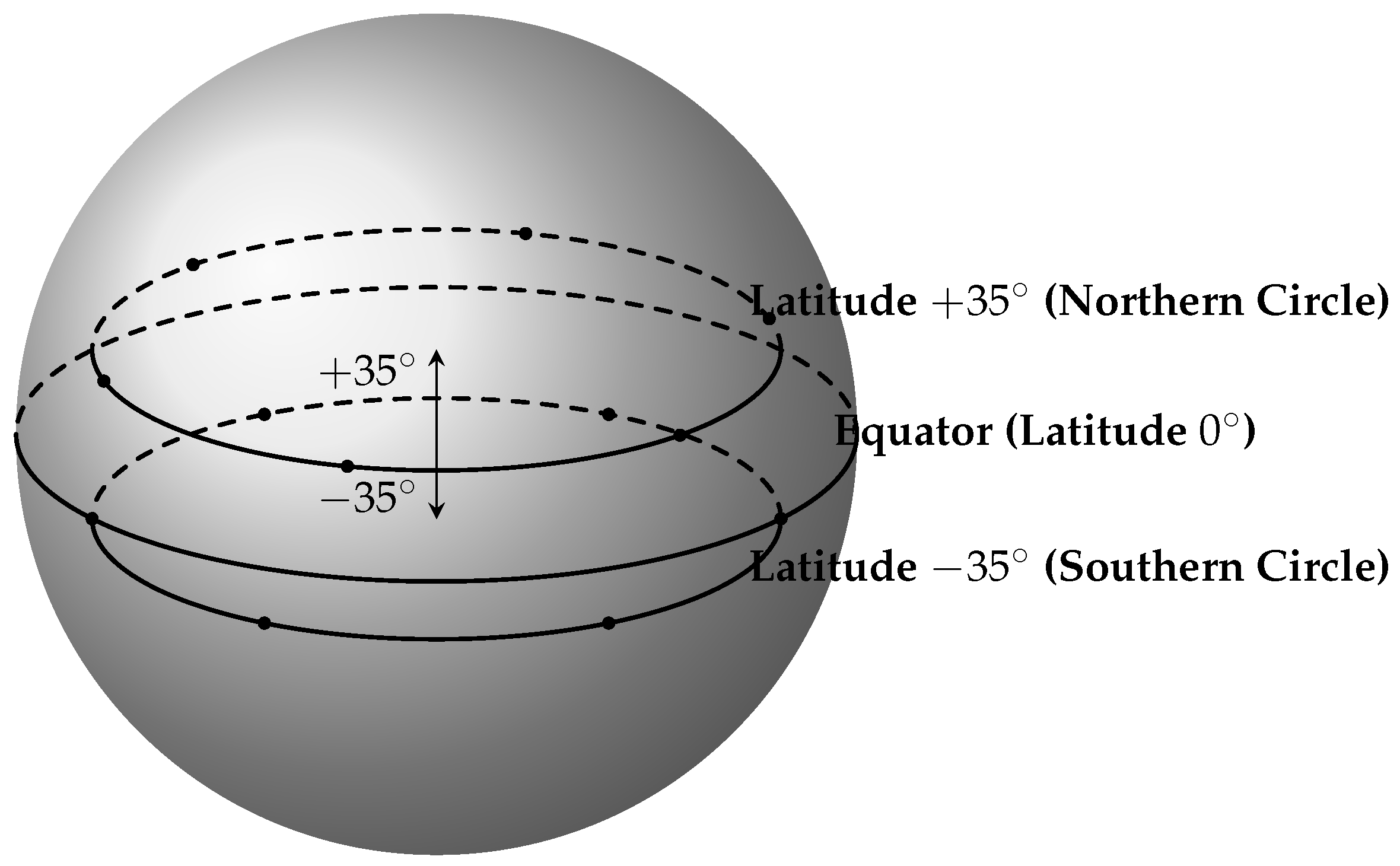
- Two Small Circles: Two antipodally symmetric parallels at latitudes , each sampled at M longitudes. We show that optimal quantizers inherit the antipodal symmetry, prove a no-cross-circle Voronoi property, and obtain finite-sum formulas with curvature-dependent bounds and asymptotics.
- (III)
- One Small Circle: A single small circle at latitude with N equally spaced points. We again obtain exact quantization formulas and quantify curvature effects, demonstrating a universal scaling of the error relative to the equator.
1.3. Novelty and Contributions of This Work
- We develop a unified framework for discrete spherical quantization that provides analytically tractable benchmark models, complementing the expository treatment of continuous spherical quantization in [12].
- For the equatorial model, we derive explicit formulas for optimal n-means and quantization error for both divisible and non-divisible cases , yielding a complete discrete analog of the classical error law on the unit circle .
- For two antipodally symmetric small circles, we prove a no-cross-circle Voronoi property, establish symmetry-preserving optimality, and obtain closed-form finite-sum error expressions together with curvature-dependent bounds and asymptotics.
- For a single small circle, we derive exact quantization formulas and rigorously quantify curvature effects, proving a universal scaling of the error while preserving the intrinsic rate.
- We include illustrative figures, numerical tables, and an algorithmic appendix with pseudocode and a short Python 3 (tested under Python 3.9+) implementation to facilitate verification and reproducibility.
1.4. Organization of the Paper
2. Preliminaries: Notation, Parametrizations, and Sums
2.1. The Unit Sphere and the Geodesic Distance
- (i)
- is even in and strictly increases with on . Moreover,
- (ii)
- (Small-angle behavior) As ,
- (iii)
- (Global bounds) For all ,In particular, the lower bound is asymptotically as .
2.2. Parametrizations of Great and Small Circles
- is the latitude, measured from the equator. Thus,
- is the longitude, measured counterclockwise from a fixed reference meridian.
- (i)
- Great Circle (Equator). The equator corresponds to . Its points are given by
- (ii)
- Small Circles at Latitude . For any fixed latitude , the parallel (or small circle) at height is
2.3. A Discrete Centered Square-Sum Identity
3. A One-Dimensional Engine on Circles: Contiguous Blocks and Midpoints
Setup and Notation
- (a)
- is a strictly convex quadratic polynomial in θ and therefore has a unique minimizer.
- (b)
- The unique minimizer is located at the midpoint of the angular span of the block, namely
- (c)
- The minimal value is
- (d)
- In a quantization problem on a circle with uniformly spaced sample points, no optimal Voronoi cell can be composed of two or more disjoint arcs. Any such non-contiguous assignment can be locally modified to strictly reduce the distortion. Consequently, each optimal Voronoi cell forms a single contiguous block of consecutive points.
- To compute the minimal value, let us introduce centered indices
- Proof of part :
- Consider two adjacent Voronoi cells and corresponding to representatives and . Suppose that is not contiguous; then it contains two disjoint arcs separated by a gap belonging to . Let x be a boundary point of the gap that lies closer (in angular order) to the midpoint of than to that of . Reassigning x from to and simultaneously transferring a point from the far end of to preserves the cardinalities of the cells.
- Because the squared loss is strictly convex in the angular coordinate, this exchange strictly decreases the total distortion: points that are closer to the midpoint representative incur smaller squared deviation. Hence any configuration with a non-contiguous Voronoi cell admits a local modification that lowers the loss. By iterating this argument, all gaps can be removed, and therefore every optimal Voronoi cell must be a single contiguous block of consecutive points. □
- The optimal strategy is to group neighboring beads into contiguous arcs and place one representative bead at the midpoint of each arc. Any attempt to form non-contiguous groups forces beads that are far apart along the circle to share the same representative, increasing the total tension. Thus, the minimum tension configuration always corresponds to contiguous blocks with midpoint representatives.
4. Model I: Great Circle (Equator)
4.1. Definition of the Model
4.2. Divisible Case
4.3. Non-Divisible Case
4.4. Summary of Model I
- Voronoi cells are contiguous arcs of approximately equal length;
- Representatives are the midpoints of those arcs;
- The quantization error decays proportionally to ;
- In the divisible case, perfect symmetry is achieved;
- In the non-divisible case, the pattern alternates between two neighboring block sizes m and .
5. Model II: Two Antipodally Symmetric Small Circles
5.1. Definition of the Model
5.2. Symmetry Reduction
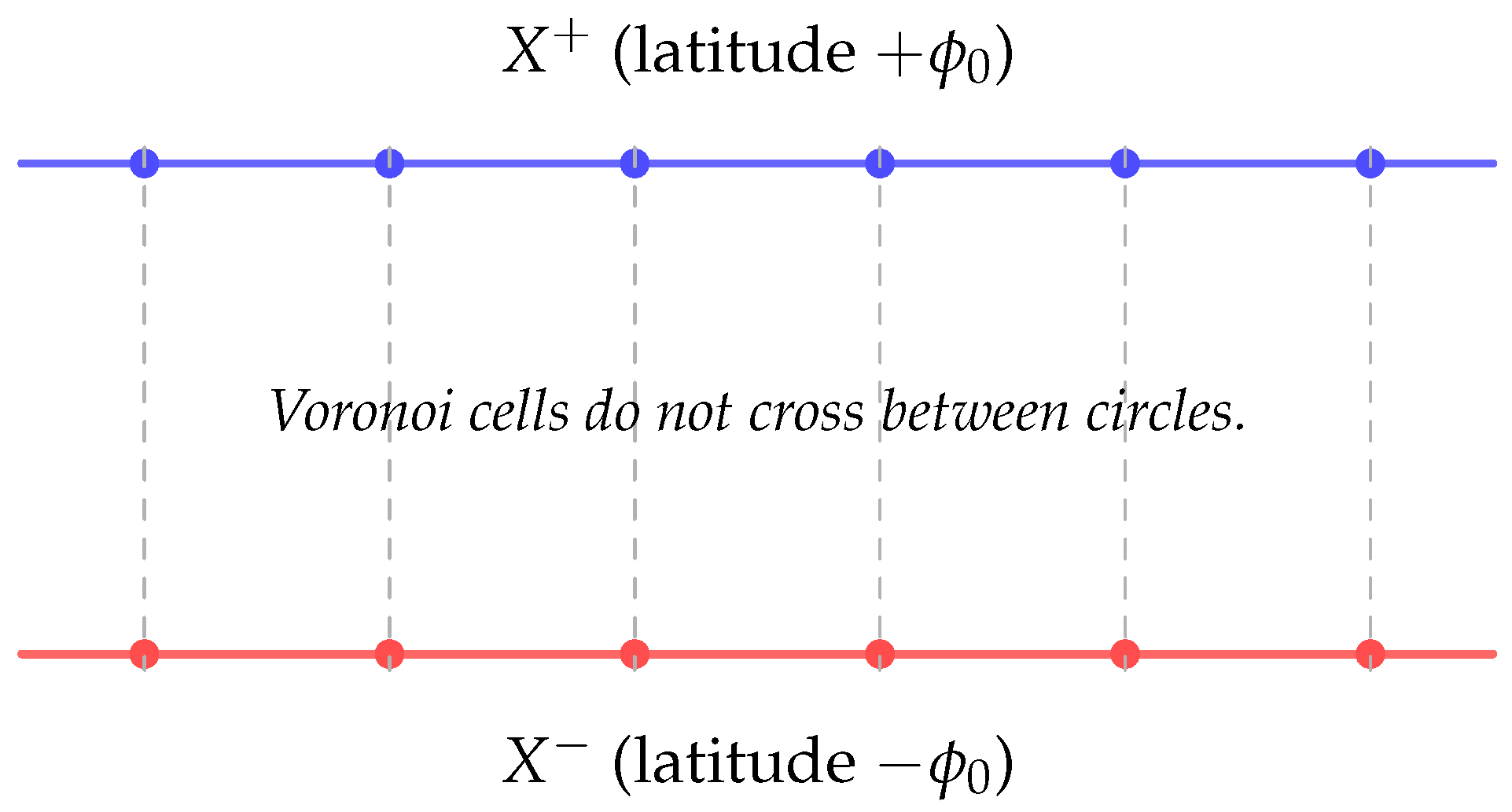
5.3. No-Cross-Circle Voronoi Regions
5.4. Exact Error Formula When n Is Even and Divides
5.5. Bounds and Asymptotics
5.6. Asymptotics for the Two-Circle Model

5.7. Visualization of the Voronoi Structure
5.8. Summary of Model II
- Optimal codebooks may be chosen antipodally symmetric, so the representatives occur in antipodal pairs; in particular, a symmetric configuration typically has the form .
- No Voronoi region crosses between the two circles (Proposition 2).
- Each circle decomposes into contiguous arcs with midpoint representatives; in divisible cases the arcs have equal size.
- Exact discrete errors reduce to a one-circle sum per block (Theorem 2), and asymptotically for fixed n.
6. Model III: One Small Circle at Latitude
6.1. Definition of the Model
6.2. Geometric Intuition
6.3. Exact Formulas for Divisible and Non-Divisible Cases
- (a)
- If n divides N and , then
- (b)
- If with , then
- (Global, uniform bound). For every and all offsets,
- (Local, asymptotically sharp estimate). As (fine sampling) with s fixed,
- In summary, curvature reduces the distortion by the multiplicative factor . The global bound is valid for all angular offsets and therefore uses the more conservative coefficient , whereas the local (small-angle) expansion shows that this coefficient improves from to 1 for small angular separations, making the lower bound asymptotically exact for fine partitions.
6.4. Numerical Example and Comparison
6.5. Summary of Model III
- Each Voronoi region is a contiguous arc with its midpoint as representative.
- The quantization error scales quadratically with , reflecting curvature.
- The rate persists, confirming that dimensional scaling dominates over curvature effects.
- In the limit , the results reduce to Model I.
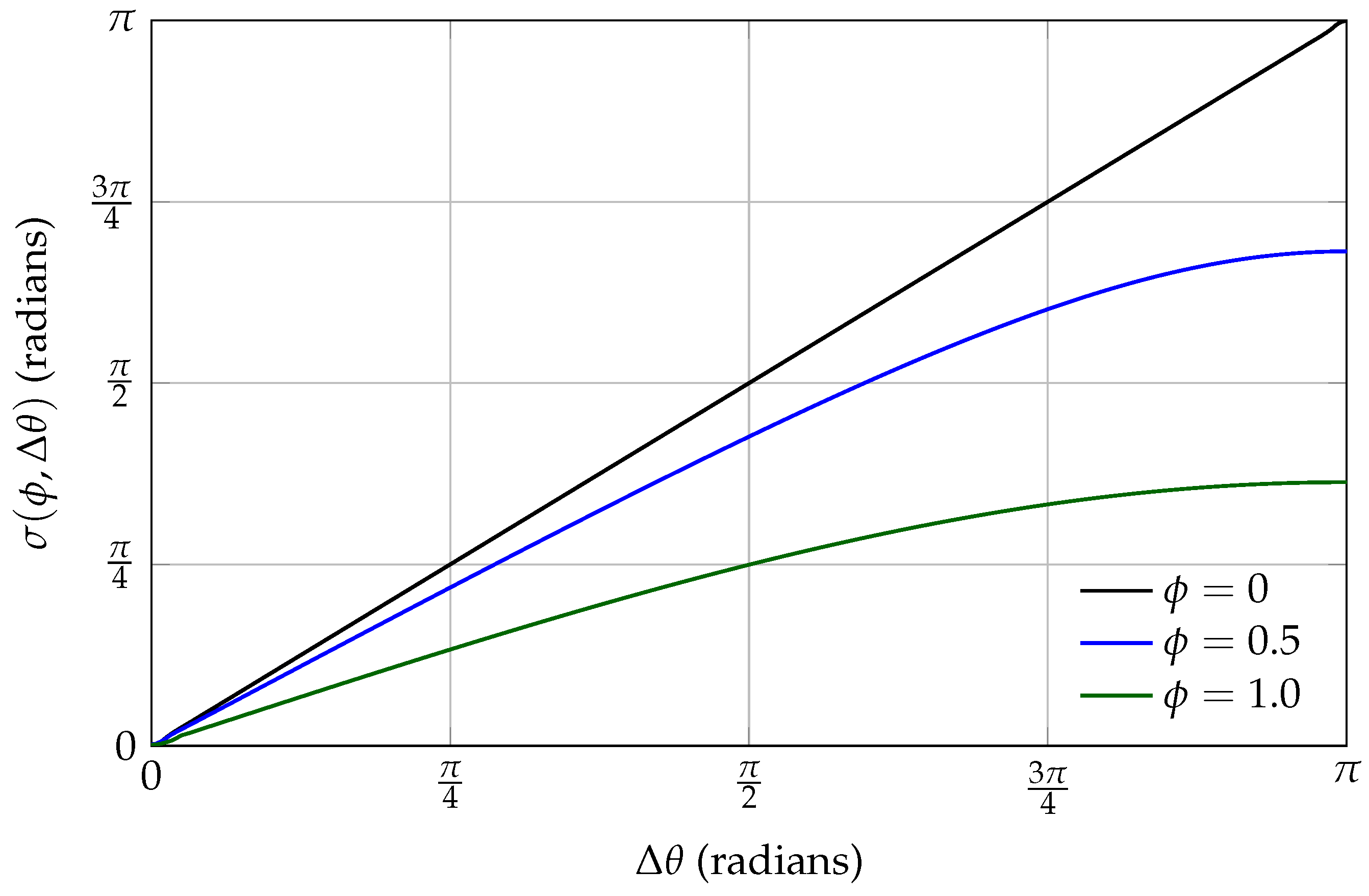
7. A Curvature Plot: vs.
7.1. Geometric Meaning of
- : the equator, where , i.e., the arc length on a circle of unit radius;
- : higher latitudes, where the same angular change in longitude corresponds to a smaller geodesic displacement because of the reduced effective radius .
- Thus, for any fixed , decreases monotonically with .
7.2. Analytic Behavior
- (no curvature);
- for and , showing that increasing latitude always shortens distances;
- is even and strictly convex on , as proved in Appendix A.
7.3. Plotting the Curvature Effect
7.4. Interpretation of the Plot
- Near the origin (), all curves are nearly straight lines with slopes , confirming the local linear approximation .
- For larger angular separations, the curves bend downward, reflecting the increasing curvature of the sphere.
- The area under each curve (for fixed ) qualitatively represents the mean distortion over that latitude, consistent with the scaling law in Models II and III.
8. Stability, Uniqueness, and Algorithmic Implementation
8.1. Uniqueness Up to Dihedral Symmetry (Divisible Cases)
8.2. Stability Under Small Perturbations
8.3. Linear-Time Algorithmic Construction
- Input. Integers , ; for Models II/III also a latitude (Model II uses two circles at with total points).
- Block sizes. Set and . Form a cyclic list of n blocks of sizes m and , placing the r larger blocks arbitrarily (e.g., first r blocks).
- Assignments. Traverse the circle once, assigning consecutive points to successive blocks, ensuring contiguity by construction.
- Representatives. For each block, place the representative at the azimuthal midpoint (the average longitude of the block). This midpoint is optimal because the loss kernel is even and strictly convex.
- Evaluation. Accumulate squared geodesic distances using on the equator or on a small circle.
8.4. Boundary and Tie Cases
- . All samples form a single block; the representative is the circular midpoint.
- . Each sample can serve as its own representative, yielding zero distortion.
- Equal-cost ties. If a boundary lies exactly halfway between two samples, either choice yields identical distortion; any consistent tie-breaking rule preserves optimality.
- Model II parity. Antipodal symmetry forces n to be even, , with k representatives assigned to each circle.
8.5. Numerical Implementation Tips
- Angle normalization. Always reduce angular differences to before squaring.
- Robust arccos. Clip arguments to to prevent floating-point errors.
- Kernel reuse. Cache and for efficient evaluation of on small circles.
8.6. Summary
- Optimal Voronoi regions are contiguous arcs, and their representatives are azimuthal midpoints.
- Divisible cases are unique up to dihedral symmetry; non-divisible cases are unique up to the cyclic placement of the r larger blocks.
- Optimal partitions and quantization errors can be constructed in linear time using numerically stable operations.
9. Discussion and Outlook
9.1. Thematic Synthesis
- Model I (Equator). Flat one-dimensional geometry on the sphere’s equator reproduces the classical quantization law of .
- Model II (Two Circles). Curvature enters via the effective radius ; antipodal symmetry enforces even n and halves the computational domain.
- Model III (Single Circle). The same curvature factor appears without symmetry, confirming that the scaling is purely geometric.
9.2. Implications for Higher-Dimensional Extensions
- (1)
- approximate the manifold by local coordinate circles or arcs,
- (2)
- quantize each arc using the 1D engine,
- (3)
- merge results through nearest-neighbor refinement.
9.3. Relation to Full-Surface Quantization
9.4. Open Directions
- Quantization on spherical triangles or polygonal regions, where Voronoi cells meet along curved geodesic boundaries;
- Optimal configurations on spherical lattices (e.g. icosahedral or Fibonacci grids);
- Conditional and constrained quantization when subsets of the sphere carry additional probability weights;
- Theoretical links between curvature-weighted distortion and intrinsic Ricci curvature of the manifold.
Funding
Data Availability Statement
Acknowledgments
Conflicts of Interest
Appendix A. Properties of the Geodesic Distance on a Small Circle
Appendix A.1. Symmetry, Monotonicity, and Convexity
- (i)
- (Symmetry) for all .
- (ii)
- (Monotonicity) is strictly increasing on .
- (iii)
- (Convexity) is strictly convex on .
- For (iii), a direct computation of shows that it is strictly positive on (details omitted for brevity). A positive second derivative confirms strict convexity. □
Appendix A.2. Exact Identity and Two-Sided Bounds
- First, use to rewrite the expression inside the arccos:
- Lower bound. Set . Since for (e.g., because for and taking gives ), from Equation (A1) we obtain
Appendix A.3. Local Expansion Near Δθ=0
Appendix A.4. Geometric Interpretation
Appendix B. Smoothing Principle for Block Lengths
Appendix B.1. Why Smoothing Is Needed
Appendix B.2. Strict Convexity of D(s) and Its Consequence
If two block sizes differ by at least 2, then redistributing one point from the larger block to the smaller block strictly decreases the total distortion.
Appendix B.3. Concrete Example
Appendix B.4. The Smoothing Principle
Smoothing Principle. Among all integer block sizes with fixed total , the total distortion is minimized when all block sizes are either m or , where . Moreover, the number of blocks of size must be .
Appendix C. Worked Micro-Examples (Didactic)
Appendix C.1. Great Circle, N=12, n=5
Appendix C.2. Two Small Circles, M=24, n=6
Appendix C.3. Two Small Circles, Full Calculation, M=24, n=6
Appendix D. Algorithmic Appendix: Computing S(s, ϕ0) and Vn,2
Appendix D.1. Pseudocode: S(s,ϕ0) on One Small Circle
Input: integers , , real
Output: , where
- ; .
- For :; .; ..
- return S.
Appendix D.2. Pseudocode: Vn,2 on One Small Circle
Input: , ,
Output:
- ; ; .
- Compute and using the previous routine (with ).
- return .
- Pseudocode: on Two Small Circles
Input: , even ,
Output: with
- (assume ); .
- Compute via the first routine (with M).
- return .
Appendix D.3. Commented Python Exam (Verbatim)
References
- Zador, P. Asymptotic quantization error of continuous signals and the quantization dimension. IEEE Trans. Inform. Theory 1982, 28, 139–149. [Google Scholar] [CrossRef]
- Gray, R.M.; Neuhoff, D.L. Quantization. IEEE Trans. Inform. Theory 1998, 44, 2325–2383. [Google Scholar] [CrossRef]
- Gersho, A.; Gray, R.M. Vector Quantization and Signal Compression; Springer: Berlin/Heidelberg, Germany, 1991. [Google Scholar]
- Lloyd, S. Least squares quantization in PCM. IEEE Trans. Inf. Theory 1982, 28, 129–137. [Google Scholar] [CrossRef]
- Linde, Y.; Buzo, A.; Gray, R. An Algorithm for Vector Quantizer Design. IEEE Trans. Commun. 1980, 28, 84–95. [Google Scholar] [CrossRef]
- Du, Q.; Faber, V.; Gunzburger, M. Centroidal Voronoi tessellations: Applications and Algorithms. SIAM Rev. 1999, 41, 637–676. [Google Scholar] [CrossRef]
- Pollard, D. A central limit theorem for k-means clustering. Ann. Probab. 1982, 10, 919–926. [Google Scholar] [CrossRef]
- Graf, S.; Luschgy, H. Foundations of Quantization for Probability Distributions; Springer: Berlin/Heidelberg, Germany, 2000. [Google Scholar]
- Mardia, K.V.; Jupp, P.E. Directional Statistics; Wiley: Hoboken, NJ, USA, 1999. [Google Scholar]
- Pennec, X. Intrinsic statistics on Riemannian manifolds: Basic tools for geometric measurements. J. Math. Imaging Vision 2006, 25, 127–154. [Google Scholar] [CrossRef]
- Tapp, K. Differential Geometry of Curves and Surfaces; Springer: Berlin/Heidelberg, Germany, 2016. [Google Scholar]
- Roychowdhury, M.K. Optimal Quantization on Spherical Surfaces: Continuous and Discrete Models—A Beginner-Friendly Expository Study. Mathematics 2026, 14, 63. [Google Scholar] [CrossRef]



| Reduction from Equator | |||
|---|---|---|---|
| 0 | 1.000 | 0.0913 | — |
| 0.6 | 0.681 | 0.0621 | 31.9% |
| 1.0 | 0.292 | 0.0267 | 70.8% |
Disclaimer/Publisher’s Note: The statements, opinions and data contained in all publications are solely those of the individual author(s) and contributor(s) and not of MDPI and/or the editor(s). MDPI and/or the editor(s) disclaim responsibility for any injury to people or property resulting from any ideas, methods, instructions or products referred to in the content. |
© 2026 by the author. Licensee MDPI, Basel, Switzerland. This article is an open access article distributed under the terms and conditions of the Creative Commons Attribution (CC BY) license.
Share and Cite
Roychowdhury, M.K. Discrete Quantization on Spherical Geometries: Explicit Models, Computations, and Didactic Exposition. Mathematics 2026, 14, 750. https://doi.org/10.3390/math14050750
Roychowdhury MK. Discrete Quantization on Spherical Geometries: Explicit Models, Computations, and Didactic Exposition. Mathematics. 2026; 14(5):750. https://doi.org/10.3390/math14050750
Chicago/Turabian StyleRoychowdhury, Mrinal Kanti. 2026. "Discrete Quantization on Spherical Geometries: Explicit Models, Computations, and Didactic Exposition" Mathematics 14, no. 5: 750. https://doi.org/10.3390/math14050750
APA StyleRoychowdhury, M. K. (2026). Discrete Quantization on Spherical Geometries: Explicit Models, Computations, and Didactic Exposition. Mathematics, 14(5), 750. https://doi.org/10.3390/math14050750