Linking Self-Organization of Bacterial and Human Populations in Mathematical Models of Chemotaxis


Abstract
1. Introduction
2. Mathematical Models
2.1. Keller–Segel Model of Chemotaxis
2.2. Bacterial Self-Organization
2.3. Capital-Induced Labor Migration
2.4. Urban Crime Propagation
2.5. Dimensionalizing the Variables
3. Numerical Simulation
4. Results and Discussion
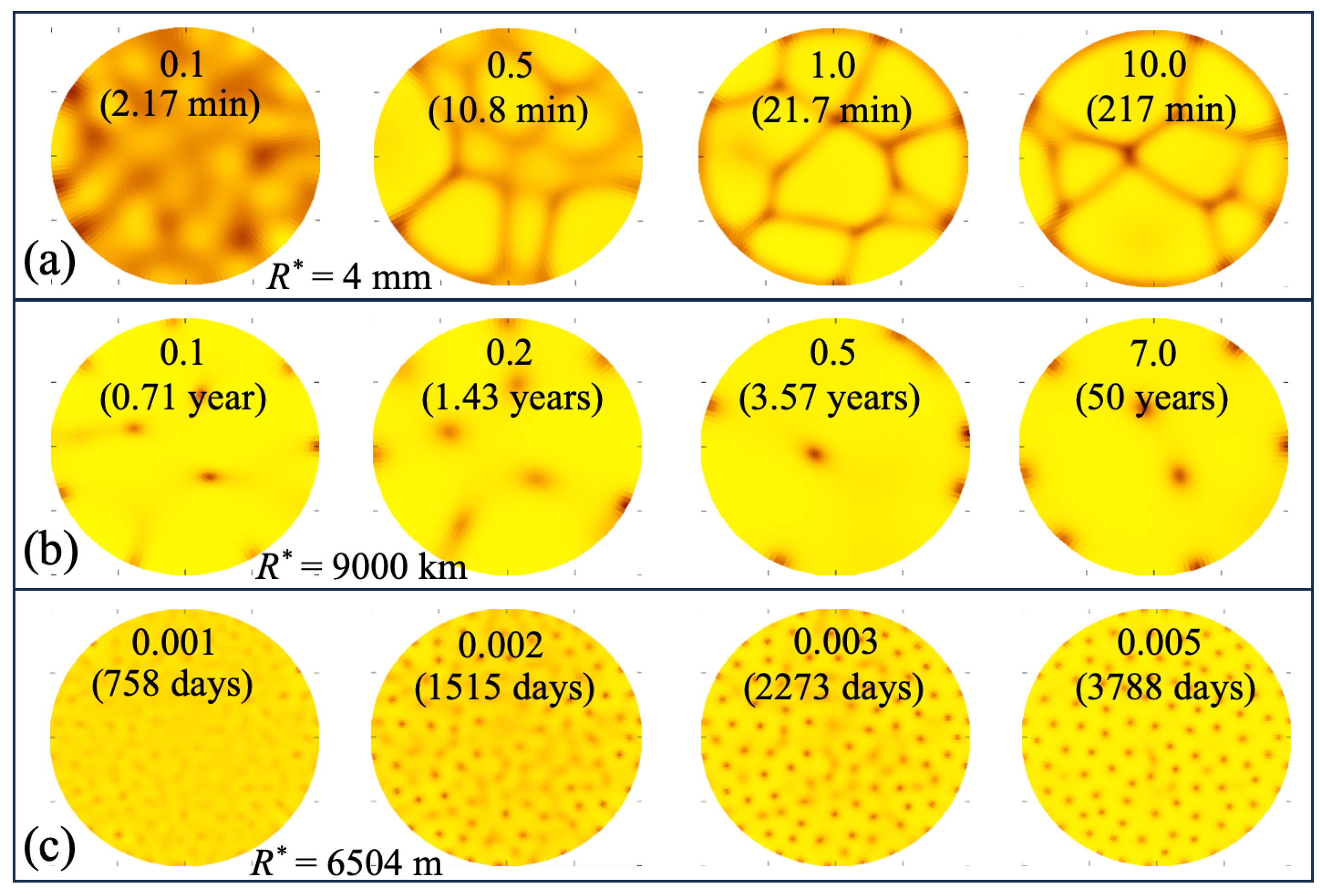
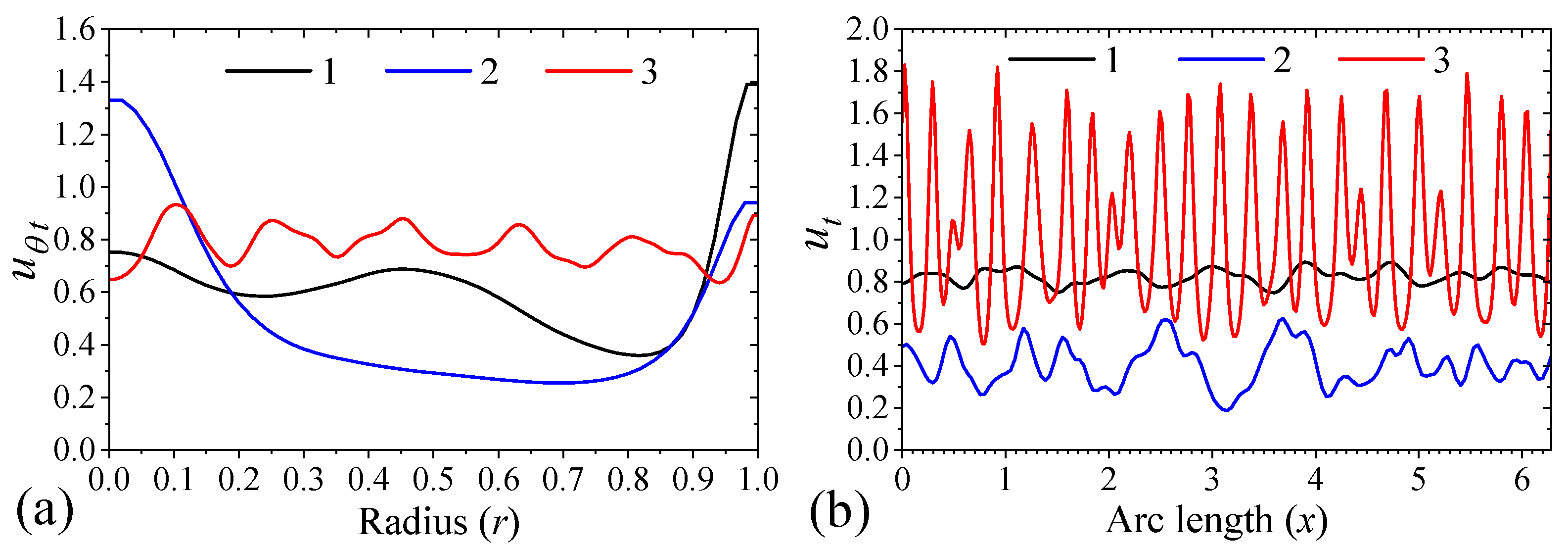
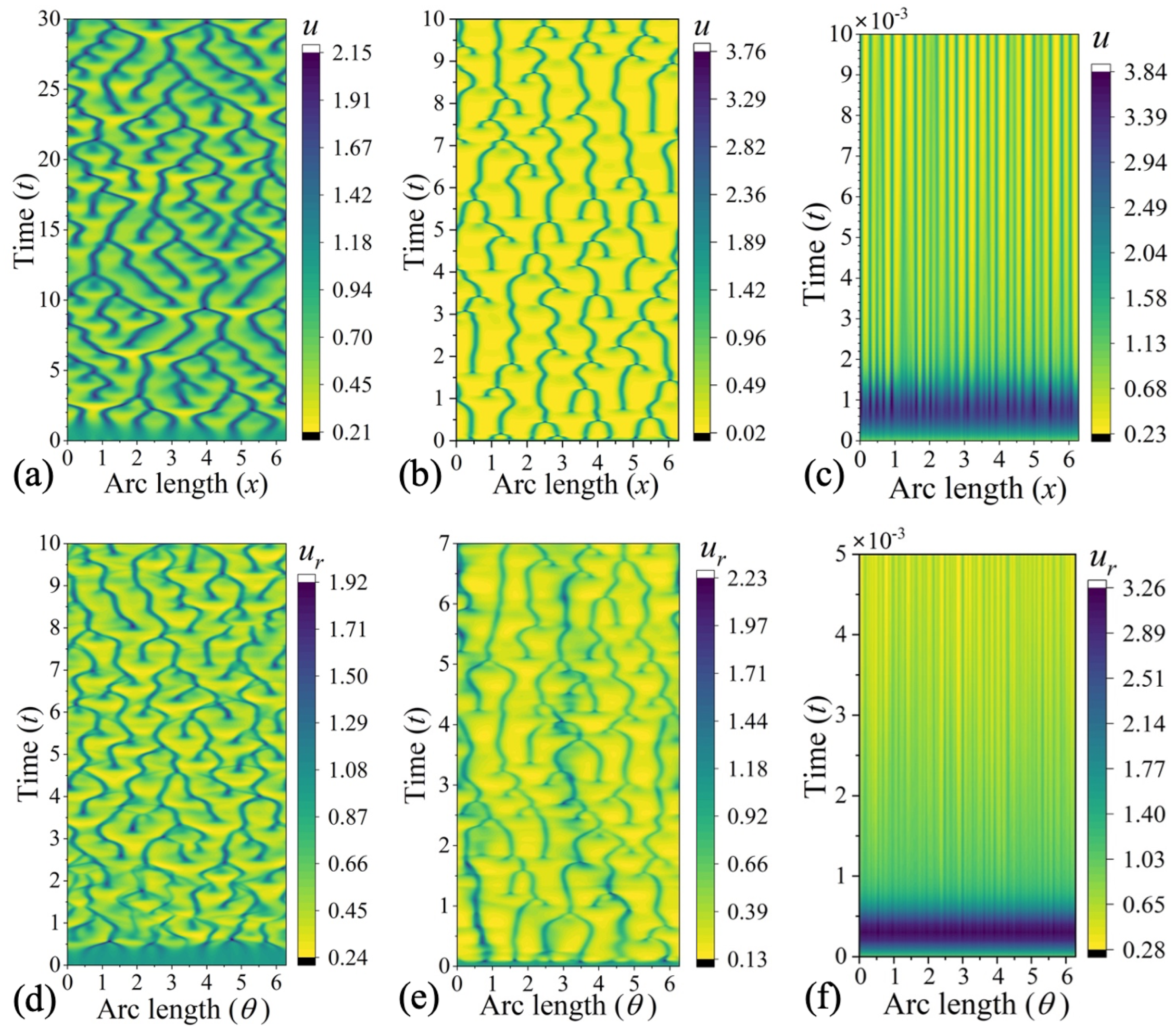
4.1. Results of Numerical Experiments
4.2. Estimation of Dimensional Parameters
4.3. Inhomogeneities in Population Densities
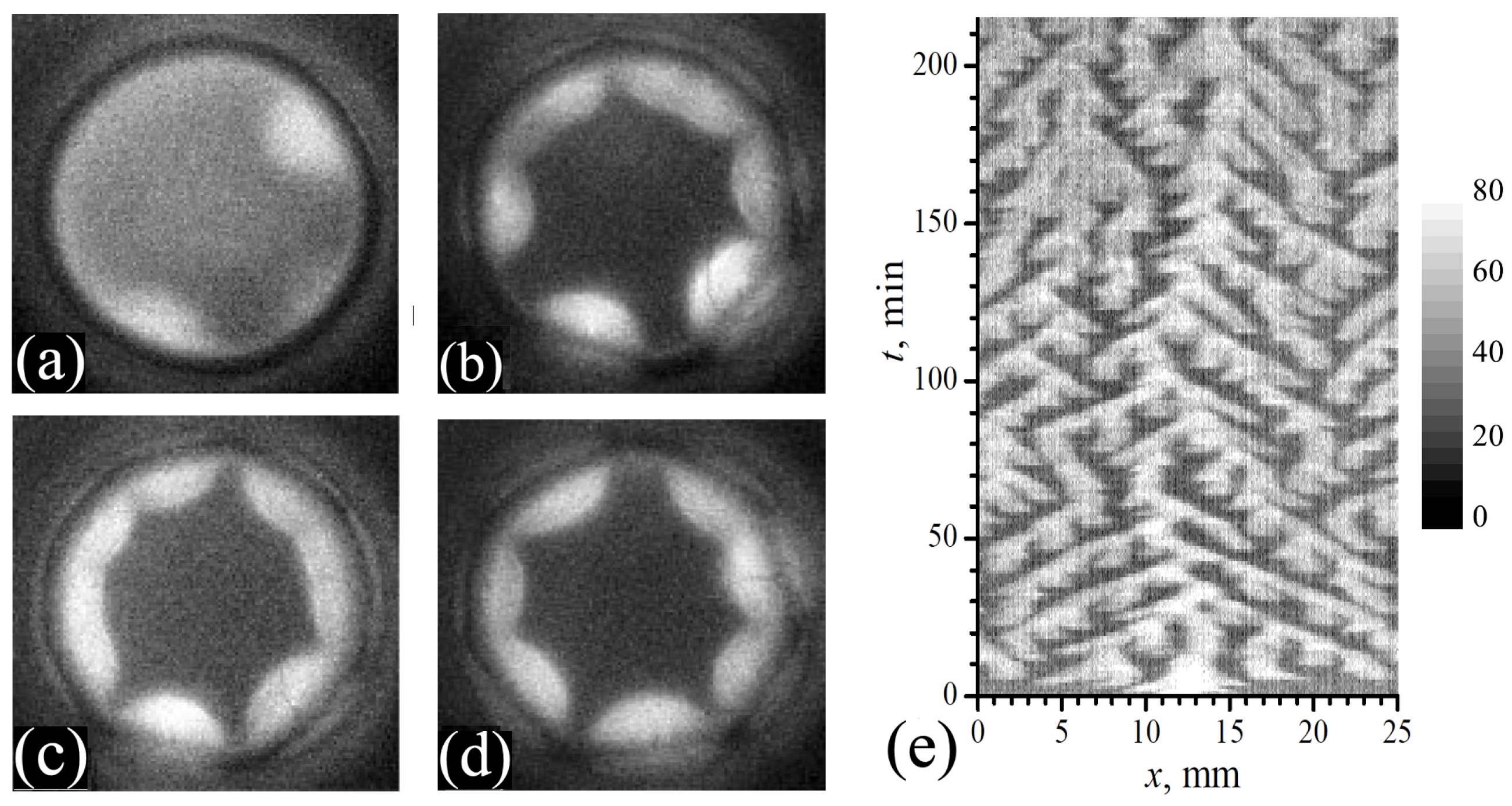
4.4. Validation of Chemotaxis-Type Models
5. Conclusions
Author Contributions
Funding
Data Availability Statement
Conflicts of Interest
References
- Simmchen, J.; Gordon, D.; MacKenzie, J.; Pagonabarraga, I.; Roggatz, C.; Endres, R.; Xiao, Z.; Friedrich, B.; Qiu, T.; Painter, K.; et al. Perspective on interdisciplinary approaches on chemotaxis. Angew. Chem. Int. Ed. 2025, 64, e202504790. [Google Scholar] [CrossRef]
- Eisenbach, M. Chemotaxis; Imperial College Press: London, UK, 2004. [Google Scholar]
- Painter, K. Mathematical models for chemotaxis and their applications in self-organization phenomena. J. Theor. Biol. 2019, 481, 162–182. [Google Scholar] [CrossRef] [PubMed]
- Budrene, E.; Berg, H. Dynamics of formation of symmetrical patterns by chemotactic bacteria. Nature 1995, 376, 49–53. [Google Scholar] [CrossRef]
- Hillen, T.; Painter, K. A user’s guide to PDE models for chemotaxis. J. Math. Biol. 2009, 58, 183–217. [Google Scholar] [CrossRef] [PubMed]
- Tyson, R.; Stern, L.; LeVeque, R. Fractional step methods applied to a chemotaxis model. J. Math. Biol. 2000, 41, 455–475. [Google Scholar] [CrossRef]
- Tuval, I.; Cisneros, L.; Dombrowski, C.; Wolgemuth, C.W.; Kessler, J.; Goldstein, R.E. Bacterial swimming and oxygen transport near contact lines. Proc. Natl. Acad. Sci. USA 2005, 102, 2277–2282. [Google Scholar] [CrossRef]
- Coppens, B.; Belpaire, T.; Pešek, J.; Steenackers, H.; Ramon, H.; Smeets, B. Anomalous diffusion of nanoparticles in the spatially heterogeneous biofilm environment. iScience 2023, 26, 106861. [Google Scholar] [CrossRef] [PubMed]
- Keller, E.; Segel, L. Model for chemotaxis. J. Theor. Biol. 1971, 30, 225–234. [Google Scholar] [CrossRef]
- Chertock, A.; Fellner, K.; Kurganov, A.; Lorz, A.; Markowich, P.A. Sinking, merging and stationary plumes in a coupled chemotaxis-fluid model: A high-resolution numerical approach. J. Fluid Mech. 2012, 694, 155–190. [Google Scholar] [CrossRef]
- Bellomo, N.; Outada, N.; Soler, J.; Tao, Y.; Winkler, M. Chemotaxis and cross-diffusion models in complex environments: Models and analytic problems toward a multiscale vision. Math. Models Methods Appl. Sci. 2022, 32, 713–792. [Google Scholar] [CrossRef]
- Neto, J.; Claeyssen, J.; Pôrto Júnior, S. Returns to scale in a spatial Solow-Swan economic growth model. Phys. A Stat. Mech. Appl. 2019, 533, 122055. [Google Scholar] [CrossRef]
- Li, B.; Li, Y. On a chemotaxis-type Solow-Swan model for economic growth with capital-induced labor migration. J. Math. Anal. Appl. 2022, 511, 126080. [Google Scholar]
- Neto, J.; de Almeida Konzen, P.; Claeyssen, J. A Model of Economic Growth in Two Spatial Dimensions. Proceeding Ser. Braz. Soc. Comput. Appl. Math. 2023, 10, 010011. [Google Scholar] [CrossRef]
- Short, M.; D’Orsogna, M.; Pasour, V.; Tita, G.; Brantingham, P.; Bertozzi, A.; Chayes, L. A statistical model of criminal behavior. Math. Models Methods Appl. Sci. 2008, 18, 1249–1267. [Google Scholar]
- Short, M.; Bertozzi, A.; Brantingham, P. Nonlinear Patterns in Urban Crime: Hotspots, Bifurcations, and Suppression. SIAM J. Math. Anal. 2010, 9, 462–483. [Google Scholar] [CrossRef]
- Li, B.; Wang, Z.; Xie, L. Regularization effect of the mixed-type damping in a higher-dimensional logarithmic Keller-Segel system related to crime modeling. Math. Biosci. Eng. 2023, 20, 4532–4559. [Google Scholar] [CrossRef]
- Rodriguez, N.; Bertozzi, A. Local existence and uniqueness of solutions to a PDE model for criminal behavior. Math. Models Methods Appl. Sci. 2010, 20, 1425–1457. [Google Scholar] [CrossRef]
- Li, B.; Xie, L. Smoothness effects of a quadratic damping term of mixed type on a chemotaxis-type system modeling propagation of urban crime. Nonlinear Anal. Real World Appl. 2023, 73, 103912. [Google Scholar] [CrossRef]
- Kurt, H.; Shen, W. Finite-Time Blow-Up Prevention by Logistic Source in Parabolic-Elliptic Chemotaxis Models with Singular Sensitivity in Any Dimensional Setting. SIAM J. Math. Anal. 2021, 53, 973–1003. [Google Scholar] [CrossRef]
- Zhao, Y.; Xie, L. Global classical solvability and asymptotic behaviors of a parabolic-elliptic Chemotaxis-type system modeling crime activities. J. Math. Anal. Appl. 2024, 532, 127909. [Google Scholar] [CrossRef]
- Tabata, M.; Eshima, N.; Takagi, I. A geometrical similarity between migration of human population and diffusion of biological particles. Nonlinear Anal. Real World Appl. 2006, 7, 872–894. [Google Scholar] [CrossRef]
- Tabata, M.; Eshima, N.; Takagi, I. A mathematical modeling approach to the formation of urban and rural areas: Convergence of global solutions of the mixed problem for the master equation in sociodynamics. Nonlinear Anal. Real World Appl. 2011, 12, 3261–3293. [Google Scholar] [CrossRef]
- Balcı, M. Distributed order model of labor migration. Int. J. Nonlinear Sci. Numer. Simul. 2023, 24, 2497–2512. [Google Scholar]
- Šimkus, R.; Baronas, R. Metabolic self-organization of bioluminescent Escherichia coli. Luminescence 2011, 26, 716–721. [Google Scholar] [CrossRef]
- Baronas, R.; Ledas, Ž.; Šimkus, R. Computational modeling of self-organization in a liquid phase bacterial bioluminescent biosensor. In Proceedings of the 6th European Congress on Computational Methods in Applied Sciences and Engineering (ECCOMAS 2012), Vienna, Austria, 10–14 September 2012; p. Paper ID: 4815. [Google Scholar]
- Baronas, R.; Ledas, Ž.; Šimkus, R. Computational modeling of the bacterial self-organization in a rounded container: The effect of dimensionality. Nonlinear Anal. Model. Control 2015, 20, 603–620. [Google Scholar] [CrossRef]
- Šimkus, R.; Baronas, R.; Ledas, Ž. A multi-cellular network of metabolically active E. coli as a weak gel of living Janus particles. Soft Matter 2013, 9, 4489–4500. [Google Scholar] [CrossRef]
- Gu, Y.; Wang, Q.; Yi, G. Stationary patterns and their selection mechanism of urban crime models with heterogeneous near-repeat victimization effect. Eur. J. Appl. Math. 2017, 28, 141–178. [Google Scholar] [CrossRef]
- Samarskii, A. The Theory of Difference Schemes; Marcel Dekker: New York, NY, USA; Basel, Switzerland, 2001. [Google Scholar]
- Maini, P.; Myerscough, M.; Winters, K.; Murray, J. Bifurcating spatially heterogeneous solutions in a chemotaxis model for biological pattern generation. Bull. Math. Biol. 1991, 53, 701–719. [Google Scholar] [PubMed]
- Painter, K.; Hillen, T. Spatio-temporal chaos in a chemotactic model. Phys. D Nonlinear Phenom. 2011, 240, 363–375. [Google Scholar] [CrossRef]
- Qiu, Z.; Li, B. Eventual smoothness of generalized solutions to a singular chemotaxis system for urban crime in space dimension 2. Electron. Res. Arch. 2023, 31, 3218–3244. [Google Scholar] [CrossRef]
- Cherstvy, A.; Metzler, R. Ergodicity breaking and particle spreading in noisy heterogeneous diffusion processes. J. Chem. Phys. 2015, 142, 144105. [Google Scholar] [CrossRef] [PubMed]
- Ballestra, L. Modeling economic growth with spatial migration: A stability analysis of the long-run equilibrium based on semigroup theory. J. Math. Anal. Appl. 2024, 531, 127794. [Google Scholar] [CrossRef]
- Rodriguez, N.; Winkler, M. Relaxation by nonlinear diffusion enhancement in a two-dimensional cross-diffusion model for urban crime propagation. Math. Models Methods Appl. Sci. 2020, 30, 2105–2137. [Google Scholar] [CrossRef]
- Balcı, M. Time fractional capital-induced labor migration model. Phys. A Stat. Mech. Appl. 2017, 477, 91–98. [Google Scholar] [CrossRef]
- Fu, S.; Liu, J. Spatial pattern formation in the Keller-Segel model with a logistic source. Comput. Math. Appl. 2013, 66, 403–417. [Google Scholar] [CrossRef]
- Murray, J. Mathematical Biology: II. Spatial Models and Biomedical Applications, 3rd ed.; Springer: Berlin, Germany, 2003. [Google Scholar]
- Pitcher, A. Adding police to a mathematical model of burglary. Eur. J. Appl. Math. 2010, 21, 401–419. [Google Scholar] [CrossRef]
- Ispolatov, J.; Doebeli, M. Diversification along environmental gradients in spatially structured populations. Evol. Ecol. Res. 2004, 11, 295–304. [Google Scholar]
- Tisbury, A.; Needham, D.; Tzella, A. The evolution of traveling waves in a KPP reaction-diffusion model with cut-off reaction rate. I. Permanent form traveling waves. Stud. Appl. Math. 2021, 146, 301–329. [Google Scholar]
- Myerscough, M.; Maini, P.; Painter, K. Pattern formation in a generalized chemotactic model. Bull. Math. Biol. 1998, 60, 1–26. [Google Scholar] [CrossRef] [PubMed]
- Čiegis, R.; Bugajev, A. Numerical approximation of one model of bacterial self-organization. Nonlinear Anal. Model. Control 2012, 17, 253–270. [Google Scholar] [CrossRef]
- Heihoff, F. Generalized solutions for a system of partial differential equations arising from urban crime modeling with a logistic source term. Z. Angew. Math. Phys. 2020, 71, 80. [Google Scholar] [CrossRef]
- Ureña, N.; Vargas, A. On the numerical solution to a Solow model with spatial diffusion and technology-induced capital mobility. Eng. Anal. Bound. Elem. 2023, 157, 541–552. [Google Scholar] [CrossRef]
- Šimkus, R.; Meškienė, R.; Aučynaitė, A.; Ledas, Ž.; Baronas, R.; Meškys, R. Phoretic interactions and oscillationsin active suspensions of growing Escherichia coli. R. Soc. Open Sci. 2018, 5, 180008. [Google Scholar]
- Lai, M.C. A note on finite difference discretizations for Poisson equation on a disk. Numer. Methods Partial. Differ. Equ. 2001, 17, 199–203. [Google Scholar]
- Knoll, P.; Mirzaei, S. Scientific computing with Java. Comput. Appl. Eng. Educ. 2010, 18, 495–501. [Google Scholar] [CrossRef]
- Moberly, J.; Bernards, M.; Waynant, K. Key features and updates for Origin 2018. J. Cheminform. 2018, 10, 5. [Google Scholar]
- Šimkus, R.; Kirejev, V.; Meškienė, R.; Meškys, R. Torus generated by Escherichia coli. Exp. Fluids 2009, 46, 365–369. [Google Scholar] [CrossRef]
- Brenner, M.; Levitov, L.; Budrene, E. Physical mechanisms for chemotactic pattern formation by bacteria. Biophys. J. 1998, 74, 1677–1693. [Google Scholar] [CrossRef] [PubMed]
- Berg, H.; Turner, L. Chemotaxis of bacteria in glass capillary arrays. Biophys. J. 1990, 58, 919–930. [Google Scholar] [CrossRef]
- Perry, N. Experimental validation of a critical domain size in reaction-diffusion systems with Escherichia coli populations. J. R. Soc. Interface 2005, 2, 379–387. [Google Scholar]
- Czaika, M.; de Haas, H. The Globalization of Migration: Has the world really become more migratory? Int. Migr. Rev. 2015, 48, 283–323. [Google Scholar] [CrossRef]
- Stillwell, J.; Bell, M.; Ueffing, P.; Daras, K.; Charles-Edwards, E.; Kupiszewski, M.; Kupiszewska, D. Internal migration around the world: Comparing distance travelled and its frictional effect. Environ. Plan. A 2016, 48, 1657–1675. [Google Scholar] [CrossRef]
- Kolter, R.; Greenberg, E. The superficial life of microbes. Nature 2006, 441, 300–302. [Google Scholar] [CrossRef] [PubMed]
- D’Orsogna, M.; Perc, M. Statistical physics of crime: A review. Phys. Life Rev. 2015, 12, 1–21. [Google Scholar] [CrossRef] [PubMed]
- Railsback, S.; Grimm, V. Agent-Based and Individual-Based Modeling: A Practical Introduction; Princeton University Press: Princeton, NJ, USA, 2019. [Google Scholar]



| Parameter | Bacteria | Labor | Crime | |||
|---|---|---|---|---|---|---|
| 1D | 2D | 1D | 2D | 1D | 2D | |
| D | 0.1 | 1 | 50 | |||
| 6.0 | 10 | 100 | ||||
| 1.0 | 0.4 | – | ||||
| 0.7 | – | – | ||||
| 12 | 36 | 70 | 70 | 600 | 1500 | |
| – | 0.7 | – | ||||
| – | – | 10.0 | ||||
| – | – | 0.5 | ||||
| 1.0 | 1.0 | 1.0 | ||||
| 1.0 | 1.0 | 1.0 | ||||
| , | 150 | 6070 | 150 | 50150 | 300 | 150250 |
| T | ||||||
Disclaimer/Publisher’s Note: The statements, opinions and data contained in all publications are solely those of the individual author(s) and contributor(s) and not of MDPI and/or the editor(s). MDPI and/or the editor(s) disclaim responsibility for any injury to people or property resulting from any ideas, methods, instructions or products referred to in the content. |
© 2026 by the authors. Licensee MDPI, Basel, Switzerland. This article is an open access article distributed under the terms and conditions of the Creative Commons Attribution (CC BY) license.
Share and Cite
Baronas, R.; Dapkūnas, B.; Šimkus, R. Linking Self-Organization of Bacterial and Human Populations in Mathematical Models of Chemotaxis. Mathematics 2026, 14, 748. https://doi.org/10.3390/math14050748
Baronas R, Dapkūnas B, Šimkus R. Linking Self-Organization of Bacterial and Human Populations in Mathematical Models of Chemotaxis. Mathematics. 2026; 14(5):748. https://doi.org/10.3390/math14050748
Chicago/Turabian StyleBaronas, Romas, Boleslovas Dapkūnas, and Remigijus Šimkus. 2026. "Linking Self-Organization of Bacterial and Human Populations in Mathematical Models of Chemotaxis" Mathematics 14, no. 5: 748. https://doi.org/10.3390/math14050748
APA StyleBaronas, R., Dapkūnas, B., & Šimkus, R. (2026). Linking Self-Organization of Bacterial and Human Populations in Mathematical Models of Chemotaxis. Mathematics, 14(5), 748. https://doi.org/10.3390/math14050748