1. Introduction
Hypercomplex function theories provide a natural language for first-order elliptic systems (Dirac-type operators) and for boundary value problems governed by these operators. In particular, Clifford analysis and its quaternionic variants unify Cauchy-type integral formulas, Hardy space decompositions, and singular integral operators; see the classical monographs [
1,
2,
3] and the geometric calculus perspective [
4]. The quaternionic viewpoint in [
5] underlines how Cauchy–Fueter type operators lead to robust integral representation formulas. Complementary noncommutative frameworks, such as slice hyperholomorphic function theory and slice topology, provide further tools and intuition for analysis on real alternative algebras [
6,
7].
A recurring analytic issue in all these settings is to control boundary limits of Cauchy-type integrals and to identify the corresponding singular integral operators on (possibly non-smooth) hypersurfaces. Hardy-space methods and Clifford-valued singular integrals are treated systematically in [
8], and are further developed on conformally flat spin manifolds (including the construction of Cauchy kernels and Plemelj projection operators) in [
9]. For first-order systems on Lipschitz domains and related Hodge-type decompositions, we refer to [
10]. In real Clifford analysis, generalized Cauchy theorems and boundary value problems yield Plemelj–Sokhotski type jump relations [
11]. Recent work provides sharpened versions of the Plemelj–Sokhotski formula [
12] as well as analogous jump formulas for the higher-order
k-Cauchy–Fueter operator [
13]. Related integral kernels and Teodorescu transforms have been developed for generalized partial-slice monogenic functions [
14,
15] and for monogenic functions with values in generalized Clifford algebras [
16]. Discrete counterparts of Plemelj projections in quaternionic analysis have also been investigated [
17]. We also mention recent refinements of Cauchy integral formulas in Hermitian/quaternionic Clifford analysis [
18].
While standard quaternionic/Clifford frameworks provide a powerful boundary integral calculus in associative algebras, they do not, by themselves, capture the perturbative “dual” mechanism studied here: a nilpotent extension coupled with a projected (hence non-associative) product. In our setting the dual ternary structure produces an explicit splitting of the Cauchy kernel into a reduced term and a dual correction term. The correction is one order more integrable, yielding a smoothing effect. This structural feature is central to our boundary limit analysis and may also suggest a practical advantage in numerical quadrature, since the dual term can be treated without special singularity subtraction.
On the algebraic side, dual and ternary extensions of reduced quaternionic frameworks appear naturally in geometric models and kinematics, and they interact well with the Clifford/geometric algebra toolbox [
4,
19]. They also motivate numerical discretizations of boundary layer potentials and singular integral operators, where kernel approximation techniques are often relevant [
20]. Motivated by the connection to boundary integral equations for Dirac-type systems, we also note recent developments on boundary integral formulations for Euclidean Dirac operators on Lipschitz domains [
21] and on boundary layer operators for the Dirac equation [
22]. In a closely related reduced quaternionic setting, differential operators and Cauchy-type theorems in the dual reduced quaternion field were investigated in [
23], suggesting that a systematic boundary integral theory in dual/ternary algebras is both natural and useful.
The goal of this paper is to develop such a theory on the reduced quaternionic (ternary) space endowed with a dual ternary algebraic structure. We introduce a dual ternary Dirac-type operator, construct the associated Cauchy kernels, and derive Borel–Pompeiu and Cauchy–Pompeiu formulas together with an explicit Teodorescu transform. The central analytic contribution is a boundary limit theory for the corresponding Cauchy-type integrals, leading to Plemelj-type jump relations for the boundary Cauchy transform. Throughout the paper, denotes a bounded domain whose boundary is of class for some ; denotes the outward unit normal and dS the surface measure on . These results provide a basis for formulating boundary value problems and for developing boundary integral discretizations on .
Organization of the paper.
Section 2 introduces the reduced ternary algebra, its dual extension, and the basic differential operators. In
Section 3 we construct the Cauchy kernels and establish the Cauchy–Pompeiu formula.
Section 4 provides illustrative examples, figures, and a practical computational procedure. In
Section 5 we derive the Cauchy integral formula, formulate boundary value problems, and prove the main boundary limit and jump results.
Section 6 presents a discretization viewpoint via a quadrature-based discretization of the boundary Cauchy transform. The Appendix collects auxiliary estimates and the fundamental solution.
2. Reduced Ternary Algebra and Dual Extension
2.1. Analytic Preliminaries and Notation
Unless otherwise stated, all function spaces for
- or
-valued maps are understood
componentwise under the identifications
and
. Throughout,
denotes a bounded domain whose boundary
is of class
for some
. We write
for the outward unit normal and d
S for the surface measure on
. For
we denote by
the usual Hölder space with exponent
(defined componentwise in the fixed basis), and we use
for
. For
we denote by
the Bochner–Lebesgue space with norm
(with the usual modification for
). Standard background on these spaces and boundary integral operators can be found, for example, in [
24,
25,
26].
2.2. Reduced Quaternions and Reduced Product
Let
be the quaternion algebra with basis
satisfying
and
for
, with the cyclic relations
,
, and
(hence
,
, and
). We work on the reduced quaternionic (ternary) space
Via the identification
, we endow
with the Euclidean inner product and norm
where
. Notation. Throughout, we write
for the reduced quaternionic (ternary) space and
for its dual extension. We do not use alternative symbols for these spaces.
To stay within
, we use the reduced product
defined as the projection of the quaternion product onto
: for
and
,
The conjugation
satisfies
The reduced product is not associative in general; however, it is flexible enough for Dirac-type analysis because it interacts well with and the Euclidean norm.
Remark 1 (On non-associativity and integral identities)
. Although is not associative, all formulas in this paper are written with explicit bracketing. Moreover, using bilinearity one has for all .
With these conventions, the proofs of the integral identities rely only on bilinearity of and on componentwise Stokes-type arguments in .
In particular, the Borel–Pompeiu and Cauchy–Pompeiu identities are obtained by applying the classical divergence theorem componentwise and then reassembling the result by bilinearity. When triple products are unavoidable (e.g., in the boundary Cauchy transform), possible associator contributions can be controlled by pointwise bounds; see Section 6.2. Hence the lack of associativity does not obstruct the integral representation formulas and the boundary limit theory developed below. Remark 2. Let . If c lies in the subalgebra or , i.e., or . When c has no component or no component, the reduced product coincides with the usual quaternion product on that subalgebra. This observation is convenient in several examples where one variable is restricted to a coordinate plane.
2.3. Dual Ternary Numbers
Let
be nilpotent,
. The
dual ternary extension of
is
Addition and scalar multiplication are componentwise. Equivalently, we identify
z with the ordered pair
and use the induced product for
,
which simply encodes the rule
. Write
and
; we set
. We extend conjugation by
and define
If
then
z is invertible and
where
denotes the Euclidean inner product on
fixed above. The formula (
3) is the algebraic prototype for the dual Cauchy kernel in
Section 3.
2.4. Differential Operators and Dual Hyperholomorphicity
Write
and
. Define the reduced Dirac-type operators
Definition 1 (Dual hyperholomorphicity)
. Let be an open set (domain) and let be .
Write with .
We say that W is dual (left) hyperholomorphic
on Ω if Lemma 1 (Factorization and dual harmonicity)
. For with components, one haswhere and . In particular, if , then and . Proof. Write
with
of class
. Using the bilinearity of
and the nilpotency
, we first expand
Applying
and collecting the
- and
-parts yields
Since the x- and y-derivatives commute and the operator coefficients are constant, the computation reduces componentwise to the scalar identities and . For example, expanding and gives because the mixed terms cancel by and . This proves the stated factorization. Finally, if , then the -part gives and the -part gives . ☐
2.5. Function Spaces and Boundary Regularity
Since
and
are finite-dimensional real vector spaces, we interpret all
and Hölder spaces componentwise. If
is measurable and
, we set
Similarly, and , , denote spaces whose component functions are k times continuously differentiable (respectively k times continuously differentiable with Hölder continuous kth derivatives of exponent ).
Throughout, (or ) denotes a bounded domain. We write for the usual Hölder space on (), and for -Hölder boundary data. The surface measure on is denoted by , and denotes the outward unit normal.
For , is defined with respect to . When we say that is of class , we mean that locally can be represented as the graph of a function in suitable coordinates, so that is and singular integrals of Calderón–Zygmund type are well-defined.
4. Examples, Figures, and Computational Procedures
Example 1 (Affine and quadratic dual hyperholomorphic functions)
. Let with constants . Then , hence W is dual hyperholomorphic. In particular, for Ω a ball, the boundary representation (9) evaluates to the mean value of W over . Example 2 (A dual Cauchy kernel as a hyperholomorphic function)
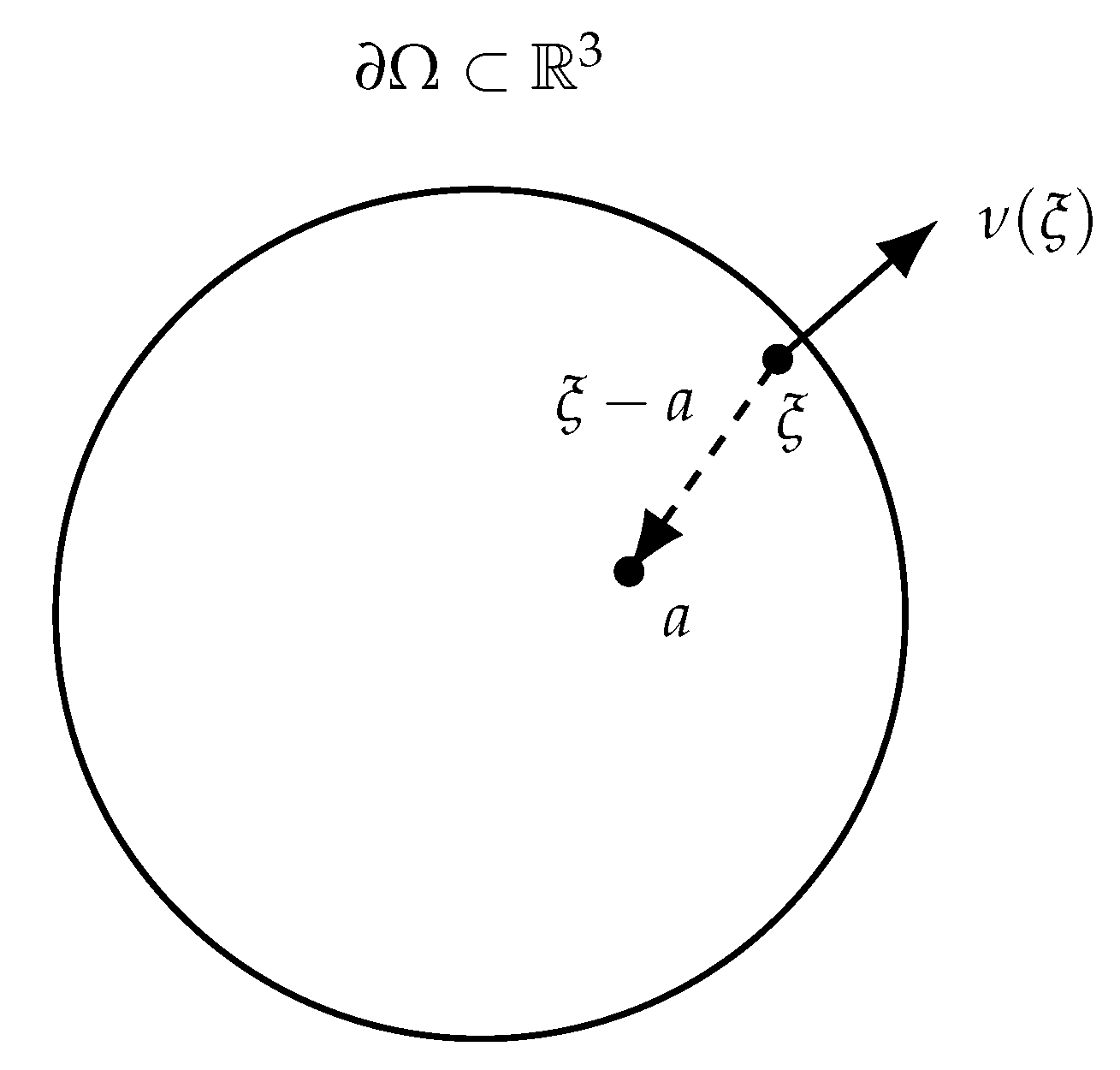
. Fix and set on . Then on Ω and W has a simple pole at . For any small ball one obtains the residue identity Figure 1 illustrates the
Cauchy kernel acting on a smooth boundary. The dual extension corresponds to thickening the domain by a nilpotent direction
b, which may be interpreted as a first-order perturbation of the boundary data.
For numerical or symbolic experimentation, one can evaluate (
9) by reducing the dual integral to two classical integrals (the
and
parts). Algorithm 1 summarizes the procedure.
| Algorithm 1 Evaluating the dual Cauchy–Pompeiu formula |
Require: Domain , point , data on - 1:
Compute the reduced kernel - 2:
Compute the dual correction - 3:
Evaluate boundary integrals for the part: - 4:
Evaluate boundary integrals for the part using and V - 5:
if then - 6:
Evaluate volume integrals of and subtract - 7:
end if - 8:
|
Numerical remark. In practical discretizations, the singular part of the boundary Cauchy transform is the same Calderón–Zygmund kernel as in Theorem 3, while the dual correction is only weakly singular. Accordingly, one expects Nyström-type quadratures for (with standard principal value treatment) to retain their usual convergence behavior on smooth boundaries, and the -component to be at least as stable. A full convergence analysis is beyond the scope of this paper.
5. Cauchy Integral Formula and Boundary Value Problems
Representation formulas immediately yield structural consequences analogous to complex holomorphic function theory. Throughout this section, denotes a small ball in centered at and we write .
5.1. Cauchy Integral Formula and Coefficient Extraction
Let
W be dual hyperholomorphic on a neighborhood of
. Applying Theorem 1 to
gives the Cauchy integral formula
In particular, taking yields a mean-value type identity.
To extract coefficients, consider the directional derivatives in the
a-variables. For a multi-index
set
. Differentiating under the integral sign in (
14) gives
Thus, the jet of W at is determined by boundary data.
Let
W be dual hyperholomorphic on
. We say that
is an
isolated pole of order one if
for some constant
and some dual hyperholomorphic
H on
.
Definition 2 (Dual residue)
. For such W, define the dual residue at bywhere .
Proposition 2 (Residue invariance). The value is independent of ρ and equals the coefficient c in the decomposition above.
Proof. Apply Theorem 1 on the annulus and let vary. The volume term vanishes by dual hyperholomorphicity, leaving equality of the two boundary integrals. Evaluating for gives c. ☐
Theorem 5 (Removable singularities). Let W be dual hyperholomorphic on . If W is bounded near , then W extends to a dual hyperholomorphic function on .
Proof. Fix
and apply (
14) with
and radius
. Since
is integrable on
uniformly in
and
W is bounded, the right-hand side defines a bounded continuous extension to
. Dual hyperholomorphicity follows by differentiating under the integral sign and using Lemma 2. ☐
5.2. Boundary Value Problems: Projections and a Riemann–Hilbert Prototype
The jump relations in
Section 3.4 provide projection operators on boundary data, mirroring Hardy space projections in complex analysis.
On a
boundary
define
Formally, project boundary data onto traces of interior/exterior -hyperholomorphic functions.
Proposition 3 (Idempotency up to compact terms). On , the operators satisfy and on smooth data. For Hölder data, these identities hold modulo compact perturbations arising from boundary curvature. The same statement holds for .
Remark 4. A full Fredholm theory requires bounds for (Calderón–Zygmund estimates) and compactness of curvature corrections. Since the reduced product does not change kernel homogeneity, the standard singular integral framework applies.
Given a boundary multiplier
and boundary data
, a typical Riemann–Hilbert-type problem asks for a dual hyperholomorphic
W in
such that
Using the Cauchy transform, one may reformulate this as a boundary integral equation for the unknown trace
:
Under smallness or invertibility assumptions on G, this leads to a Fredholm equation of the second kind. We leave the detailed functional-analytic development to future work.
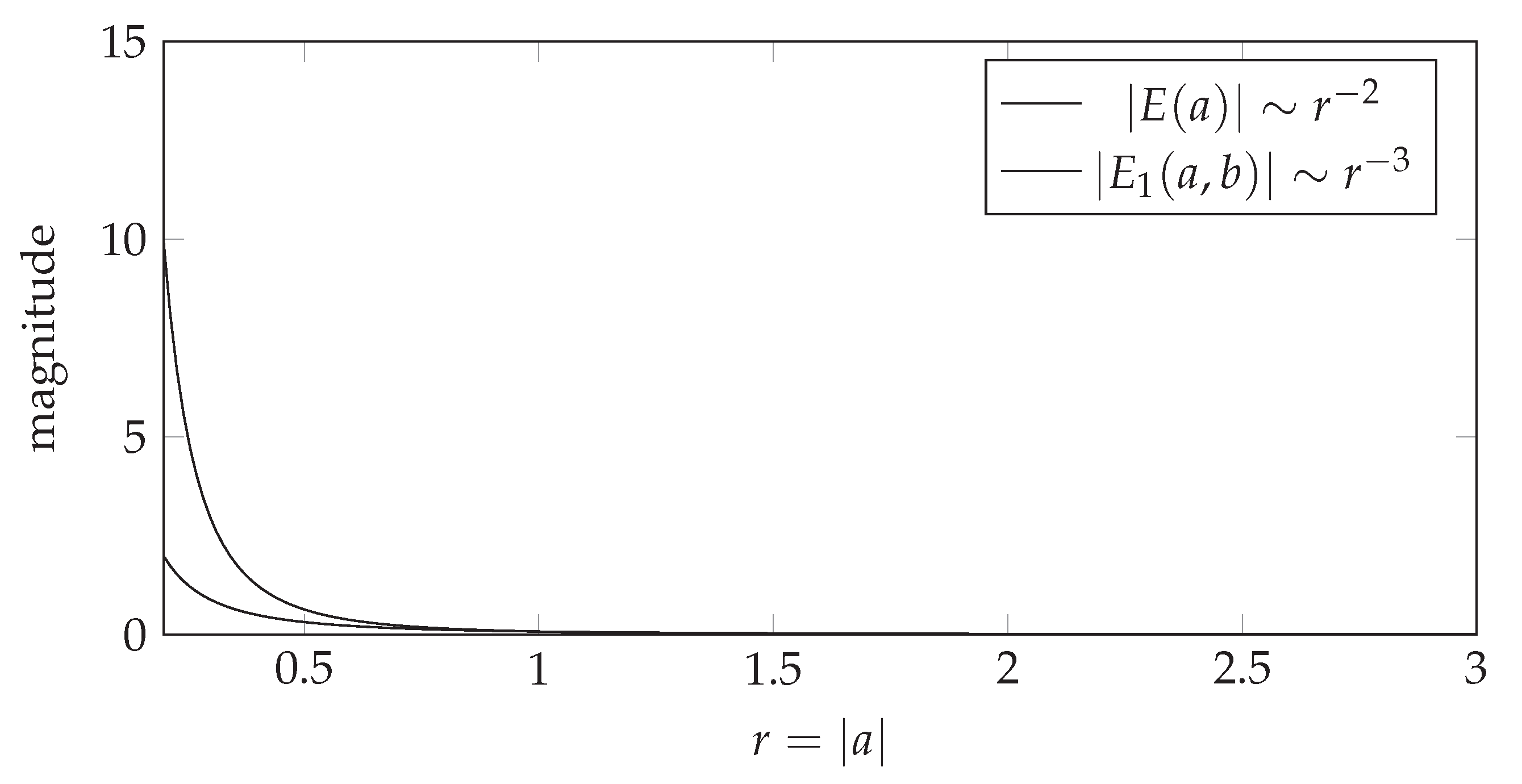
Figure 2 illustrates the singularity of
and the relative decay of the dual correction
(for fixed
) as functions of
.
5.3. Mapping Properties on Hölder and Sobolev Scales
This section records analytic estimates that justify the use of and in boundary integral equations and quantify the smoothing effect of the dual correction.
Assume is Lipschitz. The reduced kernel is odd and homogeneous of degree , hence it is a Calderón–Zygmund kernel. Consequently, the principal value operator extends to a bounded operator on for .
Theorem 6 (
bounds)
. Let Γ be Lipschitz and . Then there exists such thatMoreover, for the dual operator one has Proof. The estimate for follows from the standard singular integral theory on Lipschitz surfaces, since the reduced product is compatible with the Euclidean norm. For , the correction has an integrable kernel (because is one order less singular), hence is bounded on all spaces, and the same bound holds for . ☐
On boundaries, the dual correction term improves regularity.
Proposition 4 (Smoothing). Let Γ be . The ϵ-part of maps continuously into .
Proof. The kernel behaves like in , which is integrable on a surface of dimension 2. Differentiating under the integral sign yields an extra factor, still integrable after subtracting a local average. Standard potential estimates on Hölder surfaces then give a gain. ☐
6. A Discretization Viewpoint: Quadrature for the Boundary Cauchy Transform
Although our focus is theoretical, it is useful to outline a concrete discretization strategy for the boundary integral in (
12) and its dual analogue.
Let
be triangulated into panels
with representative points
and areas
. A standard Nyström-type approximation of
for
is
The principal value operator can be approximated by subtracting a local singular model, e.g., by excluding panels near and adding the analytically integrated tangent-plane contribution. The dual term is less singular and can be handled by standard quadrature without special treatment.
6.1. A Computational Consistency Check for the Jump Constant
Appendix A.5 records the classical half-space computation
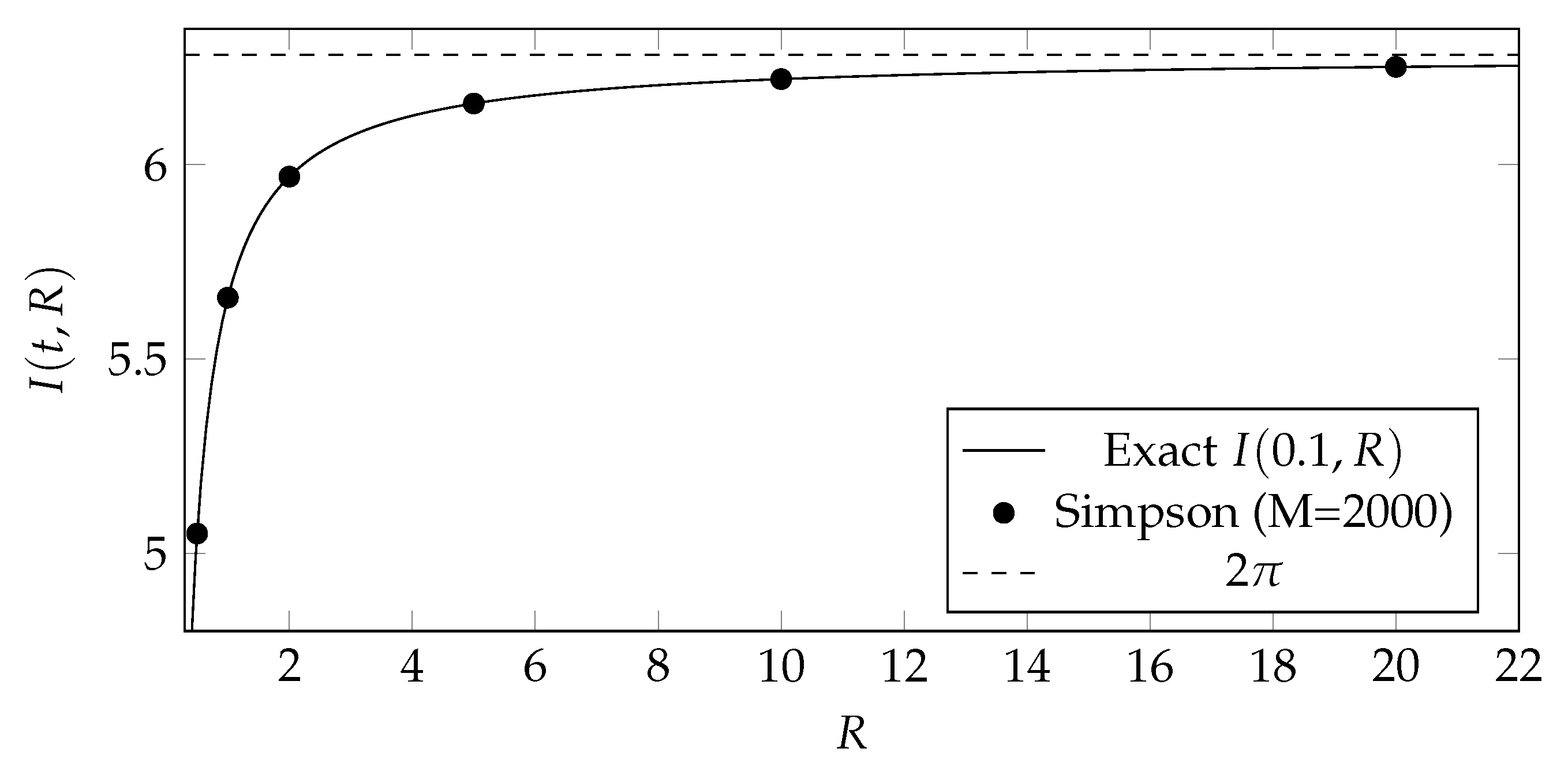
which is the scalar core behind the Plemelj-type constant in our boundary limit formulas. To connect the theoretical jump constant with a practical quadrature viewpoint, we consider the truncated integral
and approximate it by a composite Simpson rule in polar coordinates.
Table 1 reports values for
and increasing truncation radii
R.
6.2. Algebraic Aspects: Associators and Stable Identities
Because the reduced product is defined by projection, it fails to be associative in general. Nevertheless, several stable identities hold and are sufficient for the integral theory.
Define the associator
. A direct computation shows that
is purely imaginary (has no scalar part) and satisfies the norm bound
In particular, associator errors are controlled pointwise and do not obstruct Calderón–Zygmund estimates, which depend only on kernel homogeneity and cancellation.
Lemma 3 (Product rules)
. Let be . Thenwhere the error is expressible in terms of associators involving and the basis elements . Moreover, . Remark 5. Lemma 3 explains why we frame the theory in terms of integral identities rather than attempting to build a fully associative algebra calculus. The estimates are sufficient for weak formulations and for deriving (7)–(9). 6.3. Spherical Monogenic Polynomials and Series Expansion on the Ball
To further connect the reduced theory with classical Clifford analysis, we record a series expansion on the ball that is obtained from the Cauchy integral formula on spheres.
Let denote the space of -valued homogeneous polynomials of degree k in . A polynomial is called (left) monogenic if . For instance, is monogenic and the linear polynomial is monogenic.
Lemma 4 (Kelvin transform)
. If P is monogenic homogeneous of degree k, then the Kelvin transformis monogenic on and homogeneous of degree . Proof. A direct computation uses off the origin and the chain rule applied to . ☐
Let
. One has the (formal) expansion
where
is a zonal monogenic polynomial of degree
k in
a (for fixed
). The family
plays the role of
in complex analysis.
Theorem 7 (Series expansion on the ball)
. Let W be dual hyperholomorphic on . Then for one can expandwhere each is monogenic homogeneous of degree k in a and each is homogeneous of degree k in and is determined uniquely by for any . The series converges absolutely and uniformly on compact subsets of . Proof. Apply the Cauchy formula (
14) with
,
. Insert the kernel expansion (
17) and integrate termwise. Orthogonality of spherical monogenics implies that the
kth term extracts the homogeneous component
. For the dual part, expand
and apply the same argument, noting that
has improved integrability. Uniform convergence follows from the geometric bound
. ☐
For illustration, the first terms in (
18) can be written as
with higher-order
obtained by iterating (
15). The dual coefficients
additionally depend on mixed derivatives in
y through
.
6.4. Worked Example: Explicit Cauchy Transform on the Sphere
Let
with
. For
write
with
. In this setting, the Cauchy transform (
12) can be computed explicitly on low-order spherical data.
For
, rotational symmetry implies
, hence the interior limit equals
c and the exterior limit equals 0. For
one can use the identity
and integrate by parts on the sphere to obtain
This provides a calibration test for numerical implementations.
Fix
and consider
with
. Splitting
into a small cap
and its complement, one finds
The first integral converges to the principal value as
. The second integral is reduced to the half-space model by stereographic projection and yields the
jump. Carrying out the computation for
recovers (
13) and matches the explicit half-space integral recorded in
Appendix A.
7. Conclusions
We developed a boundary integral framework for dual ternary hyperholomorphic functions on the reduced quaternionic (ternary) space . Starting from the reduced product structure and its dual extension, we introduced a Dirac-type operator adapted to and constructed explicit Cauchy kernels. This led to Borel–Pompeiu and Cauchy–Pompeiu representation formulas and to an explicit Teodorescu transform that acts as a right inverse of the operator in the interior of the domain.
Analytically, the main contribution is a boundary limit theory for the associated Cauchy-type integrals. Under mild geometric assumptions on
, we derived nontangential boundary traces and Plemelj-type jump relations for the boundary Cauchy transform. These jump relations yield a natural singular-integral formulation of boundary value problems and provide an operator-theoretic link between interior hyperholomorphicity and boundary data. The concrete examples and computational procedures illustrate how the kernels and the integral operators can be evaluated in practice.
Section 6 complements the theory with an explicit quadrature viewpoint and a simple numerical consistency check for the jump constant (
Table 1 and
Figure 3).
Several directions remain open. It would be natural to develop quantitative mapping properties of the boundary operators on and Sobolev scales on rough boundaries (e.g., Lipschitz surfaces), and to study Fredholmness and index formulas for the resulting boundary integral equations. On the algebraic side, higher-order and multi-parameter extensions of the dual ternary calculus, as well as sharper connections with slice-based theories and noncommutative functional calculus, deserve further investigation. Finally, implementing a boundary element method that respects the dual ternary structure—including robust treatment of singular quadrature and adaptive meshing—is an appealing direction for future work.
Outlook and Potential Applications
Kernel-based methods in manifold alignment and multimodal data integration increasingly rely on operator-theoretic constructions for structured feature spaces. Recent work on unsupervised topological alignment has highlighted the need to extend classical operator theory to modules carrying hypercomplex structure [
27], building on earlier approaches to joint embeddings for single-cell multiomics [
28]. The boundary kernels and Plemelj-type relations developed here provide a natural starting point for constructing hypercomplex reproducing kernels and for formulating regularized boundary-integral models; we plan to explore these connections in future work.