Article

Pre-Sale Strategies Considering Consumer Anticipated Regret

Department of Decision Sciences, Macau University of Science and Technology, Macau 999078, China
*
Author to whom correspondence should be addressed.
Mathematics 2026, 14(4), 692; https://doi.org/10.3390/math14040692
Submission received: 4 January 2026 / Revised: 10 February 2026 / Accepted: 14 February 2026 / Published: 15 February 2026

Abstract

Pre-sale mechanisms are widely used by e-tailers to manage demand uncertainty and stimulate early purchases, yet existing research has largely emphasized economic incentives while giving limited attention to consumers’ psychological responses to early commitment. This study examines how anticipated regret shapes the relative performance of two prevalent pre-sale strategies—advance discounts and deposit expansion—across different market structures. We develop game-theoretic models of monopolistic and duopolistic markets in which consumers anticipate post-purchase regret and incorporate this behavioral concern into their pre-sale decisions. Our analysis shows that deposit expansion consistently attracts higher demand than advance discounts by offering post-decision flexibility, and this demand advantage increases with consumers’ regret sensitivity. However, the profitability implications are non-monotonic. While deposit expansion dominates advance discounts when anticipated regret is low to moderate, advance discounts become more profitable once regret is sufficiently strong. Competition further moderates these effects by amplifying demand differences while compressing profit margins, without altering the regret threshold at which profit dominance reverses.

1. Introduction

In recent years, technological advancements and evolving consumer behavior have significantly reshaped retailing formats, driving the transition from traditional online channels to mobile and social media platforms and accelerating growth in the global e-commerce sector. According to Shopify’s Global Ecommerce Sales Growth Report, global business-to-consumer (B2C) e-commerce sales reached $5.62 trillion in 2023 and are projected to reach $6.42 trillion by 2025 [1].
As the online retail landscape expands, competition among e-tailers intensifies, compelling them to adopt increasingly sophisticated strategies to attract and retain customers. Among these strategies, pre-sale mechanisms have emerged as a powerful tool to generate early demand, manage inventory risk, and enhance consumer engagement. Pre-sales refer to promotional strategies in which products are offered before their official release or availability for delivery, often with incentives such as discounts, bonus value, or exclusive access in exchange for early consumer commitment, e.g., [2,3,4,5].
Within this evolving landscape, two pre-sale approaches have gained particular prominence: advance discounts and deposit expansion. An advance discount is a time-limited offer that provides consumers with a lower price if they commit to a purchase early, e.g., [2,4]. This strategy is widely used across global e-commerce platforms. For instance, Amazon Prime Day regularly features early-bird deals for Prime members to stimulate early engagement and build anticipation [6]. Similarly, in China’s JD.com 618 Shopping Festival, sellers frequently offer lower prices to consumers who place orders before the event officially begins [7].
In contrast, the deposit expansion strategy requires consumers to pay a partial deposit during the pre-sale period and offers them an expanded monetary value—such as bonus credit or an extra discount—when they complete the full payment at a later stage [3,5]. A key feature of this mechanism is that consumers retain the option to cancel their order, although doing so typically results in the forfeiture of the initial deposit. This flexibility reduces the perceived risk of early commitment while still incentivizing early engagement. Deposit expansion is particularly popular on platforms such as Alibaba’s Tmall [5], where sellers frequently adopt slogans like “Pay RMB10 now, save RMB50 later” to attract price-sensitive but hesitant consumers.
Once implemented, the effectiveness of these pre-sale strategies is not solely determined by economic incentives, but also by consumer psychology, particularly the concept of anticipated regret [8]. Anticipated regret refers to the emotional discomfort consumers expect to experience when they believe they may have made a suboptimal decision or missed out on a better alternative [9]. Previous studies have shown that anticipated regret consistently affects consumer purchasing behavior across various product categories, e.g., [10,11,12,13], and influences consumers’ search and purchase timing decisions [14,15]. In the context of pre-sale promotions, consumers often face uncertainty regarding the eventual value of the product at the time of commitment. This uncertainty may lead to concerns that better alternatives could emerge after the commitment is made, making deferring or forgoing the purchase seem more advantageous in hindsight [16], thereby triggering anticipated regret. To provide additional empirical motivation for incorporating this behavioral factor into our analysis, we conducted a consumer survey via the online platform Sojump ( N = 514 ). As summarized in Table A1 (Appendix A.1), regret-related concerns are highly prevalent in presale contexts: 65.37% of respondents reported they would regret a purchase after discovering a lower price, 55.84% indicated such concerns would alter their purchase decisions, and 77.04% expressed worry about encountering similar situations in future purchases. Together, these findings suggest that anticipated regret is a relevant behavioral factor in presale decision-making, motivating our theoretical analysis.
When consumers experience anticipated regret, deposit expansion strategies, compared to advance discounts, offer a more flexible option: consumers can secure a discount through a partial upfront payment while retaining the right to cancel the pre-order—albeit at the cost of forfeiting the deposit. This structure may better align with consumers’ behavioral tendencies, as it balances the desire for early benefits with a degree of post-purchase flexibility, potentially reducing the anticipated regret associated with irreversible decisions.
While the academic literature has extensively examined pre-sale strategies, e.g., [17,18,19,20,21,22,23,24], existing research has largely overlooked the psychological dimension of anticipated regret in consumer decision-making. Additionally, the discussion on deposit expansion as an alternative to traditional advance discounts remains scarce [5].
Motivated by these gaps, this study aims to investigate how anticipated regret influences the relative performance of different pre-sale strategies—namely, advance discounts versus deposit expansion—under varying market conditions. By incorporating this critical behavioral factor, we extend the theoretical understanding of pre-sale mechanisms beyond purely economic considerations to include the psychological drivers that significantly impact consumer choices and ultimately determine strategy effectiveness. Specifically, we seek to address the following research questions: (1) How should retailers choose between advance discounts and deposit expansion strategies when consumers exhibit anticipated regret? (2) How do market structures—monopoly versus competition—affect the optimal choice of pre-sale strategy? (3) How does the intensity of anticipated regret affect consumer behavior and e-tailers’ strategic preferences regarding pre-sale mechanisms?
To answer these questions, we develop a series of game-theoretic models to analyze different types of pre-sale strategies and derive their corresponding equilibrium outcomes across various market conditions. We then conduct analytical comparisons to evaluate the relative performance of these strategies.
Our findings indicate that, when consumer anticipated regret is present, advance discount and deposit expansion strategies differ fundamentally in how they shape early purchase decisions. Specifically, deposit expansion mitigates regret-induced hesitation by separating initial commitment from final consumption, allowing consumers to secure future price advantages while retaining an option to cancel. As a result, in a monopolistic market, deposit expansion consistently generates higher consumer participation than advance discounts whenever anticipated regret is positive. Moreover, it yields higher profits when regret intensity is low to moderate, as retailers benefit from early demand commitment, reduced uncertainty, and forfeited deposits from regret-driven cancellations. However, this advantage is not universal. When anticipated regret becomes sufficiently strong, consumers become increasingly reluctant to incur potential sunk costs, weakening participation in deposit-based mechanisms. Beyond this point, advance discounts—despite their rigid structure—become more profitable due to their simplicity and lower perceived downside.
Market structure further moderates the relative effectiveness of pre-sale strategies. In monopolistic settings, deposit expansion improves both demand management and profitability by stabilizing early sales and enabling the retailer to fully internalize the benefits of early commitments and deposit forfeitures. In contrast, in competitive markets, although deposit expansion continues to attract higher demand than advance discounts across all levels of anticipated regret, its profit advantage becomes conditional. Competitive pricing pressure erodes margins and intensifies strategic interaction, leading to a threshold effect whereby deposit expansion is more profitable only when anticipated regret is relatively low. When regret sensitivity is relatively high, advance discounts outperform in profitability despite attracting lower demand, as consumers avoid mechanisms involving potential financial loss. These results highlight that competition amplifies the demand advantage of deposit expansion while simultaneously compressing its profit margin.
Finally, the analysis reveals that the intensity of anticipated regret plays a central role in shaping both consumer behavior and retailers’ strategic preferences. As regret intensity increases, consumers increasingly favor flexible mechanisms, causing the demand advantage of deposit expansion over advance discounts to grow monotonically in both monopoly and duopoly settings. Profit effects, however, are non-monotonic. Moderate regret enhances the value of deposit expansion by stabilizing demand and increasing forfeiture revenue, whereas excessive regret discourages participation altogether and shifts profitability toward advance discounts. Consequently, anticipated regret functions as a key segmentation variable for pre-sale strategy design. When consumers are mildly regret-averse, commitment-based mechanisms dominate; when regret becomes salient, simpler price discounts regain their appeal. This threshold-based switching logic is consistent with industry practices: deposit-type presales are more common in low-regret standardized categories (e.g., standardized and frequently repurchased consumables such as tea), whereas advance-selling discounts are frequently observed in high-regret categories (e.g., fashion products marketed through social-media platforms). Overall, these findings demonstrate that optimal pre-sale strategies depend jointly on consumer psychology and market structure, underscoring the importance of aligning pricing and commitment mechanisms with behavioral frictions rather than relying solely on economic incentives.
This study contributes to the literature by integrating anticipated regret into the analysis of pre-sale strategy effectiveness across monopolistic and competitive markets, revealing threshold conditions that reverse strategy dominance and demonstrating the structural flexibility advantage of deposit expansion mechanisms. The findings offer practical implications for managers, guiding them in designing effective pre-sale promotions that boost early demand, improve inventory control, and optimize cash flow management. For example, our results suggest that in markets characterized by high demand fluctuations, deposit expansion strategies can be particularly effective in stabilizing early sales and increasing overall profitability. Therefore, managers should consider adopting these strategies, particularly when launching new products or entering competitive markets.
The remainder of this paper is organized as follows. Section 2 reviews the relevant literature on pre-sale strategies and anticipated regret in consumer behavior. Section 3 presents the model settings and theoretical assumptions for both advance discount and deposit expansion mechanisms under a monopolistic market. Section 4 extends the analysis to a competitive market setting. Section 5 provides comparative statics, numerical examples, and managerial insights. Finally, Section 6 concludes the paper with a summary of findings.

2. Literature Review

This section provides an overview of the literature relevant to this study. The review is organized to reflect the evolution of pre-sale strategy research, followed by an examination of the role of anticipated regret in consumer decision-making.

2.1. Pre-Sale Strategies

Pre-sale refers to the marketing practice in which retailers release product information and accept pre-orders prior to official product launch. Initially adopted in industries with stable supply but uncertain demand—such as aviation and hospitality—pre-sale has gradually permeated other sectors [25].
A substantial body of literature has examined the economic and operational implications of pre-sale strategies, e.g., [26,27,28]. For example, Fisher and Raman [27] proposed pre-sale as a means to match supply with projected demand, showing that early order commitments can help firms reduce mismatch costs, improve inventory management, and increase overall supply chain efficiency. While Moe and Fader [28] empirically analyzed how pre-sale duration influences consumer adoption and the diffusion of new products, concluding that longer pre-sale periods can significantly enhance product visibility and encourage early adoption, especially for high-involvement or innovative products. Later, Cachon [26] argued that manufacturers can use advance order discounts as a strategic tool to reduce inventory risk. By encouraging customers to place orders ahead of the selling season, these discounts provide the manufacturer with early demand information, which in turn allows for more accurate production planning and inventory allocation. The effectiveness of pre-sale strategies, however, is shaped by various market factors. Cachon and Feldman [29] demonstrated that intense spot-market competition can substantially erode pre-sale margins, while He et al. [30] explored how online–offline channel coordination fundamentally affects pre-sale viability. Collectively, this research highlights that while pre-sale offers significant operational benefits, its success depends critically on market competition, payment timing, and channel structures.
Over time, pre-sale strategies have evolved into several distinct forms, including advance discounts, deposit expansion, and partial refunds. Among these, advance discounts are the most extensively studied. For example, Prasad et al. [4] analyzed how advance discounts—particularly when combined with flexible return policies—can incentivize early purchases under demand uncertainty. Cheng et al. [31] proposed a two-period model that integrates advance discounts with advertising, demonstrating that this dual strategy can significantly enhance retailer profitability. Gan et al. [32] further emphasized that advance purchase discounts can serve as signals of product quality and consumer valuation, thereby improving demand forecasting and inventory planning. Deposit expansion is gaining popularity in practice—particularly on e-commerce platforms, while remaining comparatively underexplored in the literature. Zhang et al. [5] examined this mechanism in the context of online retail and found that it appeals to risk-averse and price-sensitive consumers by offering flexibility while enabling retailers to secure partial early revenue. Partial refunds, although less frequently examined as standalone strategies, are often embedded within return or cancellation policies in pre-sale contexts. Prasad et al. [4] emphasized that full or partial refunds can serve as implicit risk-mitigation mechanisms that encourage advance purchases, but may also necessitate adjustments to the advance discount level to protect firm profitability.
More recently, behavioral factors such as consumer risk aversion and social learning have gained prominence in the design of pre-sale strategies. Ma et al. [33] analyze how risk preferences and market power jointly influence the profitability of advance selling, showing that such programs are most effective when consumer risk aversion is either low or high, provided the manufacturer has sufficient market power. Even without promotional incentives, the success of advance selling depends on consumer psychology. In a related study, Peng et al. [34] explore how price guarantee policies interact with preorder-dependent social learning, finding that the effectiveness of refund schemes hinges not only on compensation structure but also on consumer beliefs and the timing of their decisions—underscoring the role of expectations and sequential behavior in pre-sale outcomes.
While prior studies have explored behavioral factors such as risk aversion and social learning in shaping pre-sale outcomes [33,34], they have not addressed a closely related psychological mechanism that significantly influences consumer decision-making: anticipated regret in pre-sale settings. Anticipated regret—the expectation of future remorse for making or not making a purchase—has been shown to affect purchase timing, risk-taking, and willingness to commit in uncertain contexts. Despite its relevance, this construct remains largely absent from existing pre-sale literature. The current study addresses this gap by investigating how anticipated regret shapes consumer participation in pre-sale settings, thus extending the behavioral framework of pre-sale strategy design.

2.2. Consumer Anticipated Regret

Anticipated regret refers to the negative emotional state individuals expect to experience if a different choice would have resulted in a better outcome [9]. In consumer decision-making, this emotion functions as a form of disutility—a mental cost that influences choices before any actual outcome materializes [35].
Early research on anticipated regret primarily employed scenario-based experiments to understand its behavioral effects. For instance, Larrick and Boles [36] found that consumers anticipating regret might lean toward higher-risk options, aiming to avoid average or mediocre outcomes. Similarly, ref. [37] demonstrated a regulatory effect of anticipated regret on impulsive buying, showing that the anticipation of regret could deter hasty consumption behaviors.
Building on these empirical findings, later studies adopted formal modeling approaches to examine consumer anticipated regret, particularly within the field of operations management. A key development by Jiang et al. [11] proposed a method to quantify regret disutility, factoring in both the probability of regret and the utility gap between actual and foregone outcomes. Researchers have since applied it to a variety of operational contexts. In channel strategy, Gao et al. [38] showed that regret sensitivity shapes consumer decisions between online and offline channels, providing insights for omnichannel retail design. In pricing, Jiang and Qi [39] illustrated how firms can leverage regret aversion to set more effective price points. Anticipated regret also influences product personalization: Syam et al. [13] found that fear of making suboptimal choices can reduce consumers’ willingness to customize. In advance selling and markdown pricing, Nasiry and Popescu [40] and Özer and Zheng [41] modeled how regret affects early purchase and inventory decisions, showing its strategic relevance in demand and inventory management. Likewise, Zou et al. [42] explored product line design, finding that under-purchase regret can enhance profitability, particularly when over-purchase regret is weak.
Beyond these conventional areas, anticipated regret has also been studied in nontraditional contexts. Shih and Schau [12] and Sarangee et al. [43] examined its role in innovation adoption, while Chen et al. [10] investigated how it shapes consumer evaluations of counterfeit products. In environments with greater uncertainty—such as auctions and fluctuating product availability—Engelbrecht-Wiggans and Katok [44] and Diecidue et al. [45] found that regret anticipation significantly affects consumer decision-making.
Although the existing literature has incorporated anticipated regret into various consumer models, e.g., [11,13], most studies have focused on general contexts, such as pricing, innovation adoption, or customization. In contrast, our study explicitly models anticipated regret as a central behavioral factor in evaluating the effectiveness of pre-sale strategies, specifically comparing advance discounts and deposit expansion. By examining how consumers’ sensitivity to potential regret influences their responses to different pre-sale formats, our work bridges behavioral theory and operations strategy. In doing so, we offer new insights into how regret sensitivity interacts with pre-sale design and market structure.

3. Problem Description

We consider an online retailer selling a product with a marked price p and a cost c. Following established e-commerce practices, the retailer opts to utilize a pre-sale strategy as a mechanism to promote sales and reduce demand uncertainty. Specifically, the retailer needs to select its pre-sale strategy from two prevalent options on e-commerce platforms: (1) advance discounts [46], where products are offered to consumers at a reduced price before their official release; or (2) a deposit expansion strategy [5], where the retailer announces a deposit amount ρ p ( 0 < ρ < 1 ) and an expansion rate ( k + 1 ) at the beginning of the pre-sale period. This allows consumers to place orders by paying the deposit. When the product becomes available at the end of the pre-sale period, customers who have paid the deposit can complete the purchase by paying the remaining amount p k ρ p to complete the order. Otherwise, the booking will be canceled and the deposit will not be returned.
The customer population is normalized to 1, assuming heterogeneous product valuations among consumers. Each customer’s product valuation, denoted as v i , follows a uniform distribution over the interval 0 , 1 [47]. Moreover, pre-sale purchasing decisions are associated with potential consumer post-purchase regret, which may be caused by changes in consumer demand or emerging new purchasing options over time. Aware of this regret, consumers consider it in their purchasing decisions, exhibiting anticipated regret behavior [16]. To facilitate our analysis, we assume that the probability of experiencing post-purchase regret is consistent across the population, denoted as ϕ . When post-purchase regret occurs, the perceived value of the product decreases to β v i , where 0 < β < 1 . Consistent with prior literature, we assume c < 1 2 [48,49] and 0 < ϕ < 0.5 to ensure non-trivial, realistic scenarios.
The implementation of our model requires information about consumers’ anticipated regret, captured by two reduced-form parameters. The parameter ϕ represents the expected likelihood (or intensity) of regret in pre-purchase decisions, while β measures how strongly regret reduces consumers’ perceived valuation for the product. In the baseline model, we assume that consumers share a common ϕ and a common β . This homogeneity assumption is adopted to maintain analytical tractability and to highlight the fundamental strategic role of anticipated regret in presale strategy choice. From a practical perspective, ϕ and β can be interpreted as market-level or segment-level behavioral averages for a given product category. Consumers may form such regret expectations based on public information (e.g., historical promotions and platform reviews), and retailers may infer them from aggregate demand responses and past campaign outcomes. In Section 6.2 and Section 6.3, we relax this homogeneity assumption by allowing heterogeneity in ϕ and β , and show that our main threshold-based insights remain robust. The notations used in our paper are summarized in Table 1.

4. Monopoly Market

In this section, we analyze the optimal pre-sale strategy choice for an online retailer operating in a monopolistic market.

4.1. Pre-Sale Strategy with Advance Discounts

In this subsection, we consider the prevalent advance discount strategy (denoted by superscript “D”). Under this strategy, the online retailer needs to determine the optimal advance discount price p a , where p a < p , to maximize its profit. We first model consumers and the retailer’s decision-making, then derive the retailer’s optimal advance discount price and associated maximum profit.
Decision-making of customers. For each customer i, it is decided whether to purchase the product to maximize expected utility. Considering their potential post-purchase regret, the expected utility is calculated as follows.
U i = ( 1 ϕ ) [ v i p a ] + ϕ ( β v i p a )
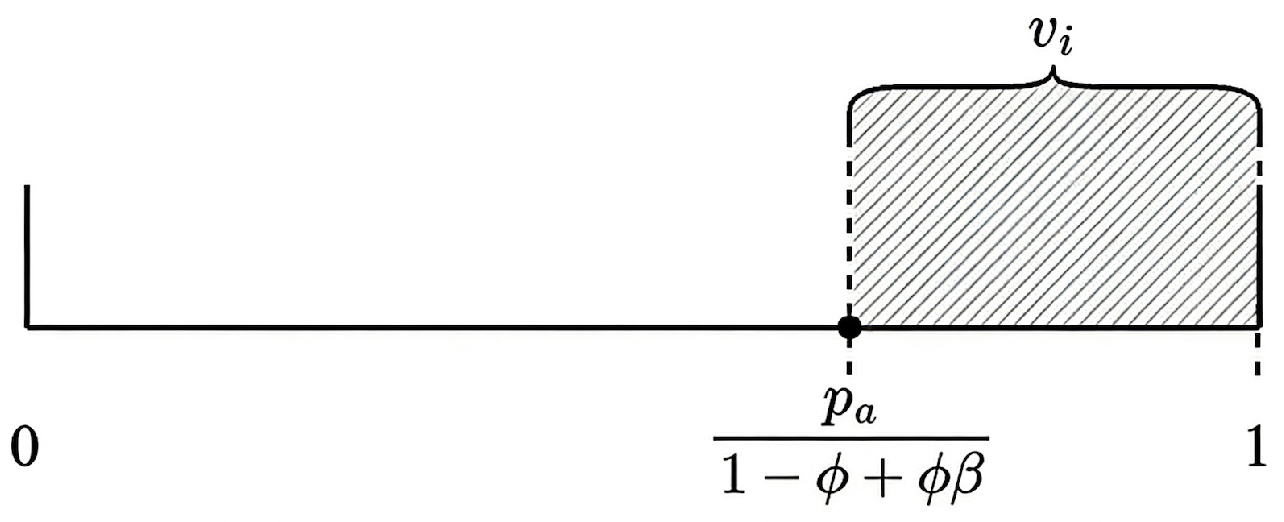
It is easy to verify that a consumer will purchase the product only if their valuation satisfies v i > p a 1 ϕ + ϕ β , as stated in Lemma 1. The group of customers who participate in the pre-sale under the advance discount strategy is illustrated in Figure 1.
Lemma 1.
In a monopolistic market, under the retailer’s advance discount strategy, only when v i p a 1 ϕ + ϕ β , will a customer purchase the product.
Pricing of the Retailer. When adopting the advance discount strategy, the retailer needs to determine the discounted advance selling price p a to maximize its expected profit. From Lemma 1, we derive the demand of the retailer under the advance discount strategy as
D = 1 p a 1 ϕ + ϕ β ,
which is further illustrated in Figure 1, where the shaded region represents consumers who purchase during the pre-sale period.
Figure 1. Customer participation under the advance discount strategy.
Mathematics 14 00692 g001
The retailer’s profit is then formulated as follows.
π = ( p a c ) · ( 1 p a 1 ϕ + ϕ β )
The optimal pre-sale price and the corresponding maximum profit can be derived by solving the retailer’s profit maximization problem, as presented in Lemma 2.
Lemma 2.
In a monopolistic market, for a retailer adopting the advance discount strategy, there exists an optimal advance discount price
p a D = 1 2 ( 1 + c ϕ + ϕ β ) .
The corresponding optimal demand is
D D = 1 2 c 2 ( β 1 ) ϕ + 2 .
The maximum profit is
π D = ( 1 c + β ϕ ϕ ) 2 4 4 ( 1 β ) ϕ .

4.2. Pre-Sale Strategy with Deposit Expansion

In this subsection, we model the deposit expansion strategy (denoted with superscript “E”), where the retailer implements a pre-sale mechanism involving deposit expansion. Under this strategy, the online retailer must determine the optimal deposit ratio ρ and expansion coefficient ( k + 1 ) to maximize profit, where 1 > ρ > 0 and k > 0 .
To participate in the pre-sale, a consumer must pay the deposit ρ p in advance. After paying the deposit, the consumer is entitled to apply the expanded deposit value ( k + 1 ) ρ p toward the final payment. Later, they can make a final decision: either complete the purchase by paying the remaining balance, p + k ρ p , or forfeit the deposit and abandon the purchase.
Consumers are assumed to exhibit anticipated regret in this setting [15,16]. Let ϕ [ 0 , 1 ] denote the probability that a consumer experiences post-purchase regret, where we assume ϕ < 0.5 . Following the literature on consumer anticipated regret [16], we assume that the probability of experiencing post-purchase regret is constant across the consumer population. As a result, among those who pay the deposit, a fraction ϕ will forfeit it (i.e., not complete the purchase), while the remaining fraction 1 ϕ will proceed with the transaction.
Decision-making of customers. Each consumer i decides whether to purchase the product in order to maximize their expected utility. Taking into account the possibility of post-purchase regret, the expected utility is given by:
U i = ( 1 ϕ ) [ v i p + k ρ p ] ϕ ρ p
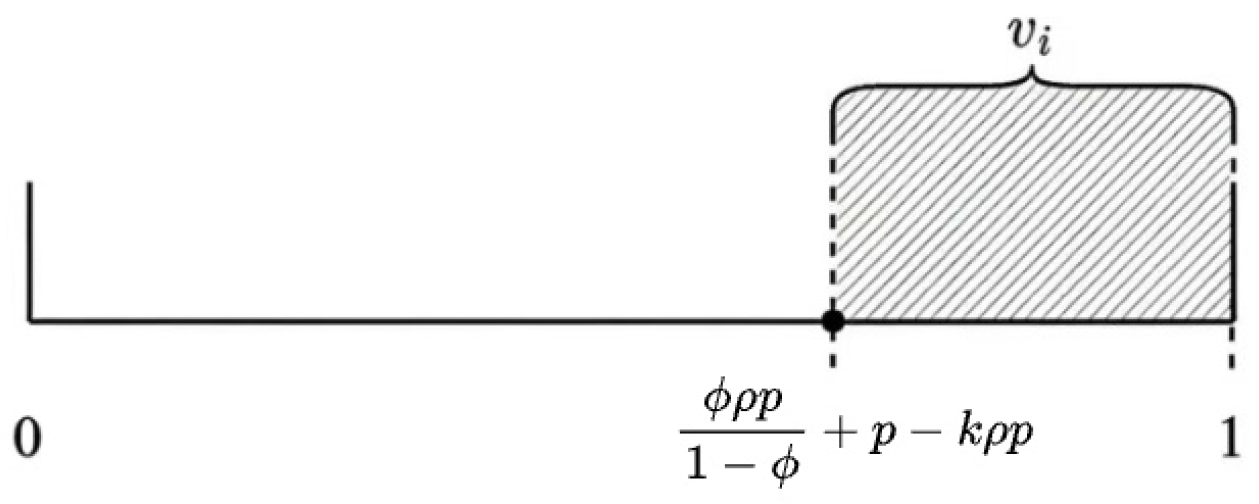
It is straightforward to verify that a consumer will participate in the pre-sale only if their valuation satisfies: v i p k ρ p + ϕ ρ p 1 ϕ , as formally stated in Lemma 3. The group of customers who participate in the deposit expansion strategy is illustrated in Figure 2.
Lemma 3.
In a monopolistic market, under the retailer’s deposit expansion strategy, only when v i p k ρ p + ϕ ρ p 1 ϕ , will a customer purchase the product.
Decision-making of the retailer. To maximize expected profit under the deposit expansion strategy, the retailer needs to determine the optimal deposit ratio ρ and expansion factor k simultaneously, based on expected customer responses. According to Lemma 3 and the customer segmentation illustrated in Figure 2, the customer demand under the deposit expansion strategy is given by:
D = 1 p + k ρ p ϕ ρ p 1 ϕ ,
as shown in Figure 2 (shaded region).
Figure 2. Customer participation under the deposit expansion strategy.
Mathematics 14 00692 g002
The corresponding profit function of the retailer is formulated as:
π = [ ( 1 ϕ ) ( p k ρ p c ) + ϕ ρ p ] · ( 1 p + k ρ p ϕ ρ p 1 ϕ ) .
We formalize the optimal decision-making for selecting ρ and k in Lemma 4, which characterizes the conditions under which maximum profit is attained.
Lemma 4.
In a monopolistic market, when a retailer adopts the deposit expansion strategy, there exist multiple pairs ( ρ , k ) that maximize the retailer’s profit, provided that ρ E and k E satisfy the condition
k E = ϕ 1 ϕ c 2 p + 1 2 p ρ E .
The corresponding optimal demand is
D E = 1 c 2 .
The maximum profit is given by
π E = 1 4 ( 1 c ) 2 ( 1 ϕ ) .
Lemma 4 reveals an important structural property of deposit expansion in a monopolistic market. The retailer’s profit-maximization problem admits a continuum of optimal solutions: any pair ( ρ , k ) satisfying the stated condition yields the same equilibrium demand and maximum profit. Hence, optimality is characterized by a locus relating ρ and k, rather than by a unique point. This property provides implementational flexibility, allowing the retailer to adjust one instrument (e.g., the deposit ratio) while compensating with the other (e.g., the expansion factor) without sacrificing equilibrium performance.
Lemma 4 implies that the retailer can implement deposit expansion through a continuum of optimal parameter pairs ( ρ , k ) . Although all such pairs deliver the same equilibrium demand and profit in our stylized model, different combinations may differ in their practical attractiveness and communication effectiveness. In particular, a lower deposit ratio ρ reduces consumers’ upfront payment burden and may increase participation willingness by lowering perceived entry barriers. Meanwhile, for a given ρ , a larger expansion factor k makes the promotional benefit more salient (e.g., “pay a small deposit and receive a larger discount/credit later”), which may enhance perceived value and facilitate marketing communication. However, excessively large k may reduce credibility and thus weaken consumers’ trust in practice. Therefore, among the optimal solutions characterized in Lemma 4, parameter combinations with a relatively small ρ and a moderate k are more likely to be adopted in real presale campaigns, as they balance low participation friction with credible and easy-to-communicate incentives.

4.3. Comparative Analysis in a Monopoly Market

In this section, we compare the demand and profit outcomes between the advance discount strategy (D) and the deposit expansion strategy (E) in a monopolistic market, with a particular focus on the role of consumer anticipated regret ( ϕ ).
Proposition 1.
Let Δ D = D E D D denote the difference in consumer demand between the deposit expansion strategy (E) and the advance discount strategy (D) in a monopolistic market. Then:
(1) When consumers exhibit no anticipated regret (i.e., ϕ = 0), the two strategies yield identical consumer demand, i.e., D E = D D .
(2) When consumers exhibit anticipated regret (i.e., ϕ > 0 ), the deposit expansion strategy attracts strictly higher demand than the advance discount strategy, i.e., D E > D D .
(3) The demand difference Δ D is strictly increasing in the level of anticipated regret ϕ, that is: Δ D ϕ > 0 .
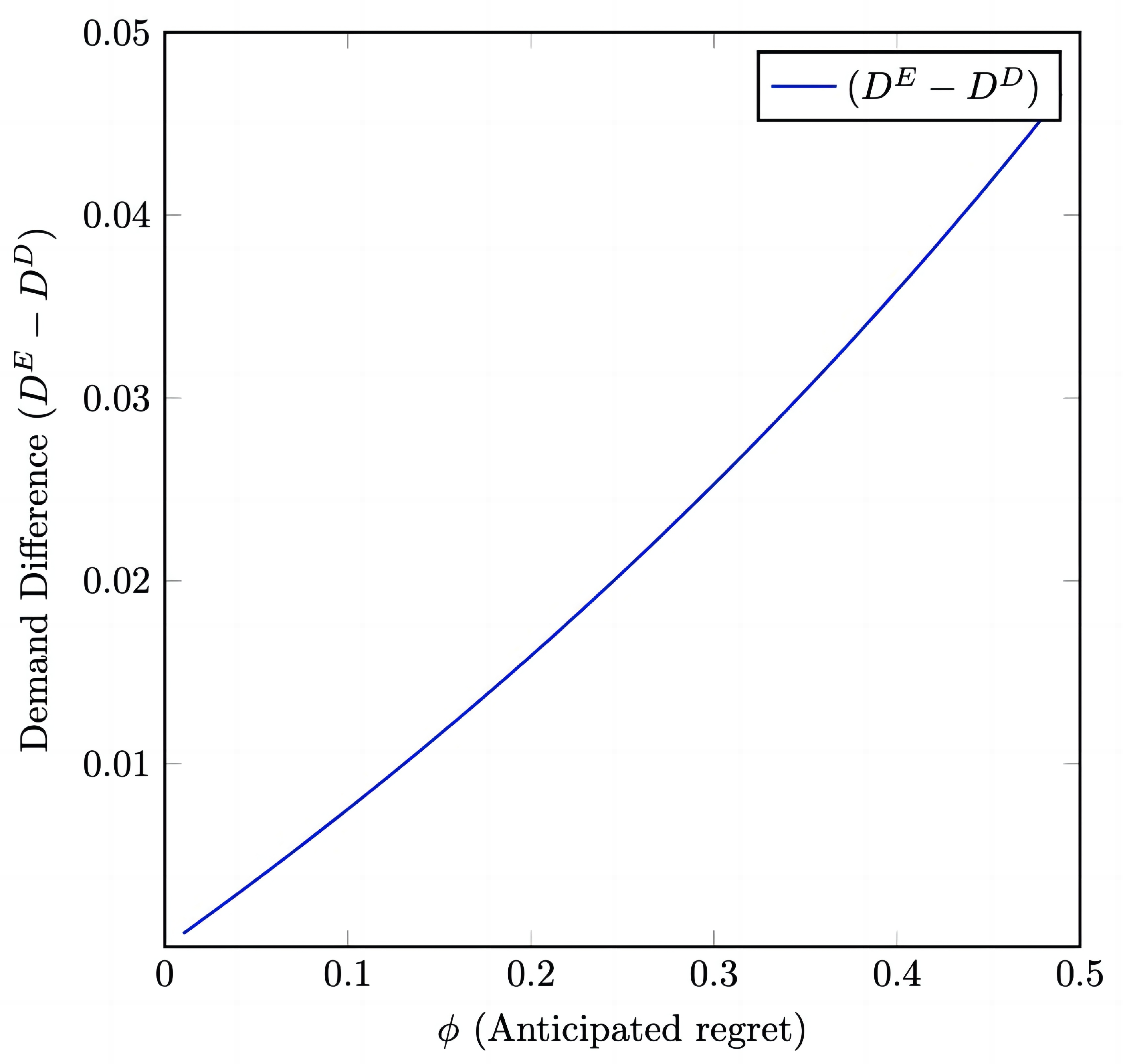
Proposition 1 establishes a monotonic dominance of the deposit expansion strategy over the advance discount strategy in terms of demand, which is further illustrated by Figure 3. This result highlights the behavioral robustness of deposit expansion: by offering post-decision flexibility, the deposit mechanism better accommodates regret-averse consumers. In contrast, the advance discount strategy requires an irreversible early purchase, which leads to systematically lower participation as anticipated regret intensifies.
Proposition 2.
In a monopolistic market with consumers exhibiting anticipated regret, when the regret discount factor lies in ( β ̲ , β ¯ ) , where β ̲ = 1 2 c 2 + 2 c 1 + 1 2 c 4 + 4 c 3 10 c 2 + 4 c + 1 and β ¯ = 2 c c + 1 , there exists a unique threshold ϕ ^ ( 0 , 0.5 ) such that:
(1) Deposit expansion strategy dominates in profitability when ϕ ( 0 , ϕ ^ ) , i.e., π E π D ;
(2) Advance discount strategy dominates in profitability when ϕ ( ϕ ^ , 0.5 ) , i.e., π E π D .
The threshold is given by ϕ ^ = 1 1 β + c 2 ( c 2 ) c + β .
To clarify the economic meaning of this parameter range, note that β represents the discount factor applied to product valuation when regret occurs. A higher β implies that regret has a relatively small impact on perceived value, reducing the importance of post-purchase flexibility and weakening the advantage of deposit expansion. Conversely, a lower β indicates that regret substantially diminishes perceived value, making consumers highly risk-averse and reluctant to commit to mechanisms involving potential sunk costs. It is easy to see that, in both extreme cases ( β ̲ > β , or β > β ¯ ), one strategy dominates unconditionally, yielding limited managerial insight. Accordingly, we focus on the intermediate range β ̲ < β < β ¯ , where anticipated regret is influential but not overwhelming, and where the interaction between regret intensity and strategic effectiveness is analytically meaningful.
Proposition 2 reveals a threshold effect of anticipated regret in monopolistic markets. When anticipated regret is relatively low ( ϕ < ϕ ^ ), the deposit expansion strategy yields higher profit than the advance discount strategy. This advantage arises because deposit expansion not only secures partial early cash flows but also allows the retailer to capture forfeited deposits from regret-driven cancellations, thereby stabilizing profits. Although advance discounts stimulate demand in low-regret environments, their rigid structure limits profitability relative to the more flexible deposit mechanism.
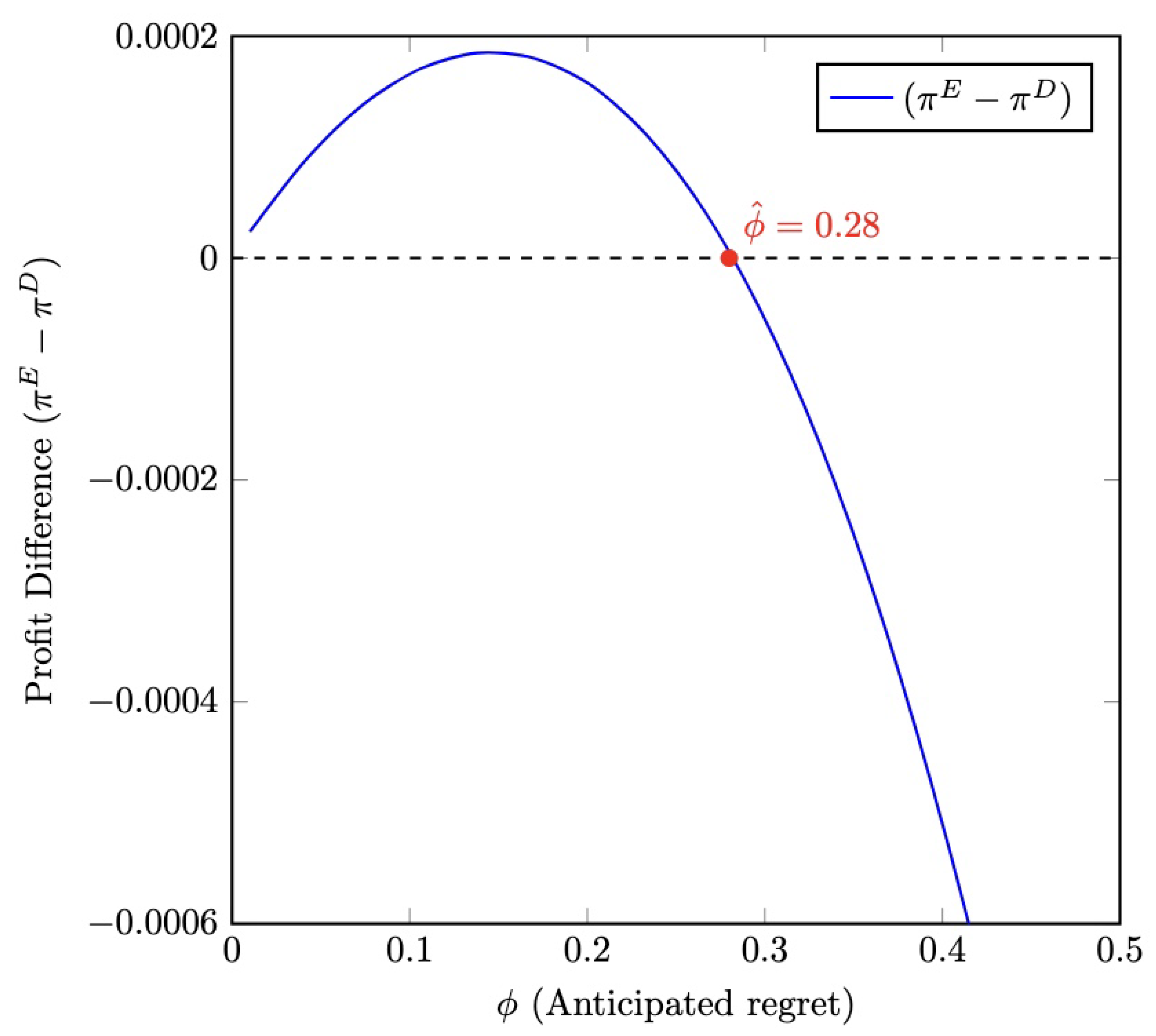
When anticipated regret exceeds the threshold ( ϕ > ϕ ^ ), the ranking reverses. High regret sensitivity makes consumers increasingly cautious about incurring sunk costs, reducing participation in deposit-based mechanisms and eroding their profitability. In contrast, the transparent and straightforward pricing of advance discount becomes more attractive, resulting in stronger profit performance. This reversal is illustrated in Figure 4, which plots the profit difference Δ π = π E π D as a function of anticipated regret and shows a unique crossing point at ϕ ^ : deposit expansion dominates for low levels of regret, whereas advance discount yields higher profits once regret intensity exceeds the threshold.
Figure 3. Demand differential between deposit expansion and advance discount strategies as a function of anticipated regret ( β = 0.49 , c = 0.28 ).
Mathematics 14 00692 g003
Figure 4. Profit differential between deposit expansion and advance discount strategies as a function of anticipated regret ( β = 0.51 , c = 0.35 ).
Mathematics 14 00692 g004

5. Duopoly Market

We now extend our analysis to a duopolistic market where two symmetric retailers compete using different pre-sale strategies. Note the presence of competition alters the strategic landscape: retailers must now account for consumer switching behavior.

5.1. Equilibrium Under Competition

We consider two competing pre-sale strategies in an online retail duopoly: advance discounts and deposit expansion (denoted with superscript “ E D ”). Both retailers simultaneously determine the corresponding decision variables associated with their pre-sale strategies, such as the advance discount level or the deposit expansion factor. Without loss of generality, we assume that retailer 1 adopts the deposit expansion strategy, while retailer 2 adopts the advance discount strategy. Each consumer is assumed to purchase only one product from either retailer.
Customer Decision-Making. Taking into account potential post-purchase regret associated with pre-sale participation, each customer i decides from which retailer to purchase by maximizing their expected utility. The expected utility for a consumer purchasing from retailer 1, who adopts the deposit expansion strategy, is given by
U 1 = ( 1 ϕ ) [ v i p + k ρ p ] ϕ ρ p ,
where the first term, ( 1 ϕ ) v i p + k ρ p , represents the expected utility if the consumer completes the purchase, and the second term, ϕ ρ p , captures the expected utility loss from forfeiting the deposit in the event of regret-induced cancellation.
Retailer 2 adopts the advance discount strategy. The expected utility for a consumer purchasing from retailer 2 is:
U 2 = ( 1 ϕ ) [ v i p a ] + ϕ ( β v i p a ) ,
where the first term, ( 1 ϕ ) [ v i p a ] , reflects the utility when no regret occurs, and the second term, ϕ ( β v i p a ) , captures the diminished utility under regret, where the consumer’s perceived value drops to β v i due to post-purchase regret.
Customers make purchasing decisions by comparing the expected utilities offered by the two competing retailers. If U 1 > U 2 + , customers prefer retailer 1, which adopts the deposit expansion strategy. Conversely, if U 2 > U 1 + , they choose retailer 2, which implements the advance discount strategy. When U 1 = U 2 , consumers are indifferent, as both options yield equivalent expected utility. Consumers’ purchase decisions are as formally stated in Lemma 5.
Lemma 5.
In a duopolistic market where retailer 1 implements deposit expansion and retailer 2 adopts advance discount, consumer purchasing decisions exhibit the following segmentation based on valuation v i :
(i) Consumers purchase from retailer 1 if and only if:
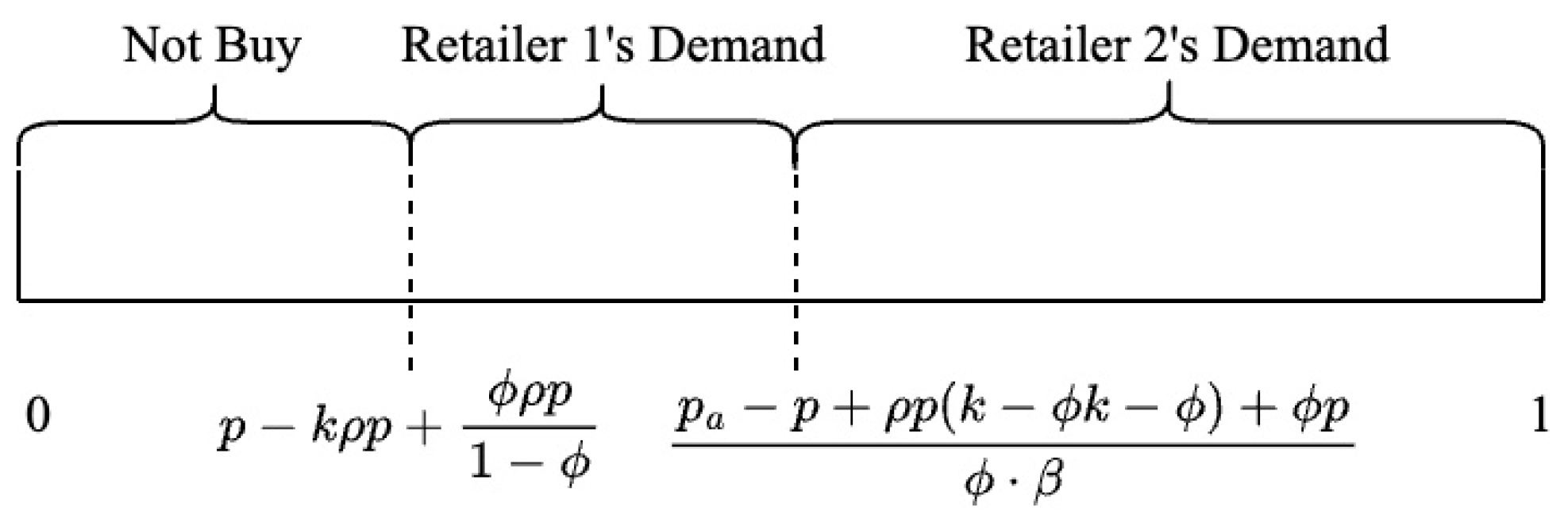
p k ρ p + ϕ ρ p 1 ϕ < v i < p a p + ρ p ( k ϕ k ϕ ) + ϕ p ϕ β .
(ii) Consumers purchase from retailer 2 if and only if:
v i > p a p + ρ p ( k ϕ k ϕ ) + ϕ p ϕ β .
(iii) Otherwise, consumers exit the market without purchase.
Decision-Making of the Retailers. Retailer 1 needs to determine the deposit discount factor ( ρ ) and the deposit expansion factor ( k ) to maximize its expected profit. Based on Lemma 5, the demand for retailer 1 under the deposit expansion strategy is given by:
D 1 = ( β 1 ) p ( k ρ + ρ 1 ) β + p ( k ρ 1 ) + p a β ϕ + p ρ ϕ 1 .
And retailer 1’s profit can therefore be expressed as:
π 1 = ( 1 ϕ ) ( p k ρ p c ) + ϕ ρ p · ( β 1 ) p ( k ρ + ρ 1 ) β + p ( k ρ 1 ) + p a β ϕ + p ρ ϕ 1 .
Retailer 2, on the other hand, needs to determine the advance discount price p a to maximize its expected profit. According to Lemma 5, the demand for retailer 2 under the advance discount strategy is
D 2 = 1 p a p + ρ p ( k ϕ k ϕ ) + ϕ p ϕ · β .
Retailer 2’s profit function is then given by:
π 2 = ( p a c ) · 1 p a p + ρ p ( k ϕ k ϕ ) + ϕ p ϕ · β
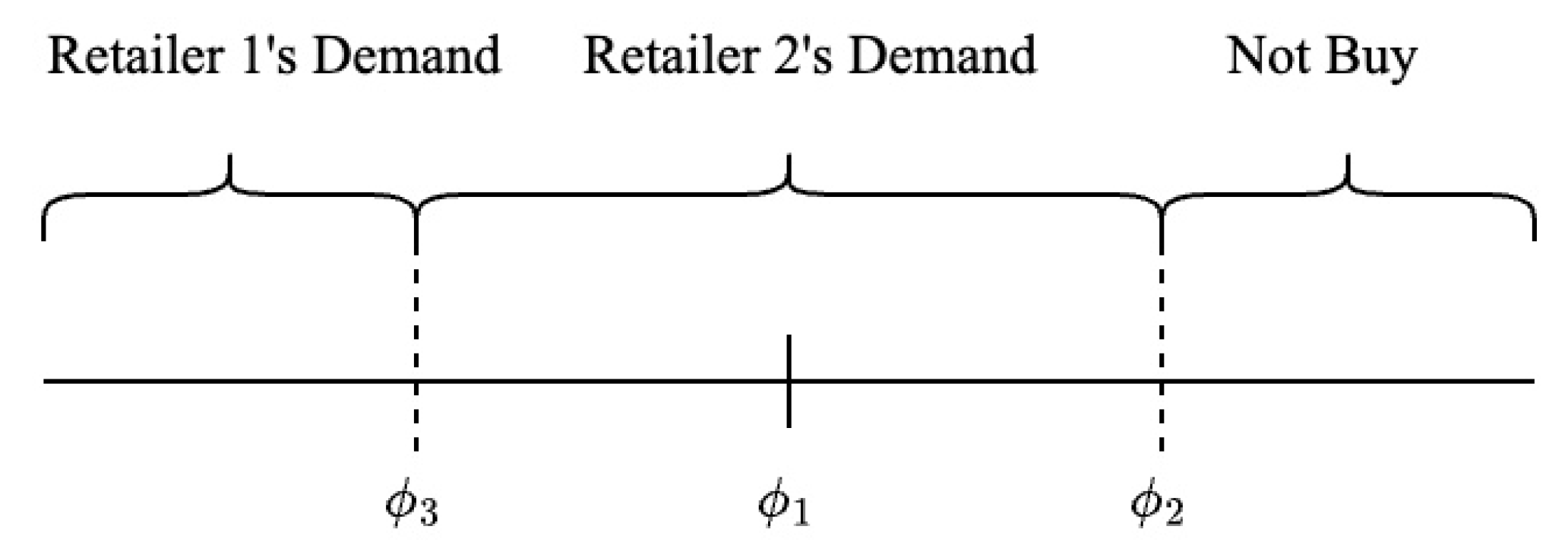
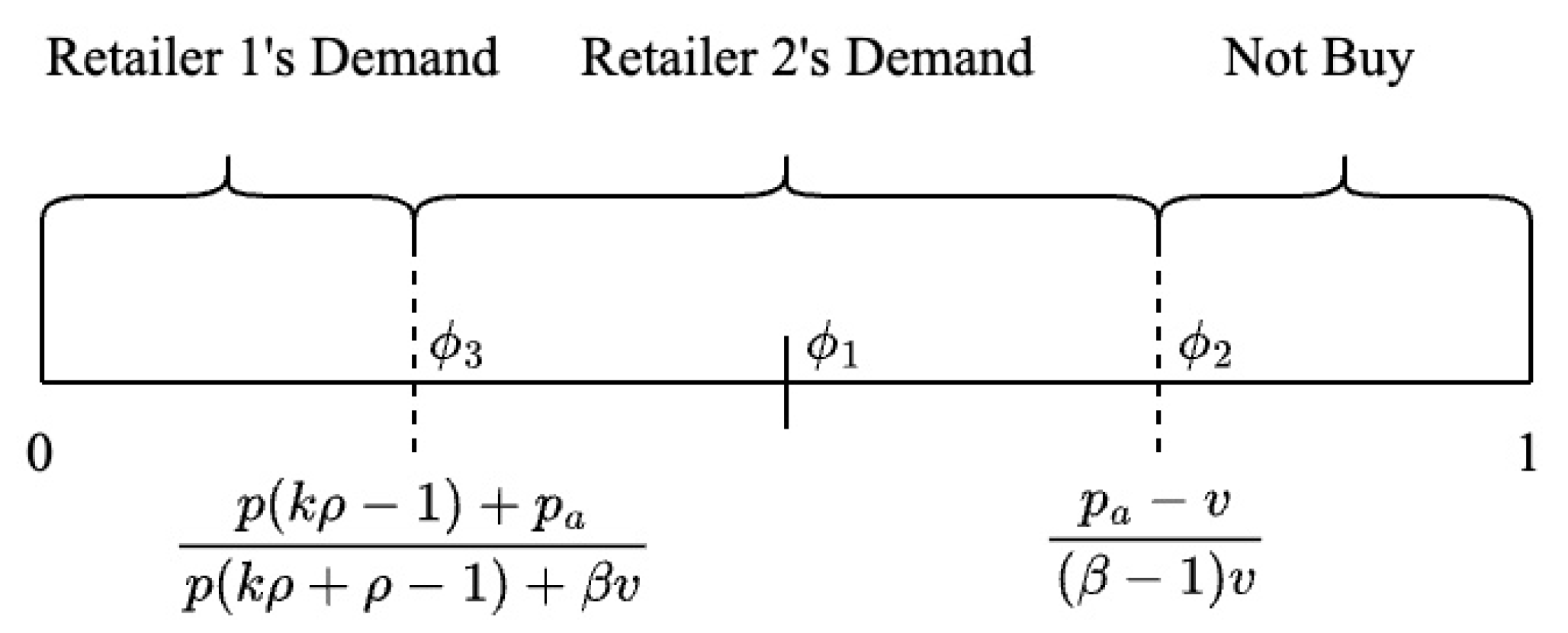
Figure 5 depicts the equilibrium market segmentation under asymmetric pre-sale strategies.
Lemma 6.
In a duopolistic market where retailer 1 implements a deposit expansion strategy and retailer 2 adopts an advance discount strategy, the equilibrium outcomes are characterized as follows.
The profit of retailer 1 is maximized at any pair ( ρ , k ) , satisfying the first-order condition:
k E D = β ( ϕ 1 ) ϕ + c ( ϕ 1 ) [ 2 ( β 1 ) ϕ + 3 ] + p ( 4 β ϕ 3 ϕ + 3 ) [ ( ρ E D 1 ) ϕ + 1 ] p ρ E D ( ϕ 1 ) [ ( 4 β 3 ) ϕ + 3 ] .
The profit of retailer 2 is maximized when the advance discount price is set at:
p a E D = ( ( β 1 ) ϕ + 1 ) ( 2 β ϕ c ( ϕ 3 ) ) ( 4 β 3 ) ϕ + 3 .
The corresponding equilibrium demands for retailers 1 and 2 are, respectively:
D 1 E D = ( ( β 1 ) ϕ + 1 ) ( ( 2 β 1 ) c β ) β ( ( 4 β 3 ) ϕ + 3 ) ,
D 2 E D = 2 β ( ( β 1 ) ϕ + 1 ) c ( ( β 1 ) ϕ + β + 1 ) β ( ( 4 β 3 ) ϕ + 3 ) .
The corresponding equilibrium profits for retailers 1 and 2 are:
π 1 E D = ( ϕ 1 ) ϕ ( ( β 1 ) ϕ + 1 ) ( β 2 β c + c ) 2 β ( ( 4 β 3 ) ϕ + 3 ) 2 ,
π 2 E D = ϕ ( 2 β + ( β 1 ) ϕ ( c 2 β ) + β c + c ) 2 β ( ( 4 β 3 ) ϕ + 3 ) 2 .
Lemma 6 suggests a similar result to the monopolistic case: retailer 1’s profit-maximization problem admits multiple optimal solutions. Specifically, any combination ( ρ , k ) satisfying the first-order condition yields identical maximum profit, given retailer 2’s optimal advance price. This structural property persists across market structures, suggesting that the flexibility inherent in deposit expansion strategies is robust to competitive pressures.

5.2. Comparative Analysis

We now compare equilibrium outcomes when retailers adopt asymmetric pre-sale strategies—retailer 1 using deposit expansion and retailer 2 employing advance discount. Our analysis focuses on how consumer psychology, i.e., anticipated regret ( ϕ ), shapes relative performance within the economically meaningful parameter space 0 < β < 2 c c + 1 .
Proposition 3.
In a duopoly with asymmetric pre-sale strategies—deposit expansion and advance discount, the demand differential Δ D E D D 1 E D D 2 E D exhibits the following properties:
(i) When consumers exhibit no anticipated regret, i.e., ϕ = 0 : Δ D E D > 0 .
(ii) When consumers exhibit anticipated regret, i.e., ϕ > 0 ; Δ D E D > 0 for all ϕ ( 0 , 0.5 ) .
(iii) Δ D E D strictly increases in the anticipated regret ϕ, i.e., Δ D E D ϕ > 0 .
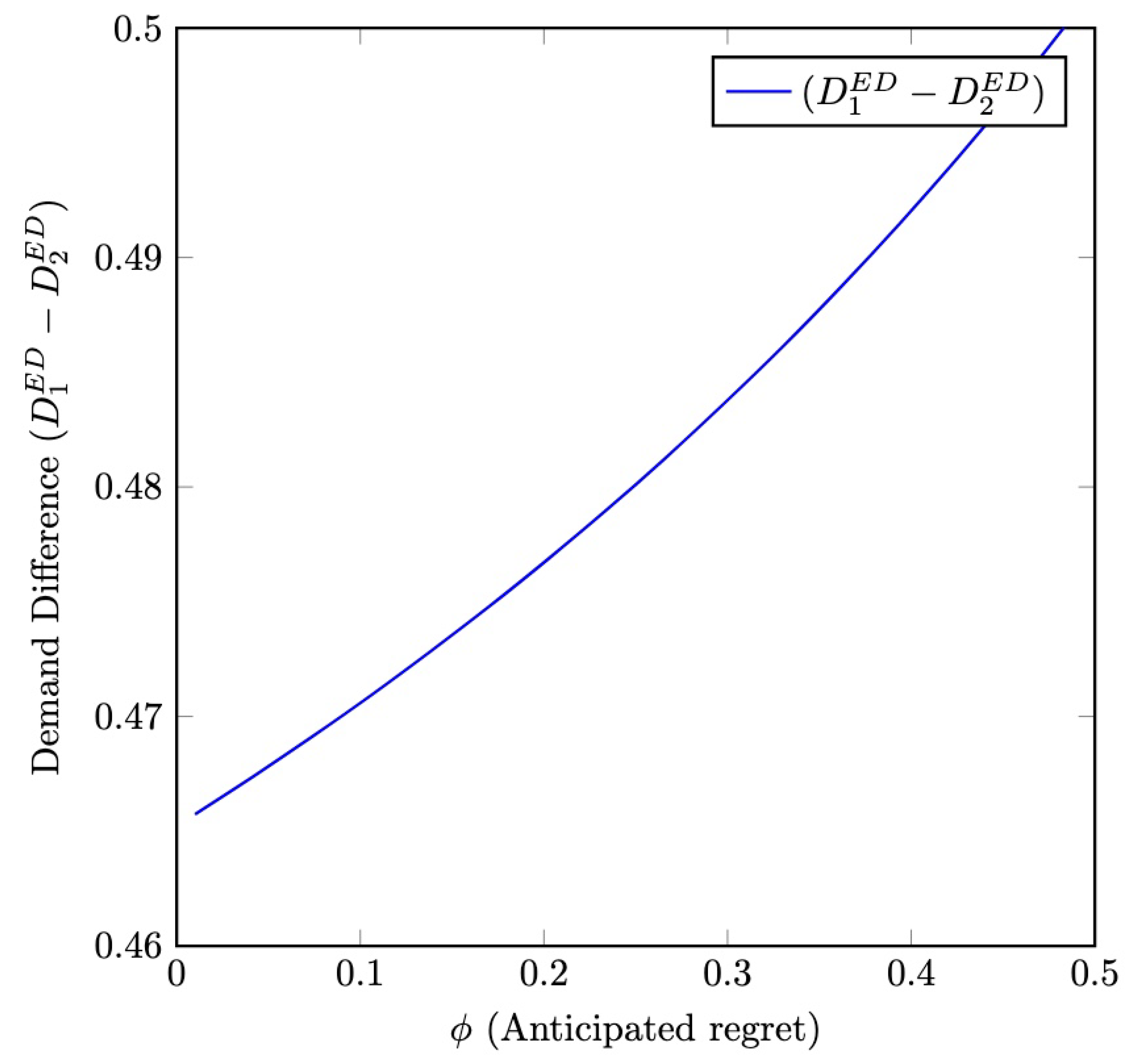
Proposition 3 establishes deposit expansion’s systematic demand advantage, which strengthens with consumer regret intensity. This dominance stems from two mechanisms. First, the baseline advantage ( ϕ = 0 ) reflects deposit expansion’s superior commitment device—partial payments create psychological ownership while preserving exit options. Second, the increasing advantage with ϕ reveals how deposit expansion uniquely leverages regret: while advance discounts amplify regret through irreversible full payment, deposits mitigate it through staged commitment. Figure 6 illustrates the demand differential between the two strategies in the duopoly market.
Proposition 4.
In a duopoly, where retailer 1 adopts deposit expansion and retailer 2 adopts advance discount, profit comparison yields: π 1 E D > π 2 E D for ϕ ( 0 , ϕ ^ ) , and π 1 E D < π 2 E D for ϕ ( ϕ ^ , 0.5 ) , where ϕ ^ is defined in Proposition 2.
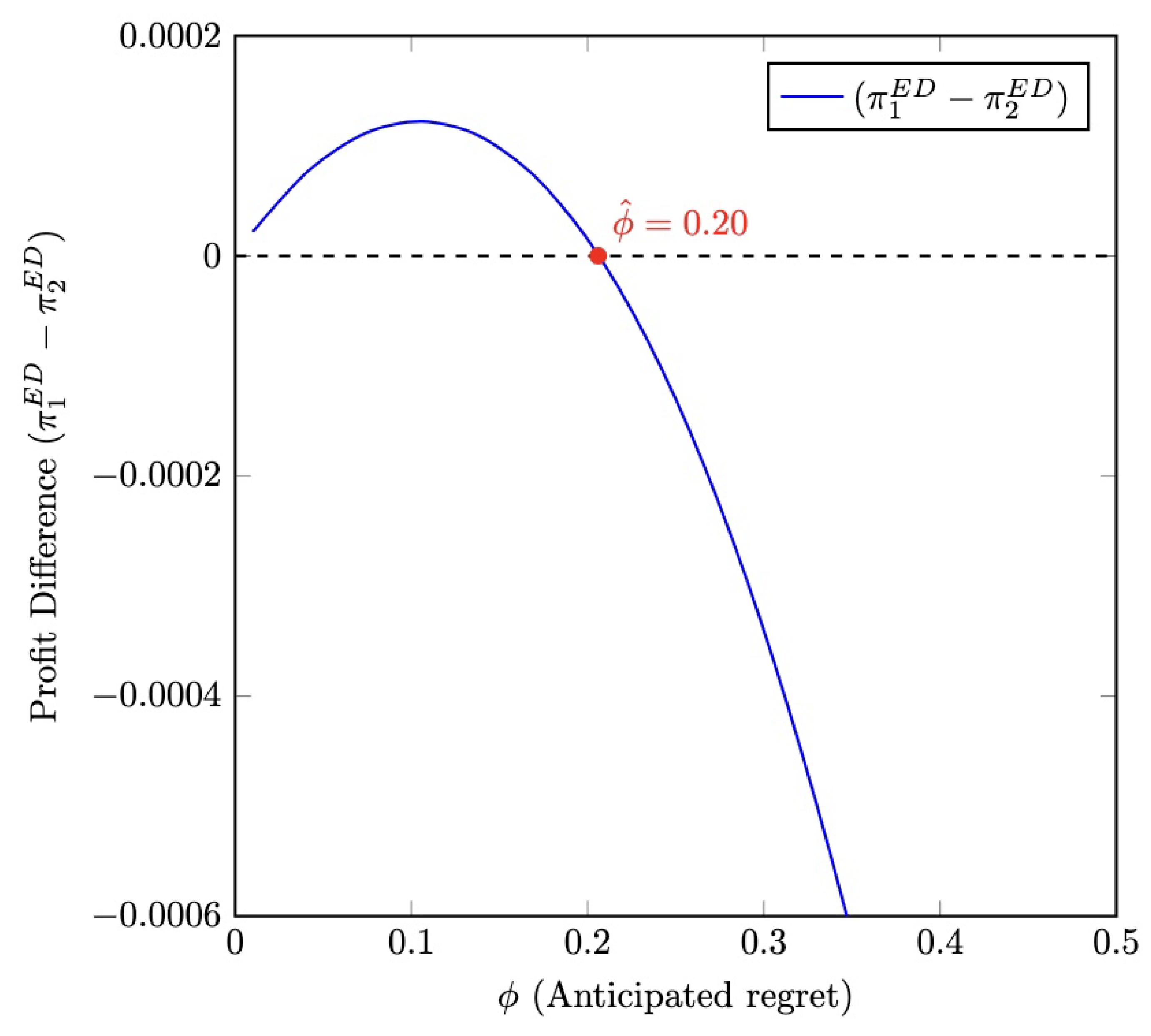
Proposition 4 shows that the profit ranking between deposit expansion and advance discounts is still governed by a unique regret cutoff ϕ ^ , and this cutoff coincides with that in the monopoly benchmark. Hence, competition compresses equilibrium profit levels but does not shift the switching point: deposit expansion is more profitable for ϕ < ϕ ^ , whereas advance discounts dominate for ϕ > ϕ ^ . This invariance indicates that the reversal is driven by the same structural behavioral trade-off as in monopoly, rather than by market structure. Figure 7 shows the profit comparison and the threshold at ϕ ^ .
Figure 6. Demand differential between retailers under asymmetric pre-sale strategies as a function of anticipated regret ( β = 0.28 , c = 0.39 ).
Mathematics 14 00692 g006
Figure 7. Profit differential between retailers under asymmetric pre-sale strategies as a function of anticipated regret ( β = 0.55 , c = 0.39 ).
Mathematics 14 00692 g007

6. Extensions

This section extends our baseline framework to examine robustness across four dimensions. First, we incorporate Bayesian learning in repeated presale games, where consumers update beliefs about regret likelihood based on past outcomes (Section 6.1). Second, we allow heterogeneity in consumers’ regret probability ϕ (Section 6.2). Third, we examine heterogeneity in the valuation-loss parameter β (Section 6.3). Fourth, we analyze asymmetric market structures with retailers of different sizes (Section 6.4). These extensions confirm that our threshold-based insights remain robust under more realistic assumptions.

6.1. Consumer Bayesian Learning in Repeated Presale Games

Presale promotions typically recur over multiple periods, allowing consumers to learn from past experiences. As consumers repeatedly encounter similar presale offers, they can update their beliefs about the likelihood of experiencing regret based on observed outcomes—whether they regretted early commitments or missed better deals. To capture this learning dynamic, we extend our baseline model to incorporate Bayesian updating. We first analyze a two-period model to establish the fundamental learning mechanism, then generalize to an N-period framework to demonstrate robustness.
We consider a two-period setting with two competing retailers selling a homogeneous product with identical marginal cost c. Retailer 1 adopts a deposit expansion strategy (denoted by “E”), while retailer 2 employs an advance discount strategy (denoted by “D”). Each retailer commits to its presale mechanism before period 1, and the chosen mechanism remains unchanged across the two periods. In each period t, given the committed mechanism, retailers simultaneously choose their period-specific prices or mechanism parameters, after which consumers decide whether to participate in the presale and which retailer to patronize.
Consumers are forward-looking and experience anticipated regret regarding their presale decisions. In period 1, consumers hold a prior belief about the probability of experiencing regret, denoted by ϕ 1 . We assume that this prior belief follows a Beta distribution, Beta ( a , b ) , where a and b represent the perceived frequencies of regret and no regret, respectively. Accordingly, the prior anticipated regret is given by:
ϕ 1 = a a + b .
Consumers use ϕ 1 when forming their expected utility and making presale decisions in period 1, following the same approach as in the single-period model.
At the end of period 1, consumers observe exogenous information about regret outcomes, denoted by ( R , N ) , where N represents the total number of independent observations, and R denotes the number of instances in which regret is realized. This information may originate from platform-level statistics, third-party reviews, or fixed-sample surveys. Importantly, we assume that the information structure ( R , N ) is exogenously given and does not depend on retailers’ presale mechanisms, pricing decisions, or the intensity of competition. That is, conditional on the true regret probability ϕ ( 0 , 0.5 ) , the distribution of ( R , N ) is independent of retailers’ strategic choices.
Under Bayesian updating with a Beta–Binomial structure, consumers’ posterior belief about regret in period 2 follows Beta ( a + R , b + N R ) , yielding a posterior mean
ϕ 2 = a + R a + b + N .
Consumers then use ϕ 2 to form expected utilities and make presale decisions in period 2. The profit functions of both retailers in each period retain the same functional form as in the baseline model, with the only difference being that the anticipated regret parameter is replaced by the period-specific belief ϕ 2 .
Because Bayesian learning affects only the level of anticipated regret in each period, but does not alter the structure of consumers’ utility functions or retailers’ profit functions, the qualitative comparison between deposit expansion and advance discounts remains unchanged. This conclusion can be easily extended to an N-period repeated environment ( t = 1 , , N ) , which is formally presented in Proposition 5.
Proposition 5.
Under repetitive mechanisms, there exists a regret threshold ϕ ^ , identical to that in the single-period model, such that for any period t, deposit expansion yields higher profit than advance discounts if and only if ϕ t < ϕ ^ . Moreover, this threshold remains the same under both monopolistic and duopolistic market structures.
The intuition behind Proposition 5 is that Bayesian learning only updates consumers’ beliefs about the likelihood of regret and hence shifts the effective level of anticipated regret in each period. Since the retailers’ profit functions preserve the same functional form as in the baseline model, the profitability comparison depends on the same structural parameters and is therefore unaffected by the learning process.

6.2. Consumer Heterogeneity in Anticipated Regret ϕ

In the baseline model, consumers are assumed to share a common anticipated regret. However, in reality, consumers may differ in their susceptibility to regret due to heterogeneous past experiences, psychological traits, or information-processing abilities. To examine the robustness of our main results, we extend our basic model by allowing consumers’ regret probabilities to be heterogeneous.
Specifically, we assume that consumers’ anticipated regret ϕ is a random variable distributed according to a general cumulative distribution function F ( ϕ ) , with corresponding density f ( ϕ ) . For tractability, we assume that product valuation v remains homogeneous across consumers, representing their maximum willingness to pay for the product [20]. All other elements of the model remain unchanged. Retailer 1 implements a deposit expansion strategy, while retailer 2 adopts an advance discount strategy. Consumers observe prices and mechanism parameters and decide whether to participate in the presale and which retailer to choose.
Given any perceived ϕ , consumers compare the expected utilities associated with deposit expansion, advance discounts, and non-participation. As in the homogeneous benchmark, these comparisons imply the existence of cutoff values of ϕ that segment consumers into different choice regions. Consumers with relatively low regret probabilities are more willing to commit early and therefore prefer the deposit expansion strategy, while consumers with higher regret probabilities either favor advance discounts or opt out of presale participation altogether.
As a result, the demands faced by the two retailers can be expressed in terms of the regret distribution evaluated at the relevant cutoff points. In particular, the demand for the retailer offering deposit expansion is given by the measure of consumers whose regret probabilities lie below the corresponding cutoff, while the demand for the retailer offering advance discounts is determined by the mass of consumers whose regret probabilities fall between two cutoff values. Importantly, although heterogeneity affects demand levels through the distribution F ( ϕ ) , it does not alter the underlying structure of the profit functions.
Proposition 6.
Suppose consumers’ anticipated regret ϕ is heterogeneous and distributed according to a general cumulative distribution function F ( ϕ ) . There exists a unique threshold ϕ ^ ( 0 , 0.5 ) , which coincides with the threshold obtained in the homogeneous benchmark, such that π 1 E D ( ϕ ) π 2 E D ( ϕ ) ϕ ϕ ^ . Consequently, deposit expansion yields higher total profit than advance discounts if and only if the expected anticipated regret E [ ϕ ] is below ϕ ^ .
The intuition behind Proposition 6 is that introducing heterogeneity in ϕ affects how consumers self-select into different presale mechanisms, but does not change the fundamental trade-off between commitment flexibility and regret exposure that drives the relative performance of deposit expansion and advance discounts. Consequently, the key threshold governing the profitability reversal between the two strategies remains unchanged. To provide further illustration, a closed-form analysis under a uniform distribution of regret probability is provided in Appendix B.

6.3. Consumer Heterogeneity in Regret-Induced Valuation Discount β

We further examine the case where the regret-induced product valuation discount β is heterogeneous across consumers. Specifically, β varies across consumers, with 0 < β < 1 . With two-dimensional heterogeneity in both consumer valuations and regret sensitivity under a general distribution form, closed-form analytical solutions become intractable [50]. Therefore, we employ numerical analysis to examine the robustness of our main results regarding the performance of the two presale strategies under different distributions of β .
In the numerical analysis, we consider two representative distributions of the regret-induced product valuation discount. In the first case, β follows a uniform distribution over the interval ( 0 , 1 ) , representing a benchmark scenario where the impact of regret on product valuation is evenly distributed across consumers. In the second case, β follows a Beta ( 2 , 2 ) distribution, which exhibits an inverted U-shape and reflects a market where most consumers experience a moderate degree of regret-induced valuation discount. For each distribution, we compare the demand and profit outcomes of the discount presale strategy and the deposit expansion presale strategy under both low and high levels of anticipated regret.
Results from Table 2 indicate that across different distributions of β , the relative performance of the two presale strategies exhibits highly consistent patterns. Specifically, when β U ( 0 , 1 ) and the level of anticipated regret is low ( ϕ = 0.1 ), the deposit expansion presale strategy outperforms the discount presale strategy in terms of both demand and profit. However, when β U ( 0 , 1 ) and the level of anticipated regret is high ( ϕ = 0.4 ), this relationship reverses. A similar pattern emerges when β Beta ( 2 , 2 ) . These results suggest that in environments with weak regret concerns, consumers are more willing to commit early through a deposit mechanism, thereby enhancing the firm’s overall profitability. By contrast, when the level of anticipated regret is high ( ϕ = 0.4 ), the discount presale strategy becomes more profitable, indicating that under strong anticipated regret, consumers are more sensitive to the potential sunk cost associated with deposits.
In summary, when the regret-induced product valuation discount β is heterogeneous, the core conclusions of the baseline model remain robust. This implies that the relative effectiveness of presale strategies is primarily driven by the intensity of anticipated regret, rather than by the presence of heterogeneity in β .

6.4. Asymmetric Duopoly

The baseline duopoly model assumes symmetric retailers. In practice, however, competing e-tailers often differ substantially in market share due to brand awareness, platform traffic, or consumer loyalty. To examine whether such asymmetry alters our main results, we extend the model to incorporate an asymmetric market structure.
We consider two asymmetric retailers selling an identical product with common marginal cost c. Retailer 1, the larger seller, adopts deposit expansion (strategy E), while retailer 2, the smaller seller, adopts advance discounts (strategy D). We assume that the market share of Retailer 1 is α ( 0.5 , 1 ) , with Retailer 2 holding the remaining share 1 α ( 0 , 0.5 ) .
To capture consumer loyalty, we further assume that a fraction β ( 0 , 1 ) of retailer 1’s consumers are loyal and do not switch between retailers, while the remaining fraction 1 β will switch to maximize utility. Similarly, a fraction γ ( 0 , 1 ) of retailer 2’s consumers are loyal, while the remaining fraction 1 γ will switch to maximize utility. The switching consumers from both retailers constitute a common pool of size
M 1 α β ( 1 α ) γ .
Consumers in the common pool compare the two retailers’ offers and psychological costs as in the baseline model. Hence, the expected utilities under deposit expansion and advance discounts remain unchanged.
Each retailer’s total profit consists of two components: profits from loyal consumers and profits from the common pool. For loyal consumers, retailer 1 earns Π E L ( ϕ ) = α β · π E ( ϕ ) , and retailer 2 earns Π D L ( ϕ ) = ( 1 α ) γ · π D ( ϕ ) , where π E ( ϕ ) and π D ( ϕ ) are per-consumer profits under deposit expansion and advance discounts, respectively. These profits are independent of competitive dynamics. For consumers in the common pool, the competitive profits follow the same structure as in the symmetric benchmark:
Π E C ( ϕ ) = M · π 1 E D ( ϕ ) , Π D C ( ϕ ) = M · π 2 E D ( ϕ ) ,
where π 1 E D ( ϕ ) and π 2 E D ( ϕ ) are equilibrium profits from the competitive segment in the symmetric case.
As a result, market-share asymmetry affects only the scale of demand faced by each retailer, without altering the structure of consumers’ utility comparisons between deposit expansion and advance discounts. Therefore, the equilibrium mechanism structure remains unchanged from the symmetric benchmark, and the profitability comparison between the two presale strategies within the competitive segment continues to be characterized by the same regret threshold.
Proposition 7.
Under the asymmetric duopoly structure, each retailer’s total profit is Π E T o t a l ( ϕ ) = Π E L ( ϕ ) + Π E C ( ϕ ) and Π D T o t a l ( ϕ ) = Π D L ( ϕ ) + Π D C ( ϕ ) . Within the common pool, the regret threshold ϕ ^ = 1 1 β + c 2 β + ( c 2 ) c remains identical to the symmetric case: ϕ > ϕ ^ Π E C ( ϕ ) < Π D C ( ϕ ) and ϕ < ϕ ^ Π E C ( ϕ ) > Π D C ( ϕ ) .
The intuition behind Proposition 7 is that market-share asymmetry introduces two distinct profit sources. Loyal consumers generate profits independent of competitive interactions, while the common pool exhibits the same competitive dynamics as the symmetric benchmark. Since anticipated regret only affects consumers’ switching decisions within the common pool, the regret threshold governing strategy profitability in the competitive segment remains invariant.

7. Conclusions

This study investigates how consumer anticipated regret influences the effectiveness of two widely used pre-sale mechanisms—advance discounts and deposit expansion—under both monopolistic and duopolistic market structures. By explicitly modeling regret-sensitive consumer behavior, we demonstrate that the performance of pre-sale strategies depends not only on pricing and cost considerations but also on the psychological frictions associated with early commitment.
Our analysis yields several key insights. First, deposit expansion exhibits a robust demand advantage over advance discounts whenever anticipated regret is present. By separating initial commitment from final consumption, deposit expansion mitigates regret-induced hesitation and consistently attracts greater participation. This demand advantage strengthens monotonically as regret intensity increases, highlighting the behavioral resilience of flexible commitment mechanisms. Second, the profitability implications are more nuanced. In monopolistic markets, deposit expansion outperforms advance discounts when anticipated regret is low to moderate, benefiting from early cash flows and forfeited deposits. However, when regret becomes sufficiently salient, consumers grow increasingly reluctant to risk sunk costs, eroding the profitability of deposit-based mechanisms and restoring the advantage of advance discounts. Third, competition alters the magnitude—but not the structure—of these effects. In duopolistic markets, competitive pressure compresses profit margins and intensifies strategic interaction, yet the critical regret threshold at which profit dominance reverses remains unchanged. This invariance is theoretically significant: it indicates that the profit reversal is driven by fundamental behavioral mechanisms rather than by market structure per se. While competition amplifies the demand advantage of deposit expansion, it does not eliminate the behavioral tipping point at which consumers’ aversion to sunk costs outweighs the benefits of flexibility.
From a managerial perspective, our results underscore the importance of aligning pre-sale strategy design with consumer psychology. Retailers should not default to a single pre-sale mechanism but instead tailor their approach to the anticipated regret profile of their target customers. Deposit expansion is particularly effective for products or markets characterized by moderate uncertainty, where consumers value flexibility but are not overly loss-averse. In contrast, when regret sensitivity is high, simpler advance discounts may yield superior profitability despite lower participation. More broadly, our findings suggest that understanding behavioral thresholds—rather than focusing solely on price levels or cost structures—is critical for effective pre-sale strategy design.
While our analysis provides clear theoretical insights into presale strategy choice under consumer anticipated regret, several limitations warrant discussion regarding practical implementation. First, the baseline model assumes homogeneous regret parameters across consumers, which simplifies market reality where regret likelihood and regret sensitivity may vary with individual characteristics, prior experiences, and product familiarity. This assumption is adopted for analytical tractability and to establish a clean threshold benchmark; accordingly, our findings are most directly applicable to well-defined product categories or market segments with relatively similar behavioral profiles. Second, the practical relevance of the framework depends on the firms’ ability to infer the regret environment. In practice, the regret parameters may be informed by multiple data sources such as historical purchase and cancellation patterns, survey-based measures of regret concerns, and controlled experiments. Third, our baseline framework is static and focuses on a one-shot presale decision, abstracting from richer long-horizon dynamics such as endogenous mechanism switching and repeated strategic interactions. Despite these limitations, our framework offers a tractable benchmark that identifies when each presale mechanism dominates and clarifies the profit implications of ignoring anticipated regret.
This study also suggests several promising directions for future research. First, while we adopt a parsimonious reduced-form representation of anticipated regret, future work could consider richer behavioral foundations, such as distinguishing between price regret and quality regret, incorporating reference-price dynamics, or allowing regret to be shaped by endogenous social influence. Second, extending the framework to long-horizon dynamic environments with repeated interactions, inventory carryover, or endogenous mechanism switching may yield additional insights into the intertemporal design of presale mechanisms. Third, we focus on two canonical presale strategies—advance discounts and deposit expansion—abstracting from hybrid mechanisms commonly observed in practice, such as partial refunds, price guarantees, or loyalty-based incentives. Finally, empirical validation using field or platform data would help assess the quantitative magnitude of the effects identified in this study and strengthen the link between theory and practice.
An additional promising direction is to incorporate cultural dimensions as moderating variables. Prior behavioral research suggests that cultural traits such as individualism–collectivism and uncertainty avoidance may shape consumers’ regret perceptions and their tolerance for sunk costs, thereby affecting both the likelihood of regret realization and the magnitude of regret-induced valuation loss. In our framework, these effects can be interpreted as cross-cultural differences in the distributions of the regret parameters ( ϕ , β ) . Future work may therefore combine our threshold-based analysis with cultural segmentation to examine how optimal presale strategy choice varies across regions and consumer populations.


Author Contributions

Conceptualization, Y.C.; methodology, W.Y.; software, Y.L.; validation, W.Y., Y.L. and Y.C.; formal analysis, W.Y.; investigation, W.Y.; resources, W.Y.; data curation, W.Y.; writing—original draft preparation, W.Y.; writing—review and editing, Y.L.; visualization, W.Y. and Y.L.; supervision, Y.C.; project administration, Y.C. All authors have read and agreed to the published version of the manuscript.

Funding

This research was funded by the Faculty Research Grant (FRG-24-077-MSB) of Macau University of Science and Technology.

Data Availability Statement

The original contributions presented in this study are included in the article. Further inquiries can be directed to the corresponding author.

Conflicts of Interest

The authors declare no conflicts of interest.

Appendix A. Proof

Appendix A.1. Survey Evidence

This appendix reports a brief consumer survey conducted to provide empirical motivation for the behavioral assumption of anticipated regret in the main analysis. The survey was administered via the online platform Sojump and yielded 514 valid responses. Respondents were asked about their emotional reactions and behavioral adjustments after experiencing price changes in a presale context. The statements were designed to capture three dimensions: direct regret and value perception, price perception and behavioral responses, and future purchase intentions. The results are summarized in Table A1.
Table A1. Summary of the price regret survey.
StatementRespondents Agreed
(A.1) I would regret this purchase.65.37%
(A.2) When I find that I bought at a high price and feel regret, I will think the product is less valuable, i.e., the perceived value decreases.57.98%
(B.1) After finding a lower price, I feel this product is “not worth the price”.58.75%
(B.2) When I worry about “the price dropping after purchase or buying at a high price”, I will change my purchase decision (e.g., delay purchase, continue comparing prices, or give up purchase, etc.).55.84%
(C.1) In the future, when buying similar products, I will worry about the situation of “price dropping after purchase” happening again.77.04%
(C.2) Before next purchase, I will spend more time comparing prices/checking promotions.73.35%
(C.3) Overall, I am satisfied with this online shopping experience.67.70%
Note: The statements are grouped into three dimensions: (A) direct regret and value perception, (B) price perception and behavioral changes, and (C) future intentions and overall evaluation.

Appendix A.2. Proof of Lemma 2

The first-order derivative of the profit function of strategy D (adopting the discount pre- sale strategy) with respect to p a is π p a = c 2 p a ( β 1 ) ϕ + 1 + 1 . The second-order derivative of the profit function is 2 π 2 p a = 2 ( β 1 ) ϕ + 1 . We can find that 2 π 2 p a < 0 , at this point, the function has a maximum value. Therefore, let the first-order derivative be π p a = 0 and solve p a D = 1 2 ( 1 + c ϕ + ϕ β ) . Substituting p a D into the demand of the retailer under the advance discount strategy D, we can get that the optimal demand of the retailer’s strategy D is D D = 1 2 c 2 ( β 1 ) ϕ + 2 . Then, substituting p a D into π a , we can get the optimal profit of the retailer’s strategy D as π D = ( β ϕ + c + ϕ 1 ) 2 4 ( β 1 ) ϕ + 4 .

Appendix A.3. Proof of Lemma 4

The retailer’s profit function under deposit expansion is: π ( ρ , k ) = [ ( 1 ϕ ) ( p k ρ p c ) + ϕ ρ p ] · ( 1 p + k ρ p ϕ ρ p 1 ϕ ) . We prove the lemma in two steps: (1) characterizing the set of candidate optimal solutions, (2) demonstrating profit invariance on this set.
(1) Characterization of the Candidate Optimal Set (S). Solving the first-order necessary conditions for optimality:
π k = 0 π ρ = 0
According to the calculation, the two first-order conditions are: π k = p ρ ( c ( ϕ 1 ) + 2 p ( k ρ ( ϕ 1 ) + ( ρ 1 ) ϕ + 1 ) + ϕ 1 ) , π ρ = p ( k ( ϕ 1 ) + ϕ ) ( c ( ϕ 1 ) + 2 p ( k ρ ( ϕ 1 ) + ( ρ 1 ) ϕ + 1 ) + ϕ 1 ) ϕ 1 . We find that if we substitute Equation (1) into Equation (2), the entire expression in Equation (2) will always be equal to zero. This means that the two equations are not independent; as long as Equation (1) satisfies, Equation (2) will automatically be satisfied. Thus, the joint first-order condition in the model ultimately simplifies to: k * ( ρ ) = ϕ 1 ϕ c 2 p + 1 2 p ρ .
This equation defines a set S of candidate optimal solutions:
S = ( ρ , k ) k = ϕ 1 ϕ 1 + c 2 p 2 p ρ , ρ ( 0 , 1 ) .
(2) Profit Invariance on S. Substituting any pair ( ρ , k * ( ρ ) ) S back into the profit function π , we obtain: π E ( ρ , k * ( ρ ) ) = 1 4 ( 1 c ) 2 ( 1 ϕ ) . The profit simplifies to an expression that depends only on the exogenous parameters c and ϕ and is independent of the specific values of ρ and k. This demonstrates that all strategies residing on the curve S yield the identical maximum profit π E .
Similarly, substituting the optimal pair ρ * , k * into the demand function D, yields the optimal demand: D E = 1 c 2 .

Appendix A.4. Proof of Proposition 1

Substitute the optimal advance discount price p a D into the demand D of the discount pre-sale strategy, we get D D = 1 2 c 2 ( β 1 ) ϕ + 2 . Substituting the optimal expansion factor k E into the demand D e of the deposit expansion strategy, we get D E = 1 c 2 . Subtracting D D from D E , D E D D = 1 c 2 ( 1 2 c 2 ( β 1 ) ϕ + 2 ) = ( β 1 ) c ϕ 2 ( β 1 ) ϕ + 2 .
The first-order derivative of the demand of deposit expansion strategy minus the demand of discount pre-sale strategy with respect to ϕ is ( D E D D ) ϕ = ( β 1 ) c 2 ( ( β 1 ) ϕ + 1 ) 2 . The first-order derivative is greater than 0, which means it is monotonically increasing and the zero point is unique. Therefore, when 0 < β < 1 , and ϕ ( 0 , 0.5 ) , D E D D > 0 , D E > D D ( D E is always greater than D D ).

Appendix A.5. Proof of Proposition 2

The profit of strategy E minus the profit of strategy D is 1 4 ϕ β + c 2 ( β ( ϕ ) + β + ϕ 2 ) ( β 1 ) ϕ + 1 + 2 c . Then, we use the zero point theorem and substitute ϕ = 0 and ϕ = 0.5 into π E π D . When ϕ = 0 , π E π D = 0 . When ϕ = 0.5 , π E π D = 1 8 c 4 c β + 1 + c + 2 β . Let π E π D = 0 , we can find the value of the threshold ϕ ^ = 1 1 β + c 2 β + ( c 2 ) c .
For ϕ ^ ( 0 , 0.5 ) , we solve the following inequality:
1 1 β + c 2 β + ( c 2 ) c > 0 1 1 β + c 2 β + ( c 2 ) c < 1 2 0 < β < 1 0 < c < 0.5
The solution to this inequality is: 1 2 c 2 + 2 c 1 + 1 2 c 4 + 4 c 3 10 c 2 + 4 c + 1 < β < 2 c c + 1 . Moreover, we note that the lower bound β ̲ = 1 2 c 2 + 2 c 1 + 1 2 c 4 + 4 c 3 10 c 2 + 4 c + 1 is strictly less than the upper bound β ¯ = 2 c c + 1 for all c ( 0 , 0.5 ) , as assumed in the model. This can be verified by analyzing the difference β ¯ β ̲ : for instance, numerical evaluation shows that β ¯ β ̲ > 0 across the entire range of c (e.g., at c = 0.3 , β ̲ 0.44 and β ¯ 0.4615 , yielding a positive difference). Thus, the inequality holds strictly, ensuring that the parameter space for β is non-empty and well-defined.
Under this condition, ϕ ^ is guaranteed to lie strictly between 0 and 0.5. Therefore:
(1) Deposit expansion dominates when ϕ ( 0 , ϕ ^ ) : π E > π D ;
(2) Discount pre-sale dominates when ϕ ( ϕ ^ , 0.5 ) : π E < π D .

Appendix A.6. Proof of Lemma 5

Consider the consumer’s expected utility from the two strategies. For retailer 1 (deposit expansion), the expected utility is U 1 = ( 1 ϕ ) [ v i p + k ρ p ] ϕ ρ p . For retailer 2 (advance discount), the expected utility is U 2 = ( 1 ϕ ) [ v i p a ] + ϕ ( β v i p a ) . A consumer chooses retailer 1 only if U 1 > 0 and U 1 > U 2 .
( 1 ϕ ) [ v i p + k ρ p ] ϕ ρ p > 0 ( 1 ϕ ) [ v i p + k ρ p ] ϕ ρ p > ( 1 ϕ ) [ v i p a ] + ϕ ( β v i p a )
The solution is that when p k ρ p + ϕ ρ p 1 ϕ v i p a p + ρ p ( k ϕ k ϕ ) + ϕ p ϕ β , the customer will choose to buy from retailer 1.
A consumer chooses retailer 2 only if U 2 > 0 and U 2 > U 1 .
( 1 ϕ ) [ v i p a ] + ϕ ( β v i p a ) > 0 ( 1 ϕ ) [ v i p + k ρ p ] ϕ ρ p < ( 1 ϕ ) [ v i p a ] + ϕ ( β v i p a )
The solution is that when v i > max p a p + ρ p ( k ϕ k ϕ ) + ϕ p ϕ β , p a 1 ϕ + ϕ β , the customer will choose to buy from retailer 2. To avoid trivial cases, we concentrate on the case where v i > p a p + ρ p ( k ϕ k ϕ ) + ϕ p ϕ β .
Next, consider the indifference point where U 1 = U 2 . Solving ( 1 ϕ ) [ v i p + k ρ p ] ϕ ρ p = ( 1 ϕ ) [ v i p a ] + ϕ ( β v i p a ) , we obtain v i = p a p + ρ p ( k ϕ k ϕ ) + ϕ p ϕ β = v ˜ .
Therefore, the consumer chooses retailer 1 if and only if p k ρ p + ϕ ρ p 1 ϕ v i p a p + ρ p ( k ϕ k ϕ ) + ϕ p ϕ β , chooses retailer 2 if and only if v i > p a p + ρ p ( k ϕ k ϕ ) + ϕ p ϕ β , and otherwise does not buy.

Appendix A.7. Proof of Lemma 6

The profit functions for Retailer 1 (deposit expansion) and Retailer 2 (advance discount) are given by Equations (10) and (12), respectively. We prove the lemma in two steps: (1) characterizing the set of candidate optimal solutions for Retailer 1, and (2) demonstrating profit invariance for Retailer 1 on this set under the optimal response of Retailer 2.
(1) Characterization of the Candidate Optimal Set (S). Solving the first-order necessary conditions for optimality for Retailer 1:
π 1 k = 0 π 1 ρ = 0
The corresponding first-order derivatives are:
π 1 k = β ( ϕ 1 ) ϕ + c ( ϕ 1 ) ( 2 ( β 1 ) ϕ + 3 ) + p ( 4 β ϕ 3 ϕ + 3 ) ( ( ρ 1 ) ϕ + 1 ) p ρ ( ϕ 1 ) ( ( 4 β 3 ) ϕ + 3 )
π 1 ρ = ( ϕ 1 ) ( ϕ ( β + 2 ( β 1 ) c + ( 3 4 β ) p ) + 3 c 3 p ) p ( ( 4 β 3 ) ϕ + 3 ) ( k ( ϕ 1 ) + ϕ )
We find that if we substitute Equation (A6) into Equation (A7), the entire expression in Equation (A7) will always be equal to zero. This means that the two equations are not independent; as long as Equation (A6) satisfies, Equation (A7) will automatically be satisfied. Thus, the joint first-order condition in the model ultimately simplifies to: k * ( ρ ) = β ( ϕ 1 ) ϕ + c ( ϕ 1 ) ( 2 ( β 1 ) ϕ + 3 ) + p ( 4 β ϕ 3 ϕ + 3 ) ( ( ρ 1 ) ϕ + 1 ) p ρ ( ϕ 1 ) ( ( 4 β 3 ) ϕ + 3 ) .
The following condition defines the equilibrium set under competition:
S = ( ρ , k ) | ρ ( 0 , 1 ) , k = N D , N = β ( ϕ 1 ) ϕ + c ( ϕ 1 ) 2 ( β 1 ) ϕ + 3 + p ( 4 β ϕ 3 ϕ + 3 ) ( ρ 1 ) ϕ + 1 , D = p ρ ( ϕ 1 ) ( 4 β 3 ) ϕ + 3 .
Simultaneously, retailer 2 maximizes its profit π 2 with respect to p a . The second-order conditions 2 π 2 2 p a = 2 β ϕ < 0 and the first-order condition π 2 p a = 0 yields a unique optimal advance price: p a E D = ( ( β 1 ) ϕ + 1 ) ( 2 β ϕ c ( ϕ 3 ) ) ( 4 β 3 ) ϕ + 3 .
This demonstrates that multiple pairs ( ρ * , k * ) can achieve optimality for Retailer 1, provided they satisfy the specified relationship.
(2) Profit invariance on S * . Substituting any pair ( ρ * , k * ) from the equilibrium set S * and the optimal price p a E D back into Retailer 1’s profit function π 1 , we obtain: π 1 E D ρ * , k * , p a E D = ( ϕ 1 ) ϕ ( ( β 1 ) ϕ + 1 ) ( β 2 β c + c ) 2 β ( ( 4 β 3 ) ϕ + 3 ) 2 . The profit simplifies to an expression that depends only on the exogenous parameters c, β , and ϕ , and is independent of the specific values of ρ and k. This demonstrates that all strategies residing on the curve S * yield the identical maximum profit π 1 E D for Retailer 1.
Similarly, substituting p a E D into Retailer 2’s profit function yields its equilibrium profit: π 2 E D p a E D = ϕ ( 2 β + ( β 1 ) ϕ ( c 2 β ) + β c + c ) 2 β ( ( 4 β 3 ) ϕ + 3 ) 2 .
We now derive the optimal demand. Substituting the equilibrium solutions ( k * , p a E D ) into the demand functions (9) and (11) for both retailers, we find that the demands also resolve into expressions dependent only on exogenous parameters:
D 1 E D = ( ( β 1 ) ϕ + 1 ) ( ( 2 β 1 ) c β ) β ( ( 4 β 3 ) ϕ + 3 ) , D 2 E D = 2 β ( ( β 1 ) ϕ + 1 ) c ( ( β 1 ) ϕ + β + 1 ) β ( ( 4 β 3 ) ϕ + 3 ) .

Appendix A.8. Proof of Proposition 3

The optimal demand D 1 E D of retailer 1 minus the optimal demand D 2 E D of retailer 2 is D 1 E D D 2 E D = β ( β ϕ + ϕ 1 ) + c 2 ( β 1 ) 2 ϕ β + 2 β ( ( 4 β 3 ) ϕ + 3 ) . The first derivative of retailer 1’s demand minus retailer 2’s demand with respect to ϕ is ( D 1 E D D 2 E D ) ϕ = β 2 β c + c ( ( 4 β 3 ) ϕ + 3 ) 2 .
Since ( c β ) 2 0 , then c 2 + β 2 2 c β 0 and c 2 + β 2 2 c β . Based on the properties of the function, we have c + β c 2 + β 2 , then we can obtain c + β c 2 + β 2 2 c β , therefore c + β 2 c β . We can conclude that if the first derivative is greater than 0, it can be determined that the function is monotonically increasing. D 1 E D D 2 E D ϕ > 0 , this means that the larger ϕ is, the larger D 1 E D D 2 E D is.
When ϕ = 0 , D 1 E D D 2 E D = c ( 2 β ) β 3 β > 0 . Therefore, we can solve that when 0 < β < 2 c c + 1 , and ϕ ( 0 , 0.5 ) , D 1 E D D 2 E D > 0 , D 1 E D > D 2 E D (retailer 1’s demand greater than retailer 2’s demand).

Appendix A.9. Proof of Proposition 4

The maximum profit of Retailer 1 (adopting the deposit expansion strategy) minus the maximum profit of Retailer 2 (adopting the discount pre-sale strategy) is π 1 E D π 2 E D = ϕ ( ( c 1 ) ( β + ( β 2 ) c ) ( β 1 ) ϕ ( β + ( c 2 ) c ) ) ( 4 β 3 ) ϕ + 3 . According to the zero point theorem and substitute ϕ = 0 and ϕ = 0.5 into π 1 E D π 2 E D . When ϕ = 0 , π 1 E D π 2 E D = 0 . When ϕ = 0.5 , π 1 E D π 2 E D = β ( β + 1 ) + ( β 3 ) c 2 + 2 ( β + 1 ) c 8 β + 6 . Let π 1 E D π 2 E D = 0 , we can find the value of the threshold ϕ ^ = 1 1 β + c 2 β + ( c 2 ) c .
The first derivative of retailer 1’s profit minus retailer 2’s profit with respect to ϕ is ( π 1 E D π 2 E D ) ϕ = ( β 1 ) ( 4 β 3 ) ϕ 2 ( β + ( c 2 ) c ) 6 ( β 1 ) ϕ ( β + ( c 2 ) c ) + 3 ( c 1 ) ( β + ( β 2 ) c ) ( ( 4 β 3 ) ϕ + 3 ) 2 . And we can get the right derivative of ϕ = 0 as π 1 E D π 2 E D ϕ ϕ = 0 = 1 3 ( c 1 ) ( β + ( β 2 ) c ) .
If the right derivative at ϕ = 0 , given by 1 3 ( c 1 ) ( β + ( β 2 ) c ) > 0 , indicates that the function is monotonically increasing, then from the inequality 1 3 ( c 1 ) ( β + ( β 2 ) c ) > 0 , it can be deduced that β + ( β 2 ) c < 0 . Solving this inequality yields 0 < β < 2 c c + 1 . And when:
π 1 E D π 2 E D ϕ = 1 2 > 0 π 1 E D π 2 E D ϕ = 1 2 < 0
The image of π 1 E D π 2 E D may increase first and then decrease or increase monotonically. Therefore:
(1) When 0 < β < 2 c c + 1 and β ( β + 1 ) + ( β 3 ) c 2 + 2 ( β + 1 ) c 8 β + 6 > 0 , π 1 E D > π 2 E D . We can solve that when 0 < β < 1 2 c 2 + 2 c 1 + 1 2 c 4 + 4 c 3 10 c 2 + 4 c + 1 , and 0 < c < 0.5 then for all ϕ ( 0 , 0.5 ) , we have π 1 E D > π 2 E D .
(2) When 1 2 c 2 + 2 c 1 + 1 2 c 4 + 4 c 3 10 c 2 + 4 c + 1 < β < 2 c c + 1 and 0 < c < 0.5 , then there exists a threshold ϕ ^ ( 0 , 0.5 ) such that:
(i) For ϕ ( 0 , ϕ ^ ) , we have π 1 E D > π 2 E D ;
(ii) For ϕ ( ϕ ^ , 0.5 ) , we have π 1 E D < π 2 E D .

Appendix B. Proof

Proof of Proposition 5

This appendix provides the Bayesian updating details for the extension in Section 6.
(1) Prior and posterior beliefs. In period 1, consumers hold a prior belief about the probability of experiencing regret, denoted by ϕ 1 . We assume a Beta prior ϕ 1 Beta ( a , b ) , where a > 0 and b > 0 represent the perceived frequencies of regret and no regret, respectively. The prior mean is E [ ϕ 1 ] = a a + b . At the end of period 1, consumers observe N independent regret realizations, among which regret occurs R times. Conditional on the true regret probability ϕ ( 0 , 1 ) , we assume R ϕ Binomial ( N , ϕ ) , and ( R , N ) is exogenously given and independent of retailers’ strategic choices.Hence, Bayesian updating does not introduce additional strategic feedback from retailers’decisions to consumers’ beliefs. By Beta–Binomial conjugacy, the posterior belief in period 2 is ϕ 2 ( R , N ) Beta ( a + R , b + N R ) , with posterior mean E [ ϕ 2 R , N ] = a + R a + b + N .
(2) In each period t { 1 , 2 } , consumers form expected utilities based on the period-specific belief ϕ t . The expected utilities under deposit expansion and advance discounts retain the same functional form as in the baseline model, with ϕ replaced by ϕ t . Accordingly, the retailers’ profit functions in each period also preserve the same functional form as in the baseline model, and can be written as π E ( ϕ t ) , π D ( ϕ t ) , where π E ( · ) and π D ( · ) are identical to those in the single-period benchmark.
(3) Threshold invariance. Define the profit difference in period t as Δ ( ϕ t ) π E ( ϕ t ) π D ( ϕ t ) . Since Bayesian learning only updates the belief parameter ϕ t and does not change the functional form of π E ( · ) and π D ( · ) , the sign of Δ ( ϕ t ) is determined by the same structural parameters as in the baseline model. Therefore, the regret threshold ϕ ^ that solves Δ ( ϕ ^ ) = 0 is identical to that obtained in the single-period benchmark, implying that the profitability comparison between deposit expansion and advance discounts is invariant to Bayesian learning.

Appendix C. Proof

Proof of Proposition 6

This appendix provides the derivations for the extension in which consumers’ regret probabilities are heterogeneous. In particular, we derive consumers’ choice thresholds, the resulting demands, and the profit expressions under a general distribution F ( ϕ ) . We further provide a closed-form illustration under a uniform distribution.
(1) Setup: General Distributions of ϕ . We extend the duopoly presale model by allowing consumers’ regret probability ϕ to be heterogeneous. Specifically, ϕ is a random variable supported on ( 0 , 1 ) with cumulative distribution function F ( ϕ ) and density f ( ϕ ) . For clarity, the baseline product valuation v is homogeneous across consumers and remains a fixed constant throughout the analysis. All other primitives and the market structure are identical to those in the baseline duopoly model. Retailer 1 adopts the deposit expansion strategy (denoted by E), while Retailer 2 adopts the advance discount strategy (denoted by D). In a given period, Retailer 1 chooses ( k , ρ ) and the presale price p, and Retailer 2 chooses the advance discount price p a (This appendix focuses on characterizing consumer sorting and the induced demand system under heterogeneity. The retailers’ strategic choices follow the same equilibrium logic as in the baseline model).
(2) Consumers’ Expected Utilities and Choice thresholds. Consider a consumer with regret probability ϕ . Under deposit expansion, the consumer pays a deposit ρ p in the presale stage and may forgo the purchase in the selling stage if regret occurs, in which case the deposit is forfeited. Following the baseline model, the consumer’s expected utility from choosing Retailer 1 (deposit expansion) is U E = ( 1 ϕ ) v p + k ρ p ϕ ρ p . Under advance discounts, the consumer pays the advance discount price p a and experiences a valuation loss to β v if regret occurs. The expected utility from choosing Retailer 2 (advance discounts) is U D = ( 1 ϕ ) v p a + ϕ β v p a . Consumers choose the option that yields the highest nonnegative expected utility. We next derive the relevant threshold values of ϕ .
  • (i) Participation Under Deposit Expansion and Advance Discounts.
A consumer chooses Retailer 1 (Deposit Expansion) only if U E > 0 and U E > U D .
( 1 ϕ ) v p + k ρ p ϕ ρ p > 0 ( 1 ϕ ) v p + k ρ p ϕ ρ p > ( 1 ϕ ) v p a + ϕ β v p a
U E > 0 , solving for U E yields, we have ϕ < p ( k ρ 1 ) + v ρ p ( k + 1 ) p + v = ϕ 1 . U E > U D , we have ϕ < p ( k ρ 1 ) + p a v β + p ( ρ 1 + k ρ ) = ϕ 3 .
In summary, the solution is that when ϕ < min p ( k ρ 1 ) + v ρ p ( k + 1 ) p + v , p ( k ρ 1 ) + p a v β + p ( ρ 1 + k ρ ) , the customer will choose to buy from retailer 1.
A consumer chooses retailer 2 (Advance Discounts) only if U D > 0 and U D > U E .
( 1 ϕ ) v p a + ϕ β v p a > 0 ( 1 ϕ ) v p + k ρ p ϕ ρ p < ( 1 ϕ ) v p a + ϕ β v p a
U D > 0 , solving for U D yields, we have ϕ < p a v v ( β 1 ) = ϕ 2 . U E < U D , we have ϕ 3 = p ( k ρ 1 ) + p a v β + p ( ρ 1 + k ρ ) < ϕ
In summary, the solution is that when p a v v ( β 1 ) > ϕ > p ( k ρ 1 ) + p a v β + p ( ρ 1 + k ρ ) , the customer will choose to buy from retailer 2. See Figure A1 and Figure A2.
Next, consider the indifference point where U E = U D , we obtain ϕ ˜ = p ( k ρ 1 ) + p a p ( k ρ + ρ 1 ) + β v .
(3) Induced Demands and Profit Functions. To avoid trivial cases, we concentrate on the case where ϕ 3 < ϕ 1 . Therefore, the demand for retailer 1 under the deposit expansion strategy is given by: D 1 = F ϕ 3 . And retailer 1’s profit can therefore be expressed as: π 1 ( k , p ) = [ ( 1 ϕ ) ( p k ρ p c ) + ϕ ρ p ] · F ( ϕ 3 ) . For a binary variable ( k , ρ ) , the necessary and sufficient condition for the Hessian to be negative definite is: π 1 2 ( k , ρ ) k 2 < 0 , det ( H 1 ) = π 1 2 ( k , ρ ) k 2 · π 1 2 ( k , ρ ) ρ 2 ( π 1 2 ( k , ρ ) k ρ ) 2 > 0 .
The demand for retailer 2 under the advance discount strategy is: D 2 = F ϕ 2 F ϕ 3 . And retailer 2’s profit can therefore be expressed as: π 2 p a = p a c F ϕ 2 F ϕ 3 . We obtain ϕ 2 = ϕ 2 p a = 1 ( β 1 ) v , ϕ 3 = ϕ 3 p a = 1 p ( k ρ + ρ 1 ) + β v . Substituting into the second derivative, we get π 2 p a = 2 f ϕ 2 ϕ 2 f ϕ 3 ϕ 3 + p a c f ϕ 2 ϕ 2 2 f ϕ 3 ϕ 3 2 . Therefore, the strict concavity of the discounted pre-sale profit with respect to p a ( π 2 ( p a ) < 0 ) is equivalent to the following under the general distribution: 2 f ϕ 2 v ( 1 β ) f ϕ 3 k p ρ + p ρ p + β v + p a c f ϕ 2 v 2 ( 1 β ) 2 f ϕ 3 ( k p ρ + p ρ p + β v ) 2 < 0 .
Figure A1. Consumer segmentation under asymmetric pre-sale strategies in duopoly (General Distribution).
Mathematics 14 00692 g0a1
In summary, the optimal decision for retailer 1 (Deposit Expansion) is determined by first-order conditions, since the decision variables are ( k , ρ ) : π 1 k = 0 , π 1 ρ = 0 . Therefore, the optimal decision for deposit expansion is: k * , ρ * .
The optimal decision for retailer 2 (Advance Discounts): retailer 2 chooses p a , with the optimal condition being π 2 p a = 0 . Therefore, the optimal decision for advance discounts is p a * .
(4) Uniform Distribution. The optimal profit is always an implicit solution, making it impossible to compare profits. Therefore, we will try to calculate it using a uniform distribution later. Therefore, the demand of retailer 1 (Deposit Expansion) is: D 1 = p ( k ρ 1 ) + p a v β + p ( ρ 1 + k ρ ) . And retailer 1’s profit can therefore be expressed as: π 1 ( k , ρ ) = [ ( 1 ϕ ) ( p k ρ p c ) + ϕ ρ p ] · [ p ( k ρ 1 ) + p a v β + p ( ρ 1 + k ρ ) ] .
The demand of retailer 2 (Advance Discounts) is: D 2 = p a v ( β 1 ) v p ( k ρ 1 ) + p a p ( k ρ + ρ 1 ) + β v . And retailer 2’s profit can therefore be expressed as: π 2 ( p a ) = ( p a c ) · [ p a v ( β 1 ) v p ( k ρ 1 ) + p a p ( k ρ + ρ 1 ) + β v ] .
Figure A2. Consumer segmentation under asymmetric pre-sale strategies in duopoly (Uniform Distribution).
Mathematics 14 00692 g0a2
The threshold is obtained as
ϕ ^ = p ρ c ( ( ( k + 1 ) p a ) + β k v + v ) + ( β 1 ) k v ( 2 p v ) + ( k + 1 ) p a 2 + p a v ( 2 β k + k 1 ) + ( p v ) ( β v ( c + p 2 p a ) + p a ( c + p a + v ) p v ) + ( β 1 ) k 2 p 2 ρ 2 v ( β 1 ) v ( p ( k ρ 1 ) + p a ) ( p ( k ρ + ρ 1 ) + v )
Lemma A1.
Under ϕ U [ 0 , 0.5 ] , there exists a regret threshold ϕ ^ such that deposit expansion yields higher profit than advance discounts if and only if ϕ < ϕ ^ .
Lemma A1 confirms that the qualitative profitability comparison between deposit expansion and advance discounts remains characterized by a threshold structure, thereby supporting the robustness of the main results.

Appendix D. Proof

Proof of Proposition 7

This appendix provides the derivations for the asymmetric duopoly extension in which Retailer 1 is the large seller with market share α ( 0.5 , 1 ) and Retailer 2 is the small seller with market share 1 α ( 0 , 0.5 ) .
(1) Market segmentation and effective market size. Assume that a fraction α β of consumers are loyal to Retailer 1 and a fraction ( 1 α ) γ are loyal to Retailer 2, where β , γ ( 0 , 1 ) . The remaining consumers constitute a competitive pool of size M = 1 α β ( 1 α ) γ .
(2) Scaled demands. Since consumers in the competitive pool compare the two retailers based on the same utility functions as in the baseline model, the equilibrium cutoffs remain unchanged. Therefore, the equilibrium demands under the asymmetric structure satisfy D 1 asym = M D 1 sym , D 2 asym = M D 2 sym .
(3) Scaled profits and threshold invariance. It follows that equilibrium profits can be written as Π E ( ϕ ) = M π 1 E D ( ϕ ) , Π D ( ϕ ) = M π 2 E D ( ϕ ) . Hence, the regret threshold ϕ ^ that governs the profitability comparison is identical to that in the symmetric benchmark. In particular, ϕ > ϕ ^ Π E ( ϕ ) < Π D ( ϕ ) , ϕ < ϕ ^ Π E ( ϕ ) > Π D ( ϕ ) , where ϕ ^ = 1 1 β + c 2 β + ( c 2 ) c .

References

  1. Shopify. Global Ecommerce Sales Growth Report. 2024. Available online: https://www.shopify.com/blog/global-ecommerce-sales (accessed on 8 June 2025).
  2. Fan, J.; Zhang, X.; Dan, B.; Tian, Y.; Chen, Z. Advance selling of fresh produce e-tailer with uncertain demand and risk-averse consumers. Manag. Decis. Econ. 2024, 45, 1702–1717. [Google Scholar] [CrossRef] [Scilit]
  3. Ma, L.; Yan, X.; Huo, Y. Research on the inventory of online merchants in the pre-sale mode of deposit. Int. J. Innov. Comput. Inf. Control 2021, 17, 1075–1083. [Google Scholar]
  4. Prasad, A.; Stecke, K.E.; Zhao, X. Advance selling by a newsvendor retailer. Prod. Oper. Manag. 2011, 20, 129–142. [Google Scholar] [CrossRef] [Scilit]
  5. Zhang, Q.; Cheng, X.; Tsao, Y.C.; Zhang, D. Advance selling under deposit expansion and consumer’s valuation change. Oper. Res. 2022, 22, 3633–3661. [Google Scholar] [CrossRef] [Scilit]
  6. Amazon. How Prime Day Deals Work. 2024. Available online: https://www.amazon.com/primeday (accessed on 8 June 2025).
  7. Yu, Y. Research on the Reasons of the Simplification of 618 Shopping Festival Marketing Strategy From the Perspective of E-Commerce Marketing Management. In Proceedings of the 9th International Conference on Engineering Management and the 2nd Forum on Modern Logistics and Supply Chain Management (ICEM-MLSCM 2024); Atlantis Press: Guangzhou, China, 2024; pp. 259–273. [Google Scholar]
  8. Abraham, C.; Sheeran, P. Acting on intentions: The role of anticipated regret. Br. J. Soc. Psychol. 2003, 42, 495–511. [Google Scholar] [CrossRef] [Scilit]
  9. Zeelenberg, M. Anticipated regret, expected feedback and behavioral decision making. J. Behav. Decis. Mak. 1999, 12, 93–106. [Google Scholar] [CrossRef] [Scilit]
  10. Chen, J.; Teng, L.; Liu, S.; Zhu, H. Anticipating regret and consumers’ preferences for counterfeit luxury products. J. Bus. Res. 2015, 68, 507–515. [Google Scholar] [CrossRef] [Scilit]
  11. Jiang, B.; Narasimhan, C.; Turut, Ö. Anticipated regret and product innovation. Manag. Sci. 2017, 63, 4308–4323. [Google Scholar] [CrossRef] [Scilit]
  12. Shih, E.; Schau, H.J. To justify or not to justify: The role of anticipated regret on consumers’ decisions to upgrade technological innovations. J. Retail. 2011, 87, 242–251. [Google Scholar] [CrossRef] [Scilit]
  13. Syam, N.; Krishnamurthy, P.; Hess, J.D. That’s what I thought I wanted? Miswanting and regret for a standard good in a mass-customized world. Mark. Sci. 2008, 27, 379–397. [Google Scholar] [CrossRef] [Scilit]
  14. Xu, C.; Zhang, B.; Yang, H. Premium pricing and capacity rationing for advance selling with consumers regret. J. Retail. Consum. Serv. 2024, 81, 104021. [Google Scholar] [CrossRef] [Scilit]
  15. Jin, Q.; Zhu, M.; Yang, Y.; Liu, L. Consumer search with anticipated regret. Prod. Oper. Manag. 2022, 31, 3337–3351. [Google Scholar] [CrossRef] [Scilit]
  16. Yang, F.; Wang, M.; Ang, S. Optimal remanufacturing decisions in supply chains considering consumers’ anticipated regret and power structures. Transp. Res. Part E Logist. Transp. Rev. 2021, 148, 102267. [Google Scholar] [CrossRef] [Scilit]
  17. Tang, C.S.; Rajaram, K.; Alptekinoğlu, A.; Ou, J. The benefits of advance booking discount programs: Model and analysis. Manag. Sci. 2004, 50, 465–478. [Google Scholar] [CrossRef] [Scilit]
  18. McCardle, K.; Rajaram, K.; Tang, C.S. Advance booking discount programs under retail competition. Manag. Sci. 2004, 50, 701–708. [Google Scholar] [CrossRef] [Scilit]
  19. You, P.S. Ordering and pricing of service products in an advance sales system with price-dependent demand. Eur. J. Oper. Res. 2006, 170, 57–71. [Google Scholar] [CrossRef] [Scilit]
  20. Cachon, G.P.; Swinney, R. Purchasing, pricing, and quick response in the presence of strategic consumers. Manag. Sci. 2009, 55, 497–511. [Google Scholar] [CrossRef] [Scilit]
  21. Yu, M.; Kapuscinski, R.; Ahn, H.S. Advance selling: Effects of interdependent consumer valuations and seller’s capacity. Manag. Sci. 2015, 61, 2100–2117. [Google Scholar] [CrossRef] [Scilit]
  22. Şeref, M.M.; Şeref, O.; Alptekinoğlu, A.; Erengüç, S.S. Advance selling to strategic consumers. Comput. Manag. Sci. 2016, 13, 597–626. [Google Scholar] [CrossRef] [Scilit]
  23. Zhang, G.; Li, G.; Shang, J. Optimizing mixed bundle pricing strategy: Advance selling and consumer regret. Omega 2023, 115, 102782. [Google Scholar] [CrossRef] [Scilit]
  24. Lu, D.; Wang, P. Dynamic pricing for new experience products in pre-sale mode with social learning. J. Retail. Consum. Serv. 2024, 76, 103569. [Google Scholar] [CrossRef] [Scilit]
  25. Xie, J.; Shugan, S.M. Electronic tickets, smart cards, and online prepayments: When and how to advance sell. Mark. Sci. 2001, 20, 219–243. [Google Scholar] [CrossRef] [Scilit]
  26. Cachon, G.P. The allocation of inventory risk in a supply chain: Push, pull, and advance-purchase discount contracts. Manag. Sci. 2004, 50, 222–238. [Google Scholar] [CrossRef] [Scilit]
  27. Fisher, M.; Raman, A. Reducing the cost of demand uncertainty through accurate response to early sales. Oper. Res. 1996, 44, 87–99. [Google Scholar] [CrossRef] [Scilit]
  28. Moe, W.W.; Fader, P.S. Fast-track: Article using advance purchase orders to forecast new product sales. Mark. Sci. 2002, 21, 347–364. [Google Scholar] [CrossRef] [Scilit]
  29. Cachon, G.P.; Feldman, P. Is advance selling desirable with competition? Mark. Sci. 2017, 36, 214–231. [Google Scholar]
  30. He, B.; Gan, X.; Yuan, K. Entry of online presale of fresh produce: A competitive analysis. Eur. J. Oper. Res. 2019, 272, 339–351. [Google Scholar] [CrossRef] [Scilit]
  31. Cheng, Y.; Li, H.; Thorstenson, A. Advance selling with double marketing efforts in a newsvendor framework. Comput. Ind. Eng. 2018, 118, 352–365. [Google Scholar] [CrossRef] [Scilit]
  32. Gan, X.; Sethi, S.P.; Xu, L. Simultaneous optimization of contingent and advance purchase orders with fixed ordering costs. Omega 2019, 89, 227–241. [Google Scholar] [CrossRef] [Scilit]
  33. Ma, S.; Li, G.; Sethi, S.P.; Zhao, X. Advance selling in the presence of market power and risk-averse consumers. Decis. Sci. 2019, 50, 142–169. [Google Scholar] [CrossRef] [Scilit]
  34. Peng, W.; Tian, Z.; Wang, Y. Price guarantee for advance selling in the presence of preorder-dependent social learning. Int. J. Prod. Econ. 2020, 219, 115–122. [Google Scholar] [CrossRef] [Scilit]
  35. Liu, F.; Meng, L.; Duan, S.; Li, Y. Study on Search Cost and Consumer Anticipated Regret Paradox: Based on the U-shaped Curve Hypothesis and Verification. J. Ind. Eng. Eng. Manag. 2022, 36, 50–64. [Google Scholar]
  36. Larrick, R.P.; Boles, T.L. Avoiding regret in decisions with feedback: A negotiation example. Organ. Behav. Hum. Decis. Process. 1995, 63, 87–97. [Google Scholar] [CrossRef] [Scilit]
  37. Yin, C.; Yu, H. The Impact of Anticipated Regret on Consumers’ Impulsive Buying Behavior. Manag. Rev. 2009, 21, 71–79+93. [Google Scholar]
  38. Gao, P.; Du, J.; Nie, J.; Li, X. Impact of Consumer Anticipated Regret on Offline Retailers’ Service Provision Strategies. Forecasting 2018, 37, 62–68. [Google Scholar]
  39. Jiang, Y.c.; Qi, Y.y. A study on limited pre-sale strategy with consideration of consumer regret. PLoS ONE 2023, 18, e0285052. [Google Scholar] [CrossRef] [Scilit]
  40. Nasiry, J.; Popescu, I. Advance selling when consumers regret. Manag. Sci. 2012, 58, 1160–1177. [Google Scholar] [CrossRef] [Scilit]
  41. Özer, Ö.; Zheng, Y. Markdown or everyday low price? The role of behavioral motives. Manag. Sci. 2016, 62, 326–346. [Google Scholar] [CrossRef] [Scilit]
  42. Zou, T.; Zhou, B.; Jiang, B. Product-line design in the presence of consumers’ anticipated regret. Manag. Sci. 2020, 66, 5665–5682. [Google Scholar] [CrossRef] [Scilit]
  43. Sarangee, K.; Schmidt, J.B.; Wallman, J.P. Clinging to slim chances: The dynamics of anticipating regret when developing new products. J. Prod. Innov. Manag. 2013, 30, 980–993. [Google Scholar] [CrossRef] [Scilit]
  44. Engelbrecht-Wiggans, R.; Katok, E. Regret in auctions: Theory and evidence. Econ. Theory 2007, 33, 81–101. [Google Scholar] [CrossRef] [Scilit]
  45. Diecidue, E.; Rudi, N.; Tang, W. Dynamic purchase decisions under regret: Price and availability. Decis. Anal. 2012, 9, 22–30. [Google Scholar] [CrossRef] [Scilit]
  46. Weng, Z.K.; Parlar, M. Integrating early sales with production decisions: Analysis and insights. IIE Trans. 1999, 31, 1051–1060. [Google Scholar] [CrossRef] [Scilit]
  47. Li, M.; Feng, H.; Chen, F.; Kou, J. Optimal versioning strategy for information products with behavior-based utility function of heterogeneous customers. Comput. Oper. Res. 2013, 40, 2374–2386. [Google Scholar] [CrossRef] [Scilit]
  48. Li, Y.; Li, G.; Tayi, G.K.; Cheng, T. Return shipping insurance: Free versus for-a-fee? Int. J. Prod. Econ. 2021, 235, 108110. [Google Scholar] [CrossRef] [Scilit]
  49. Su, X. Consumer returns policies and supply chain performance. Manuf. Serv. Oper. Manag. 2009, 11, 595–612. [Google Scholar] [CrossRef] [Scilit]
  50. Rochet, J.C.; Stole, L.A. The economics of multidimensional screening. Econom. Soc. Monogr. 2003, 35, 150–197. [Google Scholar]
Figure 5. Consumer segmentation under asymmetric pre-sale strategies in duopoly.
Mathematics 14 00692 g005
Table 1. List of notations.
Notation
Parameters
pMarked price of the product
cUnit cost of the product, where 0 < c < 0.5
ϕ Probability of experiencing post-purchase regret, where ϕ < 0.5
v i Customer’s valuation of the product, where v i uni [ 0 , 1 ]
β Regret-induced product valuation Discount, where 0 < β < 1
Decision Variables
p a Discounted price offered under the advance discount strategy, where p a < p
ρ Deposit ratio, a proportion that determines the fraction of the product price paid as a deposit, 0 < ρ < 1
k + 1 Deposit expansion factor under the deposit expansion strategy, where k > 0
Table 2. Relative performance of presale strategies under heterogeneous regret-induced valuation discount β (with c = 0.3 ).
Advanced Discount (AD)Deposit Expansion (DE)
Regret SensitivityDemandProfitDemandProfit
β U ( 0 , 1 ) , ϕ = 0.1 0.1520.07580.1740.0820
β U ( 0 , 1 ) , ϕ = 0.4 0.0530.02680.0650.0260
β Beta ( 2 , 2 ) , ϕ = 0.1 0.1740.08200.2660.1332
β Beta ( 2 , 2 ) , ϕ = 0.4 0.4240.21230.0650.0261
Notes: The regret-induced product valuation discount β is heterogeneous across consumers and follows either a uniform or a Beta distribution. ϕ denotes the probability of regret. All other parameters are held constant across scenarios.
Disclaimer/Publisher’s Note: The statements, opinions and data contained in all publications are solely those of the individual author(s) and contributor(s) and not of MDPI and/or the editor(s). MDPI and/or the editor(s) disclaim responsibility for any injury to people or property resulting from any ideas, methods, instructions or products referred to in the content.