1. Introduction
The concept of the golden structure on a differentiable manifold was first introduced by Crasmareanu and Hretcanu in 2008 [
1]. Their work arose from the observation that the celebrated golden ratio, a constant of deep importance in mathematics, geometry, and even aesthetics, could serve as the basis for a new polynomial structure on manifolds. This idea built upon earlier developments in the theory of polynomial structures on differentiable manifolds, such as those initiated by Sato and Kanno in 1970 [
2]. Crasmareanu and Hretcanu examined invariant submanifolds within golden-structured Riemannian manifolds and showed how the interaction between the golden ratio and differential geometry leads to interesting new geometric phenomena.
Following this pioneering work, several authors contributed to the development of golden Riemannian geometry. In 2013, Gezer, Crasmareanu, and colleagues studied the integrability conditions of golden structures and established criteria under which golden Riemannian structures admit foliations by invariant submanifolds [
3]. More recently, Qayyoom and Ahmad investigated the geometry of submanifolds in golden-structured Riemannian manifolds [
4], extending the theory to hypersurfaces and examining curvature properties, symmetry conditions, and related inequalities. Their later work in 2022 [
5] focused on hypersurfaces in golden Riemannian manifolds, providing further structure theorems and opening the door for new applications. These results demonstrate that golden structures form a fertile framework for the study of invariant submanifolds and their associated geometric features.
Parallel to these developments, research into the geometry of lightlike submanifolds has gained significant attention. The notion was introduced by Duggal and Bejancu in 1993 [
6] in the context of indefinite Kähler manifolds. Lightlike submanifolds are of particular importance in semi-Riemannian geometry because they generalize the concept of null hypersurfaces, which naturally arise in general relativity. Specifically, a submanifold
of a semi-Riemannian manifold
is referred to as lightlike if its induced metric
is degenerate. In this case, the tangent bundle of the submanifold intersects its normal bundle nontrivially, leading to a host of difficulties not present in the study of non-degenerate submanifolds. To address these challenges, Duggal and Bejancu introduced the screen distribution, a non-degenerate complementary distribution to the radical distribution, and developed the concept of the lightlike transversal vector bundle. This construction allows one to overcome the degeneracies and extend many of the techniques of classical differential geometry to the lightlike setting. Subsequent works (see [
7,
8]) further explored semi-Riemannian lightlike submanifolds and their properties. Later, Acet et al. [
9] studied lightlike submanifolds of para-Sasakian manifolds equipped with a semi-symmetric semi-metric connection, broadening the scope of lightlike geometry.
Another important and parallel development is the emergence of statistical manifolds, which link differential geometry with information theory and statistics. The significance of differential geometry in statistical analysis was first highlighted by Efron in 1975 [
10], who showed that concepts such as the Fisher information metric could be understood within a geometric framework. Later, Amari’s introduction of the
-connections in 1985 [
11] provided a flexible and powerful tool to study statistical manifolds and opened the field of information geometry. Since then, a variety of authors have studied inequalities, curvature properties, and submanifold theory in statistical manifolds. In particular, Aydin et al. [
12] developed certain inequalities for submanifolds of statistical manifolds with constant curvature, demonstrating the rich interplay between geometry and statistics. Other important contributions in this direction can also be found in [
13,
14,
15].
The study of lightlike submanifolds in statistical manifolds has also become a prominent topic. Many researchers have contributed to the theory of lightlike geometry (see [
16,
17,
18,
19,
20]), and in 2020 Balgeshir et al. [
21] specifically investigated lightlike submanifolds in semi-Riemannian statistical manifolds. They examined the curvature tensor for both tangential and transversal vector fields, especially in the case of completely umbilical submanifolds. This line of research integrates the ideas of lightlike geometry with information geometry, producing a natural generalization of both frameworks.
Motivated by these rich developments in golden structures, lightlike submanifolds, and statistical manifolds, we focus in this paper on the interplay of these ideas within the context of IGSMs. More precisely, we introduce and study the notions of TLSs and their radical counterparts in IGSMs. By blending the tools of lightlike geometry with the algebraic properties of golden structures and the connections arising from statistical manifolds, we aim to establish foundational results that both unify and extend several strands of current research.
The paper is organized as follows. In
Section 2, we recall the basic definitions and preliminary results necessary for our study.
Section 3 is devoted to the analysis of radical TLSs in IGSMs, where we also provide a nontrivial example illustrating the theory.
Section 4 is concerned with general TLSs of IGSMs, and we provide an explicit example to demonstrate their geometric properties. Finally, we conclude with remarks on possible directions for further research.
The main technical tools involve applying the Gauss and Weingarten formulas for the dual statistical connections to the defining equation of the golden structure. By projecting these relations onto the radical, screen, and transversal distributions, we derive the fundamental decomposition formulas (Equations (
31)–(
38) and (
47)–(
53)). The integrability and totally geodesic criteria follow from analyzing the symmetry properties of the induced second fundamental forms and shape operators derived from these formulas. The examples are constructed by explicitly defining manifolds, structures, and submanifolds, followed by verification of the defining conditions through direct computation.
2. Basic Concepts
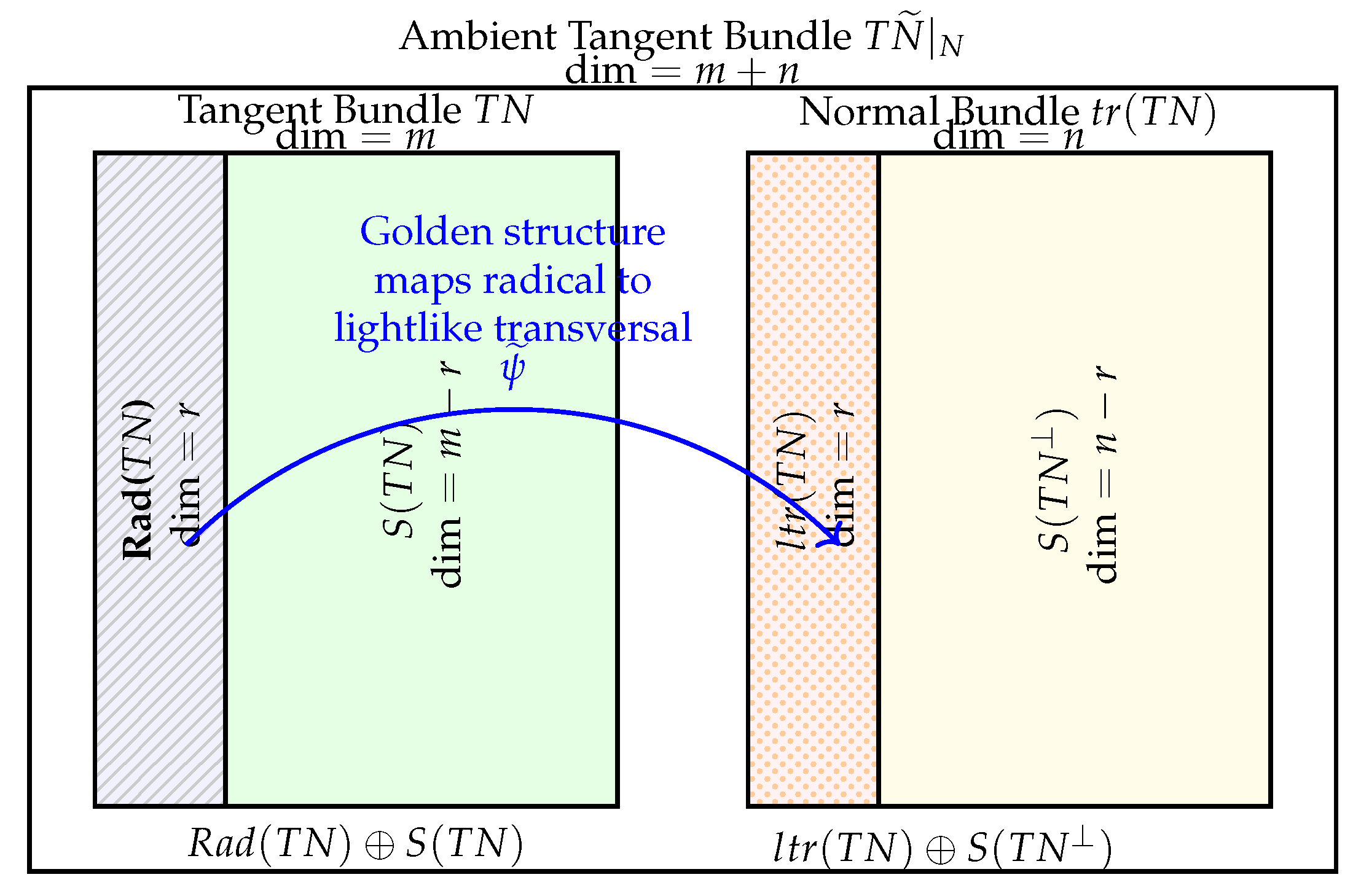
A lightlike submanifold is a submanifold immersed in a semi-Riemannian manifold such that two conditions are satisfied. First, N is itself a lightlike manifold with respect to the induced metric from . Second, the radical distribution has the rank r, where .
Consider the distribution
, which is a semi-Riemannian complementary distribution of
in
. Thus, the tangent bundle of
N decomposes as
We now introduce the screen transversal vector bundle
, which is defined as a semi-Riemannian complementary vector bundle of
inside
. According to [
8] (p. 144), for any local basis
of
on a neighborhood, there exists a local null frame
contained in the orthogonal complement of
in
. This frame satisfies
Consequently, one obtains a lightlike transversal vector bundle , locally spanned by .
Furthermore, consider the vector bundle
, which serves as a complementary subbundle of
in
. Note that this complement is not necessarily orthogonal (see
Figure 1). In fact, one has
The classification of lightlike submanifolds is given in the following four cases:
Case 1: N is r-lightlike if .
Case 2: N is co-isotropic if and .
Case 3: N is isotropic if and .
Case 4: N is totally lightlike if and .
The Gauss and Weingarten formulae for lightlike submanifolds take the form:
where
and
. Here,
and
denote linear connections on
N and on the transversal bundle
, respectively.
Furthermore, we have
for every
and
and
. Subsequently, through the utilization of Equations (
1) and (
3)–(
5), and the established property that
functions as a metric connection, we are able to derive the following outcome:
By using (
3), we have
for any
and Z
, where
,
and
. If we set
,
,
and
, then Equations (
3)–(
5) become
respectively.
Definition 1 ([
18,
20])
. Let be a differentiable manifold equipped with a indefinite metric and an affine connection with torsion tensor . The pair is called a statistical structure
on if the following conditions hold:- 1.
- 2.
Definition 2 ([
18,
20])
. Let be a semi-Riemannian manifold. Two affine connections and defined on are said to be dual connections
with respect to the metric iffor all .In this case, the quadruple is called a statistical manifold.
If
denotes the Levi-Civita connection of , then it can be expressed as In particular, if , then .
Lemma 1 ([
19,
20])
. Let be a statistical manifold. Definewhere denotes the Levi-Civita connection of . Then we havefor all .Conversely, if a -tensor field satisfies (14) with respect to a Riemannian metric , then the pairdefines a statistical structure on . Definition 3. An indefinite golden structure
(IGS) on a manifold N is a polynomial structure determined by a -type tensor field satisfyingwhere I denotes the identity transformation on . Also, if
holds, for all
, then the semi-Riemannian metric
is referred to as being
-compatible. In this case,
is referred to as an indefinite golden manifold (IGM). Further, an IGS
is referred to as a locally IGS if
is parallel with respect to two affine connections
and
, that is
and
If
is an IGS, then (
16) is similar to
for any
Definition 4. Let denote an IGS on . A triple is called an indefinite golden statistical structure
(IGSS) on if forms a statistical structure on and the conditionholds for all . In this case, an IGSM is denoted by Let
be a lightlike submanifold of a statistical manifold
. With respect to the dual connections
and
, the Gauss and Weingarten formulae are given by
for all
,
, and
.
Here and denote the induced connections on N, are the second fundamental forms, and are the Weingarten operators associated with and , respectively.
3. Radical TLS of an IGSM
In this section, we focus on the study of radical TLSs of IGSMs. A radical TLS is characterized by the condition that the image of the radical distribution under coincides with the lightlike transversal distribution, while the screen distribution is invariant under . Such submanifolds form a natural subclass of TLS, and their geometry is strongly influenced by the interaction between the radical and lightlike transversal distributions. Here, we establish several structural relations for radical TLS and derive conditions for their integrability. Furthermore, we provide additional results concerning the totally geodesic character of their foliations and the conditions under which they admit product structures.
Definition 5. Let be an IGSM. A lightlike submanifold is called a radical TLS if the following conditions are satisfied:
- 1.
is a distribution on N such that .
- 2.
.
Here, is the radical distribution of rank r (), and is the lightlike transversal bundle of rank r.
Let
N be a radical TLS of an IGSM
.
and
denote the projection morphism in
and
, respectively. For any
, we can write
where
and
Applying
to (
27), we have
where
and
Assume a locally golden statistical manifold has a TLS .
From (
17), (
24), (
26) and (
28), we have
where
.
Let and be the projection morphisms of onto and , respectively, associated with the dual connection . Let and be the projection morphisms of onto and , respectively, associated with . Similarly, for the connection , let and be the projection morphisms of onto and , respectively, and let and be the projection morphisms of onto and , respectively.
If we take
we get
By equating the tangential, screen transversal and lightlike transversal components of (
29), we get
Similarly, using (
18), (
21), (
23) and (
28), we have
where
and
are the projection morphism of
in
and
, respectively.
By equating the tangential, screen transversal and lightlike transversal components of Equation (
30), we obtain
As a result, we obtain the following Proposition.
Proposition 1. Let be a radical TLS of an indefinite golden statistical manifold . Then the following integrability conditions hold:
- 1.
The radical distribution is integrable if and only if for all .
- 2.
The screen distribution is integrable if and only if for all .
Proof. The above conditions are derived from the vanishing of the normal components in the Frobenius integrability criteria. For instance, by interchanging
G and
C in the shape operator identities for the dual connection
, one obtains
using the symmetry of the lightlike second fundamental form
. Thus
is involutive (integrable) if and only if
for all
(since integrability is equivalent to
). An identical argument for the connection Θ yields
. Similarly, exchanging
G and
C in the Gauss equation for
and using the symmetry of
gives
and likewise for
. Therefore
is integrable if and only if
and
, as stated. □
Proposition 2. Let be a TLS of an IGSM . Then:
- 1.
The radical distribution is integrable if and only iffor all . - 2.
The screen distribution is integrable if and only iffor all . - 3.
The lightlike transversal distribution is integrable if and only iffor all (where and are understood to be the normal fundamental form components projecting into .
Proof. Each of these conditions follows from the symmetry of the second fundamental form components associated with the respective distributions. For example, for any
, swapping
X and
Y in the
-connection formula for the screen-normal component yields
where
K denotes the projection onto
. Since
is integrable if and only if
(i.e.,
), we find that
must be symmetric in
. An analogous argument for the Θ-connection gives the condition
. This establishes (i). The proofs of (ii) and (iii) are similar: one applies the Gauss–Weingarten equations for vectors in
and
, respectively, and uses the symmetry
to deduce that the
components are symmetric under swapping of arguments if and only if the corresponding distribution is integrable. We omit the detailed repetition for brevity. □
Theorem 1. Let be a lightlike submanifold of an IGSM , and let be the rank of its radical distribution. Then N falls into exactly one of the following four categories:
- Case 1:
N is r-lightlike if . In this generic partial lightlike case, both and are nontrivial.
- Case 2:
N is co-isotropic if and . Equivalently, the normal bundle is totally lightlike (no non-degenerate normal subspace) while the tangent bundle has a non-degenerate screen.
- Case 3:
N is isotropic if and . In this case, the entire tangent bundle is radical (totally null), with a non-degenerate normal screen.
- Case 4:
N is totally lightlike if and . Here, both the tangent and normal bundles are completely lightlike (degenerate), yielding a fully lightlike submanifold.
Proof. This classification follows directly from the definition of the radical distribution
and its relationship with the screen distributions
and
. The ranks of these distributions determine the four non-overlapping cases. For a detailed discussion, see Chapter 1 of [
8]. □
Theorem 2. Let be a radical TLS of a locally IGSM . Then the radical distribution defines a totally geodesic foliation if and only iffor all . Proof. Let
denote the foliation by the leaves tangent to
. By the Gauss-type decompositions used in (
29)–(
36), for
, the normal (to the leaf) components of
and
are precisely encoded by the screen parts
and
. Hence,
is totally geodesic (i.e., the second fundamental form of each leaf vanishes) if and only if these screen components vanish for all
. This gives the equivalence (
37). □
Proposition 3. Let be a radical TLS of an IGSM . Then the screen distribution is integrable if and only iffor all . Proof. Take
. Using (
33) and (
36) with
and
, we obtain
Interchanging
and
and subtracting the two identities, then using the symmetry of
and
, we get
Since
is integrable if
for all
, the above is equivalent to (
38), exactly as in the proof of Proposition 1. □
Corollary 1. Let be a radical TLS of a locally IGSM. If both the radical distribution and the screen distribution are integrable, then N is locally the product of the integral manifolds of these distributions.
Proof. By Frobenius, the integrability of and yields two complementary foliations. Since and the distributions are orthogonal in the sense of the induced lightlike geometry, the standard local product decomposition applies: around each point, N is locally diffeomorphic to the product of a leaf of the radical foliation and a leaf of the screen foliation. □
4. TLS of an IGSM
In this section, we investigate the geometric properties of TLSs of IGSMs. The study of TLS is motivated by their rich structure, as they naturally arise when the tangent bundle of a lightlike submanifold decomposes into radical, screen, and lightlike transversal distributions. Understanding the behavior of these distributions plays a fundamental role in characterizing the geometry of TLSs within the ambient IGSM. In particular, we focus on the integrability conditions of the radical, screen, and transversal distributions, and we establish criteria under which these distributions define smooth foliations or totally geodesic structures. The results obtained in this section provide deeper insights into the interplay between the induced geometric structures on TLS and the ambient geometry of IGSM.
Definition 6. A lightlike submanifold of an IGSM is called a TLS if it satisfies the more general conditions: Remark 1. Note that a radical TLS (Definition 5) is a special case of a TLS where the stronger condition holds.
Let a locally IGSM
have a TLS
N.
and
denote the projection morphism in
and
, respectively. For any
, we can take
where
and
. Applying
to (
41), we have
where
and
Let
H and
R be the projection morphism in
and
in
respectively. For
, we write
By applying
to (
43),
where
. Since
is a locally IGSM, then from (
17), (
24), (
26) and (
42), we have
where
. For projection morphism
and
of
in
and
, respectively, we have
and for the projection morphisms
and
of
in
and
, respectively, we have
Therefore, (
45) can be rewritten as
Taking the tangential and transversal parts of the above equation, we get
Similarly, from Equations (
18), (
21), (
23) and (
42), we get
Theorem 3. Let be a TLS of an IGSM . Then the radical distribution is integrable if and only if, for every , the shape operators (with respect to and ) corresponding to the golden-transversal normals satisfyfor all . In other words, the endomorphisms and are symmetric in X and Y on . Proof. Assume
is integrable. By definition, this means
for all
. Equivalently, the component of
along the screen distribution
vanishes. Let
denote the projection onto
(so
is the
screen part of a tangent vector
Z). Using the golden structure
(which by the TLS assumption maps
into the transversal normal bundle
), one can derive a relation for the screen component of the difference of covariant derivatives: for any
, we have
Here,
(resp.
) is the shape operator of
N with respect to the normal vector
, applied to
X (using
, resp.
). This identity follows from the Gauss and Weingarten formulas for
and
, together with the defining property
. Now, since
and
are torsion-free (the statistical structure is assumed to be torsionless), the difference
equals the Lie bracket
, and similarly for
. Thus the above equation simplifies to
If
is integrable, the left-hand side
is zero for all
. Therefore we obtain
In fact, since the second fundamental forms associated with
and
are symmetric (recall that
and
have zero torsion, so
for all tangents
), the difference
coincides for
and
. Thus each of these differences must vanish identically. This yields
for all
, as required.
Conversely, suppose the shape operators satisfy and for all . Subtracting these two equalities (for and ) and using the relation derived above, we find . Hence has no component in , but is always tangent to N, so in fact . By Frobenius’ theorem, this implies that is integrable. □
Theorem 4. Let be a TLS of an IGSM . Then the screen distribution is integrable if and only if, for every , the lightlike second fundamental forms (with respect to and ) are invariant under swapping U and V after applying the golden structure. Equivalently, one requiresfor all . Here and denote the radical normal second fundamental forms
of N (the components of the second fundamental form taking values in the radical subbundle) for the connections and , respectively. Proof. First assume
is integrable, i.e.,
for all screen vector fields
. This condition is equivalent to the vanishing of the projection of
onto the radical (transversal normal) direction. Using
to denote the projection onto the lightlike transversal normal bundle (which, under the radical TLS assumptions, is identified with
), we must have
. Now, consider the Gauss equation for the submanifold and project it onto the
component. For any
, one obtains
and similarly
Here we have found that
(so that
has no radical component) and that the screen second fundamental forms
(taking values in
) are symmetric in their arguments (due to
and
being torsion-free). By subtracting the second equation from the first and recalling that
and
share the same torsion-free geodesic part, we get
If
is integrable, the left-hand side
vanishes identically. Thus we deduce
But in a golden statistical submanifold, the radical-valued second fundamental forms
and
are known to be symmetric when one of their arguments lies in
and the other in
(this follows from the compatibility of
with
and
). In particular, since
leaves
invariant, we have
and
for any
. Applying these symmetry properties to the relation above (by writing, for example,
since
acts as an involution on
up to the golden identity), we conclude that
This yields the stated equalities for all .
Conversely, suppose the following golden-structure-invariant symmetry conditions hold:
and
for every pair of screen vector fields
. We want to show that these imply
, i.e.,
has no component in
. From the general projected Gauss formulas above, interchanging
U and
V and subtracting, we obtain
Now, using the assumed symmetry with , we can rewrite , and similarly . The given conditions then imply (since is symmetric in its arguments when one is -transformed), and likewise . Thus . Hence, for all , proving that the screen distribution is involutive (integrable). This completes the proof. □
Theorem 5. Let be a TLS of a locally IGSM . Then the lightlike transversal distribution is integrable if and only iffor all . Proof. The result follows directly by applying the symmetry of
and
and considering the projections of Equation (
48) to the
-distribution. □
Theorem 6. Let be a TLS of a locally IGSM . Then the radical distribution defines a totally geodesic foliation if and only iffor all . Proof. If
and
, then by Equations (
47) and (
50), the second fundamental form vanishes when restricted to the radical distribution, implying that each leaf of the foliation is totally geodesic. Conversely, if the foliation defined by
is totally geodesic, the above conditions follow. □
Corollary 2. Let be a TLS of a locally IGSM . If both the radical distribution and the screen distribution are integrable, then N is locally the Riemannian product of the integral manifolds of these distributions.
Proof. The integrability of the radical distribution (Proposition 1) and the screen distribution (Proposition 2) ensures that each distribution defines a smooth foliation. Since they are orthogonal and complementary in , the manifold N can be locally expressed as the product of the leaves of these foliations. □
5. Examples
Example 1. Consider the five-dimensional semi-Euclidean space with coordinates and metric of signature . Let be the golden ratio, which satisfies . Define a -tensor field on by We show that . Using the property and noting that equals the conjugate root , for any vector , Thus, , and is an indefinite golden manifold.
Now define a submanifold by the equations: The tangent bundle is spanned by the vector fields: Further, consider the linear combination A direct computation using the metric shows that and for . Hence, ξ is a null vector orthogonal to all tangent vectors, proving that the induced metric on N is degenerate. We therefore have: Denote the screen distribution as (which is non-degenerate since ). The lightlike transversal bundle can be taken as: Now examine the action of the golden structure:so . Moreover, Therefore, and . By Definition 5, N is a radical transversal lightlike submanifold (radical TLS) of the indefinite golden manifold .
In this example, , , and . Since , the submanifold belongs to the generic r-lightlike case (Case 1 of Theorem 1).
Example 2. Consider the six-dimensional semi-Euclidean space with coordinates and the semi-Euclidean metric of signature . Let be the golden ratio, which satisfies . Define a -tensor field on bywhere . Using , one checks that ; hence, is an indefinite golden manifold. Let N be the submanifold of given by the equations Then the tangent bundle is spanned by the vector fields Verification of the lightlike condition.
With the chosen signature, a direct computation gives , , , and . Hence, the vectorsatisfies and for ; therefore is a lightlike vector orthogonal to all tangent vectors. Consequently,and N is a lightlike submanifold.Denote the screen distribution aswhich is non-degenerate because . The lightlike transversal bundle can be taken asand one checks the normalization . The screen transversal bundle is spanned by Action of the golden structure.
Computing on the radical vector yieldsso . For the screen vector, we obtainThus, .
Therefore, N satisfies Definition 6 and is a transversal lightlike submanifold (TLS) of the indefinite golden manifold .
Here, , , and . Since , the submanifold belongs to the generic r-lightlike case (Case 1 of Theorem 1).
Example 3. Consider the six-dimensional pseudo-Riemannian manifold with coordinates and signature . Let be the golden ratio and set (its conjugate, satisfying ). Define an endomorphism on the coordinate basis usingwhere . Using and , one checks that ; hence is an indefinite golden manifold. Let be the Levi-Civita connection of . Choose the -tensor field to be identically zero. Then, and its dual give a statistical structure on . Condition (20), , is satisfied trivially because both sides vanish. Consequently, is an indefinite golden statistical manifold.
Now define the submanifold by the lightlike constraint Taking as independent coordinates (with ), a convenient tangent frame on N is Using the metric , we computeand for , Thus is a null vector orthogonal to every tangent vector, and hence the induced metric on N is degenerate and Denote the screen distribution aswhich is non-degenerate because the matrix of restricted to is diagonal with entries . Action of the golden structure. Applying to the radical vector gives Since on N, a tangent vector must satisfy (because ), the vector is not tangent; it is transverse to N. After normalization we may take For the screen vectors, we obtainall of which lie in . Hence . Therefore, N satisfies Definition 5 and is a radical transversal lightlike submanifold (radical TLS) of the indefinite golden statistical manifold .
Finally, , , and . Because and the screen-normal bundle is trivial (the normal space is spanned entirely by the lightlike vector H), N falls into Case 2 (co-isotropic) of Theorem 1. In this example, both the radical distribution and the screen distribution are integrable (each being one-dimensional or spanned by commuting vector fields).
Example 4. Let be an eight-dimensional indefinite golden manifold with the coordinates and signature . Define the golden structure on a coordinate basis as follows:where and (so that ). One verifies that . Take the statistical structure with ; then , the Levi-Civita connection of . Condition (20), , holds trivially. Thus is an indefinite golden statistical manifold.
Now define the submanifold by the three linear equations These reduce the dimension by three, so . Choosing as free coordinates (with , and given by the first two equations), a convenient tangent basis is The induced metric can be computed on this basis: Hence, is a null vector orthogonal to all other tangent vectors; therefore Denote the screen distribution aswhich is non-degenerate because the matrix of restricted to isand its determinant is . This vector is not tangent to N (it does not satisfy the condition ). After normalisation we obtain a lightlike normal vectorso that . Next, consider the screen vectors. For brevity we illustrate with : A direct computation shows that is orthogonal to every tangent vector; hence, it belongs to the screen-normal bundle . The same holds for . Consequently, Using the definition of and the metric , we obtain: Thus is not orthogonal to the radical vector ; indeed, . This confirms that is not tangent to N (a tangent vector would be orthogonal to ), and together with the previous calculations it shows that maps the radical distribution into the lightlike transversal bundle and the screen distribution into the screen-normal bundle.
Therefore, N satisfies Definition 6 and is a transversal lightlike submanifold (TLS) of the indefinite golden statistical manifold .
Here, , , and . Since , the submanifold belongs to the generic r-lightlike case (Case 1 of Theorem 1).
6. Conclusions and Future Work
In this paper, we introduced a framework for IGSMs and examined the geometry of their TLSs and radical TLSs. By integrating methods from golden geometry, lightlike geometry, and statistical structures, we established defining properties, obtained integrability conditions for the radical and screen distributions, and constructed explicit examples to illustrate the developed theory. These contributions extend classical submanifold geometry and emphasize the role of degenerate distributions in the setting of golden statistical structures.
Several directions remain open for future investigation. A natural problem is to study TLSs of IGSMs under additional curvature assumptions, such as constant sectional or scalar curvature. Another promising line of research concerns stability properties, particularly in relation to second variation formulas and their implications for geometric invariants. Extending the present results to higher-codimension lightlike submanifolds or to warped product settings would also deepen the theory. From the perspective of information geometry, the analysis of statistical divergences and dualistic structures associated with IGSM and their submanifolds is of significant interest. Finally, potential applications to mathematical physics, especially the study of lightlike hypersurfaces in spacetime models endowed with golden structures, represent a rich and intriguing direction.