Article

A Multidimensional Jacobi-Based Spectral Framework for 3D Time-Fractional Diffusion and Transport Equations


by
Khadijeh Sadri
1,
David Amilo
1,
Evren Hinçal
1,
Eid H. Doha
2 and
Mahmoud A. Zaky
3,*
1
Mathematics Research Center, Near East University TRNC, Mersin 10, Nicosia 99138, Turkey
2
Department of Mathematics, Faculty of Science, Cairo University, Giza 12613, Egypt
3
Department of Mathematics and Statistics, College of Science, Imam Mohammad Ibn Saud Islamic University (IMSIU), Riyadh 11432, Saudi Arabia
*
Author to whom correspondence should be addressed.
Mathematics 2026, 14(4), 651; https://doi.org/10.3390/math14040651
Submission received: 30 November 2025 / Revised: 27 January 2026 / Accepted: 4 February 2026 / Published: 12 February 2026
(This article belongs to the Section E: Applied Mathematics)

Abstract

This work presents a new and efficient numerical framework for solving three-dimensional time-fractional diffusion and mobile–immobile equations in the Caputo sense. The method is formulated using four-variable Jacobi polynomials, constructed systematically via the Kronecker product of one-dimensional Jacobi bases to accurately represent the multidimensional nature of the governing equations. Within a pseudo-operational collocation formulation, these polynomials enable a highly accurate and computationally efficient approximation of the fractional operators in both temporal and spatial directions. From the theoretical standpoint, the existence and uniqueness of the approximate solution are rigorously established through Schauder’s fixed-point theorem. Furthermore, the Ulam–Hyers stability of the numerical solution is verified, demonstrating the robustness of the method with respect to perturbations in the input data. To reinforce the reliability of the approach, an explicit error bound for the residual function is derived in a Jacobi-weighted Sobolev space, offering a firm analytical basis for assessing convergence. Numerical experiments confirm that the proposed approach achieves superior accuracy and efficiency, highlighting its potential as a powerful tool for high-dimensional fractional partial differential equations.

1. Introduction

Fractional calculus, which generalizes the traditional concepts of differentiation and integration to arbitrary (non-integer) orders, has evolved into a powerful and versatile mathematical framework for describing a wide spectrum of complex phenomena arising in physical, biological, and engineering systems as fractional-order differential equations and time-fractional partial differential equations (PDEs) [1,2,3,4]. Among time-fractional PDEs, time-fractional diffusion and mobile–immobile equations play a crucial role in modeling anomalous transport phenomena that cannot be adequately described by classical diffusion equations. These models incorporate fractional time derivatives, typically in the Caputo sense, to represent memory and trapping effects, which are characteristic of many real-world systems exhibiting sub-diffusive behavior. The mobile–immobile framework, in particular, provides a realistic description of solute transport in porous or heterogeneous media, where particles alternate between mobile and immobile phases. Such equations have found extensive applications in hydrology, groundwater contamination, petroleum engineering, and biological systems, where they capture non-local temporal dynamics and long-tail transport behaviors. However, their non-local and history-dependent nature poses significant analytical and computational challenges, motivating the development of accurate and efficient numerical schemes.
Hence, Roul and Khandagale [5] proposed an ADI finite difference scheme on non-uniform meshes for the numerical solution of two-dimensional (2D) time-fractional reaction-diffusion equations. Cao et al. [6] analyzed a Galerkin finite element method for 2D time-fractional diffusion problems. Singh and Pandey [7] adopted a Newton–ADI strategy to treat 2D time-fractional reaction-diffusion equations. In [8], the authors constructed two-dimensional Legendre wavelets to approximate the solutions of 2D reaction-diffusion models involving Mittag–Leffler-type non-singular kernels. Chen et al. [9] introduced a barycentric rational interpolation collocation technique combined with Gauss–Legendre quadrature for 2D time-fractional convection-diffusion equations. The work [10] combined finite difference discretization with the Laplace transform to design an algorithm for a time-space fractional diffusion equation. Du and Chen [11] employed a meshless numerical procedure to solve 2D variable-order time-fractional mobile–immobile equations, while Liu et al. [12] used an ADI scheme to approximate the solutions of 2D fractional mobile–immobile transport models. In [13], a fourth-order compact finite difference method was developed for 2D nonlinear fractional mobile–immobile equations. Qiao and Cheng [14] proposed a fast Crank–Nicolson finite difference algorithm for 2D variable-order mobile–immobile problems. A modified fractional explicit group method based on a Crank–Nicolson finite difference framework was presented in [15] for time-fractional mobile–immobile equations. In [16], Nong et al. applied a Crank–Nicolson compact difference scheme combined with the L 1 formula to solve time-fractional mobile–immobile equations. Furthermore, 2D multi-term time-fractional diffusion-wave equations were investigated in [17] using a hybrid approach involving classical and shifted Jacobi polynomials together with a pseudo-operational collocation technique. Authors in [18,19] employed the finite difference method with L 1 formula to discretize one-dimensional (1D) time-fractional mobile–immobile advection-diffusion equations [18]. Liu et al. applied a modified method of characteristics and the finite element method for 2D time-fractional mobile–immobile equations [20]. Zaky used the Galerkin-Legendre spectral method with the L 1 -finite difference approach for 2D time-fractional reaction-diffusion equations with delay [21]. In the above works, authors focused on efficient numerical solutions for the 1D or 2D cases of Equation (1).
In three dimensions, Gu and Sun [22] examined a meshless finite difference method for three-dimensional (3D) variable-order diffusion equations, whereas Liu et al. [23] employed the L 1 –ADI algorithm to compute numerical solutions of 3D time-fractional mobile–immobile transport equations. Time-fractional diffusion and mobile–immobile models in higher spatial dimensions play a key role in describing complex transport processes in heterogeneous and porous media. In the present work, we focus on the following problem and construct its numerical approximation:
β K ( y , τ ) τ + γ D τ κ 0 C K ( y , τ ) α 1 2 K ( y , τ ) ξ 2 α 2 2 K ( y , τ ) ζ 2 α 3 2 K ( y , τ ) η 2 + ν 1 K ( y , τ ) ξ + ν 2 K ( y , τ ) ζ + ν 3 K ( y , τ ) η = h ( y , τ ) , ( y , τ ) I ,
where y = ( ξ , ζ , η ) , I = [ 0 , X ] × [ 0 , Y ] × [ 0 , Z ] × [ 0 , T ] , X , Y , Z , T N , β , γ , α k , ν k R , k = 1 , 2 , 3 , f ( y , τ ) is a continuous known function, and D τ κ 0 C ( . ) is the fractional-order Caputo derivative operator such that κ ( 0 , 1 ] .
The initial and boundary conditions for Equation (1) are given as
K ( y , 0 ) = h ( y ) , K ( 0 , ζ , η , τ ) = v 0 ( ζ , η , τ ) , K ( X , ζ , η , τ ) = v 1 ( ζ , η , τ ) , K ( ξ , 0 , ζ , τ ) = w 0 ( ξ , ζ , τ ) , K ( ξ , Y , ζ , τ ) = w 1 ( ξ , ζ , τ ) , K ( ξ , ζ , 0 , τ ) = g 0 ( ξ , ζ , τ ) , K ( ξ , ζ , Z , τ ) = g 1 ( ξ , ζ , τ ) ,
where h , v k , w k , g k , k = 1 , 2 are given continuous functions and X , Y , Z N . It is obvious if β = 0 and γ = 1 , then Equation (1) is called the 3D time-fractional diffusion equation and if β = γ = 1 and α k = 1 , ν k = 0 for k = 1 , 2 , 3 , then Equation (1) is called the 3D time-fractional mobile–immobile equation. The interplay between temporal non-locality and spatial complexity renders analytical solutions intractable, emphasizing the importance of developing accurate and efficient numerical algorithms. Designing such numerical schemes is essential for the reliable simulation and deeper understanding of multidimensional anomalous diffusion processes. In this regard, advanced spectral and collocation-based methods, particularly those employing Jacobi polynomials, have proven highly effective in approximating solutions to fractional differential equations with remarkable precision. Jacobi polynomials and their special cases have been widely utilized to construct efficient algorithms for solving various time-fractional functional equations. For example, they have been applied to 2D time-fractional diffusion-wave equations, time-fractional integro-partial differential equations with weakly singular kernels, time-fractional Burgers’ equations, pantograph partial differential equations, and variable-order time-space fractional KdV–Burgers–Kuramoto equations [17,24,25,26,27]. However, most existing numerical methods, like finite difference, finite element, and spectral methods, are restricted to 1D and 2D models, and their direct extension to 3D time-fractional PDEs is computationally expensive. In this study, the shifted Jacobi polynomials, denoted by P k σ , ϱ ( τ ) , σ , ϱ > 1 , k = 0 , 1 , 2 , , and t I = [ 0 , 1 ] , are employed to construct four-variable Jacobi polynomials (FVJP)s, which serve as the basis functions in a pseudo-operational collocation scheme to overcome difficultly solving 3D time-fractional PDEs. By varying the parameters σ and ϱ , different types of Jacobi polynomials can be generated, allowing investigation of their influence on the behavior of approximate solutions near the domain boundaries. The integral pseudo-operational matrices of both integer and fractional orders associated with the four-variable basis vector are constructed by employing the Kronecker product of the corresponding one-dimensional integral pseudo-operational matrices. The existence and uniqueness of the solutions to problem (1) and (2) are established using Schauder’s fixed-point theorem, and the Ulam–Hyers stability is also investigated. Moreover, rigorous bounds for the approximation errors are derived within a Jacobi-weighted Sobolev space.
The main novelties and advantages of the present work can be summarized as follows:
  • A pseudo-operational collocation scheme based on FVJPs is formulated to solve 3D time-fractional mobile–immobile diffusion equations in the Caputo framework.
  • A four-variable Jacobi basis is systematically constructed using the Kronecker product of one-dimensional Jacobi polynomials, enabling an efficient treatment of multidimensional models.
  • A complete theoretical analysis establishes existence and uniqueness via Schauder’s fixed-point theorem and verifies the Ulam–Hyers stability of the solutions.
  • A rigorous error bound for the residual function is obtained in a Jacobi-weighted Sobolev space, ensuring the convergence and robustness of the proposed approach.
  • The structure of this paper is as follows. Section 2 introduces the essential definitions of fractional integral and derivative operators together with their key properties. Section 3 analyzes the existence, uniqueness, and Ulam–Hyers stability of the solutions to problem (1). In Section 4, the shifted Jacobi polynomials in both one and four variables are reviewed, and the associated pseudo-operational integration matrices of integer and fractional orders are derived. Section 5 details the proposed numerical technique, while Section 6 provides the error analysis in a Jacobi-weighted Sobolev space. Several illustrative numerical examples demonstrating the efficiency and applicability of the method are presented in Section 7. Finally, Section 8 concludes the paper with a summary of the main results.

2. Preliminaries and Fractional Operators

This section outlines the fundamental elements of fractional calculus that are required for establishing and examining the proposed numerical methodology.
Definition 1.
Let κ ( 0 , 1 ] . The Riemann–Liouville fractional integral of order κ for a function u ( y , τ ) is given by [28]:
I τ κ 0 R L u ( y , τ ) = 1 Γ ( κ ) 0 τ ( τ s ) κ 1 u ( y , s ) d s ,   ( y , τ ) I ,
where Γ ( · ) denotes the classical Gamma function.
Definition 2.
Let κ ( 0 , 1 ] . The Caputo fractional derivative of order κ for a continuously differentiable function u ( y , τ ) is defined by [28]:
D τ κ 0 C u ( y , τ ) = 1 Γ ( 1 κ ) 0 τ ( τ s ) κ u ( y , s ) s d s ,   ( y , τ ) I .
Furthermore, for any integer n N { 0 } , the Caputo derivative coincides with the classical derivative:
D τ n 0 C u ( y , τ ) = n u ( y , τ ) τ n .
  • Based on Definitions 1 and 2, the Riemann–Liouville fractional integral and the Caputo fractional derivative satisfy the following identities for κ ( 0 , 1 ) :
  • I τ κ 0 R L u ( y , τ ) = I τ 1 κ 0 R L u ( y , τ ) τ ,   κ ( 0 , 1 ] ,
  • I τ κ 0 R L τ γ = Γ ( γ + 1 ) τ γ + κ Γ ( γ + κ + 1 ) ,   γ > 0 ,
  • D τ κ 0 C τ γ = Γ ( γ + 1 ) τ γ κ Γ ( γ κ + 1 ) ,   γ κ ,
  • D τ κ 0 C I τ κ 0 R L u ( y , τ ) = u ( y , τ ) ,
  • I τ κ 0 R L D τ κ 0 c u ( y , τ ) = u ( y , τ ) u ( y , 0 ) ,   κ ( 0 , 1 ] .
Definition 3.
For matrices as P = [ p i j ] m × n and Q = [ q i j ] k × l , the Kronecker (tensor) product P Q is an ( mk ) × ( nl ) matrix which is defined as follows [29]:
P Q = p 11 Q p 12 Q p 1 n Q p 21 Q p 22 Q p 2 n Q p m 1 Q p m 2 Q p mn Q .

3. On the Existence and Uniqueness of Solutions

In this section, we establish the existence and uniqueness of solutions to the problem described by (1) and (2), along with their Ulam–Hyers stability. Let C ( S , R ) denote the Banach space of continuous real-valued functions on
S = [ 0 , X ] × [ 0 , Y ] × [ 0 , Z ] × [ 0 , T ] ,   X , Y , Z , T N ,
equipped with the supremum norm
K = sup { K ( y , τ ) : ( y , τ ) S } .
Assume that h ( y , τ ) and K ( y , τ ) are continuous functions belonging to C ( S , R ) . Applying the integral operator (of the integer order) from 0 to τ to Equation (1), yields
K ( y , τ ) = h ( y ) γ 0 β 1 Γ ( 1 κ ) 0 τ ( τ s ) κ K ( y , s ) d s + γ 0 β Γ ( 2 κ ) h ( y ) τ 1 κ + 0 τ { α 1 β 2 K ( y , s ) ξ 2 + α 2 β 2 K ( y , s ) ζ 2 + α 3 β 2 K ( y , s ) η 2 ν 1 β K ( y , s ) ξ ν 2 β K ( y , s ) ζ ν 3 β K ( y , s ) η + 1 β h ( y , s ) } d s .
Define the operator
M : C ( S , R ) C ( S , R )
by
M K ( y , τ ) = h ( y ) γ 0 β 1 Γ ( 1 κ ) 0 τ ( τ s ) κ K ( y , s ) d s + γ 0 β Γ ( 2 κ ) h ( y ) τ 1 κ + 0 τ { α 1 β 2 K ( y , s ) ξ 2 + α 2 β 2 K ( y , s ) ζ 2 + α 3 β 2 K ( y , s ) η 2 ν 1 β K ( y , s ) ξ ν 2 β K ( y , s ) ζ ν 3 β K ( y , s ) η + 1 β h ( y , s ) } d s .
To obtain the desired results, the following hypotheses are imposed:
  • For any ( y , τ ) S , there exist constants C i , i = 1 , 2 , , 14 , such that
( H 1 ) | h ( y ) | C 1 , ( H 2 ) | h ( y , τ ) | C 2 , ( H 3 ) | K ( y , τ ) ξ | C 3 | K ( y , τ ) | , ( H 4 ) | K ( y , τ ) ζ | C 4 | K ( y , τ ) | , ( H 5 ) | K ( y , τ ) η | C 5 | K ( y , τ ) | , ( H 6 ) | 2 K ( y , τ ) ξ 2 | C 6 | K ( y , τ ) | , ( H 7 ) | 2 K ( y , τ ) ζ 2 | C 7 | K ( y , τ ) | , ( H 8 ) | 2 K ( y , τ ) η 2 | C 8 | K ( y , τ ) | , ( H 9 ) | K ( y , τ ) ξ K ˜ ( y , τ ) ξ | C 9 | K ( y , τ ) K ˜ ( y , τ ) | , ( H 10 ) | K ( y , τ ) ζ K ˜ ( y , τ ) ζ | C 10 | K ( y , τ ) K ˜ ( y , τ ) | , ( H 11 ) | K ( y , τ ) η K ˜ ( y , τ ) η | C 11 | K ( y , τ ) K ˜ ( y , τ ) | , ( H 12 ) | 2 K ( y , τ ) ξ 2 2 K ˜ ( y , τ ) ξ 2 | C 12 | K ( y , τ ) K ˜ ( y , τ ) | , ( H 13 ) | 2 K ( y , τ ) ζ 2 2 K ˜ ( y , τ ) ζ 2 | C 13 | K ( y , τ ) K ˜ ( y , τ ) | , ( H 14 ) | 2 K ( y , τ ) η 2 2 K ˜ ( y , τ ) η 2 | C 14 | K ( y , τ ) K ˜ ( y , τ ) | ,
where K ˜ ( y , τ ) is an approximation to K ( y , τ ) .
Theorem 1.
(Schauder’s fixed point theorem [30]). Suppose that S is a compact and convex subset of the Banach space C ( S , R ) and M : S S is a compact mapping. Then, M has a fixed point in S .
Theorem 2.
If Hypotheses ( H 1 ) ( H 8 ) hold, then problem (1) has at least one solution.
Proof. 
Define the set S as S = { K C ( S , R ) | K ϑ } , where
ϑ = 1 + | γ 0 β | T 1 κ Γ ( 2 κ ) C 1 + T | β | C 2 1 T | γ 0 β | T κ Γ ( 2 κ ) + C 6 | α 1 β | + C 7 | α 2 β | + C 8 | α 3 β | + C 3 | ν 1 β | + C 4 | ν 2 β | + C 5 | ν 3 β | K .
Let M : S S be defined by (6). Assume K S . Then, show that MK S is bounded. From (6), one has
| M K ( y , τ ) | = | h ( y ) γ 0 β 1 Γ ( 1 κ ) 0 τ ( τ s ) κ K ( y , s ) d s + γ 0 β Γ ( 2 κ ) h ( y ) τ 1 κ + 0 τ { α 1 β 2 K ( y , s ) ξ 2 + α 2 β 2 K ( y , s ) ζ 2 + α 3 β 2 K ( y , s ) η 2 ν 1 β K ( y , s ) ξ ν 2 β K ( y , s ) ζ ν 3 β K ( y , s ) η + 1 β h ( y , s ) } d s | | h ( y ) | + | γ 0 β | 1 Γ ( 1 κ ) 0 τ ( τ s ) κ | h ( y , s ) | d s + | γ 0 β | | h ( y ) | Γ ( 2 κ ) τ 1 κ + 0 τ { | α 1 β | | 2 K ( y , s ) ξ 2 | + | α 2 β | | 2 K ( y , s ) ζ 2 | + | α 3 β | | 2 K ( y , s ) η 2 | + | ν 1 β | | K ( y , s ) ξ | + | ν 2 β | | K ( y , s ) ζ | + | ν 3 β | | K ( y , s ) η | } d s 1 + | γ 0 β | T 1 κ Γ ( 2 κ ) C 1 + T | β | C 2 + | γ 0 β | T 1 κ Γ ( 2 κ ) | K ( y , τ ) | + T ( C 6 | α 1 β | | K ( y , τ ) | + C 7 | α 2 β | | K ( y , τ ) | + C 8 | α 3 β | | K ( y , τ ) | + C 3 | ν 1 β | | K ( y , τ ) | + C 4 | ν 2 β | | K ( y , τ ) | + C 5 | ν 3 β | | K ( y , τ ) | ) .
  • Taking the infinity norm results in:
M K 1 + | γ 0 β | T 1 κ Γ ( 2 κ ) C 1 + T | β | C 2 + T ( | γ 0 β | T κ Γ ( 2 κ ) + C 6 | α 1 β | K + C 7 | α 2 β | K + C 8 | α 3 β | K + C 3 | ν 1 β | K + C 4 | ν 2 β | K + C 5 | ν 3 β | K ) .
  • Thus, one has
M K 1 + | γ 0 β | T 1 κ Γ ( 2 κ ) C 1 + T | β | C 2 1 T | γ 0 β | T κ Γ ( 2 κ ) + C 6 | α 1 β | + C 7 | α 2 β | + C 8 | α 3 β | + C 3 | ν 1 β | + C 4 | ν 2 β | + C 5 | ν 3 β | K = ϑ .
  • So, S and consequently M K are bounded.
  • Now, it must be shown that M is a continuous operator:
  • Suppose K m S . Since the set of limit points of S is closed and compact, it follows that K m K as m . So, using Hypotheses ( H 9)–( H 14) results in
| M K m ( y , τ ) M K ( y , τ ) | | γ 0 β | 1 Γ ( 1 κ ) 0 τ ( τ s ) κ | K m ( y , s ) K ( y , s ) | d s + 0 τ { | α 1 β | | 2 K m ( y , s ) ξ 2 2 K ( y , s ) ξ 2 | + | α 2 β | | 2 K m ( y , s ) ζ 2 2 K ( y , s ) ζ 2 | + | α 3 β | | 2 K m ( y , s ) η 2 2 K ( y , s ) η 2 | + | ν 1 β | | K m ( y , s ) ξ K ( y , s ) ξ | + | ν 2 β | | K m ( y , s ) ζ K ( y , s ) ζ | + | ν 3 β | | K m ( y , s ) η K ( y , s ) η | } d s ( T 1 κ Γ ( 2 κ ) | γ 0 β | + T ( C 12 | α 1 β | + C 13 | α 2 β | + C 14 | α 3 β | + C 9 | ν 1 β | + C 10 | ν 2 β | + C 11 | ν 3 β | ) ) K m K .
Since K is continuous, it follows that | M K m ( y , τ ) M K ( y , τ ) | 0 as m . Thus, M is a continuous mapping, and by applying Theorem 1, one concludes that M has a fixed point in S . Therefore, problem (1) along with conditions (2) has at least one solution. □
Theorem 3.
The solution to problem (1) is unique under Hypotheses ( H 9)–( H 14), if the following inequality holds:
| γ 0 β | T 1 κ Γ ( 2 κ ) + T | α 1 β | C 12 + | α 2 β | C 13 + | α 3 β | C 14 + | ν 1 β | C 9 + | ν 2 β | C 10 + | ν 3 β | C 11 < 1 .
Proof. 
Let K and K ˜ C ( S , R ) be solutions to the given problem. One gets
M K M K ˜ = sup ( y , τ ) S | M K ( y , τ ) M K ˜ ( y , τ ) | = sup ( y , τ ) S | γ 0 β 1 Γ ( 1 κ ) 0 τ ( τ s ) κ ( K ( y , s ) K ( y ˜ , s ) ) d s + 0 τ [ α 1 β 2 K ( y , s ) ξ 2 2 K ˜ ( y , s ) ξ 2 + α 2 β 2 K ( y , s ) ζ 2 2 K ˜ ( y , s ) ζ 2 + α 3 β 2 K ( y , s ) η 2 2 K ˜ ( y , s ) η 2 ν 1 β K ( y , s ) ξ K ˜ ( y , s ) ξ ν 2 β K ( y , s ) ζ K ˜ ( y , s ) ζ ν 3 β K ( y , s ) η K ˜ ( y , s ) η ] d s | [ | γ 0 β | T 1 κ Γ ( 2 κ ) + T ( | α 1 β | C 12 + | α 2 β | C 13 + | α 3 β | C 14 + | ν 1 β | C 9 + | ν 2 β | C 10 + | ν 3 β | C 11 ) ] K K ˜ .
 
  • If | γ 0 β | T 1 κ Γ ( 2 κ ) + T | α 1 β | C 12 + | α 2 β | C 13 + | α 3 β | C 14 + | ν 1 β | C 9 + | ν 2 β | C 10 + | ν 3 β | C 11 < 1 , by Banach’s fixed point theorem, M has a unique fixed point. Therefore, problem (1) has a unique solution. □
  • Here, the Ulam–Hyers stability for problem (1) along with the initial and boundary conditions in (2) is investigated.
Definition 4.
A solution to problem (1), along with conditions (2), is said to be Ulam–Hyers stability if for the exact solution K ( y , τ ) of Equation (1) and its approximation, K ˜ ( y , τ ) , exists φ R + such that [30]
K ( y , τ ) K ˜ ( y , τ ) φ ϵ .
Theorem 4.
If Hypotheses ( H )–( H 14) hold, then Equation (1) is the Ulam–Hyers stable.
Proof. 
Consider Equation (5). The approximate solution of Equation (1) satisfies the following equation:
K ˜ ( y , τ ) = h ( y ) + 0 τ 1 β ( h ( y , s ) + h ˜ ( y , s ) ) d s + γ 0 β Γ ( 2 κ ) h ( y ) τ 1 κ γ 0 β 1 Γ ( 1 κ ) 0 τ ( τ s ) τ K ( y , s ) d s + 0 τ { α 1 β 2 K ˜ ( y , s ) ξ 2 + α 2 β 2 K ˜ ( y , s ) ζ 2 + α 3 β 2 K ˜ ( y , s ) η 2 ν 1 β K ˜ ( y , s ) ξ ν 2 β K ˜ ( y , s ) ζ ν 3 β K ˜ ( y , s ) η } d s ,
where h ˜ ( y , τ ) is the perturbation term. Let | h ˜ ( y , τ ) | C h ˜ . Subtracting (7) from (5), one has
| K ( y , τ ) K ˜ ( y , τ ) | = | 1 β 0 τ h ˜ ( y , s ) d s γ 0 β 1 Γ ( 1 κ ) 0 τ ( τ s ) κ ( K ( y , s ) K ˜ ( y , s ) ) d s + 0 τ { α 1 β 2 K ( y , s ) ξ 2 2 K ˜ ( y , s ) ξ 2 + α 2 β 2 K ( y , s ) ζ 2 2 K ˜ ( y , s ) ζ 2 + α 3 β 2 K ( y , s ) η 2 2 K ˜ ( y , s ) η 2 ν 1 β K ( y , s ) ξ K ˜ ( y , s ) ξ ν 2 β K ( y , s ) ζ K ˜ ( y , s ) ζ ν 3 β K ( y , s ) η K ˜ ( y , s ) η } d s | T ( ( | α 1 β | C 12 + | α 2 β | C 13 + | α 3 β | C 14 + | ν 1 β | C 9 + | ν 2 β | C 10 + | ν 3 β | C 11 ] ) K K ˜ + | γ 0 β | T 1 κ Γ ( 2 κ ) + T | β | C h ˜ ) .
Taking the infinity norm of the above inequality, one obtains
K K ˜ φ C h ˜ ,
where
φ = T | β | T ( | α 1 | C 12 + | α 2 | C 13 + | α 3 | C 14 + | ν 1 | C 9 + | ν 2 | C 10 + | ν 3 | C 11 ) + | γ 0 | T 1 κ Γ ( 2 κ ) ,
which proves the desired result. □
Remark 1.
Let 0 < κ 1 and assume h L 2 ( 0 , 1 ; L 2 ( [ 0 , 1 ] 3 ) ) with initial data K ( y , 0 ) L 2 ( [ 0 , 1 ] 3 ) . Then the solution of problem (1) satisfies
K C ( [ 0 , 1 ] ; L 2 ( [ 0 , 1 ] 3 ) ) L 2 ( 0 , 1 ; H 2 ( [ 0 , 1 ] 3 ) ) ,
while the Caputo fractional derivative fulfills D τ κ 0 c K L 2 ( 0 , T ; L 2 ( [ 0 , 1 ] 3 ) ) . Due to the non-local nature of the fractional derivative, the solution generally exhibits limited regularity in time, and in particular K τ may be weakly singular near τ = 0 . Such regularity properties are well known for time-fractional diffusion and advection–diffusion equations. This regularity structure motivates the proposed Jacobi polynomial-based collocation method, which is capable of capturing weak temporal singularities while maintaining high-order accuracy in the spatial variables [31].

4. Shifted Jacobi Polynomials and Matrix-Based Relations

Jacobi polynomials play a fundamental role in constructing efficient and accurate basis functions for solving PDEs, particularly in higher-dimensional problems. The shifted Jacobi polynomials (SJPs) P k σ , ϱ ( τ ) , σ , ϱ > 1 , τ I = [ 0 , 1 ] can be obtained from the following recurrence formula [32]:
P k + 1 σ , ϱ ( τ ) = A k σ , ϱ P k σ , ϱ ( τ ) + B k σ , ϱ ( 2 τ 1 ) P k σ , ϱ ( τ ) C k σ , ϱ P k 1 σ , ϱ ( τ ) , k = 1 , 2 , ,
while the starting values are
P 0 σ , ϱ ( τ ) = 1 , P 1 σ , ϱ ( τ ) = σ + ϱ + 2 2 ( 2 τ 1 ) + σ ϱ 2 ,
and the coefficients A k σ , ϱ , B k σ , ϱ , and C k σ , ϱ are as
A k σ , ϱ = ( 2 k + σ + ϱ + 1 ) ( σ 2 ϱ 2 ) 2 ( k + 1 ) ( k + σ + ϱ + 1 ) ( 2 k + σ + ϱ ) , B k σ , ϱ = ( 2 k + σ + ϱ + 2 ) ( 2 k + σ + ϱ + 1 ) 2 ( k + 1 ) ( k + σ + ϱ + 1 ) , C k σ , ϱ = ( k + σ ) ( k + ϱ ) ( 2 k + σ + ϱ + 2 ) ( k + 1 ) ( k + σ + ϱ + 1 ) ( 2 k + σ + ϱ ) .
Their orthogonality properties with respect to the weight function ω σ , ϱ ( τ ) = ( 1 τ ) σ τ ϱ make them highly suitable for spectral methods:
0 1 P k σ , ϱ ( τ ) P l σ , ϱ ( τ ) ω σ , ϱ ( τ ) d τ = δ k , l λ k σ , ϱ ,
where δ k , l is the Kronecker delta function and λ k σ , ϱ is the normalization factor as follows:
λ k σ , ϱ = Γ ( k + σ + 1 ) Γ ( k + ϱ + 1 ) ( 2 k + σ + ϱ + 1 ) Γ ( k + 1 ) Γ ( k + σ + ϱ + 1 ) , k = 0 , 1 , 2 , .
In addition to relation (8), the SJPs are defined by the following series, which is a useful tool to derive operational and pseudo-operational matrices of the derivative and integration:
P k σ , ϱ ( τ ) = m = 0 k ϖ m , k σ , ϱ τ m , k = 0 , 1 , 2 , ,
where
ϖ m , k σ , ϱ = ( 1 ) k m Γ ( k + ϱ + 1 ) Γ ( k + m + σ + ϱ + 1 ) Γ ( m + ϱ + 1 ) Γ ( k + σ + ϱ + 1 ) Γ ( k m + 1 ) Γ ( m + 1 ) , k = 0 , 1 , 2 , .
The lth order derivative of the Jacobi polynomial P k σ , ϱ ( τ ) is as
d l P k σ , ϱ ( τ ) d τ l = Γ ( k + l + σ + ϱ + 1 ) Γ ( k + σ + ϱ + 1 ) P k l σ + l , ϱ + l ( τ ) , k = 0 , 1 , 2 , , l k .
A function z ( τ ) L ω σ , ϱ 2 ( I ) , I = [ 0 , 1 ] can be expanded in a finite number of the Jacobi polynomials as follows:
z ( τ ) z N ( τ ) = k = 0 N z k P k σ , ϱ ( τ ) = Z T θ σ , ϱ ( τ ) ,
where Z and θ σ , ϱ ( τ ) are the ( N + 1 ) × 1 vectors of expansion coefficients and basis functions, respectively:
Z = [ z 0 , z 1 , z 2 , , z N ] T , θ σ , ϱ ( τ ) = [ P 0 σ ϱ ( τ ) , P 1 σ , ϱ ( τ ) , P 2 σ , ϱ ( τ ) , , P N σ , ϱ ( τ ) ] T .
The coefficients z k , k = 0 , 1 , , N are calculated using the following inner product:
z k = 1 λ k σ , ϱ 0 1 z ( τ ) P k σ ϱ ( τ ) ω σ , ϱ ( τ ) d τ , k = 0 , 1 , , N .
In higher-dimensional settings, tensor-product Jacobi polynomials provide systematic means of constructing multi-dimensional orthogonal systems that retain the convergence property of the one-dimensional case. The FVJPs
P k , l , m , n σ , ϱ ( y , τ ) = P k σ ϱ ( ξ ) P l σ ϱ ( ζ ) P m σ ϱ ( η ) P n σ ϱ ( τ ) , k , l , m , n = 0 , 1 , , N ,
are orthogonal w.r.t. the weight function Ω σ , ϱ ( y , τ ) = ω σ , ϱ ( ξ ) ω σ , ϱ ( ζ ) ω σ , ϱ ( η ) ω σ , ϱ ( τ ) on the region I = I 4 :
0 1 0 1 0 1 0 1 P k , l , m , n σ , ϱ ( y , τ ) P p , q , r , s σ , ϱ ( y , τ ) Ω σ , ϱ ( y , τ ) d ξ d ζ d η d τ = δ k , p δ l , q δ m , r δ n , s λ k σ , ϱ λ l σ , ϱ λ m σ , ϱ λ n σ , ϱ .
A function Z ( y , τ ) L Ω σ , ϱ 2 ( I ) can be expanded in the FVJPs as follows:
Z ( y , τ ) Z N ( y , τ ) = k = 0 N l = 0 N m = 0 N n = 0 N Z k , l , m , n P k , l , m , n σ , ϱ ( y , τ ) = Z T Θ σ , ϱ ( y , τ ) ,
where
Z = [ Z 0 , 0 , 0 , 0 , Z 0 , 0 , 0 , 1 , , Z 0 , 0 , 0 , N , Z 0 , 0 , 1 , 0 , Z 0 , 0 , 1 , 1 , , Z 0 , 0 , 1 , N , , Z N , N , N , 0 , Z N , N , N , 1 , , Z N , N , N , N ] T , Θ σ , ϱ ( y , τ ) = [ P 0 , 0 , 0 , 0 σ , ϱ ( y , τ ) , P 0 , 0 , 0 , 1 σ , ϱ ( y , τ ) , , P 0 , 0 , 0 , N σ , ϱ ( y , τ ) , , P N , N , N , 0 σ , ϱ ( y , τ ) , P N , N , N , 1 σ , ϱ ( y , τ ) , , P N , N , N , N σ , ϱ ( y , τ ) ] T = θ σ , ϱ ( ξ ) θ σ , ϱ ( ζ ) θ σ , ϱ ( η ) θ σ , ϱ ( τ ) ,
are ( N + 1 ) 4 × 1 vectors of coefficient and basis functions, respectively.
  • The pseudo-operational matrix of the integration of the integer order, corresponding to the one-variable basis vector, is obtained as follows:
If υ > 0 , then the integral of the kth component of θ σ , ϱ ( τ ) is
0 τ s υ P k σ , ϱ ( s ) d s = m = 0 k ϖ m , k σ , ϱ τ υ + m + 1 υ + m + 1 = τ υ + 1 m = 0 k ϖ m , k σ , ϱ τ m υ + m + 1 , k = 0 , 1 , , N .
The monomial τ m is expanded in the shifted Jacobi polynomials as
τ m = l = 0 N r l , m P l σ , ϱ ( τ ) , m = 0 , 1 , , k N ,
where the coefficient r l , m is calculated using the beta function’s definition as
r l , m = 1 λ l σ , ϱ 0 1 τ m P l σ , ϱ ( τ ) ω σ , ϱ ( τ ) d τ = 1 λ l σ , ϱ n = 0 l ϖ n , l σ , ϱ Γ ( m + n + ϱ + 1 ) Γ ( σ + 1 ) Γ ( m + n + σ + ϱ + 2 ) .
So, (14) is rewritten as
0 τ s υ P k σ , ϱ ( s ) d s = τ υ + 1 l = 0 N n = 0 l m = 0 k ϖ m , k σ , ϱ ϖ n , l σ , ϱ Γ ( m + n + ϱ + 1 ) Γ ( σ + 1 ) λ l σ , ϱ ( υ + m + 1 ) Γ ( m + n + σ + ϱ + 2 ) P l σ , ϱ ( τ ) ,
which, in a matrix form, one gets
0 τ s υ θ σ , ϱ ( s ) d s = τ υ + 1 T υ θ σ , ϱ ( τ ) ,
where T υ is the ( N + 1 ) × ( N + 1 ) pseudo-operational matrix of the integration with the entries as
T l , k υ = n = 0 l m = 0 k ϖ m , k σ , ϱ ϖ n , l σ , ϱ Γ ( m + n + ϱ + 1 ) Γ ( σ + 1 ) ζ l σ , ϱ ( υ + m + 1 ) Γ ( m + n + σ + ϱ + 2 ) , l , k = 0 , 1 , , N .
To find the entries of the integral pseudo-operational matrix of the fractional order, the application of the Riemann–Liouville integral operator on the component of the vector θ σ , ϱ ( τ ) is as
I τ κ 0 R L [ τ υ P k σ , ϱ ( τ ) ] = τ υ + κ m = 0 k ϖ m , k σ , ϱ Γ ( υ + m + 1 ) Γ ( υ + κ + 1 ) τ m .
Using the expansion of the monomial τ m in the one-variable Jacobi polynomials for the above expression leads to the following representation:
I τ κ 0 R L [ τ υ P k σ , ϱ ( τ ) ] = τ υ + κ × l = 0 N n = 0 l m = 0 k ϖ m , k σ , ϱ ϖ n , l σ , ϱ Γ ( υ + m + 1 ) Γ ( m + n + ϱ + 1 ) Γ ( σ + 1 ) λ l σ , ϱ Γ ( υ + κ + m + 1 ) Γ ( m + n + σ + ϱ + 2 ) P l σ , ϱ ( τ ) ,
and in a matrix form,
I τ κ 0 R L [ τ υ P k σ , ϱ ( τ ) ] = τ υ + κ T υ , κ θ σ , ϱ ( τ ) ,
where T υ , κ is the ( N + 1 ) × ( N + 1 ) integral pseudo-operational matrix of the fractional order.
Now, one can derive integral pseudo-operational matrices corresponding to the four-variable basis vector w.r.t. space and time independent variables:
  • Integral pseudo-operational matrix of the integer order corresponding to ξ :
    0 ξ s υ Θ σ , ϱ ( s , ζ , η , τ ) d s = 0 ξ s υ θ σ , ϱ ( s ) d s θ σ , ϱ ( ζ ) θ σ , ϱ ( η ) θ σ , ϱ ( τ ) ( ξ υ + 1 T υ θ σ , ϱ ( ξ ) ) θ σ , ϱ ( ζ ) θ σ , ϱ ( η ) θ σ , ϱ ( τ ) = ξ υ + 1 ( T υ I I I ) ( θ σ , ϱ ( ξ ) θ σ , ϱ ( ζ ) θ σ , ϱ ( η ) θ σ , ϱ ( τ ) ) = ξ υ + 1 T ξ υ Θ σ , ϱ ( y , τ ) ,
    where T ξ υ = T υ I I I is the ( N + 1 ) 4 × ( N + 1 ) 4 pseudo-operational matrix, and I is the ( N + 1 ) × ( N + 1 ) identity matrix.
  • Integral pseudo-operational matrix of the integer order corresponding to ζ :
    0 ζ s υ Θ σ , ϱ ( ξ , s , η , τ ) d s = θ σ , ϱ ( ξ ) 0 ζ s υ θ σ , ϱ ( s ) d s θ σ , ϱ ( η ) θ σ , ϱ ( τ ) θ σ , ϱ ( ξ ) ( ζ υ + 1 T υ θ σ , ϱ ( ζ ) ) θ σ , ϱ ( η ) θ σ , ϱ ( τ ) = ζ υ + 1 ( I T υ I I ) ( θ σ , ϱ ( ξ ) θ σ , ϱ ( ζ ) θ σ , ϱ ( η ) θ σ , ϱ ( τ ) ) = ζ υ + 1 T ζ υ Θ σ , ϱ ( y , τ ) ,
    where T ζ υ = I T υ I I is the ( N + 1 ) 4 × ( N + 1 ) 4 pseudo-operational matrix, and I is the ( N + 1 ) × ( N + 1 ) identity matrix.
  • Integral pseudo-operational matrix of the integer order corresponding to η :
    0 η s υ Θ σ , ϱ ( ξ , ζ , s , τ ) d s = θ σ , ϱ ( ξ ) θ σ , ϱ ( ζ ) 0 η s υ θ σ , ϱ ( s ) d s θ σ , ϱ ( τ ) θ σ , ϱ ( ξ ) θ σ , ϱ ( ζ ) ( η υ + 1 T υ θ σ , ϱ ( η ) ) θ σ , ϱ ( τ ) = η υ + 1 ( I I T υ I ) ( θ σ , ϱ ( ξ ) θ σ , ϱ ( ζ ) θ σ , ϱ ( η ) θ σ , ϱ ( τ ) ) = η υ + 1 T η υ Θ σ , ϱ ( y , τ ) ,
    where T η υ = I I T υ I is the ( N + 1 ) 4 × ( N + 1 ) 4 pseudo-operational matrix, and I is the ( N + 1 ) × ( N + 1 ) identity matrix.
  • Integral pseudo-operational matrix of the integer order corresponding to τ :
    0 τ s υ Θ σ , ϱ ( y , s ) d s = θ σ , ϱ ( ξ ) θ σ , ϱ ( ζ ) θ σ , ϱ ( η ) 0 τ s υ θ σ , ϱ ( s ) d s θ σ , ϱ ( ξ ) θ σ , ϱ ( ζ ) θ σ , ϱ ( η ) ( τ υ + 1 T υ θ σ , ϱ ( τ ) ) = τ υ + 1 ( I I I T υ ) ( θ σ , ϱ ( ξ ) θ σ , ϱ ( ζ ) θ σ , ϱ ( η ) θ σ , ϱ ( τ ) ) = τ υ + 1 T τ υ Θ σ , ϱ ( y , τ ) ,
    where T τ υ = I I I T υ is the ( N + 1 ) 4 × ( N + 1 ) 4 pseudo-operational matrix, and I is the ( N + 1 ) × ( N + 1 ) identity matrix.
  • Integral pseudo-operational matrix of fractional order corresponding to τ :
    I τ κ 0 R L ( τ υ Θ σ , ϱ ( y , τ ) ) = θ σ , ϱ ( ξ ) θ σ , ϱ ( ζ ) θ σ , ϱ ( η ) I τ κ 0 R L ( τ υ θ σ , ϱ ( τ ) ) τ υ + κ ( I I I T κ , υ ) ( θ σ , ϱ ( ξ ) θ σ , ϱ ( ζ ) θ σ , ϱ ( η ) θ σ , ϱ ( τ ) ) = τ υ + κ T τ κ , υ Θ σ , ϱ ( y , τ ) ,
    where T τ κ , υ = I I I T κ , υ is the ( N + 1 ) 4 × ( N + 1 ) 4 pseudo-operational matrix of the fractional order, and I is the ( N + 1 ) × ( N + 1 ) identity matrix.

5. Methodology

To provide a clearer understanding of the proposed method, the application of the scheme to problem (1) is presented step by step.
  • Noting the highest derivative orders with respect to the independent variables, the following initial approximation is selected:
7 K ( y , τ ) ξ 2 ζ 2 η 2 τ C T Θ σ , ϱ ( y , τ ) .
The above mixed approximation is suggested because we will employ the pseudo-operational matrices of the integration. So, integrating (22) w.r.t. τ and using the initial condition in (2) leads to the following approximation:
6 K ( y , τ ) ξ 2 ζ 2 η 2 τ C T T τ 0 Θ σ , ϱ ( y , τ ) + 6 h ( y ) ξ 2 ζ 2 η 2 .
Successively integrating (23) w.r.t. η and ζ results in the following approximations:
5 K ( y , τ ) ξ 2 ζ 2 η η τ C T T τ 0 T η 0 Θ σ , ϱ ( y , τ ) + 5 h ( y ) ξ 2 ζ 2 η 5 h ( ξ , ζ , 0 ) ξ 2 ζ 2 η + 5 K ( ξ , ζ , 0 , τ ) ξ 2 ζ 2 η ,
4 K ( y , τ ) ξ 2 ζ 2 η 2 τ C T T τ 0 T η 0 T η 1 Θ σ , ϱ ( y , τ ) + 4 h ( y ) ξ 2 ζ 2 4 h ( ξ , ζ , 0 ) ξ 2 ζ 2 5 h ( ξ , ζ , 0 ) ξ 2 ζ 2 η η + 5 K ( ξ , ζ , 0 , τ ) ξ 2 z e t a 2 η η + 4 g 0 ( ξ , ζ , τ ) ξ 2 ζ 2 .
Set η = 1 in (25), so, one gets the following approximation to K ξ ξ ζ ζ η ( ξ , ζ , 0 , τ ) :
5 K ( ξ , ζ , 0 , τ ) ξ 2 ζ 2 η 5 g 1 ( ξ , ζ , τ ) ξ 2 ζ 2 τ C T T τ 0 T η 0 T η 1 Θ σ , ϱ ( ξ , ζ , 1 , τ ) 4 h ( ξ , ζ , 1 ) ξ 2 ζ 2 + 4 h ( ξ , ζ , 0 ) ξ 2 ζ 2 + 5 h ( ξ , ζ , 0 ) ξ 2 ζ 2 η 4 g 0 ( ξ , ζ , τ ) ξ 2 ζ 2 = z 1 ( ξ , ζ , τ ) .
Successively integrating (25) w.r.t. ζ leads to the following approximations:
3 K ( y , τ ) ξ 2 ζ ζ η 2 τ C T T τ 0 T η 0 T η 1 T ζ 0 Θ σ , ϱ ( y , τ ) + 3 h ( y ) ξ 2 ζ 3 h ( ξ , 0 , η ) ξ 2 ζ 3 h ( ξ , ζ , 0 ) ξ 2 ζ 3 h ( ξ , 0 , 0 ) ξ 2 ζ 4 h ( ξ , ζ , 0 ) ξ 2 ζ η η + 4 h ( ξ , 0 , 0 ) ξ 2 ζ η η + η 0 ζ z 1 ( ξ , s , η ) d s + 3 g 0 ( ξ , ζ , τ ) ξ 2 ζ 3 g 0 ( ξ , 0 , τ ) ξ 2 ζ ,
2 K ( y , τ ) ξ 2 ζ 2 η 2 τ C T T τ 0 T η 0 T η 1 T ζ 0 T ζ 1 Θ σ , ϱ ( y , τ ) + 2 h ( y ) ξ 2 2 h ( ξ , 0 , η ) ξ 2 3 h ( ξ , 0 , η ) ξ 2 ζ ζ 2 h ( ξ , ζ ) ξ 2 + 2 h ( ξ , 0 , 0 ) ξ 2 + 2 h ( ξ , 0 , 0 ) ξ 2 ζ 3 h ( ξ , ζ , 0 ) ξ 2 η η + 3 h ( ξ , 0 , 0 ) ξ 2 ζ η η + 4 h ( ξ , 0 , 0 ) ξ 2 ζ η ζ η + η 0 ζ 0 s z 1 ( ξ , s , η ) d s d s + 2 g 0 ( ξ , ζ , τ ) ξ 2 2 g 0 ( ξ , 0 , τ ) ξ 2 3 g 0 ( ξ , 0 , τ ) ξ 2 ζ ζ 2 w 0 ( ξ , η , τ ) ξ 2 ,
Integrating (26) w.r.t. ξ results in the following approximations:
K ( y , τ ) ξ ξ ζ 2 η 2 τ C T T τ 0 T η 0 T η 1 T ζ 0 T ζ 1 T ξ 0 Θ σ , ϱ ( y , τ ) + h ( y ) ξ h ( 0 , ζ , η ) ξ h ( ξ , 0 , η ) ξ + h ( 0 , 0 , η ) ξ 2 h ( ξ , 0 , η ) ξ ζ ζ + 2 h ( 0 , 0 , η ) ξ ζ ζ h ( ξ , ζ , 0 ) ξ + h ( 0 , ζ , 0 ) ξ + h ( ξ , 0 , 0 ) ξ h ( 0 , 0 , 0 ) ξ + 2 h ( ξ , 0 , 0 ) ξ ζ ζ 2 h ( 0 , 0 , 0 ) ξ ζ ζ 2 h ( ξ , ζ , 0 ) ξ η η 2 h ( 0 , ζ , 0 ) ξ η η + 2 h ( ξ , 0 , 0 ) ξ ζ η η 3 h ( 0 , 0 , 0 ) ξ ζ η η + 3 h ( ξ , 0 , 0 ) ξ ζ η ζ η 3 h ( 0 , 0 , 0 ) ξ ζ η ζ η + η 0 ξ 0 ζ 0 s z 1 ( r , s , η ) d s d s d r + g 0 ( ξ , ζ , τ ) ξ g 0 ( 0 , ζ , τ ) ξ g 0 ( ξ , 0 , τ ) ξ + g 0 ( 0 , 0 , τ ) ξ 2 g 0 ( ξ , 0 , τ ) ξ ζ ζ + 2 g 0 ( 0 , 0 , τ ) ξ ζ ζ w 0 ( ξ , η , τ ) ξ + w 0 ( 0 , η , τ ) ξ z 2 ( ζ , η , τ ) ,
K ( y , τ ) ξ 2 ζ 2 η 2 τ C T T τ 0 T η 0 T η 1 T ζ 0 T ζ 1 T ξ 0 T ξ 1 Θ σ , ϱ ( y , τ ) + h ( y ) h ( 0 , ζ , η ) h ( 0 , ζ , η ) ξ ξ h ( ξ , 0 , η ) + h ( 0 , 0 , η , τ ) + h ( 0 , 0 , η ) ξ ξ h ( ξ , 0 , η ) ζ ζ + h ( 0 , 0 , η ) ζ ζ + 2 h ( 0 , 0 , η ) ξ ζ ξ ζ h ( ξ , ζ , 0 ) + h ( 0 , ζ , 0 ) + h ( 0 , ζ , 0 ) ξ ξ + h ( ξ , 0 , 0 ) h ( 0 , 0 , 0 ) h ( 0 , 0 , 0 ) ξ ξ + 2 h ( ξ , 0 , 0 ) ζ ζ 2 h ( 0 , 0 , 0 ) ζ ζ 2 h ( 0 , 0 , 0 ) ξ ζ ξ ζ h ( ξ , ζ , 0 ) η η + 2 h ( 0 , ζ , 0 ) η ξ η + h ( ξ , 0 , 0 ) ζ η η h ( 0 , 0 , 0 ) ζ η η 3 h ( 0 , 0 , 0 ) ξ ζ η ξ η + 2 h ( ξ , 0 , 0 ) ζ η ζ η 2 h ( 0 , 0 , 0 ) ζ η ζ η 3 h ( 0 , 0 , 0 ) ξ ζ η ξ ζ η g 0 ( 0 , ζ , τ ) ξ ξ + η 0 ξ 0 s 0 ζ 0 r z 1 ( r , s , η ) d s d r d r d s g 0 ( ξ , ζ , τ ) + g 0 ( 0 , ζ , τ ) g 0 ( ξ , 0 , τ ) + g 0 ( 0 , 0 , τ ) + g 0 ( 0 , 0 , τ ) ξ ξ g 0 ( ξ , 0 , τ ) ζ ζ + g 0 ( 0 , 0 , τ ) ζ ζ + 2 g 0 ( 0 , 0 , τ ) ξ ζ ξ ζ w 0 ( ξ , η , τ ) + w 0 ( 0 , η , τ ) + w 0 ( 0 , η , τ ) ξ ξ + z 2 ( ζ , η , τ ) ξ + v 0 ( ζ , η , τ ) .
Set ξ = 1 in (28) to get an approximation to K ξ ( 0 , ζ , η , τ ) as z 2 ( ζ , η , τ ) . Now, integrate (25) w.r.t. ξ to find approximations to K ζ ζ and K ζ :
3 K ( y , τ ) ξ ζ 2 ξ η 2 τ C T T τ 0 T η 0 T η 1 T ξ 0 Θ σ , ϱ ( y , τ ) + 3 h ( y ) ξ ζ 2 3 h ( 0 , ζ , η ) ξ ζ 2 3 h ( ξ , ζ , 0 ) ξ ζ 2 3 h ( 0 , ζ , 0 ) ξ ζ 2 4 h ( ξ , ζ , 0 ) ξ ζ 2 η z + 4 h ( 0 , ζ , 0 ) ξ ζ 2 η η + 0 ξ z 1 ( s , ζ , τ ) d s + 3 g 0 ( ξ , ζ , τ ) ξ ζ 2 3 g 0 ( 0 , ζ , τ ) ξ ζ 2 + z 3 ( ζ , η , τ ) ,
2 K ( y , τ ) ζ 2 ξ 2 η 2 τ C T T τ 0 T η 0 T η 1 T ξ 0 T ξ 1 Θ σ , ϱ ( y , τ ) + 2 h ( y ) ζ 2 2 h ( 0 , ζ , η ) ζ 2 3 h ( 0 , ζ , η ) ξ ζ 2 ξ 2 h ( ξ , ζ , 0 ) ζ 2 + 2 h ( 0 , ζ , 0 ) ζ 2 + 3 h ( 0 , ζ , 0 ) ξ ζ 2 x 3 h ( ξ , ζ , 0 ) ζ 2 η η + 3 h ( 0 , ζ , 0 ) ζ 2 η ζ + 4 h ( 0 , ζ , 0 ) ξ ζ 2 η ξ η + 0 ξ 0 s z 1 ( s , ζ , τ ) d s d s + 2 g 0 ( ξ , ζ , τ ) ζ 2 2 g 0 ( 0 , ζ , τ ) ζ 2 3 g 0 ( 0 , ζ , τ ) ξ ζ 2 ξ + ξ z 3 ( ζ , η , τ ) + 2 v 0 ( ζ , η , τ ) ζ 2 .
By putting ξ = 1 into (29), one can find z 3 ( ζ , η , τ ) . Now, by integrating (29) w.r.t. ζ , one gets
K ( y , τ ) ζ ξ 2 η 2 τ C T T τ 0 T η 0 T η 1 T ξ 0 T ξ 1 Θ σ , ϱ ( y , τ ) + h ( y ) ζ h ( ξ , 0 , η ) ζ h ( 0 , ζ , η ) ζ + h ( 0 , 0 , η ) ζ 2 h ( 0 , ζ , η ) ξ ζ x + 2 h ( 0 , 0 , η ) ξ ζ ξ h ( ξ , ζ , 0 ) ζ + h ( ξ , 0 , 0 ) ζ + h ( 0 , ζ , 0 ) ζ h ( 0 , 0 , 0 , τ ) ζ + 2 h ( 0 , ζ , 0 ) ξ ζ ξ 2 h ( 0 , 0 , 0 ) ξ ζ ξ 2 h ( ξ , ζ , 0 ) ζ η η + 2 h ( ξ , 0 , 0 ) ζ η η + 2 h ( 0 , ζ , 0 ) ζ η η 2 h ( 0 , 0 , 0 ) ζ η η + 3 h ( 0 , ζ , 0 ) ξ ζ η ξ η 3 h ( 0 , 0 , 0 ) ξ ζ η ξ η + 0 r 0 ξ 0 s z 1 ( s , r , τ ) d s d s d r + g 0 ( ξ , ζ , τ ) ζ g 0 ( ξ , 0 , τ ) ζ g 0 ( 0 , ζ , τ ) ζ + g 0 ( 0 , 0 , τ ) ζ 2 g 0 ( 0 , ζ , τ ) ξ ζ ξ + 2 g 0 ( 0 , 0 , τ ) ξ ζ ξ + ξ 0 ζ z 3 ( s , η , τ ) d s + v 0 ( ζ , η , τ ) ζ v 0 ( 0 , η , τ ) ζ + z 4 ( ξ , η , τ ) .
Here, again integrate (30) to ζ and put ζ = 1 into it to find an approximation to K ζ ( ξ , 0 , η , τ ) as z 4 ( ξ , η , τ ) . Now, integrating (23) to ξ and ζ leads to the following approximations:
5 K ( y , τ ) ξ ζ 2 η 2 ξ τ C T T τ 0 T ξ 0 Θ σ , ϱ ( y , τ ) + 5 h ( y ) ξ ζ 2 η 2 5 h ( 0 , ζ , η ) ξ ζ 2 η 2 + z 5 ( ζ , η , τ ) ,
4 K ( y , τ ) ζ 2 η 2 ξ 2 τ C T T τ 0 T ξ 0 T ξ 1 Θ σ , ϱ ( y , τ ) + 4 h ( y ) ζ 2 η 2 4 h ( 0 , ζ , η ) ζ 2 η 2 5 h ( 0 , ζ , η ) ξ ζ 2 η 2 ξ + ξ z 5 ( ζ , η , τ ) + 4 v 0 ( ζ , η , τ ) ζ 2 η 2 .
Putting ξ = 1 into (31) yields an approximation to z 5 ( ζ , η , τ ) .
3 K ( y , τ ) ζ η 2 ξ 2 ζ τ C T T τ 0 T ξ 0 T ξ 1 T ζ 0 Θ σ , ϱ ( y , τ ) + 3 h ( y ) ζ η 2 3 h ( ξ , 0 , η ) ζ η 2 3 h ( 0 , ζ , η ) ζ η 2 + 3 h ( 0 , 0 , η ) ζ η 2 4 h ( 0 , ζ , η ) ξ ζ η 2 ξ + 4 h ( 0 , 0 , η ) ξ ζ η 2 ξ + ξ 0 ζ z 5 ( s , η , τ ) d s + 3 v 0 ( ζ , η , τ ) ζ η 2 3 v 0 ( 0 , η , τ ) ζ η 2 z 6 ( ξ , η , τ ) ,
2 K ( y , τ ) η 2 ξ 2 ζ 2 τ C T T τ 0 T ξ 0 T ξ 1 T ζ 0 T ζ 1 Θ σ , ϱ ( y , τ ) + 2 h ( y ) η 2 2 h ( ξ , 0 , η ) η 2 3 h ( ξ , 0 , η ) ζ η 2 ζ 2 h ( 0 , ζ , η ) η 2 + 2 h ( 0 , 0 , η ) η 2 + 3 h ( 0 , 0 , η ) ζ η 2 ζ 3 h ( 0 , ζ , η ) ξ η 2 x + 3 h ( 0 , 0 , η ) ξ η 2 ξ + 4 h ( 0 , 0 , η ) ξ ζ η 2 ξ ζ + ξ 0 ζ 0 s z 5 ( s , η , τ ) d s d s + 2 v 0 ( ζ , η , τ ) η 2 2 v 0 ( 0 , η , τ ) η 2 3 v 0 ( 0 , η , τ ) ζ η 2 ζ ζ z 6 ( ξ , η , τ ) + 2 w 0 ( ξ , η , τ ) η 2 ,
K ( y , τ ) η ξ 2 ζ 2 η τ C T T τ 0 T ξ 0 T ξ 1 T ζ 0 T ζ 1 T η 0 Θ σ , ϱ ( y , τ ) + h ( y ) η h ( ξ , ζ , 0 ) η h ( ξ , 0 , η ) η + h ( ξ , 0 , 0 ) η 2 h ( ξ , 0 , η ) ζ η ζ + 2 h ( ξ , 0 , 0 ) ζ η ζ h ( 0 , ζ , η ) η + h ( 0 , ζ , 0 ) η + h ( 0 , 0 , η ) η h ( 0 , 0 , 0 ) η + 3 h ( 0 , 0 , η ) ζ η ζ 3 h ( 0 , 0 , 0 ) ζ η ζ 2 h ( 0 , ζ , η ) ξ η ξ + 2 h ( 0 , ζ , 0 ) ξ η ξ + 2 h ( 0 , 0 , η ) ξ η ξ 2 h ( 0 , 0 , 0 ) ξ η ξ + 3 h ( 0 , 0 , η ) ξ ζ η ξ ζ 3 h ( 0 , 0 , 0 ) ξ ζ η ξ ζ + ξ 0 η 0 ζ 0 s z 5 ( s , r , τ ) d s d s d r + v 0 ( ζ , η , τ ) η v 0 ( ζ , 0 , τ ) η v 0 ( 0 , η , τ ) η + v 0 ( 0 , 0 , τ ) η 2 v 0 ( 0 , η , τ ) ζ η ζ + 2 v 0 ( 0 , 0 , τ ) ζ η ζ ζ 0 z z 6 ( ξ , s , τ ) d s + w 0 ( ξ , η , τ ) η w 0 ( ξ , 0 , τ ) η + z 7 ( ξ , ζ , τ ) .
Integrating (33) with respect to η and then setting η = 1 yields an approximation to z 7 ( ξ , ζ , τ ) . Successively integrating (22) w.r.t. ξ , ζ , and η leads to the following approximation to K τ :
K ( y , τ ) τ ξ 2 ζ 2 η 2 C T T ξ 0 T ξ 1 T ζ 0 T ζ 1 T η 0 T η 1 Θ σ , ϱ ( y , τ ) + z 2 ( ζ , η , τ ) τ z 2 ( ζ , 0 , τ ) τ 2 z 2 ( ζ , 0 , τ ) τ ξ η 2 z 2 ( 0 , η , τ ) τ ξ + 2 z 2 ( 0 , 0 , τ ) τ ξ + 2 z 2 ( 0 , 0 , τ ) η τ ξ η 2 z 2 ( 0 , η , τ ) ζ τ ξ ζ + 2 z 2 ( 0 , 0 , τ ) ζ τ ξ ζ + 3 z 2 ( 0 , 0 , τ ) ζ η τ ξ ζ η + v 0 ( ζ , η , τ ) τ v 0 ( ζ , 0 , τ ) τ v 0 ( ζ , 0 , τ ) η τ η v 0 ( 0 , η , τ ) τ + v 0 ( 0 , 0 , τ ) τ + 2 v 0 ( 0 , 0 , τ ) η τ η 2 v 0 ( 0 , η , τ ) ζ τ ζ + 2 v 0 ( 0 , 0 , τ ) ζ τ ζ + 3 v 0 ( 0 , η , τ ) ζ η τ ζ η + z 4 ( ξ , η , τ ) τ ζ z 4 ( ξ , 0 , τ ) τ ζ 2 z 4 ( ξ , 0 , τ ) η τ ζ η + w 0 ( ξ , η , τ ) τ w 0 ( ξ , 0 , τ ) τ 2 w 0 ( ξ , 0 , τ ) η τ η + η z 8 ( ξ , ζ , τ ) + g 0 ( ξ , ζ , τ ) τ .
By setting η = 1 in (34), an approximation to K η τ ( ξ , ζ , 0 , τ ) will be found as z 8 ( ξ , ζ , τ ) . Since D τ κ 0 c K ( y , τ ) = I τ 1 κ 0 R L [ K τ ( y , τ ) ] , applying the Riemann–Liouville integral operator of the order 1 κ to (34) leads to an approximation to D τ κ 0 c K ( y , τ ) .
  • Substituting the obtained approximation of D τ κ 0 c K ( y , τ ) and approximations (26), (27), (29), (30) and (32)–(34)into Equation (1) results in the residual functions as R σ , ϱ ( y , τ ) . The residual functions are collocated at tensor points obtained from the roots of the Jacobi polynomial of degree N + 1 as ( ξ i , ζ j , η k , τ l ) , i , j , k , l = 0 , 1 , , N . Thus, linear systems involving ( N + 1 ) 4 algebraic equations are achieved for different choices of the Jacobi parameters σ , ϱ , which can be solved using standard linear solvers. Therefore, the coefficient vector C can be determined, and finally an approximate solution can be obtained from (28). It must be mentioned that since Jacobi polynomials form a linearly independent basis and the roots of Jacobi polynomials as collocation points are distinct, the resulting collocation matrix is non-singular. Therefore, the discrete system admits a unique solution.

6. Error Bounds

This section is devoted to analyzing the convergence properties of the proposed numerical scheme. We provide a rigorous error analysis showing that the approximate solution approaches the exact solution as the number of basis functions increases. This ensures both the reliability and the accuracy of the developed computational approach.
  • We introduce the following weighted Sobolev spaces:
A ω σ , ϱ ( ξ ) p ( I ) = u ( ξ ) | d k u ( ξ ) d ξ k L ω σ + k , ϱ + k ( ξ ) 2 ( I ) , 0 k p , B ω σ , ϱ ( ζ ) q ( I ) = v ( ζ ) | d v ( ζ ) d ζ L ω σ + , ϱ + ( ζ ) 2 ( I ) , 0 q , C ω σ , ϱ ( η ) r ( I ) = w ( η ) | d m w ( η ) d η m L ω σ + m , ϱ + m ( η ) 2 ( I ) , 0 m r , E ω σ , ϱ ( τ ) s ( I ) = f ( τ ) | d n f ( τ ) d τ n L ω σ + n , ϱ + n ( τ ) 2 ( I ) , 0 n s .
Any space is equipped with the inner product, norm, and semi-norm:
u 1 , u 2 F ω σ , ϱ ( μ ) ν = j = 0 ν d j u 1 ( μ ) d μ j , d j u 2 ( μ ) d μ j L ω σ + j , ϱ + j ( μ ) 2 ( I ) , u F ω σ , ϱ ( μ ) ν = u , u F ω σ , ϱ ( μ ) ν , | u ( μ ) | F ω σ , ϱ ( μ ) ν = d ν u d μ ν L ω σ + ν , ϱ + ν ( μ ) 2 ( I ) .
where p , q , r , s N { 0 } , ν = p , q , r , or s, μ = ξ , ζ , η , or τ , and F ω σ , ϱ ( μ ) ν = A ω σ , ϱ ( ξ ) p , B ω σ , ϱ ( ζ ) q , C ω σ , ϱ ( η ) r , or E ω σ , ϱ ( τ ) s . Now, consider the following four-dimensional weighted Sobolev space:
J Ω σ , ϱ p , q , r , s ( I ) = u ( y , τ ) | k + l + m + m u ( y , τ ) ξ k ζ l η m τ n L Ω 1 σ , ϱ 2 ( I ) , 0 k p , 0 l q , 0 m r , 0 n s ,
which is equipped with the following norm and semi-norm:
u J Ω σ , ϱ p , q , r , s ( I ) = i = 0 p j = 0 q k = 0 r l = 0 s i + j + k + l u ( y , τ ) ξ i ζ j η k τ l L Ω 2 σ , ϱ 2 ( I ) 2 1 2 , | u ( y , τ ) | J Ω σ , ϱ p , q , r , s ( I ) = p + q + r + s u ξ p ζ q η r τ s L Ω 3 σ , ϱ 2 ( I ) ,
where
Ω 1 σ , ϱ ( y , τ ) = ω σ + k , ϱ + k ( ξ ) ω σ + l , ϱ + l ( ζ ) ω σ + m , ϱ + m ( η ) ω σ + n , ϱ + n ( τ ) , Ω 2 σ , ϱ ( y , τ ) = ω σ + i , ϱ + i ( ξ ) ω σ + j , ϱ + j ( ζ ) ω σ + k , ϱ + k ( η ) ω σ + l , ϱ + l ( τ ) , Ω 3 σ , ϱ ( y , τ ) = ω σ + p , ϱ + p ( ξ ) ω σ + q , ϱ + q ( ζ ) ω σ + r , ϱ + r ( η ) ω σ + s , ϱ + s ( τ ) .
Theorem 5.
Let u N ( ξ ) = j = 0 N u j P j σ , ϱ ( ξ ) be an approximation to u ( ξ ) L ω σ , ϱ 2 ( I ) . For 0 k p N + 1 , one has
d k ( u u N ) d ξ k L ω σ + k , ϱ + k 2 ( I ) [ ( N + σ + ϱ + 1 ) ( N + 1 ) ] k p 2 | u ( ξ ) | A ω σ , ϱ p ( I ) .
Proof. 
See Theorem 6.1 in [17]. □
Corollary 1.
Suppose 0 l q N + 1 , 0 k p N + 1 , 0 m r N + 1 , 0 n s N + 1 , v N ( ζ ) = j = 0 N v j P j σ , ϱ ( ζ ) and w N ( η ) = j = 0 N w j P j σ , ϱ ( η ) , and f N ( τ ) = j = 0 N f j P j σ , ϱ ( τ ) are the approximate solutions to v ( ζ ) L ω σ , ϱ ( ζ ) 2 ( I ) , w ( η ) L ω σ , ϱ ( η ) 2 ( I ) , and f ( τ ) L ω σ , ϱ ( τ ) 2 ( I ) , respectively. Then, one has
d l ( v v N ) d ζ l L ω σ + l , ϱ + l ( ζ ) 2 ( I ) [ ( N + σ + ϱ + 1 ) ( N + 1 ) ] l q 2 | v ( ζ ) | B ω σ , ϱ q ( I ) ,
d m ( w w N ) d η m L ω σ + m , ϱ + m ( η ) 2 ( I ) [ ( N + σ + ϱ + 1 ) ( N + 1 ) ] m r 2 | w ( η ) | C ω σ , ϱ r ( I ) ,
d n ( f f N ) d τ n L ω σ + n , ϱ + n ( τ ) 2 ( I ) [ ( N + σ + ϱ + 1 ) ( N + 1 ) ] n s 2 | f ( τ ) | E ω σ , ϱ s ( I ) ,
Corollary 2.
If 0 < κ 1 , f ( τ ) L ω σ , ϱ ( τ ) 2 ( I ) , and f N ( τ ) is an approximation in the Jacobi polynomials to f ( τ ) , then one gets:
D τ κ 0 c ( f f N ) L ω σ + 1 , ϱ + 1 ( τ ) 2 ( I ) Γ ( σ + 1 ) Γ ( ϱ κ + 1 ) Γ ( 1 κ ) Γ ( σ + ϱ κ + 2 ) [ ( N + σ + ϱ + 1 ) ( N + 1 ) ] 1 s 2 | f ( τ ) | C ω σ , ϱ p ( I ) .
See [17] for more details.
Theorem 6.
Assume that 0 k p N + 1 , and let K ( y , τ ) J Ω σ , ϱ p , q , r , s ( I ) . Let K N ( y , τ ) denote its approximation using four-variable Jacobi polynomial expansions. Then the following error estimate holds:
k ( K K N ) ξ k L Ω 4 σ , ϱ 2 ( I ) 2 ( N + σ + ϱ + 1 ) ( N + 1 ) k p 2 | K ( y , τ ) | J Ω σ , ϱ p , 0 , 0 , 0 ( I ) ,
where
Ω 4 p , q , r , s ( y , τ ) = ω σ + k , ϱ + k ( ξ ) ω σ , ϱ ( ζ ) ω σ , ϱ ( η ) ω σ , ϱ ( τ ) .
Proof. 
According to the expansions of K ( y , τ ) and K N ( y , τ ) in the FVJPs, one can get
k ( K ( y , τ ) K N ( y , τ ) ) ξ k = i = k N j = 0 N k = 0 N l = N + 1 u i , j , k , l d k P i σ , ϱ ( ξ ) d ξ k P j σ , ϱ ( ζ ) P k σ , ϱ ( η ) P l σ , ϱ ( τ ) + i = k N j = 0 N k = N + 1 l = 0 u i , j , k , l d k P i σ , ϱ ( ξ ) d ξ k P j σ , ϱ ( ζ ) P k σ , ϱ ( η ) P l σ , ϱ ( τ ) + i = k N j = N + 1 k = 0 l = 0 u i , j , k , l d k P i σ , ϱ ( ξ ) d ξ k P j σ , ϱ ( ζ ) P k σ , ϱ ( η ) P l σ , ϱ ( τ ) + i = N + 1 j = 0 k = 0 l = 0 u i , j , k , l d k P i σ , ϱ ( ξ ) d ξ k P j σ , ϱ ( ζ ) P k σ , ϱ ( η ) P l σ , ϱ ( τ )
Proceeding with the same procedure of the proof in Theorem 5 leads to the desired result. □
Corollary 3.
If 0 l q N + 1 , 0 m r N + 1 , 0 n s N + 1 , κ ( 0 , 1 ] , K ( y , τ ) L Ω σ , ϱ 2 ( I ) , and K N ( y , τ ) is its approximation in FVJPs, then following error bounds can be obtained:
l ( K K N ) ζ l L Ω 5 σ , ϱ 2 ( I ) 2 [ ( N + σ + ϱ + 1 ) ( N + 1 ) ] l q 2 | K ( y , τ ) | J Ω 5 σ , ϱ 0 , q , 0 , 0 ( I ) ,
m ( K K N ) η m L Ω 6 σ , ϱ 2 ( I ) 2 [ ( N + σ + ϱ + 1 ) ( N + 1 ) ] m r 2 | K ( y , τ ) | J Ω 6 σ , ϱ 0 , 0 , r , 0 ( I ) ,
n ( K K N ) τ n L Ω 7 σ , ϱ 2 ( I ) 2 [ ( N + σ + ϱ + 1 ) ( N + 1 ) ] n s 2 | K ( y , τ ) | J Ω 7 σ , ϱ 0 , 0 , 0 , s ( I ) ,
D τ κ 0 c ( K K N ) L Ω 8 σ , ϱ 2 ( I ) 2 Γ ( σ + 1 ) Γ ( ϱ κ + 1 ) Γ ( 1 κ ) Γ ( σ + ϱ κ + 2 ) [ ( N + σ + ϱ + 1 ) ( N + 1 ) ] 1 s 2 | K ( y , τ ) | J Ω 8 σ , ϱ 0 , 0 , 0 , s ( I ) ,
where
Ω 5 σ , ϱ ( y , τ ) = ω σ , ϱ ( ξ ) ω σ + l , ϱ + l ( ζ ) ω σ , ϱ ( η ) ω σ , ϱ ( τ ) , Ω 6 σ , ϱ ( y , τ ) = ω σ , ϱ ( ξ ) ω σ , ϱ ( ζ ) ω σ + m , ϱ + m ( η ) ω σ , ϱ ( τ ) , Ω 7 σ , ϱ ( y , τ ) = ω σ , ϱ ( ξ ) ω σ , ϱ ( ζ ) ω σ , ϱ ( η ) ω σ + n , ϱ + n ( τ ) , Ω 8 σ , ϱ ( y , τ ) = ω σ , ϱ ( ξ ) ω σ , ϱ ( ζ ) ω σ , ϱ ( η ) ω σ + 1 , ϱ + 1 ( τ ) .
Corollary 4.
The following bound can be chosen for the differences K K N :
K K N L Ω σ , ϱ 2 ( I ) Λ N σ , ϱ ,
where
Λ N σ , ϱ = max { 2 [ ( N + σ + ϱ + 1 ) ( N + 1 ) ] p 2 | K ( y , τ ) | J Ω σ , ϱ p , 0 , 0 , 0 ( I ) , 2 [ ( N + σ + ϱ + 1 ) ( N + 1 ) ] q 2 | K ( y , τ ) | J Ω σ , ϱ 0 , q , 0 , 0 ( I ) , 2 [ ( N + σ + ϱ + 1 ) ( N + 1 ) ] r 2 | K ( y , τ ) | J Ω σ , ϱ 0 , 0 , r , 0 ( I ) , 2 [ ( N + σ + ϱ + 1 ) ( N + 1 ) ] s 2 | K ( y , τ ) | J Ω σ , ϱ 0 , 0 , 0 , s ( I ) } .
  • If K ( y , τ ) and K N ( y , τ ) are the exact and approximate solutions to Equation (1). Then, the approximate solution satisfies the following equation:
β K N ( y , τ ) τ + γ 0 c D τ κ K N ( y , τ ) α 1 2 K N ( y , τ ) ξ 2 α 2 2 K N ( y , τ ) ζ 2 α 3 2 K N ( y , τ ) η 2 + ν 1 K N ( y , τ ) ξ + ν 2 K N ( y , τ ) ζ + ν 3 K N ( y , τ ) η = f ( y , τ ) + H N ( y , τ ) ,
where H N ( y , τ ) denotes the perturbation term. By subtracting (35) from (1) and introducing the error E N ( y , τ ) = K ( y , τ ) K N ( y , τ ) , we obtain the following error equation:
β E N ( y , τ ) τ + γ 0 c D τ κ E N ( y , τ ) α 1 2 E N ( y , τ ) ξ 2 α 2 2 E N ( y , τ ) ζ 2 α 3 2 E N ( y , τ ) η 2 + ν 1 E N ( y , τ ) ξ + ν 2 E N ( y , τ ) ζ + ν 3 E N ( y , τ ) η H N ( y , τ ) = 0 .
Taking the norm from (36) and using the achieved bounds, one can have
H N L Ω σ , ϱ 2 ( I ) 2 | β | [ ( N + σ + ϱ + 1 ) ( N + 1 ) ] 1 s 2 | K ( y , τ ) | J Ω 7 σ , ϱ | n = 1 0 , 0 , 0 , s ( I ) + 2 | γ | Γ ( σ + 1 ) Γ ( ϱ κ + 1 ) Γ ( 1 κ ) Γ ( σ + ϱ κ + 2 ) [ ( N + σ + ϱ + 1 ) ( N + 1 ) ] 1 s 2 | K ( y , τ ) | J Ω 8 σ , ϱ 0 , 0 , 0 , s ( I ) + 2 | α 1 | [ ( N + σ + ϱ + 1 ) ( N + 1 ) ] 2 p 2 | K ( y , τ ) | J Ω 4 σ , ϱ | k = 2 p , 0 , 0 , 0 ( I ) + 2 | α 2 | [ ( N + σ + ϱ + 1 ) ( N + 1 ) ] 2 q 2 | K ( y , τ ) | J Ω 5 σ , ϱ | l = 2 0 , q , 0 , 0 ( I ) + 2 | α 3 | [ ( N + σ + ϱ + 1 ) ( N + 1 ) ] 2 r 2 | K ( y , τ ) | J Ω 6 σ , ϱ | m = 2 0 , 0 , r , 0 ( I ) + 2 | ν 1 | [ ( N + σ + ϱ + 1 ) ( N + 1 ) ] 1 p 2 | K ( y , τ ) | J Ω 4 σ , ϱ | k = 1 p , 0 , 0 , 0 ( I ) + 2 | ν 2 | [ ( N + σ + ϱ + 1 ) ( N + 1 ) ] 1 q 2 | K ( y , τ ) | J Ω 5 σ , ϱ | l = 1 0 , q , 0 , 0 ( I ) + 2 | ν 3 | [ ( N + σ + ϱ + 1 ) ( N + 1 ) ] 1 r 2 | K ( y , τ ) | J Ω 6 σ , ϱ | m = 1 0 , 0 , r , 0 ( I ) .
The right side of (37) depends on negative powers of N , which shows that by increasing values of N gradually and adopting a tolerance, one can get an appropriate approximation error.

7. Illustrated Examples

In this section, we present four numerical experiments involving time-fractional three-dimensional diffusion and mobile–immobile models over the domain I = [ 0 , 1 ] 4 . For each test problem, the maximum absolute errors (MAEs) are evaluated for different values of the fractional order κ and various choices of the Jacobi parameters σ and ϱ . The obtained results are compared with those reported in [22,23]. All simulations are performed in MATLAB Online (https://matlab.mathworks.com/) on a personal laptop with a 2.8 GHz Intel Core i5 processor and 8 GB of RAM.
Example 1.
Consider Equation (1), over the domain I = [ 0 , 1 ] 4 , with β = 0 , γ = 1 , α k = ν k = 1 , k = 1 , 2 , 3 , the source function as
h ( y , τ ) = 2 τ 2 κ Γ ( 3 κ ) + cos ( ξ ) + cos ( ζ ) + cos ( η ) sin ( ξ ) sin ( ζ ) sin ( η ) ,
and the following initial and boundary conditions:
K ( y , 0 ) = cos ( ξ ) + cos ( ζ ) + cos ( η ) , K ( 0 , ζ , η , τ ) = cos ( ζ ) + cos ( η ) + τ 2 + 1 , K ( 1 , ζ , η , τ ) = cos ( 1 ) + cos ( ζ ) + cos ( η ) + τ 2 , K ( ξ , 0 , η , τ ) = cos ( ξ ) + cos ( η ) + τ 2 + 1 , K ( ξ , 1 , η , τ ) = cos ( ξ ) + cos ( 1 ) + cos ( η ) + τ 2 , K ( ξ , ζ , 0 , τ ) = cos ( ξ ) + cos ( ζ ) + τ 2 + 1 , K ( ξ , ζ , 1 , τ ) = cos ( ξ ) + cos ( ζ ) + cos ( 1 ) + τ 2 ,
and the exact solution is K ( y , τ ) = cos ( ξ ) + cos ( ζ ) + cos ( η ) + τ 2 .
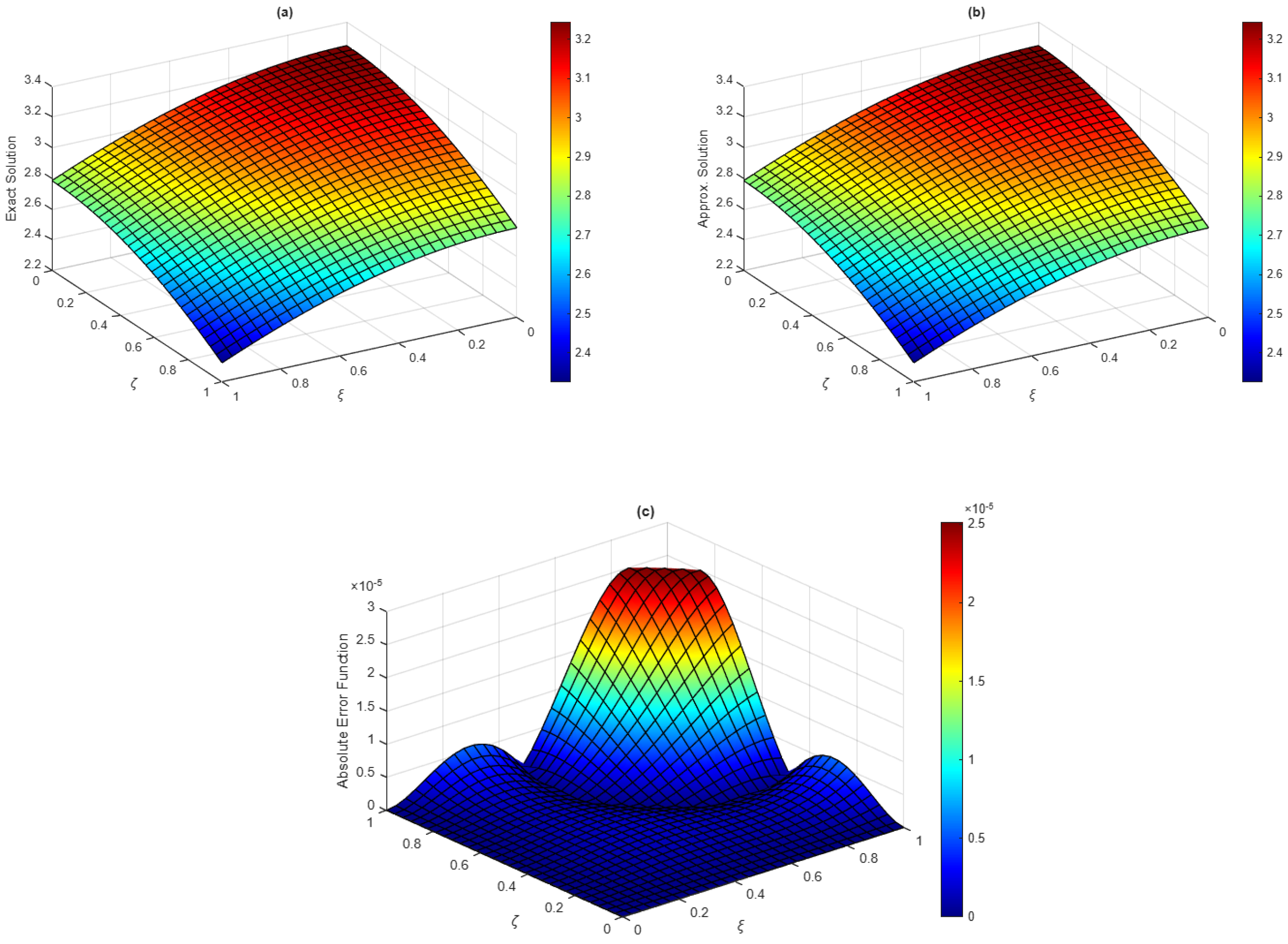
  • The proposed numerical scheme is now applied to this problem. The corresponding MAEs are listed in Table 1 for κ = 0.2 , 0.4 , 0.6 , 0.8 , with N = 2 , η = 0.1 , τ = 0.5 , and several combinations of the parameters σ and ϱ. From these data, one observes that the smallest errors are obtained for ( σ , ϱ ) = ( 1 , 1 ) . In this configuration, ( N + 1 ) 4 = 81 unknown coefficients are involved. Figure 1 displays the three-dimensional plots of the exact solution, the corresponding numerical solution, and the absolute error for N = 2 , κ = 0.6 , ( σ , ϱ ) = ( 1 , 1 ) , η = 0.1 , and τ = 0.5 . These results confirm the high accuracy and efficiency of the proposed approach. In addition, for κ = 0.8 , the relative error reported in [22] is 1.869 × 10 6 for n = 3896 meshes, while the present method attains a relative error of 9.8755 × 10 6 for κ = 0.6 , ( σ , ϱ ) = ( 1 , 1 ) , and N = 2 , highlighting its good performance.
Example 2.
Consider Equation (1) with β = 0 , γ = 1 , α k = 5 , ν k = 2 , k = 1 , 2 , 3 , the source function as
h ( y , τ ) = 2 t 2 κ Γ ( 3 κ ) 30 ( ξ + ζ + η ) + 6 ( ξ 2 + ζ 2 + η 2 ) ,
and the following initial and boundary conditions:
K ( y , 0 ) = ξ 3 + ζ 3 + η 3 , K ( 0 , ζ , η , τ ) = ζ 3 + η 3 + τ 2 , K ( 1 , ζ , η , τ ) = ζ 3 + η 3 + τ 2 + 1 , K ( ξ , 0 , η , τ ) = ξ 3 + η 3 + τ 2 , K ( ξ , 1 , η , τ ) = ξ 3 + η 3 + τ 2 + 1 , K ( ξ , ζ , 0 , τ ) = ξ 3 + ζ 3 + τ 2 , K ( ξ , ζ , 1 , τ ) = ξ 3 + ζ 3 + τ 2 + 1 ,
and the exact solution is K ( y , τ ) = ξ 3 + ζ 3 + η 3 + τ 2 .
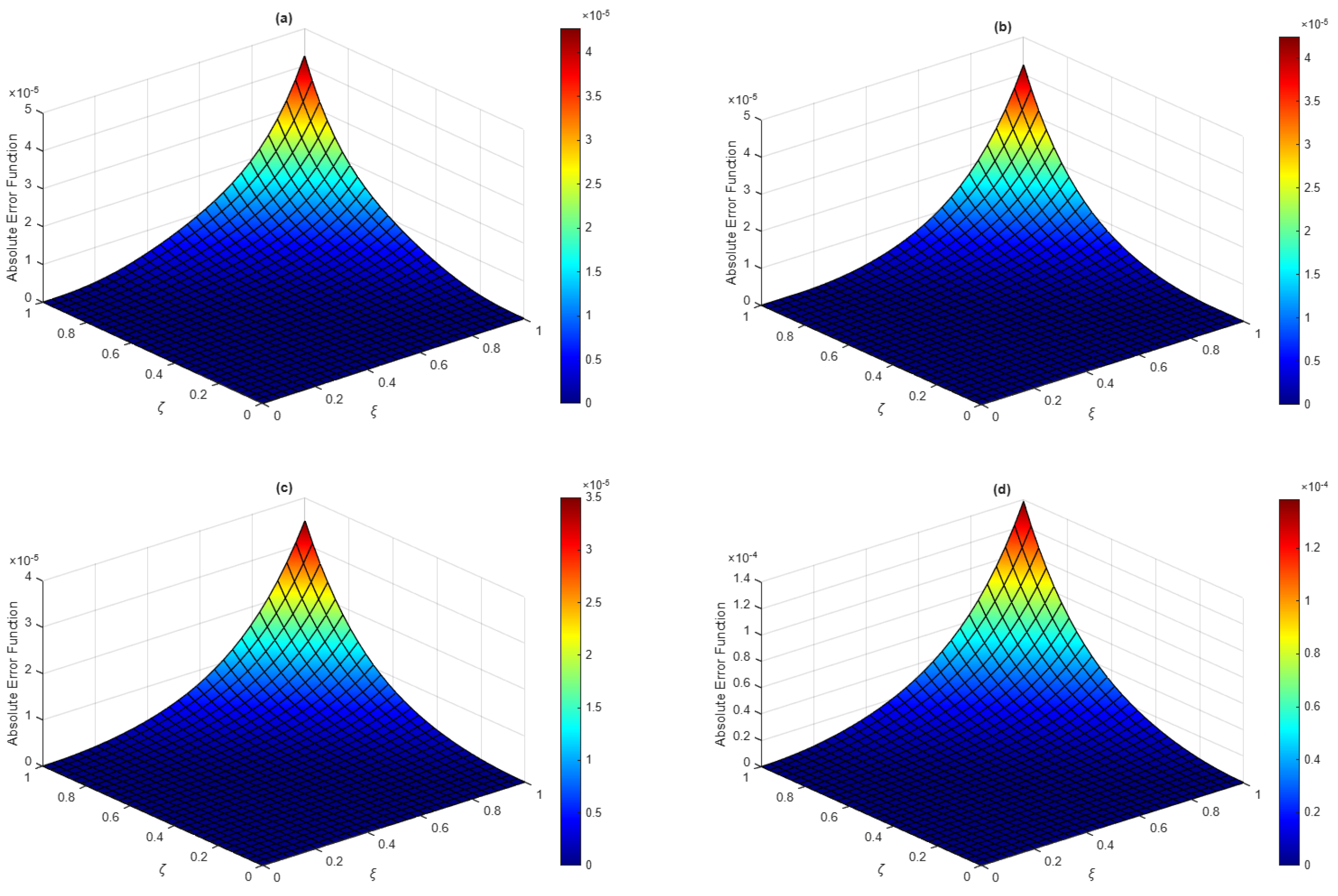
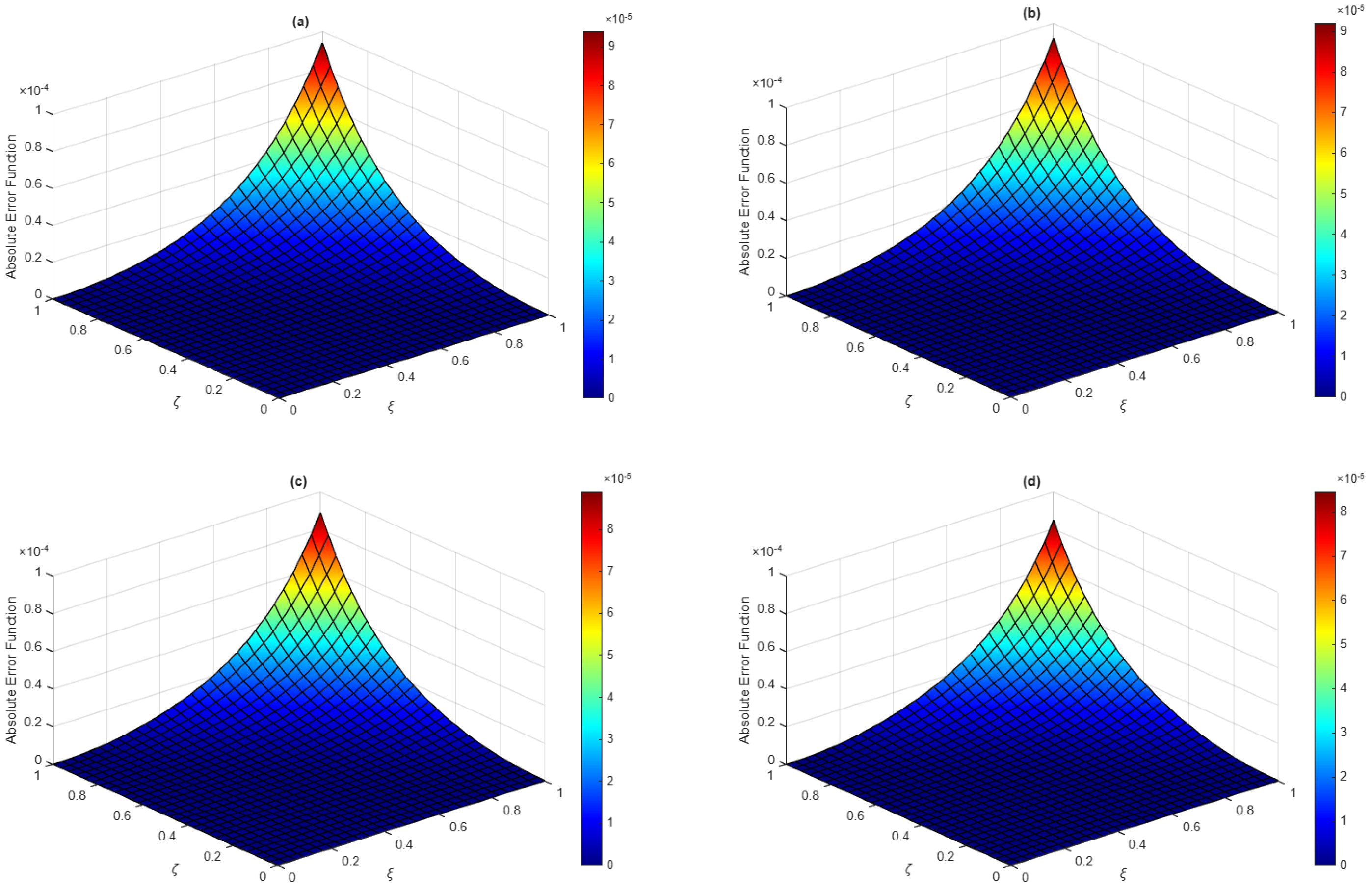
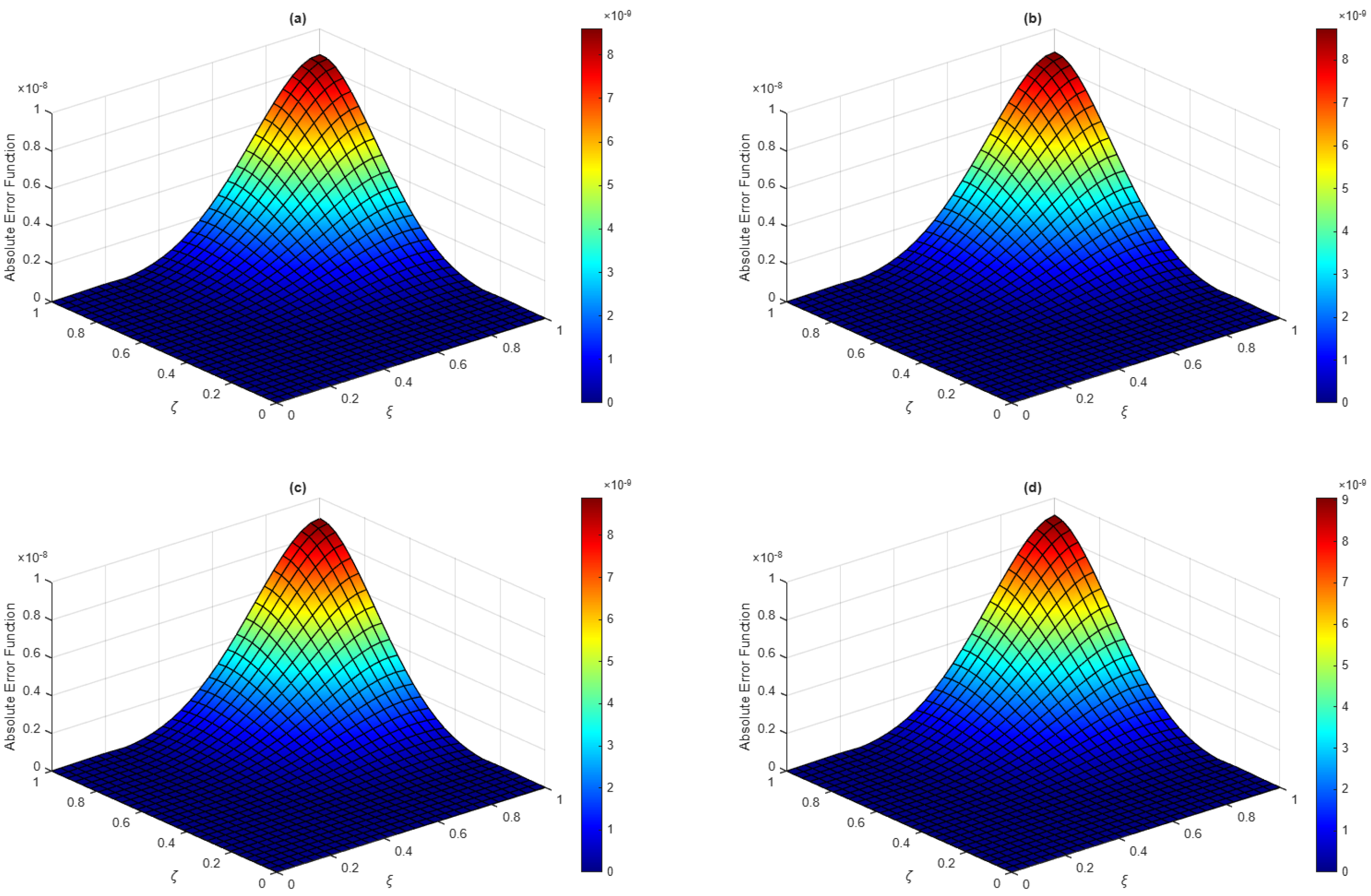
  • We next apply the proposed scheme to this problem. The resulting MAEs are summarized in Table 2 for κ = 0.2 , 0.4 , 0.6 , 0.8 , with N = 3 , η = 0.1 , τ = 0.5 , and multiple choices of ( σ , ϱ ) . The smallest errors in Table 2 correspond to ( σ , ϱ ) = ( 0.5 , 0.5 ) . Table 3 lists the absolute errors at selected spatial points for N = 3 , κ = 0.8 , η = 0.1 , τ = 0.5 , and several parameter pairs ( σ , ϱ ) . The three-dimensional distributions of the absolute error functions are displayed in Figure 2 for N = 3 , κ = 0.8 , η = 0.1 , τ = 0.5 , and different ( σ , ϱ ) , clearly illustrating the high accuracy of the approximation. Moreover, Figure 3 shows 3D plots of the absolute error for κ = 0.2 , 0.4 , 0.6 , 0.8 with N = 3 , ( σ , ϱ ) = ( 0 , 0 ) , η = 0.1 , and τ = 0.5 . These results collectively confirm the robustness and effectiveness of the proposed algorithm across a range of fractional orders.
Example 3.
Consider Equation (1) with β = γ = 1 , α k = 1 , ν k = 0 , k = 1 , 2 , 3 and
h ( y , τ ) = 2 τ 2 κ Γ ( 3 κ ) + 2 τ + 3 τ 2 sin ( ξ ) sin ( ζ ) sin ( η ) ,
and the following initial and boundary conditions:
K ( y , 0 ) = 0 , K ( 0 , ζ , η , τ ) = 0 , K ( 1 , ζ , η , τ ) = τ 2 sin ( 1 ) sin ( ζ ) sin ( η ) , K ( ξ , 0 , η , τ ) = 0 , K ( ξ , 1 , η , τ ) = τ 2 sin ( ξ ) sin ( 1 ) sin ( η ) , K ( ξ , ζ , 0 , τ ) = 0 , K ( ξ , ζ , 1 , τ ) = τ 2 sin ( ξ ) sin ( ζ ) sin ( 1 ) .
The exact solution is K ( y , τ ) = τ 2 sin ( ξ ) sin ( ζ ) sin ( η ) .
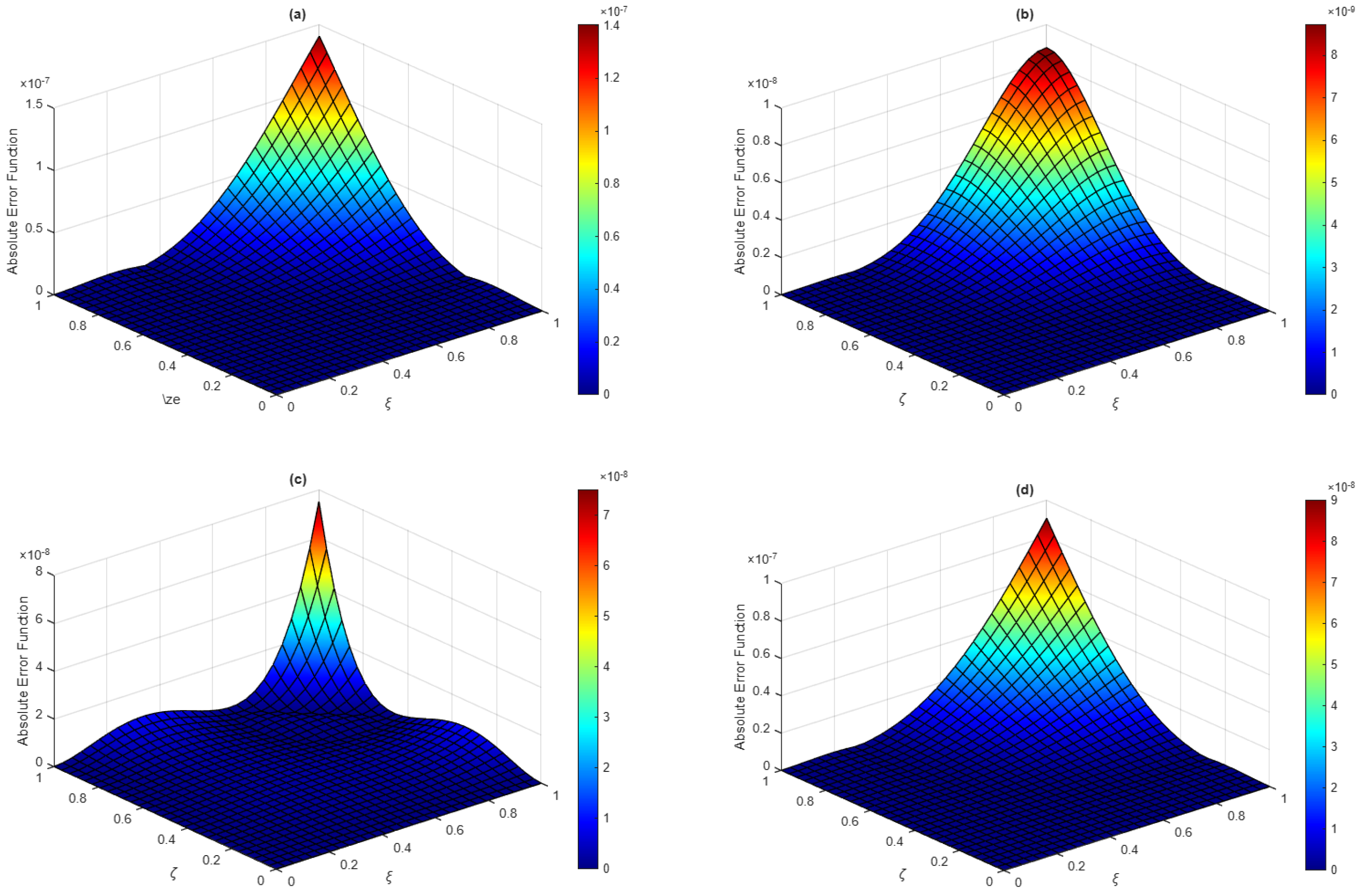
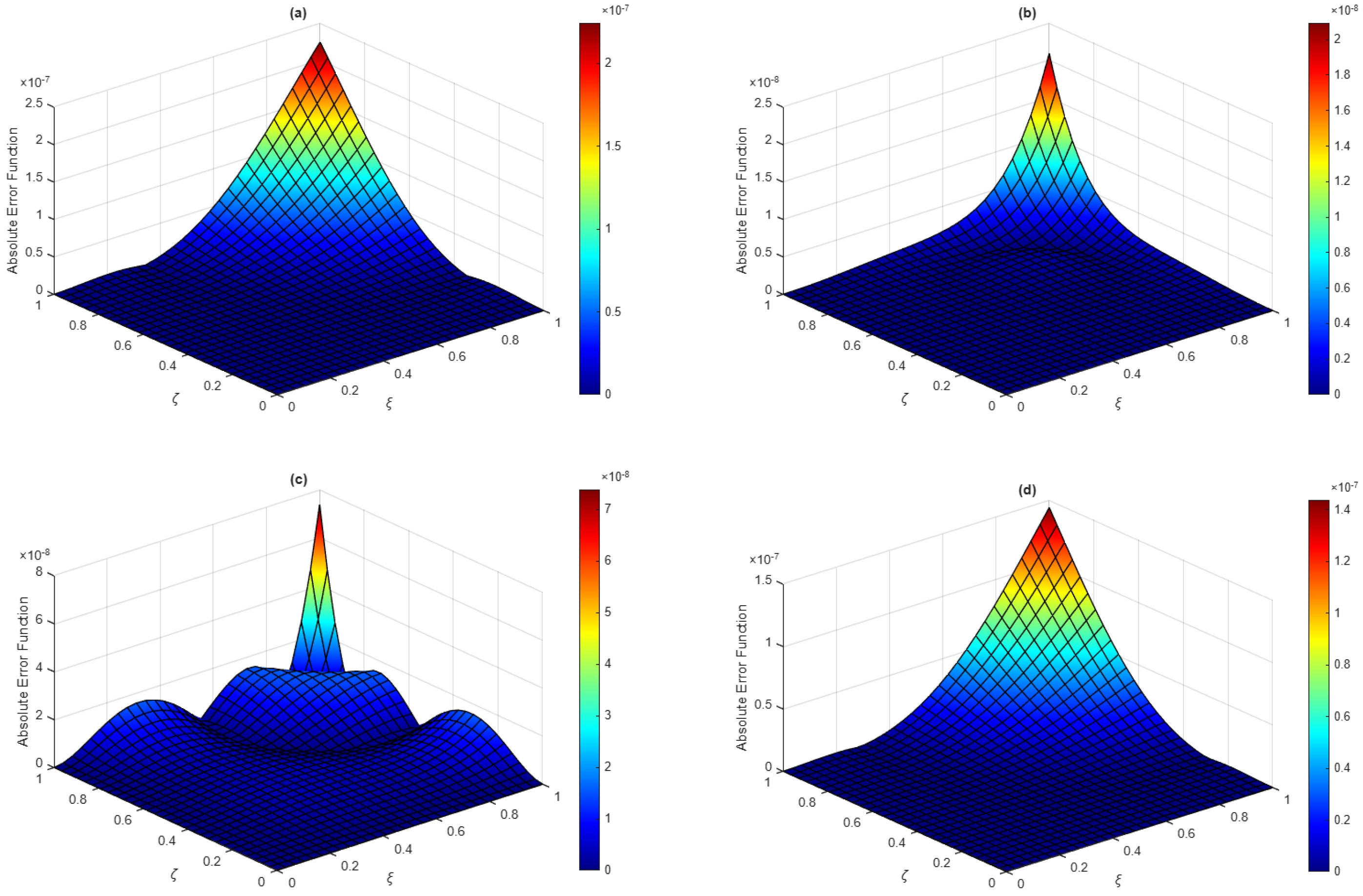
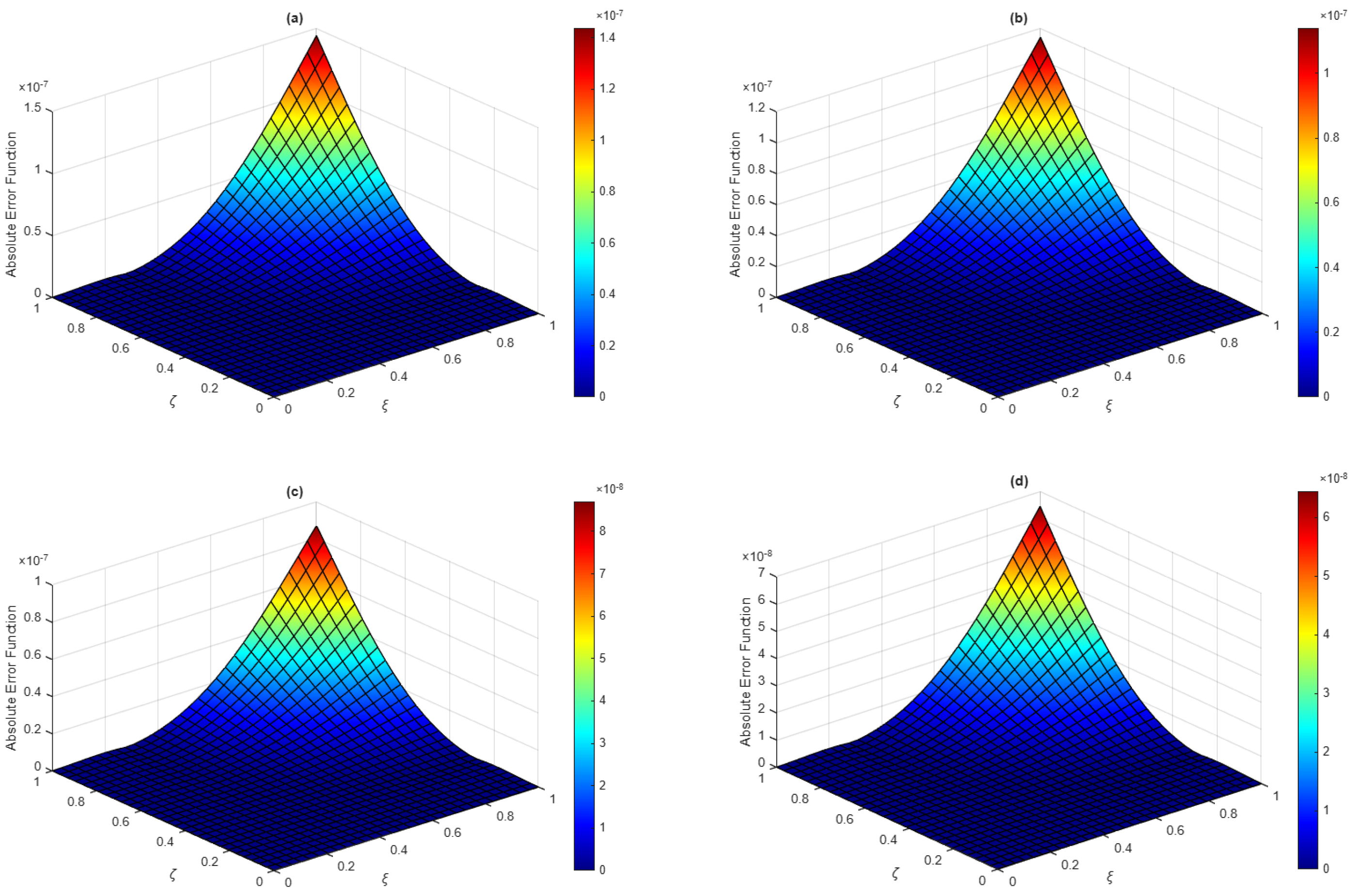
  • The MAEs for this problem are displayed in Table 4 for κ = 0.2 , 0.4 , 0.6 , 0.8 , with N = 2 , η = 0.1 , τ = 0.5 , and several parameter pairs ( σ , ϱ ) . The smallest MAEs in Table 4 correspond to ( σ , ϱ ) = ( 0.5 , 0.5 ) . Table 5 reports the absolute errors at selected grid points for N = 2 , κ = 0.4 , η = 0.1 , τ = 0.5 , and different combinations of ( σ , ϱ ) . The three-dimensional plots of the absolute error distributions are shown in Figure 4 for N = 2 , κ = 0.4 , η = 0.1 , τ = 0.5 , and various parameter choices, clearly indicating that the method provides highly accurate approximations. Moreover, Figure 5 presents 3D plots of the absolute error for κ = 0.2 , 0.4 , 0.6 , 0.8 with N = 2 , ( σ , ϱ ) = ( 0.5 , 0.5 ) , η = 0.1 , and τ = 0.5 . For comparison, the same problem was previously treated by a compact finite difference scheme in [23], where the best reported error was 1.2507 × 10 5 ; the present method achieves a substantially lower error, demonstrating its improved accuracy.
Example 4.
Consider Equation (1) with β = γ = 1 , α k = 1 , ν k = 0 , k = 1 , 2 , 3 and
h ( y , τ ) = ( κ + 1 ) τ κ Γ ( 2 + κ ) + τ + 3 τ κ + 1 Γ ( 2 + κ ) sin ( ξ ) sin ( ζ ) sin ( η ) ,
and the following initial and boundary conditions:
K ( y , 0 ) = 0 , K ( 0 , ζ , η , τ ) = 0 , K ( 1 , ζ , η , τ ) = τ κ + 1 Γ ( 2 + κ ) sin ( 1 ) sin ( ζ ) sin ( η ) , K ( ξ , 0 , η , τ ) = 0 , K ( ξ , 1 , η , τ ) = τ κ + 1 Γ ( 2 + κ ) sin ( ξ ) sin ( 1 ) sin ( η ) , K ( ξ , ζ , 0 , τ ) = 0 , K ( ξ , ζ , 1 , τ ) = t κ + 1 Γ ( 2 + κ ) sin ( ξ ) sin ( ζ ) sin ( 1 ) .
The exact solution of the problem is given by K ( y , τ ) = τ κ + 1 Γ ( 2 + κ ) sin ( ξ ) sin ( ζ ) sin ( η ) .
  • The corresponding MAEs are listed in Table 6 for κ = 0.2 , 0.4 , 0.6 , 0.8 , with N = 2 , η = 0.1 , τ = 0.5 , and different parameter choices ( σ , ϱ ) . From Table 6, we see that the smallest error is obtained for ( σ , ϱ ) = ( 0.5 , 0.5 ) . Table 7 reports the absolute errors at selected points for N = 2 , κ = 0.2 , η = 0.1 , τ = 0.5 , and several combinations of ( σ , ϱ ) . The three-dimensional absolute error distributions are shown in Figure 6 for N = 2 , κ = 0.2 , η = 0.1 , τ = 0.5 , and various parameter settings. These results further demonstrate that the method delivers highly accurate approximations. Finally, Figure 7 presents 3D visualizations of the absolute error functions for κ = 0.2 , 0.4 , 0.6 , 0.8 with N = 2 , ( σ , ϱ ) = ( 0.25 , 0.25 ) , η = 0.1 , and τ = 0.5 , confirming the reliability of the proposed scheme over a range of fractional orders.
  • Now, suppose that the exact solution to the problem under study is not available, and K N ( y , τ ) denotes the approximate solution obtained by the proposed approach. Thus, the approximate solution satisfies the following equation:
R N ( y , τ ) = β K N ( y , τ ) τ + γ 0 c D τ κ K N ( y , τ ) α 1 2 K N ( y , τ ) ξ 2 α 2 2 K N ( y , τ ) ζ 2 α 3 2 K N ( y , τ ) η 2 + ν 1 K N ( y , τ ) ξ + ν 2 K N ( y , τ ) ζ + ν 3 K N ( y , τ ) η h ( y , τ ) ,
where R N ( y , τ ) is the residual function/perturbation term. The maximum absolute values of R N ( y , τ ) are seen in Table 8 for different values of the parameters σ , ϱ and the fractional order κ, β = γ = 1 , α k = 1 , ν k = 0 , k = 1 , 2 , 3 , and initial and boundary conditions in (38) and (39). As expected, the values of the error are small.

8. Conclusions

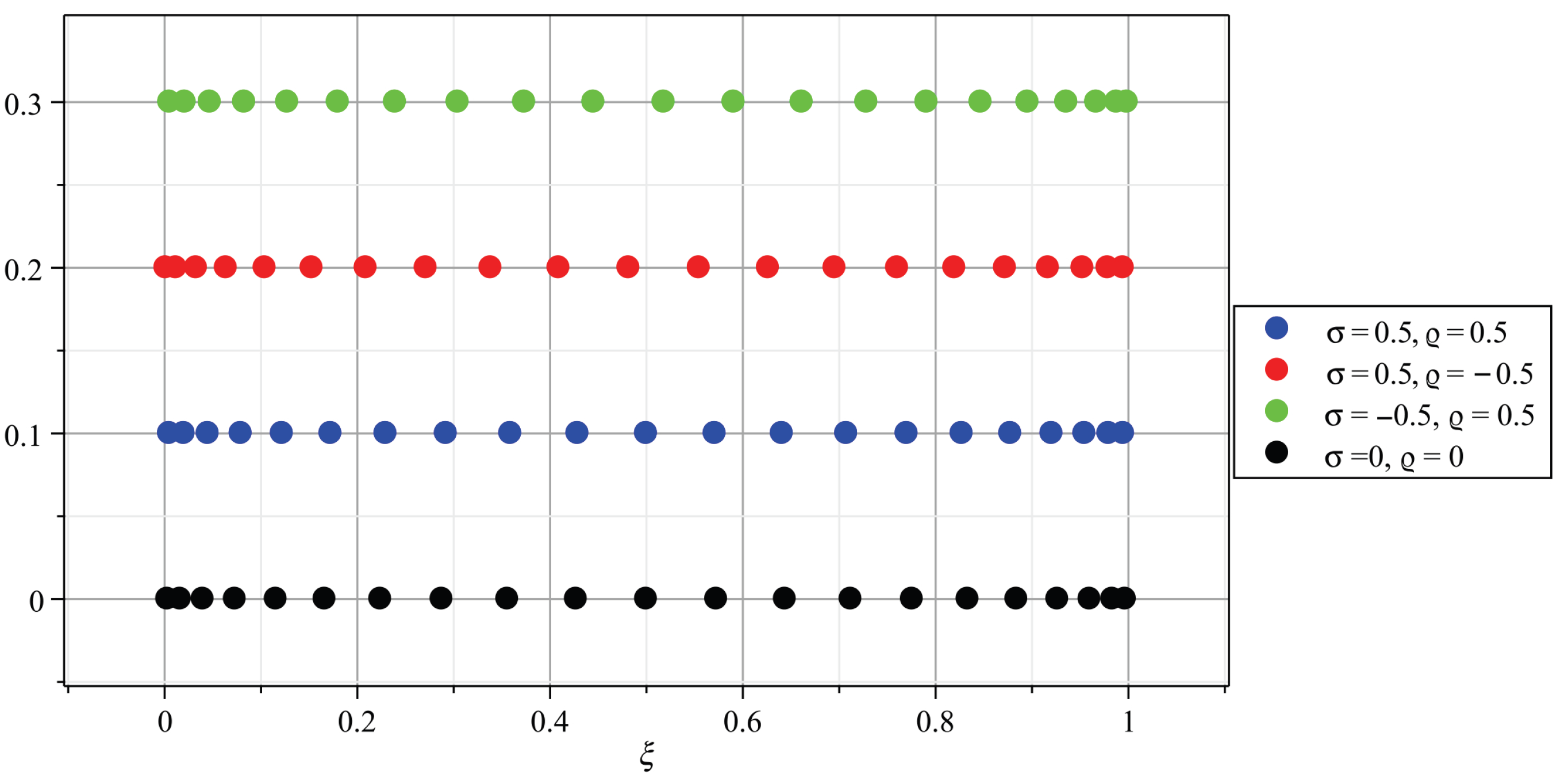
In this work, a novel numerical scheme based on FVJPs has been developed for solving three-dimensional time-fractional diffusion and mobile–immobile equations in the Caputo sense. By employing the Kronecker product of one-dimensional Jacobi polynomials within a pseudo-operational collocation framework, the proposed method achieves high computational efficiency and accuracy. Theoretical analysis established the existence and uniqueness of the solution via Schauder’s fixed-point theorem and verified the Ulam–Hyers stability. Furthermore, an error bound of the residual function was derived in a Jacobi-weighted Sobolev space, confirming the scheme’s robust convergence properties. Numerical experiments demonstrated that the proposed method yields results with superior accuracy compared to those reported in previous studies by other authors. The numerical accuracy is moderately sensitive to the choice of the Jacobi polynomial parameters, particularly through their effect on the distribution of collocation points near the domain boundaries. In Examples 1 and 2, the error obtained with σ = 0.5 , ϱ = 0.5 is smaller than that obtained with σ = 0.5 , ϱ = 0.5 . As shown in Figure 8, for the diffusion problems the eleven roots of P 21 0.5 , 0.5 ( ξ ) are clustered in the sub-interval [ 0 , 0.5 ] , while the eleven roots of P 21 0.5 , 0.5 ( ξ ) are concentrated on the sub-interval [ 0.5 , 1 ] . This indicates that accuracy improves when collocation points are concentrated near the boundary where the solution exhibits stronger gradients. In contrast, for Examples 3 and 4 (the mobile–immobile problems), smaller errors are observed when σ = 0.5 , ϱ = 0.5 .
  • These findings highlight the potential of the FVJP-based approach as a powerful and reliable tool for solving multidimensional time-fractional partial differential equations. Future research may extend this framework to more complex geometries and non-linear fractional models. Although the model includes a convection term, the present study focuses on regimes where diffusion and fractional memory effects dominate, and the solution retains sufficient spatial smoothness. Strongly convection-dominated problems, which may exhibit sharp layers or non-smooth behavior and require stabilization techniques, are beyond the scope of this work.

Author Contributions

Conceptualization, K.S. and D.A.; Methodology, E.H.; Software, K.S.; Validation, M.A.Z., K.S. and E.H.D.; Formal analysis, K.S.; Investigation, E.H.D.; Writing—original draft preparation, K.S. and M.A.Z.; Writing—review and editing, E.H.D.; Visualization, E.H.; Supervision, D.A.; Project administration, M.A.Z.; Funding acquisition, M.A.Z. All authors have read and agreed to the published version of the manuscript.

Funding

This research received no external funding.

Data Availability Statement

No new data were created or analyzed in this study. Data Sharing is not applicable to this article.

Conflicts of Interest

The authors declare no conflicts of interest.

References

  1. Podlubny, I. Fractional Differential Equations; Academic Press: San Diego, CA, USA, 1999. [Google Scholar]
  2. Metzler, R.; Klafter, J. The random walk’s guide to anomalous diffusion: A fractional dynamics approach. Phys. Rep. 2000, 339, 1–77. [Google Scholar] [CrossRef]
  3. Mainardi, F. Fractional Calculus and Waves in Linear Viscoelasticity: An Introduction to Mathematical Models, 2nd ed.; World Scientific: London, UK, 2022. [Google Scholar]
  4. Magin, R.L. Fractional calculus in bioengineering. Crit. Rev. Biomed. Eng. 2004, 32, 1–104. [Google Scholar] [CrossRef] [PubMed]
  5. Roul, P.; Khandagale, S.N. A high-order numerical scheme based on L2-1-ADI difference method on nonuniform meshes for a 2D variable coefficients time fractional reaction–diffusion equation. Commun. Nonlinear Sci. Numer. Simul. 2026, 152, 109185. [Google Scholar] [CrossRef]
  6. Cao, J.; Zhao, X.; Roul, P. A high order numerical method for 2D time-fractional neutron diffusion equation characterizing neutron transport in nuclear reactors. Nucl. Eng. Des. 2025, 441, 114145. [Google Scholar] [CrossRef]
  7. Heydari, M.H.; Hosseininia, M.; Baleanu, D. A computational approach based on the fractional Euler functions and Chebyshev cardinal functions for distributed-order time fractional 2D diffusion equation. AEJ Alex. Eng. J. 2023, 67, 643–653. [Google Scholar] [CrossRef]
  8. Hosseininia, M.; Heydari, M.H. Legendre wavelets for the numerical solution of nonlinear variable-order time fractional 2D reaction-diffusion equation involving Mittag–Leffler non-singular kernel. Chaos Solitons Fractals 2019, 127, 400–407. [Google Scholar] [CrossRef]
  9. Chen, Y.; Zhang, X.; Wei, L. High precision interpolation method for mixed 2D time-space fractional convection-diffusion equation. Int. J. Dyn. Control. 2025, 13, 333. [Google Scholar] [CrossRef]
  10. Yang, Q.; Turner, I.; Liu, F.; Ilić, M. Novel numerical methods for solving the time-space fractional diffusion equation in two dimensions. SIAM J. Sci. Comput. 2011, 33, 1159–1180. [Google Scholar] [CrossRef]
  11. Du, H.; Chen, Z. Adaptive meshless numerical method of solving 2D variable order time fractional mobile-immobile advection-diffusion equations. Comput. Math. Appl. 2022, 124, 42–51. [Google Scholar] [CrossRef]
  12. Liu, W.; Chen, H.; Zaky, M. Error analysis of an ADI scheme for the two-dimensional fractal mobile/immobile transport equation with weakly singular solutions Author links open overlay panel. Appl. Numer. Math. 2025, 210, 113–122. [Google Scholar] [CrossRef]
  13. Chai, L.; Liu, Y.; Li, H. Fourth-order compact difference schemes for the two-dimensional nonlinear fractional mobile/immobile transport models Author links open overlay panel. Comput. Math. Appl. 2021, 100, 1–10. [Google Scholar] [CrossRef]
  14. Qiao, H.; Cheng, A. A fast finite difference method for 2D time variable fractional mobile/immobile equation. J. Appl. Math. Comput. 2024, 70, 551–577. [Google Scholar] [CrossRef]
  15. Salama, F.M.; Ali, U.; Ali, A. Numerical Solution of Two-Dimensional Time Fractional Mobile/Immobile Equation Using Explicit Group Methods. Int. J. Appl. Comput. Math. 2022, 8, 188. [Google Scholar] [CrossRef]
  16. Nong, L.; Chen, A.; Yi, Q.; Li, C. Fast Crank-Nicolson compact difference scheme for the two-dimensional time-fractional mobile/immobile transport equation. AIMS Math. 2021, 6, 6242–6254. [Google Scholar] [CrossRef]
  17. Sadri, K.; Amilo, D.; Hinçal, E. A combination of classical and shifted Jacobi polynomials for two-dimensional time-fractional diffusion-wave equations. Chaos Solitons Fractals 2025, 198, 116569. [Google Scholar] [CrossRef]
  18. Zhao, Y.L.; Gu, X.M.; Li, M.; Jian, H.Y. Preconditioners for all-at-once system from the fractional mobile/immobile advection-diffusion model. J. Appl. Math. Comput. 2021, 65, 669–691. [Google Scholar] [CrossRef]
  19. Yu, B.; Jiang, X.; Qi, H. Numerical method for the estimation of the fractional parameters in the fractional mobile/immobile advection-diffusion model. Int. J. Comput. Math. 2018, 95, 1131–1150. [Google Scholar] [CrossRef]
  20. Liu, H.; Zheng, X.; Chen, C.; Wang, H. A characteristic finite element method for the time-fractional mobile/immobile advection diffusion model. Adv. Comput. Math. 2021, 47, 41. [Google Scholar] [CrossRef]
  21. Zaky, M.A. A linearized two-dimensional Galerkin-L1 spectral method with diagonalization for time-fractional diffusion equations with delay. Appl. Numer. Math. 2026, 220, 1–12. [Google Scholar] [CrossRef]
  22. Gu, Y.; Sun, H. A meshless method for solving three-dimensional time fractional diffusion equation with variable-order derivatives. Appl. Math. Model. 2020, 78, 539–549. [Google Scholar] [CrossRef]
  23. Liu, K.; Zhang, H.; Yang, X. An averaged L1 ADI compact difference scheme for the three-dimensional time-fractional mobile/immobile transport equation with weakly singular solutions. Comput. Math. Appl. 2025, 200, 102–116. [Google Scholar] [CrossRef]
  24. Yaghoubi, S.; Aminikhah, H.; Sadri, K. Bidimensional Gegenbauer polynomials for variable-order time-fractional integro-partial differential equation with a weakly singular kernel. Math. Methods Appl. Sci. 2025, 48, 5570–5585. [Google Scholar] [CrossRef]
  25. Sadri, K.; Amilo, D.; Farman, M.; Hinçal, E. Bivariate Jacobi polynomials depending on four parameters and their effect on solutions of time-fractional Burgers’ equations. J. Comput. Sci. 2024, 83, 102450. [Google Scholar] [CrossRef]
  26. Yaghoubi, S.; Aminikhah, H.; Sadri, K. A spectral shifted Gegenbauer collocation method for fractional pantograph partial differential equations and its error analysis. Sådhanå 2023, 48, 213. [Google Scholar] [CrossRef]
  27. Sadri, K.; Hosseini, K.; Hinçal, E.; Baleanu, D.; Salahshour, S. A pseudo-operational collocation method for variable-order time-space fractional KdV–Burgers–Kuramoto equation. Math. Meth. Appl. Sci. 2023, 46, 8759–8778. [Google Scholar] [CrossRef]
  28. Tavares, D.; Almeida, R.; Torres, D.F.M. Caputo derivatives of fractional variable order: Numerical approximations. Commun. Nonlinear Sci. Numer. Simul. 2016, 35, 69–87. [Google Scholar] [CrossRef]
  29. Stewart, G.W. Matrix Algorithms; SIAM: Society for Industrial and Applied Mathematics: Philadelphia, PA, USA, 1998. [Google Scholar]
  30. Kamran; Shah, A.F.; Shah, K.; Abdeljawad, T. Numerical solution of two dimensional time-fractional telegraph equation using Chebyshev spectral collocation method. Partial Differ. Equ. Appl. Math. 2025, 13, 101129. [Google Scholar] [CrossRef]
  31. McLean, W. Regularity of solutions to a time-fractional diffusion equation. ANZIAM J. 2010, 52, 123–138. [Google Scholar] [CrossRef]
  32. Szegő, G. Orthogonal Polynomials, 4th ed.; American Mathematical Society: Providence, RI, USA, 1975. [Google Scholar]
Figure 1. (a) Exact solution, (b) Approximate solution, (c) Absolute error function for N = 2 , κ = 0.6 , ( σ , ϱ ) = ( 1 , 1 ) , and η = 0.1 , τ = 0.5 in Example 1.
Mathematics 14 00651 g001
Figure 2. Absolute error functions for (a) ( σ , ϱ ) = ( 1 2 , 1 2 ) , (b) ( σ , ϱ ) = ( 1 2 , 1 2 ) , (c) ( σ , ϱ ) = ( 1 , 1 ) , (d) ( σ , ϱ ) = ( 1 4 , 1 4 ) for N = 3 , κ = 0.8 , and η = 0.1 , τ = 0.5 in Example 2.
Mathematics 14 00651 g002
Figure 3. Absolute error functions for (a) κ = 0.2 , (b) κ = 0.4 , (c) κ = 0.6 , (d) κ = 0.8 for N = 3 , ( σ , ϱ ) = ( 0 , 0 ) , and η = 0.1 , τ = 0.5 in Example 2.
Mathematics 14 00651 g003
Figure 4. Absolute error functions for (a) ( σ , ϱ ) = ( 0 , 0 ) , (b) ( σ , ϱ ) = ( 1 2 , 1 2 ) , (c) ( σ , ϱ ) = ( 1 , 1 ) , (d) ( σ , ϱ ) = ( 1 4 , 1 4 ) for N = 2 , κ = 0.4 , and η = 0.1 , τ = 0.5 in Example 3.
Mathematics 14 00651 g004
Figure 5. Absolute error functions for (a) κ = 0.2 , (b) κ = 0.4 , (c) κ = 0.6 , (d) κ = 0.8 for N = 2 , ( σ , ϱ ) = ( 1 2 , 1 2 ) , and η = 0.1 , τ = 0.5 in Example 3.
Mathematics 14 00651 g005
Figure 6. Absolute error functions for (a) ( σ , ϱ ) = ( 0 , 0 ) , (b) ( σ , ϱ ) = ( 1 2 , 1 2 ) , (c) ( σ , ϱ ) = ( 1 , 1 ) , (d) ( σ , ϱ ) = ( 1 4 , 1 4 ) for N = 2 , κ = 0.2 , and η = 0.1 , τ = 0.5 in Example 4.
Mathematics 14 00651 g006
Figure 7. Absolute error functions for (a) κ = 0.2 , (b) κ = 0.4 , (c) κ = 0.6 , (d) κ = 0.8 for N = 2 , ( σ , ϱ ) = ( 1 4 , 1 4 ) , and η = 0.1 , τ = 0.5 in Example 4.
Mathematics 14 00651 g007
Figure 8. Distribution of roots of the Jacobi polynomials for different choices of the Jacobi parameters and N = 20 .
Mathematics 14 00651 g008
Table 1. MAEs for N = 2 , various choices of κ and σ , ϱ in Example 1.
( σ , ϱ ) κ = 0.2 κ = 0.4 κ = 0.6 κ = 0.8
( 0 , 0 ) 2.7217 × 10 4 1.0010 × 10 4 2.5168 × 10 4 7.5761 × 10 4
( 1 2 , 1 2 ) 1.8166 × 10 4 1.5067 × 10 4 1.0899 × 10 4 1.7118 × 10 4
( 1 2 , 1 2 ) 3.5426 × 10 3 3.5453 × 10 3 3.5903 × 10 3 3.7922 × 10 3
( 1 2 , 1 2 ) 6.3174 × 10 4 6.3799 × 10 4 6.4391 × 10 4 6.5083 × 10 4
( 1 , 1 ) 8.1093 × 10 5 5.0055 × 10 5 2.2228 × 10 5 1.1834 × 10 4
( 1 4 , 1 4 ) 1.1287 × 10 3 1.1265 × 10 3 1.1290 × 10 3 1.1454 × 10 3
Table 2. MAEs for N = 3 , various choices of κ and σ , ϱ in Example 2.
( σ , ϱ ) κ = 0.2 κ = 0.4 κ = 0.6 κ = 0.8
( 0 , 0 ) 9.3940 × 10 5 9.3940 × 10 5 8.9009 × 10 5 8.4691 × 10 5
( 1 2 , 1 2 ) 5.2070 × 10 5 5.2070 × 10 5 4.7047 × 10 5 4.2791 × 10 5
( 1 2 , 1 2 ) 3.5557 × 10 3 3.5557 × 10 3 3.6066 × 10 3 3.6591 × 10 3
( 1 2 , 1 2 ) 1.5959 × 10 4 1.5959 × 10 4 4.7300 × 10 4 7.2067 × 10 4
( 1 , 1 ) 4.5646 × 10 4 4.5646 × 10 4 4.9061 × 10 4 4.9859 × 10 4
( 1 4 , 1 4 ) 2.2865 × 10 3 2.2865 × 10 3 5.3759 × 10 3 19.1198 × 10 3
Table 3. Values of absolute errors for N = 3 , κ = 0.8 , and various choices of σ , ϱ in Example 2.
ξ k = ζ k ( σ , ϱ ) = ( 1 2 , 1 2 ) ( σ , ϱ ) = ( 1 2 , 1 2 ) ( σ , ϱ ) = ( 1 , 1 ) ( σ , ϱ ) = ( 1 4 , 1 4 )
0.2 5.6582 × 10 9 4.2736 × 10 7 3.1909 × 10 7 3.4490 × 10 6
0.4 8.2629 × 10 8 9.0018 × 10 6 1.1428 × 10 5 3.2896 × 10 5
0.6 1.2277 × 10 6 6.8350 × 10 5 7.0166 × 10 5 2.0021 × 10 4
0.8 8.3152 × 10 6 2.8072 × 10 4 2.5487 × 10 4 1.4612 × 10 3
1.0 4.2791 × 10 5 7.2067 × 10 4 4.9858 × 10 4 9.1198 × 10 3
Table 4. MAEs for N = 2 , various choices of κ and σ , ϱ in Example 3.
( σ , ϱ ) κ = 0.2 κ = 0.4 κ = 0.6 κ = 0.8
( 0 , 0 ) 1.3953 × 10 7 1.4053 × 10 7 1.4178 × 10 7 1.4330 × 10 7
( 1 2 , 1 2 ) 4.4632 × 10 7 4.8235 × 10 7 5.7201 × 10 7 9.1674 × 10 7
( 1 2 , 1 2 ) 8.6111 × 10 9 8.7409 × 10 9 8.8964 × 10 9 9.0646 × 10 9
( 1 2 , 1 2 ) 5.1588 × 10 8 3.1168 × 10 8 1.8109 × 10 8 2.1783 × 10 8
( 1 , 1 ) 6.8771 × 10 8 7.5143 × 10 8 8.3079 × 10 8 9.2661 × 10 8
( 1 4 , 1 4 ) 8.9510 × 10 8 9.0131 × 10 8 9.0905 × 10 8 9.1835 × 10 8
Table 5. Values of absolute errors for N = 2 , κ = 0.4 , and various choices of σ , ϱ in Example 3.
ξ k = ζ k ( σ , ϱ ) = ( 0 , 0 ) ( σ , ϱ ) = ( 1 2 , 1 2 ) ( σ , ϱ ) = ( 1 , 1 ) ( σ , ϱ ) = ( 1 4 , 1 4 )
0.2 3.2450 × 10 11 3.3474 × 10 13 4.8492 × 10 10 5.3878 × 10 12
0.4 1.2140 × 10 10 6.5119 × 10 11 1.9298 × 10 9 1.5748 × 10 10
0.6 4.4920 × 10 9 1.0016 × 10 9 1.3708 × 10 9 4.2626 × 10 9
0.8 3.8593 × 10 8 4.6896 × 10 9 1.1330 × 10 9 2.7254 × 10 8
1.0 1.4053 × 10 7 8.7409 × 10 9 7.5143 × 10 8 9.0131 × 10 8
Table 6. MAEs for N = 2 , various choices of κ and σ , ϱ in Example 4.
( σ , ϱ ) κ = 0.2 κ = 0.4 κ = 0.6 κ = 0.8
( 0 , 0 ) 2.2459 × 10 7 1.7830 × 10 7 1.3630 × 10 7 1.0093 × 10 7
( 1 2 , 1 2 ) 5.8298 × 10 7 4.771 × 10 7 4.1769 × 10 7 5.1433 × 10 7
( 1 2 , 1 2 ) 2.0936 × 10 8 2.0286 × 10 8 1.0355 × 10 8 1.9246 × 10 9
( 1 2 , 1 2 ) 1.3516 × 10 7 3.4377 × 10 8 1.1888 × 10 8 2.6128 × 10 8
( 1 , 1 ) 7.3897 × 10 8 7.2211 × 10 8 6.7317 × 10 8 6.0471 × 10 8
( 1 4 , 1 4 ) 1.4387 × 10 7 1.1402 × 10 7 8.7059 × 10 8 6.4456 × 10 8
Table 7. Values of absolute errors for N = 2 , κ = 0.2 , and various choices of σ , ϱ in Example 4.
ξ k = ζ k ( σ , ϱ ) = ( 0 , 0 ) ( σ , ϱ ) = ( 1 2 , 1 2 ) ( σ , ϱ ) = ( 1 , 1 ) ( σ , ϱ ) = ( 1 4 , 1 4 )
0.2 3.2450 × 10 11 3.3474 × 10 13 4.8492 × 10 10 5.3878 × 10 12
0.4 1.2140 × 10 10 6.5119 × 10 11 1.9298 × 10 9 1.5748 × 10 10
0.6 4.4920 × 10 9 1.0016 × 10 9 1.3708 × 10 9 4.2626 × 10 9
0.8 3.8593 × 10 8 4.6896 × 10 9 1.1330 × 10 9 2.7254 × 10 8
1.0 1.4053 × 10 7 8.7409 × 10 9 7.5143 × 10 8 9.0131 × 10 8
Table 8. MAEs of the residual function for N = 2 , various choices of κ , and σ , ϱ in Example 4.
( σ , ϱ ) κ = 0.2 κ = 0.4 κ = 0.6 κ = 0.8
( 0 , 0 ) 4.0945 × 10 6 3.3878 × 10 6 2.6269 × 10 6 1.9334 × 10 6
( 1 2 , 1 2 ) 4.2048 × 10 5 3.4990 × 10 5 3.1978 × 10 5 4.4049 × 10 5
( 1 2 , 1 2 ) 3.6256 × 10 5 3.0351 × 10 5 2.0327 × 10 5 1.1816 × 10 5
( 1 2 , 1 2 ) 1.8641 × 10 5 6.1764 × 10 6 1.6905 × 10 6 5.9143 × 10 7
( 1 , 1 ) 1.0004 × 10 5 6.2911 × 10 6 3.4868 × 10 6 1.4981 × 10 6
( 1 4 , 1 4 ) 5.5448 × 10 6 4.3203 × 10 6 3.2734 × 10 6 2.4207 × 10 6
Disclaimer/Publisher’s Note: The statements, opinions and data contained in all publications are solely those of the individual author(s) and contributor(s) and not of MDPI and/or the editor(s). MDPI and/or the editor(s) disclaim responsibility for any injury to people or property resulting from any ideas, methods, instructions or products referred to in the content.