Augmentation of Small Ultrasound Databases: A Practical Approach


Abstract
1. Introduction
2. Related Work
2.1. Data Scarcity in Medical Image Processing
2.2. GANs in Medical Image Processing
2.3. Enhancements of DCGANs
3. Contribution
4. Experimental Setup
5. Model Structure
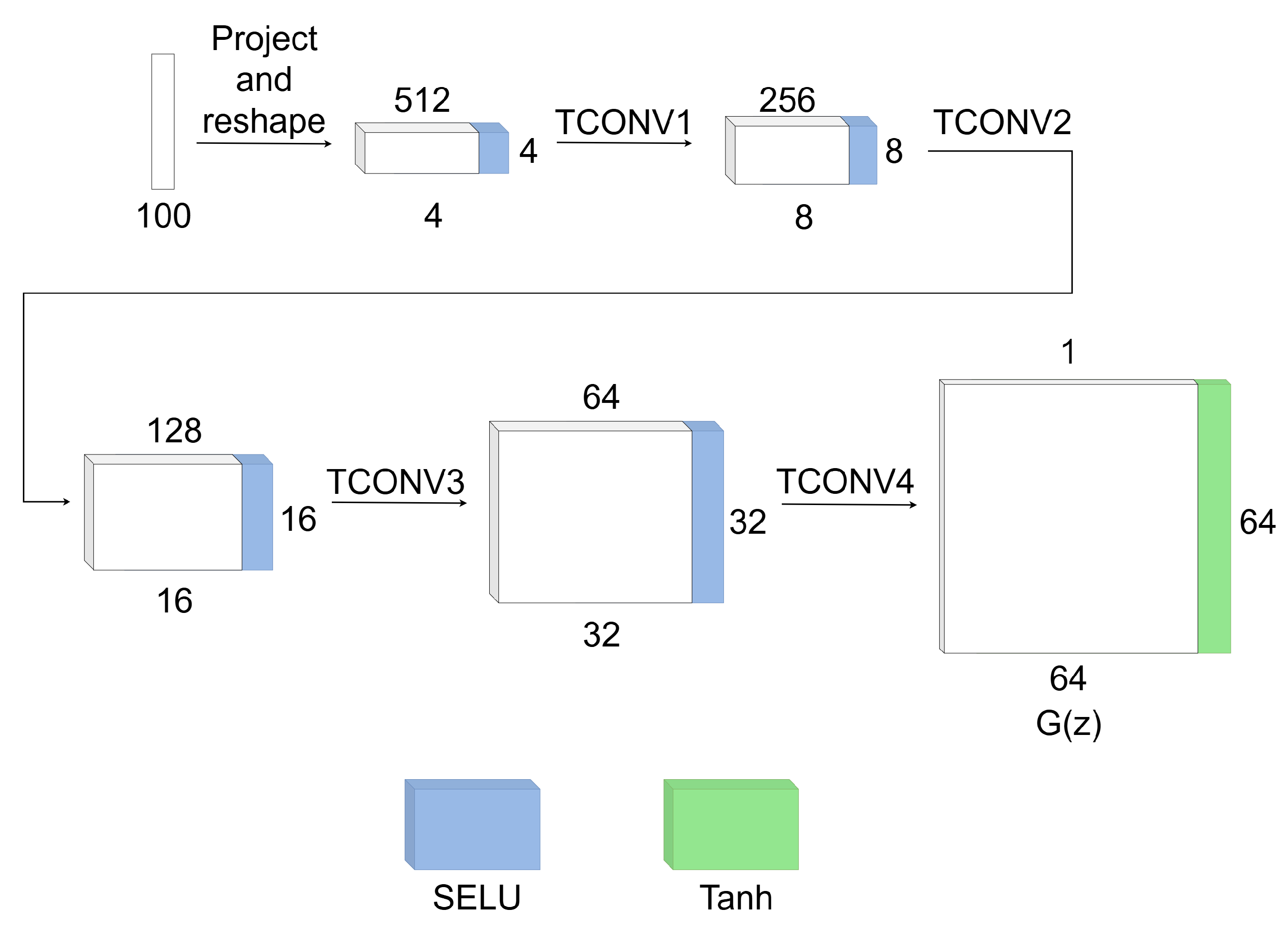
5.1. Generator
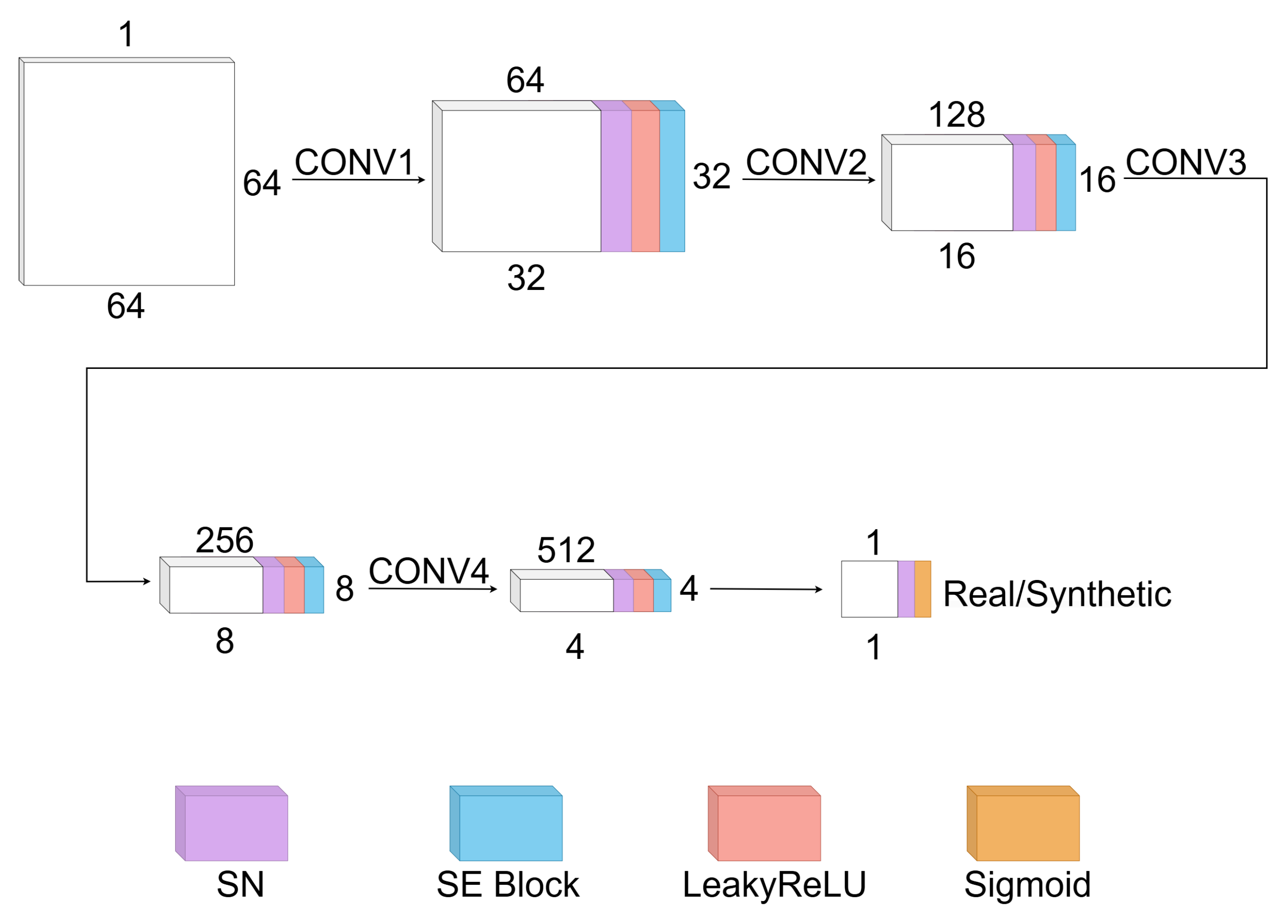
5.2. Discriminator
6. Loss Functions
6.1. Loss Function and Optimizer
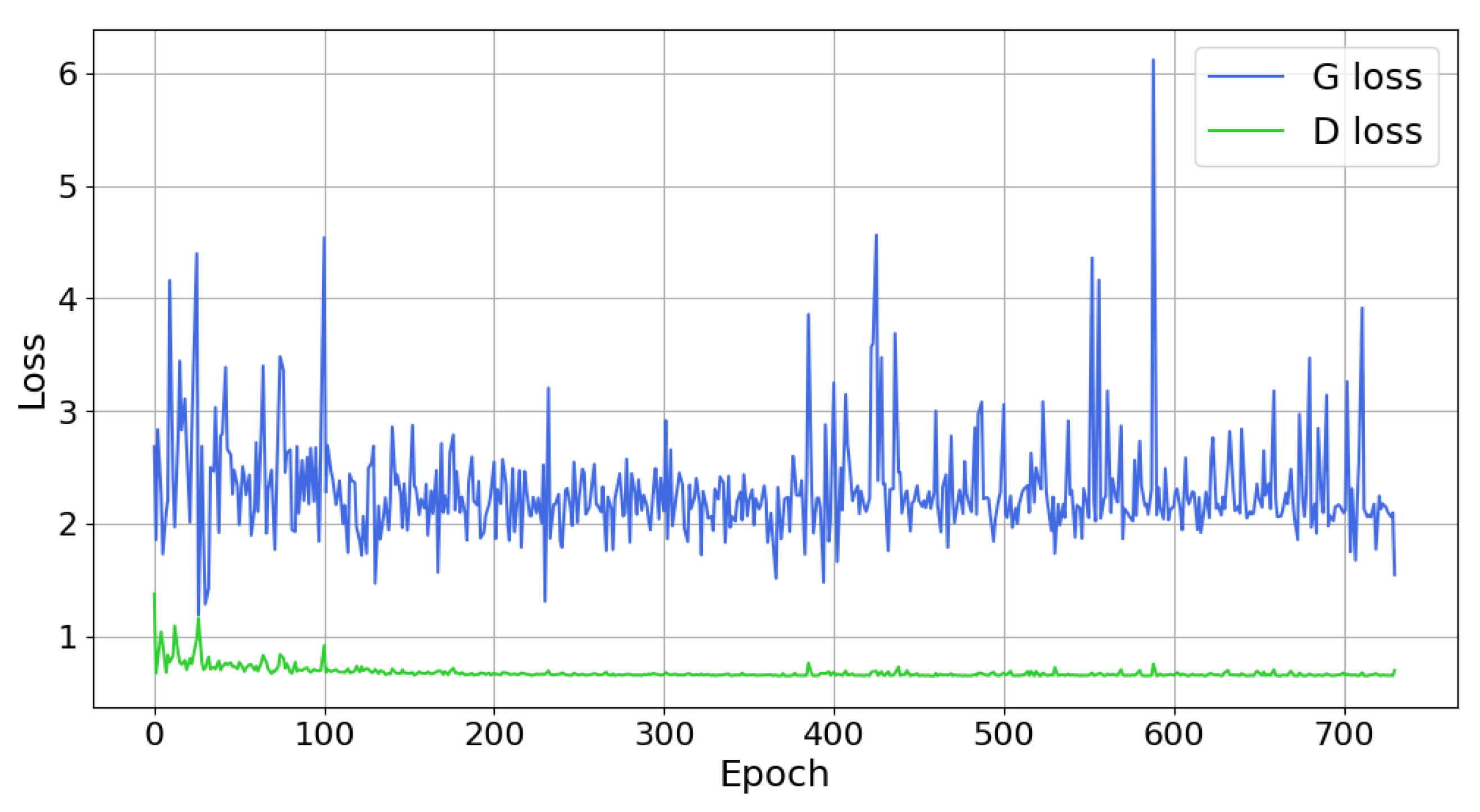
6.2. Stopping Criteria
| Algorithm 1: Summary of the loss function |
1. Input: Array and the size of the interval for moving avarage k 2. For , calculate IQR. 3. 4. 5. If & . 6. If |
7. Image Metrics
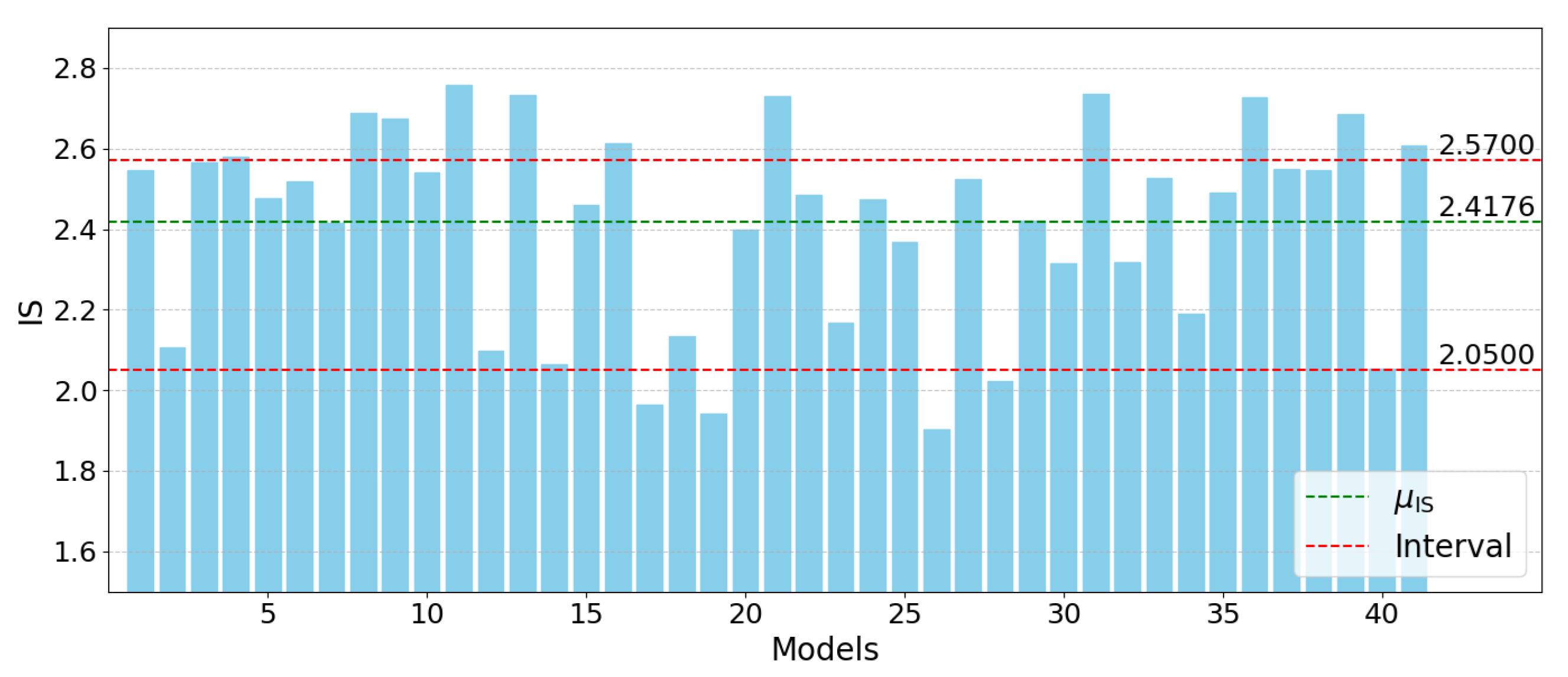
7.1. Inception Score (IS)
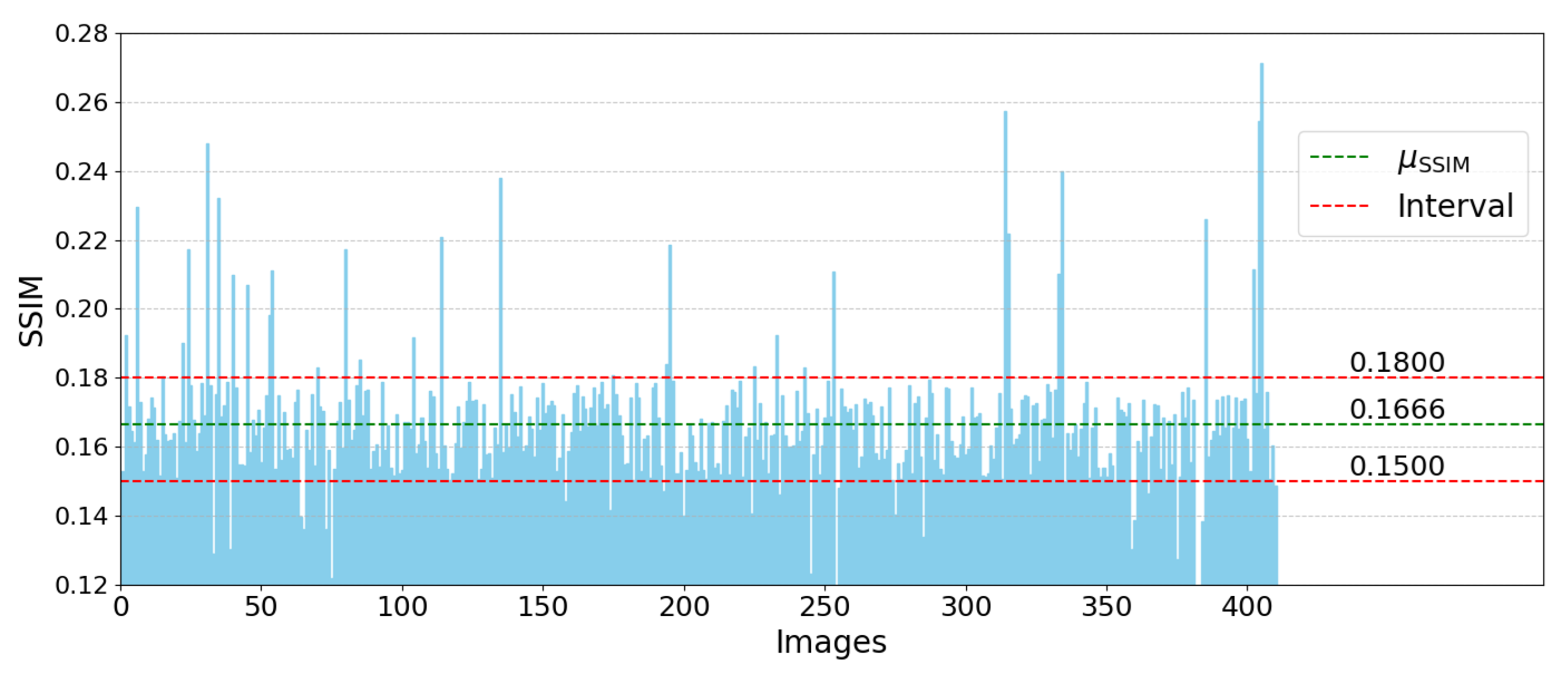
7.2. Structural Similarity Index (SSIM)
7.3. Edge Preservation Index (EPI)
7.4. Features Similarity Index Matrix (FSIM)
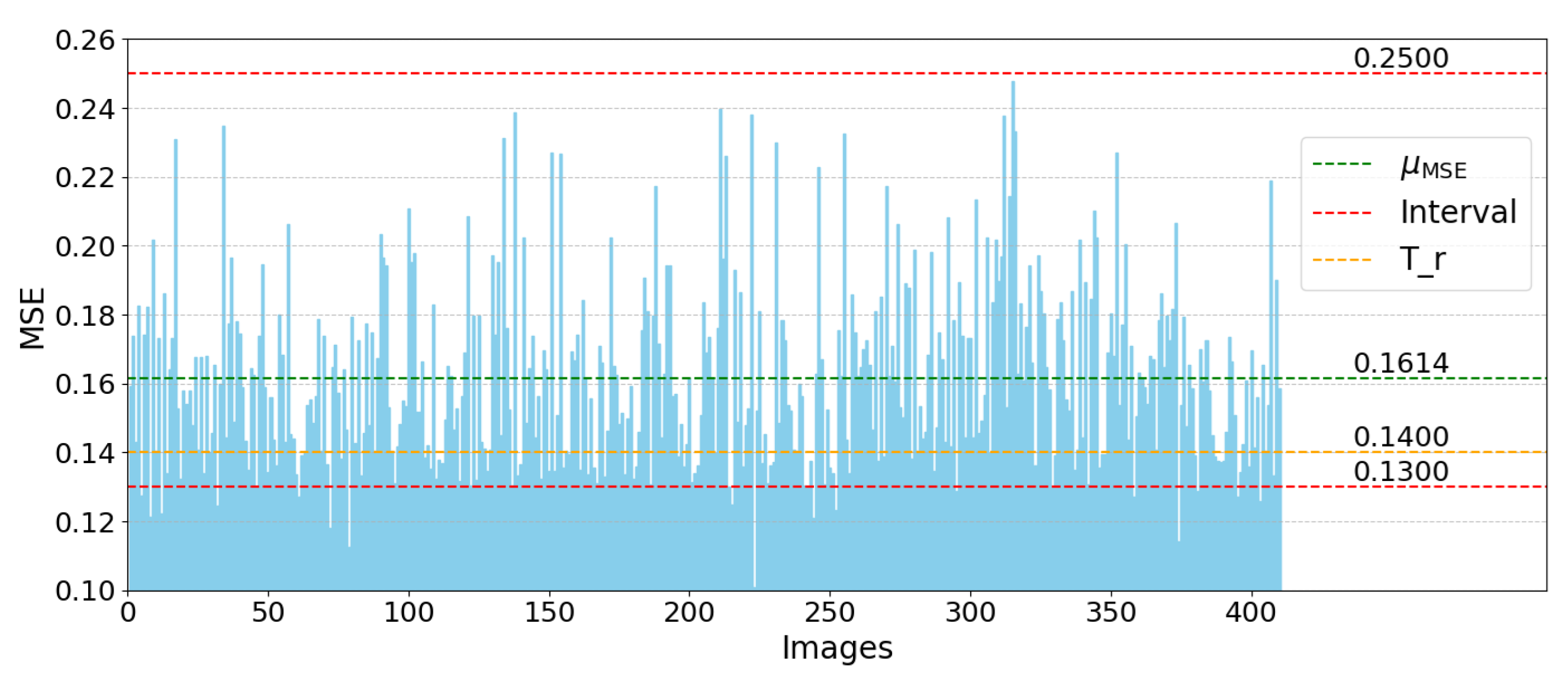
7.5. Mean Squared Error (MSE)
7.6. Freshet Inception Distance
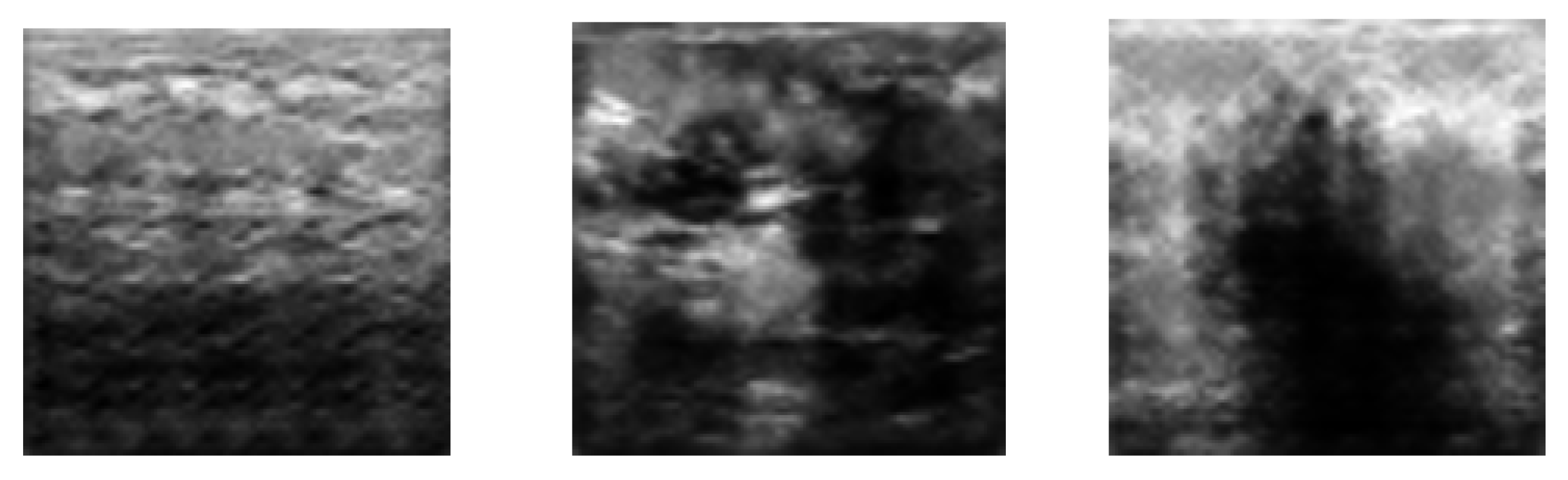
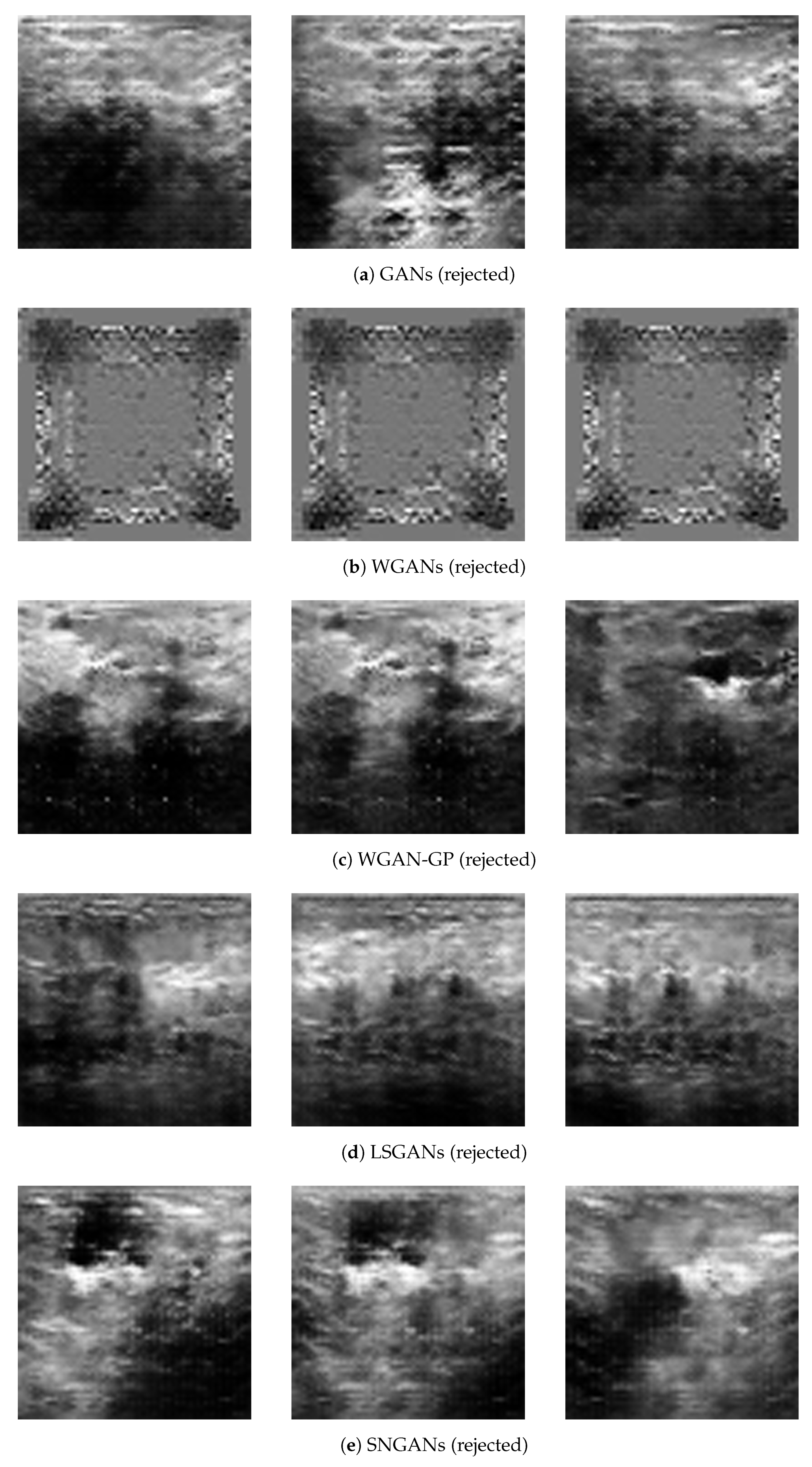
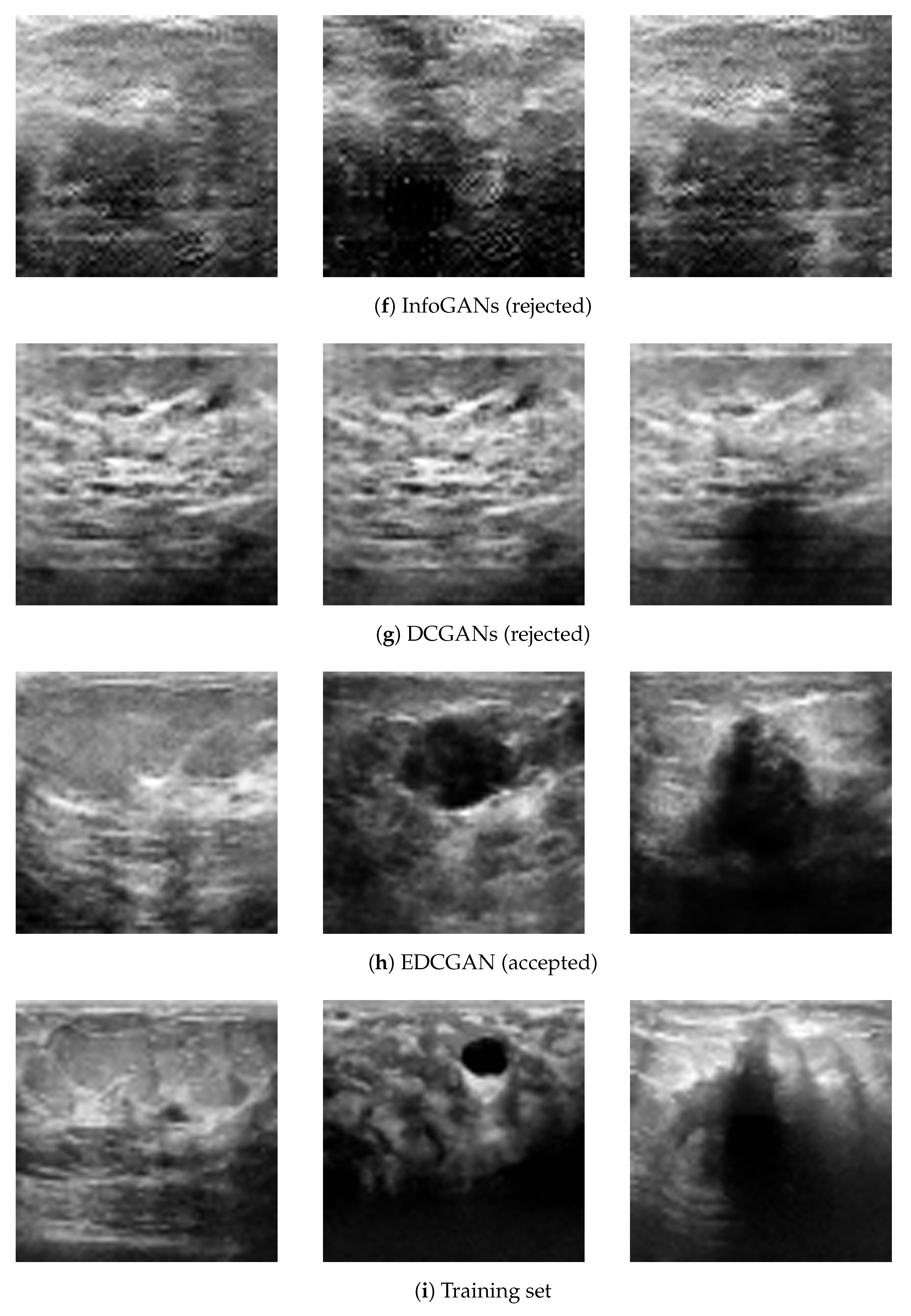
7.7. Visual Quality
8. Testing the Model Enhancements

| Activation Function | Variance | Standard Deviation | ||
|---|---|---|---|---|
| Generator | Discriminator | Generator | Discriminator | |
| ReLU [55] | 450.8382 | 0.2029 | 21.2330 | 0.4505 |
| PReLU [57] | 840.0590 | 1.4209 | 28.9838 | 1.1920 |
| RReLU [58] | 47.9511 | 0.3254 | 6.9247 | 0.5704 |
| GELU [59] | 1018.2862 | 1.2850 | 31.9106 | 1.1336 |
| ELU [60] | 38.8995 | 0.1148 | 6.2369 | 0.3389 |
| Softmax [61] | 306.0304 | 0.3354 | 17.4937 | 0.5791 |
| SELU [44] | 27.6596 | 0.1122 | 5.2592 | 0.3350 |
9. Postprocessing
10. Tests Against State-of-the-Art
Quantitative Evaluation
11. Guess-the-Real-Image Game
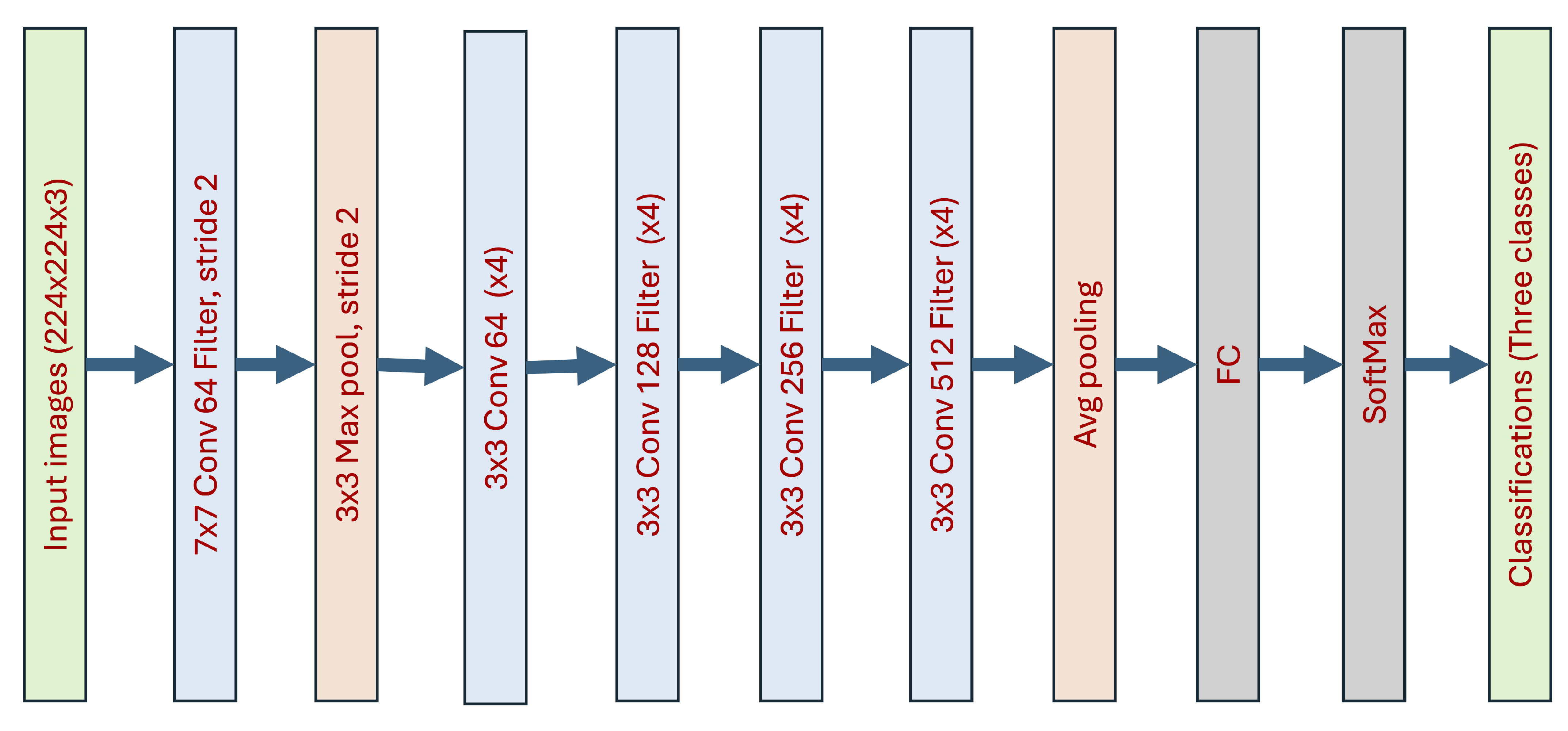
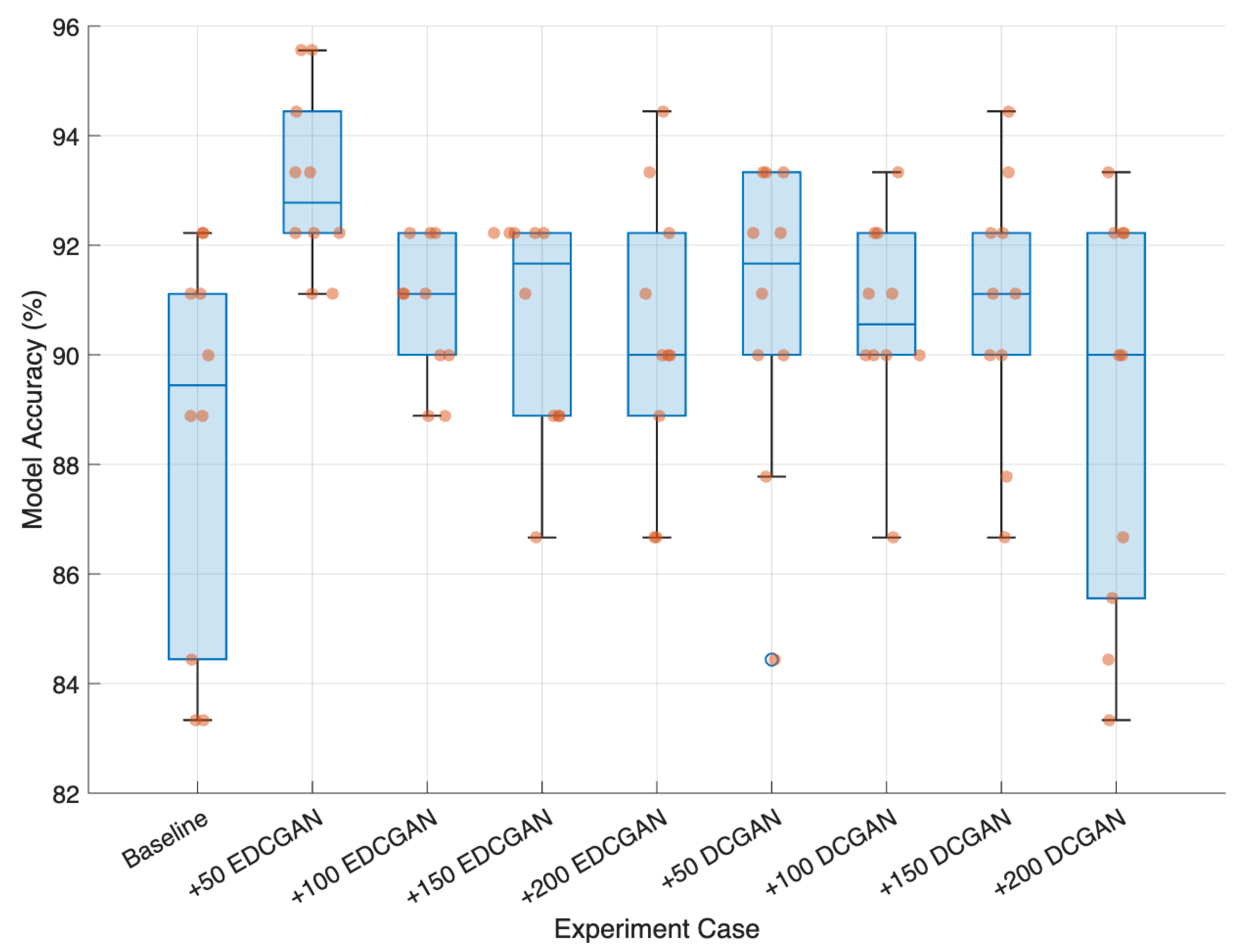
12. Application to Classification of the US Images
13. Discussion: Limitations and Future Research
14. Conclusions
Author Contributions
Funding
Data Availability Statement
Acknowledgments
Conflicts of Interest
References
- World Health Organization. Breast Cancer. Available online: https://www.who.int/news-room/fact-sheets/detail/breast-cancer (accessed on 14 January 2025).[Green Version]
- He, K.; Zhang, X.; Ren, S.; Sun, J. Deep residual learning for image recognition. In Proceedings of the IEEE Conference on Computer Vision and Pattern Recognition, Las Vegas, NV, USA, 27–30 June 2016; pp. 770–778. [Google Scholar]
- Upadhyay, A.K.; Bhandari, A.K. Advances in deep learning models for resolving medical image segmentation data scarcity problem: A topical review. Arch. Comput. Methods Eng. 2024, 31, 1701–1719. [Google Scholar]
- Gonzales Martinez, R.; van Dongen, D.M. Deep learning algorithms for the early detection of breast cancer: A comparative study with traditional machine learning. Inform. Med. Unlocked 2023, 41, 101317. [Google Scholar] [CrossRef]
- LeCun, Y.; Bengio, Y.; Hinton, G. Deep learning. Nature 2015, 521, 436–444. [Google Scholar] [CrossRef]
- Tupper, A.; Gagné, C. Revisiting Data Augmentation for Ultrasound Images. arXiv 2025, arXiv:2501.13193. [Google Scholar] [CrossRef]
- Goodfellow, I.; Pouget-Abadie, J.; Mirza, M.; Xu, B.; Warde-Farley, D.; Ozair, S.; Courville, A.; Bengio, Y. Generative adversarial nets. In Proceedings of the 27th International Conference on Neural Information Processing Systems, Montreal, QC, Canada, 8–13 December 2014; Volume 2, pp. 2672–2680. [Google Scholar]
- Chen, Y.; Yang, X.H.; Wei, Z.; Heidari, A.A.; Zheng, N.; Li, Z.; Chen, H.; Hu, H.; Zhou, Q.; Guan, Q. Generative adversarial networks in medical image augmentation: A review. Comput. Biol. Med. 2022, 144, 105382. [Google Scholar] [CrossRef] [PubMed]
- Kumar, V.; Sharma, N.M.; Mahapatra, P.K.; Dogra, N.; Maurya, L.; Ahmad, F.; Panda, P. Enhancing Left Ventricular Segmentation in Echocardiograms Through GAN-Based Synthetic Data Augmentation and MultiResUNet Architecture. Diagnostics 2025, 15, 663. [Google Scholar] [CrossRef]
- Karras, T.; Aittala, M.; Hellsten, J.; Laine, S.; Lehtinen, J.; Aila, T. Training generative adversarial networks with limited data. In Proceedings of the 34th International Conference on Neural Information Processing Systems, Vancouver, BC, Canada, 6–12 December 2020; pp. 12104–12114. [Google Scholar]
- Latif, J.; Xiao, C.; Imran, A.; Tu, S. Medical imaging using machine learning and deep learning algorithms: A review. In Proceedings of the 2019 2nd International Conference on Computing, Mathematics and Engineering Technologies (iCoMET), Sukkur, Pakistan, 30–31 January 2019; IEEE: New York, NY, USA; pp. 1–5. [Google Scholar]
- Wang, E.K.; Chen, C.M.; Hassan, M.M.; Almogren, A. A deep learning based medical image segmentation technique in Internet-of-Medical-Things domain. Future Gener. Comput. Syst. 2020, 108, 135–144. [Google Scholar]
- Wang, S.; Yang, D.M.; Rong, R.; Zhan, X.; Xiao, G. Pathology image analysis using segmentation deep learning algorithms. Am. J. Pathol. 2019, 189, 1686–1698. [Google Scholar] [CrossRef]
- Razzak, M.I.; Naz, S.; Zaib, A. Deep learning for medical image processing: Overview, challenges and the future. Classif. Bioapps Autom. Decis. Mak. 2017, 26, 323–350. [Google Scholar] [CrossRef]
- Zhang, Y.; Gorriz, J.M.; Dong, Z. Deep learning in medical image analysis. J. Imaging 2021, 7, 74. [Google Scholar] [CrossRef]
- Ker, J.; Wang, L.; Rao, J.; Lim, T. Deep learning applications in medical image analysis. IEEE Access 2017, 6, 9375–9389. [Google Scholar] [CrossRef]
- Tang, Y.; Cai, J.; Lu, L.; Harrison, A.P.; Yan, K.; Xiao, J.; Yang, L.; Summers, R.M. CT image enhancement using stacked generative adversarial networks and transfer learning for lesion segmentation improvement. In Machine Learning in Medical Imaging; Springer: Cham, Switzerland, 2018; pp. 46–54. [Google Scholar]
- Oktay, O.; Ferrante, E.; Kamnitsas, K.; Heinrich, M.; Bai, W.; Caballero, J.; Cook, S.A.; De Marvao, A.; Dawes, T.; O‘Regan, D.P.; et al. Anatomically constrained neural networks (ACNNs): Application to cardiac image enhancement and segmentation. IEEE Trans. Med. Imaging 2017, 37, 384–395. [Google Scholar] [CrossRef]
- Zhu, J.; Tan, C.; Yang, J.; Yang, G.; Lio’, P. Arbitrary scale super-resolution for medical images. Int. J. Neural Syst. 2021, 31, 2150037. [Google Scholar] [CrossRef]
- Ma, Y.; Liu, K.; Xiong, H.; Fang, P.; Li, X.; Chen, Y.; Yan, Z.; Zhou, Z.; Liu, C. Medical image super-resolution using a relativistic average generative adversarial network. Nucl. Instruments Methods Phys. Res. Sect. A Accel. Spectrometers Detect. Assoc. Equip. 2021, 992, 165053. [Google Scholar] [CrossRef]
- Xia, Y.; Ravikumar, N.; Greenwood, J.P.; Neubauer, S.; Petersen, S.E.; Frangi, A.F. Super-resolution of cardiac MR cine imaging using conditional GANs and unsupervised transfer learning. Med. Image Anal. 2021, 71, 102037. [Google Scholar] [CrossRef]
- Liu, H.; Hu, D.; Li, H.; Oguz, I. Medical Image Segmentation Using Deep Learning. In Deep Learning in Healthcare: Paradigms and Applications; Springer International Publishing: Cham, Switzerland, 2020; pp. 17–31. [Google Scholar]
- Upadhyay, A.K.; Bhandari, A.K. hlSemi-Supervised Modified-UNet for Lung Infection Image Segmentation. IEEE Trans. Radiat. Plasma Med. Sci. 2023, 7, 638–649. [Google Scholar] [CrossRef]
- Teng, Q.; Liu, Z.; Song, Y.; Han, K.; Lu, Y. A survey on the interpretability of deep learning in medical diagnosis. Multimed. Syst. 2022, 28, 2335–2355. [Google Scholar] [CrossRef]
- Karunanayake, N.; Makhanov, S.S. When deep learning is not enough: Artificial life as a supplementary tool for segmentation of ultrasound images of breast cancer. Med. Biol. Eng. Comput. 2025, 63, 2497–2520. [Google Scholar] [CrossRef] [PubMed]
- Zhang, J.; Wu, X.; Liu, S.; Fan, Y.; Chen, Y.; Lyu, G.; He, S. Adaptive batch-fusion self-supervised learning for ultrasound image pretraining. Comput. Med. Imaging Graph. 2025, 124, 102599. [Google Scholar] [CrossRef]
- Mohammed, A.A.; Geng, X.; Wang, J.; Fateh, A.A.; Hassan, M.; Ali, Z. SSL-OHE: A self-supervised ensemble approach for early diagnosis of biliary atresia from sonographic images. Biomed. Signal Process. Control 2026, 112, 108539. [Google Scholar] [CrossRef]
- Yoon, J.T.; Lee, K.M.; Oh, J.H.; Kim, H.G.; Jeong, J.W. Insights and considerations in development and performance evaluation of generative adversarial networks (GANs): What radiologists need to know. Diagnostics 2024, 14, 1756. [Google Scholar] [CrossRef] [PubMed]
- Zhu, J.Y.; Park, T.; Isola, P.; Efros, A.A. Unpaired image-to-image translation using cycle-consistent adversarial networks. In Proceedings of the IEEE International Conference on Computer Vision (ICCV), Venice, Italy, 22–29 October 2017; pp. 2223–2232. [Google Scholar]
- Sille, R.; Choudhury, T.; Sharma, A.; Chauhan, P.; Tomar, R.; Sharma, D. A novel generative adversarial network-based approach for automated brain tumour segmentation. Medicina 2023, 59, 10119. [Google Scholar] [CrossRef]
- Fujioka, T.; Mori, M.; Kubota, K.; Kikuchi, Y.; Katsuta, L.; Adachi, M.; Oda, G.; Nakagawa, T.; Kitazume, Y.; Tateishi, U. Breast ultrasound image synthesis using deep convolutional generative adversarial networks. Diagnostics 2019, 9, 176. [Google Scholar] [CrossRef]
- Maack, L.; Holstein, L.; Schlaefer, A. GANs for generation of synthetic ultrasound images from small datasets. Comput. Digit. Biol. 2022, 5, 17–25. [Google Scholar] [CrossRef]
- Kumar, D.; Mehta, M.A.; Chatterjee, I. Empirical analysis of deep convolutional generative adversarial network for ultrasound image synthesis. Open Biomed. Eng. J. 2021, 15, 71–77. [Google Scholar] [CrossRef]
- Atri, H.; Shadi, M.; Sargolzaei, M. Generating synthetic medical images with limited data using auxiliary classifier generative adversarial network: A study on thyroid ultrasound images. J. Ultrasound 2024, 27, 105–121. [Google Scholar]
- Radford, A.; Metz, L.; Chintala, S. Unsupervised representation learning with deep convolutional generative adversarial networks. arXiv 2016, arXiv:1511.06434. [Google Scholar] [CrossRef]
- Skandarani, Y.; Jodoin, P.M.; Lalande, A. GANs for medical image synthesis: An empirical study. J. Imaging 2023, 9, 69. [Google Scholar] [CrossRef] [PubMed]
- Arjovsky, M.; Chintala, S.; Bottou, L. Wasserstein GAN. arXiv 2017, arXiv:1701.07875. [Google Scholar]
- Gulrajani, I.; Ahmed, F.; Arjovsky, M.; Dumoulin, V.; Courville, A.C. Improved training of Wasserstein GANs. Adv. Neural Inf. Process. Syst. 2017, 30, 5767–5777. [Google Scholar]
- Kossale, Y.; Airaj, M.; Darouichi, A. Mode collapse in generative adversarial networks: An overview. In Proceedings of the 2022 8th International Conference on Optimization and Applications (ICOA), Sestri Levante, Italy, 6–7 October 2022; pp. 1–6. [Google Scholar] [CrossRef]
- Mao, X.; Li, Q.; Xie, H.; Lau, R.Y.; Wang, Z.; Smolley, P.S. Least squares generative adversarial networks. In Proceedings of the IEEE International Conference on Computer Vision (ICCV), Venice, Italy, 22–29 October 2017; pp. 2794–2802. [Google Scholar]
- Miyato, T.; Kataoka, T.; Koyama, M.; Ishii, S. Spectral normalization for generative adversarial networks. arXiv 2018, arXiv:1802.05957. [Google Scholar] [CrossRef]
- Chen, X.; Duan, Y.; Houthooft, R.; Schulman, J.; Sutskever, I.; Abbeel, P. InfoGAN: Interpretable representation learning by information maximizing generative adversarial nets. Adv. Neural Inf. Process. Syst. 2016, 29, 2172–2180. [Google Scholar]
- Hu, J.; Shen, L.; Sun, G. Squeeze-and-excitation networks. In Proceedings of the IEEE Conference on Computer Vision and Pattern Recognition, Salt Lake City, UT, USA, 18–23 June 2018; pp. 7132–7141. [Google Scholar]
- Klambauer, G.; Unterthiner, T.; Mayr, A.; Hochreiter, S. Self-normalizing neural networks. Adv. Neural Inf. Process. Syst. 2017, 30. [Google Scholar]
- Müller, R.; Kornblith, S.; Hinton, G.E. When does label smoothing help? Adv. Neural Inf. Process. Syst. 2019, 32. [Google Scholar]
- Al-Dhabyani, W.; Gomaa, M.; Khaled, H.; Fahmy, A. Dataset of breast ultrasound images. Data Brief 2020, 28, 104863. [Google Scholar] [CrossRef]
- Maas, A.L.; Hannun, A.Y.; Ng, A.Y. Rectifier nonlinearities improve neural network acoustic models. In Proceedings of the 30th International Conference on Machine Learning, Atlanta, GA, USA, 16–21 June 2013; Volume 28. [Google Scholar]
- Kingma, D.P.; Ba, J. Adam: A method for stochastic optimization. arXiv 2017, arXiv:1412.6980. [Google Scholar] [CrossRef]
- Salimans, T.; Kingma, D.P.; Ho, J.; Bhupatiraju, V.; de Jong, P.; Chen, X.; Sutskever, I. A note on the inception score. arXiv 2018, arXiv:1801.01973. [Google Scholar] [CrossRef]
- Szegedy, C.; Vanhoucke, V.; Ioffe, S.; Shlens, J.; Wojna, Z. Rethinking the inception architecture for computer vision. In Proceedings of the IEEE Conference on Computer Vision and Pattern Recognition, Las Vegas, NV, USA, 27–30 June 2016; pp. 2818–2826. [Google Scholar]
- Wang, Z.; Bovik, A.C.; Sheikh, H.R.; Simoncelli, E.P. Image quality assessment: From error visibility to structural similarity. IEEE Trans. Image Process. 2004, 13, 600–612. [Google Scholar] [CrossRef]
- Zhang, L.; Zhang, L.; Mou, X.; Zhang, D. FSIM: A Feature Similarity Index for Image Quality Assessment. IEEE Trans. Image Process. 2011, 20, 2378–2386. [Google Scholar] [CrossRef]
- Hodson, T.O.; Over, T.M.; Foks, S.S. Mean squared error, deconstructed. J. Adv. Model. Earth Syst. 2021, 13, e2021MS002681. [Google Scholar] [CrossRef]
- Ioffe, S.; Szegedy, C. Batch normalization: Accelerating deep network training by reducing internal covariate shift. In Proceedings of the International Conference on Machine Learning, Lille, France, 6–11 July 2015; pp. 448–456. [Google Scholar]
- Nair, V.; Hinton, G.E. Deep learning using rectified linear units (ReLU). arXiv 2018, arXiv:1803.08375. [Google Scholar]
- Scaman, K.; Virmaux, A. Lipschitz regularity of deep neural networks: Analysis and efficient estimation. In Proceedings of the 32nd International Conference on Neural Information Processing Systems (NIPS’18), Montréal, QC, Canada, 3–8 December 2018; pp. 3839–3848. [Google Scholar]
- He, K.; Zhang, X.; Ren, S.; Sun, J. Delving deep into rectifiers: Surpassing human-level performance on ImageNet classification. In Proceedings of the IEEE International Conference on Computer Vision (ICCV), Santiago, Chile, 7–13 December 2015; pp. 1026–1034. [Google Scholar]
- Xu, B.; Wang, N.; Chen, T.; Li, M. Empirical evaluation of rectified activations in convolutional networks. arXiv 2015, arXiv:1505.00853. [Google Scholar] [CrossRef]
- Hendrycks, D. Gaussian Error Linear Units (Gelus). arXiv 2016, arXiv:1606.08415. [Google Scholar]
- Clevert, D.A.; Unterthiner, T.; Hochreiter, S. Fast and accurate deep network learning by exponential linear units (ELUs). arXiv 2016, arXiv:1511.07289. [Google Scholar] [CrossRef]
- Bridle, J. Training stochastic model recognition algorithms as networks can lead to maximum mutual information estimation of parameters. In Proceedings of the Advances in Neural Information Processing Systems, Denver, CO, USA, 27–30 November 1989; Volume 2. [Google Scholar]
- Cao, J.; Guo, Y.; Wu, Q.; Shen, C.; Huang, J.; Tan, M. Improving generative adversarial networks with local coordinate coding. IEEE Trans. Pattern Anal. Mach. Intell. 2022, 44, 211–227. [Google Scholar] [CrossRef] [PubMed]
- Aravindan, A.; Palanisamy, R. ER-WGAN: Enhanced Relativistic Wasserstein GAN for medical image synthesis. In Proceedings of the 2024 IEEE International Conference on Bioinformatics and Biomedicine (BIBM), Lisboa, Portugal, 3–6 December 2024; pp. 1565–1570. [Google Scholar] [CrossRef]
- Fleiss, J.L. Measuring nominal scale agreement among many raters. Psychol. Bull. 1971, 76, 378. [Google Scholar] [CrossRef]




| Combinations | Converged Models % |
|---|---|
| DCGAN/standard | 70% |
| DCGAN/SELU | 72% |
| DCGAN/SE | 70% |
| DCGAN/SN | 77% |
| DCGAN/SELU/SE | 72% |
| DCGAN/SELU/SN | 78% |
| DCGAN/SE/SN | 78% |
| EDCGAN | 81% |
| Correct models | 40 | |
| Undefined models | 1 | |
| # of runs for each model | 100 | |
| # of images | 4100 | |
| Images classified as different and “good” | 1048 | 25.56% (of total) |
| Images classified as “good” visually (from 1048) | 928 | 88.55% |
| Classification error | 11.45% |
| Learning rate Generator | 0.0001 |
| Learning rate Discriminator | 0.0003 |
| Batch size | 8 |
| Stopping criteria threshold | 0.001 |
| Moving average period | 7 |
| MSEmin | 0.13–0.25 |
| IS | 2.05–2.57 |
| SSIM | 0.15–0.18 |
| Repeated image threshold | 0.14 |
| Model | IS ± Std | SSIM ± Std | MSE ± Std |
|---|---|---|---|
| GANs | 1.64 ± 0.15 | 0.12 ± 0.01 | 0.26 ± 0.013 |
| WGANs | 1.52 ± 0.07 | 0.05 ± 0.01 | 0.32 ± 0.03 |
| WGAN-GP | 1.91 ± 0.16 | 0.10 ± 0.04 | 0.23 ± 0.12 |
| LSGANs | 1.89 ± 0.21 | 0.10 ± 0.04 | 0.26 ± 0.12 |
| SNGANs | 1.66 ± 0.14 | 0.10 ± 0.05 | 0.25 ± 0.09 |
| InfoGANs | 1.46 ± 0.12 | 0.08 ± 0.04 | 0.26 ± 0.11 |
| DCGANs | 1.73 ± 0.22 | 0.12 ± 0.016 | 0.23 ± 0.02 |
| EDCGANs | 2.56 ± 0.21 | 0.17 ± 0.013 | 0.17 ± 0.025 |
| References | 2.29–2.62 | 0.15–0.18 | 0.16–0.26 |
| Radiologists | 2.37 | 0.18 | 0.15 |
| Models | Metric | Goal | t-Statistic | p-Value | Result |
|---|---|---|---|---|---|
| EDCGANs vs. WGAN-GP | IS | Higher is better | 4.28 | <0.0001 | Significant |
| SSIM | Higher is better | 4.29 | 0.0001 | Significant | |
| MSE | Lower is better | −2.37 | 0.0111 | Significant | |
| EDCGANs vs. DCGAN | IS | Higher is better | 6.19 | <0.0001 | Significant |
| SSIM | Higher is better | 2.74 | 0.0042 | Significant | |
| MSE | Lower is better | −2.69 | 0.0048 | Significant |
| Model | TP | TN | FP | FN | Ainter-rate |
|---|---|---|---|---|---|
| GANs | 50.00% | 40.80% | 9.20% | 0.00% | 0.799 |
| WGANs | 50.00% | 50.00% | 0.00% | 0.00% | 1.000 |
| WGAN-GP | 50.00% | 41.40% | 8.60% | 0.00% | 0.828 |
| LSGANs | 50.00% | 49.40% | 0.60% | 0.00% | 0.988 |
| SNGANs | 50.00% | 49.00% | 1.00% | 0.00% | 0.980 |
| InfoGANs | 50.00% | 49.80% | 0.20% | 0.00% | 0.996 |
| DCGANs | 50.00% | 39.40% | 10.6% | 0.00% | 0.796 |
| EDCGANs | 31.80% | 18.00% | 33.00% | 16.20% | 0.115 |
| Model | Precision | Recall | F1 Score |
|---|---|---|---|
| GANs | 0.844 | 1.000 | 0.914 |
| WGANs | 1.000 | 1.000 | 1.000 |
| WGAN-GP | 0.852 | 1.000 | 0.919 |
| LSGANs | 0.988 | 1.000 | 0.994 |
| SNGANs | 0.980 | 1.000 | 0.990 |
| InfoGANs | 0.996 | 1.000 | 0.998 |
| DCGANs | 0.826 | 1.000 | 0.904 |
| EDCGANs | 0.491 | 0.663 | 0.563 |
| Method | Class | Real Img. | Synthetic Img. | Accuracy (%) | Precision | Sensitivity (Recall) | Specificity | F1 Score (Dice) | Jaccard |
|---|---|---|---|---|---|---|---|---|---|
| Base | Normal | 100 | 0 | 88.56 | 0.94 | 0.84 | 0.87 | 0.97 | 0.80 |
| Benign | 100 | 0 | 0.89 | 0.96 | 0.92 | 0.94 | 0.86 | ||
| Malignant | 100 | 0 | 0.83 | 0.86 | 0.84 | 0.91 | 0.73 | ||
| EDCGAN Synthetic Images | Normal | 100 | 25 | 92.89 * | 0.94 | 0.84 | 0.89 | 0.97 | 0.80 |
| Benign | 100 | 25 | 0.89 | 0.96 | 0.92 | 0.94 | 0.86 | ||
| Malignant | 100 | 25 | 0.83 | 0.86 | 0.84 | 0.91 | 0.73 | ||
| Normal | 100 | 50 | 93.11 * | 0.98 | 0.92 | 0.95 | 0.99 | 0.90 | |
| Benign | 100 | 50 | 0.91 | 0.96 | 0.93 | 0.95 | 0.88 | ||
| Malignant | 100 | 50 | 0.91 | 0.92 | 0.91 | 0.96 | 0.84 | ||
| Normal | 100 | 100 | 90.78 | 0.99 | 0.86 | 0.92 | 0.99 | 0.85 | |
| Benign | 100 | 100 | 0.89 | 0.95 | 0.92 | 0.94 | 0.86 | ||
| Malignant | 100 | 100 | 0.86 | 0.91 | 0.88 | 0.92 | 0.79 | ||
| Normal | 100 | 150 | 90.56 | 0.95 | 0.92 | 0.93 | 0.98 | 0.88 | |
| Benign | 100 | 150 | 0.87 | 0.93 | 0.90 | 0.93 | 0.82 | ||
| Malignant | 100 | 150 | 0.89 | 0.87 | 0.88 | 0.95 | 0.79 | ||
| Normal | 100 | 200 | 90.33 | 0.97 | 0.87 | 0.92 | 0.99 | 0.85 | |
| Benign | 100 | 200 | 0.89 | 0.94 | 0.92 | 0.95 | 0.85 | ||
| Malignant | 100 | 200 | 0.86 | 0.90 | 0.88 | 0.92 | 0.78 | ||
| DCGAN Synthetic Images | Normal | 100 | 25 | 90.56 | 0.96 | 0.88 | 0.92 | 0.98 | 0.85 |
| Benign | 100 | 25 | 0.89 | 0.96 | 0.92 | 0.94 | 0.86 | ||
| Malignant | 100 | 25 | 0.87 | 0.88 | 0.87 | 0.93 | 0.78 | ||
| Normal | 100 | 50 | 90.78 | 0.94 | 0.90 | 0.92 | 0.97 | 0.86 | |
| Benign | 100 | 50 | 0.90 | 0.94 | 0.92 | 0.95 | 0.85 | ||
| Malignant | 100 | 50 | 0.88 | 0.89 | 0.88 | 0.94 | 0.79 | ||
| Normal | 100 | 100 | 90.67 | 0.95 | 0.88 | 0.91 | 0.98 | 0.84 | |
| Benign | 100 | 100 | 0.89 | 0.96 | 0.93 | 0.94 | 0.86 | ||
| Malignant | 100 | 100 | 0.88 | 0.88 | 0.88 | 0.94 | 0.79 | ||
| Normal | 100 | 150 | 90.89 | 0.96 | 0.89 | 0.92 | 0.98 | 0.86 | |
| Benign | 100 | 150 | 0.88 | 0.95 | 0.91 | 0.94 | 0.84 | ||
| Malignant | 100 | 150 | 0.89 | 0.89 | 0.89 | 0.94 | 0.80 | ||
| Normal | 100 | 200 | 89.00 | 0.95 | 0.85 | 0.89 | 0.98 | 0.81 | |
| Benign | 100 | 200 | 0.87 | 0.95 | 0.91 | 0.93 | 0.84 | ||
| Malignant | 100 | 200 | 0.86 | 0.87 | 0.86 | 0.93 | 0.76 |
Disclaimer/Publisher’s Note: The statements, opinions and data contained in all publications are solely those of the individual author(s) and contributor(s) and not of MDPI and/or the editor(s). MDPI and/or the editor(s) disclaim responsibility for any injury to people or property resulting from any ideas, methods, instructions or products referred to in the content. |
© 2026 by the authors. Licensee MDPI, Basel, Switzerland. This article is an open access article distributed under the terms and conditions of the Creative Commons Attribution (CC BY) license.
Share and Cite
Kasamrach, O.; Luangwilai, T.; Makhanov, S. Augmentation of Small Ultrasound Databases: A Practical Approach. Mathematics 2026, 14, 646. https://doi.org/10.3390/math14040646
Kasamrach O, Luangwilai T, Makhanov S. Augmentation of Small Ultrasound Databases: A Practical Approach. Mathematics. 2026; 14(4):646. https://doi.org/10.3390/math14040646
Chicago/Turabian StyleKasamrach, Onsasipat, Thiansiri Luangwilai, and Stanislav Makhanov. 2026. "Augmentation of Small Ultrasound Databases: A Practical Approach" Mathematics 14, no. 4: 646. https://doi.org/10.3390/math14040646
APA StyleKasamrach, O., Luangwilai, T., & Makhanov, S. (2026). Augmentation of Small Ultrasound Databases: A Practical Approach. Mathematics, 14(4), 646. https://doi.org/10.3390/math14040646