Article

Active Fault Detection of Switched Logical Control Networks with State Constraints

The School of Mathematics and Statistics, Shandong Normal University, Jinan 250014, China
*
Author to whom correspondence should be addressed.
Mathematics 2026, 14(4), 636; https://doi.org/10.3390/math14040636
Submission received: 8 January 2026 / Revised: 4 February 2026 / Accepted: 10 February 2026 / Published: 11 February 2026
(This article belongs to the Section E2: Control Theory and Mechanics)

Abstract

Fault detection is an important topic in control theory and engineering. This article analyzes the active fault detection of switched multi-valued logical control networks with state constraints based on the semi-tensor product of matrices. Firstly, by using the block selection matrix, the faulty system with state constraints is converted into an equivalent faulty system without constraints. Secondly, an auxiliary system is constructed, and a pair of distinguishable set and indistinguishable set is defined. Thirdly, the strong active fault detection and active fault detection are analyzed through checking the reachability from indistinguishable set to distinguishable set, and two criteria are established with the help of set controllable matrix. Finally, the effectiveness of the proposed results is demonstrated by the p53-MDM2 network.

1. Introduction

Faults frequently occur in many engineering applications [1], such as industrial smart manufacturing [2], nuclear engineering, flight control systems and automotive systems. If not identified promptly, the occurrence of faults may lead to severe consequences such as performance degradation, cascading failures, or even catastrophic safety incidents [3]. As a result, fault detection is a critical branch in control theory, where significant research has conducted on complex nonlinear systems [4]. Passive fault detection and active fault detection (AFD) are two important methods of fault detection [5]. Unlike passive fault detection, which checks whether a fault can be found using a known fault sequence or inherent outputs without changing inputs, AFD tests the system with different inputs to compare normal and faulty outputs. Therefore, compared with passive fault detection, AFD offers a obvious advantage through guaranteeing the fault detection performance even in large-scale or complex systems.
Gene regulatory networks are generally modeled as complex nonlinear systems, such as ordinary differential equations [6] and Boolean networks [7]. Compared with quantitative model, Boolean networks are a kind of qualitative models. Each Boolean network comprises some state nodes with only two values: 0 and 1 (off and on), and the states update synchronously based on Boolean functions. Although Boolean networks are described by discrete dynamic processes, practical gene regulation is often determined by various switching modes, leading to the study of switched Boolean networks [8,9]. In addition, certain states may lead to dangerous conditions like disease progression or metastasis in gene regulatory networks, making it necessary to impose constraints on some states of Boolean networks. To address this issue, several meaningful results were established by exploring Boolean networks with state constraints [10,11]. State constraints constitute a common yet meaningful scenario in switched systems, with broad practical relevance to engineering applications where physical limits or safety requirements inherently restrict system states [12]. Moreover, state constraints constituted a crucial factor in several fault diagnosis problems, such as nonlinear electro-hydraulic system [13].
The development of Boolean networks requires the mathematical tools for dealing with Boolean logic. Cheng et al. proposed the semi-tensor product (STP) of matrices [14], enabling Boolean logic to be expressed in an algebraic form. This expression of Boolean networks was called the algebraic state space representation in [15]. Over the past several decades, much attention has been paid to the investigation of switched Boolean networks via STP, achieving many meaningful results on the robust stability [16], synchronization and output tracking [17]. Furthermore, the STP method was used to discuss the controllability, optimal control and stabilization of switched Boolean networks with constraints [18].
Using STP, a general concept of fault detectability was proposed for Boolean control networks [19], and the off-line fault detection problem was discussed. This work was later extended to probabilistic Boolean control networks [20] and logical control networks [21]. A reduced-order observer was designed for the fault detection of Boolean control networks in [22]. In [23], PFD and four kinds of AFD were investigated for Boolean control networks. By constructing the reduced system, the computational complexity of [23] was improved in [24]. Although the fault detection of Boolean control networks is widely studied, there exist fewer results on AFD of switched multi-valued logical control networks with state constraints. In the presence of state constraints, existing methods in [23,24] cannot ensure that the output trajectory will always be valid.
Motivated by the research gap, this paper explores the AFD of switched logical control networks with state constraints. We convert the faulty system with state constraints to an equivalent faulty system without constraints by the block selection matrices, which guarantees the validity of output trajectory. With the help of the new equivalent system, we generalize the results in [24] to the (strong) AFD of logical control networks subject to the switching law and state constraints. Compared with [23], the verification time steps of our new results are much smaller due to the effect of state constraints (see Remark 5).
The structure of this paper is outlined as follows. Section 2 introduces some basic knowledge. The core findings and derivations are detailed in Section 3. Section 4 uses an example to support the main results. Section 5 offers the conclusion.
Notations: 1 m × n denotes the m × n -dimensional matrix with all entries being 1. 0 m × n denotes the m × n -dimensional matrix with all entries being 0. I n denotes the n-dimensional identity matrix, and Δ n : = { δ n k : k = 1 , , n } , where δ n k denotes the k-th column of I n . D k : = { 1 , k 2 k 1 , , 1 k 1 , 0 } , k 2 , k Z + . An m × n matrix M is called a logical matrix, if M = [ δ m i 1 , , δ m i n ] , which can be expressed as δ m [ i 1 , , i n ] . L m × n denotes the set of m × n -dimensional logical matrices. B m × n denotes the set of m × n -dimensional Boolean matrices. For a given matrix A R m × n , the ( i , j ) -th element and the i-th row of A are denoted by ( A ) i , j and R o w i [ A ] , respectively. A > 0 m × n if all the elements of matrix A are positive real numbers. B l k i ( ) denotes the i-th n × n -dimensional block of an n × n m -dimensional matrix. | S | denotes the cardinality of set S. Letting A R m × n and B R p × q , the semi-tensor product of A and B is denoted by A B = ( A I t n ) ( B I t p ) , where t = l c m ( n , p ) denotes the least common multiple of n and p, and ⊗ denotes the Kronecker product. The symbol ⋉ is often omitted in the context. W [ n , m ] : = [ I m δ n 1 , , I m δ n n ] is the swap matrix, which satisfies W [ n , m ] x y = y x , x R n , y R m . R r , n : = diag { δ n 1 , δ n 2 , , δ n n } is the power-reducing matrix, which satisfies x 2 = R r , n x , x Δ n .

2. Problem Formulation

Consider a switched k-valued logical control network with state constraints described as follows:
x 1 ( t + 1 ) = f 1 σ ( t ) ( x 1 ( t ) , , x n ( t ) , u 1 ( t ) , , u m ( t ) ) , x n ( t + 1 ) = f n σ ( t ) ( x 1 ( t ) , , x n ( t ) , u 1 ( t ) , , u m ( t ) ) , y 1 ( t ) = g 1 ( x 1 ( t ) , , x n ( t ) ) , y p ( t ) = g p ( x 1 ( t ) , , x n ( t ) ) ,
where σ : N W : = { 1 , 2 , , ω } is the switching signal, X ( t ) : = ( x 1 ( t ) , , x n ( t ) ) C x D k n , U ( t ) = ( u 1 ( t ) , , u m ( t ) ) D k m and Y ( t ) = ( y 1 ( t ) , , y p ( t ) ) D k p denote the state, input and output of system (4) at time t, respectively. C x is the state constraint set. ( f 1 h , , f n h ) : C x × D k m D k n , h = 1 , , ω and ( g 1 , , g p ) : C x D k p are k-valued logical mappings.
The following result provides the algebraic representation of logical functions based on the STP.
Lemma 1.
Given a k-valued logical function f : D k n D k , the algebraic form of f is
f ( x 1 , , x n ) = M f i = 1 n x i , x i Δ k ,
where M f L k × k n is called the structural matrix of f.
By the STP and Lemma 1, using the vector form of logical variables, system (1) can be converted into the following algebraic form:
x ( t + 1 ) = L σ ( t ) u ( t ) x ( t ) , y ( t ) = H x ( t ) ,
where x ( t ) = i = 1 n x i ( t ) C x , y ( t ) = j = 1 p y j ( t ) Δ k p , u ( t ) = k = 1 m u k ( t ) Δ k m , L σ ( t ) L k n × k m + n and H L k p × k n . Assume | C x | = α . The state constraint set can be expressed as C x = { δ k n i r : r = 1 , 2 , , α ; i 1 < < i α } .
In the following, system (3) is transformed into an equivalent dynamical system without state constraints through the block selection matrices.
Split L i into k m equal blocks as
L i = [ B l k 1 ( L i ) , B l k 2 ( L i ) , , B l k k m ( L i ) ] ,
where B l k s ( L i ) L k n × k n , s = 1 , 2 , , k m , i W .
Let
L ^ i = [ B l k 1 ( L ^ i ) , B l k 2 ( L ^ i ) , , B l k k m ( L ^ i ) ] ,
where
B l k s ( L ^ i ) = ( δ k n i 1 ) ( δ k n i α ) B l k s ( L i ) [ δ k n i 1 , , δ k n i α ] .
Then, we obtain
L ^ = [ L ^ 1 , L ^ 2 , , L ^ ω ] B α × α ω k m .
Similar to the construction of L ^ , we let
H ^ = H [ δ k n i 1 , , δ k n i α ] B k p × α .
Based on (4) and (5), system (3) can be converted into the following equivalent form:
z ( t + 1 ) = L ^ σ ( t ) u ( t ) z ( t ) , y ( t ) = H ^ z ( t ) ,
where z ( t ) Δ α , σ ( t ) Δ ω and u ( t ) Δ k m denote state, switching signal and input, respectively.
Regarding the switching signal as input, we define u ˜ ( t ) = σ ( t ) u ( t ) Δ ω k m , and then system (6) can be described as follows:
z ( t + 1 ) = L ^ u ˜ ( t ) z ( t ) , y ( t ) = H ^ z ( t ) ,
where z ( t ) Δ α and u ˜ ( t ) Δ ω k m denote state and input, respectively, L ^ and H ^ are shown in (4) and (5), respectively.
Example 1.
Consider a switched Boolean control network with state constraints as follows:
x 1 ( t + 1 ) = f 1 σ ( t ) ( x 1 ( t ) , x 2 ( t ) , u ( t ) ) , x 2 ( t + 1 ) = f 2 σ ( t ) ( x 1 ( t ) , x 2 ( t ) , u ( t ) ) ,
where σ : N W : = { 1 , 2 } denotes the switching signal, C x = { ( 1 , 1 ) , ( 0 , 1 ) , ( 0 , 0 ) } is the state constraint set, X ( t ) : = ( x 1 ( t ) , x 2 ( t ) ) C x , u ( t ) D , and f 1 1 = x 1 x 2 u , f 2 1 = x 1 u , f 1 2 = x 2 u , f 2 2 = x 1 x 2 u .
First, using the STP and Lemma 1, system (8) can be described as
x ( t + 1 ) = L σ ( t ) u ( t ) x ( t ) ,
where x ( t ) C x = { δ 4 1 , δ 4 3 , δ 4 4 } , u ( t ) Δ 2 , L 1 = δ 4 [ 1 , 3 , 3 , 3 , 4 , 4 , 3 , 3 ] , L 2 = δ 4 [ 1 , 3 , 1 , 3 , 3 , 1 , 3 , 2 ] .
Based on (4) and (5), one has
L ^ 1 = 1 0 0 0 0 0 0 1 1 0 1 1 0 0 0 1 0 0 = δ 3 [ 1 , 2 , 2 , 3 , 2 , 2 ] ,
L ^ 2 = 1 1 0 0 0 0 0 0 1 1 1 0 0 0 0 0 0 0 = δ 3 [ 1 , 1 , 2 , 2 , 2 , 0 ] ,
where δ 3 0 : = [ 0 , 0 , 0 ] .
As a result, system (9) can be converted into the following equivalent form:
z ( t + 1 ) = L ^ σ ( t ) u ( t ) z ( t ) ,
where L ^ = [ L ^ 1 , L ^ 2 ] = δ 3 [ 1 , 2 , 2 , 3 , 2 , 2 , 1 , 1 , 2 , 2 , 2 , 0 ] , z ( t ) Δ 3 , u ( t ) Δ 2 and σ ( t ) Δ 2 denote state, input and switching signal, respectively.
Treating the switching signal as input, system (10) can be transformed into
z ( t + 1 ) = L ^ u ˜ ( t ) z ( t ) ,
where L ^ = δ 3 [ 1 , 2 , 2 , 3 , 2 , 2 , 1 , 1 , 2 , 2 , 2 , 0 ] , z ( t ) Δ 3 and u ˜ ( t ) = σ ( t ) u ( t ) Δ 4 denote state and input, respectively.

3. Main Results

In this section, we explore the AFD of switched k-valued logical control networks with state constraints.
Consider the following faulty model of system (3):
x F ( t + 1 ) = L σ ( t ) F u ( t ) x F ( t ) , y F ( t ) = H F x F ( t ) ,
where x F ( t ) C x , y F ( t ) Δ k p , L σ ( t ) F L k n × k m + n and H F L k p × k n .
Let Ω t = { σ ( 0 ) , , σ ( t ) } W be a switching sequence and U t = { u ( 0 ) , , u ( t ) } Δ k m be an input sequence. Given an initial state x 0 , x 0 F C x , we denote x ( t ; x 0 , Ω t 1 , U t 1 ) and x F ( t ; x 0 F , Ω t 1 , U t 1 ) by the states of systems (3) and (12), respectively. The states x ( t ) and x F ( t ) are constrained to evolve within the set C x . For example, if x ( t ) C x is satisfied for some t, then the next state of system (3) is invalid. Meanwhile, y ( t ; x 0 , Ω t 1 , U t 1 ) and y F ( t ; x 0 F , Ω t 1 , U t 1 ) denote the outputs of systems (3) and (12) at time t, respectively. The corresponding output sequences are denoted by
Y t ( x 0 , Ω t 1 , U t 1 ) = { y ( 0 ; x 0 ) , y ( 1 ; x 0 , Ω 0 , U 0 ) , , y ( t ; x 0 , Ω t 1 , U t 1 ) }
and
Y t F ( x 0 F , Ω t 1 , U t 1 ) = { y F ( 0 ; x 0 F ) , y F ( 1 ; x 0 F , Ω 0 , U 0 ) , , y F ( t ; x 0 F , Ω t 1 , U t 1 ) } ,
respectively. Given Ω t 1 W and U t 1 Δ k m , we define
O Ω t 1 , U t 1 = { Y t ( x 0 , Ω t 1 , U t 1 ) : x 0 C x } , t N .
We next give the concepts of strong AFD and AFD for system (12).
Definition 1.
System (12) is said to be strongly active fault-detectable, if there exists an integer l N such that for any initial state x 0 , x 0 F C x , any switching sequence Ω l = { σ ( 0 ) , , σ ( l ) } W and any input sequence U l = { u ( 0 ) , , u ( l ) } Δ k m , it holds that
x ( t ; x 0 , Ω t 1 , U t 1 ) C x , t { 1 , , l + 1 } , x F ( t ; x 0 F , Ω t 1 , U t 1 ) C x , t { 1 , , l + 1 } , Y l + 1 F ( x 0 F , Ω l 1 , U l ) O Ω l 1 , U l 1 ,
where Ω t 1 = { σ ( 0 ) , , σ ( t 1 ) } , U t 1 = { u ( 0 ) , , u ( t 1 ) } .
Definition 2.
System (12) is said to be active fault-detectable, if there exist an integer l N , a switching sequence Ω l and an input sequence U l such that (13) holds for any initial state x 0 , x 0 F C x .
Based on (4) and (5), let
L ^ i F = [ B l k 1 ( L ^ i F ) , B l k 2 ( L ^ i F ) , , B l k k m ( L ^ i F ) ] ,
where
B l k s ( L ^ i F ) = ( δ k n i 1 ) ( δ k n i α ) B l k s ( L i F ) [ δ k n i 1 , , δ k n i α ] .
Then, we obtain
L ^ F = [ L ^ 1 F , L ^ 2 F , , L ^ ω F ] B α × α ω k m ,
H ^ F = H F [ δ k n i 1 , , δ k n i α ] B k p × α .
Similar to the derivation of system (7), we obtain the following equivalent form of faulty system (12):
{ z F ( t + 1 ) = L ^ F u ˜ ( t ) z F ( t ) , y F ( t ) = H ^ F z F ( t ) ,
where z F ( t ) Δ α , u ˜ ( t ) Δ ω k m , y F ( t ) Δ k p , L ^ F and H ^ F are shown in (14) and (15), respectively.
According to Definition 1, system (16) is strongly active fault-detectable, if there exists an integer l N such that
Y l + 1 F ( z 0 F , U ˜ l ) O U ˜ l : = { Y l + 1 ( z 0 , U ˜ l ) : z 0 Δ α }
holds for any initial state z 0 F Δ α and any input sequence U ˜ l = { u ˜ ( 0 ) , , u ˜ ( l ) } Δ ω k m . Definition 2 means that system (16) is active fault-detectable, if there exist an integer l N and an input sequence U ˜ l such that Y l + 1 F ( z 0 F , U ˜ l ) O U ˜ l is satisfied for any initial state z 0 F Δ α . The aforementioned transformation converts the state-constrained system (12) into the unconstrained system (16). In fact, the definitions of strong AFD and AFD are equivalent for both systems. Therefore, we will focus on analyzing the AFD of system (16) in the context.
Remark 1.
If we use the method in [23,24] to analyze the AFD of system (12), the presence of state constraints may lead to some invalid output trajectories. To solve this problem, we use the block selection matrices to convert system (12) into an equivalent system (16) without state constraints.
Now, we construct an auxiliary system based on (7) and (16) below:
z ˜ ( t + 1 ) = G u ˜ ( t ) z ˜ ( t ) ,
where z ˜ ( t + 1 ) = z ( t + 1 ) z F ( t + 1 ) Δ α 2 , G = L ^ ( I α ω k m L ^ F ) ( I ω k m W [ ω k m , α ] ) R r , ω k m L α 2 × α 2 ω k m .
Remark 2.
The auxiliary system is constructed through model transformation and joint dynamic modeling under the STP framework. First, converting the state-constrained system to an equivalent unconstrained one via block selection matrices has a time complexity of O ( α 2 ω k m ) and space complexity of O ( α ω k m + α k p ) . Then, constructing the auxiliary system’s structural matrix G involves Kronecker products and matrix multiplications, leading to the time and space complexities of O ( α 4 ω k m ) .
With the output matrices H ^ and H ^ F , we establish the following two sets:
C 0 = δ α 2 ( i 1 ) α + j : H ^ δ α i H ^ F δ α j = { δ α 2 q 1 , δ α 2 q 2 , , δ α 2 q | C 0 | } ,
C 1 = δ α 2 ( i 1 ) α + j : H ^ δ α i = H ^ F δ α j = { δ α 2 p 1 , δ α 2 p 2 , , δ α 2 p | C 1 | } ,
where q 1 < q 2 < < q | C 0 | , and p 1 < p 2 < < p | C 1 | . Obviously, C 0 C 1 = , C 0 C 1 = Δ α 2 . Here, C 0 and C 1 are called distinguishable set and indistinguishable set, respectively.
Definition 3.
Consider system (17).
(i)
z ˜ 0 Δ α 2 is said to reach z ˜ d Δ α 2 , if there exists a positive integer T and an input sequence U ˜ T 1 = u ˜ ( 0 ) , u ˜ ( 1 ) , , u ˜ ( T 1 ) such that z ˜ ( T ; z ˜ 0 , U ˜ T 1 ) = z ˜ d ;
(ii)
Let S 0 , S d Δ α 2 be two state sets. S 0 is said to reach S d under the input sequence U ˜ T 1 , if z ˜ ( T ; z ˜ 0 , U ˜ T 1 ) S d holds for any z ˜ 0 S 0 .
Split G into ω k m equal blocks of dimension α 2 × α 2 as G = [ G 1 , G 2 , , G ω k m ] , and define
M : = i = 1 ω k m G i R α 2 × α 2 .
Let
J 0 : = [ δ α 2 p 1 , δ α 2 p 2 , , δ α 2 p | C 1 | ] L α 2 × | C 1 | ,
J d : = i = 1 | C 0 | δ α 2 q i B α 2 × 1 .
Proposition 1.
Let l N be given. For system (17), C 1 can reach C 0 under any input sequence U ˜ l Δ ω k m , if and only if C s = ( ω k m ) l + 1 1 1 × | C 1 | , where C s : = J d M l + 1 J 0 is called set controllable matrix.
Proof. 
(Necessity) Assume that for system (17), C 1 can reach C 0 under any input sequence U ˜ l = { δ ω k m i 0 , δ ω k m i 1 , , δ ω k m i l } . From Definition 3, z ˜ ( l + 1 ; z ˜ 0 , U ˜ l ) C 0 holds for any z ˜ 0 C 1 and any input sequence U ˜ l . Then, we have
z ˜ ( l + 1 ; z ˜ 0 , U ˜ l ) = G i l G i l 1 G i 0 z ˜ ( 0 ) = k = l 0 G i k z ˜ ( 0 ) C 0 .
Therefore, it yields that
J d M l + 1 z ˜ ( 0 ) = j = 1 | C 0 | δ α 2 q j M l + 1 z ˜ ( 0 ) = j = 1 | C 0 | R o w q j [ M l + 1 ] z ˜ ( 0 ) = j = 1 | C 0 | R o w q j i 0 = 1 ω k m i l = 1 ω k m ( k = l 0 G i k ) z ˜ ( 0 ) = ( ω k m ) l + 1 .
From the arbitrariness of z ˜ ( 0 ) C 1 , we have
C s = J d M l + 1 J 0 = J d M l + 1 [ δ α 2 p 1 , δ α 2 p 2 , , δ α 2 p | C 1 | ] = ( ω k m ) l + 1 1 1 × | C 1 | .
(Sufficiency) Suppose that C s = ( ω k m ) l + 1 1 1 × | C 1 | . Then, based on (24) and (25),
z ˜ ( l + 1 ; z ˜ ( 0 ) , U ˜ l ) = ( k = l 0 G i k ) z ˜ ( 0 ) C 0
holds for any z ˜ ( 0 ) C 1 and any input sequence U ˜ l . By Definition 3, C 1 can reach C 0 under any input sequence U ˜ l .    □
Remark 3.
If Proposition 1 holds, then there exists an integer l 1 * { 0 , , α 2 1 } such that C 1 can reach C 0 under any input sequence U ˜ l 1 * . Actually, if not, then one can find a minimum integer t α 2 such that C 1 can reach C 0 under any input sequence U ˜ t . Since system (17) only has α 2 different states, there must exist two integers 0 t 1 < t 2 t 1 such that
z ˜ ( t 1 ) : = z ˜ ( t 1 ; z ˜ 0 , U ˜ t 1 1 ) = z ˜ ( t 2 ; z ˜ 0 , U ˜ t 2 1 ) : = z ˜ ( t 2 ) .
Thus, the trajectory of system (17) starting from the initial state z ˜ ( t 1 ) forms a cycle { z ˜ ( t 1 ) , z ˜ ( t 1 + 1 ) , , z ˜ ( t 2 1 ) } . If there exists a state on the cycle belonging to C 0 , then there exists a nonnegative integer t < t such that C 1 can reach C 0 under any input sequence U ˜ t , which contradicts the minimality of t. If all states on the cycle belong to C 1 , then there exists an integer t * { t 1 , t 1 + 1 , , t 2 1 } such that z ˜ ( t * ) C 1 . Thus, one can construct a suitable control under which C 1 cannot reach C 0 .
With the help of Proposition 1, we present a criterion for the strong AFD of system (16).
Theorem 1.
System (16) is strongly active fault-detectable, if and only if there exists a nonnegative integer l α 2 1 such that
C s = ( ω k m ) l + 1 1 1 × | C 1 | .
Proof. 
(Necessity) Assume that system (16) is strongly active fault-detectable. Then, there exists an integer l 1 N such that Y l 1 + 1 F ( z 0 F , U ˜ l 1 ) O U ˜ l 1 holds for any initial state z 0 F Δ α and any input sequence U ˜ l 1 . Accordingly, for any two states z 0 and z 0 F satisfying H ^ z 0 = H ^ F z 0 F , it holds that
Y l 1 + 1 ( z 0 , U ˜ l 1 ) Y l 1 + 1 F ( z 0 F , U ˜ l 1 ) , U ˜ l 1 Δ ω k m .
Then there exists a nonnegative integer l l 1 such that
H ^ z ( l + 1 ; z 0 , U ˜ l ) H ^ F z F ( l + 1 ; z 0 F , U ˜ l ) .
Based on system (17), for any z ˜ 0 = z 0 z 0 F C 1 , one has
z ˜ ( l + 1 ; z ˜ 0 , U ˜ l ) = z ( l + 1 ; z 0 , U ˜ l ) z F ( l + 1 ; z 0 F , U ˜ l ) C 0 .
Therefore, C 1 can reach C 0 under the input sequence U ˜ l . According to Remark 3, we choose l α 2 1 . Based on Proposition 1, C s = ( ω k m ) l + 1 1 1 × | C 1 | holds.
(Sufficiency) If C s = ( ω k m ) l + 1 1 1 × | C 1 | holds, based on Proposition 1, C 1 can reach C 0 under any input sequence U ˜ l . Then
z ˜ ( l + 1 ; z ˜ 0 , U ˜ l ) = z ( l + 1 ; z 0 , U ˜ l ) z F ( l + 1 ; z 0 F , U ˜ l ) C 0
holds for any input sequence U ˜ l , which implies that
H ^ z ( l + 1 ; z 0 , U ˜ l ) H ^ z F ( l + 1 ; z 0 F , U ˜ l ) .
Hence,
Y l + 1 F ( z 0 F , U ˜ l ) O U ˜ l
holds for any z 0 F Δ α and any input sequence U ˜ l . Thus, system (16) is strongly active fault-detectable.    □
Next, we consider the AFD of system (16) based on Definition 3 and C s .
Proposition 2.
Let l N be given. For system (17), there exists an input sequence U ˜ l Δ ω k m such that C 1 can reach C 0 , if and only if C s = J d M l + 1 J 0 > 0 1 × | C 1 | .
Proof. 
(Necessity) Assume that C 1 can reach C 0 under the input sequence U ˜ l = { δ ω k m i 0 , δ ω k m i 1 , , δ ω k m i l } . From Definition 3, z ˜ ( l + 1 ; z ˜ 0 , U ˜ l ) C 0 holds for any z ˜ 0 C 1 . Then, based on (23), we derive
J d M l + 1 z ˜ ( 0 ) = j = 1 | C 0 | δ α 2 q j M l + 1 z ˜ ( 0 ) = j = 1 | C 0 | R o w q j [ M l + 1 ] z ˜ ( 0 ) = j = 1 | C 0 | R o w q j i 0 = 1 ω k m i l = 1 ω k m ( k = l 0 G i k ) z ˜ ( 0 ) j = 1 | C 0 | R o w q j ( k = l 0 G i k ) z ˜ ( 0 ) > 0 .
From the arbitrariness of z ˜ ( 0 ) C 1 , we have
C s = J d M l + 1 J 0 = J d M l + 1 [ δ α 2 p 1 , δ α 2 p 2 , , δ α 2 p | C 1 | ] > 0 1 × | C 1 | .
(Sufficiency) Suppose that C s > 0 1 × | C 1 | . Then, based on (27) and (28), we construct the input sequence U ˜ l = { δ ω k m i 0 , δ ω k m i 1 , , δ ω k m i l } such that
z ˜ ( l + 1 ; z ˜ ( 0 ) , U ˜ l ) = k = l 0 ( G i k ) z ˜ ( 0 ) C 0
holds for any z ˜ ( 0 ) C 1 . By Definition 3, C 1 can reach C 0 under the input sequence U ˜ l .    □
Remark 4.
Similar to the discussion of Remark 3, if Proposition 2 holds, then there exist an integer l 2 * { 0 , , α 2 1 } and an input sequence U ˜ l 2 * such that C 1 can reach C 0 .
Theorem 2.
System (16) is active fault-detectable if and only if there exists a nonnegative integer l α 2 1 such that
C s > 0 1 × | C 1 | .
Proof. 
(Necessity) Assume that system (16) is active fault-detectable. Then, there exist an integer l 2 N and an input sequence U ˜ l 2 such that Y l 2 + 1 F ( z 0 F , U ˜ l 2 ) O U ˜ l 2 holds for any initial state z 0 F Δ α . Accordingly, for any two states z 0 and z 0 F satisfying H ^ z 0 = H ^ F z 0 F , it holds that
Y l 2 + 1 ( z 0 , U ˜ l 2 ) Y l 2 + 1 F ( z 0 F , U ˜ l 2 ) .
Then there exists a nonnegative integer l l 2 such that
H ^ z ( l + 1 ; z 0 , U ˜ l ) H ^ F z F ( l + 1 ; z 0 F , U ˜ l ) .
Based on system (17), for any z ˜ 0 = z 0 z 0 F C 1 , one has
z ˜ ( l + 1 ; z ˜ 0 , U ˜ l ) = z ( l + 1 ; z 0 , U ˜ l ) z F ( l + 1 ; z 0 F , U ˜ l ) C 0 .
Therefore, C 1 can reach C 0 under the input sequence U ˜ l . According to Remark 4, we select l α 2 1 . Based on Proposition 2, C s = J d M l + 1 J 0 > 0 1 × | C 1 | holds.
(Sufficiency) If C s > 0 1 × | C 1 | , according to Proposition 2, there exists an input sequence U ˜ l such that C 1 can reach C 0 . Then,
z ˜ ( l + 1 ; z ˜ 0 , U ˜ l ) = z ( l + 1 ; z 0 , U ˜ l ) z F ( l + 1 ; z 0 F , U ˜ l ) C 0
holds for any z ˜ 0 = z 0 z 0 F Δ α 2 , which implies that
H ^ z ( l + 1 ; z 0 , U ˜ l ) H ^ z F ( l + 1 ; z 0 F , U ˜ l ) .
Hence,
Y l + 1 F ( z 0 F , U ˜ l ) O U ˜ l
holds for any initial state z 0 F Δ α . Thus, system (16) is active fault-detectable.    □
Remark 5.
For general STP-based methods of studying logical networks, the complexity grows exponentially with the number of nodes n and switching mode ω. The verification time steps of Theorems 1 and 2 are α 2 , which is much smaller than that in [23]. This is because the state constraint set is a proper subset of the whole state space.
Next, an algorithm is provided to explicitly describe the checking procedure of the proposed method, whose structure is illustrated in Figure 1.
Figure 1. The structural diagram of Algorithm 1.
Mathematics 14 00636 g001
Algorithm 1 Check the AFD of constrained switched logical control networks
Input: 
k , ω , n , m , C x ( | C x | = α ), { L i , H } , { L i F , H F } , T max = α 2 1
Output: 
is strong AFD , is AFD , l * ( l * = NaN if undetectable)
1:
  Convert constrained systems to L ^ , H ^ (normal) and L ^ F , H ^ F (faulty)
2:
  Define C 0 = { δ α 2 ( i 1 ) α + j : H ^ δ α i H ^ F δ α j } , C 1 = Δ α 2 C 0
3:
  Build J 0 = [ δ α 2 p 1 , , δ α 2 p | C 1 | ] , J d = δ α 2 q C 0 δ α 2 q
4:
  Construct G = L ^ ( I α ω k m L ^ F ) ( I ω k m W ) R r , M = s = 1 ω k m G s
5:
  Initialize: is strong AFD = False , is AFD = False , l * = T max + 1
6:
  for  l = 0 to T max  do
7:
      Compute C s = J d M l + 1 J 0 ;
8:
      if  C s = ( ω k m ) l + 1 1 1 × | C 1 |  then
9:
           is strong AFD = True , is AFD = True , l * = min ( l * , l ) and break;
10:
    end if
11:
    if  C s > 0 1 × | C 1 |  then
12:
         is AFD = True , l * = min ( l * , l )
13:
    end if
14:
end for
15:
if  l * > T max  then  l * = NaN
16:
end if
  •    return  is strong AFD , is AFD , l *

4. Illustrative Example

In this section, the effectiveness of our findings is emphasized through the p53-MDM2 network, which plays a significant role as a tumor suppressor gene in the study of cancers. The p53–MDM2 network is a gene regulatory network that governs cell cycle arrest and apoptosis, functioning as a key tumor-suppressing mechanism in human cells. Dysregulation of this network is closely associated with the onset and progression of various cancers.
Example 2.
The p53 network is given below [25]:
z 1 ( t + 1 ) = z 3 ¬ ( t ) { z 1 ( t ) u ( t ) } , z 2 ( t + 1 ) = z 4 ¬ ( t ) { z 1 ( t ) z 3 ( t ) } , z 3 ( t + 1 ) = z 2 ( t ) , z 4 ( t + 1 ) = z 1 ¬ ( t ) { z 2 ( t ) z 3 ( t ) } .
In this network, z 1 , z 2 , z 3 , z 4 D denote the ATM, p53 gene, phosphatase WIP1 and E3 ubiquitin ligase MDM2, respectively, and the input u D denotes the DNA-DBS. Suppose that ATM and MDM2 can be observed. Then, the output equation can be represented by
y 1 ( t ) = z 1 ( t ) , y 2 ( t ) = z 4 ( t ) .
Utilizing the STP, we obtain the structure matrices of (30) and (31) as follows:
L = δ 16 [ 14 , 10 , 6 , 2 , 16 , 12 , 8 , 4 , 13 , 9 , 5 , 5 , 15 , 11 , 8 , 8 14 , 10 , 6 , 2 , 16 , 12 , 8 , 4 , 13 , 9 , 13 , 13 , 15 , 11 , 16 , 16 ] ,
H = δ 4 [ 1 , 2 , 1 , 2 , 1 , 2 , 1 , 2 , 3 , 4 , 3 , 4 , 3 , 4 , 3 , 4 ] .
Assume that the structure matrices of (30) and (31) with fault are
L F = δ 16 [ 10 , 10 , 7 , 3 , 15 , 12 , 8 , 3 , 13 , 9 , 5 , 5 , 15 , 11 , 8 , 8 14 , 10 , 6 , 2 , 16 , 12 , 8 , 4 , 13 , 9 , 13 , 12 , 14 , 11 , 14 , 15 ] ,
H F = δ 4 [ 1 , 2 , 3 , 2 , 1 , 2 , 1 , 2 , 3 , 4 , 3 , 4 , 3 , 4 , 3 , 4 ] .
Letting z ˜ ( t ) = z ( t ) z F ( t ) Δ 256 , we construct an auxiliary system as
z ˜ ( t + 1 ) = G u ( t ) z ˜ ( t ) ,
where G = δ 256 [ 218 , 218 , 215 , , 254 , 255 ] L 256 × 512 .
Based on (18) and (19), one obtains
C 0 = { δ 256 i : i = 2 , 3 , 4 , 6 , 8 , 9 , 10 , 11 , 12 , 13 , 14 , 15 , 16 , 17 , 19 , 21 , 23 , 25 , 26 , 27 , 28 , 29 , 30 , 31 , 32 , 34 , 35 , 36 , 38 , 40 , 41 , 42 , 43 , 44 , 45 , 46 , 47 , 48 , 49 , 51 , 53 , 55 , 57 , 58 , 59 , 60 , 61 , 62 , 63 , 64 , 66 , 67 , 68 , 70 , 72 , 73 , 74 , 75 , 76 , 77 , 78 , 79 , 80 , 81 , 83 , 85 , 87 , 89 , 90 , 91 , 92 , 93 , 94 , 95 , 96 , 98 , 99 , 100 , 102 , 104 , 105 , 106 , 107 , 108 , 109 , 110 , 111 , 112 , 113 , 115 , 117 , 119 , 121 , 122 , 123 , 124 , 125 , 126 , 127 , 128 , 129 , 130 , 132 , 133 , 134 , 135 , 136 , 138 , 140 , 142 , 144 , 145 , 146 , 147 , 148 , 149 , 150 , 151 , 152 , 153 , 155 , 157 , 159 , 161 , 162 , 164 , 165 , 166 , 167 , 168 , 170 , 172 , 174 , 176 , 177 , 178 , 179 , 180 , 181 , 182 , 183 , 184 , 185 , 187 , 189 , 191 , 193 , 194 , 196 , 197 , 198 , 199 , 200 , 202 , 204 , 206 , 208 , 209 , 210 , 211 , 212 , 213 , 214 , 215 , 216 , 217 , 219 , 221 , 223 , 225 , 226 , 228 , 229 , 230 , 231 , 232 , 234 , 236 , 238 , 240 , 241 , 242 , 243 , 244 , 245 , 246 , 247 , 248 , 249 , 251 , 253 , 255 } ,
C 1 = { δ 256 i : i = 1 , 5 , 7 , 18 , 20 , 22 , 24 , 33 , 37 , 39 , 50 , 52 , 54 , 56 , 65 , 69 , 71 , 81 , 82 , 84 , 86 , 88 , 97 , 101 , 103 , 114 , 116 , 118 , 120 , 131 , 137 , 139 , 141 , 143 , 154 , 156 , 158 , 160 , 163 , 169 , 171 , 173 , 175 , 186 , 188 , 190 , 192 , 195 , 201 , 203 , 205 , 207 , 218 , 220 , 222 , 224 , 227 , 233 , 235 , 237 , 239 , 250 , 252 , 254 , 256 } ,
where | C 0 | = 192 , | C 1 | = 64 .
According to (21) and (22), one has
J d = δ 256 i C 0 δ 256 i ,
J 0 = δ 256 [ 1 , 5 , 7 , 18 , 20 , , 237 , 239 , 250 , 252 , 254 , 256 ] .
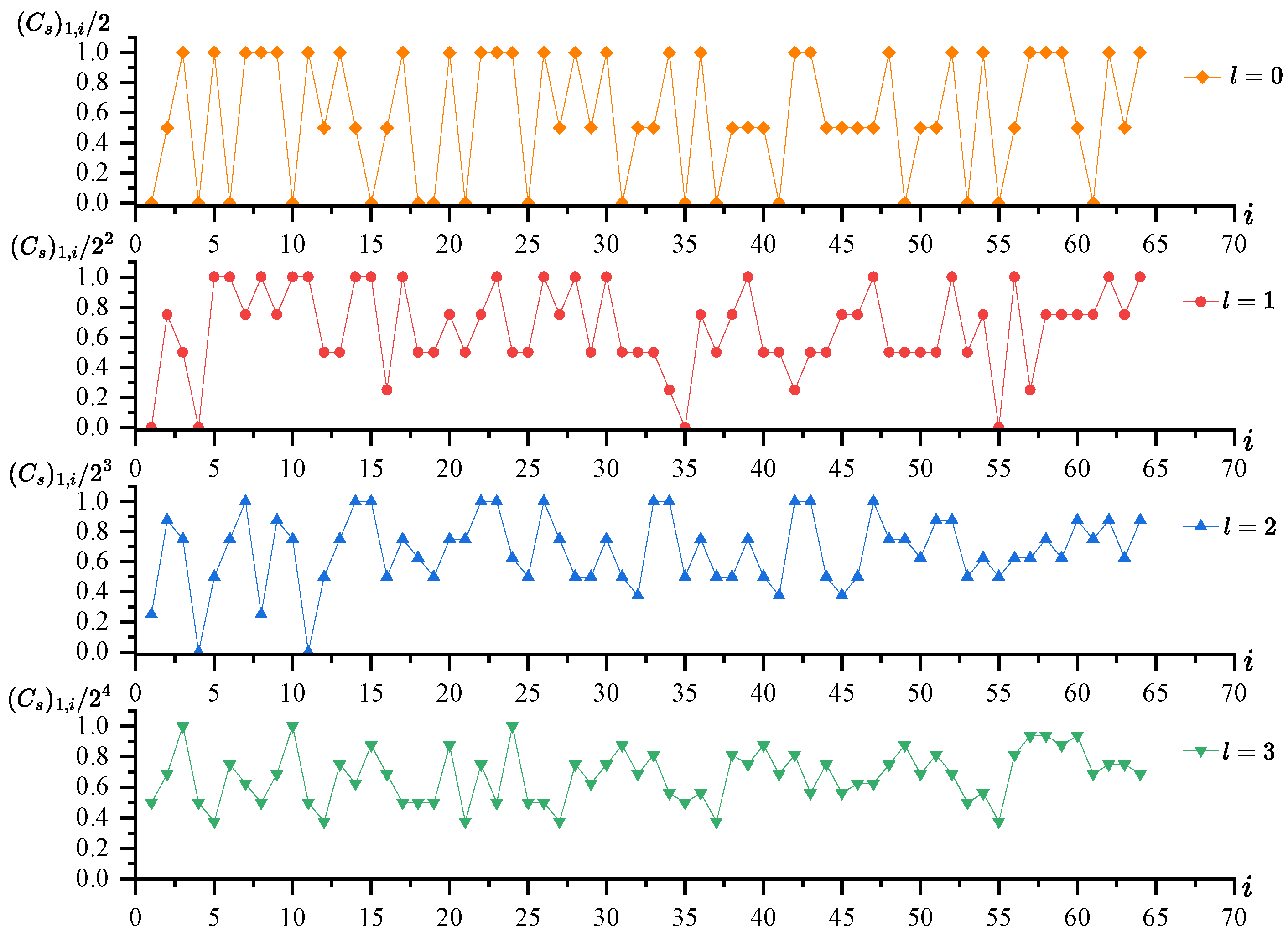
Based on the auxiliary system (32), we calculate all the set controllable matrices for any l { 0 , , 15 } . After a tedious calculation, we find
C s = J d M l + 1 J 0 ( 2 ) l + 1 1 1 × 64 , l { 0 , , 15 } .
By Theorem 1, system (30) with fault is not strongly active fault-detectable. However, when l = 3 , it holds that
C s = J d M 4 J 0 > 0 1 × 64 .
Thus, by Theorem 2, system (30) with fault is active fault-detectable. Figure 2 details the normalization of elements in the set controllable matrix when l = 0 , 1 , 2 , 3 .

5. Conclusions

Using the STP and block selection matrices, we have transformed the switched k-valued logical control networks with state constraints into an equivalent system without constraints. Then, we have defined a pair of distinguishable set and indistinguishable set to construct the set controllable matrix, and converted the (strong) AFD to the reachability from indistinguishable set to distinguishable set. Correspondingly, we have provided a new framework to discuss the AFD of constrained logical networks. In practice, uncertainties or external disturbances can be treated as arbitrary switching signals. We plan to model these disturbances as arbitrary switching signals and analyze the robust fault detection within the existing methodological framework. In future, we will focus on studying the robust AFD of logical control networks in the presence of disturbances [26,27].

Author Contributions

Investigation, W.L. (Weiyu Li); Data curation, W.L. (Wenrong Li); Writing—original draft, W.L. (Weiyu Li); Writing—review & editing, H.L. and W.L. (Wenrong Li); Supervision, H.L.; Project administration, H.L. All authors have read and agreed to the published version of the manuscript.

Funding

This research was supported by the National Natural Science Foundation of China under grants 62473239 and 62073202, the Major Basic Research Project of Natural Science Foundation of Shandong Province under grant ZR2024ZD41, and the Scientific Research Innovation Capability Support Project for Young Faculty under grant SRICSPYF-BS2025004.

Data Availability Statement

The original contributions presented in this study are included in the article. Further inquiries can be directed to the corresponding author.

Conflicts of Interest

The authors declare no conflicts of interest.

References

  1. Li, B.; Li, Q.; Du, T.; Liu, D.; Yang, Q.; Chen, T.; Xiong, J.; Peng, B.; Ren, J.; Zhao, J. Research, application, and challenges of causal inference in industrial fault diagnosis: A survey. Eng. Appl. Artif. Intell. 2025, 158, 111376. [Google Scholar] [CrossRef]
  2. Yan, W.; Wang, J.; Lu, S.; Zhou, M.; Peng, X. A review of real-time fault diagnosis methods for industrial smart manufacturing. Processes 2023, 11, 369. [Google Scholar] [CrossRef]
  3. Jadidi, S.; Badihi, H.; Zhang, Y. Active fault-tolerant and attack-resilient control for a renewable microgrid against power-loss faults and data integrity attacks. IEEE Trans. Cybern. 2024, 54, 2113–2128. [Google Scholar] [CrossRef]
  4. Hu, X.; Zhang, K.; Liu, K.; Lin, X.; Dey, S.; Onori, S. Advanced fault diagnosis for Lithium-Ion battery systems: A review of fault mechanisms, fault features, and diagnosis procedures. IEEE Ind. Electron. Mag. 2020, 14, 65–91. [Google Scholar] [CrossRef]
  5. Zhang, C.; Wang, H.; Wang, Z.; Li, Y. Active detection fault diagnosis and fault location technology for LVDC distribution networks. Int. J. Electr. Power Energy Syst. 2023, 148, 108921. [Google Scholar] [CrossRef]
  6. Karlebach, G.; Shamir, R. Modelling and analysis of gene regulatory networks. Nat. Rev. Mol. Cell Biol. 2008, 9, 770–780. [Google Scholar] [CrossRef]
  7. Kauffman, S.A. Metabolic stability and epigenesis in randomly constructed genetic nets. J. Theor. Biol. 1969, 22, 437–467. [Google Scholar] [CrossRef] [PubMed]
  8. Song, J.; Huang, C.; Xiong, W. Global asymptotic stability of switched Boolean networks with missing data. J. Frankl. Inst. 2023, 360, 6321–6337. [Google Scholar] [CrossRef]
  9. Gao, S.; Sun, C.; Xiang, C.; Qin, K.; Lee, T. Infinite-horizon optimal control of switched Boolean control networks with average cost: An efficient graph-theoretical approach. IEEE Trans. Cybern. 2022, 52, 2314–2328. [Google Scholar] [CrossRef]
  10. Laschov, D.; Margaliot, M. Controllability of Boolean control networks via the Perron-Frobenius theory. Automatica 2012, 48, 1218–1223. [Google Scholar] [CrossRef]
  11. Ding, X.; Lu, J.; Li, H.; Liu, Y. Recent developments of Boolean networks with switching and constraints. Int. J. Syst. Sci. 2023, 54, 2765–2783. [Google Scholar] [CrossRef]
  12. Zhao, Y.; Wu, C.; Zhao, J. Stability and stabilization of a class of switched systems with state and rate constraints. In Proceedings of the 37th Chinese Control Conference, Wuhan, China, 25–27 July 2018; pp. 1993–1998. [Google Scholar]
  13. Phan, V.D.; Truong, H.V.A.; Le, V.C.; Ho, S.P.; Ahn, K.K. Adaptive neural observer-based output feedback anti-actuator fault control of a nonlinear electro-hydraulic system with full state constraints. Sci. Rep. 2025, 15, 3044. [Google Scholar] [CrossRef]
  14. Cheng, D.; Qi, H.; Li, Z. Analysis and Control of Boolean Networks: A Semi-Tensor Product Approach; Springer: London, UK, 2011. [Google Scholar]
  15. Fornasini, E.; Valcher, M.E. Recent developments in Boolean networks control. J. Control Decis. 2016, 3, 1–18. [Google Scholar] [CrossRef]
  16. Wu, J.; Liu, Y.; Ruan, Q.; Lou, J. Robust stability of switched Boolean networks with function perturbation. Nonlinear Anal. Hybrid Syst. 2022, 59, 101216. [Google Scholar] [CrossRef]
  17. Zhang, Q.; Feng, J.; Xiao, F.; Wei, B. Output tracking of switched Boolean networks via self-triggered control. IEEE Trans. Control Netw. Syst. 2024, 11, 1621–1630. [Google Scholar] [CrossRef]
  18. Li, H.; Wang, Y. Controllability analysis and control design for switched Boolean networks with state and input constraints. SIAM J. Control Optim. 2015, 53, 2955–2979. [Google Scholar] [CrossRef]
  19. Fornasini, E.; Valcher, M.E. Fault detection analysis of Boolean control networks. IEEE Trans. Autom. Control 2015, 60, 2734–2739. [Google Scholar] [CrossRef]
  20. Leifeld, T.; Zhang, Z.; Zhang, P. Fault detection for probabilistic Boolean networks. In Proceedings of the European Control Conference, Aalborg, Denmark, 29 June–1 July 2016; pp. 740–745. [Google Scholar]
  21. Dou, W.; Zhao, G.; Li, H.; Chen, Q. Off-line fault detection of logical control networks. Int. J. Syst. Sci. 2022, 53, 478–487. [Google Scholar] [CrossRef]
  22. Zhang, Z.; Zhang, P.; Leifeld, T. Reduced-order observer design for fault diagnosis of Boolean control networks. Automatica 2022, 146, 110618. [Google Scholar] [CrossRef]
  23. Zhao, R.; Wang, C.; Yu, Y.; Feng, J. Fault detectability of Boolean control networks via nonaugmented methods. Sci. China Inf. Sci. 2023, 66, 94–106. [Google Scholar] [CrossRef]
  24. Wu, J.; Liu, Y.; Lu, J. Fault detection of Boolean control networks via reduced systems. IEEE Trans. Circuits Syst. II Express Briefs 2024, 71, 3820–3824. [Google Scholar] [CrossRef]
  25. Batchelor, E.; Loewer, A.; Lahav, G. The ups and downs of p53: Understanding protein dynamics in single cells. Nat. Rev. Cancer 2009, 9, 371–377. [Google Scholar] [CrossRef] [PubMed]
  26. Zhou, R.; Tu, Z.; Liu, Q.; Wang, Y.; Liu, X. Asymptotic feedback stabilization of Boolean control networks with random impulsive disturbances. IEEE Trans. Cybern. 2025, 55, 4820–4831. [Google Scholar] [CrossRef] [PubMed]
  27. Tian, Z.; Li, H. Robust stability of switched Boolean networks with external disturbances and one-bit function perturbation. AIMS Math. 2025, 10, 17291–17304. [Google Scholar] [CrossRef]
Figure 2. Normalization of elements in the set controllable matrix when l = 0 , 1 , 2 , 3 .
Mathematics 14 00636 g002
Disclaimer/Publisher’s Note: The statements, opinions and data contained in all publications are solely those of the individual author(s) and contributor(s) and not of MDPI and/or the editor(s). MDPI and/or the editor(s) disclaim responsibility for any injury to people or property resulting from any ideas, methods, instructions or products referred to in the content.