Stacked ML-GARCH for Bitcoin Risk Forecasting: A Novel Ensemble Approach for Superior Value-at-Risk Estimation




Abstract
1. Introduction
2. Materials and Methods
2.1. Data and Preprocessing Procedures
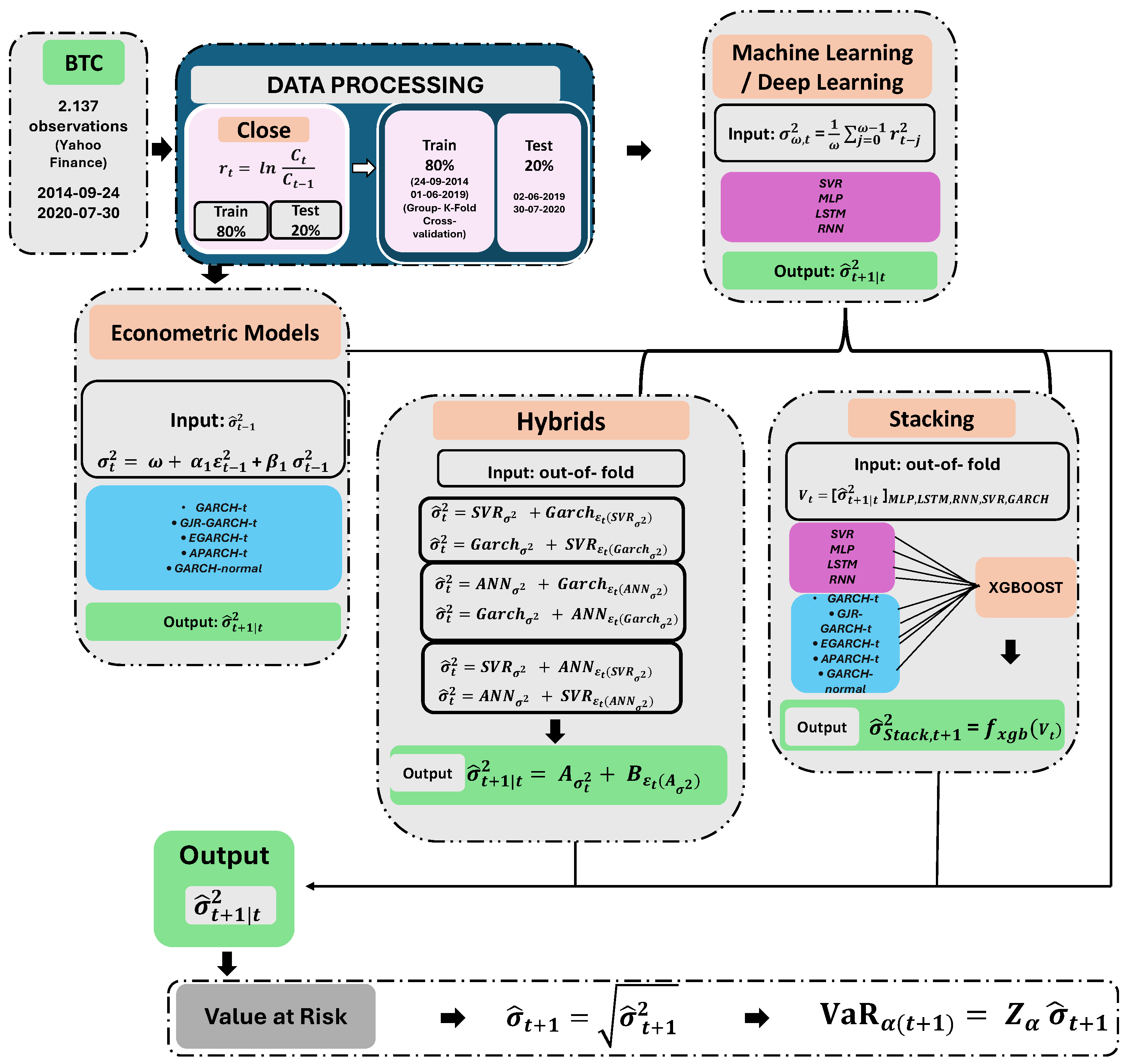
2.2. Model Specification and Analytical Framework
2.2.1. GARCH Models
2.2.2. GARCH(1,1) with Gaussian Innovations
2.2.3. GARCH–t (Student-t Innovations)
2.2.4. GJR-GARCH (Glosten–Jagannathan–Runkle)
2.2.5. EGARCH (Exponential GARCH)
2.2.6. APARCH (Asymmetric Power ARCH)
2.2.7. Support Vector Regression
2.2.8. Multilayer Perceptron
2.2.9. Recurrent Neural Network
2.2.10. Long Short-Term Memory
2.2.11. Hybrid Frameworks
2.2.12. Stacked Gradient Boosted Meta Regressor
2.2.13. Estimation and Backtesting of Value at Risk
2.2.14. Experimental Design
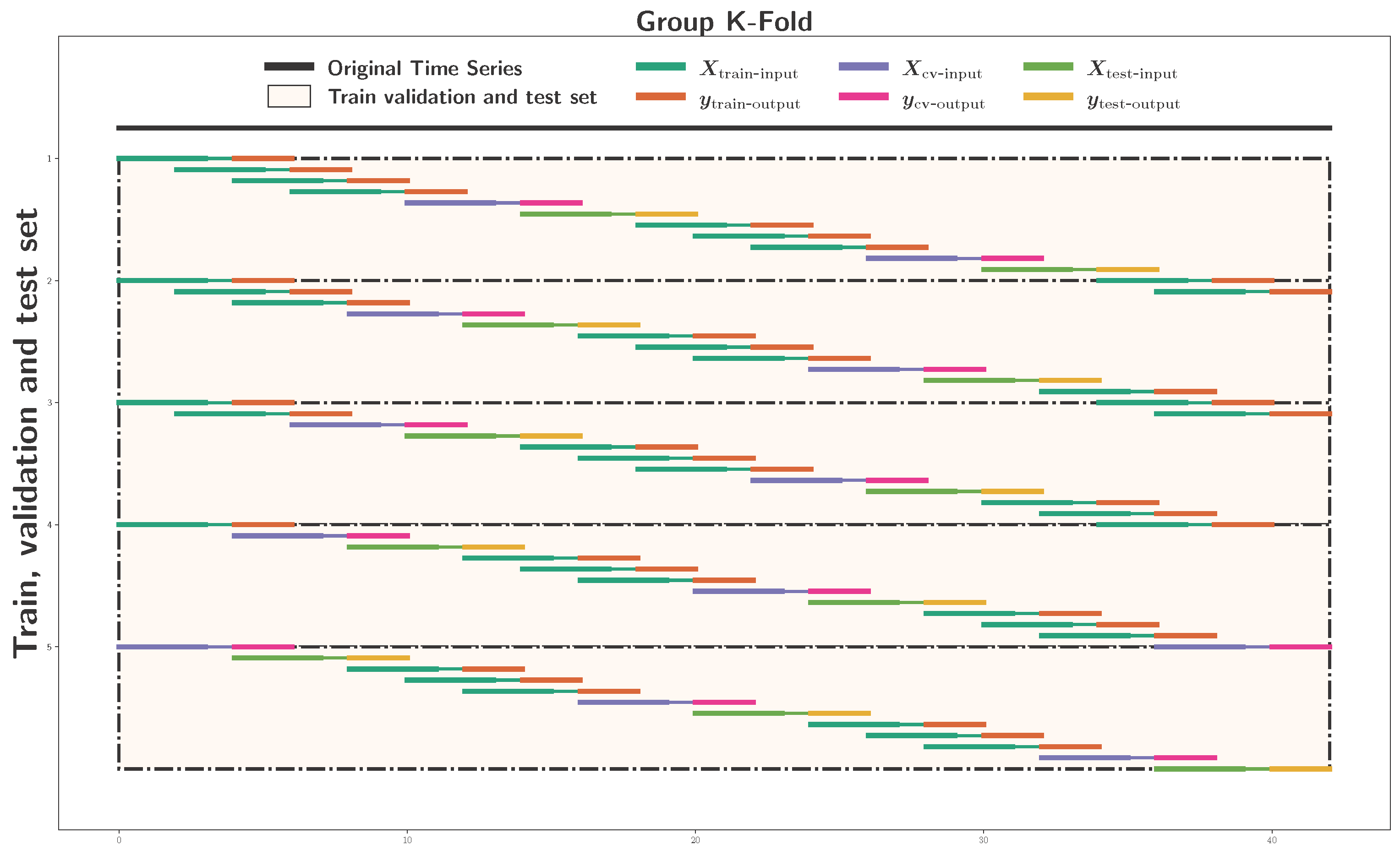
Temporal Validation Framework
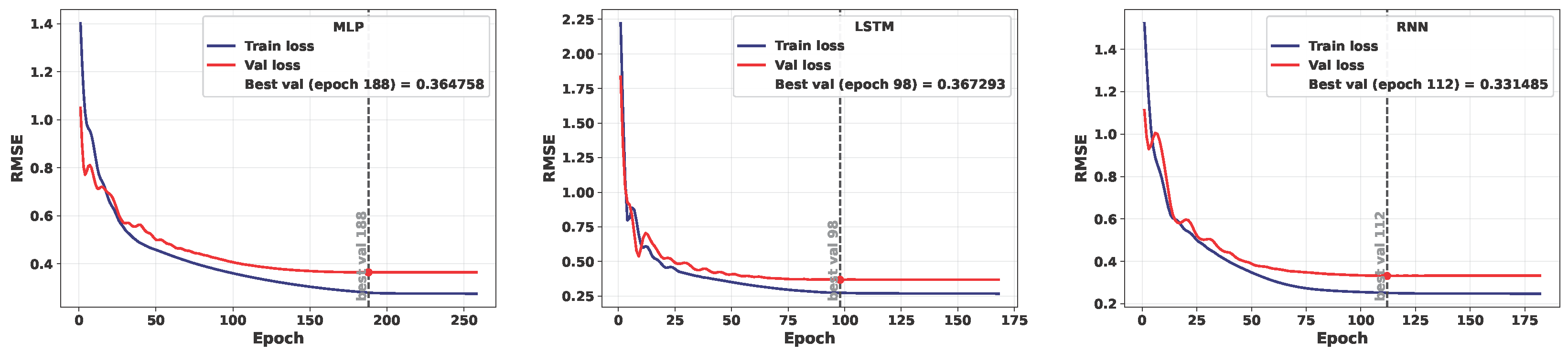
Model Training and Hyperparameter Configuration
Hybrid and Stacked Architectures
2.3. Student-t Quantiles, Unified Temporal Validation, and VaR Backtesting
Performance Metrics
3. Results and Discussion
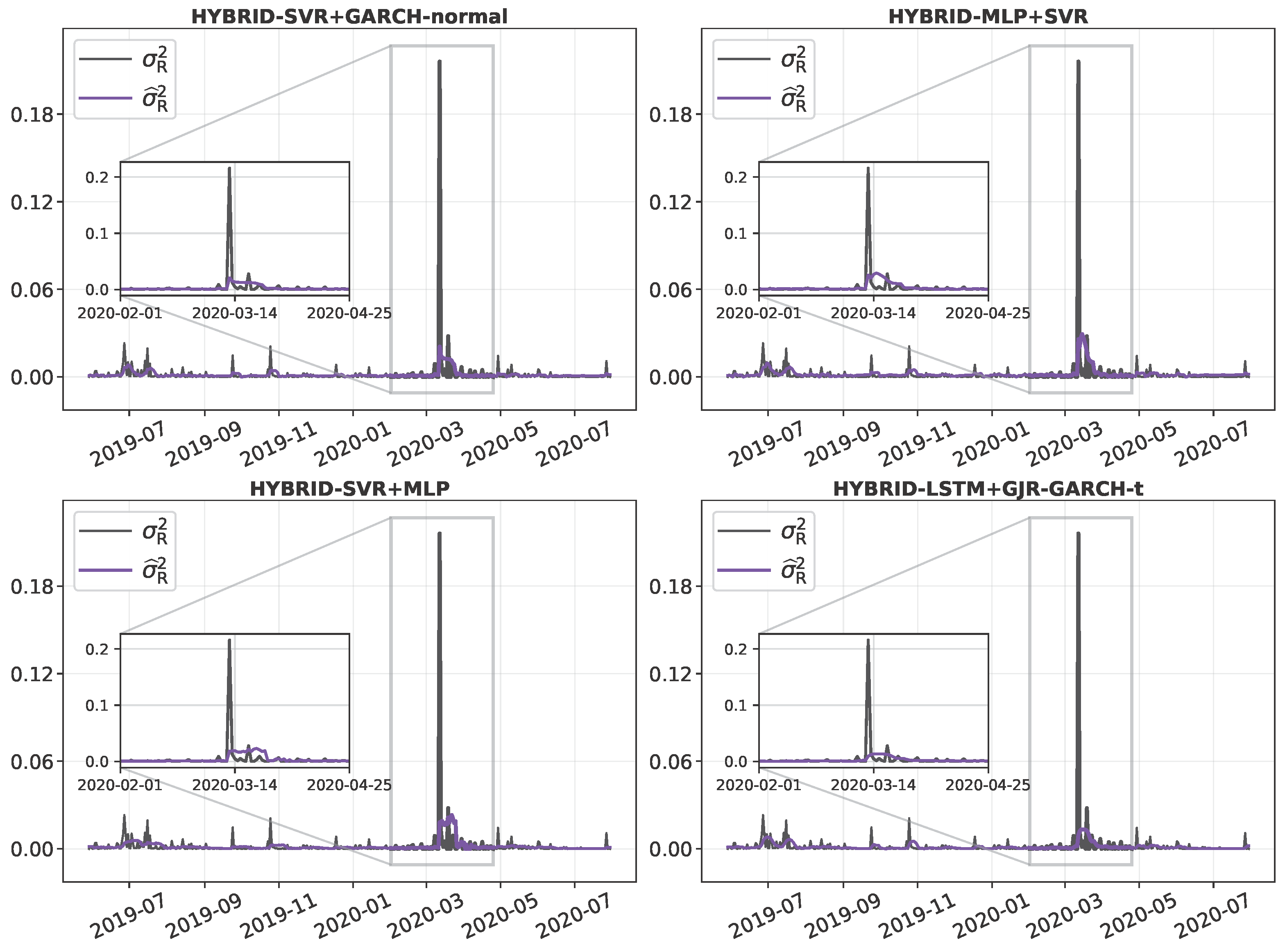
3.1. Conditional Variance, Forecasting Accuracy and Diagnostic Assessment
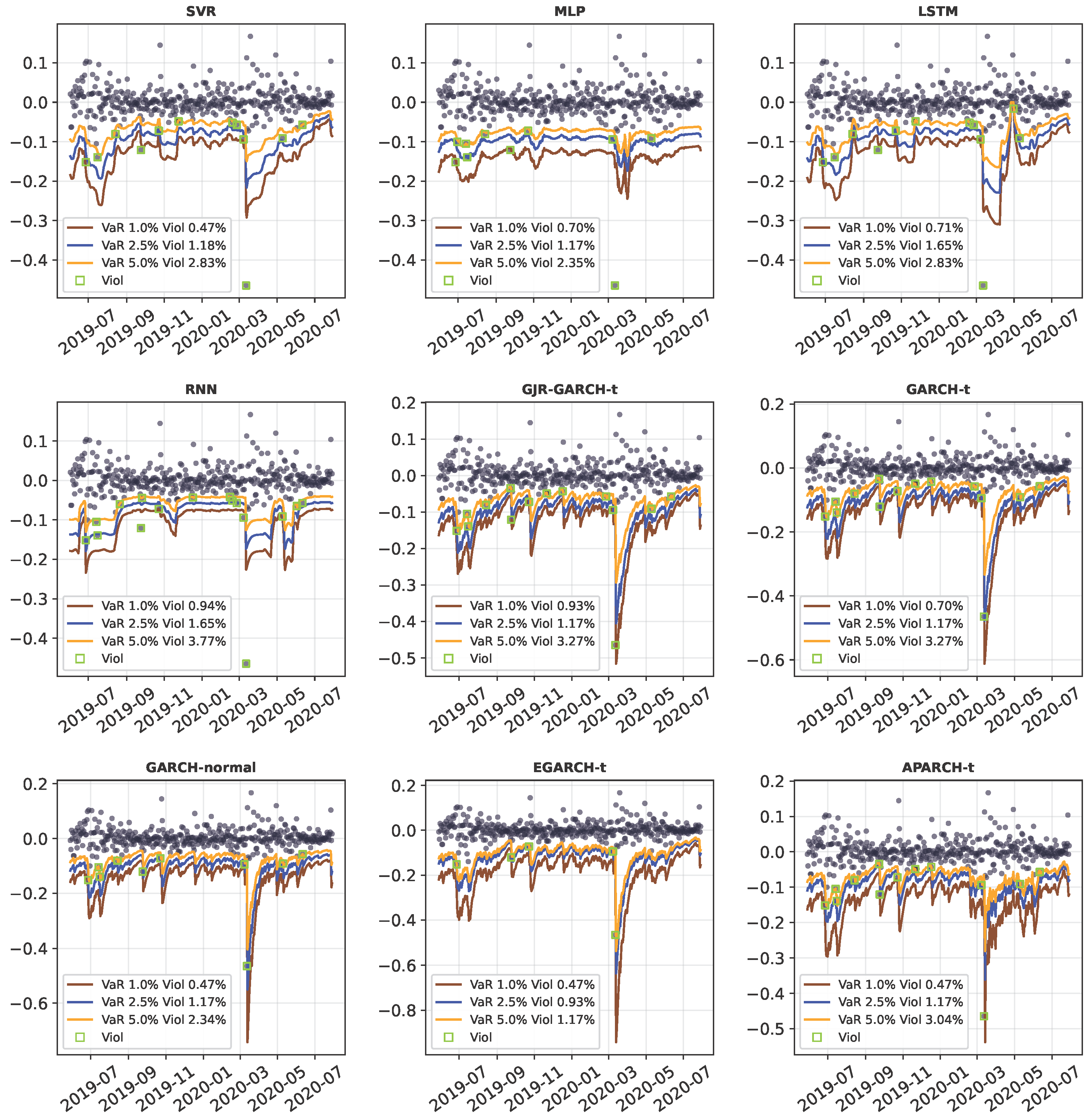
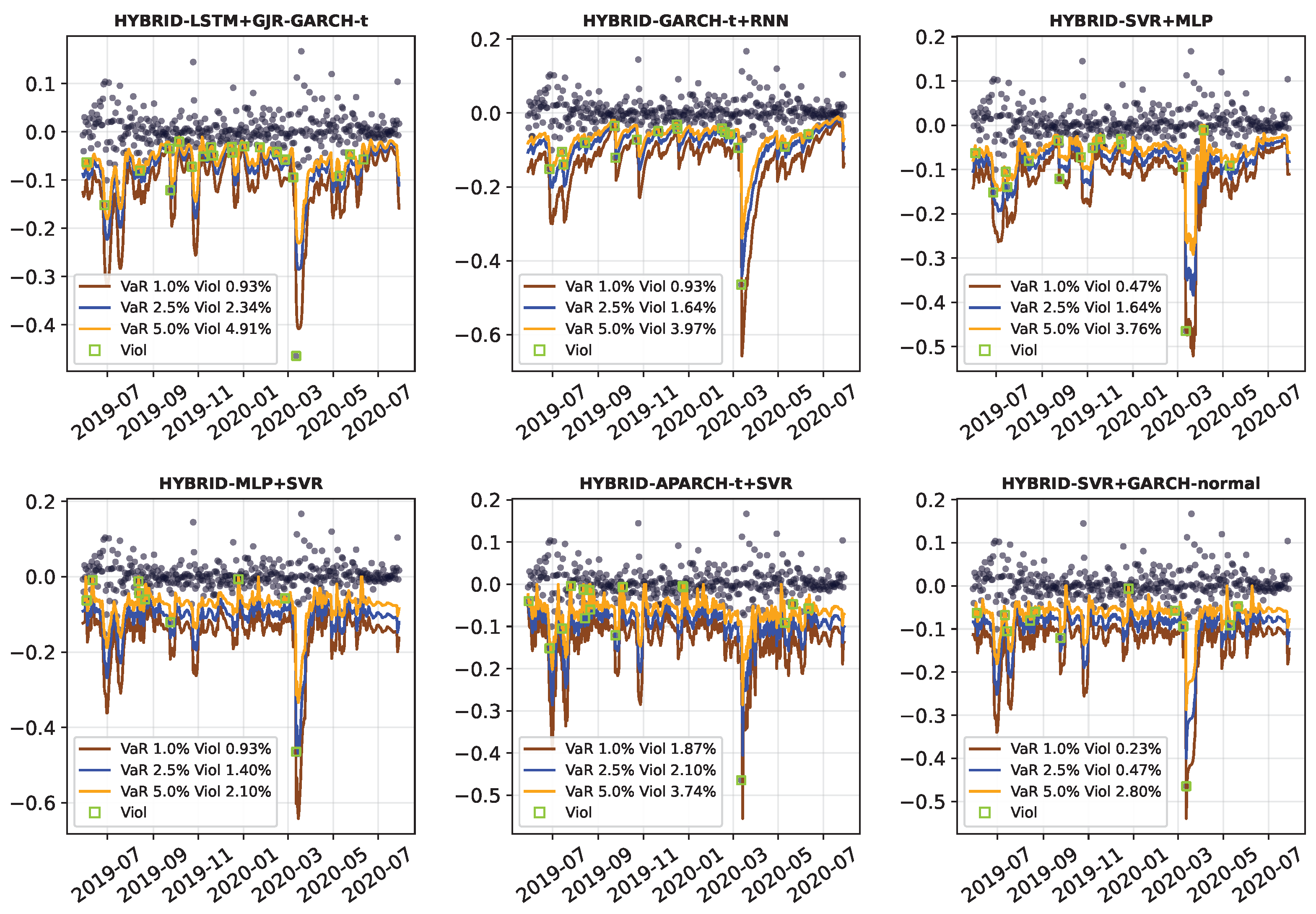
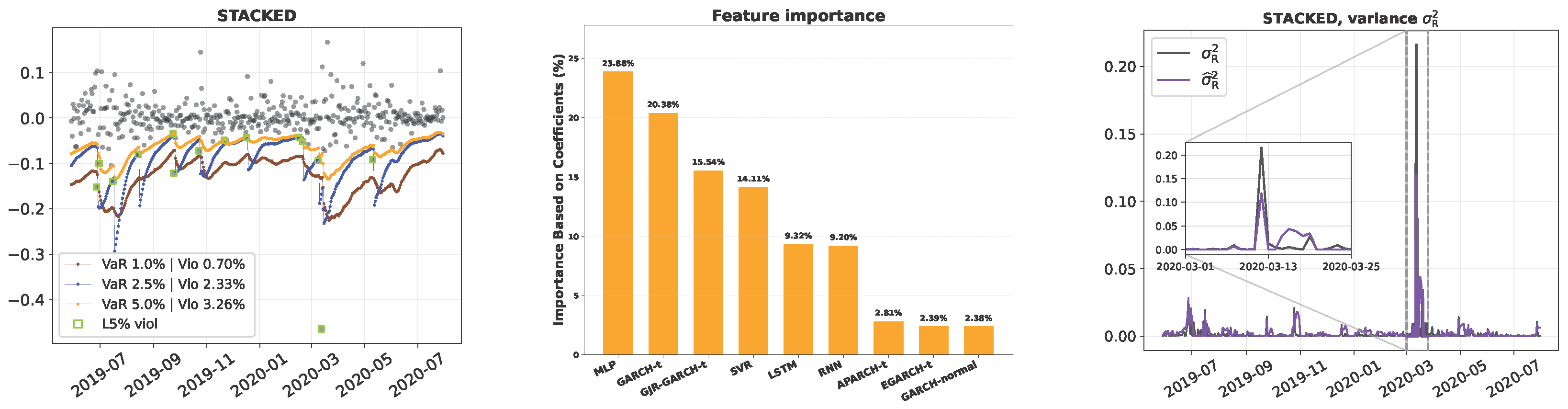
3.2. Value-at-Risk Implementation and Backtesting Assessment


Diebold–Mariano Test for Forecast Comparison
4. Conclusions
Author Contributions
Funding
Data Availability Statement
Conflicts of Interest
References
- Kristoufek, L. What are the main drivers of the Bitcoin price? Evidence from wavelet coherence analysis. PLoS ONE 2015, 10, e0123923. [Google Scholar] [CrossRef]
- Alexander, C.; Heck, D.F. Price discovery in Bitcoin: The impact of unregulated markets. J. Financ. Stab. 2020, 50, 100776. [Google Scholar] [CrossRef]
- Böhmecke-Schwafert, M. The role of blockchain for trade in global value chains: A systematic literature review and guidance for future research. Telecommun. Policy 2024, 48, 102835. [Google Scholar] [CrossRef]
- Pratas, T.E.; Ramos, F.R.; Rubio, L. Forecasting bitcoin volatility: Exploring the potential of deep learning. Eurasian Econ. Rev. 2023, 13, 285–305. [Google Scholar] [CrossRef]
- Berger, T.; Koubová, J. Forecasting Bitcoin returns: Econometric time series analysis vs. machine learning. J. Forecast. 2024, 43, 2904–2916. [Google Scholar] [CrossRef]
- Martinet, G.G.; McAleer, M. On the invertibility of EGARCH(p, q). Econom. Rev. 2018, 37, 824–849. [Google Scholar] [CrossRef]
- Aras, S. On improving GARCH volatility forecasts for Bitcoin via a meta-learning approach. Knowl.-Based Syst. 2021, 230, 107393. [Google Scholar] [CrossRef]
- Bergsli, L.Ø.; Lind, A.F.; Molnár, P.; Polasik, M. Forecasting volatility of Bitcoin. Res. Int. Bus. Financ. 2022, 59, 101540. [Google Scholar] [CrossRef]
- Musunuru, N. Examining Volatility Persistence and News Asymmetry in Soybeans Futures Returns. Atl. Econ. J. 2016, 44, 487–500. [Google Scholar] [CrossRef]
- Tavares, A.B.; Curto, J.D.; Tavares, G.N. Modelling heavy tails and asymmetry using ARCH-type models with stable Paretian distributions. Nonlinear Dyn. 2008, 51, 231–243. [Google Scholar] [CrossRef]
- Zhang, B. A study of financial time series volatility forecasting method based on GARCH modeling. In Proceedings of the International Conference on Digital Economy and Intelligent Computing; Association for Computing Machinery: New York, NY, USA, 2025; pp. 54–59. [Google Scholar]
- Güngör, A.; Güngör, M.S. Modeling time-varying co-movements between major cryptocurrencies and foreign exchange markets. In Emerging Insights on the Relationship Between Cryptocurrencies and Decentralized Economic Models; IGI Global: Hershey, PA, USA, 2023; pp. 86–106. [Google Scholar]
- Gatfaoui, H. Translating financial integration into correlation risk. Econ. Model. 2013, 30, 776–791. [Google Scholar] [CrossRef]
- Harris, R.D.F.; Stoja, E.; Tucker, J. A simplified approach to modeling the co-movement of asset returns. J. Futur. Mark. 2007, 27, 575–598. [Google Scholar] [CrossRef]
- Mili, M.; Bouteska, A. Forecasting nonlinear dependency between cryptocurrencies and foreign exchange markets using dynamic copula: Evidence from GAS models. J. Risk Financ. 2023, 24, 464–482. [Google Scholar] [CrossRef]
- Alraddadi, R. The Markov-switching threshold BLGARCH model. AIMS Math. 2025, 10, 18838–18860. [Google Scholar] [CrossRef]
- Bond, S. An Econometric Model of Downside Risk; Butterworth-Heinemann: Oxford, UK, 2007; pp. 301–331. [Google Scholar]
- Telmoudi, F.; El Ghourabi, M.; Limam, M. On Conditional Risk Estimation Considering Model Risk. J. Appl. Stat. 2016, 43, 1386–1399. [Google Scholar] [CrossRef]
- Fan, L.; Li, H. Volatility Analysis and Forecasting Models of Crude Oil Prices: A Review. Int. J. Glob. Energy Issues 2015, 38, 5–17. [Google Scholar] [CrossRef]
- Cavicchioli, M.; Ghezal, A.; Zemmouri, I. (Bi) spectral analysis of Markov switching bilinear time series. Stat. Methods Appl. 2025, 1–30. [Google Scholar] [CrossRef]
- Shen, Z.; Wan, Q.; Leatham, D.J. Bitcoin return volatility forecasting: A comparative study between GARCH and RNN. J. Risk Financ. Manag. 2021, 14, 337. [Google Scholar] [CrossRef]
- Lu, X.; Liu, C.; Lai, K.K.; Cui, H. Risk measurement in Bitcoin market by fusing LSTM with the joint-regression-combined forecasting model. Kybernetes 2021, 52, 1487–1502. [Google Scholar] [CrossRef]
- Tapia, S.; Kristjanpoller, W. Framework based on multiplicative error and residual analysis to forecast bitcoin intraday-volatility. Phys. A Stat. Mech. Its Appl. 2022, 589, 126613. [Google Scholar] [CrossRef]
- Dutta, A.; Kumar, S.; Basu, M. A gated recurrent unit approach to bitcoin price prediction. J. Risk Financ. Manag. 2020, 13, 23. [Google Scholar] [CrossRef]
- Yan, X.; Weihan, W.; Chang, M. Research on financial assets transaction prediction model based on LSTM neural network. Neural Comput. Appl. 2021, 33, 257–270. [Google Scholar] [CrossRef]
- Rokde, C.; Chakole, J.; Ukey, A. Financial Forecasting with Deep Learning Models Based Ensemble Technique in Stock Market Analysis. Int. J. Inf. Eng. Electron. Bus. 2025, 17, 1–13. [Google Scholar] [CrossRef]
- Andri; Harumy, T.H.F.; Efendi, S. Evaluating the Impact of Weight Initialization on Recurrent and Transformer-Based Models in Financial Asset Price Prediction. East.-Eur. J. Enterp. Technol. 2025, 4, 19–31. [Google Scholar] [CrossRef]
- Ahmad, Z.; Bao, S.; Chen, M. DeepONet-Inspired Architecture for Efficient Financial Time Series Prediction. Mathematics 2024, 12, 3950. [Google Scholar] [CrossRef]
- Chuku, C.; Simpasa, A.; Oduor, J. Intelligent Forecasting of Economic Growth for Developing Economies. Int. Econ. 2019, 159, 74–93. [Google Scholar] [CrossRef]
- Perez-Bernabeu, E.; Polat, O. AI and Machine Learning in Macroeconomic Forecasting: A Systematic Review of Models, Trends, and Challenges. In Proceedings of the 31st ICE IEEE/ITMC Conference on Engineering, Technology, and Innovation: AI-Driven Industrial Transformation; IEEE: New York, NY, USA, 2025. [Google Scholar]
- Hai, D.H.; Van Tuan, P. AI and Econometric Modeling: Deep Reinforcement Learning in Predictive Modeling; Springer: Cham, Switzerland, 2024; Volume 556, pp. 53–60. [Google Scholar]
- Reina-Jiménez, P.; Martínez-Ballesteros, M.; Riquelme, J.C. Deep Learning or Trees? A Trade-off Analysis for Multivariate Time Series Forecasting. In Proceedings of the Advances in Computational Intelligence; Rojas, I., Joya, G., Catala, A., Eds.; Springer: Cham, Switzerland, 2026; pp. 616–627. [Google Scholar]
- He, X. A Survey on Time Series Forecasting; Springer: Singapore, 2023; Volume 348, pp. 13–23. [Google Scholar]
- Alghamdi, S.; Alqethami, S.; Alsubait, T.; Alhakami, H. Cryptocurrency price prediction using forecasting and sentiment analysis. Int. J. Adv. Comput. Sci. Appl. 2022, 13, 891–900. [Google Scholar] [CrossRef]
- Anam, M.K.; Lestari, T.P.; Yenni, H.; Nasution, T.; Firdaus, M.B. Enhancement of Machine Learning Algorithm in Fine-grained Sentiment Analysis Using the Ensemble. ECTI Trans. Comput. Inf. Technol. 2025, 19, 159–167. [Google Scholar] [CrossRef]
- Zhang, X.; Liu, P.; Feng, J. A semi-heterogeneous ensemble forecasting method for stock returns based on sentiment analysis. Inf. Sci. 2025, 723, 122655. [Google Scholar] [CrossRef]
- Aras, S. Stacking hybrid GARCH models for forecasting Bitcoin volatility. Expert Syst. Appl. 2021, 174, 114747. [Google Scholar] [CrossRef]
- Xie, T. Forecast bitcoin volatility with least squares model averaging. Econometrics 2019, 7, 40. [Google Scholar] [CrossRef]
- Borup, D.; Jakobsen, J.S. Capturing volatility persistence: A dynamically complete realized EGARCH-MIDAS model. Quant. Financ. 2019, 19, 1839–1855. [Google Scholar] [CrossRef]
- Yang, Y.; Wen, L.; Li, L. Explainable AI for Time Series Prediction in Economic Mental Health Analysis. Front. Med. 2025, 12, 1591793. [Google Scholar] [CrossRef]
- Setiawan, H.; Setyanto, A.; Utami, E.; Kusrini. Advancements and Challenges in Financial Forecasting Models: A Systematic Literature Review. Adv. Transdiscipl. Eng. 2025, 73, 690–697. [Google Scholar]
- Castellani, M.; Dos Santos, E.A. Prediction of Long-Term Government Bond Yields Using Statistical and Artificial Intelligence Methods. Stud. Comput. Intell. 2014, 514, 341–367. [Google Scholar]
- Dang, J.; Ullah, A. Machine-Learning-Based Semiparametric Time Series Conditional Variance: Estimation and Forecasting. J. Risk Financ. Manag. 2022, 15, 38. [Google Scholar] [CrossRef]
- Nezhad, M.T.F.; Rezaei, M. Stock Price Prediction Using Intelligent Models, Ensemble Learning and Feature Selection. In Proceedings of the 2nd International Conference on Distributed Computing and High Performance Computing (DCHPC 2022); IEEE: New York, NY, USA, 2022; pp. 15–25. [Google Scholar]
- Rubio, L.; Alba, K. Forecasting selected colombian shares using a hybrid ARIMA-SVR model. Mathematics 2022, 10, 2181. [Google Scholar] [CrossRef]
- Abbasi, M.; Dehban, H.; Farokhnia, A.; Roozbahani, R.; Bahreinimotlagh, M. Long-term streamflow prediction using hybrid SVR-ANN based on Bayesian model averaging. J. Hydrol. Eng. 2022, 27, 05022018. [Google Scholar] [CrossRef]
- Rubio, L.; Palacio Pinedo, A.; Mejía Castaño, A.; Ramos, F. Forecasting volatility by using wavelet transform, ARIMA and GARCH models. Eurasian Econ. Rev. 2023, 13, 803–830. [Google Scholar] [CrossRef]
- Solís, M.; Gil-Gamboa, A.; Troncoso, A. Metalearning for improving time series forecasting based on deep learning: A water case study. Results Eng. 2025, 28, 107541. [Google Scholar] [CrossRef]
- Waqar, M.; Kim, Y.W.; Byun, Y.C. A stacking ensemble framework leveraging synthetic data for accurate and stable crop yield forecasting. IEEE Access 2025, 13, 136909–136926. [Google Scholar] [CrossRef]
- El Hafyani, M.; El Himdi, K.; El Adlouni, S.E. Improving monthly precipitation prediction accuracy using machine learning models: A multi-view stacking learning technique. Front. Water 2024, 6, 1378598. [Google Scholar] [CrossRef]
- Almeida, J.; Gonçalves, T.C. Cryptocurrency market microstructure: A systematic literature review. Ann. Oper. Res. 2024, 332, 1035–1068. [Google Scholar] [CrossRef]
- Katsiampa, P. Volatility co-movement in the cryptocurrency market. J. Int. Financ. Mark. Institutions Money 2019, 62, 101–124. [Google Scholar]
- Auer, R.; Claessens, S. Cryptocurrency market reactions to regulatory news 1. In The Routledge Handbook of FinTech; Routledge: New York, NY, USA, 2021; pp. 455–468. [Google Scholar]
- Barndorff-Nielsen, O.E.; Hansen, P.R.; Lunde, A.; Shephard, N. Designing realized kernels to measure the ex post variation of equity prices in the presence of noise. Econometrica 2008, 76, 1481–1536. [Google Scholar] [CrossRef]
- Patton, A.J. Volatility forecast comparison using imperfect volatility proxies. J. Econom. 2011, 160, 246–256. [Google Scholar] [CrossRef]
- Caporale, G.M.; Plastun, A. The day of the week effect in the cryptocurrency market. Financ. Res. Lett. 2019, 31. [Google Scholar] [CrossRef]
- Ma, D.; Tanizaki, H. The day-of-the-week effect on Bitcoin return and volatility. Res. Int. Bus. Financ. 2019, 49, 127–136. [Google Scholar] [CrossRef]
- Dudek, G.; Fiszeder, P.; Kobus, P.; Orzeszko, W. Forecasting cryptocurrencies volatility using statistical and machine learning methods: A comparative study. Appl. Soft Comput. 2024, 151, 111132. [Google Scholar] [CrossRef]
- Kwon, J.H. On the factors of Bitcoin’s value at risk. Financ. Innov. 2021, 7, 87. [Google Scholar] [CrossRef]
- Syuhada, K.; Tjahjono, V.; Hakim, A. Improving Value-at-Risk forecast using GA-ARMA-GARCH and AI-KDE models. Appl. Soft Comput. 2023, 148, 110885. [Google Scholar] [CrossRef]
- Ramos, F.R. Data Science na Modelação e Previsão de Séries Económico-Financeiras: Das Metodologias Clássicas ao Deep Learning. Ph.D. Thesis, ISCTE-Instituto Universitario de Lisboa, Lisboa, Portugal, 2021. [Google Scholar]
- Sarkodie, S.A.; Ahmed, M.Y.; Owusu, P.A. COVID-19 pandemic improves market signals of cryptocurrencies–evidence from Bitcoin, Bitcoin Cash, Ethereum, and Litecoin. Financ. Res. Lett. 2022, 44, 102049. [Google Scholar] [CrossRef]
- Tan, X.; Tao, Y. Trend-based forecast of cryptocurrency returns. Econ. Model. 2023, 124, 106323. [Google Scholar] [CrossRef]
- Ozdamar, M.; Sensoy, A.; Akdeniz, L. Retail vs institutional investor attention in the cryptocurrency market. J. Int. Financ. Mark. Institutions Money 2022, 81, 101674. [Google Scholar] [CrossRef]
- Corbet, S.; Larkin, C.; Lucey, B. The contagion effects of the COVID-19 pandemic: Evidence from gold and cryptocurrencies. Financ. Res. Lett. 2020, 35, 101554. [Google Scholar] [CrossRef]
- Jia, Y.; Liu, Y.; Yan, S. Higher moments, extreme returns, and cross–section of cryptocurrency returns. Financ. Res. Lett. 2021, 39, 101536. [Google Scholar] [CrossRef]
- Baur, D.G.; Dimpfl, T. Asymmetric volatility in cryptocurrencies. Econ. Lett. 2018, 173, 148–151. [Google Scholar] [CrossRef]
- Conrad, C.; Custovic, A.; Ghysels, E. Long-and short-term cryptocurrency volatility components: A GARCH-MIDAS analysis. J. Risk Financ. Manag. 2018, 11, 23. [Google Scholar] [CrossRef]
- Hatemi-J, A. Modeling the Asymmetric and Time-Dependent Volatility of Bitcoin: An Alternative Approach. Eng. Proc. 2024, 68, 15. [Google Scholar]
- Engle, R.F. Autoregressive Conditional Heteroskedasticity with Estimates of the Variance of United Kingdom Inflation. Econometrica 1982, 50, 987–1007. [Google Scholar] [CrossRef]
- Bollerslev, T. Generalized Autoregressive Conditional Heteroskedasticity. J. Econom. 1986, 31, 307–327. [Google Scholar] [CrossRef]
- Bollerslev, T. A Conditionally Heteroskedastic Time Series Model for Speculative Prices and Rates of Return. Rev. Econ. Stat. 1987, 69, 542–547. [Google Scholar] [CrossRef]
- Glosten, L.R.; Jagannathan, R.; Runkle, D.E. On the Relation between the Expected Value and the Volatility of the Nominal Excess Return on Stocks. J. Financ. 1993, 48, 1779–1801. [Google Scholar] [CrossRef]
- Nelson, D.B. Conditional Heteroskedasticity in Asset Returns: A New Approach. Econometrica 1991, 59, 347–370. [Google Scholar] [CrossRef]
- Ding, Z.; Granger, C.W.J.; Engle, R.F. A Long Memory Property of Stock Market Returns and a New Model. J. Empir. Financ. 1993, 1, 83–106. [Google Scholar] [CrossRef]
- Liu, J.; Seraoui, R.; Vitelli, V.; Zio, E. Nuclear power plant components condition monitoring by probabilistic support vector machine. Ann. Nucl. Energy 2013, 56, 23–33. [Google Scholar] [CrossRef]
- Yu, P.S.; Chen, S.T.; Chang, I.F. Support vector regression for real-time flood stage forecasting. J. Hydrol. 2006, 328, 704–716. [Google Scholar] [CrossRef]
- Wu, C.; Chau, K.W.; Li, Y.S. River stage prediction based on a distributed support vector regression. J. Hydrol. 2008, 358, 96–111. [Google Scholar] [CrossRef]
- Wu, M.C.; Lin, G.F.; Lin, H.Y. Improving the forecasts of extreme streamflow by support vector regression with the data extracted by self-organizing map. Hydrol. Process. 2014, 28, 386–397. [Google Scholar] [CrossRef]
- Dibike, Y.B.; Velickov, S.; Solomatine, D.; Abbott, M.B. Model induction with support vector machines: Introduction and applications. J. Comput. Civ. Eng. 2001, 15, 208–216. [Google Scholar] [CrossRef]
- Chang, C.C.; Lin, C.J. LIBSVM: A library for support vector machines. ACM Trans. Intell. Syst. Technol. (TIST) 2011, 2, 1–27. [Google Scholar] [CrossRef]
- Suganyadevi, M.; Babulal, C. Support vector regression model for the prediction of loadability margin of a power system. Appl. Soft Comput. 2014, 24, 304–315. [Google Scholar] [CrossRef]
- Rosenblatt, F. The perceptron: A probabilistic model for information storage and organization in the brain. Psychol. Rev. 1958, 65, 386. [Google Scholar] [CrossRef] [PubMed]
- Almeida, L.B. Multilayer perceptrons. In Handbook of Neural Computation; CRC Press: Boca Raton, FL, USA, 2020; pp. C1–C2. [Google Scholar]
- Murtagh, F. Multilayer perceptrons for classification and regression. Neurocomputing 1991, 2, 183–197. [Google Scholar] [CrossRef]
- Hornik, K.; Stinchcombe, M.; White, H. Multilayer feedforward networks are universal approximators. Neural Netw. 1989, 2, 359–366. [Google Scholar] [CrossRef]
- Bishop, C.M. Neural networks: A pattern recognition perspective. In Handbook of Neural Computation; CRC Press: Boca Raton, FL, USA, 2020. [Google Scholar]
- Zhang, G.P. Time series forecasting using a hybrid ARIMA and neural network model. Neurocomputing 2003, 50, 159–175. [Google Scholar] [CrossRef]
- Khashei, M.; Bijari, M. A novel hybridization of artificial neural networks and ARIMA models for time series forecasting. Appl. Soft Comput. 2011, 11, 2664–2675. [Google Scholar] [CrossRef]
- Wang, L.; Zou, H.; Su, J.; Li, L.; Chaudhry, S. An ARIMA-ANN hybrid model for time series forecasting. Syst. Res. Behav. Sci. 2013, 30, 244–259. [Google Scholar] [CrossRef]
- Khashei, M.; Bijari, M. A new class of hybrid models for time series forecasting. Expert Syst. Appl. 2012, 39, 4344–4357. [Google Scholar] [CrossRef]
- Rumelhart, D.E.; Hinton, G.E.; Williams, R.J. Learning representations by back-propagating errors. Nature 1986, 323, 533–536. [Google Scholar] [CrossRef]
- McCulloch, W.S.; Pitts, W. A logical calculus of the ideas immanent in nervous activity. Bull. Math. Biophys. 1943, 5, 115–133. [Google Scholar] [CrossRef]
- Kingma, D.P. Adam: A method for stochastic optimization. arXiv 2014, arXiv:1412.6980. [Google Scholar]
- Hopfield, J.J. Neural networks and physical systems with emergent collective computational abilities. Proc. Natl. Acad. Sci. USA 1982, 79, 2554–2558. [Google Scholar] [CrossRef]
- Jordan, M.I. Serial order: A parallel distributed processing approach. In Advances in Psychology; Elsevier: Amsterdam, The Netherlands, 1997; Volume 121, pp. 471–495. [Google Scholar]
- Elman, J.L. Finding structure in time. Cogn. Sci. 1990, 14, 179–211. [Google Scholar] [CrossRef]
- LeCun, Y.; Boser, B.; Denker, J.S.; Henderson, D.; Howard, R.E.; Hubbard, W.; Jackel, L.D. Backpropagation applied to handwritten zip code recognition. Neural Comput. 1989, 1, 541–551. [Google Scholar] [CrossRef]
- Glorot, X.; Bordes, A.; Bengio, Y. Deep sparse rectifier neural networks. In Proceedings of the Fourteenth International Conference on Artificial Intelligence and Statistics, Fort Lauderdale, FL, USA, 11–13 April 2011; pp. 315–323. [Google Scholar]
- Maas, A.L.; Hannun, A.Y.; Ng, A.Y. Rectifier nonlinearities improve neural network acoustic models. In Proceedings of the 30th International Conference on Machine Learning, Atlanta, GA, USA, 16–21 June 2013; Volume 30, p. 3. [Google Scholar]
- Werbos, P.J. Backpropagation through time: What it does and how to do it. Proc. IEEE 1990, 78, 1550–1560. [Google Scholar] [CrossRef]
- Hochreiter, S. Long Short-term Memory. In Neural Computation; MIT-Press: Cambridge, MA, USA, 1997. [Google Scholar]
- Bengio, Y.; Simard, P.; Frasconi, P. Learning long-term dependencies with gradient descent is difficult. IEEE Trans. Neural Netw. 1994, 5, 157–166. [Google Scholar] [CrossRef]
- Sagheer, A.; Kotb, M. Time series forecasting of petroleum production using deep LSTM recurrent networks. Neurocomputing 2019, 323, 203–213. [Google Scholar] [CrossRef]
- Shahid, F.; Zameer, A.; Muneeb, M. Predictions for COVID-19 with deep learning models of LSTM, GRU and Bi-LSTM. Chaos Solitons Fractals 2020, 140, 110212. [Google Scholar] [CrossRef]
- Xiang, Z.; Yan, J.; Demir, I. A rainfall-runoff model with LSTM-based sequence-to-sequence learning. Water Resour. Res. 2020, 56, e2019WR025326. [Google Scholar] [CrossRef]
- Hu, C.; Wu, Q.; Li, H.; Jian, S.; Li, N.; Lou, Z. Deep learning with a long short-term memory networks approach for rainfall-runoff simulation. Water 2018, 10, 1543. [Google Scholar] [CrossRef]
- Peng, L.; Liu, S.; Liu, R.; Wang, L. Effective long short-term memory with differential evolution algorithm for electricity price prediction. Energy 2018, 162, 1301–1314. [Google Scholar] [CrossRef]
- Li, C.; Zheng, X.; Yang, Z.; Kuang, L. Predicting short-term electricity demand by combining advantages of ARMA and XGBoost in fog computing environment. Wirel. Commun. Mob. Comput. 2018, 2018, 5018053. [Google Scholar] [CrossRef]
- Zheng, H.; Wu, Y. An XGBoost model with weather similarity analysis and feature engineering for short-term wind power forecasting. Appl. Sci. 2019, 9, 3019. [Google Scholar] [CrossRef]
- Chen, T.; Guestrin, C. XGBoost: A Scalable Tree Boosting System. In Proceedings of the 22nd ACM SIGKDD International Conference on Knowledge Discovery and Data Mining; Association for Computing Machinery: New York, NY, USA, 2016; pp. 785–794. [Google Scholar]
- Zhao, Q.; Wen, X.; Jong, W.; Fang, J. Optimised extreme gradient boosting model for short-term electric load demand forecasting of regional grid system. Sci. Rep. 2022, 12, 11029. [Google Scholar]
- Kupiec, P.H. Techniques for verifying the accuracy of risk measurement models. J. Deriv. 1995, 3, 73–84. [Google Scholar] [CrossRef]
- Engle, R.; Manganelli, S. CAViaR: Conditional autoregressive value at risk by regression quantiles. J. Bus. Econ. Stat. 2004, 22, 367–381. [Google Scholar] [CrossRef]
- Christoffersen, P.F. Evaluating interval forecasts. Int. Econ. Rev. 1998, 39, 841–862. [Google Scholar] [CrossRef]
- Christoffersen, P.F.; Pelletier, D. Backtesting value-at-risk: A duration-based approach. J. Financ. Econom. 2004, 2, 84–108. [Google Scholar] [CrossRef]
- Pajhede, T. Backtesting value-at-risk: A generalized Markov framework. J. Forecast. 2015, 34, 376–390. [Google Scholar] [CrossRef]
- Barendse, S.; Kole, E.; van Dijk, D. Backtesting Value-at-Risk and Expected Shortfall in the Presence of Estimation Error. J. Financ. Econom. 2023, 21, 528–568. [Google Scholar] [CrossRef]
- Bao, W.; Yue, J.; Rao, Y. A deep learning framework for financial time series using stacked autoencoders and long-short term memory. PLoS ONE 2017, 12, e0180944. [Google Scholar] [CrossRef] [PubMed]
- Conrad, C.; Engle, R.F. Modelling Volatility Cycles: The MF2-GARCH Model. J. Appl. Econom. 2025, 40, 438–454. [Google Scholar] [CrossRef]
- Akgun, O.B.; Gulay, E. Dynamics in Realized Volatility Forecasting: Evaluating GARCH Models and Deep Learning Algorithms Across Parameter Variations. Comput. Econ. 2025, 65. [Google Scholar] [CrossRef]
- Bollerslev, T.; Patton, A.J.; Quaedvlieg, R. Exploiting the errors: A simple approach for improved volatility forecasting. J. Econom. 2016, 192, 1–18. [Google Scholar] [CrossRef]
- Makridakis, S.; Hibon, M. The M3-Competition: Results, conclusions and implications. Int. J. Forecast. 2000, 16, 451–476. [Google Scholar] [CrossRef]



| Symbol | Description |
|---|---|
| Length of input segment that determines how many past observations serve as regressors within each model. Possible configurations comprise sets of consecutive elements containing 7, 14, 21 or 28 time points, selected to capture short- and medium-range temporal structure. | |
| h | Prediction horizon representing number of future observations produced at each iteration. This study employs a one-step-ahead specification () in a rolling evaluation routine to ensure consistent alignment between estimation and forecast generation. |
| Increment that governs movement across folds within temporal cross-validation. This parameter remains fixed at to preserve continuity and avoid loss of sequential information. | |
| Size of rolling window used to compute conditional variance, set equal to 7 in accordance with empirical evidence supporting weekly periodicity in cryptocurrency dynamics and its influence on volatility behavior. |
| Parameter | Daily Returns | Close Price |
|---|---|---|
| 2137.000000 | 2137.000000 | |
| 0.001515 | 4256.149419 | |
| 0.039378 | 4048.077591 | |
| −0.464730 | 178.102997 | |
| −0.012083 | 430.010986 | |
| 0.001835 | 3486.181641 | |
| 0.017170 | 7653.979980 | |
| 0.225119 | 19,497.400391 |
| Normality | Unit Root/Stationarity | Independence | ||||
|---|---|---|---|---|---|---|
| Test | Kurt. | Skew. | JB | ADF | KPSS | LB |
| Statistic | 13.430763 | −0.950316 | 16383.47 | −14.1608 | 0.150372 | 19.7355 |
| p-value | < | 0.341952 | < | 0.100000 | 0.031856 | |
| Model | Hyperparameter | Search Space | Selected Value |
|---|---|---|---|
| MLP | Depth/width () | ; (units per layer). Fixed: batch , Adam LR , max epochs , patience: 70. Input lags . | Best-by-TSCV (RMSE). (, , ) |
| RNN | Depth/cells () | ; (cells). Fixed: batch , Adam LR , max epochs , patience: 70. Input lags . | Best-by-TSCV (RMSE). (, , ) |
| LSTM | Depth/cells () | ; (cells). Fixed: batch , Adam LR , max epochs , patience: 70. Input lags . | Best-by-TSCV (RMSE). (, , ) |
| SVR | Kernel and regularization | Kernel (or include {linear, poly} if you tested them). Grid example: ; ; . Input lags . | Best-by-TSCV (RMSE). (kernel=RBF, , , , ) |
| XGBoost | Depth/trees/ | Meta-learner XGBoost trained on TSCV fold predictions from base learners. Depth ; trees (n_estimators) ; learning rate (other regularization parameters fixed or tuned as in the stacking grid). | Best-by-TSCV (RMSE). (stackedXGBoost; tuned depth/trees/η) |
| GARCH family | Orders/specification and innovation | Candidate set: with and innovations ; parameters are (Q)MLE re-estimated at each rolling step using data up to (including for t innovations). | Best specification by out-of-sample RMSE (and VaR backtesting). (EGARCH-t) |
| Model | QLIKEε | RMSE | SMAPE (%) | BDS (p) |
|---|---|---|---|---|
| STACKED | 5.388 | 0.006420 | 145.1 | 0.362 |
| SVR–GARCH-normal | 5.443 | 0.009893 | 121.4 | 0.443 |
| MLP–SVR | 4.598 | 0.009938 | 128.2 | 0.086 |
| SVR–MLP | 33.675 | 0.010279 | 125.5 | 0.192 |
| LSTM–GJR–GARCH–t | 44.115 | 0.010460 | 122.2 | 0.869 |
| Model | Viol (%) | Exp (%) | UC (p) | IND (p) | CC (p) | DQ (p) | DB (p) |
|---|---|---|---|---|---|---|---|
| (Lower tail) | |||||||
| SVR | 0.47 | 1.0 | 0.2228 | 0.0894 | 0.04711 | 0.8654 | 0.0000 |
| MLP | 1.00 | 1.0 | 0.0517 | 0.0587 | 0.9544 | 0.0001 | 0.0000 |
| LSTM | 0.71 | 1.0 | 0.5233 | 0.3682 | 0.9782 | 0.9999 | 0.9964 |
| RNN | 0.94 | 1.0 | 0.9059 | 0.7823 | 0.9558 | 0.0004 | 0.4932 |
| GJR-GARCH-t | 0.93 | 1.0 | 0.8906 | 0.7833 | 0.9538 | 0.0001 | 0.2563 |
| GARCH-t | 0.70 | 1.0 | 0.5111 | 0.8368 | 0.7889 | 0.9965 | 0.9975 |
| GARCH-normal | 0.47 | 1.0 | 0.2163 | 0.0889 | 0.4612 | 0.9996 | 0.9998 |
| EGARCH-t | 0.47 | 1.0 | 0.2163 | 0.0899 | 0.0967 | 0.9993 | 0.9993 |
| APARCH-t | 0.70 | 1.0 | 0.5111 | 0.8368 | 0.7889 | 0.9965 | 0.9975 |
| LSTM-GJR-GARCH-t | 0.93 | 1.0 | 0.8906 | 0.7833 | 0.9538 | 0.9983 | 0.9892 |
| GARCH-t-RNN | 0.93 | 1.0 | 0.8906 | 0.7833 | 0.9538 | 0.0001 | 0.2563 |
| SVR-MLP | 0.94 | 1.0 | 0.8982 | 0.0233 | 0.0756 | 0.0001 | 0.0000 |
| MLP-SVR | 0.93 | 1.0 | 0.8906 | 0.7833 | 0.9538 | 0.0502 | 0.9982 |
| APARCH-t-SVR | 1.87 | 1.0 | 0.1006 | 0.0058 | 0.0006 | 0.0000 | 0.0500 |
| SVR-GARCH-normal | 0.23 | 1.0 | 0.0552 | 0.9454 | 0.1586 | 0.7236 | 1.0000 |
| STACKED | 0.70 | 1.0 | 0.5082 | 0.8369 | 0.78653 | 0.9925 | 0.9965 |
| (Lower tail) | |||||||
| SVR | 1.18 | 2.5 | 0.0524 | 0.7294 | 0.1436 | 0.0174 | 0.0000 |
| MLP | 1.17 | 2.5 | 0.0492 | 0.7307 | 0.1362 | 0.0082 | 0.3475 |
| LSTM | 1.65 | 2.5 | 0.2331 | 0.6274 | 0.4366 | 0.2568 | 0.4932 |
| RNN | 1.65 | 2.5 | 0.2331 | 0.6274 | 0.4366 | 0.3010 | 0.4932 |
| GJR-GARCH-t | 1.17 | 2.5 | 0.0492 | 0.7307 | 0.1362 | 0.0082 | 0.3475 |
| GARCH-t | 1.24 | 2.5 | 0.1045 | 0.5446 | 0.2716 | 0.0548 | 0.5063 |
| GARCH-normal | 1.24 | 2.5 | 0.1045 | 0.5446 | 0.2716 | 0.0548 | 0.5063 |
| EGARCH-t | 0.93 | 2.5 | 0.0176 | 0.7883 | 0.0575 | 0.0954 | 0.9917 |
| APARCH-t | 0.93 | 2.5 | 0.0176 | 0.7883 | 0.0575 | 0.0954 | 0.9917 |
| LSTM-GJR-GARCH-t | 2.34 | 2.5 | 0.8266 | 0.2212 | 0.4620 | 0.3020 | 0.3732 |
| GARCH-t-RNN | 1.64 | 2.5 | 0.2219 | 0.0943 | 0.1170 | 0.0089 | 0.1473 |
| SVR-MLP | 2.11 | 2.5 | 0.5990 | 0.1736 | 0.3451 | 0.5211 | 0.5335 |
| MLP-SVR | 1.40 | 2.5 | 0.1131 | 0.0645 | 0.0516 | 0.0762 | 0.3830 |
| APARCH-t-SVR | 2.10 | 2.5 | 0.5886 | 0.0010 | 0.0317 | 0.0000 | 0.0000 |
| SVR-GARCH-normal | 0.47 | 2.5 | 0.0010 | 0.8909 | 0.0043 | 0.1779 | 0.9993 |
| STACKED | 2.33 | 2.5 | 0.8206 | 0.4891 | 0.7672 | 0.5312 | 0.5824 |
| (Lower tail) | |||||||
| SVR | 2.83 | 5.0 | 0.0261 | 0.4025 | 0.0593 | 0.8724 | 0.5638 |
| MLP | 1.04 | 5.0 | 0.0964 | 0.0988 | 0.0160 | 0.0821 | 0.02785 |
| LSTM | 2.83 | 5.0 | 0.0261 | 0.4025 | 0.0593 | 0.8528 | 0.5638 |
| RNN | 3.77 | 5.0 | 0.2267 | 0.2620 | 0.2567 | 0.3085 | 0.1953 |
| GJR-GARCH-t | 3.27 | 5.0 | 0.0806 | 0.4709 | 0.1676 | 0.1763 | 0.7131 |
| GARCH-t | 3.27 | 5.0 | 0.0806 | 0.4709 | 0.1676 | 0.1763 | 0.7131 |
| GARCH-normal | 3.04 | 5.0 | 0.0452 | 0.4011 | 0.0945 | 0.5714 | 0.5612 |
| EGARCH-t | 1.17 | 5.0 | 0.0500 | 0.7307 | 0.0001 | 0.0084 | 0.3475 |
| APARCH-t | 1.17 | 5.0 | 0.0452 | 0.7307 | 0.1362 | 0.0945 | 0.9794 |
| LSTM-GJR-GARCH-t | 4.91 | 5.0 | 0.9291 | 0.3691 | 0.6654 | 0.7672 | 0.5398 |
| GARCH-t-RNN | 3.97 | 5.0 | 0.3122 | 0.1667 | 0.2306 | 0.1842 | 0.2096 |
| SVR-MLP | 3.76 | 5.0 | 0.2186 | 0.1318 | 0.1057 | 0.0454 | 0.3537 |
| MLP-SVR | 2.10 | 5.0 | 0.0002 | 0.1727 | 0.0003 | 0.5462 | 0.5477 |
| APARCH-t-SVR | 3.74 | 5.0 | 0.2108 | 0.1306 | 0.1458 | 0.1069 | 0.2723 |
| SVR-GARCH-normal | 2.80 | 5.0 | 0.0235 | 0.4048 | 0.0543 | 0.5453 | 0.5087 |
| STACKED | 3.26 | 5.0 | 0.0788 | 0.4697 | 0.1644 | 0.1436 | 0.0000 |
| LSTM– GJR–GARCH–t | GARCH–t– RNN | SVR– MLP | MLP– SVR | APARCH–t– SVR | SVR– GARCH–Nor | STACKED | |
|---|---|---|---|---|---|---|---|
| SVR | 0.168654 | 0.048157 | 0.288881 | 0.090084 | 0.068224 | 0.256055 | 0.002651 |
| MLP | 0.095983 | 0.417821 | 0.288882 | 0.090085 | 0.068225 | 0.256056 | 0.002652 |
| LSTM | 0.313064 | 0.313064 | 0.569048 | 0.342083 | 0.631873 | 0.337664 | 0.344827 |
| RNN | 0.051152 | 0.116911 | 0.288880 | 0.090083 | 0.068223 | 0.256054 | 0.002650 |
| GJR-GARCH-t | 0.133034 | 0.594210 | 0.288879 | 0.090086 | 0.068226 | 0.256057 | 0.002653 |
| GARCH-t | 0.119611 | 0.823742 | 0.288883 | 0.090082 | 0.068222 | 0.256053 | 0.002649 |
| GARCH-Nor | 0.152989 | 0.868992 | 0.288878 | 0.090087 | 0.068227 | 0.256058 | 0.002654 |
| EGARCH-t | 0.029165 | 0.828949 | 0.288885 | 0.090081 | 0.068221 | 0.256052 | 0.002648 |
| APARCH-t | 0.139667 | 0.732228 | 0.288876 | 0.090088 | 0.068228 | 0.256059 | 0.002655 |
Disclaimer/Publisher’s Note: The statements, opinions and data contained in all publications are solely those of the individual author(s) and contributor(s) and not of MDPI and/or the editor(s). MDPI and/or the editor(s) disclaim responsibility for any injury to people or property resulting from any ideas, methods, instructions or products referred to in the content. |
© 2026 by the authors. Licensee MDPI, Basel, Switzerland. This article is an open access article distributed under the terms and conditions of the Creative Commons Attribution (CC BY) license.
Share and Cite
Rubio, L.; Alba, K.V.; Velasquez, C.E.; Ramos, F.R. Stacked ML-GARCH for Bitcoin Risk Forecasting: A Novel Ensemble Approach for Superior Value-at-Risk Estimation. Mathematics 2026, 14, 624. https://doi.org/10.3390/math14040624
Rubio L, Alba KV, Velasquez CE, Ramos FR. Stacked ML-GARCH for Bitcoin Risk Forecasting: A Novel Ensemble Approach for Superior Value-at-Risk Estimation. Mathematics. 2026; 14(4):624. https://doi.org/10.3390/math14040624
Chicago/Turabian StyleRubio, Lihki, Keyla V. Alba, Carlos E. Velasquez, and Filipe R. Ramos. 2026. "Stacked ML-GARCH for Bitcoin Risk Forecasting: A Novel Ensemble Approach for Superior Value-at-Risk Estimation" Mathematics 14, no. 4: 624. https://doi.org/10.3390/math14040624
APA StyleRubio, L., Alba, K. V., Velasquez, C. E., & Ramos, F. R. (2026). Stacked ML-GARCH for Bitcoin Risk Forecasting: A Novel Ensemble Approach for Superior Value-at-Risk Estimation. Mathematics, 14(4), 624. https://doi.org/10.3390/math14040624